Feeds:
Posts
Comments

Posts Tagged ‘religions’

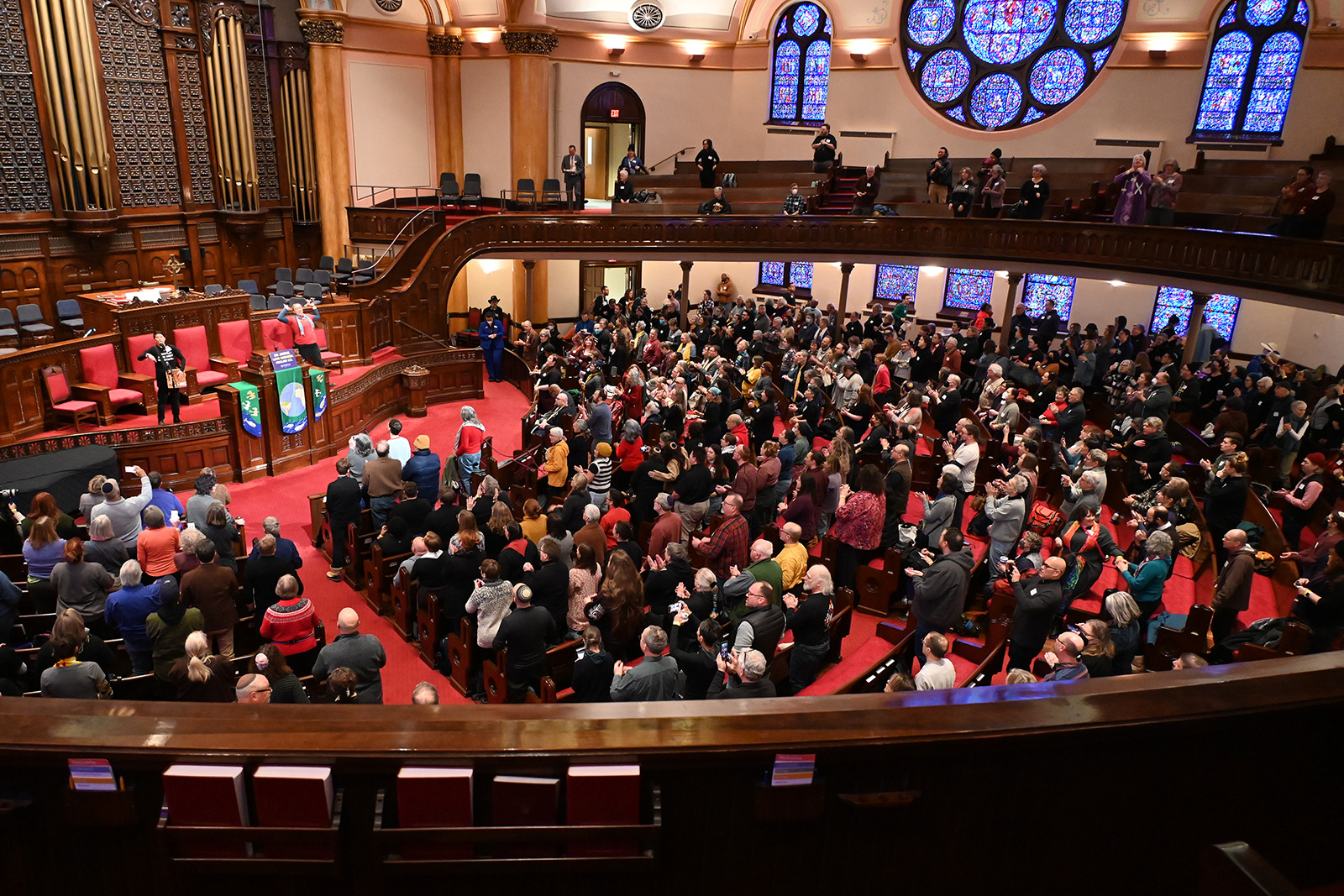
Photo: Religion News Service/Jack Jenkins.
Hundreds of clergy convened at Westminster Presbyterian Church, Thursday, January 22, 2026, in downtown Minneapolis, Minnesota.

Today’s post is about faith leaders in Minnesota and beyond bearing witness to wickedness and standing up for the values they share.

On Sunday, my husband and I heard a report from our own minister, who had just returned from protesting with those leaders in Minneapolis.

Although the largest interfaith demonstration so far was last Friday, mutual support among religious leaders has been going on a long time.

In December 2025, Louis Krauss of the Minnesota Star Tribune, wrote about faith leaders seeing signs that the government was going to start its attacks with the Somali community.

“A broad swath of religious leaders packed into a south Minneapolis mosque on Thursday to show solidarity and condemn ongoing attacks … against Minnesota’s Somali community. The crowd of more than 50 inside of Umatul Islam Center consisted of imams, pastors, rabbis and leaders from other religions who took turns cheering in support of Somali neighbors [amid] reports of the increased Immigration and Customs Enforcement (ICE) presence in the Twin Cities targeting the Somali population.”

As we know, ICE did arrive, reportedly three thousand strong. Even before the atrocities of January 24, a gathering of religious leaders was preparing to bear witness. Here are some results.

Interfaith Alliance posted this message on Sunday, January 25: “Rev. Paul Brandeis Raushenbush, president and CEO of Interfaith Alliance, just returned Friday evening from several days spent in Minneapolis marching, protesting, and rallying together with national and local faith leaders – who answered the call to do everything in their power to challenge ICE and call for them to leave Minnesota and cease terrorizing immigrants and their communities.”

Rev. Raushenbush said, “We echo the urgent demands of activists in Minnesota, including local faith leaders. ICE must leave Minnesota. … Across faith traditions, we are called to protect human dignity, care for the vulnerable, and resist systems that thrive on fear. That is why so many faith leaders and communities, in Minnesota and across the country, are showing moral leadership and courage to reject ICE.” More here.

Jack Jenkins wrote at Religion News Service, “As she stood at the pulpit at Westminster Presbyterian Church on Thursday (January 22), the Rev. Rebecca Voelkel, a United Church of Christ minister, looked out at the packed sanctuary with tears in her eyes.

“Far from the typical flock of Presbyterian worshippers who frequent the church on Sundays, the more than 600 people who filled the pews represented a wide range of faiths — Christians of all kinds as well as Buddhists, Jews, Muslims and Indigenous practitioners, among others. All were religious leaders who had traveled to Minnesota on short notice, spurred by their faith to oppose … mass deportation. …

“The moment marked the beginning of a remarkable two-day religious gathering in Minneapolis. … Constructed as a mix of activist trainings, spiritual revival and direct-action protests, Minnesota faith leaders who have been actively resisting Immigration and Customs Enforcement agents used the assembly as an opportunity to pass along lessons to clergy from other parts of the country. Amid prayers, songs and protest chants, the gathering heralded the emergence of a vast, faith-based network set on resisting the administration’s mass deportation effort.

“Religion News Service was one of only three outlets given access to the conference, which was largely organized by the local religious advocacy group Multifaith Antiracism, Change and Healing, known as MARCH. The size of the event was striking, given how quickly it came together: The public invitation was published on MARCH’s website only a week before the event began, and organizers said so many clergy wanted to take part that they eventually had to halt applications due to logistical concerns.” More at at Religion News Service.

Meanwhile, the Times of Israel noted from afar that a rabbi was among those arrested at a demonstration: “At least one local rabbi was arrested Friday in Minneapolis as hundreds of faith leaders from around the country gathered to protest Immigration and Customs Enforcement activity in the Twin Cities.

“Rabbi Emma Kippley-Ogman, the Jewish and interfaith chaplain at Macalester College in St. Paul, was briefly detained by police alongside leaders of other faiths while staging a protest at the airport. In photos and video from the protest just before the arrest, Kipley-Ogman can be seen delivering brief remarks while wearing a rainbow tallit and standing in a line at the airport’s arrivals gate with several other faith leaders who hold hands and pray.” More.

Jack Jenkins filed a separate report with the National Catholic Reporter, “Around 200 faith leaders fanned out across the city on Thursday (January 22) to observe and document the actions of Immigration and Customs Enforcement, with some clergy confronting Department of Homeland Security agents, adding a visible religious presence to widespread efforts to counter the president’s mass deportation campaign in the region.

“The faith leaders, who are in Minneapolis as part of a larger convening focused on religious pushback to ICE, deployed to neighborhoods with significant immigrant populations, where DHS agents have been most active during an ongoing campaign known as Operation Metro Surge. The clergy, who hail from a range of traditions and worship communities across the country, sang on the buses as they ventured out into the street. They belted out hymns and songs popular during the Civil Rights Movement, such as ‘Woke Up This Morning.’ ” More.

A Hindu writer posted this: “I arrived in Minneapolis on Wednesday (January 21). I had come because local organizers said people were being disappeared: kidnapped off the street, detained, shot in plain daylight. I went because there was a cry for help from a devastated community.

“Nothing prepared me for what I saw. The city was a battleground where ICE feels like an occupying force.

“A Hindu organizer and activist, I went as an ally of a 50-strong Rabbis for Ceasefire delegation, some of whom I knew from our trip to Israel and the Palestinian territories in August, to see the effects of the Gaza war. I saw there firsthand what occupation looks like. Minneapolis felt occupied, too.

“On Friday we participated in Minneapolis’ citywide day of action, a general strike, for which hundreds of local businesses chose to close. Some gave free food and drink to people participating. More than 50,000 people — faith leaders among them — marched to abolish ICE in spite of frigid temperatures. The march culminated in a huge rally in an indoor stadium, where local faith leaders, union leaders, and elected officials offered speeches and prayers of defiance and resilience.

“Within that larger strike, our faith convergence took part in actions of defiance organized by MARCH. At Minneapolis Airport, 106 local clergy were arrested, while some 600 local community members and out-of-town clergy stood witness. Later, I joined a group of multifaith clergy in song, prayer, and presence at the B.H. Whipple Federal Building, where Minnesota’s ICE offices are headquartered.” More.
Read Full Post »

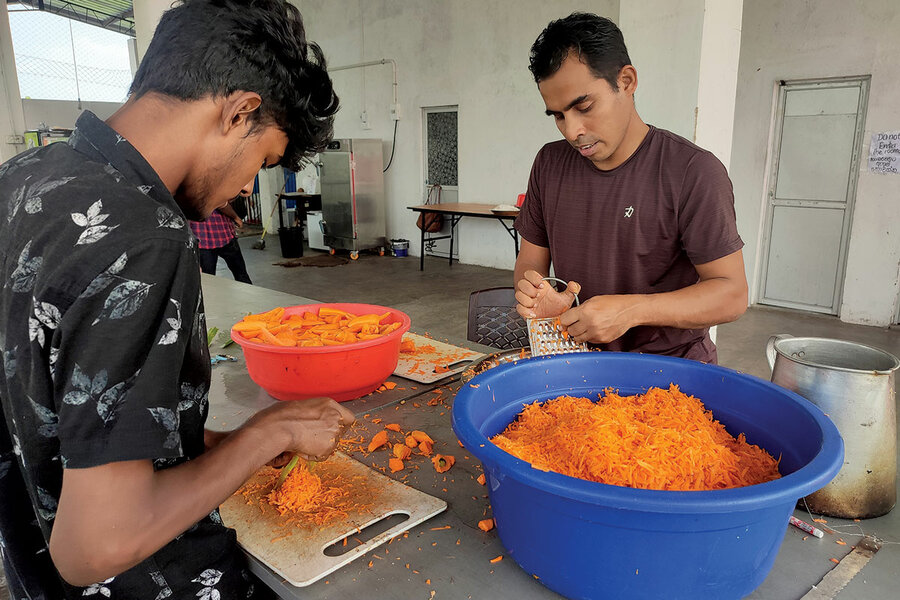
Photo: Munza Mushtaq.
Pastor Moses Akash de Silva (right) helps prepare carrot sambol at Voice for the Voiceless Foundation’s flagship community kitchen in Sri Lanka.

Here’s a story from across the world about one way that food brings people together.

Munza Mushtaq reports at the Christian Science Monitor, “It’s just past noon, and on the sweltering rooftop of the Bethany Church in Rajagiriya, Sri Lanka, Pastor Moses Akash de Silva and a team of volunteers are grating piles of carrots while K.D. Iranie hovers over a large pan, stirring a spicy fish curry atop a makeshift firewood cooker.

“Ms. Iranie, who’s in her 60s, has served as the main cook for the church’s community kitchen since Pastor Moses started the project in June. ‘I come all five days a week,’ she says. ‘Seeing the people getting a delicious meal makes me so happy.’ …

“At 12:30 p.m. sharp, after trays of fresh food are carried down four flights of steps, Pastor Moses signals a volunteer to open the church’s grilled gates. At least a hundred men, women, and children eagerly file in, following the aromas of turmeric-infused fluffy yellow rice, fish and pumpkin curries, carrot sambol, and papadums. More will arrive with time. For many, this is their first proper meal in days.

“Sri Lanka’s worst-ever economic crisis has left nearly 30% of its 22 million people food insecure, according to the World Food Program, with food inflation soaring to 73% in November. The Voice Community Kitchen helps out by providing some 6,000 free lunches every week across roughly two dozen locations throughout Sri Lanka, while also bringing together different ethnoreligious communities that have historically struggled to find common ground. Pastor Moses says the initiative was born of pragmatism, compassion toward all Sri Lankans, and a desire to model the same generosity he experienced as a young person.

“ ‘I have gone for days without food, so I understand how these people feel,’ he says. ‘It does not matter to us what religion they are from, or if they have family, or what they do. If they are hungry, they are welcome to eat at our community kitchen.’

“Raised in an orphanage in the hill capital of Kandy, Pastor Moses moved to Colombo at age 17 seeking better opportunities. He lived at a bus stop for three days before finding work as a cleaner at a polyethylene factory. It’s there he met the senior pastor of Bethany Church, Dishan de Silva, who took him in.

“Pastor Moses explains with a bright smile how he lived with the senior pastor for seven years, eventually adopting his mentor’s surname. … The community kitchen idea came to [Senior Pastor de Silva] earlier this year when Voice Foundation volunteers were distributing dry rations to families on the outskirts of Colombo.

“ ‘In one house we met a mother with a 2-year-old child who had been surviving on ripened breadfruit and water spinach for three days due to the shortage of cooking gas in the market,’ he says. ‘That was when we thought, there was no point giving dry rations if people were unable to cook.’

“So they started cooking up meals themselves. Many of the current community kitchens are based in schools, while others, such as the flagship Bethany Church program in a Colombo suburb, serve lunch every day to a mix of children and adults. At least 60% of the people who come to the kitchen do not eat breakfast or dinner due to financial hardship, according to the Voice Foundation.

“There is only one rule at the Voice Foundation’s community kitchens: Guests can eat as much as they want, but they can’t take food outside the premises. 

“At the Bethany Church, there is not a single garbage bin. According to Pastor Moses, there’s no need – there are never leftovers.

“ ‘The community kitchen attracts different people from different walks of life, including beggars, street cleaners, security guards, and anyone else who needs a meal,’ Pastor Moses says.

“N.K. Karunawathie works at a bank nearby. Even as the cost of living skyrockets, her salary has remained stagnant, meaning her family can ‘no longer afford three meals a day,’ she says. To help make ends meet, she and her husband, both Buddhists, have been visiting the Voice Community Kitchen since it started this summer. …

“For a small country, Sri Lanka frequently faces religious-based conflict. Apart from a quarter-century-long war with the Liberation Tigers of Tamil Eelam, which strained the relationship between the majority Buddhists and minority Hindus, the country has also seen a rise in attacks against Muslims since 2013. The Easter Sunday bombings in 2019 further exacerbated tensions. 

“Mehdi Ghouse started volunteering at the kitchen months ago after learning about the project on social media.

‘It doesn’t matter that I am Muslim, or this project is run by the church. What matters is the satisfaction we all get when we see people eating and leaving happy,’ he says.

“Not only are all religions welcome at the Voice Community Kitchen, but experts also say such initiatives could be key to improving ethnoreligious engagement and lead to better conflict mediation in the future. …

“For Pastor Moses, the community kitchen’s mission is simple: Feed the hungry. But he does hope the work will have a ripple effect by inspiring generosity among all who engage with the project.

“ ‘I am who I am because of the upbringing I had in the orphanage and the help I got throughout the years since I came to Colombo,’ he says. ‘I hope others who volunteer here and those who I have taken under my wings will follow my footsteps by serving the people.’ “

More at the Monitor, here.

Read Full Post »

4000182-0001

Image: Collection of Stephen J. Hornsby/Osher Map Library and Smith Center for Cartographic Education
America—A Nation of One People From Many Countries,” by Emma Bourne, published in 1940 by the Council Against Intolerance in America.

At Atlas Obscura, Lauren Young writes about a powerful 1940 map showing America as a nation of immigrants.

“In the years leading up to the Second World War,” says Young, “isolationist sentiment coursed pretty strongly throughout the United States. Some Americans feared that immigrants were a threat to the country. …

“ ‘With the exception of the Indian, all Americans or their forefathers came here from other countries,’ the illustrator Emma Bourne inscribed on the map. The Council Against Intolerance commissioned Bourne’s work in an effort to remind Americans that the U.S. had always defined itself as a country of varied national origins and religious backgrounds.

“Bourne illustrates America’s unique ethnic and religious diversity by erasing state borderlines and showing the nation as one unit. Long red ribbons weave through the landscape to show clusters of immigrant groups and where they settled, from Japanese in the West to Italians in the East. At the bottom left is an inset scroll listing famous Americans in literature, science, industry, and the arts alongside their ethnic backgrounds, including George Gershwin and Albert Einstein, who became a U.S. citizen the year the map was published. …

“Bourne also emphasizes the range of religions present during this era, along with staple industries in each state, including a giant potato in Idaho, a huge fish in Washington, and large lobster in Maine. Detailed figures of people at work are meant to show how immigrants are active in creating a prosperous America.” Read more here.

(Thank you for the lead, Bob!)

Read Full Post »