Feeds:
Posts
Comments

Posts Tagged ‘retirement’

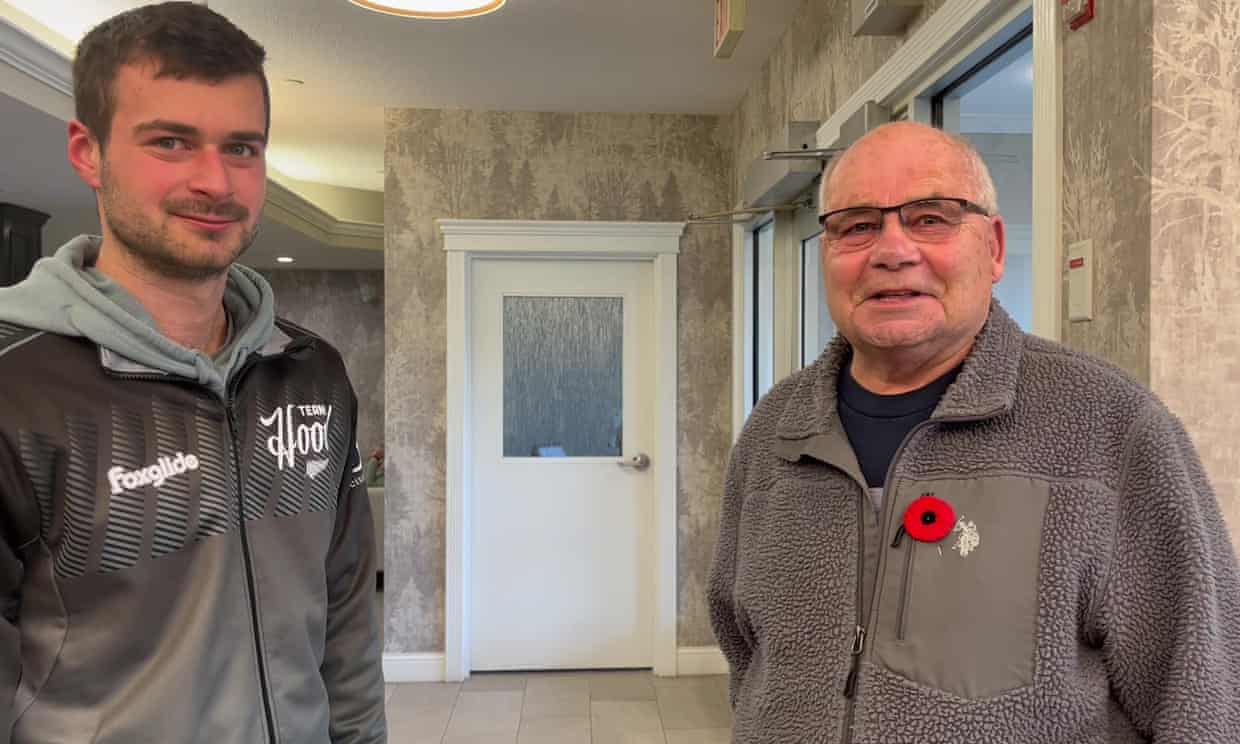
Photo: Team Hood via the Guardian.
New Zealand curling skip Anton Hood with fan and Chartwell Colonel Belcher resident Bill Dench. The New Zealand team found a good place to live while in training — a retirement community in Calgary, Canada.

This is a story about a retirement community, a team from the other side of the world, and the unexpected benefits of co-housing.

Scott Cacciola reported at the New York Times early this year, “Ben Smith never could have imagined spending the winter at a retirement home in Calgary, Alberta, sipping Caesar cocktails with three of his best friends — Anton Hood, Brett Sargon and Hunter Walker — while their octogenarian neighbors play bridge and tabletop shuffleboard.

“In fact, the four men, who are professional curlers from New Zealand working on their Olympic aspirations in one of the world’s most celebrated curling hotbeds, have made themselves at home since moving into the Chartwell Colonel Belcher Retirement Residence, a senior living community on Calgary’s west side. They are the building’s newest tenants — and its youngest. …

“The story of how a team of young men wound up occupying two suites at a Canadian retirement home … involves luck, economics and word-of-mouth generosity among Calgary-area curlers. In the process, the arrangement has showcased the virtues of intergenerational living.

“ ‘Oh, we really were just shocked,’ said Bertha Esplen, 97. ‘We really were. Because all of a sudden we get curlers from New Zealand in our building. Man, that was great. We couldn’t wait for them to come.’

“Since arriving in September [2022], the team has financed its curling dreams by landing day jobs — Mr. Smith, 24, for example, works as a plumber four days a week — while acclimating to life in a sprawling community of surrogate grandparents and well-intentioned back-seat curlers.

“At least one resident has asked for a practice schedule so that he can taxi over to the Calgary Curling Club, where the team trains and Mr. Hood, 23, moonlights as an assistant ice technician, and offer advice. …

“They nitpick because they care. That became clear to Mr. Sargon a few weeks ago when he joined Mr. Hood at a curling tournament in Okotoks, about 25 miles south of Calgary. As soon as their match began, Mr. Sargon and Mr. Hood realized that they had their own fan club. Fourteen residents, armed with bag lunches and homemade signs, had made the trip via charter bus to cheer them on in a loss to a team led by Mike McEwen, one of the top curlers in Canada.

“For those unfamiliar: Curling is a winter sport that involves pushing heavy granite rocks down a long sheet of ice toward a target. And while it is hugely popular in Canada, curling does have some historical ties to New Zealand. Miners from Scotland brought an outdoor version of the game with them to the country during the gold rush of the 19th century, and it has persisted as a popular activity whenever the ponds on New Zealand’s South Island are cold enough to form a thick slab of ice at the surface. …

“Finding the game was easy enough for Mr. Hood, Mr. Smith and Mr. Walker, 21, all of whom grew up in Naseby, New Zealand, a small resort town that, for many years, was home to the Southern Hemisphere’s only dedicated indoor curling rink. Mr. Sargon, who is from Auckland, learned the game on hockey ice. …

“Mr. Sargon soon met the others through curling circles and formed a team. But to truly grasp the sport’s many nuances and reach their long-term goal of qualifying for the 2026 Winter Olympics in Italy — a process largely based on results at the world championships — Mr. Sargon and his teammates knew that they would need to immerse themselves in the game. That meant training in Canada. …

“The team spent several weeks training in Calgary last year ahead of the inaugural Pan Continental Curling Championships, which the city hosted. … Over the summer, Mr. Hood was chatting with Kim Forge, who sits on the board of the World Curling Federation, when he mentioned the team’s plans. The challenge, he told her, was finding affordable short-term housing in Calgary. …

“She posted a message on Facebook soliciting help from the Calgary curling community in locating ‘very cheap rent’ for Team Hood. …

“The post soon found its way to Cassandra Murray, a retirement living consultant at Chartwell Colonel Belcher who is a former competitive curler. She was brainstorming with Christine Taylor, a colleague, when they came up with a potential solution.

“ ‘You probably won’t want to do this, but we do have a couple of spare rooms,’ Ms. Murray wrote the team via Facebook Messenger.

“It should be noted that while Team Hood has a couple of sponsorships … curling is not an especially lucrative profession. … So when Ms. Murray offered them a place to stay for free, aside from a few dollars a month for utilities, they were thrilled. They also were glad to find a situation where they could blend more easily with the fabric of the city than they had last winter. What better way to do that than to share a roof with some of Calgary’s most esteemed residents? …

“Karl Berg, a director of regional operations and sales for Chartwell, endorsed the idea, citing a renewed emphasis on ‘socialization’ among its residents in the wake of the pandemic. He also was aware of a successful intergenerational living experiment in the Netherlands, where the presence of a few college students in a nursing home gave their older neighbors a greater sense of connection to the outside world and increased their mental stimulation.

“ ‘It’s been awesome watching people’s faces light up when we talk to them,’ Mr. Sargon said, ‘and now we’re really starting to get know more of them. Everyone buys into what we’re trying to do as well, which is cool. Everyone wants to tell us their curling story.’ ”

More at the Times, here, the CBC, here, and the Guardian, here.

Read Full Post »

Photos: John and Suzanne’s Mom.
John rescued a worn poster collecting dust in storage. One of Suzanne’s choices was a fruit bowl she saw in our house since she was a baby.

I ran into Mary Louise one day this spring taking her constitutional in the park. She asked what was new. I told her we were downsizing prior to moving to a retirement place in town. She said she didn’t think she’d ever be able to do that because there were certain things she could never part with. For example, she said, neither of her kids wanted her grandmother’s table linens, and she couldn’t imagine passing them to anyone outside the family.

I do think being unable to separate from possessions is a deal breaker for moving to a smaller space, although linens would fit.

I admit that downsizing is no fun at all. It’s a ton of work finding where every item in your house should go and then following through. Take pictures for the kids. Remind them to get back to you with a yes or no. If they don’t want something, does it go to consignment? Will consigners pick up? Do you transport 20 bags of books to the library for its June sale? Donate unwanted treasures to charity? Or post them on a local Buy Nothing Facebook group? (I am here to tell you that even if free, no one wants an old, heavy ironing board or a rocker that needs recaning.)

Do you even have time for this mishegoss?

It takes forever, but I think it has to be done. I still remember how upset one of Suzanne’s Girl Scout moms was back in the 1980s when her parents cleaned out their house without giving the kids a chance to take what they wanted. You have to make a good-faith effort to get that right, knowing that sometimes you’ll mess up. It certainly helps to have kids who can negotiate if they both like the same item.

And if my husband and I have learned one thing from the process, it’s that you cannot possibly guess what the kids will want. Over and over again, we were surprised. That beat-up, old steamer trunk? Suzanne wants it if it has a flat top. Huh? OK, it’s hers.

Anyway, I want to mention that an unexpected plus of downsizing is how satisfying it is to see your items incorporated into your children’s homes.

Read Full Post »

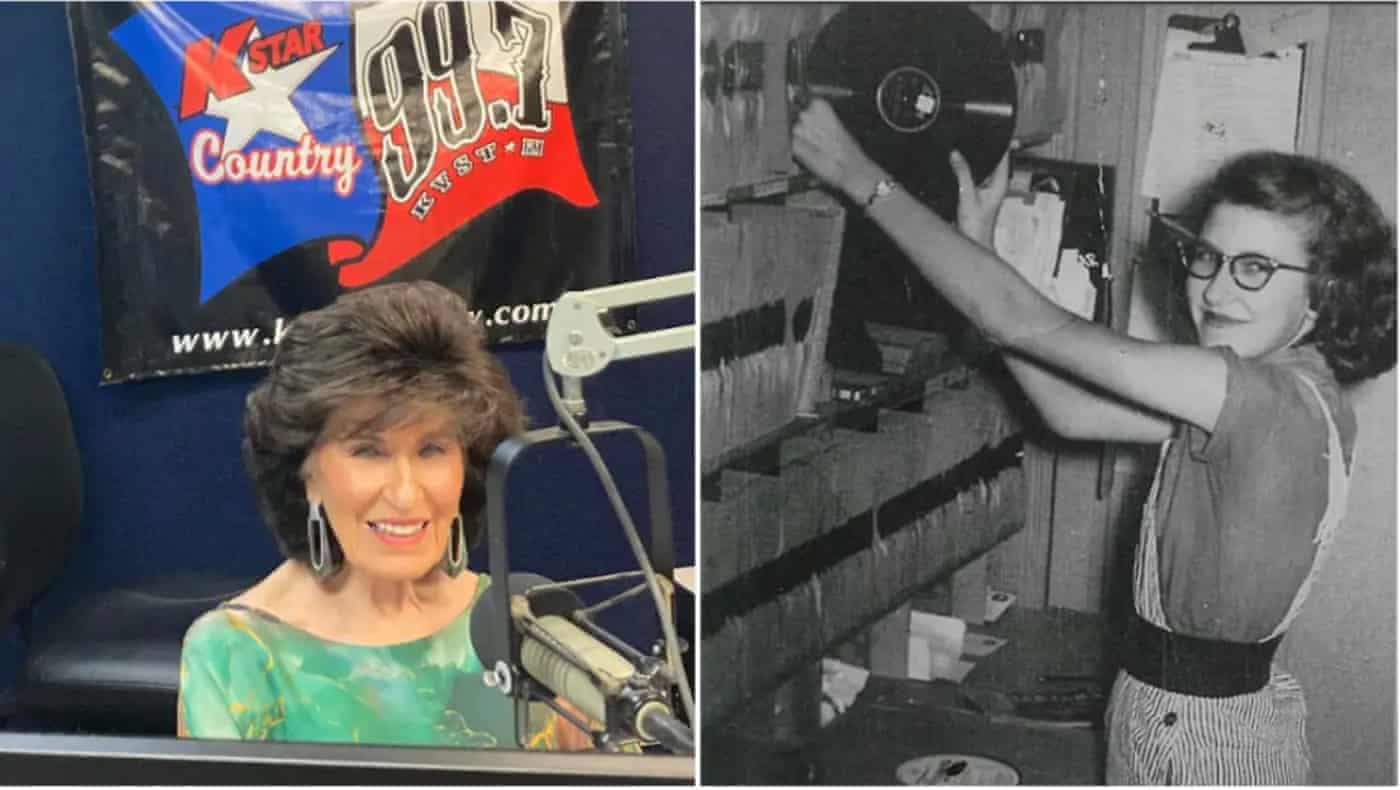
Photo: Mary McCoy.
Mary McCoy, the longest-serving female radio DJ on the globe, according to Guinness World Records, has no interest in retirement. 

If you are lucky enough to have a job that lights up your life, why would you ever retire? That’s the thinking of the woman featured in today’s story.

Ramon Antonio Vargas reports at the Guardian, “Mary McCoy has broken her neck, had multiple bouts with Covid-19 and grieved the deaths of two husbands. But none of that could get the 85-year-old off the airwaves she has been on for more than 70 years. The transition from vinyl to purely digital control panels was no match either.

“ ‘I have seen it all,’ the radio presenter from Texas told the Guardian, weeks before the end of her 72nd year in her role. ‘And you know what? I don’t plan on stopping anytime soon.’

Guinness World Records has confirmed McCoy as the longest-serving female radio disc jockey. She passed Maruja Venegas Salinas of Peru, who died in 2015 during her 70th year as a host.

“Such recognition has given McCoy and her loved ones the occasion to reflect on a remarkable journey. It began with a childhood dream of breaking into the entertainment business – dreamed even as she and her family briefly lived in a tent without running water or electricity. …

“ ‘She’s been through adversity, she’s been through pain, and she keeps going,’ said her longtime co-host, Larry Galla. …

“McCoy was born on a farm in east Texas. Her family soon climbed into their Ford Model A and moved about 200 miles south-west to Conroe. There, about 40 miles north of Houston, life was lived without frills.

“McCoy took breaks from life in the tent by learning how to yodel. She joked that her father probably wanted to strangle her but she became quite skilled. When she was 11, she signed up for a talent show at a local theater. Performing the Patsy Montana yodeling classic ‘I Want to Be a Cowboy’s Sweetheart,’ she won.

“The manager of a new radio station, KMCO, learned of the performance and called her school, inviting her to a recorded audition. McCoy borrowed a guitar she said was ‘three times’ as big as her, took a bus ride and performed. The manager asked if she knew enough songs to play a 15-minute program.

“McCoy said she did, so they recorded a show. McCoy recalls crying when she heard herself on the air. She ‘thought it was the worst thing I’d ever heard – I thought I’d never go back and my career had ended.’ But the manager called back and said KMCO had picked up a sponsor for her program, which would go out on Saturdays.

“McCoy was delighted. Eventually, she convinced the manager to let her host a show. She simply played 78 rpm records by the country artists to whom she listened. That was where the McCoy everyone in her community now knows began to take shape.

“She had on fabled singer-songwriters including Jim Reeves, Hank Locklin and Sonny James. She toured, sang and played the guitar with artists like James and Slim Whitman. She landed a spot on the Louisiana Hayride tour, which came to Conroe in 1955.

On that stop, she performed alongside a rising musician named Elvis Presley.

“Other episodes in McCoy’s career could fill a book with ease. One of her favorites came in 1965, when she performed as a last-minute substitute at a prison rodeo. After she and Roy Acuff sang, organizers let loose some bulls. It was part of the show but it scared her. McCoy tried to climb out of the rodeo ring but couldn’t because the dress she performed in was too tight. She asked some clowns to help her up. She remembers them hugging and even trying to kiss her, smudging her with their face paint. …

“In 2013, she suffered a fall. Doctors diagnosed a fractured neck, performed an eight-hour surgery and sent her home to rest on a hospital-grade bed, wearing an elaborate head brace she said made her look ‘like Frankenstein.’

“By then, 78 rpm records had given way to 45rpms and in turn CDs, before everything ultimately went digital. McCoy said she had minimal understanding of the technology that now runs her industry, but knew she could co-host her show from home if she had to. So she did, with help from colleagues at the station now known as K-Star.

“A similar plan let her stay on the air each of three times she has caught Covid-19.

“ ‘That shows you how much I love this,’ McCoy said.

“She was inducted to the Texas country hall of fame in 2010. In Conroe in 2014, she was added to a wall of local legends. Images since added to the mural include Roy Harris, a boxer who challenged Floyd Patterson for the world heavyweight championship, and the Pulitzer-winning historian Annette Gordon-Reed.

“To see if McCoy had a shot at the Guinness World Records, K-Star enlisted the help of McCoy’s youngest of four daughters, Kim Colette Stout. Beginning last year, Stout gathered photographs, newspaper articles and social security payment records, all to establish that her mother’s career began way back when at KMCO, the station whose nickname, ‘Kim-Coe,’ inspired Stout’s first and middle names. …

“Stout submitted the materials to Guinness. It eventually sent an email back.

“It said: ‘Your mother is now the world record-holder.’

“Stout said she once tried to coax McCoy, her ‘momma,’ to retire. She’s now glad she didn’t succeed. … ‘She’d be lost if she came home and she wasn’t going to work every morning.’ ”

More at the Guardian, here.

Read Full Post »

Photo: 2Life Communities.

Back in June, I was listening to the radio in the car and heard a local interview with poet Billy Collins. Collins was in the area for a 2Life Communities fundraiser. In searching for more information on 2Life Communities, I found this 2021 story from GBH radio. Turns out, there actually exists, through a lottery system, an affordable and very diverse option for retirement in Greater Boston.

Marilyn Schairer reported, “Some senior adults living in and around Boston face a major life dilemma nowadays, especially when they retire and are on a fixed income: they have to choose between paying for heat, for food or for rent.

“That’s what 2Life Communities is working to change. The nonprofit is on a mission to help senior adults live in affordable housing in the Greater Boston area, with over 1,300 units and hundreds more in planning and construction stages, as demographic shifts leave more older Americans burdened by housing costs.

“Amy Schectman, president and CEO of 2Life Communities, said 2Life does more than just provide housing for middle- and low-income senior adults.

“ ‘We’re dedicated to the proposition that every older adult should have the opportunity to live a full life of connection and purpose in a dynamic, supportive environment,’ she said.

The organization’s mission brings together a community of people from all backgrounds and cultures. …

“A major demographic shift is underway in the United States as the baby-boomer generation ages. By 2030, one in five Americans will be 65 years old or over, according to the U.S. Census Bureau.

“But Schectman said only a third of older adults who qualify for subsidized housing actually receive it nationwide. The remainder, as found by Harvard Joint Center for Housing Studies, are ‘housing cost burdened,’ Schectman said, ‘meaning they’re spending an inadequate [amount on] money on food and medicine.’

“Currently, 2Life Communities has 1,340 affordable apartments on six different campuses in the Greater Boston area, including Newton and Framingham, and they’re looking to build another campus in Lynn. … Tenants at 2Life are selected through a lottery system, and the waitlist is long. …

“Tenant Darryl Smith won an apartment in the lottery three years ago, and he is thrilled.

“ ‘Oh man, I’m jumping for joy,’ he said. Smith, who is in his 70s. …

“2Life was formed in 1965, and back then it was called Jewish Community Housing for the Elderly. Schectman said the new name is meant to convey a sense of joyous aging, and it comes from a traditional Jewish or Hebrew toast: ‘L’Chaim,’ which means ‘to life.’

“One of the things tenants said they like about the living situation is the diversity. Resident speak a plethora of languages, and there are lots of people from the Boston area, of course, but many are immigrants, representing countries such as China, Ukraine and Belarus. …

“ ‘The end of the year is a big time of giving,’ she said. ‘And let me be clear, we can’t do what we do without philanthropy. We are 100% dependent because we believe you can’t chintz out on services and programs.’

“The median annual household income among residents is $12,078, according to Schectman. But even with federal subsidies and tax credits, she said partnerships with businesses like Dellbrook Construction are needed. Dellbrook’s CEO Michael Fish said he understands the need for organizations like 2Life Communities.

“ ‘The fact that they’re expanding and growing tremendously is not surprising whatsoever, and it’s incredibly necessary given the state we are in and the need for affordable housing for seniors,’ Fish said.

“And tenants like Darryl Smith feel a lot of gratitude for having a newfound home.

“ ‘I’ve got friends now that you can go right to,’ he said, noting the sense of community. ‘If you have any kind of problem, they’ll walk with you, and everybody’s smiling.’ ” More at GBH, here.

As my husband and I scout retirement communities, we realize that although we are fortunate enough to be able to pay the costs, we are going to lose out on contact with people of diverse backgrounds. Diversity of nationality, religion, and language is often tied these days to economic diversity. I will just have to keep volunteering with English as a Second Language classes. For me, making friends in those classes is truly enriching.

Read Full Post »

030315-Morfar-has-a-cake

Retirement means different things to different people. Some people can hardly wait to start traveling or playing golf more. I was always afraid of it — afraid that I would be bored, afraid that I would stop learning, afraid that without the structure of a work schedule I wouldn’t be able to remember what day it was.

In the event, it hasn’t been too bad.

Recognizing the variety of attitudes people have about retirement, the American Association of Retired People (AARP) commissioned a study for use by financial planners (varied attitudes do affect financial planning). I got a kick out of the recommendation about tempering people’s belief in a future consisting of walks on the beach and endless golf. After all, one really changes as time marches on. And I’m particularly aware of that today as my lack of attention entering an on-ramp was a bit responsible for getting my car rear-ended.

Chaiwoo Lee, Ph.D., and Joseph F. Coughlin, Ph.D., have now published “Describing Life After Career: Demographic Differences in the Language and Imagery of Retirement” at the Journal of Financial Planning. I removed references to prior research, but you can find all that here.

“This empirical study was conducted to understand people’s perspectives toward retirement and to describe how views differ between people of various characteristics.

  • “Verbal and visual representations regarding life after completion of a career were collected online from 990 adults in the U.S. to uncover underlying ideas and map key concepts.
  • “A small number of words and features were reported in descriptions of retirement, indicating both an ambiguity and limitation in relating their current selves to possible future states.
  • “Perceptions of retirement were generally positive, and a sense of optimism was evident across different segments.
  • “Some demographic differences were found in thoughts on life after career. For example, people making less than $25,000 a year used fewer positive words and more negative words [editorial comment: No kidding!]; younger adults’ images were more likely to address financial well-being; and older adults and those with higher incomes provided more images related to travel.
  • “Using the results of this analysis, financial planners can better address clients’ emotional needs, rather than solely focusing on rational financial planning. …

“The ambiguity and limited vocabulary associated with retirement might be explained [in part by the fact that] participants were asked to think about an intangible future state, their answers may have been bounded to a small, abstract, and coherent set of words. The observation that younger respondents used more vague and abstract words, while older respondents used more specific words, further supports this explanation.

“The finding can also be explained with portrayals of retirement in public media. Ekerdt and Clark observed that the majority of retirement advertisements did not depict visual images, and the small portion that did focused on leisure and freedom. Such limitation in consumers’ exposure to related concepts may have impacted the results, where ‘relax’ and ‘travel’ were among the most frequent.

“People were generally optimistic about life after completion of career. Most of the words were positive, and images showing life after career were generally more positive compared to images representing today. A possible explanation can come from the positivity bias, or the Pollyanna Hypothesis, which describes that people universally tend to use positive words more frequently and diversely than negative words. It is also aligned with past research that found people to be more optimistic about the distant future compared to the imminent future.

“The majority of such positive words and images addressed emotional values, suggesting a higher emphasis on pursuing emotional fulfillment in retirement. This may be due to related media that mostly convey positive contents around leisure, freedom, personal pursuit, and financial security.

“Results showed some differences in how different segments view life after career. For example, older participants, suburban and rural residents, married people, and men provided more words addressing physical values compared to their counterparts. … The positivity gap between the present and the future were greater among younger participants. However, while images from the younger participants showed wealth, family, and accomplishments with a positive lens, their descriptions lacked in how they plan to reach the ideal future state. [No kidding!]

“These findings have practical implications for the evolving roles of financial planners as curators, educators, and co-creators of retirement. The limited vocabulary and imagery imply that clients may not have a clear, or realistic, vision of retirement. Results suggest that planners may have a new role as curators of possible lifestyles for clients to consider and plan for.

“Respondents reflected inordinately high positivity about their future retired selves. Financial planners may not want to dissuade clients of looking optimistically, but they may find an important role as educators in tempering popular images of beach walks and green fairways with candid discussions of possible futures that may be costly and less positive.” Ha, ha, that’s for sure!

Nevertheless, I thought it was interesting that people think about retirement so differently.

More here.

Read Full Post »

In Helsinki, Finland, where young people traditionally leave home at 18 but can no longer afford urban rents, Millennials are applying by the hundreds to live with the elderly.

According to Kae Lani Kennedy at Matador Network, “Retirement homes are serving as more than a community for the elderly. These facilities are providing affordable housing for the city’s growing population of homeless millennials.

“ ‘It’s almost like a dorm, but the people aren’t young. They’re old,’ explains Emil Bostrom, a participant in ‘A Home That Fits,’ a new housing project that allows millennials to move into retirement communities. Bostrom is a 24-year-old kindergarten teacher, and though he has a steady income, it is not enough to compete with 90,000 other renters in a city that has roughly 60,000 affordable rental properties. …

“Bostrom, along with many other young adults, can enjoy discounted rent in exchange for socializing with the seniors in their community. …

“By interacting with a younger generation, the elderly involved with ‘A Home That Fits’ have the opportunity to be engaged in an active and diverse community, instead of being left behind in a forgotten generation.” More here.

And check out a post I wrote about the same phenomenon in Cleveland, here. Both initiatives sound like fun to me.

Video: Seeker Stories

Read Full Post »

Here’s another story about an older worker from John. I think we’ll discover more of these, given that retirement today doesn’t have the same appeal for everyone.

“Frank Gurrera is old-school Brooklyn,” writes Pete Donohue at the NY Daily News.

“Gurrera, a World War II veteran, is nearly 90 years old. But he’s still working as a subway machinist at the MTA’s sprawling brick maintenance complex in Coney Island. Gurrera makes or modifies parts for workhorse trains that were built decades ago and need periodic roof-to-wheels overhauls in order to remain in service.

“ ‘I enjoy the work,’ he said. ‘It’s the satisfaction of making something from nothing, making something from just a piece of metal.’

“Gurrera is exactly the type of transit worker the Daily News celebrates with its annual Hometown Heroes in Transit awards, which honor bus and subway workers who demonstrate exceptional dedication, bravery, compassion, ingenuity and other admirable qualities.” More about the awards here.

Although this story is from New York, people like Gurrera are also valued in Greater Boston, which has the oldest subway system in the country. The Boston Globe has reported on local machinists who are needed to make train parts by hand.

Photo: Pearl Gabel/NY Daily News
Frank Gurrera, who turns 90 on Oct. 29, makes subway train parts that no longer are available from the original manufacturer. The parts are used for workhorse MTA trains that were built decades ago.

Read Full Post »

Kathy was telling me on the commuter train about an article on Littleton’s Life Care Center, which uses llamas and other critters to engage the residents.

I said, “Send me a link!”

Today I received the article in the Lowell Sun. Samantha Allen writes, “At the Life Care Center of Nashoba Valley, it’s not uncommon to see patients asleep in their wheelchairs by the saltwater-fish tank, or out for a stroll around a pasture filled with grass-grazing animals like goats and llamas.

“Director Ellen Levinson said while the merits of ‘pet therapy’ have been adopted and used at various skilled nursing facilities across the country, it’s rare to find chickens and alpacas at a site.

“At the 120-bed nursing home, which houses a specialized memory-support unit for those with severe dementia and other conditions that affect the memory, staff members make time to ensure their patients interact with the animals whenever possible.

” ‘This is my philosophy: A lot of places say, “We have pet therapy,” and what they have is someone who brings a dog in on a leash once a week,’ she said. ‘If I were living here, that would make me more miserable. It’s not like real life. It’s not like having a dog, and then you’re just tempted with what you could have all the time.’ …

“This spring, the Life Care Center of Nashoba Valley was awarded a perfect score by the [Massachusetts] Department of Public Health in a survey of nursing homes and senior-care providers.” According to Kathy, the Center is also friendly to outsiders, welcoming the public in for the llama shearing and other events.

Read more about the approach Levinson devised, here.

Photo: Life Care Center of Nashoba Valley 

Read Full Post »

There was a nice article in the NY Times last week about people aging in place and inadvertently creating a retirement community. My husband sent me the link.

“When the co-op conversion wave began in New York City in the 1960s,” writes Constance Rosenblum, “singles and young married couples flocked to the Upper West Side hoping to get a piece of the action. Some of those people, now in their 70s, are still there, cemented in place by apartments bought for a song or equally treasured rent-stabilized units.

“As the neighborhood’s population has grayed, some apartment houses have morphed into what social scientists call NORCs — naturally occurring retirement communities. The most recent census estimates indicate that 22 percent of Upper West Siders, or 46,000 people, are 60 or older, compared with the citywide average of 17 percent. Attracted by convenient shopping, abundant mass transit and a wealth of cultural activities, many older residents hope to remain in their apartments the rest of their lives.”

I am a huge fan of walkable communities for people of any age, and I have often wondered why retirement communities are built in the middle of nowhere. Cost of land, I suppose. But if I couldn’t walk (or wheel myself) to shops, public transportation, the library, and so on, I would be very unhappy.

Perhaps it is the generation now nearing retirement that will make so-called Smart Growth a reality at last — simply because they don’t want to be out in the middle of nowhere.

More from the Times.

Photograph: Marcus Yam for The New York Times
The walking group of Bloomingdale Aging in Place doesn’t let snow interfere with a constitutional in Central Park.

Read Full Post »

John recently alerted me to a PBS News Hour interview that my brother’s friend Paul Solman conducted with Rosa Finnegan, an enthusiastic 100-year-old worker. That reminded me that I had purchased the September 3 issue of the Christian Science Monitor Weekly largely because that lovely lady was on the cover.

The lead article had an intriguing title and blurb: “The silver-collar economy — More companies are hiring people 65 and older because they believe they are reliable and productive, while the seniors themselves need and want to work. But is the trend squeezing out young people?”

It interested me because I’m an older worker who is not tired of working. I don’t know if all young people feel squeezed out, but just yesterday, a young employee asked a friend of mine, “Are you thinking of retirement? You’ve been here a long time.” My friend made a polite rejoinder about loving the work and the people and not making any plans to leave.

She has many productive years ahead of her.

Mark Trumbull writes of Rosa Finnegan that she “has plenty of similarities with other wage-earning Americans. She hitches rides in with a co-worker, likes to joke around with colleagues, and feels very grateful to have her job. At the end of the day, she’s ready to sink into a cushy chair at home.

“But Mrs. Finnegan is also a trailblazer. She offers striking proof that employment and productive activity need not end when the so-called retirement years arrive. Let’s put it this way: Where many people now nearing retirement can recall Sputnik, civil rights protests, or the pitching wizardry of Sandy Koufax, she mentions memories of gas-lit streets, the spread of telephones, and working at a rubber plant during World War II.

“Having passed her 100th birthday this year, Finnegan is still working at a needle factory in [Needham, Mass.], helping to make and package the stainless-steel products in custom batches. Yes, she walks a bit more slowly now than many of her co-workers. But Rosa, as they all call her, still has willing hands and a nimble mind. And she has no desire to leave her job.

” ‘I’d rather be here than almost anywhere,’ she says. ‘You feel like you’re still a worthwhile person, even though you’re old – [you’re] not sitting in a rocking chair.’ ”

Read the whole delightful story here. And check out the Solman interview and his video clip, here.

And to all who say U.S. manufacturing is dead, I will just point out that there is a needle factory in Needham.

Photograph: Melanie Stetson Freeman / The Christian Science Monitor
Rosa Finnegan works on a needle at Vita Needle in Needham, Mass.


Read Full Post »