Feeds:
Posts
Comments

Posts Tagged ‘roadside’

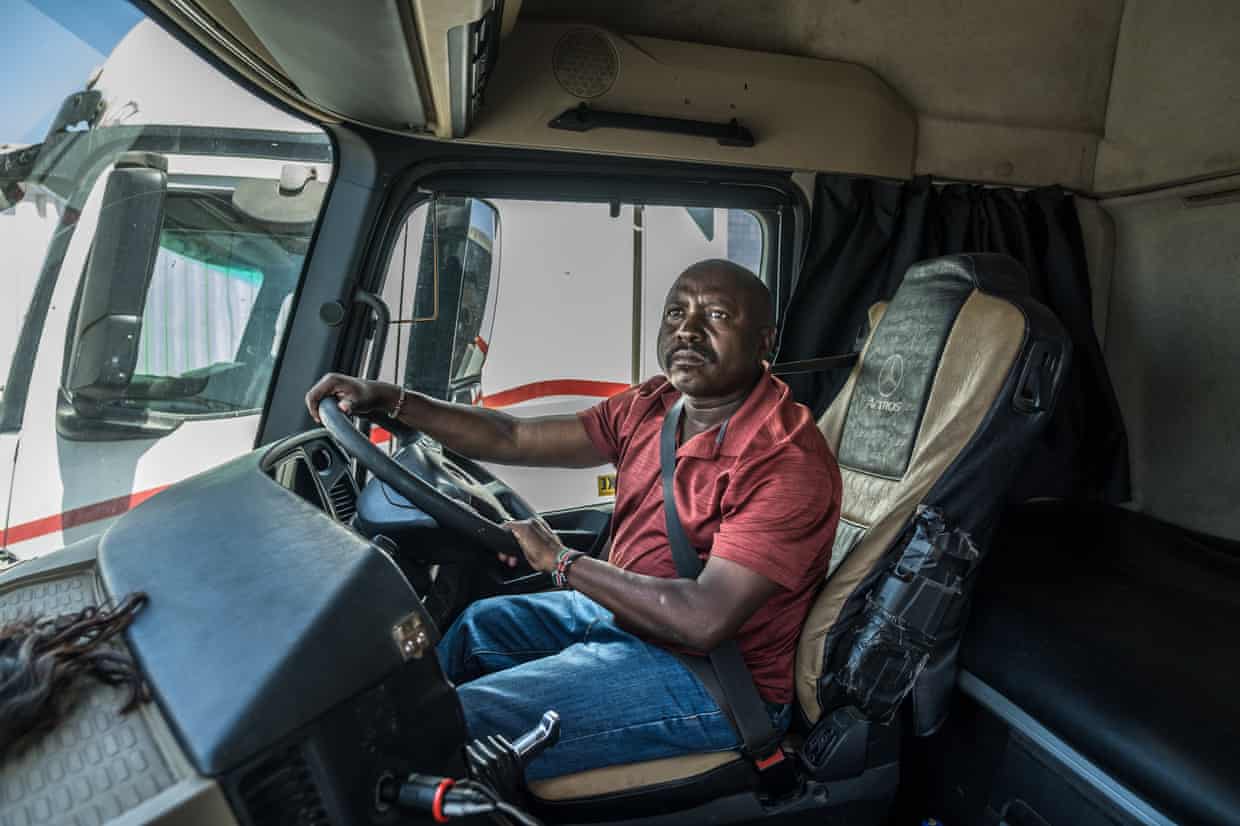
Photo: Brian Otieno/The Guardian.
Thanks to a roadside health service in Africa, Alphonse Wambua learned he had hypertension and also how to treat it. 

Every country has different ways of handling the challenges of providing health services to its people. We can learn from each other. In the US, the Covid pandemic showed us we had cut back too much on public health programs. Many people who needed help were not being reached, which caused the disease to spread more than it should have.

Today’s story suggests that you reach the hard-to-reach by meeting them wherever they are.

Caroline Kimeu writes for the Guardian from Kenya, “A life on the road had caught up with Alphonce Wambua. Twenty-five years of transporting cargo between the Kenyan capital, Nairobi, and the coastal city of Mombasa, nine hours’ drive away, had resulted in long days, a poor diet and an irregular sleep routine for the trucker. Still, it came as a shock when doctors told him he had hypertension a few years ago.

“ ‘I wasn’t expecting it – I thought I just had serious fatigue,’ says Wambua, who has stopped by the clinic where he was diagnosed to pick up his monthly prescription. ‘This job is high pressure. There’s not much rest.’ …

“The health facility, based in Mlolongo, on the busy Nairobi-Mombasa highway, attracts a steady flow of patients. As well as workers and residents from the area, it also treats drivers from the truckers’ rest stop across the road, as one of 19 roadside health facilities run by the nonprofit North Star Alliance, offering priority healthcare to mobile populations.

“The organization, which constructs clinics out of shipping containers, has set up facilities along major transport routes, transit towns, and border crossings across east and southern Africa to increase mobile workers’ access to medical services.

” ‘When governments do their health planning, they usually plan for communities, but no one plans for mobile workers,’ says Jacob Okoth, a [program] manager at North Star Alliance. ‘Their operating hours are different, so you can’t reach them with the traditional 8am-5pm healthcare service delivery model, and many can only afford to queue for short wait times.’

“North Star was founded in 2006 to tackle HIV and STD cases in the transport sector during the height of the Aids epidemic, when some transport companies were losing more than 50% of their drivers to the disease. It extended its services to cover broader health issues after identifying other recurring health concerns among mobile workers, including non-communicable diseases.

“NCDs such as hypertension and diabetes are responsible for more than half of hospital admissions and deaths in Kenya. Health practitioners warn that the growing burden demands new approaches for prevention, diagnosis and treatment. …

“Many of the NGO’s health centres are along the northern corridor, one of east Africa’s busiest transport routes, which connects several countries in the region. Truck drivers who transport cargo along the corridor can travel for 12-hour stretches with short breaks in between, sometimes for weeks or months at a time. In some areas, the distances between hospitals are long; drivers often delay seeking care due to time pressures or irregular work cycles. …

“Regular health checkups are essential for truckers. … Many rely on high-carbohydrate meals to keep them full on long drives, and they struggle to maintain a balanced diet due to time and cost pressures, says Wambua, whose go-to meal is the Kenyan staple ugali (boiled maize meal). …

“ ‘You’re not focused on eating healthy food – you eat what you find and continue with the journey,’ he says, while a clinician takes his blood pressure and writes him a new prescription. …

“Each health center tailors its opening hours to the needs of mobile workers in the area. Some, like the Mlolongo health center, have regular 9am-6pm opening hours, but run outreach programs in which clinicians and trained volunteers offer free health screenings to target groups, such as truckers, sex workers and informal traders.”

More at the Guardian, here.
Read Full Post »

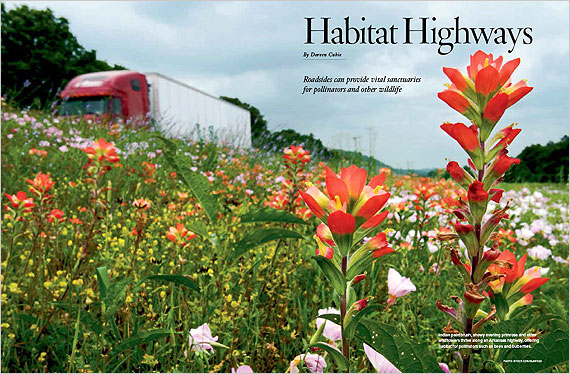
Photo: National Wildlife Federation.
More people are realizing that the 17 million acres of US roadsides are vital sanctuaries for pollinators and other wildlife.

Back in the day, when my mother was active in the Rockland County Conservation Association, I learned more about preventing soil erosion using Crown vetch along the new Thruway than any normal kid should be expected to know. Today the plant is considered invasive and the vision for highway landscaping has evolved.

A recent report from the radio show Living on Earth offers the latest thinking.

“Some 17 million acres of green space line US highways and byways, and it’s vital habitat for pollinators, as well as small voles and mice and birds. Bonnie Harper-Lore, a restoration ecologist formerly with the Federal Highway Administration, tells host Steve Curwood about the value they offer to wildlife and how President Lyndon Johnson’s wife, Lady Bird, helped uplift this elongated haven for creatures and wildflowers.

“CURWOOD: Clover is a crucial source of nectar for many pollinators, especially bees. And as national pollinator week is coming up on June 21, it’s a good time to think about the many ways we can help our endangered pollinators, starting with our highways. It turns out that medians and roadsides offer miles and miles of vital habitats for many pollinators, including bees and butterflies. Bonnie Harper-Lore was a restoration ecologist for the Federal Highway Administration, and is a member of the Commission on Minnesota Resources. Welcome to Living on Earth, Bonnie. … We’re talking about those strips of vegetation along the highways. There’s often commercial or residential property right behind them. So, nationwide, just how much of this habitat is there?

“HARPER-LORE: Well, I think the listeners will be surprised to find out that the area between the pavement and the right of way fence on county, state, and interstate highways adds up to a total of 17 million acres, possibly millions of acres of conservation opportunity. … I always saw roadsides from the beginning of my career 30 years ago as an opportunity to benefit wildlife, small wildlife, small birds, small mammals, and migrating birds also use these same corridors. So if they have places to find food and cover, they are all going to do better and their populations will continue to hold where we need them to hold.

“CURWOOD: By the way, I also understand that this roadside habitat has some of the most endangered habitat in various areas – like there are parts of the original prairie that are protected alongside roads, sort of by accident. You can sometimes find real old-growth trees. I mean, how much of a treasure trove is this territory?

“HARPER-LORE: Well that’s just it: We don’t have a complete inventory of all of our roadside vegetation.

I would indeed like to see [an inventory] because I think we would be surprised at how many remnants of these old forests, old prairies, old wetlands even do exist.

“We began doing a bit of that inventory in 1993 in California – found 19 remnants within a very short time and began protecting them, managing differently, not mowing and spraying as they had in the past. So there are some of these. I mean, it’s surprising that they do exist. I know Florida has also some endangered, I believe, pitcher plants that are growing in their rights of ways and they are now watching over them differently than they have in the past. So if we know they’re there we can do differently.

“CURWOOD: So, give us the big picture as to who are the partners in these pollinator conservation efforts.

“HARPER-LORE: Well, first of all, before President Obama visited Mexico and talked to President Nieto and Prime Minister Harper from Canada and they agreed to work together to protect Monarchs – before that point, there were actually a few states that were doing pollinator-focused efforts. Wisconsin comes to mind in that the Karner Blue butterfly is an endangered species, and they actually put together, I believe, a 20-member partnership quite a few years ago to protect the Karner Blue. [That] partnership was mostly private sector, but some state and county agencies, too. … Every state Department of Transportation basically does its own thing, makes its own priorities, but now that there’s been … a reauthorization act that actually supports pollinators, all of the states will start moving in that direction, especially if they know the public is interested. So public support needs to be there.

“CURWOOD: Tell me about the multistate project known as the I-35 corridor, and what’s been done in terms of Monarch protection there? …

“HARPER-LORE: Back in 1993, a group of six states asked the Federal Highway Administration, where I worked at the time, to work together and get some funding to support their effort to actually restore prairie along the I-35 corridor and to protect any remnants that already existed there. … It runs from Minnesota through Iowa, Kansas, Missouri, Oklahoma and Texas, therefore connecting Mexico to the edge of Canada and of course that’s where the Monarchs fly.

“CURWOOD: What other wildlife uses this roadside habitat? …

“HARPER-LORE: I’ve watched hawks, all kinds of raptors, sitting on the light standards along highways and signposts just waiting for lunch to materialize down there in the vegetation on the roadside. Yes, they do well there because there are lots of mice and voles, other small things possible, plus one that actually motivated reduced mowing here in the Midwest, pheasants and other waterfowl, different kinds of ducks will nest in these rights of ways. …

“It’s because of Lady Bird Johnson that my job even existed with the Federal Highway Administration. I was working for the Minnesota Department of Transportation establishing their wildflower program back in the 1980s when I got an invitation from Mrs. Johnson to come visit with four other states who were also interested in planting wildflowers and we sat and talked with her for two days, and the thing we didn’t know she would do — because she asked us what did we need to be able to do more — within that same year, she saw to it that there was an amendment to the transportation bill that requires all states to use certain percent, not a large enough percent, but a certain percent of their budgets on native wildflowers.”

More at Living on Earth, here.

Read Full Post »