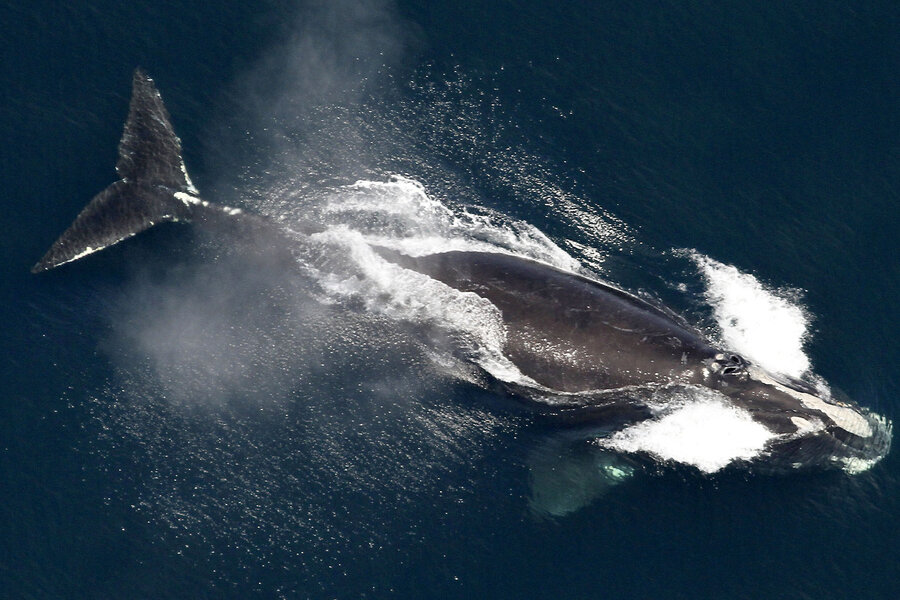
Photo: NOAA/AP file.
A North Atlantic right whale swims in New England waters.
Can we save treasured wildlife if we try? I can’t help thinking that before we pushed dodos and passenger pigeons to extinction, humans were not as aware. Now that we understand the dangers of losing species, can we put in the extra effort to preserve them?
Some humans are all in on protecting one particular species — the North Atlantic right whale.
Nate Iglehart reports at the Christian Science Monitor, “By the time Herman Melville wrote Moby Dick in 1851, New England was already famous for its whaling industry – hunting the North Atlantic right whale to near extinction. …
“Today, the once-targeted whales are prized conservation targets as New England leads efforts to bring them back from the brink. An emerging linchpin to their survival is taking form in a small but mighty network of coastal signaling devices.
“North Atlantic right whales are one of the most endangered large whale species in the world, with only about 370 left. Although whaling was almost entirely banned worldwide in 1986, the whales’ numbers have not recovered. Eleven new right whales were born this year, far below the 50 per year needed to create a stable population. Some models predict their extinction by 2035. …
“Now, everyone from fishers and marine ecologists to maritime corporations and coastal residents [is] leaning into technology to help stem the decline. …
“Mariners already try to avoid whales to protect the animals and their ships. But they don’t always know when one is around. When a whale is spotted, the National Oceanic and Atmospheric Administration (NOAA) sets up a slow zone, in which mariners are asked to slow their speed to 10 knots (11.5 mph) or less to reduce the likelihood of hitting a whale and the risk of fatally injuring it. The zones are separate from seasonal management areas, which have mandatory speed rules.
“Boaters are mainly alerted through email and text updates, and an app called WhaleAlert, which acts as a database for whale sightings and slow zones, says Greg Reilly, the International Fund for Animal Welfare’s marine campaigner. However, both need an internet connection, which is not required for boaters and is often spotty at sea.
“That’s where Moses Calouro, CEO of Maritime Information Systems, comes in. Over the last two years, Mr. Calouro has partnered with businesses, nonprofits, and coastal towns to install devices called StationKeepers along the entire Atlantic coast. These small 20-pound boxes sit high on coastal buildings and lighthouses. Using an Automated Identification System (AIS), they transmit locations of whales and speed zones directly to the navigation screens of ships. …
“Mr. Calouro’s 2024 pilot program focused on the Stellwagen Bank National Marine Sanctuary, an underwater plateau and feeding ground for right whales off the coast of Cape Cod. Upon entering, over 85% of ships slowed down, with an additional 10% doing so after receiving an automatic message warning.
Pete DeCola, the sanctuary’s superintendent, says the StationKeepers, combined with other efforts already under way to protect right whales, have reduced the risk of ships encountering whales by over 80%. …
“In 2010, NOAA researchers at the sanctuary created a program with the Massachusetts Port Authority and the International Fund for Animal Welfare that grades boaters and companies on their compliance. Last year, 91% of the 104 companies … that passed through slowed their boats appropriately. …
“Vessels that didn’t slow down were mainly new to the area. … That lack of knowledge is another challenge Mr. Calouro’s system aims to address. Mariners are skilled at avoiding hazards; it’s what they do for a living, says Mr. Reilly. But ‘they have to know where the hazard is.’ …
“But perhaps the biggest threat to North Atlantic right whales is entanglements, often in fishing gear. Even if the whale survives the tangle, the damage and stress of thrashing in the lines hurt their ability to give birth, says Courtney Reich, coastal director of the Georgia Conservancy.
“Technological advancements can reduce the need for buoy lines. Mike Lane, a lobsterman based out of Cohasset, Massachusetts, has worked with the underwater technology company EdgeTech to create prototypes of ropeless fishing gear. Typically, rope connects traps with buoys at the surface. But with ropeless gear, the traps use pop-up buoys, lift bags, or buoyant spools that, when remotely triggered, inflate or detach and bring the trap to the surface for collection.
“The gear is not perfect, Mr. Lane says, but it allows lobster fishers to keep working during the months that fisheries close due to the whales’ migration paths. He says that extra work can help lobster fishers financially, and it helps to know their gear is not snagging whales.
“But this gear, compared with a buoy and rope, is costly and can stress the fishers’ thin profit margins. There’s also a learning curve. … One of the biggest issues, he says, is keeping track of the traps so they don’t interfere with other fishers. If you tried to plot hundreds of ropeless traps in the water, the mapping data would be too cluttered to use effectively. Losing the expensive gear would be devastating. …
” ‘I’m not a huge fan of it,’ he says. ‘It’s not the way I prefer it. … The [mapping] technology is there; someone’s just got to package it properly.’ “
More at the Monitor, here. No paywall, but supporting this great news source is reasonable.










 Suzanne's Mom's Blog