Feeds:
Posts
Comments

Posts Tagged ‘salamander’

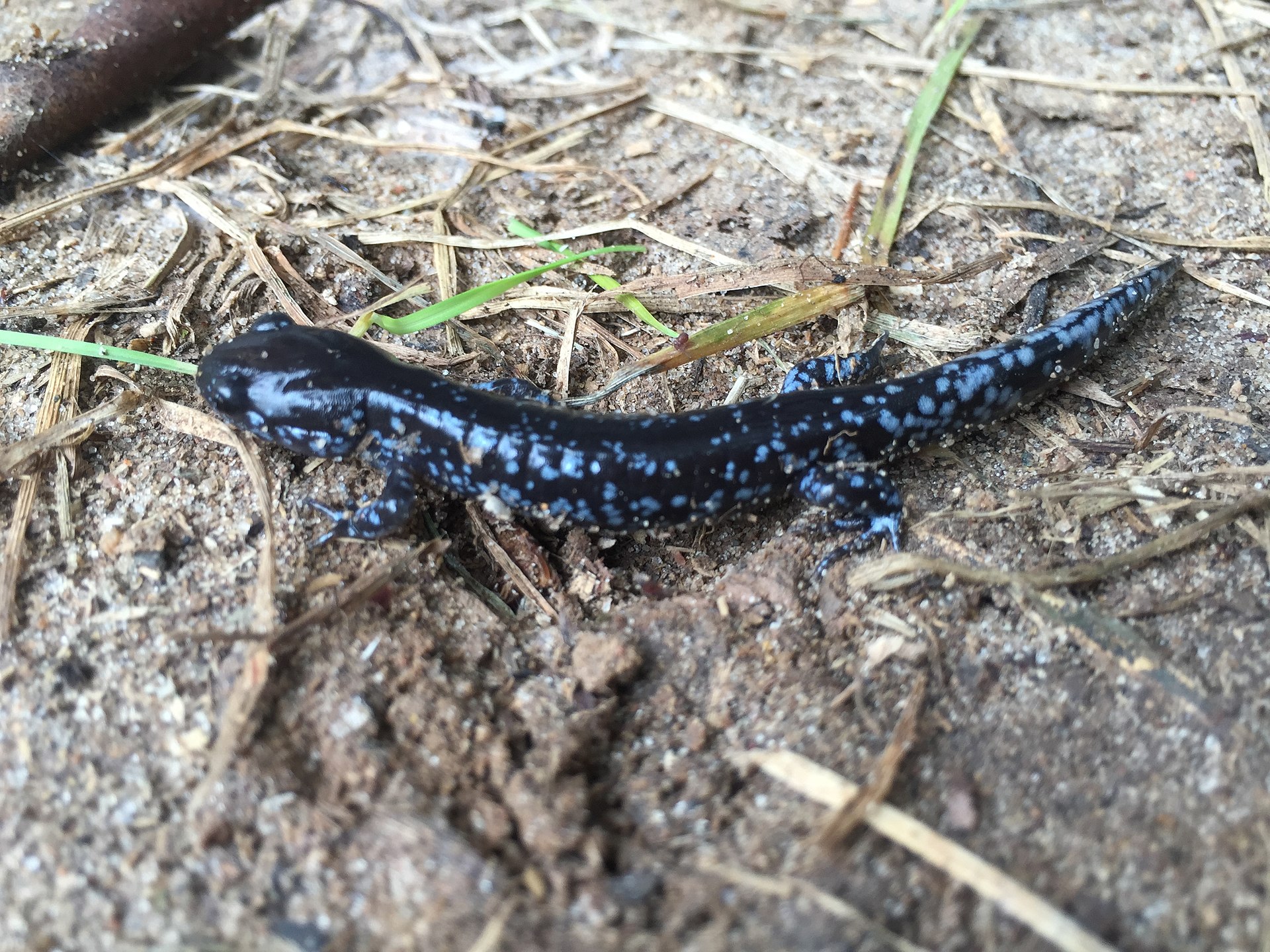
Photo: Elucius/Wikimedia.
Blue-spotted salamander (Ambystoma laterale).

Anyone can make a difference, as students in Michigan learned when they decided to do something about cars killing salamanders in migration season.

Cathy Free reports at the Washington Post, “Eli Bieri noticed something disturbing as he walked through Presque Isle Park in Marquette, Mich., a few years ago.

“Several dozen blue-spotted salamanders had been smashed by cars while they were crossing from the forest to the wetlands on the other side of the road during their annual migration to breed and lay eggs. …

“ ‘I’ve always loved salamanders, and it really made me sad,’ said Bieri, 23, then a freshman ecology student at Northern Michigan University in the Upper Peninsula, about the 4-inch, bug-eyed amphibians, a common species in east-central North America. …

“ ‘I saw them crossing the road en masse,’ said Bieri, adding that they go to their breeding ponds when the weather is just right — rainy and 30 to 40 degrees.

“The following year, Bieri said he knew he had to do something to help the blue-spotted salamanders that were being crushed by people who drove their cars into the park to stargaze, not knowing any better.

“ ‘I’ve been fascinated by swamps and ponds since I was a kid chasing frogs and turtles, so of course, I was out there,’ he said. … He started a university research project to figure out how many of the salamanders were being killed by tires in Presque Isle Park every year.

“ ‘It’s impossible for a driver to see them at night because they’re black and the asphalt is black,’ said Bieri, explaining that the long-tailed salamanders move slowly, increasing their chance of being squashed.

“Bieri checked the park road every day for several weeks. … He got other students to help with his research, and together they tagged salamanders to get a feel for their numbers, he said.

“They found about 400 dead salamanders on the road that spring, and learned that many of them were getting wiped out on the park’s main thoroughfare every year, Bieri said. He released his findings, and upon seeing them, Marquette decided in 2020 to block a quarter-mile section of the park’s main road during migration season, from 8 p.m. to 8 a.m.

“That year, Bieri found only three salamanders flattened by car tires, a big victory.

“The road closure now happens every year, and other groups joined the city to help let the public know about the salamander’s plight, including the Superior Watershed Partnership and Northern Michigan University.

“Once residents found out about the salamanders, they flocked to the park to see them, leaving their cars in safely designated areas, and searching for the critters on foot, Bieri said. …

“Although blue-spotted salamanders are not endangered, they’re an indicator species that can alert humans to problems in the ecosystem, said Tyler Pendrod, a program manager at Superior Watershed Partnership, a lake protection group in Marquette.

“ ‘What’s really cool about Eli’s research is that a lot of educational programming has come out of it,’ he said. ‘Children are experiencing nature in a way they never did before.’ …

“Blue-spotted salamanders venture out only in full darkness and they’re best viewed with a flashlight on a rainy night, Bieri said. He said he is delighted to see families carefully walking along the roadside at night with flashlights, hoping to catch the beginning of the spring migration, when the salamanders come out in droves. “

More at the Post, here.

Read Full Post »

I’m hearing more and more these days about “good bacteria,” including in a song by singer-composer Will McMillan on the friendly bacteria we humans carry around.

Now, it seems, bacteria found in soil may help to save amphibians from dangerous fungal epidemics. Public Radio International’s environmental news program, Living on Earth, has the story.

“Around the world, fungal diseases have been killing millions of frogs and bats and snakes. And a newly emerging disease in salamanders in Europe is scaring biologists here, so the US Fish and Wildlife Service has introduced a ban on their import to try to protect amphibians in the US.

“But now scientists see some hope in soil bacteria that get onto the salamanders and frogs and apparently protect them. Doug Woodhams is an assistant professor of biology at UMass Boston, who’s been working with amphibians in Panama – and he explained what his team has found to Living on Earth’s Helen Palmer.

“WOODHAMS: Some of the amphibians have beneficial bacteria that live on their skin and these have antifungal properties.

“PALMER: This is kind of like having good bacteria in your gut, for instance, that stop you from getting sick. … Is there any evidence that  good bacteria actually work against devastating funguses?

“WOODHAMS: Yeah, there’s quite a bit of evidence. Many of the bacteria that we can culture from some amphibian species are able to inhibit the fungus in culture. We also have some population-level data that shows populations that tend to have these antifungal bacteria can persist with Bd in the environment and survive. …

“Bd is the chytrid fungus that’s been spreading around the world and devastating amphibian populations. So salamanders, frogs, toads. Populations that tend to have more of these beneficial bacteria seem to be surviving, and populations that don’t have as many of the individuals that have these bacteria seem to disappear. …

“The next thing we want to try is adding some of these bacteria, not just to petri dishes, but to soil and see if infected amphibians can be cleared of their infection by being housed on soil that’s been inoculated with these bacteria. …

“There are other fungal pathogens, so it could be something that you could apply in a cave that could reduce White-nosed syndrome [in bats]. Also, rattlesnakes have been recently affected by fungal disease during hibernation, so it could be applied into a rattlesnake den.”

More on the science here.

Photo: Matt Becker
The Appalachian Mountains are home to this Cow Knob Salamander, Plethodon punctatus, from George Washington National Forest, Virginia.


Read Full Post »

I used to love finding little red salamanders when I was a child.

I didn’t know they played an important role in the ecosystem, even balancing out processes that contribute to climate change. Of course, when I was a child, nobody talked about ecosystems or climate change. But I’m glad to learn salamanders are important. Small things often are.

Writes Richard Conniff in the NY Times, “According to a new study in the journal Ecosphere, salamanders play a significant role in the global carbon cycle. …

“The study — by Hartwell H. Welsh Jr., a herpetologist at the United States Forest Service’s research station in Arcata, Calif., and Michael L. Best, now at the College of the Redwoods in Eureka, Calif. — notes that salamanders’ prey consists almost entirely of ‘shredding invertebrates,’ bugs that spend their lives ripping leaves to little bits and eating them.

“Leaf litter from deciduous trees is on average 47.5 percent carbon, which tends to be released into the atmosphere, along with methane, when the shredding invertebrates shred and eat them.

“If there aren’t as many shredders at work and the leaves remain in place, uneaten, they are covered by other leaves. … The anaerobic environment under those layers preserves the carbon until it can be captured by the soil, a process called humification.

“At least in theory, having more salamanders in a forest should mean fewer shredding invertebrates and more carbon safely locked underground.”

Read how they tested their theory, here.

 Photo: Todd W. Pierson/University of Georgia

Read Full Post »