Feeds:
Posts
Comments

Posts Tagged ‘script’

Photo: Marvin Joseph/The Washington Post.
Cursive club at Holmes Middle School in Alexandria, Virginia, has been surprisingly popular. Halle O’Brien, 12, has taken cursive back to her regular classroom.

Many adults have forgotten the cursive writing they learned in school. They felt no need to keep it going when it felt easier just to print or type. Nowadays, those of us who help out with PostcardsToVoters are told to print the messages because so many people don’t read cursive.

Today’s story is about kids who think learning cursive is a hoot. It also suggests how writing in script is good for the brain.

Karina Elwood writes at the Washington Post, “The group of preteens uncapped their markers and began practicing how to capitalize two new letters: ‘B’ and ‘Q.’ The lesson felt like a return to the basics. Only this time, the middle-schoolers were learning to write, many for the first time, in cursive.

“Sherisse Kenerson, a multilingual teacher at Holmes Middle Schoolin Alexandria, Virginia, leads a club of sixth- through eighth-graders who want to know the art of looping and curving their letters together.

“The attention her small club has attracted surprised Kenerson. Local news stories, thousands of social media comments. Teachers from as far as Oklahoma asking how they could bring something similar to their classrooms.

“If boomers and Gen X are puzzled that many youngsters are not required to endure the same painstaking labor of mastering cursive that they were, they might be even more surprised — perhaps, even delighted — to hear that some are learning the craft entirely for fun. …

“In the early 2000s, as technology picked up, cursive was declared all but dead. By 2006, only 15 percent of SAT essays were written in cursive. The Common Core standards released in 2010 did not include cursive as a required curriculum, leading to states around the country to drop the requirement.

“But in the years since, there has been a steady effort to preserve the art by historians and educators like Kenerson. Clubs, camps and optional classes like hers have popped up around the country. …

Research suggests handwriting is a key tool for learning and memory. It activates brain activity like motor, sensory and cognitive processing better than typing does.

“ ‘Even in the age of technology, I think that handwriting is here to stay,’ said Shawn Datchuk, a professor of special education at the University of Iowa who has written about the benefits of handwriting for teaching literacy. …

“Datchuk said he suspects research about the cognitive benefits of handwriting, paired with the affordability of teaching it, are key drivers behind the resurgence. But another factor could be how personal and emotionally resonant cursive is, especially for older generations. …

“[Datchuk said,] ‘It really becomes kind of a thumbprint or fingerprint of our entire development.’

“That’s the appeal to Kenerson, who launched the cursive club four years ago when her students couldn’t read a word she had written in flowing script on the whiteboard. In her after-school program, she reminds students that cursive is personal. It’s their own handwriting and can have its own flair.

“Halle O’Brien, 12, had never learned cursive before the club. Her grandfather, who was set on helping her improve her handwriting, had tried to teach it to her, but she found it too hard, she said.

“But something about cursive club just clicked. She finds herself writing in the script for class assignments. It’s easier for her than printing. It’s quicker than typing.

“ ‘People who know cursive can read and can write it so smoothly without needing to concentrate on the letters,’ Halle said. …

“Halle sees practical value in her new skills beyond bragging rights to her friends. She recalled a history field trip where none of the students could read the Declaration of Independence.

“ ‘I tried to read it, but I had no idea how to do it,’ Halle said. ‘I actually heard some people doing cursive clubs so that they could learn how to read the Declaration.’

“The need for cursive readers led the National Archives to put out a call for volunteers to help transcribe historical documents and artifacts. …

“Datchuk said there are also links between writing in cursive and better spelling skills. You have to know how to spell a word entirely before writing it in cursive, he said. That was evident in Kenerson’s classroom. Before writing the word “spectacular” in cursive, Sarah Stephens, 11, carefully spelled it out in print at the top of her paper. …

“The sixth-grader came into the club ahead of some of her peers. She first learned cursive in second grade while enrolled in private school. There, she said, students were expected to write completely in cursive by fourth grade. The school even held an annual cursive competition. …

“For all of the benefits she sees in cursive, Kenerson guesses that students are drawn to the club for the same reason she was eager to learn cursive as a child: It made her finally feel grown up. …

“ ‘I think it empowers them, because they know that everyone cannot write it.’ ”

More at the Post, here.
Read Full Post »

794

Photo: Guenter Schneider/Kaoru Akagawa
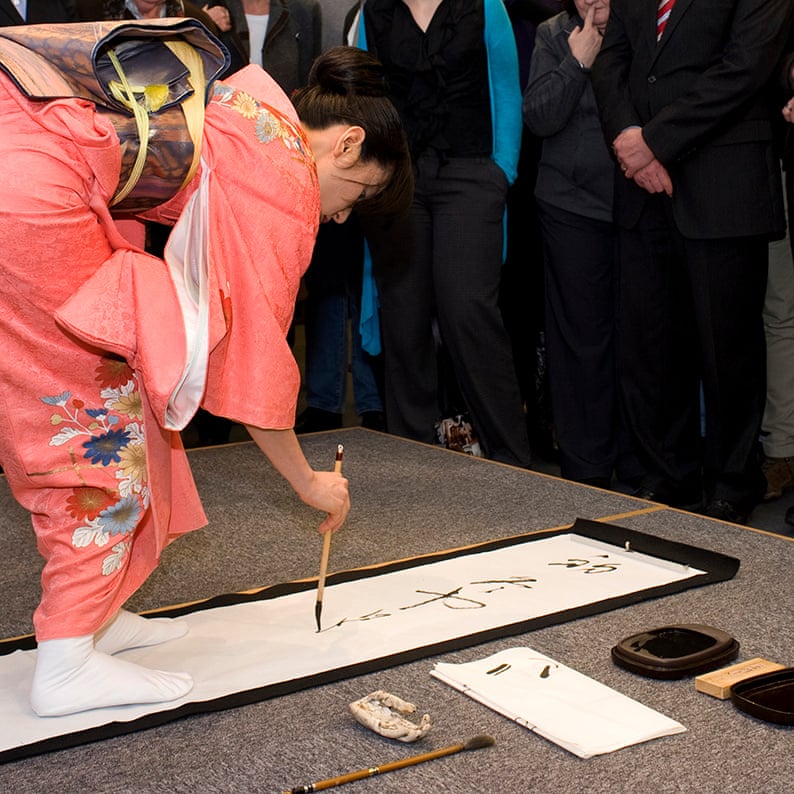
An artist rediscovers kana script, used in medieval Japan by women for secret communications. “I felt as if I were reading a history of my DNA,” Kaoru Akagawa says.

In childhood, I loved the idea of secret languages, mainly for hiding thoughts from grownups, I believe. I never learned Pig Latin, but when I was about 10, my friends and I spoke almost nothing but Goose Latin, which involved throwing a lot of f’s into words.

In medieval Japan, women developed a secret script to hide their thoughts from other authority figures — men. Today the artist Kaoru Akagawa, among others, is giving the mostly forgotten kana calligraphy new life.

Elizabeth Dearnley writes at the Guardian, “Anyone who has ever fired off a text in haste will sympathise with the first point on 11th-century Japanese writer Sei Shōnagon’s list of ‘infuriating things’: ‘Thinking of one or two changes in the wording after you’ve sent off a reply to someone’s message.’

“This list, her messages, and her Pillow Book in which they’re recorded – a sparklingly acerbic, blog-style frolic through the lives of Heian-era aristocrats – were written using kana, a Japanese script mainly used by women for nearly a millennium to write literature, arrange secret assignations and express themselves freely within the confines of court life.

“Women in medieval Japan were discouraged from studying kanji – characters modelled on written Chinese which represent individual words – and began using kana, which transcribe words phonetically. A standardisation programme at the beginning of the 20th century saw 90% of the 550 characters used in kana die out. But these forgotten characters are now being kept alive by the artist and master of Japanese calligraphy Kaoru Akagawa, who became fascinated with them after deciphering letters from her grandmother.

“ ‘Reading my grandmother’s letters was always difficult for me as a teenage girl,’ recalls Akagawa. ‘Her handwriting looked like scribbling, and I used to ask her to write properly.’ But years later, during Akagawa’s calligraphy training, she had a revelation while taking a journey along Himekaido, a historic trading route favoured by women travellers. Reading documents written in kana housed in castles and temples, Akagawa says: ‘I felt as if I were reading a history of my DNA.’ Far from being scribbles, she realised, her grandmother had been writing to her using the same script.

“Akagawa uses the forgotten kana in a style of calligraphy called kana shodo, and also fuses traditional calligraphy with new techniques in a style she’s named kana art, where thousands of minutely painted kana form larger images and paper sculptures

“ ‘When people talk about Japanese calligraphy, they normally mean kanji shodo,’ Akagawa explains, ‘a style imported from China, practiced by samurais and monks.’ Kana shodo uses a script which was known by the 10th century as onnade, or ‘woman hand’, she continues, which became ‘the backbone of a female-dominated literary culture’.

“Sei Shōnagon’s contemporary Murasaki Shikibu wrote her masterpiece The Tale of Genji – often called the world’s first novel – using kana, which were often associated with private and emotional life. Men who wanted to reply to love letters sent by noblewomen used kana themselves to reply. And the tradition lasted for hundreds of years; the 19th-century novelist Ichiyō Higuchi used kana script for her sympathetic portrait of the life of a geisha, Nigorie (Troubled Waters).

“Japan’s government standardised writing in 1900, establishing the system of kanji, hiragana and katakana characters used side-by-side in modern written Japanese. … By the second world war, knowledge of the older kana had almost vanished. One of the last generation to use the script in daily life was Akagawa’s grandmother, born in 1921: ‘When I told her I was learning kana shodo, she was very pleased.’ …

“Whether writing Japanese classics, love letters or embroidered messages, women have circumvented official communication channels in creative ways throughout history. As Akagawa remarks, such handwritten texts frequently feel very personal: ‘I’m always surprised how such a simple action as handwriting can affect audiences’ emotions so deeply.’ ”

More at the Guardian, here.

Read Full Post »

Although Ginia Desmond had been writing scripts for 12 years, she had never made a movie. Now at 74, she has risen to the challenge.

Johanna Willett writes at the Arizona Daily Star, “Ginia Desmond had a decision to make. Buy a house. Make a movie. Buy a house. Make a movie. She made a movie.

“The 74-year-old has been writing scripts for a dozen years, but ‘Lucky U Ranch’ is her first feature-length film to make it to the big screen.

“That’s because she funded it.

” ‘I consider myself the writer,’ she says of the low-budget film, which so far isn’t readily available for viewing. ‘I wrote the script, and I wrote the checks.’

“Writing screenplays is not Desmond’s first career — or even her second. This act follows others that starred Desmond as a mother and wife, professional artist and businesswoman. …

“For almost 30 years, she imported goods such as furniture and baskets to sell in her Tucson store Sangin Trading Co. on Sixth Avenue. She sold the business in 2003. …

“ ‘Ginia is an interesting combination of very creative and very practical,’ says Victoria Lucas, a Tucson screenplay consultant with a 20-year career in Los Angeles.

” ‘She has that sense of the big picture and how a business is run, and with her writing skills and talent, she has the ability to understand characters. … Very few writers write visually so that when you read the script, it’s like you have seen the movie. … Ginia writes like that. She has a real gift for getting under the skin of characters and making the reader or audience understand them. … She is a treasure for Tucson.” Read more here.

Thank you, Cousin Claire for posting the story on Facebook. Like Desmond, Cousin Claire lives in Tucson, and she has at least one script stored away somewhere about an adventurous female ancestor. I read it. And I know for a fact she is under 74, so …

Photo: Kelly Presnell/Arizona Daily Star
Ginia Desmond, 74, is reflected in her movie poster’s glass.

Read Full Post »

An experimental theater piece to test the Theory of Purposefully Divided Attention to Fend Off Meltdowns.
Cast: Grandma (G), Adult One (1), Adult Two (2), Adult Three (3), Small Child (Small)
Setting: Dinner table

G: Why is your hairdresser your hero?

1: She’s a real bootstrap entrepreneur. She’ll try anything.

G: Is that a blackberry in your popsicle?

Small: No, a blueberry.

2: Well, when you have kids, you can’t participate in every charity event or random partnership.

3: You have to prioritize, be strategic. Know when to say no.

1: But she has a great community reputation. She’s so upbeat.

G: I really think that’s a blackberry. Like Mrs. Rabbit’s in Peter Rabbit. Supporting everything in the community can add up.

1: It rolls up.

3: But you can waste a lot of time.

2: And energy.

G: People are grateful, though. If you’re strategic, you miss the kind of opportunities that you have no idea where they will lead. I like the way that popsicle drips right into the holder. It’s less messy.

Small: Do you want one?

G: I don’t want to take your last popsicle.

Small: We can make more.

G: Maybe after dinner.

Small: Let’s do it!

G: Careful — the juice is spilling. One and one and 50 make a million. It’s good to be open to serendipity if you possibly can.

2: There are only so many hours in the day.

3: Numerous small investments can’t get what one big investment would.

G: Do you want a napkin?

Small: I got a green popsicle at Whole Foods, but it dripped all over my dragon shirt. It was green.

G: There is nothing like a reputation for being upbeat and cooperative. I know where we can pick blackberries for the next batch of popsicles.

Small: But you have to add juice so it sticks together.

1: We now trade services. She does that with almost everyone. I feel like she could teach a class in entrepreneurship.

G: Teach one together, how about?

Small: Do you want a popsicle? Do you want one now?

G: Maybe after dinner. Look, that’s a raspberry. Or do you think it’s a strawberry?

Small: Do you want a popsicle now? I can go get it. We can make more later. Yes or no?

G: OK. Yes.

Small: Say, Please.

G: Yes, please.

Photo: Matthew Klein

Read Full Post »

Hidden Faces of Courage, a “theater piece with music” created by Mary Driscoll in collaboration with formerly incarcerated women, is coming soon. I will write more after I have seen the production in November, but I need to alert you that if you want tickets, you might want to get them now as the performance space is rather small. Go to Fort Point Theatre Channel, here.

I met Mary in the playwriting class that I blogged about a few times. I didn’t continue with theater after the class, but Mary kept working at this play. She has a deep commitment to helping women who have been in prison, having worked with them for years at her nonprofit, OWLL (On With Living and Learning Inc.).

Mary writes: “The voices of previously incarcerated women are notably absent in the artistic world—a world that can engage a broader community in reform and foster greater understanding between the individual and diverse audiences. Sometimes in unexpected ways.”

Read more about her show at Broadway World, Boston, here.

Hidden Faces of Courage is directed by Tasia A. Jones, with music by Allyssa Jones, and runs November 8-10, 15-17,  at The Boiler Room, 50 Melcher Street, Fort Point, Boston.

Read Full Post »