Feeds:
Posts
Comments

Posts Tagged ‘socialize’

Photos: The Literary Cat Co.
Since Literary Cat Co. opened in Kansas about a year and a half ago, 32 of the store’s foster cats have been adopted by bookstore customers.

Today’s story is about a business in Kansas that meets two very different goals at the same time — and makes a lot of people in the community happy.

Sydney Page reports at the Washington Post, “At a bookstore in this Kansas town, three cats are on the full-time staff. Hank, a domestic longhaired cat, is the ‘regional manager.’ His job duties involve keeping track of the computer cursor and ‘sleeping in adorable positions 22 hours a day,’ according to the bookstore website.

“ ‘He’s the boss of this place,’ said Jennifer Mowdy, owner of the Literary Cat Co. in Pittsburg, Kansas — a bookstore that doubles as a cat lounge and feline foster home.

“Scarlett Toe’Hara, a black short-haired cat, who is polydactyl — meaning she has extra toes — is the ‘assistant (to the) regional manager.’ She is the front door guard, plant inspector and treat tester.

“Mike Meowski — a domestic longhaired cat with one eye, named after Mike Wazowski in Monster’s Inc. — is ‘assistant (to the assistant to the) regional manager.’ His role involves cuddling guests and quality control for boxes. …

“Mowdy opened the store in 2023 after 17 years as an educator. While teaching, Mowdy volunteered with animal rescues and fostered cats. She also loved bookstores. …

” ‘I decided I could do it; I could create something,’ Mowdy said.

“There are typically about seven cats — in addition to Hank, Scarlett and Mike — who live in the bookstore as foster cats. They’re ‘temporary staff,’ and Mowdy’s goal is for her customers to adopt them.

“ ‘We partner with a rescue, and when they get a cat that they think has a personality that would fit, or they haven’t been successful in adopting a cat through other means,’ she said. ‘If we have the room, we take them in.’ … The cats come from SEK Animal Advocates, a local rescue network. …

“Lori Seiwert and her husband adopted a brother-sister duo from the Literary Cat Co. shortly after it opened. The cats are named Frog and Toad after the picture book. …

“Frog, who is male, and Toad, who is female, turned 2 in February. Seiwert said she and her husband often stop by the store to visit Mowdy and play with the other cats.

“ ‘It’s a nice thing for such a small community,’ she said. ‘It’s very homey.’

“Most cats are adopted within six months of arriving at the bookstore, though some find homes much faster; others have stayed for up to a year. …

“Mowdy looks after the cats with Caitlin Fanning, a bookseller. They also have a volunteer who visits the store on Sundays and Mondays when it is closed to feed the cats and care for them.

“The bookstore is near Pittsburg State University, so college students often bring their own books to study there and snuggle some cats.

“ ‘We’ve got lots of cozy chairs and reading nooks,’ Mowdy said. ‘Lots of people don’t buy anything, they just come and play with the cats. That’s perfectly okay. We need to get the cats socialized, too.’ …

“The bookstore has become an environment for shy or unsocialized cats to get comfortable around people. …

“Before leaving work for the day, ‘we just make sure everybody is fed and watered, and anybody that needs meds gets them,’ Mowdy said. ‘We tell them goodnight and don’t cause any trouble, and we see them in the morning.’ …

“As far as books go, the Literary Cat Co. carries a wide range of authors and genres.”

This bookstore sounds like a place that “shy or unsocialized” humans could make friends, too, but I can’t help wondering how long a bookshop can last if it doesn’t matter that “lots of people don’t buy anything”!

More at the Post, here. Lots of pictures.

Read Full Post »

Photo: Stefano Giovannini for N.Y.Post.
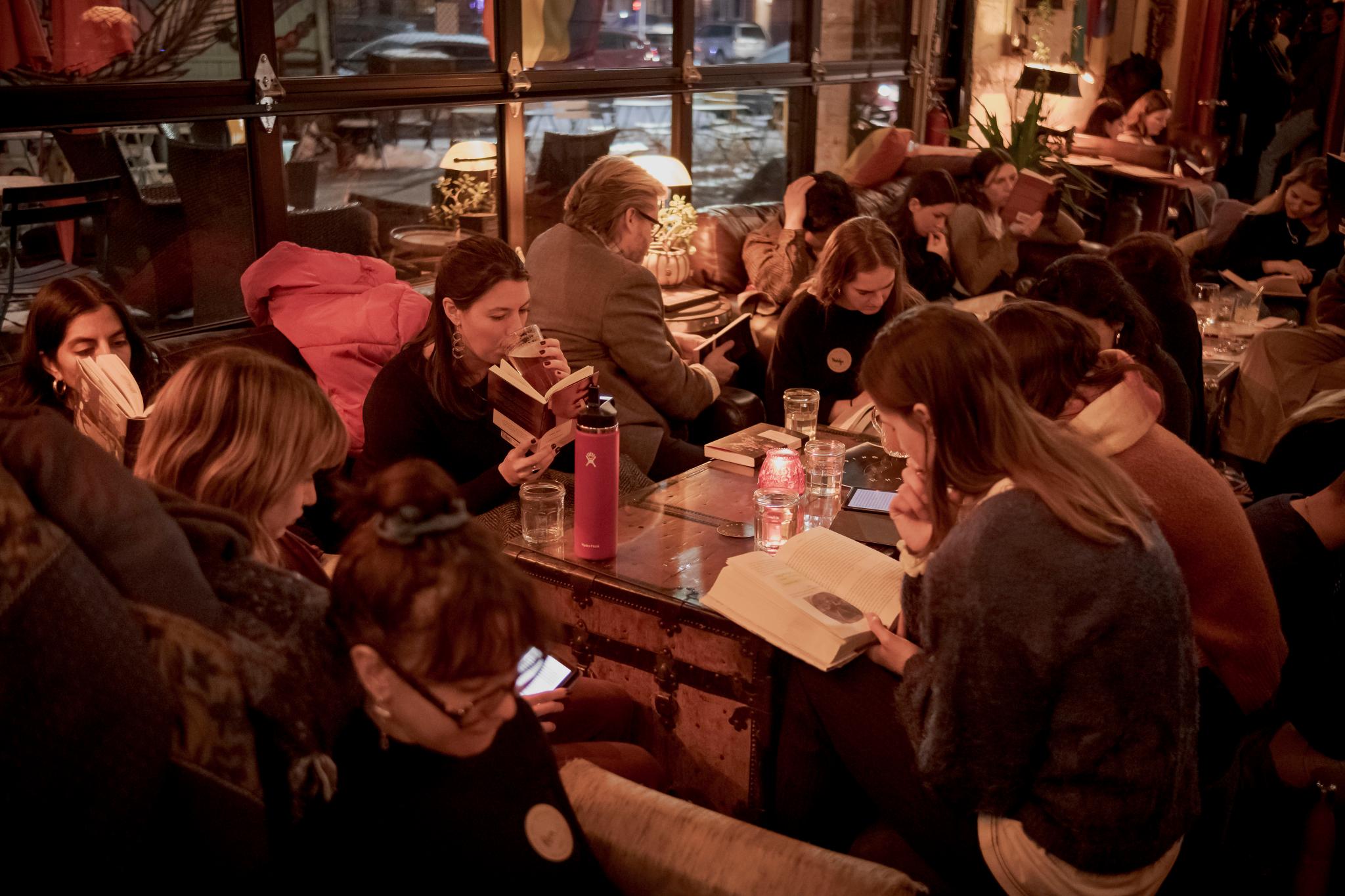
Reading Rhythms is ‘not a book club’ but ‘a reading party,’ says the NY Post, ‘where about 60 to 80 bookworms gather to read” in company — not all the same book, just whatever they happen to be reading.

Here’s an idea whose time has come: gatherings where people who love reading read whatever they like in the same place at the same time and maybe take a few breaks to socialize. It’s called a “reading party,” and the foursome behind the concept calls themselves Reading Rhythms.

Molly Young writes at the New York Times, “On a cold Monday in December, 65 people were gathered for Reading Rhythms, an event that bills itself as ‘not a book club’ but ‘a reading party.’ The parties, which began in May, take place on rooftops, in parks and at bars. The premise is simple: Show up with a book, commit to vanquishing a chapter or two and chat with strangers about what you’ve just read.

“The attendees that night, each of whom had paid a $10 entry fee, were the lucky ones: 270 people were on the wait-list to get in. …

“The idea for Reading Rhythms emerged when four friends in their 20s — Ben Bradbury, Charlotte Jackson, John Lifrieri and Tom Worcester — discovered a shared sense of alarm over the deterioration of their book consumption. The causes were what you’d expect: annihilated attention spans, too much socializing, the treacherous enchantments of the iPhone.

“Bradbury and Worcester, who are roommates, hosted the first event on their rooftop. A playlist was compiled, 10 friends showed up with books, everyone read for a bit and talked about what they’d read, and then … went home.

” ‘I got an hour of reading done and I hung out with some of my best friends, which I’d wanted to do anyway,’ [Bradbury] said. ‘That doesn’t usually happen.’ …

“The four solidified a format, gave the series a name, planned additional parties, opened up the invite list and started an Instagram account. Since May there have been parties in New York, Los Angeles and (of all places) Croatia. …

“At the event this month, none of the guests seemed to operate under the illusion that they’d reinvented any wheels. And ‘glorified library’ actually described the ambience well: Seating included antique armchairs, deep sofas and velvety settees; flickering votive candles emitted an amber glow; hot toddies and beer were available. …

“As the founders continued to host parties, they settled upon a structure. Attendees are given a name tag and half an hour to find a seat and settle in. A host then gets up before the crowd and explains the night’s schedule: 30 minutes of reading, a break, 30 more minutes of reading and then a set of discussions organized around loose prompts. Parties are held early in the week to capture gentle, non-weekend energy.

“Lifrieri, one of the founders, suggested everyone pluck an idea from what we’d just read and ‘turn to a stranger’ to discuss. An icy dart of trepidation shot through my body at the command, but to a stranger I turned: Dilvan, 29, who was reading Michael A. Singer’s The Untethered Soul.

“Dilvan shared a paragraph that she’d highlighted and we discussed its implications, which turned out to be mutually troubling. Conversation turned to other topics: Dilvan had moved to the United States from Turkey for college, specifically to study in ‘a cold location’ featuring snow. The idea of weather-based school selection was fascinating to me. Dilvan landed in Minnesota, which satisfied her temperature requirements and also prompted her to learn English rapidly thanks to the absence of other Turks in the area. …

“Reading postures varied. Some attendees sat cross-legged with a book resting lapwise. Others were curled up on a sofa. Many adopted a modified ‘The Thinker’ position. One man read his book standing ramrod straight, like a marsh bird. Not once did a cellphone chime.

More at the Times, here, and at Reading Rhythms, here.

Read Full Post »

Photo: Dominique Soguel.
Young migrants who arrive in Sweden alone become part of a “big family” with older people in this unusual living arrangement.

You may have heard of anti-immigrant sentiment rising in Sweden, a country that historically has been welcoming to victims of war and persecution. But no story is the whole story.

At the Christian Science Monitor Dominique Soguel reports about the ongoing generosity of many Swedes.

“It was when his older Swedish neighbors threw him a high school graduation party that Afghan native Zia Sarwary finally felt a sense of belonging in this picturesque seaside city [Helsingborg].

“ ‘It meant everything to me,’ says Mr. Sarwary, who at the age of 13 arrived alone in Sweden during the 2015 refugee crisis. ‘That was the beginning of feeling at home.’

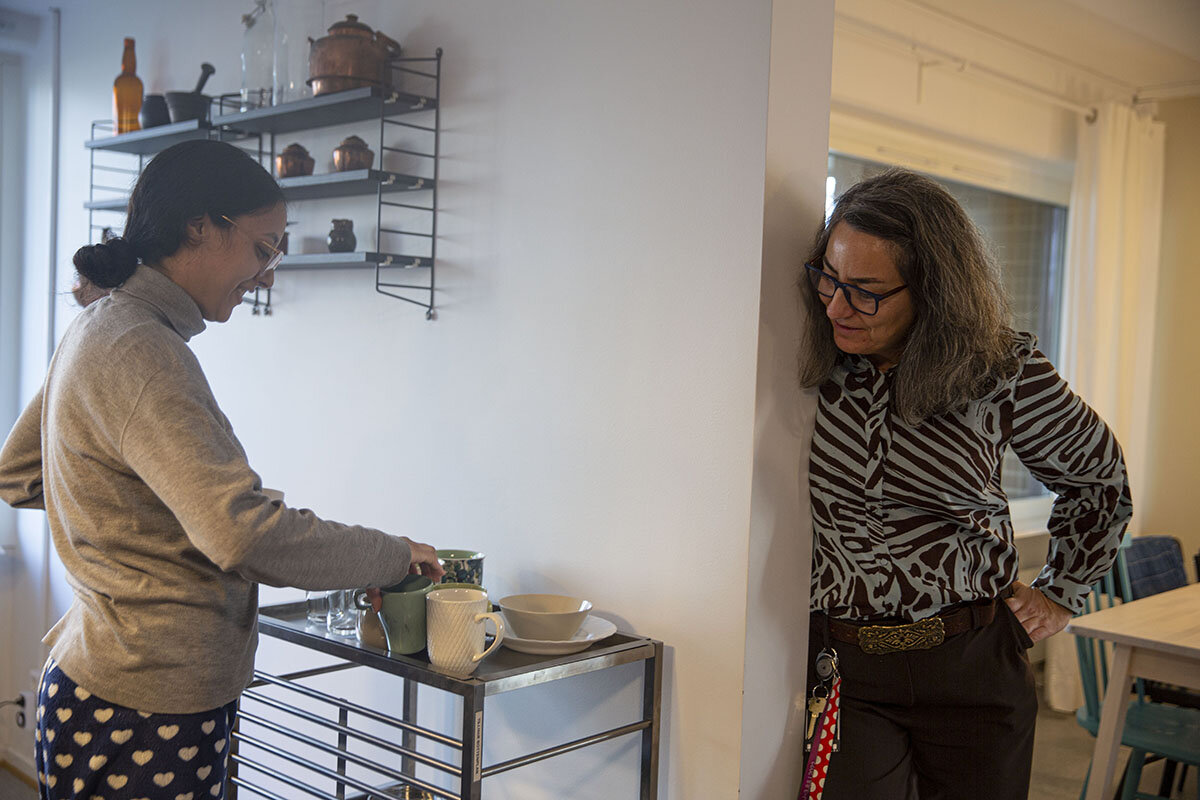
“Mr. Sarwary is one of dozens of tenants living in Sällbo, a shared-living project mixing elder Swedes and young adults, some of them from Sweden, others – like him – from the Middle East or Afghanistan. The six-story building with 51 apartments helps counter both the loneliness of advanced-age Swedes and the integration difficulties facing migrants who arrived as unaccompanied minors.

“Tenants of Sällbo have found common ground within these colorful walls, which they attribute to the cumulative impact of courtesy, kindness, mutual curiosity, and understanding.

“ ‘The whole goal was to show that even if you are different and even if you are people who would not usually socialize, you would do so if there is a safe environment where you know who is in the house,’ says Dragana Curovic, the project manager for Sällbo. ‘After three years, we can say that it worked.’

“Had they not moved under the same roof, the older Swedes and young migrants living here would almost certainly not have mingled. Fear and misunderstanding would have been major obstacles. Older Swedes’ impressions of young migrants draw heavily on negative press reports linking them to crime.

“As for the immigrants, their interactions with Swedes had largely been limited to asylum center officials – authority figures who set the initial tone for the newcomers’ experience, but weren’t focused on building bonds with them.

“Sällbo attempts to overcome that by getting tenants engaged with each other.

To move in, tenants must agree to socialize at least two hours per week.

“That can happen in shared kitchens, activity rooms, or cozy living areas. Each floor boasts three common areas, ranging from puzzle and scrapbooking rooms to libraries and film-screening rooms to carpentry workshops. Sun-kissed kitchens are set up for mingling, growing herbs, pickling, and baking. Artwork decorates the hallways. …

“Young and old concur that the pandemic helped strengthen the bonds that bind them. Younger residents did grocery shopping for the elders, who returned the favor by helping those with low computer skills keep up with their classes online.

“Now a logger working night shifts, Mr. Sarwary wishes he had even more time to spend with his older neighbors and feels bad when he needs to cut conversations short to catch his bus. After all, elders are treated with deference in Afghanistan. He believes curiosity feeds residents’ capacity to find common ground across cultures and age groups.

“ ‘People try to understand each other,’ he says. ‘I know you have your differences. I have mine. But we can meet in the middle ground and do something together that is good for both of us. There is a positivity in everything. That is the best part.’

“ ‘Sometimes you do things that are not correct,’ Mr. Sawary continues. ‘Instead of people coming in scolding you, they come in and they’re like, “Oh, you could do it this way.” ‘ …

“It helps that people understand that he had a tough background and approach him with an open mind to learn about his headline-grabbing, war-torn homeland.

“ ‘They would always ask instead of just judging. “OK, is this true about your country?” ‘ he says. …

“Jan Gustavsson, a retired provider of security systems, says he like helping young people from Afghanistan and other parts of the world integrate. ‘We can see in … Stockholm and Gothenburg, there’s a lot of problems. … I think it will help if these people live together with Swedish people.’ …

“Anki Andersson oversees scrapbooking activities on Tuesdays. Her husband, Kalle, helps fellow seniors do seated workouts. ‘Sällbo is the perfect place if you are mobile and seeking to socialize,’ says Ms. Andersson. ‘People here are so alike in a way. It is hard to explain. We click together very well, both the older and young residents. …

“ ‘If we have something we need to do or heavy things to carry, they give as a hand. We are a big family.’ “

More at the Monitor, here. No firewall. Nice pictures.

Read Full Post »

Following up on yesterday’s post, which highlighted simple pleasures like spending time in the library, I give you this report by Morgan Ribera at Bustle.

“Apparently, libraries provide patrons with a happiness that money can’t buy. Or at least nothing less than almost two grand in cash. According to a recent study commissioned by the U.K.’s Department for Culture, Media, and Sport, the act of going to the library induces joy equivalent to that brought on by a £1,359 ($1,878) pay raise.

“The study was conducted in an attempt to measure which activities have the most positive impact on an individual’s well-being. Visiting a library scored among the top joy-generating activities, alongside dancing and swimming, giving us yet another reason to hang-out at our local library. …

“And this U.K. study adds even more to the proof already stacking up on the value of libraries, a value that was evidenced extensively in a Pew Research Study released [in March]. The rather pleasing results of this eye-opening Pew study showed that habitual library goers maintain stronger community ties, are more likely to socialize with friends and neighbors, and exhibit higher levels of technological engagement.”

More at Bustle, here.
Photo: Bill Lapp

Read Full Post »