In environmental news, Lloyd Alter at Treehugger reports that an Irish county now requires new homes to meet the very high standard of energy efficiency calledpassive.
“In Ireland’s Dún Laoghaire-Rathdown County, a near suburb of Dublin, it’s now the law. …
“The building codes there are pretty tight already. And it’s not completely a done deal; the national Minister of the Environment, of all people, may challenge it out of concern that it might raise the cost of housing. However the local Passive House Association says that it’s not necessarily true, and showed case studies demonstrating that in fact they could build passive houses ‘at or below conventional build costs.’
“Writing in Passive House Plus, Pat Barry of the Irish Green Building Council noted that really, it’s all about just trades having the skills and doing the job right. …
“As many as 20,000 houses could be built in the county, houses that cost almost nothing to heat, produce almost no CO2, and are comfy as can be day or night, sun or no sun.”
“In rural Uganda,” writes Madeline Bishop for Global Envision, “light streams from the Ssenyonjo family’s windows through the night. The children inside sleep soundly, free from worry of snakes and thieves. They are prepared for the morning’s classes after an evening of study. What’s more, their lungs are healthy – no one wakes with coughing fits or fevers.
“But for nearly one-fifth of the world’s population that does not yet have solar power like the Ssenyonjo family, this vision of clean energy is still a dream. Some 1.3 billion people live without access to electricity. …
“Many companies are now taking on the achievable goal of increasing access to clean energy across the globe.
“For their solar programs to be successful, these companies focus on tailored marketing strategies to make sure the products are affordable, accepted, and culturally appropriate for the people who could most benefit from them. …
“Some solar manufacturers and energy distributors are helping people skirt [up-front] costs through creative financing models. …
“Customers can finance their own solar systems for less than what they would otherwise be spending on kerosene. [African solar company] M-KOPA reports a savings of $750 per household over the course of four years and 125 hours of fume-free lighting each month.”
Read about the wide variety of approaches to this work in developing countries here, including why Barefoot College has a “training program for grandmothers, who are more likely to stay put and use their knowledge for the good of their communities. … They learn how to install, maintain, and repair the solar systems and, upon graduation, receive a monthly salary for their work.” Hear, Hear!
Here’s a story about venture capital with a do-good focus.
Sacha Pfeiffer writes at the Boston Globe, “Among entrepreneurs, there’s a dreaded place called the Valley of Death. That’s where startup companies go when they run out of funding before making money on their own, and it’s an especially common fate for clean-energy startups, like manufacturers of solar panels and wind turbines. …
“But what if that early-stage, high-risk financing could instead come from philanthropists, who aren’t driven by profit? Later, traditional investors could step in and supply continued funding.
“That’s the concept behind PRIME Coalition, a year-old Cambridge nonprofit that has pooled $1 million from wealthy donors, including Hollywood actors Will and Jada Pinkett Smith, as seed money for its first investment: an energy storage startup company. …
“PRIME rethinks the traditional definition of charitable work and charitable giving. Its founder, 30-year-old MIT graduate Sarah Kearney, argues that companies whose products or services reduce greenhouse gases are doing a social good, just like soup kitchens and homeless shelters, so they should be able to receive philanthropic funding. In this case, the social benefits include conserving the environment and fighting climate change.
“The group searches for early-stage alternative energy companies … then locates philanthropists or socially minded for-profit investors to fund them. Those could include charitable foundations, investment offices of wealthy families, and donor-advised funds. …
“Peter Rothstein, president of the New England Clean Energy Council, said philanthropic funding ‘can make a significant dent’ in filling the need for early-stage capital for clean-tech companies.” More here.
It is not unheard of for philanthropy to put its investment dollars into companies that provide a social good. Read about the Heron Foundation’s decision to do so some years back in “Expanding Philanthropy’s Reach: Mission-Related Investing,” here.
Photo: Lane Turner/Globe Staff PRIME Coalition founder Sarah Kearney says that companies whose products or services reduce greenhouse gases are doing a social good and should be able to receive philanthropic funding.
Here’s a green-transportation update from the radio show Living on Earth.
“ELF stands for Electric, Light and Fun, And this particular Elf is an invention that launched with a Kickstarter in 2013. As Living on Earth’s Helen Palmer reported, it’s a human- and solar-powered, covered tricycle that aims to create a commuting revolution, and might just help combat climate change. Now two years on from the Elf’s Kickstarter campaign, its designer and developer, Rob Cotter, tells Living on Earth’s Helen Palmer how successful the invention has proved. …
“COTTER: Many years ago I was working for Porsche and BMW more on the race-car side of things — and I was living in Southern Calif. — and they were building the Gossamer Condor and Gossamer Albatross — the pedal-powered aircraft — not too far from me, so I kind of linked up with those folks. … I became vice president of land for human-powered vehicles, I built a 62 mph tricycle about 30 years ago — and once I realized you could go highway speeds at one horsepower — I realized how inefficient everything is that we do. …
“PALMER: [Elf] uses no gas at all: just human-power, sun-power and a battery pack with a 30-mile range. It’s not built for highways though — only for local roads, and bike trails, as federal regs say a bicycle can’t go faster than 20 miles an hour. Cotter says if enough people who drive about 30 miles a day climbed out of their cars and into an Elf, the effect on greenhouse gas emissions could be startling. …
“COTTER: Each one of these on the road takes about 28 tons of CO2 out of the atmosphere per year — so 100 of these on the road are equivalent to a 4-megawatt wind turbine at about 20% of cost. … The base price is $4,000 [and] we have over 400 orders or reservations currently, just from our website.
“PALMER: And that was before the Kickstarter campaign got underway — they reached their $100,000 funding goal in 12 days, and 40 people have actually paid for the vehicles. …
“COTTER: We actually worked with an organization in San Jose that trains homeless people to become bicycle mechanics, so we went there as kind of a test pilot to see who could build this and how, and in a week’s time we taught them how actually to build ELFs, and maintain them, and service them …
“COTTER: People are using them all winter long in places like Canada. They’re pulling trailers, 500, 600-pound trailers around with snow-blowing equipment and yard equipment on there. They turn them into food trucks. There’s a gentleman in Pasadena that has a gelato freezer on the back … One gentleman rode from Ontario, Canada, to Key West, Florida, on his Elf all on secondary roads and bike paths. But the thing that amazes me most I think is people with disabilities that are using the Elf to increase their mobility. So, this one woman, she broke both her legs in 20 places and doctors said she would never walk again without assistance. And she purchased an Elf, she lowers herself in it, and takes off on electric power, and when she can she goes ahead and just rotates the pedals. And six months later, she’s riding 22 miles a day and able to walk without a cane.”
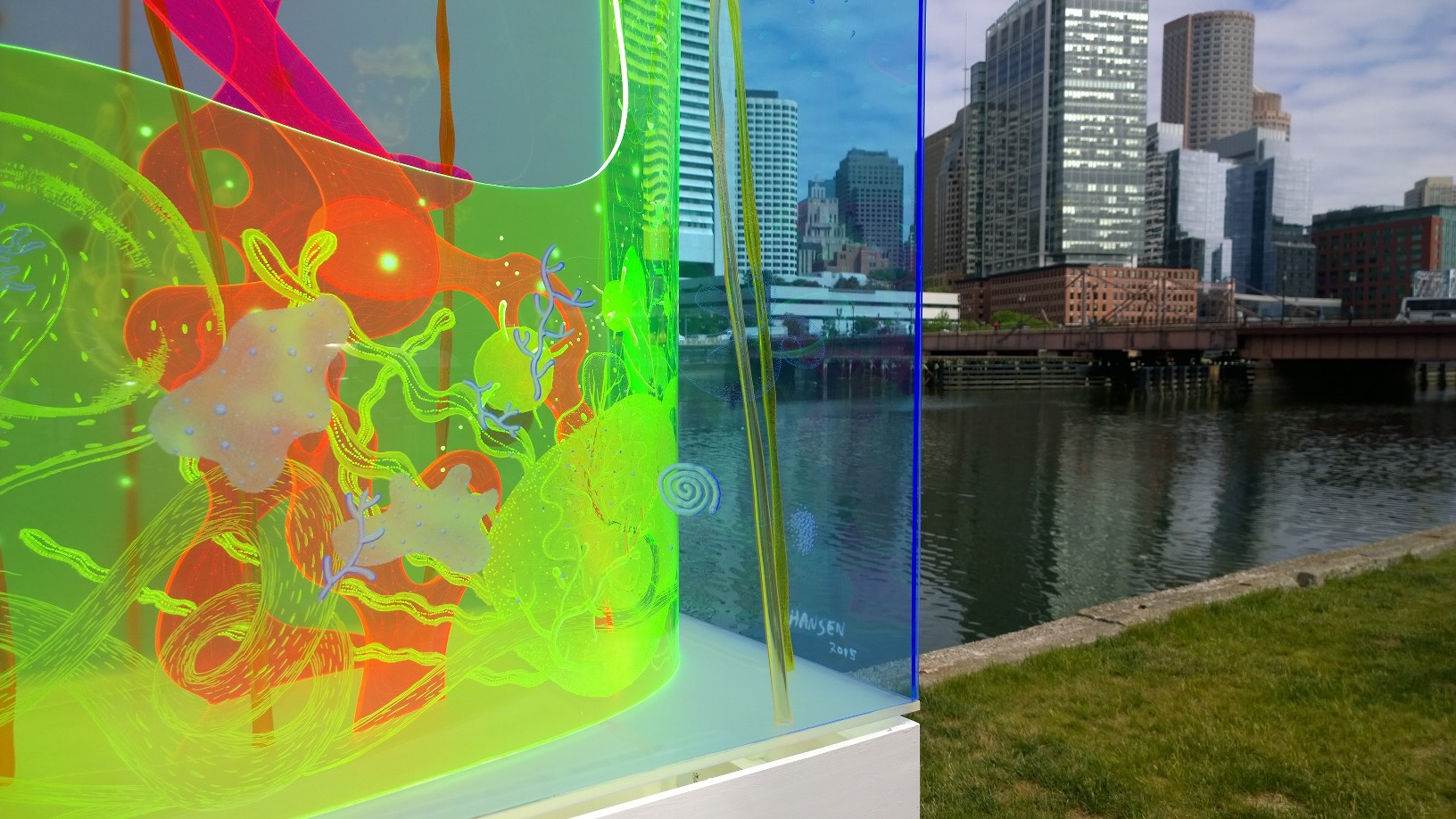
One of the many attractions of Fort Point in Boston is the ever changing array of public art. Here you see a brand new piece on Fort Point Channel: John Hanson’s “Outside the Box,” a Plexiglas sculpture with solar LED lighting.
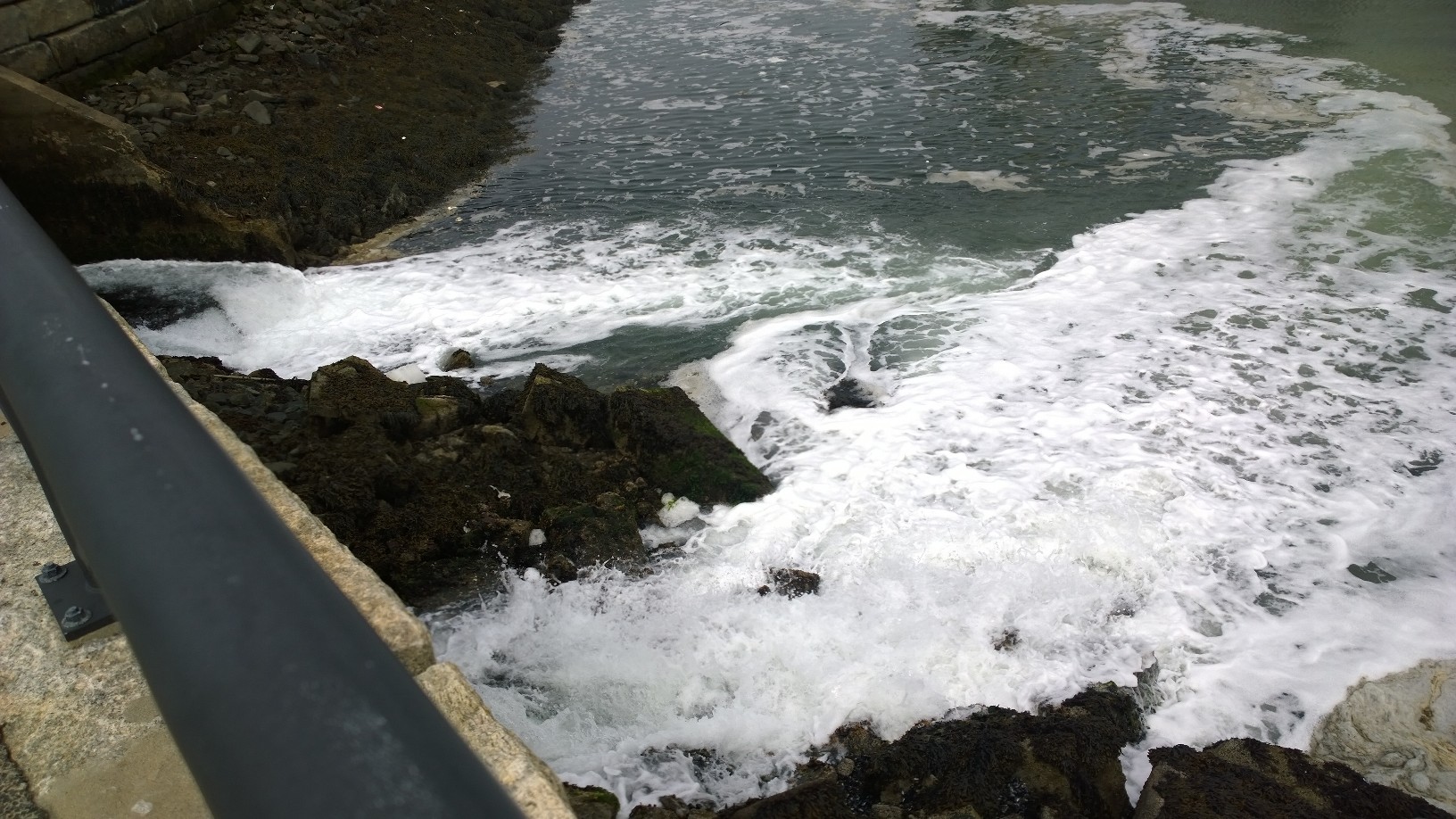
If you were to walk to the left along the channel toward Gillette, you would see water gushing out of the building into the channel and seaweed on the rocks, a reminder of how close South Boston is to the ocean and the elements. When there is a storm at high tide, the channel can overflow the walkway.
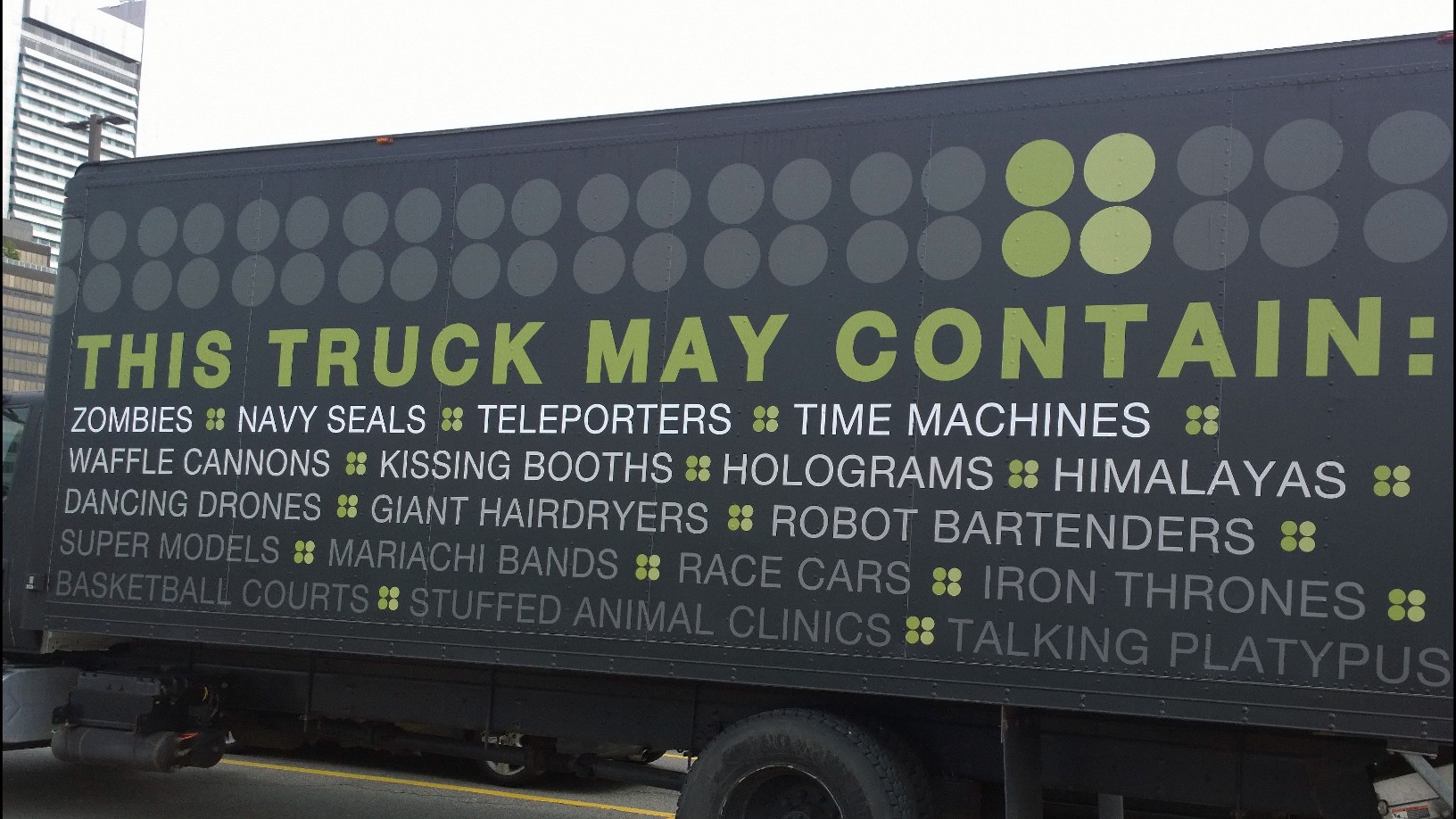
The truck in the parking lot on the other side of the walkway speaks for itself, but who can resist naming some of its contents? “This truck may contain zombies, Navy Seals, teleporters, time machines, waffle cannons, kissing booths, holograms, Himalayas …”
Would I be far off if I said I bet the truck has something to do with the nearby headquarters of the fun-loving Life is good company?
And while we’re on the subject of the energy-saving bike trails in the Netherlands, we note a brief report in the NY Times to the effectthat those clever Dutch also have a road that powers houses.
SolaRoad, according to its website, “is a pioneering innovation in the field of energy harvesting. It … converts sunlight on the road surface into electricity: the road network works as an inexhaustible source of green power.”
Adds the Times, “Sten de Wit of the engineering firm TNO said … that each square meter of road generated 50 to 70 kilowatt-hours of energy per year, or enough for the initial strip to supply power to one or two Dutch households. The test is scheduled to run three years and will cost 3 million euros ($3.7 million). Mr De Wit said despite the high costs of developing the first SolaRoad, successor projects may be more profitable as solar cells grow cheaper and more efficient.”
At the radio show Living on Earth, Steve Curwood recently interviewed Gary Cook of Greenpeace about an effort to get tech companies to be greener.
CURWOOD: “Back in 2012, you criticized Apple for using carbon-intensive energy from coal plants to power its servers. …
COOK: “Just after we spoke, they made a commitment to be 100 percent renewably powered, and as the end of last year, they even made that goal. So, it’s been quite a big shift.
CURWOOD: “100 percent renewable energy. How’s that possible?
COOK: “It requires some effort. Apple has done a lot in North Carolina where they have their largest data center in terms of deploying two different solar farms and an onsite fuel cell that’s powered with biogas energy, so it’s all renewable. They have several other data centers. … In Oregon they’re using wind; in Nevada they’re using solar.
“So they’ve actually shown a commitment from the top, been very aggressive, probably the most aggressive of any of the brands to make sure as they grow, they’re using clean energy.
CURWOOD: “Biogas. Where are they getting that from?’
COOK:” Currently, they’re getting that from landfill and some other renewable sources. The landfill is methane capture in the southeast, and they’re having that piped to where their data center is in North Carolina.”
The radio interview covers several other efforts tech companies are making. It’s a good thing, too, when you consider, as Living on Earth points out, “If the Internet were a country, it would be the sixth largest consumer of electricity in the world.” More here.
Photo: George Nikitin, Greenpeace The Greenpeace Airship A.E. Bates flies over Facebook headquarters with a banners reading “Building a Greener Internet” and “Who’s The Next To Go Green?” Apple, Facebook and Google have committed to powering their data centers with renewable energy.
Did you like last week’s entry on stained glass windows that produce solar energy? Well, there’s more.
Kristine Lofgren writes at Inhabitat about an amazing solar chandelier.
“British artist Luke Jerram is known for his stunning art installations, which are often inspired by science. His latest project, unveiled [last year] at the Bristol and Bath Science Park, is the world’s largest solar chandelier! The 16.5-foot-tall chandelier is made of 665 glass bulbs that spin when exposed to light …
“The chandelier was created using glass radiometers rather than traditional light bulbs. As the sun hits each radiometer, it begins to turn, speeding up and slowing down as the light changes. The overall effect is a shimmering, gently moving piece of artwork. At night, it is lit up using electric light.” More.
By the way, Inhabitat also features a piece on a sculptural sound chamber that sings when the wind blows, here.
Global Envision is part of an effort at the nonprofit Mercy Corps “to foster a richer conversation about global poverty.”
Last fall, Global Envision’s Erin Butler set off to investigate technologies that help schools in impoverished parts of of the world.
“For some students, hopping on the school bus is hopping into the classroom. Four communities are using solar-powered mobile classrooms to overcome inaccessibility to the power grid.
“Last week,” writes Butler, “we looked at a bus in Chitradurga, India, that brought modern computer technology to students in energy-poor rural schools through solar power. SELCO, a private energy company, engineered the bus with 400 watts of solar modules, 10 laptops, fans, and lights.
“Circumventing the area’s erratic power supply with its solar panels, this bus provides much-needed modern computer education and exposure to the advantages of solar energy. Motoring through rural villages in Chitradurga since January 2012, the bus has reached ’60 schools and 2,081 children,’ the New Indian Express reported in early September. …
“Where there’s more water than land, boats replace buses, and with rising sea levels, low-income Bangladeshi students have difficulty getting to school altogether.
“Pushed to inaccessible riverside settlements that lack basic infrastructure, students often can’t get to school due to monsoon flooding. Shidhulai Swanirvar Sangstha, a nonprofit organization started by Mohammed Rezwan, rides the rising tides with his solar-powered floating schools.
“Trained as an architect and personally experienced with soggy school disruptions in Bangladesh, Rezwan rode a brainwave that led him to floating schools. Combining the best of traditional boat design and modern sustainable practices, the organization’s 54 boats have been operating since 2002 and have served over 90,000 families.”
Photograph: Jayanta Shaw/Reuters/File
Students in Kolkata, India, check out their solar sunglasses as they prepare to watch the transit of Venus across the sun. The sun is being harnessed in India and Africa to power mobile solar classrooms for students.
From a NY Times article by Stephanie Strom June 12:
“A few companies have taken some small steps to bring lost manufacturing jobs back to American soil, driven sometimes by declining labor costs in the United States, other times by dissatisfaction with the quality of goods made abroad.
“General Electric, for example, has created almost 800 jobs by building plants in Schenectady, N.Y., and Louisville, Ky., to make sophisticated batteries, some of which were previously made in China. NCR is making automated teller machines in Georgia that had also been made overseas. Last month, Starbucks announced it would build a factory in Augusta, Ga., that would employ 140 people and make the company’s Via instant coffee and the ingredients for its popular Frappuccino drinks. About half of Starbucks’s new employment overall will come in the United States, the rest internationally. …
“The effort is not all altruistic. Chinese labor has become more expensive, and Starbucks and other companies are looking at their supply chains more holistically. American Mug can deliver to Starbucks in four days, while Chinese suppliers may take three months.
“A Chinese supplier is also likely to require an order in the hundreds of thousands, increasing the risk that Starbucks will get stuck with inventory. And then there is the difference in shipping costs. ‘No doubt the cost of doing what we’re doing in East Liverpool [Ohio] at least in the initial stage will be more expensive for Starbucks, but the investment we’re making in this is about the conscience of our company and recognition that success has to be shared,’ [Starbucks CEO Howard] Schultz said.” Read more here.
We will probably never have the massive manufacturing we once had, but do send me what you hear about manufacturing picking up, even a little. For example, I recently heard about a new company in Massachusetts, 1366 Technologies, which makes silicon wafers for solar applications and has a manufacturing pilot going in Bedford. I mentioned this to a colleague who added that he knew of a new gin distillery in South Boston, which wasn’t really what I meant by manufacturing, but whatever floats your boat.