Feeds:
Posts
Comments

Posts Tagged ‘south america’

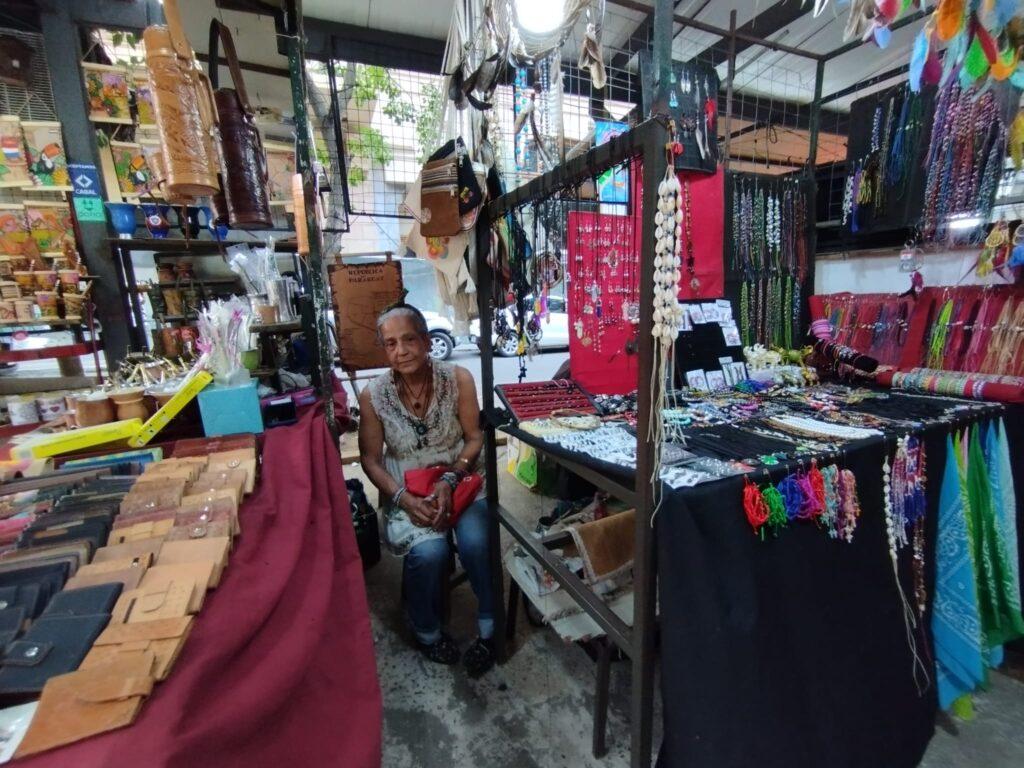
Photo: Michael Fox/The World.
Rita Álvarez has been selling handicrafts and homemade jewelry on the streets of Asunción, Paraguay, for more than 40 years. She said that most of her customers in the city speak a combination of Guaraní with Spanish.

Most of our stories on indigenous languages are about struggles in the face of looming extinction.

It’s different for an indigenous language called Guaraní in Paraguay. Michael Fox reports on the phenomenon at Public Radio International’s The World.

Tomas Zayas, who lives in the Paraguayan countryside, spoke only the Indigenous Guaraní language until he was 22 years old. 

“Later, he started to speak Spanish to be better prepared as a community leader. But Guaraní has remained his main language.

“ ‘For me, Guaraní is identity,’ said Zayas, a longtime campesino leader with the Alto Parana Small Farmers Association. ‘It’s happiness. It’s beauty. Because a joke in Spanish isn’t funny at all.’ 

“The Guaraní language, along with its many dialects, comes from the Indigenous Guaraní people who have lived in this region since long before the Spanish conquest. 

“Today, nearly 300,000 Indigenous Guaraní still live in Paraguay, Brazil, Bolivia and Argentina. In some of these countries, their language has influenced Portuguese and Spanish. 

“But in Paraguay, Guaraní is spoken as an official language alongside Spanish. Most Paraguayans speak Guaraní or a mixture of Spanish and Guaraní as their first language, whether they are of Indigenous descent or not. 

“Although there are several theories about how Paraguayans have been able to preserve their Indigenous language, one that stands out focuses on the Triple Alliance War of the 1860s.

“Most of Paraguay’s male population was killed after Brazil, Argentina and Uruguay invaded the country. ‘As a question of survival, the women who were left would only speak Guaraní,’ Zayas said. ‘They passed it on to their children.’ …

“Under the dictatorship of Alfredo Stroessner, which lasted from the 1950s until the late 1980s, Guaraní was banned in Paraguay. It has also been stigmatized as a language of the poor.

“But many Paraguayans say that Guaraní is a language of metaphor and beauty.

“Rita Álvarez has been selling handicrafts and homemade jewelry on the streets of Asunción, Paraguay’s capital, for more than 40 years. ‘For me, it’s the sweetest language,’ she said. ‘Because you can say with one word in Guaraní what you would need 10 to say in Spanish.’

“She said that most of her customers in the city speak a combination of Guaraní with Spanish, or jopara, which means ‘mixture’ in Guaraní. …

“Blanca Estela González is a retired elementary schoolteacher who now teaches Guaraní at IDIPAR Language School in Asunción.

“Gonzalez said that foreigners often pick up Guaraní rather quickly, because, unlike Spanish, there are only three types of verb conjugations: past, present and future. And Gonzalez said the language has received a boost in recent decades.

“ ‘Now, it’s an official language,’ she said. ‘And half of the lessons at the public schools are taught in Guaraní.’ ” More at The World, here.

Happy New Year to all blog friends, whatever language you speak. Any plans for celebrating?

Read Full Post »

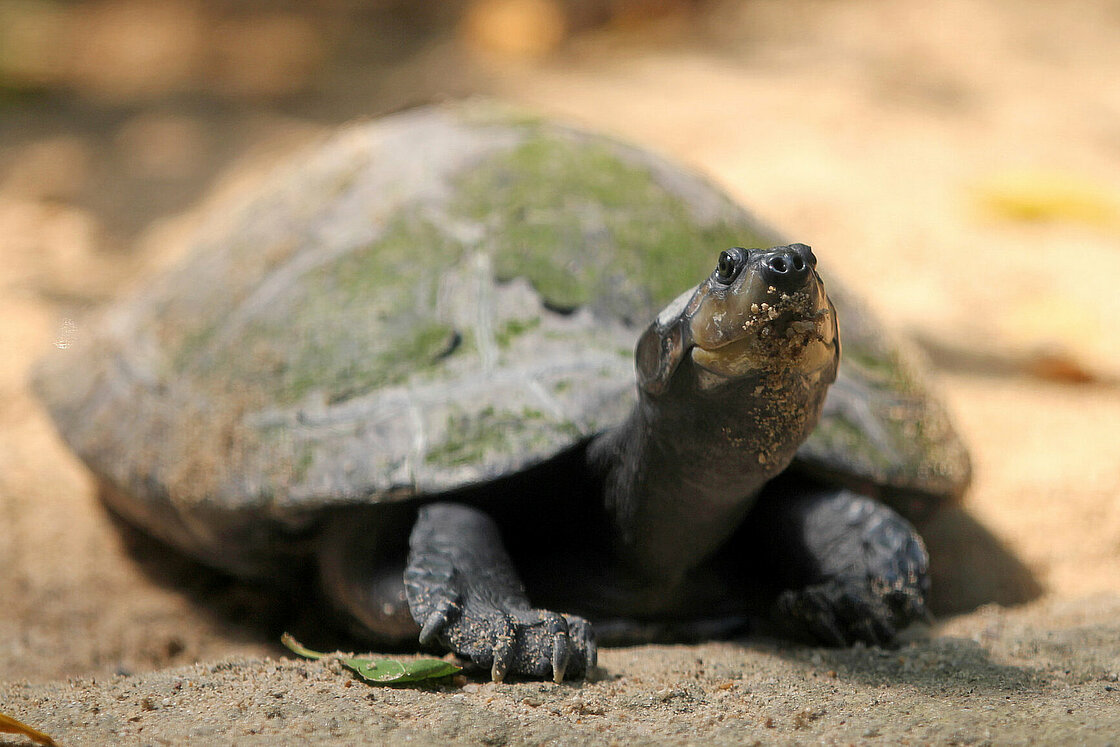
Photo: Zoo Leipzig.
The endangered Arrau, a giant South American river turtle, has unusual conversational attributes.

I remember a fad (perhaps it wasn’t a fad, perhaps it’s still going strong) of expectant mothers exposing babies-in-the-womb to classical music, art museums, and breathtaking scenery. The idea was to inculcate certain interests before birth. Turns out, there’s a turtle mom that does something similar.

Dino Grandoni writes at the Washington Post about turtles that “talk” to their babies before they hatch.

“Camila Ferrara felt ‘stupid’ plunging a microphone near a nest of turtle eggs. The Brazilian biologist wasn’t sure if she would hear much. She was studying the giant South American river turtle, one of the world’s largest freshwater turtles.

“ ‘What am I doing?’ she recalled asking herself. ‘I’m recording the eggs?’

“Then Ferrara — who works for the Wildlife Conservation Society, a U.S.-based conservation group — heard it: a quick, barely audible pop within the shells.

“The hatchlings seemed to be saying to one another, she said, ‘ “Come on, come on, it’s time to wake up. Come on, come on.” And then all the hatchlings can leave the nest together.’

“Researchers for decades thought of aquatic turtles as hard of hearing and mostly mute. … But recent recordings of these turtles’ first ‘words’ — before they even hatch — challenge notions not just of the turtles’ capacity to communicate, but also of their instinct to care for young. Now the discovery has spurred an urgent count of this talkative turtle’s numbers, and may shape protections. …

“Known locally as the arrau or tartaruga da amazonia, the giant South American river turtle lives throughout the Amazon and its tributaries. During the dry season, thousands of females at once crawl onto beaches along the river to lay their eggs. For other kinds of turtles, the mothering usually ends at the beach. Many turtle hatchlings are left by their parents to fend for themselves.

“But that’s not the case with the arrau. After nesting, females often hover by the shore for up to two months waiting for their eggs to hatch.

“So Ferrara and her colleagues wondered: are mother turtle and child turtle communicating with one another? To test the idea, her team spent months taping the turtles — on land and underwater, in the wild and in a swimming pool. The team recorded a wide repertoire of whisper-quiet calls from arrau of all ages.

“Embryos appear to chirp together to coordinate hatching and digging up to the surface. With so many jaguars and other predators lurking, it is safer for baby turtles to move en masse toward the river.

“The mothers, meanwhile, approach and respond to the calls of their young. Once the hatchlings reach the water, the baby turtles migrate down the river with the adult females, Ferrara’s radio-tracking research shows.

“When her team published an early study on turtle vocalizations a decade ago, Ferrara said, academic journals resisted putting the phrase ‘parental care’ in the title of a study about turtles. …

“But Ferrara and her colleagues have gone on to record vocalizations from more turtle species, including the pig-nosed turtle in Australia, Blanding’s turtle in Minnesota and Kemp’s ridley sea turtle in Mexico, one of the world’s most endangered. …

“Other researchers may have missed turtle noises since they tend to be quiet, infrequent and low-pitched — just at the edge of human hearing. Leatherback sea turtles, for instance, appear to have ears tuned to the frequency of waves rolling ashore. Some species can take hours to reply to each other.

Some species can take hours to reply to each other.

“ ‘Had we had a bit more expansive imaginations, we might have caught this earlier,’ said Karen Bakker, a fellow at Harvard’s Radcliffe Institute for Advanced Study who wrote about turtle vocalization in her book, The Sounds of Life.

“ ‘We’re looking for sounds in the frequencies we can hear,’ she added. ‘We’re looking for sounds at a temporal rate that is as quick as we speak.’ …

“As a group, turtles are more ancient than dinosaurs, and are central to many cultures’ creation stories. Yet today they rank among the species at most risk of extinction. Nearly three in five species may vanish, according to a recent assessment, with climate change, habitat loss and hunting posing risks.

“The Amazon once teemed with so many turtles, it was difficult to navigate. While Indigenous people have long relied on turtles for meat, the arrival of Europeans accelerated their decline. …

“The species still faces serious threats. A boom in dam construction threatens to cull their numbers. And a continued appetite for turtle meat sustains a lucrative illegal trade, where middlemen can buy an arrau for $50 and sell it downriver for $450. …

“For [Ferrara], the real fight is not in the field, but in the cities, convincing regular Brazilians to refrain from eating turtle meat. For her, changing the minds of just a few folks would be a victory.

“ ‘What I want is to see two or three people stop.’ “

More at the Post, here.

Turtles that take a long time to answer another turtle are like Bob & Ray’s Slow Talkers of America.

Read Full Post »

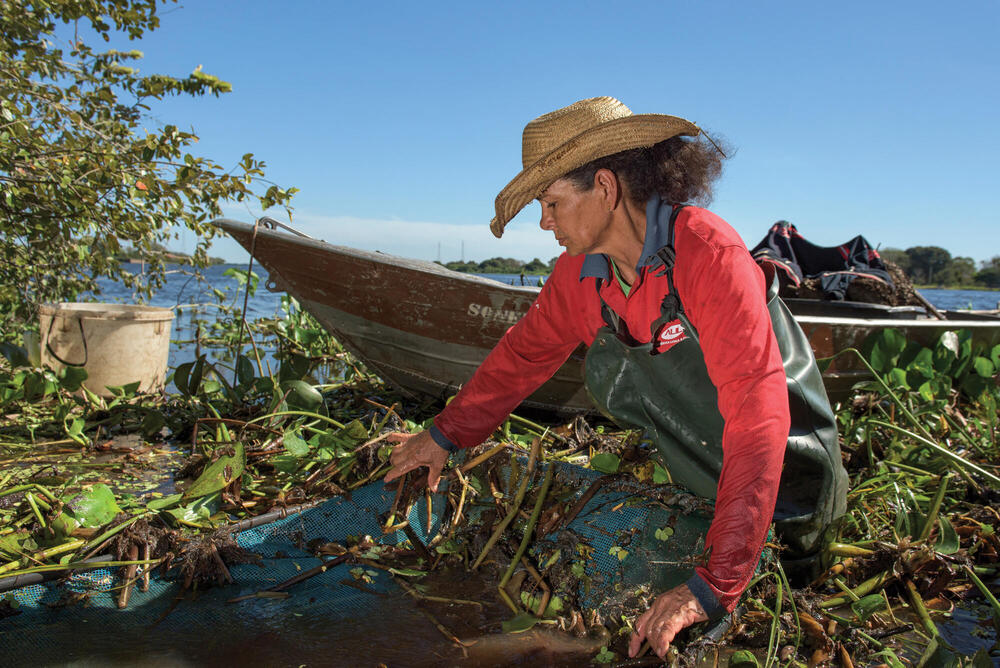
Photo: Jaime Rojo/WorldWildlife.org.
“Life here for us is very fulfilling,” says Elizete Garciada Costa Soares about the Brazilian wetland. “We have fish to eat; we have bait to sell to make money for other necessities. Even if we don’t have money for meat, we can go out on the river to fish and bring back a piranha to eat with manioc flour.”

Without actually realizing it, we’ve accepted the message over the centuries that subsistence living is undesirable. But back before capitalism, having enough for food and shelter — and something to sell if a few extras were needed — could make a pleasant life. In some parts of the world it still does.

Jill Langlois writes at World Wildlife Magazine about people who build good lives from South America’s huge wetlands.

“By the time Elizete Garciada Costa Soares wades into the deep, warm waters of the Paraguay River, the sky is usually black. The tiny crabs and bait fish called tuvira, which she captures with a metal screen, come out at night, long after the hot sun that washes over the Brazilian Pantanal has set.

“It takes Soares at least an hour to reach the best spots to fish for bait, where the tuvira and crabs hide under the thick green leaves of the water hyacinths that float on the river’s surface. She’ll be gone for at least three or four days, so she brings a tent to pitch along the riverbank. Later, she will sell the bait to other fishers, usually in the nearby town of Miranda.

“Soares is well aware of the dangers of her profession — she’s had her fair share of run-ins with jaguars and anacondas in the 26 years she’s been heading out on the river to fish. But she wouldn’t have it any other way.

“ ‘Life here for us is very fulfilling,’ says Soares of herself and her husband. ‘We have fish to eat; we have bait to sell to make money for other necessities. Even if we don’t have money for meat, we can go out on the river to fish and bring back a piranha to eat with manioc flour. Here, we never go hungry.’

“At just over 42 million acres, the Pantanal is the world’s largest tropical wetland, created by the convergence of more than 1,200 rivers and streams rushing down from the eastern Andes and the high plateaus of the Cerrado, the vast tropical savanna to the east. More than 10 times the size of Florida’s Everglades, it stretches across the borders of Brazil, Bolivia, and Paraguay. Its primary waterway is the Paraguay River, which meanders through the three countries before joining the Paraná River and flowing into Argentina.

“The Pantanal is a landscape of extremes. Acting like a giant sponge, the upper part of the basin retains floodwaters from October to March, providing natural flood protection for the millions of people who live downstream. It then slowly drains between April and September, leaving discrete pools teeming with wildlife and providing life-giving water long after the rains have gone.

“This seasonal rise and fall, the pulsing of water in and out of the surrounding landscapes, is responsible for the wetland’s significant biodiversity. Though often overshadowed by the Amazon, its neighbor to the north, the Pantanal is home to more than 4,700 plant and animal species, including fig and ipê trees, jabiru storks, capybaras, and caiman. …

“In addition to being an environmental jewel, the Pantanal is also a tremendous resource for people, says Lucy Aquino, director of WWF-Paraguay: ‘The Pantanal is one of the most important regions in the world, in terms of services provided to humanity, and one of those regions that supplies food to the world.’

“For now, the Pantanal is relatively intact, sustaining more than 270 communities — 1.5 million people — in addition to its flora and fauna, and helping to stabilize the climate throughout the region and beyond.

“But while much of the Bolivian Pantanal is protected, the overwhelming majority of the wetland, lying in Paraguay and Brazil, is not. In all, conservation areas represent just 4.6% of the Pantanal, and its headwaters in the Cerrado are at particularly high risk.

“In recent years, roads, water management systems, hydroelectric dams, large-scale mines, farms, and cattle ranches have begun to change the dynamics of the wetland, threatening the region’s integrity. In addition to poorly planned infrastructure, mining, and agricultural development, the region faces other threats, including the lack of basic sanitation and the construction of canals for navigation.

“Moreover, by the end of the century the Pantanal is expected to be much drier and hotter, with potentially devastating results, including extreme droughts and floods, and the possible shrinking of the wetland as a whole. In the absence of a holistic vision, unsustainable development threatens to limit the Pantanal’s ability to function and to adapt to climate change, putting homes and habitats at risk.

“There is a tension between communities’ needs for development — for sanitation services and clean drinking water, for example, along with roads and hydropower dams — and the costs of such development to the ecosystem and people alike. But development done right, well-designed and sustainable, would contribute to the wetland’s conservation, says Julio Cesar Sampaio da Silva, who leads WWF-Brazil’s work in the Cerrado and Pantanal. …

“ ‘Considering the Pantanal as a shared territory and developing strategies for shared management — creating a truly shared vision for the region — is fundamental to having effective conservation of these natural resources,’ he says. …

“In 2018, the three countries formally signaled their shared commitment to sustaining those resources when they signed a landmark trilateral agreement known as the Pantanal Declaration. …

“Citing the importance of the wetland to those well beyond its boundaries, WWF-Bolivia director Samuel Sangueza-Pardo calls the agreement

‘a decisive step in integrating Bolivia, Brazil, and Paraguay’s joint commitment to maintain this ecosystem, which is fundamental for the welfare of more than 10 million people.’ …

“For Pantanal residents like Elizete Soares, that kind of commitment provides hope for the future of the only home they know. ‘The Pantanal, for us,’ says Soares, ‘is everything.’ ”

More at the World Wildlife, here.

Read Full Post »

In Suriname, a country that borders Brazil on the south and the Atlantic Ocean on the north, there’s an unusual sport that only men engage in — from businessmen in suits to tough-guy boxers. It involves songbirds.

Anatoly Kurmanaev reports at the New York Times, “Every Sunday just after dawn, while much of the city sleeps, a group of men gather on the overgrown lawn of a public park in a quiet neighborhood in the capital of Suriname, South America’s smallest country. They huddle together, and hush.

“They have bird cages, each carrying a songbird — a picolet, a twa-twa or a rowti, as the species are known here. Over the next few hours, the men will lean in, silent and focused, and listen to the birds as referees note the duration of each burst of singing, and rate each songster’s performance on a chalk board.

“The audience is engrossed, but wins and losses are greeted by handlers with the same quiet collegiality that has marked the morning.

“Birdsong competitions, a sort of a Battle of the Bands between trained tropical birds, are a national obsession in Suriname. …

“ ‘Some people like football or basketball,’ said Derick Watson, a police officer who, on his days off, helps organize the competitions with a cigar in his mouth. ‘This is our sport. It’s a way of life.’ …

“The yearly bird song championship, which culminates in final rounds that are broadcast on national television in December, draws around a hundred competitors that square off for trophies and a moment of national glory. …

“The most accomplished birds, with renowned stamina, sell in Suriname for up to $15,000, a fortune in the poor former Dutch colony, which gained independence in 1975. But part of the sport’s appeal is that at entry level, it is accessible to anyone, with young untrained birds available for just a few dollars in pet shops.

‘It’s a tradition,’ said Arun Jalimsing, a Surinamese pet shop owner and one of champions of last year’s competition. ‘We grew up with it. When my father gave me money to buy a bicycle, I went and bought a bird.’ …

“Training a songbird requires expertise, but also immense patience and perseverance. To build the birds’ singing endurance, aficionados spend years stimulating them through interaction, regulating their diets and putting them in proximity with female or male partners, according to elaborate training strategies meant to elicit courtship or competitive behavior from each songbird. …

“Suriname is a diverse country, a legacy of the Dutch colonial system, which brought enslaved people and indentured laborers from around the world to work sugar, coffee and banana plantations. … The bird enthusiasts support different political parties and often live in separate, ethnically-defined neighborhoods.

“Suriname’s few decades since independence have been turbulent. … Yet politics, race, class and other differences that have bred confrontations in other arenas seem not to intrude on the collegiality of the songbird owners’ community.

“ ‘Everybody is friends when they come here,’ said Marcel Oostburg, a bird aficionado and a senior official at Suriname’s National Democratic Party, which dominated the country for decades before being ousted in a tense election last year. ‘We never talk politics here.’ ”

More at the New York Times, here.

Read Full Post »

I find lots of great links at Andrew Sullivan’s blog. Besides having an excellent staff, he seems to have half the world forwarding cool stuff to him. Otherwise, I probably would never have stumbled on Feature Shoot, which showcases work from up-and-coming and established photographers.

In one article, Amanda Gorence writes, “Photographer Fernando Decillis traveled to Pasto, Colombia for the elaborate Carnaval de Negros y Blancos, a five day festival celebrating the Epiphany that has been a tradition since 1912. …

“El Desfile Magno [the great parade] is a mind-blowing display of immaculately crafted floats made by incredibly talented artists. The artists are usually honored with this task through family ties and only after years of studying the traditional craft. … Decillis gives us a front row spot to the festivities, the artists and the giant masterpieces of Pasto’s celebrated tradition.

“Decillis was born in Montevideo, Uruguay. He is based in Atlanta mixing it up with a variety of advertising, editorial and conceptual work.” More, here.

Photograph: Fernando Decillis

Read Full Post »