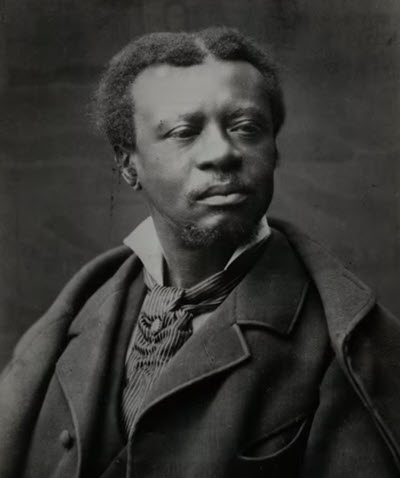
Photo: Opera Lafayette.
Nineteenth-century American composer Edmond Dédé at about age 50.
When I think of an African American born in pre-Civil War New Orleans studying music with the best and rising to high levels of composing, the word that comes to mind is courage.
There is so much I don’t know about the lives of others, and I am grateful to Early Music America for enlightening me about the Edmond Dédé, America’s first black opera composer. Patrick D. McCoy has the story.
“Like many artists of color with the opportunity,” writes McCoy, “Edmond Dédé fled the antebellum United States. After a time in Mexico, he eventually settled in France. … Among Dédé’s surviving works is a four-act opera, Morgiane, ou Le Sultan d’Ispahan, which was never performed or published in his lifetime.
“Morgiane, a happy-ending tale inspired by Ali Baba and the Forty Thieves, was finished in 1887, making it perhaps the oldest-known complete opera by a Black composer born in the United States. …
“Morgiane [received] its world premiere, fully staged, with shows in the Washington D.C. area (Feb. 3 and 7) and New York City (Feb. 5). … Patrick Dupré Quigley, artistic director-designate of Opera Lafayette, will conduct. …
” ‘I knew it was my mission to get this done,’ recalls Givonna Joseph, co-founder of OperaCreole, after receiving a digital file of the opera in 2014. ‘The world needed to know that a free Black man from New Orleans not only composed over 100 works, but also a complete French grand opera with a ballet and an extra brass section. It was never performed, so I was set on a path for restorative and transformational justice.’
“Not long after, conductor Quigley was investigating musicians of color from New Orleans and happened upon that same digitized, 550-page manuscript, which had been crammed into another composer’s score, part of a large private collection from France that ended up in Harvard’s Houghton Library. The full opera is now online and available for public view. …
“Thinking about an eventual performance, Quigley and Opera Lafayette founder Ryan Brown checked if anyone else was working on the project. They quickly found Joseph and her daughter, Aria Mason, who co-founded OperaCreole in 2011. … It was a double jackpot: Morgiane checked every box for both companies.
“And they’d all worked with a singer in common, bass-baritone (and noted composer) Jonathan Woody, who introduced them in a Zoom call in 2023. …
“Much of what’s known about the composer comes from scholarship by Candance Bailey and by Sally McKee, author of The Exile’s Song: Edmond Dédé and the Unfinished Revolutions of the Atlantic World. He was born in 1827 in New Orleans, when the city was the center of opera in America, and was educated by visiting European musicians on clarinet and violin. He was locally celebrated as a skilled violinist and composer. His earliest published music straddled the line between art song and popular tunes — an attractive mix that Joseph has called ‘an early version of the blues.’
“By the late 1850s he studied briefly at the Paris Conservatoire and built a career in Bordeaux, where he worked as a repetiteur, violinist, and assistant conductor at the prestigious Grand Théâtre. …
“Decades later, with Morgiane, he seemed to bring together his musical heritage: ‘People will be shocked that they’ve never heard of this composer,’ says Quigley. ‘The vocal writing is virtuosic, the orchestration is unbelievably colorful. He was a string player, and you hear the inner voices, it’s masterful. He combines the tunefulness of what you think of from New Orleans with the prevailing French operatic forms of the time.’
“Morgiane is through-composed — everything is sung and the orchestra plays the entire time, with no spoken dialogue. … The score calls for bright, agile voices.
“Its sensational plot, with a libretto by a still-obscure poet named Louis Brunet, taps the sort of ‘exotic’ Middle Eastern locales then in vogue (think Aïda, Samson et Dalila, or Thaïs). A beautiful young woman on her wedding day is kidnapped by the evil henchman of the Persian Sultan. Her family crosses the desert from Arabia to Isfahan (in Persia) and infiltrates the Sultan’s court on the day he’s planning to marry the young woman. They have disguised themselves as itinerant singers. But moments before they’re about to rescue her, disaster! They are discovered, imprisoned, and condemned to death. Just before the execution, the mother of the young woman who’s been kidnapped — the title character, Morgiane, is the mother — speaks to the Sultan with a shocking revelation.
“Spoiler alert: From under her cloak Morgiane pulls out a diamond ring, the very ring that he’d given her the day their daughter was born. ‘I was your sultana,’ she says. …
“Quigley says he was ‘taken aback at my own ignorance of just how early composers of color were an integral part of both American and European art music. In New Orleans alone, people of color were involved with the composition, performance, and production of opera from the late 18th century onward.’ …
“For now, says Quigley, there are plans to help ensure the success and longevity of Morgiane. Opera Lafayette will record the opera, and make the score and parts available to help the opera enter the repertoire. In addition, some of its most delectable music — the overture, the entr’actes, the ballet sequences, plus a few other numbers — would make a highly attractive orchestral suite.”
More at Early Music America, here.






 Suzanne's Mom's Blog