Feeds:
Posts
Comments

Posts Tagged ‘sweden’

Photo: Boston Globe.
A headline in the Boston Globe from 1924.

I didn’t get to post this story about a charitable Gothenburg-born Boston immigrant last year, but I think you’ll agree that it’s a bit of Christmas history that will always be fresh.

Jenny Ashcroft wrote about it at Fishwrap, the official blog of Newspapers.com.

“On Christmas Day in 1921, a Swedish immigrant quietly wheeled his hot dog stand to a street corner in Boston’s North End and distributed 500 free hot dogs to hungry children. Axel Bjorklund was no stranger to poverty. He barely made ends meet himself, but he wanted to give back. His cart was soon swamped with hundreds of shivering children wearing tattered clothing that did little to stave off the cold. Their hungry faces beamed when Axel handed them a steaming hot dog. Eventually, the food was gone, but Axel’s determination to repeat the event wasn’t. The Hot Dog Santa tradition was born. Over the next eight years, Axel gave away some 10,000 hot dogs before he died in 1930.

“Born in Gothenburg, Sweden, on August 6, 1869, Axel Bjorklund emigrated to America in 1889, eventually settling in Boston’s North End neighborhood. The area had become a melting pot of immigrants, most of whom were impoverished as they struggled to establish lives in a new country. The Spanish Flu Pandemic hit the North End particularly hard, leaving families even more destitute and many children orphaned.

“The first Christmas hot dog giveaway in 1921 was so successful that Axel decided to expand in 1922 and doubled the number of hot dogs to 1,000. His hot dog giveaway grew with each year until he distributed 3,000 annually. The children loved Axel and nicknamed him ‘Hot Dog Santa.’ …

“Axel’s annual Christmas Day hot dog giveaway eventually moved to New Year’s Day, but it was an event the children anticipated all year. As Axel’s generosity expanded, so did his health challenges. He was plagued with rheumatism, which led to frequent hospitalizations. His finances struggled, too, and he could no longer pay his rent. Not wanting to end the hot dog giveaway, he appealed to the public to help him continue the tradition.

“In December 1928, just before the annual hot dog giveaway, Axel’s landlady kicked him out because he hadn’t paid rent. The Salvation Army stepped in to help, but Axel was broke. The next two years saw Axel skipping between the poor house, the Cambridge Home for the Aged, or obtaining temporary lodging from generous benefactors. Despite his circumstances, in 1929, he participated in his final hot dog giveaway.

“On November 10, 1930, Axel Bjorklund passed away, penniless and alone at a Massachusetts hospital. He had no relatives and was set to be buried in a potter’s field when newspapers published word of his death. Citizens stepped forward, offering to contribute to a fund to give Axel a proper burial. The Swedish Charitable Society coordinated, and Axel was laid to rest in the Cambridge Cemetery.

“If you would like to learn more about the Hot Dog Santa or discover other heartwarming Christmas stories, search Newspapers.com.”

It hurts to think that today there are still plenty of shivering, hungry American children who could use this 1920s Good King Wenceslas.

Read Full Post »

Photo: Wikimedia commons.
The world’s largest version of Sweden’s famous Dalecarlian horse. Controversy has erupted in Sweden recently over what exactly represents Swedish culture.

Suzanne and Erik took the kids to Sweden for five months to learn Swedish, spend some quality time time with Farmor (father’s mother) and Erik’s sister’s family, and experience Swedish culture. The children are attending an international school in English but are having lots of opportunities to learn Swedish and soak up Swedish culture.

Sweden recently conducted a survey to determine what exactly could be considered part of Swedish culture, a tricky enterprise for any country. Needless to say, not everyone agreed on what should be on the list.

At the New York Times, Alex Marshall asks, “What are the 100 things that unequivocally define Swedish culture? Flat-packed furniture from IKEA? Of course. Pippi Longstocking? Indeed. The touchstone films of Ingmar Bergman? Absolutely.

“Abba and meatballs? Apparently not.

“[In September] the Swedish government published the country’s first Cultural Canon, a document that lists 100 artistic works and social, political and economic phenomena, that a panel of academics, authors and historians say have played a key role in shaping the country’s culture.

“The idea of creating such a canon, a pet project of the right-wing Sweden Democrats, has divided the country’s cultural world. Supporters call it a simple attempt to foster civic pride and help newcomers integrate into society. But detractors, including an expert who left the committee, see it as an effort to create a narrow view of Swedish identity that excludes minorities or contemporary life. …

“Among the canon’s 100 entries are movies (Ingmar Bergman’s The Seventh Seal), books (Astrid Lindgren’s Pippi Longstocking) and paintings (Hilma af Klint’s ‘Paintings for the Temple‘), along with inventions (the ball bearing, the Nobel Prizes, paternity leave), key parts of Sweden’s economic history (ancient copper mines) and longstanding laws (including the separate taxation of spouses).

“Björn Wiman, the culture editor for Dagens Nyheter newspaper, said in an interview that he had laughed upon first seeing the list. …

‘It’s a bit ludicrous really.’ …

“The document says that Abba did not make the list because the pop group’s ‘most lasting contributions’ to Swedish culture came after 1975, the cutoff date for inclusion in the canon so as to highlight only things that have endured. …

“Leif Mannerström, a well-known chef, has criticized the absence of any culinary items, given Sweden’s contributions to global cuisine, including meatballs and herring. Observers have also raised eyebrows at the inclusion of the Swedish-made Saab Viggen fighter jet.

“Kerstin Bergea, the president of the Swedish Peace and Arbitration Society, an antiwar organization founded in 1883, said in an interview that the aircraft’s inclusion in a cultural canon ‘was something an authoritarian state would do.’ …

“Sweden’s coalition government began the initiative in 2023 as part of an agreement to secure the Sweden Democrats’ support. Alexander Christiansson, the Sweden Democrats’ culture spokesman … argued that detractors who said the canon excluded minorities were talking ‘nonsense’ and that the growth of multiculturalism had undermined Swedish culture.

“Lars Trägårdh, the historian whom the government appointed to lead the project, said in an interview that the members of the expert team were kept ‘arm’s length’ from the government — and even himself — so the choices for the 100 artworks and phenomena ‘weren’t tainted by politics.’ …

“Still, Wiman said that right-wing lawmakers’ trumpeting of the list showed that it was a political project. Debating what constitutes Sweden’s culture was important, he said, but it would be better to combine the initiative with ‘serious political ambition to raise culture and education spending.’

“To compile the list, the project had two streams, with this canon decided by the academic panel, and then a people’s one, consisting of submissions to a website.

“The website received over 9,500 submissions, many of them more reflective of contemporary tastes and a country in which about a fifth of the population was born abroad. Unlike the canon’s trumpeting of poetry, prose and Christian monuments, the public’s many suggestions included kebab pizzarap songs and the Swedish Church of Satan.”

So Lars Trägårdh says the method of compiling the list ensured that it wasn’t “tainted by politics.” Is that the impression you get? What aspects of Sweden have always stood out to you?

More at the Times, here.

Read Full Post »

Illustration: Wingårdhs.
Tomelilla, a town in southeast Sweden, is focused on sustainability and has plans to build a school with reused materials.

With half of my family in Sweden for the fall semester, I am interested in Swedish stories. Here is one about residents in the Skåne district determined to live sustainably.

Abigail Sykes reports at the Guardian, “In a small town in Sweden, the local authority is carrying out an unusual experiment.

“In 2021 one of the team had been reading an article about the concept of doughnut economics – a circular way of thinking about the way we use resources – and he brought it up. ‘I just mentioned it casually at a meeting, as a tool to evaluate our new quality of life program, and it grew from there,’ says Stefan Persson, Tomelilla’s organizational development manager.

“The concept, developed by British economist Kate Raworth is fairly straightforward. The outer ring or ecological ceiling of the doughnut consists of the nine ‘planetary’ boundaries. These are the environmental limits that humans are at risk of passing – we’ve already crossed the safety thresholds on climate change, ocean acidification and biogeochemical flows, for example, but remain within safe limits on our atmospheric aerosol loading. The inner ring forms a social foundation of life’s essentials, and the ‘dough’ in between corresponds to a safe and just space for humanity, which meets the needs of people and planet. …

“ ‘Doughnut economics is like running a farm. Using an excess of resources, like nutrients, on your crops is a mistake. Not using enough is a mistake too,’ says Persson’s colleague Per-Martin Svensson, who is a farmer when he is not doing council work. …

“Doughnut economics is being used in Tomelilla, in Sweden’s southern Skåne region, in several ways. It has been integrated into financial planning and decision support, so that rather than building a new ice rink, the plan is now to revamp an existing building.

“The local government produces an annual portrait of how well it is doing at meeting doughnut economics targets. The best results in the latest diagram were on air quality, housing and social equality. Air quality in the area was good to begin with, but in order to keep improving it, young people at lower and upper secondary school have been given a free travel card for public transport. It is hoped the measure will also improve social equality in terms of access to education and health. Overcrowding and income disparities have both decreased, but it’s hard to link that directly to any of the council’s work.

“Education is a priority, but targets such as carbon emissions, biodiversity and health are more difficult to meet. Emissions have not been decreasing, but in 2023 the town council adopted a climate program to achieve net zero by 2045. …

“Tomelilla’s flagship doughnut economics project, though, is planning a new school. The council hasn’t built a school – or any other big development – since the 1990s. The project is still at an early stage so no decisions have been made about the final construction.

“Last year, a consultant report made recommendations for the project. These included using existing and carbon-neutral materials as far as possible, growing hemp as a building material on the current site; building the school around a greenhouse for growing vegetables as well as for educational and social activities; and making the school an off-grid energy producer using solar power and batteries. …

“This vision has carried over into the council’s procurement requirements, although budget constraints and other considerations have meant it is still unclear whether all of these ideas will come to fruition. …

“It has certainly been demanding. Is it even possible to use the resources needed for a large construction project and stay within the doughnut? Persson thinks it may not be possible but he is focusing on the bigger picture, with a more holistic view of social change. ‘In individual projects, there are always trade-offs. But we’re also looking at how the local community as a whole can move towards the doughnut model. I think that if we’re going to build anything, it should be democratic meeting places and schools.’ …

“Tomelilla is the first local government to attempt to deliver infrastructure and education using doughnut economics. … With a population of about 7,000, it is certainly one of the smallest towns in the international network of the Doughnut Economics Action Lab, dwarfed by Barcelona, Glasgow and Mexico City, which are all putting Raworth’s theories into practice in local governments. …

“The people of Tomelilla welcome the challenge and are extremely proud of the way their town is forging a path. As Jonna Olsson, one of the staff at the council says: ‘Doughnut economics is a really interesting way to work with sustainability. It feels cool to be a cog in international change.’ ”

More at the Guardian, here. No firewall.

Read Full Post »

Photo: TiVa.
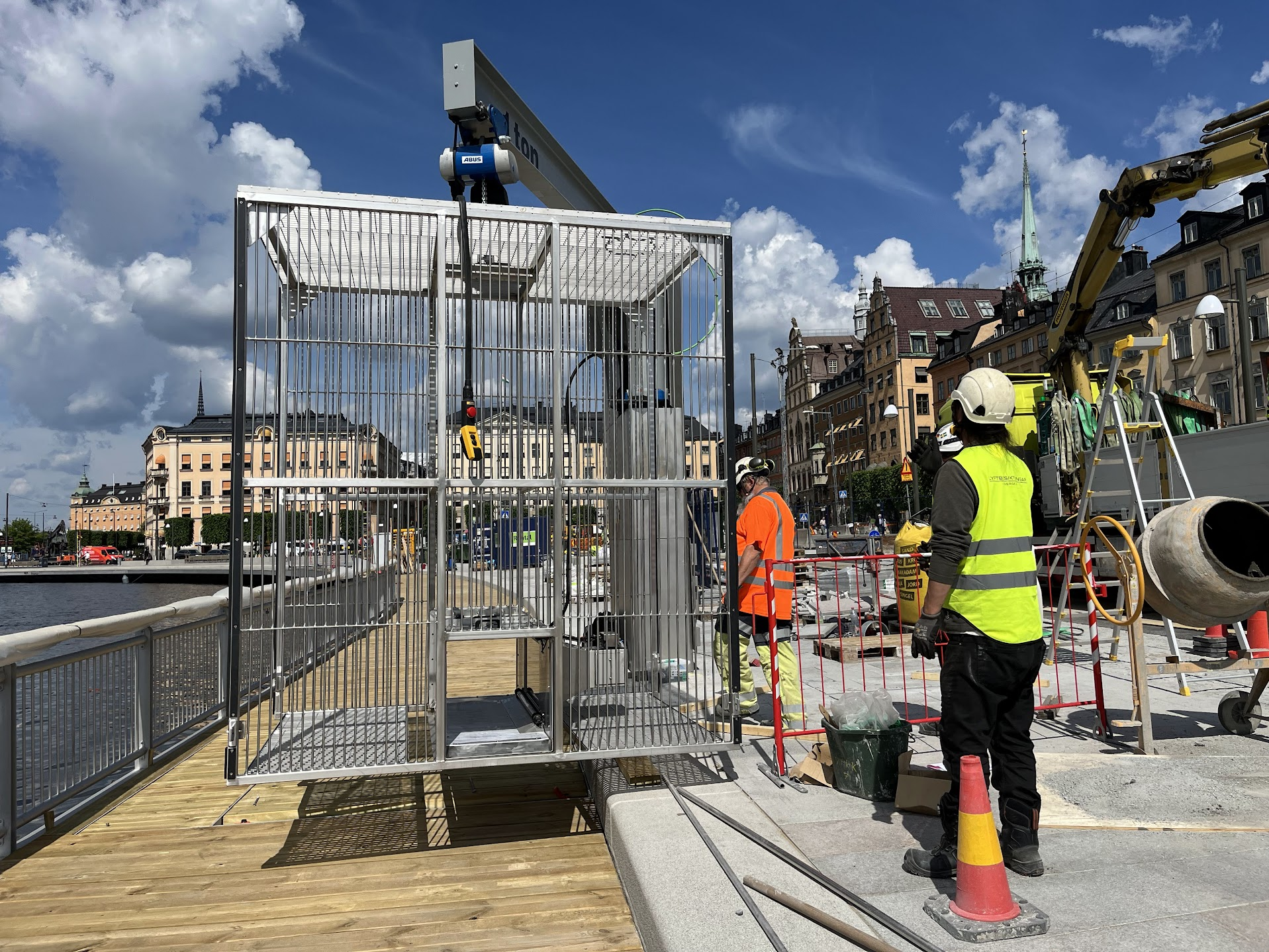
Installation of the fish counter at Gamla Stan in Slussen. The new fish highway in Stockholm has some of the first fish passages between the Baltic Sea and Lake Mälaren at Söderström in nearly 400 years.

Today’s story is about how Sweden is giving a helping hand to migrating fish that are not strong swimmers.

TiVa, an AI-powered fish-counting company, reports, “In mid-2024, a TiVA FC was installed in connection to the newly built fish migration path at Slussen in Stockholm. This long-awaited passage allows fish to freely migrate between Lake Mälaren and Saltsjön at Söderström for the first time in almost 400 years. As part of the reconstruction of Slussen, a new fish migration path has been constructed under the northern sluice quay on the side of Gamla Stan. The old Nils Ericson sluice has been converted into a passage to facilitate the free movement of weak-swimming species such as eel, roach, and perch – species that were previously hindered by human infrastructure.

The TiVA FC fish counter delivers [improved] results, both in image quality and AI-based species and length classification. … The TiVA FC at Slussen is connected to our cloud platform fiskdata.se. Here, data is available for both the client and, in this case, for the public. … The City of Stockholm has chosen to broadcast a live stream via TiVA’s YouTube channel. Shorter streams can also be broadcasted to other platforms, like Facebook, depending on the client’s needs.

“The City of Stockholm will install an informational screen for ‘Fish TV’ on the crane structure by the fish counter. Passersby in Gamla Stan will be able to learn more about the project, see selected videos, and get updates on the latest migrations.” More at the TiVa website, here.

And from Stockholm’s website: “You can watch online the fish swimming between Lake Mälaren and Saltsjön [at fiskdata.se].

“Moving between different areas is a natural part of life for many fish species. They migrate from their breeding grounds to spawning grounds to reproduce. When humans have blocked various watercourses, this has prevented fish species from passing through. To protect the fish and promote the environment, watercourses can be restored, or, as here at Slussen, a fish migration route can be opened up.

“The primary purpose of the fish migration route is to enable passage between Lake Mälaren and Saltsjön for [fish] that do not jump, which is basically all species except salmon and sea trout. By building this route, we hope that species such as eel, roach and perch will once again be able to pass here.

“The trail is designed by experts to mimic as natural an environment as possible. Stones of various sizes have been carefully placed along the trail. Some of the stones come from Gustav Vasa’s 16th-century defensive wall, which was found during the excavations of Södermalmstorg in 2022. The water flow needs to be calm so that the fish can stop and rest. There is lighting here so that the fish can swim in pleasant light.

“The fish walking trail is located under the quay on the Old Town side and is not visible from the outside. But you can watch the fish swimming through at fiskdata.se.” More here.

Looking for comments — from Swedes and fish lovers everywhere.

Read Full Post »

Photo: Visit Dalarna.
One of the languages spoken in Älvdalen, Sweden, has the charmingly elvish-sounding name of Elfdalian. Älvdalen is part of Dalarna, the area best known for colorful wooden horses.

I’m always interested in learning about endangered languages, and the radio show The World introduced me to one tucked away in the Swedish town Älvdalen.

Älvdalen appears to be a part of Sweden that, for context, is closer to that Norwegian Olympic site Lillehammer than to better known Swedish towns.

Bianca Hillier reported at The World that “an organization called Ulum Dalska, based in a small Swedish town called Älvdalen, is on a mission.  For decades, members have been working hard to help save a language called Elfdalian, a remnant of Old Norse.

“ ‘We had our first meeting on the 1st of June in 1984,’ said press secretary Björn Rehnström. ‘And the biggest hall in Älvdalen was filled with people.’

“Elfdalian sounds nothing like the country’s national language, Swedish, which Rehnström said destabilized the language about 100 years ago. At that point, Elfdalian became stigmatized.

“Ulla Schütt, also a Ulum Dalska member, saw the impact firsthand while growing up in Älvdalen.

“ ‘My parents spoke Elfdalian with each other, and with my grandma and my aunts and uncles and everyone around,’ Schütt said. ‘But when they turned to me, they spoke Swedish.’

“Schütt said her parents spoke Swedish with her because that’s what was spoken in schools. Students were even discouraged to speak Elfdalian in the classroom. Now, there’s only about 2,500 speakers left. But people are getting creative in the fight to change that trend.

“The language is getting a boost on Minecraft. Musicians are releasing new songs with Elfdalian lyrics. Several children’s books were also translated into Elfdalian, including Le Petit Prince, by Antoine de Saint-Exupéry.

“Additionally, Rehnström helps run a popular Facebook group that offers courses in the Elfdalian language, where he posts lessons to the group’s 1,800 global members.

“ ‘[People are from] America, Australia, South America, Indonesia, Haiti, Cape Verde,’ he said. …

“The local government supports the teaching and preservation of Elfdalian. … The language is also recognized on an international level. In 2016, it was assigned an ISO language code, which helps the internet distinguish one language from another.

“But the national government of Sweden is a different story. They currently consider Elfdalian a dialect of Swedish, not its own language.

“Speaking in Elfdalian, Swedish MP Peter Helander recently asked Parliament why that’s the case. But before Culture Minister Amanda Lind could answer the question, the parliamentary speaker interrupted them both to say that only Swedish may be spoken in the chamber. Helander said the ‘only Swedish’ remark proves his point, that Elfdalian should be considered its own language. …

“Schütt said every time a language dies — which some research suggests is as often as once every two weeks — it is a sad moment. To her, losing Elfdalian would be an especially tragic loss. …

“Getting Elfdalian recognized as a language by the Swedish government, she added, is key to making sure that death doesn’t come.”

Read more about Elfdalian at The World, here, and at the blog Transly, here.

Dala horses come from the region where Elfdalian is one of the languages spoken.

Read Full Post »

Photo: Caroline Gutman/Bloomberg.
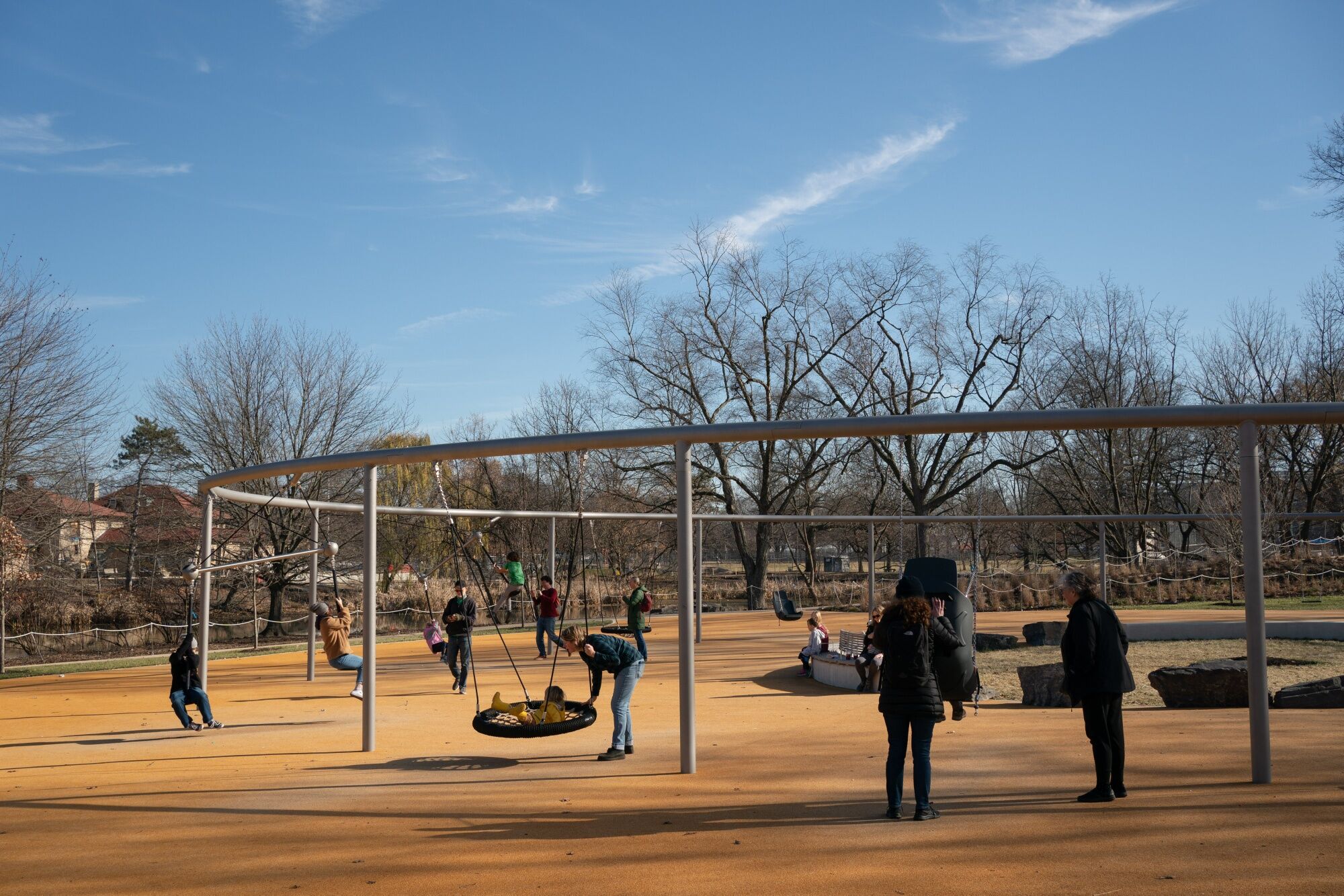
A 20-swing structure for visitors of all ages at the Anna C. Verna playground in Philadelphia. 

In the Swedish retirement community where reader Stuga40 lives, there’s a playground for adults. Of course, the Swedes are always ahead of the rest of the world on quality-of-life things, but the idea of all-ages playgrounds is catching on in other countries, too.

Alexandra Lange reports at Bloomberg, “A swing can be the simplest thing: two chains attached to a board, a rope knotted through a disc, a chair suspended from above. Swings appear on ancient Greek vases as instruments of leisure, and in eighteenth century Thailand as vehicles for competition.

“That’s the thing about swings: They can be sociable, but they are also physical. This inviting duality has often been undermined by public safety standards, which discourage swings for more than one person and mandate that they be far apart. After a certain age, swinging solo loses its thrill.

“But at Anna C. Verna Playground at Philadelphia’s FDR Park, on the south side of the city, the largest swing set in North America was designed to test those limits. Not by creating unsafe play, but by transforming those standards into something challenging, unusual, beautiful and rewarding for swingers of all ages.

“The playground, which opened in October and was designed by WRT Design with Studio Ludo as play consultant, features two acres of nature-based play, including seven slides of increasing height and speed, two steel-and-rope ‘birdhouses’ ascended by climbing nets, three log climbers, and assorted shady picnic tables, rock circles and sit-able logs.

“The centerpiece, however, is the 120-by-100-foot elliptical ‘megaswing’ from which 20 different swings of five different types hang in invitation to all the users of the park — from homeschool moms to tailgating Eagles fans, teenagers on a half-day to grandparents with toddlers, all of whom can train, bus, cycle or drive to the park.

“ ‘We are social animals, and play fosters social relationships,’ says landscape architect Meghan Talarowski, executive director of Studio Ludo, who is also a certified playground safety inspector. …

“At a time when many cities and business owners seem to want nothing to do with teenagers, it is refreshing to see a brand new public space issue them an invitation — and to go there and see that happening. Toronto urbanist Gil Penelosa, founder of 8 80 Cities, has long argued that designing a city that works for eight-year-olds and 80-year olds is a city that works for everyone. …

“Talarowski [got] her shot at the Anna C. Verna Playground in Philly, where she nestled a smaller ellipse — still equivalent to the size of a baseball infield — into FDR Park’s existing lagoon, like the thrust stage in a Shakespearean theater.

“ ‘There was this natural curve in the lagoon, and we were trying to connect the play design to the site conditions, without taking down any trees,’ says Allison Schapker, chief operations and projects officer for the Fairmount Park Conservancy, which is working with Philadelphia Parks & Recreation on the multi-phase, climate-sensitive $250 million dollar FDR Park Plan. ‘This is the point, if you are swinging high, you get views back to center city Philadelphia, so we are connected with both nature and the city.’ …

“The Anna C. Verna Playground is phase one in the restoration of FDR Park; the master plan is also by WRT. As part of their commitment to keeping things natural, WRT specified very little paint and plastic: The slides and climbing structures are stainless steel and rope, much of the seating is rocks and logs, the swings themselves are black plastic, plus more metal and rope. The big swing and the playground’s other custom pieces were designed in collaboration with equipment manufacturer Berliner Seilfabrik. Underfoot, the springy safety surface is not the flip-flop colored rubber of most playgrounds, or high-maintenance and inaccessible woodchips, but a permeable and recyclable cork product that comes in a subtle, toasted brown. ‘We feel strongly playgrounds should be sophisticated,’ says Talarowski.

“Sophistication [signals] to users that this equipment isn’t just for kids. As part of their two-year community process, the conservancy ‘did engagement activities on site with kids and their families,’ says Schapker. ‘Overwhelmingly, across every age group, they said they wanted to swing.’ ”

More at Bloomberg, here. Long article. Great pictures. No firewall.

Read Full Post »

Photo: John and Suzanne’s Mom.
Beautiful clouds and farm. How much is enough?

Although there are people in every country who strive for balance in their lives — people who are happy with having just enough — in Sweden, it’s a way of being that has its own name.

Erika Page reports at the Christian Science Monitor about the Swedish concept of lagom.

“The ladder she’s standing on rattles in the wind, but Havana Dadian’s paintbrush is steady. With freezing fingers, she lays color inch by inch onto the whitewashed wall. The street below is empty, as residents shelter from an approaching storm. 

“The muralist was hired to spruce up the working-class neighborhood of Södra Sofielund in Malmö, just blocks from where she grew up.  More than that, Ms. Dadian is painting for the future of her country. 

“ ‘I wanted to shine light on the beautiful soul of Sweden,’ she says, gesturing to the sketch on her phone. She is painting a scene from the 1940s, back when this building was home to a neighborhood laundry house. It was a time of community, frugality, and hard work – which she sees as the foundation of Sweden’s egalitarian prosperity.

“ ‘Something has happened, and it’s not so certain anymore – the safety, feeling that you have everything you need,’ says Ms. Dadian. 

At stake is a uniquely Swedish philosophy: lagom. It’s a difficult-to-translate word meaning not too much, not too little, but about right.

“The lagom amount is just enough. The lagom solution is reasonable, appropriate, and moderate. … To be lagom is to respect the rules of the group. 

“ ‘Lagom is one for all and all for one,’ says Ms. Dadian. ‘It was a way for everyone to come together, for everyone to get their share.’

“Yet Sweden appears to be reaching a turning point. The threads of lagom seem to be fraying, as social services come under increasing stress and politics reach unprecedented levels of polarization. Public discourse, dominated by talk of rising rates of violent crime and gang activity, is bringing to light fears about the erosion of social trust. Some wonder whether the economic pie is still big enough to go around. Others question the very foundation of a growth-based economy, pushing instead for a return to ‘just enough.’ …

“The country was a poor, agrarian society of low taxes and limited government until the mid-19th century. Without a feudal system, farmers in decentralized villages worked primarily for themselves, laying the foundation for a society with a relatively flat hierarchy that rewarded hard work. These farmers were of minor importance to the government as individuals but powerful as a collective, making cooperation key. …

“While socialists in other parts of the world sought complete control over the means of production in the early 20th century, the socialists who gained traction in Sweden took a more lagom tack. They believed in harnessing the power of the market through taxation and redistribution to achieve social goals. By the 1960s, Sweden had one of the most robust social support systems in the world and one of the most egalitarian income distributions.  

“ ‘A lagom economy is a pragmatic economy,’ says [Andreas Bergh, an economist at Lund University, near Malmö]. ‘At its best, Sweden has combined the benefits of a capitalist, well-functioning market economy with a relatively generous social welfare state.’

“Salaries may be lower than those for comparable job titles in the United States or United Kingdom. But for many people, that difference is compensated by free education from preschool through university, universal health care, generous pension and unemployment systems, housing allowances, and other social safety measures. …

“Social trust – including faith that people are not taking advantage of the system – is a key ingredient in the lagom mentality, ‘where people share similar interests and work together for the benefit of the group,’ says Dr. Bergh. … Recently, however, a new narrative has taken hold among some, suggesting that perhaps Sweden was once the land of lagom – but no longer. 

“A financial crisis in the early 1990s led to near political consensus that the welfare state had become too hefty. Over the past three decades, the government has slashed taxes and public spending. Sectors from education to health care and elder care have increasingly been privatized. 

“To some, this privatization is lagom, allowing for a healthy balance between the public and private spheres. … Others take the privatization as a sign that Sweden is losing its lagom-ness. 

“Tax cuts mean there is less funding today for social services. Wait times for health  services have grown notoriously long; during the pandemic, the weaknesses in Sweden’s elder care system became impossible to ignore. And since the 1980s, income inequality has increased more than in any of the other 37 countries in the Organization for Economic Cooperation and Development, though still low by international standards.

“Sweden has a reputation of being one of the most welcoming countries in the world for migrants and refugees. [But recently] neighborhoods have become more segregated, with unemployment rates higher among immigrant communities. …

“ ‘My Swedish friends have an innate safety feeling,’ says Ms. Dadian, the muralist, whose mother is Swedish and father is from Lebanon. ‘[For] my friends with mixed backgrounds … it’s starting to feel more like a movie sometimes: drugs, guns, no trust, and much involvement with the police. It can be like different worlds.’ …

“Jon-Mikko Länta, one in a long line of Sámi reindeer herders, has struggled to find that [lagom] balance in his own life as the cost of living has risen. 

“ ‘I was working a lot, all the time, working, working, working. All the money went to buying new stuff, buying new stuff, replacing old stuff,’ he says. 

“But then he began to simplify. He stopped buying the latest tools and took new pleasure in repairing old things. He bought a piece of land outside the town, where he is building a campsite for visitors – and for his reindeer. He’ll be able to continue herding while supplementing his income and spending more time with his wife and three young children.

“It’s a different kind of satisfaction, says Mr. Länta during a lunch break in his kitchen. Dishes are stacked waiting to be washed; half a bottle of milk has been left behind by their 2-year-old. Mr. Länta’s work pants are patched with tape.

“For him, [a controversial local] mine would bring ‘catastrophic’ changes to Jokkmokk, eroding respect for reindeer herding and the natural world. ‘It pinpoints exactly what’s sick with the Western society. … [It’s] built upon growth, and as much growth as possible. And that’s completely unsustainable.’  

“He wishes debates about the mine would take lagom into account, he says, helping residents ‘feel the contentness of enough.’ ” 

More at the Monitor, here. No paywall. Subscriptions encouraged.

I liked the pictures that went with this article. They had a peaceful feeling.

Read Full Post »

Photo: Anna Svanberg/Nobel Prize Outreach.
The Dream Orchestra started with just 13 members. Now there are more than 400, including this group performing at a Nobel Foundation event in Gothenburg, Sweden, in December 2023. 

Sweden has long been a country that took in refugees, but what I know from family members there is that Sweden doesn’t always do a good job helping immigrants integrate and feel at home. That’s why the orchestra leader in today’s story stands out.

As Mostafa Kazemi, originally from Afghanistan, recalls, the conductor told him that of course he could play an instrument even though he thought he couldn’t. “He’d been in Sweden for a matter of months,” Catherine E. Shoichet at CNN reports. “No one had talked to him like this before.”

The long and interesting article about the Dream Orchestra begins, “Ron Davis Álvarez stood on a train platform in Stockholm, stunned by what he saw. The Venezuelan orchestra conductor was visiting Sweden as part of a university exchange program. … He watched throngs of people getting off trains, their faces drawn and exhausted. Volunteers raced past him to hand out bananas and water to the new arrivals.

“ ‘I was completely in shock, seeing all of these young boys arriving,’ Álvarez recalls. He asked someone what was going on.

“The answer: ‘They are from Syria and Afghanistan. Many of them are unaccompanied. They traveled here alone.’

“ ‘What will happen to them?’ Álvarez asked. No one knew. …

“Álvarez was there watching, and he had an idea. That idea would change his life, and the lives of hundreds of others he hadn’t met yet. …

“It wasn’t long before Álvarez was back in Sweden. He’d been tapped as the artistic director of El Sistema Sweden, based in the coastal city of Gothenburg. … As he began his new role, the memory of what he’d seen months earlier on the train platform remained seared in his mind.

“El Sistema Sweden’s work was focused on younger children enrolled in Swedish schools. The youth he’d seen pouring into the train station were already in their later teenage years. It’s an age when many might assume it’s too late to learn an instrument.

“Álvarez knew it wasn’t. And he knew he had to try to help them. … With a handful of instruments on loan, he visited schools to drum up interest. Eventually, he recruited a group of 13 youth from Afghanistan, Syria, Eritrea and Albania. He dubbed them the Dream Orchestra.

“ ‘I remember coming into the room and there were a lot of girls and boys, and I was nervous,’ Álvarez says in a short film about the orchestra featured on its website. … Many of the Dream Orchestra’s members had never played an instrument before they joined. They came from different countries. They didn’t speak the same languages. …

“Mostafa Kazemi lights up when he recalls the day he met Álvarez in 2016.

“ ‘Which instrument do you play?’ the conductor asked him.

“ ‘I can’t play,’ Kazemi replied.

“Álvarez’s response was confident and unflinching: ‘Yes, you can. Come and pick which one you want.’

“Kazemi, originally from Afghanistan, was 16 years old at the time. He’d been in Sweden for a matter of months. No one had talked to him like this before. So a few weeks after the Dream Orchestra began, Kazemi became one of its first members. He picked the cello. …

“The small ensemble rehearsed on Fridays and Saturdays. Those were Álvarez’s days off, and also a time when he knew it was important to keep young people occupied and off the streets.

“At first, teaching the group wasn’t easy, Álvarez recalls. He was used to instructing younger Spanish-speaking students who came from similar backgrounds. This would require a different approach.

“Álvarez spoke English, and some of the other members of the Dream Orchestra did, too. But still, misunderstandings were frequent, even comical at times. Body language was key to overcoming those obstacles. So was finding a way to connect more deeply with each person – to learn what music they liked and where they came from and who they were.

“Another key part of Álvarez’s approach with these older students: giving them the confidence to make mistakes.

“I tried to build confidence – first the confidence of the sound.’ …

“ ‘Ron was full of energy all the time,’ Kazemi says. ‘And that made us want to do more and more and more. We were practicing at home. I even brought some more students. I told my friends. … And everyone told their friends, and everyone came to orchestra.’ …

“Now, eight years later, the Dream Orchestra has more than 400 members from nearly 20 countries who speak around 20 languages between them. …

“As [Álvarez] sees it, politicians and world leaders could learn a lot from this music ensemble.

“ ‘I see the orchestra like society,’ he says. ‘When you are in an orchestra, you need to learn how to hear each other, how to listen to each other, compassion, how to empathize.’

“That’s not to say there haven’t been challenges over the years. Some students at first struggled with taking direction from female conductors and teachers, Álvarez says, and tensions have boiled over at times between members of the orchestra whose home countries have a history of conflict with each other.

“Some conductors might direct their orchestras simply to play on and ignore these difficulties. Álvarez says he addresses them directly. He wants the orchestra not only to be a safe space, but a place where its members can grow and learn to live together.

“ ‘We are all people that need to respect each other. It’s difficult because you cannot erase this history, but you can rewrite the future,’ he says.”

More at CNN, here. No firewall.

Read Full Post »

Photo: juniperphoton via Unsplash.
In a world of increasing isolation and loneliness, a community can encourage people to say “hi.”

In retirement communities, I’m learning, there’s a big push to connect people with other people and combat isolation. When new residents go to the dining room, the hosts invariably ask, “Would you like to sit with some other folks?” That effort, I find, can either be helpful or strange. I had one elderly couple write down all the things I said about my history and our decision to move and then not recognize me the next day!

But I understand why the organization does it. Isolation is historically a problem for older people.

Nowadays it’s a problem for younger people, too, who often communicate through electronic media only and don’t gather in person.

Orla Barry writes at the radio show The World, “Loneliness can be as bad for your health as smoking 15 cigarettes a day, according to an international commission launched by the World Health Organization this month.

“Saying hello to a stranger may not seem like that big of a deal. But Åsa Koski, a social strategist with the Luleå municipality in northern Sweden, believes its impact could be greater than one might think. She started the Säg hej! (‘Say hi!’) campaign in Luleå to try and get people to interact more with each other to combat widespread loneliness.

“Luleå is a coastal city located around 93 miles south of the Arctic Circle. Winters there are long and cold and the average temperature can drop to 5 degrees Fahrenheit.

“But Koski, doesn’t think the weather alone is to blame for the isolation that many Swedes reportedly feel. Recent research by Sweden’s public health agency found that a third of 16-29-year-olds say they experience problems caused by loneliness.

“Koski thinks the continual urbanization of the town and an ever-growing dependence on digital technology are far bigger factors than the long dark winters. …

“California-born Lauren Ell is familiar with the Swedish reticence to engage in friendly banter with a stranger but she thinks it’s a generational thing. Ell first moved to Sweden as a foreign exchange student in 2006. Making friends with Swedish students was almost impossible, she said. 

“Like Koski, Ell thinks digital technology is part of the problem.

“ ‘Even back in 2006 gaming was really big and I remember a lot of my classmates would just go home and play video games all evening.’ Today, everyone is stuck on their phones, she said. Ell, who now lives in Skaulo, a small Swedish town north of Luleå, said she knows things aren’t that different in the US. But she said Swedes appear to have a natural tendency to keep to themselves or just mingle within their own social circles, and that makes it even harder for foreigners to integrate into the community.

“Swedish Italian filmmaker Erik Gandini believes other factors may be driving the problem of loneliness in Sweden.

“ ‘A long time ago, this country really embraced the idea of personal autonomy and independence,’ he said. Gandini was born and raised in Italy to a Swedish mother and Italian father. When he moved to Stockholm at the age of 20 he was struck by the number of people in their late teens already living alone.

“In 2021, Sweden recorded the lowest average age of young people leaving the parental home across the European Union — at 19 years. In Italy, the average age is closer to 30. …

“Gunnar Andersson, professor of demography at Stockholm University said Sweden’s ‘culture of individualism’ dates back centuries, with teenagers in rural communities typically leaving home to go and work on another farm. The strong welfare state allows young adults to live independently without the support of their parents. …

“It’s very different from the traditional Italian family structure that Gandini grew up in and in 2015 he made a documentary about the Swedish system called The Swedish Theory of Love. The film got a mixed response in Sweden. Gandini said it touched a nerve. 

“ ‘The idea is so strong in Sweden of making sure that you never need anybody else, it’s become something sacred here. Swedish people don’t like to see that criticized or questioned,’ he said.

“Gandini believes it’s a double-edged sword. The government changes in the 1970s led to greater female emancipation and pushed Sweden toward becoming a more modern society, he said, but that has left people more prone to isolation and loneliness.

“US native Lauren Ell said she often feels lonely living in Sweden. She never intended to live in the Nordic country long term, but 10 years ago, Ell fell in love with a Swedish man and moved to his hometown of Skaulo.

“In the last couple of years Ell, who now has two small children, set about trying to get to know her community better. She began organizing events to bring local residents together. … But Ell finds that just getting people to show up is not easy. It’s demoralizing, she said. …

“Ell, who’s 35, said she finds it harder to connect with Swedes who are her own age and younger. Many of her best conversations are with older neighbors in their 60s and 70s, she said. …

“Teachers in Luleå have reported that the campaign is already having an effect. Koski said students are now challenging each other to see how many ‘hi’s’ they can get in a day. A teacher told Koski that one student, who usually spends most of his time alone, admitted he was buoyed up when other students began to say ‘hi’ to him.”

More at PRI’s The World, here. No firewall.

Read Full Post »

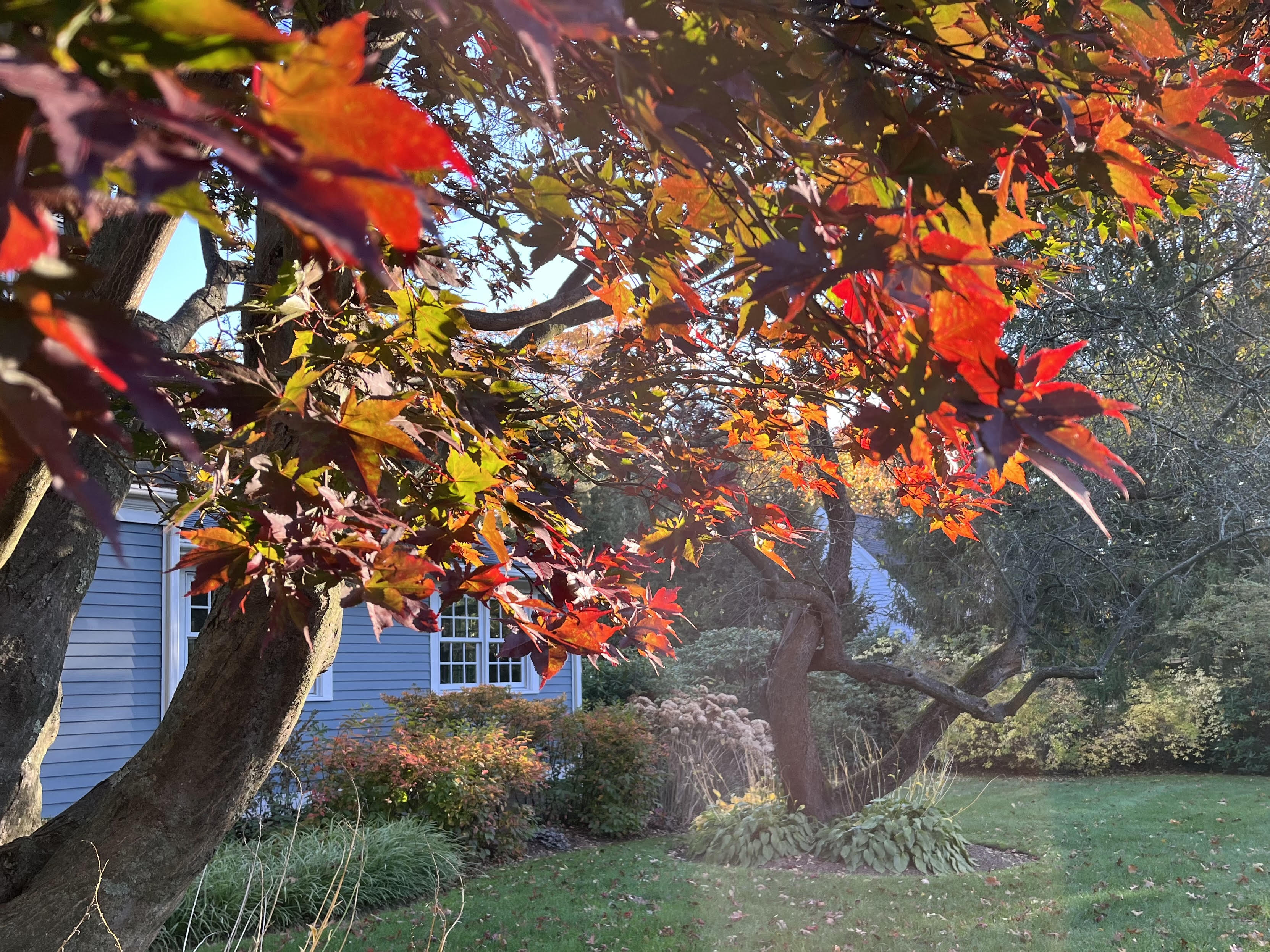
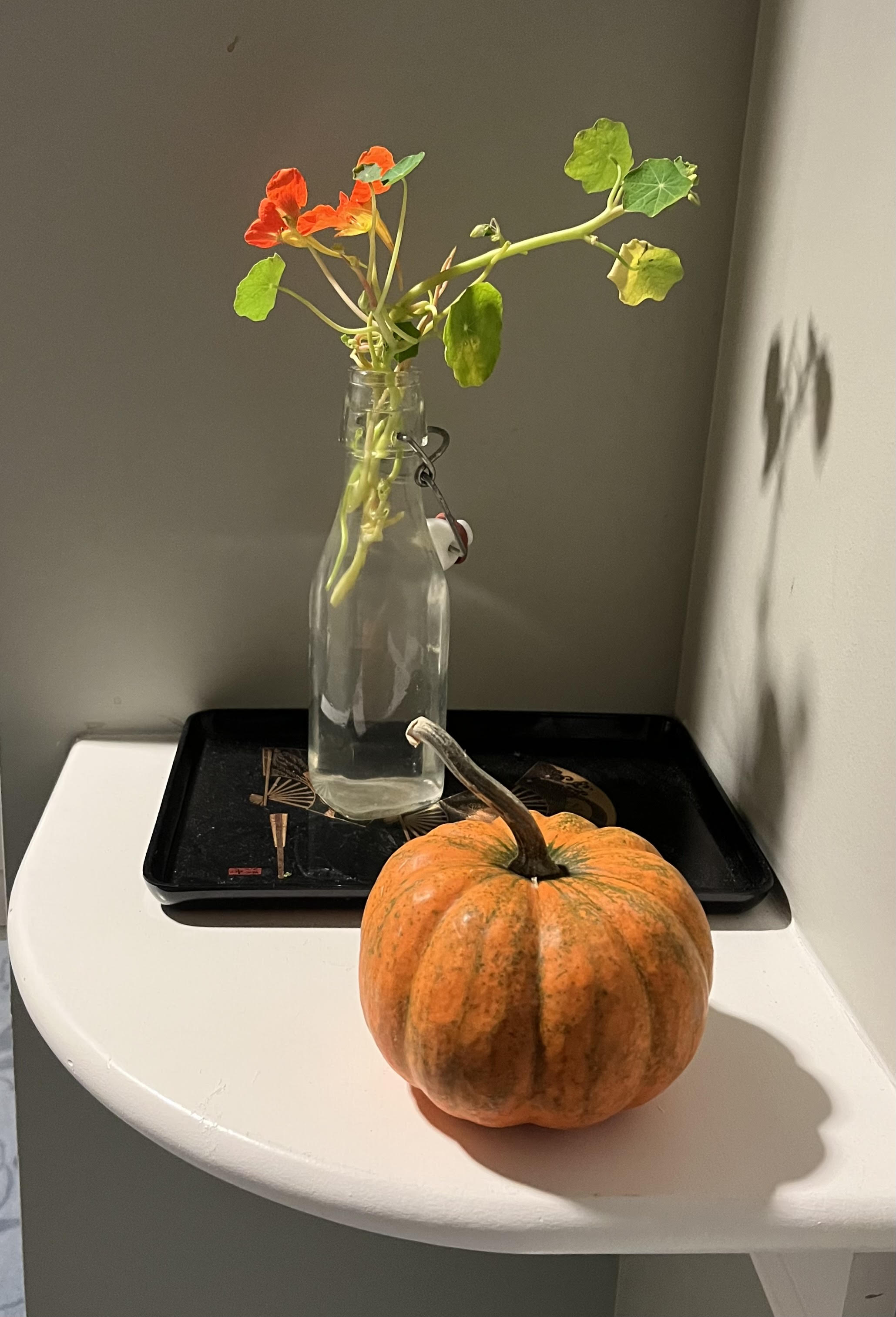
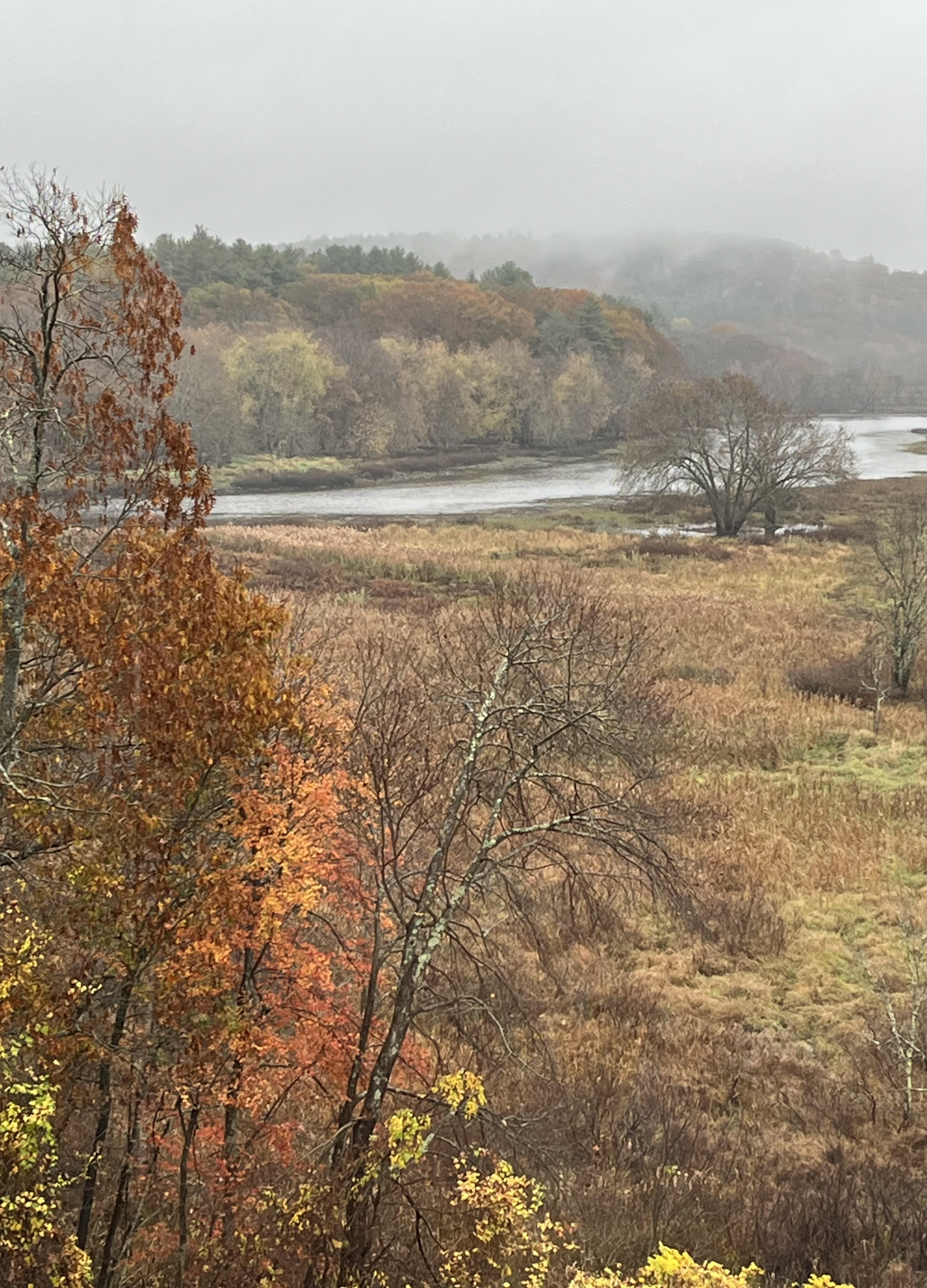
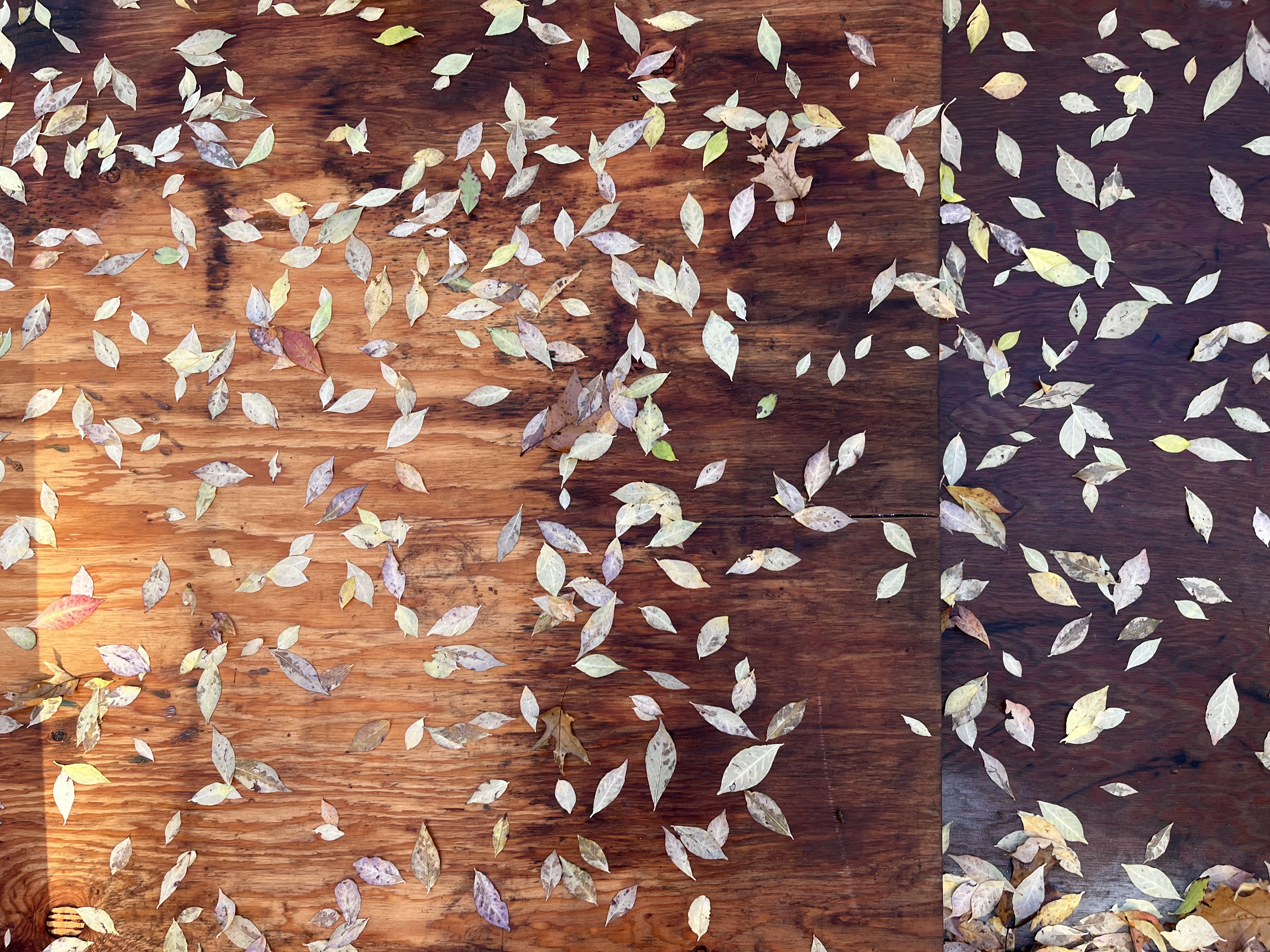
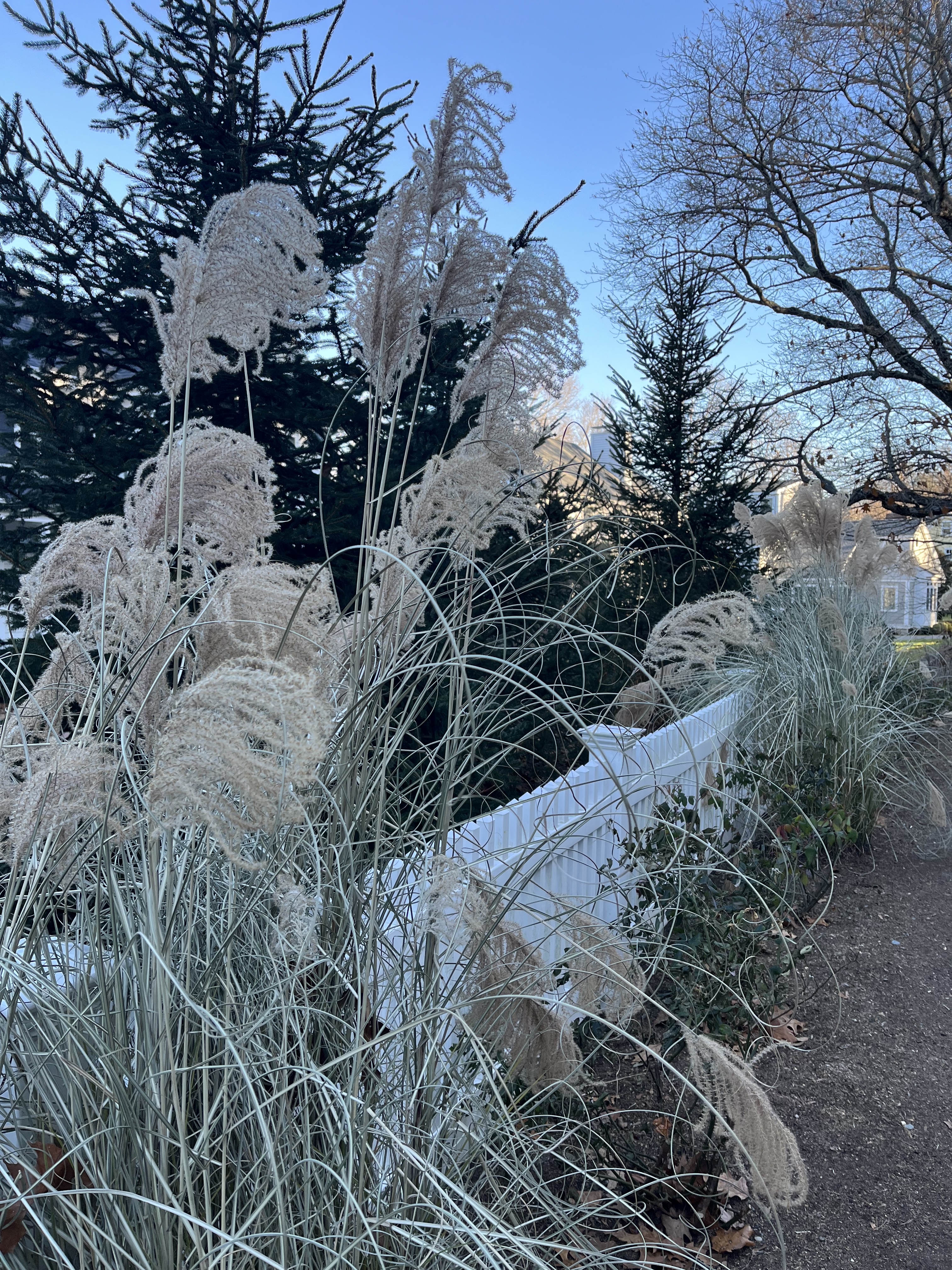
I’m taking it a bit easy as I recover from Covid, but I wanted to show you how things have looked around here lately. The photos are mostly from my routine walks along the road by the golf course. Sometimes I take golf course pictures and send them to Lynn in Florida, where she can play all year. I love the long early-morning shadows. Soon the hills and sand traps will be covered in snow.

The other photos include samples of fall color that came late this year, the foggy river, wet leaves, a last nasturtium, and feathery grasses.

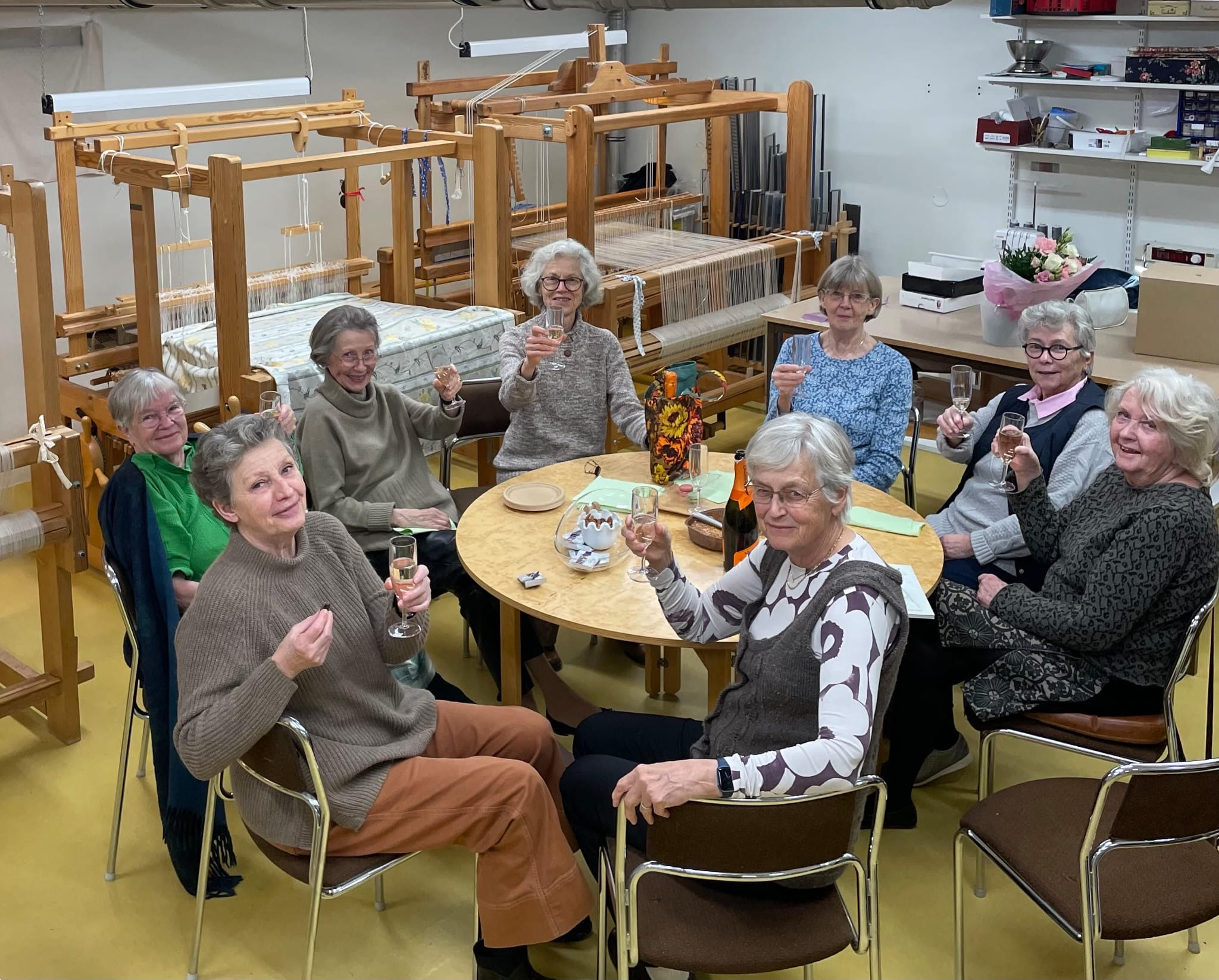
Erik’s mom sent the last picture. She, too, has moved into a retirement place, but in Sweden. The photo shows her lifting a glass with other residents celebrating their 80th year. Don’t you love the looms?

Read Full Post »

Photo: Rob Schoenbaum/The Guardian.
A Swedish coastguard diver exits the water after inspecting a wreck.

So many different kinds of work in the world! Today’s article, from the Guardian, describes an unusual job in Sweden. It involves going underwater to protect old shipwrecks from looters.

Miranda Bryant writes, “Among the rocky shores and wooden summerhouses of Dalarö, an exclusive Swedish summer retreat, there was little to indicate anything other than a typical summertime scene on the Stockholm archipelago.

“It was only as the coastguard boat reached a discreet yellow buoy that there was any suggestion of the 17th-century shipwreck lying, preserved, 30 metres beneath it. ‘STOP,’ read a sign. ‘Marine cultural reserve.’

“Bodekull, built by the English shipbuilder Thomas Day, is believed to have run aground in 1678 and sunk while transporting flour to the Swedish naval fleet in Kalmar, down the coast in south-east Sweden.

“Thanks to the Baltic’s brackish water protecting the wreck from shipworms, the 20-metre-long ship remains on the seabed, upright and largely intact, full of relics that are still being discovered. Two of its three masts poke up towards the sky in their original position.

“But now Bodekull faces a human threat to its existence. Authorities say that it is among thousands of historic wrecks across the Nordics that are at risk from plundering.

“On a monitoring operation last week, experts shared photographs with the Guardian that show that objects are vanishing from shipwrecks.

“Those responsible are believed to be a diverse array of offenders, from light-fingered sport divers in search of souvenirs to criminal gangs looking for high-value objects to sell. Such is the scale of the problem that the coastguard is now regularly sending divers down to monitor at-risk sites.

“ ‘The plundering problem isn’t just a Swedish problem, it’s a Baltic Sea problem,’ said Jim Hansson, a marine archaeologist at Vrak, the museum of wrecks, citing the sea’s low salinity and comparatively shallow average depth of 55 metres.

“These unique conditions, as well as the existence of an estimated 100,000 shipwrecks, make the Baltic a ‘mecca for marine archaeologists,’ he said. But it’s also increasingly attracting looters. Around Stockholm alone, Hansson knows of six wrecks that have been looted by international and Swedish divers. …

“ ‘Sweden has one of Europe’s longest coasts so it’s a lot of water to guard and it isn’t easy,’ said Hansson. …

” Coastguard divers normally work on environmental disasters, inspect ships for drugs and weapons and help police looking for murder weapons. ‘It is very unique for us to be part of this,’ [Patrick Dahlberg, a coastguard commander] said. …

“[On August 1] Coastguard diver Patrik Ågren said he didn’t see any evidence of tampering as he emerged from recording the contents of a tool drawer on the ship containing planes, sledgehammers, a basket and carpentry equipment. … Video footage he recorded during the dive will be compared with previous footage to check for changes.

“But on a later dive they discovered that a wheel on a cannon had been removed, a deck beam collapsed and a wine bottle moved since they last visited in January. While some of the changes may have been caused by nature, Hansson said it was difficult to see how the wheel and wine bottle could have been moved without human intervention. …

“Hansson said removing relics from wrecks prevented them from building a full picture of the type of ship, where it was going and what it was doing.

“ ‘We collect all the puzzle pieces just like a police or coastguard investigation,’ he said. ‘That’s why it is super important that objects are not moved because it is like ripping the pages from a book. In the end all you will have left is an empty shell.’

“Amid heightened tensions with Russia after its invasion of Ukraine, allegations of spying and Sweden’s hopes of imminently joining Nato, it is a critical time for the Baltic.

“But Hansson said that cultural monuments could also be used in war. ‘What happened with Nord Stream [gas pipeline bombings] could similarly happen with national cultural heritage monuments like shipwrecks. The first thing that happens with big conflicts is that you erase a nation’s integrity and history.’ ”

More at the Guardian, here.

Read Full Post »

Photo: Dominique Soguel.
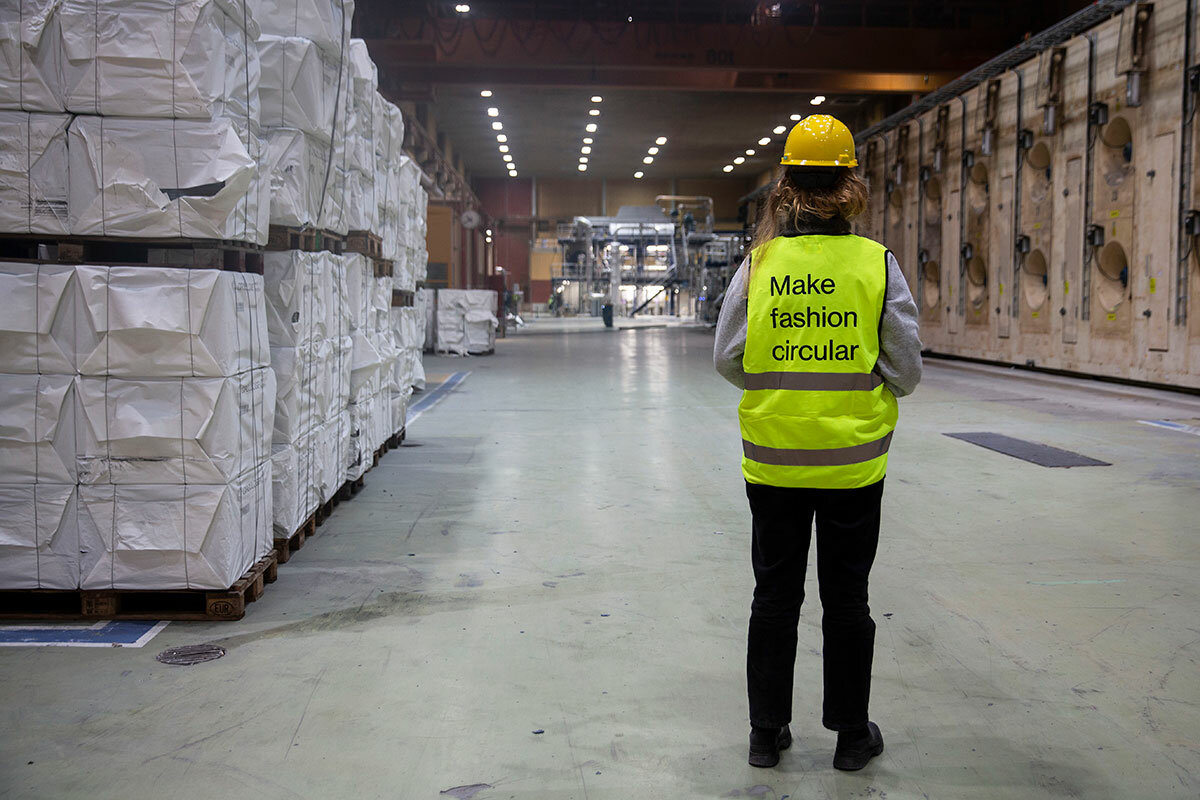
An employee stands in the industrial-scale plant of textile-to-textile recycling company Renewcell in Sundsvall, Sweden, Feb. 7, 2023.

After my youngest granddaughter toured a recycling facility in Rhode Island, she told me that one thing the state recycles is textiles. But in Massachusetts, where a new law forbids putting textiles in landfills, there are few towns that offer services for recycling worn-out clothes. At least there are plenty of outlets for reusable clothes.

In Sweden, some folks are trying to make all clothes — and the materials that go into them — reusable. That’s according to today’s article from the Christian Science Monitor.

Dominique Soguel writes, “Discarded, sorted clothes arrive by ship on the shores of Sundsvall, in the Gulf of Bothnia inlet of the Baltic Sea. But they aren’t bound for a landfill.

“Rather, they are destined for the city’s Renewcell plant, where they will be dissolved and processed into a new substance: Circulose. This material looks like white cardboard, feels like watercolor paper, and – most importantly – can be spun into yarns for textile manufacturers. …

“Renewcell’s patented technology, now available commercially, and successful launch of the world’s first industrial-scale textile recycling plant in Sweden offer a beacon of hope to brands and consumers who care about environmental sustainability.

“ ‘From an environmental perspective, it means that every year, instead of huge swaths of forest being cut down, millions of old jeans and T-shirts are being used rather than them degrading into methane in landfill,’ says Nicole Rycroft, director of the environmental nonprofit Canopy.

“The fashion industry relies primarily on three fibers – polyester, cotton, and viscose rayon – each of which is problematic for the environment.

“Polyester, made from plastic, takes hundreds of years to break down. … Soft-to-touch cotton is grown on vast, water-intensive monoculture farms using large quantities of fertilizers and pesticides. The Aral Sea, once the world’s fourth-largest lake, dried up almost completely, drained by cotton fields in Uzbekistan and Kazakhstan. …

“Viscose rayon is made from tree wood, which sometimes comes from ancient forests. Ms. Rycroft points to the 300 million trees cut down yearly to make viscose rayon, among other textiles. That consumption is slated to double within the next decade.

“On top of all this, much of what the fashion industry produces with these materials ends up as waste. Global production of textile fibers and all apparel creates 110 million metric tons of waste. On average, Europeans produce 33 pounds per year per capita, and Americans about 70 pounds per year.

“Solutions for controlling fashion’s consumption rate range from reducing overproduction and overconsumption to making longer-lasting clothes and embedding circularity into product design. But experts consider fiber-to-fiber recycling – converting textile waste into new fibers that can be used to make clothes or other textile goods – as one of the most sustainable and scalable levers available. …

“The Nordics stand out in Europe for their efforts to reduce the fashion industry’s impact on the planet. Copenhagen Fashion Week imposes sustainability requirements on brands before they hit the runway. Multiple Nordic brands offer recycling options and sell used clothes on their shelves at reduced prices.

“Sweden boasts an impressive secondhand clothes market scene; the world’s first recycling mall, Retuna; and innovative companies like Nudie. Nudie offers customers free repairs on their jeans and a 20% discount on new ones if they trade in old ones. It’s a much-loved service.

“ ‘I really like clothes, but I don’t think it’s necessary for me to buy something new to get the kind of clothes that I like to wear,’ says Tomas Persson after bringing his jeans in for repair to the Nudie shop in Gothenburg. Apart from underwear, he says has not bought a new item of clothing in years – not an uncommon claim in Sweden.

“The development of sustainable textiles is also part of Sweden’s national strategy. That keeps the Swedish School of Textiles and Science Park Borås, both part of the University of Borås, abuzz with the development of high-tech prototypes and design experiments focused on recycling, reuse, and upcycling.

“ ‘We have to find more efficient production processes … and ways of consuming garments,’ says Susanne Nejderås, textile strategist at Science Park Borås. ‘The mean use of a clothing item is around two years. We need to add another eight years to that.’ ”

I’ll just add that consumers are not only demanding sustainability these days, but human rights. There is widespread concern about China using Uyghur forced labor for cotton products. That’s why I buy cotton towels at Patagonia and fair trade cotton clothes from Fair Indigo in Peru (thanks to blogger Rebecca).

More at the Monitor, here. No firewall. Subscriptions welcomed.

Read Full Post »

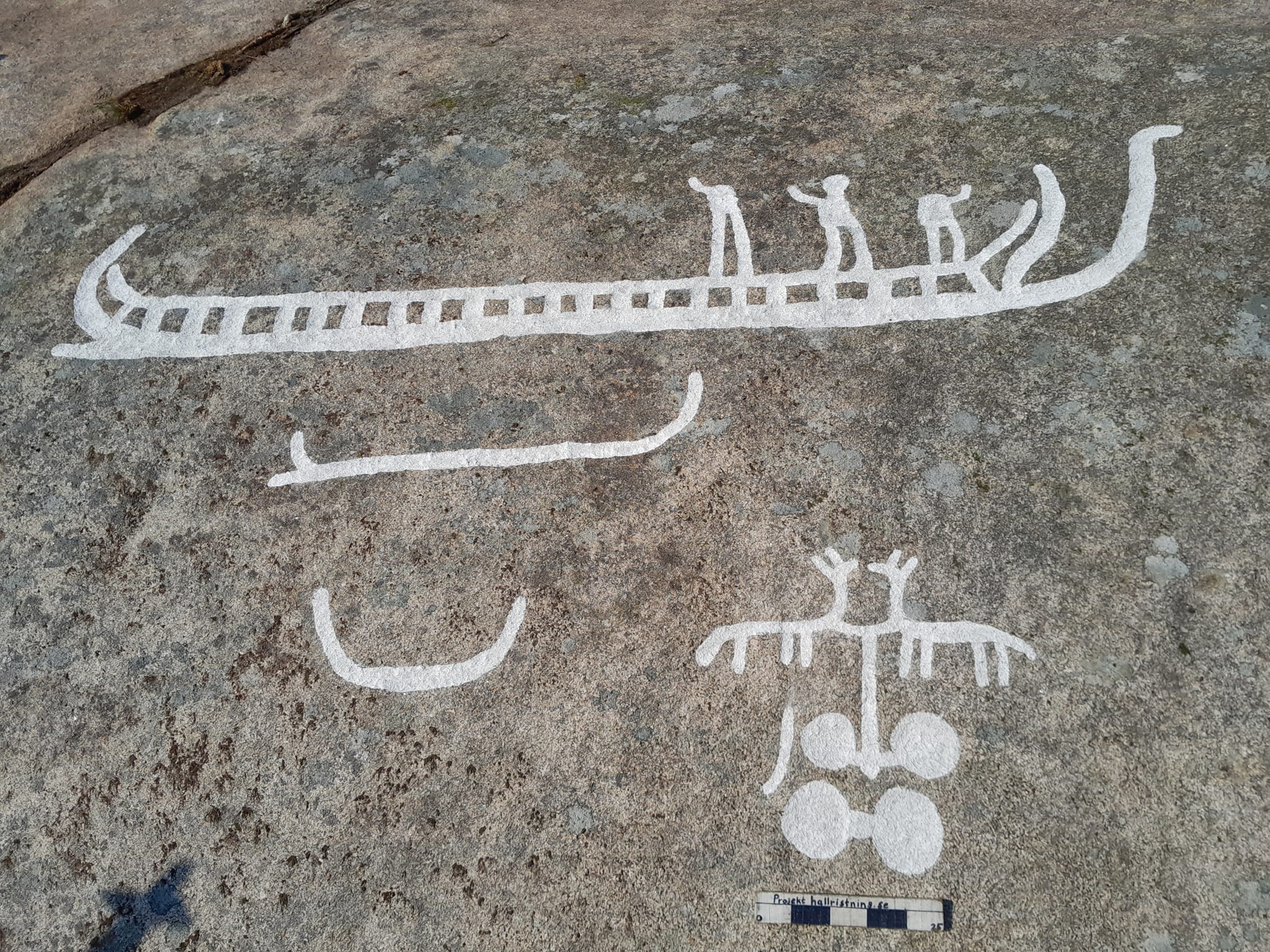
Photo: The Foundation for Documentation of Rock Carvings in Bohuslän.
One of the petroglyphs recently discovered on a farm in western Sweden.

Erik is from Sweden, so he takes Suzanne and the kids there every summer for about a month, where they connect with his sister’s lively family and his mother (Stuga40 on WordPress).

My husband and I paid Stuga40 a visit back in 2017, and one of the many fun things we did with her was visit a UNESCO World Heritage Site featuring ancient petroglyphs. (See a post on that here.)

It turns out that ancient civilizations in Sweden are not done revealing their secrets. Recently, researchers found more petroglyphs, startling the farmer who lives on the land and adding to the world’s pool of knowledge.

Richard Whiddington reports at Artnet, “In early May, a group of researchers scouring the western Swedish province of Bohuslän spotted irregular markings on a moss-covered rock face. They seemed man-made and so the team carefully removed the vegetation and uncovered scores of rock carvings, around 40 in total, depicting ships, animals, and people.

“The rock carvings, or petroglyphs, date back around 2,700 years and are the latest find in Bohuslän, an area known for its rock art, most notably the Bronze Age images at Tanum, a UNESCO site. …

“The recently discovered petroglyphs were found on a steep rock face that once formed the edge of an island before sea levels gradually dropped an estimated 40 feet over the course of several hundred years. This has led researchers to speculate the artists used boats, or a form of scaffolding laid on ice, to reach the rock surface. …

“The designs were made through a laborious process of smacking stones against the granite rock that exposed an underlayer of white. This color, in addition to their size, made them highly visible from both the mainland and passing ships.

“ ‘What makes the petroglyphs completely unique is that they are located three meters above today’s ground surface,’ Foundation for Documentation of Bohuslän’s Rock Carvings wrote in a statement. ‘The motifs lie on an even line that follows the height of the sea surface from approximately 700 to 800 BCE. The motifs are also stylistically consistent with this time period.’

“The latest group of petroglyphs found includes a 13-foot-long ship, as well as carvings of people, chariots, carts, and horses. Their meaning remains unknown. Sometimes petroglyphs were used to mark out territory, though researchers believe the repeated motifs carved into rocks outside the town of Kville may suggest they were used to tell a narrative.

“Lennart Larsson, on whose farm the rock carvings were found, was pleased by the discovery. ‘I haven’t actively been looking for petroglyphs, but it’s a lot of fun,’ he told SVT, the country’s national broadcaster in interview. ‘I can sit at home on the balcony and watch the stick figures and the ships outside.’ ” More at Artnet, here.

Also, at Live Science, Martin Östholm, a project manager with the foundation, noted that he petroglyphs include depictions of ships, people and animal figures, “including four-legged creatures that may be horses. … It’s not certain why people created the carvings, he said, but they may have served to mark ownership. …

James Dodd, a researcher at Aarhus University in Denmark and the Tanums Hällristningsmuseum’s Rock Art Research Centre Underslös in Sweden [said that] some of the motifs — including chariots, carts and animal figures — were depicted multiple times. … ‘On the basis of the repetition of the motifs, it is possible that this collection of figures forms a narrative,’ Dodd told Live Science in an email. Studies of other petroglyphs in the region have suggested that, in some cases, they may have been used in this way, but the exact meaning in this case is uncertain, he added.”

Artnet and Live Science have good pictures — and no firewalls.

Read Full Post »

Photo: Dominique Soguel.
Young migrants who arrive in Sweden alone become part of a “big family” with older people in this unusual living arrangement.

You may have heard of anti-immigrant sentiment rising in Sweden, a country that historically has been welcoming to victims of war and persecution. But no story is the whole story.

At the Christian Science Monitor Dominique Soguel reports about the ongoing generosity of many Swedes.

“It was when his older Swedish neighbors threw him a high school graduation party that Afghan native Zia Sarwary finally felt a sense of belonging in this picturesque seaside city [Helsingborg].

“ ‘It meant everything to me,’ says Mr. Sarwary, who at the age of 13 arrived alone in Sweden during the 2015 refugee crisis. ‘That was the beginning of feeling at home.’

“Mr. Sarwary is one of dozens of tenants living in Sällbo, a shared-living project mixing elder Swedes and young adults, some of them from Sweden, others – like him – from the Middle East or Afghanistan. The six-story building with 51 apartments helps counter both the loneliness of advanced-age Swedes and the integration difficulties facing migrants who arrived as unaccompanied minors.

“Tenants of Sällbo have found common ground within these colorful walls, which they attribute to the cumulative impact of courtesy, kindness, mutual curiosity, and understanding.

“ ‘The whole goal was to show that even if you are different and even if you are people who would not usually socialize, you would do so if there is a safe environment where you know who is in the house,’ says Dragana Curovic, the project manager for Sällbo. ‘After three years, we can say that it worked.’

“Had they not moved under the same roof, the older Swedes and young migrants living here would almost certainly not have mingled. Fear and misunderstanding would have been major obstacles. Older Swedes’ impressions of young migrants draw heavily on negative press reports linking them to crime.

“As for the immigrants, their interactions with Swedes had largely been limited to asylum center officials – authority figures who set the initial tone for the newcomers’ experience, but weren’t focused on building bonds with them.

“Sällbo attempts to overcome that by getting tenants engaged with each other.

To move in, tenants must agree to socialize at least two hours per week.

“That can happen in shared kitchens, activity rooms, or cozy living areas. Each floor boasts three common areas, ranging from puzzle and scrapbooking rooms to libraries and film-screening rooms to carpentry workshops. Sun-kissed kitchens are set up for mingling, growing herbs, pickling, and baking. Artwork decorates the hallways. …

“Young and old concur that the pandemic helped strengthen the bonds that bind them. Younger residents did grocery shopping for the elders, who returned the favor by helping those with low computer skills keep up with their classes online.

“Now a logger working night shifts, Mr. Sarwary wishes he had even more time to spend with his older neighbors and feels bad when he needs to cut conversations short to catch his bus. After all, elders are treated with deference in Afghanistan. He believes curiosity feeds residents’ capacity to find common ground across cultures and age groups.

“ ‘People try to understand each other,’ he says. ‘I know you have your differences. I have mine. But we can meet in the middle ground and do something together that is good for both of us. There is a positivity in everything. That is the best part.’

“ ‘Sometimes you do things that are not correct,’ Mr. Sawary continues. ‘Instead of people coming in scolding you, they come in and they’re like, “Oh, you could do it this way.” ‘ …

“It helps that people understand that he had a tough background and approach him with an open mind to learn about his headline-grabbing, war-torn homeland.

“ ‘They would always ask instead of just judging. “OK, is this true about your country?” ‘ he says. …

“Jan Gustavsson, a retired provider of security systems, says he like helping young people from Afghanistan and other parts of the world integrate. ‘We can see in … Stockholm and Gothenburg, there’s a lot of problems. … I think it will help if these people live together with Swedish people.’ …

“Anki Andersson oversees scrapbooking activities on Tuesdays. Her husband, Kalle, helps fellow seniors do seated workouts. ‘Sällbo is the perfect place if you are mobile and seeking to socialize,’ says Ms. Andersson. ‘People here are so alike in a way. It is hard to explain. We click together very well, both the older and young residents. …

“ ‘If we have something we need to do or heavy things to carry, they give as a hand. We are a big family.’ “

More at the Monitor, here. No firewall. Nice pictures.

Read Full Post »

Photo: Kevin Scott/Dezeen.
The designers of this sauna aimed to build a structure that engaged the local waterways and encouraged people to use them throughout the year, says Dezeen.

When Erik saw my post about a birdhouse championship, he told me one picture reminded him of floating saunas in Sweden. I had to look that up. I found out that saunas on the water are both like and unlike ice-fishing huts. You definitely have to dress differently.

Jenna McKnight at Dezeen writes about the sauna in the above photo: “Visitors can take a plunge into a cold lake after warming up in this floating wooden sauna by Seattle firm goCstudio – the latest example of the trend for buoyant architecture (+ slideshow).

“The structure is intended to be used all year round on Seattle’s lakes and can accommodate up to six people. It is called WA Sauna. … It follows the growing trend among architects to explore the possibilities afforded by building on water rather than land.

” ‘Following in the Scandinavian tradition of saunas as a place for gathering, WA Sauna provides a place for Seattle’s community to share a unique experience on the water,” said goCstudio, a firm founded in 2012 by Jon Gentry and Aimée O’Carroll. …

“Inspired by the concepts of fire, water and community, the designers aimed to build a structure that engaged the local waterways and encouraged people to use them throughout the year. The $25,000 (£17,000) project was funded through community donations and a Kickstarter campaign hosted in the fall of 2014.

“The deck consists of a pre-manufactured aluminum frame and marine-grade plywood with a clear varnish. Boats and kayaks can be tied up to the deck. The floating structure is powered by a 36-volt electric trolling motor. More than two dozen 208-litre plastic drums keep the vessel afloat. …

“Spruce was used to clad the interior and to form the benches. A wood-burning stove heats the space. Users can easily exit the vessel via a door or side hatch and dive into the cool water. …

“The structure was built by studio employees and skilled volunteers. It was erected within a warehouse owned by the local brewery, Hilliard’s, which allowed the team to use the space for free.

“One of the greatest challenges was getting the structure to the lakefront for the first time. … ‘Towed on six steel casters with a 1980 Volkswagen Vanagon, we slowly crept along at dawn making the eight-block trip to the boat ramp in just under three hours.’ …

“Rising sea levels and a shortage of development sites are leading to a surge of interest in floating buildings, with proposals ranging from mass housing on London’s canals to entire amphibious cities in China.

“Other examples that, like WA Sauna, are targeted at communities include a buoyant Nigerian school and a travelling London cinema.”

You can read about another nice sauna at designboom, a site that doesn’t seem to believe in capital letters: ” ‘löyly’ is a prefab floating sauna made of swiss douglas fir. gently swaying in the middle of lake geneva, ‘löyly’ is a floating prefab sauna designed by trolle rudebeck haar – a graduate from the lausanne university of art and design. haar completed this project after spending a year in finland, where he found a true appreciation for the sauna concept and translated it into ‘löyly’ – his final year project. 

“haar designed the structure as a 24 sq. ft floating sauna made of locally sourced swiss douglas fir – a lightweight yet durable material that he salvaged from a sawmill nearby. the entire structure was then coated with teak oil to create a more resistant shell all while preserving the fir’s natural look and feel.

“the interior of the floating sauna oozes with tones of intimacy and comfort. using sliding doors that echo japanese shoji screens, visitors are met with a small wooden burning stove from morzhand. … the choice of stove was made based on practicality: ‘I chose it because it’s compact, transportable, lightweight, and easy to heat up’,  comments haar. 

“haar also had to consider balance and weight while designing the sauna. ‘I was calculating the mass of every unit,’ he explains. the presence/absence of people aboard the floating structure, as well as the placement of the barrels underneath it were all carefully studied to create a safe and enjoyable experience. 

“in just six hours, the floating sauna was built – but haar made it easy to disassemble and scale for different uses.” 

You might also want to click at the Gessato website to see a sauna created by an Italian design team.

Beautifully integrated into its natural surroundings and context, this floating sauna conceptually links Sweden, Italy, and Japan.

“The structure stands on a floating platform, connecting the lake to the land and providing a relaxing space for the guests staying in the clients’ small bed and breakfast. … Self-built by the studio, the project pays homage to nature and sustainability, with impact on the birch forest minimized by moving the sauna on the surface of the water. …

“A glazed wall provides stunning views over the lake, helping guests relax completely and contemplate the beauty of nature. This floating sauna project was presented during the Superdesign Show 2017, held at Superstudio Più via Tortona 27, Milano in April 2017.”

More at Gessato, here, at Designboom, here, and at Dezeen, here. Lots of super pictures.

Read Full Post »

Older Posts »