Feeds:
Posts
Comments

Posts Tagged ‘thailand’

Photo: Gianmarco Di Costanzo.
Lek Chailert devoted her life to rescuing abused elephants. Now caring for 120 of them, she fears for their future in Asia.

The stylist at my salon sometimes talks about her love for elephants. She’s the one who opened my eyes to what elephants and other animals suffer from captivity. I had never thought much about it, assuming that zoos were good, helping children to learn about the wild and saving endangered animals from extinction. Those things may be true to some extent, but not always.

Today’s story is about a woman who set up a rescue operation for elephants in her homeland.

Patrick Greenfield writes at the Guardian, “Saengduean Lek Chailert was five years old when she saw an elephant for the first time. It was in chains, lumbering past her home in rural Thailand on its way to help loggers pull trees from the forest. Back then, she saw the giant mammals like everyone else – as animals that served humans. But that changed the day she heard a scream from the forest.

“Chailert was 16 when she heard the terrible noise. She scrambled through the trees until she found the source: a bull elephant scrabbling in the mud as it tried and failed to drag a log out of a ditch. Every failed attempt was met with punishment from the loggers and mahout, the elephant keeper. …

“ ‘The elephant looked at me and I felt the fear and anger. I felt helpless and confused. My heart hurt a lot,” says Chailert. …

“The incident changed the direction of Chailert’s life forever. She was from a poor family – there was no electricity or school in her village – but she vowed to do something for the animals she loved.

“Before a ban on logging in natural forests in Thailand in 1989, elephants were a key part of the industry. In the early 20th century, there were an estimated 100,000 elephants in Thailand. Thousands were worked to death or left with severe injuries. …

“After the ban, many elephants were used by the country’s rapidly growing tourism industry to give performances and rides. …

” ‘Camp owners were competing with each other for tourists,’ she says. ‘They would train their elephants to dance, ride a motorbike, play darts or hula hoop, walk on a rope or play a harmonica. This brought more suffering to elephants.’

“It took Chailert a few attempts to fulfill her dream of finding a way to care for Thailand’s elephants. In 1996, she sold everything she had and borrowed money to set up an elephant sanctuary. She paid $30,000 for four hectares (10 acres) of land to provide a home to nine elephants.

“She insisted that there would be no elephant rides or performances. Her family invested money to help but after disagreements over how to run the park, she left the project, taking the elephants with her.

“Then, Chailert got lucky. National Geographic was filming a documentary with the Hollywood star Meg Ryan about Thailand’s wild elephants, which were estimated to number 4,000 to 4,400 by 2023; Chailert and her newly released elephants featured in it.

“In the US, a Texas couple, Bert and Christine Von Roemer, saw the TV program and contacted Chailert, donating enough money to buy a 20-hectare parcel of land in the Mae Taeng district of northern Thailand, near Chiang Mai. In 2003, Elephant Nature Park was born.

‘Today, about 120 rescue elephants are at the park, which has grown to more than 1,000 hectares, home to a small fraction of the 3,900 or so domesticated elephants in the country. The sanctuary’s work has an enormous social media following on Instagram and Facebook.

“Elephants arrive from all over Thailand. …

” ‘Some arrive with huge mental issues. Some stand like a zombie; some are aggressive, they swing their head back and forth. When they arrive, we do not allow our staff to use any tools or do anything that might make them feel threatened. We are gentle. We have to give them our love to make them trust us. We have to be patient,’ she says.

“New arrivals are almost always put into quarantine and slowly introduced to the herd. Over time, they are accepted. When their ears start to flap and their tails start to whirl, the elephants are happy, says Chailert. …

“Today, the conservation scheme is funded by visitors and volunteers who pay to work on the project. But despite the success of the sanctuary, Chailert fears for the future of Asian elephants, which she believes are decreasing in Thailand, despite official figures showing a steady increase in the population.

“ ‘Throughout Asia, many people are starting to hate elephants. Human-wildlife conflict is a big problem. Many died from being shot and poisoned,’ she says.

“ ‘Many have lost their habitat and water sources so they have to go to golf clubs and rice fields – places that don’t belong to them. So, people get angry and make the elephant into a monster. The future will depend on the government policy to resolve this,’ she says.”

More at the Guardian, here. PS. The Guardian doesn’t have a paywall. Please consider donating to keep their journalism alive.

Read Full Post »

Photo: The Guardian.
Phra Mahapranom Dhammalangkaro, abbot of Wat Chak Daeng, with the solar-powered Hippo waste-collection vessel behind him. When he began his campaign against plastic, he found a novel way to get people to send monks their waste: ‘People can make [Buddhist] merits by giving us plastic bottles, bags and paper.’

Today’s story shows a good way to reduce current plastic problems, even though we know that long-term, we need to stop producing plastic. You can collect it and turn it into other products, but when the new products break down, we still have plastic.

Claire Turrell writes at the Guardian from Bangkok, ” ‘Once upon a time this river was filled with fish; now, nothing swims in it any more,’ says Wat Chak Daeng temple’s abbot, Phra Mahapranom Dhammalangkaro, as he looks out over Bangkok’s Chao Praya River.

“As a novice monk in the 1980s, he remembers seeing children playing in the river and people scooping up handfuls of water to drink. But when he became abbot of Wat Chak Daeng more than 25 years later, those bucolic images were a thing of the past. Instead, when he arrived at the 240-year-old temple, he was saddened by the sight of the dirty river and the rubbish-strewn grounds surrounding it.

“Dhammalangkaro knew that if nothing was done, the situation would only get worse. He built a recycling centre in the temple grounds, which evolved from collecting a handful of bottles to upcycling 300 tons of plastic a year. His biggest problem was that he was unable clean the river itself.

“But then he met Tom Peacock-Nazil, chief executive of Seven Clean Seas, an organization that finds solutions for plastic pollution. Last week the two men launched the Hippo, a solar-powered boat, which aims to remove [millions of pounds] of plastic a year from Bangkok’s busiest waterway. …

“The Chao Phraya River is the largest waterway flowing through central Thailand. It stretches more than 230 miles from the northern Nakhon Sawan province to the Gulf of Thailand and is home to critically endangered species such as the Siamese tigerfish, giant barb and Chao Phraya giant catfish.

“In Bangkok, it is an artery for a network of water buses, ferries and wooden long-tail boats. But it’s not just carrying people. According to research by the Rotterdam-based non-profit organization Ocean Cleanup, the Chao Praya River carries 4,000 tons of plastic waste to the sea every year. …

“The Hippo’s design is simple and effective. A boom on the vessel funnels the floating plastic from the river on to a solar-powered conveyor belt. This then hauls the rubbish out of the water and drops it into a dumpster hidden under its roof.

“The tangled mass of water hyacinths, food containers, plastic bottles and bags is then sorted by hand and recycled at the plant in the temple. …

“Chalatip Junchompoo, a director of the Marine and Coastal Resources Research Centre, believes the Hippo’s presence will have an important impact by raising awareness of plastic waste. She views it as a welcome addition to its network of river booms and rubbish-collection boats. …

Thailand is aiming to have all plastic recycled by 2027, up from 37% now, according to the Pollution Control Department. Plastic that cannot be recycled is, where possible, used for refuse-derived fuel. …

“While sponsorship has helped cover the running costs of the Hippo, future expenses and maintenance will be paid for with plastic credits, which companies can use to offset their plastic footprint.

“In Wat Chak Daeng, some of the plastic is sent to a factory to be converted into fabric. The fabric is then sewn by volunteer seamstresses at the temple into saffron-colored robes for the monks, as well as blankets and bags. …

“The monks can upcycle multilayered plastic, which is seen as challenging to recycle, thanks to a new machine that uses a chemical recycling method known as pyrolysis to break plastic down into oil. Any organic waste is converted into fertilizer using two industrial composters.

“The Hippo has created the final link in Wat Chak Daeng’s circular economy. Now the aim of the team is to build more Hippos to tackle other polluted rivers elsewhere in Thailand and south-east Asia.

“Peacock-Nazil says that addressing rivers alone is not the solution. ‘We need to work onshore and in riverside communities to make sure they have the infrastructure needed to stop plastic leaking into the environment in the first place,’ he says.

“Seven Clean Seas, as well as extending its reach in Bangkok, plans to create educational programs at a local level and would like to offer the Hippo as a floating laboratory for universities in the future.”

More at the Guardian, here. No paywall. Contributions keep the Guardian going.

Read Full Post »

Photo: Chalida EKvitthayavechnukul/AP.
Monkeys eat fruit during a monkey feast festival in Lopburi province, Thailand, Nov. 27, 2022.

Today’s story is about overly aggressive monkeys that went from being a tourist attraction to rather dangerous predators.

I don’t think I knew monkeys could be like that, but then, we don’t get many local monkey stories in the Northeast. Unless you count my story about the librarian on my street who was looking out her window as she dressed one morning and saw a little, wrinkled, old-man face staring at her.

That one turned out to be an escaped pet.

Jintamas Saksornchai at the Associated Press writes, “Thai wildlife officials laid out a plan [in April] to bring peace to a central Thai city after at least a decade of human-monkey conflict. The macaques that roam Lopburi are a symbol of local culture, and a major tourist draw. But after years of dangerous encounters with residents and visitors and several failed attempts to bring peace with population controls, local people and businesses have had enough.

“The monkeys frequently try to snatch food from humans, sometimes resulting in tussles that can leave people with scratches and other injuries. But outrage grew in March when a woman dislocated her knee after a monkey pulled her off her feet in an effort to grab food, and another man was knocked off a motorcycle by a hungry monkey.

“Authorities hope to round up some 2,500 urban monkeys and place them in massive enclosures, said Athapol Charoenshunsa, the director-general of the Department of National Parks, Wildlife and Plant Conservation. They’ll work with wildlife experts to find a way for a limited number of monkeys to stay at liberty in the city, he added. …

“An official monkey catching campaign was launched week, prioritizing more aggressive alpha males. It has caught 37 monkeys so far, most of whom have been put under the care of wildlife authorities in the neighboring province of Saraburi, while others were sent to the Lopburi zoo. Officials said they plan to capture the rest of the monkeys once the enclosures are complete, especially those in the residential areas. …

“The monkeys are a symbol of the province, about 140 kilometers (90 miles) north of Bangkok, where the ancient Three Pagodas temple celebrates an annual ‘Monkey Buffet’ festival, and they’re commonly seen throughout the city. Macaques are classified as a protected species under Thailand’s wildlife conservation law.

“Some have blamed the city’s monkey troubles on tourists and residents feeding the animals, which they say drew monkeys into the city and boosted their numbers, as well as getting them accustomed to getting food from humans.

“But an earlier effort to limit feeding may have made things worse, some residents say. Local officials began threatening fines for feeding monkeys outside a few designated areas around the main tourist attractions in recent years. But those feeding areas were dominated by a few troops of the highly territorial creatures, while rival bands grew hungry and turned to harassing humans in other areas for food even more.

“Athapol said people shouldn’t see monkeys as villains, saying that the authorities might have not been efficient enough in their work to control the simian population.

” ‘People also need to adapt to the city’s monkeys,’ said Phadej Laithong, director of the Wildlife Conservation Office, explaining that a lack of natural food sources prompts the animals to find food wherever they can, including from humans.”

More at WPRI in Providence, Rhode Island, here. There’s audio on this dilemma at The World, here.

Read Full Post »

Photo: Ronan O’Connell.
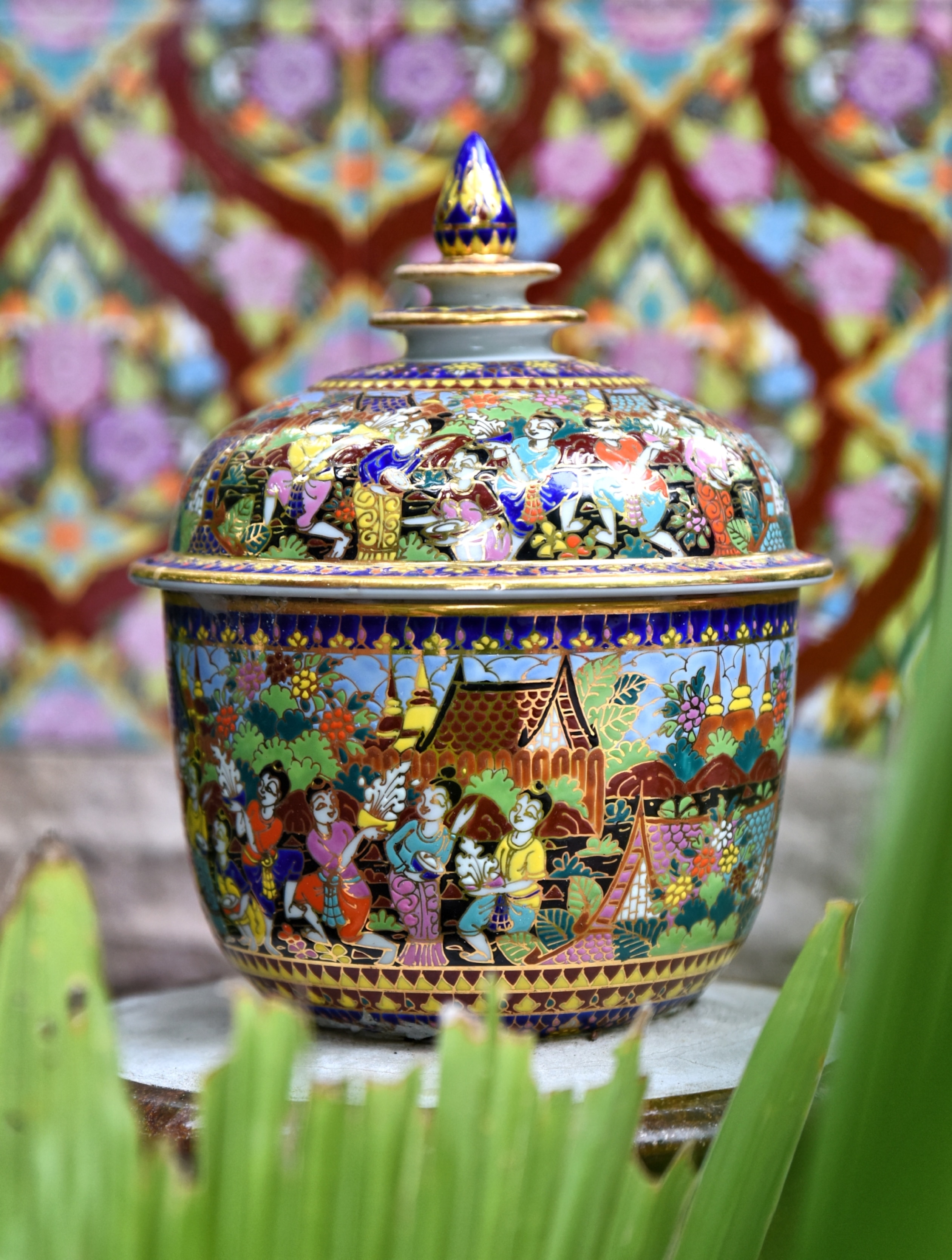
Once reserved only for Thailand‘s elite, authentic benjarong porcelain takes highly skilled artisans days to create.

The other day, Princeton University reported that “a tortoise from a Galápagos species long believed extinct has been found alive and now confirmed to be … the first of her species identified in more than a century.” Wow. Good thing there are people working all the time to identify and save species.

Efforts to save dying arts are also important. Here is one practiced in a village in Thailand.

Writing last November at National Geographic, Ronan O’Connell reported, “Few tourists to Bangkok know that the glimmer of the iconic Wat Arun temple is thanks to the same magnificent Thai porcelain that decorates five-star hotel lobbies or serves as dinnerware in high-end Bangkok restaurants.

“Hand painted with intricate Buddhist motifs, benjarong porcelain once was reserved only for Thailand’s elite. In the 18th and 19th centuries, Thai royalty ate from delicate benjarong dishes and plates, wealthy women stored jewelry in benjarong boxes, and Bangkok’s palaces displayed tall benjarong vases.

“In the early 1900s, mosaics made of benjarong shards began embellishing many of the city’s most important Buddhist temples. … But it soon fell out of favor, and porcelain production eventually ceased.

“It would now exist only as an antiquity if not for a village that, in the 1980s, saw an opportunity to revive the art form. Located about 19 miles west of Bangkok, Don Kai Dee has grown to become what Atthasit Sukkham, assistant curator of the Southeast Asian Ceramics Museum at Bangkok University, describes as the sole source of authentic benjarong. …

“As of November 1, vaccinated travelers can visit Thailand quarantine-free, where they can buy benjarong from the artists at Don Kai Dee, learn the history of Thai ceramics at Bangkok’s Southeast Asian Ceramics Museum (reopening in December), and admire the exquisite benjarong decorations in the Thai capital’s Grand Palace. …

“It took the 1982 closure of a ceramics factory near Bangkok to resuscitate this royal craft. Urai Tangaeum was one of dozens of Thai artists made redundant when that workplace closed in Samut Sakhon province, where Don Kai Dee is also located. …

“Instead of wallowing in her misfortune, Tangaeum recounts, she decided to take a risk. After studying benjarong designs, she began painting them on plain ceramics sourced from factories. When it became apparent Thai buyers appreciated this forgotten product, she bought her own kiln. Slowly, Tangaeum created a start-to-finish benjarong studio at Don Kai Dee. Nearly 40 years later, this has become a co-operative where dozens of potters share skills and knowledge.

“During tours of Don Kai Dee led by senior workers, tourists to the village learn that each benjarong item is crafted using a nine-step process involving up to four different artists. It begins with soils from three Thai provinces. When mixed together they provide the perfect blend of plasticity, heat absorption, and white-color finish.

“After being shaped on a pottery wheel, the benjarong item is set in an electric kiln for 10 hours at 1472°F (800°C). Once it cools, the item is coated with a glaze and baked for another 10 hours at an even higher temperature, until it gleams.

“The next step is benjarong’s trademark. Artists paint designs with liquid gold, which costs $5,000 per liter, according to Tangaeum’s daughter, Nippawan. This gilding is executed only by veteran workers, who have 20-plus years’ experience in a profession which some artists can continue well into their 60s.

“Finally, another worker traces around the golden lines with colored paints, then a supervisor inspects the piece. The process finishes with another blast in the oven. It takes three to four days to produce a benjarong cup, dish, or plate, which go for at least $30 each. That time frame extends to two weeks for the largest vases, which can be up to six feet tall and cost as much as $10,000. …

“While shops across Thailand sell mass-produced, cheaper versions of benjarong, Don Kai Dee is the only source of authentic, traditional benjarong, according to ceramics expert Sukkham. At Don Kai Dee, tourists can purchase ready-made items and have them personalized on site, or order custom artworks to be shipped to their homes.

“The village does not have a website, with most of its sales done in person at the village, or via art dealers who facilitate purchases for rich clients, Pongmatha says. Some of these buyers pay up to $30,000 for particularly intricate, gold-laden dining sets.

“The expense of benjarong reflects the painstaking intricacy of its crafting. It requires poise and persistence to scrawl precise benjarong designs for hour after hour. It is those attributes, above all, that decide whether a benjarong student can become a master.

“ ‘We have many young people who come to the village to learn benjarong, but most don’t last,’ [villager Prapasri Pongmatha] says. ‘They have enough skill, but not the patience. Making benjarong can make you crazy if you aren’t patient. But if you are patient enough, it is very soothing, nearly like meditating.’

“The humble incomes earned by Benjarong artists also deter young Thai people from learning this craft, according to her daughter, Supawan Pongmatha. The 39-year-old says she loves making these ceramics. But she does so only in her spare time, having decided to instead become an art teacher, a more stable job with a higher salary.

“ ‘Young people want to make money, to feel they have a safe job with a good future,’ Supawan says. ‘Being a benjarong artist is not as reliable.’

“Without a robust new generation of craftspeople making benjarong, its future is uncertain, the villagers agree. Forty years ago, benjarong was a relic. Having slowly roused this art form out of hibernation, the artists of Don Kai Dee are now fiercely trying to keep it awake.”

More at National Geographic, here. Wonderful pictures. (Four free articles per month.)

Want to watch a short video about another endangered craft? Learn about making toe shoes in the UK, here.

Read Full Post »

jayfai_wide-3a01246810c2d39a14544605a9be03051690aae9-s800-c85

Photo: Lillian Suwanrumpha/AFP/Getty Images
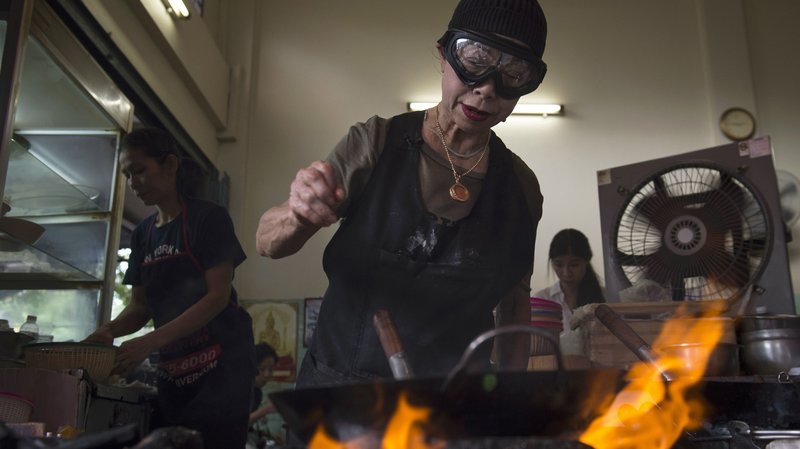
Chef Jay Fai in Thailand wears a wool cap and safety goggles to ward off the heat from the charcoal fires in the alley where she cooks all of her restaurant’s meals. She won a Michelin star for her high-quality food.

Quality can be found anywhere, as this National Public Radio (NPR) story about a chef in a Thailand alley shows.

Michael Sullivan writes, “Bangkok is legendary for its fun and its food. Especially its street food. And one vendor’s is so good, it has earned a Michelin star for the second year running.

“Raan Jay Fai is a small, seven-table joint in Old Bangkok that’d be easy to miss if it weren’t for the line. There’s always a line.

“You can try to make a reservation, but the place — named after its chef/owner, a local legend — is usually booked a month or two out. Signing up for the walk-in list is the best bet for many, especially tourists. But you need to get there early.

” ‘I got here at 7:30 [a.m.],’ says 24-year old Kashmira Velji, from Austin, Texas, who was determined to try Jay Fai after viewing the chef’s star turn on the recent Netflix special Street Food. Never mind that the restaurant doesn’t open for lunch until 2 p.m. …

” ‘I’ve never had anything like this before,’ Velji says between bites. … ‘Our first bites were very intense. We kind of just stayed silent and were in shock at how good it tastes.’

“Suparat Tretachayakorn — a doctor — isn’t shocked at all. He’s a regular. And the crab omelette is one of his go-to dishes. … He and his friends have also ordered Jay Fai’s famous tom yum soup, and half a dozen other dishes. Tom yum is a Thai staple — made with shrimp, lemongrass, galangal, kaffir lime leaves, chilies, garlic and mushrooms — and it’s found almost everywhere. But that doesn’t mean it’s always good.

” ‘Actually, I don’t normally order tom yum because I know that I’m going to be disappointed at most places,’ he says. …

“It’s another of her signature dishes. One that’s got the visitor from Austin, Velji, baffled. In a good way.

” ‘It tastes just like the soup, but it’s dry,’ she says. “It’s exactly the same flavors of the tom yum soup, but instead of slurping it, I’m chewing it and I’m still getting all those sour, spicy flavors’ …

“Part of the fun [is] watching the maestro at work. The 74-year-old Jay Fai cooks everything herself — over two blazing charcoal fires, in the alley next to the busy street. …

” ‘It’s faster to cook when using charcoal, to stir-fry vegetables,’ Jay Fai says. … Jay Fai is a perfectionist — so much so that she doesn’t let anyone else on her staff do the cooking. That’s another reason why it takes so long to get your food here — even with reservations.

” ‘They can’t do it. This is very hard to do,’ she says. ‘It’s not that I don’t want them to do it, I do. But even when they watch me, they can’t remember anything.’ …

“About that Michelin star: When she got the first phone call, she kind of blew them off. By accident.

” ‘I was confused,’ she says. ‘They said they wanted to invite me to an event, a gala dinner, and I said, “Oh, my, a gala dinner, no thank you. I don’t want to go. What would I wear?” ‘…

” ‘To be honest, it was the high point of my life. If I die now, if anything happens now, I’m OK with it. I’ll die peacefully.’ ”

More at NPR, here.

Read Full Post »

Oh, I do love kindhearted stealth projects. This worldwide campaign promotes reading. Chayanit Itthipongmaetee filed a report about it at KhaosodEnglish in Thailand.

“ ‘A Little Prince’ was hiding at BTS Siam [Bangkok Transportation System, or Skytrain]. A ‘Cat in the Rain’ was discovered at BTS Sala Daeng. …

“Fairies hid copies of these books and more in public places [in early August] as a local launch of The Book Fairies project, an international initiative in which people leave texts for others to discover in cities around the world. After readers finish a book, they are supposed to pass it on to others.

“One of the Bangkok book fairies said she learned about the book-drop project a few days before attending Saturday’s TedxBangkok. At the event held inside the KBank Siam Pic-Ganesha Theatre, she sneakily dropped five copies of best-selling memoir ‘Tuesdays with Morrie.’

“ ‘I was really excited for my first book drop, hiding one book at a time, mostly on breaks throughout the event,’ said the woman. …

“She was delighted to hear from one of her book beneficiaries a day later.

“ ‘Dear #bookfairies, I found this at #TEDxBangkok and took it home with me. I don’t know who you are but thank you for passing it on,’ wrote Facebook user Awm Has Standards. …

“Asked what kind of books she wants Thais to read more, the Bangkok book fairy said it would be literary publications for youths.

“ ‘This might sound strange, but I would love to recommend everyone to read English children’s books. … They are doors to creativity, language learning and life lessons. With or without pictures, the exciting stories for children always allow you to be free with your imagination and color them wild. They are also a good start for those who want to practice English.’

“The Book Fairies campaign was originally launched March 8 on International Women’s Day. The campaign became world-famous when British activist and actress Emma Watson, best known as Hermione Granger in the ‘Harry Potter’ film franchise, left copies of books with feminist themes around cities such as London, Paris and New York.”

More here.

Photo: The Book Fairies Thailand / Facebook

littleprince-420x420

Read Full Post »

The American Refugee Committee, or ARC, is a wonderful nonprofit that periodically sends me news from its headquarters in Minneapolis. Recently, I learned about its Welcome Home blog, which reports on the organization’s Changemaker initiatives, including this music collaboration in Thailand’s Dong Yang Refugee Camp.

“Every year,” writes ARC, “we hold a global ideas competition with our staff around the world. We love seeing the inspiring, new ideas that are submitted.

“This year, we were excited to see one of these ideas come to life in Thailand. Facilitated by ARC and Playing for Change, an organization using music to connect people around the world, this Changemaker idea brought together kids in Dong Yang refugee camp for a two day music workshop including creative, visual arts projects and music lessons.

“For young kids stuck inside the confines of a refugee camp, the workshop provided a much-needed creative outlet. One participating staff member remarked, ‘The participants so thoroughly enjoyed the activity and lost track of time while participating because they were so involved.’

“A group from Minneapolis had the chance to travel to Dong Yang to participate in the workshop and production of a music video.” More at blogspot.

Here’s hoping that the two days will lead to a lot more for these children.

Photo: American Refugee Committee

Read Full Post »

Here’s an interesting start-up by a couple of entrepreneurs who love to eat. The two women decided to build a business around helping travelers find truly authentic cooking.

According to Aashi Vel and Steph Lawrence’s website, “Traveling Spoon believes in creating meaningful travel. We are passionate about food, and believe that by connecting people with authentic food experiences in people’s homes around the world we can help facilitate meaningful travel experiences for travelers and hosts worldwide.

“To help you experience local cuisine while traveling, Traveling Spoon offers in-home meals with our hosts. In addition, we also offer in-home cooking classes as well as market tours as an extra add-on to many of the meal experiences. All of our hosts have been vetted to ensure a safe and delightful culinary experience.

“Traveling Spoon currently offers home dining experiences in over 35 cities throughout Bangladesh, Cambodia, China, Hong Kong, India, Indonesia, Japan, Singapore, South Korea, Sri Lanka, Taiwan, Thailand, Turkey and Vietnam, and more countries are coming soon!” More here.

I have no doubt that Traveling Spoon is also boosting international understanding. What a good way to use an MBA! Business school is not all about becoming an investment banker, as Suzanne and Erik would tell you.

Photo: Traveling Spoon
Traveling Spoon founders Aashi Vel and Steph Lawrence met at the Haas School of Business.

Read Full Post »

A new exhibit organized by the Cooper-Hewitt National Design Museum in New York demonstrates the power of design to make life better for disadvantaged people.

“This is a design show about remaking the world … And that’s thrilling,” writes Michael Kimmelman, “whether it’s happening in Cupertino, Calif., or Uganda, where H.I.V. infects hundreds of people a day, and the latest news cellphone-wise has been the design and distribution of a text-messaging system that spreads health care information.

“In Kibera, an area of Nairobi, Kenya, and one of the densest slums in Africa, the challenge was different. Traditional wood and charcoal fires cause rampant respiratory disease there. Refuse fills the streets. So a Nairobian architect designed a community cooker, fueled by refuse residents collect in return for time using the ovens.

“From cellphones and cookers to cities: in Thailand, a public program called Baan Mankong Community Upgrading has, for the last eight years, been improving conditions in hundreds of that country’s 5,500 slums, bringing residents together with government and nongovernment agencies to design safer, cleaner places to live.”

Read more in the NY Times.

You will also enjoy reading about slum (favela) painting in Brazil and what a new coat of paint can do for building residents’ skills while lifting their spirits.

Read Full Post »

Some years ago, the John Adams family biographer Paul Nagel introduced me to physician/poet Norbert Hirschhorn. Paul told me that Bert was on the team that helped save thousands of lives in Third World countries simply by distributing water to which sugar and electrolytes had been added. (A National Institutes of Health paper references Bert’s 1973 research on “oral glucose electrolyte solution for all children with acute gastroenteritis” here.)

A special NY Times science supplement on Sept. 27, 2011, “Small Fixes,” reminded me of Bert and the notion that small innovations can have a huge impact.

Among the great stories in the supplement. is this one about Thailand’s success fighting cervical cancer with vinegar.

It turns out that precancerous spots on the cervix turn white when brushed with vinegar. “They can then be immediately frozen off with a metal probe cooled by a tank of carbon dioxide, available from any Coca-Cola bottling plant.” The complete procedure, which can be handled by a nurse in one visit, has been used widely in Thailand, where there are a lot of nurses in rural areas.

In Brighton, Massachusetts, Harvard’s George Whitesides founded Diagnositcs for All to commercialize his inventions, including a tiny piece of paper that substitutes for a traditional blood test for liver damage. Costing less than a penny, “it requires a single drop of blood, takes 15 minutes and can be read by an untrained eye: If a round spot the size of a sesame seed on the paper changes to pink from purple, the patient is probably in danger.” Read the Times article.

Amy Smith at MIT is another one who thinks big by thinking small. Read about her Charcoal Project, which saves trees in poor countries by using vegetable waste to make briquettes for fuel.

Read Full Post »

We read a lot of mysteries in our house. We especially like stories set in places we don’t know much about, although my husband enjoyed the Qiu Xiaolong books because he had lived in Shanghai himself.

I just finished a mystery by James Church (pseudonym for an author who is a “former Western intelligence officer”). He writes about North Korea. Since hardly anyone ever goes there, I tend to accept Church’s descriptions as better informed than your average Joe’s. And I find that whenever there’s a news story about that isolated country, it seems to mesh with the murder mysteries. The series starts with The Corpse in the Koryo.

Eliot Pattison’s Tibetan series, starting with The Skull Mantra, was a great hit with me — son John, too, until he got tired of exotic locales and started reading business books (snore). Pattison now alternates writing Tibetan mysteries with writing mysteries about pre-Revolution America and Indians. I heard him say at a book reading in Porter Square that he finds similarities in the spiritual beliefs and practices of Tibetan Buddhists and American Indians.

The wacky Colin Cotterill writes a series set in Laos, stating with The Coroner’s Lunch. We love his style and his unique characters. I’m just starting his new series, set in Thailand and featuring a malapropism of George W. Bush at the start of each chapter.

S.J. Rozan’s detective Lydia Chin operates mostly in New York’s Chinatown, but she does get to Hong Kong, and you can pick up a lot of Chinese culture from her. That series starts with China Trade.

Good novelists do a lot of research. You can get the flavor of a culture without going anywhere.

Read Full Post »