Feeds:
Posts
Comments

Posts Tagged ‘thomas hart benton’

On Sunday, I got to the Peabody Essex Museum early and decided to walk around Salem before going in to see the Thomas Hart Bentons. I thought I might take a look at the hotel where I stayed when DeAnna and Mairtin got married.

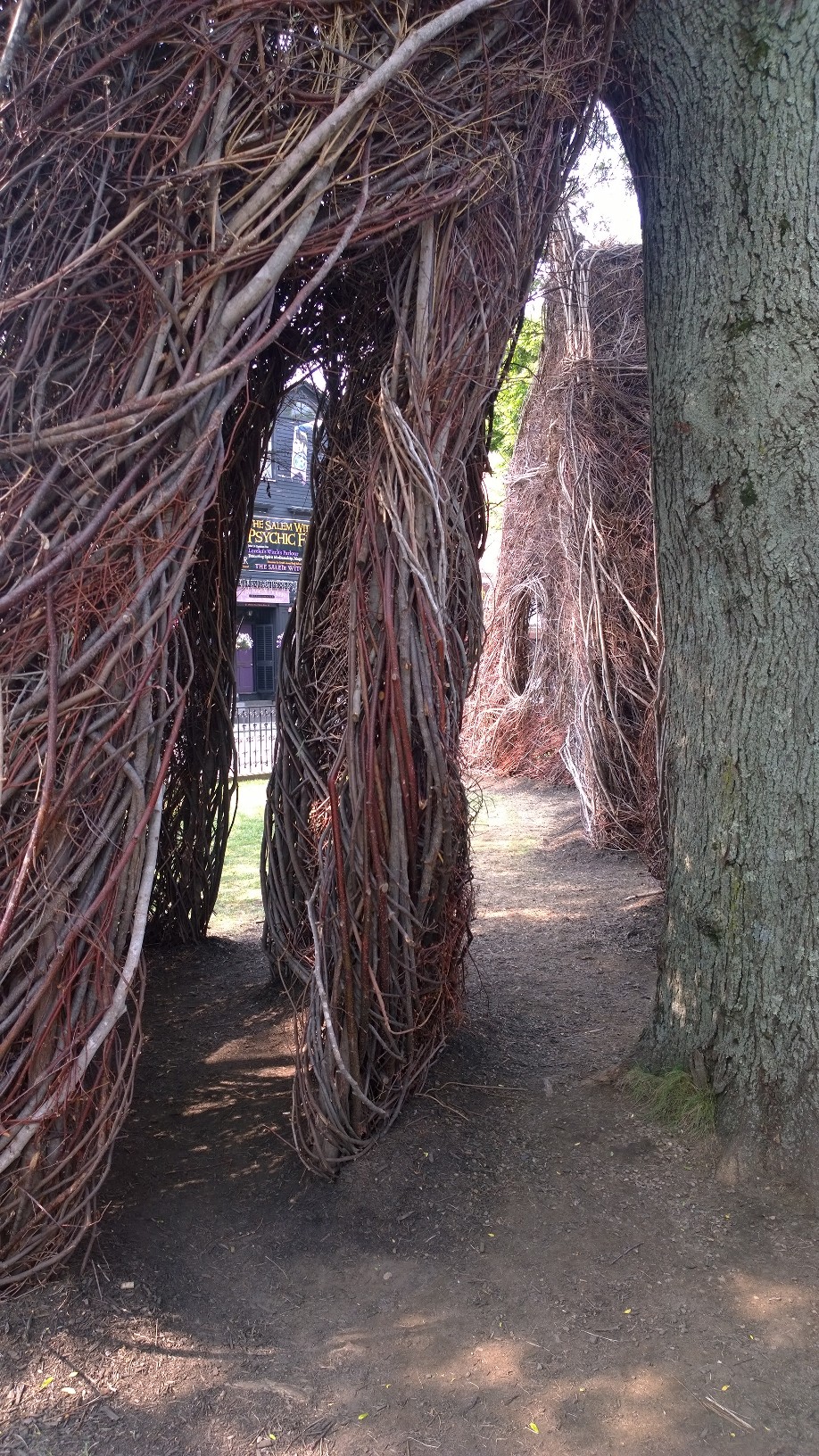
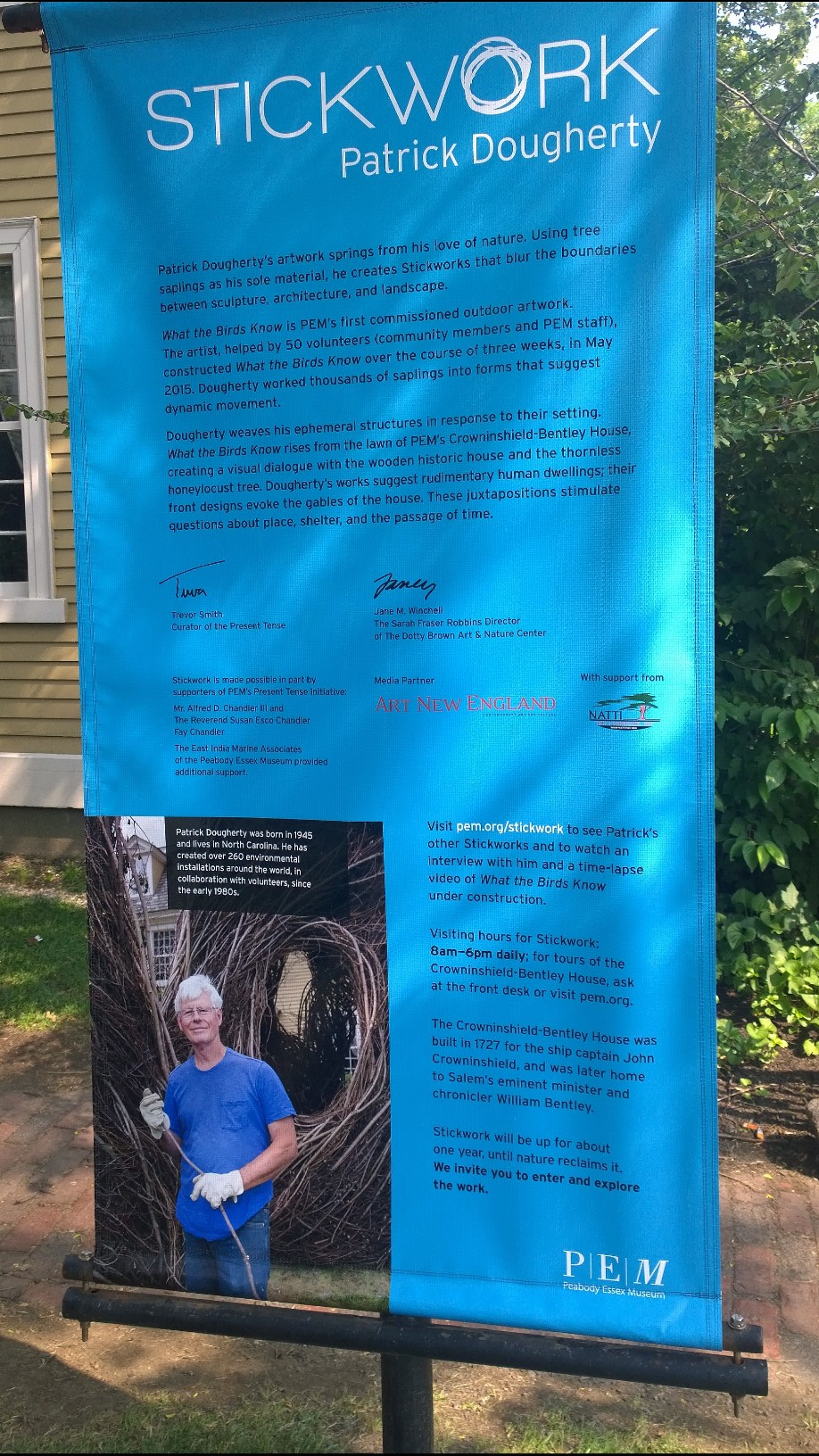
I hadn’t gone very far when what should I spy but some very strange constructions made of sticks. Turns out the sculptures, by Patrick Dougherty, were also a PEM exhibition: “Stickwork.”

From Dougherty’s website: “Born in Oklahoma in 1945, Dougherty was raised in North Carolina. He earned a B.A. in English from the University of North Carolina in 1967 and an M.A. in Hospital and Health Administration from the University of Iowa in 1969. Later, he returned to the University of North Carolina to study art history and sculpture.

“Combining his carpentry skills with his love of nature, Patrick began to learn more about primitive techniques of building and to experiment with tree saplings as construction material. In 1982 his first work, Maple Body Wrap, was included in the North Carolina Biennial Artists’ Exhibition, sponsored by the North Carolina Museum of Art. In the following year, he had his first one-person show entitled, ‘Waitin’ It Out,’ in Maple at the Southeastern Center for Contemporary Art in Winston-Salem, North Carolina.

“His work quickly evolved from single pieces on conventional pedestals to monumental scale environmental works, which required saplings by the truckloads. Over the last thirty years, he has built over 250 of these works, and become internationally acclaimed. His sculpture has been seen worldwide—from Scotland to Japan to Brussels, and all over the United States.” More at http://www.stickwork.net.

Aren’t artists something? They just follow where it leads. Nobody gets them into windowless rooms to discuss strategy, goals, subgoals, benchmarks, measures, or evaluation.

Although, I suppose, if Dougherty started out in hospital management, he was subjected to lots of that sort of thing.

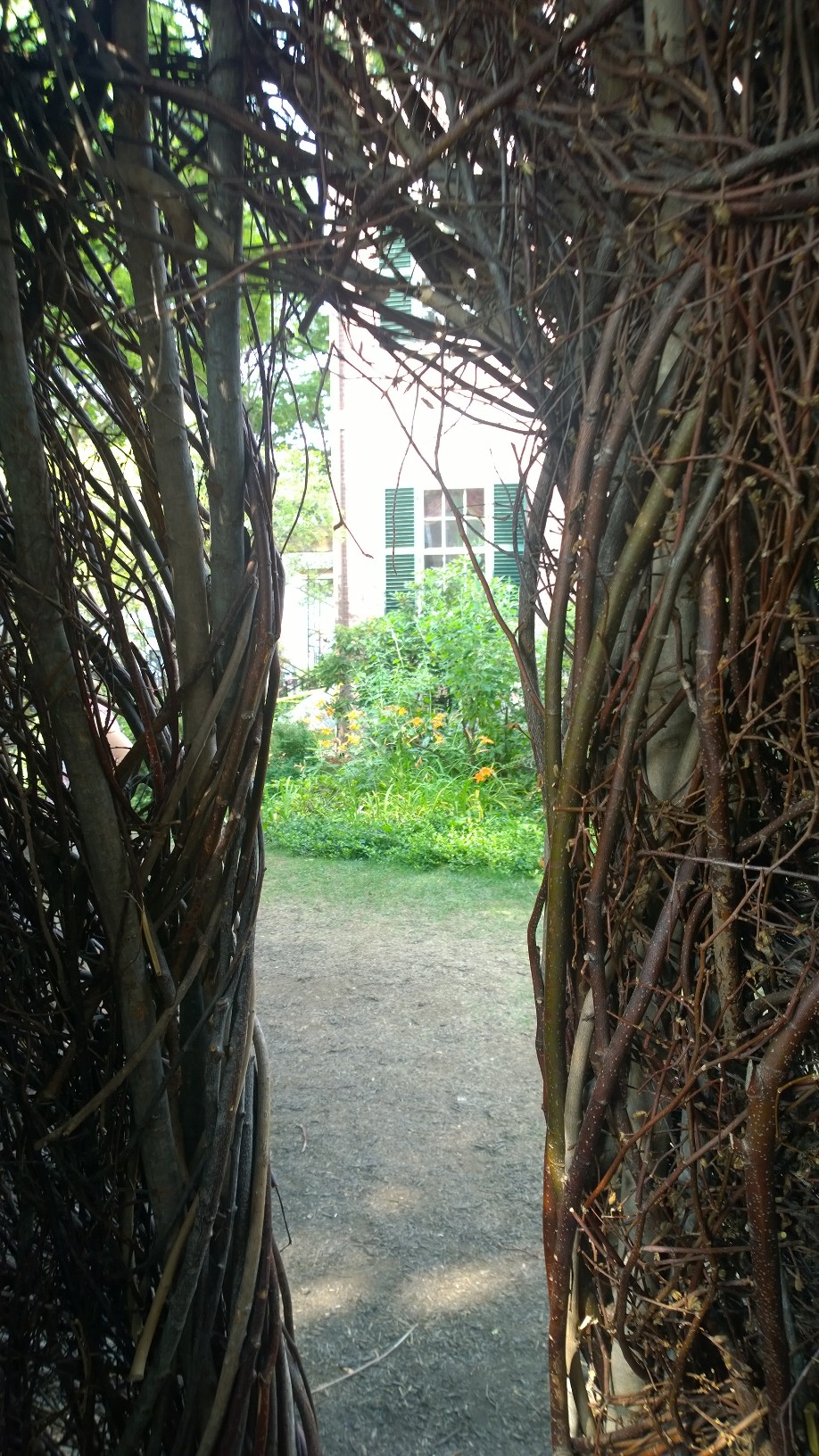
071215-Dougherty-Sticks-Salem

071215-lilies-and-sticks

071215-more-Stickwork

071215-thru-the-sticks-darkly


071215-Pat-Dougherty-Stickwork-Salem

Read Full Post »

Art: Thomas Hart Benton
One of my favorites: Spring on the Missouri, 1945, oil and tempera on Masonite panel. On loan to the PEM from the North Carolina Museum of Art.


When I was moonlighting as a theater reviewer, I always liked to “sleep on it” before writing anything, just in case my unconscious had anything useful to add.

Well, I slept on the big Thomas Hart Benton exhibition I saw yesterday, and sleep confirmed that certain lesser-known aspects of his work are troubling. I still adore the wavy energy of his landscapes, people, horses, trains, clouds, smoke, even fence posts. I still love the way Benton honors ordinary people and ordinary jobs and the way his paintings comment on social injustice.

But I really did not like the gruesome murals of invading armies that Benton created to jolt overly complacent Americans after Pearl Harbor. There was something cheap about them.

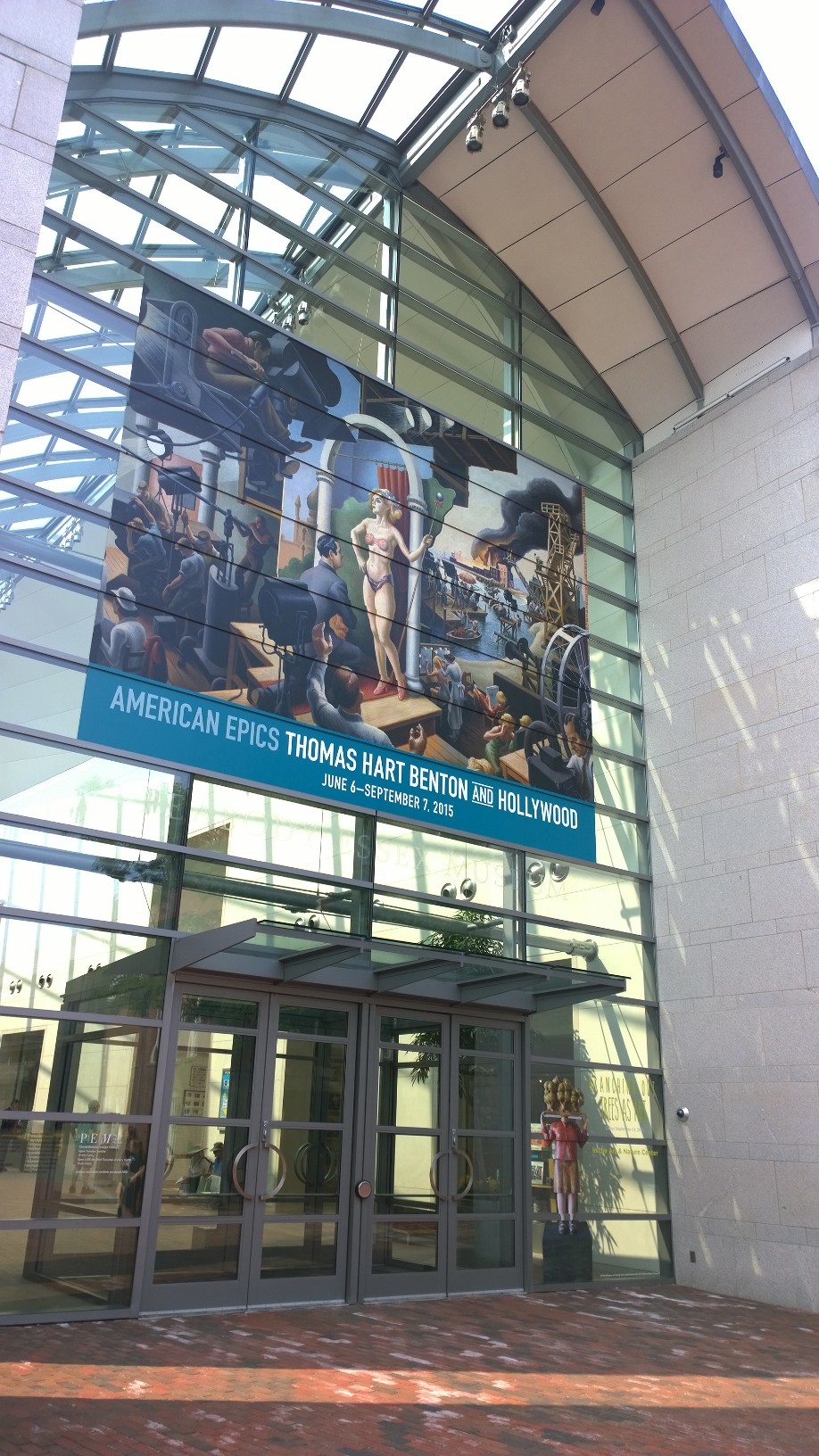
Of course, there was a lot more than that to the exhibition “American Epics: Thomas Hart Benton and Hollywood,” a sweeping retrospective of most of the artist’s work: murals showing Indians or slaves being mistreated, paintings of the the vibrant life of the West and Midwest, detailed depictions of the inner workings of Hollywood sets, designs for the Henry Fonda version of The Grapes of Wrath, illustrations for an edition of Huckleberry Finn, posters touting the contributions of African Americans to the war effort.

The day before, I had been hearing about Irving Berlin’s dedication to the war effort, and I think these two different artists conveyed, more viscerally than I had previously experienced, the underlying fear prevalent at that time. Since I grew up after it was all over, I probably unconsciously assumed that everyone always knew the Allies would win.

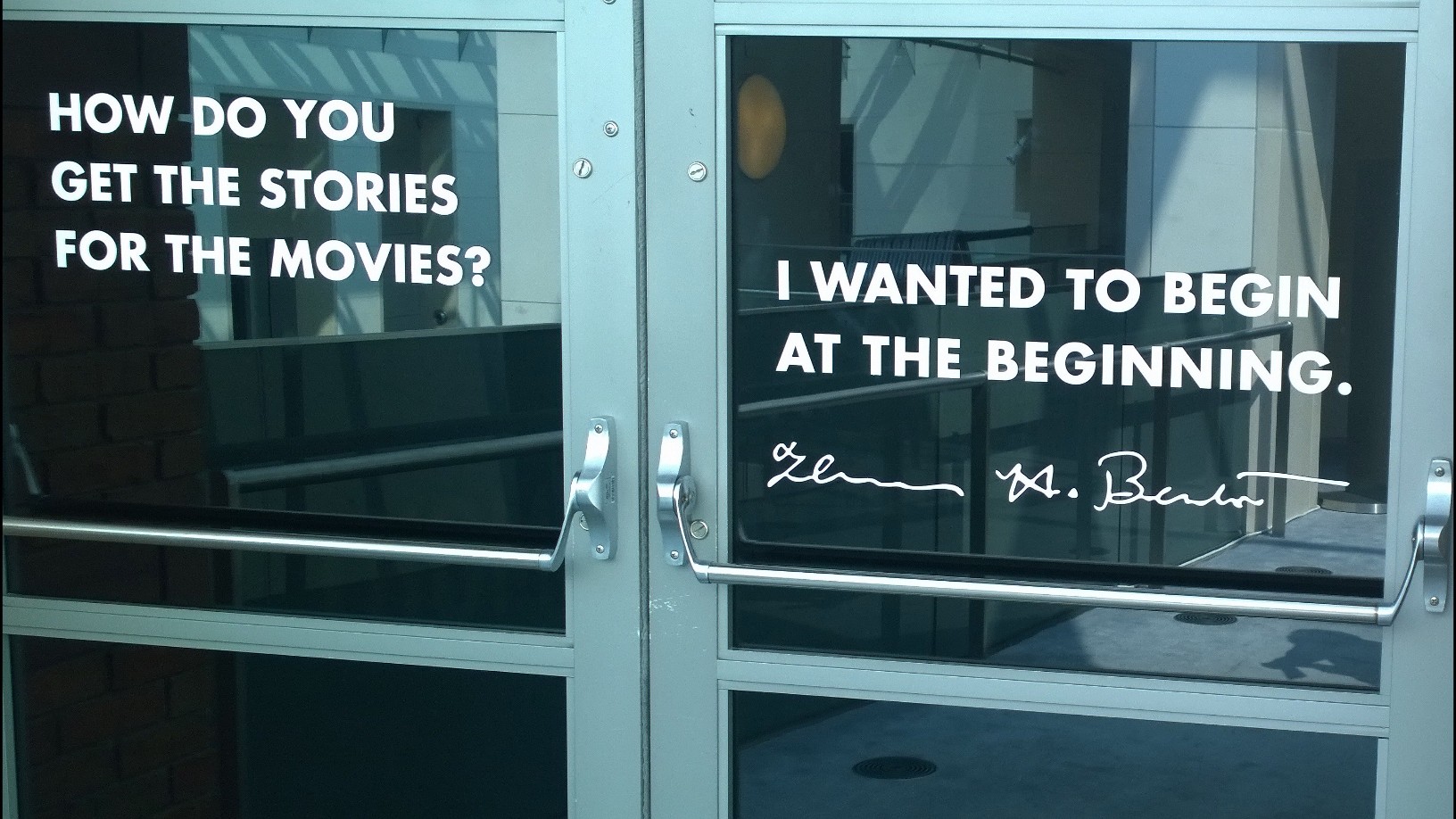
Do go to the show at the Peabody Essex Museum in Salem. You have until September 7. An enormous array of Benton’s work has been gathered from near and far — and there are some intriguing movie clips. (I was moved by a character’s tears to put The Grapes of Wrath on my Netflix list.)

Details of the exhibition here, at the PEM website.

071215-Thos-Hart-Benton-show

071215-Thos-Hart-Benton-at-PEM

Read Full Post »

I do like stories about people who love their work so much that they never want to stop.

Perhaps it helps to have a talent like muralist Eric Bransby, who got to study with one of my favorite artists, Thomas Hart Benton. (Suzanne says I have a personal aesthetic, which is a polite way of saying I’m crazy about anything wavy, like Benton’s energetic American landscapes.)

Chloe Veltman writes at National Public Radio, “Eric Bransby is one of the last living links to the great age of American mural painting. He studied with one of this country’s most famous muralists — Thomas Hart Benton — and went on to create his own murals in prominent buildings across the west. The artist is now 98 and still painting.

“At his Colorado Springs studio, Bransby attacks a drawing with tight, sharp strokes, a pastel pencil grasped between gnarled fingers. His studio is unheated, but he doesn’t seem to notice the cold. He’s completely engrossed in the image taking shape on his easel. It’s a study for a new mural that he hopes to install at nearby Colorado College. He says he draws between two and eight hours every day.

” ‘Drawing has been a continuous thing for me, like exercises for a musician,’ he says. ‘It’s refreshing. I draw better. I paint better.’ …

“His parents didn’t encourage his artistic pursuits. It was during the Depression, and when he demanded that he get sent to art school, he remembers his parents said: ‘Well, he’ll do one year and he’ll come back so discouraged that we’ll make something else out of him.’

” ‘But that didn’t happen,’ Bransby says. ‘I found heaven.’ ” Read more here.

Photo: Nathaniel Minor/Colorado Public Radio
Eric Bransby, pictured above in his home in Colorado Springs, is still creating art at 98. “I try to make each mural a project that will somehow expand my abilities a little bit more,” he says.

Read Full Post »

Suzanne says I have an art esthetic. That makes me laugh.

My esthetic, as far as I can tell, is mostly a preference for painting that is wavy: Charles Burchfield, Virginia Lee Burton, Grant Wood, Marsden Hartley, Kate Knapp, Edvard Munch, Reginald Marsh.

A massive mural by one of my wavy favorites, Thomas Hart Benton, has recently been rescued from storage. Carol Vogel has the story in the NY Times.

“On New Year’s Day 1931, a new and radically different building opened amid the town houses of West 12th Street: Joseph Urban’s International-Style New School for Social Research, with one room in particular as a star attraction. Thomas Hart Benton, the American realist painter, had lined the third-floor boardroom with nine panels of what would be a 10-panel mural, ‘America Today,’ depicting a panoply of pre-Depression American types, from flappers to farmers, steel workers to stock market tycoons. Lloyd Goodrich, a prominent art historian, pronounced it a breakthrough that heralded a new approach to mural painting, ‘of actually taking reality and making mural art directly out of it.’

“Eight decades later, ‘America Today,’ now considered one of the most important and famous examples of American scene painting, is languishing in storage. That will change, however, because AXA Equitable, the insurance company that bought it nearly 30 years ago, has decided to donate it to the Metropolitan Museum of Art. …

“The only problem,” writes Vogel, “is that the museum is so squeezed for space that the mural’s first public appearance after the handover won’t be until at least 2015, when the Met takes over the Whitney Museum of American Art’s landmark Marcel Breuer building on Madison Avenue (after the Whitney’s move to the meatpacking district).” More.

Something to look forward to in 2015.

Photograph: The Metropolitan Museum of Art, New York

Read Full Post »