Feeds:
Posts
Comments

Posts Tagged ‘uk’

Photo: Sam Frost/The Guardian.
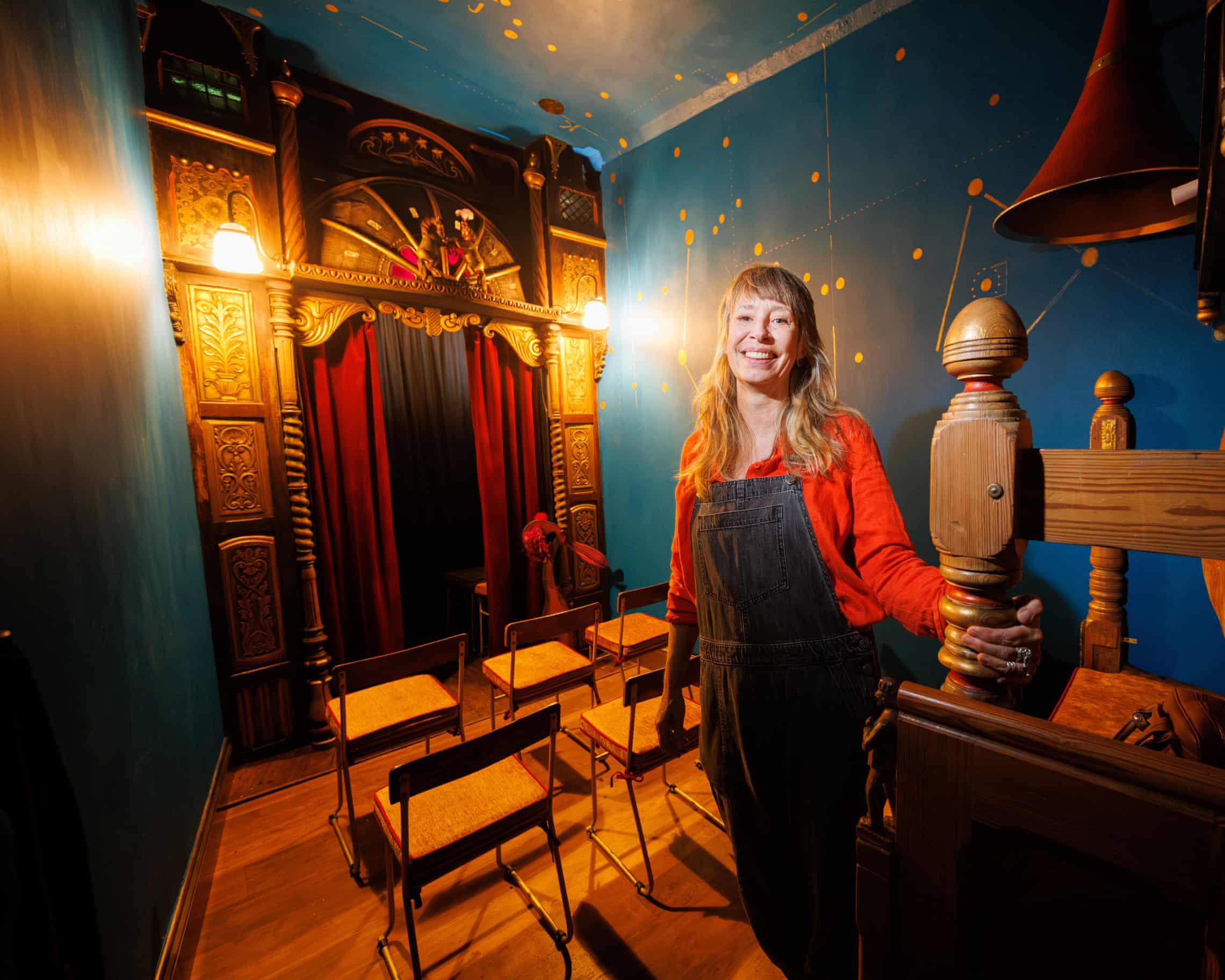
Loz Samuels, creative director of the tiny Theatre of Small Convenience, believes that in the digital age it is ‘really important’ to keep places like this alive. 

People care about having the arts in their lives. It’s not all about big donors wanting to show themselves in designer clothes at a charity ball. Although they are needed, too.

It’s mostly about the audience.

Jessica Murray writes at the Guardian about how a threatened UK theater, housed in what was once a Victorian public toilet, was brought back to life.

“Perched on a sign above a tiny stage draped with red velvet curtains are the Latin words Multum in parvo. Meaning ‘much in little,’ it has become the motto of this minuscule establishment in the Worcestershire town of Malvern.

“This is the world’s smallest commercial theater, with room for 12 people – or 16 with some standing – that has been brought back to life by local residents after falling into disrepair and at risk of demolition.

“Called the Theatre of Small Convenience, it was once a Victorian toilet and measures just [108 square feet] – the stage itself is a snug [16 square feet].

“ ‘Places like this are so rare now,’ said Loz Samuels, the theatre’s creative director and co-founder of the community interest company which runs it. …

“The theatre was created in 1997 by Dennis Neale, described as a local legend and eccentric performer who spent 19 years putting on puppetry shows in the space that captivated local children. In its heyday it was a much-loved and unique claim to fame for Malvern, with the theatre entering the Guinness World Records in 2002.

“But after Neale’s retirement in 2017, the building fell into disrepair and was badly damaged by a fire caused by a dehumidifier. With a destroyed roof, damp floor and damaged walls, local residents began to fear it would be lost for ever, especially with talk of a development next door. …

“Along with local volunteers Jan Birtle and Dibah Farooqui, [the community interest company] acquired the building from the council and raised [$22,000] from the local community to help get the renovation off the ground.

“ ‘It needs replastering, it needed rewiring, it needed a new floor, it needed underfloor heating. There’s obviously no room for heaters,’ Samuels said. …

“The theatre’s deep blue walls are adorned with a vivid gold constellation – with stars ‘sponsored’ by local residents – while intricate wooden carvings frame the stage.

“The challenge hasn’t been plain sailing, and Samuels has fears for the long-term future of the theatre. The team were recently rejected for Arts Council funding, and … with just 12 seats, making the space financially viable will take some creative thinking.

“Set to open its doors in October [2025], the theatre’s first show is Sceptre, a seance-themed immersive show designed specifically for the space. There are plans for a Narnia-style Christmas grotto and even weddings in the future.

“ ‘It is a challenge to find work that fits in here,’ she said. ‘But I feel like the building creates opportunities, you’ve just got to be imaginative. You can make real sensory experiences because you can control the light. As soon as you step foot in here, you forget the world outside, you could be anywhere.’

“Neale, who still lives locally, has also given the project his blessing and recorded a message that will be played at the start of future performances.

“ ‘I think what he did is so quintessentially English and so special,’ Samuels said. ‘He’s really happy, although I think at first he was a bit like, Who is this crazy woman?  …

“Samuels is urging performers and artists with original ideas for the space to come forward, and despite some nervousness, is optimistic for the future of the venue.

“ ‘I feel like it’s a strangely magical place and I just believe that the universe will look after it somehow,’ she said.”

More at the Guardian, here. No paywall.

Read Full Post »

Photo: David Kohler via Unsplash.
Vintners are discovering the importance of bringing back earthworms.

In many parts of the world, growers who have relied on herbicides and pesticides are learning about the benefits of healthier soil, and so they’re getting rid of soil-damaging practices.

In today’s story, we have an example of vintners in the UK who have caught up with recent bio-friendly practices in France. They have not made their changes out of kindness to the planet, although that’s a side effect. They’ve done it to produce a better grape.

Helena Horton writes at the Guardian, “Vineyards are generally the most inhospitable of landscapes for the humble earthworm; the soil beneath vines is usually kept bare and compacted by machinery.

“But scientists and winemakers have been exploring ways to turn vineyards into havens for worms. The bare soil is problematic because worms need vegetation to be broken down by the microorganisms they eat. Pesticides are also highly harmful to the invertebrate, as is the practice of compacting the earth: worms need the soil to be porous so they can move through it.

“Earthworms … aerate soil, and they pull fallen leaves and other organic matter into the earth and recycle them. But their populations have declined by a third in the UK over the past 25 years due to pesticide use and over-tilling of soil.

“Marc-André Selosse, a professor at the National Museum of Natural History in Paris, has been urging vineyards to increase grass and plant cover on their soil, and reduce the amount they till, to save the worms.

“Selosse said: ‘In France, the vineyards are 3% of the agricultural area, and they are using 20% of the chemicals. In vineyards, for the soil there is a lot of treatments, so there’s a lot of compaction, and there is a lot of pesticides used.’ …

“Worms had not yet vanished from the most intensively farmed vineyards, he said, but they did need to be supported with more regenerative practices.

“ ‘I think the worms are at a low level,’ he said. ‘They are just surviving, but they are still there, which means that no one is thinking of buying earthworms for the soil, because they are there. It’s like Sleeping Beauty; they are there at very low level, and we have to wake them. But once again, in soil, we have resilience. It’s one part of biodiversity where they are so numerous that we were not able to kill all of them.’ …

“Selosse said the main thing vineyards could do for worms was to stop tilling the soil – breaking it up and turning it over – even if that means that herbicides such as glyphosate are used instead to remove weeds. … ‘In the future, sooner or later, we’ll have to stop glyphosate also but for now, tilling is the first cause of worm problems.’

“Now some vineyards in the UK are making worm-friendly wine. When Jules and Lucie Phillips, co-owners of Ham Street Wines in Kent, started their vineyard, they were advised to grow conventionally by tilling and using pesticides, but were horrified by the results.

“Jules said: ‘After we did that, we went out and we dug a soil pit immediately after planting, and then also later in the season, and we realized the soil was just dead.’ There were no worms. It was smelling not particularly interesting at all, and the structure was poor.’ …

“The pair had a revelation. ‘We just thought, this is completely the wrong way of farming and we need to do something different. We want life in our soils. And so we began the conversion to organic in that same year, and we’re now certified biodynamic.’

“Rather than using pesticides, they applied herbal teas to the vines to promote plant health, Jules said: ‘For example, horsetail tea has a real high silica content, and that improves the leaf cell wall and means that it’s more resilient.’

“The couple run a no-till system under the vine: ‘We’ve let the cover crop grow really long, and we typically let it grow right up into the canopy up until about flowering, and then we’ll mow it back. And the benefits of that are huge. The cover crop is really growing and really establishing that root structure and getting it to its maximum point. And finally, we put a big mulch on top of the soil that’s going to feed those worms and feed that soil life.’

“This has hugely helped their worm population: ‘We’ve seen our worm counts increase massively from basically none to around 20 or 30 in a spade full. So extrapolate that up to a square metre, and it’s a very decent volume.’

“Rob Poyser, a viticulturist at the regenerative wine consultancy firm Vinescapes, said that growing wildflowers in the vineyards they consult on had also brought great results. ‘We think in between three and five years we can take a bare soil and bring it back to life, into a thriving ecosystem,’ he said. ‘We’ve used things like cover crops to bring this vineyard to life, to build the fertility into this system, and organic matter. We’re bringing life back to these soils we’re using. We’re letting nature do it.’

“Poyser said they allowed wildflowers to grow all over the vineyards, and clients were delighted when clover, for example, sprung up because ‘clovers are great companion plants under the vine for grapevines; they’re also loved by earthworms.’ “

More at the Guardian, here. No paywall.

Read Full Post »

Photo: Adrian Sherratt/The Guardian.
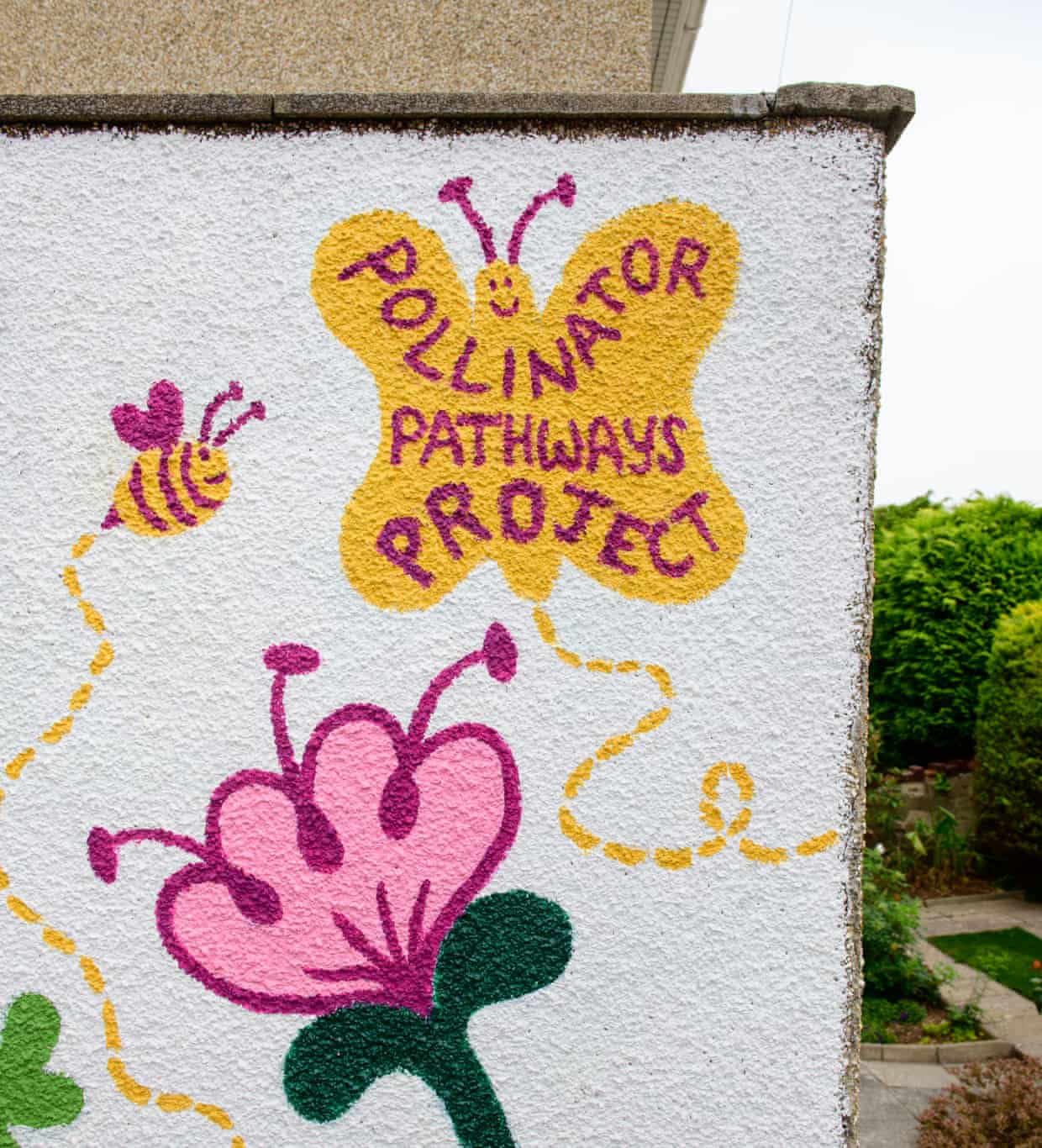
The UK pollinator pathways project in Knowle, Bristol.

I do like stories about how humans sometimes learn what they’ve been doing wrong and then go all out to rectify the damage. I’m speaking of what humanity has done in ignorance to bees and other pollinators that uphold life on Earth.

Emma Snaith has a turnaround example at the Guardian. “Take a closer look at the colorful plants dotted along an initially unassuming Bristol alleyway and you’ll see them teeming with insects. Bumblebees, hoverflies and ladybirds throng around a mixture of catmint, yarrow, geraniums and anemones. ‘It’s buzzing with pollinators now,’ Flora Beverley says.

“Just over a year ago, the alley we are walking down was a dreary, litter-strewn dumping ground. Now, thanks to the pollinator pathways project, it is filled with nectar-rich plants and bee hotels. Colorful murals line the walls. A neighbor and her son passing by stop to tell Beverley they watered the plants yesterday. The local people who helped to transform the pathways continue to maintain them too.

“A trail runner and fitness influencer, Beverley started the project after a chronic illness left her unable to spend as much time running in the countryside. She wanted to bring more nature into her local community and, at the same time, help to connect important nearby habitats in Bristol including parks and the Northern Slopes nature reserve with insect-friendly corridors.

“The project took off unexpectedly well and in the space of a year local groups have revamped seven alleyways around the south of the city. Most transformations take place over a weekend. Volunteers and mural artists pile in, and it is funded by small grants that Beverley – who does not get paid – applies for in her own time, street collections and donations from local businesses.

“ ‘The things that are good for nature tend to be very good for people too,’ she says. ‘We’re lucky to have so many green spaces in Bristol, but there is a lack of connection between them.’ Habitat fragmentation is a big issue.’ …

Scientists are reporting catastrophic declines in insect numbers around the world. International reviews estimate annual losses globally of between 1% and 2.5% of total insect biomass every year. The drivers of the plummeting numbers vary, but include habitat loss, exposure to pesticides and the climate crisis.

In the UK, ​a citizen science survey run by the conservation charity Buglife monitors bug splats on cars. It found a 63% decline in flying insects between 2021 and 2024.

“There are many ways to help protect insects, some simple, others harder to achieve. Prof Dave Goulson from the University of Sussex says that creating more pollinator-friendly habitat in our cities is ‘a fairly easy win.’

“ ‘We already know that urban areas can be surprisingly good for pollinators compared to modern, intensive farmland,’ he says. …

“A huge network of community pollinator pathways has [sprung] up across 300 towns in 24 states in the US and in Ontario, Canada. It began in 2017 when the conservationist Donna Merrill offered people near her home town of Wilton free native trees to form a passage of pollinator habitat that spanned the Connecticut-New York state line. Merrill was particularly inspired by Oslo’s ‘bee highway‘ created a few years before – a network of green rooftops, beehives and patches of insect-friendly plants that stretches across the city.

“In the UK, Buglife is tackling the loss of pollinator habitat on a national scale through its B-Lines network, which is mapping a series of 3km-wide [~2 miles] insect superhighways that crisscross the country, connecting the best remaining wildflower-rich areas. The charity has been working with farmers, landowners, wildlife organizations, businesses, local authorities and the public for more than 10 years to help fill at least 10% of each line with insect-friendly plants. …

“The charity’s B-Lines officer, Rachel Richards, says the lines running north-south are particularly important for migrating species and those moving northwards as a result of the climate crisis.

“ ‘Reconnecting fragmented landscapes builds resilience,’ she says. ‘As we see more fires and floods, it’s quite easy for an amazing site to be destroyed or partly destroyed. But if we have the stepping stones of wildflower-rich habitat, it can be colonized by insects from neighboring sites.’ ” More at the Guardian, here.
In the Greater Boston area, my friend Jean and Biodiversity Builders have been leading the way for years. I wrote about them several times — for example, here. Do you have pollinator pathways near you?

Read Full Post »

Photo: Christopher Thomond/The Guardian.
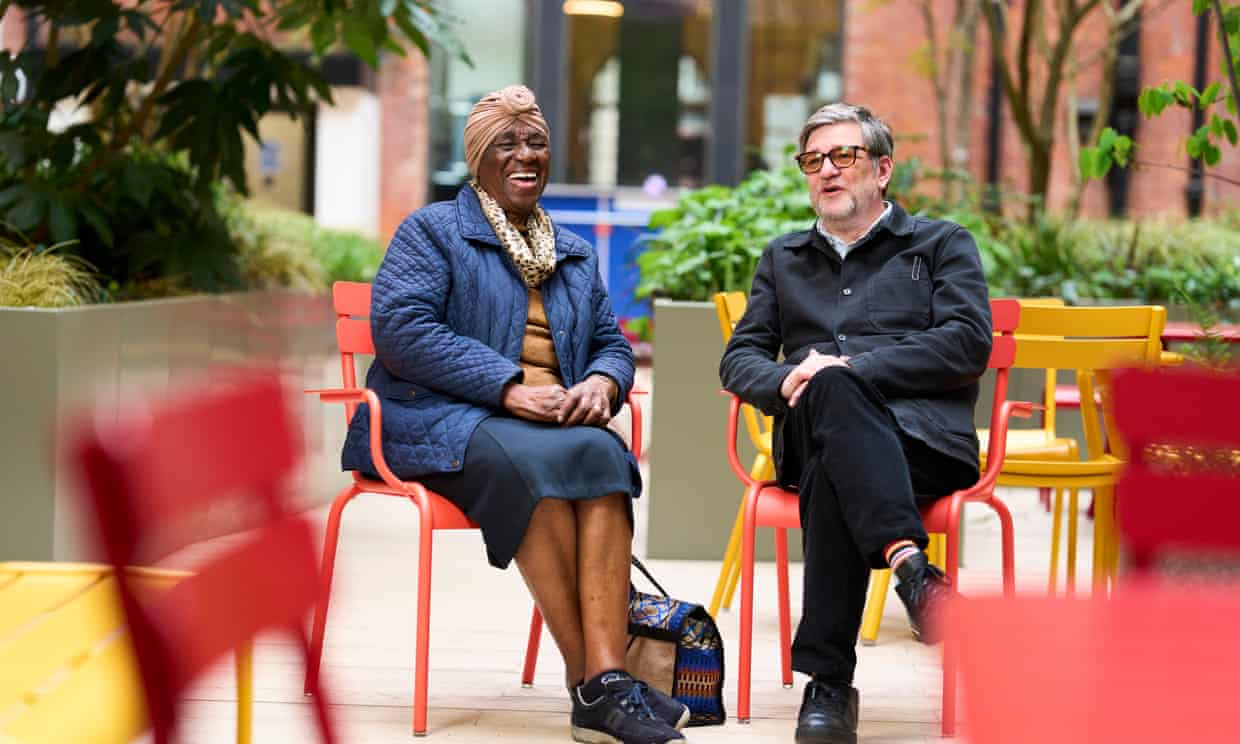
Elaine Unegbu, the chair of the Age Friendly Manchester [UK] older people’s board, and Paul McGarry, the head of the Greater Manchester aging hub. 

Where I live now, in a retirement community with various levels of care, the management favors pilot projects from academia and startup companies to test technology that can keep people independent longer. I haven’t volunteered for any of them, but I think it’s a good idea, especially as Erik still holds patents for something along those lines.

I recently read about some simple but ingenious innovations in Manchester, England, that I thought might interest readers like Making Home Home. I mean — how obvious but how overlooked is putting numbers on outdoor benches to aid in emergencies?

Chris Osuh  reports at the Guardian, “Futuristic planning for spaces where people can age well and live in an area designed for them to grow old in is accelerating in the UK with a radical project backed by £1.5bn [$1.7bn].

“The plan to transform a hospital into the first neighborhood in the country designed for people to thrive as they age will be a national testbed for holistic health and social care approaches. It will include hi-tech homes that adapt to occupants’ life stage and care needs, transport, a village green and a social calendar to combat isolation.

“The master plan for the North Manchester general hospital (NMGH) redevelopment in the Crumpsall district is the result of collaboration by public health officials, local politicians, experts and architects.

“Michelle Humphreys, the director of strategic projects for Manchester University NHS foundation trust (MFT), described it as a neighborhood that ‘adapts around people as they go through life,’ powered by advances in medical wearables and remote monitoring. …

“NMGH’s ‘healthy neighborhood‘ scheme is multigenerational. It will include family housing and will be built in line with age-friendly concepts, spearheaded by the World Health Organization (WHO) in response to two major trends – the aging population and urbanization.

“By 2050 60% of the global population will live in urban environments and 27% of people will be over the age of 65, the OECD predicts, yet experts say cities are often defined by spatial agism where environments are not set up for older people.

“The age-friendly movement aims to ensure older people can still play a part in civic life. The Elders Council of Newcastle, Northern Ireland’s older people’s commissioner and Wales’ commitment to becoming an age-friendly nation reflect how UK regions and devolved governments have been preparing for demographic change.

“The humble bench – improved with armrests, numbered to aid in a medical emergency, or placed strategically for wellbeing and intergenerational conversation – can be transformative, with dozens installed in Manchester, taking inspiration from New York’s CityBench initiative. However, the UK has further to go.

Akita, in northern Japan’s Tohoku region, where 30% of the population is over 65, has more than 60 heated roads to prevent slips on ice.

“In Singapore, where one in four are predicted to be over 65 by 2030, the Admiralty ‘vertical village’ has a central medical tier, so older residents, who live in slip-proof homes with alarms alerting neighbors in an emergency, can have surgery without leaving. In Germany in 2007, BMW made 70 changes to its Dingolfing factory to adapt to an older workforce. …

“Prof Stefan White, from Manchester Metropolitan University and Manchester School of Architecture, said the NMGH project would exemplify how to free up hospital space and allow people to ‘age in place’ with the type of support ordinarily provided in a care home made available to the whole neighborhood on a flexible basis.

“Elaine Unegbu, the chair of the Age Friendly Manchester older people’s board, has successfully lobbied the Greater Manchester mayor’s team for transport adaptations, benches and afternoon matinees. She said the healthy neighborhood would give residents peace of mind at a time when gentrification ‘whitewashed’ older urbanites, with many forced from their homes by health crises to the detriment of communities.

“Manchester, where previous age friendly projects include the Derek Jarman Pocket Park inspired by LGBTQ+ over-50s, has been pioneering the movement in the UK since 2008. Last month the city hosted international experts at the Age-Friendly Futures Summit.

“Paul McGarry, the head of the Greater Manchester aging hub, said: ‘The task is to get a national conversation on aging.’ “

More at the Guardian, here.
Read Full Post »

Photo: Nilo Merino Recalde.
A visual representation of an audio clip of five different great tit birds singing one song each.

There is so much for humans to learn about other species! The other day, a post on household pets reacting to the animated film Flow inspired Deb in Tennessee to conduct her own experiment with her dog. She learned that Buster, for one, was bored by Flow, failing to replicate the anecdotal evidence of curiosity described at the New York Times — a good example of why studies usually say, “More research is needed.”

Today we learn something new about birds, but maybe it’s only certain birds.

Victoria Craw writes at the Washington Post, “They sound beautiful, herald the start of spring, and even have the power to reduce stress and boost mental health.

“Now it turns out that some birdsongs also contain a hidden world of shared language, with varying local accents and dialects that change depending on the age of the bird and its peers — not unlike human songs.

“ ‘Just as human communities develop distinct dialects and musical traditions, some birds also have local song cultures that evolve over time,’ said Nilo Merino Recalde of the University of Oxford’s biology department, who led the new research published in the journal Current Biology. ‘Our study shows exactly how population dynamics — the comings and goings of individual birds — affect this cultural learning process.’ …

“The study is based on analysis of over 100,000 bird songs from at least 242 birds recorded in 2020, 2021 and 2022 in Wytham Woods in Britain’s Oxfordshire — a sprawling 1,000-acre wood where ecological and environmental research is carried out. For the last 77 years it has been the site of the Wytham Great Tit Study showing how two species of tit — the great tit and blue tit — have changed over time. …

“While some birds learn songs from their fathers and others learn continuously from neighbors, great tits are believed to do most of their learning in the first 10-11 months of life. …

“Merino Recalde said he was inspired by his love of birds and interest in social learning in animals, which creates an evolving shared culture reminiscent of the way humans learn languages and music. Theoretical work indicates that factors such as population turnover, immigration and age can affect the evolution of these cultural traits — so far, however, empirical evidence on the subject has been limited.

“His research team focused on the great tit, a small bird that lives just 1.9 years on average. The team recorded the ‘dawn chorus’ from March to May — coinciding with breeding season — using microphones placed near nesting boxes to gather more than 200,000 hours of the ‘simple yet highly diverse songs’ sung by males. Through a combination of physical capture, microchips and an artificial intelligence model, researchers were able to recognize the songs of individual birds and track how they changed over time, showing each bird had a repertoire ranging from one to more than 10 tunes.

“ ‘One of the main findings was that the distance that these birds travel while they are learning the songs, and also the ages of the other birds they interact with … affect how varied their songs become, collectively,’ Merino Recalde said. …

” ‘Homegrown’ songs in areas where birds stay close to their birthplace tend to stay unique, similar to the way in which isolated human communities can develop distinct local dialects over time, the team found.

“Age also had a significant impact, with birds of a similar age singing similar tunes, whereas mixed-age neighborhoods had ‘higher cultural diversity.’

This shows that the older birds can act as guardians of culture as they ‘continue to sing song types that are becoming less frequent in the population,’ researchers said.

“ ‘In this way, older birds can function as “cultural repositories” of older song types that younger birds may not know, just as grandparents might remember songs that today’s teenagers have never heard.’ …

“Merino Recalde said capturing how population changes are reflected in song could provide a future avenue for less invasive research, eliminating the need for capturing and tagging animals, for instance. …

“Professor Richard Gregory, the head of monitoring conservation science at Britain’s Royal Society for the Protection of Birds (RSPB), who was not involved with the study, praised the ‘herculean’ effort to analyze such a large data sample over a three-year period and said similar research could be used to highlight ‘critical tipping points’ for a population in future.

“While the great tit is not endangered, Gregory said the study could help inform plans to reintroduce or relocate certain animals, as such conservation efforts may be ‘doomed’ if they don’t take their cultural traits into account. ‘This study reminds us that the details of an animal’s life really matter.’

“Gregory, who is also an honorary professor of genetics, evolution and environment at University College London, said the study also showed that ‘methods of wildlife recording and song analysis are developing at break-neck speed,’ and AI is going to ‘revolutionize conservation science’ by allowing patterns in nature to be identified more readily.”

More at the Post, here. You can listen to an audio clip there.

Read Full Post »

Photo: Handout via the Guardian.
You can take hikes with goats. Why not enjoy time with lambs, too?

I’ve been saving an article from the Boston Globe for some future birthday, when I’ll talk my family into joining me in a hike with goats. It’s a service that a goatherd here in Massachusetts offers, and I think it might be fun.

But now I’m learning about spending a weekend with lambs. Maybe that would be even more fun. But I would have to fly to England, and I’m down on air travel.

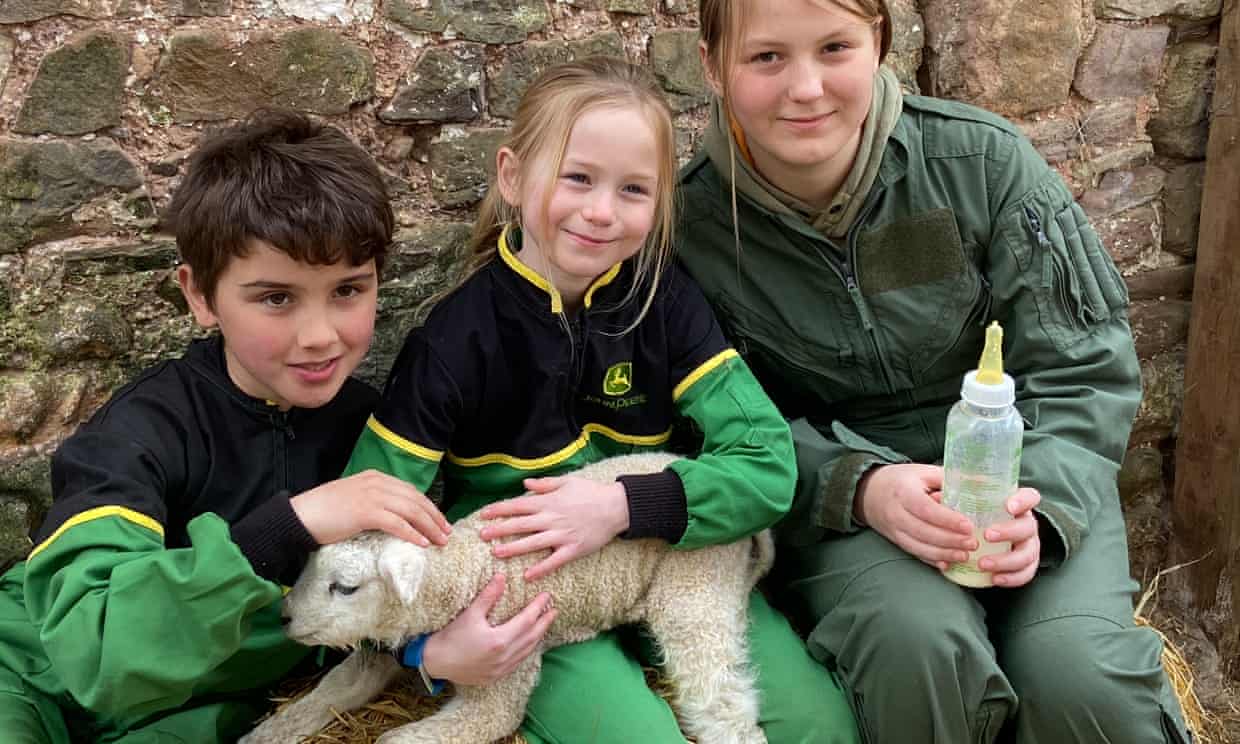
Sally Howard writes at the Guardian, “In a shed in the Malvern Hills, lambs struggle clumsily to their feet as holiday-making couples look on.

“Clare John, the third generation in her family to farm these 50 acres of Worcestershire pasture, began offering lambing-themed breaks two years ago in response to a surge of customer requests. Rowley Farm’s holiday cottages are block-booked for the 2025 spring lambing season, which traditionally peaks around Easter.

“ ‘For farmers like me it’s a bit strange to treat sheep like pets,’ John said. Self-catering guests arrive at Rowley Farm from February to May to feed hay to her pregnant ewes, and to bottle-feed orphan lambs who have been abandoned by their mothers or are the thirds in triplets (which ewes can struggle to feed).

“ ‘Mostly the guests want to touch and cuddle the lambs rather than do the mucking out,’ she said. …

“Farm Stay UK, a co-operative for farmers in hospitality, said that 90 of its 400 members now offer ‘lamb watch’ holidays. A number of farms are expanding their lambing offerings for 2025. … Church Farm in Lancing, West Sussex, offers evenings with the ‘shepherdess team’ where visitors can feed lambs and watch out for live births.

“Some put this popularity down to the effect of TV shows … or the growth of live-stream lambing cams such as lambwatch.co.uk and Walby Farm Park’s Lamb Cam Live.

“Farmer Helen Hearn introduced lambing-shed slots for visitors in 2023 after demand began to outstrip capacity at 450-acre Penhein Farm in Monmouthshire. Guests accompany Hearn – checking the sheds for births, ensuring lambs in the field are paired up with their mothers and bottle feeding the lambs – at a charge of £45 [~$60] for up to eight people a shed. ‘We charge for lambing as it takes four times as long to do our farming rounds when the public is involved.’ …

“She thinks lambing breaks answer a human need for connection to nature. ‘In previous generations most British people would have an aunt or cousin who worked on a farm and would be around farm animals that way,’ she said. ‘That’s all gone now.’

“Hearn said she wouldn’t install a lamb cam for the public to witness live births, however. ‘Often I’ll get a delivery that’s tricky … and the vet needs to come for a caesarean or the lamb comes out dead,’ she said.

“TikToker and amateur lambing enthusiast Melissa Arnold, AKA @melissa­lovessheep, refers to herself as ‘a crazy sheep lady.’ The graphic designer has volunteered for lambing season at her local farm, Readstock in Bagber, Dorset, since 2022. With no prior farming experience, Arnold has now delivered and raised more than 90 lambs. …

“ ‘I discovered lambing when I was going through a tricky period in my life and it’s total escapism for me,’ she said. However, she points out the hobby isn’t all gamboling newborns. ‘It’s an everyday soap opera in the lambing shed. Lambs and ewes die regularly, and you have to learn to handle that.’

“In Hampshire, farmers Fran and John Drake have had to take on additional staff, including veterinary students, to cope with surging demand for lambing stays at Michelmersh Manor Farm, a family-run mixed arable, dairy and sheep farm where 140 lambs are expected this April. ‘We have one London family coming back for their fourth lambing season,’ Fran Drake said. …

“Michael Gibbs, who has farmed at Mill Farm in Middle Tysoe, Warwickshire, for 50 years, welcomes local schoolchildren into his lambing sheds but is unconvinced about turning it into a spectator sport. Farming is a business, after all. ‘The French have a taste for British lamb at the moment and prices are up 30% on 2022,’ the 73-year-old said, passing a trailer of hoggets (sheep between one and two years old) off to market. ‘That’s what the job is at the end of the day. It’s not all cuddles.’ ”

More at the Guardian, here. No paywall at the Guardian, but please consider donating something to support their journalism.
Read Full Post »

Photo via the Guardian.
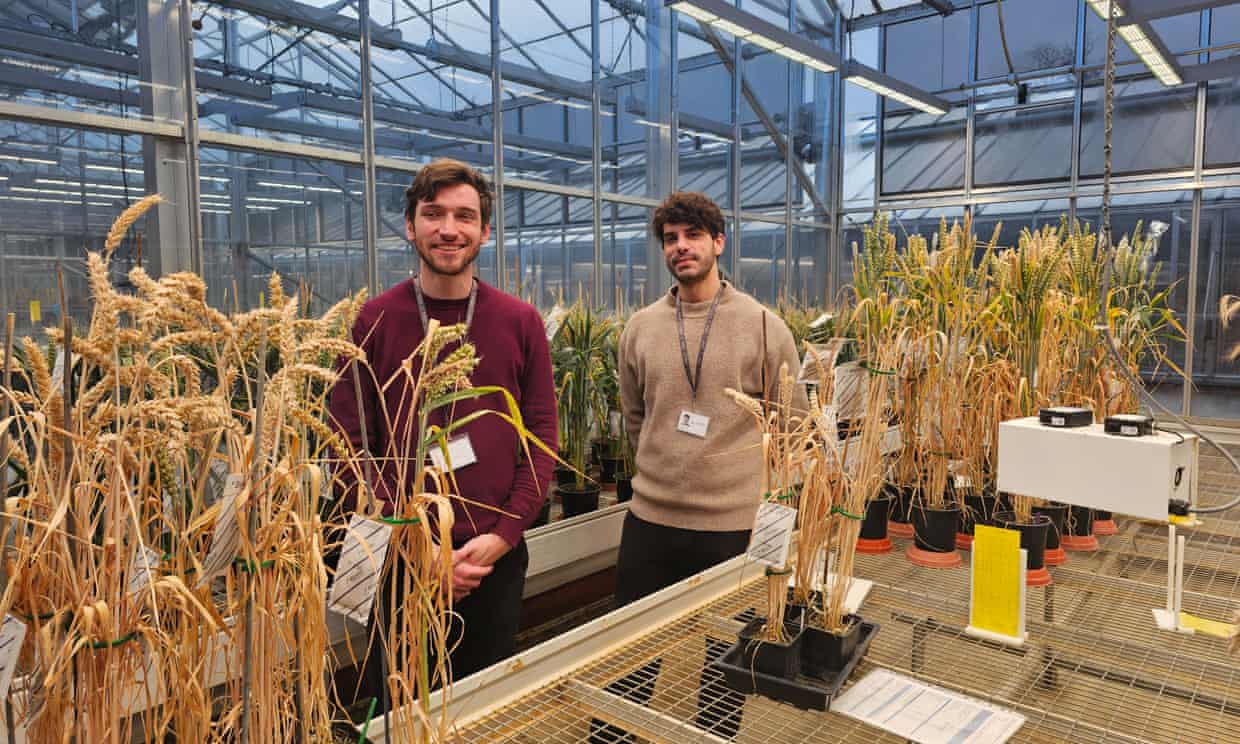
Imperial College researchers Franklin Keck, left, and Ion Ioannou are seeking a biological approach to mining copper with less danger to the environment. 

Can mining be made greener? I know it sounds implausible, but you have to love people who will tackle questions like that. Especially as the modern world is demanding more and more metals.

Robin McKie writes at the Guardian that copper “faces an uncertain future as manufacturers prepare to expand its use to make the electric cars, renewable power plants and other devices that will help the planet move towards net zero. Unrestricted extraction could cause widespread ecological devastation, scientists have warned.

“The issue is to be the prime focus for the new Rio Tinto Centre for Future Materials, based at Imperial College London in partnership with several international university groups. …

“ ‘The world needs to electrify its energy systems, and success will absolutely depend on copper,’ materials scientist and Imperial vice-provost Prof Mary Ryan, one of the centre’s founders, told the Observer last week. ‘The metal is going to be the biggest bottleneck in this process. So, in setting up the centre, we decided copper would be the first challenge that we dealt with.’ …

“Copper has become essential for powering devices ranging from smartphones to electric vehicles because it transmits electricity with minimal loss of power and is resistant to corrosion. Around 22m tons of copper were mined in 2023, a 30% increase from 2010, and annual demand will reach around 50m tons by 2050, say analysts.

“Such an output will have enormous environmental consequences because copper mining uses acids that poison rivers, contaminate soil and pollute the air. Producers such as Peru, Chile and the Democratic Republic of the Congo have seen natural habitats destroyed, wildlife populations wiped out and human health damaged near mines. Deep-sea mining has been proposed, but the idea horrifies marine biologists, who say such enterprises would devastate sea life.

“The aim of the new centre is to find ways round these problems and help provide the materials the world will need to reach net zero. It is funded by the mining group Rio Tinto and hosted by Imperial College London in partnership with the University of British Columbia in Vancouver, the University of California, Berkeley, the Australian National University and the University of the Witwatersrand, Johannesburg.

“One key project is seeking new ways to mine copper. ‘We typically extract it from minerals that have crystallized out of very saline, copper-rich brines,’ said Professor Matthew Jackson, chair in geological fluid dynamics at Imperial College. ‘However, this process requires huge amounts of energy to break open the rocks and bring them to the surface and also generates a lot of waste as we extract copper from its source ores.’

“To get round this issue, Jackson, working with international partners, has been searching for underground sites where copper-rich brines are still in liquid form. These brines are created by volcanic systems which can, crucially, provide geothermal energy for extraction.

“ ‘That means we can extract the copper by pumping the brines to the surface via boreholes – which is relatively easy – and also use local energy to power the mine itself and possibly provide excess energy for nearby communities,’ Jackson said. ‘Essentially, we are seeking to build self-powered mines and have already pinpointed promising sites in New Zealand, and there is potential to explore conventionally barren areas such as Japan.’

“A different approach is being followed by another Imperial project where a company, RemePhy, has been started by Imperial PhD students Franklin Keck and Ion Ioannou.

“They have used GM technology to develop plant-bacterial systems that have an enhanced ability to extract metal from the soil. ‘Essentially, you will be able to grow these crops on land contaminated by waste left over from the mining of metals such as copper, and they will extract that metal,’ said Keck.

“The importance of these techniques was stressed by Ryan. ‘The world will need more copper in the next 10 years than has been mined in the whole of the last century. [We] need to both reduce our demand for copper and work out how to extract it in the most sustainable way possible.’ “

More at the Guardian, here. No firewall. Donations support reliable journalism.

Read Full Post »

Photo: Gordon Noble, University of Aberdeen.
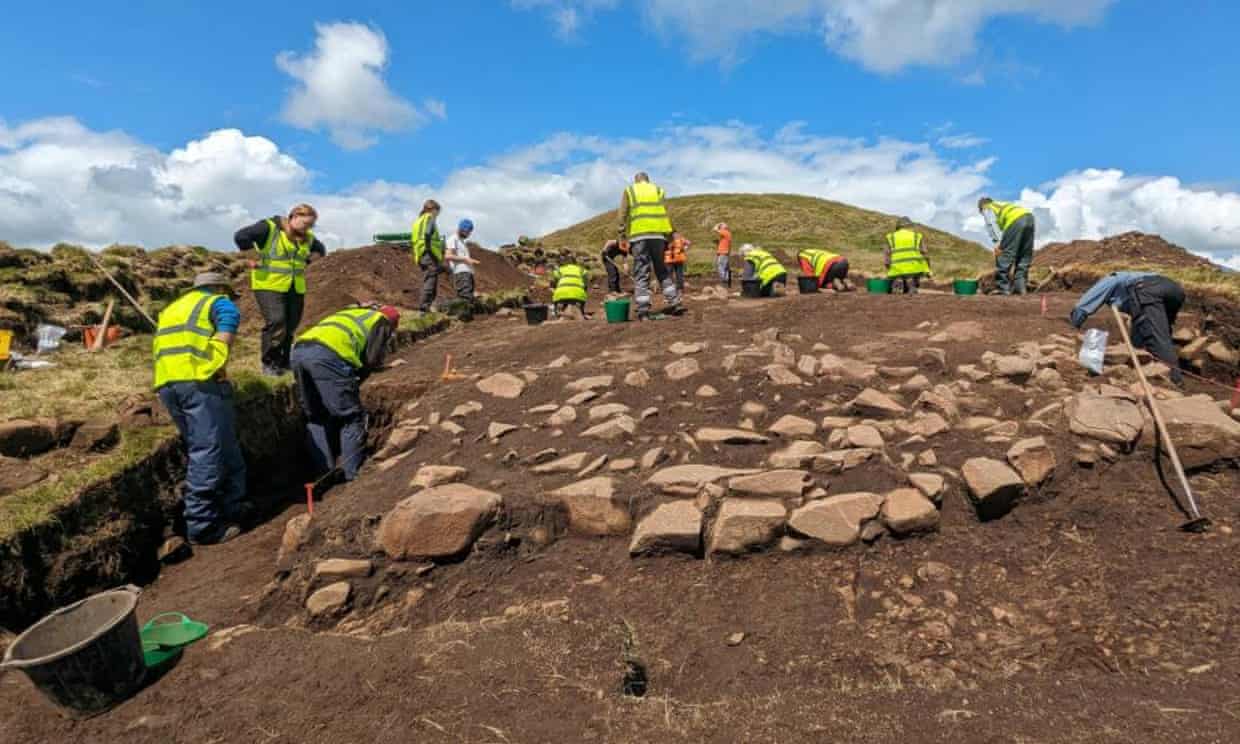
The community archaeological dig at the East Lomond hillfort site. 

Did you ever want to be an archaeologist? I think there was a period in childhood that it interested me, encouraged by gifts of picture books about the discovery of Knossos in Crete. But then I moved off in other directions.

Perhaps you had that experience, too, always wondering what it would have been like. Today there are opportunities to get a taste of that world as a volunteer.

Libby Brooks writes at the Guardian about the thrill of being a citizen archaeologist in Scotland.

“They were moving forward in a line across the 10 sq metre [~108 square foot] trench, volunteer excavators elbow to elbow with academics, and Joe Fitzpatrick was at the far edge.

“He was digging around the hearth of a building, about 60cm (2ft) below surface level, when he hit the earth twice with his mattock and out it popped – a rare bronze spear butt, a metal fitting placed over the end of a wooden shaft to counterbalance the spear head. Covered in Pictish inscriptions, it had remained buried for more than one and a half millennia, and was one of the most groundbreaking archaeological discoveries of 2024 in Scotland.

‘The hair stands up on the back of your neck and you tingle,’ says Fitzpatrick, of the moment he realized the significance of the find. ‘It is special.’

“Fitzpatrick, who has always had a passion for history, got involved with the regular community dig at the site of the East Lomond hillfort, beside the village of Falkland in Fife, as a retirement activity.

“He was working next to Prof Gordon Noble, the head of archaeology at the University of Aberdeen, who was leading the dig: ‘We just looked at each other,’ Fitzpatrick recalls. ‘Two men with their jaws hanging open, dumbfounded.’

“He helped unearth the artifact in July, during excavations organized by the Falkland Stewardship Trust and the University of Aberdeen, which bring together members of the public and students to help uncover settlement remains dating from around the second or third century AD to around AD700.

“He is one of a growing legion of citizen archaeologists, eager volunteers who are sustaining projects across the country even as volunteering more generally is in decline.

“Fitzpatrick says: ‘A lot of people who retire are more aware of keeping active and outdoors, but we also have young people working out what to do after their studies, and the media has broadened archaeology’s appeal with programs like ‘Time Team’ and ‘Digging for Britain’ – it’s not just Oxford dons doing it.’

“An ‘exceptionally rare’ find like the spear butt boosts team morale … says Noble. ‘Community involvement has really ramped up in the past 10 years,’ he says. ‘There’s the excitement of uncovering the past on your doorstep. These volunteers come from all walks of life.’ …

“Although Volunteer Scotland has warned that last year’s Scottish Household Survey results ‘point to a crisis in volunteering,’ for those participating in culture and heritage the numbers remain constant, compared with a drop of four percentage points elsewhere.

“Jeff Sanders, the head of outreach for the Society of Antiquaries of Scotland, says the cost of living crisis has affected individuals and their ability to participate, but also organizations and their capacity to put things on for volunteers. …

“As well as funding challenges, Sanders says there is a push to diversify volunteering – volunteers are often retirees with more disposable income. Sanders also works on the Make Your Mark campaign, which worked with the Scottish Refugee Council over the summer to co-design archaeology taster sessions to attract people who wouldn’t ordinarily get involved in volunteering.

“This ‘continuing upward trend’ in community involvement has prompted Emily Johnston to chart the citizen archaeologist phenomenon as part of her doctoral research at the University of Edinburgh. She has launched a database of community archaeology activities across Scotland, Outreach in Scottish Archaeology (OScA). …

“Says Johnston, ‘A lot of volunteers have been really interested in archaeology from a young age. It’s about creating a tie to your past and gives people a sense of identity.’ “

I love the idea of “taster sessions” for volunteers — in any field. I imagine more people would take on gigs if they knew there was no embarrassment about dropping out. They would keep trying things until they found the right opportunity for them. I tried volunteering with many ESL [English as a
Second Language] organizations until I found the right fit.

More at the Guardian, here.

Read Full Post »

Photo: Jamie Fullerton/The World.
A snowman figurine made by the woodworkers at the Witney Shed, part of the UK Men’s Sheds Association.

In my retirement community, there are two or three times more women than men — and more activities geared to women. It’s not surprising that some male residents become a prey to loneliness. Loneliness can plague older men anywhere, not just men in retirement communities.

That’s why some countries have taken the concept of the backyard work shed where men hang out alone and put it in more of a group setting.

Jamie Fullerton writes at the radio show The World, “In the United Kingdom, there is a gently mocking stereotype about older men and sheds — the wooden outhouses usually found at the end of a garden.  The cliche image is of an elderly man tinkering with tools for hours, alone and avoiding the outside world.

“Things are more social in The Witney Shed, in the town of Witney in Oxfordshire, southern England. 

“ ‘I just like coming here; it’s the camaraderie with everybody,’ said Tony Halcrow, a regular visitor to the Witney Shed, as he worked on a lathe, making wooden Christmas decorations. ‘And it gets me out of the house.’

“In the large shed, situated behind a church-run community center, there’s space for about 10 shedders, as they are known, plus a few more working in the garden outside. They’re making bird boxes and other wooden objects, occasionally pausing for coffee and light banter.

“The Witney Shed is one of around 1,100 community sheds in the UK, affiliated with the UK Men’s Sheds Association. The charity originated in Australia, and was set up in the UK around a decade ago, primarily to help older men tackle loneliness.

“Some British community sheds charge small fees, but people can turn up to the Witney Shed for free, then join in with woodwork or just have a coffee. Most people who visit are seniors, but people of all ages are welcome. ‘Anybody can come, even ladies,’ said Phil Tarry, co-founder of the Witney Shed. …

“The shedders make wooden items like bird boxes, bat boxes and Christmas decorations, and sell them locally at cheap prices, to help fund the shed. They also help out local residents, schools and the church where the shed is based. ‘On a Monday morning, the first thing is a toddler group in here, and they’re our best customers, for repairing toys’ [says Tarry].

“Over a third of shed leaders said they believed that their community shed may have helped prevent a suicide. Tarry said he certainly thinks so.

“ ‘Loneliness is a very big part of it,’ he said, ‘because there are a lot of lonely people out here. I live in sheltered housing, and I know what it’s like. Some people don’t see anybody from one week to another, and it is important to get those people to come out.’ …

“Local doctors have told some of their mental health patients about the shed. A couple of men with dementia also visit.

“ ‘You’ve got to be very patient because, with people with dementia, they’ll come and say, “What can we do today?” and you say, “Oh, can you sand this?” They’ll go off, then come back and say, “What are you doing today?” You’ve got to be patient and say, “Yeah, it’s OK. Sand this,” ‘ Tarry said.

“Rachel Meadows, who works as the volunteer and community development manager for the UK Men’s Sheds Association, said … ‘We hear a lot that people find it easier to talk to each other when they’re engaged in an activity. … It’s easier to talk shoulder-to-shoulder, rather than face-to-face,’ she said. ‘Somebody’s not looking you in the eye and asking you to talk about your feelings, but there’s usually somebody at the shed who’s maybe been through something similar, or can relate to how you’re feeling.’ …

“Nearby, an older man sat alone on a bench. Tarry asked him if he was OK. The man said he was fine, but a bit confused. But later, he suddenly stood up and started helping another man, glueing together a bird box. …

“Tarry said that his main problem is that the Witney Shed is so popular, they’ve decided their next woodwork project needs to be a shed extension.”

More at The World, here. No firewall. Charming photos.

Read Full Post »

Photo: Joanna Hawkins/BBC.
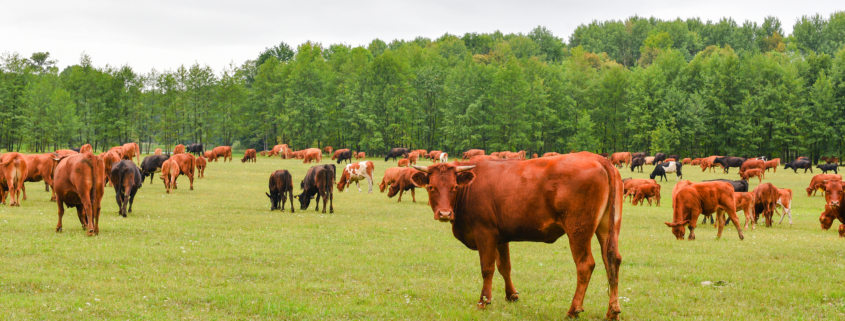
Artist David Taylor spotted this early 20th Century by Canadian impressionist Helen McNicoll at a UK auction house. It is valued at 150 times what it cost.

Let’s start 2025 with another fun story of a rediscovered treasure. The person who found it wasn’t just some guy. He was an artist who knew quality when he saw it and was willing to pay a large amount for it — just not as large an amount as it turned out to be worth.

David McKenna writes at the BBC, “A painting bought for just over £2,000 [~$2500] has been authenticated as a long-lost masterpiece worth £300,000 [~$374,000].

“The buyer, [Lincolnshire] artist David Taylor, said he had been ‘bowled over’ by the artwork while browsing a sale at a regional auction house.

“Experts on the BBC’s Fake of Fortune? were able to prove the painting, known as ‘The Bean Harvest’ and depicting a scene of women in a field, was a piece from the early 20th Century by Canadian impressionist Helen McNicoll. …

“McNicoll is one of Canada’s most celebrated female artists, achieving considerable international success during her career.

“Deaf from the age of two, McNicoll was known for her impressionist representations of rural landscapes.

“In 1915, her career was cut short when she developed complications from diabetes and died at the age of 35.

“It was revealed [in an October 2024] episode of Fake or Fortune? that the artwork had been exhibited in Canada five times between 1912 and 1913, but its whereabouts had since been unknown.

“During the episode, the show’s team — including presenters Fiona Bruce and Philip Mould — helped Mr Taylor to prove its authenticity.

” ‘I’d not heard of Helen McNicoll before we started investigating this painting,’ Bruce said. ‘But what a pioneer she was — a woman at that time, the early 20th Century, traveling abroad with her easel while profoundly deaf. I’m so glad we’ve been able to bring her name to wider attention.’ …

“Co-host Mould described the find as a ‘once-in-a-lifetime discovery,’ adding there was a massive desire on both sides of the Atlantic for the work of high-quality women artists.

“Canadian philanthropist Pierre Lassonde, a major collector of McNicoll’s work, flew over to London to see the painting in person. During the show, he said: ‘For a painting that has been missing for 110 years, I think it’s fantastic… I wouldn’t mind adding one more piece to my collection.’

“Mr Taylor described the experience as ‘an absolute adventure.’ “

More at the BBC, here. Find out more about the artist at Sotheby’s, where her painting was offered for sale in November.

Read Full Post »

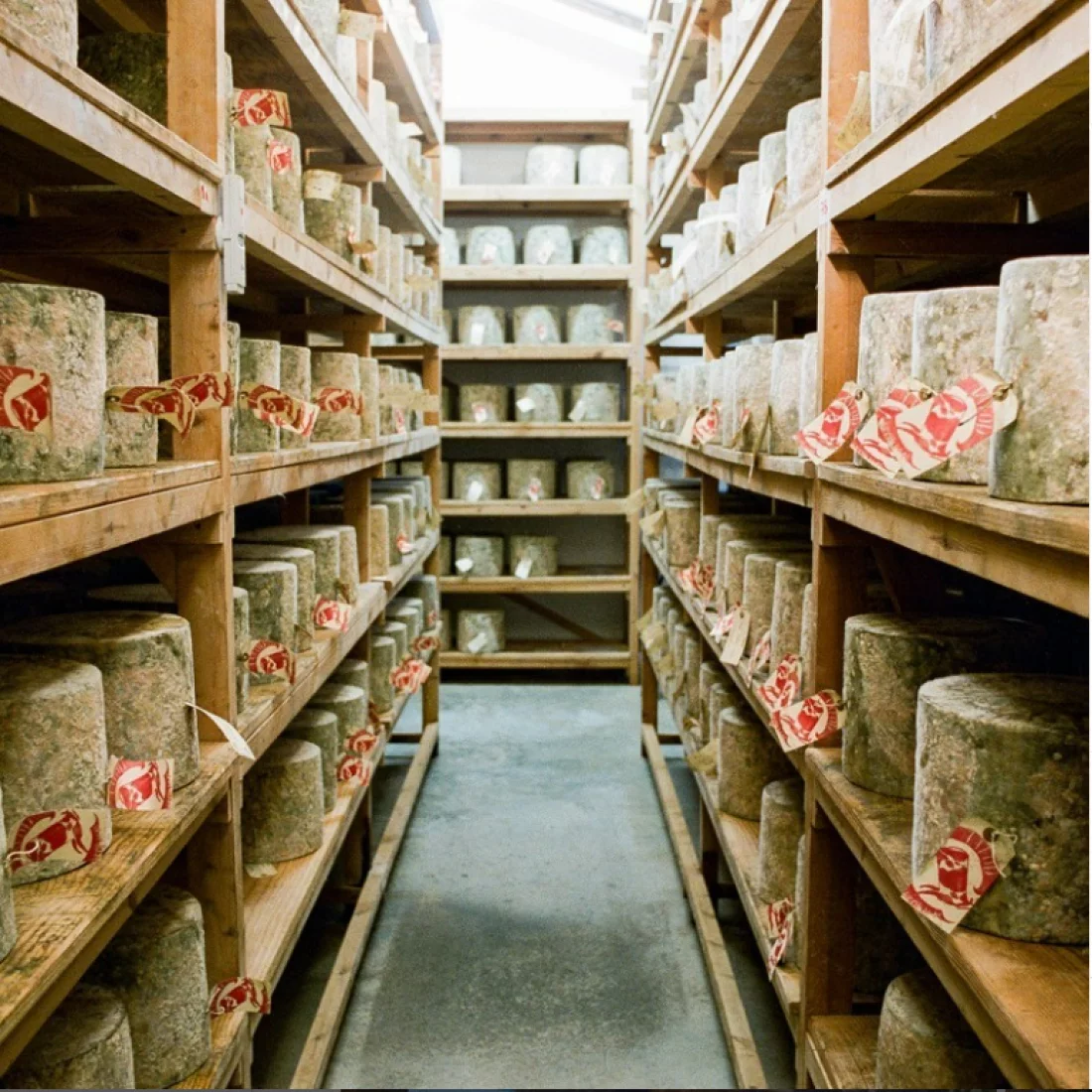
Livestock produces a lot of methane, which is unlikely ever to be balanced out by carbon captured in the soil. The Soil Association Exchange wants you to know about a few positive effects, however. 

It’s an ongoing process to keep up on the latest, especially when it comes to protecting the planet. I myself once thought that massive tree planting had the biggest bang for the charitable buck. Then I learned that, although trees are important, they can’t help much without due consideration given to where and how they are planted, and what varieties of trees they are.

Today I’m trying to bone up on the situation with cows, which we all know (including a young grandson who has cut beef out of his diet) produce too much climate-warming methane gas.

James Tapper reports at the Guardian, “New data shows [cows] may play an important role in renewing farm soil. Research by the Soil Association Exchange shows that farms with a mixture of arable crops and livestock have about a third more carbon stored within their soil than those with only arable crops, thanks to the animals’ manure.

“This also has an effect on biodiversity: mixed arable and livestock farms support about 28 grassland plant species in every field, compared with 25 for arable-only and 22 for dairy-only.

“Joseph Gridley, chief executive of SAE, which was set up by the Soil Association in 2021 to support and measure sustainable farming, said it was unlikely that carbon captured in soil would balance out the enormous amounts of methane created by cattle. Farm livestock around the world creates about 14% of human-induced climate emissions.

“ ‘It’s pretty unequivocal in the data that having livestock on your farm does mean you have more emissions – five or six times more emissions,’ he said. ‘But if you integrate livestock into the system, on every metric on soil health, there’s an improvement, and on a lot of the biodiversity measures as well.’

“Soils are degrading, but by how much exactly is unclear. In 2015, the UN Food and Agriculture Organization claimed that the world had only 60 harvests left, but researchers at Oxford University and Our World In Data said in 2021 that there was a complex picture. …

“Lee Reeves, UK head of agriculture at Lloyds bank, which helps fund SAE … suggested ministers should create a decarbonization strategy, and a standardized carbon calculator, so that farmers and other businesses could use a single tool to calculate their carbon impacts.

“ ‘Moving from traditional to regenerative farming can see a dip in profitability for the first five years, so the government needs to support farmers and banks in that,’ he said.

“[In the UK] the Department for the Environment, Food and Rural Affairs has been investigating so-called methane blockers as a way to reduce emissions. Adding substances such as essential oils, probiotics and even seaweed to cattle feed can reduce the amount of burps and wind they generate.

“Last month the Green Alliance charity said that feeding Bovaer, a methane blocker, to a third of the UK’s dairy cows would cut the country’s emissions by about 1%. Yet this is not happening, the campaign group warned, because farmers were unwilling to pay extra for something they did not benefit from. It said methane blockers should be subsidized, as other green farming schemes were.”

More at the Guardian, here. The Natural Resources Defense Council explains more about regenerative farming here.

Read Full Post »

Photo: Neal’s Yard Dairy/Instagram.
London-based distributor Neal’s Yard Dairy announced recently on Instagram that it was “the victim of a sophisticated fraud” involving high-value cheddar cheese.

You really don’t want to get mixed up with people who are intense about cheese. Years ago, when I was a member of Cheese Lovers International, I crossed knives with the highly emotional founder, whose name I no longer recall. To compensate for something I once complained about, he told me he would give me a discount on every order for my life. Unfortunately, his staff had no way of knowing about my discount. Explaining got to be too much work.

Rachel Treisman and Juliana Kim have a great cheese story at National Public Radio.

“Authorities in London have arrested a 63-year-old man in connection with the cheese heist of 2024, in which tens of thousands of pounds of high-value cheddar were stolen from a major distributor. ..

“ ‘The man was taken to a south London police station where he was questioned. He has since been bailed pending further enquiries,’ a police spokesperson said.

“Over the past week, the British artisanal cheese community has been reeling after Neal’s Yard Dairy announced it had been the ‘victim of a sophisticated fraud resulting in the loss of over £300,000 worth of clothbound Cheddar’ — the equivalent of more than $389,000.

“ ‘The theft involved a fraudulent buyer posing as a legitimate wholesale distributor for a major French retailer, with the cheese delivered before the discovery of the fraudulent identity,’ the company said.

“The thief made off with 950 wheels — over 22 metric tons, or roughly 48,500 pounds — of Hafod, Westcombe and Pitchfork cheddar. … The wheels came from three different artisan suppliers across England and Wales.

“ ‘Between them, these cheeses have won numerous awards and are amongst the most sought-after artisan cheeses in the U.K.,’ Neal’s Yard Dairy said. … The crime cuts deep: Cheddar, which originated in a village by the same name in Somerset, England, is the best-selling cheese in the U.K. and a big source of national pride.

“Last week, British celebrity chef Jamie Oliver explained in an Instagram video that there is ‘only a small handful of real cheddar cheese makers in the world,’ and that’s where the stolen cheese came from. …

“Neal’s Yard Dairy is shouldering the cost of the crime, having already paid the artisan cheesemakers in full. The company says it is now taking steps to ensure its own financial stability. …

“Tom Calver with the cheesemaker Westcombe says they were led to believe they were sending their products to France via Neal’s Yard Dairy.

“ ‘These guys … basically impersonated a wholesaler-slash-customer, quite a large retailer over in France,’ he said in an Instagram video, showing a row of empty shelves and noting he had posted excitedly about the 10-ton order just weeks earlier. ‘It was a hoax, it was theft, it was fraud. I mean, it’s nuts.’

“Patrick Holden, whose Hafod Welsh cheddar was taken, told the BBC … he believes they may be trying to sell it in the Middle East or Russia, ‘because people won’t ask questions there.’

“ ‘I think if they tried to sell it closer to home they’d find it difficult,’ he said, naming North America and Australia as examples. ‘Because the international artisan community is very connected.’ …

“Neal’s Yard Dairy is asking its ‘esteemed community of cheesemongers around the world’ to keep an eye out for the cheese and contact them if they are offered or receive any suspicious deals — especially clothbound cheddars of certain weights (10 kg and 24 kg) with the tags detached. …

“ ‘Because we can potentially trace it back — hopefully, maybe, I don’t know.’ “

I have one more question: Where was Ratatouille at the time of the crime?

More at NPR, here.

Read Full Post »

Photo: Claudia Gooch, avicultural warden, Pensthorpe.
Gertrude the flamingo produced her very first egg at age 70.

The miracle baby of a 70-year-old flamingo make me tired just thinking about it.

Cathy Free writes at the Washington Post about Gertrude the flamingo and the surprise she gave the staff at her nature preserve.

“When the greater flamingo reached age 70 last year, it was a safe conclusion that she would spend the rest of her life as a grand-auntie among a flamboyance of 63 other flamingos at the Pensthorpe nature reserve in Norfolk, England.

“ ‘The average flamingo lives for 30 to 40 years in the wild, so Gertrude is quite unique,’ said Ben Marshall, manager of the reserve. ‘She’d just been unlucky in love and had never found a boyfriend.’

“That changed last month to the surprise of Marshall and other bird keepers at Pensthorpe.

“In late April, they noticed that Gertrude — normally shy and not one to cause a kerfuffle in her flock — was suddenly flirting with Gil, 37, a male flamingo about half her age.

” ‘She and Gil were giving each other wing salutes, bowing to each other, and displaying some of the other 136 different courtship and mating dances that flamingos have,’ said Marshall, 31. …

“The next surprise came in early May, when one of the flamingo keepers noticed that Gertrude had made a volcano-shaped nest out of mud and was sitting on an egg — the first one she had ever laid, according to caretakers at Gertrude’s previous bird refuge who advised the Pensthorpe staff, Marshall said.

“ ‘Our entire team was amazed — Gertrude and her egg were the talk of the reserve,’ he said. …

“The greater flamingo can start breeding at about age 5 and does not breed more than once a year. A male and female will bond for mating, then split up after breeding season. …

“It takes 26 to 31 days for an egg to hatch, and Gertrude dutifully sat on her egg for about 10 days, taking breaks only to get food and water. But in mid-May, the septuagenarian bird abandoned her egg, probably because it wasn’t viable, Marshall said.

“ ‘It could also be that at her advanced age, she decided it was just too much for her,’ he said. ‘Although it was a little sad for us, knowing the egg wouldn’t hatch, it was still a remarkable win for Gertrude,’ Marshall added. ‘She made the call herself not to incubate the egg, and she was able to simulate those maternal instincts ingrained in flamingos and experience something completely new.’ …

“It is unusual for a flamingo to have longevity like Gertrude’s, but it isn’t unheard of. Betty, a matriarch flamingo at the National Zoo, was 67 when she died in 2022, and a flamingo named Greater died at age 83 in 2014 at an Australian zoo. She still holds the record as the world’s oldest flamingo.

“Marshall said he wouldn’t be surprised if Gertrude were to break that record someday. ‘She’s quite sprightly and healthy, and she’s very friendly with the other flamingos,’ he said, noting that Gertrude is back to hanging out with younger females while they sit on their nests. …

“The birds are all greater flamingos — among the most widespread varieties of the species, with about 680,000 living in the wild in Africa, India, the Mediterranean and the Middle East, according to World Population Review.

“ ‘We have about 20 eggs at the moment, and one of them hatched a few days ago,’ Marshall said. ‘Every egg isn’t always viable, but we’re hopeful.’

“Even though Gertrude won’t have the experience of hatching her own egg, she will fill in as a protective babysitter for the other hatchlings — something she has done every year for decades, he said.

“ ‘She leads a laid-back life, but she still takes a turn teaching the chicks how to get food and other key skills,’ Marshall said. ‘She always works with the other flamingos for the good of the group.’ ”

More at the Post, here.

Read Full Post »

Photo: Classical-Music.com.
Playing piano four-hands.

Where I live now, we think a lot about brain health. We know that parts of our brains are not working as well as they used to. It takes longer to remember a word. Sometimes a memory is completely gone, and then we worry.

I like to think of a young man I know whose father helped him use other parts of his brain for daily functioning after he was born without a cerebral cortex. This young man now lives independently, has a job in the city to which he takes a train, and is the subject of study by amazed doctors. He’s my hero these days. Brains can learn new tricks.

BBC health reporter Aurelia Foster wrote recently about one way to teach your brain new tricks, and that’s through music.

She wrote, “Playing a musical instrument or singing could help keep the brain healthy in older age, UK researchers suggest. Practicing and reading music may help sustain good memory and the ability to solve complex tasks, their study says. In their report, published in the International Journal of Geriatric Psychiatry, they say music should be considered as part of a lifestyle approach to maintain the brain.

“More than 1,100 people aged over 40, with a mean age of 68, were studied. Scientists at the University of Exeter observed their brain function data as part of a wider study that has been finding out how brains age, and why people develop dementia.

“They looked at the effects of playing an instrument, singing, reading and listening to music, and musical ability.

“The researchers compared the cognitive data of those in the study who engaged in music in some way in their lives, with those who never had. Their results showed that people who played musical instruments benefitted the most, which may be because of the ‘multiple cognitive demands’ of the activity.

“Playing the piano or keyboard appeared to be particularly beneficial, while brass and woodwind instruments were good too. Simply listening to music did not appear to help cognitive health. The benefit seen with singing might be partly because of the known social aspects of being in a choir or group, the researchers say.

” ‘Because we have such sensitive brain tests for this study, we are able to look at individual aspects of the brain function, such as short-term memory, long-term memory, and problem-solving and how engaging music effects that,’ lead author Prof Anne Corbett told the BBC. …

” ‘Playing an instrument has a particularly big effect, and people who continue to play into an older age saw an additional benefit,’ she said. In the study, people who read music regularly had better numerical memory.

“Prof Corbett said: ‘Our brain is a muscle like anything else and it needs to be exercised, and learning to read music is a bit like learning a new language, it’s challenging.’

“Researchers did not test potential benefits of taking up a musical hobby for the first time later in life, but Prof Corbett said she believed, based on current evidence, it would be ‘very beneficial. …

” ‘The message is around how people can proactively reduce their risk of cognitive decline or dementia, and really thinking about engaging with music as a way of doing that.’ … However, she said: ‘It would be naïve to think taking up a musical instrument would mean you won’t develop dementia. It’s not as simple as that.’ “

More at the BBC, here.

Read Full Post »

Photos: Libby Keatley.
Libby Keatley and some of the “inherently charismaticsea slugs she has encountered. 

After blogging singer Will McMillan told us more than we ever imagined about sea snails once used for a royal purple dye, I remembered that the Guardian had an equally fascinating story on sea slugs. It turns out some young people are huge fans of the critters and are helping scientists keep track of them.

Helen Scales writes, “Two years ago, Libby Keatley was diving off the coast of County Antrim in Northern Ireland when she spotted something unusual. It was a sea slug – or nudibranch – whose transparent body had orange lines running through it and twiggy projections arranged along its back. ‘It was quite distinctive and not like anything I’d seen before,’ she says.

“Keatley called over her diving buddy, Bernard Picton, a local marine biologist and pioneer in UK sea slug studies. He scooped it up in a plastic bag and, back at his lab, confirmed it was a newly discovered species. He named it in Keatley’s honour: Dendronotus keatleyae.

“ ‘Three years ago, I didn’t really know what a nudibranch was or I thought they only lived in tropical countries,’ says Keatley.

‘It just shows you can learn – you don’t have to be somebody who’s been in a lab for 20 years to know that something looks a bit funny or different.’

“For a niche but growing group of amateur naturalists, sea slugs have become an ideal subject: as stunning as butterflies but with the good grace to sit still while you peer in close and take a photograph. Distant relatives of the slimy, drab land-dwellers that live in gardens, sea slugs are an altogether more endearing bunch. Many are daubed in jewel-like colors that warn off predators. Others take on hues to blend in with their surroundings, often gaudy seaweeds and sponges. There are also plenty of sea slugs to discover in UK waters, with about 150 known species across the north Atlantic. …

“To show me why the hobby has attracted a worldwide community of scuba divers and amateur photographers – and how it makes important contributions to scientists’ understanding of how our oceans are changing – Keatley takes me diving in Strangford Lough. An hour’s drive south of Belfast, it is one of Europe’s largest sea inlets and a renowned wildlife spot, home to seabirds, seals and recently a pair of bottlenose dolphins.

“There’s even more going on beneath the waterline. At high tide, the Irish Sea brings in a soup of particles and nutrients which feeds a rich mix of underwater species – and a host of other creatures that feed on them. …

“We are joined on the dive by Keatley’s partner and fellow enthusiast, Phil Wilkinson, and Picton, who recently updated a guidebook to sea slugs of the north Atlantic with Christine Morrow. …

“We find more sea slugs than I’ve ever seen, even in tropical seas: neon pink ones and transparent ones covered with finger-like projections with shiny turquoise tips; another is white with yellow specks and a pair of bunny ears that are for smelling not hearing. We encounter a gathering of sea slugs that look like miniature fried eggs splashed in chili sauce, and Keatley points out a peach-colored specimen hitching a ride on a hermit crab. It feeds on minute hydroids – stinging relatives of jellyfish – that grow on the crab’s shell.

“For Keatley, sea slug spotting was part of an unexpected reawakening of a childhood interest in nature. In January 2019, she learned to scuba dive and was an instant convert to the underwater world. ‘I couldn’t get enough,’ she says. ‘The more I saw, the more I wanted to learn, and then the more I was seeing. So it just snowballed a wee bit.’ ”

Don’t you love the variety of things that people get interested in? At the Guardian, here, you can read about the importance of citizen scientists in the slug world. No firewall. Donations encouraged.

Read Full Post »

Older Posts »