Feeds:
Posts
Comments

Posts Tagged ‘uk’

Photo: Fabio De Paola/The Guardian.
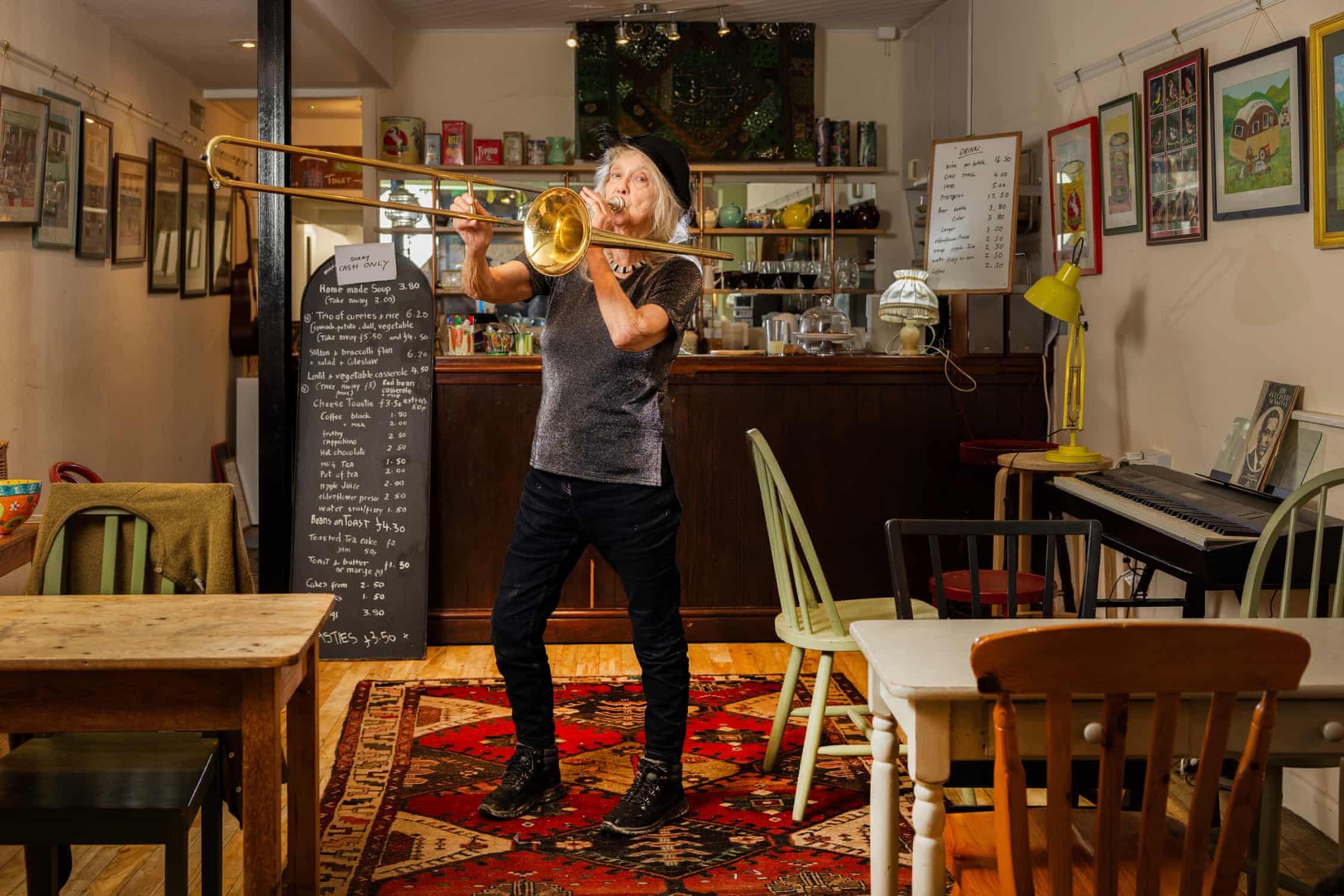
Eighty-four-year-old Noreen Davis took up trombone at 72 and never looked back.

Where I live now, it’s nice to see people taking up some pursuit that always interested them but seemed out of reach. For example, there’s a retired radiologist across the hall whose wife is an artist whose work he has always admired. Nowadays, he’s throwing himself heart and soul into some high-level art classes here and is doing an impressive job.

Today’s story is similar. It starts with a woman in the UK Midlands paying attention to a dream she had when she was sound asleep.

Ammar Kalia writes at the Guardian, “Twelve years ago, Noreen Davies had a dream. In it, the artist and cafe owner, then 72, saw herself wielding an unusual instrument. ‘There was a jazzy tune on in the background and I was playing along on a trombone, bending the notes and having a great time,’ she says. ‘When I woke up, I knew I had to learn it.’

“She headed to her cafe in Leominster, Herefordshire, and had a [routine] meeting with her accountant. ‘At the end, I asked him if he knew anyone with a trombone I could try out and he said he had five! Turns out he played in a local brass band with his wife, so he ended up bringing one round to me, along with an old music book on the instrument, and that’s how it all started.’

“Now 84, Davies has gigged throughout the West Midlands with groups exploring everything from the blues to vintage jazz and big band funk. No matter the tune, she has stayed true to her vision of bending the notes on the giant horn, twisting and wailing like a held string on an electric guitar. ‘I’ve only had two lessons and in the first one the teacher told me to just play what was written, but I do whatever I want to,’ she says. ‘I use it more like a percussion instrument, improvising over the tunes.’

“The trombone is notoriously difficult to learn, since players have to judge the distance between notes by pulling and pushing its tubing, rather than pressing fixed keys. Davies, though, found the instrument easy, thanks to her musical history. At 14, she took up the guitar and taught herself to play chords with her younger brother. ‘I forced him to play along with me. I taught myself the piano, too, by working out songs I liked listening to,’ she says. …

“Davies’ confidence to play live grew through hosting monthly music nights at the cafe, including a jam session with Ric Sanders of Fairport Convention, although she faced a setback when a series of operations on her lungs meant she was unable to play for several months.

“One evening in 2018, when she had regained her strength, she went along to a jam session in nearby Bromyard and met two young musicians who were looking for a trombone to round out their trio. Luckily, she had hers in the boot of her car in case such an opportunity arose. ‘We did a few numbers together and they ended up adopting me,’ she says. ‘We played for a couple of years, until Covid. It was great fun.’

“The open world of jam sessions and gigs has since led Davies to more instruments. She is back on the piano and has added the accordion, the washboard and the baritone ukulele. ‘I ended up in a vintage jazz band because they needed a washboard player and I was the only one who took it up in the local area. I also play Bob Dylan tunes on the ukulele and I’m trying to learn some Cole Porter on the accordion,’ she says. … ‘Everyone should try it out – just get yourself to a jam session somewhere and see what happens.’ “

More at the Guardian, here.

Read Full Post »

Photo: BBC News.
Rooted in Hull, a nonprofit that teaches people how to grow produce in urban areas, flourishes in the industrial heartland of Hull, UK.

Here’s a city in the UK that is essentially giving residents permission to save the planet in those small ways that can add up. It’s about growing healthful food where polluting industry once held sway.

Kevin Shoesmith writes at BBC News, “Hull looks set to become the first UK city to give people the ‘right to grow’ food on disused council land.

“Council bosses say the move would bring communities together, reduce antisocial behavior and make places look better, as well as put quality food on dinner plates. As campaigners call for the idea to be adopted nationally, BBC News visited one Hull-based community group that is ahead of the curve, growing healthy food in the shadows of factories. …

“In multiple raised beds on a graveled patch of land off St Peter’s Street, plants flourish, irrigated using a system which collects and stores rainwater from the roof of the Royal Mail’s sorting office next door.

“Stopping to inspect an apple tree as an HGV rattles by, Martin King, manager of Rooted in Hull, a not-for-profit community organization, said staff and volunteers have proven food can be grown almost anywhere.

” ‘You don’t need a lot at all,’ he says, grinning. ‘Joinery students at Hull College made the raised beds for us.’

“The organization acquired the land in 2015, with Mr King explaining it was once a basin used to hold ships delivering timber to a nearby dock. A stipulation of the lease, he told me, is that no foundations must be dug, hence the presence of containers, a compost toilet and even a reed bed that filters dirty dishwater. …

“[King is] supportive of Hull councillors who recently unanimously passed a ‘right to grow’ motion. If approved by the city council’s scrutiny committee, a map would eventually be produced showing suitable land it owns that could be used by those who want to grow their own fresh food.

“Hull would become the first city in the UK to give people a right to grow on unused council land. …

“Inside a grocery box before us is an abundance of autumnal vegetables destined for the dinner plates of volunteers. Glancing over the road towards the muddy banks of the River Hull, [King] says: ‘Let’s wash away the idea that Hull is some rundown backwater.’

“Incredible Edible, a network of more than 150 community growing groups, is pressing for more councils to do the same. The group insists unused land could ‘with a little TLC be turned into oases for food and wildlife.’ …

” ‘Land already earmarked for building in the future could be temporarily used to grow food,’ [Councillor Gill Kennett] says. ‘Years pass before the foundations are laid and fruit and vegetables could be grown over several seasons.’

“Councillor Mark Ieronimo, the council’s infrastructure portfolio holder, says the city is ‘blessed with green areas,’ adding there are also spaces that are no longer used, such as former car parks. … ‘This will bring people together and it’ll improve mental health and reduce food waste.’

“Back at Rooted in Hull, two volunteers beaver away, weeding and removing the remains of wilted, summer crops. Kale and butternut squash are in plentiful supply.

“Mr King agrees community gardening projects such as this one can help boost mental wellbeing. He says the group works with many vulnerable members of society, including Hull All Nations Alliance (HANA), which helps refugees.

” ‘We had a group of kids from HANA come down,’ he points out. ‘They made chips and pizzas using produce grown here. We help tackle social isolation.’

“At the back of the yard, there are three beehives. ‘A man serving a sentence at HMP Hull used his graphic skills to design labels for the honey,’ Mr King informs me.

“Mr King is content but conscious that more spaces, not just in Hull, could be used in a similar way for food production.”

More at BBC News, here.

Read Full Post »

Photo: Estate of Cicely Mary Barker, 1934 Flower Fairies.
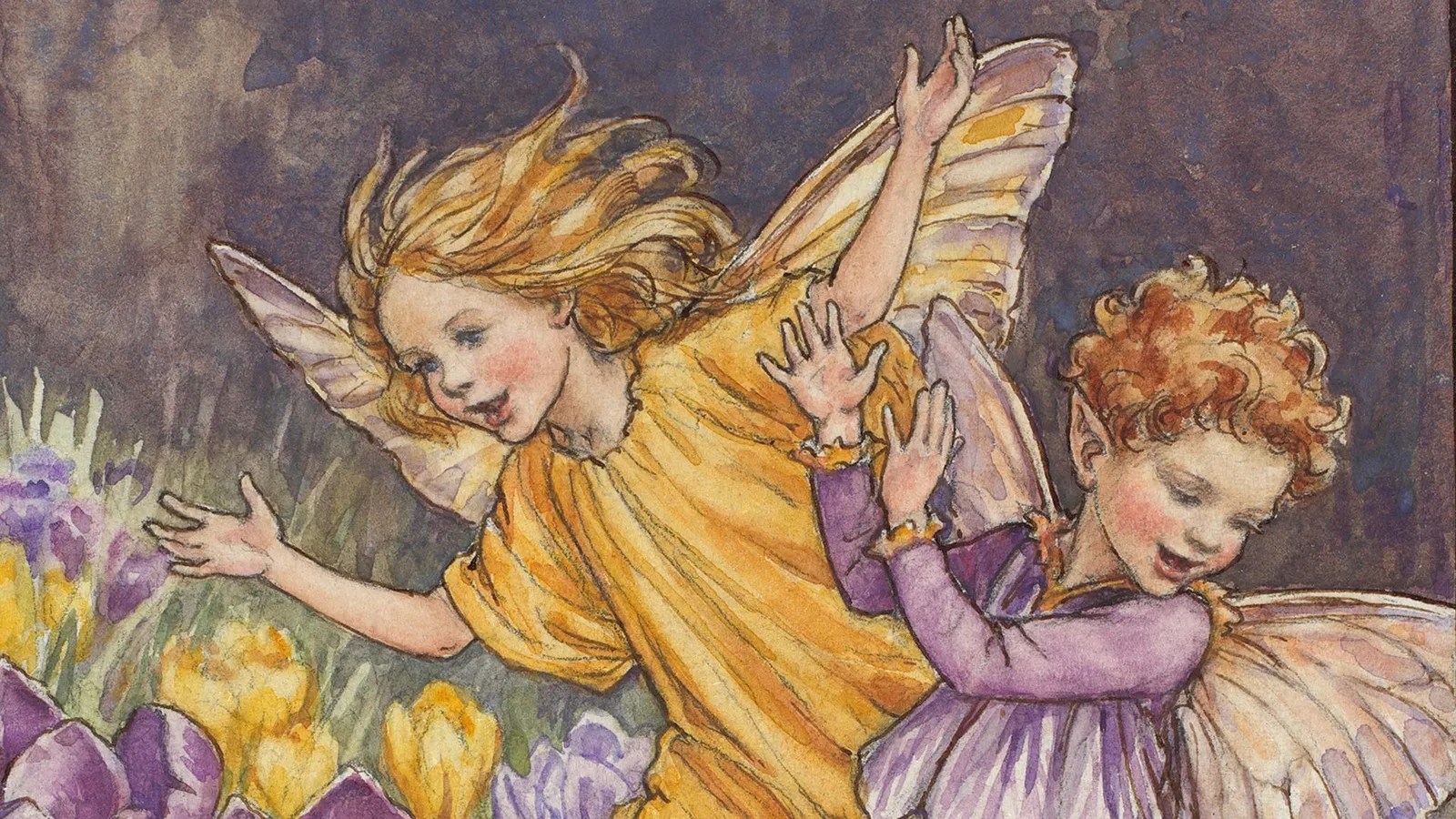
The Crocus Fairies from Flower Fairies of the Spring – the watercolors are still popular today with “fairycore” fans, the BBC opines.

Hannah will remember my devotion to the subject of today’s post. Fairies. I have always been into fairies, and long ago Hannah joined me in bringing them to life.

Meanwhile in the UK, the BBC’s Holly Williams writes this about them: “Imagine a fairy. Is the picture that appears in your mind’s eye a tiny, pretty, magical figure – a childish wisp with insect-like wings and a dress made of petals?  

“If so, it’s likely you’ve been influenced by Cicely Mary Barker, the British illustrator who created the Flower Fairies. 2023 marks 100 years since the publication of her first book of poems and pictures, Flower Fairies of the Spring – an anniversary currently being celebrated in an exhibition at the Lady Lever Gallery in Merseyside, UK.  

“The Flower Fairies’ influence has endured: they have never been out of print, and continue to be popular around the world. … Barker’s delicate watercolors certainly helped cement several tropes we now consider classic – almost essential, in fact – in the iconography of the fairy: they are miniature, sweet and youthful, they are intertwined with plants and the natural world, and they are distinctly twee.

“Yet her drawings were also ‘firmly footed in realism’ points out Fiona Slattery Clark, curator of the show. … Barker drew children from the nursery school her sister ran in their house in Croydon near London; each was assigned a flower or tree, and Barker’s detailed illustrations were botanically accurate – she would source samples from Kew Gardens, says Slattery Clark. Even the petal-like wings and fairy outfits were closely based on plants: an acorn cup becoming a jaunty cap, a harebell becoming a prettily scalloped skirt. 

“The Flower Fairies were an immediate hit – but Barker was far from the only artist of her era to find success with fairies. In fact, fairy fever swelled within the United Kingdom for over half a century, reaching something of a peak around the time the Flower Fairies emerged in 1923. Over 350 fairy books were published in the UK between 1920 and 1925, including in Enid Blyton‘s first fairy foray, a collection of poems called Real Fairies in 1923. Fairy art even had the stamp of royal approval: Queen Mary was a fan of Ida Rentoul Outhwaite‘s ethereal drawings, and helped popularize them by sending them in postcard form. …

“But for many hundreds of years, they were not necessarily tiny and fey, but grotesque or fierce elemental forces, capable of great darkness. ‘In 1800, if you thought your child was a fairy it would have been like demonic possession – you would have put that child in the fire to drive out the fairy,’ points out Alice Sage, a curator and historian.

“Yet within 100 years, the whole conception of fairies completely changed. … Fairies became a fashionable subject for Victorian artists, often taking inspiration from Shakespeare’s A Midsummer Night’s Dream and The Tempest. John Anster Fitzgerald, Edwin Landseer, John Everett Millais, Joseph Noel Paton, Arthur Rackham and even JMW Turner – among many others – painted supernatural sprites from the 1840s onwards. But there was still a sense of otherworldly strangeness in many of their depictions – as seen in the work of Richard Dadd, who made his hyper-intricate fairy paintings while living in a Victorian asylum. …

“Barker never made any claims for fairies being real – ‘I have never seen a fairy,’ she wrote in a foreword to Flower Fairies of the Wayside. But it is worth noting that she first published the Flower Fairies at a moment when the desire to believe in magical beings was at a rare high. In 1920, Britain was gripped by the story of the Cottingley Fairies, after two girls claimed to have photographed fairies at the bottom of their garden in West Yorkshire – and were widely believed.

“Their beautiful photographs were created by paper cut-outs, floating on hat pins. Although many were skeptical, they nonetheless also fooled many of the great and the good – the photographs were brought to prominence by no less than Sir Arthur Conan Doyle, the author of Sherlock Holmes, who wrote a whole book about it, The Coming of the Fairies, in 1922.

“Cousins Elsie Wright and Frances Griffiths were aged 16 and nine when they took the first photos. Many years later, in the 1980s, they admitted it was a hoax, explaining that they kept up the pretense that the fairies were real a because they felt sorry for the middle-aged men, like Conan Doyle, that so wanted to believe. …

” ‘For Conan Doyle, it was all about a search for another realm of being that related to life after death, vibrations, telepathy, telekinesis – this fascinating world on the edge of the limits of human perception,’ says Sage. ‘And obviously that’s connected to the loss of his son in World War One.’ …

“Sage is pleased to see the Flower Fairies exhibited in a fine art context at the Lady Lever gallery. For a long time, men painting fairies has been considered art – but when women do it, it’s just silly flowery stuff for children. ‘This is fine art – it’s mass, popular fine art,’ insists Sage.”

More at the BBC, here. No paywall. If you live in the UK, you have until November 5 to see the fairy exhibit at the Lady Lever Art Gallery, Port Sunlight Village.

Read Full Post »

Photo: Oscar Espinosa.
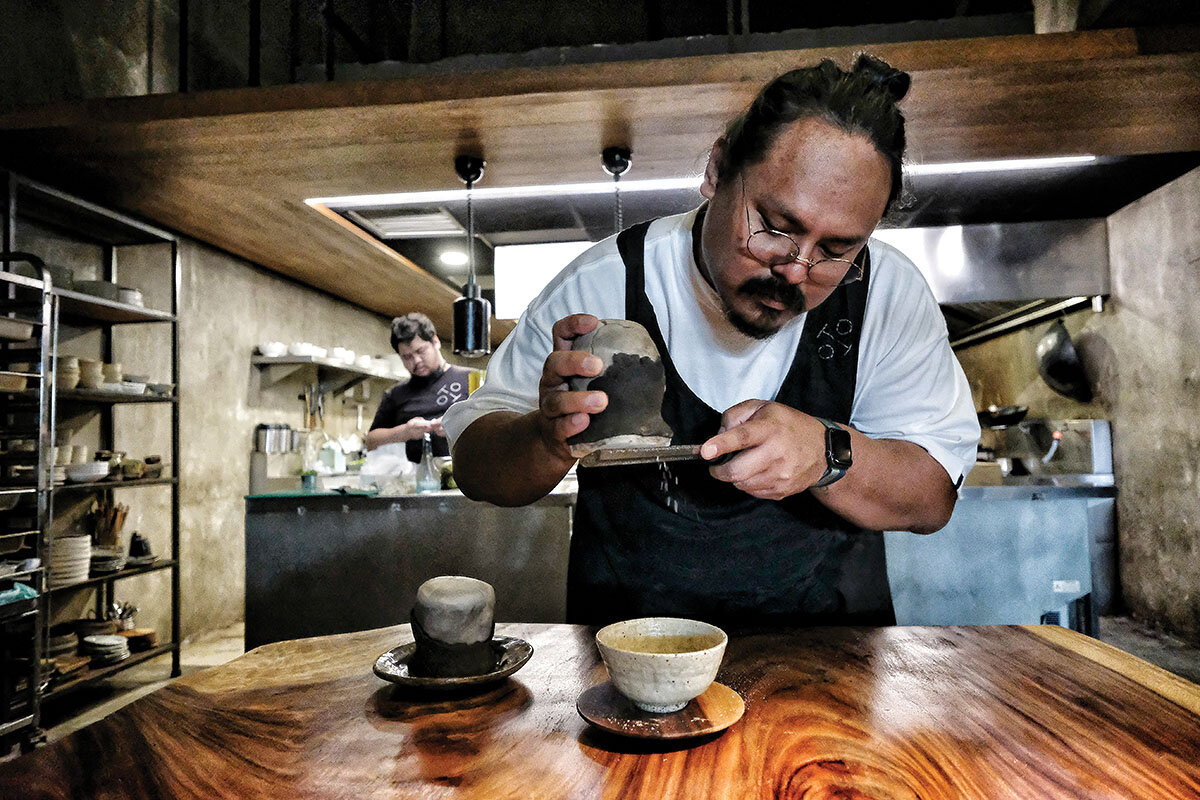
“Jordy Navarra, chef at Toyo Eatery in Manila, Philippines, delicately grates a bit of ‘asin tibuok salt on top of flan de leche ice cream, one of his restaurant’s signature desserts,” reports the Monitor.

When Fuji Xerox brought the Kinoshita family over to Rochester years ago, I spent a lot of time with Yuriko. She had lots of questions about the US but spoke great English and soon was advising other Fuji Xeros families, even making a guide book for the women.

One day Yuriko asked me why Morton Salt said “with iodine” on the label. I told her Americans didn’t get enough of that essential ingredient in their typical diets. But it got me interested in salt.

Oscar Espinosa and Laura Fornell have a report at the Christian Science Monitor on a particularly unusual salt.

“Smoke escapes from a hut in front of the mangroves of Alburquerque, on the Philippine island of Bohol. The pleasant smell of wood, coconut, and salt burning over a slow fire signals that the making of artisanal salt has begun. 

“The process, which had been passed down for generations, results in a product known as asin tibuok. It’s an oval piece of salt compacted into a clay mold that has been partially broken by the intense heat of the fire. Asin tibuok is only produced in this small coastal town of about 11,000 inhabitants. 

“ ‘For the next few days, we’ll be taking turns so that we can watch the fire 24 hours a day,’ says Nestor Manongas, who keeps his eyes on the pile of smoldering wood in the center of the hut. ‘We will have to be pouring seawater [in] to prevent the flame from igniting so that the coconut shells are slowly consumed,’ he says. ‘We can’t get distracted because the process could be ruined.’

“This controlled combustion will result in gasang, a highly salt-concentrated ash, which is then placed in a funnel-shaped tank made of bamboo, where the salt is filtered out of the ash by pouring in more seawater. The resulting brine, called tasik, will be used to cook the asin tibuok pieces.

“Mr. Manongas is one of the last remaining makers of this salt. But thanks to the determination of his family, this old trade, which had fallen into oblivion, has been revived.

“ ‘Against all odds, we kept going because we were determined to give it a new life,’ says Crisologo Manongas, Nestor’s brother. He recalls how, little by little, asin tibuok became known, with university students making it the subject of their research, chefs from Manila discovering it, documentaries being made, and in 2017 a Filipino American entrepreneur based in California deciding to import the product to the United States.” Fascinating pictures at the Monitor, here. No paywall.

For more on the production of salt, particularly the production of sea salt, I turned to Malden Salt, here. Of course, it’s self-promoting, but I think you may learn a few things, as I did. Those of you who are cooking bloggers might be especially interested.

The website says, “Salt production is one of the oldest practices dating as far back to 6,000 BC. Used for various trading and religious offerings, empires such as the ancient Romans actually used salt as a means of commerce, with Rome deriving the word ‘salary’ from salt. … Not only does it enhance flavors within dishes and allows you to season to perfection, it is an element in which the human body can’t live without – sodium. …

“Sea salt is made by seawater from the ocean entering into shallow ground or a ‘salt works’ (man-made salt water pools) where by time the sun will begin to evaporate the water, leaving behind sea salt crystals – this is called solar evaporation.

“Now this is is the easiest and preferred method for warmer climates with a low rainfall and high evaporation rate. But what about the other climates like the UK that aren’t graced with regular hot weather? This is where countries like ourselves get creative with sea salt production.

“[It’s] a naturally occurring element, containing less iodine than table salt and obtains traces of minerals/nutrients including magnesium and potassium. …

“Although it’s safe to say Maldon is sea salt’s biggest fan – there are other salts. Table salt [is] mined from natural salt deposits (older bodies of seawater which have dried long ago) the salt is then processed and manufactured into smaller crystals. Unlike sea salt, which is produced through natural methods, table salt production involves chemicals after being mined. It’s purified and striped of minerals and infused with anti-caking substances.

“Mineral salt [is] similar to table salt, but this type of salt is specifically mined from areas such as Pakistan, near the Himalayas. Did you know it’s colors are influenced from the additional minerals, such as calcium, potassium, and magnesium. You may know this as ‘Rock Salt.’ Here at Maldon we stock Tidman’s Natural Rock Salt. [Unlike] other salts, Tidman’s is also additive free. …

“Since 1882, our world-famous salt flakes have been made with the same traditional artisan methods from the coastal town of Maldon, Essex. Our salt works are run by the fourth generation Osborne family, currently in the hands of Steve Osborn, following his father’s footsteps Clive, grandfather Cyril and great grandfather James.

“Seawater from the the Blackwater Estuary in Maldon is carefully harvested on the spring tide, where there is an appreciated art to the temperature and timing, which is a family secret. Master of salt makers have been hand harvesting the naturally formed pyramid-shaped crystals that have since became Maldon’s signature.

“Maldon Salt is created through an evaporation process. Brine is evaporated in our salt pans over flames to form the unique salt crystals. [Our] salt makers use the same time-honored techniques with skilled hands poised over every batch. You can find out more where Maldon Sea Salt comes from by heading over to our YouTube channel.” Read more here.

Read Full Post »

Photo: Historic England Archive.
An aerial view of the Isles of Scilly, with St Martin’s in center left and Tresco and Bryher in the background. 
A discovery on Bryher has led to insight into women warriors.

Today’s archaeological story is set in a British island cluster with a name that sounds like “silly.” A discovery there adds to the evidence that there have always been women who have served in male bastions.

Caroline Davies reports at the Guardian, “For decades archaeologists have puzzled over whether the stone-lined burial chamber, which was discovered in 1999 on Bryher Island, contained the remains of a man or a woman.

“Excavations revealed a sword in a copper alloy scabbard and a shield alongside the remains of the sole individual, objects commonly associated with men. But a brooch and a bronze mirror, adorned with what appears to be a sun disc motif and usually associated with women, were also found. The grave is unique in iron age western Europe for containing both mirror and sword.

“Now a scientific study led by Historic England has determined the remains are that of a woman, a discovery that could shed light on the role of female warriors during a period in which violence between communities is thought to have been a fact of life.

“Original attempts to establish sex by traditional methods, such as DNA analysis, failed because of disintegration of the bones. All that could be seen of the skeleton was a dark soil stain where the body had once lain, with only small pieces of bone and teeth. …

“Scientific advances, in particular the development of a sophisticated technique at the University of California, Davis, meant it was possible to test tooth enamel, according to research findings published in the Journal of Archaeological Science: Reports.

“Dr Glendon Parker, an adjunct associate professor in the department of environmental toxicology at UC Davis, said: ‘Tooth enamel is the hardest and most durable substance in the human body. It contains a protein with links to either the X or Y chromosome, which means it can be used to determine sex. This is useful because this protein survives well compared to DNA.

“ ‘Our analysis involved extracting traces of proteins from tiny pieces of the surviving tooth enamel. This allowed us to calculate a 96% probability that the individual was female.’

“The main form of warfare 2,000 years ago is likely to have been raids – surprise attacks – on enemy settlements. The mirror and weapons found in the grave are all associated with warfare.

“It is thought that mirrors may have be used in the iron age for signaling, communicating and coordinating attacks. They also had ritualistic functions, as a tool to communicate with the supernatural world to ensure the success of a raid or ‘cleanse’ warriors on their return.

“Dr Sarah Stark, a human skeletal biologist at Historic England, said … ‘Although we can never know completely about the symbolism of objects found in graves, the combination of a sword and a mirror suggests this woman had high status within her community and may have played a commanding role in local warfare, organizing or leading raids on rival groups. …

” ‘This could suggest that female involvement in raiding and other types of violence was more common in iron age society than we’ve previously thought, and it could have laid the foundations from which leaders like Boudicca would later emerge.’ ”

I guess all British people know who that is, but since I don’t, I went to Wikipedia.

“Boudica was a queen of the ancient British Iceni tribe, who led a failed uprising against the conquering forces of the Roman Empire in AD 60 or 61. She is considered a British national heroine and a symbol of the struggle for justice and independence.

“Boudica’s husband Prasutagus, with whom she had two daughters, ruled as a nominally independent ally of Rome. He left his kingdom jointly to his daughters and to the Roman emperor in his will. When he died, his will was ignored, and the kingdom was annexed and his property taken. … The historian Cassius Dio wrote that previous imperial donations to influential Britons were confiscated and the Roman financier and philosopher Seneca called in the loans he had forced on the reluctant Britons.

“In 60/61, Boudica led the Iceni and other British tribes in revolt. They destroyed Camulodunum (modern Colchester) … at that time a colonia for discharged Roman soldiers. Upon hearing of the revolt, the Roman governor Gaius Suetonius Paulinus hurried from the island of Mona (modern Anglesey) to Londinium, the 20-year-old commercial settlement that was the rebels’ next target.

“Unable to defend the settlement, he evacuated and abandoned it. Boudica’s army defeated a detachment of the Legio IX Hispana, and burnt both Londinium and Verulamium. In all, an estimated 70,000–80,000 Romans and Britons were killed by Boudica’s followers. Suetonius, meanwhile, regrouped his forces, possibly in the West Midlands, and despite being heavily outnumbered, he decisively defeated the Britons. Boudica died, by suicide or illness, shortly afterwards. The crisis of 60/61 caused Nero to consider withdrawing all his imperial forces from Britain, but Suetonius’s victory over Boudica confirmed Roman control of the province.”

More at the Guardian, here. No firewall. Donations encouraged.

Read Full Post »

Photo: BBC.
A group of women from the Western Isles of Scotland perform a Waulking Song while softening wool so it can be woven and made into clothes and blankets.

Have you ever heard of “wool waulking”? It was new to me — a step after shearing the sheep and before turning wool into something usable. It shows up in various parts of the British Isles, and in addition to the delightful idea of working together to prep wool, it involves a special kind of song.

As in the old photo above, the wool “is banged off of a table, or ‘waulked,’ in time to songs that take the form of question and answer type songs. One woman would sing the question and the rest of the group would sing the response.”

A blogger at the website Shepherd’s Dream opines, “One of the most powerful aspects of working with wool is how deeply connected the tradition is with our Ancestors. Learning the traditional ways that our Ancestors worked with wool is a powerful way to connect with the fabric in our lives. Reading about the history of waulking songs is one of those opportunities. …

“Waulking is another word for fulling, a step in woolen clothmaking that refers to the practice of cleansing the cloth to eliminate oils, dirt, and other impurities. Fulling involves two processes, scouring and thickening, and is one of the steps in creating melton cloth.

“Originally, fulling was carried out by pounding the woolen cloth with the fuller’s feet, or hands, or a club. In the Scottish Gaelic tradition this process was accompanied by Waulking Songs, Scottish folk songs which were sung to set the pace.

“One person led the group by singing well-known verses or making up new lines. The rest would then come in on the chorus while the leader took a breath. A fulling session usually began with slow-paced songs. The tempo only increased as the cloth softened. As the fullers sang, they gradually shifted the cloth to the left so as to work it thoroughly.

“In this tradition moving the cloth counterclockwise is unlucky. It is also bad luck to repeat a song during a fulling session, which explains the large number of songs and verses.

“Our washable mattress protectors are made out of our pure melton wool textile and our mattresses are encased in this historical material as well,” the blogger adds.

Wikipedia also talks about “fulling” and adds some surprising details.

“Fulling, also known as tucking or walking (Scotswaukin, hence often spelled waulking in Scottish English), is a step in woollen clothmaking which involves the cleansing of woven cloth (particularly wool) to eliminate (lanoline) oils, dirt, and other impurities, and to make it shrink by friction and pressure.

“The work delivers a smooth, tightly finished fabric that is isolating and water repellent. Well known examples are duffel cloth, first produced in Flanders in the 14th century, and loden, produced in Austria from the 16th century on.

“Waulking could be done with the hands and feet. In Medieval Europe, it was done in water-powered fulling mills. After the industrial revolution, coal and electric power were used.

Felting refers more generally to the interlocking of loose wool fibers; they need not be spun and woven first.

“Fulling involves two processes: scouring (cleaning) and milling (thickening). Removing the oils encourages felting, and the cloth is pounded to clean it and to encourage the fibers to felt, so in practice the processes overlap.

“Urine was so important to the fulling business that it was taxed in Ancient Rome. Stale urine, known as wash or lant, was a source of ammonium salts and assisted in cleansing and whitening the cloth and having its fibers intertwined.

“By the medieval period, fuller’s earth had been introduced for use in the process. This is a soft clay-like material occurring naturally as an impure hydrous aluminium silicate. Worked through the cloth, it absorbs oils and dirt. …

“The second function of fulling was to thicken cloth by matting the fibres together to give it strength and increase waterproofing (felting). … After this stage, water was used to rinse out the foul-smelling liquor used during cleansing. Felting of wool occurs upon hammering or other mechanical agitation because the microscopic scales on the surface of wool fibres hook together, somewhat like hook and loop fixings. …

“There are several Biblical references to fulling (2 Kings 18:17Isaiah 7:3 and 36:2Malachi 3:2Mark 9:3). …

“Scotland, then a rather remote and un-industrialized region, retained manual methods into the 1700s. In Scottish Gaelic tradition, this process was accompanied by waulking songs, which women sang to set the pace.”

More here, at Shepherd’s Dream, and here, at waulk.org. No firewalls.

Read Full Post »

Photo: Dave Farrance at Wikimedia Commons.
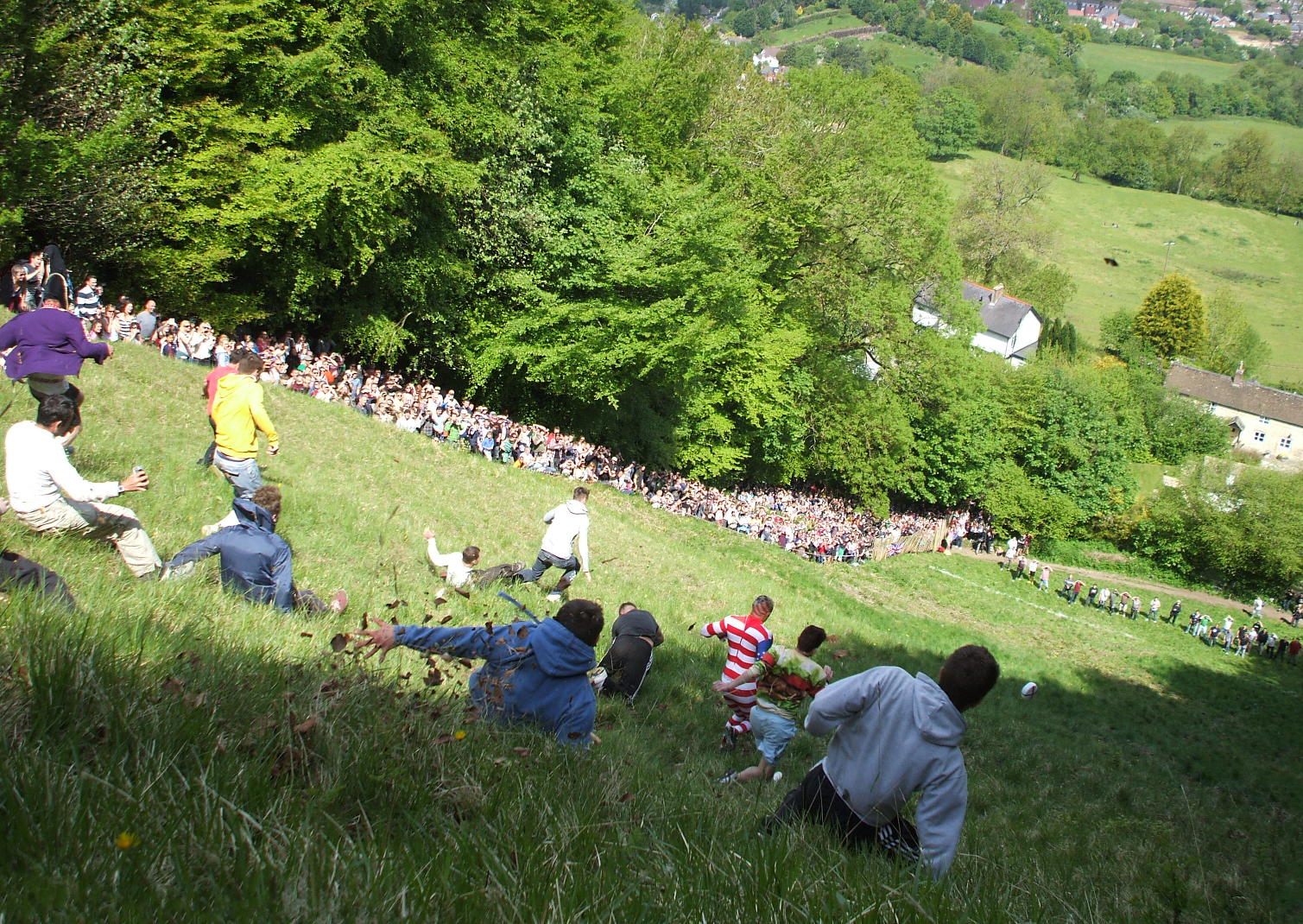
An annual cheese-rolling competition is held on Cooper’s Hill near Gloucester in England.

Do any longtime readers of the New Yorker magazine remember the bottom-of-column blurbs called “There’ll Always Be an England?” Although that faith is questioned in some quarters nowadays, a recent article suggests to me that English quirkiness is still going strong.

Jennifer Hassan reports at the Washington Post, “For hundreds of years, people have gathered in Gloucestershire, England, to fling themselves down a notoriously steep hill — in pursuit of a hefty chunk of golden-yellow cheese.

“The annual cheese roll, a race dating back centuries, often results in broken bones and concussions as participants tumble, run and bounce down the 180-meter (590-foot) hillside to become the first to cross the finish line.

“This year was no exception: Delaney Irving was crowned the winner of the women’s cheese-rolling race Monday — but the 19-year-old Canadian apparently did not actually realize she had won the competition until she regained consciousness in a medical tent shortly after.

“ ‘How are you? You took a hell of a tumble,’ one British interviewer asked Irving, shortly after she regained consciousness after bumping her head. Irving replied: ‘Did I?’ …

“The teenager was one of hundreds of racers who chased a cheese — a seven-pound full-fat hard cheese named ‘Double Gloucester. ‘ … The cheese can reach up to 70 to 80 mph as it topples down the hill, according to Gloucestershire outlets. Rugby players wait at the bottom of the hill to catch people as they crash across the finish line.

“Footage recorded of Irving shows her emerging triumphant — with her lump of precious cheese. …

“The tradition, according to a website for the modern-day cheese-roll organizers, is believed to be one of the oldest customs to have survived in Britain. A site for the town says the first written evidence of it is found in a message to the town crier in 1826. It brings spectators from around the world who gather to watch in awe and horror as individuals tumble down the hill.

“A 2020 Netflix documentary — on ‘unique, quirky and bizarre’ competitions people may not know about — dubbed the cheese roll as the ‘world’s most dangerous footrace.’ …

“The rules of the race are simple. Admission is free of charge. Participants must gather at the top of the hill before the race starts. The first person to cross the line wins, and gets to keep the cheese.

But the contest, often labeled an ‘extreme sport’ is not for the fainthearted. Injuries from past races include bruised kidneys, severe concussion, broken bones, sprained ankles and dislocated joints. …

“Irving was not the only overseas visitor to take part in the event. An American man dressed as George Washington attended the contest Monday alongside his friend who also dressed as the first president, local media reported. The pair’s day took a dramatic turn when one of the George Washingtons broke their foot amid the downhill race.

“Aside from the risks to people, People for the Ethical Treatment of Animals (PETA) also expressed concern about the risks to animals. Ahead of the race, they urged organizers of the event to … to ‘switch to a vegan cheese,’ a move they said would be ‘better for cows and the planet,’ while making the race itself ‘more inclusive.’ “

More at the Post, here.

Although it’s not nearly as cool, there’s a parade for a giant cheese in Massachusetts every year. Read about that here.

Read Full Post »

Photo: Luke Waddington.
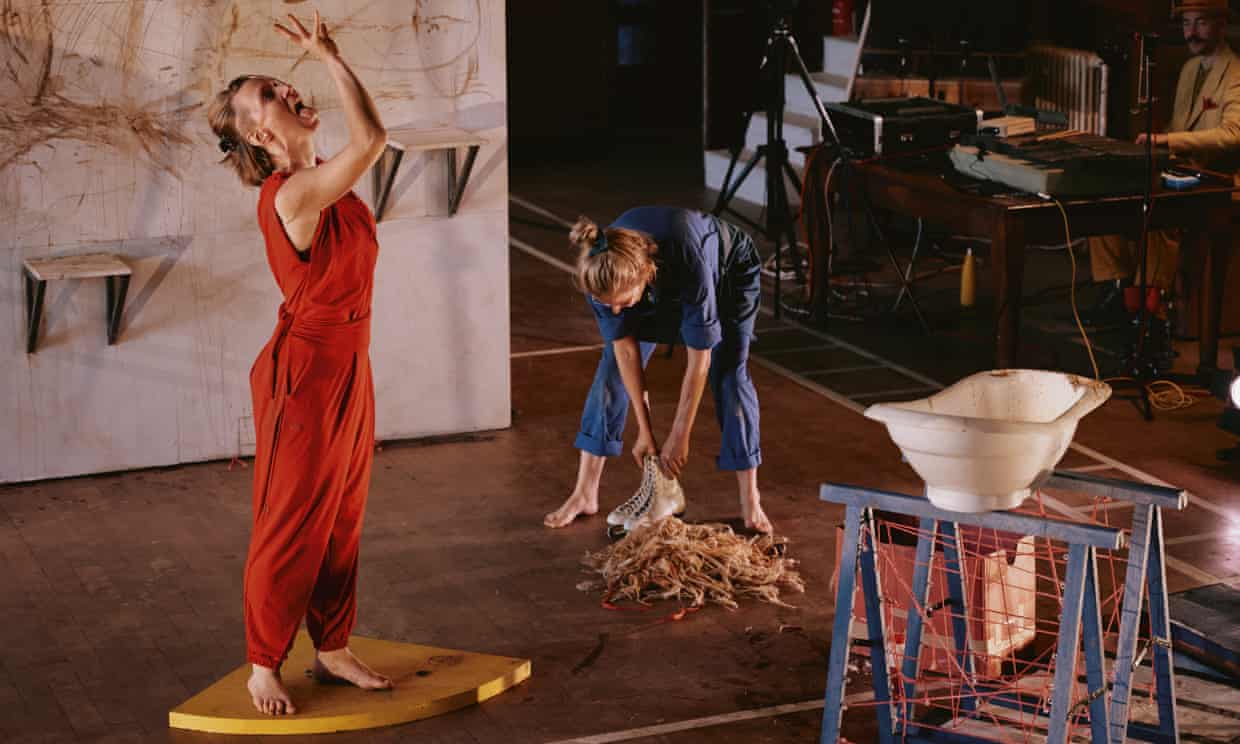
At Cambois Miners Welfare Institute, Esther Huss’s avant garde dance group involved local residents in performing Stairwall. Another choreographer in the north of England tapped local low-income children for a production and realized that it would be practical to make costumes that the kids could keep.

When the arts engage local people, they learn fast that fantasy tied to the practical concerns of daily life works best.

Lyndsey Winship reports at the Guardian on dance groups in the UK that are serious about involving the community.

“On the beach, the sand is black-flecked with coal. The pit closed in 1968, houses condemned and residents pushed to move out. But people stayed. ‘There’s not much in the way of anything really,’ says one local resident, Becca Sproat, except for a strong sense of community.

“This isolated patch of Northumberland seems an unlikely place for the German choreographer Esther Huss to have set up shop, after 20 years in London. But her husband, the playwright Alex Oates, who grew up down the coast in Whitley Bay, brought her here. ‘I fell in love with the oddness of this place, this meeting of the industrial and nature and being slightly outside mainstream society. It’s creatively interesting,’ she says. …

“In the middle of a row of brightly painted houses stands the Cambois Miners Welfare Institute, built in 1929. It had been unused for more than a decade until Huss asked to have a look inside. … Huss and Oates took on the lease, shared with the local boxing club. So there is a boxing ring on the hall’s stage and leather punchbags along one wall. As well as Huss making her own work here, she runs a dance group, and Oates runs a writing group, shivering through the winter with no heating and scraping together funding to keep everything free. Some artists pay lip service to reaching new audiences, Huss and Oates are actually living it. Next is a two-year project Cambois Creates, to make a memorable event for the whole community.

“Huss’s choreography is inspired by dadaism, German expressionism and the Japanese dance-theatre form butoh, and in the Cambois dance group, she encourages novice dancers to create their own movement.

‘My family howl at me,’ laughs 61-year-old Alison Johnson, ‘ “Oh mam, show us your latest interpretive dance!” But it’s nice to do something different,’ she says.

“ ‘It’s become such a safe environment where we all get out of our comfort zone, because we trust each other, because of Esther. It’s special.’

“Sproat, 33, had been stuck at home for 16 months during the pandemic when she got a leaflet through the door. ‘Something about a dance group, and I just laughed and binned it, because there’s no way I was going to do that. Or so I thought!’ she says. Desperate to get out of the house, she agreed to volunteer at the Institute, ‘And somehow Esther’s enthusiasm rubbed off on me. I’m not a dancer,’ says Sproat, who has some mobility issues, ‘but I’ve learned how to express myself through movement. I’m a lot more confident than I was.’ …

“You’re a long way from the London bubble and for artists working here that can be part of the appeal. ‘Moving up here, it changed everything,’ says Huss. ‘I always felt like, does London need another dance piece?’ Liv Lorent, who moved to Newcastle 30 years ago, tells me the same: ‘London didn’t need another choreographer.’ Lorent only planned to stay a few months, but fell in love with the people, the light, the beauty, the audiences. [They’re] no-nonsense, there’s no woolliness, she says, but there’s always a sense of humor. …

“Lorent describes herself as ‘all heart and idealism’ and being in the north-east has allowed that. Like Huss, she’s long been committed to community involvement. Her company, balletLORENT, recently moved into a 1930s former school building in Newcastle’s deprived West End. Lorent frequently works with local adults and children in performances. She tells me about one project where there was a costume budget, but knowing some of those children were in need of every day clothes, she made the costumes something they could take home and wear after the show. It’s about creating fantasy, while living in the real world.

“Huss likes to take her fantasies into the real world. Her last piece, Stairwall, toured in unconventional venues including a timber merchants in North Shields. She heard that some of the male staff were expecting the dancers to arrive in heels and sexy outfits – ‘It’s quite blokey up here sometimes’ – so they must have been surprised by Huss’s multidisciplinary dance-theatre. But some of the men were game to be part of the performance, one telling Huss: ‘When I die, this is going to be one of the proudest days of my life.’ She loves seeing how people respond to her work. ‘I’m not pretending everyone liked it, but generally people were really open to it,’ says Huss.

“ ‘I was surprised how immersed I became in it,’ says Johnson. ‘I found myself becoming quite emotionally charged. The fact that she’s showcased these within Cambois, I remember feeling very privileged that something you would see on a stage in a major town or city was on in Cambois Institute!’

“ ‘I didn’t think I would actually like it,’ says Sproat, ‘But it was just so inspiring. Esther and Alex lived in London and there’s millions of opportunities down there. So for them to come here is amazing.’ ”

More at the Guardian, here.

Read Full Post »

Photo: Getty Images.
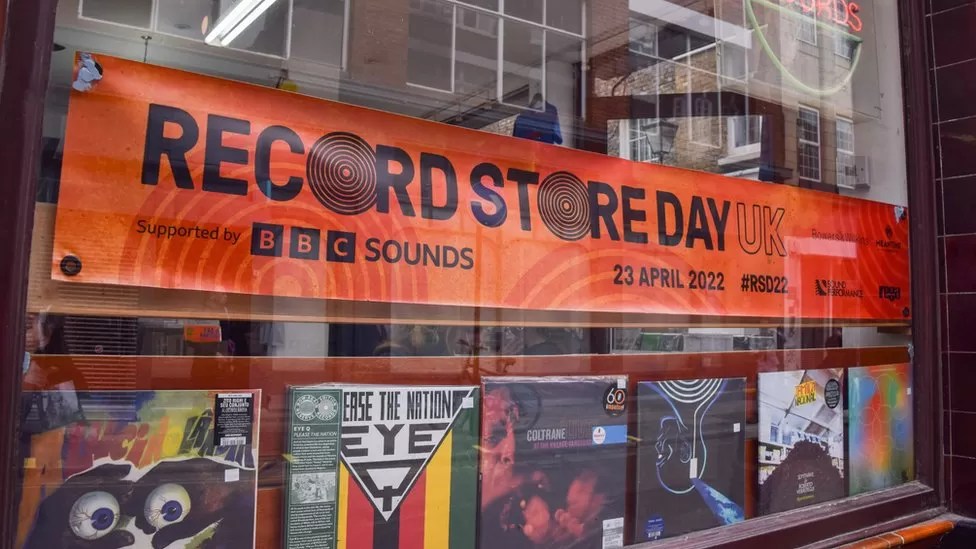
Record Store Day celebrates independent music stores in the UK, says the BBC, “with many labels and artists releasing limited vinyl editions specifically on the day.”

Some of us still listen to our vinyl records. And others are starting to. In fact, vinyl records have become so popular in England that there is now an official Record Store Day to celebrate the bricks-and-mortar places you can buy them.

Gareth George reports at the BBC, “More young music fans are snapping up the latest releases on vinyl, triggering a boom in LP sales. In 2022, vinyl outsold CDs for the first time in 35 years. Ahead of Record Store Day in the UK, the BBC asked young record store regulars why ‘old school’ beats downloads. …

“Will, 16, is a GCSE [General Certificate Secondary Education] student and guitarist who hopes to study music full-time at the Colchester Institute. He believes buying vinyl is a better way of supporting artists than streaming or downloading music and reveals he has inherited his own collection of records from parents and grandparents. …

” ‘You can inherit not only the music, but also the memories, and tell the story though vinyl.’

“Will is running a second-hand vinyl stall with Sam, 18, from Chelmsford, a guitarist and singer who plays in a band called Alison. Sam says record fairs are essential because new vinyl LPs can be expensive for budding collectors.

” ‘It’s hard to become a vinyl collector now when you go to your local record shop and see that it’s 40 quid a record,’ he says. ‘That’s why these record fairs are important. Stuff’s just cheaper.’

“The pair work at Intense Records in Chelmsford, one of the hundreds of independent music shops across the UK taking part in Record Store Day on 22 April. The annual event, which was established in 2007, has become one of the biggest in the music calendar, with independent record shops often achieving their highest sales of the year. …

” ‘We’ve definitely seen a new generation of younger music fans embracing vinyl,’ says Record Store Day UK co-ordinator Megan Page. ‘For superstar artists like Taylor Swift and The 1975, vinyl has become a really important part of their marketing campaign. …

“Jon Smith, manager of Intense Records, says DJs will be playing to the crowds of collectors expected to go along. He said many customers hope to grab a bargain or snap up a limited release on the day. …

“Nineteen-year-old Kasabian fan, Geordie Breeze, is ‘crate-digging’ in Norwich – a vinyl hunter term for flicking through the rows and racks of records in music shops. The environmental science student at Lancaster University says he already has ‘a few hundred’ vinyl LPs. ‘I think the sound quality’s better, and I like a physical record to hold,’ he says.

“According to figures from the British Phonographic Industry, vinyl records outsold CDs in 2022 for the first time in 35 years. The revenue generated from vinyl was [about] £119.5m [$128 million] more than CDs. …

“Musician Imogen Bradley, 23, looks out for ‘old school hip-hop’ on vinyl. She is a fan of British rapper MF Doom and American hip-hop collective Wu-Tang Clan. ‘I just prefer having a physical copy,’ she says.”

What was before vinyl? My grandfather left behind a wind-up Victrola with a horn that would be valuable today. But my brother and I at a young age thought it was hilarious to smash the records. Golly, but kids are weird!

More at the BBC, here. No firewall.

Photo: Suzanne and John’s Mom.

Read Full Post »

Photo: Emily Turner.
Emily Turner (pictured) planned to take 16 buses in total, traveling exclusively by buses that fall under the government’s £2 [$2.40] local bus program. 

The other day, a friend asked me what I will do if I decide to give up driving: for example, how will I get to the Providence grandchildren from Massachusetts. Public transportation, I said. It will take all day, and I’ll have to go there less often and stay longer, but it’s doable. I’ve tested it.

Because public transportation in the US is not the best, I think you really have to reorganize your life around using it. And you have to assume everything will take a lot longer. But what’s the hurry?

Here’s a woman in the UK who decided to test how far she could go just using public buses. She’s been buoyed by all the people following her adventure on social media.

Sophie Zeldin-O’Neill reported last month at the Guardian, “A British woman undertaking an epic three-day expedition from London to Scotland using only local buses has expressed her surprise at the level of support from thousands of people following the chronicles of her journey on Twitter.

“Writer and podcast host Emily Turner, from London, began her nearly 400-mile journey in the early hours of [Feb. 10], announcing on Twitter: ‘I’ve been wanting to do this for YEARS!!’ …

“She plans to arrive at her destination, Edinburgh, on Sunday, taking 16 buses in total, and traveling exclusively by those that fall under the government’s £2 [$2.40] local bus program. …

“Turner, who hosts the Roundel Round We Go podcast about the London underground, planned her trip to coincide with her 35th birthday on Friday, and is attempting to keep the total cost under £35 [$42].

“On Friday night, she tweeted: ‘And that concludes my 35th birthday. When my mother turned 35, she was about to give birth to me, but I feel like today I have given birth to a whole Twitter bus lover community, so to each their own.’

“In response to one Twitter user who commented ‘I bet it’s going to cost more than a single megabus ticket,’ Turner replied, ‘Oh definitely! It was more about the journey than saving money.’

“Upon arriving in Leeds, she explained some of the background to her penchant for public transport, saying: ‘Leeds is a city I’ve spent about three weeks in previously. They were while I was doing intensive teacher training, and I was spending a lot of time with large groups of people, which I found exhausting, so I’d escape and go ride buses.’

“Thousands of people around the UK have followed her account before and during her journey, providing tips and encouragement – and sharing their own bus-related anecdotes. One Twitter user said: ‘Looks like you passed my house on the Stagecoach 59 from Barnsley this morning. Wish I’d known, I’d have got you a coffee and a sandwich from Noble’s at Busy Corner.’ …

“Turner has been compiling a bus-themed playlist, with songs including Erica Banks’ ‘Buss It’ and ‘Vengabus’ by the Vengaboys.

“In response, she has been offered tips for audio accompaniments to the voyage: ‘I hope you liked the 16-minute @GratefulDead song I recommended earlier,’ said one follower. ‘If you’ve got another long bus ride still to come, I’ve got a 30-minute one ready for you.’

“A newer follower added: ‘Very much enjoying the @ETWriteHome bus tour … I did a similar hitchhike to Paris from Edinburgh in 2010. If you can muster the energy down to @NewbarnsBrewery when you make it to Edinburgh there will be a drink on the bar for you.’

“Despite trying to adhere to a strict schedule en route to Scotland, Turner’s journey has been disrupted and delayed at various points. On Friday, she boarded an unplanned bus at Luton, and on Saturday, she got stuck after her card was declined – something which, it transpired, was because she had carried out more than the permitted number of Apple Pay transactions in a single day.

“At the time of writing, Turner is in Newcastle. She plans to get the train back to London on Sunday evening.”

Have you had public transportation adventures worth sharing? I seem to recall that blogger Asakiyume tweeted that her son had planned a similar trip in the US. And the reason I learned that public transportation to and from Providence was doable was a blizzard.

I left my car in the Amtrak garage in Providence and trained it to South Station in Boston. From there, I took the subway to Porter Square, Cambridge, and hung around for the commuter rail to my town. When I got to town, I walked across the snowy street to my house, a block from the train.

It was the only moment I needed my snow boots.

More at the Guardian, here.

Read Full Post »

Permission to Stay Warm

Photo: Henry Nicholls/Reuters.
Residents take shelter inside London’s Roehampton Library, Dec. 14, 2022. The library is being used as a “warm bank,” according to CSM, welcoming members of the community to spend time there in the winter months as an alternative to heating their homes amid increased energy costs.

After Russia invaded Ukraine a year ago, oil prices and heating costs went up for everyone. And rather than help people out, oil companies gave their windfall profits back to themselves. In the long run, that can only help to spur alternative energy development. But meanwhile, folks are just trying to keep warm.

Natasha Khullar Relph writes at the Christian Science Monitor, “String lights, boxes full of postcards to share a story, or a sign on the door that lists the top five David Bowie songs with the message, ‘Come in and argue’: There are many ways to make people happy to come out of the cold and into a public warm space, says Maff Potts. The key, he adds, is to make sure they feel welcome and not judged.

“ ‘What gets people in is that it’s not a church. It’s not a charity,’ says Mr. Potts, who founded Camerados, a social movement that’s been opening public living rooms in communities across the United Kingdom since 2015. ‘There’s no fixing, no answer. There’s just permission.’ …

“While the U.K. Health Security Agency is encouraging people to warm their homes to at least 18 degrees Celsius (64.4 F), more than 3 million low-income households cannot afford to heed this advice.

According to analysis by the Joseph Rowntree Foundation, around 710,000 households across the U.K. cannot pay for warm clothing, heating, and food, with approximately 2.5 million households – a fifth of all low-income households – going without both food and heating.

“And with power prices hitting record levels and energy costs double what they were last year, warm spaces have popped up all over the country. To avoid any potential stigma, they’re being presented as communal spaces where people can come to chat rather than charitable offerings of heat or food. While the main reason someone would go to a warm space or public living room is most likely to be warmth, it’s the camaraderie and conversation that keeps people there. …

“Britain’s poor people face the worst winter in living memory, tweeted former Prime Minister Gordon Brown in December. ‘A year ago we talked about people having to choose between heating and eating, now many can’t afford either,’ he wrote. Two-thirds of the country will be in fuel poverty come April, which includes 70% of pensioners [retirees] and 96% of single-parent families with two or more kids, he noted. …

“If you’re struggling to pay to heat your home, you only really have three options, says Matt Copeland, NEA’s head of policy: You could rack up debt with your energy supplier, ration your energy and use less than you need to stay warm, or simply turn off the heating, the impact of which can be significant. Research shows that more people die from cold homes than they do from alcohol’s short- and long-term effects, Parkinson’s disease, or traffic accidents.

“ ‘We know of households with prepayment meters who just can’t afford to top them up at all,’ says Mr. Copeland. ‘They’re going days, weeks, and sometimes months without access to energy.’ …

“Where the government is failing, communities are stepping up. ‘It is completely absurd that one of the 10 richest countries in the world can’t put a sufficient priority on things and make the right choices so that we have somewhere to keep people warm,’ says Mr. Potts of Camerados, whose public living rooms are now being used as templates for warm spaces around the country. After almost 30 years of working with people at the margins, Mr. Potts says he doesn’t have faith that the solution lies in the civil service. …

“An LGBTQ+ community space in Brighton. A bakery in North Yorkshire. A gaming cafe and ‘geek culture’ store in Ipswich. A vegetarian restaurant in Tunbridge Wells. A brewery in Devon. A former shoe store in Worcestershire. Warm spaces are popping up all around the country, in all manner of ways, in a community effort that started organically, from the grassroots, without a central organizer.

“In addition to community halls and churches, hotels, hairdressers, and cricket clubs are opening up their doors for anyone who needs some warmth, some company, and perhaps even a drink. Even legendary soccer club Manchester United has gotten in on the action and is offering Old Trafford, the club’s stadium, as a free warm hub, with its restaurant, the Red Café, opening its doors on Monday and Wednesday evenings ‘to help those facing difficult months ahead.’

“The Warm Welcome campaign, an organization that has encouraged thousands of faith groups, charities, and businesses to provide such public spaces, said they’d seen 80,000 people use their facilities during December’s cold snap. The campaign notes that there are now warm spaces in every town and city in the country, and lists over 3,200 venues on their website, which include spaces run by local authorities, charities, and businesses. …

“ ‘What we have in Brighton and Hove is a tremendous community-mindedness among residents. Despite the stark reality facing residents this winter, people have stuck together and they’ve really helped each other through some of the starkest problems,’ says Brighton and Hove City Council Leader Phélim Mac Cafferty, who notes there are more than 40 warm spaces available to the public across the city. …

“This nationwide response to the energy crisis is unique in how much of a community effort it is. The effort to create warm spaces was neither government- nor council-led, nor the work of any one particular organization. As the need became obvious, first volunteers, then organizations, and later local councils jumped in feet first.”

More at the Monitor, here. No firewall.

Read Full Post »

Photo: BBC.
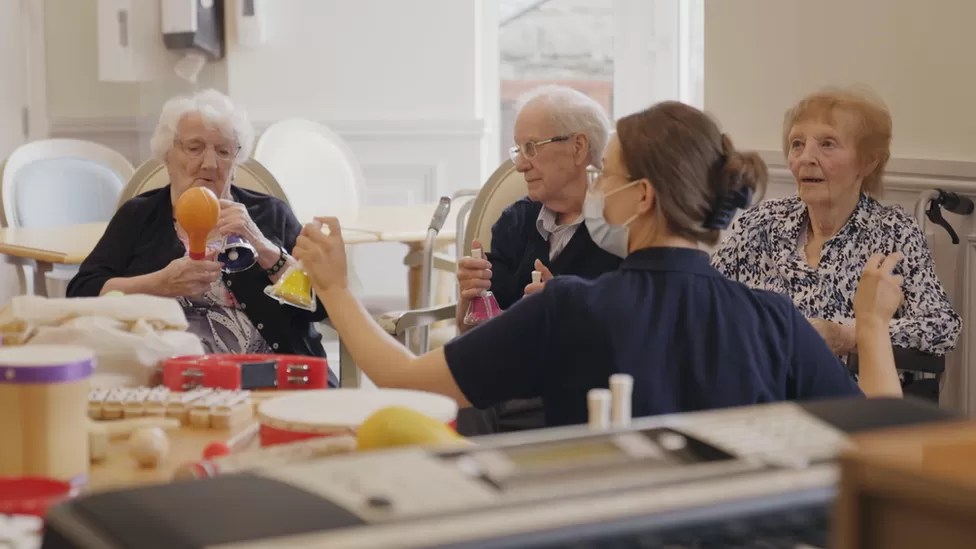
Carer Beth Forster leads music workshops for seniors with dementia in the UK.

At Thanksgiving, we had the pleasure of meeting Meg, a relatively new member of our family who shared a bit about using music therapy with hospitalized patients suffering from mental illness. So I was interested to read today’s story about a similar music program in the UK, one that focuses on people with dementia.

Sarah Gwynne and Woody Morris had this report at the BBC.

“An orchestra is attempting to bring people living with dementia back into the present. The work being done by Manchester Camerata has never been more important, given that there are about 900,000 people with the condition in the UK, a number that is predicted to nearly double by 2040. …

“People with dementia often find listening to music can reignite old memories from long ago. Much more overlooked, though, is the impact that making music can have on the present.

“While some with dementia can often feel trapped in the past, some researchers believe the act of creating music – as well as listening to it – can help to reconnect them to the here and now.

“A new BBC documentary — Dementia, Music and Us — follows the work of Manchester Camerata and its principal flautist Amina Hussain.

“Amina, who is also a professional music therapist, leads classes across the north-west of England that have been described as life-changing.

” ‘Taking part in the ‘Music in Mind’ workshops has been an enormous privilege for me as a musician,’ she said. …

“Classes for the community consist of improvisation, singing, and writing their own music and lyrics.

“Keith Taylor, 62, was diagnosed with frontotemporal dementia when he was 53. … Like many, he really struggled to come to terms with his new reality.

” ‘The best way I could explain it,’ he said, ‘is if you’re in a pine-wooded area and all of the trees are in grids and blocks and you’re walking through that and it’s dark and you can see the mist coming up behind you and you can feel it catching you.’ …

“Keith’s partner of 14 years, Joan, said they had found the sessions to be genuinely life-changing. ‘I think the thing that saved us was the first ever music group we went to because from that group it opened other groups up for us,’ she said. ‘It’s been fantastic.’

“Keith added: ‘I live life every week. Not every day — every week because I’ve got music sessions.’ He said the workshops ‘make him smile, enjoy life and it just brings the best out of you.’

“Researcher Dr Robyn Dowlen is seeking to better understand the ‘in the moment’ benefits of music-making for people with dementia. … She believes the improvisational music workshop experience allows people to ‘create something that is held now in the moment.’

“Keith described how the sessions and being in what Dr Dowlen calls the ‘musical spotlight’ had helped him ‘stand up taller.’

“Dr Dowlen added: ‘Improvisational music-making is particularly important for people with dementia, especially when it comes to building their confidence and their self-esteem.’

“Beth Forster, from Liverpool, started her career in caring as a volunteer two years ago when she found herself furloughed during the pandemic. When a staff position subsequently became available she applied and has never looked back.

“The 28-year-old decided to get involved in the music workshops after news began to spread about the positive impact they could have on those living in care homes. A musician herself, Beth received training from Manchester Camerata’s professional music therapists so she could lead her own workshops.

“Beth said: ‘I feel like I’ve got more strategies to bring residents into the present to help them if they’re distressed… I can’t really believe this is my job. … it is a real privilege.’ “

More at the BBC, here.

Read Full Post »

Photo: Emli Bendixen/Arts Fund/PA.
The venue in London’s Forest Hill, says the
Guardian,”is the capital’s only museum where environment, ecology and human cultures can be seen side by side.”

What special features are people looking for in museums these days? The traditional recorders of art and history keep changing. A look at a museum award in the UK may provide an insight into what is currently valued.

Nadia Khomami writes at the Guardian, “The Horniman museum in London has been crowned the Art Fund museum of the year 2022 for its work to inspire the next generation. …

“Its director, Nick Merriman, was presented with the £100,000 [about $117,000] prize – the world’s largest museum prize – by the DJ and broadcaster Huw Stephens at a ceremony at the Design Museum. … The Horniman was commended for completely reconfiguring its program in 2021 after the pandemic, Black Lives Matter and the increasing urgency of the climate crisis.

“It set up its ‘Reset Agenda,’ which focused on reorienting activity to reach diverse audiences more representative of London. This included embedding a Climate and Ecology Manifesto – from an online club of Environment Champions to the creation of a microforest to combat local air pollution.

“ ‘From a takeover of the galleries by children to its youth panel of 14-19-year-olds, work experience opportunities and Kickstart apprenticeships, the museum is inspiring the next generation,’ Art Fund, the UK’s national art charity, said.

“A further focus of the Reset Agenda was the 696 Program, an interrogation of the power and responsibility that public organizations have in supporting local music.

“The museum was said to showcase Black British creativity through a sold-out festival that reached 8,000 visitors, while nearly 20,000 experienced the related exhibition.

“Jenny Waldman, Art Fund director and chair of the judges, said: ‘The Horniman museum and gardens has now blossomed into a truly holistic museum bringing together art, nature and its myriad collections.’ …

“Dame Diane Lees, director-general of the Imperial War Museums and fellow judge, said the museum was championing the natural environment and commissioning artists and music festivals ‘to bring the eclectic collections of Frederick Horniman new relevance with diverse communities.’ …

“The 2022 edition of the annual award championed organizations whose achievements told the story of museums’ creativity and resilience, and particularly focused on those engaging the next generation of audiences in innovative ways.

“The other four shortlisted museums – the Story Museum in Oxford, the People’s History Museum in Manchester, Ty Pawb in Wrexham [Wales], and the Museum of Making in Derby – each received a £15,000 [about $18,000] prize in recognition of their achievements.”

I’m looking at an example form the Horniman website. An upcoming show, “We Breathe, Together: A Day of Community Air Action and Exploration” invites all who “dream of a clean air future – and want the tools to take action.

“From building (and racing!) your own hydrogen car, learning the skills to create a 2D stop motion clean air animation, to co-designing immersive climate adventures and ink breath painting. Meet incredible local campaigners in our Clean Air Village and listen to expert talks.

” ‘We Breathe, Together’ extends the conversation around ‘Breathe:2022‘ by artist Dryden Goodwin, the ambitious multi-site artwork exploring air pollution produced by Invisible Dust. ‘Breathe:2022’ combines over 1,000 new drawings, appearing as large-scale still and moving images on sites close to the heavily polluted South Circular Road and beyond, from May to December 2022.

“As part of the day, you can also immerse yourself in ‘Airborne,’ artist Sarah Stirk’s audio-visual installation that seeks to make the invisible threat of pollution visible.”

More at the Guardian, here. I know I have friends in the UK. If you go, will you share your reactions?

Read Full Post »

Photo: Kerry Jones.
Artist Kerry Jones turned her old trailer into one of the smallest cinemas in the UK.

Today we have another idea on taking what you have and turning it into something that can delight others.

“Until fairly recently,” writes the BBC, “Kerry Jones’s caravan lay rotting and forgotten about in her garden in Galashiels in the Scottish Borders — a home for discarded bric-a-brac.

“But during the Covid-19 lockdown, the artist and filmmaker saw new potential in the 1980s Swift Pirouette, and resolved to turn it into a tiny, traveling cinema. With a maximum of eight seats, it could be one of the smallest cinemas in the UK.

” ‘It isn’t the first cinema caravan to exist,’ said Kerry. ‘There was one over in Dumfries and Galloway that a friend of mine made at the beginning of the 2000s, that was really inspiring. I’m really interested in projects that involve people out in your community.’ …

“Over the pandemic, Kerry secured a bursary [grant] from the Alchemy Film and Arts charity based in nearby Hawick as part of a local arts program running between July 2021 and December 2023. She used it to renovate the caravan inside and out, swapping the retro mint paneling for a bright red that could be seen for miles. … Inside, she plans to install between six and eight seats, again in a plush, cinematic red fabric.

“Speaking to Mornings with Stephen Jardine, she said: ‘[I’ve] had it for 12 years — it’s been out and about, it’s been used for people to stay, it’s been a spare room. But over the last few years, but it’s just been one of those spaces that you put things in and forget about.’

“Kerry’s caravan cinema project — named Moving Images — [made] its debut at Hawick’s Alchemy Film Festival on 28 April, screening nine short films all made by people in the south of Scotland.

“It comes at a time when Scotland has lost one of its smallest cinemas — the Schoolhouse Cinema in Shetland. This 20-seat cinema, run by local magician Chris Harris, was put up for auction in 2020 after he decided to leave the islands.

“Around the same time another tiny theater opened in the Highland village of Cromarty — a 35-seat facility that took two years to come to fruition.

“Kerry aims to cater for an even more intimate experience, and will be using a small portable projector to save on power without sacrificing picture quality.

“The caravan itself is solar powered, but Kerry said she will borrow a high-quality battery as back-up until she can crowdfund her own.

“Any spare cash will then be put towards taking the caravan on the road — possibly for a tour of free screenings and running filmmaking workshops at local primary schools.

“Kerry added: ‘It’s going to be really adaptable. Selkirk’s market square have said they’d be quite interested in having the caravan there. I’d love to take it out to some of the more rural areas like Duns and Gordon.

” ‘We’re also going to work with a group called Connecting Threads and they’re doing lots of projects along the Tweed [river] — I’d love to see it there, that would be quite magical.’ “

There’s more to read at the artist’s website. “As part of The Teviot, the Flag and the Rich, Rich Soil, our programme exploring the pasts, presents and futures of Hawick and the Scottish Borders and investigating the town and wider region’s cultural identities in relation to land, water, industry, territory, place and environment, Alchemy is offering a number of bursaries to Borders-based artists. These bursaries will support a range of community-oriented projects between July 2021 and December 2023.”

More at the BBC, here, and Jones’s website, Alchemy Film and Arts, here.

Read Full Post »

Photo: James O Davies/The Historic England Archive, Historic England.
Sphinx House, Moulsford, Oxfordshire, is an example of Egyptian influences on the work of newly rehabilitated British architect John Outram.

Sometimes a person whose work hits a wall of resistance from contemporaries is merely ahead of the times. That may be the case with UK architect John Outram.

Guardian reporter Oliver Wainwright talks to the architect about his philosophy and rehabilitation. ” ‘Our beginning was a worm,’ says John Outram. ‘It had light-sensitive cells at one end that later turned into eyes.’ He is standing in the bathroom at the top of his house in London’s Connaught Square, explaining the symbolism of the patterns that line the walls of his shower.

“Three white worms wiggle their way across a background of blue mosaic tiles at the base of the cubicle, while a black I-shape floats against a band of red tiles above, denoting ‘the emergence of the ego.’ A third yellow band at the top marks the realm of light, where the figure of ‘thought’ appears between two triangles, signifying the parted halves of the ‘heap of history.’

“It’s a lot to digest before breakfast – and we haven’t even got on to the symbolic ceiling (the ‘raft of reason’) or the hexagonal serpent-skin floor tiles.

“ ‘I stand here every morning to do my exercises,’ says Outram, breaking into an infectious giggle. ‘A good dose of metaphysics sets one up for the day.’

“The eccentric architect has reason to be cheerful. At the age of 87, he is enjoying an unexpected wave of popularity. Having been stamped with the label of postmodernism – out of favor since the 1990s, when his work was described as ‘architectural terrorism’ – he has been rediscovered by a new generation, thirsty for color, pattern, ornament and fun.

“The last few years have seen several of his buildings listed, from the Isle of Dogs pumping station, that cartoonish temple to summer storms, to an opulent country house in Sussex built for the Tetra Pak billionaires Hans and Märit Rausing. Illustrations of Outram’s buildings can now be found emblazoned on T-shirts and mugs, while he has a growing following on Instagram, which he joined during lockdown, where he expounds his esoteric theories to a rapt audience. And now, for the first time, the full breadth of his maverick output has been brought together in a monograph. So how does it feel to be recognized so late in life, after years in the wilderness?

” ‘I call it being dug up,’ he says with a chortle. ‘Disinterred, as it were. It’s quite entertaining.’

“As Geraint Franklin, the book’s author, observes, the English have never quite known what to do with Outram. His buildings are hi-tech, neoclassical and postmodern all at once, yet they fit neatly into none of these categories. His chubby columns house sophisticated mechanical systems for ventilation, wiring and drainage, while simultaneously alluding to ancient mythologies in their richly layered ornament.

“A huge jet engine fan in the pediment of the pumping station helps to cool the machinery inside, while also standing as the symbolic source of the ‘river of somatic time.’ A pyramidal glass fireplace in the Egyptian-themed Sphinx Hill house in Oxfordshire summons momentous Pharaonic allusions, while cleverly sucking smoke beneath the floor to a hidden flue.

“In Outram’s world, embracing technology and modernity did not preclude the presence of poetry and history. … Outram piled it all on, mining inspiration from Sumerian, Egyptian, Chinese and Mayan cultures with magpie glee. …

“Born in Malaysia, where his army officer father was stationed, Outram’s outsider status owes something to his upbringing. His childhood saw spells in Burma and India, before he arrived at prep school in England at the age of 11, feeling like ‘a refugee from the British empire.’ His early exposure to the vivid sights and sounds of South Asian cities informed his impression of the classical world, as being ‘much more like India than like the British Museum. Very noisy, very smelly, very colorful.’ …

“Unlike his hi-tech peers, his projects rarely exceeded the capabilities of the average builder. ‘The problem with hi-tech is that it’s very expensive, and the tech isn’t very high,’ he says. ‘I’d been a pilot, so I knew what real hi-tech was – and it wasn’t suitable for architecture.’ …

“As Franklin writes, base materials are subject to an almost alchemical transformation in Outram’s hands. Humdrum concrete – which he once described as a ‘funereal porridge of muddy ashes’ – could be transformed into ‘blitzcrete with fragments of colored brick, ground and polished to an edible nougat finish. It debuted at his New House for the Rausings in Wadhurst, Sussex, in 1986, where five types of crushed brick swirl across the facade like confetti in the wind.”

More at the Guardian, here. Great Pictures. No firewall.

Read Full Post »

« Newer Posts - Older Posts »