Feeds:
Posts
Comments

Posts Tagged ‘umass’

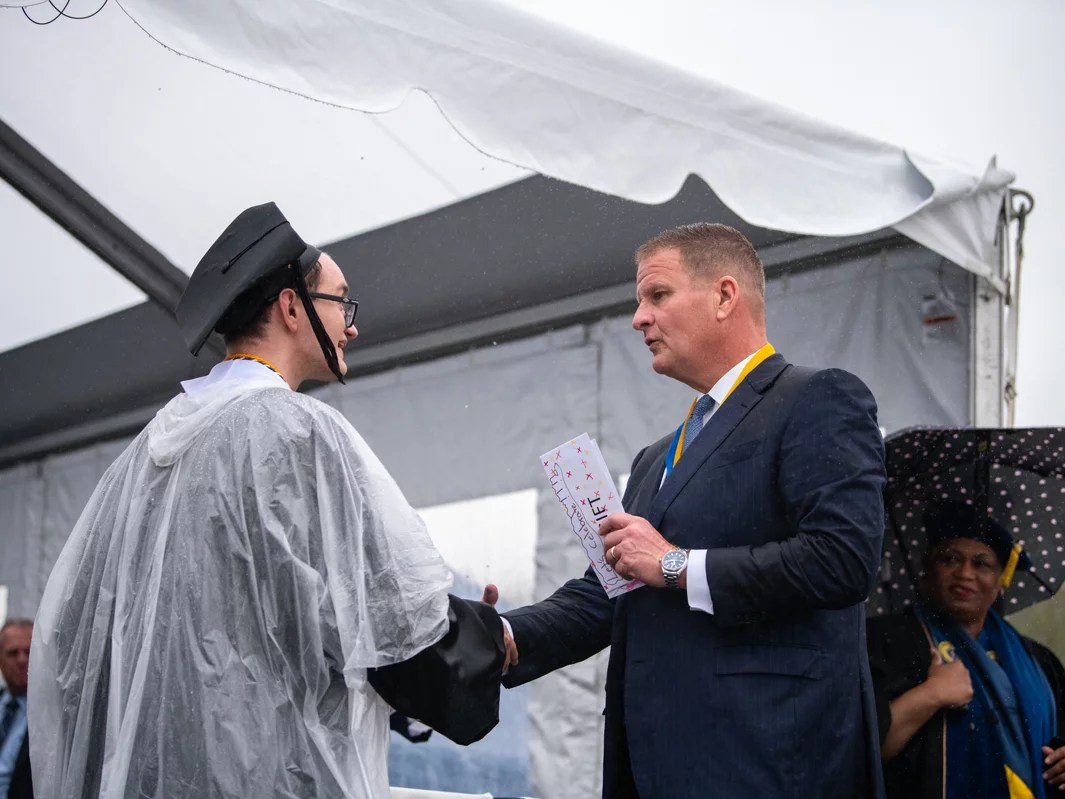
Photo: Karl Christoff Dominey/University of Massachusetts Dartmouth via NPR.
Robert Hale gives an envelope with cash to a graduating UMass Dartmouth student at commencement. Each of the 1,200 graduates received $1,000 onstage, half to keep and half to donate.

Here’s a story from the most recent graduation season: a speaker who gave graduates the inspiration and also the means to start being productive members of society right away.

Jenna Russell reported at the New York Times in May, “Until the final minutes of their commencement ceremony last Thursday, the 1,200 graduates of the University of Massachusetts Dartmouth thought they knew what they would remember most about it: the supremely bad weather during the outdoor ceremony, where they sat drenched and shivering in a torrential rainstorm.

“Then, as they prepared to collect their diplomas, their commencement speaker, Rob Hale, a billionaire philanthropist from Boston, returned to the dripping podium. He brought along two cash-stuffed duffel bags, he announced, and would hand every graduate $1,000 as they crossed the stage — $500 to keep for themselves, and $500 to give to any good cause. …

“Hale, the co-founder and chief executive of Granite Telecommunications … told the graduates at UMass Dartmouth he has never forgotten the experience of losing everything, when the first company he built went bankrupt in the dot-com crash more than 20 years ago.

” ‘Honestly, have you guys ever met someone who lost a billion dollars before?’ Mr. Hale, a part owner of the Boston Celtics, asked in his speech, which he cut short because of the rain.

“Since that disaster, he said in an interview this week, he and his wife have found deep joy and satisfaction in giving their money away. In granting college students a chance to experience the same feeling, he said he hoped to light a spark that they will carry with them — even if he had no guarantee that they will honor his request. …

“ ‘If they get to feel that joy themselves, then maybe it becomes something they want to do again, and make part of their own lives,’ Mr. Hale, 57, said.

‘In America and the world, these are times of turmoil, and the more we help each other, the better off we’ll be.’

“In the week since a businessman they had never met handed them two damp envelopes onstage — one labeled ‘GIFT and the other ‘GIVE’ — the new graduates have packed up dorm rooms, fine-tuned résumés and snapped last campus selfies. They have also pondered where to send what for most will be the largest charitable gift they have ever had the chance to give.

“Tony da Costa, a graphic design major who graduated with high honors, considered giving his $500 to a charitable organization but decided instead to hand it over to an acquaintance of his mother, someone he has never met, who is suffering from an illness and struggling to pay bills. …

“Kamryn Kobel, an English major, gave her $500 to the Y.W.C.A. in Worcester, Mass., where she learned to swim as a child, to support its programs for young women and survivors of violence. Her donation felt like something to be proud of, she said — once it sank in that the envelopes she tucked under her rain poncho contained exactly what Mr. Hale had promised. …

“UMass Dartmouth enrolls about 5,500 undergraduates, more than half of them first-generation college students. Eighty percent come from Massachusetts; 80 percent receive financial aid. It is the fourth Massachusetts college campus in the last four years where Mr. Hale has thrilled graduates with his signature split gift. Each time, he has selected a public school with high concentrations of first-generation and lower-income students who have ‘worked their tails off to get there,’ he said. …

“In an interview … he briefly grew emotional describing how one of the UMass Dartmouth graduates had given her $500 to a local group that provides holiday gifts for children in need — a program that had helped her family when she was a child.

“ ‘Seeing things like that is very cool,’ he said.”

More at the Times, here. There’s a story on this at NPR, too, where there’s no paywall.
Read Full Post »

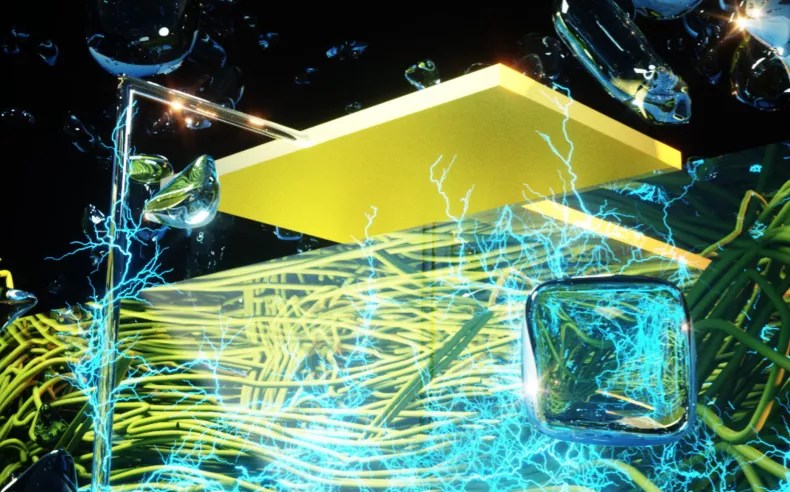
Photo: Derek Lovley/Ella Maru Studio/UMass Amherst via Newsweek.
Scientists have figured out how to use nanopores to make electricity from thin air. These 100nm pores harvest electricity from water molecules in the air.

Scientists, thank goodness, are still doing science, despite recent hostility. At the Washington Post, Dan Rosenzweig-Ziff has a cool story on scientific methods being used to unlock the green energy hidden around us.

“Nearly any material can be used to turn the energy in air humidity into electricity, scientists found in a discovery that could lead to continuously producing clean energy with little pollution.

“The research, published in a paper in Advanced Materials, builds on 2020 work that first showed energy could be pulled from the moisture in the air using material harvested from bacteria. The new study shows nearly any material, such as wood or silicon, can be used, as long as it can be smashed into small particles and remade with microscopic pores. But there are many questions about how to scale the product. …

“ ‘It’s like a small-scale, man-made cloud,’ said Jun Yao, a professor of engineering at the University of Massachusetts at Amherst and the senior author of the study. ‘This is really a very easily accessible, enormous source of continuous clean electricity.’ …

“That could include a forest, while hiking on a mountain, in a desert, in a rural village or on the road.

“The air-powered generator, known as an ‘Air-gen,’ would offer continuous clean electricity because it uses the energy from humidity, which is always present, rather than depending on the sun or wind. Unlike solar panels or wind turbines, which need specific environments to thrive, Air-gens could conceivably go anywhere, Yao said.

“Less humidity, though, would mean less energy could be harvested, he added. Winters, with drier air, would produce less energy than summers.

“The device, the size of a fingernail and thinner than a single hair, is dotted with tiny holes known as nanopores. The holes have a diameter smaller than 100 nanometers, or less than a thousandth of the width of a strand of human hair.

“The tiny holes allow the water in the air to pass through in a way that would create a charge imbalance in the upper and lower parts of the device, effectively creating a battery that runs continuously. …

“While one prototype only produces a small amount of energy — almost enough to power a dot of light on a big screen — because of its size, Yao said Air-gens can be stacked on top of each other, potentially with spaces of air in between. Storing the electricity is a separate issue, he added.

“Yao estimated that roughly 1 billion Air-gens, stacked to be roughly the size of a refrigerator, could produce a kilowatt and partly power a home in ideal conditions. The team hopes to lower both the number of devices needed and the space they take up by making the tool more efficient. Doing that could be a challenge.

“The scientists first must work out which material would be most efficient to use in different climates. Eventually, Yao said he hopes to develop a strategy to make the device bigger without blocking the humidity that can be captured. He also wants to figure out how to stack the devices on top of each other effectively and how to engineer the Air-gen so the same size device captures more energy. …

“It could be embedded in wall paint in a home, made at a larger scale in unused space in a city or littered throughout an office’s hard-to-get-to spaces. And because it can use nearly any material, it could extract less from the environment than other renewable forms of energy.”

Well, OK, it needs work. But you know that someone will move this into the practical realm someday. More at the Post, here.

By the way, it is also possible to make drinking water from air. Read about how that is actually happening in Africa, here.

Read Full Post »

I’m hearing more and more these days about “good bacteria,” including in a song by singer-composer Will McMillan on the friendly bacteria we humans carry around.

Now, it seems, bacteria found in soil may help to save amphibians from dangerous fungal epidemics. Public Radio International’s environmental news program, Living on Earth, has the story.

“Around the world, fungal diseases have been killing millions of frogs and bats and snakes. And a newly emerging disease in salamanders in Europe is scaring biologists here, so the US Fish and Wildlife Service has introduced a ban on their import to try to protect amphibians in the US.

“But now scientists see some hope in soil bacteria that get onto the salamanders and frogs and apparently protect them. Doug Woodhams is an assistant professor of biology at UMass Boston, who’s been working with amphibians in Panama – and he explained what his team has found to Living on Earth’s Helen Palmer.

“WOODHAMS: Some of the amphibians have beneficial bacteria that live on their skin and these have antifungal properties.

“PALMER: This is kind of like having good bacteria in your gut, for instance, that stop you from getting sick. … Is there any evidence that  good bacteria actually work against devastating funguses?

“WOODHAMS: Yeah, there’s quite a bit of evidence. Many of the bacteria that we can culture from some amphibian species are able to inhibit the fungus in culture. We also have some population-level data that shows populations that tend to have these antifungal bacteria can persist with Bd in the environment and survive. …

“Bd is the chytrid fungus that’s been spreading around the world and devastating amphibian populations. So salamanders, frogs, toads. Populations that tend to have more of these beneficial bacteria seem to be surviving, and populations that don’t have as many of the individuals that have these bacteria seem to disappear. …

“The next thing we want to try is adding some of these bacteria, not just to petri dishes, but to soil and see if infected amphibians can be cleared of their infection by being housed on soil that’s been inoculated with these bacteria. …

“There are other fungal pathogens, so it could be something that you could apply in a cave that could reduce White-nosed syndrome [in bats]. Also, rattlesnakes have been recently affected by fungal disease during hibernation, so it could be applied into a rattlesnake den.”

More on the science here.

Photo: Matt Becker
The Appalachian Mountains are home to this Cow Knob Salamander, Plethodon punctatus, from George Washington National Forest, Virginia.


Read Full Post »