Feeds:
Posts
Comments

Posts Tagged ‘vancouver’

Photo: Erika Schultz / The Seattle Times.
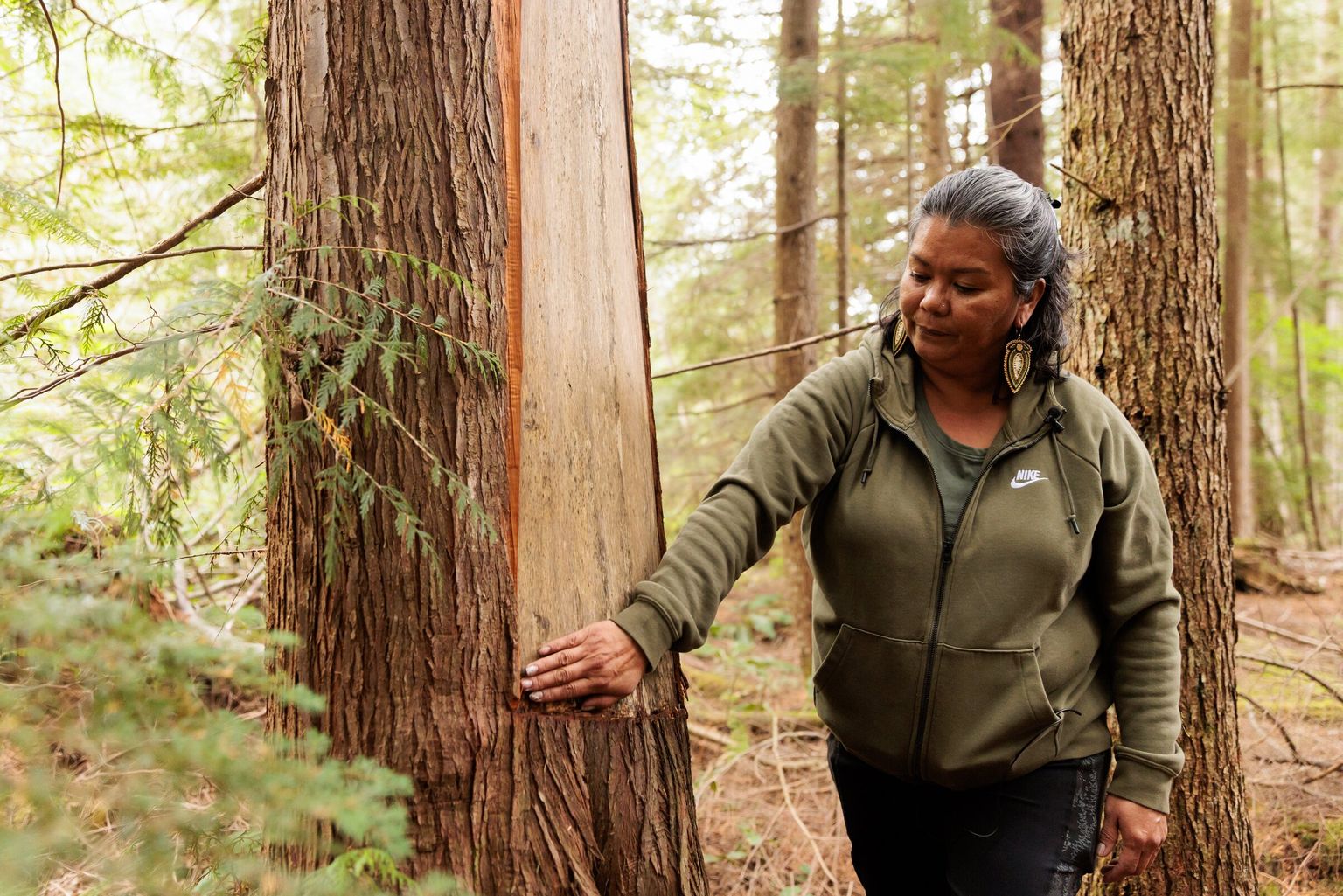
Gail White Eagle, a master cultural traditions specialist and master weaver at Muckleshoot, shows a cedar tree where she has traditionally stripped cedar bark for weaving baskets, hats, and more.

There’s always something more to learn about the generations that inhabited North America before European settlers came. Today’s article explains how indigenous people both used and managed forests, and how some continue to do so today.

Environmental reporter Lynda V. Mapes writes at the Seattle Times, “On a promontory above Puget Sound, a Douglas fir with arms bent at right angles stands above a quiet cove, where shellfish would have been gathered, long before this place was settled by newcomers. This tree was deliberately shaped by generations of hands into its current form, to mark what was here for countless years: rich clam beds, and a gathering site. … Modified trees are a connection interweaving generations of the region’s first people tightly as a cedar basket.

“ ‘It is the sacred fingerprint of the ancestors that shaped this place,’ said Sam Barr, a Samish tribal citizen and tribal historic preservation office supervisor for the Stillaguamish Tribe.

“Another tree, a cedar near the tree on the promontory over the cove, is elaborately trained to grow with branches at 90 degree angles low on its trunk that also were cut and recut so the branches would fork, and then fork again. The result is an elaborate candelabra. This is a marker tree, Barr said, that may have denoted the village that was here — today a housing development. It may also have indicated the direction toward the confluence of the deltas of the Skagit and Stillaguamish rivers that also fork and refork. …

” ‘People don’t think about it much, but we truly are living in an Indigenous garden, from which the gardeners have been forcibly removed,’ Barr said. ‘The entire landscape around the Pacific Northwest was carefully managed and stewarded by Indigenous hands. And there are traces of this everywhere.’

“Trees were stripped for bark for weaving, trees were planked for building materials, trees were made to serve as indicators of everything from trails, to a water source, a rich area for harvest, village or sacred place. …

“Trees are slow growing, and for a marker tree, it takes multiple generations of a family to curate it. … The presence of modified trees all over the landscape today, and continued traditional use of cedar in particular, binds tribes up and down the West Coast. … The Snoqualmie Tribe recently identified — and the state registered as an archaeological site — a modified tree in a lot being cleared for new homes in the Wedgwood neighborhood of Seattle. …

“Gail White Eagle, a Muckleshoot master weaver, said she always looks forward to this moment, as she paused the tribal van at a yellow gate that opens to a forest road in the foothills of Mount Rainier. She was about to enter Tomanamus Forest, 105,000 acres of forest land in King, Pierce and Lewis counties purchased by the Muckleshoot Indian Tribe in 2013. …

“The forest is in part of the territory ceded by the tribe in its treaty with the U.S. in 1855. Taking the forest back into tribal ownership was an act of healing, White Eagle said. Every tribal member can request a key to the gate, unlike at other forests that used to be theirs, now owned by other governments, corporations and individuals.

“A soft misty rain was falling as she walked into the forest, looking for trees from which she had harvested bark the previous spring. … She explained the harvesting process, which always begins with asking permission before taking anything.

She gives an explanation to the tree that its bark will be put to good use. And she often leaves a gift at the tree’s base, such as a bit of tobacco, sage or smoked fish.

“It’s a gesture of thanks and reciprocity in the relationship she holds with this tree, and this forest.

“White Eagle put her hand gently on the healing bark scar, and explained she is careful never to take a piece wider than two hands’ length. She chooses trees only big and robust enough for her to hug. And she pulls bark only in spring, when trees are full of sap, making the harvest easier on her and the tree. A tree can be harvested multiple times over many generations of users, if the harvest is done correctly.

“Tree wounds that penetrate bark damage the cambium layer, vascular tissue that is vital to movement of water and nutrients in a tree. The tree will seal and close the wound, compartmentalizing it with healing lobes to cover it and prevent rot. As long as a tree is not girdled — cut entirely around its circumference, severing all the vascular tissue — it will continue to live.

“Sometimes modified trees are recorded by tribes and government land managers as archaeological sites. But much more often, these trees are known only to the families that use them.

“Jacob Earnshaw is an independent archaeologist based in Victoria, B.C., who works to find and register modified trees as archaeological sites. His work has been entered as evidence in a right and title case in B.C. with the Nuchatlaht First Nation, who are working to prove their long presence on the northern half of Nootka Island on the northwest coast of Vancouver Island, to regain control of lands they never ceded. That case has not yet been resolved.

“Earnshaw has documented more than 1,000 years of cutting and pulling bark for harvest on Vancouver Island. The trees show management of these forests, Earnshaw said, by the island’s first people to protect what was an exhaustible resource. ‘What we are looking at is woodland management by these people who were thought of as hunter-gatherers,’ he said.

“That term is a myth, says Chelsey Geralda Armstrong, assistant professor in the Department of Indigenous Studies and School of Resource and Environmental Management Studies at Simon Fraser University in Burnaby, B.C. The first people didn’t just pick up what they needed here and there; they managed and cultivated their land and waters just as they do today — and evidence of their ancestors’ practices persists in the landscape.

“Armstrong teamed up with Earnshaw and other researchers to publish a 2022 paper that described forest gardens on Vancouver Island with still-evident remnants of cultivation, transplanting and all the other usual horticultural arts. The gardens were just part of the associated archaeological evidence of long prior use, including clam gardens, village sites, shell middens and trees in the nearby forest bearing scars of harvest for bark and other needs.

“Their work shows that far from an unpeopled wilderness, the Northwest Pacific Coast was a managed and stewarded place for thousands of years.” More at the Seattle Times, here.
Read Full Post »

Image: Revery Architecture/Westbank/Squamish First Nation.
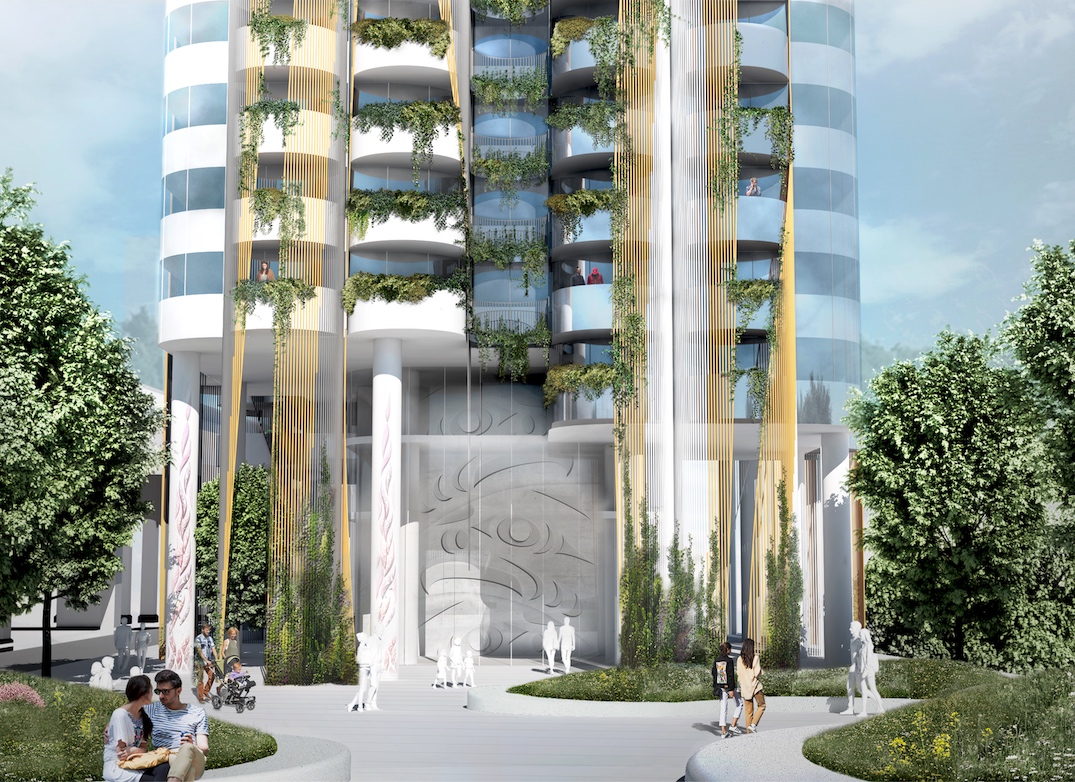
2021 artistic rendering of Senakw. The Squamish First Nation has set a goal of housing every member within a generation.

Just before the pandemic, I read at the Guardian about an indigenous-led development for Vancouver, Canada. And yes, it’s still going forward. The market-rate aspect of the development is supposed to fund the parts that benefit the First Nation providing the land. I found a more recent story from the Daily Hive.

Kenneth Chan reports, “By the end of this year, site preparation for construction could begin on the Senakw development. … Squamish First Nation members overwhelmingly voted to approve the massive development on their 12-acre Kitsilano reserve in late 2019. Thus allowing band leaders to seal the partnership with local developer Westbank and continue their work with refining the design concept.

“In an interview with Daily Hive Urbanized, Khelsilem, a spokesperson and councillor of the First Nation, said the heights of several buildings have been increased, including the tallest tower, now up from 56 storeys to 59 storeys at 172 metres (564 ft). … The first of four construction phases will target the westernmost parcel of the reserve — a narrow strip of land between the bridge and Vanier Park. …

“He said, ‘Some of the motifs of the building have been refined to incorporate Squamish culture and identity, and there is starting to be a bit more imagining of where the public gathering spaces will be.’

“The ground plain commercial space component of the project has changed too, with open public courtyards sunken into the landscape, activated by retail, restaurants, cafes, and potentially grocery stores and fitness centres.

“It also takes advantage of the space under the Burrard Street Bridge, using the structure as a cover for an ‘outdoor restaurant,’ gathering areas, a playground, and basketball courts.

“The residential component of the project still carries a total of 6,000 units, possibly enough to house as many as 9,000 people. …

“The housing tenure composition has not been finalized, but Khelsilem maintains purpose-built market rental housing will likely account for at least 70% of the homes. The below-market rental housing component dedicated to Squamish members has grown slightly to roughly 300 units. …

“The First Nation has set a goal of housing every member within a generation, defined as in 25 years. More than half of its 4,000 members live on reserve, and over 1,000 are on the housing waitlist, with the most recent housing allocations offered to members who have been waiting for over three decades.

“Senakw’s non-market housing component for members will help achieve some of this broader goal directly. The real win is that the revenue generated by the market housing will provide the First Nation with the capacity to pursue greater self-determination. It will greatly enhance their ability to provide current members and future generations with more services, such as eldercare, education, and language and culture support. It would also help fund more member housing initiatives beyond this reserve. …

“Khelsilem adds many members have also expressed excitement about the trades training and employment opportunities that will be offered by the construction project.

“ ‘It is important for the public to understand that this is an economic development venture, it is not an affordable housing project. It is an economic development venture so that we can generate significant amounts of revenue to be invested into our community because we’ve been without the means to do it otherwise,’ said Khelsilem. …

“The infusion of thousands of market rental homes at Senakw will serve to improve overall housing affordability in Metro Vancouver by filling some of the demand from moderate-income households.

“ ‘The reality is new market rental housing is affordable for middle class workers and families in Vancouver, and that’s who this housing will be for,’ he said, adding that strong demand for rental housing has persisted even under COVID-19 conditions.”

More at the Daily Hive, here.

Read Full Post »

I don’t know about you, but I really enjoy the verbal style some indigenous people use when speaking of traditional ways or of ancestors. If it is not disrespectful to say so, it transports me to a place in the imagination where wizards and Hobbits reside — different from my own place in a way that feels both magical and close to Nature.

In Vancouver, Adrienne Matei writes for the Guardian, “On winter nights for the past six years, a group of 20 people have rustled through dark, coniferous woods to emerge on a Canadian beach at the lowest possible tide, illuminated by a correspondingly full moon.

“An elder offers a greeting to the place and a prayer, then the team of researchers, volunteers, and First Nations ‘knowledge holders’ lights a warming fire and begins its work. At sites outlined by stones placed hundreds or even thousands of years ago, some begin raking, or ‘fluffing,’ the top three inches of the beach, loosening rocks and mud — and a remarkable number of old clam shells.

“When the tide comes back in, it will flush out any rotting organic matter, changing ‘some places that are compact and smelly into a good clam beach again.’ says Skye Augustine, a member of the Stz’uminus First Nation.

“This spot was once a clam garden, an ancient indigenous form of mariculture that coastal First Nations people have used for millennia. It is estimated that they once numbered in the thousands along the Pacific north-western coast, though ruins are all that’s left of most. In collaboration with the W̱SÁNEĆ and Hul’q’umi’num nations, Augustine has spearheaded the first formal clam garden rehabilitations at two sites in the Gulf Islands, in British Columbia, with dozens more to follow.

‘My elders articulated to me that if we want to bring our beaches back to life again, we need to bring people back on to them to care for them as they have been cared for in the past.

” ‘That became my inspiration for my education and career,’ she says. ‘How do we make this clam garden thing happen?’

“For millennia pre-colonization, clam gardens epitomized sustainable food security for Pacific north-western coastal nations from northern Washington to south-eastern Alaska. Modern studies have found that clam gardens have historically been up to 300% more productive than unmodified beaches, that their clams grew larger and faster than average, and that the clams did not exhibit any signs of resource stress from over-harvesting.

“To create the beaches, indigenous people built rock walls parallel to a beach’s low tide line, which would trap sediment and flatten the slope of the shore. With continuing tending, such as tilling to improve aeration and the removal of predators like sea stars, these gardens increase or create habitat for butter, littleneck, and horse clams, as well as crabs, chitons, seaweeds, and other useful species.

“Recent carbon dating has revealed that the oldest clam garden known to science was built about 3,500 years ago. …

“ ‘It has always been our duty to be the stewards of the land,’ says group member Nicole Norris, a knowledge holder for the Hul’q’umi’num and an aquaculture specialist. ‘It is the exact same land my ancestors walked. … From the work that we’ve done, we’ve seen the greater ecosystem return – some of the people who live in the local communities have talked about the return of certain birds and plants, and that’s been heartwarming,’ she says.

“In addition to providing food, clam gardens have historically provided the opportunity for ‘grandparents, aunties, and uncles to spend time at the beach with their grandchildren and younger generations, not only teaching about how to tend the environment … but sharing stories, language, spiritual ties to the place,’ says Melissa Poe, who specializes in the social and cultural dimensions of ecosystems at the University of Washington.”

More at the Guardian, here.

Read Full Post »

Jerry and Priscilla’s granddaughter, recently accepted at Stanford, founded a club at her Vancouver high school to collect and distribute food for residents experiencing homelessness.

She feels pretty strongly that, in modern society, the distribution of resources is out of whack, and she wanted to reach out to those who have little. She started with donations from one bakery willing to give her fresh leftover bread at the end of the day.

CBC caught up with Kristen Anderson in the giving season, last Christmas.

“Grade 12 student Kristen Anderson founded ‘Kitchen on a Mission’ in July of 2015.

” ‘I tried at first to go down and hand out sandwiches but realized I couldn’t afford to buy the bread every day for this, so I had to rethink my idea.’

“Anderson was then inspired by an article she read about New York teens collecting leftover restaurant food and feeding the homeless. …

“Anderson and other volunteers from Winston Churchill Secondary set out collecting, not only bread, but Danishes and other baked goods and dropping them off at shelters under the umbrella of the Atira Women’s Resource Society.

“She knocked on more bakery doors and soon enlisted [four more]. Since its early days, the club has grown to five schools and 100 students who collect goods for 10 different shelters. …

“The club members say their volunteer work is satisfying and eye opening.

” ‘I didn’t realize what a community the Downtown Eastside was before going down there each day with my friends. They are such kindhearted people down there. They were giving me advice on my life, to stay in school and listen to my parents. I even had one man play guitar for me, which was really touching because I love to sing.’ ”

Pretty amazing young lady.

Video of the interview here.

img_1960_

Read Full Post »

Planetizen’s Brent Toderian wrote a while back that he attended a book party in Vancouver where Simon Fraser University City Program Director Gordon Price asked “each member of the crowd to state an urban design decision that ‘they loved.’ …

“When it came to my turn, my answer took a big picture and perhaps surprising approach, depending on your definition of urban design. In Vancouver, a city often referred to as ‘a city by design,’ the most important urban design decision we ever made, the decision I loved most, is actually usually referred to as a transportation decision.

“In 1997, the city approved its first influential Transportation Plan.

“It was a game-changer for our city-making model in many ways, most notably in its decision to prioritize the ways we get around, rather than balance them. The active, healthy and green ways of getting around were ranked highest – first walking, our top priority, then biking, and then transit, in that order. The prioritization then went on to goods movement for the purposes of business support and economic development, and lastly, the private vehicle. …

“If you’re a driver who is worried about a ‘war on the car,’ remember this — our model of city building understands the ‘Law of Congestion’ and proves that when you build a multimodal city, it makes getting around better and easier for every mode of transportation, including the car. It makes our city work better in every way.”

Read Toderian’s whole Planetizen post, here.

Photo: Vancouver.ca

Read Full Post »

ArtsJournal.com sent me to this article describing a ballerina posed on the Wall Street bull. The article suggests that one of the many tipping points that led to the Occupy movement was this image of a dancer. I like to think that the arts can spark a movement, although I think the Arab Spring played a bigger role in this case.


“When Vancouver-based Adbusters presented the idea to the world, it did so in the form of a poster that featured a dancer posed on the shoulders of the Wall Street bull statue, a foggy clamour of demonstrators behind her. The poster asked the question, ‘What is our one demand?’ Activist groups seized on it, as did the hacktivist group Anonymous, and a collective began to form. …


“To hear tell from [Vancouver-based] Adbusters founder and editor Kalle Lasn now, the question of that one demand still needs to be answered concisely and directly. But as the movement overspills Wall Street, he describes it as the most successful in the 22 years he and his magazine have been advocating ‘culture jamming.’ ” Read more. The Kalle Lasn interview is at Seattle’s Crosscuts.com  (“news of the the great nearby,” whatever that means).


As intrigued as I am that a ballerina poster could have been a tipping point for a movement, I think the question, “What is our one demand?” is even more intriguing. I would like to spin off from that and ask, “What is the one thing you want (in general, not public policies necessarily)?” Could you name the one thing? I think this is different from making a wish and blowing out candles. But maybe not. I will give it some thought myself.


Read Full Post »

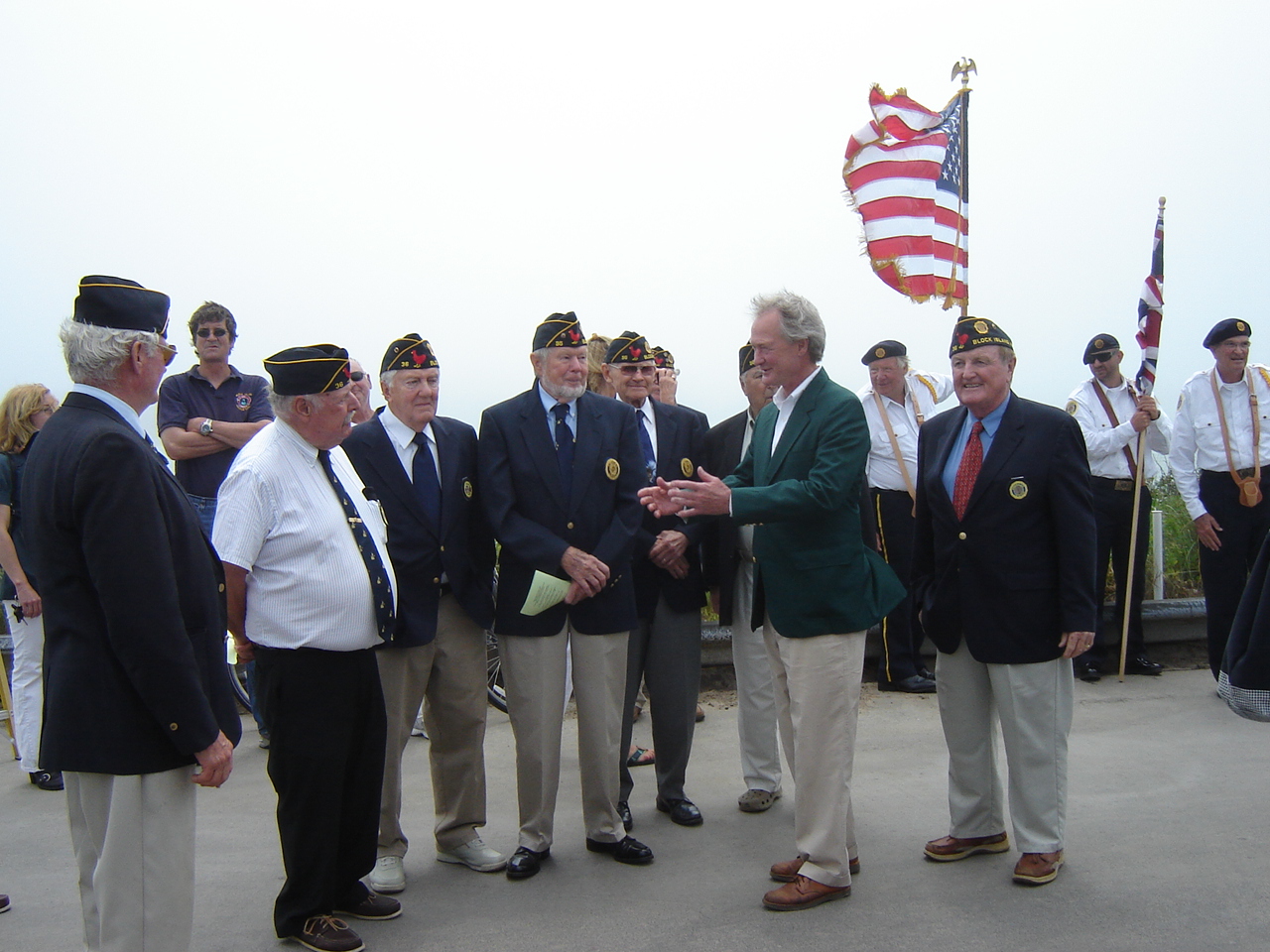
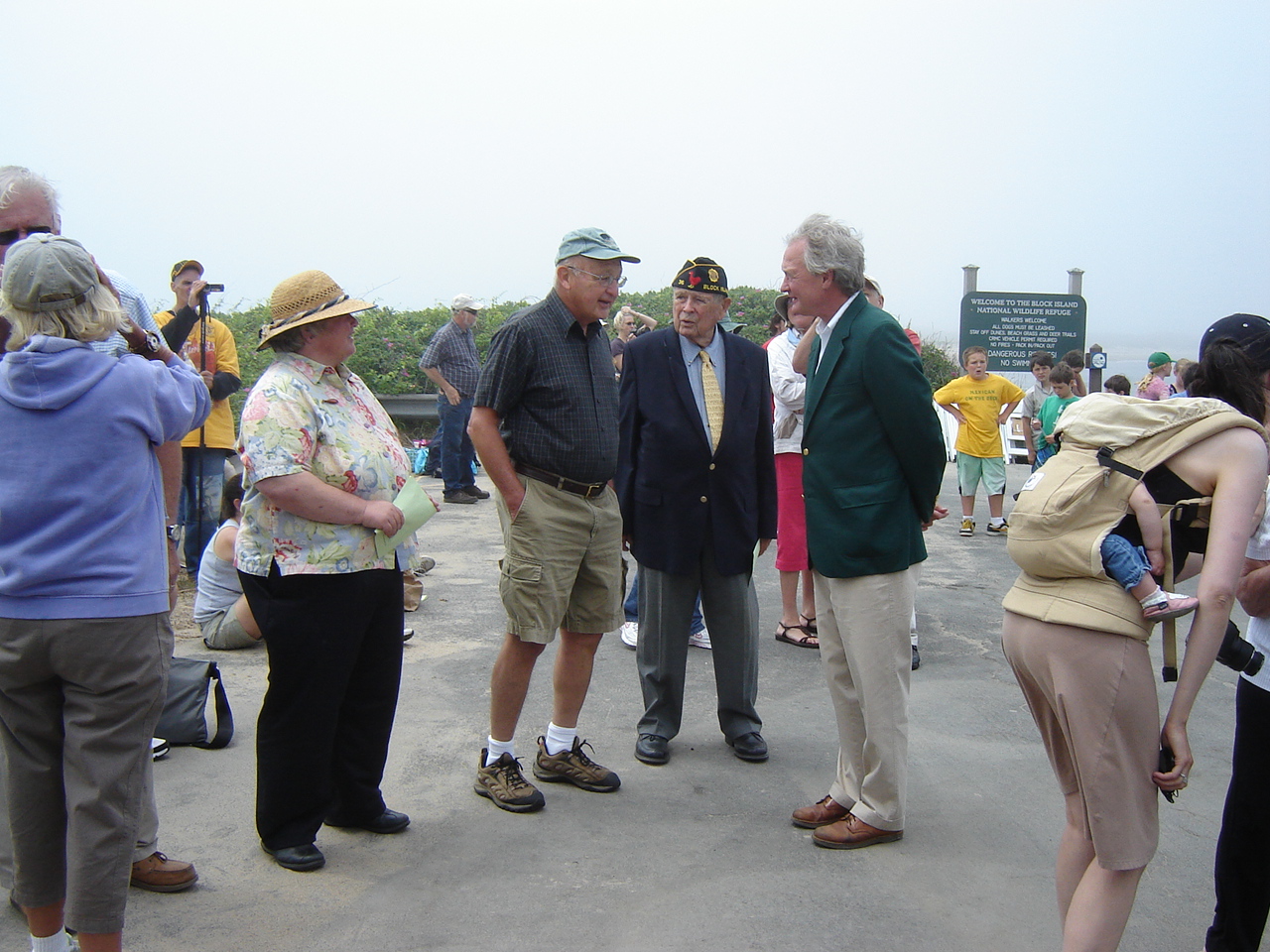
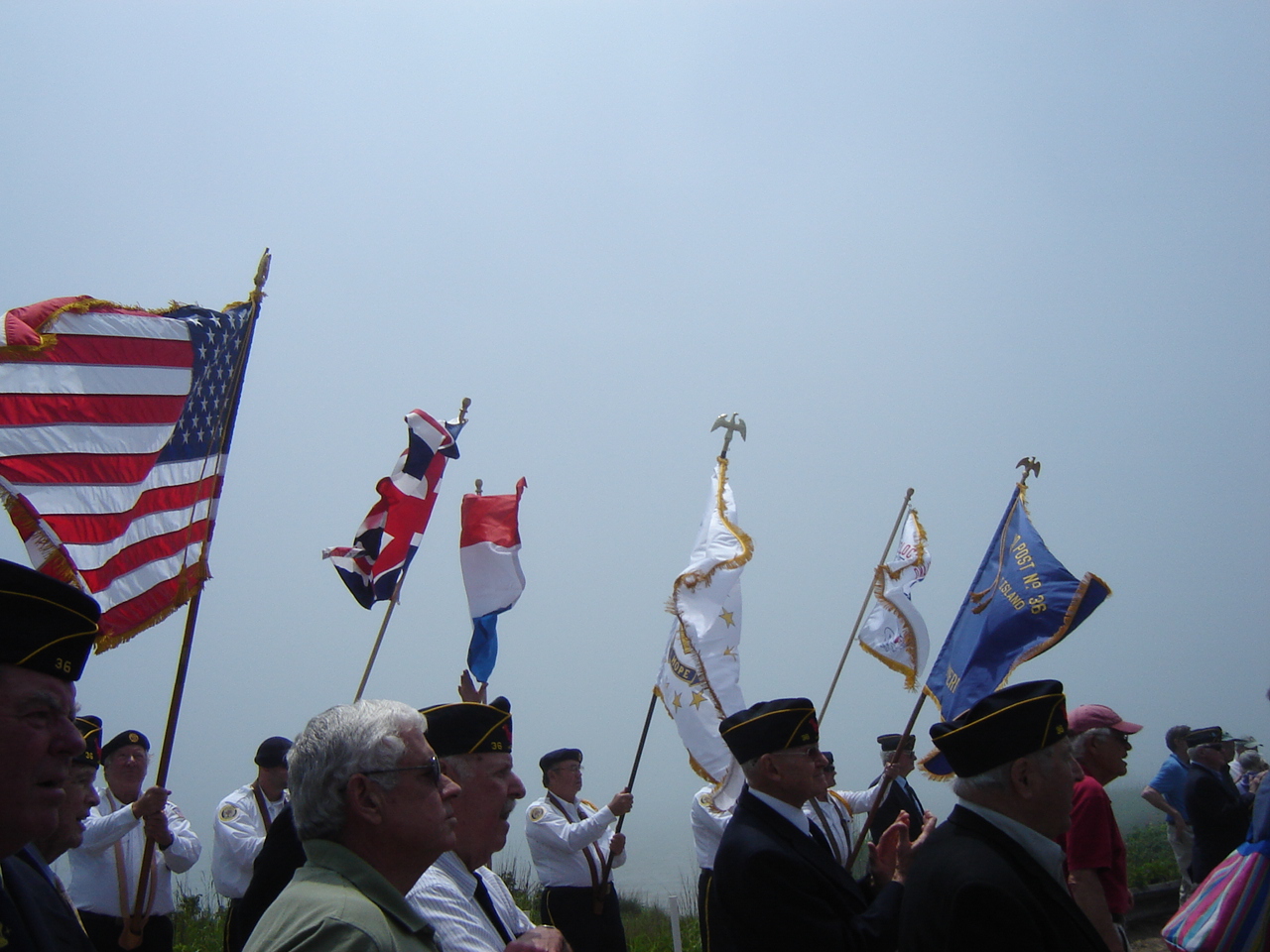
A swell time was had by all at the 350th anniversary of British settlers landing their boats on the shores of what is still the smallest community in the smallest state! The sun shone, the speakers were brief, and lots of pictures were taken.

I thought we had come a long way as a country when several speakers, including the governor, acknowledged that the Manissean Indians were there first and that there would be another ceremony at the Indian Cemetery the following weekend, with another commemorative marker.

The governor, who had earlier visited an oyster aquaculture area by boat, was brief and gracious. Interesting speakers included a Rear Admiral with a surname that is pronounced — I kid you not — Neptune. He gave the chief of police an award for a risky rescue at sea last year.

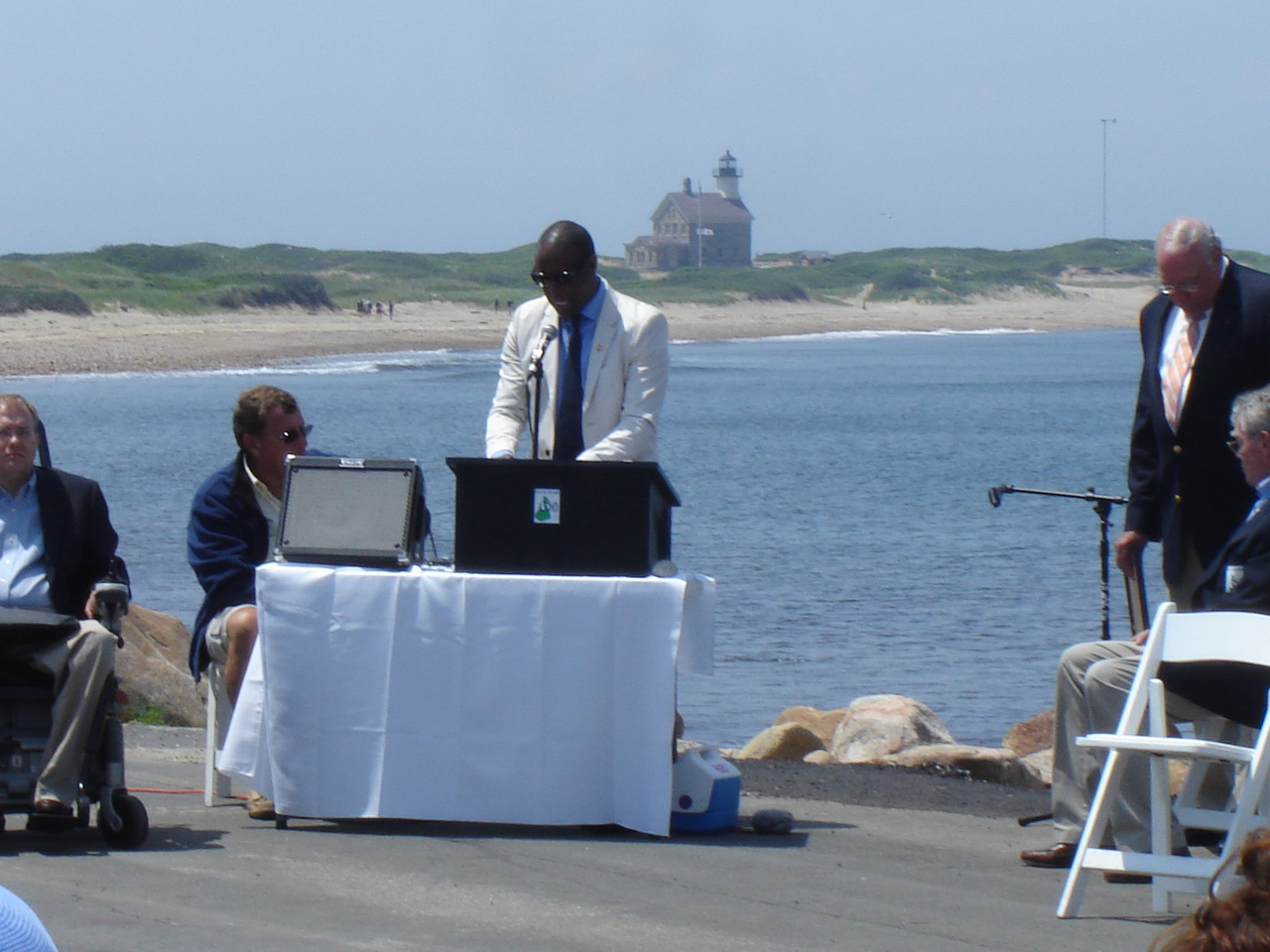
Dutch Consul General Kibbelaar was there because it was a Dutch navigator who originally named the island as he sailed by without landing. British Consul General Budden, based in Boston, made jokes about his brother who is the Consul General in Vancouver and the bet he intended to collect since Boston won hockey’s Stanley Cup. Budden was invited because the British were the ones who landed at Settlers’ Rock 350 years ago. He said that Britain today is the biggest foreign investor in Rhode Island. The chorus of the island school (which had recently graduated all seven seniors) sang the Alma Mater and “America the Beautiful.”

Gov. Lincoln Chafee (in green blazer)

First Warden Kim Gaffett (in straw hat) and governor

Dutch Consul General Kibbelaar (in white suit)

Read Full Post »