Feeds:
Posts
Comments

Posts Tagged ‘venezuela’

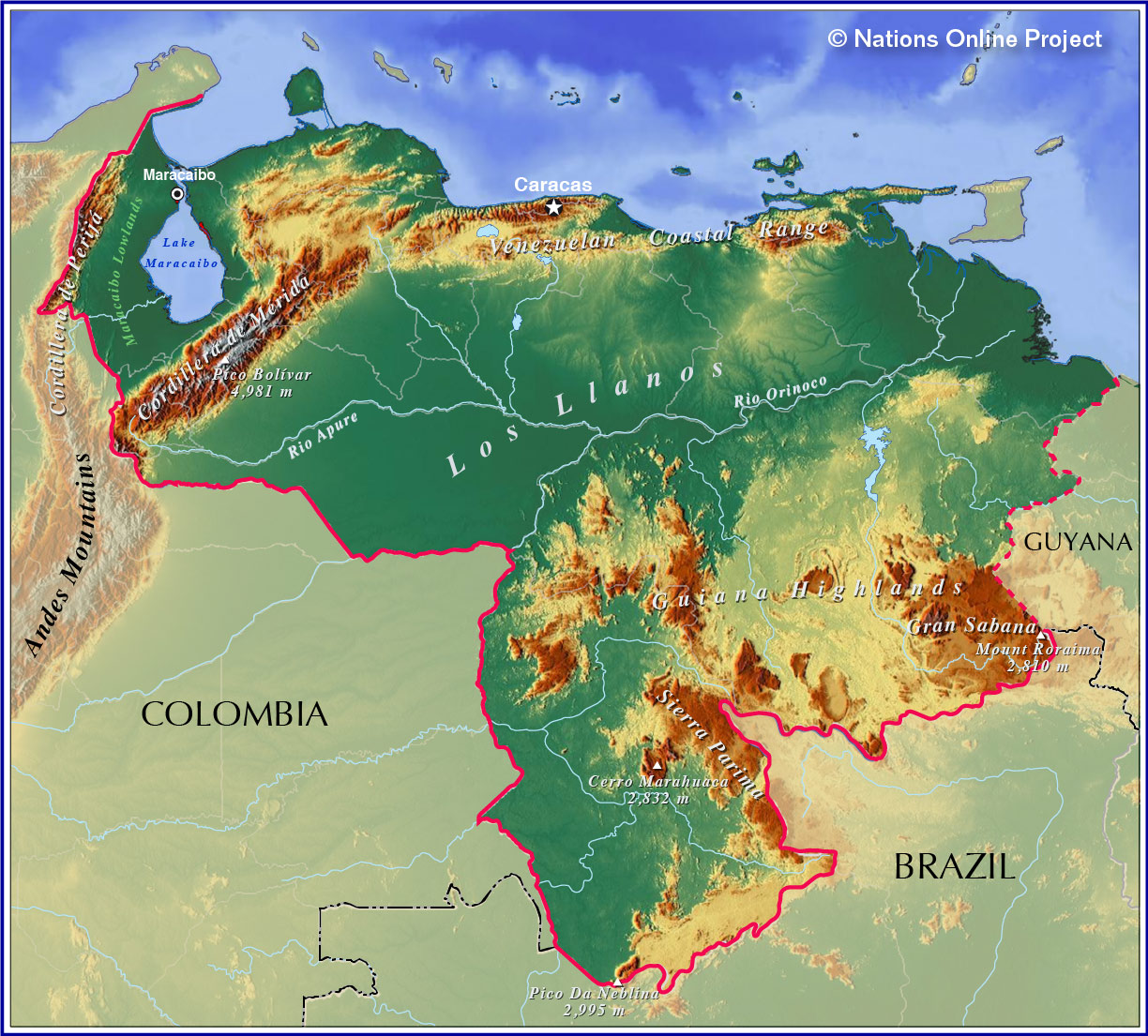
Photo: Nations Online.
Lake Maracaibo in Venezuela (upper left) is subject to oil spills that thousands of volunteers have agreed to treat with their hair.

We all know that to solve big problems we need to get to root causes. But what to do in the meantime? A woman in Venezuela had an idea about a temporary fix for a lake’s constant oil leaks.

At the Washington Post, María Luisa Paúl writes, “For years, Selene Estrach has seen how Venezuela’s crumbling oil industry has taken a toll on Lake Maracaibo, one of the world’s largest and oldest lakes. Once a symbol of the country’s oil wealth, its waters are now coated with iridescent slicks and swirls of neon green algae blooms that can be seen from space.

“The pollution is the product of decaying machinery and ruptures in a network of nearly 16,000 miles of underwater pipelines. Though oil slicks are common in Lake Maracaibo, which contains one of one of the planet’s largest known oil and gas reserves, experts and environmental groups have warned that years of mismanagement and a crippled oil industry have left a constant stream of crude oil oozing into the water.

“Yet little has been done to clean up the lake, which is home to endangered species such as pink river dolphins and manatees. In recent years, officials have downplayed the pollution as ‘a visual matter‘ or ‘not a big deal.’

“That’s why Estrach, a 28-year-old environmental activist, was determined to find a way to help. She founded Proyecto Sirena, a national network of activists dedicated to saving the lake using an unorthodox, yet bountiful, material.

“Hair.

“She got the idea in July while scouring the internet for easy, cost-effective and sustainable solutions for the pollution marring Lake Maracaibo. She saw that Matter of Trust, a San Francisco-based nonprofit, had used human locks 22 years ago to help soak up a spill off the coast of the Galápagos Islands. …

“Estrach told the Washington Post. ‘I thought, “If they’re doing this in … other parts of the world, why can’t we do it in Venezuela?” It’s easy and cheap. Plus, all the hair that’s left over in the salons is going to waste. Why not put it to good use?’

“Since founding Proyecto Sirena — a play on the Spanish words for mermaid and emergency siren, Estrach said her car is constantly filled with bags of donated human and pet hair. Across Venezuela, more volunteers are holding haircut drives that have brought in thousands of people.

“In 1989, Philip McCrory, a hairstylist in Alabama, first designed a hair-filled net to be used after oil spills, which NASA later tested and found effective. Researchers from the University of Technology Sydney found in 2018 that hair is ‘significantly better at absorbing oil than other materials, including cellulose and cotton. …

“Hair was not only used in Ecuador in 2001, but to clean the 2007 Cosco Busan oil spill in California, the 2010 Gulf of Mexico oil spill and, most recently, in this year’s spill in the Philippines.

“Estrach has spent weeks huddled inside a lab at the University of Zulia, where she is a student, trying to replicate how the Matter of Trust nonprofit used hair after past oil spills. The results are promising, she said, with her tests indicating that about two pounds of hair can soak up between 11 and 17 pounds of oil. …

“Estrach’s team is also researching ways to safely discard the oil the devices soak up so they can be reused. ‘It will be our contribution to a growing field of research about this technique,’ she said.

“The first step, however, was getting the hair to make the items. Estrach turned to salons for help. … By October, 600 had signed up to help, which will allow her to collect about seven tons of hair every three months.

“Michele Giurdanella, 46, the CEO of Salvador Hairdressing … ended a 20-year hiatus of not cutting hair to personally help out during a donation drive. Next month, he and about 30 other stylists will give free cuts at Salvador Hairdressing’s headquarters. All the locks from the event will go toward the lake cleanup. …

“Giurdanella said, ‘[The drive] also helps out with our low-income community members who might otherwise not be able to afford getting a haircut. Everyone wins with this.’

“The effort has expanded well beyond Maracaibo. In Caracas, students from the Central University of Venezuela organized another haircut drive this month. They expected 200 people — nearly 1,500 showed up, said Rafael Chavero, a 26-year-old medical student and social activist.

“ ‘We had to promise some that we’d do another drive because we just didn’t have enough volunteer stylists to keep up with the demand,’ he said.

“That day, Chavero said people traveled up to an hour ‘to literally just give us a baggie of hair they collected.’ Others even brought their dogs for a shave and donated the fur.”

When in doubt about the state of humanity, remember that.

More at the Post, here. No firewall at Hindustan Times, here.

Read Full Post »

Photo: Laure Joliet
Important shows are proliferating for 98-year-old artist Luchita Hurtado. “Luchita Hurtado. Dark Years” — was on view at New York’s Hauser & Wirth gallery earlier this year, and more exhibits are scheduled around the world.

In my after-kids career, I had jobs in which my colleagues were nearly always decades younger than me. I didn’t want to tell anyone my age. If the workplace celebrated birthdays, I didn’t want anyone to know when mine was. On Facebook, my date of birth is still visible only to me (and Facebook, alas).

So I loved what this artist who’s getting big shows at 98 had to say about revealing her age.

‘The older I get, the more I want to tell you how old I am,’ the 98-year-old artist Luchita Hurtado says, gesturing toward the paintings in her Los Angeles studio. ‘I’m showing off. Sometimes I feel that I’m really overdoing it.’

Maybe if I get to 98 with all my marbles, I will feel the same.

Anna Furman writes at the New York Times, “On a cloudless afternoon in October, I meet the artist Luchita Hurtado, 98, in her Santa Monica home studio — a sand-colored three-story building a 20-minute walk from the Pacific Ocean. Inside, her riotously colorful paintings — in which genderless figures transform into trees — animate the walls of her compact 145-square-foot studio, interspersed with dried leaves and a framed rare butterfly. …

“She recounts searching for Olmec colossal heads from a two-seater plane above San Lorenzo Tenochtitlán; camping at the Lascaux Cave in southern France before the site closed permanently to the public in 1963; posing for Man Ray, and forging friendships with Frida Kahlo, Isamu Noguchi and Leonora Carrington. …

“Hurtado has recently experienced a rise to fame that has been thrilling to witness — albeit maddening in its lateness. … In her expansive oil paintings, ink-based drawings, fabric collages and patterned garments, Hurtado explores what she sees as the interconnectedness of all beings. Her paintings from the ’70s [represent] women as sacred beings, powerful subjects of their own lives. …

“Born in the seaside town of Maiquetía, Venezuela, in 1920, Hurtado migrated to New York at age 8. At the then-all-girls high school Washington Irving, she studied fine art and developed a keen interest in anti-fascist political movements. [At one point], she supported herself by creating imaginative installations for Lord & Taylor and fashion illustrations for Vogue — at night, she created totemic figure drawings with watercolor and crayon. …

“ ‘Luchita has always had this very fluid identity, which makes her art so 21st century,’ says the curator Hans Ulrich Obrist, who is organizing her retrospective in London. ‘We have to contextualize her clearly with the historic avant-garde, because she is a contemporary of Frida Kahlo, she knew Diego Rivera and was married to Wolfgang Paalen, a key figure of surrealism — and she is a key figure of spiritual surrealism, with a connection to pre-Columbian art, but we cannot lock her in that.’…

“Hurtado possesses the grace of someone who has not spent her life promoting her art, but quietly and diligently producing it — at her kitchen table, in backyards and closets and, at one point, in a stand-alone studio in the Santa Monica Canyon. …

‘I never stopped drawing, looking, living,’ she tells me. ‘It’s all the same thing, all solving your own life. …

” ‘I remember my childhood more and more,’ Hurtado tells me, tucking a tortoiseshell comb into her hair, which she had cut short herself the day before. She shares memories from Venezuela — hiding under fan-shaped leaves, watching crabs scuttle across the beach, devouring mangoes in a cool stream.

“Lately, when she wakes, she sees a vision of a pink ceiling floating above her. I imagine the series of paintings she created in 1975 in which bright-white squares are framed by mesmerizing planes of blue, goldenrod and fiery red — intended to draw moths to an illusory light, they give off a sense of ascension and expansion.

‘I’ve concluded that I’m going somewhere,’ she tells me. ‘It’s not death; it’s a border that we cross. I don’t think I’ll be able to come back and tell you, but if I can, I’ll find a way. If you suddenly see a pink ceiling, that’s me.’

Read her reasons for promoting different husbands’ work, never her own, at the New York Times, here.

Read Full Post »

I’ve been meaning to blog about the wildly successful music-education program out of Venezuela, El Sistema.

Here music critic Mark Swed follows the L.A. Philharmonic to Caracas and writes about El Sistema for the Los Angeles Times.

“Musically, Venezuela is like no other place on Earth. Along with baseball and beauty pageants, classical music is one of the country’s greatest passions.

“In the capital, Caracas, superstar Venezuelan conductor Gustavo Dudamel is mobbed wherever he goes. Classical music teeny-boppers run up to him for autographs when he walks off the podium at concerts. The state-run music education program, which is known as El Sistema and from which Dudamel emerged, is the most extensive, admired and increasingly imitated in the world. One of its nearly 300 music schools for children, or núcleos, is deep in the Venezuelan Amazon, reachable only by boat. …

“The basic tenet of José Antonio Abreu, the revered founder of El Sistema, is the universal aspect of music. He likes to say that music is a human right. That’s an effective, politically expedient slogan. But what he has demonstrated on a greater scale than ever before is that music is not so much a right as a given. El Sistema is not about talent, ingeniously effective system though it may be for discovering and fostering musical talent. The truly revolutionary aspect of El Sistema is its proof that everyone has a capacity for music.”

Read about how El Sistema has spread worldwide in the Los Angeles Times.

Children at La Rinconada in Caracas, Venezuela, Feb. 14, 2012. Gustavo Dudamel, right, among students at a showcase of El Sistema in Caracas, Venezuela, Feb. 15. Photograph: Mark Swed / Los Angeles Times

Read Full Post »

Who wouldn’t love this story? Remember the mime Marcel Marceau? Now try to picture him directing traffic in a crazy intersection.

According to an article in the Canadian Press, by Christopher Toothaker (really his name), “Caracas, Venezuela, is placing over a hundred mimes on its busy streets to admonish reckless drivers and pedestrians. The mimes, dressed in clown-like outfits and wearing white gloves, may frown and gesticulate the command of ‘stop’ to motorcyclists roaring towards crosswalks or wag their fingers at jaywalking pedestrians. Although some reprimanded motorists have predictably hurled insults, mimes have reported that most people have reacted agreeably. Caracas is following the example set by Bogota, Columbia, which has successfully used mimes in a broader effort to increase commuter civility.”

Let’s bring back the Works Progress Administration and employ people as mimes. I can think of lots of intersections that need them, mostly in Boston. (But learning to be a mime is probably not as easy as it seems.)

****

With the increase in vehicle crimes
Caracas has turned to some mimes.
They’ve slowed down the speeding,
Which no one was needing,
And inspired these few awkward rhymes.

Your turn. (If you use the French pronunciation, “meem,” that opens a whole other slate of rhyming options.)

P.S. Isn’t there a literary character — probably in Dickens — who keeps “dropping into poetry”?

Read Full Post »