Feeds:
Posts
Comments

Posts Tagged ‘welcome’

Photo: Debra Brehmer/Hyperallergic.
Installation view of Nordic Utopia? African Americans in the 20th Century at the Chazen Museum of Art in Madison, Wisconsin, showing the suitcase owned by classical pianist Eugene Haynes.

Looks like there was a good show last fall in Madison, Wisconsin, at the Chazen Museum of Art. Since it’s come and gone, I won’t be able to see it, but I was interested to learn about it from Debra Brehmer at Hyperallergic. I hadn’t known about the warm welcome that Nordic countries gave to African American artists in the last century.

Brehmer wrote, “An old suitcase with a small leather handle summons the presence of the person who once carried it across oceans and nations. Surrounding it in a display case are a pair of shoes, gloves, a hat, and a Bible, all owned by the Julliard-trained Black classical pianist Eugene Haynes. The suitcase symbolizes the flight of Black artists to European countries during the civil rights era and beyond. Although Paris was a well-known hotbed of artistic expats, Nordic Utopia? African Americans in the 20th Century at the Chazen Museum of Art zeroes in on a far less charted corner of Black history: the artists who ventured north.

“Haynes spent summers and winters in Denmark from 1952 to 1962 while he performed across Europe. … Even the most accomplished Black artists found the Jim Crow conditions untenable — the US wasn’t only segregated, it was dangerous. 

“At this time, the Nordic countries of Sweden, Norway, Finland, and Denmark held the promise of racial equality, despite primarily White populations. And slowly, word spread. While many Black artists found solace in the Parisian avant-garde (Josephine Baker, James Baldwin, and Langston Hughes, among others), the Nordic regions, according to poet Gregory Pardlo, quoted in the exhibition catalog, were ‘hipper … for black intellectuals escaping the stifling air pollution of American racism.’ 

“One could get lost in the details of this research-heavy presentation, but an overall theme emerges: the need to get away, not just from an inhospitable place, but from the weight of always being defined by race. Distance from US discriminatory politics gave these artists room to experiment, to make art that wasn’t about being Black or the entrenched problems of their homeland. After he ventured to Scandinavia, the artist William H. Johnson painted van Gogh-influenced portraits, expressionistic sunrises, street scenes, and boats in a harbor. He had married Danish textile artist Holcha Krake. When he returned to the US in 1938, his art underwent a major stylistic shift as he produced folk art-influenced paintings that centered on Black life in Harlem and portraits of Black global activists, for which he is best recognized. …

“Harlem-born painter Herbert Gentry, who first spent five postwar years in Paris and then moved to Copenhagen and later Stockholm, chose cities with thriving jazz scenes as well as international art communities. Gentry often made abstract paintings on unstretched canvas that he could fold into suitcases for easy transport. Ronald Burns, who relocated to Denmark in 1965, pursued a Surrealist style of complex dreamlike compositions. Howard Smith, an artist and designer who arrived in Finland in 1962, worked across media with paper-cutting, laser-cut steel forms, porcelain sculpture, and collage. …

“Being in Europe, most of the artists absorbed the prevalent modernist influences, seeing themselves as part of a broader and more open public consciousness, an environment particularly supportive of Black swing and jazz musicians. … A brilliant documentary, Dancing Prophet (1971), shows dancer/choreographer Doug Crutchfield back home in Cincinnati in earnest conversation with his Baptist minister father about why he needs to leave the USA to pursue his dancing career.

To its credit, the exhibition does not offer simple conclusions.

“Instead it provides multiple perspectives on issues of expatriation, including the fact that racism also existed overseas. … Dexter Gordon expresses one attitude, quoted in wall text: ‘Since I’ve been over here, I felt that I could breathe, you know, and just be more or less a human being, without being white or black, green or yellow, whatever. Actually it’s very seldom that I’m conscious of color here in Europe.’ Artist Howard Smith, who lived in Finland for 14 years, suggests a different condition: ‘I got lonesome there … I need the spiritual input, I guess, of being around Black people.’ …

“Walter Williams first ventured to Denmark in 1955 on a fellowship. He previously earned recognition for his New York City urban scenes. The new landscapes of Denmark stirred him to paint sun-infused pastoral imagery. ‘Southern Landscape’ (1977–78) portrays a young Black girl in the foreground, standing in a field of blooming sunflowers. A bouquet of flowers sprouts from her shoulders. Butterflies surround her. In the background, another Black girl appears to be picking cotton in a field with a shanty behind her.”

“The exhibition was organized by the National Nordic Museum, Seattle.”

More at Hyperallergic, here. No firewall. Subscriptions encouraged.
Read Full Post »

Photo: Dominique Soguel.
The
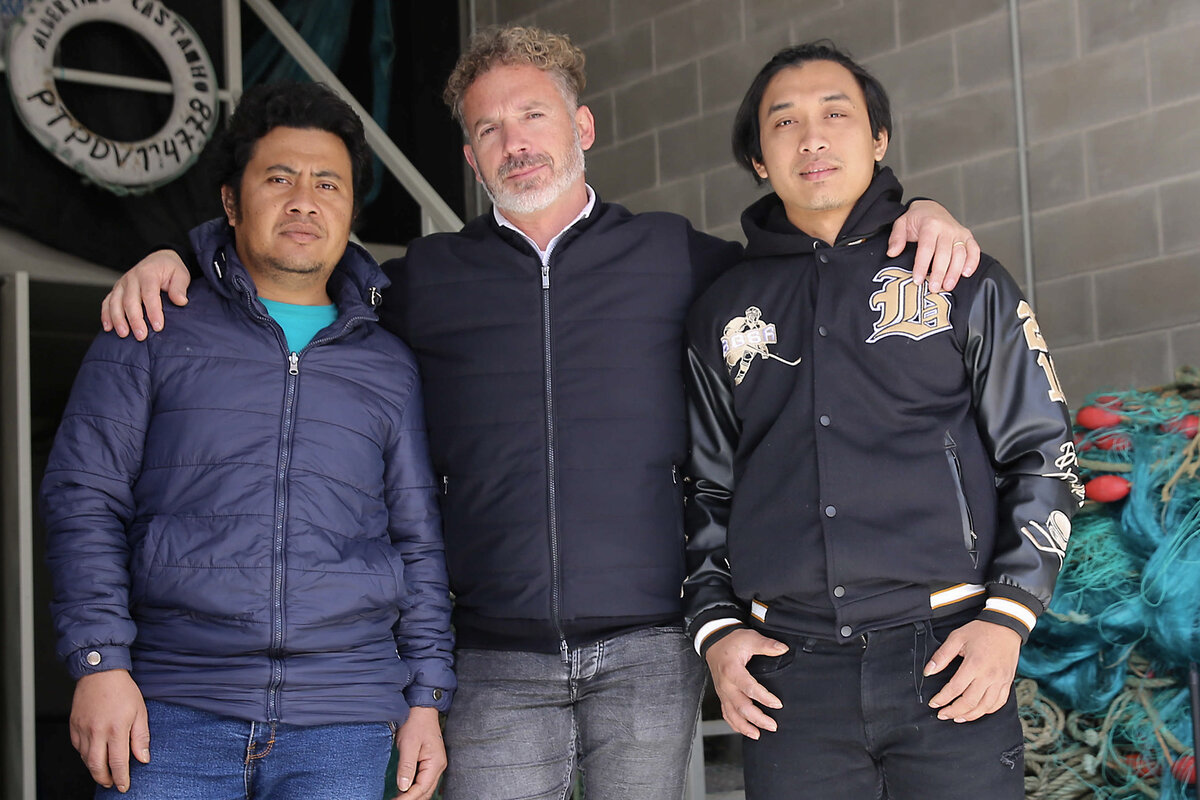
Christian Science Monitor shows a Portuguese fishing vessel captain with two of his Indonesian deckhands, March 8, 2024.

The Christian Science Monitor does a great job of finding stories about humans treating other humans with respect, even kindness. Such stories do exist. Why other media outlets don’t spend much time on them is anybody’s guess. They seem to think that anger is what people want, but why do they think that?

Dominique Soguel writes that many in Portugal are giving a welcome to migrants rejected elsewhere. They know it’s in their mutual interest. A far-right party is trying to change that, but so far harmony, says Soquel, is winning.

“Among the warehouses of one of Portugal’s oldest ports, conversations are flowing among the men sorting their fishing nets. But not without the help of Google Translate.

“The fishers at work include not just Portuguese people but also Indonesians. Thanks to a local ship captain who ventured east to solve labor shortages, Póvoa de Varzim sees a steady supply of deckhands from Indonesia, and now they account for half of all crew mates.

“And while an influx of Muslim migrants into a traditional vocation like fishing is the sort of event that would be potentially inflammatory elsewhere in Europe, in Portugal it seems to be working out without much fuss.

“ ‘The Indonesians are quite well integrated in the community,’ says another ship captain, Manuel Marques. ‘We were never against their culture. We did not ask them to change a single thing. We tried to make things as easy for them as if they were at home.

‘We do need them, and we know it. There is a mutual respect.’ …

“ ‘We also have a place to worship here, like a mosque,’ says Wahono Lucky, an Indonesian fisher. ‘I tell my boss that I don’t eat pork – I eat meat, chicken, rice, pasta, but no pork. Muslim, Christian, it’s never a problem here.’ …

“ ‘We are the only country in the European Union that allows people to come to Portugal without a job,’ notes journalist and professor Paulo Agostinho. ‘We are one of the biggest entry doors for Europe, and we are having problems with Brussels because of that. But Portugal does not have an immigration problem.’

“People from former colony Brazil make up about a third of the migrant population. Citizens of the Community of Portuguese Language Countries are also well represented, benefiting from facilitated residency procedures. In recent years, migration from India, Pakistan, Nepal, and Bangladesh has ticked up.

“Not all of Portugal’s South Asian arrivals are integrating smoothly. In the agricultural fields of Póvoa de Varzim, the sense of harmony that is palpable portside is elusive.

“Lazaro Morgado, a foreman overseeing a quartet of Indians planting seeds, clearly prefers working with a Brazilian, with whom he shares a native tongue. ‘It is complicated for the Portuguese to work with the migrants,’ says Mr. Morgado. ‘Sometimes they don’t know the procedure, and it is hard to explain. And sometimes they don’t obey the Portuguese worker even though at the end of the day, the Portuguese one is the one directly accountable to the boss.’

“Two Indian workers say they paid exorbitant sums – about €14,000 ($15,200) – to visa consultants to get here. ‘Not all Portuguese like migrants,’ notes Hardy Singh, one of the Indian workers, citing experiences of job and housing rejections on account of his ethnicity. ‘But our boss here is good.’

“Back at the port, Mr. Marques wants the Indonesian crews to stay. That’s why he – like other shipowners in the area – houses the workers in apartments scattered across the community and invites them for barbecues. The Indonesian fishers also get minimum-wage contracts and a paid-for trip home for vacation.

“ ‘Some Portuguese don’t make as much as them because they are on contract, while we only get paid if we go to sea,’ laments Tomas Postiga, an older fisher. But he grasps the importance of Indonesian workers to keep the traditional community afloat and prefers them to workers of other nationalities. Religious differences are not a problem. ‘Some are religious. Some are not. It changes nothing,’ stresses Mr. Postiga. …

“For Masrura Rashid, [Portugal’s Moorish quarter] is simply home. She arrived here six months ago, after studying engineering and wandering in the lush tea gardens of Sylhet, Bangladesh. Her father moved to Lisbon first, obtaining the right to family reunification. Now she works at her uncle’s travel agency.

“In a street rich in halal butchers and supermarkets, Ms. Rashid does not especially stand out. Donning traditional Muslim attire that fully covers her face, she is keen to learn Portuguese. ‘It’s easy here,’ she shares. ‘The weather, the environment, the people, it’s all good.’ “

More at the Monitor, here. No paywall. Subscriptions are not expensive.

Read Full Post »

Photo: Guy Peterson/Special to the Christian Science Monitor.
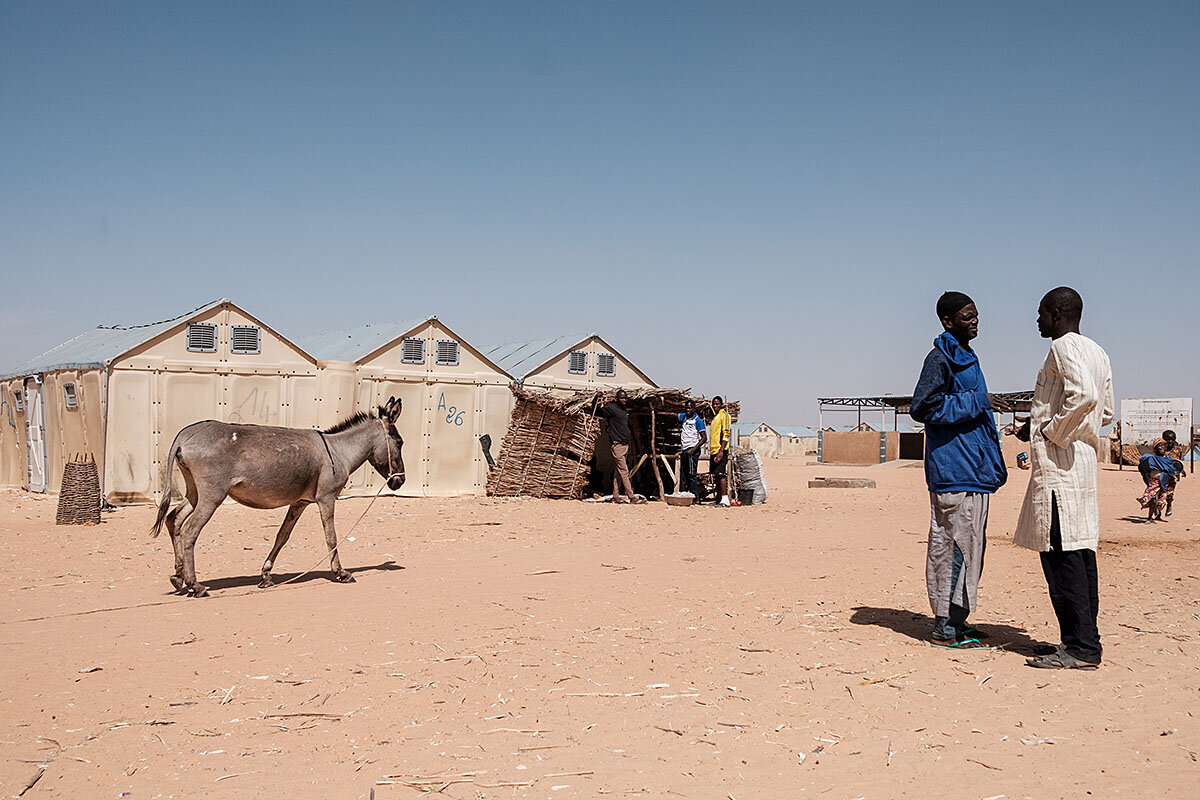
In Niger, the poorest of the poor are protecting refugees on the run.

When I was chatting with blogger Will McMillan after one of his recent concerts, he said he noticed that at my blog, I seemed to seek out stories to cheer people up. I said, “To cheer me up, too.”

A great source for such stories is the internationally focused Christian Science Monitor (CSM). The news site is not unrealistic about the world’s challenges, but it looks for the good people and positive developments it knows are out there.

Here’s a CSM story by Nick Roll set in an impoverished part of Africa.

“Yacouba Aboubacar has an unusual way to measure the welcome he received as a refugee in Niger. 

“His razor blade.

“It takes a certain amount of trust, after all, to let a stranger cut your hair – and a good deal more to allow him to circumcise your baby. But since Mr. Aboubacar fled here from neighboring Nigeria in December, he has found his services as a barber and circumciser constantly in demand.

“Some of that work comes from other refugees, with whom he lives in a sea of white tents huddled on the edge of this small village. But much of it comes from the locals who inhabit the mud-brick houses in town. …

“Mr. Aboubacar is one of some 200,000 Nigerians who have fled rising violence in recent years to seek refuge in neighboring Niger. Chadakori’s population has doubled to 16,000 since 2020 – a refugee intake on a scale almost unimaginable in the West. Yet the response from Chadakori and other villages like it has largely not been one of resentment or rejection. Instead, in one of the world’s poorest countries – beset by its own problems with violent extremism – locals have made visitors feel welcome, even when there is little to share. 

‘Your guest is your god,’ says Laouan Magagi, Niger’s minister of humanitarian action and catastrophe management, reciting a popular local proverb.

“Mr. Magagi, whose grandfather was an immigrant from Nigeria, responds with a firm ‘non‘ when asked if Niger would ever impose a cap on the number of refugees it receives. Despite conflicts in some areas of neighboring Nigeria and Mali stretching back more than a decade, ‘Niger is an open country,’ he says. ‘Niger stands for humanity.’

“Niger and Nigeria have long been deeply interlinked. They share a 1,000-mile border – much of it porous. Trade, languages, and culture straddle this colonial-era divide. Still, Niger is not an obvious place to host refugees, no matter how much they share in common with locals. 

“At $590, Niger’s GDP per capita ranks the 10th lowest in the world. On the United Nations Human Development Index, Niger has long jostled for last place, and now it sits only above Chad and South Sudan. Meanwhile, climate change has made farming in the semiarid country even more unpredictable, and some 3 million people are expected to face hunger in the next six months, according to the nonprofit Save the Children.

“But in welcoming refugees, Niger is not an outlier. About 86% of the world’s refugees live in low- and middle-income countries, and nearly 70% are in a country that neighbors the one they fled from.

“ ‘A lot of people disagreed’ at first, saying ‘we should not accept them,’ says Achirour Arzika, Chadakori’s traditional chief, recalling the day three years ago when a government delegation came to ask the residents if refugees could be resettled here. But he held firm, and others soon warmed to the idea. ‘It could happen to us also,’ he says. ‘So we agreed, and we gave a place where we could host them.’ 

“Besides, he adds matter-of-factly, ‘this is … international law,’ referencing Niger’s adherence to the 1951 United Nations Refugee Convention.

“Conflict between armed groups and the military have also displaced more than 350,000 Nigerians. … In northwest Nigeria, where Mr. Aboubacar is from, criminal groups stage regular armed robberies and kidnappings. It’s a campaign of terror born of poverty, joblessness, poor governance, and fights over the region’s dwindling land. 

“One evening last December, he was sitting outside with friends drinking tea in his village in Sokoto state, near Nigeria’s northern border. … After the attack, Mr. Aboubacar and the rest of his village fled north, over the border. He soon found himself in Chadakori, where ‘we were really received well,’ he says. 

“Integration isn’t always so smooth. Different official languages – French in Niger, English in Nigeria – are used in government as well as education. Refugee students must now make the switch to French, and government forms need translation.

“ ‘It’s a very welcoming country. … It’s just that the resources are very limited,’ says Ilaria Manunza, Niger country director for Save the Children, which runs child protection and other youth services in the country’s refugee camps. And the population of refugees, she notes, is constantly in flux. ‘They tend to go back when the situation is a little bit calmer, and they flee [again] when attacks increase.’ …

“Four years ago, Anas Habibou led a group of about 350 Nigerian refugees trekking through Niger, seeking somewhere to settle. Some villages offered help, but ‘many villages refused,’ says Mr. Habibou. Today, he is the traditional chief for 5,500 Nigerian refugees who have settled next to the town of Dan Daji Makaou, 22 miles away from Chadakori, where they outnumber the local population by a factor of four or five. ‘We are safe here,’ he says. ‘Even before NGOs brought anything, the head of the village and his people contributed personally.’

“Yacouba Saidou, a prominent Dan Dadji Makaou elder, says that other village leaders in the region warned him that trouble stalked refugees. They told him that the violence that caused Nigerians to flee could strike next on their doorstep. But his town’s experience, he says, has been the opposite. Refugees have been a boon to the local economy, working as farm laborers and brick makers, and spending their earnings in local markets. ‘It has turned into something beneficial to us,’ he says.”

More at the Monitor, here. No firewall.

Read Full Post »

Photos: Nichole Sobecki for the New York Times
Samuel Lagu set aside five acres of his land in Mireyi, Uganda, for a rice venture in which South Sudanese refugees and Ugandans work side by side.

Sometimes it’s the poor who do the best job of helping the poor. That is also true of nations. Uganda is no utopia, as those who have been oppressed by the government know firsthand, but it’s doing a better job of helping Sudanese refugees than many richer countries. Officials understand that refugees can build the economy, and individual Ugandans have not forgotten when they were in need and Sudanese people helped them.

Joseph Goldstein writes at the New York Times, “Solomon Osakan has a very different approach in this era of rising xenophobia. From his uncluttered desk in northwest Uganda, he manages one of the largest concentrations of refugees anywhere in the world: more than 400,000 people scattered across his rural district.

“He explained what he does with them: Refugees are allotted some land — enough to build a little house, do a little farming and ‘be self-sufficient,’ said Mr. Osakan, a Ugandan civil servant. Here, he added, the refugees live in settlements, not camps — with no barbed wire, and no guards in sight. …

“In all, Uganda has as many as 1.25 million refugees on its soil, perhaps more, making it one of the most welcoming countries in the world, according to the United Nations.

“And while Uganda’s government has made hosting refugees a core national policy, it works only because of the willingness of rural Ugandans to accept an influx of foreigners on their land and shoulder a big part of the burden.

“Uganda is not doing this without help. About $200 million in humanitarian aid to the country [in 2018] will largely pay to feed and care for the refugees. But they need places to live and small plots to farm, so villages across the nation’s north have agreed to carve up their communally owned land and share it with the refugees, often for many years at a time.

“ ‘Our population was very few and our community agreed to loan the land,’ said Charles Azamuke, 27, of his village’s decision in 2016 to accept refugees from South Sudan, which has been torn apart by civil war. ‘We are happy to have these people. We call them our brothers.’ …

“As the sun began to set one recent afternoon, a group of men on the Ugandan side began to pass around a large plastic bottle of waragi, a home brew. On the South Sudanese side, the men were sober, gathered around a card game.

“On both sides, the men had nothing but tolerant words for one another. … As the men lounged, the women and girls were still at work, preparing dinner, tending children, fetching water and gathering firewood. They explained that disputes did arise, especially as the two groups competed for limited resources like firewood. …

“Recent polls show that Ugandans are more likely than their neighbors in Kenya or Tanzania to support land assistance or the right to work for refugees. Part of the reason is that Ugandans have fled their homes as well, first during the murderous reign of [Idi] Amin, then during the period of retribution after his overthrow, and again during the 1990s and 2000s. …

“Many Ugandans found refuge in what is today South Sudan. Mark Idraku, 57, was a teenager when he fled with his mother to the area. They received two acres of farmland, which helped support them until they returned home six years later.

‘When we were in exile in Sudan, they also helped us,’ Mr. Idraku said. ‘Nobody ever asked for a single coin.’

More at the New York Times, here.

A goat shelter on the land that Ugandans such as Mark Idraku lent to a refugee from Sudan. Queen Chandia, who cares for 22 children, some of whom lost their families in Sudan’s civil war, said the donated land has made all the difference.

Read Full Post »

5ad9bbba3

Photo: UNHCR/Benjamin Loyseau
Primary school teacher Sylviane Zins with a class of refugee children. “They are motivated students who really want to learn,” she says. The tiny village of Thal-Marmoutier, France, has set a welcoming example for all.

There are now an estimated 258 million people living in a country other than their country of birth — an increase of 49% since 2000 — according to figures released by UN DESA on December 18, 2017. Violence and famine are often the reasons migrants try to get their children to someplace safer.

Fortunately, even in countries whose governments are hostile to migrants, some citizens follow their hearts and provide comfort. Others are following religious traditions like Judaism, Christianity, and Islam, which exhort believers to welcome the stranger.

Céline Schmitt and Kamilia Lahrichi filed a report in April from Thal-Marmoutier, France, for the UN Refugee Agency.

“On a winter’s day, a group of refugees newly arrived from Africa walks through the falling snow in a village in eastern France. Some of the 800 residents of the peaceful Alsatian commune of Thal-Marmoutier, moved by their ordeal, gather to welcome them and help them take their first steps towards a new life.

“For the next four months the 56 women, men and children will be hosted by Franciscan nuns in their convent as a French non-profit organization, France Horizon, helps them put down roots. …

“The mayor of Thal-Marmoutier, Jean-Claude Distel, said the operation had gone smoothly. ‘The refugees have appreciated the welcome they received from the residents and, for our part, we are glad we were able to make a small contribution to their resettlement and provide them with all they need to integrate into the life of the nation.’

“Here are the stories of some of those involved.

“Abdel … is the France Horizon official in charge of the refugees’ reception and accommodation in the village. Abdel lives temporarily in the convent. … A clinical psychologist, he is passionate about assisting people in difficult circumstances, including asylum-seekers. ‘Over time, we realize that the people we welcome are people who have experienced atrocities,’ he says.

“When the group arrived in Thal-Marmoutier, Abdel and his team of seven organized activities, such as cooking workshops and yoga classes, with other local government organizations.

“Today, a medical team working with Strasbourg University Hospital provides health checks for the refugees, under Abdel’s supervision. The new residents take it in turns to see the doctor and make sure they are fit and well.

“Abdel works on raising residents’ awareness of the refugees’ circumstances. ‘I am satisfied and proud to welcome and reassure the refugees and the villagers and explain to them that we shouldn’t have prejudices or stigmatize people we don’t know,’ he says.”

Meanwhile, outside the convent’s schoolroom, “The strains of the traditional song ‘Alouette’ can be heard. … The children sit on the floor while the teacher stands in the middle and mouths the words. This class is a springboard to enrollment in a public class.

“ ‘These are just delightful students,’ says the teacher, Sylviane. ‘They are motivated students who really want to learn. They give their all to learn.’ ”

Then there is Nicolas, social and educational coordinator with France Horizon. “No one understands the refugees’ circumstances better than Nicolas, a refugee himself. … He has been a devoted humanitarian since he helped distributed food to Rwandan refugees seeking refuge in his home country, the Democratic Republic of Congo.

‘It gives me great pleasure to help others to make progress,’ he says. ‘That’s what I enjoy most in life.’

“Nicolas fled the DRC because of the instability there and sought political asylum in France, where his brother lives. He became a French citizen in 2009.

“ ‘Leaving Africa and ending up here is like moving from one planet to the other,’ he says. ‘These refugees have never seen snow and have never lived in Europe.’

“Nicolas is studying for a doctorate in education. ‘For refugees like us … training and education is the only way to move forward.’ ”

More.

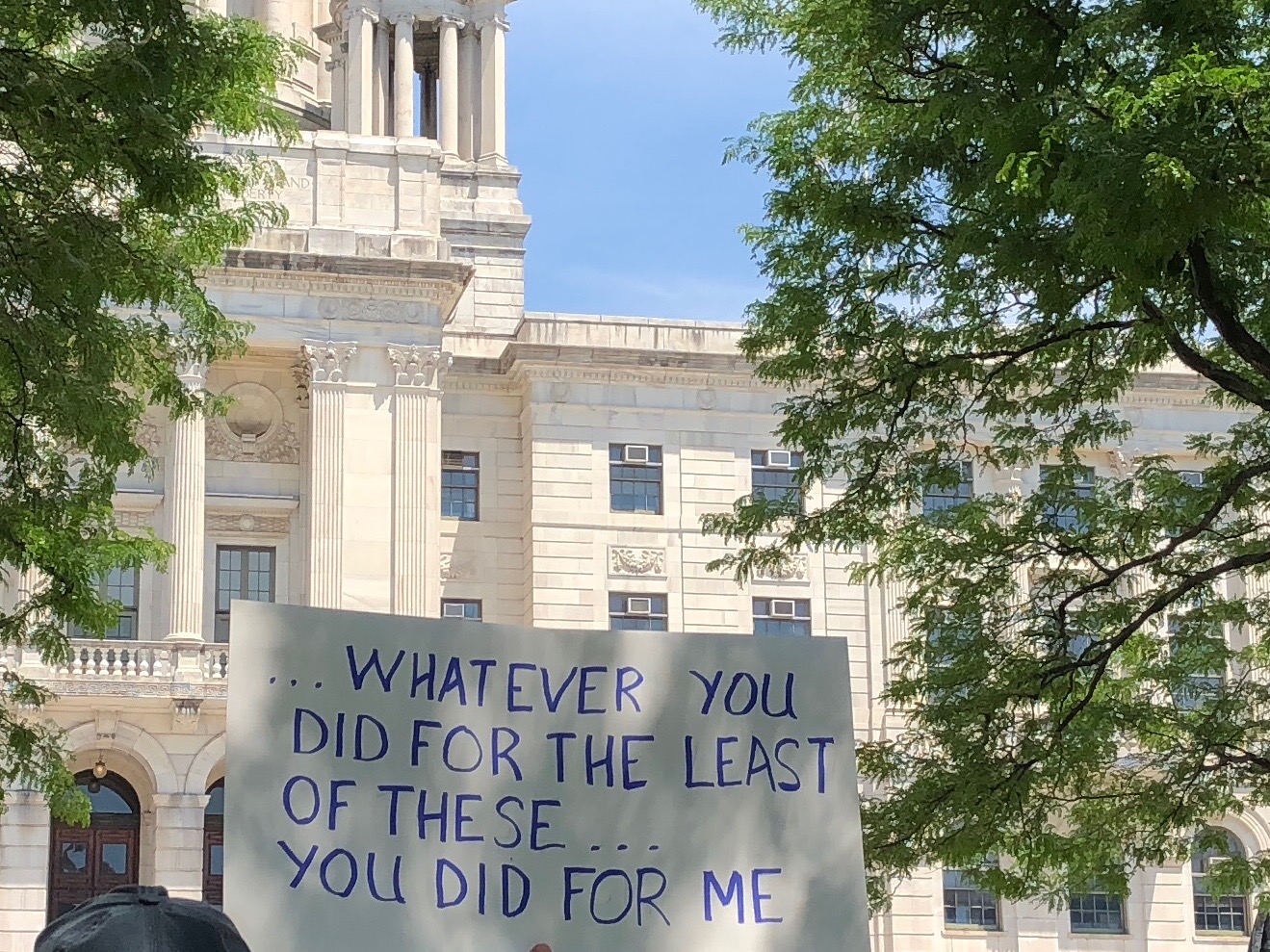
Sign at Families Belong Together rally, June 30, 2018, Rhode Island State House.

063018-the-least-of-these-sign

More here.

Read Full Post »

Photo: Vince Talotta / Toronto Star
Tom McKeon’s flight was diverted to Canada on 9/11. He says the warm welcome he received made him lose his cynicism. The musical
Come From Away recounts that many lives were changed in Canada that day.

The kindness of strangers is the never-ending story that provides reassurance about the world when it’s needed. In this instance, the thousands of people whose airplane flights were diverted to Canada on 9/11, were welcomed by Canadians in a life-changing moment. The musical Come From Away lets audiences experience what those travelers experienced.

Bruce DeMara writes at the Toronto Star, “Beverley Bass was the pilot of an American Airlines plane, the 36th of 38 flights diverted to Gander, Newfoundland, on Sept. 11, 2001. Hers is one of numerous stories dramatized in the hit musical Come From Away.

“Bass had seen the show 97 times. Sunday’s red-carpet premiere at the Royal Alexandra Theatre, with a new, all-Canadian cast was her 98th. ‘Honestly, there are still times when I’ll tear up.’ …

“Many of the 7,000 who unexpectedly landed in Newfoundland that day had their lives altered by the generosity of their hosts, but Come From Away has given a certain celebrity status to those whose stories are told by the musical.

“ ‘I receive messages and emails every day from people all over and now I’ve even gotten involved in school projects because . . . I can’t say no to the kids,’ Bass says. …

“Bass has also become involved in volunteering, including taking part in relief efforts last summer when Hurricane Harvey hit south Texas. …

“Tom McKeon, whose character in the show is a cynical New Yorker named Bob, said he’s pleased with how he’s portrayed. …

“Kevin Tuerff, who owned an environmental marketing company in Austin, Texas, said he decided to ‘pay it forward’ a year later on the anniversary of Sept. 11, 2001, and subsequent ones, giving his employees $100 to go out and perform random acts of kindness. … He has most recently become involved in helping refugees and immigrants.

“Being an American refugee — it’s taken me (many) years to reflect on this — but it’s now opened my eyes to the global refugee crisis. So now I’m personally very heavily involved in advocating through my church in helping immigrants and refugees,’ Tuerff said. …

“Hannah O’Rourke lost her eldest child, Kevin, a Brooklyn firefighter trained in rescue operations, on Sept. 11. His body was recovered almost two weeks later in the rubble of the twin towers.

“But O’Rourke made a friend for life in Beulah Davis, whom she met at the Royal Canadian Legion, where O’Rourke stayed and where Davis still volunteers. Davis is also a character in the show and the two women, who call each other every two weeks or so, have been reunited in Toronto in recent days. …

“The loss of her son has taken a heavy toll, O’Rourke added.

“ ‘I (used to be) more outgoing and full of the devil and that. Ah, there’s not a minute of the day that you don’t think, “now he would be enjoying his children and his grandchildren,” ‘ O’Rourke said.

” ‘But I will never forget Gander.’ ”

More here.

Read Full Post »

Photo: UNHCR/Benjamin Loyseau
“When you see their desire to learn, it gives you a boost of energy,” says Brigitte Dubosclard, who volunteers with refugees.

I can never get enough of stories about people helping people. A good example is seen in this article on a French village welcoming refugees.

Céline Schmitt wrote for the refugee agency UNHCR, “In November 2015, Pessat-Villeneuve, which has a population of 550, opened the doors of the château as a reception and guidance centre for refugees from Calais and Paris. [As of April 2017], it has hosted 136 refugees. …

“[Mayor] Gerard Dubois strongly believes in solidarity, in mutual support, and while it was an easy decision for him to open a reception centre for refugees in Pessat-Villeneuve, he had to persuade residents that it was the right thing to do. It was not as easy task. At a public meeting, organized in November 2015 when the centre was opened, he says he felt like a ‘bull in the ring.’ In the weeks afterwards, he even received death threats, but solidarity was stronger.

“Hatred is noisy,’ he says. ‘Solidarity is quiet, but inspiring and effective.’ …

“Dubois believes that initial fears stemmed from the fact that locals did not know the new arrivals. Any apprehension, he says, disappeared once they had met them. ‘Meeting and getting to know each other changes everything. It’s as simple as that. I don’t call them refugees, but guests.’ …

“Brigitte Dubosclard is a volunteer at the reception centre in Pessat-Villeneuve. A retired teacher, she gives French lessons to the refugees and also runs a clothing store. She was the first to volunteer to help during the public meeting organized by the mayor when the centre opened.

“ ‘When I realized that there was a general feeling of fear, I immediately said that we are here to help, that France is a country that has always welcomed refugees for many years,’ she says. ‘I asked just one question: What do they need?’

“Brigitte opened the clothing store with help from non-profit organizations Secours Populaire Français and Secours Catholique, as well as donations from the public and local shops. …

“Sandrine Menuge has been the head of Pessat-Villeneuve primary school since 2000 and saw the arrival of refugees as an opportunity to talk about diversity with the children in her class. She tasked them to find faces of 100 children throughout the world in 100 days.

“ ‘We searched for photos to see where they come from, what they look like, how they live,’ says Sandrine. …

“One afternoon, she invited two refugees, Mary from Eritrea and Ali from Sudan, to come to the school. The local children asked them about their journey. ‘We looked on the map to see all the countries they had to go through to come to France. They found them very brave.’

“The children also understood why the refugees had to leave their homes. ‘They realized that in some countries, children are afraid that bombs will fall on their heads. It was a wonderful shared moment.’ …

“[Amir, a 27-year-old from Afghanistan,] travelled on foot, by truck and boat, by any means possible, to reach safety.

“ ‘I feel better now,’ he says, from the reception centre in Pessat-Villeneuve. ‘I have accommodation. I have friends. There are good people here. It is important that people understand why we are here. We are refugees. I don’t want to take benefits from the government. I want to start my life for myself.’ ”

More at UNHCR, here. And thanks to my twitter friend Jane for passing this story along.

Read Full Post »

Photo: Isabelle de Pommereau
Anja Reefschläger has taken Ahmad Madarati and other refugees under her wing since they arrived near her Berlin home last year.

The Christian Science Monitor always has great stories about good works around the globe, and this one on ordinary Germans who are volunteering to help refugees get settled is no exception.

Isabelle de Pommereau writes, “ ‘Frau Anja.’ Hearing this name for a Berlin volunteer who teaches refugees German – and has become a second mother to many of them – brings a smile to Ahmad Madarati’s long, sad face.

“Mr. Madarati, who fled war-torn Aleppo, Syria, and Anja Reefschläger met on a freezing November morning last year. …

“Today, Madarati works practically gratis at a youth center in Berlin, helping young people build furniture. And in a few weeks, he is set to move out of the so-called Treskowallee camp into a house. The house is next to Reefschläger’s, and she is the one who persuaded the owner to rent it out to Syrians.”

Ordinary Americans are also showing kindness and warm hearts, even when state government refuses to participate.

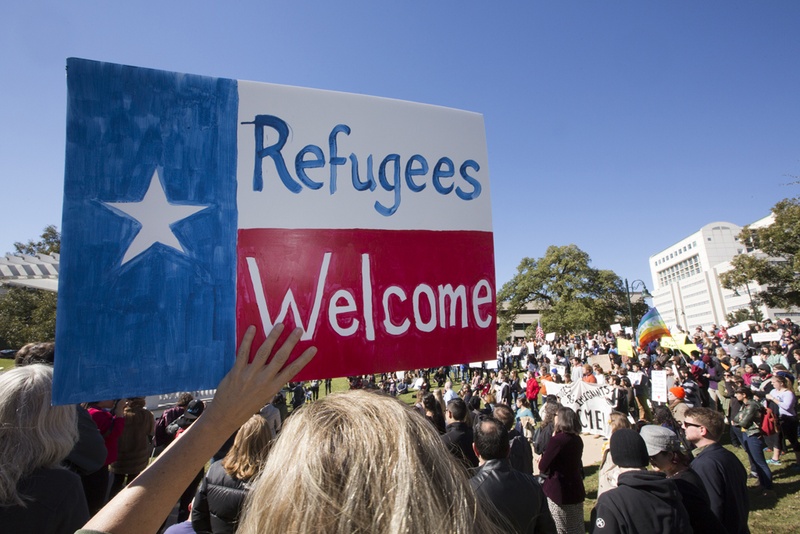
In Texas, for example, when the governor refused to sign on to the federal effort to resettle Syrians, ordinary Texans and nonprofits stepped up to the plate.

Jim Malewitz writes at the Texas Tribune, “Texas’ top elected officials have not exactly welcomed refugees over the past year. [In September] Gov. Greg Abbott followed through on his threat to end cooperation with the nation’s refugee resettlement program because federal officials refused to ‘unconditionally approve’ a Texas plan requiring extra vetting of applicants. Such a move will not keep refugees from coming here, but it eliminates the state government’s role.

“But everyday Texans seem to be more willing to help refugees from Syria and elsewhere start new lives in the Lone Star State. Nonprofits that resettle refugees say volunteer turnout has increased — in some cases dramatically — since Texas Republicans first suggested they threatened security.” More. See also an article in the Nonprofit Quarterly, here, for details on the critical role of nonprofits and volunteers in Texas at this point in time.

I have personal knowledge of the many volunteers reaching out to refugees in Providence via the Providence Granola Project (how about giving their yummy products as holiday gifts?), the Refugee Dream Center, Genesis Center, and Dorcas International. The Diocese of Providence is also at the forefront of service as an official resettlement agency, like Dorcas.

You know what else? I just heard of a woman in my town who is selling her house and moving to “wherever she’s needed.” She wants to use her years of language-teaching skills to help refugees.

[10/15/16 Update: Read about the outpouring of support for refugees in Lowell, Mass., here.]

Photo: Marjorie Kamys Cotera
A group gathered at Wooldridge Park in Austin on Nov. 22, 2015, to show support for refugees.

Read Full Post »

Refugees continue to be on my mind, and I can’t resist any story about ordinary, kind-hearted people who recognize that no one would leave their homeland on a dangerous, uncertain journey unless they were desperate.

Sam Warner at Huck magazine (“Huck celebrates independent culture – people and movements that paddle against the flow”) has examples of kindness from the past year.

“Where European governments have largely failed, individuals across the continent have stepped up to help the plight of  refugees in any way they can. Here are some of them.

“Two Dresden writers showed solidarity with the refugees by painting ‘welcome’ in Arabic on the side of a train carriage in the city. …

“As migrants arrived in Munich, they were greeted with applause from Germans waiting for them at the train station. On top of that, they were given food, water and toys for the children and people also held up signs that said ‘welcome.’

“While refugees were stuck in Hungary, a convoy of Austrian volunteers called ‘refugeeconvoy’ crossed the border to distribute aid and help refugees cross through Western Europe.  …

“Numerous Icelandic residents have joined an initiative to help the refugees, started by writer Bryndis Bjorgvinsdottir. Her Facebook page Syria is Calling already has over 17,000 likes, using the slogan: ‘Just because it isn’t happening here doesn’t mean it isn’t happening.’

“It encourages the government to take in more refugees, whose numbers have been officially capped at 50. It has also inspired American initiative Open Homes, Open Hearts US – with Syrian refugees, which aims to raise awareness across the Atlantic and lobby the US government to accept more refugees. …

“Outside Budapest’s main railway station, a group of volunteers set up a projector and screened Tom and Jerry for refugee children to watch. They had been barricaded outside the station by authorities for 48 hours … .

“Refugee Phrasebook is an online collaborative project that aims to give important vocabulary for orientation that can be distributed to refugees. Its collaborative aspect means that experts can improve and update the material as it goes along. The project has phrases in 28 languages.”

More here.

Photo: Thomas Rassloff on Flickr

Read Full Post »

A New York Times article that was widely shared yesterday detailed how eager many Canadians are to welcome refugees. Enthusiastic, sometimes a bit bossy, they are volunteering in droves to make a difference in the lives of anxious families who have been through the mill.

It reminded me of other welcome stories I’ve been collecting. Small towns, in particular, seem to feel they could benefit from welcoming refugees.

On Nagu, a remote island on the southwest tip of Finland, migrants have found open arms.

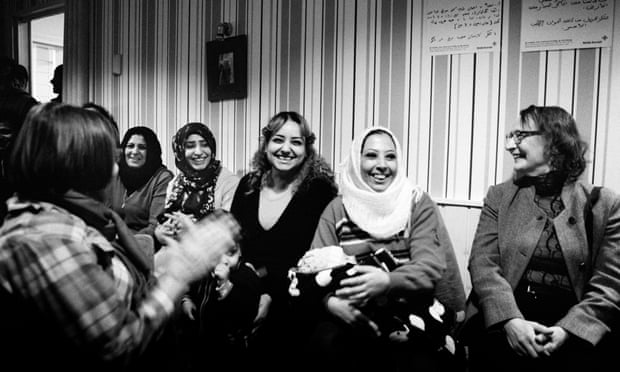
Giles Duley writes in the Guardian, “From the start, the people of Nagu made their guests feel welcome. A Facebook group was set up, activities suggested, volunteers came forward. ‘It was exciting,’ says Mona Hemmer, a bastion of Nagu life and one of the organisers of activities for the refugees. …

“Of course, for the refugees, being busy does not erase their past or the uncertainty of their future. … Many still find it hard to sleep, aware that until their asylum applications have been processed, they have not reached the end of their journey.

“However, the warm welcome of the Nagu people has made a difference. And despite their initial reservations, the islanders now feel that it is the refugees who have brought them something.”  More.

In this Al Jazeera story by Thomas Bruckner, refugees are reviving faded Italian villages.

“The village of Riace had seen its population drop from 2,500 to 400 since the 1990s, when people moved to northern Italy for better economic opportunities.

“Domenico Lucano, Mayor of Riace, saw the flow of refugees in Italy as an opportunity. ‘We have been welcoming refugees with open arms for the past 15 years. [They have] saved our village,’ Lucano explained.

“The resourceful mayor first acted on this opportunity in 1998, when a boat with 218 Kurdish refugees on their way to Greece got stranded on a beach in Riace. This is when Lucano first proposed that the refugees should stay in the village and take over the homes and apartments that had been left vacant by the migrating former residents of the town.

“The mayor helped to facilitate the integration by establishing a ‘refugees welcome’ project, which is now spreading through neighbouring towns.”

Here’s a PBS story by Jason M. Breslow about a small town in Germany that wants more population. “With Goslar’s population shrinking by around 2,000 people per year as young people flee to bigger cities and older residents die, [Mayor Oliver] Junk sees refugees as key to the town’s future.

“ ‘Europeans must welcome and integrate refugees, accepting that they are not a burden but a great opportunity,’ Junk wrote in an op-ed published last month in the policy journal Europe’s World.”

The mayor has also said, “Anyone who tells me Germany is full up, or that we can’t afford them, I say think of our past, and of the future. Of course we can afford them – we’re a rich country, and we have a duty to help those in need.’ ” More from PBS.

And here’s a story closer to home. Brian MacQuarrie writes at the Boston Globe about Rutland, Vermont, and its interest in refugees.

“Mayor Christopher Louras has unveiled a plan, developed in near-secrecy, to resettle 100 Syrian refugees who fled the onslaught of the Islamic State and are exiled in sprawling Jordanian camps. …

“Most residents appear ready to welcome the refugees, mindful of the harrowing images of Syrians desperately seeking refuge outside their ravaged country….

“ ‘The benefits, economically and culturally, that we will recognize is exactly what the community needs at this time,’ said Louras, the grandson of a Greek immigrant who fled the Ottoman Turks a century ago. ‘As much as I want to say it’s for compassionate reasons, I realize that there is not a vibrant, growing, successful community in the country right now that is not embracing new Americans.’ ” More at the Globe.

Photo: Giles Duley/UNCHR
Volunteers from Nagu, a small island in Finland, laugh with refugees during a New Year’s Eve concert put on by local musicians.

Read Full Post »