Feeds:
Posts
Comments

Posts Tagged ‘wild’

Photo: Graeme Sloan for the Washington Post.
Wild ponies swim across the Assateague Channel in a 100-year-old tradition. Remember Misty of Chincoteague?

Today’s story reminds me of a book series I loved as a child, one that I have learned is too slow for today’s kids, who love slam-bang spy adventures.

Remember Misty of Chincoteague and the annual swim? Hau Chu at the Washington Post wrote about the 100th real-life swim.

“By sunrise at 6:03 a.m. on Wednesday, hundreds of people already had their legs smeared with mud and their brows filled with sweat as their eyes gazed across the Assateague Channel along Virginia’s Eastern Shore.

“They trudged through the marsh to stake out a spot of shoreline. Some woke up as early as 3 or 4 a.m. Others planned more than a year ago from their homes in Massachusetts, Texas and beyond to be in this exact spot.

“These people wrestled with all these things to see wild ponies [at] Pony Swim Lane.

“ ‘Let me tell y’all, you guys are hardcore,’ Chincoteague Mayor Denise Bowden said to the crowd, nearly two hours later, while standing on a pier overlooking the water. … ‘That mud will wash off, but your memories are gonna last forever.’

“The annual wild pony swim at Chincoteague brings thousands of visitors and locals to the town every summer. This year marked the 100th year of the event. Ponies are corralled by the volunteer fire company on neighboring Assateague Island and swim over at slack tide, when the current is still. Officials say they do this to manage the population of ponies that inhabit the land: The festivities culminate in an auction of some of the foals that provides money for the company and veterinary care. …

“Andrea Lucchesi of Southampton, Massachusetts, knew plenty about it. Like some others, she had long dreamed of attending because of her fondness for Misty of Chincoteague, a 1947 children’s novel by Marguerite Henry.

“The book, and subsequent 1961 film, were inspired by a real pony, who is memorialized with a statue along the town’s Main Street. Business signs, restaurant menu specials and residential decorations throughout Chincoteague incorporate the wild creatures. Visitors and locals alike are clad for days in apparel with pony imagery or the Saltwater Cowboys, the group of firefighters responsible for managing the ponies.

“Those cowboys brought the ponies to the edge of Assateague Island at about 8:06 a.m. …

“And off they went. Dozens of ponies’ heads stayed above water and inched closer to the shore within minutes. All made it over to a pen on Pony Swim Lane. …

“Some have criticized the swim over concerns about the horses’ welfare and the desire to tame wild animals. Scott Rhoads, 69, was standing along a fence of the pony pen after the swim. He went back and forth on how he felt about it.

“ ‘You just wonder, these ponies, what they’re thinking,’ Rhoads, a retired small-animal veterinarian, said before taking a second to pause. ‘I worry,’ he paused again, ‘how it affects them, but I’m sure they get over it quickly.’ …

“People like Ashley Le embraced the summer beach town atmosphere and the novelty and spectacle of the event. Le, 28, had been to Chincoteague a few times before but never during pony swim time, she said. She lives in the Logan Circle neighborhood of Northwest Washington but was born and raised in Ho Chi Minh City, Vietnam.

“ ‘It’s a very American thing, but it’s not like a military American thing; it’s a small-town American thing,’ Le said. ‘I feel like a lot of unique American things you think of is like July 4 or like fireworks and that kind of stuff. But this isn’t it; this is so outside of that zone. … I think just being here makes me feel like taking a breath of fresh air away from everything that’s happening in America. And the ponies are just so cute.’

“By sunset at 8:12 p.m., hundreds of people were cleaned up at the Chincoteague Carnival Grounds on Main Street. …

“Bowden, 56, was sitting in a chair inside the information booth at the carnival entrance. She was born and raised in Chincoteague. She’s a Saltwater Cowboy, and her family’s participation in the event goes back to her grandfather. But Bowden was injured in an April roundup of the ponies. The wild horses started charging and fighting and threw her off her horse. The distal femur in her right leg was crushed, she said. Still, this was all worth it.

“ ‘If they had to drag me down there on a stretcher … if they had to helicopter me in, it didn’t matter,’ Bowden said. ‘I wouldn’t miss this for anything.’ ”

More at the Post, here. Have you ever been to that part of Virginia? I was there once but didn’t see the ponies. The main thing I recall is eating my first oyster fritters.
Read Full Post »

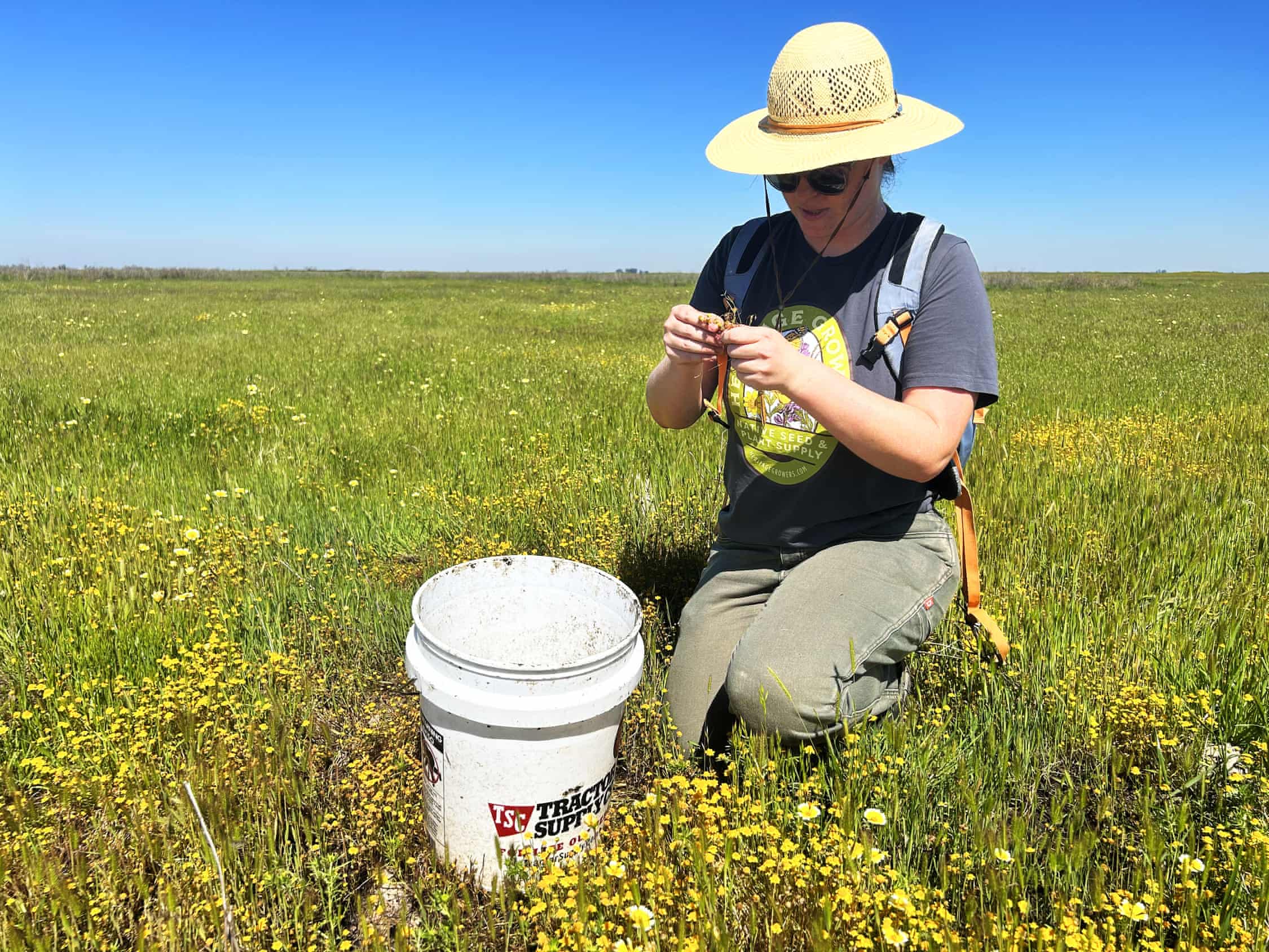
Photo: Dani Anguiano.
Haleigh Holgate, seed collection manager at Heritage Growers, inspects a seed in the San Luis national wildlife refuge complex on March 2025. Only the correct species will do.

I have blogged about seed banks in various countries (search on “seed bank”), and particularly about the global one that will keep seeds safe forever — if it stays frozen.

Today we learn what’s going on in California, where Heritage Growers is focused on local flora.

Dani Anguiano reported at the Guardian, “Deep in California’s agricultural heartland, Haleigh Holgate marched through the expansive wildflower-dotted plains of the San Luis national wildlife refuge complex in search of something precious.

“She surveyed the native grasses and flowering plants that painted the Central valley landscape in almost blinding swaths of yellow. Her objective on that sweltering spring day was to gather materials pivotal to California’s ambitious environmental agenda – seeds. …

“As a seed collection manager with the non-profit Heritage Growers native seed supplier, Holgate is tasked with traveling to the state’s wildlands to collect native seeds crucial for habitat restoration projects.

“The need has become particularly acute as California aims to conserve 30% of its land by 2030, with the governor pledging to restore ‘degraded landscapes’ and expand ‘nature-based solutions’ to fight the climate crisis. …

“But the rising demand for seeds far outpaces the available supply. California faces an ‘urgent and growing need’ to coordinate efforts to increase the availability of native seeds, according to a 2023 report from the California Native Plant Society. There simply isn’t enough wildland seed available to restore the land at the rate the state has set out to, Holgate said.

“Bridging the gap starts with people like Holgate, who spends five days a week, eight months of the year, traveling with colleagues to remote spots across the state collecting seeds – an endeavor that could shape California’s landscape for years.

“That fact is not lost on the 26-year-old. It’s something she tries to remind her team during long, grueling, hot days in the oilfields of Kern county or the San Joaquin valley. …

“Seeds play a vital role in landscape recovery. When fires move through forests, decimating native species and leaving the earth a charred sea of grey ash, or when farmlands come out of production, land managers use native seeds to help return the land to something closer to its original form. They have been an essential part of restoring the Klamath River after the largest dam removal project in US history, covering the banks of the ailing river in milkweeds that attract bees and other pollinators, and Lemmon’s needlegrass, which produces seeds that feed birds and small mammals.

“California has emphasized the importance of increasing native seed production to protect the state’s biodiversity. … Three-quarters of native vegetation in the state has been altered in the last 200 years, including more than 90% of California wetlands, much of them here in the Central valley.

“For the state to implement its plans, it needs a massive quantity of native seeds. … Enter Heritage Growers, the northern California-based non-profit founded by experts with the non-profit River Partners, which works to restore river corridors in the state and create wildlife habitat.

“The organization takes seed that Holgate and others collect and amplifies them at its Colusa farm, a 2,088-acre (845-hectare) property located an hour from the state capital. (The ethical harvesting rules Heritage Growers adhere to mean that they can take no more than 20% of seeds available the day of collection.) …

“Currently, the farm is producing more than 30,000 lbs of seeds each year and has more than 200 native plant varieties.

“The goal, general manager Pat Reynolds said, is to produce source-identified native seed and get as much of it out in the environment as possible to restore habitat at scale. …

“The benefit of restoring California’s wildlands extends far beyond the environment, said Austin Stevenot, a member of the Northern Sierra Mewuk Tribe and the director of tribal engagement for River Partners.

“ ‘It’s more than just work on the landscape, because you’re restoring places where people have been removed and by inviting those people back in these places we can have cultural restoration,’ Stevenot said. ‘Our languages, our cultures, are all tied to the landscape. … It’s giving the space back to people to freely do what we would like for the landscape and for our culture,’ he said. …

“The mission is worthwhile, Holgate said. The seeds she collects are expensive, but if they can be amplified and expanded, native seeds will become more abundant and restoration projects can happen more quickly.

“ ‘We can restore California faster,’ she said. … ‘I know that when I’m dreaming about a certain species, I should go check that population and see what’s happening. And normally there’s something going on where it’s like grasshoppers came in and ate all the seed, or the seed is ripe and ready, and I gotta call in a crew,’ she said. ‘I’ve really put my whole heart into this job.’ “

More at the Guardian, here. No firewall at this outstanding news site, but please support it.

Read Full Post »

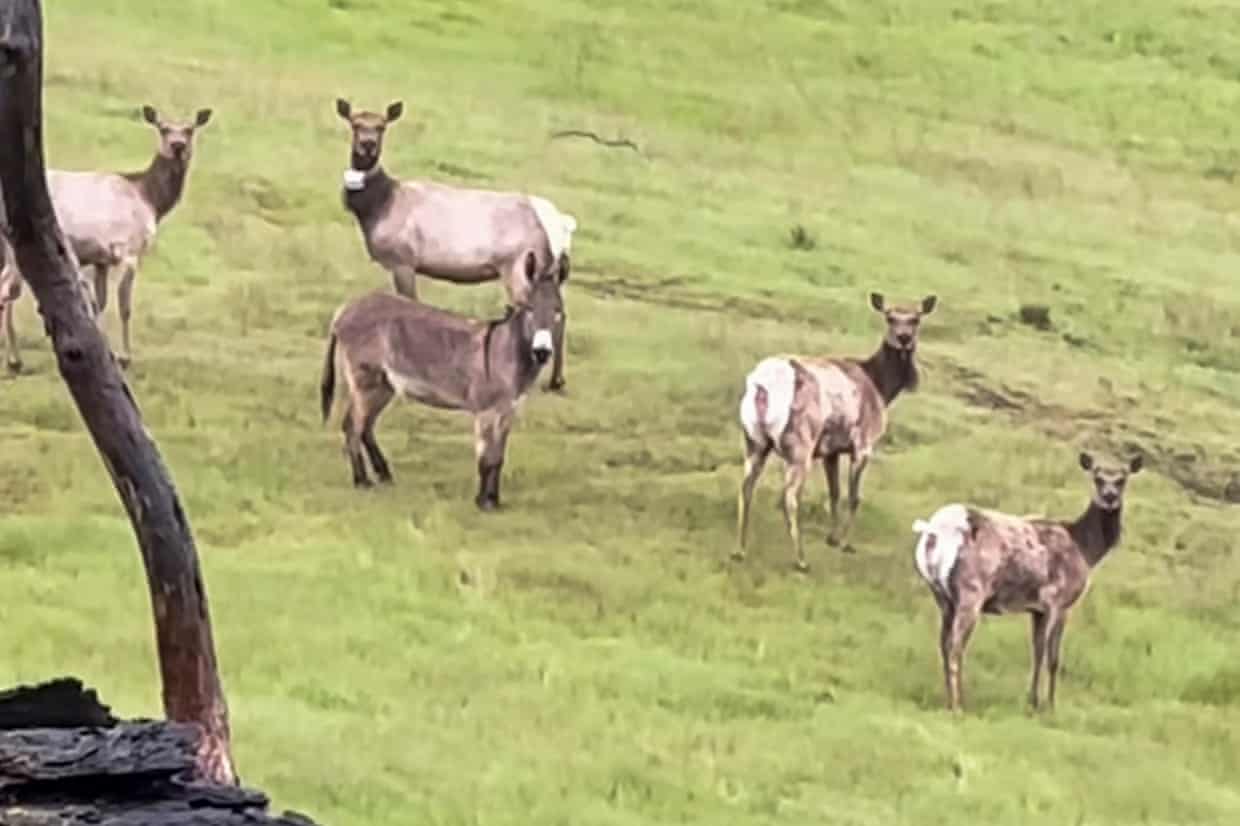
Photo: Instagrammer @maxfennell.
A hunter spotted a donkey living with elks in northern California.

A donkey-owning family in California lost its pet to a wild elk herd — and decided he was better off. What would you have done? Would it depend on how long your pet was missing?

The Guardian reports: “A donkey spotted apparently living with a herd of wild elk in a video that went viral on the internet has been identified as Diesel, a once beloved pet who had apparently run away five years ago.

“The video was taken earlier this year, when Max Fennell, a hunter in northern California, filmed a group of wild elk apparently hanging out with a donkey who appeared to be a member of their herd.

“The short clip of the unusual scene rapidly spread across social media. Now Terrie Drewry and her husband, Dave, have told CBS news that they are convinced the free-roaming burro is their missing pet Diesel, who had scarpered into the wilderness five years earlier. …

“ ‘Finally, we know he’s good. He’s living his best life. He’s happy. He’s healthy, and it was just a relief,’ Drewry told CBS.

“The Drewrys revealed that Diesel had gone missing after getting scared on a trail while on a hiking trip with his human family. They searched for him in vain, though a trail camera spotted him, and hoof prints showed that he was still alive.

“Despite their joy, in seeing Diesel alive and apparently thriving as a want-to-be elk, they have no plans to try to capture him.” More at the Guardian, here.

That got me curious about donkeys that normally live in the wild, and poking around on the web, I ended up at the Young People’s Trust for the Environment (YPTE), which works to inspire “young people to look after our world.”

“There are still several types of donkey living wild in various parts of the world including: the ‘Kiang’ in India and Nepal the ‘Somali’ wild ass in Africa the endangered ‘Onager’ in Mongolia, Turkestan, Iran and Syria. …

“In the wild, donkeys don’t live in such close herds as horses and ponies do, since they occupy marginal desert-lands where food is generally scarce. As a result they have developed very loud ‘voices,’ which can carry just over three kilometres [~2 miles]. This allows them to keep in contact with one another. Their larger ears also allow them to hear the distant calls of their neighbors. Donkeys also use their ears as a form of visual communication and they may help dissipate some of the hot desert heat.

“Donkeys have a very tough digestive system that can break down almost inedible vegetation and at the same time extract and save as much moisture as possible.” More here.

Read Full Post »

Did you ever picture yourself running away from home as a kid? I did. I liked the book The Boxcar Children because it suggested that kids could manage on their own. Even as a young adult, I was still puzzling about it in my imagination but was never able to invent a scenario that didn’t involve some helpful adult.

When I read today’s story, I was reminded of that conundrum because the author, Sabra Boyd, notes the impossibility of getting any landlord to rent to a 14-girl-old with two younger siblings. Her article at the Washington Post also discusses how foraging for food influenced her cooking style.

“Desperate times call for comfort food,” Boyd writes. “And whenever I have time, making fresh pasta helps me embrace being home. … Rolling out fettuccine noodles is the only kind of meditation I have patience for these days. I press my hands firmly into the dough, feeling grateful to have a kitchen. I coat the rolling pin in extra flour and think about how, as a homeless teenager 20 years ago, I cooked using only a backpacking stove. Surviving teen homelessness prepared me for a pandemic in ways I never could have imagined.

“My mother first kicked me out when I was 14. … I didn’t know anyone to crash with, so I trudged uphill to the dark high school because I could not think of anywhere better to go other than the place I needed to be in the morning. I climbed the roof of the auditorium and took a clumsy parkour leap from the eave of my English classroom’s window. Tracing constellations with my finger, I pulled my hoodie tight against the cold. The glare of a neon crucifix, perched on a hill above the school, flooded the football field with light. I closed my eyes and tried to fall asleep.

“The following night, I sneaked into my mom’s house through a window and packed my camping gear. I set up my new home in a cave above the Elwha River. Sometimes I slept in an abandoned house in Eden Valley. When it grew too cold, I stayed at a hippie commune, in the goat stable, but I left when the commune became too dangerous. I returned periodically to check on my younger siblings, but Mom would fly into an alcoholic rage, so I spent most of high school homeless. …

“I kept my favorite nonperishables in a bear canister: instant noodles, dehydrated miso soup, granola bars and halvah. In the spring, I sauteed fiddleheads and horsetails in olive oil with my compact camp stove. In summer, I gorged on blackberries, delicately picked bright red thimbleberries and, when their pink blossoms fell, hunted for the electric hue of salmonberries. In the fall I gathered apples from wild orchards and scanned the sepia leaves on the forest floor, training my eye for a pop of yellow chanterelle.

“In winter I relied more on eating lunch at school and at work, or restocking my canister with trips to the co-op near my many after-school jobs. I worked as a barista, landscaper, maid, caregiver, caterer and pastry chef. I also volunteered for Olympic National Park’s revegetation crew and as a tour guide at the local aquarium. Volunteering and working all the time distracted me from everything going wrong in my life — plus, I hoped it would help me get into a good college far away. Volunteering also meant I could spend a few extra hours indoors if it was raining or cold outside.

Despite working seven days a week, I could never save enough money to persuade a landlord to rent an apartment to a 14-year-old girl and her two siblings.

“Striving to make fewer trips to the grocery store during the coronavirus pandemic has pushed me to become more creative and less precious about my culinary endeavors. … I am making Douglas-fir fettuccine Alfredo, or fettuccine al burro, named for its rich butter sauce, because the weather has turned cold and there is not much else to forage. The bright citrus tang of Doug fir is welcome when the days turn dreary, and I use it as a wild alternative to rosemary. …

“The leaves are most tender in the spring when they are neon, but they can be harvested year round, making this literally an evergreen recipe. The first rule of foraging is to be certain that you know what you are eating, because otherwise it can be dangerous.”

Get both the recipe and the rest of the story at the Washington Post, here.

Read Full Post »

From time to time I hear about a growing interest in play areas that focus less on safety and more on creativity and fending for yourself. Safety has always been important to me, but maybe children (grownups, too) get in more trouble when they leave the safety issues to authorities. Maybe there’s something to be said for learning to handle tricky situations by being in tricky situations.

In any case, woodland nursery schools, wild parks, and junky playgrounds are getting attention.

Amy Fusselman, adapting her book Savage Park for the Atlantic, describes her family’s reaction to a wild park in Japan.

“As the eight of us walked, first up a slight dirt hill, then past a gaggle of unlocked bicycles, we smelled it: smoke. The smell became stronger as we went ahead. We followed it until at last we were all standing beside a traditional Japanese hut that was perched atop a downward-sloping one-acre patch of dirt and trees.

“The hut’s front porch was completely overflowing with crap, including a pink-painted piano at which a girl, five, was sitting and playing a John Cage-ian ditty. It was a strangely radiant sound to be hearing as we stood there looking down through the smoke—we could see it as well as smell it now—to the smoke’s source: open fires.

“There were three of them. At one, a boy about eight years old was kneeling, poking at the flames with paper fans; at another, a father was sitting and roasting marshmallows with his toddler son. A third fire seemed to be unattended. …

“We stood there, dumbfounded, staring at the dirt and trees and the structures that were woven around and between them, structures that were clearly not made in any place where safety surfacing had ever been a subject of serious discussion. These were structures that looked like what remained when my sons decided to build an airport out of Legos and then abandoned the project halfway through, only these half-made baggage carts and control towers were much larger and crafted not from nicely interlocking plastic rectangles but from scraps of wood and nails. …

“At one point, I looked up at the trees. I was astonished to see that there were children in them. The more I looked, the more children I saw. There were children 15 feet high in the air. …

“I sat on a log, eating warm, white gooey marshmallows. The park was around us, and the trees were around us, and the dirt was around us, and the smoke, and the music. The children were in the trees, and were flying in the air. We stayed there as long as we could.”

More here.

Photo: Associated Press


Read Full Post »

Photo: clickalps.com

Go to Bored Panda to see adorable mouse photographs collected by Skirmantė that could come straight from Beatrix Potter. Two Bad Mice, anyone?

Wikipedia’s entry on the children’s book author and naturalist says, “Born into a wealthy Unitarian family, Potter, along with her younger brother Walter Bertram (1872–1918), grew up with few friends outside her large extended family. Her parents were artistic, interested in nature and enjoyed the countryside. As children, Beatrix and Bertram had numerous small animals as pets which they observed closely and drew endlessly. …

“Beatrix was educated by three able governesses, the last of whom was Annie Moore (née Carter), just three years older than Beatrix … She and Beatrix remained friends throughout their lives and Annie’s eight children were the recipients of many of Potter’s delightful picture letters. It was Annie who later suggested that these letters might make good children’s books.

“In their school room Beatrix and Bertram kept a variety of small pets, mice, rabbits, a hedgehog and some bats, along with collections of butterflies and other insects which they drew and studied. Beatrix was devoted to the care of her small animals, often taking them with her on long holidays.”

I visited her home in the Lake District with my husband, and I read a biography of her. Like many girls of her time and social stature, she was a lonely child. But her creative genius filled her world with fully realized imaginary companions. And she seems to have had a satisfying adulthood preserving land in the Lake District and pursuing her natural history interests.

[Asakiyume: Thanks for putting the lead on Facebook.]

Photo: Miroslav Hlavko

Read Full Post »