Feeds:
Posts
Comments

Posts Tagged ‘workers’

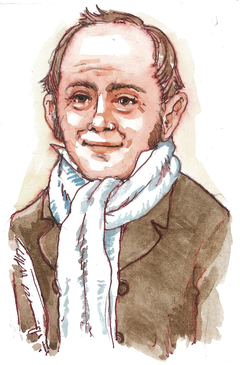
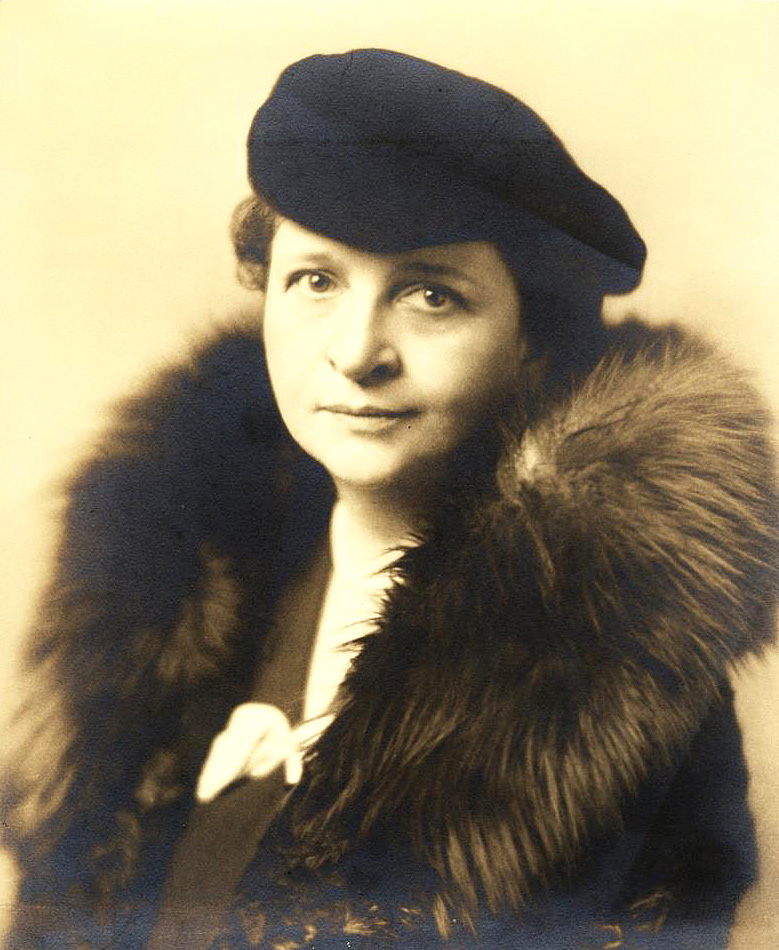
Photo: Frances Perkins Center.
Frances Perkins, President Franklin D Roosevelt’s Secretary of Labor, had more to do with shaping the New Deal than most Americans realize.

A few years ago, someone recommended a book to me, a biography of President Franklin D Roosevelt’s Secretary of Labor. I had heard of Frances Perkins, but until I read that book (see GoodReads, here), I really had no idea what an extraordinary woman she was — and how influential.

For Labor Day this year, I thought I would share what the AFL-CIO has to say about her, while also encouraging you to get a biography out of your library.

“Frances Perkins was secretary of labor for the 12 years of Franklin D. Roosevelt’s presidency and the first woman to hold a Cabinet post. She brought to her office a deep commitment to improving the lives of workers and creating a legitimate role for labor unions in American society, succeeding admirably on both counts. …

“Born in Boston in 1880, Perkins grew up in a comfortable middle-class Republican family descended from a long line of Maine farmers and craftsmen. When Perkins was two, the family moved to Worcester, Mass., where her father opened a profitable stationery business. Her parents were devoted Congregationalists and instilled in Perkins an earnest desire to ‘live for God and do something.’ At Mount Holyoke College … Perkins majored in the natural sciences, but she studied economic history, read How the Other Half Lives, Jacob Riis’s exposé of the New York slums, and attended lectures by labor and social reformers such as Florence Kelley, general secretary of the National Consumers League.

“After graduation from Mount Holyoke in 1902, Perkins accepted a series of teaching positions and volunteered her time at settlement houses, where she learned firsthand the dangerous conditions of factory work and the desperation of workers unable to collect their promised wages or secure medical care for workplace injuries. By 1909, she had given up teaching science and moved to New York to study at Columbia University, where she earned a master’s degree in economics and sociology in 1910. For the next two years, she served as secretary of the New York Consumers League; working closely with Florence Kelley, she successfully lobbied the state legislature for a bill limiting the workweek for women and children to 54 hours. …

“One of the pivotal experiences of her political life occurred in 1911, when she watched helplessly as 146 workers, most of them young women, died in the Triangle Shirtwaist fire.

Many, she remembered, clasped their hands in prayer before leaping to their deaths from the upper-floor windows of a tenement building that lacked fire escapes.

“It was, as Perkins later explained, ‘seared on my mind as well as my heart — a never-to-be-forgotten reminder of why I had to spend my life fighting conditions that could permit such a tragedy.’

“During these years, Perkins also witnessed the widespread labor upheavals among garment and other New York City workers and learned from friends such as labor leader Rose Schneiderman the one-word solution to poverty: organize. …

“In 1918, Perkins accepted Gov. Al Smith’s invitation to join the New York State Industrial Commission, becoming the first female member of the commission. In 1926, she became chairwoman of the commission, and then, in 1929, the new governor, Franklin D. Roosevelt, appointed Perkins industrial commissioner of the state of New York, the chief post in the state labor department. Having earned the cooperation and respect of a wide range of political factions, Perkins, ever the master deal-maker, helped put New York in the forefront of progressive reform. She expanded factory investigations, reduced the workweek for women to 48 hours and championed minimum wage and unemployment insurance laws.

“When Roosevelt tapped her as labor secretary in 1933, Perkins drew on the New York State experience as the model for new federal programs. She put every ounce of her formidable energy into weaving a safety net for a Depression-scarred society, securing a remarkable array of benefits for American workers. … Her vision found concrete expression in such landmark reforms as the Wagner Act, which gave workers the right to organize unions and bargain collectively, and the Fair Labor Standards Act, which established for the first time a minimum wage and a maximum workweek for men and women. Perkins also chaired the Committee on Economic Security, which developed and drafted the legislation that became the Social Security Act in 1935.

“As secretary of labor during the 1930s and early 1940s, Perkins played a crucial role in the outcome of the dramatic labor uprisings that marked the era. She consistently supported the rights of workers to organize unions of their own choosing and to pressure employers through economic action. In one famous incident captured in a widely circulated newspaper photo, an indomitable Perkins strides toward the U.S. post office in Homestead with thousands of steelworkers trailing behind her. Denied a meeting hall by the mayor and steel executives, Perkins found an alternative site where she could inform the workers directly of their collective bargaining rights. It was also the unflappable Perkins who advised President Roosevelt to ignore the pleadings of state and local officials for federal troops to quell the 1934 San Francisco General Strike. The successful resolution of that strike as well as countless others during her tenure as labor secretary laid the foundation for the rebirth of American labor. …

“In 1945, Perkins resigned from her position as labor secretary to head the U.S. delegation to the International Labor Organization conference in Paris. President Truman subsequently appointed her to the Civil Service Commission, a job she held through 1953. In the last years of her life, Perkins assumed a professorship at Cornell University’s School of Industrial and Labor Relations. She died in New York at the age of 85 and was buried in her family’s plot in New Castle, Maine.”

More at the AFL-CIO, here.
Read Full Post »

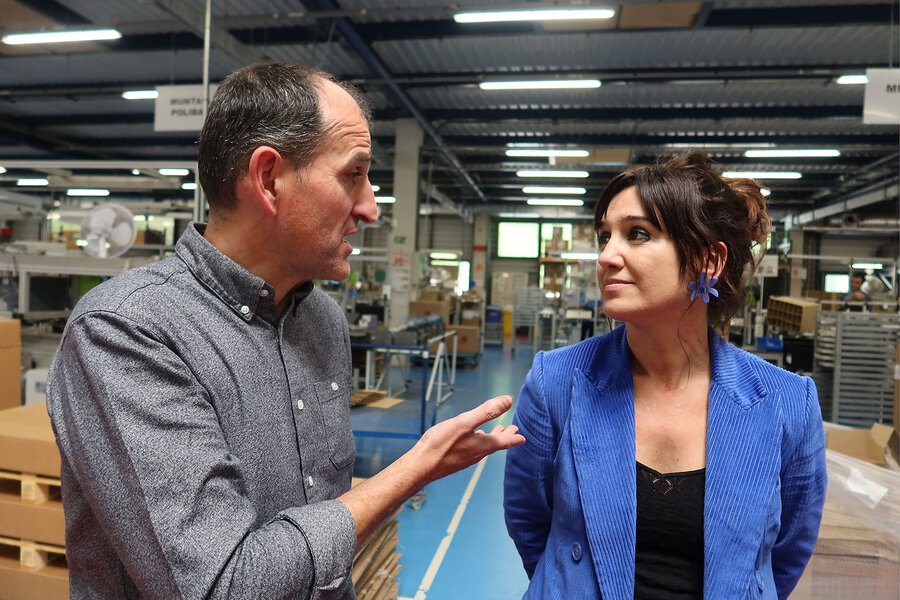
Photo: Erika Page/Christian Science Monitor.
Amaia Salbide speaks with plant manager Ander Jausoro on the factory floor of an industrial plant belonging to Copreci, one of the Spanish companies sharing ownership with workers. “No one is rich. No one is poor.”

Giving workers a piece of the responsibility for a company’s success — and a piece of the profits — is not a new idea. But lately it’s been gaining traction in Spain.

Erika Page reports at the Christian Science Monitor, “At first glance, this could be any industrial factory. Workers wearing protective gloves assemble control panels and heating plates amid the relentless whirring of machinery. Giant yellow robot arms swing back and forth, lining trays with tiny metal parts.

“But there is a reason that each year thousands of visitors from every continent come to this mountainous Basque landscape to study factories like this one. This is the home of the Mondragon Corp., the world’s largest federation of worker-owned cooperatives. 

“Copreci, which makes parts for home appliances, is one of 81 Mondragon cooperatives, ranging from manufacturing to finance and retail. By the end of the day, this floor alone will churn out 30,000 gas valves, destined for stoves worldwide.

“Yet it is also churning out a radically different vision of capitalism. For young people especially, capitalism brings to mind wealth inequality, cost-of-living crises, and environmental collapse. …

“The Mondragon Corp. sees itself as a third way, not as an alternative to capitalism, but as an alternative way of doing capitalism – one that can build trust, not widen divisions.

“ ‘The purpose of what we’re doing here is not the machinery or the production process,’ says Amaia Salbide, president of Copreci, on a visit to the factory floor. ‘Those are tools to reach a higher goal of social transformation.’ …

“Mondragon’s nearly 70,000 members, ranging from floor workers to top executives, are co-owners of their businesses. They have voting power at general assemblies, where they weigh in on company strategy and policy. The income disparity between the highest- and lowest-paid employees in Mondragon’s cooperatives is capped at a ratio of 6-to-1, compared with a typical ratio of 344-to-1 in the United States. …

“As the saying around here goes, Mondragon does not create rich people, but rich societies. That means prioritizing quality of life for the employees who live and work in the towns dotting these forested hills rather than maximizing profit for investors.

“ ‘I think of it as a sort of attractive form of capitalism,’ says Nick Romeo, author of The Alternative: How To Build a Just Economy. ‘One that works more effectively for more people but retains some of the benefits of markets and efficiency and competition.’

“Hugo Montalvo knows he could make more money as a sales manager at a regular multinational company. But he wouldn’t trade his middle-class status or the small town where he is raising his two children. At the end of a day’s work, Mr. Montalvo often finds those on the assembly line picking up their children from the same schools as top managers and gathering at the same tables at local bars. The base pay for a Mondragon worker is on average 40% higher than Spain’s minimum wage.

“ ‘Here, no one is rich,’ says Mr. Montalvo, who works for Ecenarro, a Mondragon cooperative. … ‘But no one is poor either. We’re all in that middle range, earning decent salaries.’

“Solidarity permeates the business model. To become a member of a cooperative, a worker invests €17,000 ($18,400), normally bit by bit over time. As for company profit, 60% is reinvested in the business, 30% goes to employees as capital, and 10% is for the local community. At the end of each year, Mondragon reviews each cooperative’s earnings, and companies in better financial positions contribute to those that are struggling.

“ ‘Just as we’ve received in the past, now it’s our turn to give,’ says Mr. Montalvo.

“Back in 2013, he was working for Fagor Electrodoméstico, a Mondragon cooperative that at the time was Spain’s leading home appliance company. When the company went bankrupt in the aftermath of the financial crisis, his job and initial investment disappeared.

“Within two weeks, he was transferred to Ecenarro, and Mondragon covered his membership fee. Of the almost 2,000 people who lost their jobs at Fagor, 95% were relocated within the Mondragon network. During the pandemic, workers came to collective agreements to avoid job losses, including salary reductions. …

“ ‘The cooperative is a creator of wellness, so it has to exist for decades and decades,’ says Ander Etxeberria, who leads Mondragon’s cooperative outreach program.”

As with anything, there are challenges here, too. Get more details at the Monitor, here.

Read Full Post »

Photo: John Tlumacki/Globe Staff.
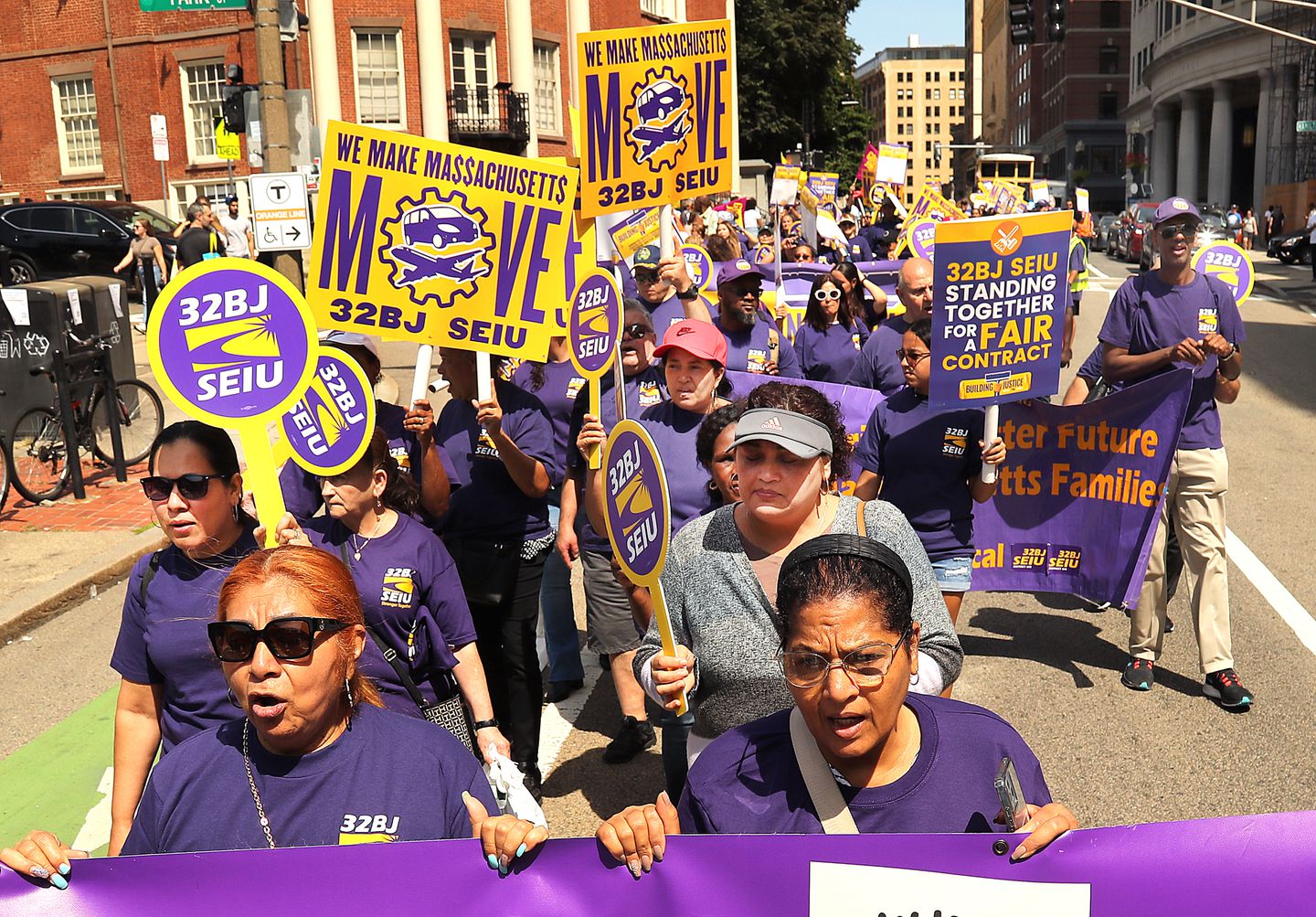
The Boston Globe reported recently on service workers marching “down Tremont Street to Boston Common, where they held a labor rally for new contracts and freedom to unionize.

As a member of the general public, I don’t like being inconvenienced by a labor strike any more than the next person. But I know my history. I know what life was like when workers couldn’t strike and how some gave their lives to change the status quo. So I think of that on Labor Day.

At the Boston Globe, John Hilliard wrote recently about service workers, who are among the last to band together for better working conditions. We need to stay as grateful to them as we were during the pandemic.

“Hundreds of essential workers — including janitors, airport staff, and ride-hailing drivers — marched through Boston’s streets Saturday demanding better post-pandemic workplace conditions after laboring to keep the economy afloat during the health crisis.

“The Labor Day weekend demonstration, organized by Local 32BJ of the Service Employees International Union, drew together service workers from across Greater Boston who are members, as well as some who are organizing to join the union, according to Roxana Rivera, a labor organizer and assistant to 32BJ president Manny Pastreich.

“ ‘This is a moment for workers, because they put so much of themselves out there during the pandemic. They didn’t have a choice to work remotely. Service workers risked their own personal health, and those of their families,’ Rivera said. ‘The fact that they still struggle to make ends meet is unacceptable.’ …

“Luis Medina, of Malden, who works full time as a janitor, said he joined the demonstration because he is fighting to secure full-time hours for colleagues struggling to make ends meet with part-time employment. …

“Saturday’s demonstration came amid a dramatic resurgence in labor organizing and activity across the country — from Starbucks workers seeking to unionize to Hollywood writers and actors now on strike — demanding better pay, benefits, and working conditions from employers.

“Among the successes are Teamsters and UPS workers who have secured new contracts through union efforts.

Support for labor unions in the US has soared, with roughly two-thirds of Americans now saying they approve of them, according to a Gallup poll released Wednesday.

“And demonstrators in Boston Saturday, like Marty, a 43-year-old from Plymouth who works as an Uber driver and gave only his first name, drew a direct line between union successes nationwide and efforts to support workers locally.

“ ‘We are really important, because we are the people who move the economy,’ said Marty, who wore a Screen Actors Guild shirt to support striking actors. ‘If no one is making any money, no one’s spending anything, [and] that’s when the economy starts to suffer.’

“Rivera said that even though many people now can work from home, commercial buildings must still be cleaned and maintained, while airport employees and ride-hailing drivers remain vital to keeping the economy going. ‘We need to make sure that we are not leaving these workers behind,’ Rivera said. …

“Waitstaff and food service workers at restaurants along the route gathered at doors to watch the protesters. One worker left her restaurant, asked a union representative for a flyer being handed out and took it back inside.

“The city was packed with people enjoying a beautiful end-of-summer Saturday, and throngs watched from sidewalks, many taking photos with their phones. Several raised their arms in support, and one man on a scooter beeped his horn as he rode along Tremont Street.

“Elizabeth Hill-Karbowski, who was visiting Boston with family from Wisconsin, watched as demonstrators marched along Tremont Street and read from a flyer.

“ ‘It’s a timely type of demonstration for the Labor Day weekend, very peaceful, well organized and [it is] people just wanting to have their voices heard,’ Hill-Karbowski said. …

“State Senator Lydia Edwards, whose district includes East Boston, Revere, and Winthrop, spoke to workers in Spanish then English. …

“ ‘We celebrate all the victories that we have had, but also we need to remember the lives that we’ve lost in the fight for justice, and the lives that you have saved as workers’ during the pandemic, Edwards said.

“Ed Flynn, Boston City Council president, told the crowd: ‘When workers aren’t receiving a decent wage here in the most liberal, progressive city in the country, there’s something wrong with that.’ ”

More at the Globe, here.

Read Full Post »

Photo: Barrett Doherty, Cultural Landscape Foundation.
D.I.R.T.’s corporate campus for Urban Outfitters in the Philadelphia Navy Yard.

When you rehab a Superfund site or other industrial dead zone, should you wipe out the history or make the interesting parts work for a new generation? You can guess that I’m going to answer that question on the side of the landscape architect mentioned in today’s story. Read on.

Justin Davidson reports at Curbed, “If there was a childhood moment when Julie Bargmann had intimations of her future as a landscape architect, it came not during some backwoods tromp or while touring a lavish garden but when she was sitting in the back seat of her family’s station wagon on the New Jersey Turnpike. The great chemical plants exhaling sulfurous plumes seemed to her like magic kingdoms, and she wondered about the lives of the people inside. Later, when she was in college at Carnegie Mellon in the 1980s, Pittsburgh’s ozone-laced air gave her the same jolt of industrial excitement. …

“Bargmann, who has just been awarded the first $100,000 Cornelia Hahn Oberlander prize in landscape architecture, never lost her taste for such wounded and poisonous places, even after they’ve stopped being productive. Old industrial areas bring out her desire to nurse them slowly back to health.

As a professor at UVA and the founder of a firm she called D.I.R.T. (short for ‘Dump It Right There’) studio, she rejects the urge to demolish dead factories and scrub the land of memory, to conflate cleanup and obliteration.

“ ‘For me, the modest or the genuine way to approach these ugly-duckling sites is to be empathetic. I see a place that’s impregnated with the labor of generations of workers. That goes deep. How do you honor that history without just resorting to plaques?’

“The answer lies in projects like Detroit’s Core City Park, where Bargmann unpaved a parking lot and bared the foundations of a fire station that had been razed long ago. ‘I blurted out “Dig!” and up comes this beautiful red sandstone from the former engine house,’ she says. ‘The miraculous moment was when they hoisted out of the ground the cornerstone with “1893” written on it. The client wanted to stand it up and put it on a pedestal, and I said no — “Put it in the ground and put it back to work.” ‘ Stones, bricks, and asphalt became the raw materials for a new pattern of pavers, interspersed with trees to form an urban woodland. The result is a public space layered with memory.

“Bargmann preaches an ethic of modesty and restraint. Instead of moving great mountains of earth, making the land conform to a drawing, sift through what is already there. Don’t delete; preserve. …

“The conventional technique for cleaning up a contaminated site is [scooping] polluted soil and carting it to other dumps — essentially, moving dirty dirt around. Bargmann prefers to leave as much of the stuff in place as possible to avoid spreading toxins ‘to someone else’s backyard’ and help nature perform its slow-motion cleanup. She starts by visualizing the different levels of contamination and letting those variations suggest a strategy. ‘I love to take the data from the engineers and do a map of what’s hot and what’s not,’ Bargmann says.

“Where conditions allow, she opts for phytoremediation: using plants to clean the soil. At AMD&ART Park in Vintondale, Pennsylvania, acidic mine runoff filters through a series of rock-lined ponds that raises the pH to safe levels, then washes through a sculpture park and flows into a restored wetland.

“The mission to use landscape as a ledger inscribed with both heroic and unsavory history can smack up against her clients’ goals. Sometimes she finds herself working for the companies that ravaged the landscape in the first place and then want to erase that stigma as quickly and cleanly as possible. When Ford opened its River Rouge plant in Dearborn, Michigan, in 1928, it was a marvel of Machine Age efficiency that beguiled filmmakers, painters, and photographers. …

“ ‘They were going to wipe out everything, and I was just … Why?‘ Bargmann recalls. ‘This is the most critical part of an integrated manufacturing world — the first anywhere! Some structures were really nasty and best dealt with off-site, but we also planted remediation gardens in front of the old coke ovens, which were preserved. If you’re going to honor history and work on the toxic legacy, storytelling is a really powerful tool.’ …

“Bargmann’s approach coexists uneasily with Instagram culture, in which landscape is treated as a frame for a preening object. Her projects aren’t conceived to be photogenic on opening day since they set up processes that can grind on for years. Rather than plant meticulously coordinated gardens that require constant tending, she pops in trees and grasses that can be relied on to fend for themselves. Bargmann also has a soft spot for rough hardscape. …

“She has trained contractors to chop up concrete into big reusable slabs she calls ‘Barney rubble’ and mix smaller chunks with crushed brick to produce ‘Betty rubble.’ The combination can produce results that verge on the chic, as at Urban Outfitters’ headquarters at the Philadelphia Navy Yard.”

Read more — including why a developer in Detroit says he “inhales her ideas” — here.

More at Curbed, here.

Read Full Post »

Image: York Notes.
York Notes, a literature guide, says, “Bob Crachit is Scrooge’s clerk and represents the lower classes. He has to accept poor wages and working conditions because he has a family to support.”

I was thinking about Labor Day and remembering that in many of my favorite novels Dickens wrote with passion about the working conditions of the poor. He had himself worked in a blacking factory as a child when his father was in debt, and few topics were more likely to spark his outrage.

John Broich, an associate professor at Case Western Reserve University, wrote at Time that Dickens decided Scrooge, his hard-working clerk Bob Crachit, and the half-starved Tiny Tim would have more impact on the big issue of the day than the political pamphlet he’d been planning.

“Published 173 years ago this month,” Broich writes, “Charles Dickens’ A Christmas Carol was an instant bestseller, followed by countless print, stage and screen productions. … But A Christmas Carol’s seemingly timeless transcendence hides the fact that it was very much the product of a particular moment in history, its author meaning to weigh in on specific issues of the day.

Dickens first conceived of his project as a pamphlet, which he planned on calling, ‘An Appeal to the People of England on behalf of the Poor Man’s Child.’

“But in less than a week of thinking about it, he decided instead to embody his arguments in a story. … So what might have been a polemic to harangue, instead became a story for which audiences hungered.

“Dickens set out to write his pamphlet-turned-book in spring 1843, having just read a government report on child labor in the United Kingdom. The report took the form of a compilation of interviews with children — compiled by a journalist friend of Dickens — that detailed their crushing labors.

“Dickens read the testimony of girls who sewed dresses for the expanding market of middle class consumers; they regularly worked 16 hours a day, six days a week, rooming — like Martha Cratchit — above the factory floor. He read of 8-year-old children who dragged coal carts through tiny subterranean passages over a standard 11-hour workday. These were not exceptional stories, but ordinary. Dickens wrote to one of the government investigators that the descriptions left him ‘stricken.’

“This new, brutal reality of child labor was the result of revolutionary changes in British society. The population of England had grown 64% between Dickens’ birth in 1812 and the year of the child labor report. Workers were leaving the countryside to crowd into new manufacturing centers and cities. Meanwhile, there was a revolution in the way goods were manufactured: cottage industry was upended by a trend towards workers serving as unskilled cogs laboring in the pre-cursor of the assembly line, hammering the same nail or gluing the same piece — as an 11-year-old Dickens had to do — hour after hour, day after day.

“More and more, employers thought of their workers as tools as interchangeable as any nail or gluepot. Workers were becoming like commodities: not individual humans, but mere resources, their value measured to the ha-penny by how many nails they could hammer in an hour. But in a time of dearth — the 1840s earned the nickname ‘The Hungry ‘40s’ — the poor took what work they could arrange. And who worked for the lowest wages? Children.

“Popular theories about how — or whether — to help the poor often made things worse. The first was the widespread sense that poor people tended to be so because they were lazy and immoral, and that helping them would only encourage their malingering. If they were to be helped, it should be under conditions so awful as to discouraged people from seeking that help. The new workhouses were seen as the perfect solution — where families were split up, food was minimal and work painful. ‘Those who are badly off,’ says the unreformed Scrooge, ‘must go there.’

“Associated with this concept were the ideas of Rev. Thomas Malthus, who cautioned against intervening when people were hungry because it would only lead to an untenable population size. Better that the poor should starve and thus ‘decrease the surplus population.’ …

“Friedrich Engels read the same report on child labor that Dickens did and, with his collaborator Karl Marx, envisioned an eventual revolution. Dickens was very much an anti-revolutionary. In fact, he implied that [revolution] was the fearsome consequence of not solving the problem some other way.

“ ‘This boy is Ignorance. This girl is Want. Beware them both, and all of their degree, but most of all beware this boy, for on his brow I see that written which is Doom, unless the writing be erased.’ …

“Dickens wasn’t a ‘systems’ thinker, nor was he proto-socialist. Yet what Dickens did propose in A Christmas Carol … was that employers are responsible for the well-being of their employees. Their workers are not of value only to the extent to which they contribute to a product for the cheapest possible labor cost. They are of value as ‘fellow-passengers to the grave,’ in the words of Scrooge’s nephew, ‘and not another race of creatures bound on other journeys.’ Employers owe their employees as human beings — no better, but no worse, than themselves.

“And, yes, that might mean ‘a prize Turkey’ at Christmas … but the real salvation that Scrooge gives to the Cratchit family is a raise.

“As Scrooge and the Ghost of Christmas Past watch Tim, his father holding his [hand], the miser pleads, ‘say he will be spared.’ The ghost reminds readers of Scrooge’s Malthusian quote. ‘If he be like to die, he had better do it, and decrease the surplus population.’ ” More at Time.

Today we know that most of the labor benefits we have today, including the Monday holiday in America, were not handed down by benevolent company owners but were wrested from them by workers and unions.

You can read that history at Wikipedia, here. Even so, I do think stories help prepare a population to accept change — to recognize that the way things are is not always the best way.

Read Full Post »

I feel especially grateful to essential workers, mail carriers, and delivery people this Labor Day. Workers really make the world go ’round any year, not just during a pandemic, and many get no credit for it.

As Kenya Evelyn noted in the Guardian in April, Amazon the company was doing just great thanks to quarantine; workers not so much.

“The Amazon CEO and entrepreneur, Jeff Bezos, has grown his vast fortune by a further $24bn so far during the coronavirus pandemic, a roughly 20% increase over the last four months to $138b. …

“[Meanwhile] Amazon reported its first warehouse worker death on Tuesday. The man, an operations manager who worked at the company’s Hawthorne, California, warehouse, died on 31 March.

“Several workers have organized strikes and walkouts in protest at lack of worker protections. Chris Smalls, a former manager assistant, was fired by the retailer after leading workers at the JFK8 warehouse in Staten Island, New York, on a walkout. …

“Memos leaked by Vice News revealed company executives suggested coordinating an attempt to smear Smalls as ‘not smart or articulate’ in response to the backlash over his firing.

“Several Amazon workers have since alleged retaliation for organizing. In an op-Ed for the Guardian, Smalls urged Bezos to spend more time on protecting his workers instead of stifling dissent.

‘Without us working, what are you going to do,’ he asked. ‘You’ll have no money. We have the power. We make money for you. Never forget that.’

Something to think about.

For more on how our society has moved away from appreciation for workers, you might check out a fat book my husband has been fascinated by for months called The Enchantments of Mammon, which suggests that when capitalism has become a religion, it’s gone too far. “Everything in Moderation,” advise the Greeks.

Do you like traditional songs from the labor movement? Nick Noble’s Folk Revival on WICN radio plans to feature them this week and you can stream his show.

Here’s a word on the Folk Revival, in case you’re interested.

“The Folk Revival features the ‘folk of the folk renaissance’ from the second half of the last century right into the millennium. Focusing on the folk boom of the 1950s and the 1960s, this four-hour show also visits recordings from both before and well after that period,  highlighting folk music as a living and ever-changing tradition, connecting listeners and music through an eclectic mix of traditional songs, topical and  protest music, singer-songwriter creations, the blues, folk rock, and more. …

“Do you want to suggest a theme? Request a song? Talk about the music? React to the show? Correct the host (nicely, of course)? Share and/or find out more about the folk music tradition? Feel free to contact the host: nicknoble@wicn.org.”

Workers who matter, and not just in a pandemic.

Read Full Post »

df59b7bbd4c1a071922f705dbbf5f485

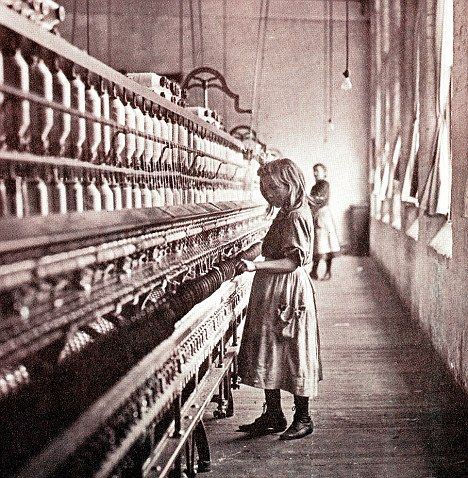
Before the rise of unions and child labor laws, it was common to see scenes like the one above showing a young girl working with dangerous textile machines in Lowell, Massachusetts.

The pendulum has swung too far away from workers. Just my view. There was a time that unions had built up power to the point of abuse. That’s not where we are now. We have all benefited from people banding together to fight deadly working conditions, end child labor, and negotiate a living wage.

Ideally, it would be corporate leaders themselves who recognized that everyone is better off when employees have a decent life. How likely are we to see such leaders today? Too many parents work two or three jobs while their children still don’t eat well without the free lunch at school. CEOs’ attitude: Not my problem.

But wait! There’s news.

Ben & Jerry’s leaders may be outliers. Of course, it took worker activism, but a good-faith effort led to positive results for all.

As John Dillon reports at Vermont Public Radio, “Some Vermont dairy workers say their wages and living conditions have improved, thanks to an agreement reached last year between the workers and Ben & Jerry’s, a division of global consumer products company Unilever.

“Times are tough on dairy farms around the country, with milk prices declining for the fourth year in a row. But 72 farms that supply Ben & Jerry’s earn a little more by agreeing to follow labor and housing standards.

“Enrique Balcazar is a former dairy farm worker and an activist with the group Migrant Justice who helped negotiate an agreement last year called Milk with Dignity. …

” ‘There are farmworkers in the state who, in collaboration with their farmers and with support from the Milk With Dignity Standards Council, are now receiving a day off every week when they previously didn’t have one, who are receiving wages to bring their wages up to the Vermont minimum wage,’ he says. …

“Farms enrolled in the Milk with Dignity program also commit to providing five annual paid sick days, five paid vacation days and to meet housing health and safety standards.

“Farmers get a premium for following these standards, but it’s not clear how much. …

” ‘Ben & Jerry’s is paying the premium because we recognize a lot of farmers will need some of the financial support to improve housing conditions or to make up for the vacation days that they’re going to provide workers,’ [Cheryl Pinto, manager of values-led sourcing at Ben & Jerry’s,] says. …

“The Milk with Dignity program covers all farmworkers whose farms are enrolled — and not just undocumented workers who work on many of Vermont’s dairy farms. … Migrant Justice says the program is a model for other dairy processors.”

How about you consider Ben & Jerry’s if you are buying ice cream or frozen yogurt for your Labor Day party? Cherries Garcia, Moo-phoria, anyone?

More at Vermont Public Radio, here.

Read Full Post »

980x

Photo: Amitava Sarkar/Forklift
The cast of
Served performs a dance phrase based on the five key movements of mopping. Forklift Danceworks makes choreography from everyday life, revealing the beauty and majesty of what you thought was mundane.

From childhood, I was always one for fantasy and found it easy to relate to imaginary worlds in the arts. Lately, though, I find myself more interested in art that feels relevant, art that uncovers wonder in everyday life. So it’s not surprising that this Dance Magazine article about discovering the dancelike moves of ordinary occupations appealed to me.

Nancy Wozny writes, “Austin renegade Allison Orr doesn’t use traditional performers. With her Forklift Danceworks, she has created dances featuring everyone from sanitation workers (The Trash Project) to power linemen (PowerUP), urban forestry department members (The Trees of Govalle) and food service employees (Served).

“Orr has a BA in anthropology and calls her process ‘ethnographic choreography.’ Using the movements of everyday workers, she crafts large-scale extravaganzas that have included more than 75 performers (and sometimes trucks), audiences of 2,000, and a deep research process that may involve her learning how to scale a power-line distribution pole or riding with a sanitation worker at 4 am.

“She recently spoke to Dance Magazine about her unique creative process.

” ‘When I start a new piece, I listen for the story the workers want told. What do they want people to know about what they do? I usually do about 50 to 100 interviews. Then I watch people doing their expert movement, looking for that seed. ,,, Usually there’s an all-staff meeting where I am introduced. Then I start job shadowing, working alongside them when I can. …

” ‘We don’t actually get people to agree to perform until very late in the process. I usually don’t ask for what we want until that person is likely to say yes. We put out a question, like “How do you cook an omelet in three minutes or less?” and they start choreographing it. Then they want to be in it, because they are the ones who can do it.

” ‘For the actual piece we organize sequences based on their movements, expanding it in space and time. For Served I watched one gentleman mop the floor and observed five different movements he does, including this beautiful turn. …

” ‘Because participants are asked to collaborate across different work groups to make the dance together, they build trust with people they might have worked with for years but never had the chance to really get to know.

” ‘The act of performing changes how collaborators see themselves. Being witnessed in one’s everyday work, particularly doing what might be thought of as mundane or ordinary, is transformational.’ ”

More at Dance Magazine, here.

Photo: Jonica Moore/Forklift Danceworks
A worker from Austin’s Urban Forestry Division performs in the dance
The Trees of Govanelle.

980x1

Read Full Post »

122617-dirndl-on-VT-hospitality-worker

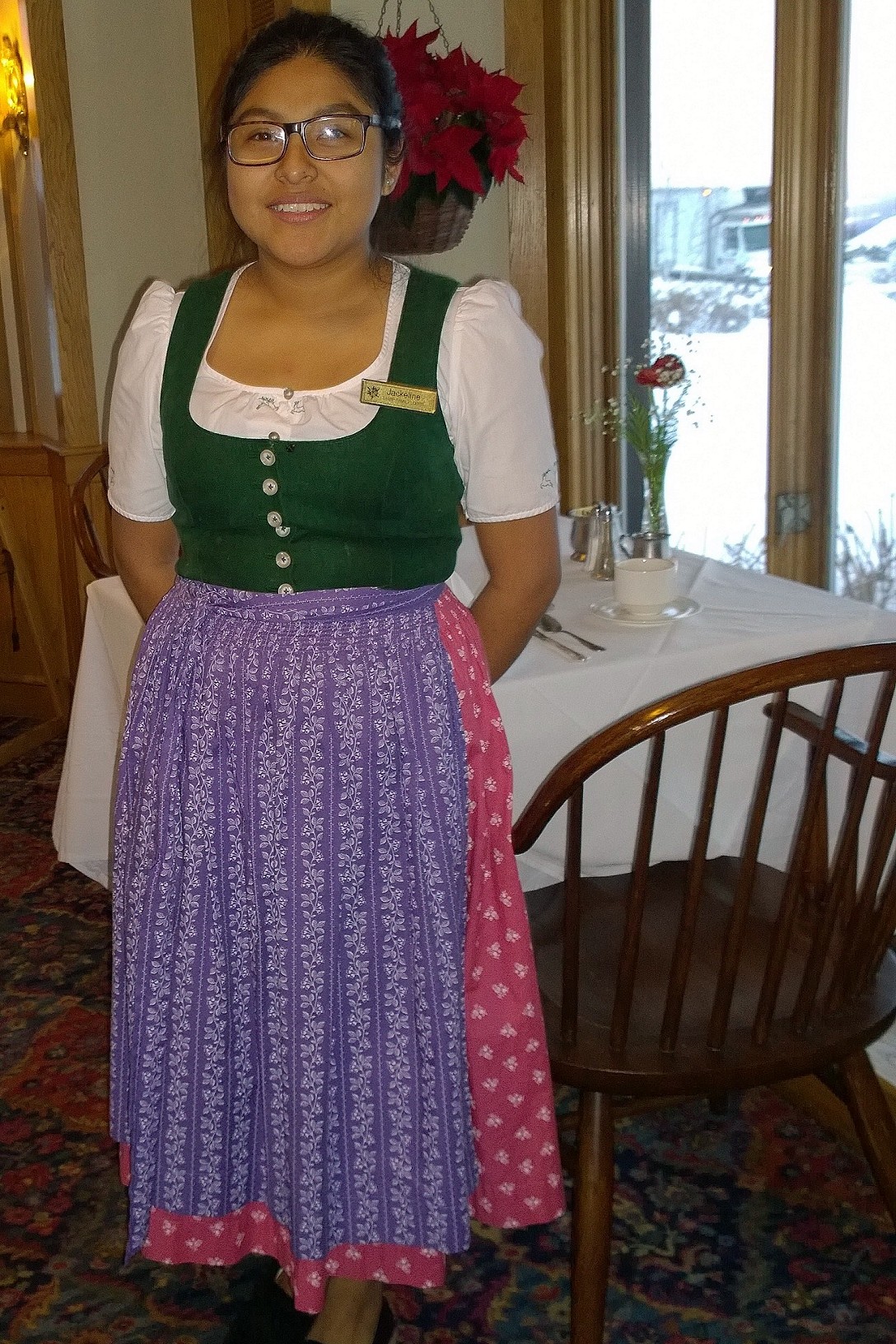
Dressing in Austrian dirndl at Trapp Family Lodge, Stowe, Vermont.

Nearly five years ago, when I was an editor, I solicited an article on Latino dairy workers from Daniel Baker at the University of Vermont. Dairy farms are practically synonymous with Vermont, where cows dot the mountainous landscape. The article summarized Dr. Baker’s research showing how essential immigrants were to the Vermont dairy industry’s survival. (Read the piece here.)

Of late, however, Vermont dairy farmers are anxious about their industry’s viability as walls both figurative and solid threaten the labor supply.

Visiting the state this week, I did note that there seemed to be a good supply of immigrants or former immigrants working in the hospitality industry at least.

I try not to ask people where they are “from” since friends in my Race in America group at the Fed have convinced me it’s a question that can make people feel unwelcome. But I was interested when someone whose way of speaking suggested Africa came to fix the hotel shower and when I noted the dirndl-garbed young lady above working the breakfast shift.

According to 2015 data from Migration Policy, Vermont has 2,619 residents born in Africa (9.3 % of the state’s foreign-born population in 2015), 8,199 born in Asia (29%), 9,113 born in Europe (32.3%), 3,038 born in Latin America (10.8%), 4, 875 born in North America, with small places like Greenland added to that mix (17.3%), and 403 born in Oceana (1.4%). By far the largest group is from Canada, which borders Vermont on the north. Vermont would be a more empty state than it is and nearly devoid of workers without all the foreign born.

If you’re interested in more, take a look at American Migration Council’s Vermont data, too. It’s here.

Read Full Post »