Feeds:
Posts
Comments

Posts Tagged ‘world war II’

Photo: Wild Gratitude.

Many of us know about the World War I Christmas truce, when as many as 100,000 soldiers on European battlefronts lay down their arms for a night.

I’ve been saving up a similar story by Dave Kindy at the Washington Post — this one from World War II. It’s a lovely one, with a Loaves and Fishes angle.

“On Christmas Eve 1944, heavy snow blanketed the Hürtgen Forest in Germany, near the Belgian border. Inside a tiny cabin deep in the woods, 12-year-old Fritz Vincken and his mother, Elisabeth, listened to warplanes and artillery shells as the Battle of the Bulge neared its climax. …

“Months earlier, the mother and son had moved to the isolated cottage when their home in nearby Aachen had been destroyed by Allied bombing. For Fritz, who first recounted his story in a 1973 article for Reader’s Digest, the remote cabin offered a reprieve from the death and destruction of World War II.

“They were alone because Fritz’s father, Hubert, who baked bread for the German army, had recently been called into service as Allied armies pressed closer to Germany. …

“Less than two weeks earlier, the tranquility of the Hürtgen Forest had been shattered when Field Marshal Gerd von Rundstedt unleashed 30 divisions hidden in the nearby Ardennes Forest of Belgium for the last major German offensive of World War II. Vicious fighting erupted across the Western Front, including around the Vincken cabin, as Allied armies desperately tried to repel the surprise attack amid blizzard conditions.

“As mother and son prepared Christmas Eve dinner, they were startled by a knock on the door. The closest neighbors were miles away. With Fritz by her side, Elisabeth opened the door and saw three young soldiers, all armed. Two were standing; the third was lying in the snow with grievous wounds. The men spoke a language unknown to the Vinckens. Fritz realized they were Americans.

“ ‘I was almost paralyzed with fear, for though I was a child, I knew that harsh law of war: Anyone giving aid and comfort to the enemy would be shot,’ Fritz later remembered.

“Elisabeth also knew the penalty for harboring Americans. But the soldier bleeding in the snow was young enough to be her son. She motioned for all three to enter the tiny cabin. Fritz and his mother helped the severely injured man into a bed and tended to his wounds.

“None of the Americans spoke German, but Elisabeth and one of the men communicated in French. Elisabeth, seeking to stretch their meager meal to accommodate the guests, told Fritz, Go get Hermann.’

Hermann was a rooster being fattened in case Hubert made it home for dinner. He was named for Hermann Göring, a Nazi leader for whom Elisabeth had little regard.

“Suddenly, there was another knock on the door. Fritz opened it, expecting to see more Americans lost in the forest. Instead, he was alarmed to find four German soldiers. The young men had become separated from their unit and were looking for shelter from the cold.

“Elisabeth went outside to speak with the new arrivals, telling them they were welcome to spend the night but had to leave their weapons outside. When the young Wehrmacht corporal started to object, Elisabeth looked at him sternly and said, ‘It is the Holy Night and there will be no shooting here.’

“While the Germans placed their weapons next to the woodpile, Elisabeth went back into the cabin and returned with the Americans’ guns. When they were all gathered inside, the enemies stared at each other in stony silence. …

“Elisabeth took command of the scene, Fritz wrote in Reader’s Digest, and had the combatants mingle close together. …

“When the wounded American started moaning, one of the Wehrmacht soldiers examined him. He had been a medical student before the war. … Eventually, everyone began to relax. Both groups of soldiers searched their backpacks for food to share. The Wehrmacht corporal contributed a bottle of red wine and loaf of rye bread.

“Soon the soup was served. Elisabeth bowed her head and said grace. Fritz remembered seeing tears in his mother’s eyes and noticed that some of the soldiers wept too, perhaps thinking of their families far away or feeling grateful that they wouldn’t have to fight on Christmas Eve. …

“Fritz always hoped to meet the soldiers again, though he knew his chances of seeing the Germans were not good, given their staggering casualty rate at the end of the war. He thought publicity might help, starting with his 1973 Reader’s Digest article, which President Ronald Reagan mentioned in a 1986 speech. In 1995, Fritz appeared on national television, telling his story on Unsolved Mysteries to host Robert Stack.

“A nursing home chaplain in Frederick, Md., saw the episode and remembered a resident telling a similar story. He contacted the TV producers about Ralph Blank. In 1996, Fritz flew to Maryland to meet with Blank, who was 76 and in poor health. They recognized each other immediately. …

“The reunion was filmed and shown on Unsolved Mysteries later that year. At one point during the episode, Ralph turned to Fritz and said, ‘Your mother saved my life.’ For the former German boy who was now an American citizen, that moment was the high point of his life.”

More at the Post, here.
Read Full Post »

7lml4w4k6rdejczc77tdfn7enq

Photo: Hanjun
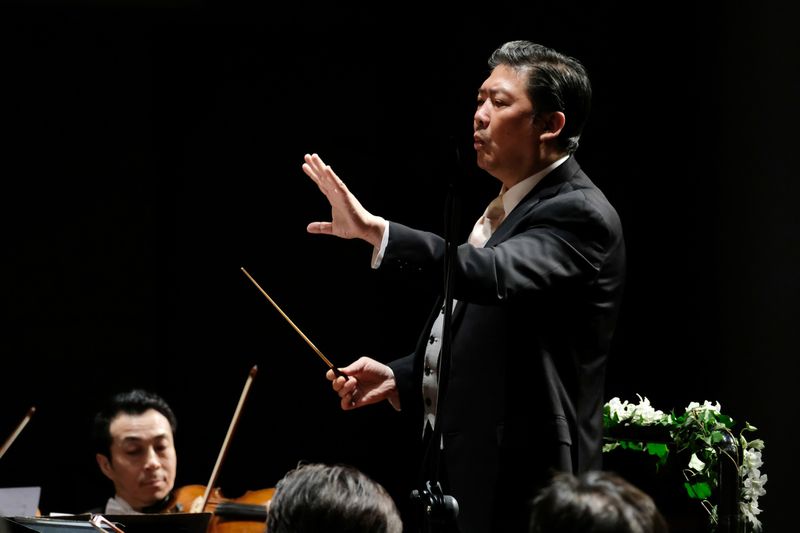
Music director Long Yu with the Shanghai Symphony  This orchestra carried on straight through World War I and World War II. During the Cultural Revolution, they had to play folk songs and songs of revolution. But they played.

This past August the Shanghai Symphony came to Chicago. And thanks to coverage of the visit, I learned something new about a Chinese city I visited in 2007.

Howard Reich interviewed the symphony’s conductor at the Chicago Tribune. “When the Shanghai Symphony Orchestra makes its Chicago-area debut Aug. 16 at the Ravinia Festival, no one will be prouder of the occasion than its music director, Long Yu.

“For to him, the Shanghai ensemble will be more than just a visitor from the other side of the world – it will be bringing with it a legacy stretching back to 1879, when it was established under a previous name.

“ ‘This is the first orchestra not only in China, but in the Far East,’ says Yu, speaking by phone from Hong Kong. …

“In effect, adds Yu, this orchestra ‘introduced most of the classical music to China and to Asia.’ …

“ ‘There is something wrong about how the Western world – I don’t speak about the United States only – the Western world is taking for granted our culture,’ [Chicago Symphony Orchestra music director Riccardo Muti] said. ‘In China, where we performed in this big (arts) center – where they have theater, concert halls and drama – that is so modern and fantastic, they told me that they are building a new hall!’ …

“Few could have envisioned such an embrace of Western classical music when the Shanghai ensemble was founded. But equally remarkable is the fact that it has survived through so many political, social and cultural upheavals.

“ ‘You can see this orchestra for 140 years, you can find all the programs through the First (World) War, Second (World) War, Cultural Revolution and till today – they have not stopped playing concerts,’ says Yu.

‘Especially during the Cultural Revolution, they still played! They did function in the Cultural Revolution – Chinese folk songs, but they still played. …

“ ‘Today it sounds like a very crazy idea. But during the years of the Cultural Revolution in China, it was fashionable to punish people for learning too much Beethoven, Bach and Mozart. I graduated from high school (in 1970) having been trained as a pianist, but my studies were interrupted, and I was sent to the rice fields for four years of physical labor. The government felt they needed to purify my soul, and they believed physical labor was the best way.’

“Musicians who nurtured Western culture suffered severely. Yang Bingsun, the Central Philharmonic Orchestra of China’s concertmaster, spent ‘nine years and four months in prison, my fingers constantly being injured because I was forced to work in cement,’ he told me in 1987. …

“What a difference a few decades make: In May, the First China International Music Competition launched in Beijing with an unprecedented first prize: $150,000 plus professional career management for three years (second and third prizes were $75,000 and $30,000). … Why have the Chinese put so much muscle behind classical music?

“ ‘To be placed on the international music map in a very serious way,’ Richard Rodzinski, the contest’s general director, told me earlier this year.

“Which helps explain why conductor Yu and the Shanghai Symphony Orchestra are bringing their wares here. …

“For his Ravinia program, he’ll feature cellist Alisa Weilerstein in Dvorak’s Cello Concerto, Rachmaninoff’s Symphonic Dances and Qigang Chen’s ‘Wu Xing (The Five Elements),’ a kind of East-meets-West program. But unlike some observers, Yu sees fewer distinctions between music-making in the two hemispheres.

“ ‘I don’t like to put Western music or Eastern music, Western culture or Eastern culture’ in categories, he says. ‘People ask me what is the difference between Chinese orchestras and Western orchestras? Basically, no difference. Eastern and Western orchestras do the same things, we teach every orchestra the same way, we rehearse the same way, we do the same programs.’ ”

More at the Chicago Tribune, here.

Read Full Post »

101817-Brush-Gallery-Vets-Ribbens-quilt

My former Minnesota boss, Ann Ribbens, has always quilted, even when her day job was something completely different. Her quilts have been in a number of shows and in a book published by Mary Ann’s company, Quarry: 1000 Quilt Inspirations, by Sandra Sider.

Recently, one of Ann’s quilts was accepted by the Brush Gallery in Lowell, Massachusetts, for an art exhibit honoring veterans. The show was diverse and included military artifacts, paintings, and photography. I thought Ann’s quilt was especially wonderful.

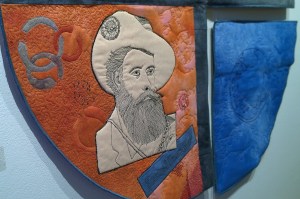
The quilt narrates the stories of three family members who served — one in the Boer War (lower left panel), one in World War II (upper left), and one in Vietnam (upper right). The fourth panel expresses her longing for peace and an end to all that veterans suffer in war and on their return from war.

I love the combination of gratitude and hope that these portraits represent, the war colors expressing the heat of battle and the cool blue expressing serenity.

The exhibit was presented in conjunction with Ironstone Farm of Andover, Massachusetts, which provides veterans who have experienced trauma and anxiety with a healing “equine encounter” one day a week for eight weeks. (“I never thought a horse could teach me so much about myself,” says one participant.)

101817-Lowell-MA-Ribbens-quilt

101817-Boer-War-Ribbens-quilt


Read Full Post »

My friend was born and raised in Hawaii. His parents were Japanese-American. His mother was sent to an internment camp during World War II. It’s a complicated story how she got released and ended up in Japan for the war’s duration. Something like a prisoner swap. She returned to Hawaii after the war and raised a family.

My friend was invited to talk to fifth graders about his mother’s experience in the camp. He was reluctant. It’s painful to think about. Would young children get it?

In the end, he went, and it was a good experience for him as well as for the kids. I think he had an impact on how they think about differences in our multicultural society. And their curiosity and understanding was a comfort to him.

Here is what he put on Facebook this spring.

“Last week I spoke to two classes of fifth graders about my mom’s experience in a Japanese-American relocation camp during World War II. After the talk, one of the students asked me why the Japanese-Americans had been relocated to camps but the German-Americans hadn’t. Wow, I could have hugged that boy for asking such a perceptive question, and I was also touched by how the students were able to draw a parallel between the Japanese-American discrimination decades ago and the anti-Muslim sentiment that’s currently been gaining so much traction in the U.S. and elsewhere.”

My friend posted a family photo that he goes on to describe. It is not the photo I put below.

“This photo, taken in the mid 1930s, is of my mom and her younger sister when they were growing up in downtown Honolulu, before they were forced to relocate to a camp in Arkansas. My mom looks like she’s around the age of the students I was talking to last week, and when I showed those students this photo I got a little emotional imagining my mom as a young girl being in that classroom too, listening to me tell her story. In such ways, our stories really do have such raw power to connect people through different generations and cultures, which, I suppose, is why I first became interested in becoming a writer all those years ago.”

America has always needed people like my friend’s mother — people who carry on and return benefits to the place that harmed them. And there are lots of them. Even in the town where I live, a couple who suffered internment during the war became quietly known for philanthropy to both the Nisei Student Relocation Commemorative Fund, Inc. and our town, donating all their reparation money to local high school scholarships.

Photo: Dorothea Lange
Some Japanese-Americans who suffered from internment in World War II
still chose to return kindness for hurt after the war.

Read Full Post »