Feeds:
Posts
Comments

Archive for June, 2011

Do you rent movies? If you haven’t seen “Young at Heart,” try to get it.

It’s about a group of seniors in Central Massachusetts and a choral director with a wild imagination. These guys go on tour — and pack the house. If you’ve never heard an 80-year-old on oxygen sing Coldplay’s “Fix You,” get ready for … deeper meaning.

“When you try your best but you don’t succeed

“When you get what you want but not what you need

“When you feel so tired but you can’t sleep

“Stuck in reverse …


“Lights will guide you home

“And ignite your bones

“And I will try to fix you.” More here.


And while we’re on the subject of music, here’s Shaimus, a young group with songs that are sometimes pretty mature. I like this line, “Do you ever wish you could rewind” from “Slow Down” on their album Paper Sun.


Here’s the official Shaimus video.


Read Full Post »

My last job in Minneapolis was located not far from the wonderful Northern Clay Center on Franklin Avenue. I liked to go over at lunch, and when the late Anne Kraus was showing her ceramics, I must have visited five times just to look at her domestic but fanciful pieces and read their cryptic messages. Kraus decorated exotic tea cups. teapots, tiles, and more with intricate, mysterious scenes, and on them she wrote puzzling remarks. You would think about them long after leaving.

This one, “I Can’t Sleep Tile 1998” has this written near the top: “I ask this intruder if he can be quiet because I want to sleep so that I can dream. But he tells me that we are right now asleep and deep into a dream.” (The photo in the Garth Clark Gallery survey book was taken by Noel Allum.) You can see more of Kraus’s work online. Here, for example.

By the way, Warren MacKenzie, a giant among potters, was one of the original founders of the Northern Clay Center in 1990. He gets around, and I have observed that he has an exhibit at the Lacoste Gallery in Concord (MA) almost every year. He is showing there now.

On October 28, 2011, the NY Times noted a sale of some Anne Kraus ceramics, which brought numerous people who were searching on her name to my post.

Read Full Post »

What makes you happy? The bluebird of happiness brushed a little air current toward me today as I crossed over a bridge at lunch. So I can report that one thing that makes me happy is seeing the jellyfish arrive in Fort Point Channel on a sunny day in late June.
*
I remember being ridiculously happy at the sight of Fort Point Channel jellyfish some years ago on a Boston visit that broke up a three-year landlocked Minneapolis sojourn. Minneapolis had its points, but it didn’t have jellyfish. Jellyfish naturally lead to thoughts of 25 summers on Fire Island and going with my father at dusk to shine flashlights on glowing blobs in the water along the boat dock.
*
Two poets share many Fire Island memories with me. Poem 1 is by my sister Nell. Poem 2 is by Ronnie Hess, now based in landlocked Wisconsin. I offer the conclusion to Ronnie’s “Dinner at the Shish Cafe,” and you may read the whole poem here.
*
1. May 1986

Now the island belongs to the deer

And the birds and the wild bayberry flowers

*

And the workmen

Wearily riding the ferry,

To work on other people’s houses,

Carrying their tools home at night.

*

There’s no honeysuckle

Yet rimming the streets

And the crown-vetch sliding through

Rips in the concrete

Has no pink buds

*

And the rain is like tears

Over the fog-filled ocean.

*

What brush, what watery ink

Has painted this sky

The color of bruises?

*******

2. My husband says listening to poetry is hard work. Poems are dense.
Sometimes, I let him read mine. He sits quietly. He studies them.
He edits in blue ink in the margins, he writes words like
Good, nice image, not quite right, and meaning unclear.
*
Those lines of Ronnie’s remind me of the ever ironic poet Marianne Moore, who wrote of her beloved art, “I, too, dislike it.” By which she meant, I think, that it was hard work.
*
More poetry by Ronnie is here and here.

Read Full Post »

I think that my cousin Sally has been an artist ever since she first picked up a crayon.

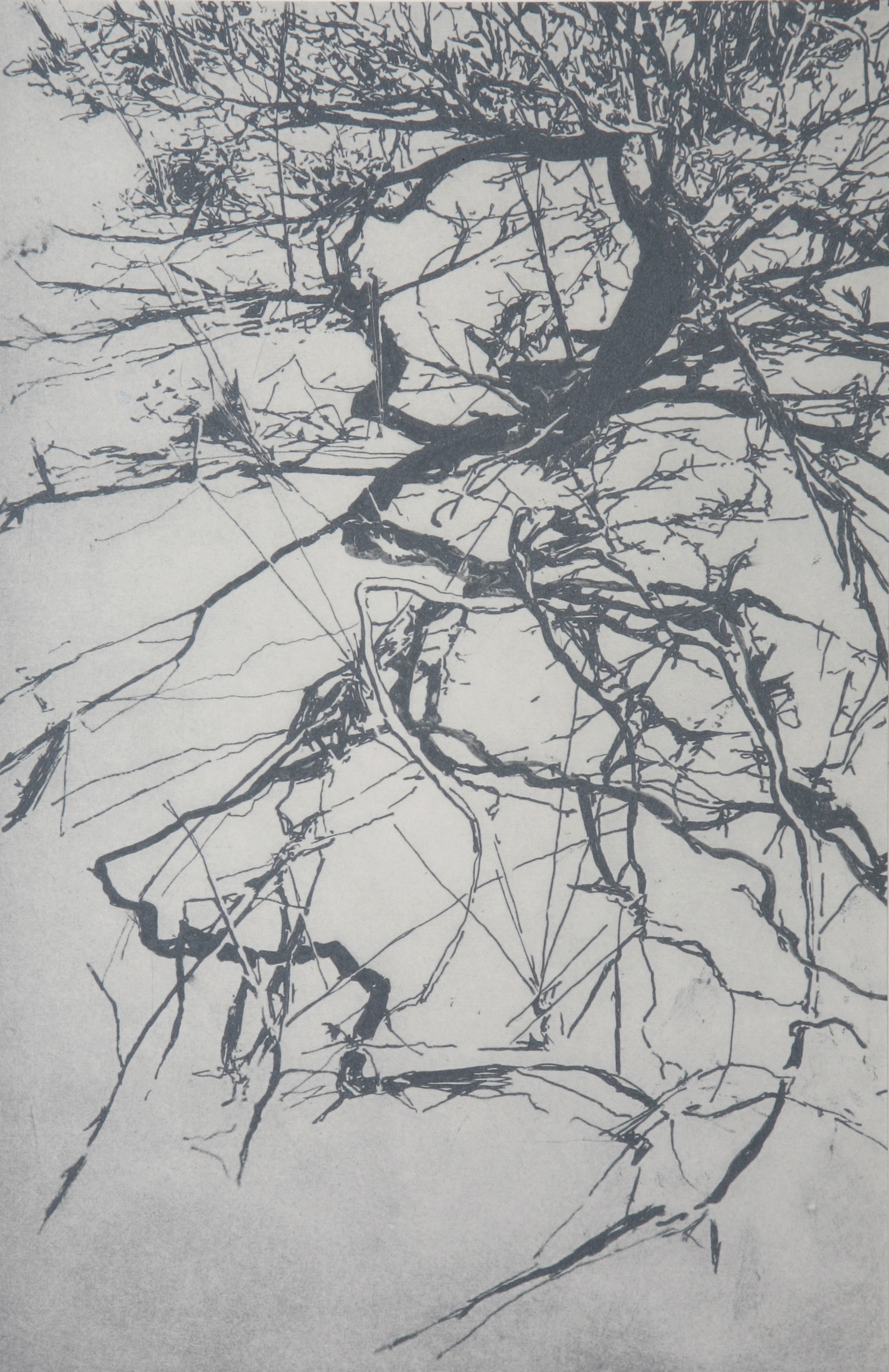
Today she works in monotype and other advanced media. Her work has appeared in solo and group shows. Read about the current one in Lakeville, Connecticut, here.

Sally has become a bit of an expert in beautiful, bare trees and branches. Whether or not this focus has anything to do with my Uncle Jim having been a supreme gardener and nature aficionado, I am not prepared to say, but if you read about Sally Frank here and look at some of her art, you will likely find that the trees speak to you in their subtle tree language.

Here Sally captures the intricate expressions of a beach plum bush.

Also, a lovely crabapple with a serene Asian vibe.

Read Full Post »

Saw an amazing photography show this morning. Lori Waselchuk chronicles a program at a maximum security prison. The exhibit flyer says, “A life sentence in Louisiana means life. More than 85% of the 5,100 inmates imprisoned at the Louisiana State Penitentiary in Angola are expected to die there. Until the hospice program was created in 1998, most prisoners died alone.”

The inmates who work in the hospice program are pictured caring for others and keeping a 24-hour watch when someone is near death. They “go to great lengths to ensure that their fellow inmate does not die alone.”

I don’t want to be a pollyanna about this (I can see that some patients are still so susceptible to violent outbursts that volunteers may visit them only by speaking through a small window), but I am interested that many of the hospice workers discover a new side of themselves. George Brown, 49, says, “The most important thing I have learned as a hospice volunteer is that I have a heart and it has feelings.” Sometimes the guards find a new attitude in themselves, too. The flyer adds that the show, Grace Before Dying, “reflects how grace offers hope that our lives need not be defined by our worst acts.” Read about it here.

I have heard about one or two similar prison programs. Here is a piece about the Yoga Prison Project , started at San Quentin in California. And here is a movie about a prison meditation project called Dhamma Brothers.

My second cousin Alex was so energized by teaching meditation in a Boston prison that she is now entering a graduate program to gain more skills.

Read Full Post »

Playwriting teacher Peter Littlefield had the class do an exercise. First, we each drew pictures of two different people on two pieces of paper and decorated them a little (stick figures were OK). Then we shuffled the pictures, and we each pulled out two that were not our own, invented names for the characters, and wrote the names on the papers. Then we shuffled them again and chose two other drawings. About these two final characters, we each wrote a little scene, read it aloud, and discussed.

It was almost like an inkblot test, because the stories we saw in these crude drawings came from inside us. People were very supportive of one another’s writing efforts, some of which entailed far-out themes, and the teacher pointed to what was unique about our voices and what aspects he himself found most intriguing.

The previous weekend I had had time to write a short monologue about someone I know, a rather obsessive person with whom I had recently had a strange conversation. I wanted to capture the bubbly surface and the sadness beneath. What was really nice was that everyone in the class totally got what I was doing.

We also did a Meisner acting exercise, which involved one person saying the same word over and over as another person repeats the word in between as if responding. I have just wasted a lot of time trying to find a good example of this Meisner exercise on YouTube. Although there was a lot of blah-blah-blah about Sanford Meisner and “the Group,” I think I better ask my class to make its own video. It would fill a YouTube vacuum for sure.

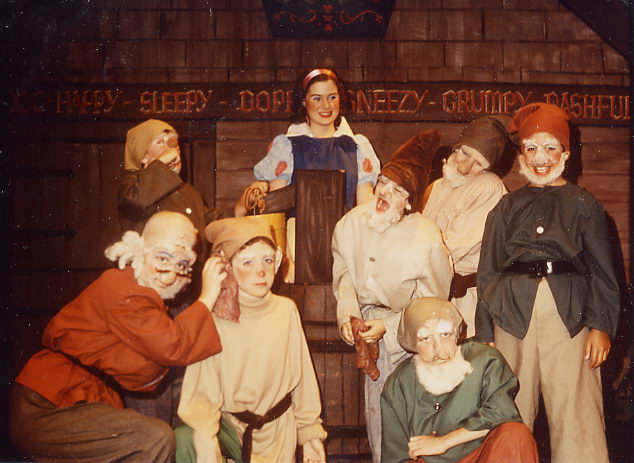
Instead, I am showing you, by means of the photo below, that the theater bug runs in our family. This is John as Grumpy in 1983  (lower right, green shirt).

And sometime you should ask Suzanne to sing “Turn Back, Oh, Man” from her performance in Godspell as a teenager.

Read Full Post »

In China, the artist responsible for some of the Beijing Olympics’ most amazing effects, Ai Weiwei, has been released on bail, at least for now. The authorities say they still are investigating him for tax evasion, but it is tempting to think it is really for being a free spirit. Here’s the NY Times article: “Chinese legal authorities released the dissident artist Ai Weiwei on Wednesday after a three-month detention, apparently ending a prosecution that had become a focal point of criticism of China’s eroding human rights record.”

Meanwhile in California, where a young Whitey Bulger once did a stint in Alcatraz, the missing Boston gangster has been found after 16 years on the lam.  Within a couple days of the FBI focusing on his girlfriend, he was identified.

Suzanne’s dad can now stop pretending to be Whitey’s double. Here’s the Whitey doppleganger with Pat.

I don’t think the Boston Globe, which claims all matters Whitey as its own, realizes to what extent the hunt was slowed down by look-alikes. The Globe reports here.


Read Full Post »

Some years before Suzanne launched Luna & Stella, her brother started his own entrepreneurial business, Optics for Hire. John’s work has entailed regular trips to Ukraine and Belarus to meet with optical engineers.

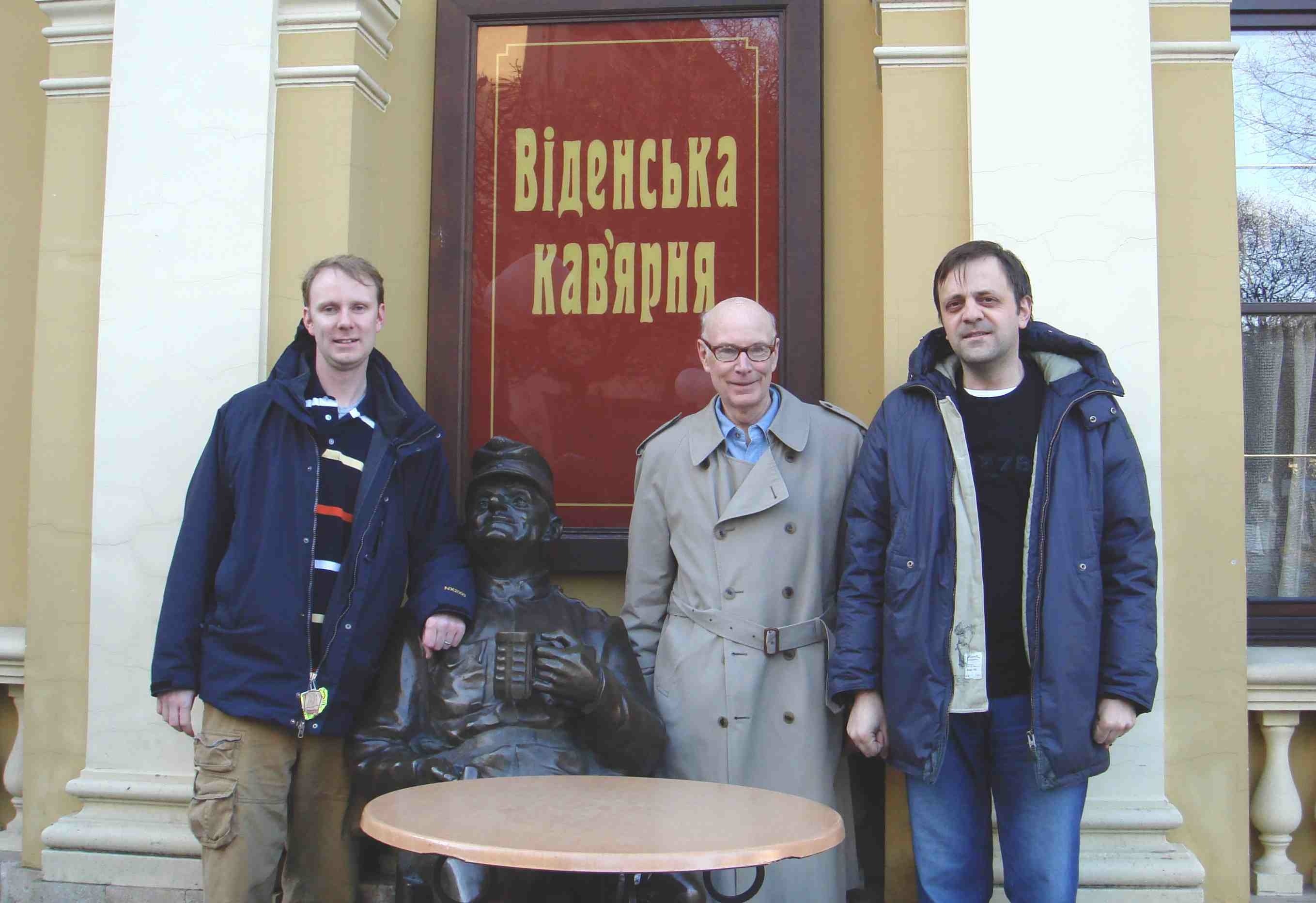
In 2008, his dad decided to join him on a trip to Lviv, Ukraine (called Lvov when it was part of Poland). Here they are.

John is on the left, then the Good Soldier Švejk (Schweick), then my husband, then a Ukrainian engineer.

Do you know the Good Soldier Švejk? He is a character in a Czech antiwar novel written after WW I. The book reemerged as the thing to read around the time of the Vietnam War. The Wikipedia write-up says in part:

“It explores both the pointlessness and futility of conflict in general and of military discipline, specifically Austrian military discipline, in particular. Many of its characters, especially the Czechs, are participating in a conflict they do not understand on behalf of a country to which they have no loyalty.

“The character of Josef Švejk is a development of this theme. Through possibly feigned idiocy or incompetence he repeatedly manages to frustrate military authority and expose its stupidity in a form of passive resistance: the reader is left unclear, however, as to whether Švejk is genuinely incompetent, or acting quite deliberately with dumb insolence.”

I was delighted to see that Švejk is still appreciated in Lviv.

Meanwhile, whenever John goes to Lviv, I always ask him to hunt down the lost masterpiece of the Jewish writer Bruno Schulz, best known for The Street of Crocodiles. He is said to have given his greatest work to a Catholic friend for safekeeping just before being shot in the street by a Nazi officer. I have read a good bit about him, including the biography Regions of the Great Heresy, and I am really worried about the missing work, The Messiah. He was an amazing writer.

 This write-up on the Internet generally coincides with what I have read about Bruno Schulz, except for the emphasis on his Polishness. Nations fight over his legacy because that part of the world has shifted so often. Israel also thinks he is theirs and about 15 years ago undercover agents upset Ukraine mightily by absconding with a mural Schulz had painted and taking it to a museum in Israel. The web write-up also mentions the great Israeli writer David Grossman’s novel about Schulz,  See Under: LOVE, a difficult read.

Read Full Post »

I have always liked reading poetry, but there is something extra delightful about actually knowing people who write good poetry.

Nancy Greenaway is a friend I see summers in Rhode Island. I learned last weekend that among other output, she recently published this poem at the Texas Observer site. It begins:

Salaam.

You write ghazals under shade of an acacia,

speak Farsi or Pashto,

eat qurmas, sabzi, lamb kebabs,

wear burqas and hijabs.

I write free verse under shade of a maple,

speak English,

eat pizza, cod, corn on the cob,

wear jeans and t-shirts. 

Read it here. 

Francesca Forrest has several online poetry outlets. In the tantalizing “Temptation,” an internal voice whispers,

Throw yourself down from here; try!

This is a dream, and you will fly.

Read “Temptation” here, published at the Linnet’s Wings. Two other poems by Francesca are “Songs Were Washing Up,” in the publication Scheherzade’s Bequest, and “Old Clothes Golem,”  at the site Stone Telling.

When Suzanne was getting ready to launch Luna & Stella, she came to the conclusion that a poet should write the descriptions of the birthstones, because only a poet would have the right artistic sensibility. As it happened, she knew a poet who also did copywriting, Providence-based poet Kate Colby. Here is what Kate wrote about the gems for Luna & Stella.

You might also like to read one of Kate’s poems, “A Body Drawn By Its Own Memory.” It begins :

Certain labels are impervious

to solvents, impermeable

as drawn bridges. …

I will post poems from time to time. Perhaps you will let me know what you like. Try the comments feature. Or e-mail me at suzannesmom@lunaandstella.com.

Nancy writes: 
“Thought you might be one of the few who would appreciate our adventures in Boston/Cambridge on Sunday and Monday. Malcolm and I had a one-night vacation by driving to Cambridge on Sunday, staying at the Marlowe Hotel (with a view of the Charles) and hearing Naomi Shihab Nye read and then receive the Golden Rose Award from the Poetry Club of New England. She concluded with her poem about the Block Island ferry (which will appear in her new book of poems to be released by BOA Editions in September.) Before the reading, to the amazement of all in the audience, she rushed up the center aisle directly to me and gave me a wonderful hug.”

Read Full Post »

Of course, it wasn’t really called Cancer Dance Class. It was called “I Hope You’ll Dance,” and any woman who had ever had cancer was welcome to come to Emerson Hospital and join in. It wasn’t really dance either. I would call it dancelike movement to recordings. With props. Teacher Susan Osofsky-Ross was a cancer survivor herself and had a great collection of music from her many years in the dance world. Some pieces, like “You Raise Me Up,” had a spiritual vibe.  But in the same session we were just as likely to perform numbers like “Diamonds Are a Girl’s Best Friend” (with feather boas) or “Everything Old Is New Again” (with bowler hats). There was a lot of chat and laughter even though not all of us were in remission.

One of the women brought her mother in a wheelchair. The mother had a heart condition. She danced with her arms and often cracked us up with her quiet humor. One day we came to class and learned that she had had an attack and was now upstairs in the hospital. She was in a coma. Her daughter had been with her all night and decided to join us for class while her brother kept the vigil. At the end of the class, we asked the daughter whether she thought it would be a good idea if we took the boom box up to her mother’s room and did one of the dances for her. Bonny said, “Yes. Let’s try it.”

So up we traipsed, through the hospital corridors to the sick room, and quietly sang and “danced” one of our more uplifting numbers around the bed in the cramped room.

We still like to think Bonny’s mother heard us and was pleased.

Read Full Post »

A swell time was had by all at the 350th anniversary of British settlers landing their boats on the shores of what is still the smallest community in the smallest state! The sun shone, the speakers were brief, and lots of pictures were taken.

I thought we had come a long way as a country when several speakers, including the governor, acknowledged that the Manissean Indians were there first and that there would be another ceremony at the Indian Cemetery the following weekend, with another commemorative marker.

The governor, who had earlier visited an oyster aquaculture area by boat, was brief and gracious. Interesting speakers included a Rear Admiral with a surname that is pronounced — I kid you not — Neptune. He gave the chief of police an award for a risky rescue at sea last year.

Dutch Consul General Kibbelaar was there because it was a Dutch navigator who originally named the island as he sailed by without landing. British Consul General Budden, based in Boston, made jokes about his brother who is the Consul General in Vancouver and the bet he intended to collect since Boston won hockey’s Stanley Cup. Budden was invited because the British were the ones who landed at Settlers’ Rock 350 years ago. He said that Britain today is the biggest foreign investor in Rhode Island. The chorus of the island school (which had recently graduated all seven seniors) sang the Alma Mater and “America the Beautiful.”

Gov. Lincoln Chafee (in green blazer)

First Warden Kim Gaffett (in straw hat) and governor

Dutch Consul General Kibbelaar (in white suit)

Read Full Post »

We heard an amazing concert by countertenor Terry Barber last night. His range goes from baritone to soprano, and his repertoire from the 1600s to contemporary. Formerly with the Grammy-winning group Chanticleer, Barber records and tours widely. You can hear excerpts from both his sacred and secular music on YouTube. Search on his name as I am having trouble embedding a sample here. (Weak Internet connection.)

Barber also founded, in honor of his mother, Artists for a Cause, which enlists performers for the fundraising activities of worthy nonprofits. Last night’s concert was for the benefit of the Mary D Fund, which provides for the emergency needs of struggling families in Rhode Island’s smallest town. It was held in the church where Suzanne and Erik were married not that long ago, and their pianist, Carrie Todd, accompanied Barber — along with organist Brink Bush and violinist Lisa Gray.

My husband and I are huge fans of Broadway music but loved everything that Barber performed (including the 2004 “Every time I look at you,” Schubert’s “Wohin,” Bernstein’s “A Simple Song,” Mozart’s “Laudate Dominum,” and  Cohen’s “Hallejujah.” “Anthem,” from the great Tim Rice musical “Chess,” blew us away. A piece that I recognized from what I used to call my “cancer dance class” was “You Raise Me Up” — tremendously moving.

Read Full Post »

Heard this interview today on the great environmental radio show Living on Earth. Tom Montgomery Fate talks about  trying to “live deliberately” like H.D.  Thoreau and connecting to nature and memories of his father in the woodland cabin he often escapes to. His book is  Cabin Fever: A Suburban Father’s Search for the Wild.

In the elementary school Suzanne attended, all second-graders learn about Thoreau, and as a parent volounteer, I went with her class to the cabin site at Walden Pond. The children had a quiz sheet with questions like, “What sounds would Thoreau have heard in his cabin?” The teacher asks,  “An airplane?” (All the kids say, “No-o-o!”) When the Living on Earth interviewer asked the author about his own retreat being near a noisy highway and a short walk to a pub, I was surprised that he didn’t point out that a Boston-Fitchburg train ran right along the edge of Walden Pond in Thoreau’s day, and that the famous naturalist had an easy walk back home to Concord for a Sunday dinner with his mother. Fate did explain that the Walden mystique was all about a mindset and keeping a balance between what’s important and the often numbing dailiness of modern life.

Asakiyume comments: Living deliberately. Something that’s very important to me about that concept is the notion that you can do it anywhere, in any circumstances. I’ll grant that some circumstances make it really hard: if you’re in a job you hate, or a relationship you hate–basically, if there’s some part of your life that’s putting a huge negative drain on you–I think it’s very hard. But I do think that living deliberately can be done in a suburb, in the country, in a city… not just in the wilderness. I think Thoreau wanted to mark, in actual space, his separation from mundane daily life, and I understand that. But I think it’s the mindset, not the location, that’s important.  

Read Full Post »

Suzanne’s friend Sara, from Pomona College days, has a nice report on KUMN, the public broadcasting station in Albuquerque. It’s about Health Care for the Homeless — a program serving 7,500 people in the Albuquerque area — and in particular, it’s about a successful art therapy program. The story tends to confirm my observations earlier this week on the “Waste Land” documentary — namely, that art can open up the world for even the most disadvantaged.

Comments may be sent to suzannesmom@lunaandstella.com. I will post them.

Asakiyume comments: I, too, felt the resonance with the entry you had posted earlier about Wasteland. On the one hand, when someone tells me in passing about various unusual services for the homeless–like this one–I sometimes roll my eyes and get all practical minded (art? art? how about a PLACE TO LIVE and a JOB).  And yet, on the other hand, the chance to make art, to be “allowed” (as it were) to be a person who creates, and not merely someone desperate to survive, restores dignity and personhood and also, I’m thinking, a kind of autonomy. So yes: ART!

Read Full Post »

I am taking a playwriting class at the Cambridge Center for Adult Education with Peter Littlefield, who also does a lot of directing. Here is an opera (Handel’s “Partenope”) he co-directed at the English National Opera. I wish I had a real video, but this is what I could find on YouTube.

I just had one class so far, and it looks like it’s going to be a lot of fun. The students are an interesting mix of ages and backgrounds, and I’m really looking forward to getting to know everyone. One woman, as it happens, teaches in a Boston elementary school where I volunteer.

I really like Peter’s sort of associative approach to playwriting, in which you mess around with images and ideas that interest you, then set them aside while you play with different images and ideas, and ultimately see how they converge. To me the attraction is that you’re less likely to get bored with what you are doing than if you were trying to force an idea into a structure. (I really am sick of writing coaches who harp on “structure.” I believe a structure will emerge.) We did a really funny exercise for openers.

Although I have often tried to write plays, the only actual class I ever had was in writing for TV, which I took while getting a master’s in communications at Syracuse’s Newhouse School. It was all about the formula: one, two three, gag (joke); one, two three, gag; one, two three, gag. Spirit crushing.

For fun, watch the first few minutes of opening-night comments on my teacher’s production of Partenope.

Comments may be sent to suzannesmom@lunaandstella.com. I will post them.

Asakiyume comments: I’m so excited about this playwriting class. You must have such a great sense of theater from *watching* so many plays, and you’ve definitely got stories to tell. I hope you’ll share any scripts that you do write.  (Your thing about television screenplays, with the “one, two, three, gag” made me laugh because of the alternative meaning of gag–which is what, of course, someone with an artistic vision and free spirit must surely do if trapped with such a formula.)

Read Full Post »

Older Posts »