Feeds:
Posts
Comments

Archive for December, 2012

It should be obvious that being out in nature is good for us, but today it often seems like a foreign concept.

“Take Two Hours of Pine Forest and Call Me in the Morning” is a lovely article, coming to you from Outside magazine. (I got the link from Andrew Sullivan’s blog.)

“These days, screen-addicted Americans are more stressed out and distracted than ever. And nope, there’s no app for that. But there is a radically simple remedy: get outside. [Outside magazine’s] Florence Williams travels to the deep woods of Japan, where researchers are backing up the surprising theory that nature can lower your blood pressure, fight off depression, beat back stress —  and even prevent cancer. …

“If the Japanese embrace of forest therapy can be attributed to one man, it’s [Yoshifumi] Miyazaki, a physiological anthropologist and vice director of Chiba University’s Center for Environment, Health, and Field Sciences, located just outside Tokyo.

“Miyazaki believes that because humans evolved in nature, it’s where we feel most comfortable, even if we don’t always know it. …

“Miyazaki has taken more than 600 research subjects into the woods since 2004. He and his colleague Juyoung Lee, also of Chiba University, have found that leisurely forest walks, compared with urban walks, yield a 12.4 percent decrease in the stress hormone cortisol, a seven percent decrease in sympathetic nerve activity, a 1.4 percent decrease in blood pressure, and a 5.8 percent decrease in heart rate. On subjective tests, study participants also report better moods and lower anxiety. …

“The science is so convincing that other countries are following Japan’s lead in studying and promoting nature as a cure. Lee just got hired away by the South Korean government, which is pouring more than $140 million into a new National Forest Therapy Center, expected to be completed in 2014. Finland, an empire of boreal spruce and pine, is also funding numerous studies. ‘Japan showed us that there could be cooperation between forestry and medical fields,’ says Liisa Tyrvainen of the Finnish Forest Research Institute” More.

Apart from just feeling better when I step outside for my walk and breathe the outdoors air, I note that a couple of my hero writers (Dickens and Asakiyume) are known for ruminating on long walks. Nature nourishes creative thought. P.S. Asakiyume also takes great pictures on her walks and posts them on her blog.

May 27, 2013, update from John: Mononoke creator Hayao Miyazaki on how he thinks about his art, here.

Photograph: Casey Yee
Mononoke forest, Yakushima Island, a
long the Kusugawa Trail. This is the forest that inspired Ghibli studio’s “Princess Mononoke.”

[University of Chiba‘s Yoshifumi Miyazaki] believes that because humans evolved in nature, it’s where we feel most comfortable, even if we don’t always know it. “Throughout our evolution, we’ve spent 99.9 percent of our time in natural environments,” he says. “Our physiological functions are still adapted to it. During everyday life, a feeling of comfort can be achieved if our rhythms are synchronized with those of the environment.”

To prove it, Miyazaki has taken more than 600 research subjects into the woods since 2004. He and his colleague Juyoung Lee, also of Chiba University, have found that leisurely forest walks, compared with urban walks, yield a 12.4 percent decrease in the stress hormone cortisol, a seven percent decrease in sympathetic nerve activity, a 1.4 percent decrease in blood pressure, and a 5.8 percent decrease in heart rate. On subjective tests, study participants also report better moods and lower anxiety.
Read Full Post »

Snow

Yesterday, according to WordPress stats, visitors who chanced on Suzanne‘s Mom’s Blog came from the United States, Canada, the Netherlands, the Cayman Islands, Serbia, the Russian Federation, Egypt, India, Nepal, and Ireland.

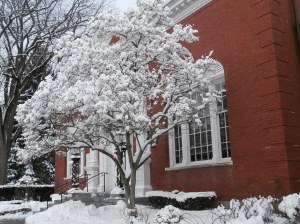
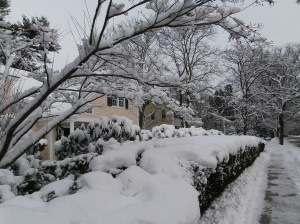
I don’t know if they found what they were searching on or if they will return, but in case they do, I’m posting a sampling of what happened here overnight. It won’t impress Margareta, who had lots of snow in Stockholm for Christmas, nor will it surprise blog visitors who live in Nepal or Canada, but the ones from India and Egypt might be interested.

The first real snow of the year always feels special. I have a friend who grew up in Hawaii and claims to hate winter, but he’s just as excited as I am to take pictures and post them on the Internet.


Read Full Post »

I took vacation time Thursday afternoon and went with my husband to the American Repertory Theater production of the musical Pippin.

A polished and charming spectacle — with actual circus performers punctuating stages of Charlemagne’s son’s search for extraordinary-ness — it nevertheless failed to move me. Not sure what I was looking for. I had only the vaguest memory of Suzanne playing the part of Pippin’s grandmother in a church youth group production. The words she sang then, “Time to start livin’ ” constituted my favorite song in the A.R.T. production — utterly hilarious.

The Boston Globe lists certain details: “The show, with music and lyrics by Stephen Schwartz, book by Roger O. Hirson, [has] direction by ART artistic director Diane Paulus … Playing Pippin [is] British-born actor Matthew James Thomas, who made his Broadway debut as the lead in ‘Spider-Man Turn Off the Dark.’ ”

The cast was tiptop. I liked the Bob Fosse dancing. I don’t mind that it is very stylized, but the whole show felt stylized and distancing. I felt I was always being caught up in the “art” of it and I wanted to be in the story.

The original version of Pippin was directed by Bob Fosse in 1972 and won nine Tony Awards. I think the A.R.T. version would do fine on Broadway, and I doubt most people would agree that the spectacle overwhelms the story. Most of the time it is just a lot of fun.

Photograph of Matthew James Thomas in rehearsal: David l. Ryan/Boston Globe

Read Full Post »

At Nourishing the Planet in October, Molly Redfield interviewed Vietnam vet Howard Hinterthuer, a peer-to-peer mentor for an Organic Therapy Program that helps distressed veterans.

Redfield: “You recently gave a Ted Talk on the Organic Therapy Program (OTP). Can you tell us how the OTP started? …

“William Sims, a Vietnam veteran of the 101st Airborne Division who served from 1966 to 1967, started the Organic Therapy Program. Mr. Sims was wounded after being in Vietnam for about 9 months, and returned home to Milwaukee. He was able to deal with the stress of coming home and experiencing combat by puttering around in his mom’s garden. He remembered that.

“The Center for Veterans Issues [in Milwaukee] has about 300 or more formerly homeless veterans in transition with PTSD, traumatic brain injury, and depression. These veterans come to us and we provide a wrap-around service to deal with their different problems. Mr. Sims figured that if gardening was good for him, then it would be good for other veterans as well. So he began creating raised-bed gardens to help veterans cope with their problems. …

“Gardening is important because it allows our veterans to have …  positive experiences. This is almost guaranteed by the act itself, as it creates such a peaceful place. Gardening is meditative and increases self-esteem. …

“After the TED talk I gave, I was contacted by a woman in Scotland working with veterans of the British military. Her program used horticulture for veterans’ recovery, so I think gardening is an approach to dealing with difficult issues that can definitely be replicated in other places.”

Read more.

Photograph: AP Photo/Chattanooga Times Free Press/Allison Love
Working in community gardening programs is proving to have many good effects on troubled military veterans.


Read Full Post »

The New York Times recently printed a lovely collection of pop-up music sightings by various reporters. Each unexpected free performance affected New Yorkers like a flash mob.

At the High Line, surprised “participants were given small sets of speakers that could be attached to their coats or backpacks, or held by hand. As you began the walk at the southern end of the High Line, near Gansevoort Street, your every footstep or hand twist kicked the app into action, and you heard various sounds — clinking, chimes, splashing water, car horns, chords on electric guitar and, in a novel touch, occasional rounds of applause.”

Another report notes, “The High Line elevated park does not normally allow group walks or amplified sounds, but it made an exception for ‘The Gaits,’ one of a dozen participatory performances that constituted Make Music Winter.

“The event was an offshoot of Make Music New York, a festival of hundreds of concerts that occurs in June on the first day of summer, in public spaces around the city. Modeled after Fête de la Musique, an annual affair in Paris started in 1982, the New York version is in its sixth year.

“The founder of Make Music New York is Aaron Friedman, a composer and political activist who decided it was time to add a winter solstice edition.”

Several delightful Winter Solstice music events are described here.

Photograph: Todd Heisler/The New York Times
Meredith Krinke, 6, holds Bach sheet music for her father, Brian, December 21 on the G train in New York.

Read Full Post »

When people click “like” at one of my entries, I go look at their site. Often I find that we share interests. Art is one interest.

Katie J. Anderson clicked “like” for the post “Art in the Exurbs.” I think she is an artist in Scotland.

Her WordPress blog, here, led me further, to an artists’ cooperative blog where she volunteers time. The site is the Commonty, which in Scottish law is a “common; a piece of land in which two or more persons have a common right.”

Following Ariadne’s thread from one blog to another can confuse a person. Thus, the Commonty took me to “The Stove,” which the site says emphatically is not the Commonty although TheStove’s home page also seems to be the Commonty’s.

Perhaps confusion is a hazard of a blog run by many people. I dug some more and found this: “an artists collective from SouthWest Scotland, The Stove is occupying a 3 storey building in the heart of Dumfries as the HQ for an adventure that asks useful questions about the role of a southern regional capital in contemporary Scotland.”

Which doesn’t sound that different from this: “The Commonty was formed, and is run entirely, by working creative people on a voluntary basis – we have nobody’s remit or priorities except our own.

“We are committed to the vision of Dumfries and Galloway as a region whose character is significantly shaped by the creative people and projects that are based here — we see a vital spark in the interconnections between our environment and culture, making this the place that we want to live, and a place that we are proud of.”

In a recent post, the Commonty notes with pride: “The Theatre Royal, Lochside Theatre, and The Stove have received funding from Creative Scotland as part of a national programme which helps organisations carry out refurbishments and purchase equipment.”

Does someone from Dumfries or Galloway want to tell me more?

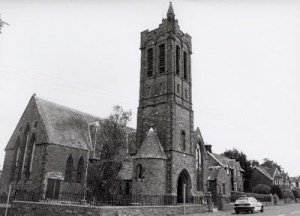
Photograph of Lochside Theatre at http://thecommonty.blogspot.com/

Read Full Post »

A busy holiday here in New England with both our kids, their spouses, and the two grandsons. Every time we thought we were nearly done opening presents, one or more of us needed a nap.

The distaff side produced a chicken masala (with rice, nuts, raisins, cilantro, coconut, and chutney from Swaziland via the Servv catalog), creamed spinach, salad, and pear crumble.

Meanwhile, here’s a Christmas-y story from South America …

“In 2001, when Argentina’s economy was near collapse and property prices plummeted, UCLA art prof Fabian Wagmister bought a 15,000-square-foot abandoned warehouse in Buenos Aires. When he finally set out to clear the remaining debris from the building last year, he uncovered more than 100,000 Christmas ornaments piled in one of the back rooms.

“What to do with a trove of metallic bulbs, plastic wreaths, and bags of fake snow for a sunny Argentine Christmas?

“Re-gift them, of course,” writes Elise Hennigan at Pacific Standard.

“ ‘As artists we were immediately taken by the powerful expressive potential of the materials,’ says Wagmister.

“Now the director of the University of California, Los Angeles’s Center for Research in Engineering, Media, and Performance (REMAP), Wagmister invited a team of ten artists, researchers, and programmers from Los Angeles to distribute the ornaments to the surrounding community …

“Starting on December 15, the team invited community groups to visit the warehouse, one among many lining a historically working-class district that has seen an influx of technology companies. There, the researchers have encouraged participants to develop projects that will use the ornaments to express their identities, struggles and aspirations. On December 23, the groups took to the streets and decked the halls accordingly.” More.

 Photograph: Pacific Standard
Some of the found ornaments going up around Argentina’s capital

Read Full Post »

Higgs Boson Cookie

At this time last year, I wrote at Suzanne’s Mom’s Blog that I came home from running an errand and found mystery cookies in the back door. It didn’t take long, however, to recognize the artistry of a certain family Suzanne has known since kindergarten.

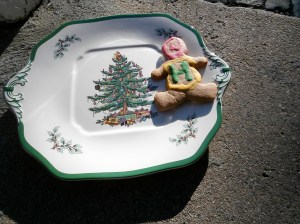
This year, the pater familias presented me with a cookie I guarantee has never been seen before.

Perhaps you have heard of the Higgs Boson, that elusive particle that physicists claim is necessary for mass. It was thought to have been corralled last July after “a decades-long search [and] the construction of one of the most expensive and complex experimental facilities to date, the Large Hadron Collider, able to create and study Higgs bosons (if they exist).” Thus, Wikipedia.

Do you believe in things unseen?

Well, let me tell you: if Higgs Boson were a cookie, this is what it would look like. (Please note the H and the confusion in the brain.)

Read Full Post »

, a National Public Radio (NPR) reporter, had an intersting story a while back about a vibrant art community in rural Marfa, Texas.

“This tiny town perched on the high plains of the Chihuahua desert is … a blue-chip arts destination for the sort of glamorous scenesters who visit Amsterdam for the Rijksmuseum ...

“It all started when the acclaimed minimalist artist Donald Judd left New York City in the 1970s for this dusty dot of a town. He wanted to escape the art scene he claimed to disdain. With the help of the DIA Foundation, Judd acquired an entire Army base, and before he died in 1994, he filled it with art, including light installations by Dan Flavin and Judd’s own signature boxes. One hundred of them, made of silvery milled aluminum, are housed in two old brick artillery sheds. … Now, all 400 acres of the site are run by the Chinati Foundation. …

Sculptor Campbell Bosworth, for one, loves living and working in Marfa.

” ‘You just come out here and you feel like, I want to make something; I want to do something!’ ”

Read more about art in exurbia. Cities are not the only places where art can be made.

But you knew that.

Photograph: Judd Foundation/Licensed by VAGA, New York, NY
In the 1970s, minimalist artist Donald Judd moved to Marfa, Texas, where he created giant works of art.

Read Full Post »

Public banks can be helpful in emergencies, and what with hurricanes, tornadoes, and all, we sure seem to have a lot of emergencies.

Grand Forks, North Dakota, figured this out after one of their floods. Most banks have to make sure their loans meet the tough safety and soundness requirements of regulators, so they may not come through fast enough for people trying to rebuild after a disaster. Grand Forks isn’t relying on them.

Kelly McCartney at Shareable (by way of the Christian Science Monitor) says that the Public Banking Institute blog at WordPress “cites a powerful example of how a public bank can help a city bounce back from a devastating natural disaster. As Hurricane Sandy recovery efforts unfold, there’s a lesson from history about the role of strong local financial institutions in increasing urban resilience.

“In April of 1997, Grand Forks, North Dakota, was hit by record flooding and major fires that put the city’s future in jeopardy. One of the first economic responders was the Bank of North Dakota (BND), currently the only public bank in the United States.

“What’s a public bank, you ask? Public banks are owned by citizens through their government. They have a public interest mission, are dedicated to funding local development, and plow profits back into the state treasury to fund social programs and cover deficits. Rather than competing with private banks, BND partners with them to meet the needs of North Dakotans. …

“As a public bank, BND was able to respond to the ’97 flood in ways that a privately owned bank could not …

“Right after the flood, the Bank of North Dakota got to work, established a disaster relief loan fund, set aside $5 million to assist flood victims, and set up additional credit lines of around $70 million.” More.

Photograph: Reuters/File
Residents of Grand Forks, N.D., carry their pet dog to safety in the shovel of a frontloader April 20, 1997. The more than 50,000 residents of the city were forced to evacuate as the Red River reached 25 feet above flood level. A public bank, owned by citizens, was a key player in the city’s recovery.

Read Full Post »

Right outside my window at work is the rejuvenated Boston Tea Party Museum, which I watched rise from the ashes over a period of years.

On Sunday, December 16, there was a public reenactment of the original Boston Tea Party. A Boston Globe reporter got into the action:

“Upon entering the museum,” writes Christopher Klein, “we were given cards with brief biographies of actual Tea Party protesters, identities we would assume for the next hour. I realized I was dealt a bad hand as I read about my alter ego, John Crane, the Colonist caper’s lone casualty. After being knocked unconscious by a falling tea crate, Crane was thought to be dead and hidden by his compatriots under a pile of wood shavings in a nearby carpenter’s shop.
 
“He awoke hours later, however, and given a new lease on life, much like this museum itself, which was destroyed by a lightning strike in 2001 and set ablaze again in 2007 from sparks from a construction project on the Congress Street Bridge. Reborn after a $28 million makeover, the attraction features historically accurate replicas of two of the Tea Party ships, the Eleanor and the Beaver, which were modified from wooden fishing vessels.”
 
More at the Globe.

Photograph: Christopher Klein for the Boston Globe
Costumed volunteers at Boston Tea Party Ships and Museum where they toss crates of tea into the harbor.

Read Full Post »

Here’s another nice story about using the arts to inspire kids who are turned off by school in troubled districts.

Writes Patricia Cohen at the NY Times, “Stationed in front of one of his large self-portraits, the artist Chuck Close raised his customized wheelchair to balance on two wheels, seeming to defy the laws of gravity.  The chair’s unlikely gymnastics underlined the points that Mr. Close was making to his audience, 40 seventh and eighth graders from Bridgeport, Conn.: Break the rules and use limitations to your advantage.

“The message had particular resonance for these students, and a few educators and parents, who had come by bus on Monday from Roosevelt School to the Pace Gallery in Chelsea for a private tour of Mr. Close’s show. Roosevelt, located in a community with high unemployment and crushing poverty, recently had one of the worst records of any school in the state, with 80 percent of its seventh graders testing below grade level in reading and math.

“Saved from closure by a committed band of parents, the school was one of eight around the country chosen last year to participate in Turnaround Arts, a new federally sponsored public-and-private experiment that puts the arts at the center of the curriculum.”

Read about the reactions of the students — and more at the NY Times.

Photograph: Kirsten Luce for the NY Times
The artist Chuck Close giving a private tour of his show to students from Bridgeport, Conn.

Read Full Post »

Deanna Isaacs has a funny post at the Chicago Reader. It’s about the Storefront Playwright Project.

“Tired of sitting around watching paint dry?” she asks.

“Then get yourself over to 72 E. Randolph, where, thanks to the League of Chicago Theatres and the Department of Cultural Affairs and Special Events, you can watch a real, live writer at work.

“The Storefront Playwright Project is putting 27 authors on exhibit this month in the big front window at Hot Tix/Expo 72.

“Never mind that writing is right up there with sleeping as a potential spectator sport, so stimulating that the writer him- or herself often has to bring the action to a complete stop in order to check e-mail, clean a closet, or book a flight and get the hell out of there. …

“Guessing that dramatists would be more dynamic at work than, say, novelists (readily observed in deep rumination at most any coffee shop), I stopped by last week, when Emilio Williams was on display.

“The playwrights each take a four-hour shift. Williams was a couple hours into his afternoon stint, gamely focused on his laptop, which was perched on a small white table and hooked into a large screen mounted in the window. The big screen faces outward, allowing passersby a look at the creative product the instant it emerges from the writer’s brain. …

“Behind the glass, Williams pursed his lips and crossed his ankles. …

“He leaned his chin on his hand and scrolled through several pages of dialogue that went something like this:

“Mar: Done?

“Ted: Yep.

“Mar: You don’t sound very enthusiastic.

“Williams paused.

“He blinked.

“He scrolled again.

“And then, it happened!

“On the big screen, before my very eyes, the cursor hesitated. It stopped. And it backed up, deleting as it went, wiping out ‘tucitcennoC’ and replacing it with ‘Lake Geneva.’ ” More from Deanna, even funnier.

Readers may recall several posts I wrote on a playwriting class I took the summer before last. (For example, here.) I thought the class got playwriting out of my system. Should I reconsider now that playwrights have the opportunity to sit in storefronts where strangers can watch them think?

Um, maybe not.

Photograph: The Chicago Reader

Read Full Post »

How much fun would this be: to sit next to a music group that uses improvised passages, and to write a words on scraps of paper indicating how you would like to hear the next bit played, and to hear the words take shape as sound?

That is what NY Times critic Corinna da Fonseca-Wollheim got to do recently, and I have to say, I admire her word choices.

“On a recent rainy afternoon,” she writes, “I was sitting at an old-fashioned desk in a bare concrete loft in Greenpoint, Brooklyn, listening intently to the members of So Percussion, joined by Grey McMurray on electric guitar, rehearse a composition called ‘Toothbrush.’  …

“I was busy tearing scraps of paper out of my notebook and scribbling words on them. ‘Feathery,’ for example, and, ‘Question everything,’ and, ‘You want to dance.’

“Then I would dash over and deliver my note to one of the players and hear it translated into sound or action.

“ ‘Toothbrush’ is an otherwise fully composed and notated piece featuring instrumental music, singing and spoken dialogue — plus one silent participant who sits onstage listening and writing down notes that become in-the-moment instructions for players to improvise on. …

“Next to me, Adam Sliwinski was tapping out a crisp rhythm on a tom-tom with one hand and on a tambourine and wooden plank with the other. ‘With Outrage,’ I scribbled on a scrap of paper and placed it in his field of vision. Almost immediately, mallets went flying in an explosion of angry energy.” More here.

I want to try this. Just need to find a willing musician.

Photograph: Hiroyuki Ito for The New York Times
Jason Treuting rehearsing with So Percussion.

Read Full Post »

A Little Free Library has come to Cambridge.

Writes Jan Gardner at the Sunday Globe, “About a block from the Cambridge Public Library, its Lilliputian cousin is perched atop a post on the sidewalk. At this Little Free Library, open since mid-October, there are no due dates, late fees, or library cards. Made out of recycled wood, it consists of a single shelf that holds about 20 books.

“The library’s founders are Laura Roberts and Ed Belove who put it in front of their house at 1715 Cambridge St. so they can keep an eye on it. …

“Sabrina Françon, a student at the nearby Harvard Graduate School of Design, sees the Little Free Library as an example of tactical urbanism, a trend she is studying. She wants to determine whether small playful citizen projects like the Little Free Library influence a neighborhood’s social capital.” Roberts reports to Françon what she sees from the window.

“The little library had its origins on Facebook. A friend of Roberts posted a message about Little Free Library, a nonprofit that started in Wisconsin three years ago. Founder Todd Bol built the first library in tribute to his late mother, a book lover.”

More from the Globe. You may also want to read my earlier post on the concept here. By the way, have you ever noticed that the Globe posts weekday articles fast, but Sunday Globe articles like this one may wait until Tuesday.

Photograph: Laura Roberts

Read Full Post »

Older Posts »