Feeds:
Posts
Comments

Archive for March, 2014

Photograph: Devesh Uba
Grocery store in Makoko, Lagos, Nigeria.

A recent manmade-island story in the Guardian made me think of Francesca Forrest’s lovely novel Pen Pal, which involves a girl in a floating community in the U.S. South who corresponds with a political prisoner in Asia.

The Guardian article, however, is about designers and architects building islands for populations threatened by rising seas.

Jessa Gamble writes, “It may seem like science fiction, but as rising sea levels threaten low-lying nations around the world, neighbourhoods like [the Yan Ma Tei breakwater in Hong Kong’s Causeway Bay, where residents live in boats] may become more common.

“Whereas some coastal cities will double down on sea defences, others are beginning to explore a solution that welcomes approaching tides. What if our cities themselves were to take to the seas? …

“The immediate and most numerous victims of climate change are sure to be in the developing world. In Lagos, the sprawling slum of Makoko regularly suffers floods, and its stilted houses are shored up with each new inundation. It’s under threat of razing by authorities.

“The Nigerian-born architect Kunlé Adeyemi proposes a series of A-frame floating houses to replace the existing slum. As proof of concept, his team constructed a floating school for the community. Still, many buildings do not make a city: infrastructure remains a problem here. One solution would be to use docking stations with centralised services, rather like hooking up a caravan to power, water and drainage lines at a campground.” More.

It all sounds like Noah building an ark. But I can’t help thinking it would be better to end global warming in the first place.

Photograph: Seasteading Institute, by way of the Guardian
The Seasteading Institute proposes a series of floating villages.
Read Full Post »

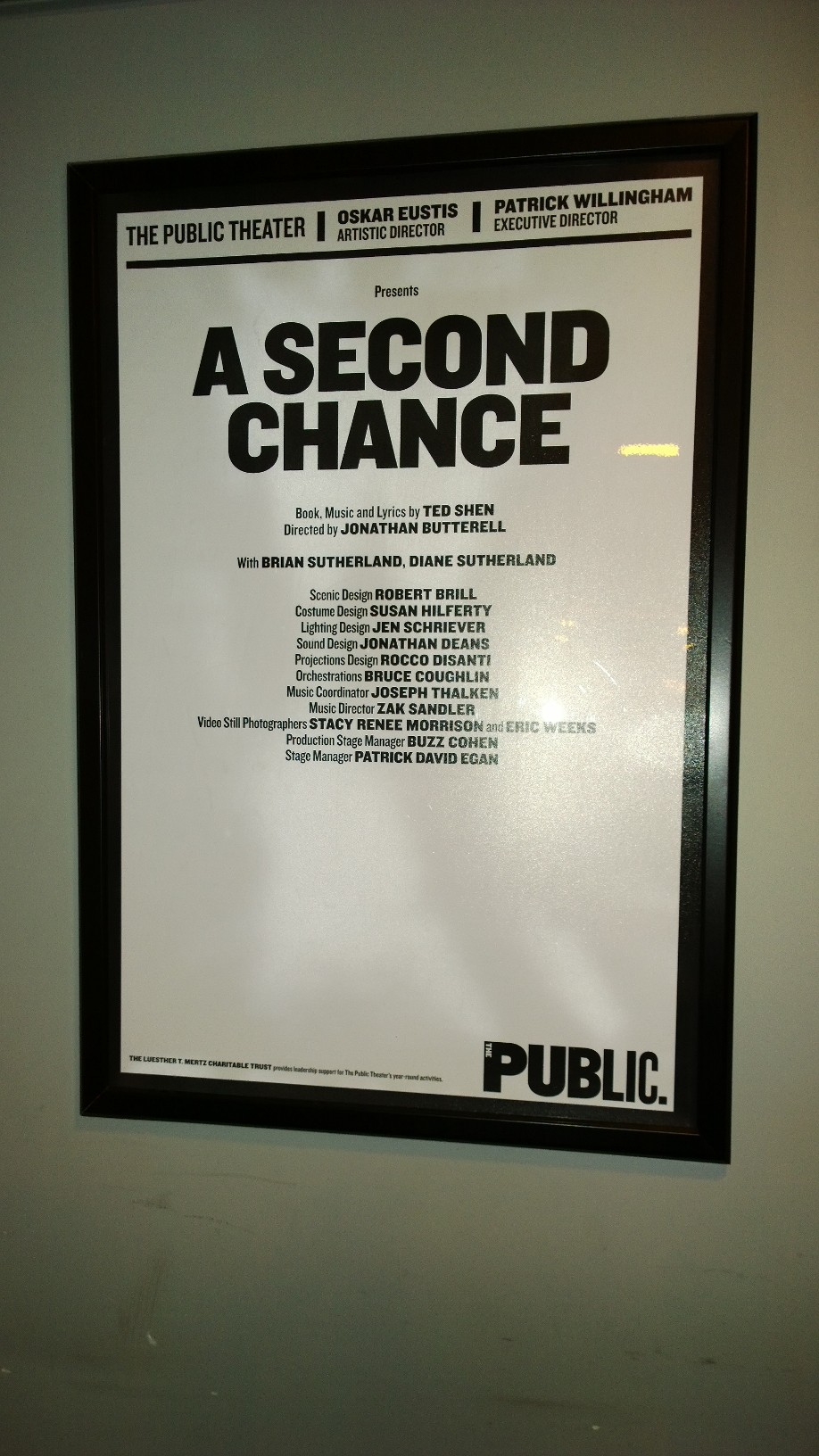
Ted-Shen-Second-Chance-at-PublicWe went down to New York this weekend to see my husband’s classmate’s new musical.

Ted Shen wrote the book, lyrics, and music to A Second Chance, a lovely little cameo about a widower and a divorcee. The title refers to new beginnings for two people, but it’s hard for my husband and me not to think of new careers, too, since Shen was an investment banker for 30 years before turning to music so seriously.

At TheaterMania, where a couple of old reviews I wrote are still archived, Shen describes how he began to develop his musical after Stephen Sondheim gave him encouragement.

And he explains his style. “In my role as composer, my preference has been to emphasize the use of ‘action songs’ that show the characters interacting with each other and conversing primarily through lyrics rather than pure spoken dialog, and to limit the use of ‘introspection songs’ that stop the action to express feelings and inner thoughts. I have attempted to create a contemporary musical ‘language’ that is jazz-inflected rather than written in today’s predominant pop-based genre.’ ” More at TheaterMania.

Oskar Eustis, the artistic director of the Public Theater, where the show is being performed, says that Shen “has written some of the most elegant and sophisticated music I have heard in theater in many a moon.”

While in New York, we also saw the musical A Gentleman’s Guide to Love and Murder (based on the movie Kind Hearts and Coronets). It was pure Broadway fun, and we laughed a lot. But A Second Chance gave us more to talk about after.

Consider checking out the site for the Shen Family Foundation, here, which “concentrates its grant-making in the area of musical theater through its funding support of works of exceptionally gifted and highly original musical theater composers.”

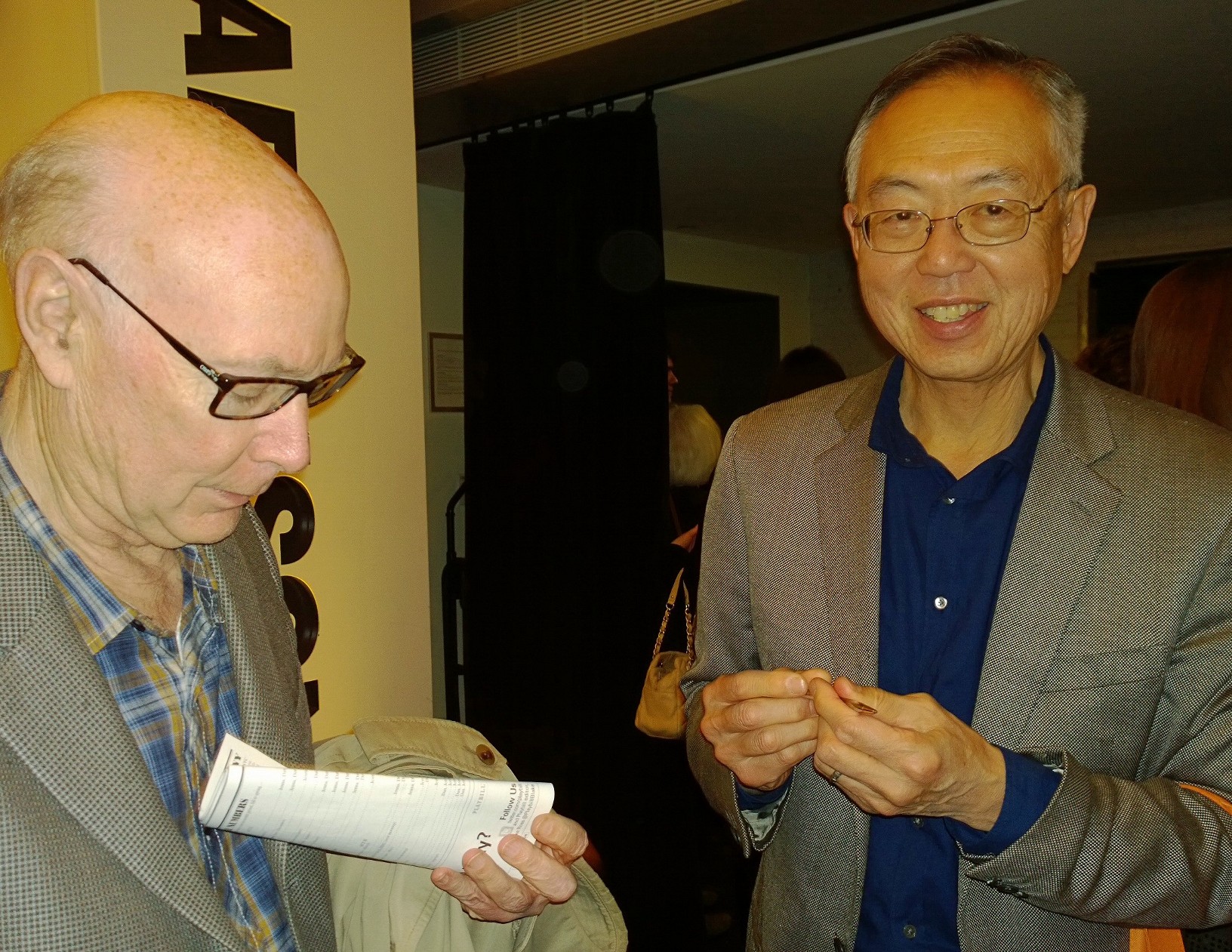
Photo: Suzanne‘s Dad reconnects with his classmate decades after business school and asks him to sign a Playbill.

032914-John-and-Ted-Shen-at-Public-Theater

Read Full Post »

Art: Edward Mitchell Bannister, Boston Street Scene, Wikimedia Commons

Some years ago, a friend who creates exhibits opened a highly successful one on black entrepreneurs in 18th and 19th century New England. In the process, she made the acquaintance of the Rhode Island Black Heritage Society. The society lent her exhibit some materials from its collection, including mementos of the painter Edward W. Bannister: a portrait he did of his wife, Christiana Carteaux Bannister, an original brochure for the nursing home that she helped found.

My friend has kept in touch with the society, which is how I learned about the two adorable-sounding events for children below.

“Join the Rhode Island Black Heritage Society at the Old Brick Schoolhouse in Providence for the annual Boys’ Bow-Tie Event [on May 3, 10 a.m.-12 noon]. The Boys’ Bow-Tie Event is a chance for boys ages 6-12 to learn to tie a bow-tie and a number of other useful skills to know as they transition into young adulthood. Attendees will be instructed by Casby Harrison, Esq., and other mentors on how to properly shake hands and introduce themselves in public. Attendees are asked to wear a collared shirt. Refreshments will be served during the event. All participants get a free bow-tie for attending!” Sign up at EventBrite, here.

And for the young ladies: “Join the Rhode Island Black Heritage Society at the historic Governor Lippitt House on Hope Street in Providence for the Girls’ Tea Party [on May 17, 2 p.m. to 4 p.m.] Girls will be instructed on how to take tea and learn the basics of social etiquette. Mrs. Christiana Bannister, abolitionist and businesswoman, will also share stories of historic Black women in RI. All Participants will receive a complementary vanity mirror for attending!” Go to EventBrite, here.

Both events are free to attend. “If you would like to sponsor a child for the event by covering the cost of tea and vanity mirrors [or bow ties], you can do so with a donation to the Rhode Island Black Heritage Society. The cost to sponsor one child is $15. Please use the donation form [at EventBrite] or send a check to 123 North Main Street, Providence, RI 02903.

“The Rhode Island Black Heritage Society was founded in 1975 with a mission to preserve three centuries of African American history in the state.  The Society has amassed an invaluable collection of artifacts that documents African Americans’ achievements in military service, business, politics, the arts and education.  The Rhode Island Black Heritage Society encourages and promotes the study of African American history by hosting tours, lectures, and exhibits for the general public.”

Read Full Post »

Holmes-School-Dorchester-MaA new employee goes to the Oliver Wendell Holmes School in Dorchester with the team I’m on. He can’t get over how great it is to work for an organization that gives you time to do this. We go out once a month from January to June, and other teams go once a month so that we cover every week.

I started eight years ago with the team that read picture books to a room of first graders. Then I read for a few years with fifth or fourth graders who received chapter books from the librarian. These were students whose teachers thought they would appreciate the extra reading. We all read aloud, with the adult volunteers only taking a turn if the story seemed to lag.

Holmes is a minority-majority urban school with many dedicated teachers who are tolerant of the extra work it takes to herd volunteers. (We also have volunteers who work on math.)

This year, the team I’m on includes the woman who started the whole relationship with Holmes 20 years ago and is now retired. We are assigned to read copies of printed passages and help the children answer multiple-choice questions from tests they have had in the past.

Given the current nationwide emphasis on testing and these third graders’ tendency to keep guessing wildly, I consider it my role to focus on the thought process and deemphasize getting the right answer. I ask, Why do you think that’s the answer? How did you get there?

The administrators often tell us that we make a difference. We’re probably just a drop in the bucket. But, you know, One and One and 50 Make a Million.

More employers should make it so easy to improve the world in which they operate. Other employees probably spend the hour and a half it takes to go out, tutor, and get back once a month in less valuable ways.

Read Full Post »

I remember going with Nicky Perls up a steep and very narrow stairway near Times Square years ago so my brother could buy bootlegged blues 78s. Later Nicky traveled the South buying up old 78s and rediscovering blues singers like Mississippi John Hurt.

Record collecting can become an obsession, as seen in a Brooklyn Magazine excerpt from Do Not Sell At Any Price: The Wild, Obsessive Hunt for the World’s Rarest 78rpm Records, by Amanda Petrusi.

Petrusi says, “In the 1940s, 78 collecting meant jazz collecting, and specifically Dixieland or hot jazz, which developed in New Orleans around the turn of the 20th century and was defined by its warm, deeply playful polyphony …

“Because of its origins, collecting rare Dixieland records in 1942 was not entirely unlike collecting Robert Johnson records in 1968, or, incidentally, now: deifying indigent, local music was a political act, a passive protest against its sudden co-optation by popular white artists. …

“In January 1944 [collector James] McKune took a routine trip to [the Jazz Record Center operated by Big Joe Clauberg] and began pawing through a crate labeled ‘Miscellany,’ where he found a record with ‘a sleeve so tattered he almost flicked past it.’ It was a … nearly unplayable copy of Paramount 13110, Charley Patton’s ‘Some These Days I’ll Be Gone.’

“Patton … was almost entirely unknown to modern listeners; certainly McKune had never heard him before. He tossed a buck at a snoozing Clauberg and carted the record back to Brooklyn. As [scholar Marybeth] Hamilton wrote, ‘even before he replaced the tone arm and turned up the volume and his neighbor began to pound on the walls, he realized that he had found it, the voice he’d been searching for all along.’ ”

More here on the world of the impassioned music collector.

Photo: Nathan Salsburg

Read Full Post »

No matter how much you like your routine or how pleasant your surroundings, sometimes you just have to get up and go out. Today I needed a change of scene so, in spite of the freezing temperatures and high wind, I went to look at some art.

The Design Museum is not far from my office, and the folks there come up with lots of good projects. I blogged here about their Street Seats, an array of public benches designed by creative people from around the world.

This being Design Week in Boston, I decided to check out the exhibit space they are using in a new apartment building called 315 on A, a lovely renovation of an 18th century warehouse for coffee.

The new exhibit is called Green Patriot Posters and features handsome posters from professionals as well as the pretty impressive results of a school poster contest on the conservation theme.

Many of the posters explicitly reference WW II posters. You know: “Loose lips sink ships” and all that. Here, the posters urge viewers to pursue a more sustainable way of life and fight global warming. More.

Be sure to check the poster over the left shoulder of the woman speaker in this video. That was my favorite in the show because it made me laugh out loud. I think you can see a Paul Bunyan figure with an ax. He is looking at the tree he was going to cut with an uncertain expression as the tree is growing out of his foot.


Read Full Post »

If you happen to be in the jungle with nothing but paper, a ball lens, a button battery, an LED, a switch, 3 cents worth of copper tape, and a need to see if there is E. coli in the drinking water, you’re in luck! You can make your own microscope.

Writes Keith Hartnett at the Boston Globe, “In recent years there’s been a trend in international development work towards building low-cost versions of key tools for widespread dissemination—inexpensive computers that let Indonesian fisherman check the weather before they go out to sea, or clean-burning stoves that replace coal and improve air quality in family huts.

“Now a laboratory at Stanford University has introduced a microscope that’s made of paper, assembled using principles of origami, and costs less than $1 to manufacture. It’s called Foldscope. …

“Despite the simple construction, Foldscope is a capable tool of real science. Users can adjust the focus using paper tabs, and the engineering team, led by bioengineer Manu Prakash and funded in part by the Gates Foundation, explained in a paper [PDF] that Foldscope ‘can provide over 2,000X magnification with submicron resolution.’ ” More. Hat tip to MIT Technology Review.

I wonder if I could get a gig folding paper at John’s Optics for Hire. I just made an origami fortune-teller for John’s son on Saturday, after all.


Read Full Post »

OLYMPUS DIGITAL CAMERAYou never know what you’ll find at Andrew Sullivan’s blog.

Today he notes research on the memory of toddlers. A new study has demonstrated that three-year-olds have memories of  seeing someone once, back when they were one.

Danish researcher Osman “Kingo and his team first renewed contact with parents and their children who’d taken part in an earlier study when the children were age one. That earlier research involved the infant children interacting with one of two researchers for 45 minutes – either a Scandinavian-Caucasian man or a Scandinavian-African man.

“Now two years on, 50 of these parents and children – the latter now aged three – were invited back to the exact same lab (hopefully cueing their earlier memories). Here the children were shown two simultaneous 45-second videos side by side. One video was a recording of the researcher – either the Scandinavian-Caucasian or Scandinavian-African man – interacting with them two years earlier; the other video showed the other researcher (the one they hadn’t met) interacting with a different child in the exact same way. …

“The children spent significantly more time looking at the video that featured the researcher they’d never met. … This result provides strong evidence that the children had some recognition of the researcher they’d met, and were drawn more strongly to look at the unfamiliar researcher.”

More at Andrew Sullivan, here, and at Research Digest at the British Psychological Society, here.

I am especially delighted that there’s a bit of proof for what I have long insisted was true. (No one ever believes that I remember taking my first steps.)

Read Full Post »

bitcoin-machine-at-South-StationA friend is doing research on bitcoin and other virtual currencies.

Although it sounds like phoney money to me, I still honor the lesson I got in fourth grade about how a dollar represents trust. You trust when you receive it that it will be accepted by someone else in exchange for something you want. You trust the entity that backs it. Today people are using virtual currencies like real money, so trust is working so far.

But does it all remind you of the company that used to accept your money and promise to do your worrying for you? Or how about virtual gift giving, which enjoyed a flurry of attention in the media a while back. (The gift company will e-mail your friend that you “bought” a virtual gift. The concept is based on the premise that it’s the thought that counts. VirtualGifts4U.com, for one, just asks you to support its sponsors.)

I took this picture at Boston’s South Station, where, during specified hours, a friendly young man will explain how you can buy bitcoins at this machine. I haven’t chatted with him, so I don’t know if he also explains that the value of your bitcoins can not only go up in an hour or two but go way down.

There is no significance to the fact that the machine is located right next to an endlessly running “If you see something, say something” security video.

Read Full Post »

Something fun from Studio 360: the mystery of the Toynbee tiles.

“For more than two decades, an unknown artist has been leaving a message in the streets of Philadelphia. The message is has been cut by hand into a linoleum tile, and pressed into the asphalt by the weight of passing cars. There are dozens of these around the city; old ones wear away, and new ones appear. The message is the same:

TOYNBEE IDEA
IN Kubrick’s 2001
RESURRECT DEAD
ON PLANET JUPITER

“The Toynbee tiles, as they’re called, have become a thing in Philly — you can even buy a t-shirt (the tiler isn’t getting royalties). For artists, the cryptic message inspires far-out forms of creativity, but perhaps nothing as ambitious as the ten-minute work by the rapper and ‘bedroom composer’ Raj Haldar, who performs as Lushlife.

“The work is in four parts, one for each line of the tiles’ message. By the end, the ‘Toynbee Suite’ has left behind anything resembling hip-hop, going out on a two-minute clarinet solo.

“But what exactly is the Toynbee message? Alfred Toynbee was a historian and philosopher of the 20th century, known for the 12-volume A Study of History. …

“A documentary film speculated that the tiler remained unseen by dropping the tiles from a car with cut-out floorboards.”

More on the mystery here, where you also can listen to the rapper’s tile-inspired music and check out a map showing where Toynbee tiles are located around Philadelphia.

Photo: Kimberly Blessing/flickr
A Toynbee Tile at 9th and Market Streets in Philadelphia, Pa.

Read Full Post »

Because I believe in Pete Seeger’s notion that “one and one and 50 make a million,” I’m drawn to stories of individuals making small contributions that could add up to something big.

So here is a story from Forbes, of all places, about several women in Detroit quietly working toward rescuing the city.

Denise Restauri writes, “As we drive through Detroit, on the surface I see a city that’s been abandoned by its residents, filled with poverty and crime. But when we stop and meet store owners, artists and women who went from being homeless to employed, I see a city that’s energized with entrepreneurship, hipster creativity and potential.

“Suddenly I understand what Veronika Scott, the 24-year-old who is sitting in the driver’s seat, often called ‘the crazy coat lady,’ means when she says, ‘I love Detroit.’

“Veronika is empowering Detroit with a disruptive business model. She’s the CEO and Founder of The Empowerment Plan, a non-profit organization that employs homeless women and trains them to become full-time seamstresses who produce coats that turn into sleeping bags which are given to homeless individuals across the nation.

“She doesn’t just employ these women — she educates and equips them with the professional skills and knowledge needed to compete in Detroit’s new economy and evolving job market.”

Restauri goes on to describe five other female-powered enterprises in her Forbes post.

JJ Curis, 32, is gallery director at the Library Street Collective, which helps struggling artists. The five James Sisters, 25-32, cofounded DROUGHT to make organically grown produce accessible to all.

Amy Kaherl, 32, is the executive director of Detroit SOUP, a novel idea that involves inviting people to pay for a dinner where they can hear pitches from local charities and vote on which one should get the evening’s donations, or micro grants.

Cheryl P. Johnson, 53, is the CEO of COTS: Coalition On Temporary Shelter. And LaKeisha Blackwell, 41, is jail diversion coordinator at Northeast Guidance Center. Read about the women here.

Photo: Forbes
Veronika Scott wears the Empowerment Plan’s sleeping bag coat.

Read Full Post »

An early stage in the creation of a Hari & Deepti light box

Do you ever click on the links to the right, in my blog roll? My Dad’s Records, for example, has old blues recordings you’d be hard-pressed to find anywhere else.

And This Is Colossal is a constant wonder. Today the art and visual-culture site posted illuminated paper light boxes that have to be seen to be believed.

Says Colossal: “Deepti Nair and Harikrishnan Panicker (known collectively as Hari & Deepti) are an artist couple [originally from India] who create paper cut light boxes. Each diorama is made from layers of cut watercolor paper placed inside a shadow box and is lit from behind with flexible LED light strips. The small visual narratives depicted in each work often play off aspects of light including stars, flames, fireflies, and planets. The couple shares about their work …

‘What amazes us about the paper cut light boxes is the dichotomy of the piece in its lit and unlit state, the contrast is so stark that it has this mystical effect on the viewers.’ ”

More.

Read Full Post »

National Public Radio recently featured a researcher who has figured out a way to help people who can’t talk by matching the sounds they are able to make to someone else’s voice and creating a synthetic voice.

“Speech scientist Rupal Patel creates customized synthetic voices that enable people who can’t speak to communicate in a unique voice that embodies their personality.

“Rupal Patel directs the Communication Analysis and Design Laboratory at Northeastern University. She helped found VocaliD, an organization working to help the millions of people who use computerized devices to communicate in unique voices.

“Patel’s technique to move beyond the usual generic male voice. She samples the tones of those with severe speech disorders and matches them with a surrogate talker. By blending the two, the team can create a synthetic voice to match the person using it.”

Check out the NPR story here.

Read Full Post »

One thinks of Iran as repressive, and having watched the doomed 2009 revolution unfold on twitter, I believe it is. But Iranian theater people seem to be managing to squeeze in some fun.

I blogged before about the Tehran production in a taxi, here. Now Studio 360 has a story on what might be called extreme improvisation. I take that back. There’s a script. But the actor doesn’t get to see it in advance.

“Actors face stage fright all the time,” says Studio 360, a radio show. “But consider this scenario: you show up to perform a one-person show, and you’ve never seen the script. You don’t know what it’s about because you promised not to do any research. It’s your first performance, and the only one you’ll ever have. The theater’s artistic director hands you a fat manila envelope with a script. And go.

“Also, the audience will decide whether you drink a glass of water that appears to have been poisoned.

“This is the premise of White Rabbit, Red Rabbit, by Iranian playwright Nassim Soleimanpour. ‘I did not know what was in front of me inside that envelope,’ says actor Gwydion Suilebhan. ‘What if this script is going to require that I disrobe? Or insult my mother? Or be rude or self-debasing?’ …

“Soleimanpour pulls his strings from afar, because — although the play has been performed in Toronto, Berlin, San Francisco, Brisbane, Edinburgh, London, and now Washington, DC — he really is in a cage. He doesn’t have a passport and can’t leave Iran, so he has never seen his play performed. ‘Nassim has given up the kind of control that is customary for playwrights,’ says Suilebhan, of working with actors and directors to realize the play. ‘At the same time, because he has put all of these restrictions on how it is to be performed, he has seized certain kinds of control that playwrights normally do not have. So he is literally embodying the ideas of control and submission and manipulation that he’s baked into his script.’ ” More.

Photo of Iranian playwright Nassim Soleimanpour found at the HuffingtonPost

Read Full Post »

Recently, I cut out an article about Dr. Seuss and his hometown of Springfield, Mass., for a visiting brother who had memorized Dr. Seuss’s first book at the age of 3. The book was And to Think That I Saw It on Mulberry Street.

Writes Christopher Klein in the Boston Sunday Globe travel section, “Whenever young Theodor Geisel [the birth name of Dr. Seuss] stepped out the front door of his pale gray boyhood home at 74 Fairfield St. a century ago, a vibrant urban cavalcade awaited. Streetcar bells clanged. The engines of locally built Stevens-Duryea automobiles and Indian motorcycles purred. Clydesdales clomped on cobblestones as they hauled wooden barrels of beer produced at the Geisel family brewery.

“During summer months, young Ted explored the vast natural spaces of nearby Forest Park, and he sled down its hills in wintertime. The boy’s creative mind concocted the extraordinary from everyday life. After visits to the park’s zoo with his mother, he doodled a wild menagerie of beasts with nonsensical names on his bedroom walls.

“The Springfield of Geisel’s youth was a dynamic boomtown; its population doubled between 1890 and 1910. The city’s factories roared as they manufactured everything from Smith & Wesson firearms to Milton Bradley board games, Rolls-Royces to Absorbine Jr. It was a magical time to grow up in Springfield.”

After leaving for Dartmouth College and years in the advertising business in New York, “a chance sidewalk encounter on Madison Avenue with a college friend who had started a job that very morning with Vanguard Press led to the 1937 publication of his first children’s book, And to Think That I Saw It on Mulberry Street, in which the magical imagination of a boy named Marco transforms a mundane horse-drawn wagon into a street pageant complete with a ruby-clad rajah atop an elephant pulling a big brass band.” More here on a charming tour of Springfield today.

I wonder if Mulberry streets in the old days — before the irrelevant street naming of massive developments — got their names because they had actual mulberry trees. I like picking mulberries, and Suzanne and John always liked them, too. Suzanne even lived on a Mulberry Street after college.

Photo: Christopher Klein
A Lorax statue in a Dr. Seuss sculpture garden, Springfield, Mass.

Read Full Post »

Older Posts »