Feeds:
Posts
Comments

Archive for March, 2018

Photo: Beinecke Flickr Laboratory/CC BY 2.0
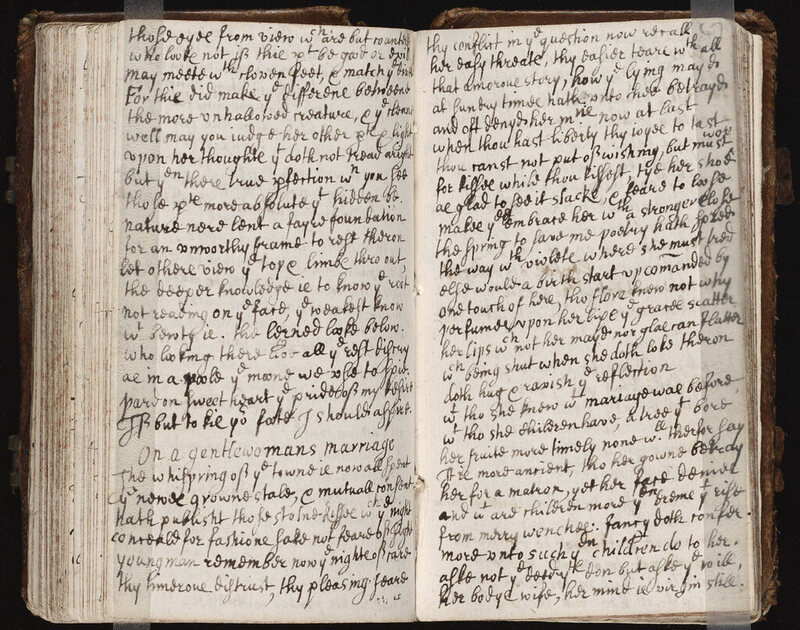
A 17th century “commonplace” book. Linda Watson, a transcriber on the Isle of Man, can decipher pretty much any document.

One of the great things about word processors (well, typewriters, too) is that people with terrible handwriting can make themselves understood. The secretary who used to be the only person in the company who could read the boss’s handwriting can now spend time on more valuable work.

But documents written out long ago still need to be deciphered, often for legal purposes. Enter transcriber Linda Watson on the Isle of Man (a British Crown dependency in the Irish Sea). Watson has built an unusual talent into a business employing transcribers in an array of languages.

Sarah Laskow writes at Atlas Obscura, “On any given day, from her home on the Isle of Man, Linda Watson might be reading a handwritten letter from one Confederate soldier to another, or a list of convicts transported to Australia. Or perhaps she is reading a will, a brief from a long-forgotten legal case, an original Jane Austen manuscript. Whatever is in them, these documents made their way to her because they have one thing in common: They’re close to impossible to read. …

“The problem is not only that our ancestors’ handwriting was sometimes very bad, but also that they used abbreviations, old conventions, and styles of lettering that have fallen out of use. Understanding them takes both patience and skill. ‘I see the job as a cross between a crossword puzzle and a jigsaw puzzle,’ says Watson.

“She fell into this line of work about a decade ago, when a cousin asked for help deciphering a family will and she discovered that she has a talent for interpreting the strange, scrawling writing of the past. … Since then she’s had a steady stream of projects from amateur genealogists, grad students struggling with their long-sought primary source material, and libraries. The British Library had the company transcribe not just Austen’s work, but also manuscripts from the Brontës, William Wordsworth, Percy Bysshe Shelley, Samuel Taylor Coleridge, John Donne, and other luminaries.

“ ‘You can actually see how they have changed their manuscript — how Jane Austen changed Pride and Prejudice as she’s writing it,’ says Watson. …

“Most of the documents that people need to understand, though, are wills and legal papers, which have their own pleasures. ‘The inventories I love,’ she says. ‘It’s like someone comes to the front door and says, come on in to my house and have a look around.’ … A woman described each piece of her wardrobe, down to her second-best red flannel petticoat, and specified which great-niece or -nephew should receive each item. …

“Older scripts — court hand, for instance, which was used by lawyers and clerks beginning in the medieval period (and eventually became stylized into illegibility) — have long, narrow strokes and letters jammed together to save space, making it a challenge to find where one word ends and another begins. Some styles of writing lean heavily on space-saving abbreviations: An extra flourish on a letter ‘p’ can turn it into a ‘per’ or ‘par,’ a ‘pro’ or ‘pre,’ depending on the exact position of the extra line. …

“Since she first started specializing in old documents, Watson has expanded beyond things written in English. She now has a stable of collaborators who can tackle manuscripts in Latin, German, Spanish, and more. She can only remember two instances that left her and her colleagues stumped. One was a Tibetan manuscript, and she couldn’t find anyone who knew the alphabet. The other was in such bad shape that she had to admit defeat.

“In the business of reading old documents, Watson has few competitors. … ‘I’ve seen some documents done by the software, and they just make you laugh. I think I’m safe in my job for a good while yet.’ ”

More at Atlas Obscura, here.

4/27/18. I just learned anyone who can read handwriting can join a transcribe-a-thon. There are events for transcribing the papers of Frederick Douglass, among others. Here is one the Massachusetts Historical Society is holding to get the voluminous diaries of John Quincy Adams online: https://www.masshist.org/calendar/event?event=2248.

Read Full Post »

Photo: Anthony Casillo
The Sholes & Glidden Type Writer, 1874.

Personally, I never liked using a typewriter. Part of the problem was I didn’t learn to touch-type until I was over 50. But I also find typewriters are too limited. Word processors let you search for a word, fix mistakes fast, cut and paste — they also let you see if you accidentally hit the space bar an extra time. (Well, some features are more important than others.) I don’t love spellcheck because it uses a different dictionary from my favorite, and I hate the distracting grammar check. I turn it off.

We all value different things. Some people, for example, still value typewriters.

Anthony Casillo writes at LitHub, “In the late 1970s, I stumbled upon an old, long abandoned, Oliver typewriter stored away in the back room of a typewriter repair shop where I worked in New York City.

“The Oliver was unlike anything I had ever seen. … It was old and deserving of greater appreciation than it was receiving there. It begged me to rescue it from that dark room — and potentially the trash heap. So, I packed up the 30-pound orphan and carried it home on the subway during my standing-room-only rush-hour commute.

“Once home, I began to explore this beauty a little further. The Oliver opened a door to a new world for me, one that ignited my curiosity about the early history of the typewriter. …

“Shortly after the Oliver discovery, I was leafing through the classified section of a monthly typewriter trade magazine when another vintage machine caught my eye: a Blickensderfer typewriter from the 1890s was being offered for sale. The Blickensderfer was a small manual typewriter that used a type element similar to the modern IBM Selectric typewriters that were popular in the 1970s. …

“I took a road trip across two states to purchase and pick up my prize. After all, I thought to myself, when would I ever see another one? On my return trip, a voice inside kept telling me that not only had I just acquired something special, but also, on that day, I had become a collector. …

“Some remained faithful to their typewriters during a period of technological change that began in the 1980s with the introduction of the personal computer. They were the holdouts who refused to part with their trusted friend as technology marched forward, always keeping a place on their desks for tasks that a typewriter could perform more efficiently than their computer. For these people, the filling in of forms, addressing of envelopes, and other small tasks always seemed to get done more quickly on a typewriter, giving the machines an extended life as a secondary writing instrument in many offices.

“And then there are the collectors who see beauty in old, twisted, and often rusted metal. It is not uncommon for a dedicated collector to travel great distances to procure an ancient typewriter for his or her collection. …

“Many of us have a typewriter story to tell — whether we used the machines for papers in high school and college, or watched our grandparents type out letters on their cherished machines — stories that evoke fond memories of a much simpler time.” Hmm. My memory is of paying Harriet to type my college papers. That’s how hopeless I was then.

Read more at LitHub, here. And at National Public Radio, here, you can read about actor Tom Hanks and how his love of typewriters led him to write a book about them.

Read Full Post »

sheku-kanneh-mason-2-credit-lars-borgesPhoto: Lars Borges
As of February 2, 18-year-old Sheku Kanneh-Mason was 2018’s best-selling British debut artist – across all genres.

Here’s another story celebrating a young person who thinks differently and opens a new path. He’s a musician in the United Kingdom who refuses to limit himself to one kind of music — and shows that one can excel in different genres.

Katy Wright at Rhinegold Publishing reports, “Sheku Kanneh-Mason has become this year’s best-selling British debut artist – across all genres – to enter the Top 20 in the Official UK Albums Chart with his album Inspiration.

“The release, which features repertoire ranging from Shostakovich to Bob Marley, has entered the main chart at No. 18, and is at No. 1 in the classical chart.

“The 18-year-old is the first BBC Young Musician to break into the pop chart with his debut album, as well as the youngest cellist ever to reach the Top 20 and the youngest classical artist to break into the Official UK Albums Chart in almost a decade. …

“The album … features Shostakovich’s first cello concerto – the piece which propelled Sheku to fame as the first black winner of BBC Young Musician in the competition’s 38-year history – and Kanneh-Mason’s own arrangement of Bob Marley’s ‘No Woman, No Cry’.

“Kanneh-Mason is the top streamed young classical artist, having received 2.5 million streams on Spotify alone.”

Wikipedia adds some biographical details. “Sheku Kanneh-Mason grew up in Nottingham, England. He is the third eldest of the seven children of Stuart Mason (a business manager) and Kadiatu Kanneh (a former university lecturer), and began playing the cello at the age of six, having briefly played the violin. At the age of nine, he passed the Grade 8 cello examination with the highest marks in the UK, and won the Marguerite Swan Memorial Prize. …

“In 2015, he and his siblings were competitors on Britain’s Got Talent as The Kanneh-Masons. He won the BBC’s Young Musician of the Year contest in May 2016, later telling The Observer that appearing on Britain’s Got Talent had been ‘a good experience for getting used to performing in front of lots of people, with cameras and interviews.’ …

“Kanneh-Mason is a member of the Chineke! Orchestra, which was founded by Chi-chi Nwanoku for black and minority ethnic classical musicians. …

“In 2016, Kanneh-Mason told The Guardian‘s Tom Service that ‘Chineke! is a really inspiring project. I rarely go to a concert and see that kind of diversity in the orchestra. Or in the audience. Having the orchestra will definitely change the culture.’ …

“In January 2018, it was reported that Kanneh-Mason had donated £3,000 to his former secondary school, enabling ten other pupils to continue their cello lessons.” More at Wikipedia, here.

Read Full Post »

56876a3cc5470-imagePhoto: Richmond Register
When artist Ken Gastineau moved to Berea, Kentucky, in 1987, there were few artists working in Old Town. Today, with taxpayer support, artists have become Berea’s economic engine.

Residents of Berea, Kentucky, have long known that their arts college was internationally admired. But it wasn’t until the loss of local mining jobs, that people began to see the arts as their most promising economic engine.

Ivy Brashear writes at NextCity, “One of the things people notice after spending any amount of time in Berea’s historic downtown is the density of galleries. For a small city in the foothills of the Appalachian Mountains, there are a lot of them.

“The state-designated ‘Folk Arts and Crafts Capital of Kentucky’ attracts visual artists, ceramicists and traditional craftspeople just like Nashville lures country musicians, albeit on a smaller scale. …

“City officials count 40 galleries in total, and three new restaurants and a gallery-cafe have opened in the past two years — not a bad showing of entrepreneurship in a city of fewer than 20,000 people.

“ ‘I believe we can legitimately claim we’re a town where art’s alive because any visitor, almost any time of the year, will be able to encounter active arts in motion,’ says Mayor Steve Connelly. …

“The little town that sprung up around Berea College [is] a rare growing, thriving city in a region that’s confronting steep population decline and rising rates of joblessness due in large part to the collapse of the coal industry. Eastern Kentucky alone has lost nearly 7,500 coal jobs since 2012. … The hope is for something place-based that can keep the economy humming while encouraging businesses to invest locally. In Berea, that thing is art and culture.

“Since 2010, the population of the city has grown by nearly 12 percent, making it one of the fastest growing places in the state. … With new people and businesses moving in, the city’s unemployment rate is four percent, compared to a statewide rate of five percent and a rate of seven percent in nearby communities, 2016 Census Bureau data shows.

“It’s difficult to make a direct connection between any one economic strategy and growth, but local officials say that their investment in building an arts economy has paid off because it gives people a reason to stay. …

“The [arts] culture was largely unsupported by any local government entity until about a decade ago. It was at this time that the city began to recognize what Connelly refers to as its ‘artistic infrastructure,’ and the need to invest in it. …

“It didn’t take long for local officials to recognize that Berea’s greatest local asset was its arts community, something that had been woven into the fabric of the town since the very beginning.

“Local artists were investing in Berea in big ways: by opening galleries and weaving shops, making and selling art, and starting local festivals that continue today.

“They were doing it largely on their own with little to no help from the government or Berea College. They were doing it because there was energy and synergy behind their efforts — a confluence of creativity and economy that city commissioners saw as an investment worth making.

“In 1982, the City Commission passed a hotel/motel tax and started a tourism commission. The World’s Fair was in Knoxville that year, and Berea wanted to catch I-75 travelers on their way south. The commission passed a 3 percent tax, and from 1982 to 2007, the all-volunteer tourism commission received about $125,000 a year from the tax.

“Further tax reform was made in 2007 during the Great Recession when Berea raised its property tax rate from the lowest in the state at .03 percent, to 10 percent. Soon after, they instituted a 3 percent restaurant tax, and the tourism budget quickly shot up to nearly one million dollars a year. …

“Berea Economic Development Director Danny Isaacs describes the decision to move away from traditional industries and look to the arts as a economic engine as one of sheer logic. …

“ ‘[Economic growth] goes back to building on what you have and what you’re known for,’ Isaacs says. ‘For Berea, the natural choice was arts and crafts.’ ”

More at NextCity, here.

Read Full Post »

Photo: Everett Collection 
In the early 20th century, audiences crammed into theaters to see silent films accompanied by piano, organ, or orchestra. This film starred William S. Hart

Do you ever think about what an art it was to accompany a silent film? At the website Atlas Obscura, Jessica Leigh Hester has a great post about people who crave the experience today

“Sitting at a Steinway piano in near-darkness, Bernie Anderson flicks his eyes between the keys and a movie screen. Over his right shoulder, nearly all of the 203 seats in the Bruno Walter Auditorium on New York’s Upper West Side are full.

“These enthusiastic viewers have escaped the biting January wind for a screening of the ‘Silent Clowns’ film series. Anderson is set off in a corner of the stage, so as not to distract from the daring, hapless antics. His fingers fly and flutter, and give the cinematic shenanigans an extra dimension.

“He gamely tackles One Week, a 1920 short starring Buster Keaton, in which the master of physical comedy constructs a home from a do-it-yourself kit. It’s no spoiler to say that it doesn’t go well. The porch roof leans, and the windows are askew. When the house needs to be relocated, it gets lodged on some railroad tracks along the way. Anderson’s live melodies invigorate the charming foibles.

“The music is amiable when Keaton strolls with his new bride. When a storm spins Keaton’s sorry house around, Anderson’s playing evokes a vortex — swirling and insistent. The sound grows frenzied as a train finally reduces the slapdash home to splinters.

“The audience is devouring the century-old hijinks of the bill’s four comedic shorts. Laughter erupts regularly, gut-deep and contagious. ‘Oh nuts! Nuts!’ one man chortles when Laurel and Hardy tread, theatrically, on a heap of nails in The Finishing Touch. Other viewers can’t stop themselves from swapping corny puns as the gags pile up. ‘He got plastered,’ someone whispers to a friend as paint and glue cover a character’s face like meringue. …

“The phrase ‘silent film’ is, of course, a misnomer. Screenings of the 1920s were hardly quiet. The soundtrack for any given showing depended, in large part, on the setting. At deluxe movie palaces, films were often accompanied by entire symphony orchestras. …

“What they played varied by movie and musician. An orchestra conductor might rifle through a large library of sheet music to compile a patchwork score, [Scott Eyman, author of The Speed of Sound: Hollywood and the Talkie Revolution, 1926–1930] notes.

“Some were dashed off quickly, [and] sounded predictably derivative or cheesy. Tawdrier examples relied on snippets of familiar tunes to do some heavy thematic lifting, such as walloping viewers with ‘I’ve Been Working on the Railroad’ when a train barreled past.

“As an alternative, a conductor or individual accompanist might rely on a cue sheet. … One for another Keaton film, Sherlock Jr., for instance, primes accompanists to stay tuned for the moments when a ‘man buys a box of candy,’ or ‘man with black mustache leaves house.’ The sheet recommends measures by Irving Berlin and ‘On the Mill Dam,’ a banjo tune that evokes galloping hooves. …

“Performances are similarly variable today, depending on the accompanist and instrument of choice. ‘I try to be as authentic as possible,’ Anderson says. But there’s a lot of debate about what that should sound like.

“If a score or cue sheet for a given film survive, Anderson tries to track them down. Some never existed, others have been lost to time and neglect, and still more, he has found, just aren’t very compelling. [Anderson says,] ‘Whatever’s there, I try to use.’ ”

Atlas Obscura, here, goes into a lot of additional detail, if you are intrigued. You can also see an impressive pipe organ which, along with a 110-piece orchestra, used to accompany movies at the Roxy Theatre. Wouldn’t you love to go to one of these contemporary reenactments?

Read Full Post »

Photo: Getty Images
Michael Stubbs, mayor of Stockton, California, is following through on fresh ideas, including college scholarships for high school graduates and a pilot program on basic income.

The 20-something mayor of Stockton, California, is determined to try things to benefit residents that older heads have shied away from. He’s a good example of how being young and not knowing what’s impossible can lead to success.

Tonja Renée Stidhum writes at Blavity, “Michael Tubbs made history by becoming Stockton, California’s first African American mayor, and youngest mayor ever to serve a city with a population of over 100,000 people. The 27-year-old, who recently launched an initiative to provide basic income to help Stockton residents maintain a stable living, has now announced a plan to help his city’s students afford college, and that the initiative has received a $20 million grant.

“In a press release sent to Blavity, the mayor’s office outlined Tubbs’ new ‘Stockton Scholars‘ initiative, which will provide all graduates from Stockton Unified School District with college scholarships. Students heading to four-year institutions will receive $4,000 ($1,000 per year) and those going to two-year schools will receive $1,000 ($500 a year). The program will begin in 2019. …

“Mayor Tubbs said, ‘The tallest building in Stockton is also our newest – a courthouse, which cost $300 million to build. Surely, we can raise just one-third that amount to drive our youth towards a better future.’

“The money from the $20 million grant will last for ten years — however, raising an additional $80 million will allow the program to be sustained indefinitely, and will allow the city of Stockton to offer the scholarship not just to students of the Unified School District, but all of the city’s students. …

“Lange Luntao, a Unified School District school board member said. ‘This community refuses to allow our past to dictate our future.’ ” More here.

Curious about the basic-income experiment? Vibe reports, “Announced in October 2017 with the assistance of Facebook co-founder Chris Hughes and others, the Stockton Economic Empowerment Demonstration (SEED) will provide 100 people of different income levels with $500 a month for three years.”

I wrote about basic-income initiatives in Finland and Kenya, here.

Read Full Post »

Photo: The Stage
The cast of Brick Up the Mersey Tunnels at Liverpool’s restored Art Deco Royal Court theater has had six runs and has been seen by more than 175,000 people.

Before restoration began on a dilapidated theater in Liverpool, a decision was made to ensure the new venue was truly responsive to everyday Liverpudlians.

Catherine Jones writes at The Stage, “The Scouse Nativity broke attendance records at Liverpool’s Royal Court [in December] after 42,000 people flocked through the doors of the art deco building during the play’s run.

“It’s not a bad way to see in its 80th anniversary year for a venue that has gone from outsider status on the city’s art scene to ‘people’s theatre’ over the course of a decade. There has been a theatre on the site for almost 200 years.

Pablo Fanque, celebrated in Beatles song ‘Being for the Benefit of Mr Kite,’ performed there in the Victorian era when circus acts and variety thrilled the crowds.

“The current [venue] has been through many incarnations since it opened with musical comedy Under Your Hat in 1938. … When the current team took over the city council-owned building in spring 2005 [there was] no heating, no stalls seating, and the floors were sticky.

“Royal Court executive producer Kevin Fearon recalls: ‘The building was horrible. We put a Lycra mesh across the top of the stalls, so you hid the circle. That kept some of the heat in. It was actually the biggest piece of Lycra in Europe at the time.’ …

“In the ensuing decade, Fearon says it was a struggle to be accepted by the local theatre scene. It was also a struggle to keep the business running, where receipts from a production paid for the next to be staged.

“But four key moments helped turn the Court’s fortunes around. It started with the ‘game-changing’ success of ribald Scouse comedy Brick Up the Mersey Tunnels. …

“Setting up the Royal Court Trust, headed by partner Gillian Miller, to drive the theatre’s redevelopment was another key stage, as was securing financial support from the Heritage Lottery Fund.

“Along with Heritage Lottery funding, the work has been paid for by grants from the European Regional Development Fund, a city council loan and, most recently, £2 million Arts Council funding, assisted by £630,000 from a ticket levy that was started in 2011. …

“Lindzi Germain, a regular face at the Royal Court, is also one of the actors given the chance to write their own play — her hospital-set disaster comedy — The Royal already having two successful runs. She says: ‘It was unbelievable, it really was, for them to give me a chance. And now also to be asked, “what else have you got? What else are you going to write?” ‘

“As for the audience, Germain adds: ‘They get so involved and so engrossed. In some shows, it’s like it’s just them watching a play on their own. They feel the need to shout out.’ ”  More.

Refreshing the audience pool is always a challenge for theaters. I hope the Royal Court has some cheap tickets for people who can’t regularly pay for full-price tickets with surcharges. And I always think, the more you can sort of roll out of bed and into the theater, the more likely people will attend. By which I mean — informal. My husband and I also favor 90-minutes and no intermission unless the theater is doing Angels in America or Nicholas Nickleby.

Read Full Post »


Photo: Saul Gonzalez/PRI
Kalman Aron began sketching when he was 3 years old and had his first show at 7. Still working at 93, he said if he didn’t paint and draw every day, life would be too boring.

Links to some of the stories that I aim to blog about get squirreled away weeks in advance, and now I’m wishing I used this one in February before a certain artist died. Kalman Aron was 93 and was making art every day.

I heard about Aron from Saul Gonzalez at Public Radio International’s The World.

“When you step inside artist Kalman Aron’s modest apartment in Beverly Hills, a lifetime of creation surrounds you. The walls are covered in paintings and finished canvases are stacked on the floors, a dozen deep. The paintings range from portraits to landscapes to abstract works. They’re just a fraction of the roughly 2,000 pieces Aron says he’s created over the decades.

“Born in Riga, Latvia, in 1924, Aron started sketching when he was 3. At age 13, he won a competition to paint a portrait of the country’s prime minister. But then came the start of World War II; Germany invaded Latvia in 1941. … He was imprisoned in seven concentration and labor camps over the course of four years, not knowing if he’d be alive the next day.

“But Aron was able to survive when German soldiers discovered his skills as an artist. Camp guards and officers asked Aron to make small portraits of family members in exchange for scraps of bread. …

“After the war ended, Aron lived in a displaced persons camp in Austria and received a scholarship to attend Vienna’s Academy of Fine Arts.

“In 1949, with only $4 in his pocket, Aron immigrated to the United States with his first wife, settling in Los Angeles. After a stint painting pottery in a factory, Aron started getting work by painting portraits for the city’s wealthy, like the family of Susan Beilby Magee. …

“Magee says you can trace how Aron came to grips with the trauma of his wartime experiences by studying how his work changed over the decades in Los Angeles.

“ ‘At the beginning of his time in LA in the ’50s, [the paintings] are all gray,’ Magee says. “There is no sunlight or people, there is nothing. That was his interior landscape when he arrived. Thirty years later he paints the Hollywood Hills and they are beautiful, full of color.’ …

“Aron says his art has saved him more than once — first, during the Holocaust, and now that he’s 93, it’s kept him from something many people his age struggle with.

“ ‘Dying of boredom,’ Aron says. ‘I’m still talking. I’m still working. They die of boredom.’ ”

The story I heard at PRI is here. And this obit appeared in the Washington Post.

Read Full Post »

Photo: MediaPunch/REX/Shutterstock/
Prima ballerina Misty Copeland (right) and Raven Wilkinson at the Urban World Film Festival in New York City in 2015. Wilkinson has mentored many dancers since retiring from dancing at age 50.

Former ballerina Raven Wilkinson has shared her experiences — and her strength — with dancers of color since ending her own dancing career at age 50. She’s a great example of someone turning even bad experiences into something that sustains others.

Olivia B. Waxman writes at Time magazine, “In the years since she became the first black ballerina to be a principal dancer with the American Ballet Theatre, Misty Copeland has become a well-known symbol of breaking down barriers in her art. The strides she has made build on the work of one particular dancer — a mentor of Copeland’s, Raven Wilkinson, who broke new ground in similar ways during the 1950s. …

“Wilkinson’s passion for ballet began at an early age and would take her around the nation with the Ballet Russe de Monte Carlo. As the first African American ballerina to dance with a major touring troupe, she performed the coveted solo waltz in Les Sylphides.

“But her story — which is told in the new picture book Trailblazer: The Story of Ballerina Raven Wilkinson, written by Leda Schubert and illustrated by Theodore Taylor III … didn’t always feel like a fairy tale.

“Wilkinson, now 82, risked death and arrest by touring with the company in the South during a period when it was illegal for black and white dancers to share a stage. …

“As a native New Yorker, Wilkinson grew up only seeing the Ku Klux Klan in newsreels at the movie theater. It was through dance that she had her first real-life encounter with the group, in 1957 in Montgomery, Ala, while her company passed through the city on tour. …

“ ‘The KKK were everywhere. There was a convention,” Wilkinson recently recalled to TIME. “The [hotel] manager said, “You can’t dance tonight. Go to your room, stay in your room, lock the door, and don’t come out and don’t let anybody in.” ‘ There, she saw a cross burning outside her window. She says she wouldn’t have been able to get through … tense moments without her fellow dancers in the company. …

“After a brief stint in a convent to reflect on the path she had chosen, she moved to Europe, where it was easier for her to dance professionally. She danced with the Dutch National Ballet in Holland before returning to the States in 1974, where she danced with the New York City Opera until her retirement at age 50. …

“When TIME asked Copeland what has changed since Wilkinson was dancing professionally, she said ‘a lot is still so much the same. … We won’t be told to leave the company because our safety is at risk, but I had a similar experience being told to pancake my skin a lighter color to fit in with the rest of the company. … [Knowing Raven] made me feel really empowered not to let the negativity of racism even to this day affect me and my career. I can be strong and persevere and allow my talent to shine beyond the color of my skin.’ ”

It makes you think about the strength of character and the courage that barrier-breakers embody. The “poor, terrified girl” story melts away into the “young woman of steel” story.

More here.

Read Full Post »

Photo: Bethesda Magazine
New research finds some children are more attentive after experiencing a class taught on the lawn.

As the fourth snow event of March 2018 decorates my yard, I’m finding it hard to visualize academic lessons on a lawn, but I know they do happen.

Tom Jacobs writes at Pacific Standard, “A carefully designed 10-week study found outdoor lessons ‘boost subsequent classroom engagement, and boost it a great deal,’ writes a research team led by Ming Kuo of the University of Illinois — Urbana-Champaign. ‘After a lesson in nature, teachers were able to teach for almost twice as long without having to interrupt instruction to redirect students’ attention.’

“In the journal Frontiers in Psychology, Kuo and her colleagues note that, while many European nations have incorporated classes in nature into children’s education, the idea has not been embraced in the United States. This may reflect ‘concern on the part of teachers that outdoor lessons will leave students keyed up and unable to concentrate,’ they write. Their findings debunk that notion.

“The study featured third-graders (ages nine and 10) at an environment-oriented magnet school in the Midwest. The kids were predominantly African American, and 87 percent qualified for a free or reduced-price lunch.

“Two teachers — one keen on the idea of teaching in nature, the other somewhat skeptical — each ‘delivered 10 pairs of lessons over 10 different weeks.’ On five of the 10 weeks, the first lesson of the pair was taught at a grassy spot just outside the school, adjacent to some woods.

” ‘For any given pair of lessons, both the treatment lesson (in nature) and its indoor counterpart were delivered by the same teacher to the same students, on the same topic, in the same week of the semester,’ the researchers write.

“The students’ engagement in the lesson taught immediately afterwards—which was always indoors—was measured in a variety of ways, including the teacher’s perception; the judgment of an independent observer who examined photographs of the classroom; and how often the teacher needed to stop teaching to attend to a student’s inappropriate behavior.

” ‘Classroom engagement was significantly better after lessons in nature,’ the researchers report. … Most striking was the reduction in ‘redirects,’ which are defined as ‘instances where a teacher interrupted the flow of instruction to redirect students’ attention.’

” ‘Normally, these occur roughly once every 3.5 minutes of instruction’ in a third-grade classroom, the researchers write. But after a lesson in nature, ‘teachers were able to teach for 6.5 minutes, on average, without interruption.’ …

“The five-minute-long walks to and from the outdoor learning area may have played a positive role. It’s also possible the kids were responding to rejuvenated instructors.” More here.

In college, I found the occasional springtime lesson on the lawn distracting, but there is no doubt it could perk up a teacher. And I know that both kids and adults benefit from just getting up and moving.

Read Full Post »

Water for Congo

Photo: Ideo
Asili, an enterprise designed by the American Refugee Committee (ARC), IDEO.org, and the people of Kabare in the Congo, has distributed millions of liters of clean water to people who didn’t have any. In the photo, a prototype offers sample cups of Asili water outside a Sunday church service. 

One of my favorite organizations is the Minneapolis-based American Refugee Committee, which does good work all around the world. In this story about bringing clean water to people in the Congo, they demonstrate the importance of asking the local people what they want, consulting with them on how work should be done, and enabling them to take charge.

In the Congo’s Kabare region, ARC partnered with residents and USAID to create a community-run business called Asili, and Asili partnered with residents and the design firm Ideo to launch a clean water initiative.

The project is described at Ideo.

“The Democratic Republic of Congo (DRC) has been beset by decades of war, deep poverty, and an underdeveloped infrastructure for international development projects. Yet Asili — a community-run business delivering essential services in the Kabare region — is flourishing, thanks to the pride, strength, and ingenuity of the Kabare locals.

“[It] offers clean water, agricultural services, and a health clinic to area communities. Designed by the American Refugee Committee (ARC), IDEO.org, and the people of Kabare themselves, Asili has distributed millions of liters of water, seen local farmers’ incomes and outputs jump tremendously, and had thousands of patients at its three health clinics since they were established in 2014.

“Perhaps what’s most important, especially in a landscape of failed international development projects, is that Asili was born from — and is run by — the people of Kabare.

“In 2013, the American Refugee Committee (ARC) approached IDEO.org with a bold challenge: How might we build a community-owned, for-profit business in eastern DRC to support better health and improved livelihoods? …

“The early results have been truly remarkable. Since Asili was launched, 60 kilometers of pipeline have brought 5.3 million liters of clean water to previously overlooked villages, and this influx has helped cultivate a new local agriculture ecosystem. In addition, world-class healthcare has been delivered to over 3,000 people in some of the most vulnerable communities on earth….

“The Asili team have totally embraced human-centered design, and Congolese staff are hard at work building prototypes, iterating on what’s working, and using a design approach to build the next steps for this remarkable organization.” Wow.

In my ESL volunteering, I have had the privilege of meeting many Congolese refugees. To say that life in Congo is hard would be a gross understatement. Projects by Asili represent hope.

More at the American Refugee Committee website, here, and at Ideo, here.

Read Full Post »

It’s A Pity . . .

Here is a Nor’Easter Bonus for you. It’s by blogger KerryCan. I got *such* a kick out of it.

Read Full Post »

Photo: My Modern Met
Sekai Kobayashi allows customers to work 50-minute shifts in order to earn their meal.

This story is such a good example of how diversity breeds creativity. The restaurant entrepreneur here got her ideas about a new model of eatery, an open-source eatery, from her former techy career. In the same way, having diversity in a workplace or other organization, including diversity of thought, can be a kind of power pack (as my 3-year-old granddaughter would say) for the mission.

Jessica Stewart has a report at My Modern Met, “Don’t have enough money for a hot meal? That’s not a problem if you are dining at Tokyo’s Mirai Shokudo (aka Future Eatery). Since opening its doors in 2015, owner Sekai Kobayashi has allowed customers to work 50-minute shifts in order to earn their meal at the small eatery, which seats 12 people around a small counter. Kobayashi, a former software engineer, sees the system as part of her ‘open source’ restaurant concept, where the participation of customers helps the business.

“The idea struck her while working for a recipe website, Cookpad Inc., which has an in-office kitchen that staff could use. Encouraged by her colleagues’ compliments, she decided to leave behind her work as an engineer and open her own restaurant. Now, in a little over two years, more than 500 helpers have worked with Kobayashi — who runs Mirai Shokudo by herself — and earned a meal by doing so.

“Ranging from university students looking to save money to a former teacher in her mid-50s hoping to move into the food industry, there’s always someone new in the kitchen. And for Kobayashi, this is part of the joy.

‘I use this system because I want to connect with hungry people who otherwise couldn’t eat at restaurants because they don’t have money.’

“This desire to give back doesn’t just end with a free meal. The former engineer takes things a step further, even sharing the finances of her restaurant with the public, … she shared with China Daily.

“ ‘I posted the restaurant’s business plan and finances on its website so I can collect input from the public on how to make improvements.’ Not only does it help her, but it also serves as a resource for others who may be interested in opening their own restaurant.” More here.

Hat tip: Boston Public Radio with Jim Braude and Margery Eagan, a show I really enjoy. It airs from 11 a.m. to 2 p.m. on weekdays.

Read Full Post »

Photo: u-theopera
A scene from “u,” the first Klingon opera on Earth.

I was late to the Star Trek party. I didn’t get hooked until the spinoff Deep Space 9, which featured an actor I had performed with as a child (René Auberjonois). But I have friends who are lifetime Trekkies — Asakiyume for one. (She’s a Vulcan.)

Partly because I’m interested in invented languages like Esperanto, I have written before about Klingon, a language created for Star Trek. Today I’m here to tell you about a new Klingon center — in Sweden, if you can believe it.

Lee Roden writes at The Local, “The world’s first ‘Klingon tourist centre’ [opened February 3] in Sweden, in a collaboration between a Stockholm theatre and an organization which calls itself the Klingon Institute of Cultural Exchange.

“The doors of ‘Visit Qo’noS’ [are] open at Turteatern in southern Stockholm … until late March. No stone has been left unturned at what Turteatern’s Theresa Jonasson told The Local is the ‘first Klingon centre in Alpha Quadrant’ (which apparently is the part of the Milky Way where Earth lies, in Star Trek lore).

” ‘The visitors check in at the reception desk, where they will get some tourist information, such as a visitor map of the Klingon capital First City. They will then be invited into the ceremonial presentation hall. The non-hologram live-act presentation is performed by the four Klingon ambassadors Ban’Shee, Mara, Morath and Klag, all from the House of Duras,’ she explained.

” ‘The visitors/audience will be introduced to the Klingon culture and customs and acquire lifesaving tips to apply when interacting with Klingons. There will also be a singalong, dancing, Klingon opera, and scenes from the famous Klingon play Romyo je joloywI’ (better known on Earth as Romeo and Juliet), by Shex’pir.’ …

“Even by science fiction standards, Star Trek fans are known for being a particularly passionate bunch, and the Stockholm theatre has been careful to try to meet their high expectations when it comes to costumes and staging. It has also called upon the help of Klingonska Akademien (The Klingon Academy), an Uppsala-based society with expertise in the Klingon language. …

“The Klingons will be of the more traditional kind [says Jonasson]:

‘The most common question is if the Klingons look like the Klingons in the new Star Trek TV series Discovery, which of course they do not. That series is offensive for Klingons, and should not be mentioned during the presentation.’ …

“For any readers fluent in alien languages, a message from the Klingon Institute of Cultural Exchange in Klingon can even be found here.”

More at the Local, here.

Read Full Post »

Photo: CNN
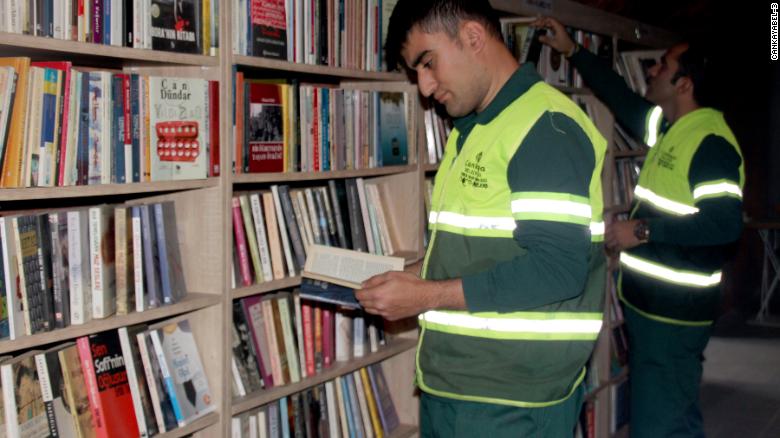
Garbage collectors in Ankara, Turkey, created a library from abandoned books.

This story seems to go with the one about the homeless man in South Africa who sells used books to passersby. The books in the CNN article, however, are not only used — they have been thrown in the trash or abandoned.

Garbage collectors in Ankara thought it was a shame that so many salvageable books should be landfilled when there are people who would appreciate access to them.

Here’s the report from Spencer Feingold and Hande Atay Alamat.

“Garbage collectors in the Turkish capital have opened a public library composed entirely of books once destined for the landfills. The library, located in the Çankaya district of Ankara, was founded after sanitation workers started collecting discarded books.

As word of the collection spread, residents also began donating books directly.

“Initially, the books were only for employees and their families to borrow. But as the collection grew and interest spread throughout the community, the library was eventually opened to the public in September of last year.

” ‘We started to discuss the idea of creating a library from these books. And when everyone supported it, this project happened,’ said Çankaya Mayor Alper Tasdelen, whose local government oversaw the opening of the library.

“Today, the library has over 6,000 books ranging from literature to nonfiction. There is also a popular kid’s section with comic books and an entire section for scientific research. Books in English and French are also available for bilingual visitors.

“The library is housed in a previously vacant brick factory at the sanitation department headquarters. With an aged brick façade and long corridors, the space was ideal for a library. …

” ‘On one hand, there were those who were leaving these books on the streets. On the other hand others were looking for these books,’ Tasdelen said.

“The collection grew so large the library now loans the salvaged books to schools, educational programs, and even prisons.

” ‘Village schoolteachers from all over Turkey are requesting books,’ Tasdelen said. The city government also hired a full-time employee to manage the library. …

“The library is especially popular with cyclists who bike in the nearby valley and break for a quick read and cup of tea.” More here.

You know what I love best about this? It shows how a good idea attracts people of good will as fast as honey attracts flies.

Read Full Post »

Older Posts »