Feeds:
Posts
Comments

Archive for March, 2018

Photo: Good News Network
Philani Dladla, once homeless, now serves others with the money he gets selling used books he reviews.

Terry Turner reported recently on a South African man who went through a period of homelessness and, while relying on the kindness of strangers, gave a lot of thought to how he might give back. He started providing book reviews for used books he sold and using the proceeds to help others.

Turner’s Good News Network piece begins, “Called the ‘Pavement Bookworm,’ he may look like a roadside panhandler, but this once homeless man is actually running a reading foundation. …

“Philani Dladla credits his love of books, specifically motivational ones, with breaking his drug habit. Now that he’s clean, he has dedicated his life to being of service to others.

“Today, he can be found selling used books to passing motorists — but only after he’s read them first. That way, he can give passersby a book review and set the price accordingly; from a dollar for books he doesn’t like, to six dollars for real page-turners.

“While still homeless himself, Dladla began using the money to buy other homeless people soup and bread every day.

“ ‘Seeing their smiles motivated me to keep using the little I had to spread happiness,’ Dladla said. …

“No longer homeless, he still feeds those on the streets, and even started a ‘Pavement Bookworm’ Book Readers’ Club in a local park where kids can hang out and read until their parents come home from work.

“He has also set up a website where people in Johannesburg, South Africa, can donate books or support a child in the reading club.”

Read more at Good News Network, here.

I’m pretty clueless about how to interact with someone who is homeless, although I’ve learned to smile since Suzanne told me that smiling was Mother Teresa’s advice.

And I’m getting to know the woman who spends the winter in one of the two ladies room cubicles at the Porter Square T station. She tends to rant, but her rants sometimes make sense. I think it’s a kindness that the T lets her stay on cold nights. She doesn’t seem to be doing any harm. Of course, it’s an outrage that anyone is without a home in this country.


Read Full Post »

Lavner-trumpet-lilies-021318


Today I thought I’d start my picture roundup with Lynn’s photo from Florida. Lynn says she was first introduced to trumpet lilies when she toured Africa with her cabaret show. I definitely don’t have any trumpet lilies growing outside my house today.

What I do have is ice, snow, and shadows. Here goes. The icicles were shot back in January. The tulips were a little joke in February (I got them in the store and planted them before the snow). The other photos don’t need much explanation. You know I love shadows.

The moose is waiting for the mail lady.

011917-icicles-on-pine-tree

021818-6tag-store-tulips-planted-before-snowstorm


031418-icicle-on-dogwood

031418-lichen-and-snowy-branches


031418-unshoveled-staircase

022118-shadows-on-picket-fence


022718-leaf-shadows-stone-wall

022118-I-Love-Shadows


031118-moose-waiting-for-mail

Read Full Post »

Photo: Carter Burden Gallery
The Carter Burden Gallery in Chelsea shows works by artists who are at least 60 years old.

I’m always happy to see that older people are still appreciated in some quarters — in this case, at a New York gallery that features only artists over 60. Susan Stamberg has the story at National Public Radio (NPR).

“Some artists in New York may be wishing to get older faster. A gallery there caters to artists age 60 and older. No kids allowed.

“Some 200 artists have exhibited at the Carter Burden Gallery since it opened nine years ago in Chelsea. Business is good, and works sell from $200 to $9,000. It’s a lot like hundreds of other galleries in New York — except for one important thing: The Carter Burden has an age limit. Why?

” ‘Older adults do not stop being who they are because they hit a particular age,’ said gallery director Marlena Vaccaro. ‘Professional artists never stop doing what we do, and in many cases we get better at it as we go along.’

“What does change is the art market. With rare exceptions, artists who were hot when they started out found that galleries, and certainly museums, cooled to them as years passed. They kept making art, but weren’t being shown or bought. Carter Burden’s mission is to give them a wall, ‘because walls are the thing we need,’ Vaccaro said.

“According to Vaccaro, very few galleries represent older professional artists, unless they’re really famous. ‘And I get that,’ she said. “Galleries are a business. They need to show artists that are going to bring in big bucks.’

“Carter Burden is different. It’s a nonprofit, supported by a board, a corporate sponsor and philanthropists. …

“Artist Nieves Saah, 67, originally from Bilbao, Spain, has painted all her life. ‘My first show was in SoHo in ’85,’ she said. ‘And I had like 28 paintings there. I sold a few, and then from that I got many shows. I think that year I was in like 15 shows.’

“Then things slowed down. There wasn’t much interest for 10 years. Saah kept on painting her figures and fantasies in vividly colored, cheerful oils. One day she heard about Carter Burden and decided to apply online. ‘I was in a show one month after I sent the application,’ she recalled. …

“Werner Bargsten, a newbie, had his first show this past October. It consisted of stunning, powerful sculptured wall hangings made with clay and copper tubing, and formed into what look like wrapped packages. …

“At 69, Bargsten is glad to be part of the Carter Burden over-60 crowd. ‘I mean, look, it’s always harder to get out of bed the older you get, but most of the artists that I’ve met here seemed like they missed that memo that they were getting old. Most of them have the brains of a 20-year-old or a 30-year-old or something. So they haven’t really aged in terms of their spirit.’ ”

More at NPR, here.

Photo: Carter Burden Gallery
“Under the Stars,” by Nieves Saah, an 0ver-60 artist who shows her work at the Carter Burden Gallery in New York.

Read Full Post »

Photo: Richard Vogel/AP
A statue of Gene Autry and Champion at the entrance to the Autry Museum of the American West in Los Angeles. The museum opened in 1988
.

My family had one of the early televisions because my father was writing a story about Dumont for Fortune. It was a clunky little thing, showing black and white only, of course, but we loved it, and all the kids in the neighborhood came to watch.

My hero was Gene Autry, the singing cowboy. (Want me to sing the opening number for you, the one Autry sang when he rode Champion up close to the camera and reined him in with a little bounce?)

Recently I learned that in 1988, Autry founded a museum in Los Angeles about the American West. Here’s an Associated Press report by John Rogers at US News on the museum’s 2016 expansion.

“The Autry Museum of the American West [is expanding] to include a garden of native Western flora, as well as new galleries showcasing hundreds of Native American works, some from present day, others centuries old, many never seen publicly.

“The expansion, named California Continued, adds 20,000 square feet of gallery and garden space to the museum that, with its red-tiled courtyard and distinctive beige bell tower, evokes images of an 18th century, Spanish-styled California mission . …

“Museum officials say visitors will now see one of the largest collections of Native American artifacts found anywhere. Also included will be more than 70 plants native to California — many medicinal and some endangered — as well as new displays that include Western mixed-media paintings and interactive works showing such sights as California from the highest point in the continental United States (Mount Whitney in the state’s midsection) to its lowest (Death Valley on the Nevada border).

“Because it’s the Autry Museum, visitors also will still see such venerable Hollywood artifacts as the Singin’ Cowboy’s Martin guitar, TV Lone Ranger Clayton Moore’s mask and a wealth of silent cowboy star Tom Mix memorabilia. …

“[Autry] died at age 91 in 1998, just a few years before … its 2003 merger with Los Angeles’ Southwest Museum of the American Indian. …

” ‘This collection that is now in the Autry Museum is a native collection of the very same rank, and in some quarters even better, than the Smithsonian’s,’ said [the museum’s president, W. Richard West Jr.,] who was founding director of the Smithsonian’s National Museum of the American Indian.

“Some of the best of the collection on display is contained in the exhibition ‘The Life and Work of Mabel McKay,’ a Pomo Indian basket weaver, healer, civil rights activist and person believed to be the last speaker of her tribal language when she died in 1993. Her intricately woven, often colorful baskets are accompanied by a recreation of her workroom, narration by her son and other works. …

“The garden contains native plants that caretaker Nicholas Hummingbird hopes will make people realize there is more to Western flora than cactus and sagebrush.”

More at US News, here.

Read Full Post »

031318-tall-bushes-bent-over


“My hair was over in the grass/ My naked ears heard the day pass.”

These bent-over bushes, usually so tall, look resentful to me: “How can you keep letting this happen?”

“Well,” I respond, “I can’t control the weather.”

And then it occurs to me that I am actually relieved there are still things humans can’t control.

One thing we can control, usually anyway, is our decision making. I often think about how hard it is to make a decision with incomplete information and, when you look back at what you ended up doing, how obvious the choice seems.

Usually I spend two nights in Providence at Suzanne and Erik’s so I can volunteer in a couple Rhode Island ESL classes. But early Monday I had to decide where to spend my blizzard. One report quoted a manageable 2-4 inches. Others said 6-12. I even heard 18 inches was a possibility in places.

Without complete information about the amount of snowfall projected, the time that the blizzard would hit, and the likelihood of classes being canceled, I struggled to decide whether to stay in Providence or go back to Massachusetts.

Another wrinkle: I had promised to take an Eritrean refugee to a parking garage to see if there were any job openings, and I knew that if I left Providence late, I could hit heavy Boston traffic and might have to drive in the dark, which I have been avoiding lately.

In the end, I took The Eritrean student to the garage. The man in charge wasn’t exactly friendly to her, but she was thrilled to have practiced asking for work and to have received a URL for making an online application. She told me she hadn’t had any ideas about how to get started.

A very independent woman, the student insisted on taking the bus home, and I headed north.

As it happened, I was going to be on my own whether in Providence or at home, and today being at home seems so obvious I wonder why I was anxious about making the right choice. At home, my car is sheltered, there’s a greater possibility of someone checking on me, and a reduced likelihood of power failures. (The town has a municipal light plant, and outages are both rare and quickly fixed if they do occur.)

What was your last many-moving-parts decision? Doesn’t it seem obvious to you now?

Bushes to homeowner: “Seriously?”
031318-tall-bushes-bent-over-2


Read Full Post »

Photo: L’Artisan Café and Bakery
This Providence eatery, founded by immigrants, has created jobs in two Rhode Island cities. I especially love the tea at l’Artisan and the takeout food.

The idea that most immigrants take jobs away from other people in this country makes no sense to me. Some immigrants may take some jobs, but when you consider all the immigrant-founded companies, large and small, that create jobs for Americans, there is no comparison.

Here is an op-ed from an immigrant who, as an economist, has studied the issue in depth.

Dany Bahar writes at The Hill that calling the thousands of immigrants who, like him, have come here via the diversity visa lottery “the worst of the worst” shows a lack of understanding of the facts.

“I’ve been privileged enough to have accomplished many things since winning a green card, such as having completed doctoral studies at Harvard and joining a highly respected think tank. I did all of this while paying my fair share of taxes.

“My story is not unique, and, as a researcher on the economics benefits of migration, I can say that most other migrants actually are good people, work hard, pay taxes and often create jobs even at a higher rate than natives.

“Take David Tran, who in 1978 arrived in California as a refugee from Vietnam. Two years later, he founded Huy Fong, a company that produces and exports a highly popular version of Sriracha sauce.

“Huy Fong, named after the refugee vessel on which Tran came to the U.S., earns millions in sales year and employs hundreds. Tran’s tale is just one of many that illustrate how first- or second-generation migrants have shaped the U.S. economy. …

“For the most part, migrants (low- and high-skilled) compete with other incumbent migrants, not with natives. In fact, [one] study shows that, between 1990 and 2006, immigration had a small positive effect on the wages of American-born workers, as the presence of migrants encourage natives to specialize in better jobs. …

“Migrants are highly entrepreneurial and create jobs. While immigrants represent about 15 percent of the general U.S. workforce, they account for around a quarter of this country’s entrepreneurs and a quarter of inventors. …

“Immigration and diversity foster economic growth. More diverse countries perform better economically and migrants create business networks with their home countries that foster trade and investment. …

“Subsequent generations of migrants contribute considerably to the economy, thus offsetting the cost of absorbing first-time migrants. While the average fiscal burden of each immigrant is about $1,600, second- and third-generation migrants create a net positive fiscal contribution of $1,700 and $1,300, respectively.

“In addition, migrants and their families also eat, wear clothes, consume housing and all sorts of other goods and services, which contributes to economic growth.”

I know I’m biased. My daughter-in-law’s parents were immigrants from Egypt years ago, and my son-in-law is an immigrant who now holds citizenship in both the United States and his home country, Sweden. My husband and I feel lucky.

More at The Hill.

Read Full Post »

Photo: Hartford Courant
Former US Marine Roman Baca
develops ballets that help veterans heal and help audiences gain empathy. For his Fulbright Fellowship, he’s creating a new version of Igor Stravinsky’s
Rite of Spring tied to WW I.

Not long ago, Suzanne’s friend Liz found a piece of antique weaponry and asked instagram friends how it might be used in an art project or something else positive.

I said to “beat it into plowshares.”

In their own way of beating weapons into plowshares, war veterans may continue to serve the country after their time in the military. They may run for Congress like Seth Moulton of Massachusetts or establish a nonprofit like Soldier On, which treats veterans suffering from addictions.

And then there’s the Marine who became a choreographer to tell stories that enlighten and heal.

Candice Thompson writes at Dance Magazine, “When Roman Baca returned home from active duty in Iraq in 2007, he found himself having a tough time transitioning to civilian life.

” ‘I remember a couple of instances where I was mean and angry and depressed,’ says Baca. [His wife] suggested Baca return to his roots in dance. ‘She asked me, “If you could do anything in the world, what would you do?” ‘…

“Baca had to broker his transition back into dance. Earlier, he had trained at The Nutmeg Ballet Conservatory in Connecticut and spent a few years as a freelance dancer before feeling compelled, like his grandfather had, to serve his country. ‘I walked into the recruiter’s office and said, “I want to help people who can’t help themselves.” ‘ Baca reveled in the rigor of the Marine Corps, which seemed like a perfect analog to classical ballet. …

“Baca served as a machine gunner and fire team leader [in Fallujah]. And while his job was one of looking for insurgents and intelligence, Baca also ended up doing humanitarian work, bringing water and school supplies to those in need. The transition from violence to aid helped him meet his original desire to defend the vulnerable.

“In 2008 … he reached out to his mentor Sharon Dante from The Nutmeg Ballet Conservatory. He had dabbled in choreography before joining the Marines and had begun to write while overseas. Dante suggested [that he] focus his writing and choreography on his experiences in Iraq. The exploration led Baca to form Exit12 Dance Company, a small troupe with a goal of inspiring conversations about the lasting effects of violence and conflict. …

“When a theater in the UK reached out to him in 2016 about creating a new Rite of Spring — one that would explore the connections between the creation of this famous ballet and the outbreak of World War I, in commemoration of the war’s centennial, as well as touch on today’s veterans and current events — he knew immediately it was a project for [him].

” ‘One percent of our population serves in the military, and an even smaller number serves in war,’ explains Baca of one of the central questions motivating this new commission. ‘How do we take all of this remote and little understood experience and inspire the audience to positive action?’ ”

More at Dance Magazine, here.

Read Full Post »

030818-bent-dogwood-at-backdoor

March 8, 2018, New England. Beaten-down dogwood blocks the back steps.

After the blogger behind Jnana’s Red Barn posted 10 things he liked about March, I thought, “Wow! What a challenge!” New Englanders often find it hard to think of even one good thing about March. Winter hangs on and hangs on and hangs on, the snow no longer seems magical, and activities get canceled that you thought for sure you would be able to do in March.

Could I possibly think of 10 good things? I knew it would be good for me to try.

1. Daylight. I definitely like having more daylight.

But although I thought about Jnana’s challenge for days, daylight was the only thing I could think of that I liked about March.

Should I mention how quiet it is at Suzanne and Erik’s house when they take the family off for March vacation? (I stay at the house when I volunteer in Rhode Island.) It’s much more entertaining when the grandchildren are there, but quiet can be nice once in a while, and I’ll never get to 10 if I don’t include this.

2. A quiet house.

A couple items are comparative — that is, they start to happen a lot more in March.

3. More walks in the woods.

4. More sightings of neighbors.

Once I got this far, I began to think it might be possible to get to 10.

5. The first spring flowers.

6. Four young cousins playing at my husband’s birthday.

7. Decorating Easter eggs.

8. John and Suzanne planning their two families’ New Shoreham summer.

9. Irish music by the Clancy Brothers and Tommy Makem.

10. Return of the redwing blackbirds.

Yaay! I’m feeling more positive already. How about you? Can you find 10 things you like about March?


Read Full Post »

Photos: Rachel Watson
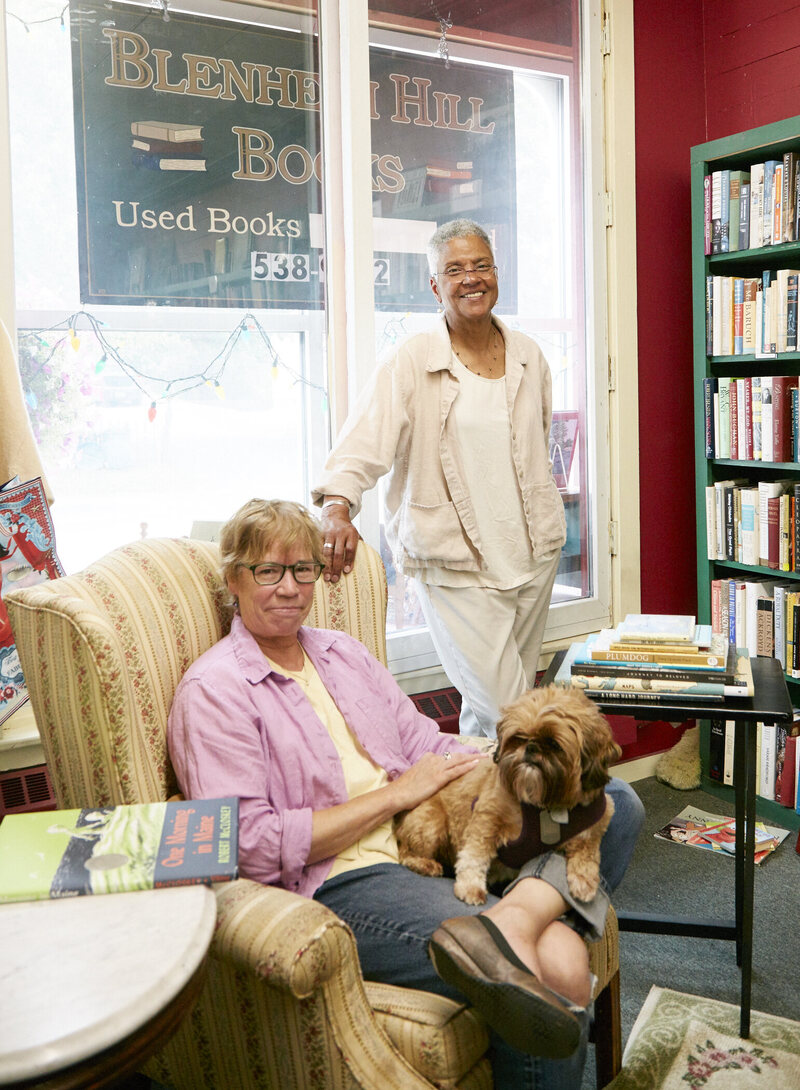
Barbara Balliet and Cheryl Clarke, owners of Blenheim Hill Books, one of five bookstores in an upstate New York village of 500 souls.

This village sounds like heaven to a book lover. I think the people who live there must be very happy. I’m pretty sure they are well-read.

Daniel A. Gross writes at Atlas Obscura, “The village of Hobart, New York, is home to two restaurants, one coffee shop, zero liquor stores, and, strangely enough, five independent bookstores. … Fewer than 500 people live in Hobart. Yet from Main Street, in the center of town, you’re closer to a copy of the Odyssey in classical Greek, or a vintage collection of Jell-O recipes, than a gas station.

“This literature-laden state of affairs emerged just after the turn of the millennium, when two residents of Manhattan, Diana and Bill Adams, stopped in Hobart during a trip through the Catskills. ‘We were both intrigued,’ says Bill, who worked as a physician for 40 years. … He and his wife, Diana, a former lawyer, were looking for retirement activities that they could pursue into their old age.

“During that first trip, in 2001, the couple spotted a corner store for rent at the end of Main Street. After speaking with the owner, they decided to rent it on the spot, and soon they were lugging their hefty personal book collection to Hobart, one rental car-load at a time. They didn’t expect to establish a book village in the process. ‘There was no plan,’ Bill says. They weren’t even sure whether their bookstore would survive in the foothills of the Catskills, three miles from the main highway.

“But they did own a lot of books. … That was how it became possible to buy a leather-bound collection of classical verse, or a set of classic political essays, in a tiny village more than two hours from New York City. Wm. H. Adams Antiquarian Books had a relatively quiet first year. But then Don Dales, a local entrepreneur and piano teacher, decided that one good bookstore deserves another, and opened his own shop. …

“Readers, like shoppers at the mall, often wandered back and forth between the shops. As more bookstores came to town, one of Hobart’s original booksellers (no one can quite remember who) began to describe the town as ‘the only book village east of the Mississippi.’ (Other American book towns include Stillwater, Minnesota, and Archer City, Texas.) …

“Barbara Balliet and Cheryl Clarke, a couple who spent their careers at Rutgers University, moved to Hobart at around that time. Clarke was surprised to find such a tiny community, far from cities or colleges, so overrun with books. …

” ‘She says, “You find all kinds of people who like books, and they’re not just college-educated.’ When the two women arrived, they met a bookseller who was ready to sell her stock, so Balliet bought it and they hopped into business themselves.

“Both women saw right away that, compared to other Catskills towns that have lost jobs and emptied out, Hobart seemed to be coming back to life. … The bookstores were a part of that. …

“Balliet says that, although she can’t make a living off the store, she can make a tidy profit — enough to grow a garden, travel, and buy more books. …

“According to the International Organisation of Book Towns, [the first] was Hay-on-Wye, Wales, founded in 1961 by Richard Booth. … Others include Wigtown, Scotland; Featherston, New Zealand; Kampung Buku, Malaysia; and Paju Book City, South Korea.

“As Hobart evolved, individual book shops have found their own specialty, like siblings who each choose their own path. ‘We try to complement each other,’ Balliet says. ‘Each one maintained its own identity and individuality,’ adds Bill Adams. Creative Corner Books, a cozy one-room shop that specializes in craft, cooking, and DIY books, is Hobart’s only shop with a knitting corner.”

More here.

Hat tip: @michikokakutani on twitter

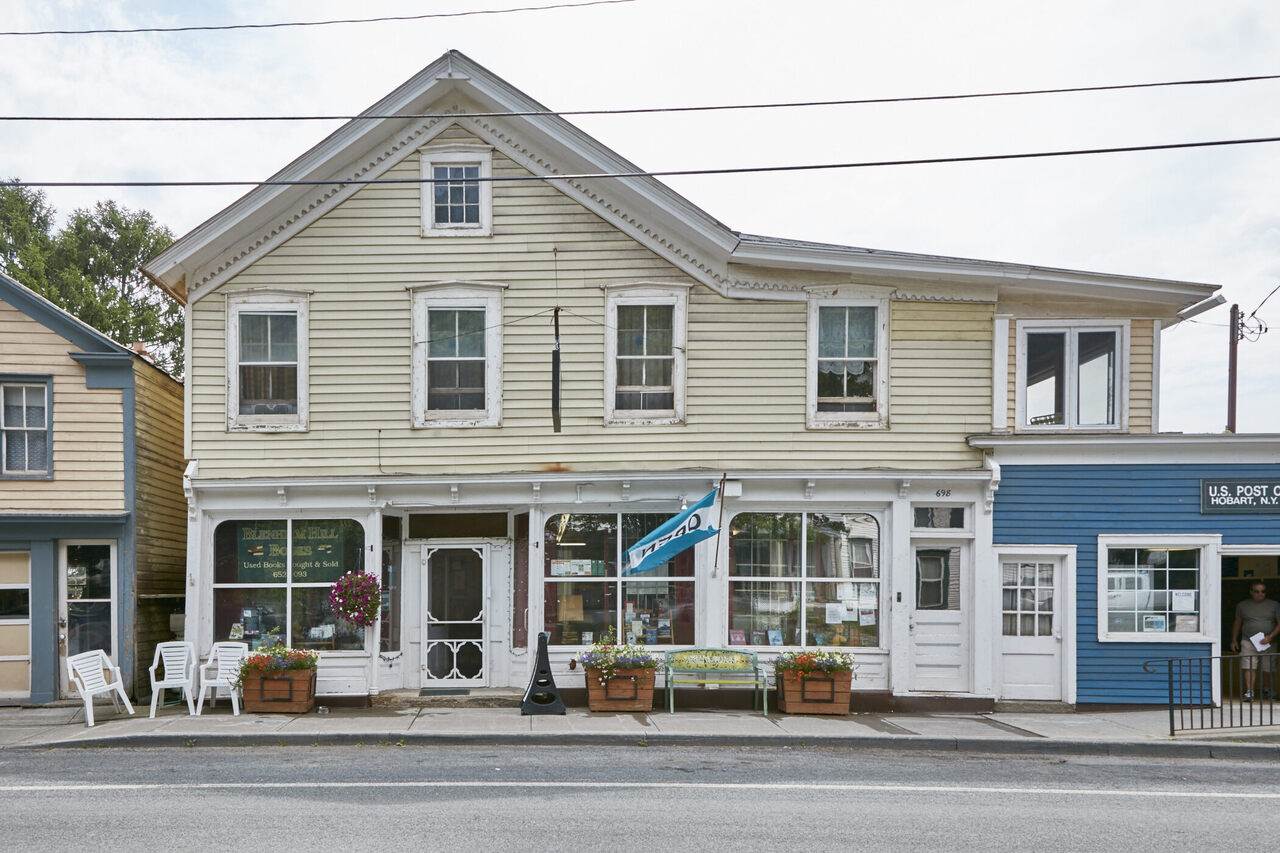
Photo: Blenheim Hill Books in Hobart.

Read Full Post »

Photo: Mohammad M. Rashed
Of the roughly 200 houses in Makhunik, Iran, 70 or 80 stand only 5.0 feet to 6.5 feet tall. Even this boy would have to stoop to get in the door.

Long before the Hobbit, stories abounded around the world about miniature races of people. In Iran, there is actually a kind of proof.

As Shervin Abdolhamidi writes at the BBC, “In the first part of Jonathan Swift’s book Gulliver’s Travels, Lemuel Gulliver washes ashore on the island country of Lilliput, where he encounters the Lilliputians, who stand barely taller than [6 inches].

“While Swift’s Lilliput is merely a fantasy, a comparable village exists in the eastern extremities of Iran. Up until around a century ago, some of the residents of Makhunik, a 1,500-year-old village roughly [47 miles] west of the Afghan border, measured a [little over a yard] in height. …

“In 2005, a mummified body measuring [10 inches] in length was found in the region. The discovery fuelled the belief that this remote corner of Iran, which consists of 13 villages, including Makhunik, was once home to an ancient ‘City of Dwarfs’. Although experts have determined that the mummy was actually a premature baby who died roughly 400 years ago, they contend that previous generations of Makhunik residents were indeed shorter than usual.

“Malnutrition significantly contributed to Makhunik residents’ height deficiency. Raising animals was difficult in this dry, desolate region, and turnips, grain, barley and a date-like fruit called jujube constituted the only farming. Makhunik residents subsisted on simple vegetarian dishes such as kashk-beneh (made from whey and a type of pistachio that is grown in the mountains), and pokhteek (a mixture of dried whey and turnip).

“Arguably the most astonishing dietary anomaly was a disdain for tea – one of the hallmarks of Iranian cuisine and hospitality.

“ ‘When I was a kid no-one drank tea. If someone drank tea, they’d joke and say he was an addict,’ recalled Ahmad Rahnama, referring the stereotype that opium addicts drink a lot of tea. The 61-year-old Makhunik resident runs a museum dedicated to Makhunik’s historic architecture and traditional lifestyle. …

“Although most of Makhunik’s 700 residents are now of average height, reminders of their ancestors’ shorter statures still persist. Of the roughly 200 stone and clay houses that make up the ancient village, 70 or 80 are exceptionally low. …

“Constructing these tiny homes was no easy feat, Rahnama said, and residents’ short stature wasn’t the only reason to build smaller houses. Domestic animals large enough to pull wagons were scarce and proper roads were limited, meaning locals had to carry building supplies by hand for kilometres at a time. Smaller homes required fewer materials, and thus less effort. Additionally, although cramped, smaller houses were easier to heat and cool than larger ones.”

Ah-ha! The wisdom of the Tiny House was tested centuries ago in a remote Iranian village! “The sun also riseth and goeth to his downsetting, and there is no new thing under the sun.”

More here.

Read Full Post »

Photo: Keith Bedford/Globe Staff
Djennyfer Joseph, who is from Haiti, filled an order at the Shake Shack on Newbury Street.

One of the places I volunteer to help adults learn English is Jewish Vocational Service (JVS) in Boston. The students come from all over the world as JVS is a resettlement agency as well as a job-placement agency, but the majority that I have met are either Latino or Haitian.

Although my focus is on helping people learn English, I’ve come to appreciate the way JVS prepares students for the workplace. It actually finds the jobs for them and has many partnerships with companies that need entry-level workers whether or not they speak much English yet. As Boston’s labor market gets tighter, more businesses are seeking out these workers.

Katie Johnston at the Boston Globe provides a window on the phenomenon.

“The lunch rush was just beginning at Shake Shack on Newbury Street and the all-American tasks of grilling burgers and making milkshakes were being handled by a crew made up almost entirely of immigrants — from Haiti, Senegal, Morocco, El Salvador, and Ethiopia.

“But these weren’t just people who happened to apply for a job: All of them were actively recruited by the restaurant chain, including those who spoke little English — a marked difference from years past, when only workers with strong English skills made the cut.

“Like other employers struggling to fill jobs in a tight labor market, Shake Shack has started seeking out candidates it might not have considered before. Spaulding Rehabilitation Network is opening the door to those with criminal backgrounds, in partnership with the Suffolk County Sheriff’s Department. CVS is bumping up its efforts to attract workers with disabilities, while other employers are lowering experience and education requirements. …

“As Northeastern University economist Alicia Sasser Modestino puts it: ‘We have gone through all the easy-to-employ people, and we’re down to the hard-to-employ people.’

“And, as it turns out, some of these ‘hard-to-employ’ people make excellent workers.

“Djennyfer Joseph, 22, was enrolled in an English class for just three weeks at Jewish Vocational Service when her case manager called to tell her she had an interview at Shake Shack. ‘I was like, what, already?’ said Joseph, who came to the United States from Haiti in 2016. ‘It was so fast.’

“Joseph, who studied English in Haiti and also speaks French and Haitian Creole, has been at the Newbury Street restaurant for less than a year and is working toward becoming a cross-trainer, a kind of jack-of-all-trades role that comes with a bump in pay from $12 to $14 an hour. Joseph also recently became a certified nursing assistant, a profession in high demand, but plans to keep working at Shake Shack even after she finds a job in health care.

“Shake Shack managers say [the] roughly two dozen immigrants — many of them refugees — that the restaurant has hired through Jewish Vocational Service over the past year are more than making up for the decrease in the number and quality of college students and American-born adults applying for jobs there. …

“Of course, hiring these nontraditional workers can present challenges for employers, who might have to make adjustments for someone who is blind or has a limited grasp of English.

“At Shake Shack, non-native English speakers are taught specific restaurant phrases, such as ’86’ (get rid of) or ‘drop a wave’ (cook eight burgers at once). Many of them speak French, and translations are posted in the walk-in cooler and kitchen: ‘Changez vos gants means change your gloves’ and ‘Bon travail means good job.’ ”

More at the Boston Globe, here. The article also covers “Triangle in Malden, which trains and supports people with disabilities and [is seeing an uptick in] requests for workers, largely from health care and retail companies.” And you can read about how the Suffolk County Sheriff’s Department helps employers place promising ex-offenders.

Read Full Post »

Photo: Colombia Games
A scene from the ‘Ancient Wisdom’ smartphone games, which allow players to learn about Colombia’s indigenous peoples.

As we have discussed before, there are many cultures and languages in danger of dying out, often because few people know about them.

A Colombian game company has taken a step toward addressing that ignorance, providing school children with entertaining phone games to help them learn about their indigenous neighbors.

Joe Parkin Daniels writes for the Guardian, “In a simple wooden hut on a Caribbean beach, a young girl sits at the feet of her grandmother, who is crocheting a brightly coloured shoulder bag whose intricate design draws on the mythology of the Wayuu people.

“It’s the opening scene from a smartphone game that seeks to educate Colombian children about their country’s endangered indigenous cultures.

“Some 3.4% of the Colombia’s population belongs to 87 different indigenous groups that speak 71 languages. But experts warn that these diverse cultures are at risk of dying out, threatened by climate change and violent armed groups operating in isolated regions the state has not reached. The National Indigenous Organisation of Colombia (Onic) estimates that 35 ethnic groups are at risk. …

“The games, available for iOS and Android devices, challenge players to learn the languages and cultures of the country’s indigenous groups, which vary from farming communities in the northern Darién jungle to nomadic hunter-gatherers in the Amazon. …

“The games narrate indigenous creation stories, and players must solve puzzles and draw the wild animals that populate indigenous myths.

“ ‘From one day to another these cultures could be lost,’ said Juan Nates, the CEO of Colombia Games, which recently relaunched the games. ‘When we started this project, I assumed there were three or four indigenous tribes; it was a shock to know how many there are – and how little we know about them.’

“The project was funded by the Sura Foundation, an educational subsidiary of the Sura banking group. The Sura Foundation has also sent about 200 teachers to schools to educate children about endangered cultures. …

“For Nates, raising awareness is key to preserving at-risk indigenous cultures. ‘People can’t worry about something, can’t do something, if they don’t know about it,’ he said. ‘It feels good to help with that.’ ”

Unfortunately, native children themselves usually don’t have smartphones, so it seems like the next step for a kindly philanthropist or foundation would be to get them some to use in school. (Can’t imagine anyone wants children looking at phones more than that.) And it would be nice if the different groups of kids could actually meet.

But what a good start! I’d love to see a game like this in parts of the US where there are large indigenous populations.

Finally, I don’t want to close without giving a shout-out to the Tomaquag Museum, which works to improve New Englanders’ knowledge of Rhode Island tribal culture through educational activities for children.

More at the Guardian, here.

Read Full Post »

Photo: National Park Service
Female mountain lions (cougars) are an increasingly common sight in the mountains surrounding Southern California cities.

I like the idea of sharing space with wildlife, but there are limits. Not sure I want too many skunks in my suburban backyard or even one cougar. Richard Conniff at Yale360 explains how coexistence is working in a variety of people-inhabited places around the world.

“One morning not long ago, in the southern Indian state of Karnataka,” he writes, “I traveled with a Wildlife Conservation Society biologist on a switchback route up and over the high ridge of the Western Ghats. Our itinerary loosely followed the corridor connecting Bhadra Tiger Reserve with Kudremakh National Park 30 miles to the south.

“In places, we passed beautiful shade coffee plantations, with an understory of coffee plants, and pepper vines — a second cash crop — twining up the trunks of the shade trees. Coffee plantations managed in this fashion, connected to surviving patches of natural forest, ‘provide continuous camouflage for the predators’ — especially tigers moving through by night, my guide explained, and wildlife conflict was minimal.

“Elsewhere, though, the corridor narrowed to a thread winding past sprawling villages, and conservationists played a double game, part hand holding to help people live with large predators on their doorsteps, part legal combat to keep economic interests from nibbling into the wildlife corridor from both sides. It was a microcosm of how wildlife hangs on these days, not just in India, but almost everywhere in the world.

“For conservationists, protecting biodiversity has in recent years become much less about securing new protected areas in pristine habitat and more about making room for wildlife on the margins of our own urbanized existence.  Conservation now often means modifying human landscapes to do double-duty as wildlife habitat — or, more accurately, to continue functioning for wildlife even as humans colonize them for their homes, highways, and farms. …

“Corridor protection on the grand scale has achieved remarkable results, notably with the 2,000-mile long Yellowstone-to-Yukon Conservation Initiative. It aims to connect protected areas and to ensure safe passage for elk, grizzly bears, and other wildlife across 500,000 square miles of largely shared habitat, both public and privately owned.

“At the same time, research by Nick Haddad, a conservation biologist at the University of Michigan’s W.K. Kellogg Biological Station, has demonstrated substantial improvements in biodiversity from corridors as little as 25 yards in width, well within the range, he says, of ‘what’s reasonable in urban landscapes.’

Indeed, a new study from northern Botswana has found that elephants traveling from Chobe National Park to the nearby Chobe River will use corridors as small as 10 feet wide to traverse newly urbanized areas.

“Urban areas now increasingly recognize that it’s cheaper to protect clean water by buying up natural habitat both within their own borders and at the source, instead of installing expensive technology to purify it after the fact.  It’s not just about New York City purchasing huge chunks of the Catskills. North Carolina’s Clean Water Management Trust Fund, for instance, has also protected 500,000 acres of watershed and riverside habitat over the past 20 years — with enormous incidental benefits for wildlife. …

“Scientists were stunned in October by the report [that] that over a 27-year period, from 1989 to 2016, the population of flying insects at nature reserves across Germany had collapsed, down by 76 percent overall, and 82 percent in the peak mid-summer flying season. Most of the likely causes — including habitat fragmentation, deforestation, monoculture farming, and overuse of pesticides — were factors outside the borders of these ostensibly protected areas.”

For more on global efforts to protect biodiversity near human habitation (and the unlikely entities getting on board, such as power companies, highway systems, and active train systems), click here. You can also learn ways of protecting beneficial insects outside your home at my friend Jean’s Meadowmaking website, here.

Read Full Post »

Photo: Melanie Stetson Freeman/Christian Science Monitor
Iceland has cut teen alcohol and drug use with fun after-school activities and a 10 pm curfew (age 18 and under).

Sometimes it takes a huge, intractable problem to motivate people to find serious solutions. That’s what Iceland discovered after it was overwhelmed by an epidemic of teen substance abuse.

Sara Miller Llana writes at the Christian Science Monitor, “In the late 1980s, when Björgvin Ívar Guðbrandsson was a teenager, alcohol and school dances went hand-in-hand. While he was later to drinking than his peers – more interested in playing soccer and guitar – when he did start around age 16, he would smuggle alcohol in his guitar case into school events.

“ ‘I think the adults just turned a blind eye,’ says Mr. Guðbrandsson. ‘The culture was, I think, “they’re just kids. As long as they aren’t fighting, it’s okay.” ‘

“Today, as a teacher at Langholt school in Reykjavik where he once studied, he says that if a student were to show up drunk to a dance, it would  be such a scandal that the school principal would likely call child protective services.

“In reality, that rarely happens because substance abuse on a wide scale has essentially become a ‘non-issue,’ says Guðbrandsson. Alcohol and school dances, in other words, don’t go together in Iceland today.

“This school is hardly alone. Teen drinking – as well as teen smoking, marijuana use, and abuse of other drugs – has plummeted across Iceland in the past two decades as academics, policy makers, and parents joined forces to clamp down. …

“Beyond adolescent alcohol and drug use, Iceland has shifted thinking on youth culture itself, making it by many accounts more innocent and carefree. It has expanded parents’ notions of childhood and the importance of family time, while reinforcing the maxim that it ‘takes a village’ to raise a child, says Hrefna Sigurjónsdóttir, director of the national umbrella for parental organizations in schools, Home and School, one of the key players in the federal-state government program now known as Youth in Iceland.

“She calls it an ‘awakening’ that has taken place at home, school, and beyond. ‘I think people are not confused anymore about, “is this kid an adult or not.” ‘ ”

Just-say-no substance-abuse prevention programs didn’t work.

“Substance use kept going up, says Inga Dora Sigfúsdóttir, cofounder of the Icelandic Center for Social Research and Analysis (ICSRA), which is the data hub for Youth in Iceland. ‘A group of people came together, sat down and said, “we need to find a different approach. This is obviously not working.” ‘

“One of the problems was an ambiguous view of the line between child and adulthood, she says.

“One of the most absolute rules to take effect was legal curfews: Kids ages 12 and younger must be home at 8 p.m. in the winter and 10 p.m. in the summer. Thirteen to 16-year-olds must be home at 10 p.m. in the winter and by midnight in the summer, even when the sun is still blazing. …

“Parents began to sign agreements, through schools and parental organizations, with various pledges such as not allowing unsupervised parties in their homes or spending at least an hour a day with their children. …

“Municipalities funded and expanded after-school activities, from sports to gymnastics, to music, art, and ballet. The basic idea is to keep kids busy – and out of trouble – and help them find meaning in their lives that dissuades them from seeking alcohol or drugs in the first place.

“At its heart, it takes the onus off the teens themselves – the opposite of the D.A.R.E. approach – and places it on the community. …

“ ‘It does not concern teaching individual children about responsible choices, or even about making them responsible for their own behavior,’ says Álfgeir Kristjánsson, a former data analyst at ICSRA who is now an assistant professor of public health at West Virginia University. ‘The Icelandic approach … is to strengthen the societal and protective factors and drive down risk factors.’ ”

Makes such sense. When I was a teacher decades ago, I really didn’t buy into the idea that students who got in trouble were always making “choices.” If there was trouble at home, for example, kids were often tumbling into risky behaviors because of depression or other psychological stressors. The Icelandic approach seems to have opened the eyes of more adults to the complexity of the issue.

More here.

Read Full Post »

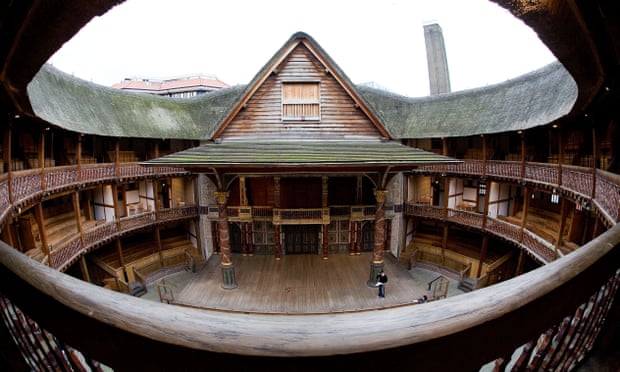
Photo: Alamy Stock Photo
The new director at Shakespeare’s Globe, herself an actor, wants to take the hierarchy out of theater.

I’ve been reading a fascinating book about the making of Tony Kushner’s monumental Angels in America, which you may recall is a play about AIDS, the Reagan years, the awakening of gay activism, Mormons, the unscrupulous McCarthy-ite Roy Cohn, bias, love, and theater.

I’m still in the beginning, where I’m learning about a 1970s political-theater group in San Francisco called the Eureka. One of its high-minded goals was to take hierarchy out of theater.

That’s a goal yet to be met, or yet to be met for long, as appears from this article on Shakespeare’s theater by Mark Brown at the Guardian.

“The new artistic director of Shakespeare’s Globe has promised to give more power to the casts and audiences of plays, saying she wants to dismantle theatre hierarchies.

“Michelle Terry announced a new season opening with Hamlet and As You Like It. Eye-catchingly, none of the actors turning up for rehearsals will know which role they are taking, with the whole ensemble choosing who plays whom.

“In a similar vein, when the plays The Merchant of Venice, The Taming of the Shrew and Twelfth Night go on tour, some audiences will be able to choose which one they want to see that night. …

“Some eyebrows were raised because Terry, while a hugely accomplished Shakespearean actor, has never directed. [In January] Terry said theatre culture was too ‘director-centric. with ‘too much responsibility on one person.’ …

“The first two plays will be presented by a Globe ensemble of 12 actors, two co-directors and one designer. The ensemble will decide who plays, for example, Hamlet or Rosalind.

“Terry said she had chosen Hamlet and As You Like It because they were both written around 1599, the year the original Globe was built, and were conceived with its architecture in mind.

“The democratisation will continue later in the season when one group of eight actors will have to learn three plays. …

“Terry promised diversity across the organisation, with the bottom line being: ‘We just have to do it. We can’t keep talking about it. … If our job is to hold a mirror up to nature then we’ve got to truly reflect the society in which we live.’

“Other new measures include allowing people into rehearsals, particularly school parties who might be heartened to see that even the actors don’t understand what some words and lines might mean.”

More here.

Read Full Post »

« Newer Posts - Older Posts »