Feeds:
Posts
Comments

Archive for November, 2020

I liked this story from Stefan Andrews at Vintage News about a 91-year-old grandmother who’s a kind of street artist.

“For most of her life, Anežka Kašpárková (also known as Agnes) has been making her income by working as a farmer. … Ever since she retired, Kašpárková has used many of the sunny days each year to make her home village of Louka a little bit more beautiful.

“The village is found in the South Moravian region of the Czech Republic. The [artist] is now an expert on how to decorate window frames, doors and facades across her village with traditional Moravian folk art. She mostly works on flowery patterns, giving a fresh feeling to the old facades worn by time. …

“Other women have done a similar type of decoration in the past and Kašpárková has worked tirelessly to continue the tradition. …

‘I try to help decorate the world a bit,’ she is recorded as saying.

“Kašpárková uses mainly blue paint and works simply with one small brush. Her color choice blends perfectly with the old, white-painted village houses and buildings.

“Kašpárková says that she does her artwork for the pleasure she gets from it, and that she never makes any plan how her next creation is going to look. She just takes up her brush and gets things going. …

“Given her age, Agnes complains that sometimes she finds it challenging to paint. Yet … she has been comfortable enough to climb a ladder almost every spring and refresh the design on the village chapel.” More at Vintage News, here.

Most people know by now that buildings make great canvases for outdoor murals. I myself have blogged a lot about this form of art. The blue Czech designs represent a different take from urban graffiti, say, as does the current London art walk experienced through windows.

Hannah Jane Parkinson writes at the Guardian, “Artists Walk is … a simple idea for an art trail that began as a joint endeavour between printmaker and painter Rosha Nutt, and her art marketing consultant friend Holly Collier. Those who in normal times would be exhibiting in galleries or community spaces can now place their work in the windows or surroundings of their homes for passers-by to admire. …

“ ‘Lockdown was the catalyst,’ Collier tells [Parkinson]. ‘So many artists have moved studios into their homes. Exhibitions and events have been cancelled. It’s pretty depressing being an artist who can’t show work. We wanted to do something that had a positive action.’ …”

“Until 14 December, London artists working in whichever medium – painters, photographers, illustrators, film-makers, ceramicists and more – can pay £15 to have their location added to the ‘interactive map’ on the website, as well as a short bio and links to the artists’ website and social media profiles, plus a custom poster.

“Collier and Nutt pulled the whole thing together in seven weeks. ‘It’s been late nights, early mornings and a lot of elbow grease,’ Collier says. They applied unsuccessfully for an Arts Council grant, but local collectives and businesses stepped in. An estate agent became a sponsor and organised a leaflet drop. Alexandra Palace – usually home to concerts and comedy gigs – lent its support, including what amounts to a quasi window-residency.” More.

Such a creative way to help artists show their work to potential customers in this difficult year!

Photo: Hannah Jane Parkinson
Paintings displayed by Sarah Barker Brown for Artists Walk 2020 in London.
Read Full Post »

Blind Photographer

A disability may make a person think about things in new and interesting ways. Remember the blind architect whose other senses helped him carve out an inspiring career? (Blog post here.)

In a first-person account at Audubon magazine, Liz Bossoli, describes her life as a mostly blind photographer of birds.

She writes, “As far back as I can remember, I’ve been enthralled with animals. Wherever I went, it wouldn’t take long for me to orient to the nearest one. By age eight, I could identify upward of 100 dog breeds. Yet when it came to birds, my list wouldn’t have gone far beyond Northern Cardinals and Blue Jays. I often heard my grandfather warmly refer to ‘chickadees,’ but this species only existed vaguely in my mind’s eye as a small, probably cute bird. Until recently, I never actually saw a Black-capped Chickadee in a way that I could appreciate. When my grandparents marveled over a bird at their feeder, I only experienced their joy vicariously.  

“I was born with a congenital condition called Septo-Optic Dysplasia, and as a result, I’m almost totally blind in my left eye and legally blind in my right. Blindness is not a binary condition, but rather affects individuals across a broad spectrum. … I’m among the majority of blind individuals who have some usable vision, and I happen to fall on the end of the spectrum with the greatest degree of functional eyesight.

“I’ve been known to describe myself as having ‘pretty good vision for being legally blind.’ It’s my light-hearted spin on living in an awkward space where I don’t need a lot of adaptive tools or assistance from others, until I do. That also makes it easy for people to forget I can’t see well — including myself. Day to day, I’m not often cognizant of the degree to which my vision impairment affects me. Still, one of the most poignant reminders occurs when I can’t perceive my environment in the same manner as those around me. In my yard, I’m consistently awestruck when a friend immediately points out birds I don’t know are there.

“For nearly as long as I’ve been fascinated by animals, I’ve used art to express that fondness; first, through drawing and then, photography. I purchased my first DSLR camera in 2009, so I could create images that would do justice to the relationships I had with my dogs and other animals in my life. 

“I spent the better part of the last decade honing my skills as a dog portrait photographer, but a 2016 visit to Audubon’s Corkscrew Swamp Sanctuary in Naples, Florida, reignited a passion for connecting with the natural world. That trip to Corkscrew gifted me with up-close encounters with wild birds, unlike anything I had experienced. Equipped with an entry-level zoom lens, my camera gave me just enough visual reach to see the Red-shouldered Hawk that landed on a low branch right above my head, and to engage in a game of peek-a-boo with an active Pileated Woodpecker. …

“Back home, in Connecticut, my husband and I continue to adapt our small suburban property to create a more hospitable environment for native birds. This year, while spending most of my time in my own yard, I appreciate their presence more than ever.  I’ve found myself fully engrossed in the art of bird photography, driven by desire to understand the wildlife around me. My photo of a Gray Catbird even made it into the final gallery of reader submissions for Audubon’s Bird From Home project. …

“I employ three different strategies for photographing birds in my yard. The first two are intentional: I either actively seek out birds that I hear in nearby trees, or I plant myself in a position from which I know I’ll be able to observe birds. The third strategy usually looks something like me being surprised by an unexpected bird encounter, frantically running into my house to get my camera, and returning in hopes I didn’t miss everything.

“Bird feeders, nest boxes, and a birdbath are often just as integral to my process as the camera itself. They take the guesswork out of finding birds to photograph. I admit that photographing birds in these contexts lacks the thrill of successfully locating a bird on a branch, but that doesn’t mean it’s a passive process. For my purposes, any amount of predictability is a vote in favor of creativity.

“And when I do hear the sound of uncharacteristic rustling in the trees or a bird call close nearby, I hope for the best. I rely on the goodwill of birds who are generous enough to remain in the same location for minutes at a time, as I visually scan the area with my camera. Through the viewfinder, I trace the outline of branches in order of my best guess that the sound came from that specific area. I repeat this with other branches until I have to refocus and scan the same area at a different distance from me. In the course of this process, I’m likely pointing my camera directly at the bird I’m seeking several times without realizing it. I estimate that at least 90 percent of my attempts at photographing birds under these circumstances are fruitless, but the occasional success makes the time investment worthwhile.” More.

There’s something wonderful about the unexpected in any art. Take the happy accidents of Raku pottery, for example. I don’t imagine anyone can control precisely how Raku turns out. There may also be good surprises in domestic arts like cooking and knitting, not just horrible glitches. And what about the scientific arts? Scientifically minded readers should check out the eight beneficial mistakes described here.

Read Full Post »

Musicians and other artists who are not big names don’t get paid what they’re worth in the best of times, and a pandemic is not the best of times.

At the online magazine Slate, William Ralston and Niko Seizov suggest that fans in large enough numbers can help musicians survive by making micropayments. The writers point to a model in China.

“Back in July, Spotify CEO Daniel Ek caught flak for saying it’s no longer enough for artists to record ‘once every three to four years’ — that they need to pump out more product if they want to make a living streaming their music on his platform. As the man cutting their modest checks, Ek would know.

“Streaming on platforms like Spotify, Apple Music, and Pandora accounted for 79.5 percent of the $8.8 billion total global revenue for recorded music last year. But … while these platforms generate mammoth revenues through advertising and subscriptions, they pay out negligible amounts per stream, and only a portion of this ends up in creators’ pockets. To make it even worse, Spotify has proposed a new feature that will enable artists and rights holders to boost specific tracks in the platform’s recommendation algorithms provided they agree to a lower royalty rate for those streams. It’s a race to a bottom we didn’t know existed.

“The shortcomings of the streaming payment model have long been blunted by a swelling live music industry: Streaming barely paid for most artists, the argument went, but at least it facilitated audience expansion so that musicians could better make a living on the road. The pandemic has killed that argument, at least for now — and now many artists must wonder where their next paycheck will come from. It has underlined a profound need to restructure, so that artists can depend on selling their art as well as their time. …

“An integral part of any solution may exist within China’s walled-off internet. On several streaming platforms under the umbrella of China’s Tencent Music … micropayments from fans help compensate artists where royalties fall short. …

“What’s interesting is that only around 30 percent of Tencent Music’s revenue comes from subscriptions, music downloads, and advertising revenue; the lion’s share comes through a commission on one-off payments given to artists by listeners, called micropayments. These can be straight-up donations, or given in exchange for virtual goods. …

“There’s no reason why Tencent Music’s model can’t be applied beyond China. We all inherently crave a deeper emotional bond with our favorite artists, and we will part with money for it. …

“The on-demand streaming model has ruptured the audience-artist relationship. There’s no longer a traditional exchange of X record for Y; instead, platforms like Spotify have become gatekeepers, and music has become more like a utility: unlimited supply for a monthly charge. We listen to curated playlists with the creators demoted to the background, their work consumed by a detached and disengaged audience. With its micropayment features, Tencent Music bridges this gap, and provides artists with a toolkit to foster and more importantly monetize deep fan loyalty.

“Skeptics might say that the Tencent model wouldn’t work in the west because there isn’t the same culture of tipping over the internet. … But western platforms like Anchor and Twitch have been successful in implementing micropayment features in podcasting and gaming, and the same could be true of music. There just has to be a convenient mechanism.

“Social media platforms like Facebook have capitalized on this dynamic … without rewarding artists for their efforts for their own contributions to these networks. Not only are the artists not rewarded, but they must invest in advertising to reach the followers they attracted to their page in the first place.

“The toolkit in the west is materializing. Bandcamp, the independent-focused online music store, has offered the ‘pay what you wish’ model for years. Artists set a minimum purchase price for goods, but leave you free to add more. And during the coronavirus crisis, major streaming platforms have started to tip-toe toward this model. Spotify, for one, has launched ‘Artist Fundraising Pick,’ which allows listeners to make donations via artists’ profiles … but it’s not enough. …

“On Patreon, on the other hand, around 4 million fans, or patrons, subscribe to their favorite creators in return for rewards like exclusive songs, physical merchandise, or private lessons. There are no micropayments per se, but the platform is monetizing the direct artist-audience channel, becoming a digital incarnation of a fan club. …

“One major barrier for Patreon is that it exists as an isolated ecosystem separate from where you actually go to listen to music. … It’s a lot to expect listeners to jump to another site, but Patreon does provide a foundation that could feasibly be integrated into a major streaming platform. …

“In the meantime, we must support artists in any way we can. … When you purchase a record, as opposed to streaming it, a larger amount of money ends up with the artist.” More at Slate, here.

Over at Will McMillan’s blog “A Musical Life on Planet Earth,” the cabaret artist/music teacher has been pondering the same issues. Read him here.

Read Full Post »

People like to paint rocks. It’s an art that’s simultaneously permanent and impermanent. In New Shoreham, for example, the beloved Painted Rock is like a mural or community bulletin board (there’s a real bulletin board, too, online). I’ve blogged about it often, including in 2015, here.

In the summer, you need to photograph your artwork quickly because the rock gets painted over faster than you can say Jack Robinson. But an archaeologist would find all the layers still underneath, and the rock itself has probably been there since the last Ice Age.

Similarly, there are small, smooth rocks people paint for sale, for charity, or for gifts. In a May post I wrote about local kids painting rocks during the pandemic and raising money for medical workers.

Meanwhile, the Washington Post has a story on another pandemic-inspired rock project, one featuring thousands of painted rocks from around the country.

Cathy Free reports, “Chris Penny figures that his mail carrier must have spectacular biceps by now.

“Most every day for the past seven months, when the carrier arrives at Penny’s home in Grapevine, Tex., he unloads a few heavy bins and hauls them one by one up the driveway to Penny’s front porch.

“The boxes are filled with packages containing painted rocks, most of them intricate works of art, handmade and mailed from people all over the country. Since the beginning of the pandemic, people have been sending them to Penny so that he and his family can place them along the Parr Park Rock Art Trail — a mile-long public walking path that has become a wonderland of more than 4,000 art rocks. …

‘These aren’t just any rocks — they’re works of art,’ said Penny, 44. …

“The rocks — painted to resemble everything from the Beatles to Mickey Mouse to a face mask — started arriving at Penny’s house ever since he bought a bunch on eBay after noticing a dozen painted rocks scattered along a nature trail in Parr Park. Penny said he knew right away that he wanted to flood the trail with them and make it a destination.

“Penny learned that the colorful rocks he’d stumbled upon were painted by [Grapevine photographer and RV dealer] Ron Olsen and his three grown children in March, after Olsen returned from a trip to Iceland and discovered that Grapevine, a city of around 46,000 people, had practically become a ghost town due to the nationwide coronavirus shutdown. …

“Soon, he and Penny decided to join forces to transform the trail into an artsy attraction for anyone in Grapevine and beyond who wanted to escape the stress of covid-19 for a while.

“ ‘We wanted to make it a getaway for people and give parents something safe to do outdoors with their children,’ said Olsen, 62. …

“Penny, who runs the nonprofit Broken Crayon, focused on helping women and children living in poverty in the United States and Ghana, said the project has provided his family with something fun and positive to do close to home during the pandemic.

“In the early days in March, after he’d painted several dozen rocks with his daughters and bought dozens more online, Penny posted on Facebook, asking anyone who would like to contribute to the project to mail him their rocks and he’d pay for the shipping. …

“Penny said he’s contributed almost $10,000 of his own money for shipping costs (rocks are heavy), although many people now pay to ship their rock masterpieces on their own. …

“All along the nature trail, visitors will now find painted owls, unicorns, tigers and humpback whales, along with the emblems of favorite sports teams, salutes to fallen soldiers and paintings of beloved cartoon characters and classic cars. Somebody even mailed Penny a giant tic-tac-toe board. …

“Penny’s favorite part of the project is that every rock tells a story. ‘Some people have painted rocks in memory of family members who have died, and others have painted memories of high school, like a favorite teacher or a favorite song,’ he said. ‘One woman painted a rock to honor her daughter because she’s serving with the military in Afghanistan and she misses her.’ …

“Whether a rock is painted by a professional artist or a 2-year-old doesn’t matter, Penny said. ‘When it comes down to it, there’s really no such thing as a bad rock,’ he said.”

Check out photos of some beautiful rocks at the Washington Post, here.

Read Full Post »


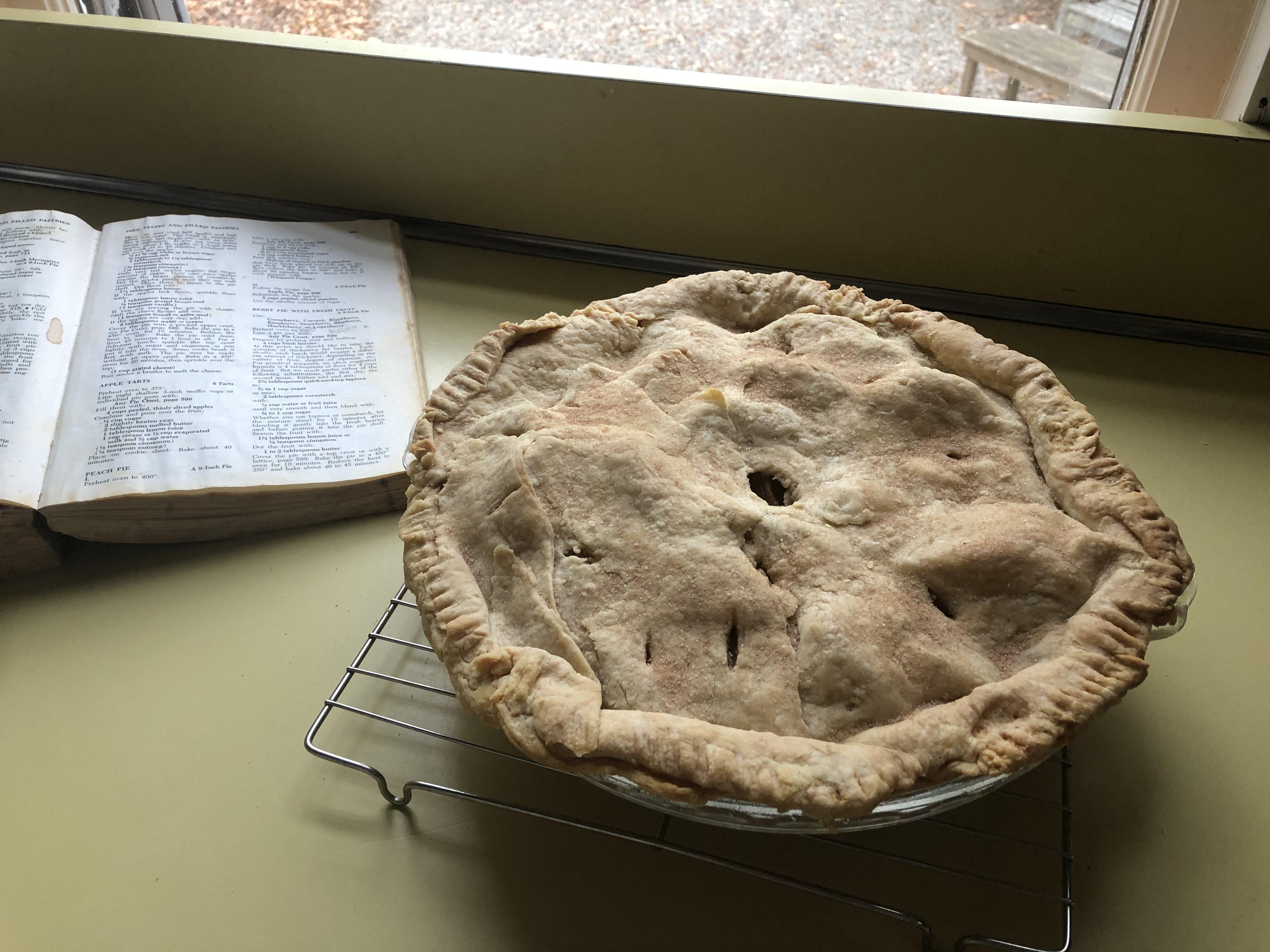
My husband and I are on our own for the first time at Thanksgiving. We ordered turkey takeout, but I did make the apple pie.

I want to avoid perpetuating any Thanksgiving mythology but at the same time write about the enduring appeal of a universal idea — people with differences breaking bread together.

We now know that our traditional Thanksgiving story is both inaccurate and hurtful to descendants of the indigenous people who first encountered the Pilgrims. As you can read at the Christian Science Monitor, here, the New York Times, here, and the Smithsonian, the story of colonial contact is considerably more heartbreaking than uplifting.

This knowledge has been discussed widely for quite a few years now, and yet there are still schools where children make feather headdresses and Facebook friends who post Pilgrims and Wampanoag chiefs holding hands. So what is the appeal, apart from the spin and wishful thinking of conquerors?

Pretty sure it’s the breaking-bread-together part.

I remember my sense of gratitude and privilege (the good kind of privilege) when I was invited to my friends’ Passover seder. How I loved hearing about the words that are said over all the traditional dishes and the history associated with them. I loved learning that I shouldn’t quiz my friend’s father on his WW II experience because “we focus on peaceful topics at Passover.” How else would a person raised Episcopalian gain this interesting knowledge about cultural differences?

Even at non-Covid Thanksgiving meals, you know, we often break bread among differences. Friends regularly say they hope they can keep distant relatives off religion and politics and just focus on things everyone enjoys in common. Because among differences, there are always commonalities.

All of which is my roundabout way of sharing my delight in some unusual combinations of dishes ESL students I know are preparing for Thanksgiving. It’s a merging of cultures.

“For Thanksgiving, I’m going to cook baked pork in sweet and sour pineapple and orange sauce, turkey, Russian salad, and Italian pasta.”

“For Thanksgiving, I plan to cook baked pork with pineapple, cranberry, and ginger sauce. Mashed potatoes and fruit salad.”

“I plan on cooking turkey, rice, pork, and Salut bacalao [Puerto Rican fish stew]. The drink will be Coquito [coconut eggnog].”

“I plan on cooking turkey, potato salad, chicken lasagna, and fruit.”

“I plan to cook turkey, rice, salad, and lasagna. For dessert we will make a brownie and three-milk cake.”

“Our plan for Thanksgiving is to cook a turkey, chicken, rice. And we are going to make a salad.”

Another student told me she usually makes the same things I think of as traditional Thanksgiving dishes but adds corn fritters. This year, she writes, she’s alone and isn’t sure what she’ll make, adding, “The smallest number of people in the home will be best for avoiding Covid-19. I think I’m in the smallest group by myself.”

Read Full Post »

What you need today — a day that even in the best of times can mean anxiety about travel or kitchen prep or argumentative relatives — is Pizza Rat.

Valentina Di Liscia and Hyperallergic explain what I mean. “The internet is squeaking with delight this week at a 23-second-long clip of a figure in a rat costume, complete with a long tail, whiskers, and mousy gray suit, dragging a life-sized pizza slice up the stairs in a New York City subway station.

“As surreal as it may be, the sight is intimately familiar to urban dwellers who remember video footage of a real rodent carrying an entire cheese slice up the platform steps a few years back. The strangely endearing, ubiquitous New Yorker became lovingly known as ‘Pizza Rat.’

“The man behind the very realistic mask in the more recent viral video [is] Jonothon Lyons, an accomplished dancer, theater artist, and puppeteer whose previous credits include the Blue Man Group, Sleep No More, and the Metropolitan Opera’s 2019 staging of Madame Butterfly. For his latest act, however, no tickets are needed. …

“Buddy the Rat, as Lyons has baptized his wiry-tailed character, brings the stage to the streets and the subway platforms: getting pets on the Brooklyn Bridge, showing off for Minnie Mouse in Times Square, and encouraging train riders to wear a mask.

“In an interview with Hyperallergic, below, Lyons tells us how Buddy was born and why he’s shaking up the performance art scene right now.

HyperallergicWhat’s the story of Buddy the Rat? How did the character originate?

Jonothon Lyons: Twelve years ago, I was working for a theater company in Portland, Oregon, called Imago Theater, and they have a show called Frogs, where we played big animal characters in masks. I played a frog, a polar bear, an anteater, and a penguin, but I never played a rat, and I always wanted to. In 2009, I made my own rat mask and went out in Times Square and ran around, put it up on YouTube, and it got around 70,000 views. It wasn’t gigantic, but it was enough that in the back of my mind I kept thinking, ‘I need to take this rat out again.’

H: I’ve just emerged from a rabbit hole of TikTok videos of you performing in the costume. They’re incredible, and they’re really resonating with people right now. How did Buddy go viral?

JL: I’m friends with this film director Todd Strauss-Schulson (Isn’t It Romantic, The Final Girls, A Very Harold and Kumar 3D Christmas). I told him I had this rat character I’ve been wanting to do more with it, so we conceived of a little three and a half minute-long film.

“We shot it the week leading up to the election, in abandoned SoHo, as the windows were being boarded up — a very surreal and uncommon vision of New York. After the first night of shooting, a stranger had posted a video of me that got 1.7 million views that day. We wrapped up the movie, and over the next few days I started going out on my own and posting the content to TikTok and Instagram, and it really took off.”

Folks, I’m thankful for a whole lot of things today, but at this particular moment, I’m thankful for anyone who says they always wanted to play a rat! More at Hyperallergic, here.

Read Full Post »

On my first day at the Boston Fed in 2005, I attended orientation with two other new hires, one an immigrant from Mali. In the years since, especially after Mamoudou returned to Africa, I’ve read with alarm about the many tragedies his country has suffered. How do people live through great upheaval and keep their sense of self and their spirits intact?

Anastasia Tsioulcas has some thoughts at National Public Radio.

“The northwestern African country of Mali is one of the world’s musical cradles. Its rich traditions helped give birth to American blues and jazz, traditions brought by enslaved Africans to these shores. But today, Mali is in turmoil. The country has suffered a long civil war spurred by Islamist insurgents (whose attacks are still ongoing), and the government fell to a coup in August. The country is also trying, like the rest of the world, to cope with the coronavirus.

“Despite all of those challenges, however, Malian musicians are still creating amid the chaos — and have some important lessons to share about how to get through tough times.

“The band Songhoy Blues plays rollicking music of resistance against the political and social threats its country is facing.

“These Malian musicians came together in 2012 after attacks by local and foreign jihadists forced people to flee the country’s northern cities and towns as well as its vast Saharan desert. …

” ‘When the civil war start in Mali, when they banned music, all the people from the north of Mali has to move to the south just to be safe at that moment,’ explains Aliou Touré. He’s the lead singer of Songhoy Blues. …

” ‘When you come far away from your hometown and you meet each other,’ Touré explains. ‘you speak the same language. It’s kind of like a satisfaction of nostalgia when you meet someone who speak your language, who do what you do, who love something that you love.’ …

“The Malian musicians are a thoroughly modern band, but they’re also walking in the footsteps of some of their country’s most revered musicians, like Ali Farka Toure and Salif Keita.

“And like those other artists, the music of Songhoy Blues is born of struggle — and not just political. When I spoke to Aliou Touré (no relation to Ali Farka) by phone in Bamako, he had just recovered from a bout of malaria. And, like so many other places in the world, the coronavirus pandemic has shut down his country. He says enduring each hurdle is like surfing.

‘As every single band in the world during now,’ [Aliou Touré] says, ‘we just keep surfing on the waves — see what’s gonna happen next day, what’s gonna happen next day, next month.’

“The pandemic shutdown, though, has created some interesting creative opportunities for artists. … The pandemic has also provided a respite for one of the country’s most beloved singers, Oumou Sangare.

“Sangare spent much of the coronavirus shutdown in the U.S. — first in New York, and then in Baltimore. She’s since returned to her home in Bamako. She says the isolation was actually nourishing.

” ‘I rejoiced in my confinement,’ she says in French. ‘I’ve never had the chance to rest like that in the 30 years of my career.’ …

“That period of reflection gave Sangare the creative energy to start work on a new album herself. Sangare also acknowledges that Mali’s ongoing civil strife has taken a severe toll across the nation — across ethnic and geographic boundaries. …

” ‘The whole country is suffering. I think that the Malians must unite. That’s my point of view: It is unity that makes strength.’

“For years, musicians have been at the forefront of urging the country to stay united and to stand for peace. Their voices are now again in the lead — trying to bolster the country’s courage.

“Songhoy Blues decided to name its latest album Optimisme — ‘optimism.’

“Lead singer Aliou Touré says that he’s learned that it’s the only way forward. ‘That’s the only thing keeping us, keeping people smiling, and that’s the only, only way to give ourselves a hope,’ he says. ‘It’s the best way to keep yourself alive. To be optimist, I think, is the biggest message ever that the whole world need to hear right now.’ “

As Bonnie Johnson at WICN jazz radio says, “Stay Positive. Test negative.”

More at NPR, here.

Read Full Post »

Whether we know it or not, we’re always passing down family customs, sayings, songs, crafts, and more to the next generation. Sometimes I’m a bit sad that I stopped singing songs in the car as an adult, because there are a ton of old nursery rhymes and folk songs from my childhood that my kids never learned. One time my youngest brother said to them, “Does your mother still sing in the car?” and they had no idea what he meant.

I’ve blogged before about efforts to preserve marginalized languages, and any similar initiative gets my attention. Consider this story on preserving artisan techniques in danger of dying out.

Gareth Harris writes at the Arts Newspaper, “Centuries-old practices and traditions across communities worldwide that might be lost forever — from beekeeping in Kenya to creating the Dalai Lama’s clothes — are being quietly supported and documented online through the British Museum’s Endangered Material Knowledge Programme (EMKP).

“The scheme, launched in 2018, has been boosted by an [$11.7 million] grant awarded by Arcadia, a charitable fund founded by the philanthropists Peter Baldwin and Lisbet Rausing; the cash injection means the project has been extended for seven years (2021-28). …

“ ‘Locally informed knowledge is in danger of being lost — knowledge that has helped communities thrive in unique environmental, social and cultural contexts,’ says a statement from the British Museum. …

” ‘We are offering communities the resources to record themselves; that is so powerful. It’s a form of auto ethnography as such,’ says Ceri Ashley, the head of EMKP.

“ ‘Once this material has been collated, it is uploaded onto an open access digital database hosted by the British Museum, and a digital copy is also shared with a partner in the country of work so that it remains close to the community whose cultural heritage it represents,’ say museum officials. …

“This year’s supported schemes include a survey of the skills of Venerable Phuntsok Tsering, the Dalai Lama’s personal tailor. ‘Since 1959, he has been responsible for (re)constructing the tailoring requirements of the Dalai Lama in exile. He rebuilt the ceremonial wardrobe left behind in Tibet and developed new garments for use in the unfamiliar environmental and cultural conditions of India. Despite this singularity his practice has never been documented,’ says an online statement.

“Ashley points out that the EMKP team, working primarily online, has worked throughout lockdown, collaborating with an international advisory panel to review and select the next round of grants. …

“Another 2020 project focuses on the manufacture of Ostrich eggshell beads among the El Molo Community in Kenya, capturing their making and use through audio files, video clips and field notes.

“Last year, the EMKP recorded the dwindling practice of beekeeping amongst the Sengwer communities living in the Embobut Forest in western Kenya. ‘Some projects celebrate the everyday, which is so important,’ says Ashley, referring to a 2019 analysis of the traditional natural broom and fibre rope crafts of the Urhobo people of Nigeria.

“Applications are now open for the 2021 round of funding (deadline for applications is 31 January 2021). Instructions online stress that prospective candidates should ‘consider the viability and ethics of conducting this work within the context of the Covid-19 pandemic.’ ” Read more at the Art Newspaper, here.

The Kenya beekeeping reference makes me think of a wonderful documentary, Honeyland, about an isolated beekeeper in rural Macedonia. Do watch it if you get a chance. I hope her techniques are being preserved, too.

Read Full Post »

As the story goes, a wolf protected and raised the human twins Romulus and Remus, which somehow led to the founding of Rome. The notion that a wolf could suckle a human baby has a universal appeal, if not much biological support. It certainly has spawned a lot of art.

What are the chances wolves could protect us now?

Scientists concerned that a deadly cervid disease similar to ‘mad cow’ could jump to humans are asking if wolves might detect and destroy weakened animals before people can.

Jim Robbins writes at the New York Times, “Are the wolves of Yellowstone National Park the first line of defense against a terrible disease that preys on herds of wildlife?

“That’s the question for a research project underway in the park, and preliminary results suggest that the answer is yes. Researchers are studying what is known as the predator cleansing effect, which occurs when a predator sustains the health of a prey population by killing the sickest animals. If the idea holds, it could mean that wolves have a role to play in limiting the spread of chronic wasting disease, which is infecting deer and similar animals across the country and around the world. Experts fear that it could one day jump to humans. …

“Chronic wasting disease, a contagious neurological disease, is so unusual that some experts call it a ‘disease from outer space.’ First discovered among wild deer in 1981, it leads to deterioration of brain tissue in cervids, mostly deer but also elk, moose and caribou. …

“It is caused by an abnormal version of a cell protein called a prion, which functions very differently than bacteria or viruses. … The disease is part of a group called transmissible spongiform encephalopathies, the most famous of which is bovine spongiform encephalopathy, also known as mad cow disease. Mad cow in humans causes a variant of Creutzfeldt-Jakob disease, and there was an outbreak among people in the 1990s in Britain from eating tainted meat.

“Cooking does not kill the prions, and experts fear that chronic wasting disease could spread to humans who hunt and consume deer or other animals that are infected with it.

“The disease has infected many deer herds in Wyoming, and it spread to Montana in 2017. Both states are adjacent to Yellowstone, so experts are concerned that the deadly disease could soon make its way into the park’s vast herds of elk and deer.

“Unless, perhaps, the park’s 10 packs of wolves, which altogether contain about 100 individuals, preyed on and consumed diseased animals that were easier to pick off because of their illness (the disease does not appear to infect wolves). …

“ ‘Wolves have really been touted as the best type of animal to remove infected deer, because they are cursorial — they chase their prey and they look for the weak ones,’ said [Ellen Brandell, a doctoral student in wildlife ecology at Penn State University who is leading the project]. By this logic, diseased deer and other animals would be the most likely to be eliminated by wolves. …

“[Ken McDonald, chief of the wildlife division of Montana’s Fish, Wildlife and Parks Department,] said that maintaining a large enough wolf population outside of Yellowstone to control chronic wasting disease would require so many wolves that it would be socially unacceptable, especially to ranchers and hunters.

“The state’s approach to controlling the disease, he said, is to increase the number of deer that can be killed in places where the disease is growing.

“Ms. Brandell, however, said that wolves may detect the disease long before it becomes apparent to people, through smell or a slight change in the movement of prey, which could be beneficial.

“ ‘Wolves wouldn’t be a magic cure everywhere,’ [Ms. Brandell] said. ‘But in places where it was just starting and you have an active predator guild, they could keep it at bay and it might never get a foothold.’ ”

More here.

Read Full Post »

Every once in a while I feel moved to explain why this eclectic site is called Suzanne’s Mom’s Blog. My son, John, asked the same question when he heard the title nine-plus years ago, saying with mock indignation, “Hey, what about me?”

But the blog came about because Suzanne and my son-in-law, Erik, wanted a blog connected to Suzanne’s jewelry business, Luna & Stella, and they set up this WordPress account. When they asked me to do it, they said I could blog about anything that interested me. I’ve loved every minute of it.

I also love letting readers know when something particularly special is going on at Luna & Stella, and that includes Suzanne’s first-ever Archive Sale, here.

As she wrote to her newsletter subscribers, “You’ll find over 100 of our most giftable pieces at 40 – 60% off the original retail price.  

“Each of these charmsearrings, and rings are designed to be stacked and layered, making them perfect gifts for girlfriends, sisters, mothers, and daughters.  We hope you’ll find a meaningful gift for someone you love, or a treat for yourself. ” 

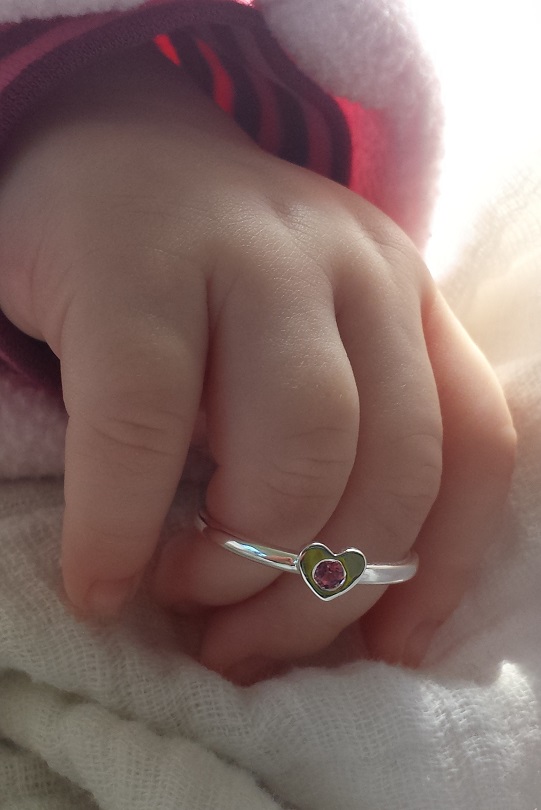
I’m posting some of my favorite photos from the Archive Sale, including a grandchild’s darling pudgy hand. Time sure flies. No grandchild is pudgy anymore.

Keep up-to-date with Suzanne’s offerings on Instagram @lunaandstella. If you need to contact me, I’m at suzannesmom@lunaandstella.com

Read Full Post »

Sometimes it seems that American media are too inwardly focused, which is why I like getting ideas for the blog from people on Twitter who link to reliable foreign media — and why I appreciate sources like the Guardian and Public Radio International (PRI).

For today’s post I’m turning to PRI’s the World, where Daniel Ofman has produced a broadcast about a student in remote Siberia who had to scale a tall birch to get access to his online classes.

“During the coronavirus pandemic, working or studying from home requires logging onto Zoom or Skype. … Take Stankevichi, Russia, a 39-inhabitant village deep in the Siberian region. That is where student Alexei Dudoladov has been forced to go to great lengths — or rather, great heights — to attend classes online. He must climb a birch tree in his remote hamlet every time he needs an internet connection.

“The 21-year-old is a popular blogger and a student at the Omsk Institute of Water Transport, located 1,383 miles east of Moscow.

“Dudoladov, who also works on his family’s farm, has been posting videos of his daily routine on social media and keeping up with Russian-language TikTok and Instagram for nearly a year. 

“Then the COVID-19 pandemic hit and authorities in several Russian regions moved university students to online classes to counter a surge in coronavirus cases. Dudoladov started to take classes online, but internet service at his family farm was patchy or non-existent.

‘Our village has really bad internet, so I found a solution. I climbed a birch tree. Up there I got a pretty good signal. The internet was alright, so I started studying on the tree.’ …

“But the arrival of the Siberian winter presented a new challenge for Dudaladov, who was spending long hours on top of a tree and under the elements. So he posted a video on social media appealing to Alexander Burkov, the regional governor, for a better internet connection — for himself and other students in Russia. 

“ ‘I want to ask you on behalf of all students who have bad internet, how are we going to solve this problem?’ Dudoladov asked in the video, which has since then caught national — and international — attention.

“Dudoladov has been offered some help from people in Russia and other countries, but he is still waiting for a satisfactory solution from the governor. … Dudoladov still catches the internet signal from the top of the tree but says he may know a guy who might be able to help.

“ ‘We hope that Elon Musk sends out his internet satellite system here so that we can have high-speed internet everywhere — not just in the US, but also here in Russia,’ he says.” Listen to the broadcast here.

I love learning what’s going on in other parts of the world just like I love knowing people from other parts of the world. Without PRI, how would I know, for example, that you can train for a career at place called Omsk Institute of Water Transport? (Be sure to look at their webpage.)

And speaking of higher education, without a friend from China, how would I know that a perfectly reasonable place to go to college is the province where my friend’s nephew goes — Inner Mongolia.

Read Full Post »

People have so many different sides to them! My friend Ann — retired human resource professional, acclaimed textile artist, and hiker — told me recently about a pianist-composer-hiker who conquered the New England portion of the Appalachian Trail and then wrote a symphony about the experience. As I write, I’m listening to this wonderful piece online.

In a 2018 broadcast, Mary Engisch at Vermont Public Radio (VPR) shared part of Southard’s story in a podcast.

Keane Southard,” writes Engisch, “spent many of his childhood weekends hiking and camping with his family in New Hampshire and Vermont. From that early age, he imagined one day he would hike the legendary Appalachian Trail.

“Southard went on to study [music] composition and theory, and all the while, the idea of hiking the trail and composing a piece about the experience percolated in his mind.

In April [2018], Southard completed ‘An Appalachian Trail Symphony: New England (Symphony No. 1),’ inspired by his 66-day, 734-mile hike of the New England portion of the trail.

” ‘I entered the trip knowing I [would] write this piece afterwards, but kind of having a blank slate to start off, and to have the music and the ideas come out of my experience,’ Southard said.

“In this podcast, learn about … how he transformed the trail sounds of footsteps, buzzing bugs and bird songs that he heard along the way into this composition for orchestra.”

Southard tells Engisch, “I’m really inspired by New England. I grew up in Massachusetts, and my parents took me and my siblings on so many trips up to New Hampshire and Vermont. And it wasn’t until leaving New England and going off to school that I realized how much this region is ingrained in me and how much I love it.” More at VPR, here.

At Southard’s website, he writes about the symphony and some of his other compostions.

“In June, I found out that my orchestral work Titanium and Mercury (which is the first movement of my in-progress second symphony but extracted as a stand-alone work) [won] First Prize in the [Eastern European] 2nd International Michal Kloefas Oginski Symphony Orchestra Contest for Young Composers! I’ve never won first prize in an overseas competition before, so it was great to hear this news! 

“The jury told me that my piece really reminded them of Prokofiev (which is a bit surprising to me) and it looks like the piece will be scheduled to be premiered in Molodechno, Belarus, in spring 2021!

“Just last week, on August 10, I had my first performance since February when the British pianist Maria Marchant gave a beautiful premiere of my Prelude No. 17 (For the Left Hand) in London, UK as part of her ‘7 Notes in 7 Days at 7pm’ project.  

“Back in April, I was fortunate to have pianist Adam Marks record a video of my Prelude No. 18 (On the Day of Penderecki’s Death) as part of his ‘One Page Pieces’ project.  As the title suggests, I wrote this short work (about 30 seconds long) on the day I heard that legendary Polish composer Krzysztof Penderecki passed away at the end of March.  While not a ‘threnody’ for him, I was thinking about him as I wrote the piece.

“In April, I also found out my Missa Brevis for Choir was awarded the Belle S. Gitelman Award from the composition department here at Eastman.

“And way back in February before the pandemic hit, I was lucky to have a reading of my wind ensemble transcription of John Foulds’ wonderful piece April-England with the Eastman Wind Orchestra led by David Baker.”  More here.

You might also like to check out an interview Southard gave to the Claflin Hill Symphony, here.

Read Full Post »

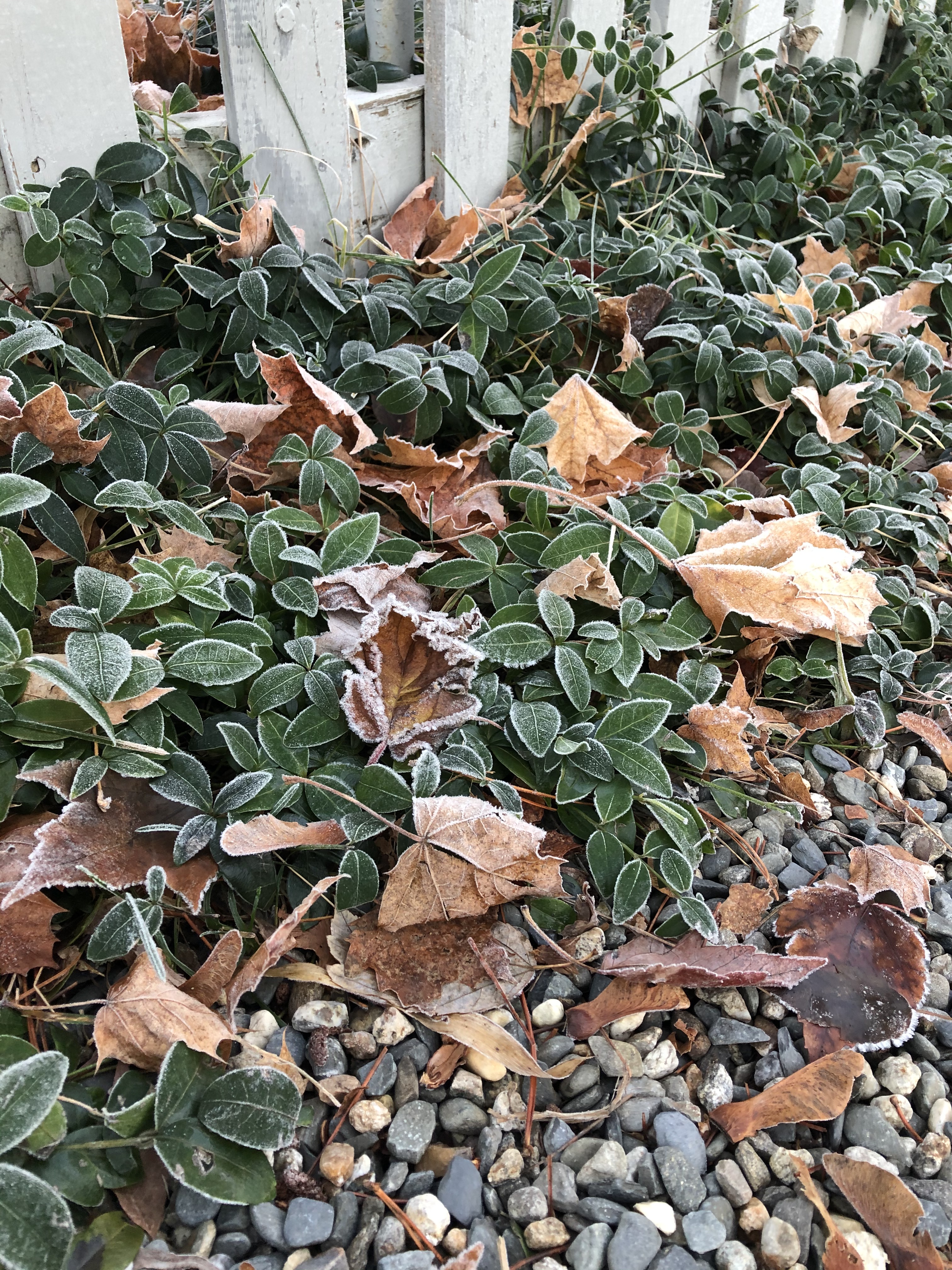
Frost

For one of the online English as a Second Language (ESL) classes where I work as a teacher’s aide, I think up writing prompts for students who want to practice their skills. The other day, I thought of “Write about something you like about cold weather” — but I changed my mind. It’s hard even for me to think of something I like about cold weather, and I imagined it would be harder still for the students from tropical countries.

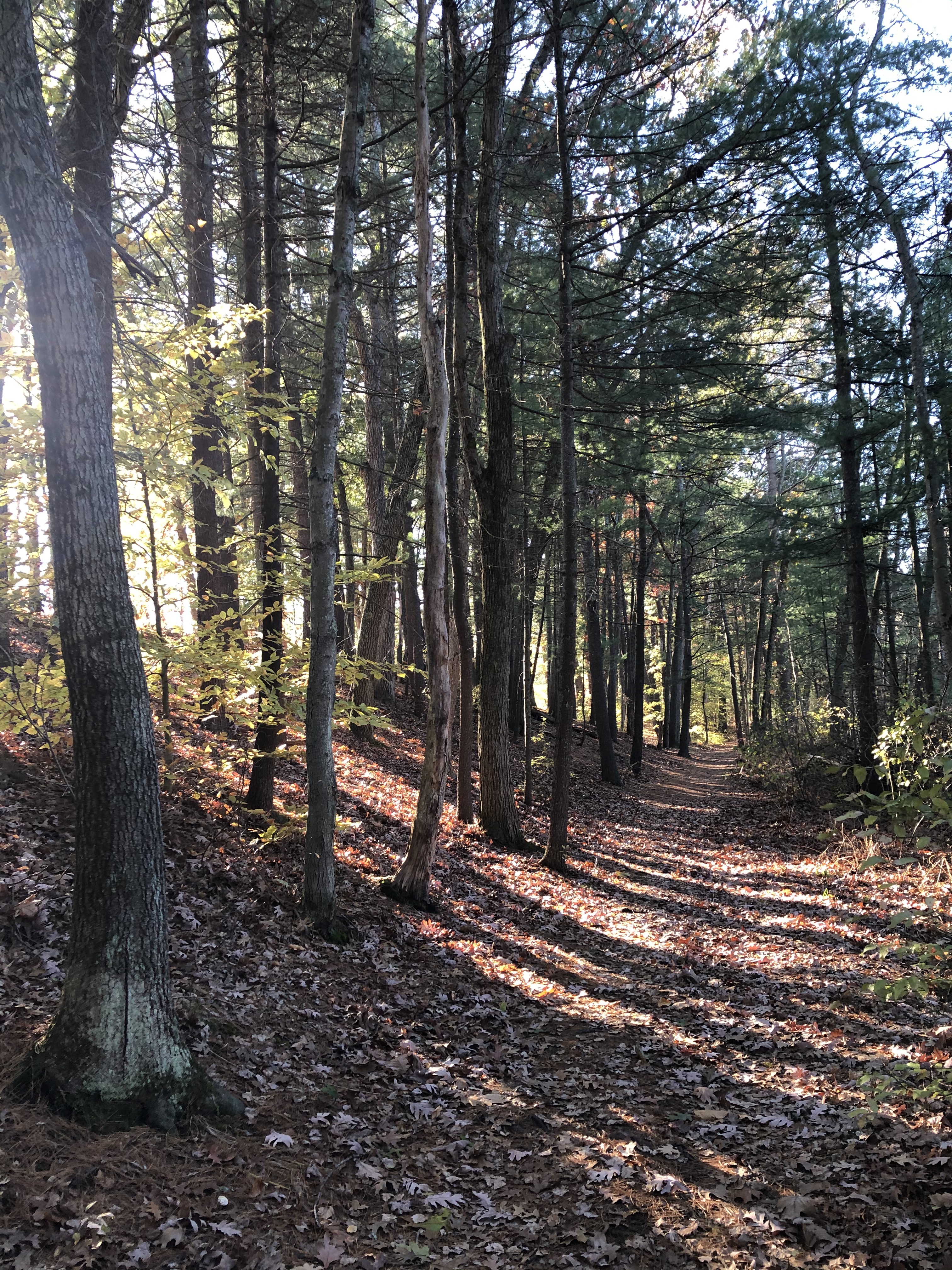
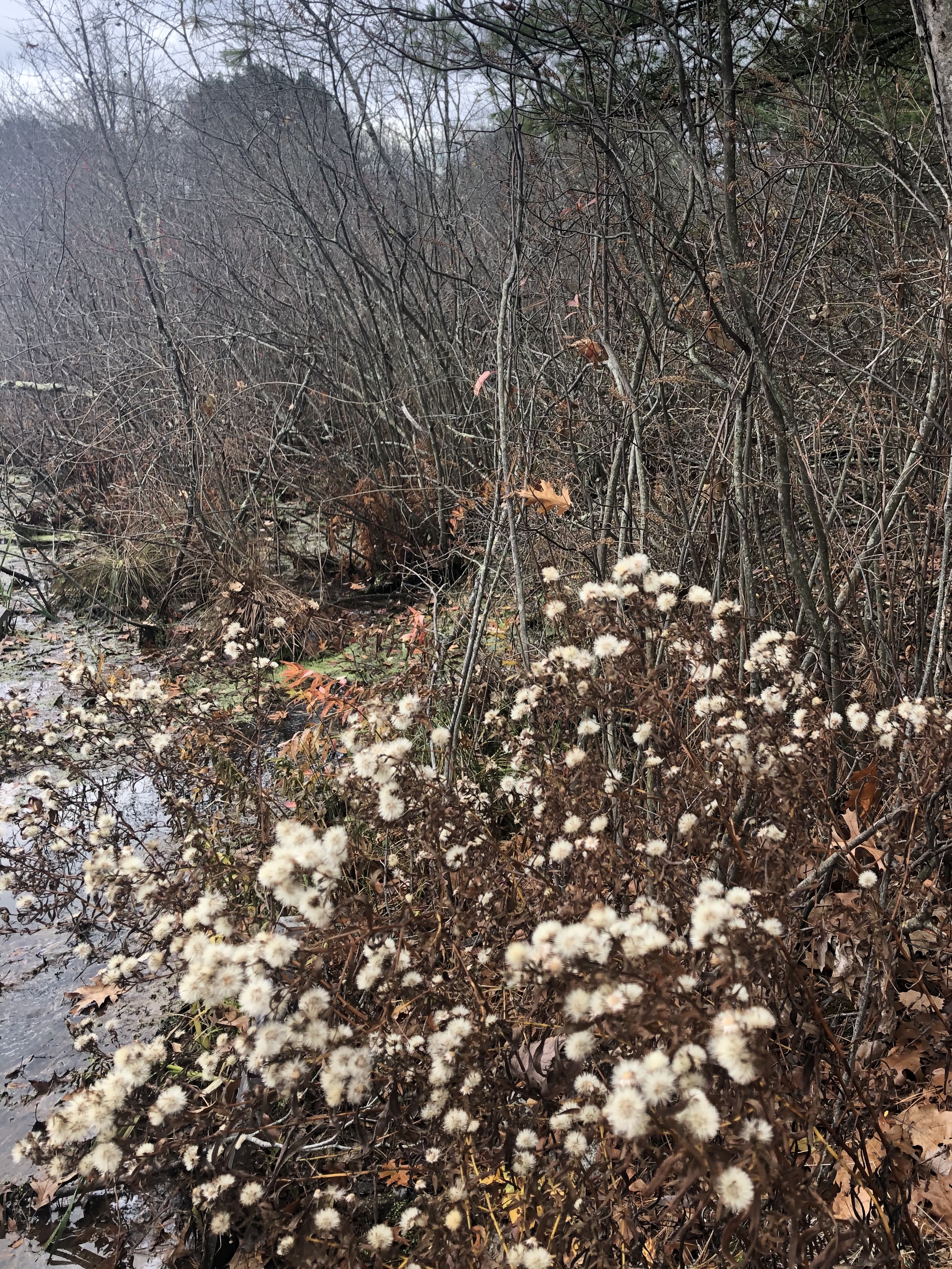
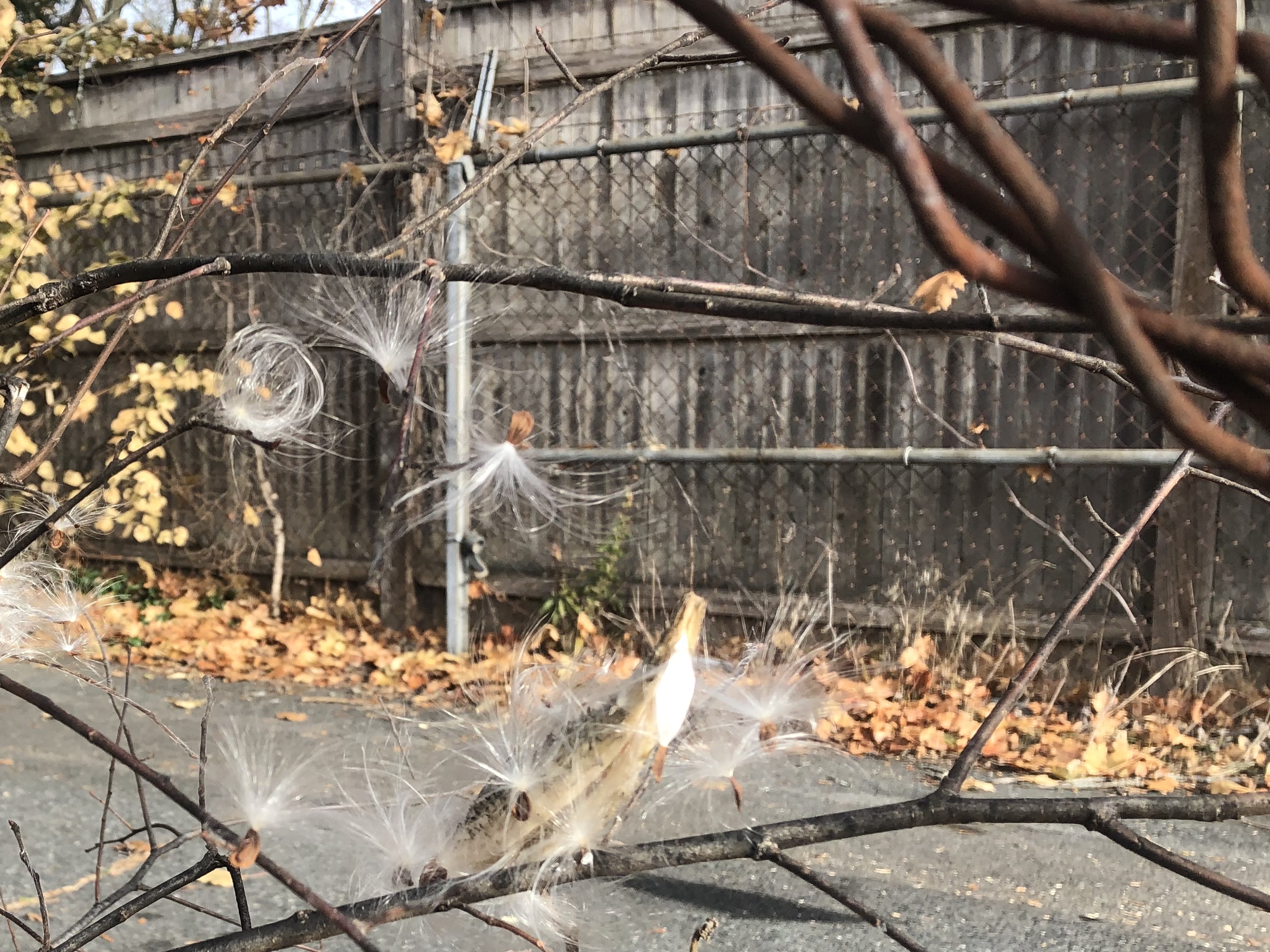
In any weather, however, there are always photo ops to be found, and I must say I loved the frost-etched leaves above. Today I thought I’d share other signs of the changing seasons.

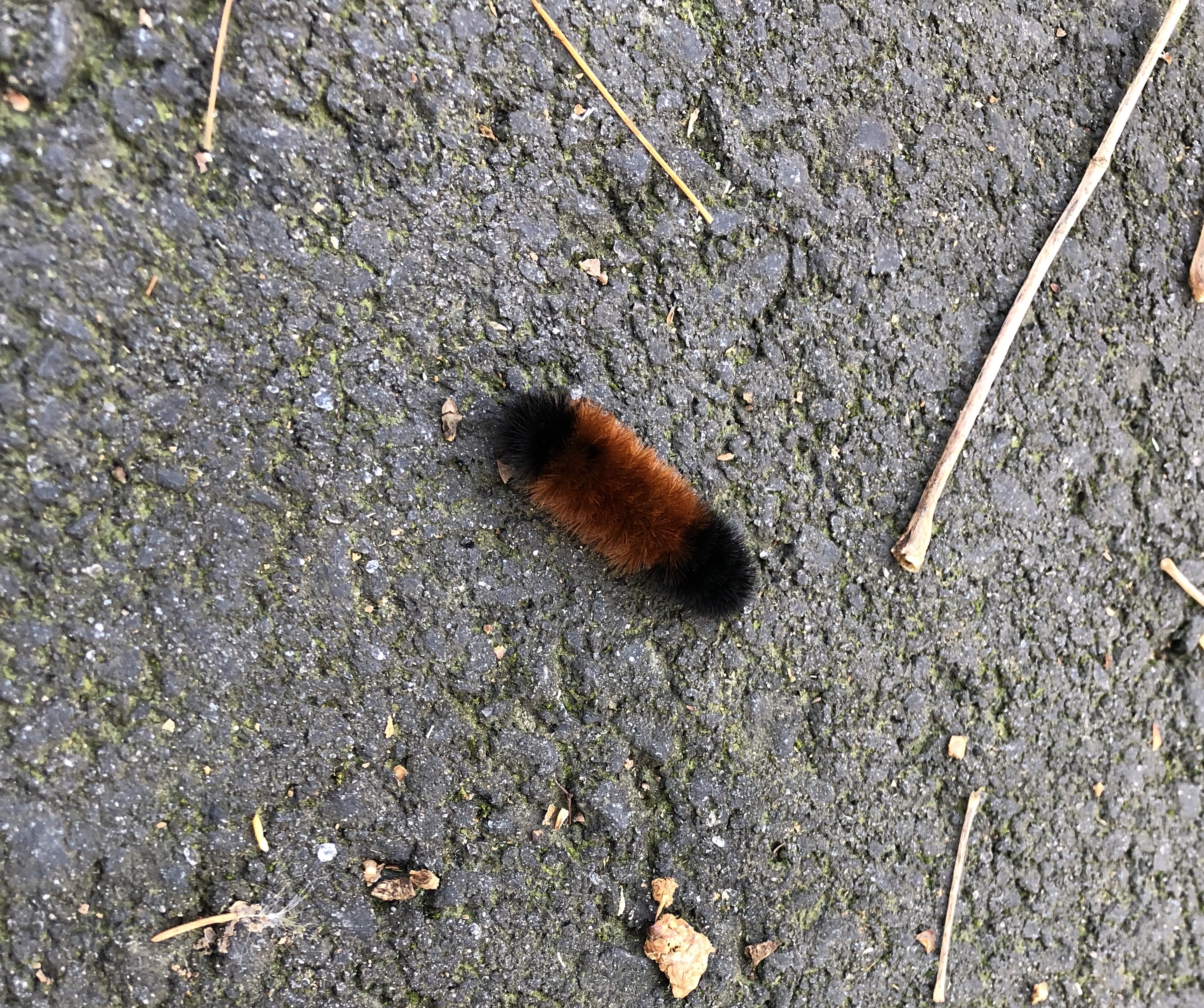
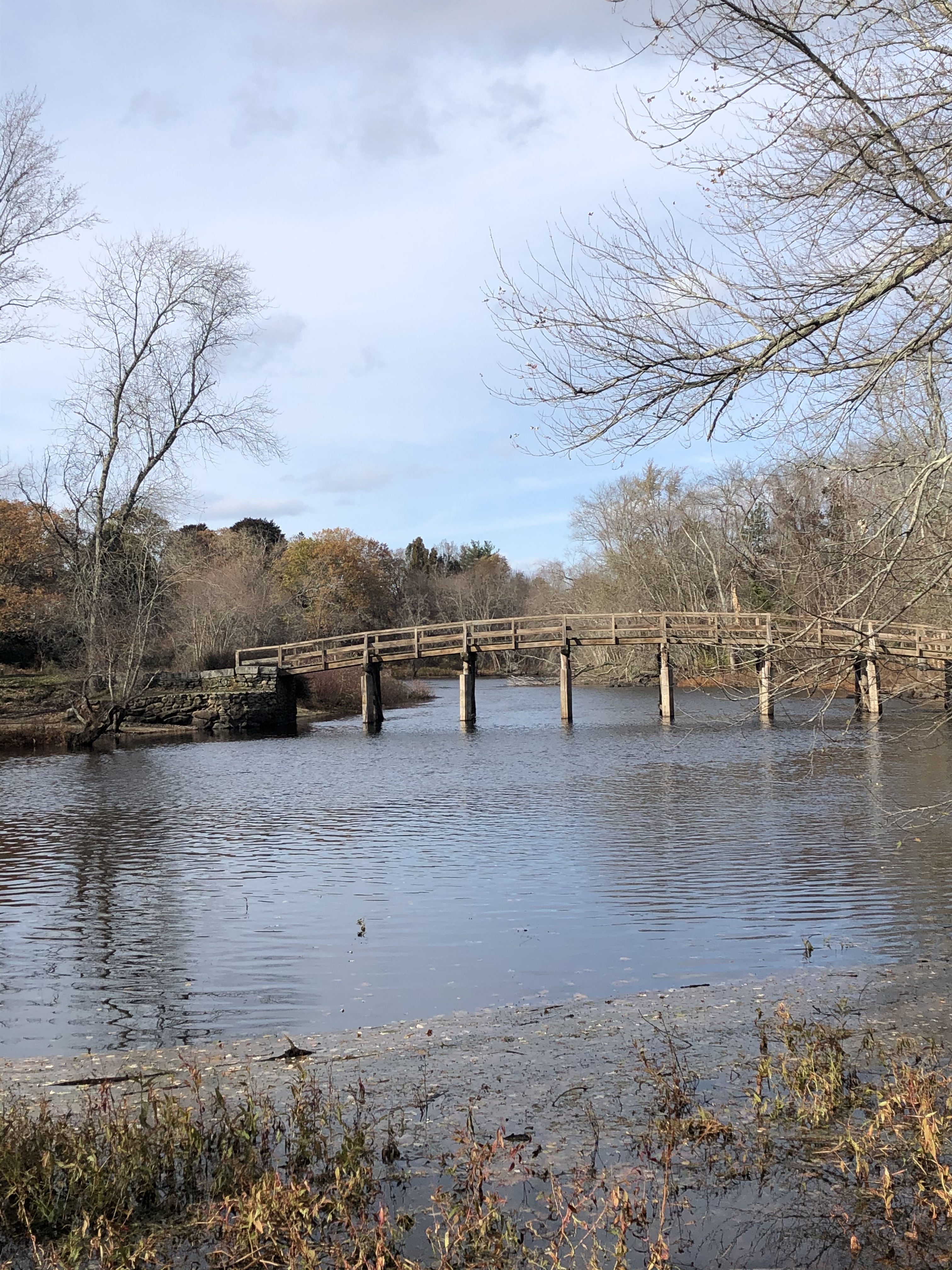
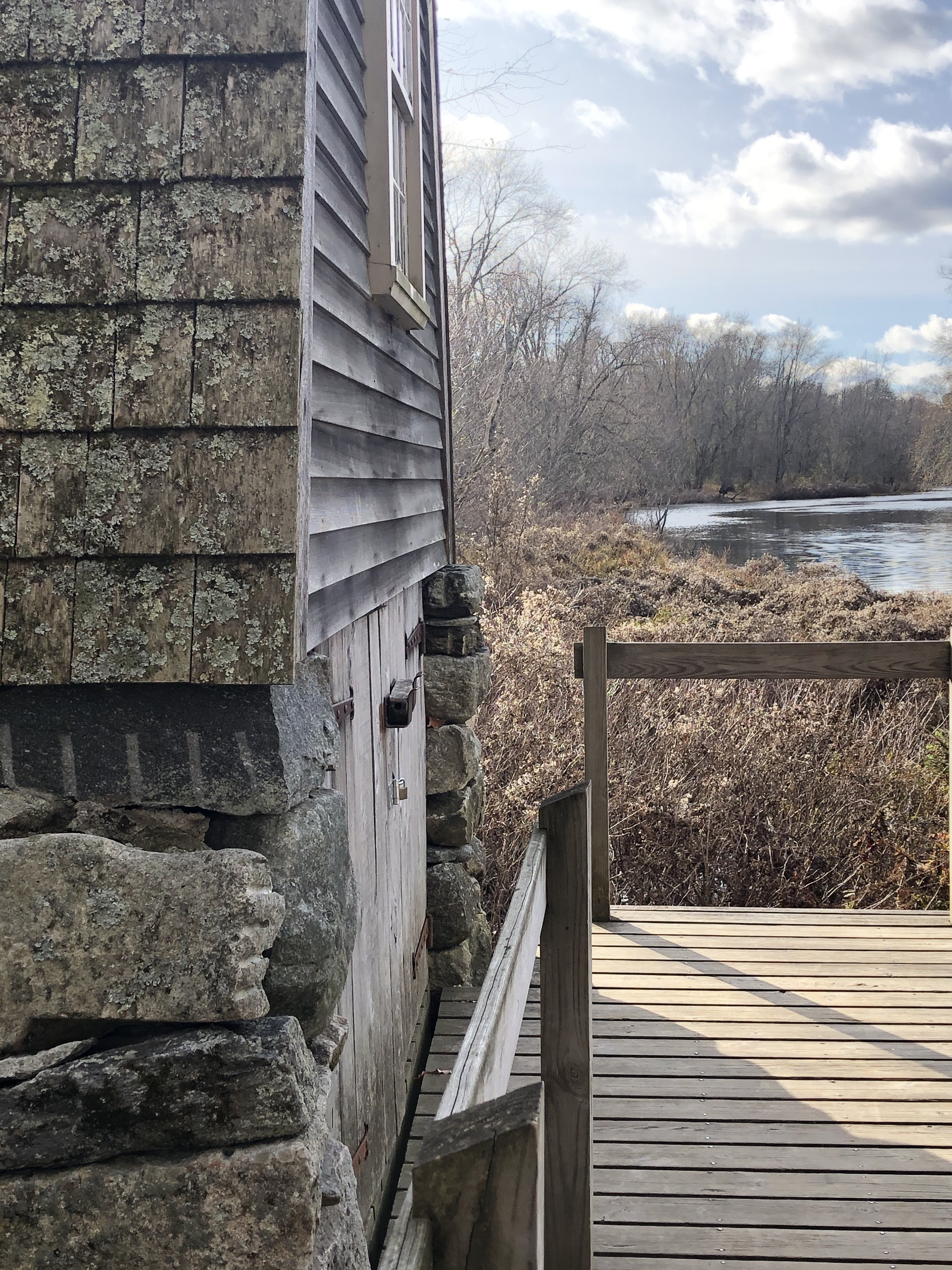
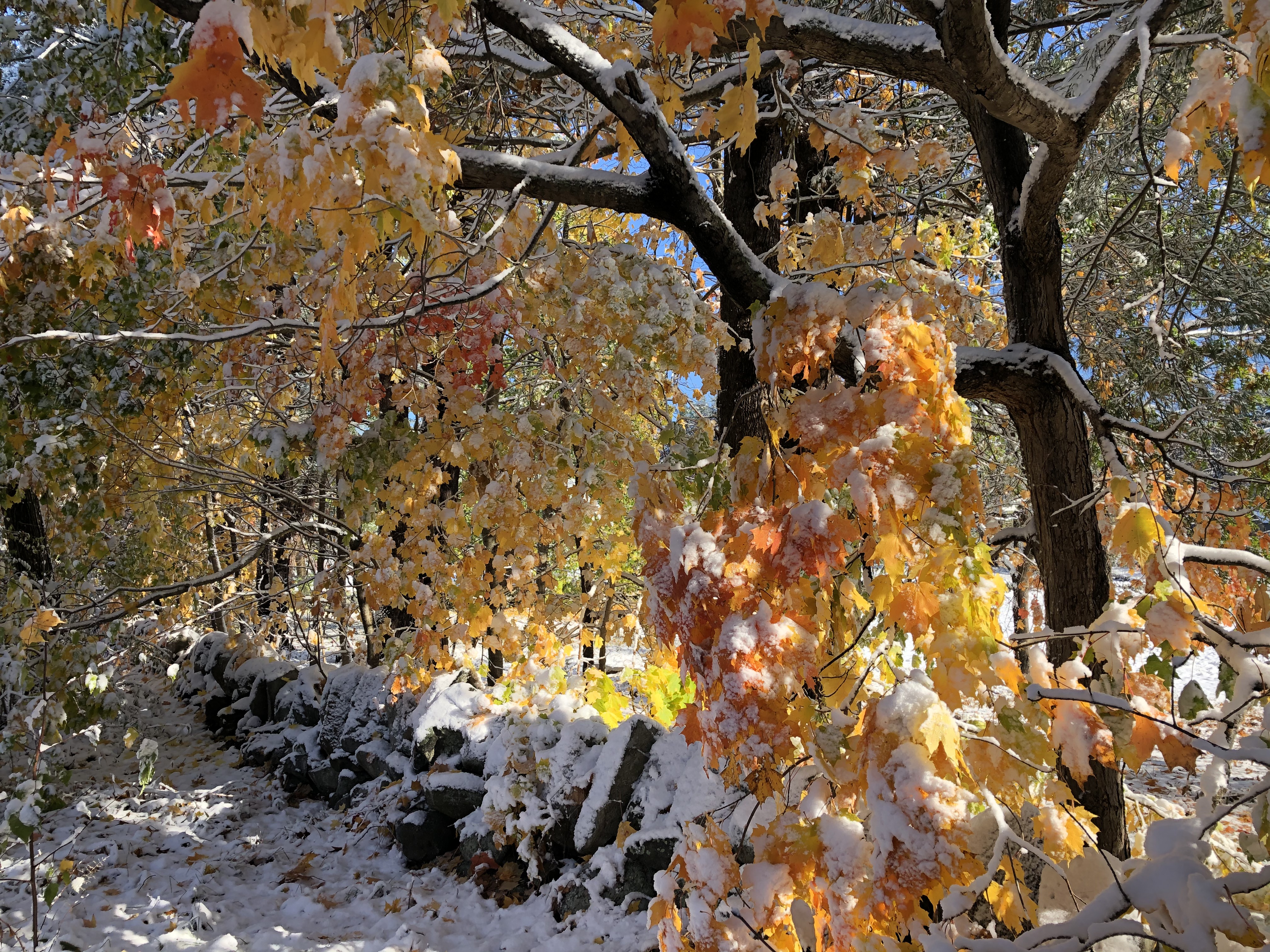
I read the long, rust-colored band on this Woolly Bear as predicting a mild winter. It’s harder to read the conflicting signs in the photos that follow. The North Bridge and the boat house at the Old Manse look bleak enough for a tough winter. But on one day, I’m kicking through dry leaves along a sun-strewn trail, and the next trudging through snow.

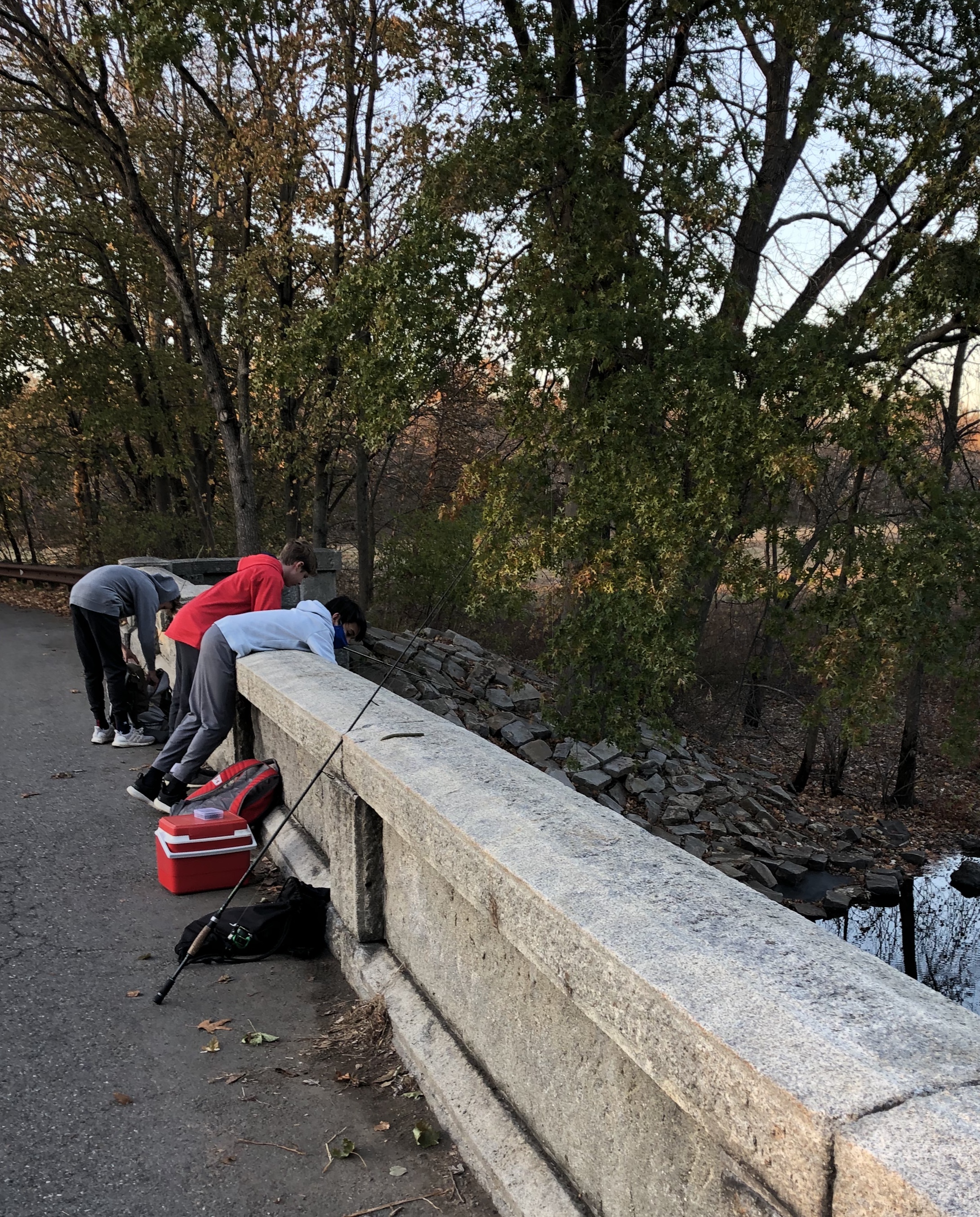
The snow was actually an October surprise. It melted pretty soon. More typical for the time of year are the three scenes that follow., including the one of boys seizing the day for a bit of fishing in the Sudbury River (posted with a warning about mercury contamination).

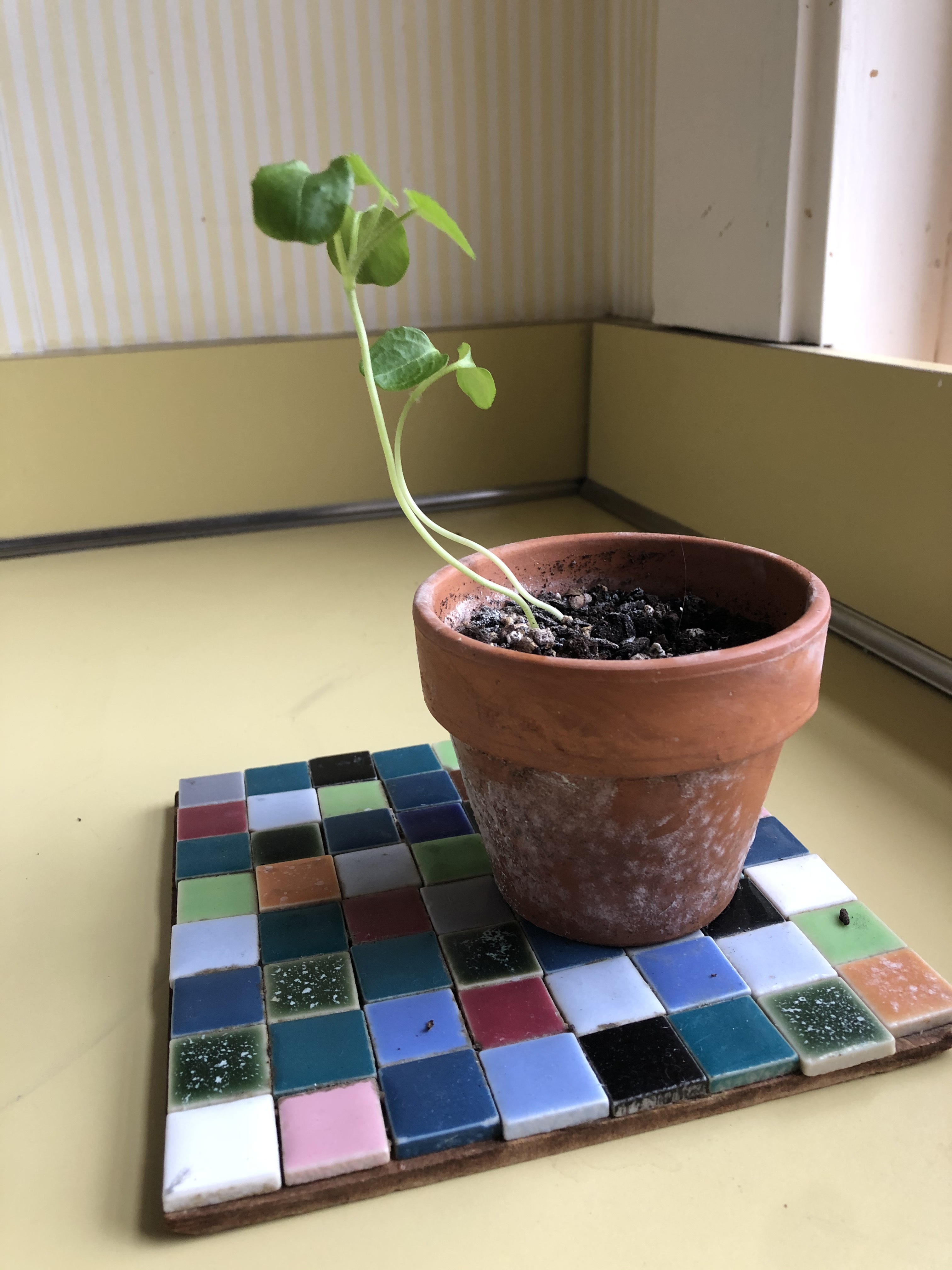
I expect that my Money Plant — a goofy gift from the bank, of all things — will keep turning to the light no matter what the weather. I like watching its slow dance. Funny how a pandemic-constricted social being can end up befriending a plant.

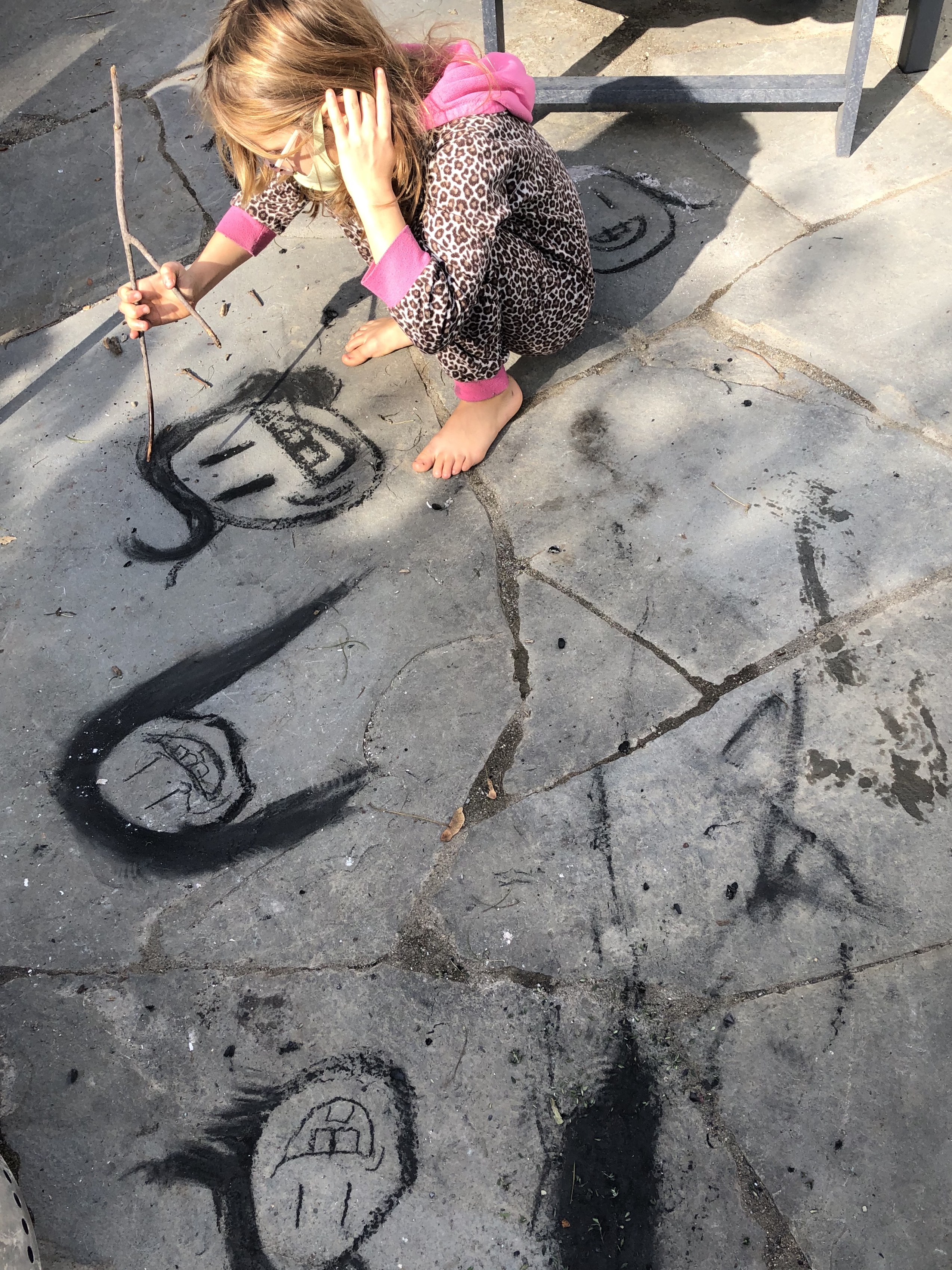
The artist in the next photo noticed she could draw pictures with the charcoal from a fire pit. She’s partially covering one family portrait that features white hair made from ashes.

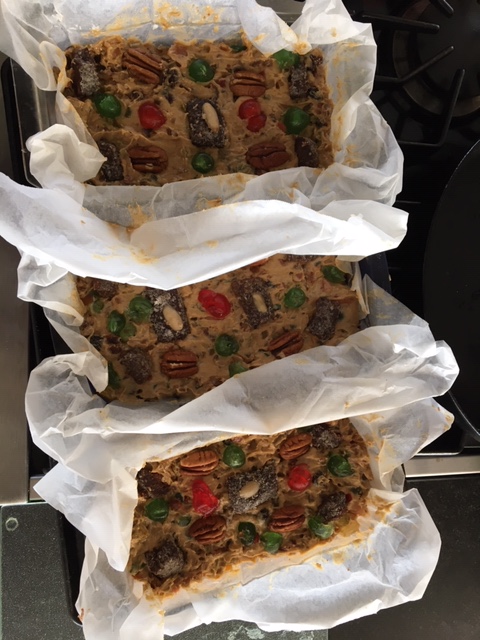
Whatever the season, life goes on in its random way, and my pictures documenting it are eclectic. The next one shows a farmer’s version of a Little Free Library beside the big, open-air barn where I buy produce. That photo is followed by a shot of Sandra’s magnificent baking. Her brother-in-law loves fruitcake at Christmas, and she starts making it in November. Ordinarily, she would give it to Tom at Thanksgiving, but this year, she and Pat are on their own with the turkey. Gatherings are getting too worrisome, and the governor is revving up extra hospital space in the convention center.

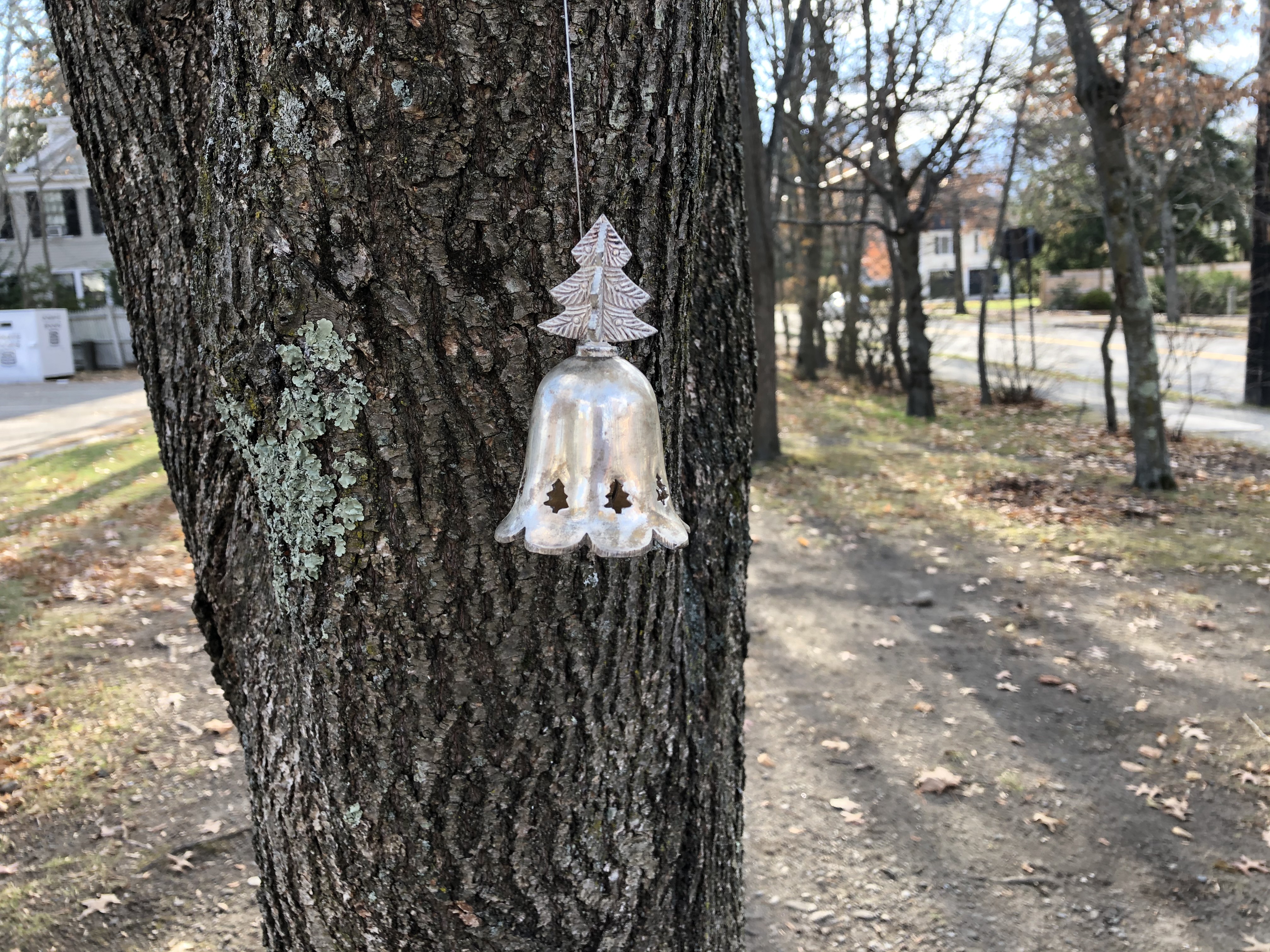
The last picture is of one of those charming things that people do just because they feel like it. I loved the surprise of two silver bells hanging near the library. It made me want to do more stealth decorations myself, as I did a few years ago.

Read Full Post »

Today’s story is about the kindness of one stranger. But something I especially like about it is that it’s also an example of more than one person making the kindness happen. For the woodworker in Virginia to make something that an Alzheimer’s patient in North Carolina would enjoy, it required the patient’s sister to think up the idea and put out a request to the Reddit universe.

Cathy Free reported the story at the Washington Post. “John Adams has been anxious lately. The nuclear engineer and his wife brought home their newborn son shortly before the pandemic started, and working from home has been challenging.

“For stress relief, Adams, who lives in Bedford, Va., likes to scroll through social media looking at woodworking projects, and one of his favorites places is Reddit, where there’s a community dedicated to woodworking. About a month ago, a post jumped out at him.

“ ‘Are there any craftsmen here who would be willing to make a shallow cabinet for me so I can create a “busy box” for my brother with Alzheimer’s?’ it read.

“The poster, Sharon Elin of Mechanicsville, Va., near Richmond, explained that she hoped to attach several kinds of latches and hooks on the doors to provide her brother with something to fiddle with and engage his mind. Her brother had become more frustrated lately and had been wandering around his two-acre property in North Carolina.

“Adams, 31, knew right away that he was the person for the task. … He agreed to make the box, then he stayed awake in bed for hours that night coming up with a design for it.

‘I thought, “I can’t pass this up — it seems like fate,” ‘ said Adams. … ‘I had plenty of scrap wood waiting to be used in my shop.’

“After consulting on Reddit with Elin, Adams spent a weekend in his shop building a polished pine busy box. As he worked, he kept in mind Elin’s brother, a retired chemistry teacher he’d never met, hoping the box would engage him and bring him joy.

“Elin had mentioned that fidget lap quilts with buttons, pockets and zippers can help keep people with dementia busy and give them something to do with their hands when they become agitated. She said she’d noticed that as her brother’s memory loss progressed, he became more restless and could spend hours doing the same tasks repeatedly, often old habits, such as folding towels or arranging bird feeders on the porch.

“ ‘That’s when I started thinking that maybe a busy box would help,’ Elin said. … ‘He’s always loved tools and tinkering with things, and I thought he’d enjoy something that had hardware on it instead of some of the lap cloths I’d seen with zippers and Velcro,’ said Elin, 65.

“ ‘I could envision a “busy box” in my mind, but I had no idea how to make it myself,’ she said. …

“She and Adams messaged on Reddit about her idea, then he designed a box that he thought [her brother, Chad] Chadbourne would appreciate. … ‘Sharon initially said she wanted a cabinet, but then we agreed that something lightweight was better,’ he said. …

“ My wife’s grandmother is going through dementia right now, and my grandmother passed away from it about six years ago,’ he said. ‘I know that she would have enjoyed something like this. I thought about her a lot when I went into the shop to work on the box that weekend.’

“Adams said it took him about 10 hours to make and put the finishing touches on the busy box. Then on Sunday, he arranged to meet Elin in a store parking lot in Lynchburg, about 30 minutes from his house. Elin arrived with the latches she’d bought for the project, and Adams brought along his drill and attached them.

” ‘He put them on right there on the spot,’ Elin said. ‘I’m so appreciative of what he did for my brother. He didn’t want to accept payment. … It’s really been heartwarming.’ …

“Over the summer, Kathryn Chadbourne took [Elin’s brother] to a gerontologist. Tests revealed that he had middle-stage Alzheimer’s disease. …

“Before he lost his memory, Chadbourne had a small day lily flower farm that he’d started as a hobby on his property, and he carried a pair of clippers everywhere in his pocket, she said. As Alzheimer’s took hold and he began cutting flowers repeatedly, her sister-in-law replaced the clippers with a set of pliers to help keep him safe.

“ ‘It became important for him to have those pliers in his pocket,’ Elin said. ‘Being outdoors on his farm was calming and took him back to something he enjoyed doing.’ …

“Several people on Reddit told Adams how much they admired what he did — one called it ‘some Mr. Rogers-level kindness’ — and a few told their own stories of relatives with Alzheimer’s.

“Adams responded that Elin ‘caught me in a rare period where I had finished everything on my wife’s honeydo list for the year but still had some warm-weather months left and was itching for another project. Came across B’s post while doomscrolling reddit and couldn’t pass up the opportunity to help!’ …

“ ‘We’re going through a stressful change, so this kindness is coming at the perfect time,’ Kathryn Chadbourne said. ‘My husband has always loved to do things with his hands. It’s perfect.’ ”

Here’s the follow-up on Reddit.

“A while back I posted on the woodworking subreddit for advice on finding or building a box I envisioned for my brother in the mid-stages of dementia — something he could fiddle with that was ‘masculine’ with hardware. Other Alzheimer’s busy toys are often geared toward feminine objects (such as a lap cloth with zippers, velcro, buttons, and furry textures). A big shoutout to u/vtjadams for volunteering and taking the time & materials to build this awesome unit!! I’m overwhelmed with admiration for his talent and gratitude for his helpfulness!”

More at the Washington Post, here.

Read Full Post »

This is where I trot out sayings like “There is no new thing under the sun” and “Everything old is new again.” They may be clichés, but they reflect my delight in learning about a 19th C. invention that foreshadowed the 21st.

Natasha Kitcher, a doctoral researcher in the department of communication and media at Loughborough University, UK, writes about this at the Conversation.

“The idea of streaming live theatre into people’s homes,” she notes, “goes back to the Victorian era. From 1893 to 1925 the London Electrophone Company streamed the sound of live theatre into the home using a telephone device known as an Electrophone.

“Inventors of the time, including Alexander Graham Bell, had looked at the telephone and seen something that could be used to reach large groups of people – they understood that telephone cables could be used to deliver information from one person to many, and not just for one-to-one conversations.

“Music concerts, scientific lectures, church services and theatre shows were ‘streamed’ into the homes of those that could afford it across the country. For those with a smaller budget, listening salons were created. For the first time, you could experience a show without being in the theatre. This was, of course, well before the first live radio broadcast in 1920.

“Made possible thanks to the work of Frenchman Ernest Mercadier (who first patented headphones), the Electrophone used primitive headsets, copied from the French Théâtrophone (although, unlike the Théâtrophone, the Electrophone did not use stereo technology). …

“The Electrophone worked by sending information through telephone wires into a central receiver in the home where one or more headsets could be installed (each additional headset came with an extra cost). The sound listeners heard would be from small microphones secreted behind the footlights at the front of the stage.

In church services the microphones were hidden in fake wooden Bibles.

“Each Electrophone performance was a genuine live show taking place somewhere in the country – most commonly the big London theatres, such as the Adelphi Theatre or Covent Garden Opera. In 1896, the Musical Standard reported users from the time saying they could hear audience members in the theatre ‘rustling like leaves’ during the performance, which was broadcast live as it happened.

“Streaming genuine live shows meant that the listener at home experienced the start, end and [intermission] of a show just as if they were there. If someone slipped up or forgot a line, this would be just as obvious to audience members listening on headphones as it was to those inside the theatre. And Electrophone listeners could enjoy the experience of finding out ‘whodunit’ at the same time as audience members sitting in the stalls.

“The Electrophone cost £5 [$6.60] a year when it was first available for subscription in the 1890s – equivalent to around £120 [$158] today – and the unobtrusive nature of the technology involved meant that there was no need to reduce the size of the theatre audience. The London Electrophone Company paid for the technology to be installed in the theatre, the National Telephone Company (later the Post Office) would pay for the upkeep of the telephone lines and the theatre would receive a share of the Electrophone Company’s profits – exact records of how profits were shared are yet to be uncovered.

“Subscribers could pay an additional fee to be connected to a theatre for the season, such as the Covent Garden winter season. The high cost of the Electrophone (much more than a Netflix subscription today) almost certainly meant it was mainly used by the wealthy, but sets installed in hotels, public gardens and exhibitions were operated by the use of coin slots and, for a smaller fee, people could listen to snippets of live theatre and musical broadcast.

“People unable to attend the theatre, for whatever reason, could listen at home – just as French novelist Marcel Proust did in the early 20th century when he was too sick to make it out of his house.”

More here.

Read Full Post »

Older Posts »