Feeds:
Posts
Comments

Archive for the ‘Uncategorized’ Category

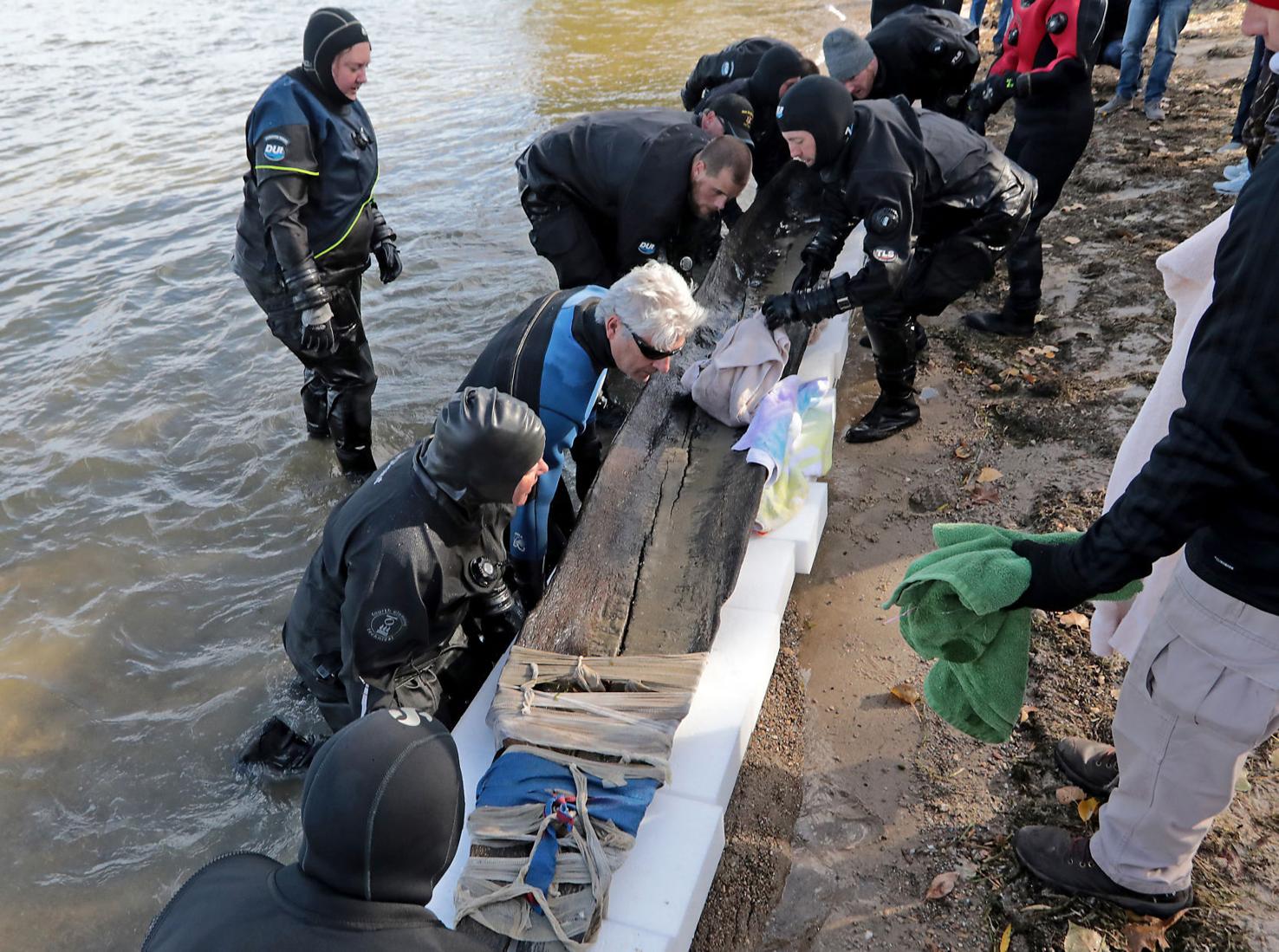
Photo: John Hart/ Wisconsin State Journal.
The State Journal reports, “A 1,200-year-old dugout canoe was raised from Lake Mendota [Nov. 2] by the Wisconsin Historical Society. The canoe … is the oldest intact boat ever recovered from Wisconsin waters.”

My Wisconsin brother sent me a cool article recently about the discovery of an ancient canoe. I suspect that blogger Rebecca Cunningham knows all about this as she lives in Madison.

Barry Adams at the Wisconsin State Journal has the story.

“Tamara Thomsen and Mallory Dragt thought they would take a spin under Lake Mendota on a couple of underwater scooters, motorized gadgets that scuba divers use to propel themselves through the water. It was a beautiful Saturday morning in June, and the duo, who work at Diversions Scuba, debated whether they had just seen a log sticking out of the bottom of the 9,781-acre lake or something extremely rare.

“The discovery, on a slope in 27 feet of water near Shorewood Hills, has turned out to be about as historic as it gets.

“After a bit of investigation, it turns out that Thomsen, who is also a maritime archaeologist for the Wisconsin Historical Society, was right in judging that it was more than just a log: It was a dugout canoe. A few weeks later, carbon-14 dating showed that the 15-foot-long vessel was an estimated 1,200 years old, the oldest intact boat ever found in Wisconsin waters.

“On a brisk Tuesday, amid a chop of waves and 50-degree water, the canoe was brought to shore by teams of divers who shared fist bumps and hugs to applause from residents of the Spring Harbor neighborhood who had gathered at the beach to witness the canoe’s return to shore.

“ ‘This is the first time this thing has been out of the water in 1,200 years. And maybe they left from this very beach to go fishing,’ said James Skibo, Wisconsin’s state archaeologist. ‘Not only has it been underwater; it’s been under the ground. The reason it’s so well preserved is that it has not been exposed to the light. So that’s one of the reasons we have to start preserving it.

‘There’s living organisms on it that are chewing away on it as we speak.’

“The canoe will ultimately be displayed in the Historical Society’s proposed new and expanded museum on Capitol Square. But for the next two years, it will undergo a series of treatments. The first, in a 16-foot-long, 3-foot-wide tank at the State Archive Preservation Facility on Madison’s Near East Side, will preserve its liquid environment, although mixed in the water will be a biocide to kill any algae or microorganisms. That’s followed with a treatment of polyethylene glycol designed to replace the water that has saturated the wood.

“The process will make the structure more solid and stable, and prevent further degradation, said Amy Rosebrough, a leading expert on the Effigy Mound builders of Wisconsin, who likely made the canoe and inhabited villages and encampments around Lake Mendota and throughout much of southern Wisconsin. A cache of net sinkers, used to weigh down fishing nets, was also found with the canoe, which could have been made from basswood or a walnut tree, two common woods used for dugouts during that time frame.

“ ‘This is extraordinarily rare,’ said Rosebrough. ‘We really don’t have anything like this from Wisconsin. We have found pieces of dugouts before in various lakes (but) nothing this intact and nothing intact this old.’ …

“The people who built the dugout canoes in what is now Dane County were ancestors of the Ho-Chunk Nation. Typical techniques could have included using a combination of burning the inside of the canoe and using stone tools to scrape out the charred and soften remains. Bill Quackenbush, the Ho-Chunk’s tribal historic preservation officer, was on hand Tuesday to watch the dugout canoe emerge from the lake. The Ho-Chunk are referred to as ‘People of the Big Water.’

“ ‘When it comes to items of this nature, if it’s going to protect and preserve the history and culture of us in this area, we’re all in support of that,’ Quackenbush said of the canoe’s recovery. …

“The recovery effort began last week with divers carefully dredging around the canoe. Once sediment was removed and the boat fully exposed, rods of rebar were stuck into the lake bottom and a web of rope tied over the canoe to keep it in place.

“On Tuesday morning, a small armada of boats made their way to the site. … Thomsen drove [a] boat that included Randy Wallander, a volunteer diver from Manitowoc who has years of experience bringing up large objects from Lake Michigan. His equipment included large yellow floats, diving gear and four 45-pound bags of sand that were placed in the canoe to give it weight as it was towed into shore in a sling supported by the floats at just above idling speed. The 1-mile trip took nearly two hours, after which divers unhooked the canoe from a boat and walked it the last 100 yards or so to shore. …

“ ‘It was a team effort,’ Thomsen said. ‘I’m actually surprised at how smooth it went. You always expect for there to be problems and you anticipate the worst and hope for the best, but it came up faster than we thought. Everybody really danced together to make it come up.’ ”

More at Madison.com, here.
Read Full Post »

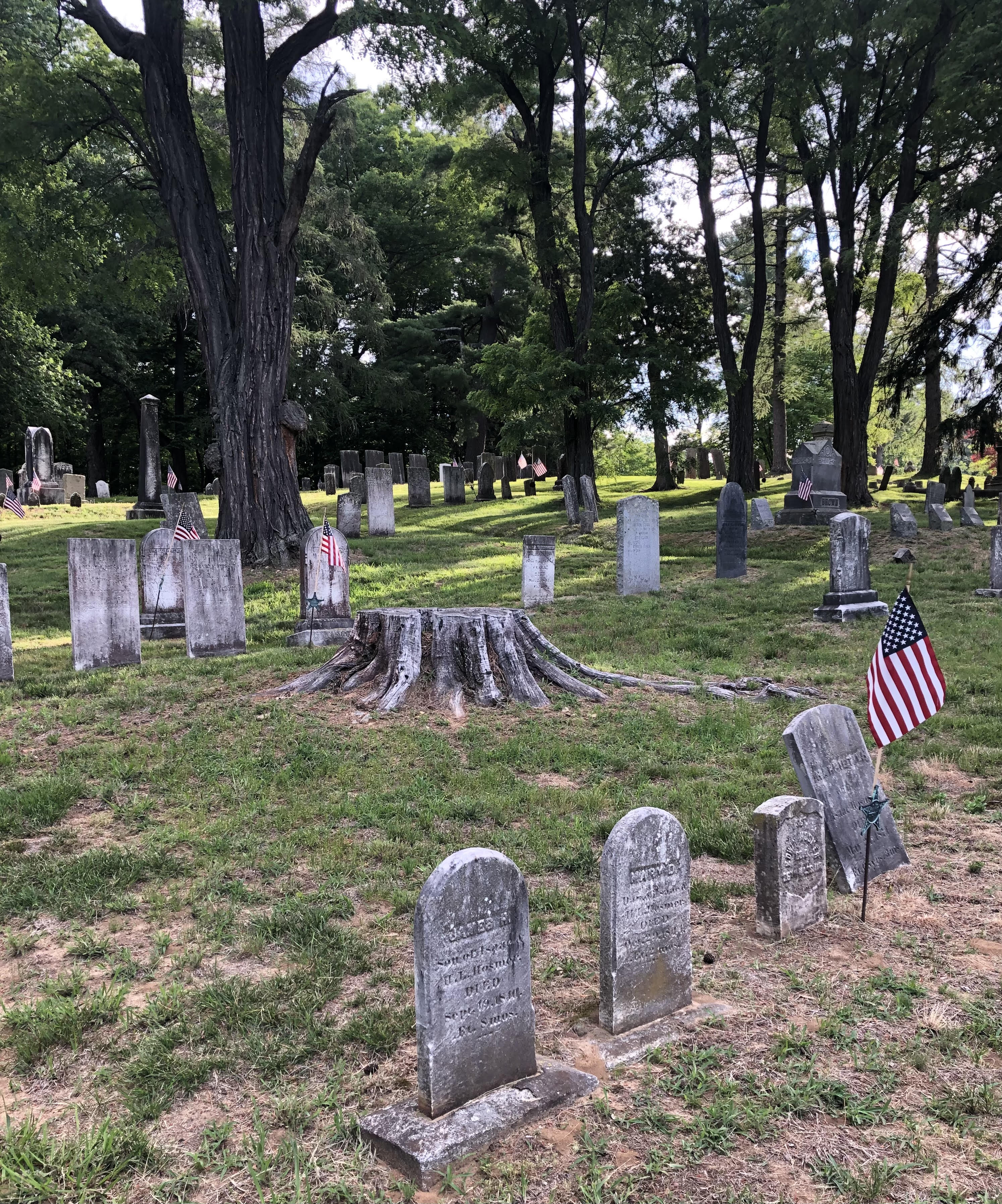
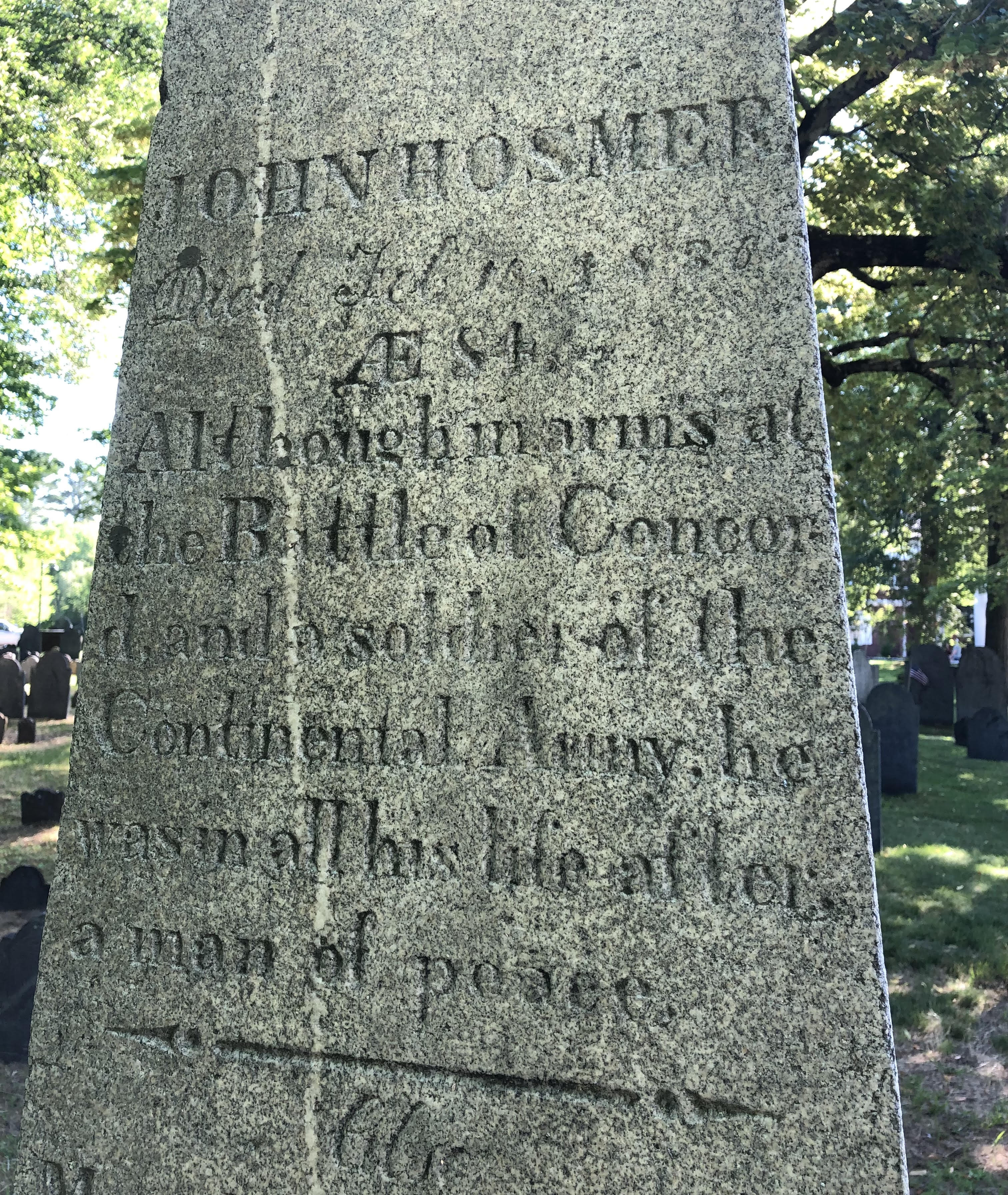
The photos are from two local cemeteries. The first honors John Hosmer, who fought in the Continental Army and “was in all his life after a man of peace.” In the second, you see how the living put flags on the graves of veterans who have died.

In one of the ESL (English as a Second Language) classes where I volunteer, the teacher introduces a citizenship factoid every week as some students plan to take the test to become US citizens. Citizens or not, we all learn something from the test questions.

That made me think that for Veterans Day this year, I should look up the history. The commemoration started after World War I, when many soldiers came home relieved to be alive, only to die of a pandemic not unlike the one that you and I know too well.

The day was originally named for the cease-fire that ended hostilities in the “Great War” but became “Veterans Day” in 1954, when a WW II general who had become president renamed it

Here’s what the US Department of Veterans Affairs has to say.

“World War I – known at the time as ‘The Great War’ — officially ended when the Treaty of Versailles was signed on June 28, 1919, in the Palace of Versailles outside the town of Versailles, France. However, fighting ceased seven months earlier when an armistice, or temporary cessation of hostilities, between the Allied nations and Germany went into effect on the eleventh hour of the eleventh day of the eleventh month. For that reason, November 11, 1918, is generally regarded as the end of ‘the war to end all wars.’

“In November 1919, President Wilson proclaimed November 11 as the first commemoration of Armistice Day with the following words: ‘To us in America, the reflections of Armistice Day will be filled with solemn pride in the heroism of those who died in the country’s service and with gratitude for the victory, both because of the thing from which it has freed us and because of the opportunity it has given America to show her sympathy with peace and justice in the councils of the nations…’

“The original concept for the celebration was for a day observed with parades and public meetings and a brief suspension of business beginning at 11:00 a.m. … In 1954, after World War II had required the greatest mobilization of soldiers, sailors, Marines and airmen in the Nation’s history; after American forces had fought aggression in Korea, the 83rd Congress, at the urging of the veterans service organizations, amended the Act of 1938 by striking out the word ‘Armistice’ and inserting in its place the word ‘Veterans.’ With the approval of this legislation (Public Law 380) on June 1, 1954, November 11th became a day to honor American veterans of all wars.”

I had forgotten why there’s a moment of silence at 11 a.m. on Veterans Day. Good to know. More here.

Read Full Post »

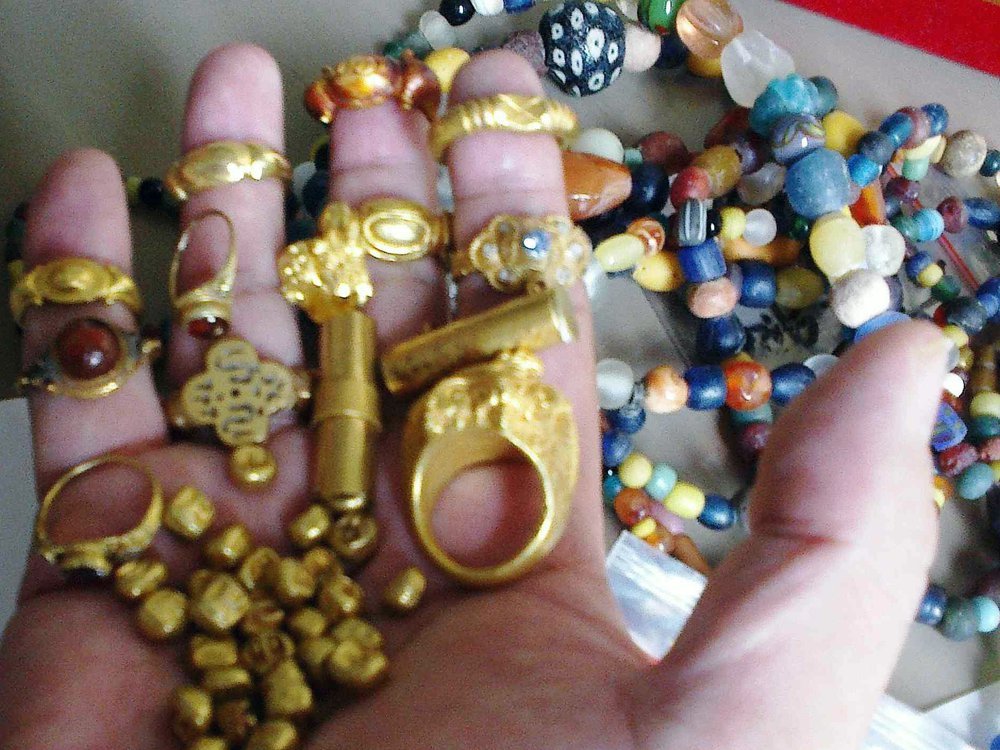
Photo: Wreckwatch magazine.
Archaeologists are learning more about the Srivijaya Empire of Indonesia, which once dominated maritime trade routes. But nighttime divers selling to the black market may stop the research in its tracks.

I’ve been reading a murder mystery that takes place after a very dark time in India’s history — the time called Partition, when Britain made a ghastly, clumsy attempt to create one Hindu nation and one Muslim nation out of a country Gandhi had hoped would stay whole. I’m at the part in the book where it appears that the ugliness of different faiths slaughtering each others’ families might have been exacerbated by lust for gold. Where some have a lot of wealth, others may have nothing.

That’s my roundabout introduction to a report on newly found treasures of a defunct civilization — and my way of saying that lust for wealth can’t end well.

Livia Gershon reports at Smithsonian magazine, “Local divers exploring Indonesia’s Musi River have found gold rings, beads and other artifacts that may be linked to the Srivijaya Empire, which controlled sea trade across large swaths of Asia between the 7th and 11th centuries C.E.

“ ‘In the last five years, extraordinary stuff has been coming up,’ British maritime archaeologist Sean Kingsley, who reported on the discoveries in the autumn issue of Wreckwatch magazine, tells the Guardian’s Dalya Alberge.

‘Coins of all periods, gold and Buddhist statues, gems, all the kinds of things that you might read about in Sinbad the Sailor and think it was made up. It’s actually real.’

“Among the discoveries are a life-size Buddhist statue covered in precious gems, temple bells, mirrors, wine jugs and flutes shaped like peacocks, reports Stephanie Pappas for Live Science.

“The kingdom of Srivijaya began in Palembang, a city located on the Musi River on the island of Sumatra. Per Encyclopedia Britannica, the empire controlled the Strait of Malacca — a key route between the Pacific and Indian Oceans — and established trade with groups in the Malay Archipelago, China and India. Srivijaya was also a center of Mahayana Buddhism.

“Seventh-century Chinese reports indicate that Palembang was home to more than 1,000 Buddhist monks. Chinese Buddhists stopped in the city to study Sanskrit during pilgrimages to India, according to Indonesia’s Ministry of Tourism. In 1025, war with India’s Chola dynasty reduced Srivijaya’s power, though it continued to play a role in trade for another two centuries. 

“As Kingsley writes in Wreckwatch, archaeologists have found no traces of royal court buildings, temples or other structures. It’s possible that the island’s volcanoes covered them. But another likely explanation is that the city was built mostly out of wood, with homes and other buildings constructed on rafts that floated on the river—a type of architecture still seen in some Southeast Asian countries today, per Live Science. Such structures would have rotted away long ago. …

“Per Wreckwatch, the kingdom was rich in gold, which it used strategically to build relationships with China and other regional powers. …

“Kingsley tells Live Science that no official archaeological excavations have been conducted in or around the Musi River. But amateurs have been finding treasures there since 2011, when construction workers discovered a number of artifacts while dredging sand from the river. Soon, local fishermen and workers began exploring the body of water. …

“Large numbers of these artifacts then showed up on the antiquities market. Many ended up in private collections, leaving little physical evidence about the civilization for scholars to study. …

“Indonesia put a moratorium on underwater archaeology in 2010. But as Kingsley points out, a black market in artifacts discovered during nighttime dives continues.

“ ‘Fishermen don’t stop fishing and they don’t stop discovering,’ he tells Live Science. “ ‘Only now, they’re even more unlikely to report finds to authorities. … Newly discovered, the story of the rise and fall of Srivijaya is dying anew without being told.’ “

More at the Smithsonian, here.

Read Full Post »

Photo: Marcio De Assis via GoodNewsNetwork.
Brazilian piano maestro João Carlos Martins was deeply moved when new bionic hands enabled him to return to the keyboard.

Well, here’s some uplift for a November Monday. It concerns a Brazilian pianist who had to switch to conducting when disease and injury crippled his hands. Twenty years later, a designer tried to get in touch with the famed musician “on various platforms.” If you’ve ever tried to reach a famous person that way, you’ll appreciate the designer’s persistence.

Gabriella Paiella at GQ wrote, “Over the years, fate seemed to do all that it could to stop João Carlos Martins from playing the piano.

“It started in the 1950s, when he was 18. Something called focal dystonia. … The brain misfires and causes involuntary muscle spasms, which was mighty inconvenient for a young Brazilian piano prodigy on the precipice of world fame.

“He managed to get it under control and, by his early 20s, landed in New York City. Martins had it made back then: a tony apartment across the street from the Met, celebrated performances at Carnegie Hall and virtually every other major theater around the globe. They even had a nickname for him, the Mailman, because he always delivered. To relax, Martins would take leisurely strolls around Central Park, where sometimes he’d see his neighbor Jackie Kennedy. He played pickup soccer in the park too.

“Then one day, while chasing after the ball, he tripped.

“In the seconds between losing his footing and hitting the ground, there hung countless permutations for how skin and bone could collide with earth and inflict damage. The outcome: right elbow, sharp rock, a sliced ulnar nerve. Martins knew he was in trouble when the blood started spurting out. He knew he was really in trouble when, in the coming months, his fingers started to atrophy. And when his fingers started to atrophy, he thought about killing himself.

“Martins kept going, though his skills as a pianist were diminished. He even embarked on a decades-long quest to record the complete works of Johann Sebastian Bach. In 1995, at the age of 54, he traveled 6,000 miles from his then home in Brazil to tape in this one theater in Sofia, Bulgaria, with great acoustics. He was walking back to his hotel late at night when two muggers ambushed him with a metal pipe, and — thwack! — they took off with his passport and wallet and left him for dead. When Martins woke up in the hospital, he couldn’t feel the right side of his body.

“There had been other pain and misfortune along the way. A recurring repetitive-motion injury from practicing that was so agonizing he compares it to kidney stones. A pulmonary embolism. A coma because of that pulmonary embolism, during which Death, or at least an apparition of it, paid him a personal visit.

‘I recall an image of a carriage passing by with beautiful black horses,’ Martins says. ‘It was a beautiful carriage. The coachman asked me to get in the carriage, and I said, “No, I’m not going to get in.” That image is something I’ve never forgotten. The image is like a sign that I had a mission I had to fulfill with music.’

“In 2000, a failed surgery originally intended to restore functionality did his right hand in for good. Soon after, doctors found a tumor in his left. They removed it, along with any remaining hope of his fingers gliding over his beloved keyboard ever again. …

“At the age of 63 … Martins resigned himself to saying his most permanent goodbye to the piano yet: He chose to retire and become a conductor. He would now make music communally, after decades of being entwined in personal relationship with his instrument.

“Then along came these bionic gloves, created by an industrial designer named Ubiratan Bizarro Costa, who became familiar with Martins’s problems after he saw the maestro on a Brazilian television show in 2019. There is nothing high-tech about the gloves Costa invented, which is how he prefers it. … ‘I use minimalist design,’ Costa says. ‘The fewest number of pieces and the fewest number of expensive parts for the maximum result.’

“The gloves are both deceptively complicated looking and incredibly precise. The hand slips into a neoprene sleeve outfitted with a 3D-printed frame and stainless steel bars on the fingers. … Without the gloves, when Martins’s fingers hit a key, they stay depressed; the steel bars pop them back up.

“After seeing Martins on TV, Costa made a prototype and tried to get in touch with him on various platforms, but never heard back. The gloves lay dormant on a shelf in his office, until Costa saw that Martins and his orchestra were passing through Sumaré. …

“He went to the show, flagged down a musician, and explained his predicament. The guy thought Costa was kind of a weirdo but agreed to grab Martins. Eventually, Martins came out and Costa presented him with his invention.

“ ‘I thought he was an endearing mad scientist,’ Martins says, remembering his first encounter with Costa. [But] a few days after the concert, Martins invited Costa over for lunch. He told the designer what worked and what didn’t. Costa went home and fiddled with his model. …

“By Christmas 2019, Martins was able to place all 10 fingers on the keyboard for the first time in over two decades. Costa was pleased to see Martins playing in person, but it wasn’t until he saw the video that the gravity of the moment fully dawned on him.

“It’s like designing a paintbrush for Pablo Picasso, he thought.”

More at GQ, here. If you are on Instagram, you will be moved by this video of him playing properly for the first time in 20 years, thanks to the bionic gloves.

Read Full Post »

Photo: Aloha Feels Chocolate.
Many boutique candy companies are determined to do more than the giants about child labor. “There are over 27 million slaves in the world today. Of them, over 9 million are children,” says slavefreechocolate.org.

I’m sure you know I’m not going to focus on the dark side of anything, so as we dig out from Halloween chocolate created by name brands that have failed to end child labor, let’s start by mentioning companies that are more careful about sourcing.

I, too, buy the mini Trick-or-Treat bars available in the supermarket. But I also have a friend who loves getting chocolate on her birthday, and that is when I really focus on ethical brands. There’s a long list here. Taza is one I know. It’s headquartered in Somerville, Massachusetts.

The problem with chocolate seems to be that even companies seeking Fair Trade labels are often bamboozled by chocolate growers or aggregators on the ground. No doubt, it’s hard to get to the bottom of things unless you work directly with a grower.

In a February article from the Guardian, we learn that several young men who were once child slaves in Africa were hoping for a hearing in US courts. After all, big companies like Cargill, Mars, and Hershey are based here.

Oliver Balch writes, “Eight children who claim they were used as slave labour on cocoa plantations in Ivory Coast have launched legal action against the world’s biggest chocolate companies. They accuse the corporations of aiding and abetting the illegal enslavement of ‘thousands’ of children on cocoa farms in their supply chains.

“Nestlé, Cargill, Barry Callebaut, Mars, Olam, Hershey and Mondelēz have been named as defendants in a lawsuit filed in Washington DC by the human rights firm International Rights Advocates (IRA), on behalf of eight former child slaves who say they were forced to work without pay on cocoa plantations in the west African country.

“The plaintiffs, all of whom are originally from Mali and are now young adults, are seeking damages for forced labour and further compensation for unjust enrichment, negligent supervision and intentional infliction of emotional distress.

“It is the first time that a class action of this kind has been filed against the cocoa industry in a US court. Citing research by the US state department, the International Labour Organization and Unicef, among others, the court documents allege that the plaintiffs’ experience of child slavery is mirrored by that of thousands of other minors.

“Ivory Coast produces about 45% of the global supply of cocoa, a core ingredient in chocolate. The production of cocoa in west Africa has long been linked to human rights abuses, structural poverty, low pay and child labour.

“A central allegation of the lawsuit is that the defendants, despite not owning the cocoa farms in question, ‘knowingly profited’ from the illegal work of children. According to the submissions, the defendants’ contracted suppliers were able to provide lower prices than if they had employed adult workers with proper protective equipment.

“The lawsuit also accuses the companies – whose industry body is the World Cocoa Foundation – of actively misleading the public in the voluntary 2001 Harkin-Engel Protocol, characterized by the complainants as promising to phase out some child labour (‘the worst forms,’ in the protocol’s words). …

“In the legal claim, all eight plaintiffs describe being recruited in Mali through trickery and deception, before being trafficked across the border to cocoa farms in Ivory Coast. There, they were forced to work – often for several years or more – with no pay, no travel documents and no clear idea of where they were or how to get back to their families.” More at the Guardian, here.

Alas, at the Washington Post, here, you can read that the former child slaves were not granted standing by the courts, although the plaintiffs sued confidently “under the Alien Tort Statute, a 1789 law that allows federal district courts to hear ‘any civil action by an alien for a tort only, committed in violation of the law of nations or a treaty of the United States.’ ”

Robert Barnes and Peter Whoriskey reported in June, “The Supreme Court on Thursday said U.S. chocolate companies cannot be sued for child slavery on the African farms from which they buy most of their cocoa. But the court stopped short of saying such a lawsuit could never go forward.

“The court’s splintered decision was written by Justice Clarence Thomas. Justice Samuel A. Alito Jr. dissented from the decision, saying it was premature to dismiss the suit.”

Alito, for goodness sake! This is why I don’t like blanket assumptions about what Supreme Court justices are thinking. You can say what position they are likely to take, but you can’t really know. And besides, it’s too depressing to assume you know.

Anyway, we’re back to Square One with chocolate and child labor.

Except that informed consumers can do their part: start asking themselves the right questions and paying a few more cents to be sure no children are harmed. After all, more chocolate-buying holidays are fast approaching.

Photo: jbdodane/Alamy
A sign warns against child labor in cocoa production in Ghana.

Read Full Post »

Photo: Acciona.
Toronto uses deep lake water to cool buildings.

Although the building-cooling technology in today’s post has been online since 2004, it was new — and delightful — to me. I do love hearing about advances in energy sustainability.

Tik Root at the Washington Post has the story.

“With just minutes left in Game 5 of the 2019 NBA finals, the Toronto Raptors drained a 16-foot jumper to pull ahead by six points. Hardly a soul was sitting down or silent as fans cheered the team toward Canada’s first basketball championship.

“But the sellout crowd also posed a challenge. The National Basketball Association requires arenas to be chilled to between 65 and 72 degrees Fahrenheit. And, left unchecked, the arena’s 20,144 attendees were likely to produce a sweltering mess that would set off alarms at league headquarters.

“ ‘People bring with them a lot of body heat,’ said Kyle Lamkey, director of engineering for the arena. ‘Cooling is probably one of the most critical parts of our building.’

“But unlike other sports venues, Scotiabank Arena doesn’t keep its temperatures in check using air conditioners. Toronto is home to the world’s largest deep lake water cooling (DLWC) system.

Conceptually, the technology is relatively simple. Instead of relying on energy-intensive compressors and chillers to dissipate heat from buildings, DLWC uses water from nearby Lake Ontario to whisk away the warmth.

“The system launched in 2004 with only a handful of customers in the city, but it now cools over 100 downtown buildings, ranging from City Hall and Toronto General Hospital to hotels and even a brewery.

“Enwave, the company that owns and operates Toronto’s DLWC, says the system already saves 90,000 mega-watt hours of electricity use annually — roughly enough to power a town of 25,000. It is so popular that the city has nearly reached capacity and recently committed to an expansion. …

“Toronto’s cooling process begins about 3.5 miles south of the city and 280 feet underwater, in the depths of Lake Ontario where the water remains cool year-round. The water is first drawn into the city through three massive pipes, spaced about half a mile apart. In the planned expansion, a fourth pipe will be added to increase capacity by 60 percent.

“Once the lake water makes it to the city, the DLWC system operates via a series of water loops. There is a loop that moves the lake water; a loop that moves water within the downtown area; and loops in each building the system serves. The water moves itself through these pipes using relatively little energy.

“Traditional commercial water-cooling systems often involve towers that evaporate water as a means of expelling heat. DLWC avoids that evaporation, and Enwave estimates that the Toronto system saves roughly 220 million gallons of water annually.

“Another way the Toronto system saves is by using largely passive heat exchangers, rather than energy-intensive air conditioners and chillers. Heat exchangers transfer heat, or coolness, between water loops and are located where those water loops meet — at each customer site and where the lake water pipes meet the city pipes. The latter heat exchanger uses the coolness of the lake water to dissipate heat from the downtown buildings. DLWC ultimately allows buildings to consume less electricity. …

“Finding suitable conditions for a DLWC system isn’t always simple. Location is the first hurdle to making the technology feasible. Much of the East Coast of the United States, for example, has a shallow, sloped ocean shelf that makes it difficult to position a system at the depths necessary. There also must be enough cooling demand to justify a system.

“Then there are the enormous upfront costs. Cornell University’s lake water cooling system — the largest and oldest in the United States — cost $58.5 million. The investment, though, ‘has easily already paid for itself,’ said Todd Cowen, an engineer at the university, because operating and maintenance costs are so low.

“Toronto’s system costs (CAD) $170 million, and unlike Cornell, Enwave needed customers. Lou Di Gironimo, general manager for Toronto Water, says the question was, ‘Would this be a sustainable economic activity?’ But any fears of failure were short-lived. Starting with only a few customers in 2004, Enwave’s DLWC customer base has since expanded rapidly. …

“Said Hermann Kugeler, with Makai Ocean Engineering, Inc., a company that designs and installs piping for the systems … ‘I think the big thing is informing people that it exists.’ ”

Diagrams at the Post, here, can help you understand how it works.

Read Full Post »

Photo: Goban1.
The Chinese game called Go is more than 2,500 years old.

This past summer, I blogged about a new board game called Wingspan. It sounded wonderful, especially for bird lovers, like those in my family. I bought it.

Well, I think it is going to be wonderful, but the rules are really hard. Recommended for people over 14, it is still too “buch for be, “as Rudyard Kipling’s Elephant’s Child says.

Fortunately, it’s not too much for my 9-year-old grandson, who is gradually figuring it out and explaining it. Otherwise, I might have had to call on artificial intelligence experts, like those described in today’s story.

Samantha HuiQi Yow explains at Wired: “In 1901, on an excavation trip to Crete, British archaeologist Arthur Evans unearthed items he believed belonged to a royal game dating back millennia: a board fashioned out of ivory, gold, silver, and rock crystals, and four conical pieces nearby, assumed to be the tokens. Playing it, however, stumped Evans, and many others after him who took a stab at it. There was no rulebook, no hints, and no other copies have ever been found. Games need instructions for players to follow. Without any, the Greek board’s function remained unresolved—that is, until recently.

“Enter artificial intelligence and a group of researchers from Maastricht University in the Netherlands. Thanks to an algorithm the team used to analyze the playability of one suggested ruleset, the century-old guesswork could soon be taken out of the Knossos game. Today, not only can its recognition as a game be further assessed, with hopes of a clearer answer in future, a version of it is also playable online.  And for the first time, so are hundreds of other games thought to have been lost to history.

“Board games go back a long way. Centuries ago, before the chess we know today, there was Chaturanga in India, Shogi in Japan, and Xiangqi in China. And long before them was Senet, one of the earliest known games, which, along with others played in ancient Egypt, may have ultimately inspired backgammon. ‘Games are social lubricants,’ explains Cameron Browne, a computer scientist at the university who received his PhD in AI and game design. ‘Even if two cultures don’t speak the same language, they can exchange play. This happened throughout history. Wherever people spread to, wherever soldiers were stationed, wherever merchants were trading. Anyone who had time to kill would often teach those around them the games they knew.’ …

“[But] the rules were typically passed on by word of mouth instead of being written down. The little that is known is left open to modern interpretation.

“It’s these lapses in board game history that gave legs to the five-year Digital Ludeme Project, which Browne leads. ‘Games are a great cultural resource that’s been largely underutilized. We don’t even know how so many of them were played, especially when you go farther back in time,’ he says. ‘So the question for me was, can we use modern AI techniques to shed insight into how these ancient games were played and, together with the evidence available, help reconstruct them?’

“As it turns out, the answer is a resounding yes. It’s been three years since Browne and his colleagues set to work, and already they have brought nearly a thousand board games online, ranging from across three time periods and nine regions. Thanks to them, games once popular in the second and first millennia BC, like 58 holes, are now just a few clicks away for anyone on the internet.

“Interestingly enough, this reconstruction process begins with the opposite. Games are first broken down into fundamental units of information called ludemes, which refers to elements of play such as the number of players, movement of pieces, or criteria to win. Once a game is codified in this manner, the team then fills in the missing pages of its rulebook with the help of relevant historical information, like when it or another game with similar ludemes was played and by whom.

“The riddle however is only partly solved at this stage. Others who do similar work–manually–usually hit a dead end here. It’s because what looks good on paper might not translate as well in reality, Browne explains. ‘The rules might make sense when you read them, but you don’t know how well they actually work unless you play the game. Quite often, rules that make perfect sense play terribly as games.’ …

“But computers can have blind spots too, in that they only measure what’s measurable. Here’s where Walter Crist comes in.” More at Wired, here.

Read Full Post »

France is experimenting with giving free money to kids to spend on culture. Most are buying media they already like, not high art, but maybe that’s OK.

Aurelien Breeden presents the controversy at the New York Times. “When the French government launched a smartphone app that gives 300 euros (about $348) to every 18-year-old in the country for cultural purchases like books and music, or exhibition and performance tickets, most young people’s impulse wasn’t to buy Proust’s greatest works or to line up and see Molière.

“Instead, France’s teenagers flocked to manga.

“ ‘It’s a really good initiative,’ said Juliette Sega, who lives in a small town in southeastern France and has used €40 (about $47) to buy Japanese comic books and ‘The Maze Runner,’ a dystopian novel. …

“As of this month, books represented over 75 percent of all purchases made through the app since it was introduced nationwide in May — and roughly two-thirds of those books were manga, according to the organization that runs the app, called the Culture Pass.

“The French news media has written of a ‘manga rush,‘ fueled by a ‘manga pass‘ — observations that came via a slightly distorted lens, since the app arrived just as theaters, cinemas and music festivals, emerging from pandemic-related restrictions, had less to offer. And manga were already wildly popular in France.

“But the focus on comic books reveals a subtle tension at the heart of the Culture Pass’s design, between the almost total freedom it affords it young users — including to buy the mass media they already love — and its architects’ aim of guiding users toward lesser-known and more highbrow arts. …

“Teenagers can buy physical goods from bookstores, record shops and arts supply or instrument stores. They can purchase tickets to movie showings, plays, concerts or museum exhibits. And they can sign up for dance, painting or drawing classes.

“Noël Corbin, a Culture Ministry official who oversees the project, said the pass gave France’s newly minted adults a way of looking up nearby cultural offerings — the app has a geolocation feature — and encouraged them to indulge their cultural passions.

“But it also uses incentives to push teenagers toward new, more challenging art forms, he said. … Those include recommendation lists curated by Culture Pass staff members and by popular artists and celebrities, as well as access to V.I.P. events, like a live-streamed concert at the Soulages Museum in southern France and a behind-the-scenes look at the Avignon theater festival. …

“Jean-Michel Tobelem, an associate professor at the University Paris 1 Panthéon-Sorbonne who specializes in the economics of culture, said that it was a laudable effort but that it would largely benefit the mainstream media. …

“There is nothing wrong with pop music or blockbusters, he stressed, acknowledging that ‘you can enter Korean culture through K-Pop and then discover that there is a whole cinema, a literature, painters and composers that go with it.’ But Tobelem said that he was unconvinced that the no-strings-attached approach of the Culture Pass would do that. …

“Naza Chiffert, who runs two independent bookstores in Paris, said the Culture Pass had already had a positive impact on her business. ‘Getting young people who read but who are more used to Amazon or big-box stores to come to us isn’t easy,’ she said, but now she has teenagers in her stores every day.

“Still, some worry that the pass will be a financial windfall for people from privileged backgrounds while doing little to help others expand their cultural horizons. …

“Opponents accuse Macron of throwing cash at young people to court their vote before next year’s presidential election and choosing an unregulated approach instead of funding existing cash-strapped outreach programs, like those run by youth community centers, that broaden access to culture in a more structured way.

“France’s Culture Ministry counters that it plans to introduce the pass to middle-school students, first in a teacher-managed classroom setting, and gradually increasing amounts of autonomy and money, until students reach 18. It also says the pass enables cultural institutions to reach young audiences, which are usually hard to attract, directly on their smartphones. …

“Gabriel Tiné, an 18-year-old osteopathy student in Paris, has spent over €200 from his pass at Citeaux Sphère, a Parisian record store, where he and a friend were thumbing through vinyls on a recent afternoon. … Tiné said he liked the idea, especially the ability to splurge on musical instruments or art classes.

“ ‘I wouldn’t say no to attending a jazz concert or something like that,’ Tiné said, although he added that the app hadn’t enticed him to buy those tickets.”

More at the Times, here.

Read Full Post »

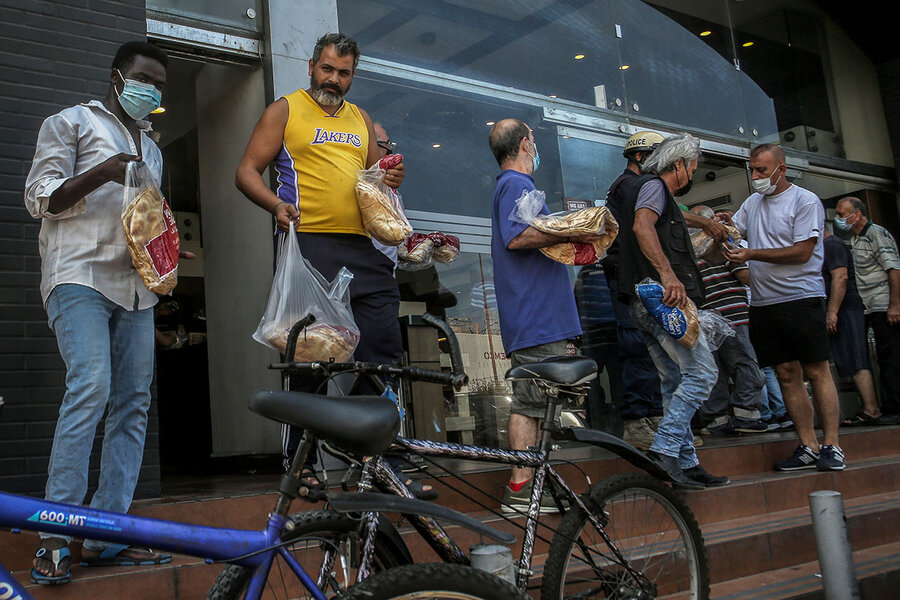
Photo: Marwan Naamani/picture alliance/Getty Images
Amelia at the
Christian Science Monitor says, “As its economy and government collapse, Lebanon has become almost unrecognizable to its own people. Now, they are rallying around each other.”

When corrupt leadership creates a failed state, ordinary people may step up.

Taylor Luck has the story of Lebanon’s struggle today.

“Each day for Safa is the same: a race for a solution. Her husband, a construction worker, has been without work for six months. The two now worry about how to make their nearly bare cupboard – and the $30 in their bank account – stretch to make their next month’s rent. Her children skip one to two meals per day.

“ ‘We have no government, no services, no electricity, no currency, no hope,’ says Safa, who did not wish to use her full name. ‘Who can we even turn to?’

“It is a question being faced by many Lebanese: What happens when a state fails, and no one is there to help?

“In Lebanon – in the midst of what the World Bank is calling the worst economic collapse the world has seen since 1850, and in the aftermath of the third-largest nonnuclear explosion in human history – people are finding hope as scarce as the medicines and baby formula disappearing from store shelves.

Yet some are finding solace in leaning on one another, and, thanks to civil society groups that are refusing to give up, strength to make it through another day. …

“ ‘No one is coming to save us,’ says Beirut resident Rayan Khatoun.

“Her response, starting two years ago, was to help found a grassroots network that identifies the needs of vulnerable Lebanese families and launches fundraising appeals on social media.

“With support from the Lebanese diaspora abroad, the network, called All of Us, has helped hundreds of families, providing rent money to keep some off the streets, and providing others with dry food staples whose shelf life is unaffected by electricity cuts. …

“The collapse of Lebanon’s economy and the decline of government services have been a work in progress for years, the product of worsening political gridlock and corruption among competing sectarian elites.

“What began as a very visible failure to deliver basic services, such as trash collection, worsened as the country defaulted on its international debt and the economy crumbled. A grassroots protest movement two years ago sprang up to demand systemic political change, even before the pandemic and the devastating blast at the Port of Beirut destroyed for many Lebanese the last shreds of government function or accountability. …

“Lebanon has now become unrecognizable to its people. Beirut and most of Lebanon are in darkness. Out of cash, the national electricity provider turned off its generators completely [in October]. In the best of times, it provides one to two hours of electricity per day. …

“As the Lebanese say, ‘The surprises just keep coming.’ … It now costs more than 300,000 Lebanese pounds – nearly half the monthly minimum wage – for 20 liters (5.3 gallons) of gasoline. …

“ ‘Our coping mechanism is to make fun of the situation, slave the next day just to survive, come back home and rest a little,’ says Ms. Khatoun. ‘People just don’t have the energy to be angry.’

“The economic crisis is felt by all classes, but is crushing the working class. … [But] the fact that Lebanese’s misery is caused by financial and government mismanagement, rather than by earthquakes or war, makes it a tough sell to donor countries, many of whom insist that Lebanon stand on its own feet. …

“To help compensate for a failing government social safety net, the World Food Program is providing food parcels to 100,000 of the most vulnerable families across Lebanon, and modest cash assistance to 1.6 million people. …

“Unlike in previous crises, wealthy Gulf Arab states, the international community, and even Iran are not coming to Lebanon’s rescue with big-ticket bailouts. Instead, Lebanese are stepping up themselves, trying to do good where they can with rapidly dwindling resources. …

“Volunteers soldier on also at Embrace, a mental health care group whose emotional support and suicide prevention hotline, Lifeline, has become a critical service in the wake of last year’s port blast. …

“[But] dozens of Embrace’s volunteers have left Lebanon because they too, exhausted, can no longer afford life in the country. Embrace is already training the next batch of staff. … Says Rêve Romanos, a clinical supervisor and psychotherapist at Embrace. ‘Hopelessness is a recurrent theme for all of us.’

“But small things can help people cope, Dr. Romanos says. ‘Sometimes, just being able to vent, talk it out, and have someone listen can make a difference.’ ”

More at the Monitor, here.

Read Full Post »

There were quite a lot of opportunities for photos on sunny October days this year, and I’m not even counting funny pictures from Halloween in Providence, where one grandchild was Harry Potter, another was Princess Aurora, Suzanne was the Fairy Godmother from Disney’s Cinderella, and Erik had turned into a vampire after getting vaccinated (as some would have you believe).

I didn’t get to see my young Captain Marvel and her scary brother the Mummy in person. Fortunately, their mom sent a dramatic action shot.

I do try to be a bit restrained with family photos on social media, so today I will show you other shots I’ve collected. The photo above is of a kind of mandala that a Providence resident is in the process of creating near Blackstone Park. She encourages passersby to add something. I added more red leaves.

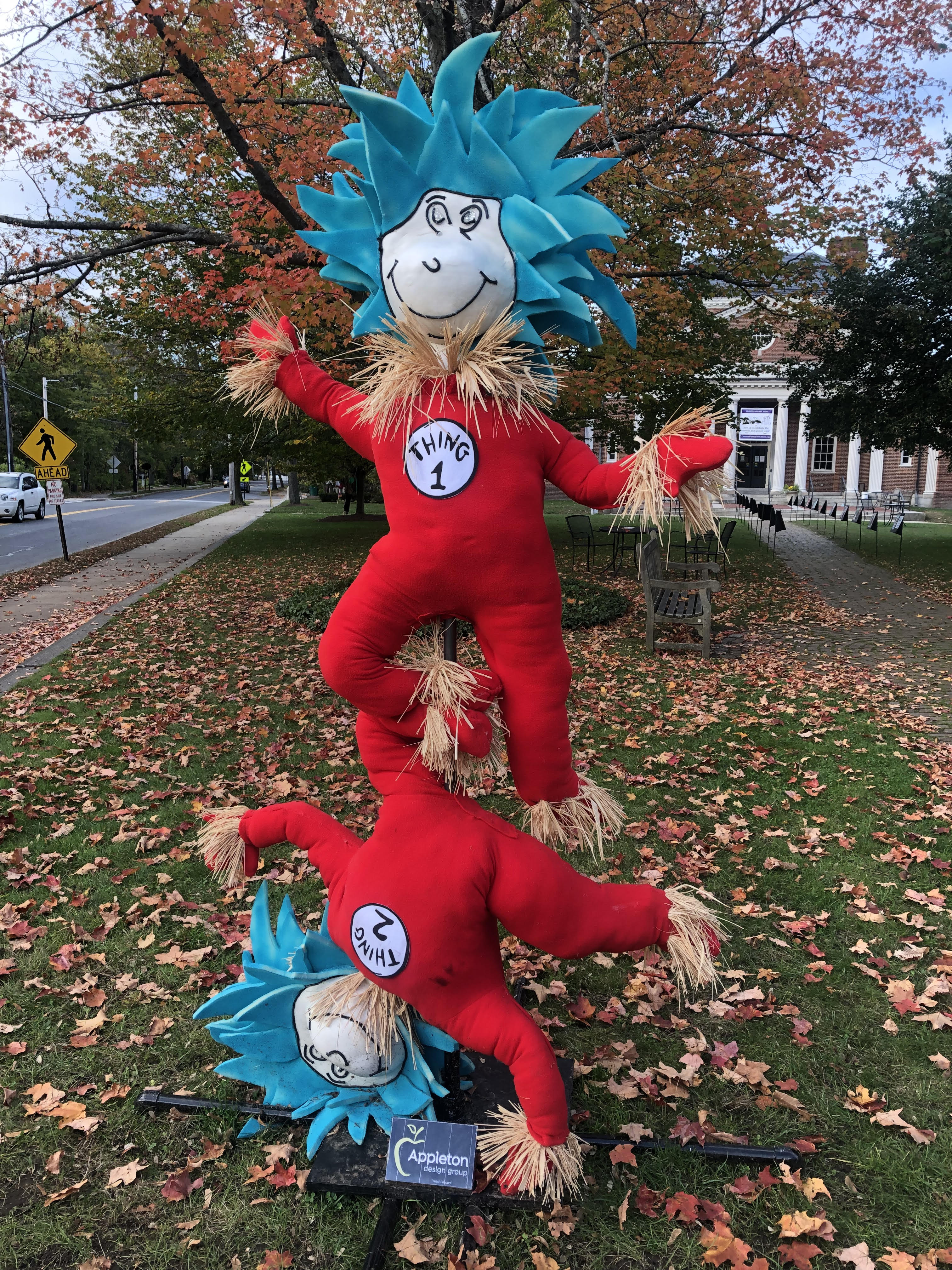
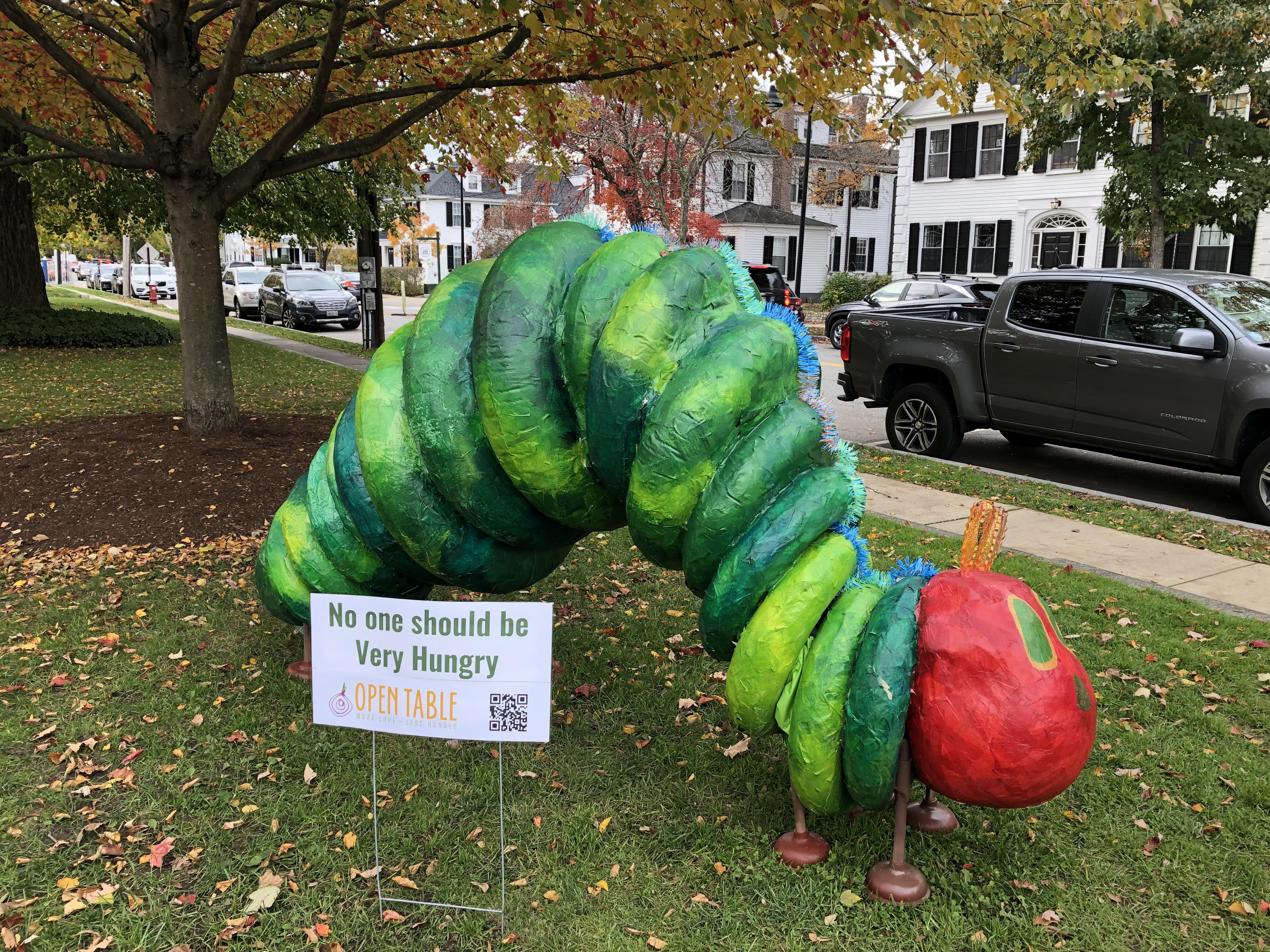
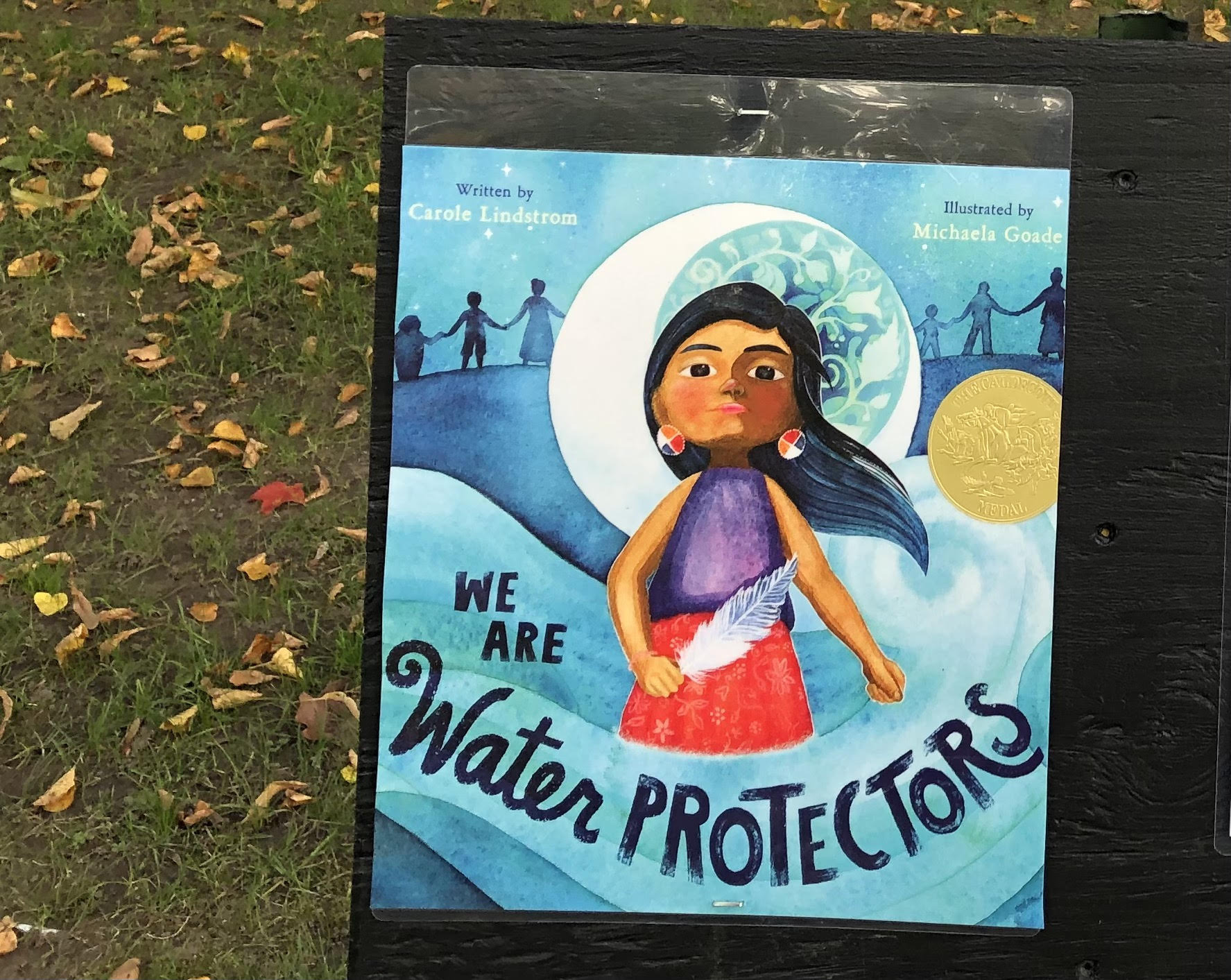
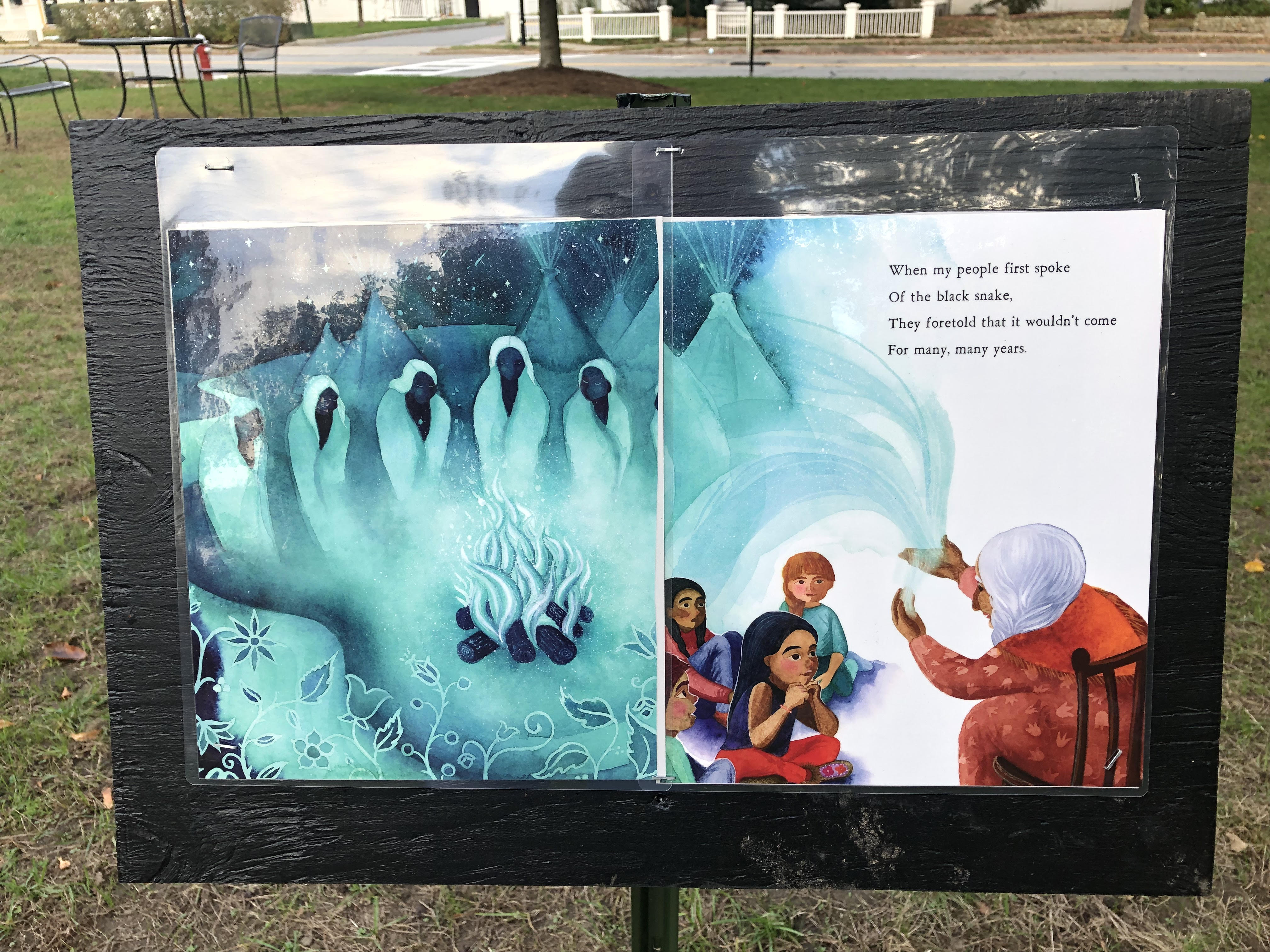
On the library lawn back home, I got to see Dr. Seuss’s famous Thing One and Thing Two and Eric Carle’s Very Hungry Caterpillar. There was also a “walking” book, consisting of signs showing page spreads. The current choice is The Water Protectors, by Carole Lindstrom and Michaela Goade (illustrator).

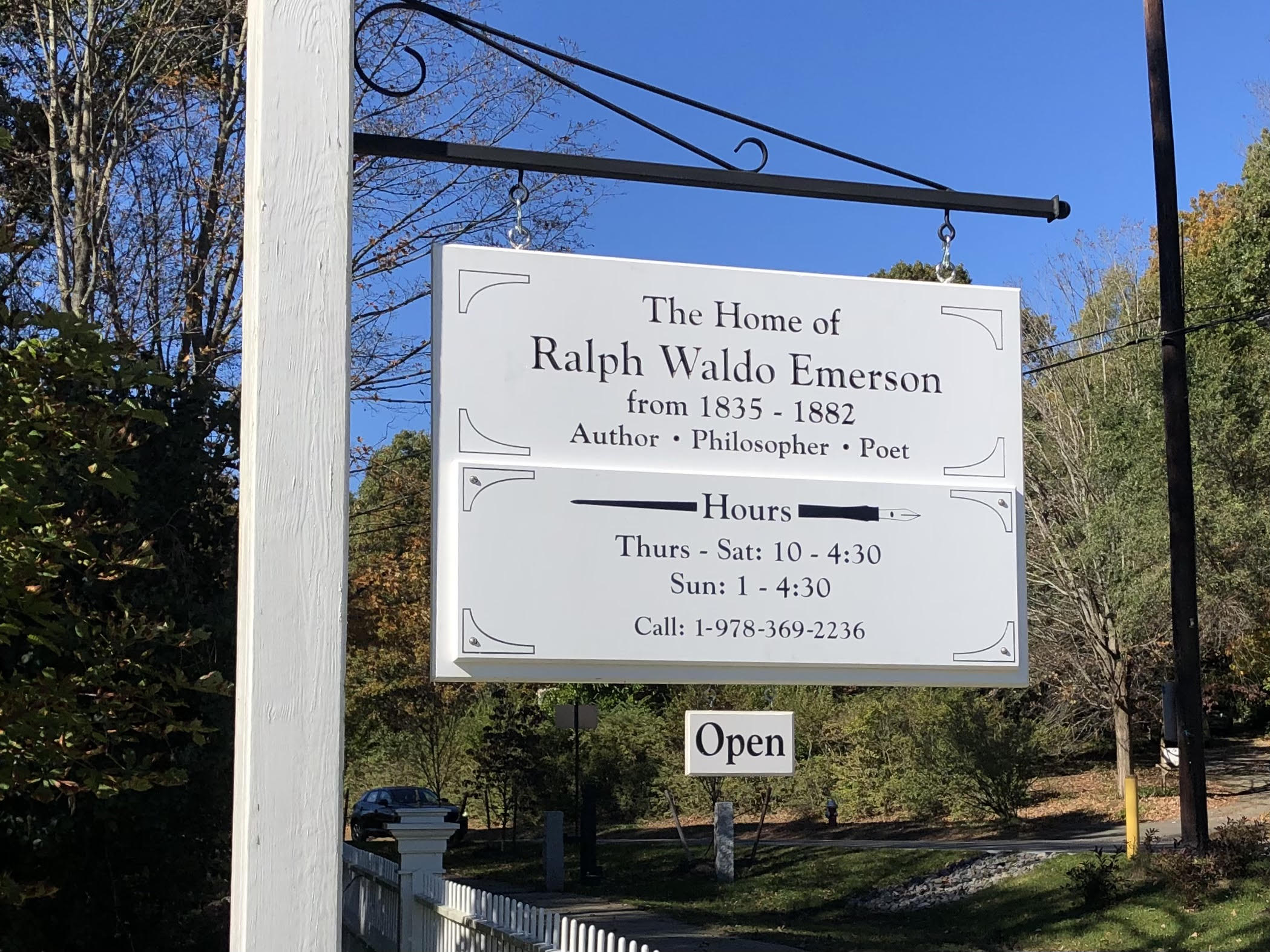
My husband had been reading about Ralph Waldo Emerson — particularly about the influence that Quaker thinker George Fox had on him — and so decided it was high time to visit Emerson’s house. Among other things we learned was the fact that in the early 1800s, people didn’t know that tuberculosis was contagious. Emerson’s first wife died of it at age 18. Also, the original Emerson family still owns the home. It’s a rather dark and gloomy place, though. I preferred the recently restored barn and took a picture there.

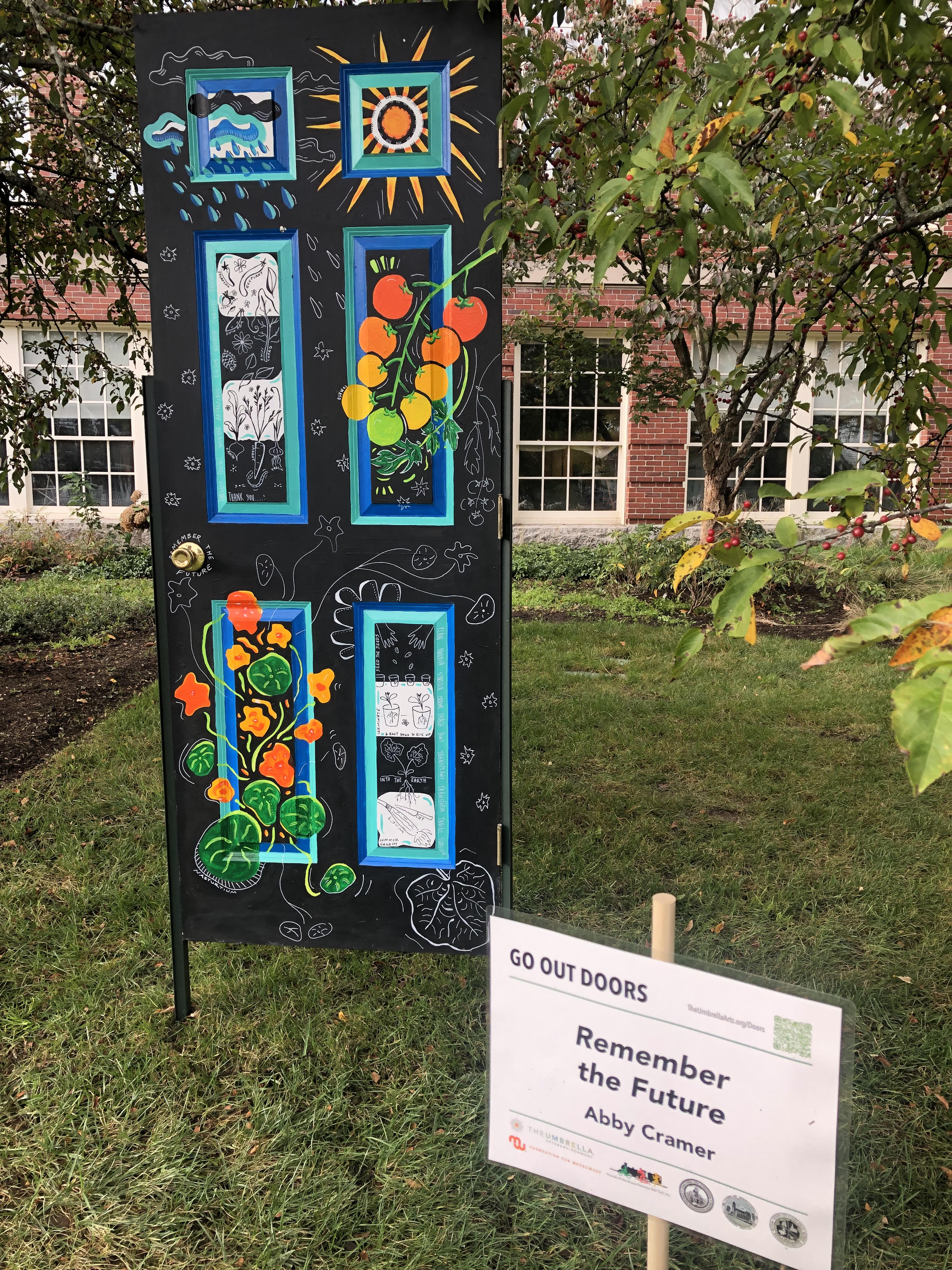
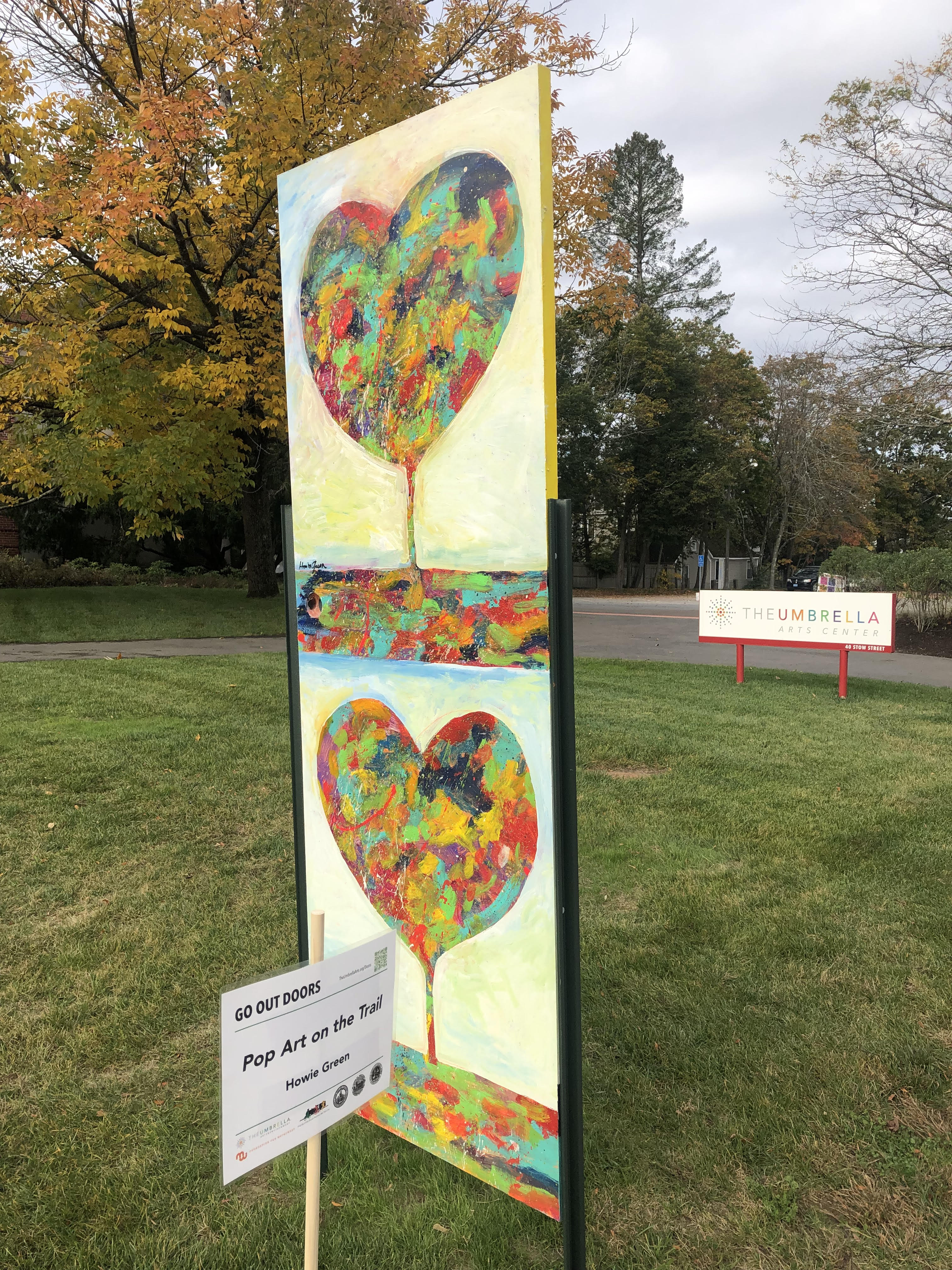
Moving right along, I have art for you from the Umbrella. The two pieces of door art are “Pop Art on the Trail,” by Howie Green, and “Remember the Future,” by Amy Cramer.

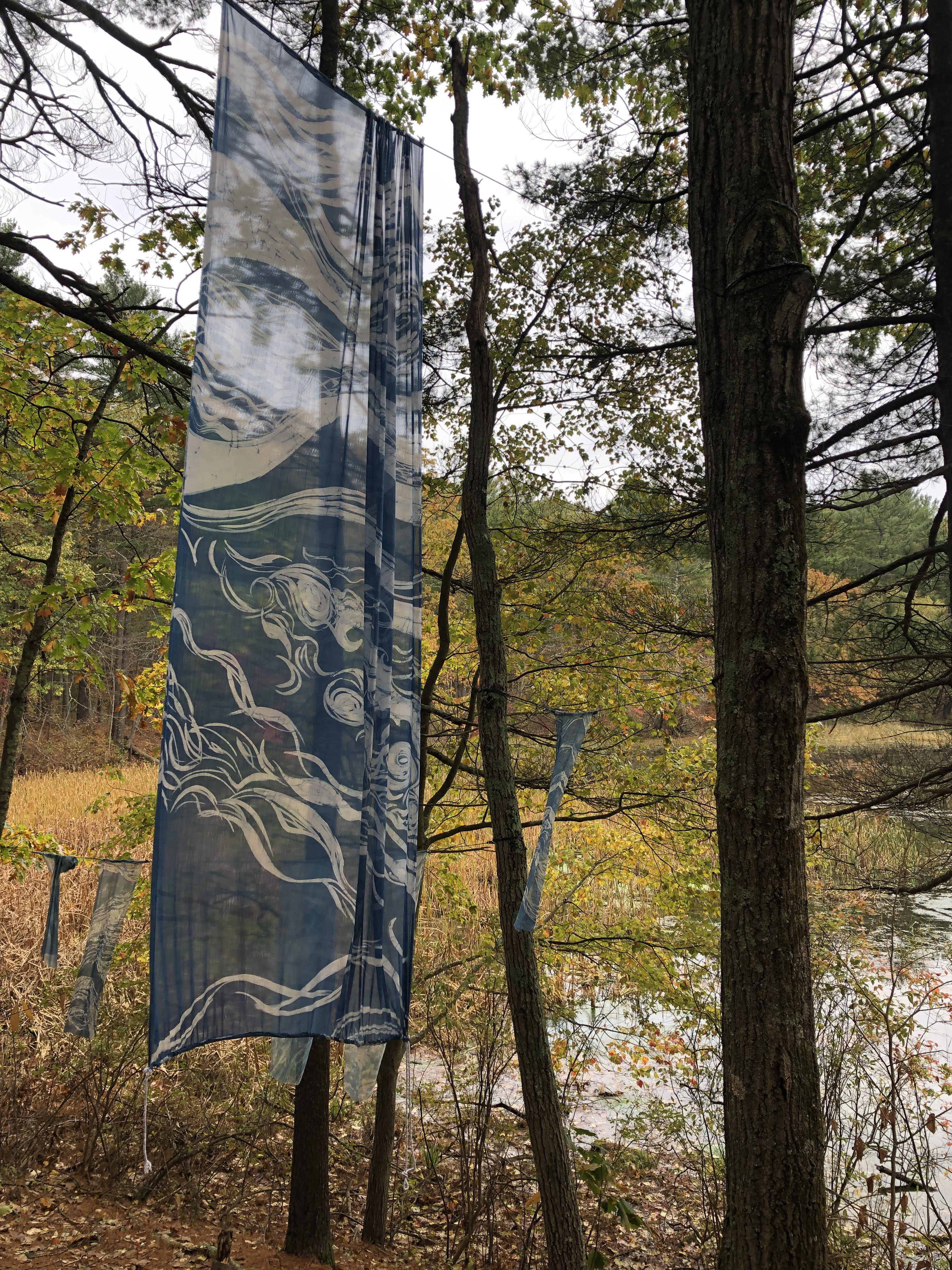
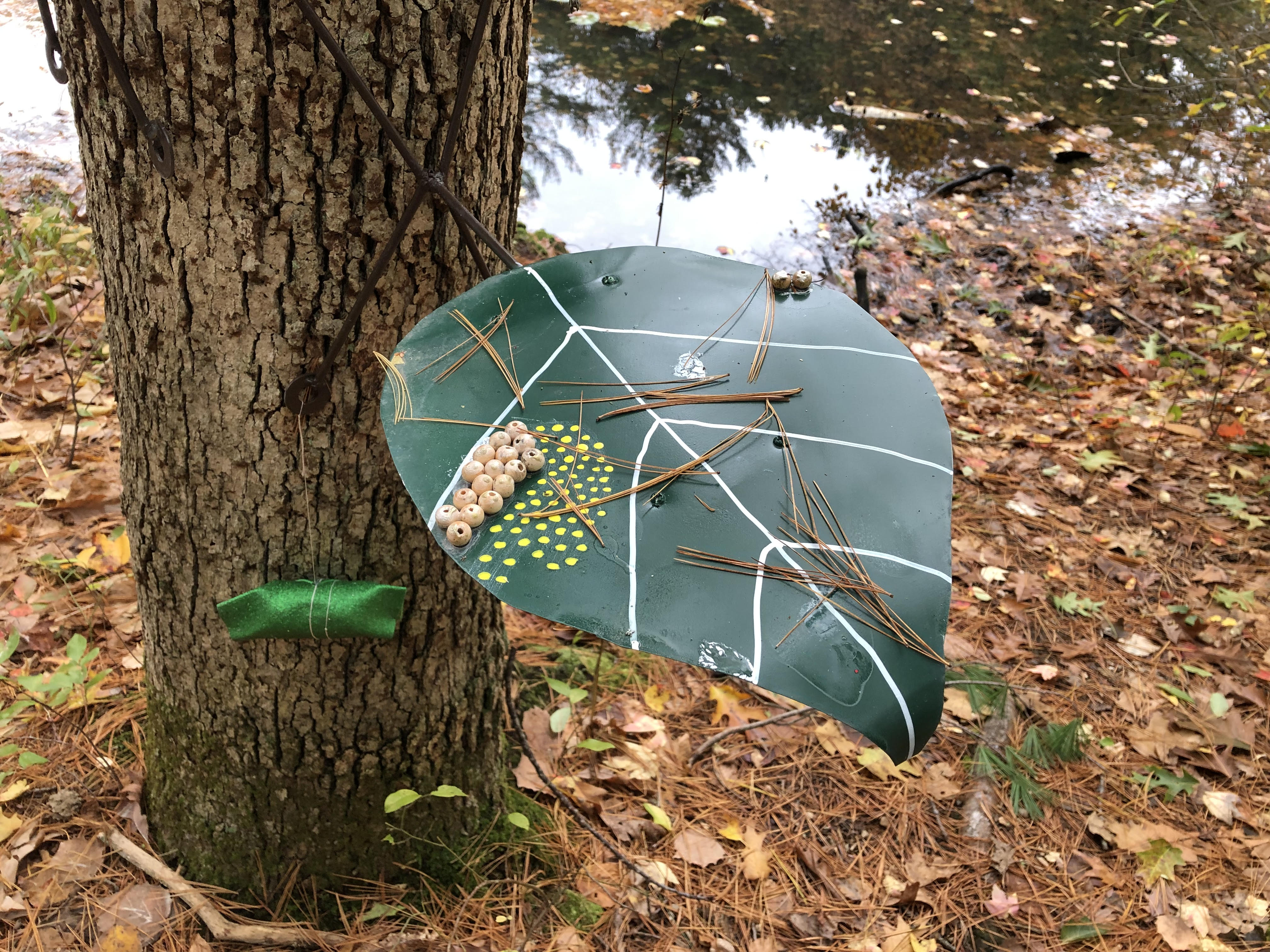
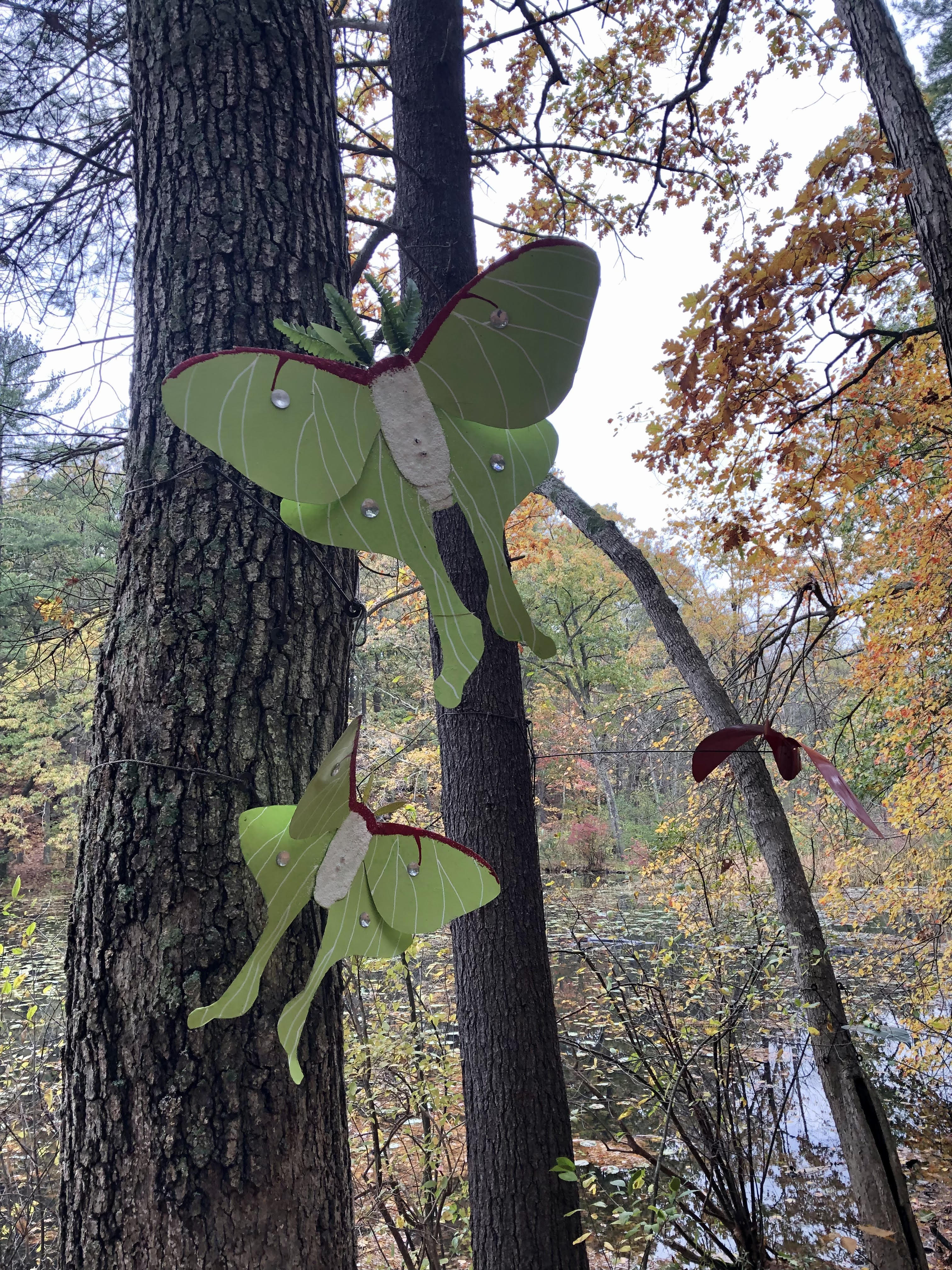
Then there’s the art center’s fabulous annual Art Ramble in the Hapgood Wright Town Forest, which I generally hold off on visiting until the first frost kills off the mosquitoes that breed in Fairyland Pond.

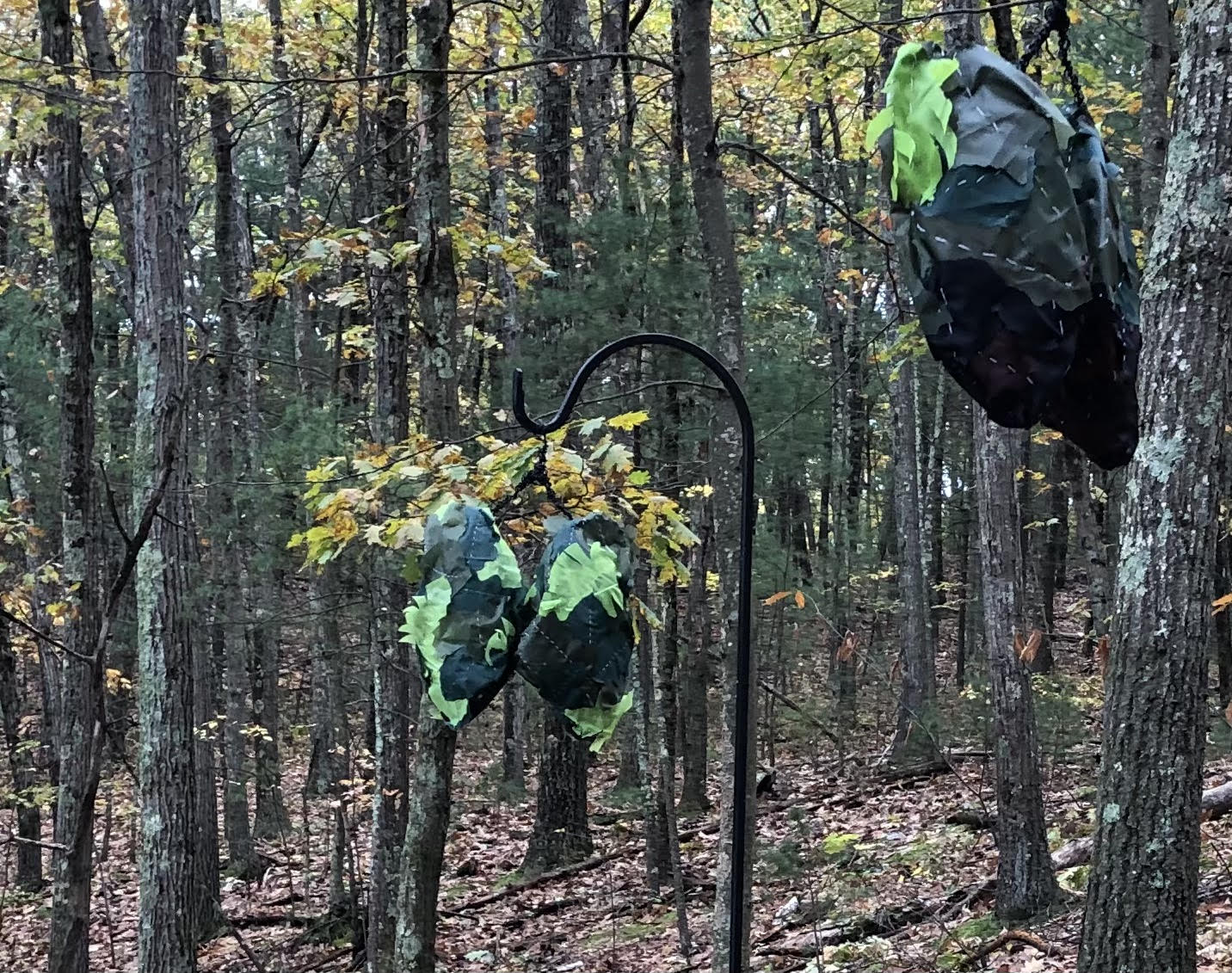
The Shibori hanging series, “Windblown,” is by Kiyomi Yatsuhashi. The beautiful Luna Moth Life Cycle is by Jude Griffin. The lungs of the forest are depicted by Barbara Ayala Rugg Diehl (BARD) in a work called “In and Out.”

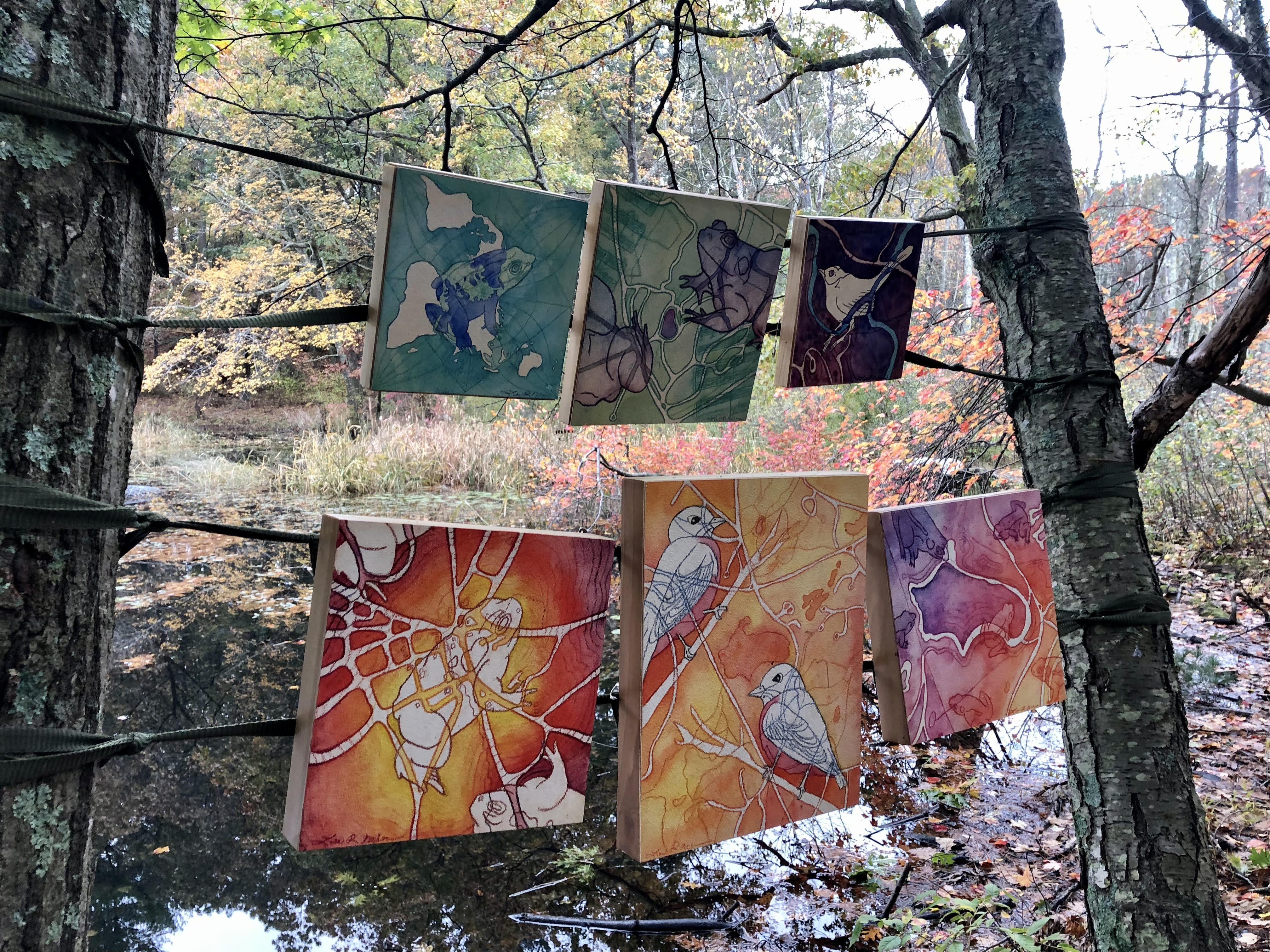
The next photo shows Lisa Nelson’s “Waves of the Aerial Sea.” And last but not least is a huge dragonfly, or “Ethereal Dreamer,” by Laurie Bogdan and Kimberley Harding.

Thanks for joining me in New England.

Read Full Post »

Photo: Book Aid.
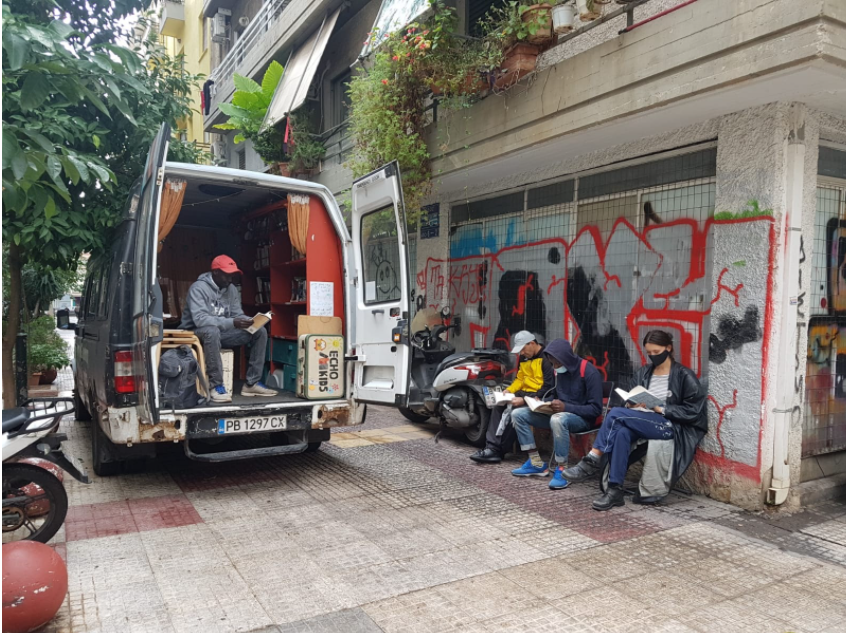
Says Book Aid International, “With very little to do in the camps, many [refugees] enjoy coming to the library to read.

Having learned from the Guardian in early 2020 how Greek refugees were enjoying the services of a mobile library, I was happy to find a post from this year that says it’s still going — despite Covid challenges.

Book Aid reports, “ECHO is a mobile library based in Athens, Greece. Founded in the summer of 2016, its mission is to provide people seeking asylum with books, learning resources and a shared community space whilst they live in the camps. …

“We spoke to one of the coordinators of ECHO, Becka, about the library, the people who use it and the ways it impacts the many lives it reaches. 

People often say, ‘If the library wasn’t there, people would still be living,’ and yes, they’d be alive, but they’d be existing.

“ ‘The educational services within the camps are extremely limited, the WiFi is patchy or non-existent and these camps are not safe places. There is no neutral community space, nowhere you can just relax that’s warm and comfortable, like a library. If we wanted to set up permanent library spaces it would be extremely challenging, so we bring in our lending library service once a week. Even though it’s just once a week and it’s an outside space, which isn’t ideal, we have a rug for children and we have spaces for adults so people come to us to relax and learn. 

” ‘There’s very little to look forward to in these camps, and one of the very few things you can actually do is sit and read a book, either for study or for the sake of exploring a different world. With the pandemic affecting our access to the camps, it’s clear that people notice when we’re not there. Covid-19 has exacerbated a situation which was already very bad. …

” ‘Thanks to Book Aid International, English books are fortunately one of our less stressful things. These are one of our most used resources because they support people who are learning English. Greek is a very challenging language, and not everyone living in the camps will settle in Greece for life.

” ‘There is no effective long-term integration programme or much holistic support for refugees. Most people imagine Greece as a sort of stopping off point; so learning English can be a useful tool for the future. It’s part of building up self-reliance and self-confidence to be able to support yourself in a new life in Europe. Without access to books that becomes really difficult.

” ‘For many people, like young mothers, grappling with the alphabet and being able to start to have basic conversations in English can be extremely empowering. It’s almost like repairing that sense of “I am capable, even in really terrible situations, of taking control of my own learning to benefit me and my children for the future.” …

” ‘People like new books… who doesn’t!? It makes a difference seeing something that is not battered and torn. It’s like, “this is for me. Everything else in this camp and this life is old and horrible. But here is a new book that they brought for me to use.”  

“I think people often say, “If the library wasn’t there, people would still be living,” and yes, they’d be alive, but they’d be existing. For our library users and friends in the camps, books are invaluable.’ ”

Read more at Book Aid, here, and at the Guardian, here.

Read Full Post »

Pumpkins and More

Huge selection of pumpkins and gourds at Wilson Farm, Lexington, Massachusetts.

Most people regard Halloween as simple fun — a moment to indulge in humanity’s playful side. That’s especially true for the very young, if not for the gruesome-looking teens or mischief makers. I always love seeing the littlest ones in their Spider-Man, Snow White, or witch costumes,

But even the creepy stuff is sometimes fun. I went trick-or-treating with John when he was 10, and we loved being startled by what we thought was a bundle of old clothes on the Dallas family’s front steps when it suddenly started moaning.

Back at the house, I would usually put on Halloween-ish records and turn up the volume: “Night on Bald Mountain,” “The Ride of the Valkyries,” a pre-Cats version of TS Eliot’s Old Possum’s Book of Practical Cats (narrated in a spooky voice by Robert Donat), and the Lambert, Hendricks & Ross song below, “Halloween Spooks.” Not sure anyone else listened to that background music, but it always got me in the mood.

Nowadays, we alternate between John’s neighborhood Halloween and Suzanne’s. Since we went to his in 2019 and did nothing in the pandemic, we will be with our younger grandson and granddaughter today.

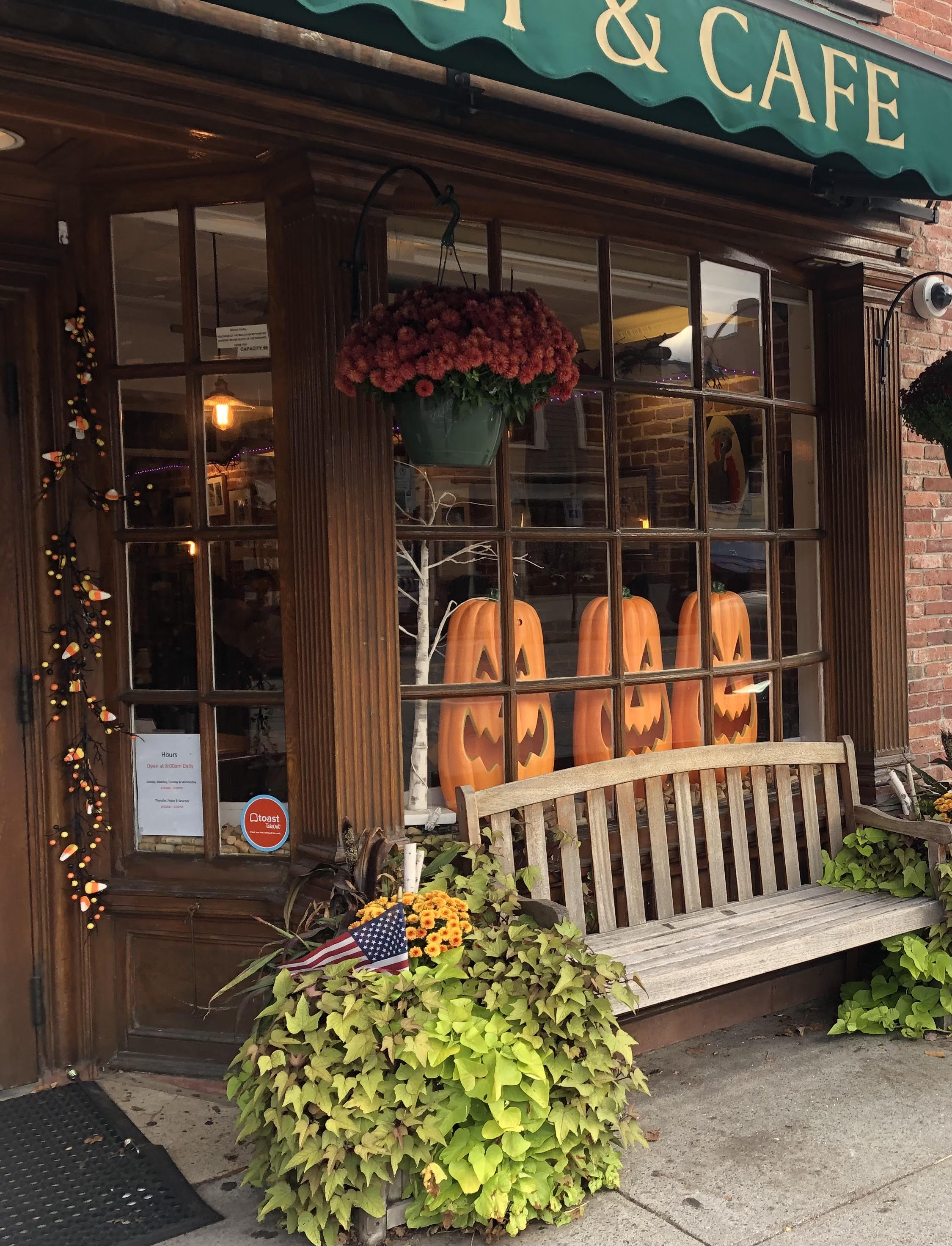
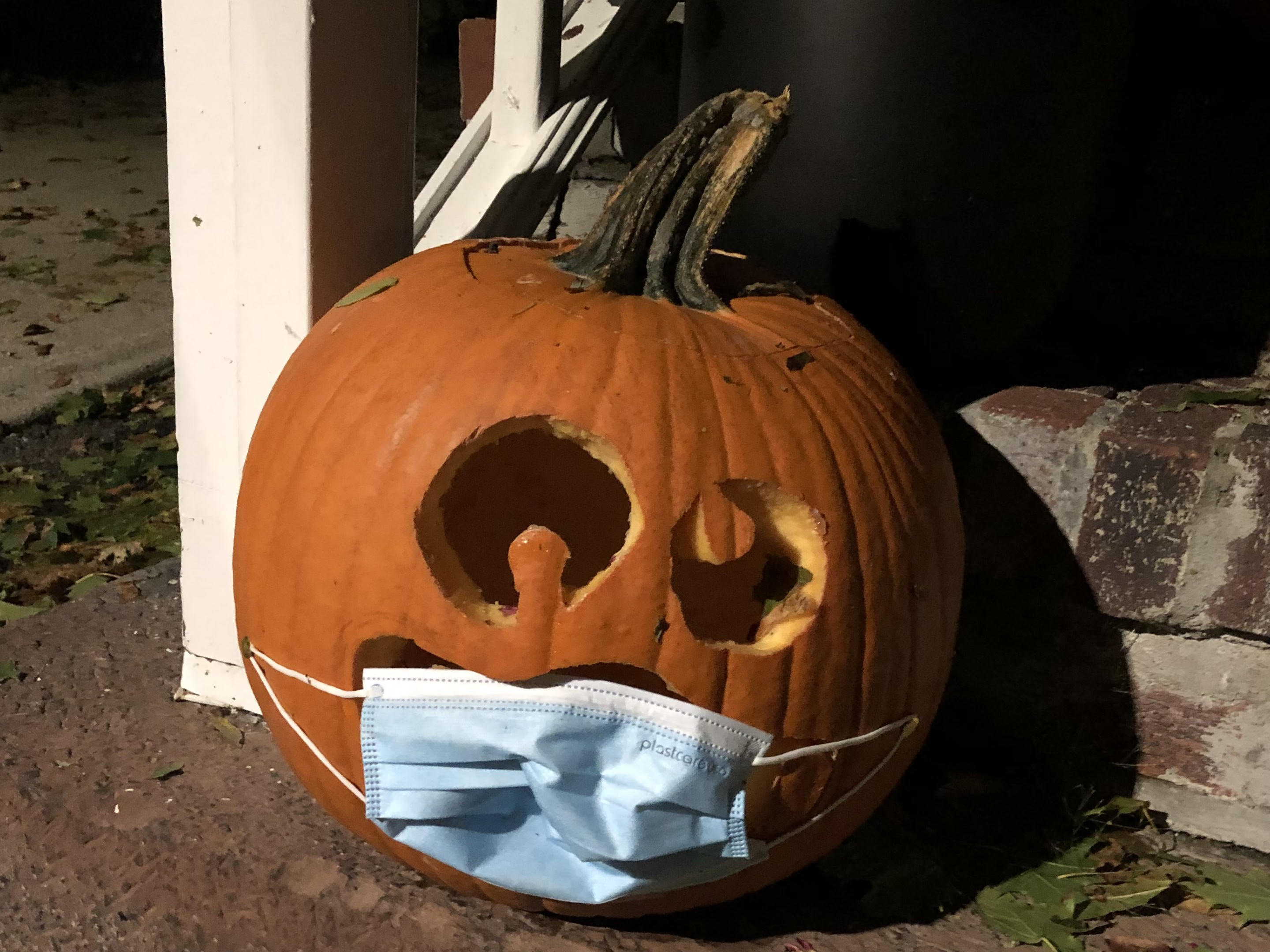
Enjoy a few pre-Halloween photos from around these parts.

Read Full Post »

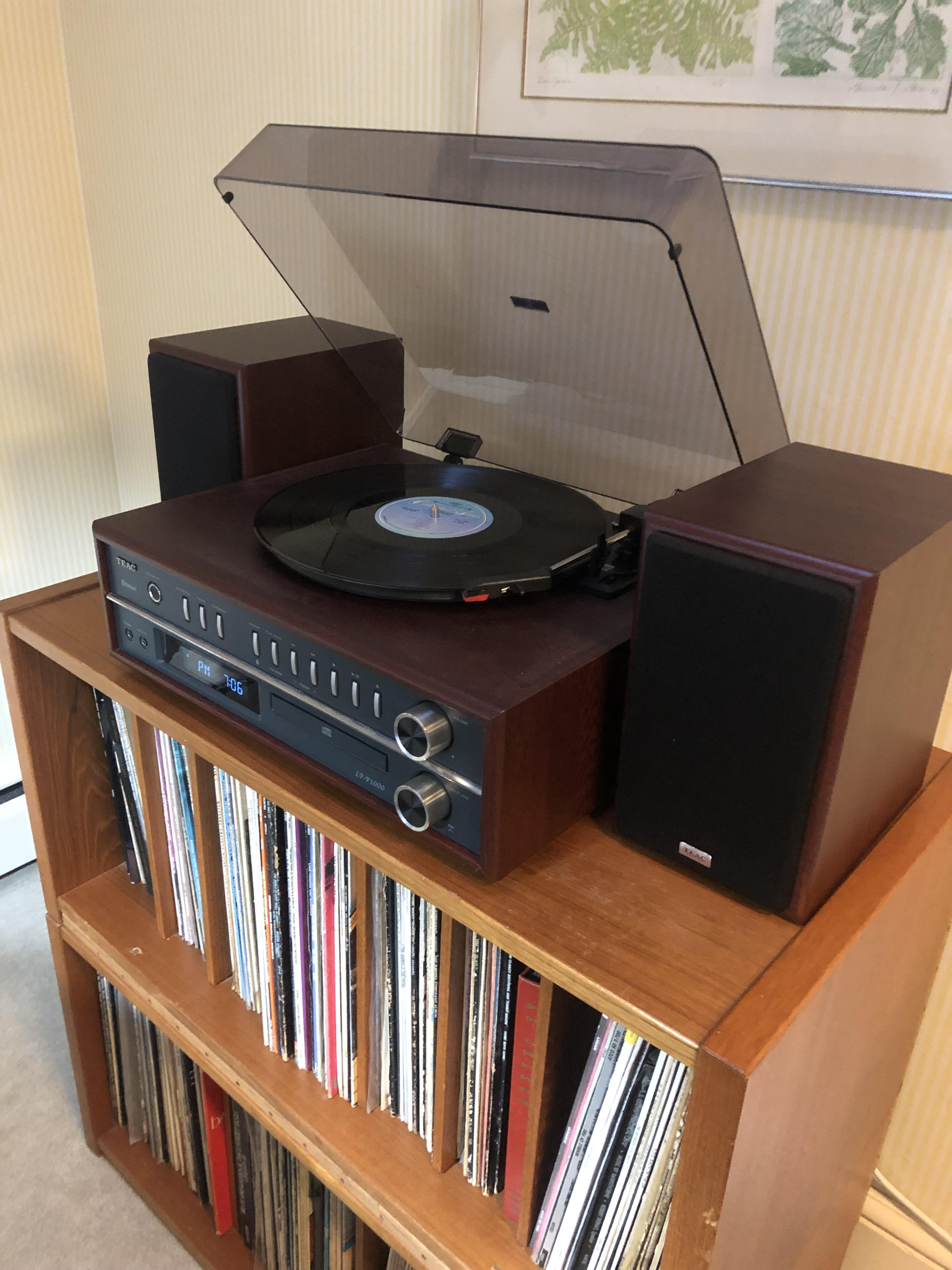
I love my vinyl records and can easily understand the renewed demand for them. They’re so popular, there isn’t enough vinyl or pressing equipment to create all the new ones wanted right now. I sympathize, but what should I do with my anti-plastic concerns? Buying vintage is always a good solution for getting products that don’t hurt the environment, but new bands can hardly use vintage vinyl.

Ben Sisario wrote recently at the New York Times about the challenges.

“Within the Indianapolis office of Joyful Noise Recordings, a specialty label that caters to vinyl-loving fans of underground rock, is a corner that employees call the ‘lathe cave.’ There sits a Presto 6N record lathe — a 1940s-vintage machine the size of a microwave that makes records by cutting a groove into a blank vinyl platter. Unlike most standard records, which are pressed by the hundreds or thousands, each lathe-cut disc must be created individually.

‘It’s incredibly laborious,’ said Karl Hofstetter, the label’s founder. ‘If a song is three minutes long, it takes three minutes to make every one.’

“This ancient technology — scuffed and dinged, the lathe looks like something from a World War II submarine — is a key part of Joyful Noise’s strategy to survive the very surge of vinyl popularity the label has helped fuel. Left for dead with the advent of CDs in the 1980s, vinyl records are now the music industry’s most popular and highest-grossing physical format, with fans choosing it for collectibility, sound quality or simply the tactile experience of music in an age of digital ephemerality. After growing steadily for more than a decade, LP sales exploded during the pandemic.

“In the first six months of this year, 17 million vinyl records were sold in the United States, generating $467 million in retail revenue, nearly double the amount from the same period in 2020, according to the Recording Industry Association of America. …

“Yet there are worrying signs that the vinyl bonanza has exceeded the industrial capacity needed to sustain it. Production logjams and a reliance on balky, decades-old pressing machines have led to what executives say are unprecedented delays. A couple of years ago, a new record could be turned around in a few months; now it can take up to a year, wreaking havoc on artists’ release plans.

“Kevin Morby, a singer-songwriter from Kansas City, Kan., said that his latest LP, ‘A Night at the Little Los Angeles,’ barely arrived in time to sell on his fall tour. And he is one of the lucky ones. Artists from the Beach Boys to Tyler, the Creator have seen their vinyl held up recently. …

“For Joyful Noise, the vinyl crunch has also presented a puzzling problem. Up to 500 V.I.P. customers pay the label $200 a year for special editions of every LP it makes. But the production holdups mean the label cannot predict which titles will be ready during 2022. …

“The label’s solution is to make lathe-cut singles for each of the eight albums it intends to release next year, as placeholder bonuses while its customers wait. Doing so will cost Joyful Noise money and time — Hofstetter groaned as we calculated that eight records with five minutes of music per side, cut 500 times each, would take 666 hours of lathe work — but the label sees it as a necessary investment. …

“The pandemic shut down many plants for a time, and problems in the global supply chain have slowed the movement of everything from cardboard and polyvinyl chloride — the ‘vinyl’ that records (and plumbing pipes) are made from — to finished albums. In early 2020, a fire destroyed one of only two plants in the world that made lacquer discs, an essential part of the record-making process.

“But the bigger issue may be simple supply and demand. Consumption of vinyl LPs has grown much faster than the industry’s ability to make records. …

“ ‘What worries me more than anything is that the major labels will dominate and take over all of the capacity, which I don’t think is a good idea,’ said Rick Hashimoto of Record Technology Inc., a midsize plant in Camarillo, Calif., that works with many indie labels. Others say the big labels are just a convenient target. The real problem, they believe, isn’t celebrities jumping on the vinyl bandwagon but that the industrial network simply has not expanded quickly enough to meet growing demand.

“ ‘Am I mad that Olivia Rodrigo sold 76,000 vinyl copies of her album?’ said Ben Blackwell of Third Man, the record label and vinyl empire that counts Jack White of the White Stripes as one of its founders. ‘Not at all! This is what I would have dreamed of when we started Third Man — that the biggest frontline artists are all pushing vinyl, and that young kids are into it. If someone is mad that that prevents some other title from being pressed,’ Blackwell continued, ‘it feels a little bit elitist and gatekeep-y.’ “

More at the Times, here.

Read Full Post »

Photo: Laura Mam.
The artist’s mother writes the Cambodian lyrics. It makes her feel like a teenager again. She says, “This is what I would have wanted to be, you know, be silly, be brave,”

In today’s story, a pop star of Cambodian heritage stumbles on the fun of sharing her parents’ language with audiences hungry for a contemporary vibe.

Quinn Libson reported the story for National Public Radio (NPR) in February 2020.

“Laura Mam is one of Cambodia’s biggest pop stars, but she wasn’t born or raised in the country. She’s American, and even though both of her parents are originally from Cambodia, she hardly spoke a word of the country’s language, Khmer, when she first became famous there.

“Laura’s fame happened almost by accident. It all started 10 years ago, at her mother’s house in San Jose, Calif. It was Christmas Eve and Laura was home after graduating with a degree in Anthropology from the University of California, Berkeley.

” ‘I had been writing music and my mom was kind of interested in what I was doing. I think I went to her room and I was playing this song. I was like “Hey mom, could you write lyrics in Khmer on top of it?” ‘ Laura says. …

” ‘The first song, I didn’t understand what I was doing and I didn’t know how to rhyme,’ Thida says.

“But Thida gave it a try, and it turned out she had a knack for it. They called the song ‘Pka proheam rik popreay,’ which means ‘morning flower is beautifully blossoming.’ A few months later, Laura and some friends made a music video and uploaded the song to YouTube, not expecting much.

“The morning after the music video went live, they woke up to a big surprise. The video had reached 75,000 views in the course of a single night. But it wasn’t just about the numbers. The viewers’ reactions stunned them.

” ‘The comments were all just like “Yes! Original Cambodian music, oh my god!” ‘ Laura remembers. The comments came streaming in from all over the world. …

” ‘I was from Phnom Penh. And when I was growing up the music scene was huge. During that time there were all these new artists writing all these new sounds, new music,’ [Thida] says.

“This was the early 1970s and Cambodia was in the middle of a music renaissance. … While most fathers at the time might have discouraged their young daughters from diving headfirst into Phnom Penh’s music landscape, Thida’s father was different. …

“Thida says. ‘It was a beautiful childhood I had here in Phnom Penh until the war.’

“[In] the background of Thida’s childhood, bombing campaigns by the United States as part of the Vietnam war and political upheaval meant Cambodia was growing more and more unstable. And in the countryside, a radical Marxist insurgent group — the Khmer Rouge — was steadily amassing power. …

“Educated, urban families like Thida’s were considered politically suspect and were forced to live under intense scrutiny in regime-controlled villages.

” ‘As a child, I was wild,’ Thida says. ‘And then [during] the Khmer Rouge, I had to shut down the feeling. It’s as if there’s a lid put on top of something that bubble[s].’ … When the Vietnamese army swept through Cambodia in 1979, Thida’s family fled across the border to a camp in Thailand. And in 1980, when Thida was 19, she and her family came to California as refugees.

“Thida wanted her children to grow up feeling fully American — Laura and her younger brother had American friends and spoke English at home — but at the same time, Thida found ways to weave bits of Cambodia into their lives. Much of that revolved around music. …

“The Khmer Rouge had targeted and killed musicians. … The Cambodian music industry that came after had been shaped by that grim reality. The result was a country whose airwaves were flooded with cheaply produced, karaoke-style covers.

” ‘There was no pride in that kind of music for me,’ says Laura. Thida agrees. … ‘We were longing for something of our own. It’s a quiet longing.’

“The global reaction to the song they wrote showed Laura and Thida they weren’t the only Cambodians who felt that way. So they wrote more. … The process wasn’t always easy. For Thida, helping Laura transform her lyrics from English to Khmer often meant not just translating words, but translating culture as well. …

‘I would write these very American songs with such American attitude and then my mom would have to translate it into this really good girl who doesn’t break any of the rules and just loves with all the poetry of her heart,’ Laura says.

“But they got better at melding their points of view, and Laura’s fame in Cambodia started to grow. But fame alone wasn’t the goal: For both women, the real mission was to foster a more creative Cambodian music industry. To do that, Laura saw she’d have to leave California behind. …

“Moving to Cambodia opened Laura’s eyes to what was happening behind the scenes of the country’s music industry. ‘Once I got here, it was realizing that it’s not that people can’t do original music, it’s that they aren’t allowed to. [Karaoke] houses were like “No, you can’t do original music because that would be only one album a year and I need to sell 12 to 25.” ‘

Read more about this mother-daughter success story and why they created their own production company, here.

Read Full Post »

Photo: Maxpixel.net.
When Suzanne got Basil as a kitten, he looked a lot like this.

I hesitate to do a post about the rhymes I made when my children were small because there are several actual poets who read the blog. I have no aspirations in the poetical line.

What got me on the train of thought, though, was a memory I had the other day about the cat we once had, Basil.

I remembered how when the kids were young, if they were bored or restless, I sometimes said out of the blue, “Let’s pretend Basil is a fox.”

That always stopped them in their tracks. I mean, how does one pretend a cat is a fox in the first place? The kids were usually able to find something to entertain themselves after that break in the mood.

I liked to make up silly rhymes about Basil. There was a counting rhyme that still comes into my head sometimes when I count. And there was this one:

Basil, Basil, you’re a cat
Never try denying that.
Stand up for your kitty mother,
Turn your back on no cat brother.
When the cat god calls your name,
Let there be no cause for blame.
Future generations all
Will praise the cat who heard the call.

Then there was an attempt at lyrics to be sung in winter to the tune of “I’m Looking Over a Four-Leaf Clover.”

What is the reason that we’re all freezin’
And the birdbath is filled with ice?
Why does my Omni go sideways down the street?
Why do my children wear baggies on their feet?

What normal fellow whose brains aren’t Jello
Would keep fighting this cold war?
What is the reason that we’re all freezin’,
And what did we move here for?

The music teacher that Suzanne had in elementary school actually used that one in a class.

Suzanne’s friend Joanna was amused by the goofy ending of this one back in the ’80s:

Think how lovely it would be
Living always by the sea,
Eating muffins with your tea.
And jam.

Finally, I offer a nonsense poem called a double dactyl. (A dactyl is a rhythm with a hard stress first, followed by two light ones, as in the name “BEV-er-ly.”)

I just had to try it out after reading an entertaining book by the real poets John Hollander and Anthony Hecht. The form is described in the encyclopedia Britannica, which says in part, “One line in the second stanza must consist of a single word. According to the introduction to Jiggery-Pokery: A Compendium of Double Dactyls (1967), edited by the poets Anthony Hecht and John Hollander, this single word should appear ‘somewhere in the poem, though preferably in the second stanza, and ideally in the antepenultimate line,’ though that ambivalence has, for some, hardened into a rule that the word must appear in the poem’s sixth line. (Jiggery-Pokery credits Hecht, the scholar Paul Pascal, and Naomi Pascal, his wife, with having invented the form over lunch in Rome in 1951.)”

If I remember correctly, my double dactyl went as follows below. (I had to look up the Greek word, which means “rosy-fingered.” I used to know such things, and double dactyl rules encourage throwing in other languages.)

Higgledy-piggledy
Fabius Maximus
Waiting for Hannibal
Wasn’t a dope.

Dixit the Cunctator
Demosthenistically
Dawn ῥοδοδάκτυλος
Always brings hope.

l sent it to Hecht, who had a teaching job not far from our home at the time, and he liked it. I think because it followed all the rules.

Read Full Post »

« Newer Posts - Older Posts »