Feeds:
Posts
Comments

Archive for the ‘Uncategorized’ Category

Photo: Justin McCurry/The Guardian.
Members of Ara Style Senior breakdancing club at a recent class in Tokyo, Japan. 

When John was in middle school, he got into breakdancing for a while, an activity that seems manageable for young people. But what about for the elderly? For them, the more recent nomenclature, “breaking,” seems more appropriate.

But not in Japan. Justin McCurry filed another story at the Guardian about that endlessly fascinating country.

“Ten people – wearing bright orange and green T-shirts that mark them out as members of Ara Style Senior – do not belong to the demographic you would normally associate with breakdancing. Their average age hovers just below 70, and the oldest is 74.

“But on a hot afternoon in an eastern Tokyo suburb, amid nervous smiles and initial timing issues, the group ends with a perfectly executed pose the dance’s originators in 1970s New York neighborhoods would probably agree is not too shabby at all.

“Senior breaking is one of a growing category of sports tailored to Japan’s large population of older people who, thanks to the country’s extraordinary longevity statistics, are determined to keep popping and locking for as long as their bodies will allow.

“ ‘At first I thought, there was no way I could breakdance at my age,’ says 69-year-old Hitomi Oda. ‘And of course, we can’t do anything extreme, but it’s fun just to do the easy moves and get your body working.’

“These superannuated b-girls and b-boys, who meet twice a month at a community center in the capital’s Edogawa ward, have the organizers of this summer’s Paris Olympics, and former breaking national champion Yusuke Arai to thank for this novel approach to fitness in their later years.

“ ‘Some of my mother’s friends told her they were interested in learning how to breakdance, and when it was chosen as an Olympic sport, I thought, “Why not give it a go?” ‘ Arai tells the Guardian. …

“The 39-year-old tailors his class to bodies that may not be as supple as the children he has been teaching for almost a decade. ‘You have to lower the hurdles to make it possible for older people to do the moves, so I begin with a focus on easy moves using the top half of the body,’ says Arai. …

“The class is just a few minutes old when the dancers, faces flushed from stretches and warm-up exercises, take the first of several breathers. The genteel approach works: since the classes started last year, not a single dancer has so much as sprained an ankle.

“A few have backgrounds in other forms of dance, but most had never tried breaking until a combination of Olympic excitement and gentle peer pressure brought them through Arai’s door. Now they are converts, practicing together between sessions with the help of YouTube tutorials.

“The class ends with a meticulously rehearsed routine that combines toprocks and floor moves and, as its sign-off, a baby freeze the dancers are asked to re-create multiple times by a visiting Japanese TV crew.

“ ‘The rhythm and the perseverance mean it stimulates your brain as well as your body,’ says Kazuharu Sakuma, the only male dancer, who is here taking a trial class.

“The 71-year-old says he will be back. ‘It’s not like you have to memorize the moves … you just do them two or three times and you realize, “yes, I can actually do this.” That’s when it becomes really enjoyable. It’s also great for general fitness … I’m hoping it will make it easier to walk up stairs.’

“Class regular Takako Mizutani removes her trucker cap and pronounces herself ‘not in the least bit tired. … It doesn’t matter if you’re not very good at it, it’s a lot of fun and a proper workout,’ adds Mizutani, who has a background in jazz dance. ‘I plan to keep breaking for as long as I can.’ ”

More at the Guardian, here. No paywall.

Read Full Post »

Photo: Justin McCurry/The Guardian.
Rieko Hirosawa performs the music of the goze – itinerant blind and visually impaired women who earned a living playing the shamisen in Japan.

I love how the Guardian collects stories from around the world that I would never learn about otherwise. Sometimes I wonder how they do that. Do they have a reporter in all these locales, does a freelancer pitch them an idea? Maybe they have a stringer in a nearby country and send them there. Here is a story I like from Japan.

Justin McCurry reports at the Guardian, “Rieko Hirosawa sits on a stone bench outside her home, tunes her instrument and takes a deep breath. She unleashes an impossibly high note while her bachi plectrum slaps the three strings of her shamisen, a traditional instrument. …”

“Barely a decade has passed since Hirosawa started learning goze uta (blind women’s songs) – a prodigious genre of music spanning four centuries that most Japanese people have probably never heard.

“That she now plays with the composure of a veteran is remarkable for two reasons: not a single goze uta musical score exists, and even if the chords and notes had been written down, Hirosawa would not be able to read them.

“ ‘I knew when I was a young child that I would lose my sight,’ says Hirosawa at her hillside home in Tomi, Nagano prefecture, the outline of the Japanese Northern Alps in the distance.

“But it is because of her condition, not in spite of it, that the 65-year-old has formed an unbreakable spiritual bond with the music of the goze – blind and visually impaired women who earned a living as itinerant musicians and who numbered in their hundreds in the late 19th century.

“In the north-western prefectures, where the tradition flourished during the Edo period (1603-1868), Hirosawa is at the heart of a movement to protect the legacy of the goze.

“ ‘They sang songs while they were living really tough lives,’ she says. ‘Just surviving was a challenge. They used music to have a sense of purpose and then passed on those skills to their apprentices.’

“The musical genre, which historical texts and artwork suggest began as long ago as the 1500s, was no simple career choice. In feudal Japan, girls from poor rural regions who suffered from visual impairment as a result of measles and cataracts, then both commonplace, had only two means of making a living – as masseuses or as traveling musicians.

“Those who chose the latter route out of poverty and discrimination became live-in apprentices at guilds run by an experienced goze, who would pass on songs by word of mouth and teach the shamisen by sitting behind younger musicians and guiding their hands along the instrument’s three strings. …

“They were expected to give a portion of their earnings to the most senior woman in a show of loyalty and observed a strict hierarchy, from the use of honorific to address senior musicians, to the way they wore their hair. The least experienced ate and bathed last, their stock rising with every year of their apprenticeship. The women were not allowed to marry, and men were banned from their lodgings. …

“ ‘It wasn’t unusual for parents to go directly to the master of a goze household and ask her to take on their daughter,’ says Zenji Ogawa, curator of a museum dedicated to the musicians in Takada, a town in Niigata prefecture that was once home to almost 100 performers. ‘They were worried about what would happen to them after they died.’ …

“Life on the road was even more arduous. Three or four musicians, led by a sighted guide, spent 300 days of the year walking from one village to the next, mainly in Japan’s northwestern prefectures of Nagano and Niigata. …

“The women were paid in rice that they would exchange for cash. ‘There was a belief that the goze must have magical powers to have overcome so much adversity and become musicians, so people would buy back the rice they had donated to the women,’ says Ogawa, who organizes bus tours of goze-related sites. …

” ‘They thought that feeding the rice to their children would make them just as strong-willed,’ adds Ogawa, co-founder of the Takada Goze Culture Preservation and Promotion Association. ‘It was the opposite of discrimination. People with disabilities suffered terrible discrimination in those days, of course, but the goze were treated differently.’ …

“Haru Kobayashi, who went blind when she was three months old, is regarded as the last true goze. Born in 1900, she spent her childhood locked in a room at the back of her family home in Niigata and began her career at the age of eight.

“She continued performing until 1978 and was named a living national treasure and received the medal of honor. …

“ ‘Kobayashi-san was 101 years old when I met her,’ says Hirosawa, who wanted to interview the musician for her local radio program, Rieko no Mado (Rieko’s Window). ‘She had lost her sight, of course, and her hearing was failing too.’ Hirosawa had been warned by care home staff that Kobayashi would not be able to sing during their meeting.

“ ‘But she was determined to sing one stanza of a song to me. When I heard her sing it was like thunder … I’d never experienced anything like it. It sent chills down my spine, and I found myself crying the whole time, even on the train on the way home.’

“Inspired by the encounter, she continues to memorize more of the goze repertoire with the help of a teacher who once studied under Kobayashi. ‘All I want is for people to enjoy the music … after all, that’s what the goze’s original purpose was,’ she says.”

More at the Guardian, here. No paywall. Contributions encouraged.
Read Full Post »

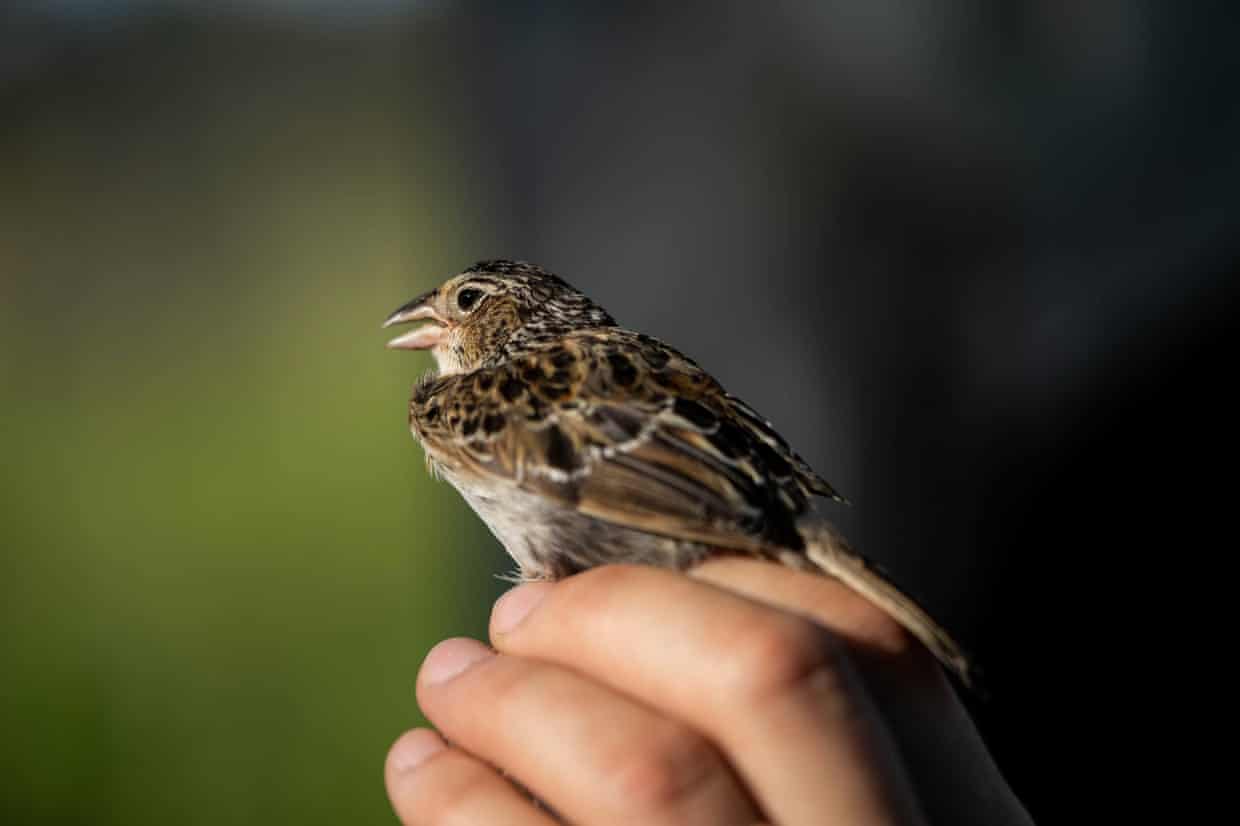
Photo: Carlton Ward Jr.
A grasshopper sparrow in Florida. 

Continuing on the subject of endangered birds, let me introduce Florida’s grasshopper sparrow. Now, you may think that with all the troubles in the world, the future of the grasshopper sparrow is the least of your worries.

But I like how the story represents bigger things — how we can make the world better if we try, how there are people who devote their lives to some small area that has big implcations.

Richard Luscombe writes at the Guardian, “Scientists in Florida are hailing the landmark release this week of a tiny bird only 5 inches tall as an oversized success in their fight to save a critically endangered species.

“Numbers of the Florida grasshopper sparrow, seen only in prairies in central regions of the state, dwindled so severely by 2015, mostly through habitat loss, that authorities took the decision to remove remaining breeding pairs into captivity. Their wager was that a controlled repopulation program would be more successful than leaving the birds to their own devices.

“[Their] gamble was rewarded. Partners joined the Florida Fish and Wildlife Conservation Commission (FWC) to release into the wild the 1,000th bird bred under controlled conditions, adding to an increasingly stable population that researchers believe has turned the tide towards the species’ survival.

“ ‘The recovery and release program diverted the extinction of the Florida grasshopper sparrow,’ said Adrienne Fitzwilliam, lead sparrow research scientist at the FWC’s fish and wildlife research institute.

“The fear was we might just be expediting their demise by bringing in proven breeders, so to see these birds making it in the wild, breeding with wild birds and other release birds, and their offspring going on to breed, has just been incredibly rewarding.’ …

‘Releases, which began in 2019, have taken place at three sites, with the newly freed birds monitored by patient teams of observers with binoculars and lawn chairs at two more. Birds are released in batches at about 40 days of age and, Fitzwilliam said, quickly set about setting up their ‘territory.’

“ ‘There’s a lot of sitting and waiting and watching because their nests are incredibly hard to find,’ she said.

“At the Avon Park military range south of Orlando where the milestone release took place this week, researchers have this year recorded 16 nesting pairs and 30 ‘singing’ males looking for a mate.

“At Three Lakes wildlife management area, the program’s first release site where once only 11 pairs were present, the observers found 40 pairs and 68 males, and are hopeful of more with the breeding season still in progress. …

“ ‘These numbers mean released birds successfully survive, breed and raise young in the wild, which is a huge success,’ Fitzwilliam said. ‘It has diverted extinction and allows partners to research possible landscape-level solutions.’

“Grasshopper sparrows, per their name, eat mostly grasshoppers and seed, and according to the FWC, the loss of large areas of prairie habitats to agriculture fields has vastly reduced their range and numbers. … FWC’s program partners, which include Audubon, White Oak Conservation and the Fish and Wildlife Foundation of Florida (FWF), are researching potentially beneficial land management practices such as roller chopping, which prepares land for controlled burns and speedier regeneration of native grasses. …

“News of the recovery of grasshopper sparrow numbers follows an upbeat report by a coalition of prominent universities for the future of Florida’s wildlife, if the climate emergency is mitigated properly.

“Andrew Walker, FWF president and chief executive, said: ‘These little birds represent a big beacon of hope that our commitment, partnership and holistic approach can save vulnerable wildlife from the brink of extinction.’ “

More at the Guardian, here.

Read Full Post »

Photo: Richard Vogel/AP.
A California condor takes flight at the Los Angeles Zoo, on 2 May 2023. 

Few of us warm up to scavengers like condors and vultures, but I recall a kid I knew back in the day who was obsessed with endangered California condors. Now their numbers are creeping back, thanks to protection efforts, and more people are learning why scavengers are essential.

Coral Murphy Marcos reports at the Guardian, “Nearly 20 new California condors will fly across the western sky after a record-setting hatching of baby birds this summer at the Los Angeles Zoo.

“The zoo marked a record of 17 California condor chicks hatched during this year’s breeding season, with staff members preparing to set the birds into the harsh wild as they are currently protected as an endangered species.

“ ‘Our condor team has raised the bar once again in the collaborative effort to save America’s largest flying bird from extinction,’ said Rose Legato, curator of birds at the LA Zoo.

“Legato said the record number of birds was thanks, in part, to new breeding and rearing techniques developed and implemented by the team. The process places two or three condor chicks together with a single adult surrogate condor to be raised. Usually, the four-inch-long eggs are laid in late winter or spring, and take two months to hatch. …

“The condors will be released as part of the recovery program for the California condor, led by the US Fish and Wildlife Service. In 1967, the California condor was listed as endangered by the federal government. …

“Twelve years later, the wildlife service started the California Condor recovery program. The species ranged from California to Florida and western Canada to northern Mexico, but, by 1982, only 22 condors survived in the wild. Those birds remained in captivity and were placed in the agency’s program. As of December 2023, there were 561 California condors in the world, of which 344 are living in the wild, according to the zoo.

“Ashleigh Blackford, the California Condor recovery program coordinator, said that the birds play an important role in the ecosystem because they help eliminate disease and recycle nutrients by feeding on animal carcasses that would otherwise decompose and spread disease. …

“This year, for the first time, the zoo’s condor team implemented a technique allowing three chicks to be raised at the same time by a female to increase the ability to raise condors without human interaction. … This process helps breeding pairs produce more than one viable egg in a season. It also makes the birds adjust better to the wild after they are released.

“The number of birds in the wild fluctuates due to habitat loss, pesticide contamination, consumption of micro trash in their environment, and lead poisoning from eating lead bullet fragments or shot pellets found in animal carcasses.

“Lead poisoning is the main hurdle to recovery of the California condors. Avian influenza is also an increasing threat to the condors. In response to a recent outbreak of highly pathogenic avian influenza in the western coast of the US, the US Fish and Wildlife Service has been vaccinating condors before releasing them into the wild.” More at the Guardian, here.

And while we’re on the topic of scavengers, read how cattle medicine that accidentally poisoned vultures in India led to thousands of human deaths.

Catrin Einhorn wrote at the New York Times, “To say that vultures are underappreciated would be putting it mildly. With their diet of carrion and their featherless heads, the birds are often viewed with disgust. But they have long provided a critical cleaning service by devouring the dead.

“Now, economists have put an excruciating figure on just how vital they can be: The sudden near-disappearance of vultures in India about two decades ago led to more than half a million excess human deaths over five years, according to a [study] in the American Economic Review.

“Rotting livestock carcasses, no longer picked to the bones by vultures, polluted waterways and fed an increase in feral dogs, which can carry rabies. It was ‘a really huge negative sanitation shock,’ said Anant Sudarshan, one of the study’s authors and an economics professor at the University of Warwick in England.

“The findings reveal the unintended consequences that can occur from the collapse of wildlife, especially animals known as keystone species for the outsize roles they play in their ecosystems.” The Times story is here.

My last word on this topic is for people who enjoy reading mysteries set in foreign countries. One of my all-time favorite mysteries is The Skull Mantra, which is the beginning of a series about Tibet. Somewhere in that series, I learned about the role of a class of people who traditionally prepared bodies to be exposed to vultures on high plateaux for “sky burials,” a way of life that other Tibetans seemed to find both distasteful and holy.

Read Full Post »

Photo: Carolyn Cole/Los Angeles Times via Getty Images.
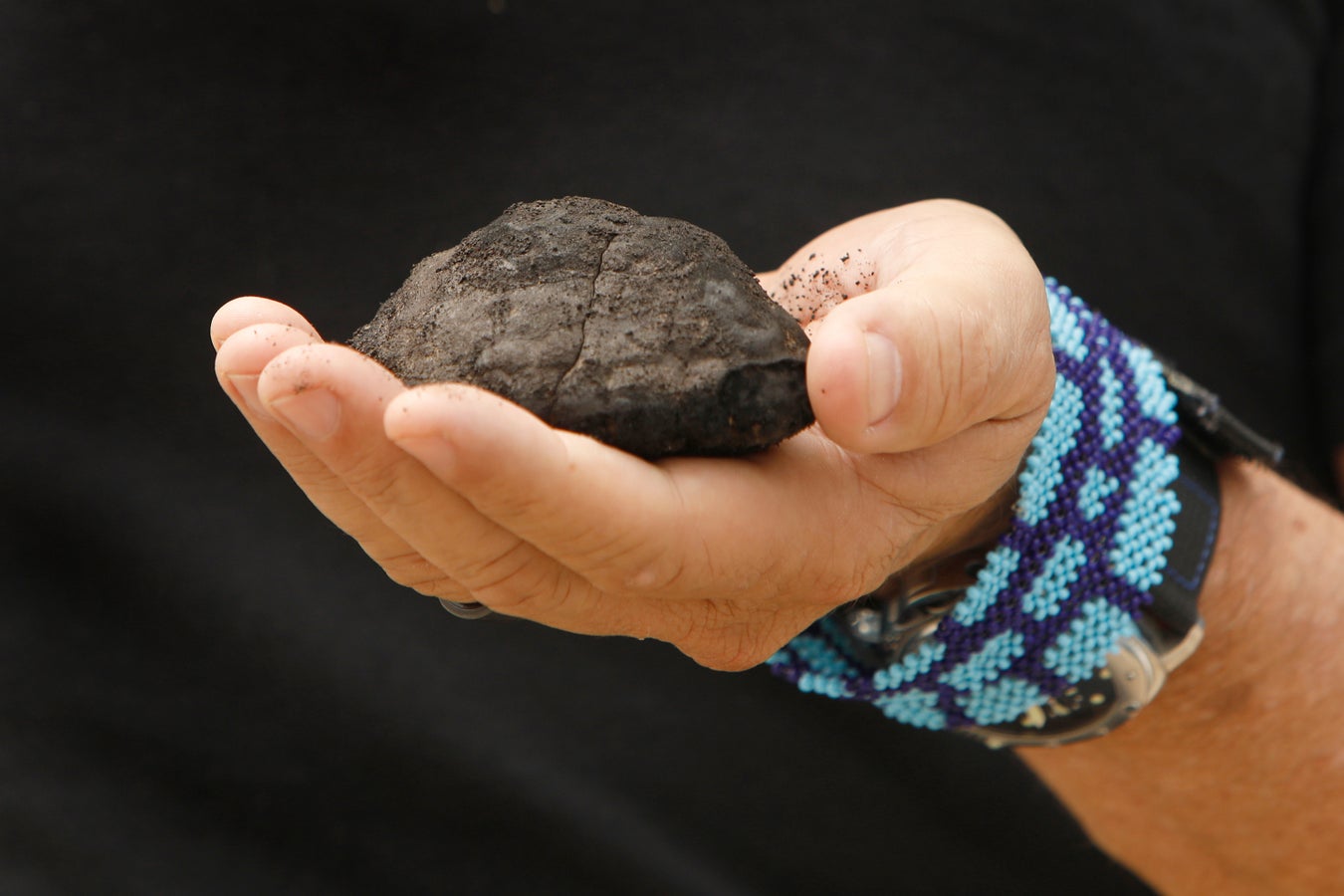
Metal deposited over millions of years forms these nodules, which can somehow generate oxygen.

Sometimes it seems like scientists have all the fun. In today’s story, certain researchers of the deep ocean thought their instruments were at fault and complained to the manufacturer. Then one day, ironically, an ad from a deep-sea mining company struck a chord in one scientist and led to some creative thinking.

Allison Parshall writes at Scientific American that some rocklike mineral deposits in the deep sea may have more to them than meets the eye.

“The dark seabed of the Pacific Ocean’s Clarion-Clipperton Zone (CCZ) is littered with what look like hunks of charcoal. These unassuming metal deposits, called polymetallic nodules, contain metals such as manganese and cobalt used to produce batteries, marking them as targets for deep-sea mining companies.

“Now researchers have discovered that the valuable nodules do something remarkable: they produce oxygen and do so without sunlight. ‘This is a totally new and unexpected finding,’ says Lisa Levin, an emeritus professor of biological oceanography at the Scripps Institution of Oceanography, who was not involved in the current research.

“According to Boston University microbiologist Jeffrey Marlow, the idea that some of Earth’s oxygen gas may come not from photosynthesizing organisms but from inanimate minerals in total darkness ‘really strongly goes against what we traditionally think of as where oxygen is made and how it’s made.’ Marlow is a co-author of the new study, which was published in Nature Geoscience.

“The story of discovery goes back to 2013, when deep-sea ecologist Andrew Sweetman was facing a frustrating problem. His team had been trying to measure how much oxygen the organisms on the CCZ seafloor consumed. The researchers sent landers down more than 13,000 feet and created enclosed chambers on the seabed to track how oxygen levels in the water fell over time.

“But oxygen levels did not fall. Instead they rose significantly. Thinking the sensors were broken, Sweetman sent the instruments back to the manufacturer. ‘This happened four or five times’ over the course of five years, says Sweetman, who studies sea­floor ecology and biogeochemistry at the Scottish Association for Marine Science. …

“Then, in 2021, he returned to the CCZ on a survey expedition sponsored by the Metals Company, a deep-sea mining firm. Again, his team used landers to make enclosed chambers on the seafloor and monitor oxygen levels. They used a different technique to measure oxygen this time but observed the same strange results: oxygen levels increased dramatically. …

“The researchers initially thought deep-sea microbes were producing the oxygen. That idea once might have seemed far-fetched, but scientists had recently discovered that some microbes can generate ‘dark oxygen‘ in the absence of sunlight.

In laboratory tests that reproduced conditions on the seafloor, Sweetman and his colleagues poisoned seawater with mercury chloride to kill off the microbes. Yet oxygen levels still increased.

“If this dark oxygen didn’t come from a biological process, then it must have come from a geological one, the scientists reasoned. They tested a few possible hypotheses — such as that radioactivity in the nodules was decomposing seawater molecules to make oxygen or that something was pulling oxygen from the nodules’ manganese oxide — but ultimately ruled them out.

“Then, one day in 2022, Sweetman was watching a video about deep-sea mining when he heard the nodules referred to as ‘a battery in a rock.’ That bit of marketing was only a metaphor, but it led him to wonder whether the nodules could somehow be acting as natural geobatteries. If they were electrically charged, they could potentially split seawater into hydrogen and oxygen through a process called seawater electrolysis. (A battery dropped in salt water produces a similar effect.)

“ ‘Amazingly, there was almost a volt [of electric charge] on the surface of these nodules,’ Sweetman says; for comparison, an AA battery carries about 1.5 volts. The nodules may become charged as they grow, as different metals are deposited irregularly over the course of millions of years and a gradient of charge develops between each layer. Seawater electrolysis is currently the researchers’ leading theory for dark oxygen production, and they plan to test it further.”

More at Scientific American, here. No firewall.

Read Full Post »

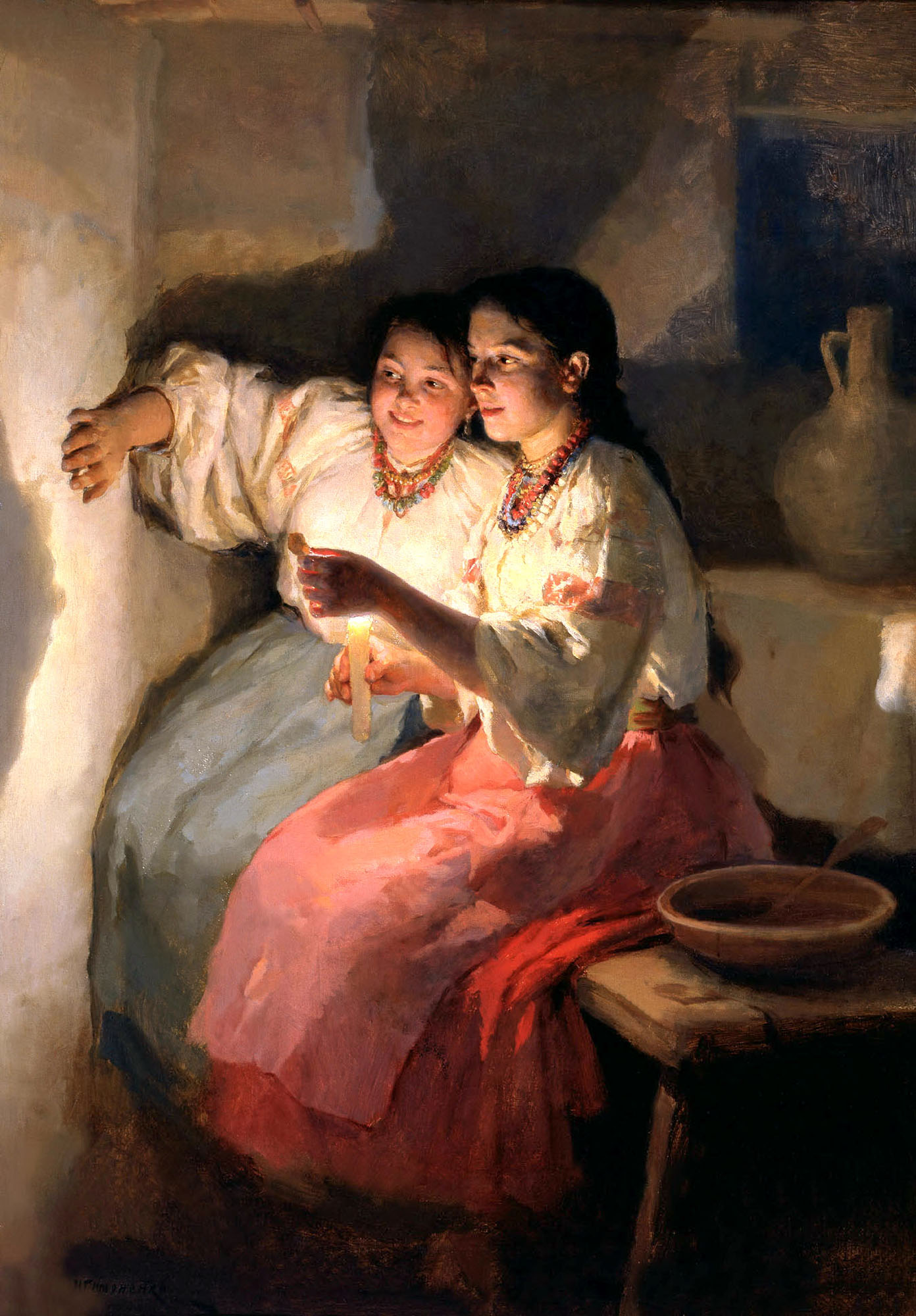
Photo: Ivan Honchar Museum.
Witchy arts are part of Ukrainian folklore. The girls in the painting above (Divination by Mykola Pymonenko, 1888) are trying to predict the future.

Somehow, even in wartime, artists’ imaginations keep creating. Today’s story is about a new Ukrainian play that has captured the country’s attention.

Ashley Westerman at National Public Radio [NPR] tells us that “even though the plot takes place centuries ago, the play’s takeaways and parallels to today resonate with Ukrainians.”

Here are excerpts from the NPR transcript.

Westerman: In the early days of Russia’s full-scale invasion of Ukraine, a video surfaced online – a woman shouting at a Russian soldier sitting atop a tank. …

‘Do you even know where you are? You’re in Konotop,’ shouted the woman off-screen. ‘Every second woman here is a witch.’ …

“The video went viral in Ukraine, not just because of the woman’s defiance, but also because Konotop, a city in the country’s far northeast, is a place associated with witches. ‘Witches are a part of Ukrainian culture and Ukrainian tradition,’ says Khrystyna Fedorak, so you can rely on something having to do with witches going viral. This is one of the reasons the play Fedorak is currently starring in at the Ivan Franko Theater in the capital, Kyiv, has become a summer blockbuster. Fedorak plays the witch in the dark musical comedy The Witch Of Konotop.

“Based on the 1833 satirical fiction by Ukrainian writer Hryhorii Kvitka-Osnovianenko, this story leans hard on the stereotype that Ukrainian literature is full of sadness and tragedy. Taking place in the 1600s, the audience follows the main character, Zabryokha, a Cossack military leader in Konotop, pursuing the lovely Olena, but she rejects his proposal. She loves someone else. In this scene, Pistryak, Zabryokha’s cunning assistant, tries to confuse Olena’s love interest by accusing him of crimes he didn’t commit. …

“Then, in a twist of events that sounds a lot like today, Zabryokha receives an order to join a military campaign to help the Cossacks fend off an overreaching Tsarist Russia.

” ‘They order us,’ Pistryak says, ‘to take our Cossacks in Konotop to join the main army. There may be drills, or there may be war.’

“But Zabryokha refuses to go, saying he needs to stay in Konotop to root out the witch problem — the root, he says, of everyone’s problems. What ensues is a string of ridiculous, funny and very human moments. Spells are cast, couples are wed and, of course, there’s a witch hunt, meaning a swim test. If you’re not a witch, you drown. If you are a witch, you don’t.

“All with a larger threat looming over everything — Russia. But while that might be the most obvious takeaway from The Witch Of Konotop, the cast has some of their own ideas.

Kateryna Artemenko: Don’t kill women (laughter). Don’t mess with women. …

Westerman: Artemenko plays one of the townswomen mistaken for a witch. …

Artemenko: The main message is about people who — they’re trying to fool their destiny, but destiny will find them.

Westerman: Nazar Zadniprovskiy, who plays the ill-fated Cossack commander, views this play as a lesson in avoiding responsibility. … Zadniprovskyi says many people see a parallel with Ukrainian men dodging conscription today. …

“As the play ends and the theater’s mustard-yellow felt curtain drops to a thunderous applause, producer Polina Lytvynova and I ask a few audience members what parallels they drew. Olha Vasylevska is from Kharkiv, the northeastern Ukrainian city currently fending off an intense Russian offensive. She thinks the play is about love.

Olha Vasylevska: (Through interpreter.) If the love is true, it doesn’t need any outside assistance … but if the love is not true, nobody and nothing can help it, even the witch.

“Westerman: Markian Halabala, from Kyiv, says the message he took away is that you shouldn’t interfere in God’s will.

“Markian Halabala: (Through interpreter.) This is like Putin. He interfered in natural Ukraine’s way of independence. And Russians, they try to stop and prevent, like, [the] natural way of Ukrainian history with this war.

“Westerman: Critics say the many takeaways The Witch Of Konotop offers its audiences is one reason it’s been so popular. … But another reason is the overall push to celebrate Ukrainian culture and literature. Putin has repeatedly said victory, to him, means nothing short of Ukraine losing not just their sovereignty, but also their identity.”

Finally, Westerman spoke to Mykhailo Kukuyuk, who plays Pistryak. He speaks of the value of his country’s arts: “What are we fighting for? it’s the details, the sparks, that make us alive.” He adds that, while it’s sometimes difficult to block out the events happening outside of this theater, it’s an honor to perform for his country.

More at NPR, here.

Read Full Post »

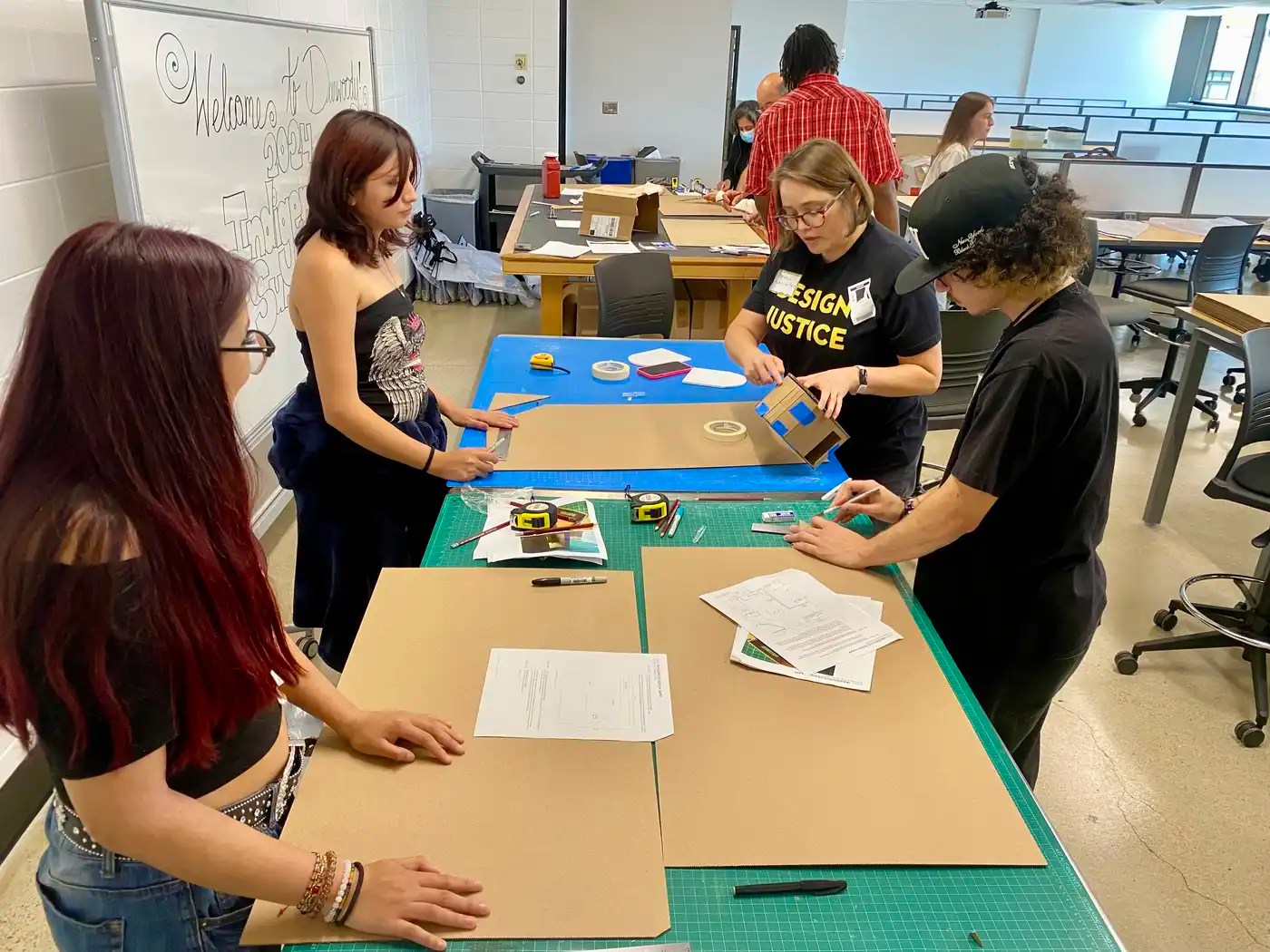
Photo: Alex V. Cipolle.
University of Minnesota architecture professor Jessica Garcia Fritz teaches Indigenous Design Camp campers cardboard scoring techniques on day one.

It seems like every year, the first question on the first day of school is, “What did you do over the summer?” This past summer, if you were an indigenous teen in the Twin Cities of Minnesota, you might have had some new experiences to report.

In July, Alex V. Cipolle at Minnesota Public Radio wrote about an unusual class at the Dunwoody College of Technology.

“A group of teens cuts cardboard with X-ACTO Knives. They will soon shape this cardboard into architectural models of their bedrooms. …

“ ‘It’s my first time doing something in architectural-related study,’ says Dominic Stewart of Burnsville.

“ ‘I’m excited to get that hands-on experience,’ says Carsyn Johnson of Elk River.

“They are here for the weeklong Indigenous Design Camp, the first camp of its kind in the U.S. The goal is to teach Indigenous teens about career options in architecture and design, a field where Native Americans are underrepresented.

“Two of the founders of the new camp — architects and friends Mike Laverdure and Sam Olbekson — estimate that there are only about 30 Indigenous architects total in the U.S.

“Laverdure is an enrolled member of the Turtle Mountain Band of Chippewa and a partner at DSGW Architects as well as the president of First American Design Studio. Olbekson is a citizen of the White Earth Nation and founded the firm Full Circle Indigenous Planning and Design. They are the only two practicing Native architects in Minnesota. 

“ ‘The need for creating a space for kids to become designers, Indigenous designers, is great,’ says Laverdure, who has wanted to start this camp for years. ‘Representation matters for these kids to see us as architects and designers. A lot of us who grew up in reservations or urban Indigenous communities only see a few career types.’ …

“The campers are Indigenous teens ages 14-18 from the metro area. They will be constructing architectural models all week. Campers will also tour the University of Minnesota School of Architecture and local architecture firms.

“They will also visit the American Indian Cultural Corridor on Franklin Avenue, where both Laverdure and Olbekson have designed buildings, as well as another Olbekson project, the recently completed expansion of the Red Lake Nation College downtown.

“Olbekson says, ‘to actually go and see [the buildings] and see the impact that they’re having on the community, not only as individual buildings, but how they’re forming an identity for the American Indian Cultural Corridor and how these projects are supporting education, economic development, community building, cultural development, and youth and elder spaces, I think is going to be a great way for them to understand the impact of what design, urban design, interiors, landscape, can have on creating a healthy, Indigenous urban community.’

“The camp began [with] a welcome from Laverdure, Olbekson and University of Minnesota assistant architecture professor Jessica Garcia Fritz, a citizen of the Cheyenne River Sioux Tribe. Fritz also helped start the camp.

“ ‘If you think about your home reservations, or your urban communities, you think about all the buildings that are there,’ Laverdure told the class, ‘Ninety-nine percent of all the buildings built that Indigenous people sit in are not designed by indigenous designers. … When you have Indigenous designers be a part of that process, what happens is that those buildings have a special kind of connection to the communities and that makes those buildings extra special.’

“Next came a presentation on Indigenous architecture, past and present, by Tammy Eagle Bull, who did a video call from her home in Arizona. Eagle Bull is a member of the Oglala Lakota Nation of Pine Ridge, South Dakota. In 1994, she became the first Native woman in the U.S. to become a licensed architect. …

“For the remainder of the first day of camp, Jessica Garcia Fritz guided campers in a design exercise to create their sleep space or bedroom.

“First, they taped 10 by 10-foot squares on the classroom floor to help them visualize the scale. Then they sketched blueprints of their bedrooms. Finally, they cut and scored cardboard to build shoebox-size models. …

“ ‘One of the things Tammy Eagle Bull had said this morning was, “I wish that a camp like this had existed when I was young.” I think that’s the sentiment among many of us,’ Garcia Fritz says. …

“Garcia Fritz, Laverdure and Olbekson hope this camp is the first of many. One of the goals is to expand the camp to greater Minnesota.

“ ‘Right now, it’s in the Twin Cities, but there are so many Indigenous communities regionally, up north and even in other states that could really benefit from this,’ Olbekson says. 

“ ‘Long term, we want to create a space where five to 10 years from now, we’ve got 10, 15, 20, Native designers that are out there and being a force for change,’ Laverdure says.”

More at MPR News, here.

Read Full Post »

Photo: Rasmus Hjortshoj.
Dortheavej residence in Copenhagen. Social housing accounts for about 20% of all housing stock in Denmark and is available to anyone, regardless of income.

I’m always interested in housing stories, partly because among the issues that the department I worked in at the Fed addressed was housing. After the mortgage meltdown in 2008, I remember, we had a gigantic event at the Patriots’ football stadium to gather borrowers in danger of foreclosure under one roof with organizations that could help them.

Today’s story looks at new ideas in public housing from around the world. Maddie Thomas reports at the Guardan, “The social housing of last century often calls to mind towering blocks of flats, poorly maintained with dark, pokey and cold units. But alongside a rise in community living, the 21st century has brought quality construction, sustainability, and quality of life to the forefront of social housing design.

“Australia’s commitment to and funding for social housing stock is limited. But by 2037, Australia is estimated to have 1.1 million people seeking social housing. Professor of architecture and head of the University of NSW’s school of the built environment, Philip Oldfield, says that for an investment in social housing to match cosmopolitan cities like Paris or Barcelona, more housing of quality needs to be built.

“ ‘Architects are trained in this … so when they’re given the opportunity to do it well, Australian architects will create as good a housing as anywhere else in the world,’ he says. ‘At the moment, the system, with few exceptions, doesn’t give them that creative opportunity to deliver … the kind of world class social housing we would love to see.’

“While Australian not-for-profits are building design-led affordable housing for low to middle income earners, government-funded social housing for those on waitlists is lacking. Oldfield says organizations like Nightingale Housing are pioneers in built-to-rent housing, with 20% of apartments assigned to community housing providers for those most in need. But examples like Sydney’s Sirius building, previously owned by the state government, show that Australia needs more purpose-built social housing to cater to demand and match international standards.

“ ‘In conventional market-led housing, you build for the people who purchase the house … so you don’t consider as much the energy bills that are going to accumulate over time,’ he says. ‘With social housing, you’re not trying to create a profit so you can consider things like the life cycle costs for housing in a much more significant way.’ …

“Social housing in Denmark is available to anyone, regardless of income. Highly regulated to ensure quality construction, social housing accounts for about 20% of all housing stock in Denmark. In 2013, global architecture firm Bjarke Ingels Group was commissioned by Lejerbo, a Danish organization building housing for those in need, to design ‘Dortheavej’ – a social housing block in Copenhagen.

“Bjarke Ingels’ ‘winding wall’ of social housing has 66 units for low-income citizens, with a small balcony and floor-to-ceiling windows in each.

“ ‘The stacking of prefabricated elements consisting of two kinds of stacked modules, which are repeated to create the characteristic checkered pattern,’ says Kai-Uwe Bergmann, partner at Bjarke Ingels. ‘By gently adjusting the modules, the living areas open more towards the courtyard while curving the linear block away from the street to expand the sidewalk into a public square.’

“The stairwells allow for the units to be filled with daylight, and views of the neighboring green space. Pathways through the site give access to the street. The apartments themselves range from 60 to 115 sq m [~646 to ~1200 square feet], but with open plan designs, space within the units themselves is flexible.”

Read housing stories from Mexico City, Paris, Barcelona, Los Angeles, and Vienna at the Guardian, here; no paywall. You’ll appreciate the variety of approaches around the world and enjoy some great photos.

Making Home Home blog, looking at you!

Read Full Post »

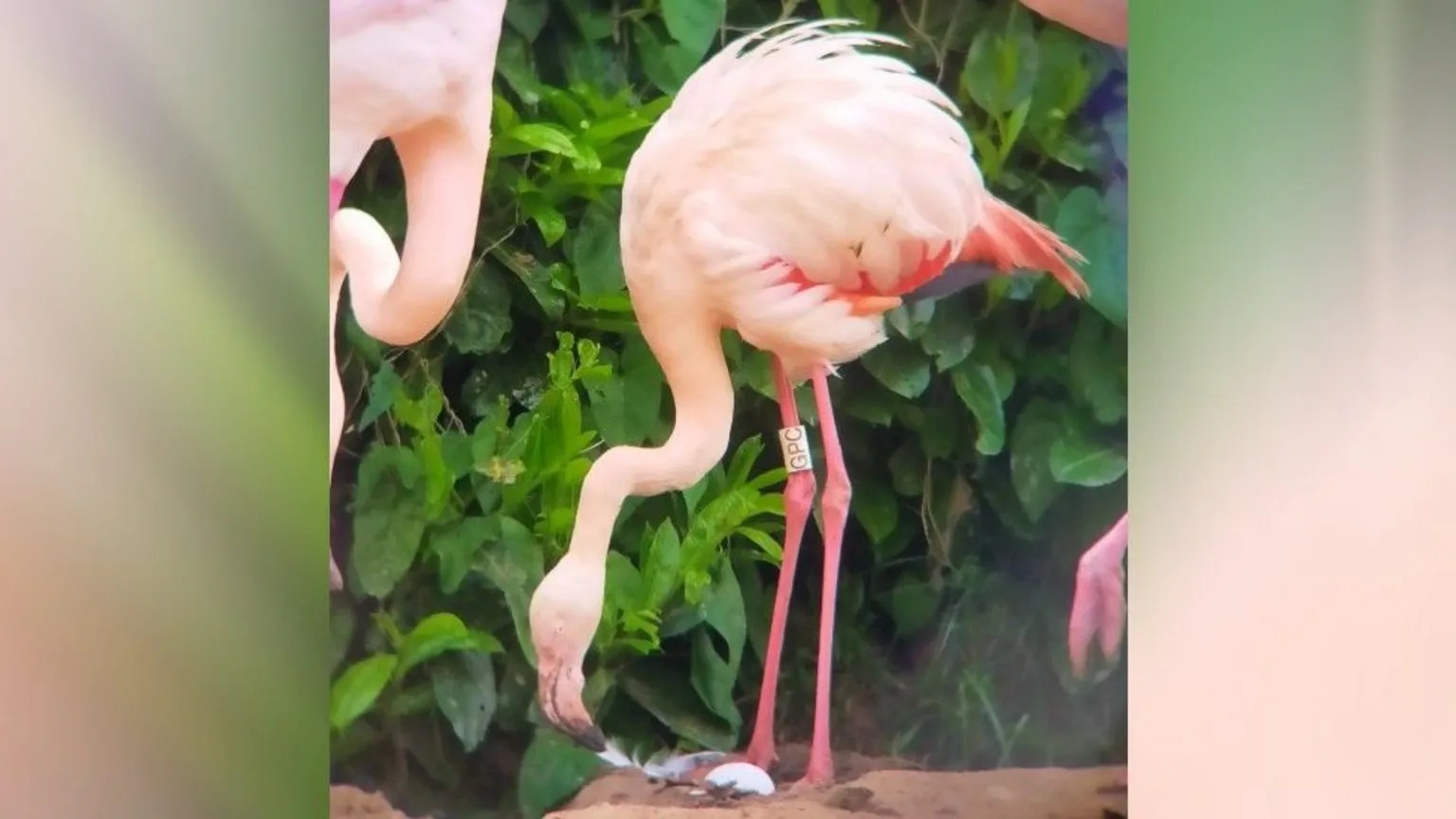
Photo: Claudia Gooch, avicultural warden, Pensthorpe.
Gertrude the flamingo produced her very first egg at age 70.

The miracle baby of a 70-year-old flamingo make me tired just thinking about it.

Cathy Free writes at the Washington Post about Gertrude the flamingo and the surprise she gave the staff at her nature preserve.

“When the greater flamingo reached age 70 last year, it was a safe conclusion that she would spend the rest of her life as a grand-auntie among a flamboyance of 63 other flamingos at the Pensthorpe nature reserve in Norfolk, England.

“ ‘The average flamingo lives for 30 to 40 years in the wild, so Gertrude is quite unique,’ said Ben Marshall, manager of the reserve. ‘She’d just been unlucky in love and had never found a boyfriend.’

“That changed last month to the surprise of Marshall and other bird keepers at Pensthorpe.

“In late April, they noticed that Gertrude — normally shy and not one to cause a kerfuffle in her flock — was suddenly flirting with Gil, 37, a male flamingo about half her age.

” ‘She and Gil were giving each other wing salutes, bowing to each other, and displaying some of the other 136 different courtship and mating dances that flamingos have,’ said Marshall, 31. …

“The next surprise came in early May, when one of the flamingo keepers noticed that Gertrude had made a volcano-shaped nest out of mud and was sitting on an egg — the first one she had ever laid, according to caretakers at Gertrude’s previous bird refuge who advised the Pensthorpe staff, Marshall said.

“ ‘Our entire team was amazed — Gertrude and her egg were the talk of the reserve,’ he said. …

“The greater flamingo can start breeding at about age 5 and does not breed more than once a year. A male and female will bond for mating, then split up after breeding season. …

“It takes 26 to 31 days for an egg to hatch, and Gertrude dutifully sat on her egg for about 10 days, taking breaks only to get food and water. But in mid-May, the septuagenarian bird abandoned her egg, probably because it wasn’t viable, Marshall said.

“ ‘It could also be that at her advanced age, she decided it was just too much for her,’ he said. ‘Although it was a little sad for us, knowing the egg wouldn’t hatch, it was still a remarkable win for Gertrude,’ Marshall added. ‘She made the call herself not to incubate the egg, and she was able to simulate those maternal instincts ingrained in flamingos and experience something completely new.’ …

“It is unusual for a flamingo to have longevity like Gertrude’s, but it isn’t unheard of. Betty, a matriarch flamingo at the National Zoo, was 67 when she died in 2022, and a flamingo named Greater died at age 83 in 2014 at an Australian zoo. She still holds the record as the world’s oldest flamingo.

“Marshall said he wouldn’t be surprised if Gertrude were to break that record someday. ‘She’s quite sprightly and healthy, and she’s very friendly with the other flamingos,’ he said, noting that Gertrude is back to hanging out with younger females while they sit on their nests. …

“The birds are all greater flamingos — among the most widespread varieties of the species, with about 680,000 living in the wild in Africa, India, the Mediterranean and the Middle East, according to World Population Review.

“ ‘We have about 20 eggs at the moment, and one of them hatched a few days ago,’ Marshall said. ‘Every egg isn’t always viable, but we’re hopeful.’

“Even though Gertrude won’t have the experience of hatching her own egg, she will fill in as a protective babysitter for the other hatchlings — something she has done every year for decades, he said.

“ ‘She leads a laid-back life, but she still takes a turn teaching the chicks how to get food and other key skills,’ Marshall said. ‘She always works with the other flamingos for the good of the group.’ ”

More at the Post, here.

Read Full Post »

Photo: Tom Waddington via Times Now.
Tom Waddington was surrounded by pilot whales as he rowed solo from Newfoundland to England.

I’ve been on a couple whale watches with family members, and I think there are few things more exciting than seeing whales in their natural environment. In today’s story, a man who sought excitement by rowing from Newfoundland to England may have gotten a little too much from some curious pilot whales.

Bill Chappell reports at NPR, “Tom Waddington is on a quest to row across the Atlantic Ocean all by himself — but [in July], he found plenty of company at sea, when a pod of pilot whales thronged around him. They followed him for hours, growing from a few playful animals to hundreds of large creatures. …

“The whales popped their heads above the surface and seemed to play together — a gam of whales, gadding about — as Waddington, who is rowing some 2,000 nautical miles from the Newfoundland coast to Penzance, in the United Kingdom, watched in amazement.

“ ‘This is so cool,’ Waddington said as he took a video of the whales’ antics. With a laugh, he added, ‘I love it, but I’m scared they’re gonna hit my rudder.’

“Waddington emerged unscathed — but a little shaken by the risks mammals weighing thousands of pounds can pose to his boat and equipment on an unsupported solo trip.

“ ‘They were just playing and going under the boat and I was taking videos,’ he said on Facebook and Instagram, describing hundreds of whales around him. Then one of the whales slammed into the side of his light boat.

“ ‘And I was like, Oh my God. And suddenly it turned from David Attenborough into Moby Dick. And I was really scared.’

“Waddington’s team on land believes the playful mammals are long-finned pilot whales, which the National Oceanic and Atmospheric Administration says are known to live in the North Atlantic and ‘are very social, living in large schools of hundreds of animals separated into close-knit pods of 10 to 20 individuals.’ …

“When it came time to take leave of his visitors, Waddington says he wasn’t sure how to do that. He tried shouting a bit, and splashed his oars. He veered north — but the whales followed, and for more than two hours, it seemed more whales kept showing up.

“Waddington, who works as a ski instructor, is rowing across the ocean for a fundraiser benefiting Mind, the British mental health charity led by the actor Stephen Fry. Waddington estimates that more than 1,000 whales swam with him. For advice, he called his coach, Charlie Pitcher (who has himself rowed across the Atlantic).

“ ‘He was like, the best thing to do is, be quiet and still — which is exactly the opposite of what I did’ earlier, he said.”

Check out the map of Waddington’s transatlantic journey at NPR, here.

Read Full Post »

Photo: Popi Sibiya.
Blogger Popi Sibiya didn’t see herself in any travel writing about Africa and decided to write from a female traveler’s point of view. Here she is in Matadi, Congo.

We all know that a lot of things in our world have historically been male-oriented. Medical research, for example. As women step up to correct imbalances, that sort of bias is being corrected. Today we learn about online travel influencers who are providing a fuller picture of where and how to travel. Safety is one thing that might be more of an issue for women.

Ayen Deng Bior reports from Senegal for the Christian Science Monitor, “Last year, South African travel blogger Popi Sibiya found herself cruising the canals of Ganvié, a village on stilts in the middle of a lake in Benin. As she sat in the back of a wooden canoe, she pulled out her smartphone and began broadcasting the experience to her 40,000 Instagram followers. …

“Ms. Sibiya is a former kindergarten teacher who has spent much of the last two years crisscrossing the African continent on public transportation – and now has over 100,000 followers. She is part of an emerging group of young African women travel bloggers who are using their social media platforms to redefine what adventure travel looks like in Africa – and who gets to experience it. They are pushing back on the stereotype that travel on the continent is the exclusive domain of khaki-clad Europeans on safari or sunburned Americans sipping cocktails on Zanzibari beaches – and inviting their mostly African audiences to do the same. 

“African travelers ‘are starting to prioritize fun and adventure’ on their own continent, says Ms. Sibiya, whose followers are mostly well-off South Africans used to traveling to Europe, the Middle East, and Asia for their vacations. On her account, ‘they see that we also have beautiful beaches; we don’t have to go to Thailand,’ she says.

“Each year, African countries clock more than 80 million visitors, and the industry generates about 25 million jobs, according to the World Travel & Tourism Council, an industry advocacy group. 

“Still, African countries are rarely featured on global ‘where to visit’ lists – at least outside stock-standard international favorites like Morocco, Mauritius, South Africa, and Egypt. 

“Ordinary travelers with large social media followings are filling that void, says American travel journalist Rosalind Cummings-Yeates, who has traveled extensively in the region and often uses travel influencers to help plan her trip. 

“ ‘We don’t have to rely on traditional media [anymore],’ she says. Instead, would-be travelers can scroll the feeds of influencers like Ebaide Joy, Instagram alias @go_ebaide, a Nigerian adventure traveler currently riding her motorcycle from Nigeria to Kenya. Or like Ess Opiyo (@ess_opiyo), a Kenyan travel guide with a passion for offbeat destinations. …

“Margot Mendes has seen firsthand the power of social media to transform how people travel in the region. She lives in Dakar, Senegal, where she works in marketing. She puts the same skills to use on her Instagram account, @thedakardream, where she shares her life and travels with her 33,000 followers. 

“Her grid features scenes from bustling open-air markets, peach-colored sunsets overlooking cerulean hotel pools, and glimpses of local cuisine including baguette sandwiches and spiced rice dishes. 

“Ms. Mendes started the account five years ago, when she moved back to Dakar from Paris, where her Senegalese and Bissau-Guinean family had migrated when she was a child. Originally, the page was just to show her worried friends and family in Europe how much Dakar had transformed in the decades since they emigrated. 

“ ‘It was just me being curious about my culture and going to places to discover my own culture,’ she says. 

“But soon her page began to gain an audience beyond people she knew. She says her new followers – most of them African – told her they loved seeing their own continent branded as a glamorous travel destination for the first time. 

“Ms. Mendes’ account has the feel of a glossy travel magazine, but for many young African women documenting their travels, it is important not to shy away from the continent’s struggles – or the challenges that make travel there tricky to navigate. 

“Recently, for instance, Nigerian British travel blogger Pelumi Nubi completed a 10-week road trip from London to Lagos. … Ms. Nubi documented the journey for more than a quarter million people on her Instagram account, @pelumi.nubi. Her posts bounced between travel highs – like when Lumi the Peugeot’s wheels touched African soil for the first time in Morocco – and lows – a video of Lumi’s crumpled hood after she slammed into a parked car on a dark road in Ivory Coast. 

“ ‘You have the people who are trying to paint [Africa] as a war-torn place, a dangerous place, and then you have the people who are trying too hard to sell it as this paradise,’ says Ms. Sibiya, whose page cheerfully records her travels in rickety buses she describes as ‘hearses’ and doesn’t shy away from her brushes with poverty, bad roads, and chaotic border crossings. …

“Ms. Sibiya says her audience is mainly other South Africans, many of whom tell her they are experiencing the continent’s beaches, safaris, fancy hotels, and restaurants for the first time through her account. For many, the issue is partly cost. Counterintuitively, flights between African countries are often more expensive than flights from the continent to international travel hubs like Dubai in the United Arab Emirates or New York. And instead of high speed trains or rental cars, overland travelers often have to choose between taking rundown public transport or paying up for a private car and driver. 

“Ms. Sibiya funds her travels through paid subscriptions to her Instagram account, which cost 140 rand (about $7) a month and give access to more detailed and frequent travel updates than her public page. Currently, she has around 1,200 subscribers.”

More at the Monitor, here. No firewall. Subscriptions are reasonable.

Read Full Post »

Photo: Melanie Stetson Freeman/CSM Staff.
Folk musician Jake Xerxes Fussell performs at Club Passim, one of his favorite venues, in Cambridge, Massachusetts.

My son has a goofy impression of who I was in the 1960s. He describes some kind of hippy personality, which I never had. I was more of a folkie — in the sense that I loved folk music and followed that crowd, went to those concerts.

I don’t think folk music has been cool with young people for many years, but I was interested to read at the Christian Science Monitor about one young musician who is keeping it alive and moving it forward. Simon Montlake has the story.

“In the summer of 1993, Fred Fussell, a folklorist and museum curator in Columbus, Georgia, packed his family van for a monthlong road trip to document the crafts and traditions of Native American tribes. He brought along his son, Jake, who had just finished fourth grade and was riding shotgun, where he kept a daily tally of roadkill.

“That summer, the Fussells visited artisans from Native communities in Oklahoma, Texas, and Louisiana, those whose forebears had been expelled from the Southeast in the 1800s but kept alive their spiritual ties to the land. Jake took charge of a Sony tape recorder. He taped his father’s interviews, learning to ‘sit back and shut up’ while people talked, which ‘is the key to good documentation,’ says the elder Mr. Fussell.

“His young son also recorded performances, which included music. … Jake liked vernacular arts and crafts, and he showed an early talent for drawing. But what lit his fire were the songs he heard at folk festivals his father put on in Georgia, songs that had been passed down from generation to generation and performed like the oral traditions of Homeric verse. …

“ ‘I always knew I would play music because music was the thing that was a constant source of joy,’ the younger Mr. Fussell says today.

“His family’s circle of friends included musicians, from blues singers to bluegrass pickers, and veteran collectors of traditional songs who never stopped looking for more. … From this unusual upbringing, Jake Xerxes Fussell has emerged as one of the most singular interpreters of folk music and all its tributaries. …

“ ‘He’s a real-deal folk singer. And there’re not very many of those,’ says Eli Smith, organizer of the Brooklyn Folk Festival. …

“From spirituals and jigs to fiddle tunes and sea chanteys, folk music is part of America’s cultural bedrock. It has long braided commercial music – from the folk revivalists of the 1950s and 1960s, who include Pete Seeger and Bob Dylan. …

“Some traditional songs arrived with the European migrants who brought their fiddles and hymnbooks to Appalachia and other regions. Others sprang from the Black experience of enslavement and freedom. …

“Mr. Fussell draws on that inheritance to create music that sounds both contemporary and timeless. His creative process carries him down rabbit holes of archival research and experimentation with musical motifs, even while tinkering on his guitar at home or on tour.

“He adds melodies when none exist and transposes verses, acting as both a caretaker and a remodeler of songs. …

“He started as a toddler on pots and pans, banging out rhythms at home. Then he got a drum kit and was ‘immediately good,’ says Coulter Fussell, his older sister. … From drums, Mr. Fussell moved to the upright bass, which he learned at school from a teacher who played in a bluegrass band. When he was 13 years old, his teacher asked him to take over as the bassist at a weekly gig at a barbecue restaurant.

“ ‘Everybody went there on a Friday night,’ says Ms. Fussell, who is now a quilter in Water Valley, Mississippi. ‘The band would play, and it was these scruffy grown men and then little Jake up there.’ …

“He was also listening to rock and hip-hop on the radio and going to shows, including of Georgia’s R.E.M., whose lead singer, Michael Stipe, had studied drawing with Mr. Rosenbaum at the University of Georgia. But rock bands lacked the raw passion and poetry of the traditional songs he heard growing up. ‘None of that stuff really spoke to me in any real deep way,’ he says. 

“Mr. Fussell also fell hard for the music of Mr. Dylan, whom Mr. Rosenbaum had known in Greenwich Village in the early 1960s. But it was another local musician and family friend, Precious Bryant, who would influence Mr. Fussell’s rhythmic guitar picking and give him a taste of life on the road.

“Since Ms. Bryant, a country-blues artist, didn’t drive, it was Mr. Fussell’s mother, Cathy, who would drive her to shows. Her eager son began to take that role once he got a driver’s license. He would also visit Ms. Bryant at her rural trailer home, bringing along his guitar. ‘She would play, and I would play along,’ Mr. Fussell says. 

“ ‘Jake always liked older people. He liked listening to older people. He liked hanging around with older people,’ says his mother, a retired English teacher and quilter.”

Lots more at the Monitor, here. No paywall. Tiny Dest Concert at YouTube here.

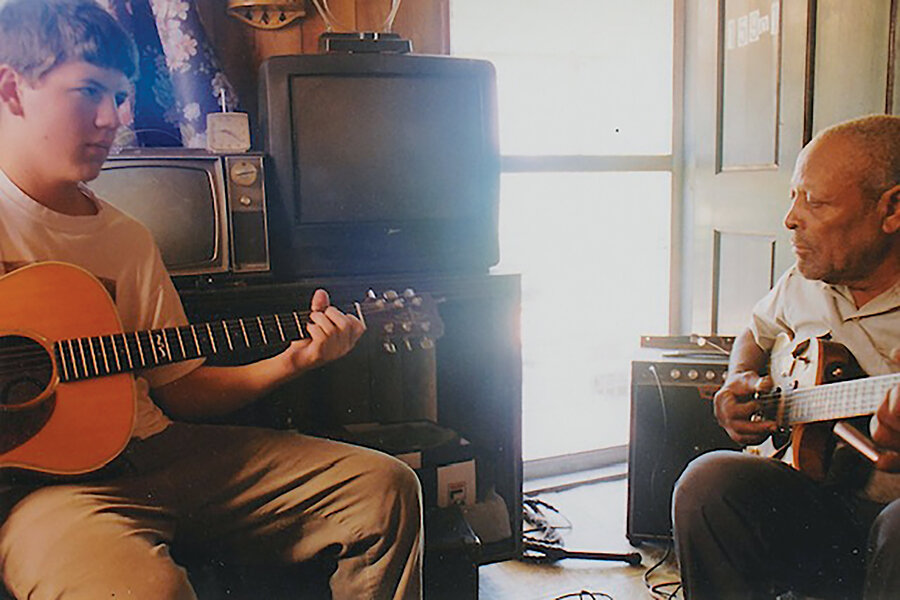
Photo: Jake Xerxes Fussell
As a youngster, Jake Xerxes Fussell soaked up the wisdom of older generations. Here he is jamming with George Daniel, a blues musician, in Macon County, Alabama, around 1996.

Read Full Post »

Photo: Magnolia Pictures/AP.
Actor June Squibb with Richard Roundtree in the movie Thelma. 

I’ve been wanting to see this movie since I first read about it, but I have trouble accessing movies these days. Some get shown on the tv network in our retirement community, but we may not get this one for a while as it’s not available yet.

What’s cool about Thelma is that the lead actor is 94 and also that she has glowing reviews.

Fiona Sturges writes at the Guardian, “There’s a new action hero in town. In Josh Margolin’s wildly entertaining Thelma, an elderly widow is duped out of $10,000 by a scammer masquerading as her grandson. Realizing her error, she resolves to track him down, retrieve her cash and dispense some rough justice.

If summer blockbusters are about the action, then Thelma has it all: guns, explosions and mobility scooter-based stunts.

“When the 94-year-old actor June Squibb read the script, with its mischievous nods to Mission: Impossible, she knew she had to do it. She also knew she would do lots of the stunts herself. ‘I have more security in my physicality than a lot of people do, and I thought riding around on that scooter was going to be great fun,’ she beams. …

“She says she is in excellent health, even though, ‘I should be doing pilates more than I am, because I’ve had such a crazy schedule. I was doing it for one hour a week with a trainer, and it makes a huge difference. I’m in good shape.’

“Extraordinarily, Thelma is Squibb’s first ever starring role. Until now, she has been viewed as a character actor, someone you’re more likely to know by face (or by voice: she is Nostalgia in Inside Out 2) than by name. She has spent decades quietly propping up lead actors playing their wives, mothers and grandmothers in films such as Scent of a WomanAbout Schmidt and Palm Springs. 

“While Thelma is primarily a comedy, it is underpinned by a more serious theme: the way society treats its elderly. We see Thelma’s well-meaning family talking about her when she’s still in the room and pondering whether to move her into a home. … But she is happy to report that, in her 10th decade, she has had nothing but love and respect from her family and has retained her independence. She lives in an apartment complex in the San Fernando Valley. … ‘And I have a wonderful assistant without whom I couldn’t keep working,’ Squibb says. ‘I have two cats and I make sure that, first thing in the morning, they’re taken care of. And then I have most of the day to myself if I’m not filming. I have no trouble getting around, though I do get tired. Tiredness is real when you get to my age.’

“Yet Squibb has rarely been in such demand. She credits her increased workload to a ‘greater interest in the aging process. There’s more work for people my age than ever before. … When I was a young, good-looking actor in New York, I was constantly aware that people looked at me as an object.’ She and her contemporaries had their coping mechanisms, ‘but I got mad too. When #MeToo happened, all of us in our 80s were amazed. We were, like, “Oh my God, we’ve lived this our whole lives.” ‘ …

“Squibb learned her craft in the 1950s at the Cleveland Play House, where she met Jack Lee, who went on to become a leading musical director on Broadway. ‘He decided I had to sing. So, I began singing and I did all the comedienne roles in all the musicals. … My first 20 years in New York were all musicals.’ Then came a gear-change after she met her second husband, Charles Kataksakis, an acting coach. Kataksakis thought she had it in her to play more serious roles (he and Squibb were together for 40 years until his death in 1999). …

“Squibb was 61 when she made the move from stage to screen. … ‘I went to my agent and said, “I think I should be doing this too.” The next week I was auditioning for Woody Allen.’ That film was Alice, a romcom starring Mia Farrow in which Squibb played a maid. The casting director, Ellen Lewis, took an instant shine to Squibb and set her up for a meeting with Martin Brest, who cast her in his new Al Pacino vehicle, Scent of a Woman. …

“After that came roles in TV shows . … [Alexander] Payne brought her on board for 2013’s Nebraska, in which she played the abrasive and unfiltered Kate, wife of Bruce Dern’s delusional Woody. The role earned her an Oscar nomination for best supporting actress. …

“Squibb just wrapped another film, playing the lead in Eleanor the Great, about a 90-year-old who moves back to New York after decades in Florida. It is the directorial debut of Scarlett Johansson, who Squibb describes as ‘so bright, so smart.’ Being No 1 on the call sheet, she says, means ‘going into it with a feeling of responsibility that you don’t have with a supporting role. I always felt what I did was important. But as the lead you’re kind of responsible for the whole film.’ ”

More at the Guardian, here. Have you seen this movie yet? (Looking at Laurie, who seems to see everything.)

Read Full Post »

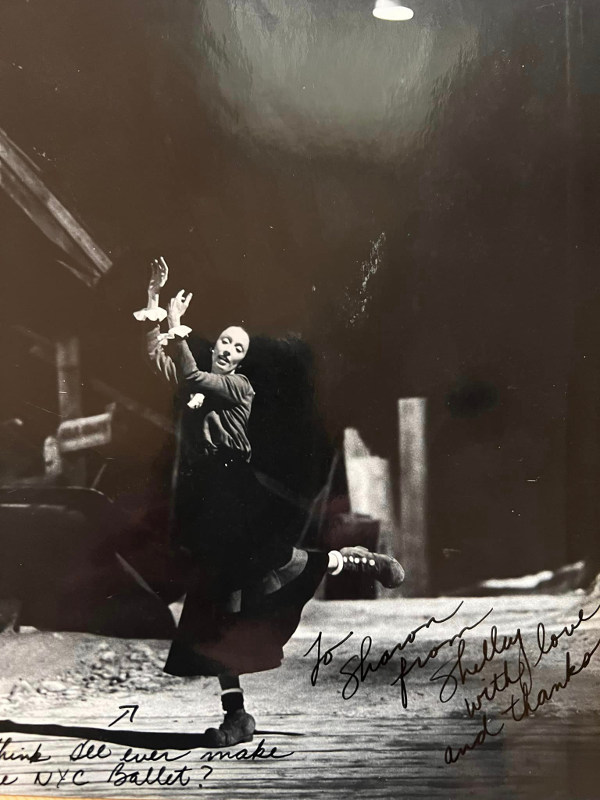
Photo: Sharon Kinney via ArtsMeme.
The recently deceased actress Shelley Duvall dancing as Olive Oyl in director Robert Altman’s Popeye (1980). 

One of the films that the late, versatile actor Shelley Duvall was best known for was her wistful interpretation of a cartoon character — Popeye’s girlfriend Olive Oyl.

Website ArtsMeme says, “Duvall (1949-2024), who recently passed away, led a long and memorable career primarily as a character actress, but in this case she played a full leading role countering Robin Williams as Popeye. …

Sharon Kinney … the creator/choreographer/coach of Shelley’s special dance, tells us that Duvall did her own singing in the number. She was not dubbed, which would be common in this circumstance.

“The dance world reveres Sharon for having been one of choreographer Paul Taylor‘s original dancers in his iconic dance company. But since retiring from performance, she has led a fruitful career as an instructor at Cal State Long Beach, as a filmmaker and indeed as a dance-film choreographer/coach living in Los Angeles. Sharon shared with Facebook friends her memories of working with the lanky Ms. Duvall in staging a solo song ‘He Needs Me,’ in the Altman film.

“Sharon reminisced, ‘She was so professional, so invested and really wanted to personify Olive Oyl and her love for Popeye! She did great things before with Altman and had just finished The Shining with Stanley Kubrick! She then went on to do some other great work with Faierie Tale theater!’

“Shelley Duvall’s inscription to Sharon Kinney on the glossy photo [above] is good natured. ‘Think I’ll ever make New York City Ballet?’ she mused. Dance ‘people’ will recognize the innate beauty of her pose that is rooted in the cartoon version of OO as gangly. Even in her clodhopper shoes, this Olive Oyl is luscious.” Check out YouTube videos of Duvall singing “He Needs Me” and “He’s Large,” in which she’s defending an early attachment to the character Bluto.

In a comprehensive reminiscence after her death, Owen Gleiberman at Variety notes, “In Robert Altman’s Popeye, an early visionary/cracked comic-book musical. With goldfish eyes, pursed lips, and a Victorian knot of hair set off by her dainty clenched-fist pose of adoration, Duvall gave a performance as Olive Oyl that was so perfect it was almost a joke.

“As an actor, Duvall could seem naturally stylized, which made Olive a role she was born to play. Yet within all that, she found a reservoir of heart. The highlight of Popeye might be Duvall’s performance of ‘He’s Large,’ in which Olive explains her devotion to the oversize Bluto with a girlish defiance that’s indelible.

“And indelible, make no mistake, was the word for Shelley Duvall. She imprinted her presence upon you; once you’d seen her, you couldn’t forget her. It was Altman who first had that reaction. In 1970, a few months after MASH came out and made Altman the hottest director in Hollywood (a status that wouldn’t last long — he was far too independent an artist), he was shooting his next feature in Houston, a fantasy comedy called Brewster McCloud, when he met Duvall at a party and, encouraged by a handful of crew members, decided to cast her in the movie.

“She’d had no experience as an actor. What they were all reacting to was what you can only call Duvall’s being — the eyes that were like something out of anime, her rabbity two front teeth, and a quality that could make you laugh or break your heart: the softness of her gaze, the tender passive radiance with which she looked out at the world.”

More at ArtsMeme, here, amd at Variety, here.

Read Full Post »

Photo: SoBar Comedy.
SoBar Comedy worked in collaboration with Dray Drinks, Boston’s first non-alcoholic bottle shop to assemble its lineup of non-alcoholic beers, wines and mocktails.

We’ve featured articles about watering holes that ban cellphones (here, for instance) so people can socialize without distractions. Turns out, there are also people who hate all the alcohol that flows at comedy clubs, people who would really like to enjoy the comedy. Enter, Boston’s SoBar.

WBUR Radio’s Elijah Nicholson-Messmer reports, “When John Tobin started working as a door person at a local comedy club in the early ‘90s, his boss asked him how he liked the work.

“ ‘I love being in the comedy business,’ Tobin said.

“But his boss Dick Doherty, a legend in the city’s comedy scene who drank and drugged his way through the ‘60s, ‘70s, and early ‘80s, was quick to correct him.

” ‘You’re not in the comedy business,’ Tobin recalled Doherty saying. ‘You’re in the alcohol business.’

“Over three decades later, that business has started to change. Younger adults are drinking less than they did 10 or 20 years ago and show producers like Tobin and his business partner Norm Laviolette are taking notice.

[In June] they launched SoBar Comedy, the country’s first sober-curious comedy club [to host] bi-weekly improv and stand-up shows, located in Faneuil Hall.

“Tobin and Laviolette own and operate some of the biggest comedy clubs across New England, including Laugh Boston and Improv Asylum. Laviolette said they started noticing the trend at their other comedy clubs, where food and beverage sales form a cornerstone of the business model. The pattern soon became clear — younger audience members were increasingly forgoing beers and cocktails when going out.

“ ‘As we started to watch we’re like, “Well, geez, maybe there’s an opportunity . . . to do something that speaks directly to that mindful drinking, sober-curious [mindset],” ‘ Laviolette said. …

“On opening night at SoBar, some folks were excited to sample the non-alcoholic beers and mocktails on offer, crafted in collaboration with Dray Drinks, Boston’s first non-alcoholic bottle shop. …

“Performing comedy for an all-sober audience is a daunting task for some comedians, but for Corey Manning, who headlined and hosted SoBar’s inaugural show, having an alcohol-free night of comedy comes with plenty of upside.

“ ‘One of the things that’s different about a sober show than the regular comedy show is that I didn’t have to deal with a drunk audience member, which is always a good thing not to have to do,’ Manning said.

“This December, Manning will celebrate 30 years of sobriety from drugs and alcohol. Now, he helps others as a substance misuse counselor. But in the early years of his sobriety, performing in comedy clubs across the country made that journey challenging. …

“Crowds and performers expect alcohol at comedy clubs like they expect popcorn at a movie theater, Manning said. But for audiences and comedians who want a fun night out without the drinking, that relationship can be far from ideal. Over the years, Manning’s sobriety has helped other comedians as well.

“ ‘Because I have been consistently the person that didn’t drink at comedy shows, it actually has inspired other comedians who are having difficulties with drinking and stuff like that to not drink,’ Manning said. ‘And one of the things that I also started trying to do is work that material into my set, because sometimes I hit home with someone in the audience.’

“Other comedians like Mary Spadaro, who performed at SoBar’s opening night, make an asset of their sobriety, flipping what could easily be a heavy subject into fresh comedy material.

“Decades after Tobin got his start as a comedy club door person, his old boss’s words still ring true for much of the industry today. Many comedy clubs across the country are still very much in the alcohol business. But for Tobin and Laviolette, it’s all about putting the comedy first.”

Uh-oh. I found that the club is on hold until “early 2025.” I hope it succeeds long term. With two successful clubs under their belts, I think the owners know what they’re doing. Maybe summer was just not the best time to launch in Boston. Do you think a sober comedy club could thrive where you live?

More at WBUR, here.

Read Full Post »

« Newer Posts - Older Posts »