This is your Small Business Saturday reminder that Suzanne’s jewelry company, which hosts this blog, has a 20%-off sale until late Sunday Eastern Standard Time.
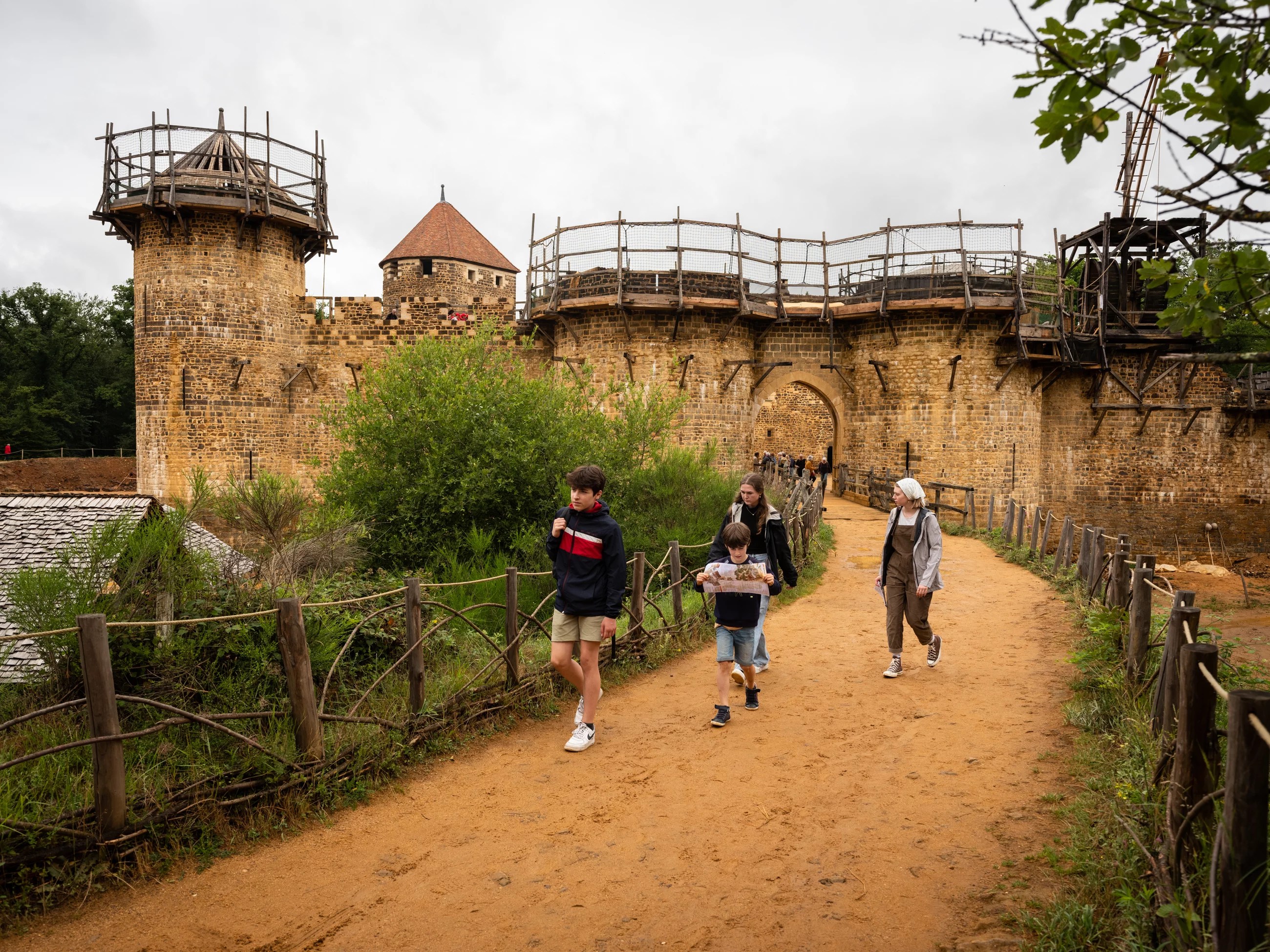
Photo: Cristina Baussan for NPR. Visitors walk near the construction of Guédelon Castle, dreamed up as an exercise in “experimental archaeology” 25 years ago.
The Plimoth Patuxet Museums in Massachusetts used to be called Plimouth Plantation, and at Thanksgiving lucky visitors got to share in whatever version of the First Thanksgiving was in vogue at the time. Today the history involves the indigenous people in a much more balanced way. But a visit to the site is still a step into another century, a century without cellphones.
Not unlike a visit to a certain castle in France.
Eleanor Beardsley reports at National Public Radio, “Deep in a forest of France’s Burgundy region, a group of enthusiasts is building a medieval castle the old-fashioned way — that is, with tools and methods from the late 13th century.
“Some of those working here are heritage trade craftspeople, others are ardent history buffs, but all say they share a deep respect for nature and the planet, and a desire to return to simpler times.
” ‘This is a place you experience with all your senses,’ says Sarah Preston, communications director and guide of these grounds known as Guédelon Castle. ‘As soon as we walk onto the site you smell the woodsmoke. There’s something so evocative about these sights and sounds.’ …
“Once beyond the entrance barn doors, visitors plunge into a bygone age. There are no mechanical sounds, no motor engines — and cellphones must be turned off. The idea to build Guédelon was born in 1995 among three friends, residents of the area, who are also history buffs and nature lovers. One of the three owned a nearby 17th century château and was involved in work to restore different castles in the area.
” ‘But we thought, how amazing would it be to actually build a castle from scratch?’ Maryline Martin, CEO and a co-founder of Guédelon, told public radio station France Culture last year.
“After finding and purchasing the original 27 acres of land in a forest near a centuries-old abandoned quarry and water (necessary ingredients for any medieval construction site), the co-founders got a construction permit and, in 1997, laid the first stones. …
“Martin said Guédelon is an example of experimental archaeology — which is a way to research how people did things in the past by trying to imitate them. … The builders use the examples of other medieval castles in the area, as well as descriptions in old manuscripts and books.
“The workers are all dressed in medieval clothing, except for sturdy contemporary footwear and sometimes helmets mandated for a modern construction site. The smell of fire and a clanking sound are coming from a nearby blacksmith’s shop. That’s where 20-year-old Matisse Lacroix is forging the tools needed to build the castle. Sparks fly as he pulls a cord that operates a large bellows.
“Lacroix says the furnace temperature is around 2,000 degrees Fahrenheit, ‘so the iron is soft and malleable and I can make these nails.’ He bends and shapes pieces of iron into nails. …
“During NPR’s visit, a group of fourth-graders are at the site. They watch Lacroix pound the glowing red rods. The craftsmen stop their work to explain what they’re doing to visitors as well as train young craftsmen in heritage skills. …
“That learning aspect of Guédelon is one reason its construction is taking so long. The owners say the project is meant to discover and pass along skills and knowledge from a 13th century work site. Workers stop their tasks several times a day to answer questions from visitors — as part of the job. There are six turrets completed as well as a protective wall and inner living castle with a chapel. …
“Preston said they initially financed their work through donations and some European Union funding. Now the château is financed through more than 300,000 visitors a year (paying between 12 and 15 euros each). …
“There are all kinds of projects to recreate the kind of village that would have existed beside a castle like this 800 years ago. A garden grows plants indigenous to the area in the Middle Ages.
” ‘We grow only medieval plants,’ says Antoine Quellen, who works in the garden two days a week. ‘So that means we don’t have tomatoes, we don’t have potatoes, because those came from South America much later.’ He says people ate a lot of grains back then. The indigenous plants are hardier and help preserve the land and soil, as they have a kind of genetic memory of place in their germ cells, he says. …
“Half a dozen stone masons work near the quarry. Tendra Schrauwen, a 29-year-old from Belgium, says Guédelon is one of the few places in the world you can practice this craft using traditional methods and old tools.
” ‘Our job is to cut stones in perfect geometrical shapes,’ he says. ‘For window, doors, chimneys, staircases, stone by stone.’ He says it’s all about teamwork. ‘The stones are very heavy. It’s very dangerous, you can damage your body. So the most important thing is to work in a team.’ …
“To lift the tons of wood and stone needed to finish the castle’s outer walls, two men walk inside a contraption that looks much like a giant hamster wheel. It’s a kind of medieval crane with a central axle and ropes. Known as a treadmill crane, it can pivot and raise or lower materials, depending on which way the workers walk inside it. The only modern addition at Guédelon is a safety brake.”
Photo: Jorge Gardner via Unsplash. Street art in Bogotá, Columbia.
We who have so much reason to be thankful at Thanksgiving can spare a thought today for those who have little — and are grateful for that little. An experiment in Bogotá is offering hope to some of the poorest women in Columbia.
In an opinion piece at the Washington Post, Bina Venkataraman writes, “One day in the distant future, caregiving could be as celebrated as carrying a football into an end zone. Rather than toil in the shadows, people who juggle children and aging parents might be applauded for their skills — or stopped on the street by admirers. Family caregivers could get paid for the hours they put in minding the young, the sick, the disabled and the old. Men would be as proud as women to care for their children. Governments would fund more services to relieve at-home caregiving, recognizing its physical and psychological toll. …
“For now, consider a small experiment hatched in Ciudad Bolívar, the second-poorest district of Colombia’s capital city, where settlements of makeshift houses sprawl up a steep mountainside, emblazoned with colorful street murals. This district has long been a hotbed of political resistance, home to diverse Indigenous peoples as well as Venezuelan refugees. …
“Since 2020, it has become the site of Bogotá’s first manzana delcuidado, or ‘care block,’ in a city where caregivers — mostly women, mostly poor — ordinarily labor in obscurity without compensation or formal recognition. More than 30 percent of Bogotá’s female population, some 1.2 million women, provide unpaid care full time, some for as much as 10 hours a day.
“Most lack formal education beyond some years of high school, and the city estimates that 1 of every 5 of these women has a diagnosed illness, ranging from arthritis from long hours spent hand-washing clothes to sexually transmitted diseases and untreated cancers. And many of them, says Nathalia Poveda, who manages the Manitas care block in Ciudad Bolívar, don’t recognize that when their husbands hit them, it is domestic abuse.
“A care block is a modest attempt to shift the way caregivers are viewed and supported, and the way they view themselves. It’s a community-scale solution — something that’s needed if poor women are to benefit from global progress in gender equality.
“In Ciudad Bolívar, women can drop off dirty clothes and bedding each week to a city-funded laundromat. Demand is so high in the district, and given only four washing machines and dryers, the women have to rotate out of using the program every three months.
“A community center offers free courses to help women earn high school diplomas and practice yoga while city employees mind the children, elderly or people with disabilities in their care. Caregivers and their spouses can learn to use a computer or cellphone and get STD testing, psychological counseling and legal aid — all under one roof. In the same building, a child can get a strep test and his mom can get a Pap smear, rather than having to shuffle to clinics around the city.
‘It gives me a breath, a break,’ said Lisbeth Diaz.
“This isn’t rocket science, but it is innovation. ‘We need to care for the people who care for us,’ says Diana Rodríguez Franco, Bogotá’s secretary for women’s affairs, who came up with the idea. The city now has 20 care blocks, as well as a program to send relief caregivers directly to people’s homes. The city funds the program with an annual budget of $800,000, and it has attracted grants from global organizations for pilot projects such as caregiving classes for men.
“I spoke with several women using services at various care blocks in the city. ‘It gives me a breath, a break,’ said Lisbeth Diaz, who was taking a class that would certify her skills as a caregiver at the Manitas care block in Ciudad Bolívar. The idea behind certification, said Poveda, is to help women recognize that the work they do in the home is valuable.
“ ‘You have to take care of yourself to take care of everyone else,’ said Sandra Quevedo, who was glad to learn yoga, lifting her chin and chest with pride as she spoke. At a care block within a high-altitude ecological park called Entrenubes, a group of middle-aged women in a program called Las Mujeres Que Reverdecen — ‘the women who regreen’ — giggled and flexed their muscles when I asked what it was like to get paid to learn to plant trees and care for city parks part time. …
“The manzanas are one of several initiatives that Bogotá’s first female and openly gay mayor, Claudia López, has launched to try to shift the balance of power between men and women. … The López government also brought in an all-electric fleet of city buses, called La Rolita, and has been hiring and training women to drive and maintain them.
“ ‘There’s been huge pushback,’ says Rodríguez Franco, noting that the city was sued in 2021 by a man who objected to the care blocks’ focus on women. (La Rolita also inspired a lawsuit.) But Rodríguez Franco is heartened to see some men now coming to the care blocks with their female partners to finish high school or to learn to use computers. …
“International development experts have long argued that, along with fostering social progress, educating girls and women and putting more income in their hands can break cycles of intergenerational poverty and moderate population growth. Helping caregivers finish school and find jobs has been an often overlooked but critical piece of this puzzle.
“In recent decades, Colombia has made strides toward recognizing the rights of women — especially caregivers. In 2010, it became the first country to require that women’s contributions to the care economy be documented. …
“Much change is needed to lift the burden on caregivers worldwide and to give women greater access to education and jobs. As political leaders in rich nations debate policies that can put more women into the halls of power, Bogotá’s efforts are a reminder that the world’s poorest caregivers also need innovative measures — if we are one day to inhabit a world in which the average woman’s economic and political power is equal to that of the average man.”
Photo: Kris Craig/The Providence Journal. Guerrilla Tango on the Van Leeston Pedestrian Bridge over the Providence River in Rhode Island.
Do you love reading about new ways people find to have fun? You don’t always need to spend money for entertainment. Check out what Kris Craig wrote at the Providence Journal.
“In the last rays of a beautiful Sunday in September, Susan Davis of Providence Tango finds an open spot and wheels a small black speaker to a corner railing around a lower deck of the Michael Van Leesten Memorial pedestrian bridge. She starts the music, and with it begins an evening of Guerrilla Tango.
“Everything around the bridge ebbs and flows, with people enjoying the mild late-day weather. And then, like a mist coming off the Providence River, the music rises, a beacon to a small, selective population, drawing tango true believers onto the planks and into the evening.
“This is Milonga, a tango dance party, social dancing that is all about connection and community.
“Davis, who organizes these summer-long monthly events, will tell you this tango is about feeling quiet and sensitive to your partner of the moment and the others around you.
“As dancers accumulate on the decks to the side of the bridge, faces beam. There are a few newcomers and out-of-towners, but these people are not strangers.
All are part of the small New England tango community, moved by digital bulletin boards and word-of-mouth to the Guerrilla Tango.
“On the wooden planks of the bridge, street shoes are swapped for shiny black patent leathers for men and ankle-strapped high heels or stilletos for women. Hints of piano, violin and the accordion-like bandoneon coax the arrivals to finish changing quickly.
“The dancers pair off on the fly with provisional partners and ease into the tempo, and the scene transforms. The smiles of greeting fall away and the couples become one, as if the closeness of torsos and the placement of hands – one near the middle of the back or shoulder, the other gripped lightly with their partner’s – complete a circuit and light a fire in a world unto itself, shared two by two but really by all.
“The impromptu embrace and collective grace of this fluid assembly speak of romance uncoupled, large and free, less amorous than artful. The love is of music and motion. Of life itself. …
“I move from spot to spot, photographing the dancers, making my way around a crowd of spectators on the walkway, and I catch the awe in their appreciative murmurs.
“A pair of teenage girls laugh their way down the terraces of the bridge, placing hands to bodies, mimicking the dancers, and they move into the mix. I too feel the pull to join the magic, but there are no invites for dilettantes. Knowledge of tango is the price of admission, and unaware guests become meteors wreaking havoc in this synchronized universe. Among the group, some dancers may learn from this evening, but it’s not a dance class.
“A series of three mostly traditional tangos ends, and the music shifts to a 30-second Cortina, a completely different style. The dancers seem to awaken from a meditative trance. The short respite affords them a glimpse of the banal world surrounding their own before each seeks yet another partner for the next series. Another chance to get lost in the tango.
More at ProJo, here. Catch it next year, tango lovers!
Photo: Rewilding Europe. By 1627, the massive auroch had been hunted to extinction across its entire range. But strands of its DNA remain alive, and in 2013, Rewilding Europe, together with the Dutch Taurus Foundation, embarked on a program to bring the auroch back to life.
Are you up for another “extinct but still around” story? This one is about the mighty auroch, whose bull form Zeus assumed in one Greek myth. The rewilding folks in Europe are using the auroch’s remaining DNA to bring it back.
Gerry Hadden at PRI’s The World reported recently on the herd being “back-bred” in Spain.
“The auroch — giant, wild cows — date back nearly 10,000 years and once roamed freely across Europe. Until they were hunted to extinction by humans. The last ones died in Poland in 1627, according to Ricardo Almazán, a safari guide in the mountains of Albarracín, Spain, where a herd of modern-day aurochs can be found.
“Today, the wild bovine — called tauros in Spanish — are here once again thanks to the nongovernmental organization Rewilding Spain.
“They are working to ‘rewild’ the auroch — or bring back the animal hunted out of the area to restore the wilds as they were before. …
“Aurochs played a key role in the ecosystem — namely, grazing the largest brush and small trees to keep forests from growing too dense and prone to burning. …
“Reintroducing the auroch to the wild involves crossbreeding cows with the ancient genes of the aurochs, according to Lidia Valverde from Rewilding Spain.
“So, taking the ‘genetic features from different breeds of cows that we know that are descendants of that wild ancient cow’ to create a new breed, she explained. But they’re not introducing an entirely new species — scientists have managed to recover more than 90% of the aurochs’ DNA, she said.
“Rewilding Europe, together with the Dutch Taurus Foundation, began the program to bring back the auroch in 2013. Now, the breeding of aurochs is happening in a selective way in Spain, Portugal, Croatia, Czech Republic, Romania and the Netherlands. And, more than 600 of the animals have been bred since the end of 2017, according to Rewilding Spain.
They are reminiscent of fighting bulls, but up to three times bigger.
“Almazán said these new aurochs look and behave just like their forebears. They are reminiscent of fighting bulls, but up to three times bigger. An auroch may weigh over 2,000 pounds, with horns hovering 7 feet above the ground. They are Europe’s largest herbivore.
“Almazán said their presence in the forest is evident in the fact that a lot of trees have been knocked down — the aurochs walk along and smash them flat and then eat the wood and everything. The cows’ behavior has a larger, ecological benefit, he said. The new clearing has allowed the sun to reach the forest floor for the first time in years, giving other plants the chance to grow and attracting insects, birds and other grazers, like deer.
“Local farmer, Paco Rollola, who works with Almazán to help keep the aurochs from straying too far, said that lightning struck a tree nearby recently, but it didn’t start a fire because there was no undergrowth around the tree. The aurochs had eaten it all, he said. Without them, he said, everything would have burned down.
“Valverde of Rewilding Spain said that the beasts are not only making this forest healthier, but they’re also helping the local economy [by] attracting tourists to an area seldom visited.”
More at the World, here. I am fascinated by rewilding projects, but as for these giant animals, I just hope they don’t bulldoze (to coin a phrase) the wrong trees. Can’t you just imagine a science fiction film in which the program runs amok?
Photo: Met Opera/Karen Almond via National Catholic Register. Ryan McKinny portrays inmate Joseph De Rocher and Joyce DiDonato portrays Sr. Helen Prejean in Jake Heggie’s opera Dead Man Walking.
My new friend Lynn S. is an opera lover. I met her when I was asked to interview someone for the newsletter at our current residence. She told me about attending a breathtaking Met opera broadcast in a local movie theater, Dead Man Walking. You may know the true story of the nun and the death row inmate.
As Javier C. Hernández reports for the New York Times, the opera generated an extra level of intensity when the Met took it to Sing Sing prison for a special performance.
“One by one, the inmates filed into a chapel at Sing Sing Correctional Facility in Ossining, N.Y. — past a line of security officers, past a sign reading, ‘Open wide the door to Christ.’ Under stained-glass windows, they formed a circle, introducing themselves to a crowd of visitors as composers, rappers, painters and poets. Then they began to sing.
“The inmates had gathered one recent afternoon for a rehearsal of Dead Man Walking, the death-row tale that opened the Metropolitan Opera season [in September]. Together, they formed a 14-member chorus that would accompany a group of Met singers for a one-night-only performance of the work before an audience of about 150 of their fellow inmates.
Michael Shane Hale, 51, a chorus member serving a sentence of 50 years to life for murder, said that he often thought of himself as a monster.
“ ‘I feel like I’m at home,’ said a chorus member, Joseph Striplin, 47, who is serving a life sentence for murder, as the men warmed up with scales and stretches. ‘I feel I’m alive.’
“Dead Man Walking, based on Sister Helen Prejean’s 1993 memoir about her experience trying to save the soul of a convicted murderer at the Louisiana State Penitentiary in Angola, has been staged more than 75 times around the world since its premiere in 2000.
“But the opera, with music by Jake Heggie and a libretto by Terrence McNally, had never been performed in a prison until last week at Sing Sing, which is home to more than 1,400 inmates.
“There were no costumes or props. Chorus members, who were dressed in prison-issued green pants, had to be counted and screened before entering the auditorium, lining up by cell block and building number. …
“Yet the opera, with its themes of sin and redemption — and of the pain endured by victims’ families — resonated with inmates.
“Michael Shane Hale, 51, a chorus member serving a sentence of 50 years to life for murder, said that he often thought of himself as a monster. In the 1990s, prosecutors sought the death penalty in his case. (New York suspended the practice in 2004.) Hale said the opera, which portrays the friendship between Sister Helen and Joseph De Rocher, a death-row prisoner, had taught him to see his own humanity. …
“Not everyone at Sing Sing, a maximum-security prison about 30 miles north of New York City, was enamored. Some prisoners declined to take part in the opera because of concerns about its dark themes, including the portrayal of a prisoner’s death by lethal injection. …
“The idea for bringing Dead Man Walking to Sing Sing emerged several years ago when an inmate promised the renowned singer Joyce DiDonato, who plays Sister Helen in the Met’s production, that the men could sing the chorus parts. …
“Paul Cortez, 43, who is serving a sentence of 25 years to life for murder, worked with [Bryan Wagorn, a Met pianist] to learn the score and held Saturday night rehearsals with small groups of prisoners at Sing Sing. Some were initially hesitant, unsure if the opera advanced prisoners’ rights and fearing they ‘might be exploited,’ he said, but eventually more people started showing up.
“ ‘It was daunting at first,’ said Cortez, who majored in theater in college. ‘I did not know how I was going to get the guys in shape. But they were so diligent. They took it seriously.’
“[In September] DiDonato, joined by Sister Helen, 84, visited the prison to work through the music and to get to know the participants. They discussed life in prison, morality, shame and stigma, as well as Sister Helen’s efforts to abolish the death penalty. Some inmates, saying they were still consumed by guilt about their crimes, asked about seeking forgiveness.
“DiDonato and Sister Helen returned [two days] after opening night at the Met, joined by singers and staff from the Met and Carnegie Hall. … The Met singers introduced themselves, taking pains to remind the inmates that they were only pretending to be prison guards and police officers. (‘Clemency!’ a prisoner shouted, after the bass Raymond Aceto announced he was playing the role of a warden.)
“Sister Helen, standing among the inmates, said that there was love and trust in the room. ‘This is a sacred gathering,’ she added. ‘There is no place on earth at this time that I’d rather be. We’re going to create beauty today, and you’re going to feel it.’
“For more than five hours, the men worked with the Met artists, under the conductor Steven Osgood, practicing rhythm, diction and dynamics in three sections that feature the chorus.
“They stomped their feet and clapped their hands in ‘He Will Gather Us Around,’ a spiritual that opens the opera, which is typically performed by women and children. And they sang with fiery intensity as De Rocher confesses his murder, shortly before his execution. …
“Then, around 6:30 p.m., an audience of inmates and corrections officials took their seats in the auditorium, adjacent to the chapel.
“ ‘The most beautiful thing in the world is a human being that does something and is transformed,’ Sister Helen said in introducing the opera. ‘Everybody’s worth more than the worst thing they ever did.’ ”
More at the Times, here. And there is no paywall at the National Catholic Register, here, where there’s an interview with Sister Helen. Really interesting!
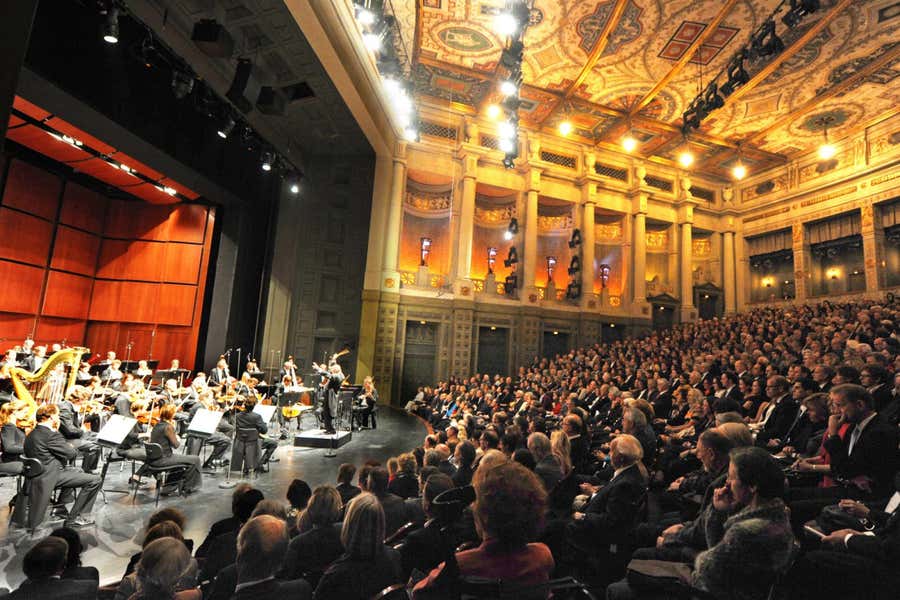
Photo: Stephan Rumpf/Süddeutsche Zeitung Photo/Alamy. Research involving self-reported personality traits shows that music can synchronize the heartbeats of some members of an audience.
For about a year or so, I have been learning to breathe. Ha. I always made fun of that sort of thing, but noticing your breathing is supposed to be good for your health, and I have found it often does lower my blood pressure.
So, what was my delight to read this related research! It’s about how classical music often synchronizes the heartbeats of an audience.
Jason Arunn Murugesu wrote at New Scientist, “Audience members’ heartbeats, breathing speeds and even degree of sweating synchronize when they watch a classical music concert together.
“Wolfgang Tschacher at the University of Bern in Switzerland and his colleagues monitored 132 people who were separated into three groups to watch different concerts of the same pieces of music – Ludwig van Beethoven’s Op. 104 in C minor, Brett Dean’s Epitaphs and Johannes Brahms’s Op. 111 in G major – while wearing body sensors.
“Various measurements became more synchronized during the concerts, such as the participants’ heart rates, breathing speeds and their skin conductance, which measures how much someone is sweating based on their skin’s varying electrical properties.
“Prior to the concerts, the researchers asked the participants to complete a personality test. They found that this synchronization was more likely to occur among people who considered themselves to be agreeable or open. …
“Tschacher expects that this synchronization would also apply to non-classical music genres and would probably be stronger still outside a trial setting. Due to covid-19 restrictions at the time of the experiment, the audience members were socially distanced. In a normal music concert, where audience members often engage with one another, the synchrony may be more pronounced, he says.
“The timing of the participants’ breathing, such as when they inhaled and exhaled, didn’t synchronize, however. Otherwise, you might think that a synchronized heart rate somehow leads to a synchronized breathing pattern, says Daniel Richardson at University College London. Instead, perhaps a person’s heart rate is influenced by their enjoyment of the music, he says.” More at New Scientist, here.
Aristos Georgiou at Newsweek adds, “Synchronization between humans is usually observed in physical bodily responses, such as breathing. Most frequently, this synchronization is the result of direct social interaction with another person. But it can also be induced by other external factors that are not related to such social interactions.
” ‘Synchrony is an important part of social interaction, and psychology has started to measure how much people become synchronized in different settings,’ such as in psychotherapy, discussions between spouses, and other conversations, Wolfgang Tschacher, an author of the study from the University of Bern’s Hospital of Psychiatry and Psychotherapy in Switzerland, told Newsweek. …
“While the researchers found that the audience members shared the same heart rate during the concerts, the heartbeats themselves were likely not all occurring at the same time, Tschacher said. The same applied to their breathing. The rate at which the audience members breathed was synchronized, but the individual ‘in’ and ‘out’ breaths of each attendee did not necessarily all occur at the same time.
“In addition, the researchers found that the [self-reported] personality traits of a listener were associated with the likelihood of their physical responses being synchronized with other audience members. Those participants who rated more highly for personality traits such as agreeableness or openness were more likely to become synchronized. On the other hand, those with neurotic or extraverted traits were less likely to become synchronized. …
“Alexander Khalil, a researcher in the Department of Music at University College Cork in Ireland, who was not involved in the study, told Newsweek that the scale and scope of the latest research is notable.
” ‘Typically, musical synchrony studies only address a small number of parameters at a time and in a relatively small group of people,’ he said. ‘Here, we have data on interpersonal synchrony amongst audience members attending a concert recorded from a large group of people.’ …
“The study is ‘particularly interesting and useful’ because individual variation across these different parameters has been compared with the subjective experience and personality traits of audience members, Khalil said. …
” ‘It tells us that that urge to tap your foot, nod your head, or sway from side to side is just the tip of the iceberg: from head to toe, body and mind are in motion with those of other listeners.’ ” More at Newsweek, here.
Photo: JJ Harrison/Wikimedia Commons. This tiger quoll (or spotted-tailed quoll) at Barren Grounds Nature Reserve, New South Wales, Australia, is similar to one a farmer caught harassing his chickens.
The creature of the day, the spotted-tailed quoll, is not extinct everywhere but was thought to be extinct in southern Australia. That is, until a farmer protecting his chickens caught one. Imagine how your perspective would change if an animal you just wanted to destroy suddenly turned out to be a rare find!
Aspen Pflughoeft reports at the Miami Herald. “A farmer in southern Australia captured an animal considered locally extinct for over a century while trying to protect his chickens. …
“Frank Pao-Ling Tsai, a trout farmer in Beachport, South Australia, heard a ‘panic’ from his chickens and rushed outside early in the morning on Tuesday, Sept. 26, he told McClatchy News in an email.
“Inside the coop, Tsai found a spotted creature and a dead chicken, he said.
“ ‘I had no idea what it was at first,’ Tsai told the Australian Broadcasting Corporation. ‘I expected to find a cat, but I found this little animal instead.’ …
“The captured animal [has] a furry brown body, long tail and smattering of white spots. … Tsai captured the creature in a plastic chicken cage, he told McClatchy News. He took photos and shared them in hopes of identifying the animal.
“Wildlife officials identified the animal as a spotted-tailed quoll, the National Parks and Wildlife Service of South Australia told McClatchy News.
“Quolls are ‘about cat-sized’ marsupials with a ‘cat-like shape but a lot stronger jaws and a lot longer canine teeth,’ Limestone Coast district wildlife ranger Ross Anderson told McClatchy News.
“The spotted-tailed quoll, also known as the tiger quoll, is an endangered quoll species and the ‘largest native carnivore left on the (Australia) mainland,’ according to the Australian Conservation Foundation. An estimated 14,000 spotted-tailed quolls are left in the wild, the organization said.
“The last officially documented sighting of a spotted-tailed quoll in South Australia was in the 1880s, Anderson said. The species has been considered locally extinct for over 130 years.
“ ‘It’s a once-in-a-lifetime event, really,’ Anderson told the Australian Broadcasting Corporation. …
“ ‘We can’t be sure where it’s come from,’ Anderson told the Guardian.
“The quoll Tsai originally captured managed to escape out a damaged corner of the cage, he said. Wildlife officials set up another trap and again captured a spotted-tailed quoll, Anderson said. …
“ ‘It could have been a relic population,’ Anderson told McClatchy News. ‘(Or) it could have been an animal that’s moved from other areas …. (or) it may have escaped from captivity.’
“ ‘We took some DNA to see if we can work out the likely origins,’ he said. ‘It’s a great opportunity for us to get some information and it would be fabulous if it turned out to be a relic population.’
“After being checked by a vet and DNA-tested, the captured quoll was released, Anderson said.
“Wildlife officials will set up cameras and traps to study the rediscovered quoll species and see if there are more quolls around Beachport, he said.”
See Tsai’s photos of a very angry beast at the Miami Herald, here. No firewall.
When Hannah saw an October post about mini urban forests, here, she was reminded of something similar going on in Greater Philadelphia, the Manayunk area to be exact. Wednesday she sent me an article about what people are working on there.
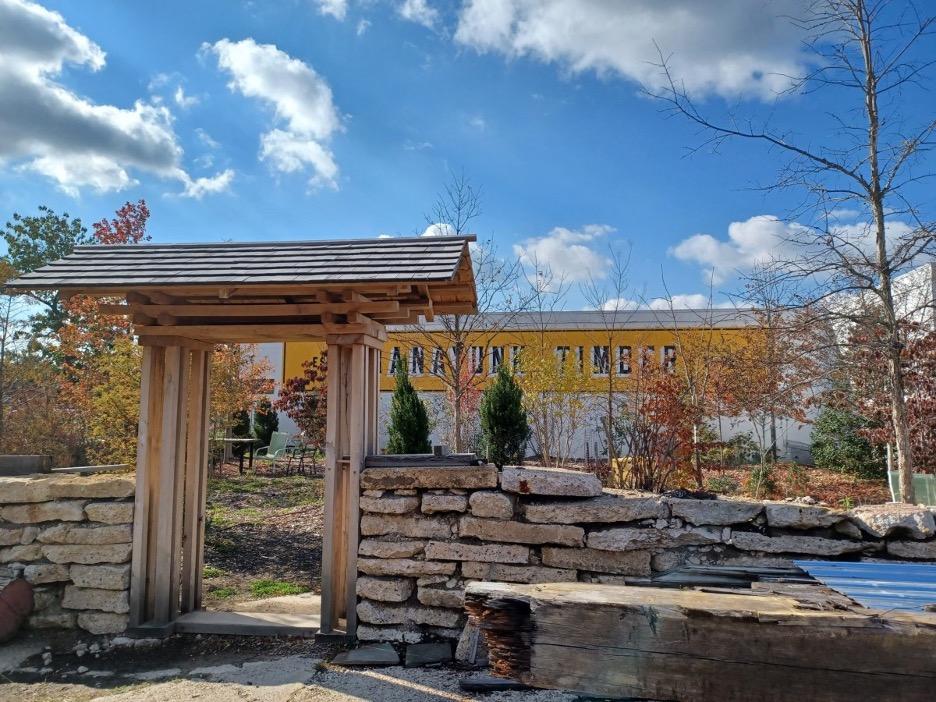
Nick Jaramillio reports at WHYY’s Billy Penn neighborhood newsletter, “A parking lot is being transformed into a thriving indigenous forest at Manayunk Timber, and will feature a new gate entrance with sculptures from internationally renowned wood artist Roger Wing.
“ ‘The forest that they planted is a poetic metaphor for what’s going on here,’ Wing told Billy Penn. ‘So much of what happens in the forest is unseen to our eyes. It’s the microbes, the animals that come out at night, the seeds, the germination in the soil, and the changing of the seasons.’
“A project from the team behind Manayunk Timber, Philly’s only sustainable sawmill, the burgeoning forest has benches where the public can sit and appreciate the surroundings, or enjoy a bite from the new bread shop next door.
“Manayunk Timber owner Steve Ebner decided to transform the former parking lot a year ago. At first, he wanted to plant an orchard.
“The plan changed when John Cox, a local wholesale florist, introduced him to the Miyawaki method, a technique developed by Japanese ecologist Akira Miyawaki to cultivate fast-growing native vegetation. Cox also gave Steve a book on ‘pocket forests’ that showed the method could be replicated on smaller plots of land.
“A typical Fairmount Park forested area has about one plant every square foot, per Cox. The plot at Manayunk Timber is about 3,500 square feet, so Ebner calculated it would need about 3,500 plants to become a mature forest. Currently, it has around 250, he said — a work in progress.
“The project so far has cost around $30,000, Ebner estimated, which included tearing up the concrete, building a ‘rubble wall’ out of the broken-up concrete, putting in the topsoil, and buying tree specimens.
“Native tree species already planted include cedars, hawthorns, red oaks, maples, witch hazel, winter king, American beech, honey locusts, hornbeams, and buckeyes.
“Sculptor Wing, who is based in West Philly, hopes his contribution by creating a notable gate will help make the forest a hub for landscapers, designers, and developers who share Manayunk Timber’s commitment towards sustainability. …
“By wintertime Ebner hopes to start cultivating the ‘undergrowth,’ adding small trees and low-lying plants like shrubs and mosses to enrich the soil and provide food and shelter for small animals. Eventually, the 70-year-old entrepreneur wants to open a bookstore.
“He’s ready for his daughter Rebecca to take over the urban sawmill business. …
“ ‘I hope this forest shines a light on what’s possible for what was: a non-used, ugly, concrete area,’ Rebecca added. So far the forest has been a hit. Ebner’s newest tenant, the wholesale bakery Dead King Bread, just celebrated the new location with an open house and live music. Tables, chairs, and a fire pit was set up in the forest for attendees.
“This is the first time Wing gets to carve pieces from Manayunk Timber. As a sustainable sawmill, it only processes wood from fallen trees or reclaimed antique beams.
“For the gate, Wing is working with timber salvaged from an 150 year-old warehouse. The wood survived a fire, giving it a blackened rippling surface wherever it was charred. ‘It’s almost too beautiful to cut into,’ the sculptor told Billy Penn. …
“ ‘Manayunk Timber has become this nexus for people interested in sustainability, forest ecology, and making ourselves better stewards living with the forest,’ Wing said. ‘Rather than dominating the entire ecosystem, we can live within the ecosystem, as part of the whole.’ ”
Our friend Toshi was lucky to have Yuriko to take care of his aging mother in their home. That was always the custom for daughters-in-law.
Nowadays, Japan has a greater percentage of people over 65 and not enough caregivers. So the Japanese are getting creative. Monthly “dementia cafes,” where elderly people can enjoy working, are a drop in the bucket. But charming.
Michelle Ye Hee Lee and Julia Mio Inuma report at the Washington Post, “The 85-year-old server was eager to kick off his shift, welcoming customers into the restaurant with a hearty greeting: ‘Irasshaimase!’or ‘Welcome!’ But when it came time to take their orders, things got a little complicated.
“He walked up to a table but forgot his clipboard of order forms. He gingerly delivered a piece of cake to the wrong table. One customer waited 16 minutes for a cup of water after being seated.
“But no one complained or made a fuss about it. Each time, patrons embraced his mix-ups and chuckled along with him. That’s the way it goes at the Orange Day Sengawa, also known as the Cafe of Mistaken Orders.
“This 12-seat cafe in Sengawa, a suburb in western Tokyo, hires elderly people with dementia to work as servers once a month. A former owner of the cafe has a parent with dementia, and the new owner agreed to let them rent out the space each month as a dementia cafe. The organizers now work with the local government to get connected to dementia patients in the area. …
“ ‘It’s so much fun here. I feel like I’m getting younger just being here,’ said Toshio Morita, the server, who began showing symptoms of dementia two years ago.
“A condition of unending indignities and financial burdens, dementia is a global phenomenon that every society is confronting. But in Japan, the world’s oldest society, dementia is a pressing national health challenge.
About 30 percent of the Japanese population of about 125.7 million is over 65. More than 6 million Japanese people are estimated to have dementia, and the number is expected to grow as high as 7.3 million — or 1 in 5 people over the age of 65 — by 2025, according to the Health Ministry.
“Japan’s chronic lack of caregivers and the soaring costs of elderly care mean it needs to find creative ways to empower these dementia patients so that they can be mentally and physically active for as long as possible, rather than isolated at home or at a hospital.
“Dementia cafes [were] introduced in Japan in 2017 through pop-up events, but more permanent efforts are now cropping up throughout the country.
“In June, Japan passed legislation to enact a slew of new programs and services to help those with dementia, which Prime Minister Fumio Kishida has identified as an urgent national project. …
“Kazuhiko, a 65-year-old diagnosed with dementia five years ago, has been working at the cafe every month. … At one point, Kazuhiko was heading to a table with an order but became distracted when the construction crew outside made a loud noise. He proceeded to leave the cafe and move toward the sound, and the staff rushed to bring him back in. …
“Kazuhiko rarely talks or shows emotion anymore. He usually doesn’t make eye contact with customers until he sees them multiple times. But that day, he showed a smile.
“The smile was directed at Tomomi Arikawa, 48, and her 16-year-old daughter, Sayaka, who visited around noon for a piece of chiffon cake and a citrus jelly dessert. … Kazuhiko brought them their orders. Sayaka thanked him and smiled, and he smiled back. ‘It felt really special,’ she said. …
“Since April, the Cafe of Mistaken Orders has opened once a month around lunchtime. One dementia patient works as a server per hour, wearing an apron that is bright orange, the color associated with dementia care. There is a chair set aside for them near the kitchen so they can rest in between orders.
“Younger volunteers help the elderly servers as they mark customers’ orders on the order forms, which are simple and color-coded.
“Table numbers were difficult for the elderly to remember, so the staff switched them out for a centerpiece with a single flower, a different color for each table.
“The cafe’s administrators wanted to help the community see that dementia patients can prolong their active years, with a little bit of understanding and patience from those who interact with them. …
“ ‘I hope that our initiative will give people with dementia something to look forward to,’ said Yui Iwata, who helps run the cafe. ‘If people get a deeper understanding, it would become easier for people with dementia to go out, as well.’ ”
More at the Post, here. Or just check out the restaurant’s site, here.
With all the furor about artificial intelligence, Rebecca Schmid decided to check in with MIT’s Tod Machover, “a pioneer of the connections between classical music and computers.” Their conversation about how AI applies to music appears on the Chamber Music America website.
“Sitting at his home in Waltham, Massachusetts, the composer Tod Machover speaks with the energy of someone half his 69 years as he reflects on the evolution of digital technology toward the current boom in artificial intelligence.
“ ‘I think the other time when things moved really quickly was 1984,’ he says — the year when the personal computer came out. Yet he sees this moment as distinct. ‘What’s going on in A.I. is like a major, major difference, conceptually, in how we think about music and who can make it.’
“Perhaps no other figure is better poised than Machover to analyze A.I.’s practical and ethical challenges. The son of a pianist and computer graphics pioneer, he has been probing the interface of classical music and computer programming since the 1970s.
“As the first Director of Musical Research at the then freshly opened Institut de Recherche et Coordination Acoustique/Musique (I.R.C.A.M.) in Paris, he was charged with exploring the possibilities of what became the first digital synthesizer while working closely alongside Pierre Boulez.
“In 1987, Machover introduced Hyperinstruments for the first time in his chamber opera VALIS, a commission from the Pompidou Center in Paris. This technology incorporates innovative sensors and A.I. software to analyze the expression of performers, allowing changes in articulation and phrasing to turn, in the case of VALIS, keyboard and percussion soloists into multiple layers of carefully controlled sound.
“Machover had helped to launch the M.I.T. Media Lab two years earlier in 1985, and now serves as both Muriel R. Cooper Professor of Music and Media and director of the Lab’s Opera of the Future group. …
“Machover emphasizes the need to blend the capabilities of [AI] technology with the human hand. For his new stage work, Overstory Overture, which premiered last March at Lincoln Center, he used A.I. as a multiplier of handmade recordings to recreate the sounds of forest trees ‘in underground communication with one another.’
“Machover’s ongoing series of ‘City Symphonies,’ for which he involves the citizens of a given location as he creates a sonic portrait of their hometown, also uses A.I. to organize sound samples. Another recent piece, Resolve Remote, for violin and electronics, deployed specially designed algorithms to create variations on acoustic violin. …
“Machover has long pursued his interest in using technology to involve amateurs in musical processes. His 2002 Toy Symphony allows children to shape a composition, among other things, by means of ‘beat bugs’ that generate rhythms. This work, in turn, spawned the Fisher-Price toy Symphony Painter and has been customized to help the disabled imagine their own compositions. …
“Rebecca Schmid: How is the use of A.I. a natural development from what you began back in the 1970s, and what is different? “Tod Machover: There are lots of things that could only be done with physical instruments 30 years ago that are now done in software: you can create amazing things on a laptop. But what’s going on in A.I. is like a major, major difference, conceptually, in how we think about music and who can make it.
“One of my mentors and heroes is Marvin Minsky, who was one of the founders of A.I., and a kind of music prodigy. And his dream for A.I. was to really figure out how the mind works. He wrote a famous book called The Society of Mind in the mid-eighties based on an incredibly radical, really beautiful theory: that your mind is a group of committees that get together to solve simple problems, with a very precise description of how that works. He wanted a full explanation of how we feel, how we think, how we create — and to build computers modeled on that.
“Little by little, A.I. moved away from that dream, and instead of actually modeling what people do, started looking for techniques that create what people do without following the processes at all. A lot of systems in the 1980 and 1990s were based on pretty simple rules for a particular kind of problem, like medical diagnosis. You could do a pretty good job of finding out some similarities in pathology in order to diagnose something. But that system could never figure out how to walk across the street without getting hit by a car. It had no general knowledge of the world.
“We spent a lot of time in the seventies, eighties, and nineties trying to figure out how we listen — what goes on in the brain when you hear music, how you can have a machine listen to an instrument — to know how to respond. A lot of the systems which are coming out now don’t do that at all. They don’t pretend to be brains. Some of the most kind of powerful systems right now, especially ones generating really crazy and interesting stuff, look at pictures of the sound — a spectrogram, a kind of image processing. I think it’s going to reach a limit because it doesn’t have any real knowledge of what’s there. So, there’s a question of, what does it mean and how is it making these decisions?
“What systems have you used successfully in your work? “One is R.A.V.E., which comes from I.R.C.A.M. and was originally developed to analyze audio, especially live audio, so that you can reconstruct and manipulate it. The voice is a really good example. Ever since the 1950s, people have been doing live processing of singing. The problem is that it’s really hard to analyze everything that’s in the voice: The pitch and spectrum are changing all the time.
“What you really want to do is be able to understand what’s in the voice, pull it apart and then have all the separate elements so that you can tune and tweak things differently on the other side. And that’s what R.A.V.E. was invented to do. It’s an A.I. analysis of an acoustic signal. It reconstructs it in some form, and then ideally it comes out the other side sounding exactly like it did originally, but now it’s got all these handles so that I can change the pitch without changing the timbre. And it works pretty well for that. You can have it as an accompanist, or your own voice can accompany you. It can change pitch and sing along. And it can sing things that you never sang because it understands your voice. …
“The great thing about A.I. models now is that you can use them not just to make a variation in the sound, but also a variation in what’s being played. So, if you think about early electronic music serving to kind of color a sound — or add a kind of texture around the sound, but being fairly static — with this, if you tweak it properly, it’s a kind of complex variation closely connected to what comes in but not exactly the same. And it changes all the time, because every second the A.I. is trying to figure out, How am I going to match this? How far am I going to go? Where in the space am I? You can think of it as a really rich way of transforming something or creating a kind of dialogue with the performer.” Lots more at Chamber Music America, here. No firewall.
I myself have posted about the composer a few times: for example, here (“Tod Machover,” 2012); here (“Stanford’s Laptop Orchestra,” 2018); and here (“Symphony of the Street,” 2017).
“AI Finished My Story. Does It Matter?” at Wired, here, offers additional insight.
Photo: Espen Finstad/Secrets of the Ice. Melting glaciers are revealing older and older artifacts. Archaeologists discovered the arrow above in Norway’s Jotunheimen Mountains. Made out of freshwater pearl mussel, it’s one of the best preserved findings so far.
I hesitate to say that anything about climate change has an upside, but we might as well enjoy the things that keep being revealed — at least until we reach the more important goal of controlling global warming.
At Hyperallergic, Maya Pontone reports on melting glaciers in Norway and the latest Bronze Age discoveries.
“Archaeologists trekking through the Jotunheimen Mountains in Norway’s Innlandet County,” Pontone writes, “came across a remarkable find — an intact shell arrow dating back to the Early Bronze Age. Fastened with an arrowhead made of freshwater pearl mussel, the well-preserved hunting tool dates back 3,600 years and is one of eight shell arrows that have emerged from melting ice in Norway in recent years.
“On September 13, archaeologist Espen Finstad and his research team came across the artifact while checking a site as part of a routine monitoring job they typically run at the end of the field season. While the discovery of the ancient weapon was an unprecedented surprise that day, it is just one of hundreds that the Secrets of the Ice glacial archaeology team has uncovered over the past decade due to climate change.
“ ‘The glaciers and ice patches are retreating and releasing artifacts that have been frozen in time by the ice,’ Lars Holger Pilø, co-director of the archaeology program, told Hyperallergic. …
“The archaeologists have been continuously rescuing artifacts from Innlandet’s glaciers and ice patches since the fall of 2006, when the first ‘big melt‘ hit the Jotunheimen Mountains, located northwest of Oslo. [It’s the] home of the mythological jötnar, the rock and frost giants in Norse folklore. …
“ ‘Now the artifacts are exposed and deteriorating fast, so we are in a race against time to find and rescue the artifacts,’ Pilø said.
“So far, the Secrets of the Ice research team has mapped 66 ice sites and recovered approximately 4,000 finds including hunting gear and tools, textile remnants, transportation equipment, and clothing materials. The team has also found biological specimens such as antlers, bones, and dung.
“ ‘Arrows with shell arrowheads only became known in Europe when they started melting out of the ice in Norway,’ Pilø explained about the recent discovery. …
“As global warming transforms Norway’s mountainous landscape, Finstad, Pilø and their fellow glacier archaeologists are rushing to collect the exposed artifacts, which continue to get older as the ice continues to melt.
‘Most of the ice here in Norway will be gone in this century,’ Pilø said. ‘You can say that we are melting back in time.’
“ ‘The finds are incredible, but the reason they are melting out is sad,’ Pilø said, explaining how the ice melt will lead to drastic changes in Norway’s landscape, local wildlife, agriculture, tourism, and hydro-electrical power plants dependent on glacial water.
“ ‘It will be a very different world,’ he lamented.”
Feel free to revisit my February post about amateur archaeologists in Norway — the three buddies who under cover of darkness have found hundreds of previously unknown rock-carving sites. Click here.
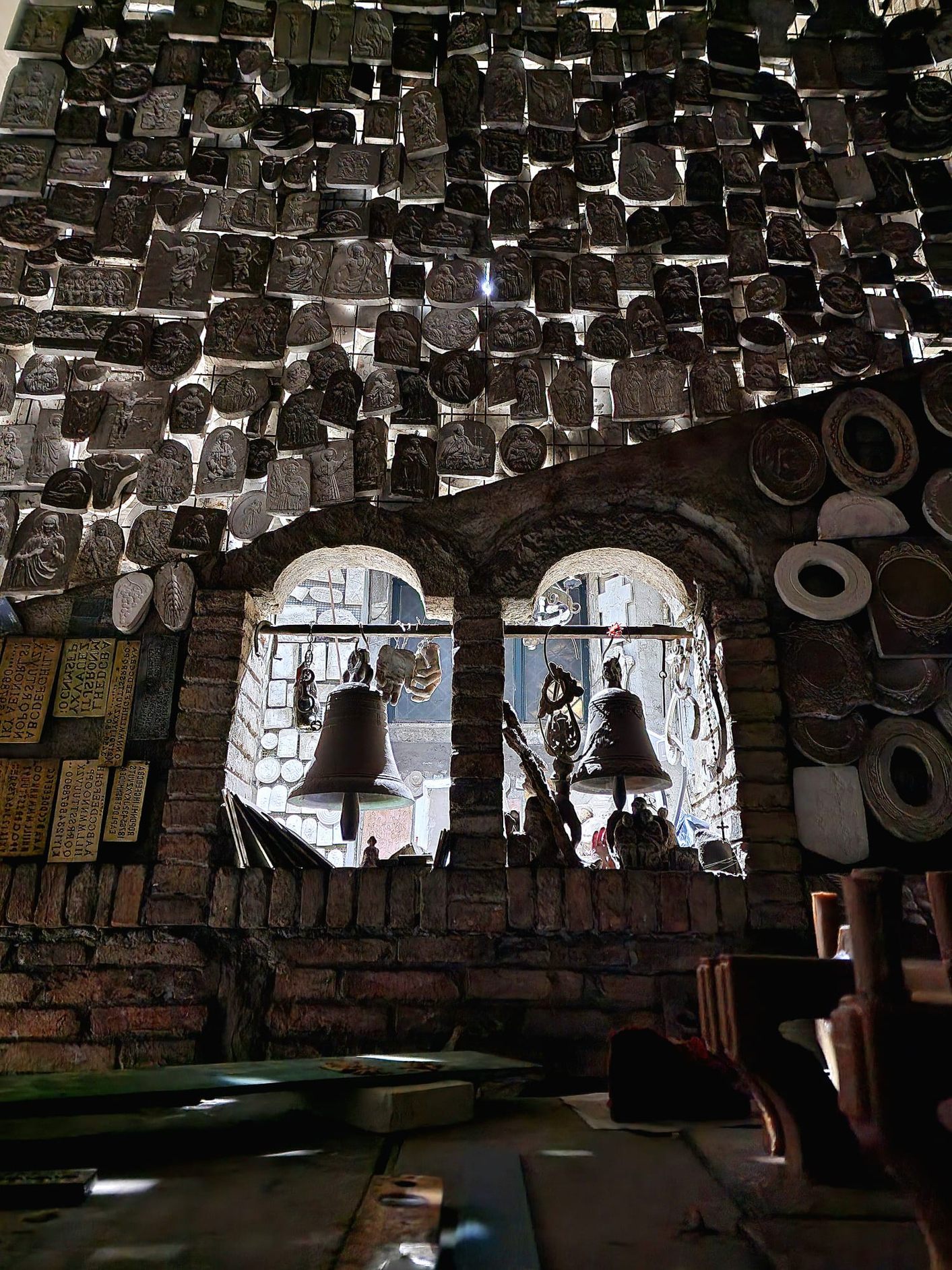
Photo: Pontifical Marinelli Bell Foundry. One family has been making bronze bells for over 1,000 years in the Molise region of southern Italy. The bells can be seen in the Marinelli Bell Museum.
My brother the business writer has made a study of companies in America with impressive longevity. For example, the Hollingsworths of Hollingsworth Vose were granted a patent to manufacture paper from manila fibers in 1843, but my brother says they go back to the time of George III.
Be that as it may, the Italian family in today’s story has been in business even longer.
Asia London Palomba writes at Atlas Obscura that Pasquale Marinelli is “a bell artisan in Italy. Pasquale and his brother Armando are the 26th generation of a family who has been crafting handmade bells since the middle ages. Pouring scalding-hot liquid metal into carefully designed molds, the two sweat over glowing embers, working with 10 centuries worth of knowledge in order to spread a medieval chime around the world.
“Naturally, such historical work is done in an ancient town called Agnone. Located in Italy’s isolated and rugged southern region of Molise, the quiet stone village lies squarely in a mountainous valley, where green hills roll into each other like waves and hay barrels freckle the land like drops of gold. It’s here, teetering at the top of a rocky outcrop, where you’ll find the two brothers working in the Pontifical Marinelli Bell Foundry, which, appropriately, is the oldest family-run business in Italy and among the oldest in the world.
“The Marinellis have been handcrafting bronze bells since at least the 11th century, although archaeological findings at nearby Benedictine monasteries suggest the Marinellis’ craft could date as far back as the 9th century.
“ ‘The same techniques and models, everything from A to Z, have been the same for the last 1,000 years,’ notes Armando. ‘Deviating from these methods that have been passed down throughout the generations means shutting the door on 1,000 years of history.’ …
“Their ancestor Nicodemo Marinelli, for whom they have historical documents … is documented to have been crafting bells in an era when the sonorous instrument had a greater, even primary role in society. ‘Bells were the first mass media. They heralded the salient moments of the day: to call people to work, for lunch, to return home from work. They were a way of telling time, of warning people,’ notes Pasquale.
“For almost its entire history, the foundry and its artisans were mobile, moving around to forge bells wherever there was demand. ‘We were like nomads,’ explains Armando, ‘living away from home for months alongside the tratturi, which were like the highways of antiquity.’ …
During World War II, Nazi troops seized many of the family’s historic bells and melted them down to create cannonballs.
“The brothers’ grandfather managed to bury some of the business’ most important bells underground, which were eventually recovered after the war, although Armando suspects there still may be a handful forgotten beneath the town’s earth. …
“A Marinelli bell is made with three cups stacked within each other — think of them as Russian nesting dolls. The first cup, called the ‘soul,’ is the internal part of the bell and is created by laying brick fragments upon each other and wrapping them together with iron string. This is slathered in a thick layer of clay, then wax, and then even more clay to create the second cup, named the ‘false bell,’ which will eventually be destroyed to make way for the bronze product. Smoldering coals are poured inside these two structures to bake the clay and melt the wax from the inside out.
“Hand-drawn wax molds are then cast onto the exterior of the false bell. ‘This is a very important step, because once its realized in bronze, it’ll live on for centuries in a church or a community,’ explains Armando. While almost everyone in the family partakes in the decoration process, this work falls primarily on Ettore Marinelli, Armando’s 31-year-old son and part of the 27th generation of artisans. Also a talented bronze sculptor, he works mainly in the artist’s hall. … ‘I was practically born in the foundry. I was already molding clay at the age of three,’ says Ettore.
“The soul and decorated false bell are then covered in more clay to create the third and final cup, called the ‘mantle.’ Once dry, the mantle, with the wax designs embossed into it, is lifted and the false bell is destroyed by hand with a hammer. A bronze alloy, spiced with a smattering of tin, is heated to 1,200 degrees Celsius (roughly 2,192 Fahrenheit) and poured into the bell mold, now consisting only of the mantle and the soul, while a priest blesses the process with a sprinkling of holy water. When the alloy hardens, the mantle is broken apart with a hammer to release the bronze bell, which is then polished until it shines.”
More at Atlas Obscura, here. No paywall. Lovely photos.
Photo:Frank Carini/ecoRI News. These Growing Futures RI staffmembers help trainees get landscaping experience through park maintenance.
In a win-win reminiscent of the Great Depression’s Civilian Conservation Corps, trainees are gaining valuable work experience while benefiting Rhode Island parks.
Frank Carini at ecoRI News has the story.
“The infamous hurricane of 1938 built the Tefft Hill Trail. Well, that’s not entirely accurate. One of the most powerful hurricanes in recorded history did the no-bid prep work. The FDR-era Civilian Conservation Corps, while conducting search and salvage operations and helping with the cleanup, built the Tefft and many other hiking trails in the area that would become known as Arcadia.
“The Rhode Island Department of Agriculture and Conservation — now the Department of Environmental Management — acquired the 14,000-acre Arcadia Management Area a few years before the 1938 hurricane struck. Today, Arcadia features a wide range of natural landscapes, including hardwood and pine forests, hills and valleys, ledges, fields, and lakes, ponds, and streams of various sizes. It also boasts miles and miles of trail.
“DEM doesn’t have the staff necessary to maintain all of Arcadia’s recreation aspects, so a 21st-century version of the Corps lends a hand — many hands, in fact. … The trails in Rhode Island’s largest management area are maintained and tended to under the direction of Jordan Miller, director of education and training for the Rhode Island Nursery & Landscape Association and the leader of RINLA’s Growing Futures RI initiative. …
“For the past three winters, Miller and the program’s two other staffers — Christie Milligan, director of workforce programs, and Mason Billings, program associate and resources coordinator — shepherd 30-40 workers into the Arcadia Management Area to maintain trails, clear overgrown vegetation, repair wooden walkways, and remove invasives. …
“Throughout Arcadia during its destination heyday, there were picnic tables and other amenities, offices in the woods, and a house for the caretaker and his family. In the decades since DEM changed its management strategy for state-owned land, the picnic tables and structures that once decorated Arcadia have faded into the landscape. The baseball field swallowed by vegetation. …
“After the campground closed, the state maintained the beach and recreation area until the mid-1990s, which is around the same time that the universal access boardwalk was built and the Tefft Hill Trail was being transformed into an area more accessible to those living with mobility issues.
“Funded by a federal grant, the boardwalk and bridge were built in three phases over 10 years. DEM’s Division of Forestry did the work using no mechanized equipment to avoid disturbing the sensitive environment,’ according to Michael Healey, the agency’s chief public affairs officer. …
“Miller, who has worked in the horticulture industry in a variety of roles since 2004, was hired in 2020 to run RINLA’s new initiative. The purpose of Growing Futures is to ‘cultivate, train, and educate the next generation of natural resource professionals who will be charged with stewarding, protecting, and responding to a changing environment and feeding our community.’ …
“Every January and February for the past three winters, the 30-40 workforce trainees, under the guidance of the Growing Futures trio, prepare Arcadia trails for a new season of hiking and nature watching. Trainees are hired for a week or five, and crew leaders from RINLA’s 250 member businesses are loaned to the program to ‘help run things in small groups,’ according to Miller.
“ ‘One of the main reasons for that is timing of when our industry starts up for the year and hires people, which is typically in March,’ he said. ‘So we’ll do the training so that people graduate and then they go straight into job interviews and are able to get jobs for the season. The other part of it is because that’s a winter layoff time, we can actually get crew leader staff who were laid off from their landscaping jobs to be able to help us out.’ “
More at ecoRI News, here. No paywall. Nice pictures.















 Suzanne's Mom's Blog