Feeds:
Posts
Comments

… I have to believe she will do it. She’s a miracle girl.

Let me begin at the beginning. Almost exactly three years ago, I wrote a blog post about a girl from a deeply conservative family in Herat, Afghanistan, who secretly took up golf and opened a whole new world for herself.

It was through the radio show “Only a Game” that I learned about Shagufa Habibi and how she had gotten herself to a golf competition in Bangladesh and then bravely applied to college there and matriculated without the knowledge of either her family or the abusive husband she was forced to marry at age 16.

Fast forward to early 2020, when I get a message at the blog from Shagufa thanking me for my 2017 post. Turns out she now lives half an hour away from me in Massachusetts.

This is a young woman who makes things happen for herself. After a few emails, she asks if I could help her prepare for the graduate record exam (GRE). She wants to go to grad school to acquire the tools she needs to set up a South Asia foundation for girls in sports that will empower them to break free of traditional constraints and dangers.

Shagufa’s vision combines access to sports (which poor South Asian girls usually lack), education in skills such as leadership, and a stipend to help the young women financially so their impoverished families will be less pressed to marry them off for the bride price.

I know. Pretty far out, huh?

But when I consider all she has already done, including being accepted for fall 2021 at a top grad school and awarded a generous scholarship, I know she will do what she sets out to do.

But here’s the rub. Despite the generosity of the scholarship from Brandeis, Shagufa still can’t afford to go. She has no family here to help her, and they definitely do not support her goals. In fact, if she returned to Afghanistan right now, her life would be in danger because she is regarded as having “dishonored” her family.

Read her description of the situation and her ambitious dream in the GoFundMe link below and consider whether you want to help her with a donation or just cheer her on. Maybe you’d be up for telling someone you know about her.

I have been speaking with Shagufa via What’s App once or twice a week since we met. We alternate between work on advanced vocabulary (you wouldn’t believe how she studies and retains the most difficult words!) and GRE-type essay topics, because even though Brandeis waived the GRE for now, Shagufa still plans to take it. Often we spend part of the hour just chatting and learning about each other’s culture.

The GoFundMe site for Shagufa is here.

Shagufa Habibi, Afghan miracle worker.

081020-New-Shoreham-SE -Light

Photo: Shadows on the Southeast Lighthouse

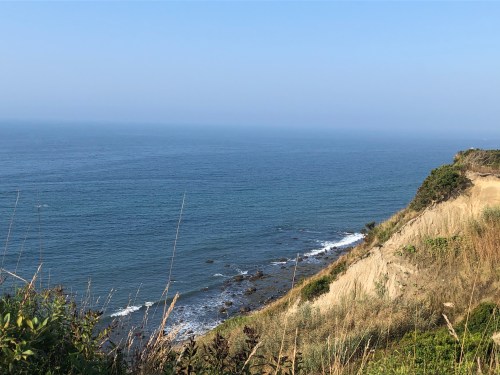
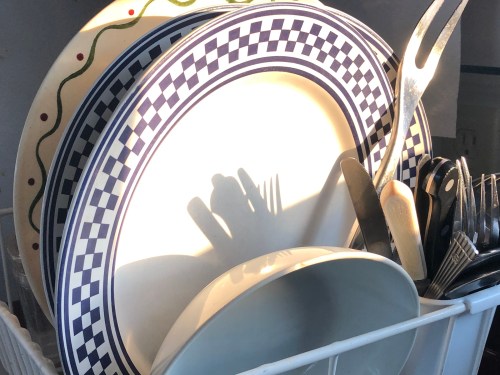
Time to share a few more photos from a summer in isolation. Four island photos come first. The dishrack photo is to show how I spend my time there. (LOL. I am the one, alas, who said we should protect the groundwater and not have a dishwasher. Sometimes it’s better to be pragmatic than idealistic.)

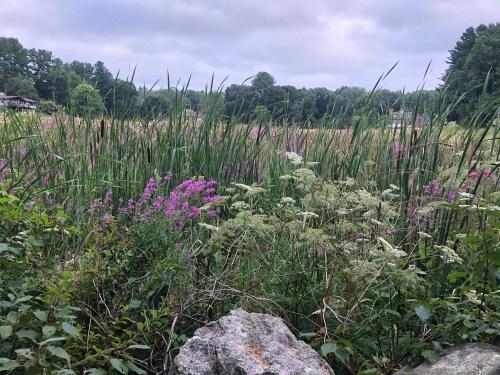
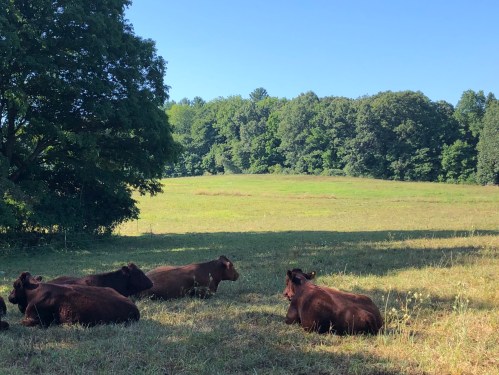
Back on the mainland, the photos reflect my appreciation of colorful summer meadows, cows, and outdoor library fun for kids. No pictures of people. I do sometimes meet a friend at a safe distance for a sandwich and a chat, but masks never make for good photos. And in my walks, I generally aim for places where people are scarce, like graveyards.

I really liked the spooky-looking crypt and wish I could be Edgar Allan Poe for a minute and invent a reason that a lock was broken.

The long shadow in the next photo is in front of a local senior-living building.

Next comes a sign at Emerson Field that struck me as funny. No golfing? There was never any golfing there. What’s the story? Someone must have tried to get around the governor’s rules in coronavirus Phase One and gotten in the way of dog walkers. If there’s one thing I’ve learned in our town it’s you don’t want to mess with dog walkers.

I wonder what memories we will take away from this weird time. For me, a sign forbidding golfing where there was never golfing might be one.

081020-RI-lighthouse-from-1873

081020-Mohegan-Bluffs-BI-RI

081020-what-I-did-on-my-vacation

081520-.loosestrife-and-Queen-Annes-Lace

081920-cows

Photo: Ken Hofheinz
Brandon Steppe, the founder of the David’s Harp Foundation, received a grant for his work using music education and multimedia training to help at-risk youth.

When philanthropists step up to fill a need, it may be a sign that our tax money is not being used in some important ways. Arts education, for example, provides so many benefits to students that it really should be available in every school, but too often it’s the first thing to go when districts are underfunded.

So hooray for philanthropists filling a gap! Lauren Messman wrote at the New York Times, “The Lewis Prize for Music, a new philanthropic organization focused on fostering music education and career development in young people, announced its first slate of winners on [January 14]. The $1.75 million will be awarded to the leaders of nine organizations in eight states.

“The prize, which is split into three categories and includes both long-term and single-year support, was founded in 2019 by the philanthropist Daniel R. Lewis.

“ ‘My vision is to ensure opportunities to learn, perform and create music are available to all young people,’ said Mr. Lewis in a statement. ‘Ideally, this would be happening in every school, but that isn’t the case, especially in low-income and historically marginalized communities.’

“The Accelerator Award, which provides $500,000 for multiyear support, was given to Community MusicWorks, which provides classical music educational programs in Providence, R.I.; My Voice Music, which brings songwriting, recording and performance mentorships to mental health treatment and detention centers in Portland, Ore; and The David’s Harp Foundation, a San Diego-based organization that works to develop job skills through music with youth in the juvenile justice system. …

“ ‘What we’ve noticed is that when these young people come from being incarcerated back into the community, there’s a gap in our service there,’ [Brandon Steppe, the founder,] said in a phone interview. He added that the rest of the money will go toward building ‘arts-based diversionary programming in the community,’ in an effort to keep youth out of the juvenile justice system.

“Winners of the Infusion Award, which provides $50,000 over one year, include programs aimed at inspiring Native American music educators and composers, bringing traditional Mexican music education to the children of immigrants, providing music and entrepreneurship training for young musicians of color in Detroit and building support for the next generation of New Orleans brass band musicians.” More at the Times, here.

I liked reading further about one of the Infusion Award winners, the Native American Composer Apprentice Project. The Grand Canyon Music Festival website explains, “Since 1984, the Grand Canyon Music Festival has been dedicated to bringing the world’s finest musicians to Grand Canyon National Park in celebration of the power and beauty of this magnificent World Heritage site.

“Since 1985, the Festival has extended this gift of music to the students of northern Arizona’s under-served and rural communities, primarily at schools on the Navajo and Hopi Reservations. In 2001, the Festival initiated its Native American Composers Apprentice Project (NACAP) to extend its outreach to training talented Native American students in the art of composition. NACAP develops musical literacy and enhances critical thinking and decision making skills through the study of music composition. It introduces students to European ‘classical’ music techniques, develops their understanding of their own musical heritages and how to use that knowledge to develop their own compositional voices.”

2480

Photo: Bertramz
When you look at the remains of Qalb Lozeh church in Syria, you can see the inspiration behind Notre-Dame.

As many of us have been learning in recent years, much that is beloved in Western architecture was originally inspired by buildings in the Middle East. Moreover, there are Christian cathedral styles that mirror Muslim mosques.

A new book aims to set the record straight. Oliver Wainwright reviewed it at the Guardian.

“As Notre-Dame cathedral was engulfed by flames last year, thousands bewailed the loss of this great beacon of western civilisation. The ultimate symbol of French cultural identity, the very heart of the nation, was going up in smoke. But Middle East expert Diana Darke was having different thoughts. She knew that the origins of this majestic gothic pile lay not in the pure annals of European Christian history, as many have always assumed, but in the mountainous deserts of Syria, in a village just west of Aleppo to be precise.

‘Notre-Dame’s architectural design, like all gothic cathedrals in Europe, comes directly from Syria’s Qalb Lozeh fifth-century church,’ Darke tweeted on the morning of 16 April, as the dust was still settling in Paris. …

“It is not only the twin towers and rose window that have their origins in the Middle East, she pointed out, but also the ribbed vaults, pointed arches and even the recipe for stained glass windows.

“Gothic architecture as we know it owes much more to Arab and Islamic heritage than it does to the rampaging Goths. ‘I was astonished at the reaction,’ says Darke. ‘I thought more people knew, but there seems to be this great gulf of ignorance about the history of cultural appropriation.’ …

“With Stealing from the Saracens, an exhilarating, meticulously researched book, [she] sheds light on centuries of borrowing, tracing the roots of Europe’s major buildings – from the Houses of Parliament and Westminster Abbey to Chartres cathedral and St Mark’s basilica in Venice – back to their Middle Eastern precedents. …

“ ‘Now we have this notion of east and west,’ says Darke. ‘But back then, it wasn’t like that. There were huge cultural exchanges — and most came from the east to the west. Very little went the other way.’

“Given their prevalence in the great cathedrals of Europe, it is easy to imagine that pointed stone arches and soaring ribbed vaults are Christian in origin. But the former dates back to a seventh-century Islamic shrine in Jerusalem, while the latter began in a 10th-century mosque in Andalucia, Spain.

“In fact, that first known example of ribbed vaulting is still standing. Visitors to the Cordoba Mezquita can marvel at its multiple arches intersecting in a masterpiece of practical geometry and decorative structure, never needing a repair in its thousand-year existence. …

“The pointed arch, meanwhile, was a pragmatic solution to a problem encountered by masons working on the Dome of the Rock in Jerusalem. One of the holiest sites in the Muslim world, it was built in 691 by the ruler of Islam’s first empire.

“The challenge was how to line up an outer arcade of rounded arches with a smaller inner arcade, while maintaining a horizontal ceiling between them. For the openings to align, the masons had to give the inner arcade tighter arches, forcing them to become pointed. Another world first can be spotted higher up in the shrine, where encircling the dome is an arcade of trefoil arches, the three-lobed style of arch that went on to encrust practically every European cathedral. …

“[Misidentification of] the Dome of the Rock was down to the Crusaders of the Middle Ages mistakenly thinking the building was the Temple of Solomon. They used the domed, circular layout of this [shrine] as the model for their Templar churches (like the City of London’s round Temple church), even copying the decorative Arabic inscription, which openly chastises Christians for believing in the Trinity rather than in the oneness of God. Their pseudo-Kufic calligraphic patterns went on to adorn French cathedral stonework and the borders of richly woven textiles, with no one aware of what they actually meant.” More at the Guardian.

Photo: Decca
British songwriter Bill Fay in 1970, when a Decca imprint released his debut album. After the release of ‘Time of the Last Persecution’ a year later, he seemed to disappear.

Who doesn’t love a mystery? Thanks to mystery fiction, I’ve waded deep into topics and places I would never have known anything about. Nonfiction mysteries can be even more fun. Today’s story is about a songwriter who really wanted to know why the musician behind an obscure album his father loved disappeared from the music scene after the album came out.

Grayson Haver Currin at the New York Times reported on the quest in January: “Joshua Henry never understood why his father owned ‘Time of the Last Persecution,’ an obscure 1971 psychedelic-folk album by the British songwriter Bill Fay.

“Henry, a 40-year-old songwriter and producer devoted to old-school analog technology, grew up in the woods at the edge of California’s Sierra Nevada. His father, Jamie, wasn’t a record collector: He reluctantly served in Vietnam before becoming an antiwar activist, then spent his final four decades as a hardscrabble logger. ‘Last Persecution’ was never issued in the United States, and barely caused a blip in England’s very crowded singer-songwriter scene of the early ’70s. After its release, Fay vanished from music.

“All his life, Henry remained curious about the Fay LP, with a portrait of a disheveled singer on its stark black cover. When he was caring for his father, who was battling cancer, the album became a lifeline between the two men. They’d listen to Fay, dissecting his peculiar mix of apocalyptic vision and hopeful grit. After his father’s [death], Henry began trying to make good on a fantasy they had shared: to find Fay and help him make his first record since 1971.

“[In January, Fay released] ‘Countless Branches,’ his third album in the 10 years since Henry tracked him down and urged him to return to the studio. Fay — now 76 and married, almost all he’ll allow about his personal life — has made as many studio albums this decade as in the previous six combined. …

‘When Joshua told me about his dad and that he’d grown up listening to my music, it was real and profound,’ Fay said by phone from his North London home. …

“Fay stumbled into music in the ’60s. As a college student in Wales, he began to forsake his electronics curriculum for writing songs featuring piano and harmonium. … His self-titled 1970 debut featured idealistic odes to friendship, nature and peace swaddled in swooping strings and cascading horns. But only a year later, he’d turned to thorny rock for ‘Time of the Last Persecution.’

“Fueled by the horrors of the Vietnam War and the violence of the Jim Crow South, Fay railed against social corruption for 14 fractured songs, framing life as a revolving door of chances to get right with God. Dense and challenging, the album flopped. …

“Labels rejected subsequent demos and his father died from an aneurysm, leaving Fay as his mother’s longtime caretaker. During the next four decades, he raised a family and worked as a groundskeeper in a London park and a fish packer in a supermarket. Still, in a quiet corner of his home, he slowly built a meager recording rig with a cheap eight-track and a little keyboard, shaping full-band arrangements of songs he never intended for anyone to hear.

“ ‘I was disappointed,’ Fay said, ‘but music was never my living. And I wasn’t like other people, who had become part of a scene. I went back to what I had always done, which is the gift and blessing of working on music in its own right.’ …

“Jim O’Rourke found Fay’s music while researching Ray Russell, the electrifying guitarist on both Decca albums. … When a small British label reissued both albums on one CD in 1998, O’Rourke began telling his friends. As O’Rourke worked on Wilco’s ‘Yankee Hotel Foxtrot,’ he played Fay’s debut for Jeff Tweedy.

‘I was astonished: How have I not heard this? How is this not something that is part of our DNA?’ [Wilco’s] Tweedy said of the first time he listened to Fay. … ‘It’s music that sounds like it was designed in a laboratory for me to fall in love with.’ …

“O’Rourke also sent ‘Last Persecution’ to David Tibet, … Despite rumors that Fay had absconded to a Christian cult, Tibet began looking for him; within a week, a British journalist connected him with a guitarist who had once played with Fay and became their intermediary. The two became fast friends.

“In 2005, Tibet released ‘Tomorrow Tomorrow and Tomorrow.’ …  In early 2010, Tibet also issued a two-disc sampler called ‘Still Some Light,’ culled from decades of Fay’s home recordings.

“A year after its release, the liner notes in that set finally gave Henry the lead he needed.”

Read what happened next at the New York Times, here.

PRI’s The World has an in-depth international focus I don’t find at other radio shows. Although the program is available nationwide, it’s produced at WGBH in Boston, and I listen to it there (weekdays at 3).

Yesterday’s show included some cool research by Duke University’s lemur center, a fascinating place I visited when Suzanne was on her high school tour of colleges.

The story was not about lemurs, however. It was about a rare critter scientists hadn’t seen in 50 years, the Somali sengi, popularly but imprecisely called the “elephant shrew.”

Amanda McGowen reported at The World, “The Somali sengi is a tiny mammal that looks almost like a mouse, but with a long, trunk-like nose, sort of like an aardvark.

“[For] 50 years, a sighting of this sengi had not been recorded by scientists — until now.

“A team of American sengi experts and Djiboutian ecologists rediscovered the elusive Somali sengi after a research expedition to Djibouti in 2019. Their findings were published in the scientific journal PeerJ [Tuesday].

“Houssein Rayaleh, a Djiboutian research ecologist and conservationist on the expedition, said that ‘people living in Djibouti never considered the sengis to be “lost,” ‘ but that ‘the new research brings the Somali sengi back into the scientific community, which is valued,’ according to the BBC.

“ ‘They’re unique in a lot of ways,’ said Steven Heritage, the lead author of the study who is a research scientist at the Duke University Lemur Center in Durham, North Carolina. …

“Sengis, Heritage explained, have flexible noses that they use to pick through leaf litter for food, as well as enormous back legs that allow them to run up to 18 miles per hour or more. They also have a monogamous mating system, where a male and female bond for life.

“Sengis are closely related to aardvarks, elephants and manatees. Though they’re commonly called elephant shrews, Heritage explained that the name has largely fallen out of favor among scientists because sengis are not really shrews or elephants.

“To find this particular species of sengi, the team drew on the knowledge of its local members, including Houssein Rayaleh, a bird expert at Association Djibouti Nature, as well as interviews with people in the areas where they were searching.

‘When we would go to these field sites, we would often interview locals. … They’d say, “Oh yeah, that animal is over there in those rocks, and this mouse animal is over here in this more flat area,” ‘ Heritage said. ‘Incorporating that local knowledge was invaluable.’ …

“The researchers used a combination of oatmeal, peanut butter and Marmite to lure sengis into live box traps so they could be observed.

“ ‘[It’s] this super smelly concoction of bait,’ he said. ‘You can imagine if you’re a small mammal that lives in essentially a desert, rocky environment, you’ve never smelled anything like that before. So you’re going to go check that out and see what’s going on.’ …

“Heritage said generating knowledge about rare or ‘lost’ species helps keep the IUCN Red List of Threatened Species up to date. He called the list a ‘barometer of the health of the biodiversity on our planet.’ “

More at The World, where you can also listen to the radio report.

Photo: Steven Heritage
The rare Somali sengi, small enough to fit in the palm of your hand, is a relative of the elephant and the aardvark. 


Photo: Cape Cod Fishermen’s Alliance
Captain Eric Hesse is a member of the Cape Cod Commercial Fishermen’s Alliance, which is participating in a collaborative initiative to help food banks and fishermen at the same time.

Even though fishermen have been able to fish during the pandemic, reliable clients like restaurants have not been able to buy. Fishermen — and those who support the industry — have had to put their creativity to work to find new ways to survive.

This story highlights one recent solution, a win for food pantries as well as for fishermen.

As Meg Wilcox reported at the Boston Globe, “Massachusetts fishermen have struggled to make ends meet during the pandemic, as restaurants — their main market — have closed or scaled back. Less demand for seafood means fishermen get paid less for their catch, or worse, they can’t sell it. That’s led some to make the painful decision to forgo fishing.

“Now, the Cape Cod Commercial Fishermen’s Alliance has found a way to keep fishermen on the water while also helping local families in need keep food on their tables. Haddock chowder.

“With philanthropic support from Catch Invest, the fishermen’s alliance will pay fishermen a fair, predictable price for haddock, making it worth their while to harvest the fish. The alliance will also pay a Dorchester fish processor, Great Eastern Seafood, to fillet the fish, and a Lowell soup company, Plenus Group, to produce the chowder, which it will donate to Massachusetts food banks.

“Starting Monday, Aug. 17, chowder frozen in 18-ounce containers will be provided to four Massachusetts food banks. The first donation includes 18,720 containers, providing about 56,000 individual servings. All told, some 100,000 pounds of haddock will be donated through the program. …

“Hearty, yet light, the chowder recipe features 25 percent locally caught haddock, potatoes, celery and onions, and milk sourced from New England dairy farms. Most chowders typically use only 10 to 15 percent fish, according to Seth Rolbein, director of the Cape Cod Fisheries Trust and coordinator for the effort. ‘But we felt very strongly we wanted to increase that, and make a really great chowder.’ ”

Food insecurity has increased 53 percent in Massachusetts as a result of COVID-19, so this is big.

‘Our big hope is to help with food security,’ said Rolbein, while also supporting Cape Cod’s historic small-boat, independent, fishing fleet.

“After the initial donation, the alliance plans to introduce the chowder to retail outlets under the brand name Small Boats, Big Taste to raise revenue to keep the program self-sustaining. …

“Other kinds of chowders, including quahog or oyster stew, could be added to the line based on the needs of local fishermen and the availability of product.

“The Plenus Group, maker of Herban Fresh, a soup line that supports local agriculture, and Boston Chowda, sees potential in Small Boats, Big Taste. ‘We’re hoping it takes off and are looking forward to growing it along with the fishermen’s alliance,’ said Michael Jolly, Plenus’s marketing director. ‘It’s a great product, with a great story.’ ”

More at the Globe, here. You might also be interested in this retail/wholesale seafood vendor that gives Rhode Island fishermen an outlet for their catch. I follow the family-owned company on Instagram, @andrades_catch, and I can attest that the photos are really mouth-watering.


Photo: Kevin McGill
A view of the Terracotta Army in the mausoleum of Qin Shi Huang, the first emperor of China. In normal times, several million people visit the Xi’an, Shaanxi province, site each year.

I save links about interesting happenings to share later on the blog, but when coronavirus hit, some of the happenings in my pipeline seemed out of date. Archaeological finds are different. Anytime’s a good time to read about the excavation of terracotta warriors in China.

As you may know, the Mausoleum of the First Qin Emperor in China is a designated Unesco World Heritage site. The online Unesco description says (with prescience), “No doubt thousands of statues still remain to be unearthed at this archaeological site, which was not discovered until 1974. Qin (d. 210 B.C.), the first unifier of China, is buried, surrounded by the famous terracotta warriors, at the centre of a complex designed to mirror the urban plan of the capital, Xianyan. The small figures are all different; with their horses, chariots and weapons, they are masterpieces of realism and also of great historical interest.”

In January this year, Taylor Dafoe reported at Artnet that more statues had indeed been discovered. “The Terracotta Army,” he writes, “just got a little more formidable.

“More than 200 additional funerary sculptures have been uncovered near the tomb of China’s first emperor, Qin Shi Huang, in Xi’an, the capital of China’s Shaanxi Province. The relics join the 8,000 already unearthed soldiers that constitute the Terracotta Army, created 2,200 years ago to protect the emperor in the afterlife.

“The discovery, first announced by the country’s state-run news agency, came during a decade-long excavation of the first of four pits at the mausoleum. … Archaeologists uncovered roughly 200 new warriors, 12 clay horses, and two chariots, as well as a number of bronze weapons, over the past 10 years.

“According to Shen Maosheng, the archeologist who led the dig, the new findings provide researchers with a clearer picture of how the ancient Chinese military operated. For instance, Maosheng notes that most of the newly uncovered figures are depicted either holding poles or bows — a clue that reveals the soldiers’ battlefield roles and responsibilities.

One of the world’s most treasured historical artifacts, the army was first discovered by a group of local farmers trying to dig a well roughly a mile east of Emperor Qin’s tomb in 1974. They stumbled upon a vault that held thousands of human-sized military figures, each unique in appearance, all lined up in battle formation. …

“Researchers believe it took 700,000 laborers as much as 30 to 40 years to complete the army and its tombs, and that there are still likely more vaults and warriors to be discovered.” More.

Have any readers visited the mausoleum? I was in China once, when my husband was working there, but for the 10-day visit, I stayed in Shanghai and environs. Xi’an would have been too far, and besides it was Spring Festival (or Lunar New Year) at the time, and the whole country was on the road. If you have seen the terracotta warriors, I would love to know your personal reactions.

Otters!

Photo: Isabelle Groc
Historical records show that otters were once abundant in California’s estuaries. Now they’re back — and bringing surprising benefits.

This is a story about America’s smallest marine mammals and how they are improving ecosystems.

Isabelle Groc reports at the Guardian, “When Brent Hughes started studying the seagrass beds of Elkhorn Slough, an estuary in Monterey Bay on California’s central coast, he was surprised by what he found. In this highly polluted estuary, excessive nutrients from agricultural runoff spur the growth of algae on seagrass leaves, which kills the plants. Yet in 2010, Hughes noticed that the seagrass beds were thriving. It did not make sense. …

“Hughes [a biologist at Sonoma State University] examined every possible factor, including water quality, temperature and changes in seagrass coverage over time, going back 50 years. He was not making any progress until he was approached by a boat captain named Yohn Gideon who had been running wildlife tours in the slough since 1995. Over the years, the captain had handed clickers to his passengers, asking them to count the sea otters they saw.

Hughes overlaid the captain’s sea otter counts with historical seagrass coverage data and realised the two graphs were almost perfectly in sync. When sea otter numbers went up, seagrass went up, too.

“ ‘You don’t see that very often in ecology. That was a eureka moment.’ …

“Sea otters may be North America’s smallest marine mammal, but they have a huge appetite. … When the otters first moved into the slough in the 1980s, they put their big appetites to work eating crabs. With fewer crabs to prey on them, the California sea hares – a sea slug – grew larger and became more abundant. The slugs fed on the algae growing on the seagrass, leaving the leaves healthy and clean. …

“Since the otters arrived in the slough, the seagrass has recovered and increased by more than 600% in the past three decades.

“Sea otters had already shown that they were capable of a large influence on the ecosystem. In the 1970s, biologist James Estes was conducting research in the Aleutian Islands in Alaska and noticed some areas where the seafloor was covered with sea urchins. As herbivores, urchins feed on kelp, and when their numbers are not kept in check by predators, no kelp remains. In contrast, in places where sea otters were present, kelp forests were thriving. …

“But the discovery that sea otters could also be important players in estuaries came as an ecological surprise. In fact, scientists had not even expected sea otters to survive in an estuary. … Since the otters were first recovering in kelp forests along the open coast, the scientists who studied the animals assumed that this was their primary habitat. When they started turning up in Elkhorn Slough in the 1980s, they thought that was an anomaly, failing to realise that they were in fact reoccupying old habitats. …

“Estuaries were not even considered in the US fish and wildlife service’s plan for the recovery of the sea otter in California, listed as threatened under the US Endangered Species Act. … In the past decade, the expansion of sea otters on the California coast has been curbed unexpectedly by the presence of the great white sharks. …

“Estuaries could provide otters with an important refuge from sharks and other unfavourable coast conditions, such as storms and warming events. …

“ ‘Once fully recovered, between a quarter and one third of the entire population in California could be accounted for by otters living in estuaries,’ [Tim Tinker, a wildlife biologist at the University of California, Santa Cruz,] says. …

“However, the benefits are not felt equally, especially among indigenous communities who rely on shellfish harvesting for food security.

“ ‘Sea otter recovery is different from the recovery of any other species because they have such disproportionally big effects on the ecosystem,’ Tinker says. ‘For most depleted species you are just worried about the conservation of the species but with sea otters, you are thinking how the entire ecosystem is going to change when they recover.’ ”

More.

Hat tip: Earle.

Photo: University of Pennsylvania
An illustrated headpiece from a mid-18th century collection of ghazals and rubāʻīyāt.

Today’s article is about an ancient type of poetry still in use. Before yesterday I might have thought it a bit too esoteric for a chatty blog post, but yesterday Suzanne’s kids showed me an educational iPad program they love, and the 8-year-old started discussing metaphors and onomatopoeia.

I decided we could handle ghazals.

Claire Chambers writes at 3QuarksDaily, “Ghazal poetry is an intimate and relatively short lyric form of verse from the Middle East and South Asia. The form thrives in such languages as Arabic, Persian, Urdu, and now English. Like the Western ode, these poems are often addressed to a love object. …

“A mixture of sacred, profane, romantic, and melancholic elements are frequently stitched into the ghazal’s poetic fabric. Many ghazals revolve around the theme of lovers’ separation. This topic also functions as an image for the Muslim worshipper’s longing for Allah. In doing so, the ghazal draws comparisons with seventeenth-century metaphysical poetry. Like ghazalists, John Donne would ostensibly write about love for a woman but also shadow forth devotion to God. …

“In the Muslim world, the arts are less likely to be locked away in compartments or considered elitist as they are in the West, and more likely to be part of everyday life. In the Indian subcontinent and its diaspora, mushairas (meaning ‘gathering of poets’) are interactive poetic meetings. These recitals, with their call and response tradition, have made the ghazals an instantly recognizable form in the popular consciousness.

Because of this accessible performative and musical tradition, working-class South Asians have nearly as much access to poetry as the elite. …

“Rich images can be found in Urdu ghazals: tropes include the moth and the flame, stars and diamonds, and the rose and the nightingale. Such leitmotifs from ghazal poetry have various connotations (relating to such issues as politics, love, and religion) to different people in particular contexts. …

“By noticing the opulence associated with Urdu poetry, one realizes that Islam is a diverse religion and culture. … In modern-day Britain and the United States, ghazals have become a popular form. Here, they sometimes touch on a migrant’s yearning for home and belonging. The year before he died, the Kashmiri-American poet Agha Shahid Ali (1949–2001) published Ravishing DisUnities, a collection of ghazals mostly by fellow Americans. …

“Chafing against the free-verse liberties new world poets had previously taken with the ghazal, he exhorted contributors to return to structural ‘form for form’s sake’, while reinvigorating the form in the fresh language of English. As a Pakistani-American poet from the next generation Shadab Zeest Hashmi puts it in her beautiful nonfiction book Ghazal Cosmopolitan, ‘the ghazal fuses the old with the new, the friend with the stranger – reflecting, refracting, and constantly reminding us that America to is a convergence of sorts, a cultivation of diversity – at least the promise of it’. …

“The ghazal is made up of semi-autonomous couplets, each of which helps to set up the logic of the whole poem. The form is notable for its rhyme, the symmetry of its couplets, and a [refrain] at the end of the second line of each couplet. …

“In the first ghazal Ali ever wrote, he ends with an explanation of his middle name’s significance in Arabic, that language which has been extolled in the [refrain] of each of the foregoing couplets:

‘Listen, listen: They ask me to tell them what Shahid means:
‘It means “The Beloved” in Persian, “witness” in Arabic.’ ”

The article also features an amusing explanation from the American poet John Hollander — known partly for inventing the humorous double dactyl with Anthony Hecht — which uses the ghazal form to show how a ghazal is constructed. The poets among you might find it useful.

More.

victoriaprice-wfla

Photo: Twitter via at Deadline

Years ago I read an article in which a dermatologist lamented how conflicted he felt when he saw a stranger on the street with an obvious skin cancer. Should he tell the person to see a doctor? Should he mind his own business? I was shocked that it was even a question. If you see a stranger with her coat on fire, are you going to say it’s not your problem and walk away?

Thank goodness there are Good Samaritans out there. One woman who failed to mind her own business probably saved the life a young television reporter recently.

Cathy Free writes at the Washington Post, “As a television news reporter in Tampa, Victoria Price is accustomed to finding her inbox full of emails from viewers offering story ideas, criticism and praise, along with the occasional fashion critique.

“When she opened an email in June that had a small message in the subject line but was otherwise empty, Price, 28, was tempted to dismiss it as a bad joke or spam. But then she impulsively decided to hand her phone to her boyfriend, Ryan Smith.

“ ‘I said, ‘”Look at this weird email I just got,” ‘ recalled Price, an investigative journalist for NBC affiliate WFLA. A woman from out of state had seen a report by Price on the evening news a few hours earlier and had spotted something that troubled her, she said.

‘Hi, just saw your news report,’ the viewer wrote. ‘What concerned me is the lump on your neck. Please have your thyroid checked. Reminds me of my neck. Mine turned out to be cancer. Take care of yourself.’

“Price, who had never noticed anything unusual about the appearance of her neck, said she didn’t think the message was worth taking seriously. Smith thought otherwise. …

“Several weeks later, after she had had an ultrasound and a blood panel screening, Price received startling news: She had papillary thyroid cancer that had started to spread to her lymph nodes. Her doctor recommended that she have surgery as soon as possible.

“ ‘It was explained to me that I had a large nodule growing right in the middle of my thyroid, and it was pushing my gland so that it bulged from the side of my neck,’ Price said. ‘That’s what the woman who emailed me had noticed. Fortunately for me, she reached out about it.’

“On July 27, Price underwent surgery at Tampa General Hospital to have her thyroid removed. Her surgeon also removed 19 cancerous lymph nodes, she said, and she was relieved to learn that she didn’t immediately need to do any follow-up treatment apart from daily hormone replacement medicine. …

“A few days before the surgery, in a post on Twitter, Price alerted WFLA viewers to her diagnosis and thanked the observant stranger who may have saved her life.

“ ‘As a journalist, it’s been full throttle since the pandemic began,’ she wrote. ‘Never-ending shifts in a never-ending news cycle. We were covering the most important health story in a century, but my own health was the farthest thing from my mind. Until a viewer emailed me last month. Turns out, I have cancer, [and] I owe it to one of our wonderful @WFLA viewers for bringing it to my attention.’ …

“Now back at work, Price said she hopes to launch a foundation before year’s end to promote thyroid cancer awareness for young adults.

“ ‘I’ve learned that for young people, particularly women between ages 20 and 35, this is the most commonly diagnosed cancer,’ she said, with about 53,000 people diagnosed every year. …

“If not for that alert viewer, Price said, she might have gone for months without knowing she had a problem. … ‘It’s very humbling to know that this person took the time to shoot me this little email. Your health is your wealth — without it, you don’t have anything. …

” ‘I’m so incredibly thankful for what she did. If she hadn’t sent that email, I may have never seen my doctor, and the cancer would have continued to grow. I just want to thank her from the bottom of my heart.’ ”

More at the Washington Post, here.

A community garden in New York City.

I’ve been thinking lately how nice it would be if we could get most of our produce from the garden. My husband has provided lettuce this summer and blueberries and tomatoes. Potatoes are coming along. But I do envy people who don’t have to shop for produce at all.

Earle sent this piece from a California organization called LandPaths about how community gardens have gained importance during the pandemic.

“When LandPaths broke ground at Bayer Farm in 2007 and kids from the neighborhood began planting seeds on a neglected plot of land in Roseland, we knew something special was happening. It was obvious in the potlucks that sprung up, followed by cactus, sunflowers, greens, and chickens. It was obvious from the smiles on children’s faces as they traipsed through the garden learning about beneficial insects and compost during IOOBY [In Our Own Back Yard] field trips. It was obvious from the joy and belonging on the faces of neighbors who soon claimed their very own community garden plots, where they were able to grow fresh, culturally relevant, chemical-free food.

“As the coronavirus pandemic continues to impact Sonoma County (particularly the Latinx community, which has suffered high rates of the virus due to inequality and dependence on their labor as essential/frontline workers), the value of our community teaching gardens to the physical and mental health of the communities surrounding Bayer Farm and Andy’s Unity Park (AUP) in southwest Santa Rosa has never been more apparent. …

“When County Health Officials first announced orders to close parklands, our staff struggled to figure out a way to allow access to the gardens without compromising safety protocols. New Audiences Manager Omar Gallardo worked with officials from the City of Santa Rosa and County of Sonoma Regional Parks to come up with a plan that would allow the gardeners at Bayer Farm and AUP community garden to continue accessing their plots.

At both locations, this looks like allowing only a specific amount of people to work in the gardens at any given time. Masks and six-feet of social distancing, outside of family groups, were required at all times. …

“The collaboration and ongoing communication with city and county officials and resulting distancing restrictions similar to those in place at grocery stores allowed the gardens to reopen on a limited basis during the second week of shelter-in-place orders. Financial support for on-site staff through funding from the City of Santa Rosa’s Measure O also made this possible.

“The response from the community shows us that this was the right move. On any given day during the pandemic, 17 to 40 people have come to the garden to harvest food throughout the day. …

“LandPaths has also worked throughout the summer with Redwood Empire Food Bank, the City of Santa Rosa, and Sonoma County Regional Parks to continue our free summer lunch program at both gardens. The free summer lunch program is a chance for parents and guardians to pick up free lunches for any kids under the age of 18. …

“In mid-June, at a time when Sonoma County residents that identify as Latinx or Hispanic accounted for 75 percent of the Covid-19 cases, LandPaths hosted residents from UCSF/Sutter Hospital at Bayer Farm. Led by Dr. Michael Valdovinos, the residents and staff from St Joseph health provided information with Spanish translation on the coronavirus, answered questions, and left resources for participants from Roseland. The North Bay Organizing Project provided free masks. …

“Says Omar, ‘Aside from food access, it is a place of healing and mental well-being. People speak of their connection to the land and their connection to what is grown here. A whole generation of youth [have] grown-up in the garden. These cross-generational interactions give the youth a sense of meaning, especially now that they see their parents depending on the garden in another time of community crisis.’ ”

More at LandPaths, here.

Photo: Carl Van Vechten
Portrait of composer Shirley Graham (1896-1977), later Shirley Graham Du Bois, taken July 18, 1946.

One of my favorite places to walk — because it’s lovely and because it’s easy to move away from maskless people — is the shady local cemetery. Naturally, I have read a lot of tombstone inscriptions on my walks, and one thing I’ve noticed is how often a woman’s marker says “his wife” or identifies the deceased as “wife of.” I have never seen a stone that describes a man as “husband of.” This hierarchy seems to apply to all races in our country.

So when I share today’s story about Black opera composer Shirley Graham, I’ll just say her husband was known as W.E.B. Du Bois and had a career in his own right.

David Patrick Stearns reported recently at WQXR radio that one Africana studies professor wants everyone to know Graham’s story.

“ ‘This is the time to unleash my voice again.’ Such is the message that Oberlin College’s Africana studies professor Caroline Jackson Smith is hearing, beyond the grave, from the late activist / composer / writer Shirley Graham Du Bois (1896–1977). … Smith moderated a panel following the Caramoor Festival’s recently streamed excerpts from Tom-Tom: An Epic of Music and the Negro, Du Bois’ 1932 opera that is said to be the first by an African American women composer. A full production is hoped for in 2021.

“From the outset, few listeners could’ve known what to expect, because — unfairly — Du Bois’ name has faded in history. … Born in Indianapolis, this daughter of a preacher lived all around the country during her childhood. As an adult, she was often on the move, most significantly with educational pursuits at the Sorbonne in Paris, where she studied composing and began writing Tom-Tom in 1926.

“The opera, however, predates most of what she was known for: Her joining the American Communist Party in the late 1940s, her 1951 marriage to the famous sociologist / activist W.E.B. Du Bois, their back-to-Africa immigration to Ghana in 1961, her later move to Cairo, and her many, many writings along the way.

“In fact, she seemed to write constantly, whether comedies and tragedies for the stage, biographies of fellow radical Paul Robeson (as well as Booker T. Washington and Gamal Abdul Nasser) as well as novels, almost right up to her death from breast cancer. Given her global existence, it’s fitting that she died in China but was a citizen of Tanzania.

In 1932, Tom-Tom was the kind of hit that composers dream about at its Cleveland Opera premiere. Reviews were excellent and two performances reportedly drew stadium-size audiences of 25,000.

“Descriptions suggest it was more than an opera — it was more like a pageant with dancers, singers, musicians, and even elephants. … Tom-Tom disappeared until a score was found among Du Bois’ papers in 2018 at Harvard by Lucy Caplan, then a Yale University doctoral candidate in American and African American studies. The six excerpts presented on the July 9 livestream from Caramoor revealed a convincing synthesis of spirituals and West African folk music applied to a Wagnerian template. …

“This is not a fragile but endearing ballad opera like Scott Joplin’s Treemonisha. … Tom-Tom is an opera with a mission: to connect the African American community with something beyond its history of American slavery. The only apt comparison that I can come up is Kurt Weill’s the Eternal Road, a 1937 pageant whose mission was to call attention to the plight of European Jews in Nazi Germany. …

“In writing Tom-Tom, Du Bois had plenty of education to draw on, and during her period in Paris at the Sorbonne, she discovered that the music that her missionary brother brought back from Liberia (as well as the spirituals she grew up with as the daughter of a minister) stuck in her head much more readily than the conventional chord progressions of western music, according to the 2000 biography by Gerald Horne, Race Woman: The Lives of Shirley Graham Du Bois. Later, she would translate those impulses directly into Tom-Tom, whose prelude was played by three timpani that were translated into what she considered an accurate rendering of African drumming. …

“Act I takes place in 1619 Africa, when a tribal human sacrifice is interrupted by the invasion of slave traders. Act II is set in mid-19th-century America, progressing on to then-contemporary 1930s Harlem in Act III. … How this epic-sized production was financed and mounted remains to be revealed.

“For all of the success of the opening (Horne quotes critic John Gruesser as describing the piece as having ‘the length, complexity and power to be called major’), the opera’s moment in the sun was brief.

“As Horne put it, ‘She quickly discovered that writing operas during the Great Depression was not the soundest method by which an African American woman could escape privation.’ Du Bois went on to the Federal Theater Project doing just about everything, including composing a number of works, including a musical. But after the early 1940s, she seems not to have pursued the kind of composing career that would prompt her — or those impressed with Tom-Tom — to return to the opera in later years.

“Being female and African American in a white, male-dominated world couldn’t have been encouraging. But looking at Du Bois’ biography in the long term, she was about spreading her message — whether as a civil rights activist, advocate of Socialism in various guises, and much else — in whatever form was most effective. Almost anything is more agile than the high-overhead medium of grand opera.” More at WQXR, here.

Photo: Lotte Jacobi, University of Massachusetts Amherst
Composer Shirley Graham Du Bois with her husband on his 87th birthday, 1955.


Photo: Crown Office Communications/PA
These Bronze Age objects were found buried underground by a Scotsman with a metal detector who was obliged to work near home during the pandemic.

And speaking of discoveries made when plague regulations keep folks close to home … how about this significant find by a Scotsman with a metal detector!

As Amy Walker reports at the Guardian, “Metal detectorists, it’s fair to say, have had a good lockdown. Last month it emerged that amateur treasure hunters had unearthed dozens of rare finds in their back gardens while restrictions kept them at home.

“Now a detectorist in the Scottish Borders has uncovered a haul of bronze age artefacts – including a complete horse harness and preserved leather and wood – in what is described as a ‘nationally significant’ discovery.

“Among items also pulled from the ground after Mariusz Stepien’s initial find in a field near Peebles was a sword dated from 1000 to 900BC.

“Stepien had been metal detecting with friends on 21 June when he came across a bronze object buried half a metre underground. As he received such strong signals from the earth around the object, he reported the find to the Treasure Trove unit.

“The moment of the find was emotional.

‘I felt from the very beginning that this might be something spectacular and I’ve just discovered a big part of Scottish history. I was over the moon, shaking with happiness,’ he said.

“Archeologists spent 22 days investigating the site, during which Stepien and his friends camped in the field. ‘We wanted to be a part of the excavation from the beginning to the end,’ he said. ‘Every day there were new objects coming out which changed the context of the find, every day we learned something new. I’m so pleased that the earth revealed to me something that was hidden for more than 3,000 years.’

“The archeologists found the sword, still in its scabbard, which had been adorned with straps, buckles and chariot-wheel axle caps, alongside remnants of a decorative ‘rattle pendant’ that would have hung off the horse’s harness – the first to be found in Scotland and only the third in the UK.

“Treasure Trove, which is overseeing the recovery and assessment of the find, said the soil had preserved the leather and wood found among the items, allowing experts to trace the straps that connected the rings and buckles together to make the harness, something that has ‘never been seen before in Britain.’ …

“With detecting in the open off limits between March and May, many amateurs looked closer to home during lockdown … Peter Reavill, a finds liaison officer from Shropshire, said: ‘With so many people spending so much more time in their gardens, there have been some really interesting finds. …’

“Simon Maslin, a finds liaison officer in Surrey and Hampshire, [said], “It’s the stuff that appears more humdrum that actually tends to be more archeologically important.’ ”

More at the Guardian, here.

Image: arthénon
A postcard called  “Rue Daubigny, Auvers-sur-Oise” is superimposed with parts of the painting “Tree Roots” (1890) by Vincent van Gogh, revealing new insights on the artist’s last hours.

One doesn’t need to go to Mars or the Himalayas or Sedona to make discoveries. One doesn’t need to skydive or eat insects or tag sharks to have new experiences. Not that people shouldn’t seek out adventure, but the truth is, there’s always quite a lot to discover right where you are — maybe just deepening your understanding of what makes an old friend tick.

I loved this story of a discovery about the great Impressionist painter Vincent van Gogh, a discovery made just by studying an old postcard and thinking.

Jasmine Weber writes at the arts website Hyperallergic, “In one of the most captivating artistic discoveries made amid the COVID-19 pandemic, a researcher has pinpointed the likely location of Vincent van Gogh’s final painting, ‘Tree Roots’ (1890).

“Wouter van der Veen, the scientific director of the Institut van Gogh, noticed the oil painting’s clear resemblance to a portion of a postcard from the French town of Auvers-sur-Oise, where the Dutch painter took his life in 1890. Dated between 1900-1910, the postcard shows mangled tree roots growing out of the hillside; when superimposed onto the photograph, the painting seems to be a perfect match.

When France lifted its COVID-19 lockdown this May, Van der Veen was able to visit the spot and found the large trunk still looked as it had over a century ago.

“Van der Veen submitted his findings to two senior researchers at the Van Gogh Museum in Amsterdam, Louis van Tilborgh and Teio Meedendorp. The pair believes there is a ‘high plausibility’ that the the hillside in the town where van Gogh spent the last 70 days of his life, was the same as the motif in ‘Tree Trunks,’ which belongs to the museum’s collection. …

“ ‘On closer observation, the overgrowth on the postcard shows very clear similarities to the shape of the roots on Van Gogh’s painting,’ [Meedendorp] said in a press release. …

“ ‘The site is also consistent with Van Gogh’s habit of painting motifs from his immediate surroundings,’ said van Der Veen. He adds that the ‘sunlight painted by Van Gogh indicates that the last brush strokes were painted towards the end of the afternoon,’ contributing further information about van Gogh’s last hours.

“The Institut van Gogh has since worked with local authorities to build a protective wooden structure around the site.” More.

In one more example of the benefits of having plenty of time to think, the BBC adds that Mr Van der Veen “had the revelation at his home in Strasbourg, France, during lockdown. … [and] visited the site to verify his theory in May 2020, once coronavirus restrictions had been lifted in France.

“A ceremony was held in Auvers-sur-Oise, a few miles north of Paris, [in July] to mark the discovery of the apparent location. Emilie Gordenker, the general director of the Van Gogh Museum, and Willem van Gogh, the great-grandson of Vincent’s brother Theo, were in attendance to unveil a commemorative plaque at the site.” More at the BBC.