Feeds:
Posts
Comments

Photo: Diman Regional Vo-Tech High School
This school offers practical solutions to challenges facing Fall River and Southeast Massachusetts while providing students with lifetime skills.

I love vocational schools that give students the satisfaction of both learning new skills and applying them to community service. Where I live, for example, there’s a nonprofit called Second Chance Cars that taps the auto-mechanic programs of two vo-tech schools to reburbish vehicles that are then resold to ex-service members and approved ex-offenders at a subsidized price.

And in Fall River, Mass., the regional school tackles serious work like building homes and improving city infrastructure. In this story, students from several disciplines worked on a flood-control sluice gate that the city needed repaired.

Jo C. Goode reports at Fall River’s Herald News, “A group of Diman Regional Vocational Technical High School students saw the fruits of their labors materialized in a dramatic way [in July] when a project they had worked on for a year — replacing vital sluice gates that help control the flow of water from the Quequechan River — became an integral part of the city’s infrastructure for decades to come.

“Students, their educators and staff from the city’s water and sewer departments met at what is called #7 Iron Works, located behind a group of mills on Pocasset Street where the river flows underground to a sluice that directs the water to the Battleship Cove area and Firestone Mill Pond.

“They watched as a crane lifted large gates into a black metal sleeve, where crews will open and close the gates with a giant iron wrench to control the flow of water from South Watuppa Pond. …

“Within about 15 minutes after the dam was opened at South Watuppa, a torrent flowed from the underground Quequechan River through as workers tweaked the placement of the new sluice gates.

” ‘About a year ago we knew the sluice gate needed to be repaired,” said Paul Ferland, the city’s director of community utilities, who said the pre-existing gates were easily over 100 years old. ‘We’ve worked with Diman on other projects in the past … Their work is top notch.’

“Working with the vocational-technical high school also saved the city money, said Ferland. If the department hired an outside firm, the project could have easily cost the city $60,000.

“Maria Torres, assistant principal for technical affairs at Diman, said … ‘We’re always looking to partner with the community, number one. And number two, we always want to take on projects that challenge our students, so that was the biggest thing.’ …

“Torres said the project incorporated a range of the school’s areas of studies from drafting, machine tool technology, carpentry, welding and metal works.

The dental assisting program even pitched in and took impressions of the old gate gears.

“Machine tool technology student Evan Thro, who recently graduated from Diman and is attending University of Massachusetts Dartmouth as a mechanical engineering student, [said,] ‘There was constant communication,’ said Thro. ‘It was measure twice and cut once, because you only had one shot and make sure you do it right.’ ”

Read more at the Herald News, here.
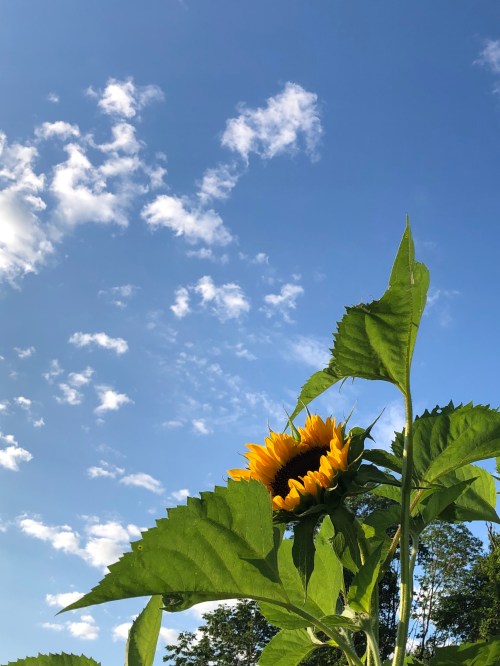
080620-sunflower-in-community-garden

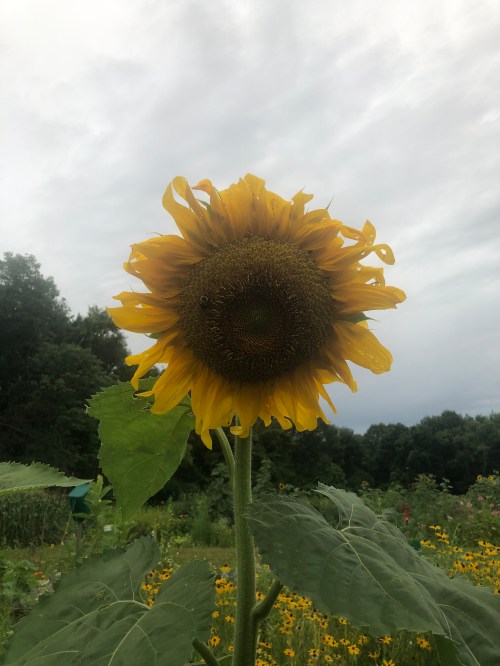
Sunflowers are wonderful on gray days or sunny, but they seem happiest on sunny days. Gardeners in the local community garden plant a lot of sunflowers, probably to keep the birds busy and away from other plants.

I took the second sunflower photo on a gray day when I happened to notice how prettily this lady’s hair was arranged around her face. I haven’t been to my hairdresser for many moons. Although I’m concerned for her and her coworkers, who need to make a living, I’m still too afraid to go in buildings where coronavirus droplets might linger in the air. I’m hoping my hair ends up with a sunflower naturalness — but a scarecrow look seems more likely.

Going deeper into the garden to capture the first photo, I noticed an arbor I hadn’t seen before. All Morning Glories!

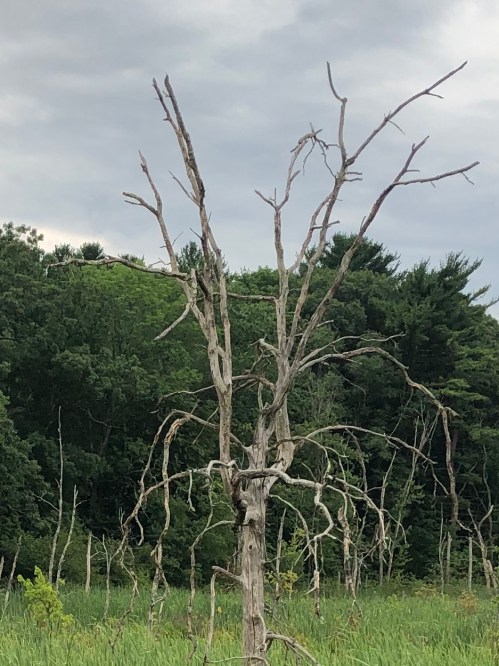
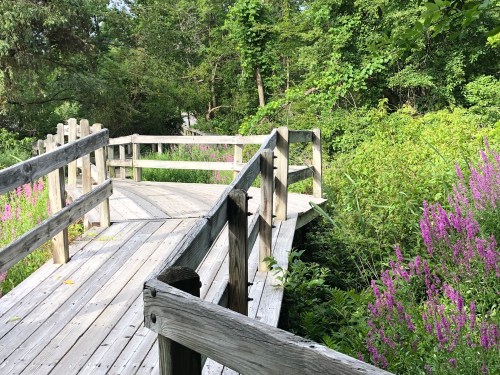
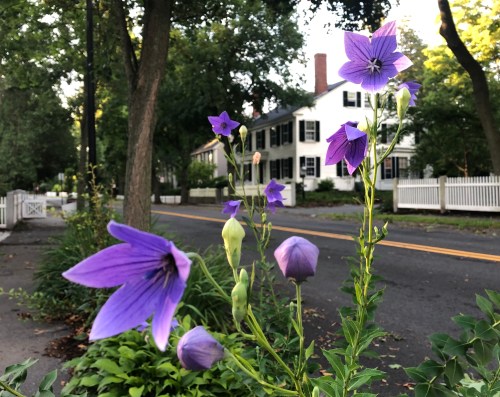
In other walks around town, I was drawn to a stark tree skeleton in a quiet swamp and Purple Loosestrife crowding around a footbridge. The Balloon Flower (or Japanese Bellflower) I suddenly started noticing in local yards after studying a painting on a calendar that a friend in Hokkaido sends me every year. I had never zeroed in on those balloon-like buds before.

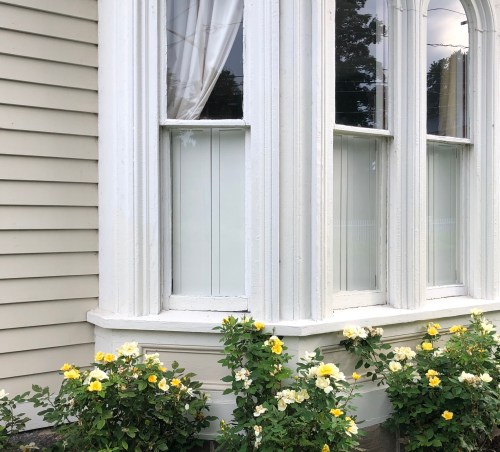
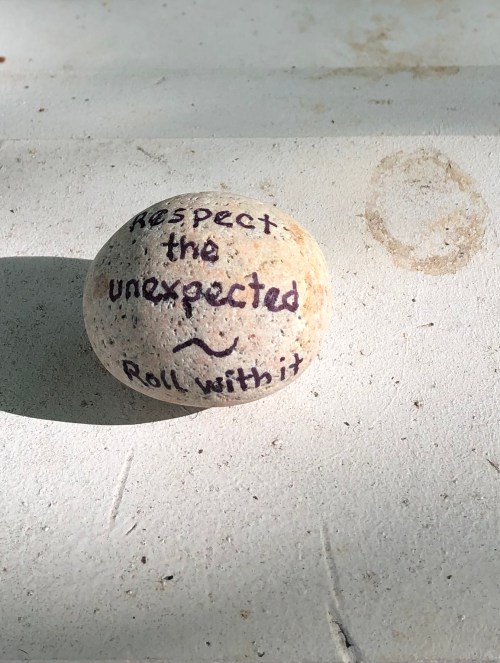
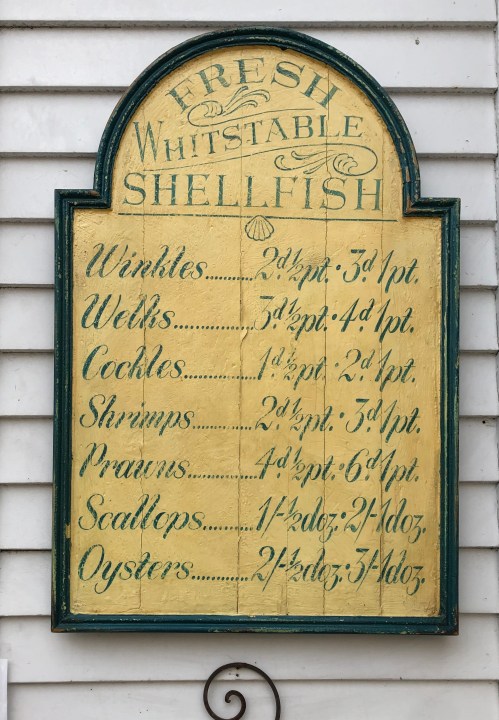
Next are yellow roses, a bizarre fungus, and good advice on a small, wise stone. The old seafood sign was outside an antique shop. I’m also sharing a picture of produce that the grocery store delivered the other day, and a blueberry-raspberry cake I made for our very quiet 50th anniversary.

The sheep were sent to me by Stuga40, who sees many wonders on her walks in Stockholm, a city that knows the value of nature.

080420-sunflower-on-gray-day

080620-arbor-in-community-garden

073020-wetlands-Cambridge-Turnpike

073120-loosestrife-by-bridge

080520-balloon-or-Japanese-bell-flower

073120-yellow-roses

072920-mystery-fungus

073120-respect-the-unexpected

073020-antique-seafood-sign073020-green-still-life073120-very-berry-cake

20200729-sheep-in-Skogen-Sweden


Photo: David Sowells via Upworthy
Henry Sowells, 16, in his garage in Bethesda, Maryland. Sowells is selling homemade furniture and donating the profits to Bethesda Cares to help people experiencing homelessness.

Enterprising folks have taken advantage of being home all day to take on a new challenge. This high school student and his father enrolled in an online woodworking class. But they didn’t stop there.

As Teddy Amenabar reported in a July Washington Post article, “Three months ago, 16-year-old Henry Sowells didn’t know the first thing about woodworking. Now, he has people asking him to renovate their kitchens.

“Henry is quick to say he can’t install your granite countertops, but he can build you furniture out of pine. Henry, a rising junior at Walt Whitman High, has turned his budding hobby into an act of goodwill with help from his father, David. For every piece of furniture Henry builds and sells to neighbors, he is donating [the profits] to a local nonprofit, Bethesda Cares, which serves those experiencing homelessness in Montgomery County. …

“After schools shut down in the Washington region in mid-March because of the growing number of novel coronavirus cases, David and Henry started a six-week online woodworking course from Steve Ramsey, a YouTube creator who uploads instructional videos for those interested in learning the craft.

“When Henry’s high school classes moved online, Henry and his family noticed that the school district’s priority was making sure students with free and reduced-price meals had food.

There were frequent discussions around the Sowellses’ dinner table about the wealth disparity in the United States, which led Henry to his idea — to sell the furniture he has built and donate the profits to people nearby who are fighting hunger. …

“Henry sells seven different products for a variety of prices — a small bench costs $100, wooden crates are $35, and a patio table is $85. Each item on the website includes a cost breakdown for the parts and how much money would go to Bethesda Cares.

“For example, he explains that for the $100 bench, parts cost $60 and $40 goes to Bethesda Cares. Henry said some customers have paid more than the asking price, and he donates any extra money to the nonprofit.

“Most of the designs come from the tutorials that Henry followed with his dad. But he also created his own design for a raised planter bed after a request from a customer. …

“David Sowells learned the basics of woodworking along with Henry, but he said Henry runs the show. David’s contribution is that he drives three times a week to Home Depot so he can stock up on wood and other supplies. …

“Henry’s first orders came from dog walkers in his neighborhood, Woodhaven. To get the ball rolling, Henry made one of every product he offers and set up a display in his driveway. That way, when people walked by, they could see the furniture and take a flier to learn more about how to buy their own stool or bench. …

“Heading into the summer, Henry was going to intern at a local dentist’s office, but the coronavirus made that impossible. … Depending on how the school year goes, Henry’s plan is to keep building and selling furniture through the end of the year. Henry said he already has ideas to make cutting boards or other gifts around the holidays.”

More here.

Ben Hoyle of the UK-based Times writes that Christine Walevska went to Facebook to post a painting of herself at aged eight with her child-size cello.

Here’s a story about a virtuoso’s stolen cello that has a happy ending. I initially learned about it from the Los Angeles Times, where reporter Stacy Perman starts out with a bang: “It was Sept. 14, 2013, when a mysterious email bearing the subject line ‘Is this your first cello?’ landed in Christine Walevska’s inbox.

“The renowned cello virtuoso, however, checked her emails infrequently. … And so six months passed before she clicked on the missive sent by strangers living in Chico, Calif.

“ ‘Maybe you will recognize this cello,’ the note read, describing the instrument made by the 19th century French luthier Auguste Sébastien-Philippe Bernardel. Three photographs were attached.

“Walevska scanned the first two, showing the front and back of the instrument. When she pulled up the third, her heart nearly leaped from her chest. ‘I was so shaken up,’ she recalled.

“The image revealed the luthier’s label, visible through one of the curlicued f-holes. Across it was a note inscribed in the feathery pen of the master himself: Pour la petite Comtesse Marie 1834. ‘For the little Countess Marie.’

“ ‘I could hardly believe it,’ she recalled. The cello had been given to her as a child by her father; nearly 40 years earlier, it had been stolen. …

“Walevska responded to the email with alacrity: ‘Please phone me as soon as you can! Anxiously awaiting your phone contact.’ …

“Her father, Hermann Walecki, an internationally respected dealer of fine and rare classical instruments in Los Angeles, [had] presented the little cello to her in 1953. She was 8½. …

“[Even as she outgrew it,] she remained stubbornly attached to the Bernardel, said her brother Fred, recalling how hard-pressed she was to move up to a larger instrument. Hermann mounted the little cello on a wall in his store, telling her, ‘You will hand this down to your daughter, and her child after that.’

“When Hermann died in 1967, Fred took over the music shop and transformed it into a rock ‘n’ roll mecca — the place where everyone from the Beach Boys to the Rolling Stones went to buy guitars and have them repaired.

“Then one day in 1976, two men in their 30s walked into the store. ‘Wow, what a far-out store,’ Fred remembered one of them saying. ‘You must have a lot of expensive things. What are the most valuable?’

“Without thinking, Fred immediately pointed to his sister’s cello on the wall, as well as a custom-made guitar with mother-of-pearl inlay. That night, after closing, the store’s windows were smashed, setting off the alarm. By the time the police arrived, the cello and the guitar were gone.”

♥♥♥

Years later, when the Breshears family decided to rent a child-size cello from a reputable dealer for their daughter Starla, Julie Breshears “found the label intriguing,” the Los Angeles Times continues. ” ‘I thought it was crazy that this belonged to a countess and nobody knows about it.’

“So she searched the internet looking for clues. When she typed in ‘Bernardel’ and ‘Pour la petite Comtesse Marie 1834’ she came across an interview that Christine Walevska had done with the Internet Cello Society. The Breshearses decided to reach out to her. They typed up an email, attached three photos and waited.

“It was shortly after Walevska’s birthday, March 8, 2014, when she spoke to the Breshearses.

“The conversation started on a note of wariness but quickly turned to amazement. The Breshearses described how Starla had been winning contests and was about to solo with an orchestra. Walevska recounted the instrument’s theft. ‘Now you know the true story of that instrument,’ she told them. The Breshearses were dumbstruck.

“Before they ended the phone call, Dustin told her, ‘You should have your cello back.’

“ ‘We’ve got to figure out how to handle this properly,’ she replied.

“The Breshearses sent Walevska videos of Starla playing the cello, and as she watched Starla perform, Walevska saw herself. ‘I knew immediately, she was a big talent,’ she said. ‘This little girl’s name, Starla, is well chosen.’

Click here to read how a lovely relationship developed between the former child prodigy and the little girl she met because once upon a time a beloved cello was stolen.

The London Times has additional information here.

Photo: Damien Finch et al
Mud-wasp “nests go hard and mineralise over time,” reports the BBC. “(1) Dating nest material on top of the paintings gives a minimum age only.” (2) Removing the nest allows researchers to ascertain the maximum age.

Prehistoric cave paintings, it seems, still have secrets for the enterprising to unravel. Researchers, with the active support of the local Aboriginal community, recently learned that calcified wasp nests could help determine when some of those paintings were created.

Jonathan Amos reported at the BBC, “When the veteran telecoms engineer Damien Finch went on a three-week bush walk in Australia’s Kimberley region, he became enthralled with its rock art. On his return home, he tried to find out more about these enigmatic aboriginal paintings and engravings.

” ‘I couldn’t believe how little was known about them; we didn’t even know how old they were,’ Damien said. ‘It seemed disrespectful that scientists hadn’t studied this stuff more; it was downplaying the importance of the culture,’ he told BBC News.

“Now, 10 years on and in his 60s, Damien is putting that right. He’s approaching the end of his doctoral research on the topic, and in [a February issue of] Science Advances journal, has published his own efforts to age the Kimberley’s so-called Gwion figures.

“These feature finely painted human forms, often in elaborate ceremonial dress and carrying spears and boomerangs. It was thought they were painted some 16,000 years ago, but the University of Melbourne investigator has been able to show the likely age is [about] 12,000 years ago.

“Dating rock art is really hard. Aboriginal artists use iron oxide pigments (ochre) which contain no organic material and are therefore resistant to any radiocarbon analysis.

“Damien has got around this by studying instead the scraps of organic matter stuck on top of and underneath the paintings. And for this, he’s working with wasps. In particular, the ones that build nests out of mud. …

“When the female wasp gathers her mud supplies she inevitably picks up fragments of charcoal from the Kimberley’s fire-prone landscape. And this charcoal can be radiocarbon dated. … Material that smothers pigment gives a minimum age; underlying material provides a maximum age.

“A distribution of dates from many locations enables an estimate to be made for when the Gwion style was in vogue. …

“The paintings [Damien] and his team have been working on are, of course, sites of immense cultural significance. All the sampling was guided and approved by representatives from the traditional owners of the artwork.

‘We couldn’t have done what we did without their active support and encouragement,’ ‘Damien told BBC News.

“He’s hopeful the mud-wasp dating technique can now be used at more locations right across the north of Australia, and perhaps at other rock art locations in the Americas and Europe.”

More at the BBC, here.

Photo: Peter J. Thompson/National Post/File
The Royal George Theatre in Niagara-On-The-Lake, Canada, is home to the annual George Bernard Shaw Festival. The National Post reported in July, “Shaw’s are among the only actors, musicians, and theatre workers in the world who still have jobs.”

When Suzanne was a toddler and John about 6, we made the pilgrimage from our home near Rochester, New York, to the famed Shaw Festival at Niagara-on-the-Lake. Curiously, although it’s a June event, I think of the festival every year in December when I hang Christmas tree ornaments that I bought in Niagara-on-the-Lake.

The main focus of the festival is the oeuvre of playwright George Bernard Shaw, but there are other offerings. We took turns babysitting, and I went to see the British concert comedienne Anna Russell (1911-2006), always hilarious.

But I digress. Today’s post is about the Shaw Festival, but not about the performances.

Calum Marsh writes at Canada’s National Post, “About three-and-a-half years ago, Tim Jennings, the executive director and CEO of the Shaw Festival in Niagara-on-the-Lake, decided to undertake some risk analysis alongside his CFO. He looked at potential problem areas, and at concerns that might arise throughout the course of an ordinary season of theatre, and came to a shrewd conclusion: The festival should take out an insurance policy against the threat of a pandemic.

“The policy covered the interruption of planned performances by communicable disease. As a consequence of that remarkable foresight, the Shaw Festival has been able to do the basically impossible …

In an industry that has been universally devastated, the festival has kept its more than 500 employees on the payroll full-time.

“Almost everyone in the field of arts and entertainment has been out of work since the beginning of the lockdown, when live performances became a logistical impossibility. But thanks to the coverage, Shaw’s are among the only actors, musicians, and theatre workers in the world who still have jobs. …

“Given how few people were prepared for such an incredible turn of events — and how many businesses, including major corporations, failed to anticipate such a contingency — the Shaw’s insurance policy doesn’t look merely fortuitous. It looks downright prophetic. Jennings insists he is no Nostradamus. He was simply planning ahead.

‘People keep telling me it was genius,’ Jennings says, reflecting on this extraordinary stroke of luck. ‘It wasn’t actually genius. It wasn’t about this pandemic at all — it was about communicable disease.’

“In his time working in theatre Jennings has seen a minor stomach bug waylay productions on countless occasions. Shaw employs a rotating repertory ensemble; if one of his actors got the flu, ten of them could, and that might stall a show. ‘We took it out for the whole season, thinking that if six actors got ill and we had to shut down for two weeks, we might lose two million bucks,’ he explains. ‘But the policy also very clearly covered a pandemic. That was really a useful piece of good fortune.’

“No insurance policy is perfect, of course, and the Shaw Festival, Jennings points out, is ‘still running into money issues, as one would expect.’ But it is nevertheless the only organization of its kind to have managed to keep so many people employed and working when the actual work they do isn’t feasible.

“The festival has also taken advantage of the CEWS [Canada Emergency Wage Subsidy] to offset the cost of paying its people — including the many actors and musicians who aren’t technically eligible, as independent contractors, thanks to another canny move. ‘Our actors rehearsed on Zoom from March through May, waiting to get back on stage,’ he says. ‘When it became clear that it wasn’t going to happen, we pivoted.’

“Jennings terminated their contracts, instead hiring them on as employees, under the title Education and Community Outreach Specialists.

“[They] made calls to donors, taught choreography to students over Zoom, and performed for the ill in hospice. ‘I was able to rehire all of the artists, actors, and musicians, plus about ten more. All of these artists are able to get back to work.’ ”

Such a nice story! Read more here.

Hat tip: ArtsJournal.com

Art: Diana Beltrán Herrera
The artist makes birds and other wildlife from paper and in recent years has started to use her art to support nonprofits fighting for the environment.

Although it is not new for artists to celebrate nature — a compulsion dating at least to prehistoric cave paintings — there’s a new sense of urgency in the era of global warming.

In a 2018 article in the New York Times, for example, 12 artists described how the crisis is influencing their work.

Here artist Xavier Cortada explains to the Times why he made a work showing residential street numbers underwater. “In response to South Florida’s vulnerability to rising sea levels, the village of Pinecrest, Florida will encourage its 6,000 households to install an ‘Underwater HOA [Homeowner Association]’ yard sign (similar to the 18- by 24-inch ‘Home for Sale’ yard signs used by realtors) on their front lawns during the first week of December. I numbered each yard sign from 0 to 17 feet (the municipality’s land elevation range) to show how many feet of melted glacial water must rise before a particular property is underwater.” Oy.

Art: Xavier Cortada
This painted sign is a marker that someone can plant in their yard showing that the property would be underwater with a sea-level rise of five feet.

Meanwhile, the fascinating website This Is Colossal has for some years been following the amazing paper creations of Diana Beltrán Herrera as she expands from birds she knows to environments she has never seen to helping nonprofits battle climate change.

Grace Ebert writes, “In 2012, Bristol-based artist Diana Beltrán Herrera [began] sculpting impeccably layered paper birds and other wildlife as a way to record her surroundings. Her lifelike pieces continuously have captured nature’s finely detailed and minuscule elements, like the fibrous texture of feathers and the veins running through leaves.

“Today, the artist has expanded the practice to include exotic species and environments she’s never seen up close, developing her paper techniques to express the more nuanced details of the shapes and textures she studies in biology books. Now focusing on the structural elements of fungi, fruit, and florals, Beltrán Herrera shares with Colossal:

‘Paper as a medium for documentation allows me to register and create notions and ideas of subjects that I have not experienced in real life but that I can experience when a sculpture is completed. I like this approach because it is not harmful, and through my work, I can show and tell my viewers about the things I have been learning, of the importance of nature just by researching and making it myself.’

“Much of her work centers on conservation efforts and environmental justice. For example, a recent commission by Greenpeace UK bolstered the organization’s Plastic Free Rivers campaign. ‘I am constantly looking for more subjects that are relevant to the times we are living in, so that through my work I can communicate important information that can educate or just make things more visible.’ …

“Her hope is to merge graphic and digital design with her paper pieces, potentially adding in animation, as well. Ultimately, her goal is to dive into larger projects. ‘I don’t see my work as something I want to know how to make and stay safe, but as a challenge, that will always allow me to wonder how to execute and create things that were never made with paper,’ she says.” More.

Other Colossal articles on the artist’s work can be found here. Follow her on Instagram, @dianabeltranherrera.

A musical composition created from climate-change data is another example of using an art to raise consciousness about the current state of the natural world.  From the website Science News for Students.

Photo: Daniel Biber, via the Independent
A murmuration of starlings was targeted by a bird of prey and took the form of a giant bird. But contemporary scientists insist “thinking” isn’t involved. 

The natural world never ceases to amaze. Consider the flight of large groups of starlings. You have probably seen some of the YouTube videos. Mark MacNamara wrote about the phenomenon at Nautilus in March.

“Eugene Schieffelin was the eccentric ornithologist who in 1890 shipped 60 starlings from London to New York City and set them free in Central Park. The next year he released 40 more, and today there are maybe 200 million starlings in the United States and Southern Canada. [Starlings] are shrewd flyers, clever mimics, and often unwelcome … displacing woodpeckers and flycatchers, and destroying entire crops of berries and cherries. Not to mention the havoc they cause at many airports.

“Ah, but when they come round in their murmurations on fall afternoons, or in early winter, what magicianry is that, gathering up out of nowhere, arriving in strands or massive clusters, over inlets or forests. You’ll see them fill up neighboring trees and fall into an oily, high-pitched chatter. [The] most subtle spooking will do it, a dog’s bark, the slam of a car door down the street, or nothing at all, and off they go at 50 miles per hour, wheeling around the countryside, sheets and sheets of them, thickening and thinning, blackening and scattering, merging and splitting. …

“The performance is self-organized, cohesive, and perfectly synchronized; and distinguished by elaborate patterns of spirals, spheres, planes, and waves. What causes starlings to perform these displays? …

“Theories have evolved over the last century. In 1931, Edmund Selous, a renowned ornithologist and bird activist [sumised] that birds in a flock must all be ‘thinking’ as one; how else to explain the synchronization except by telepathy. …

“Later theories suggested that murmurations are ways to find food and keep warm. Those theories linger, but in the past 50 years the predominant explanation is predation, particularly the role of raptors, such as hawks and falcons, in triggering escape behaviors that involve particular patterns of grouping. …

“In the mid 1960s, researchers found that murmurating birds, particularly starlings, interact—not always, but often — with six or seven of their closest neighbors, who interact with six or seven of their closest neighbors. In recent years, studies posit that a network with seven neighbors optimizes the trade-off between ‘group cohesion and individual effort.’

One theory among researchers, in the context of predation, is that starlings are ‘managing uncertainty while maintaining consensus.’ …

“In a murmuration, the distance between fellow fliers is based on a set of rules also seen in certain kinds of fish and insects. These rules require birds to draw closer to birds farther away; at the same time, not to get too close to the nearest neighbor; and finally to join in directional flow. Add to these rules the aerodynamic factors in starlings — and the blistering speed at which the birds turn, climb, and dive — and you have a sense of the intricacy of flock synchronization. …

“In 2019, evolutionary biologist Rolf F. Storms at the Groningen Institute for Evolutionary Life Sciences in the Netherlands, led a study on starlings that delved into the rules of murmurations. … The study [found] different patterns of escape by the starlings.

“For example, when a falcon attacked a flock from above — not from the sides or below, and at high speed — the starlings frequently [scatter] in all directions in the sky. … When a falcon attacks starlings at medium speed, allowing it to be detected, warnings spread through the flock, and the birds respond in a ‘wave.’ They turn right and left, zig and zag, creating ‘darkened bands’ that ripple through the flock, confusing the falcon. …

“Grainger Hunt, Senior Scientist Emeritus with the Peregrine Fund’s California Condor and Aplomado Falcon restoration project, underscores the fact that murmurations are emergent. …

” ‘The peregrine does not purpose the shapes and movements of the flock. Nor does any starling. The spectacle of wondrous shapes and movements is an unintended effect. The peregrine is trying to catch a starling, and each starling is trying not to get caught.’ ” More.

Would you agree that humans need to learn from the starlings how to maintain consensus while managing uncertainty? What a concept!

Video: Dylan Winter
A murmuration of starlings.

Photo: Hong Seo-yoon 
Hong Seo-yoon is a South Korean advocate for accessible tourism. In her book Europe: There’s No Reason Not to Go, she even has a section on paragliding.

International tourism may be in a Covid-19 slump, but there are lots of people aching to get back to it. At Public Radio International (PRI), Jason Strother reports on a South Korean world traveler who uses a wheelchair and has shown through her life and writing that sometimes it takes only small changes to enable everyone to travel.

“Hong Seo-yoon maneuvers through shifting clusters of picture-snapping tourists outside of Deoksugung, a palace in downtown Seoul. Before passing through the former royal residence’s wooden gate, she adjusts her motorized wheelchair’s speed ahead of a gradual incline in the stone walkway that leads into a tree-lined courtyard.

“The 32-year-old explains that even small modifications, such as replacing a step with a ramp, give people like her access to places that otherwise would have been difficult if not impossible to enter independently.

“Hong says that many people are often unaware that when it comes to tourism, sightseeing or even extreme sports, many people with disabilities, whether they are blind, deaf or use a wheelchair, ‘all want the same things.’

‘They want to travel, they want to visit places, I don’t think there’s a difference,’ Hong said. ‘Having a disability is not something special or weird.’

“Hong is the founder of Tourism for All Korea, a nonprofit that advocates for greater inclusion in the country’s tourism industry for people with disabilities and makes policy recommendations for improvements in this sector. She’s also the author of Europe, There’s No Reason Not to Go — the first travelogue written by a wheelchair user from her country.

“Her work has informed Seoul’s efforts to make its streets, transit and tourism locations more inclusive for citizens and visitors with disabilities. … A generation ago, a person with a physical or intellectual difference might have been ‘a  shame to their family,’ she said, theorizing this attitude was a consequence of South Korea’s postwar trauma that placed economic growth and competition paramount to other concerns.

“The Korean War in the early 1950s left the South in ruin and poverty. In 2007, South Korea passed the Disability Anti-Discrimination Act, but Hong believes some people still hold onto old biases. …

“Her own experience facing physical and social obstacles underlie her advocacy. When Hong was 10 years old, she suffered a spinal cord injury during a swimming pool accident that paralyzed her from the waist down. At that time, ‘Korea wasn’t accessible at all’ for wheelchair users, she said.

“She recalls her brother pushing her alongside cars in the street since there were no sidewalk curb cuts in her provincial hometown. Hong says she also faced discrimination when her parents were told to send her to a distant institution for people with disabilities because there wasn’t an elevator in the local, four-story grade school.

“Her family instead moved to the Philippines, where a nurturing teacher told Hong that ‘being disabled was not abnormal,’ she said.

“When she returned to South Korea to attend the university, Hong had learned to stand up for herself. She got a taste for activism when her school’s administration refused to relocate a class to the ground floor. Hong fought back and won. …

“Her book idea was rejected by two publishers that told her ‘no one would read about disability stories,’ she said. ‘It really hurt me.’

“After promising to buy any unsold copies, Hong convinced the company Saenggak Bi Haeng in 2016 to take a chance with her book. But, she did not have to live up to her end of the deal — all 3,000 copies sold out, and now, the title is in a second-print run. …

“She believes travel and tourism are ways people with disabilities and the nondisabled can connect with each other and help nondisabled people overcome their biases.

“ ‘Suddenly, they meet a disabled person in their life and they change,’ she said. ‘They change their mind about what [are] disabled people and how to live with disabled people.’ ”

More here.

Photo: Murdo MacLeod/The Guardian
A music and performance space in Springburn Park, Glasgow, Scotland, was created inside a steel hut by repurposing old pianos.

We had a parlor grand for many years, and I took lessons on it. It had belonged to my mother-in-law, who was much more musical than I. After I stopped playing, the piano sat forlorn a long time, drawing the attention only of toddler grandchildren. My husband decided maybe we could use the space. The piano did need work, and no one was buying a fixer-upper at the time, so he gave it away to a guy who would remove it.

What do you think that guy wanted a piano for? He planned to rent it to companies staging high-end houses before they went on the market. Ugh. What a sorry end for that piano! I like the idea in today’s article much better for an instrument that had once been loved.

Libby Brooks writes at the Guardian, “Inside a cavernous steel hut in the middle of Glasgow’s Springburn Park, the sweeping arc of keyboards, lids and carved panels has been taking shape, creating the UK’s first permanent auditorium made entirely of recycled pianos.

“Using mainly upright instruments, with a baby grand artfully sliced in half to make a corner balcony, about 40 pianos have been expertly disarticulated to create the tiered seating.

“ ‘When you dismantle a piano you end up with a kit of different parts, from the ornate front pieces to the strong planks normally hidden beneath the key,’ explains Tom Binns, who founded the Glasgow Piano City project in 2013, finding new uses for unwanted instruments in public places from hospitals to bookshops.

“It was Binns who brought together a Glasgow community activist with big plans and the Edinburgh-based instrumental innovators Pianodrome in what he says is a testament to the collaborative potential of social enterprise.

“Two years ago, Alex Docherty, a hip-hop artist and chair of Friends of Springburn Park, countered plans to demolish the site where the massive hut stands with a proposal for a community village with an event space, cafe and outdoor classroom.

“ ‘When I talk to my gran who grew up in Springburn, it used to have cinemas and places to go,’ Docherty says. ‘But since the decline in industry and the motorway demolitions [creating the unpopular dual carriageways and flyovers that bisect Springburn] they disappeared. We really need a community space in the area.’

“The area has its problems, including widespread unemployment and a high rate of drug deaths, but ‘there’s been an energy of change in Springburn over the last few years,’ Docherty says. …

“The plan to use old pianos for the seating came through Binns. He visited the team at Pianodrome, whose mobile amphitheatre has impressed audiences at previous Edinburgh festivals as a creative response to consumer culture, to see their initial constructions. ‘I thought: “This could work,” ‘ he says.

‘We were hired to design a permanent theatre space,’ says Matt Wright, a co-founder of Pianodrome. ‘It breaks down the division between audience and performer. You’re sitting on an instrument while you watch and listen to someone play.’ …

“Wright says the arrangement of benches rather than having separate seats is more appropriate to social distancing: ‘You can space people out but it doesn’t look so stark as having empty seats.’

“For Binns, the project has grown out of a respect for people’s deep connection to their individual instruments and the hopes they have when they pass them on. ‘People have an extraordinary emotional attachment to their instruments and would be heartbroken to see them go in a [dumpster]. We’re giving pianos a new life.’ ”

More here.

Photo: Sam Butler
“Two-year-old Lula-Belle Butler-Wenlock-Simpson, who was born with heart problems and underwent open-heart surgery, poses with a Special Friends doll whose scar mirrors her own,” explains PRI.

At Public Radio International (PRI), a distributor of some of my favorite shows, I recently learned about personalized dolls for children with disabilities and other big challenges. Bianca Hillier reported the story at PRI’s “The World.”

“Dolls have come a long way since the 1950s. One of the first TV commercials for Mattel Inc.’s Barbie doll sang: ‘Barbie’s small and so petite. Her clothes and figure look so neat.’

“While modern-day dolls aren’t confined to quite as rigid looks, the industry still has room to expand its inclusivity — especially for children with disabilities.

“That’s the challenge Victoria Band faced when her son was growing up. He is deaf in both ears and uses hearing aids. When he was younger, she wanted to give him a doll that also used hearing aids to show that he was not alone.

“ ‘When he went to his [medical appointments], he’d say, “Mommy, it’s a scary place at first. You don’t know what’s happening. You don’t know what [the hearing aids] are going to look like,” ‘ Band said. ‘So if [only] there was a doll there and they could say, “Oh, look, this is what you’re going to have in your ears. Look at all the different colors you could have.” ‘ …

“Band, who has always been crafty, started making her own dolls last year. She called the business ‘Special Friends.’

Working from her home in Dewsbury, England, she now makes dolls who have scars, cleft lips, hearing aids, oxygen tanks, or anything else that matches a child’s special needs. Many of the dolls are custom-made. …

“Band’s handmade dolls have since helped hundreds of kids, including a little girl named Lula-Belle who was born with heart problems and had open heart surgery at 14 weeks old. Lula-Belle is 2 years old now and has a scar down the middle of her chest. Her mom, Sam Butler, found out about ‘Special Friends’ on Facebook. …

“ ‘When she got her first doll, she was like, “Mommy, scar! Scar! Scar! Me scar, me scar!” ‘ Butler recalled. ‘And she pulled up her top. And she was matching scars with her baby.’ …

“Special Friends has been up and running for less than a year, but Band has already sent dolls beyond the United Kingdom to Germany, the US, and Australia. She says seeing the reactions come in from around the world is priceless.

“ ‘You can’t ask for much more than seeing a child really happy,’ Band said. ‘That’s worth more than anything.’

“Band added that the dolls can also be used as an educational tool to teach kids about medical equipment, surgeries, and conditions they may not know about. People need to be ‘more aware,’ she said, so that other children aren’t made to feel different in the first place.”

More at PRI, here.

Photo: Veronica Blaylock
Lucy Blaylock of Gallatin, Tennessee, makes blankets for kids who need a little extra love.

I’ve shared a lot of articles lately about kids stepping up to help people in distress, but I never get tired of them. Oftentimes, it’s not just the product that matters to recipients, but the sense that someone is thinking of them. Feeling connected to a kind stranger can be as comforting as a favorite blanket.

Andrea Sachs wrote about this at the Washington Post, “Blankets can keep you toasty on cold nights or clean and relatively ant-free on picnics. Lucy Blaylock and Tori Holmes make blankets for a different purpose: to comfort people going through difficult times. … We spoke to the girls, who each won a Prudential Spirit of Community Award, about their inspiration, who has received blankets and how kids can get involved in helping others.

“Lucy learned to sew three years ago, when she was 8. After she made a flannel blanket for a friend’s birthday, she started to think about other kids who might need a little extra love. She asked her parents if she could organize a giveaway and shared her idea on her mom’s Instagram account (lucysloveblankets). She received 16 responses from children facing issues such as cancer, autism, bullying, divorce and the death of a grandmother.

“ ‘It makes me excited when I think of the kids getting the package in the mail and opening it,’ said the 11-year-old, who just completed fifth grade in Gallatin, Tennessee.

‘I always hope they know someone cares about them.’

“Since 2017, Lucy has donated about 500 Lucy’s Love Blankets to kids living in 14 countries and nearly three dozen states. She spends about two hours sewing the fabric by machine and hand-stitching her name inside a heart — her logo, of sorts. During the coronavirus pandemic, she turned her attention to making masks for health-care workers, but she jumps back into blanket action when she receives a request from a child suffering from a terminal illness. ‘Even though it gets a little hard sometimes,’ she said, ‘it is always the right thing to do.’

“For kids interested in volunteering, she recommends they forge ahead without overthinking it. ‘Don’t wait until you have everything figured out. Just do it, and keep going,’ she said. ‘Even when you feel like it might not be making that big of a difference, serving other people always matters.’

“Tori knows firsthand the challenges of being separated from a parent. When she was 6 years old, her mother was hospitalized for six months with leukemia. Tori moved into her aunt’s house, leaving her Corning, New York, home so quickly that she had only enough time to pack an overnight bag.

” ‘I missed my blanket and, of course, I missed my mom,’ the 13-year-old said. … Last July, inspired by her own experience, Tori started to make pairs of blankets for family members kept apart by unfortunate circumstances, such as illness. The parents receive one blanket; the kid gets the other one.

“ ‘I wanted to make a magic blanket that connects people,’ she said. ‘This way they have hope that they will be together again.’ …

“She donates the blankets to a children’s hospital, the medical-care facility that took care of her mother and the school where her mother teaches. Families can also request the twin blankets at operationstarways@gmail.com. …

“Tori, who will enter high school in the fall, said … ‘I want to give people who are going through what I went through hope.’ ”

Summer Weather

Summer heat means taking walks earlier and earlier.

Today I’m sharing a bunch of my recent photos, plus three from friends. It’s great that so many self-isolating people are sending pictures to each other now. Have you noticed?

Kristina sent the red flower below, which I believe is a Chinese Hibiscus. She lives in my town, but we don’t get to see each other as regularly as before Covid. The next two photos are from Melita, who is currently living in Madrid. Spain was hit hard by the virus, and Melita says she’s grateful for the relative safety of the gardens she can walk tThe rest of the photos are mine. For weaving bloggers, I took a picture of the handsome dishtowel a childhood friend made and sent me out of the blue. I positioned it on top of a pillow cover her parents wove many years ago. She carries on the traditional craft.

My local community garden is coming along beautifully and providing a temptation to more than birds. Hence the sign.

Funny to be regarding as art the commuter train that was part of my working life for decades.

Louisa’s grave in Sleepy Hollow Cemetery is never short of writing utensils. I love checking it out. And every day that I take a walk near there, I see more gravestones I want to photograph. Shadowed ones for example.

The next four photos show art on the Bruce Freeman Rail Trail, courtesy of Umbrella Art Center artists. The painted doors are by Sophy Tuttle, and the woodland shelving is by Rebecca Tuck.

The various lilies belong to neighbors, and the bright pink flower is, according to the app PictureThis, a rose mallow, apparently a relative of Kristina’s flower.

The last three photos are from New Shoreham and include the historic home where the song “Smilin’ Through” was written — a fact, I fear, that only an islander would consider worthy of note.

072220-weaving-by-Ursula-and-parents

Photo: Library of Congress.
A New York City school around the time of the flu pandemic. History shows it’s possible to hold classes outdoors when the safety of breathing indoors is uncertain.

Photos taken in the 1918 flu pandemic show some schools holding classes with all the windows open or even outdoors. Could we do that today? Reporter Nate Berg at Fast Company looked into the question.

“Sharon Danks has been working for more than 20 years to get schoolkids outdoors,” he writes. “As a trained landscape architect and urban planner, she says too many schools across the country ignore the educational and health benefits offered by the outdoor spaces of their campuses. This is something she’s been trying to change through her nonprofit Green Schoolyards America, based in Berkeley, California. …

“In April, Danks began having conversations about reopening local schools with three other organizations in the San Francisco Bay Area. … In early June, the organizations cohosted a webinar on responding to COVID-19 by using outdoor spaces for education. More than 1,000 people from 40 states and eight countries registered.

“[The organizations then] created the National COVID-19 Outdoor Learning Initiative, an effort to create guidelines schools can follow to use their outdoor spaces more effectively in order to bring back face-to-face learning. Volunteers from across the country are now participating in 10 working groups focused on different aspects of moving classes outdoors, from funding to safety to the physical infrastructure needed to seat and teach students outside.

‘The central problem that we were looking at is that none of our schools were built to be able to accommodate kids 6 feet apart inside the building,’ Danks says.

“But what most schools are equipped with is outdoor space and playgrounds — spaces that can be adapted for outdoor learning. Through the use of physical objects such as shade structures and weatherproof seating and adjusted lesson plans that reduce teachers’ reliance on computer screens and overhead projectors, outdoor classrooms can allow classes to continue with the space and fresh air that epidemiologists believe prevents transmission of the virus.

“Outdoor learning can move all students outdoors, or at least shift enough of the student population outside to make indoor classrooms safe with smaller class sizes. Distance learning, with its inherent difficulties, inequities, and access challenges, may become just a rainy day backup plan. …

“In 2017, the San Mateo County Office of Education started an Environmental Literacy and Sustainability Initiative that focuses on increasing knowledge about environmental issues. It does so partly by integrating natural and outdoor spaces into school curricula. Andra Yeghoian, the initiative’s coordinator, says the program has been working to ensure that students at every grade level in its roughly 270 schools have daily access to outdoor learning and play spaces. … ‘Now COVID-19 has really flipped that to be that every kid at every grade level in every subject area can do the majority of their learning outside.’ …

“Danks estimates that only about 15% to 20% of schools in the U.S. have these kinds of facilities. ‘The other 80%, 85% of schools have probably never taken a class outside to do hands-on learning on their own site,’ she says.

“This is where the initiative’s working groups come in. Each is developing a set of two-page recommendations that will provide simple instructions for dealing with common outdoor complications like cold and hot weather, spatially distanced seating arrangements, dust, and insects. Eventually, the recommendations will be published as a free online guidebook. …

“Claire Latané is an assistant professor in Cal Poly Pomona’s landscape architecture department and is leading a group of volunteer landscape architects who are working directly with school officials to identify optimal spaces and sizes of outdoor classrooms. She says about 100 designers have signed up to help, and the first teams are using aerial imagery of campuses to find places with adequate shade, either under trees or carports, and ensuring any changes to school grounds comply with local fire and accessibility codes. They’re also advising on how the locations of outdoor classrooms can address weather concerns. …

“Three case studies have been published on Green Schoolyards America’s website, and offer suggestions for schools in different climates. … At a low cost of just a few thousand dollars, schools use only their existing outdoor shade and tree-covered areas, augmented with affordable seating such as hay bales and additional clothing for unexpected cold or wet weather. …

“The whole process of transitioning to outdoor education doesn’t have to be tortuous, Danks says.

‘In the last pandemic in 1918 to 1920, with tuberculosis and the Spanish flu, schools around the world went outside … even just moved their desks right outside their buildings,’ Danks says. ‘They didn’t overthink it, they just moved their space to where the air was fresher.’ ”

More at Fast Company, here.  Hat tip: ArtsJournal.

Photo: Volcano Discovery

I love stories about volcanoes that change the flow of history. The really big ones, you know, darken the skies for months — even years — and disrupt the sea like a tsunami.

As Katherine Kornei reports at the New York Times, there are other effects that researchers are just beginning to discover.

“Chaos and conflict roiled the Mediterranean in the first century B.C.,” she reports. “Against a backdrop of famine, disease and the assassinations of Julius Caesar and other political leaders, the Roman Republic collapsed, and the Roman Empire rose in its place. Tumultuous social unrest no doubt contributed to that transition — politics can unhinge a society. But so can something arguably more powerful.

Scientists [in June] announced evidence that a volcanic eruption in the remote Aleutian Islands, 6,000 miles away from the Italian peninsula, contributed to the demise of the Roman Republic.

“That eruption — and others before it and since — played a role in changing the course of history.

“In recent years, geoscientists, historians and archaeologists have joined forces to investigate the societal impacts of large volcanic eruptions. They rely on an amalgam of records — including ice cores, historical chronicles and climate modeling — to pinpoint how volcanism affected civilizations ranging from the Roman Republic to Ptolemaic Egypt to pre-Columbian Mesoamerica.

“There’s nuance to this kind of work, said Joseph Manning, a historian at Yale University who has studied the falls of Egyptian dynasties. ‘It’s not “a volcano erupts and a society goes to hell.” ‘ But the challenge is worth it, he said. ‘We hope in the end that we get better history out of it, but also a better understanding of what’s happening to the Earth right now.’ …

“Joseph McConnell, a climate scientist at the [Desert Research Institute in Reno, Nev.], and his collaborators are in the business of looking for debris [from long ago eruptions]. …

“Volcanic ash, more generally known as tephra, sometimes hides in ice. It’s a special find because it can be geochemically tied to a specific volcano. … The ice also carries a time stamp. Dr. McConnell and his colleagues look for variations in elements like sodium, which is found in sea spray that’s seasonally blown inland. By simply counting annual variations in these elements, it’s possible to trace the passage of time, Dr. McConnell said. ‘It’s like a tree-ring record.’

“Dr. McConnell and his collaborators recently analyzed six ice cores drilled in the Arctic. In layers of ice corresponding to the early months of 43 B.C., they spotted large upticks in sulfur and, crucially, bits of material that were probably tephra. The timing caught the scientists’ attention. Researchers have previously hypothesized that an environmental trigger may have helped set in motion the crop failures, famines and social unrest that plagued the Mediterranean region at that time. …

“Gill Plunkett, a paleoecologist at Queen’s University Belfast, set out sleuthing. After extracting 35 pieces of tephra from the ice, she pored over the rock chemistry of likely volcanic suspects. Nicaragua’s Apoyeque. Italy’s Mount Etna. Russia’s Shiveluch.

“But it was Okmok, a volcano in Alaska’s Aleutian Islands, that turned out to be the best match, at least on paper. Sealing the deal would require testing two tephra samples — one from the ice and one from Okmok — on the same instrument.

“Dr. Plunkett arranged for a tephra handoff at a conference in Dublin. A colleague from the Alaska Volcano Observatory, Kristi Wallace, packed four bags of Okmok tephra in her carry-on luggage. The match was spot on, Dr. Plunkett said. …

“This eruption was one of the largest of the last few millenniums, Dr. McConnell and his collaborators concluded, and the sulfate aerosols it created remained in the stratosphere for several years. These tiny particles are particularly good at reflecting sunlight, which means they can temporarily alter Earth’s climate. …

“There’s good evidence that the Northern Hemisphere was colder than normal around 43 B.C. Trees across Europe grew more slowly that year, and a pine forest in North America experienced an unusually early autumn freeze. Using climate models to simulate the impact of an Okmok eruption, Dr. McConnell and his collaborators estimated that parts of the Mediterranean, roughly 6,000 miles away, would have cooled by as much as 13.3 degrees Fahrenheit. … Rain patterns changed as well — some regions would have been drenched by 400 percent more precipitation than normal, the modeling revealed.

“That climate shock came at precisely the wrong time, Dr. [Jessica Clark, a historian of the Roman Republic at Florida State University] said. ‘This was a period of Mediterranean-wide political, social and economic upheaval.’

“These cold, wet conditions would have almost certainly decimated crops, Dr. McConnell and his colleagues said. Historical records compiled by Roman writers and philosophers note food shortages and famines. … For a society already reeling from the assassination of Julius Caesar the year before, such trying conditions might have exacerbated social unrest, the researchers concluded. They might even have kick-started transfers of political power that led to the rise of the Roman Empire.

“ ‘It’s an incredible coincidence that it happened exactly in the waning years of the Roman Republic when things were falling apart,’ said Dr. McConnell, who published the team’s results in Proceedings of the National Academy of Sciences.”

This was a long, fascinating article. For additional details, including details about the effects of distant volcanic eruptions on the Nile River in Egypt, click here.