Feeds:
Posts
Comments

69e5c57b-13a8-4f7b-90ca-5ec55c34bad9-768x675-1

Photo: Parklands Primary School
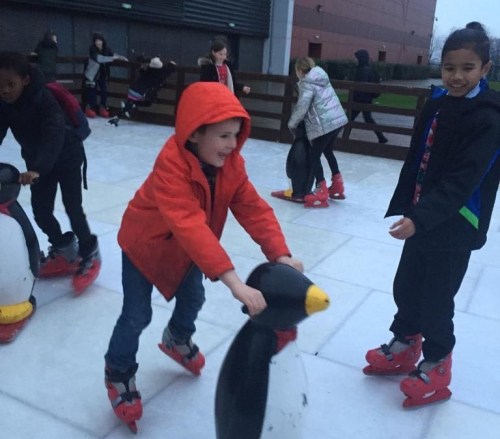
Children from Parklands Primary School in the UK enjoyed a Christmas extravaganza at the ice rink of Leeds East Academy. And Parklands staff volunteered their time to serve a hot Christmas meal.

Here’s a Christmas dinner story from the UK, one that would be perfect if it weren’t so necessary.

Alex Evans writes at the Yorkshire Evening Post, “Staff at Parklands Primary School volunteered their time to serve up a hot meal for the school’s 328 pupils and their families [Monday] at its ‘Christmas Eve Eve’ party.

“Youngsters were able to meet Santa Claus at the party which was set up by headteacher Chris Dyson. He says he was left ‘heartbroken’ when he discovered some of his pupils had never met Father Christmas and many wouldn’t receive gifts. …

“Each child received a Christmas present to unwrap — likely to be the only one they will receive this year, Mr Dyson said.

“The school, in Leeds, West Yorkshire, serves one of the largest council estates in Europe and an area in the top 1 percent in England for deprivation.

“Only a third of working-age adults have jobs and three-quarters of pupils qualify for the pupil premium, extra money given to schools from the Government to support the poorest children.

“Headteacher Chris Dyson, hailed ‘an inspirational leader’ by Ofsted inspectors said: ‘It broke my heart when I started at the school five years ago and found out that some families don’t even go to visit Santa, which is something we all just take for granted. …

” ‘So I said I would bring Santa to Parklands and get every child at least one present to open.’ …

“Mr Dyson’s initiative saw 150 people attend the school’s first party six years ago. The number doubled the following year and continued to grow. [Today] 800 people benefited from the headteacher’s generosity, which has been helped by donations from local business who have given cash and gifts, as well as Leeds City Council who have provided food.

“Mr Dyson added: ‘We are in the middle of one of the biggest council estates in Europe, a lot of our families don’t even go off the estate. …

” ‘Christmas is a vulnerable time for families, its cold and for some people it is the only hot meal they will get this week. I’m blessed that I have had so many presents donated that those with a birthday coming up will get a birthday present as well.’

“Mr Dyson took over at the school in 2014, after it went through five headteachers in just one year and was rated inadequate by Ofsted, the government’s education watchdog. It had the country’s highest number of annual exclusions and a padded cell was used as a form of punishment. Mr Dyson said he wanted to bring ‘love and smiles’ back to the school and has extended that to the wider community. …

” ‘It’s for the entire community, anyone can come and they all do. Our first year we had a lot of kids who didn’t come to our school come round, and I said Santa doesn’t turn people away. So we just welcomed everyone. … It’s a vulnerable time, food isn’t as plentiful here as where I live. It’s important they get a hot meal.

‘These kids will ask why doesn’t Santa answer my letters like he does to people in those middle class areas. I want to make sure they feel Santa hasn’t forgotten about them.’

More.

Just a reminder about the miracle of great teachers.

Hat tip: @HertsLearning on twitter.


afghan-peace-1_custom-2bf0e338cd1a8052480a2967558c666eaa9be5a8-s600-c85

Photo: Diaa Hadid/NPR
Farahnaz Mohammadi (left) and her cousin Fatima Almi, seen in a peaceful Kabul park, hope that the gains made by Afghan women in recent years will remain after a peace deal.

This story is about a peaceful garden in Kabul, Afghanistan, a city where peace is at a premium. Erik’s sister works for the UN in that city, helping women gain leadership skills, so of course, I want to believe in islands of peace like this taking over the danger zones.

Diaa Hadid and Khwaga Ghani reported on the Gardens of Babur at National Public Radio (NPR) in October.

“Farahnaz Mohammadi, 17, and her cousin Fatima Almi, 19, dress identically, from their patterned headscarves to their shoes with matching bunny ears. They also share the same opinions on Afghanistan’s future, which may be nearing a critical phase as a deal between the U.S. and Taliban insurgents appears to be reviving.

“That deal would likely see most American forces withdraw from Afghanistan, where they have been at war for 18 years. In exchange, the Taliban would not host global militant groups like al-Qaida and may adhere to some sort of ceasefire. It would also likely to allow the Taliban to reenter political life.

“The two young women don’t like it at all.

” ‘We will go back to what we were,’ says Mohammadi, referring to a time before she was born, when the Taliban ruled much of Afghanistan and imposed harsh rules against women. …

“Mohammadi’s view was echoed by other women interviewed by NPR in Kabul. The capital is more liberal than other quarters of Afghanistan, yet the uniformity of the opinions suggests a broadly held concern. …

“Mohammadi says she craves safety and security. But she has also benefited from the advances women have made with American forces helping to secure Afghan cities. Describing it as a ‘half-peace,’ she says even in those conditions, ‘girls can go out.’ She gestures around where she stands in Kabul’s Babur Garden, a centuries-old park where orchards and grassy lawns provide a shelter of sorts from the city’s dusty chaos.” More from NPR.

Wikipedia explains that the Garden of Babur “is the last resting-place of the first Mughal emperor Babur. The gardens are thought to have been developed around 1528 AD [when] Babur gave orders for the construction of an ‘avenue garden’ in Kabul …

“Since 2003, the focus of conservation has been on the white marble mosque built by Shah Jahan in 1675 to mark his conquest of Balkh; restoration of the Babur’s grave enclosure; repairs to the garden pavilion dating from the early 20th century; and reconstruction of the … Queen’s Palace. In addition, a new caravanserai was built on the footprint of an earlier building at the base of the garden …

“Significant investments have been made in the natural environment of the garden, taking account of the historic nature of the landscape and the needs of contemporary visitors. A system of partially piped irrigation was installed, and several thousand indigenous trees planted, including planes, cypresses, hawthorn, wild cherry (alubalu — allegedly introduced by Babur from the north of Kabul) and other fruit and shade trees. Based on the results of archaeological excavations, the relationships between the 13 terraces and the network of paths and stairs have been re-established.

“Since January 16, 2008, the garden has been managed by the independent Baghe Babur Trust and has seen a significant increase in visitor numbers. Nearly 300,000 people visited the site in 2008 and about 1,030,000 people visited the site in 2016.”

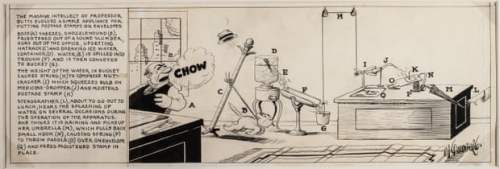
Cartoonist Rube Goldberg

6144

Illustration: Rube Goldberg
From 1914 to 1964, cartoonist Rube Goldberg ran a series called The Inventions of Professor Lucifer Gorgonzola Butts. This one involves postage stamps. (1929, ink on paper)

Rube Goldberg was a cartoonist known for his fanciful designs for machines, many of which inspired admirers to try to build a “Rube Goldberg” chain reaction. I myself at age 12 partnered with Joanna Pousette-Dart to make a contraption we called an “egg-breaking machine.” It was loads of fun, but my 7th grade science teacher, though genuinely amused by my demonstration, wasn’t thrilled that I forgot the egg in the classroom for days.

Recently Nadja Sayej reported at The Guardian about a new Rube Goldberg show in Queens, New York. You can catch it before February 9, 2020.

“There’s a cartoon hanging in the Queens Museum in New York – a drawing of a man with a shovel, digging through piles of paper.

“The papers symbolize government corruption, but they wind up in the dump. The caption explains: ‘Senate investigating committee digs up huge mass of evidence which passes before startled eyes of indignant but apathetic public, and then slides into obscurity, making room for next investigation.’ …

“The cartoon is from the 1940s, by the New York cartoonist Rube Goldberg. … The pioneering 20th-century artist created more than 50,000 cartoons in a career that spanned seven decades. This is the first retrospective in 49 years to look at Goldberg’s work. It also highlights his overlooked career as a Pulitzer prize-winning political satirist. …

“Goldberg wasn’t primarily a satirist but made a significant impact with his political cartoons. He received a Pulitzer prize in 1948 for a drawing called Peace Today, showing an atomic bomb teetering towards the brink of destruction.

“Goldberg … got a job at the Evening Mail in 1908 with a cartoon series called Foolish Questions. It was based on the premise: ‘Ask a stupid question, get a stupid answer.’

“In one cartoon, a woman asks her husband, who just came in from the rain: ‘Why, dearie, did you get wet?’ He answers: ‘Of course not – the rain is dry today.’ The series was so popular, readers started mailing in their own foolish questions for Goldberg to answer. …

“From 1914 to 1964, he ran a series called The Inventions of Professor Lucifer Gorgonzola Butts. Before becoming a cartoonist, Goldberg studied engineering, and here put his knowledge to work. He turned seemingly useless tasks into complicated chain reaction invention machines (in one, a car gets a windshield wiper from a dog’s wagging tail; in another, there’s a 20-step way to brush your teeth).

“It didn’t stop on paper, either. Goldberg’s invention machines made it to Hollywood. He created a feeding machine that allowed Charlie Chaplin to sip on soup without raising his arms in the 1936 film Modern Times.

“Much later, his breakfast machines were featured in blockbuster films, including Chitty Chitty Bang Bang, where a toy train pushes plates along a kitchen, while in Pee-wee’s Big Adventure, a statue of Abraham Lincoln flips pancakes (which end up stuck to the ceiling).”

More here.

surgeons_perform_better_to_classical_music

The website Ludwig van Toronto (as in Ludwig van Beethoven) often has interesting posts about classical music, and if you’re on twitter, you can easily keep track of them via @LudwigVanTO. Recently, Anya Wassenberg reported on a study showing how classical music, as long as it’s not too loud, can help surgeons doing surgery,

“Going for surgery anytime soon? It’s probably a good idea to suggest that your surgeon listen to a little Mozart or Bach during the operation — but not too loud. They’ll be faster and more accurate — that’s the recommendation distilled from a recent scientific research study.

“The study was recently published in the International Journal of Surgery, and involved researchers from Scotland, Sweden, and Finland. The new paper reviews existing research data. After evaluating 18 international studies, nine articles with a total of 212 participants were included in the review.

“As the study noted, music is already played in operating theatres as a matter of course by most doctors and nurses — about two-thirds, as it turns out. Participants said that listening to music reduced stress and made them feel more relaxed. Patients also reported that music played before their surgeries reduced stress levels.

“Almost all the respondents preferred classical music of some kind, with a slight preference for Mozart piano sonatas. Classical music was used in six of the studies, and music of choice in the others.

“The results of the study also seem to favour classical music played at medium to low volume levels, with hip hop coming in second in some key areas of the study. However, researchers also noted that music can have a mixed effect. At times, it can be distracting, and affect communication between members of the surgical team. …

“The paper notes the so-called ‘Mozart effect’ — that classical music reduces stress and helps the surgeons to focus — but it’s a difficult premise to prove. Specifically, surgical procedures were completed up to 10 percent quicker, and the quality of work such as skin repairs was higher.

Patients also seem to benefit. They need less anaesthetic and fewer painkillers.

“Turn the music too loud, however, and it can have the opposite effect. Loud or what is called ‘high-beat’ music can actually cause an increase in post-operative infections. It can also lead to miscommunications between members of the surgical team, which, as the researchers note, is one of the leading causes of mistakes. …

“The World Health Organization (WHO) recommends that music in operating theatres not exceed 30 decibels.

“Researchers cautioned that the settings used in the study were simulated rather than live surgery, and noted the relatively low number of participants. However, they were optimistic about the positive effects of music during surgery.

“The practice of listening to music during surgery is, according to the British Medical Journal, thousands of years old, dating as far back as 4000 BC to a time when priests and musicians played harp and other instruments during medical procedures.”

More at Ludwig van Toronto, here.

What music calms your nerves? I am surprised about hip hop mainly because I think words in music would be distracting for a surgeon, but everyone is different. One friend is actually peaceful in an MRI because she says she doesn’t have to worry about anything, just listen to her beloved Miles Davis.


093020news20band20lede

Photo: Richland Source
As part of its effort to engage community members, an online news startup in Mansfield, Ohio, holds free Newsroom After Hours concerts that feature local bands — and free beer and food.

Local journalism is in trouble as giant organizations like GateHouse Media buy up papers and cut staff. That’s a problem not only because of the jobs lost but because so much important news is first revealed thanks to investigations at the local level.

Still, there are always people who will find find opportunity when everything looks bleak.

Doug Struck writes at the Christian Science Monitor, “Noah Jones is working. The young reporter for the Richland Source, a local news startup in the heart of Ohio’s Rust Belt, listens to the jazz quartet warm up and eyes the crowd. Then he takes the mic.

“ ‘Thank you for coming out tonight,’ Mr. Jones intones, in his best master-of-ceremonies voice. ‘Now let’s welcome the Mansfield Jazz Orchestra quartet!’

“The small concert, with free beer and food for the public, is in the middle of the shared-space newsroom of the Richland Source, an online site started by a businessman who thought his city needed more news.

“The monthly Newsroom After Hours concert – from jazz to pop to hip-hop – is just one of the unfamiliar roles for some journalists and publishers trying bold experiments to buck the wholesale die-off of local news sources around the country. Like mad inventors, they are furiously writing and rewriting plans to find what works, often in small-scale, community efforts. …

The University of North Carolina at Chapel Hill last year found that in the past 14 years, 1,800 newspapers have closed – 1 in every 5 across the country – creating a U.S. map spotted with ‘news deserts.’

“A Pew Research Center analysis in July showed newspaper circulation since 1990 dropping by half, to 31 million last year. Pew noted jobs in all newsrooms plunged by one-quarter in the past decade. A Wall Street Journal study published in May said Google and Facebook have sucked up 77% of digital advertising revenues from local markets. …

“For years, observers have warned of the effects of this loss of news coverage: paralyzing partisanship, lower voting rates, government corruption, little accountability among public officials, less civic engagement. … Equity firms have bought up many local news outlets at fire-sale prices, often slashing staffs and coverage to drain the last bit of profits. …

“[Carl Fernyak, founder of the Richland Source,] says he knew ‘zero, nothing’ about news publishing when he began the Richland Source six years ago, but predicts the organization is now within 18 months of breaking even. …

“In 2013, Mr. Fernyak joined a Chamber of Commerce study of the sagging Rust Belt town. ‘Without fail, each one of the businesses said we have an image problem, a self-esteem problem,’ he says. ‘Ninety-five percent of the coverage was crime.’

“Mr. Fernyak was in the office equipment business, but within six months he had hired a president, a veteran managing editor, and a few journalists, and started the Richland Source. … The site, which Mr. Fernyak adamantly keeps free to readers, offers up a smorgasbord of hard news and homespun stories. A recent front page included a shooting-suicide next to news that Barb Weaver had once again won the county fair’s lemon meringue pie contest. The site has local sports, summer parades, short features on business owners, and occasionally a deep dive into a social problem.

“To support this, and to bond with readers, the Richland Source and its owner do some decidedly untraditional things. There are the newsroom concerts, trivia nights at a local brewery, movie nights, and roundtable discussions with high school students – all staffed in part by Richland Source employees.

“The Source has a marketing arm that crafts social media strategies and ads for businesses, the editors are trying to sell an artificial intelligence program they use to generate short stories on high school games, and the staff solicited $70,000 from businesses and community groups to pay for two extensive reporting projects. Reporters are expected to make an ‘ask,’ through email and social media appeals, for readers to sign up for memberships at $5 to $20 a month. …

“ ‘I like it,’ says Cheryl Moore, a clerk at the 111-year-old Hursh Pharmacy. ‘It’s current, it’s true, and it’s factual.’

“The mayor of the town concurs. ‘They’ve been a breath of fresh air,’ says Timothy Theaker, who was first elected in 2011. ‘If the news is always negative, it starts tearing down the community.’ …

“Mr. Fernyak thinks newsrooms and owners are figuring out models that will work. ‘We’ve had a crazy amount of support from our community for this,’ he says. ‘I had people saying, “It’s about time.” ‘ ”

More at the Christian Science Monitor, here.

apa_2013_28408_227010_taratanaka_northern_parula_kk_0

Photo: Tara Tanaka/Audubon Photography Awards
A Northern Parula like this definitely qualifies for the affectionate label “birb.” In fact, in its fluffed-up form, it also fits the birb subcategory “floof.” (All in fun.)

You can discover some entertaining things on twitter, especially when someone you follow retweets an unusual item from someone else. I keep tabs on a lot of nature lovers, and that’s how I learned about birbs.

Asher Elbein writes at Audubon magazine that because birbs have been an internet meme for seven years (who knew?), “it’s high time we establish some ground rules. …

“For those not terminally online, birb is affectionate internet-speak for birds. The word began, as near as anyone can tell, when the absurdist Twitter account BirdsRightsActivist tweeted the single word ‘Birb’ out on November 2012. … The term is seemingly designed for the internet: one syllable, beginning and ending with ‘b,’ connoting a pleasant roundness, a warm mouth-feel. ‘What a good birb,’ you might say, or ‘I’m so glad we went birb-watching,’ or ‘I love Alfred Hitchcock’s The Birbs.’

“Birb is a slightly daffy word from the same school of internet absurdity that gave us LOLCats (‘I Can Haz Cheezburger’). … Yet unlike these online gags, or memes, birb functions as a category rather than a stock character. It is roughly akin to ‘doggo,’ or ‘snek,’ yet all dogs and snakes are contained within those words; birb remains amorphous. … Are some birds more birb-like than others? What is a birb, really?

“First, let’s consider the canonized usages. The subreddit r/birbs defines a birb as any bird that’s ‘being funny, cute, or silly in some way.’ Urban Dictionary has a more varied set of definitions, many of which allude to a generalized smallness. …

“What this question requires, therefore, are some basic operational rules.

“Rule 1: Birbs are often (though not conclusively) small. Adult Ostriches are thus disqualified, as is any bird larger than a turkey; warblers, sparrows, flycatchers, and other songbirds are the most likely demographic. Even large birds start small, however: An ostrich or crane chick is absolutely a birb. We may understand, then, that while ‘birb’ can be a developmental stage, some birds are birbs their whole lives.

“Rule 2: Birbs are often (though not always) round. People tend to regard round animals as cuter, and round objects in general to be more pleasant. … Classic songbirds and rotund groundbirds like grouse and ptarmigans have the advantage: They look like little balls of fluff, an important component for birbness. … If the Pileated Woodpecker didn’t lose its birb status under Rule 1, it does now, though smaller and rounder woodpeckers like the Downy or Red-bellied are most certainly birbs.

“Rule 3: Birbs appear cute. This gets into slightly dicier territory: Isn’t cuteness subjective? Up to a point, but Rule 2 helps here. Humans tend to like looking at round and fluffy things. So much so, in fact, that violent or unseemly behavior doesn’t disqualify a bird from birbness: the aggression of hummingbirds, the Vlad-the-impaler antics of shrikes, brood parasitism of cuckoos, and brain-eating of Great Tits are immaterial to their round fluffiness. You could post a picture of any of these on reddit under ‘murder birb’ and nobody would blink. … Silliness and absurdity also come into play: The potoo bird is large and not particularly fluffy, but its general muppety appearance makes it a contender for the title. …

“The following can be unquestionably judged as birbs, hitting the natural sweet spot of round, fluffy, and small: The vast majority of songbirds. Burrowing Owls, Elf Owls, both screech-owls, American Kestrels, and other small raptors also qualify. So do prairie chickens, quail, shorebirds like sandpipers, and smaller seabirds like puffins and penguins. … Little waders like the Green Heron are in, but the Great Blue Heron? Sorry, not a birb.

“Big raptors, while incredible and fascinating creatures, are not birbs. … Most cranes, herons, and storks are too large and lanky. And then you get to birds like the Cassowary, which is perhaps the least birb-like bird on the planet. Its chicks may qualify as birbs (see Rule 1), but the adults most definitely do not.

“Now, one might reasonably ask why it matters which birds qualify as birbs. Strictly speaking, of course, it doesn’t. But viewed sidelong, it becomes a taxonomic game, akin to ‘is a hot dog a sandwich?’ ”

Which, you have to admit, is one of the more urgent questions of our time.

More at Audubon, here. There is no way I would ever have heard about birbs were it not for twitter.

Photo: Honest to Paws
The Muppet-like goofiness of the Great Potoo allows it to qualify as a birb.

the-great-potoo-and-the-common-potoo-768x444-1

oypmomn4w5fqvh4avx2kwy3rgqPhoto: Shoup Family
Col. Harry Shoup was a NORAD commander who received a surprising phone call in 1955 about Santa — and started a new tradition.

This story about a fast-thinking colonel in the North American Aerospace Defense Command (NORAD) who calmed a crying child and started a new Christmas tradition is sure to warm the cockles of your heart. John sent it to me early this year, and I’ve been waiting until the right moment to share it.

Steve Hendrix at the Washington Post had the report.

“Col. Harry Shoup was a real by-the-book guy. At home, his two daughters were limited to phone calls of no more than three minutes (monitored by an egg timer) and were automatically grounded if they missed curfew by even a minute. At work, during his 28-year Air Force career, the decorated fighter pilot was known as a no-nonsense commander and stickler for rules.

“Which makes what happened that day in 1955 even more of a Christmas miracle.

“It was a December day in Colorado Springs when the phone rang on Col. Shoup’s desk. Not the black phone, the red phone.

“ ‘When that phone rang, it was a big deal,’ said Shoup’s daughter, Terri Van Keuren, 69, a retiree in Castle Rock, Colo. ‘It was the middle of the Cold War and that phone meant bad news.’

“Shoup was a commander of the Continental Air Defense Command, CONAD, the early iteration of the North American Aerospace Defense Command (NORAD). Then, as now, the joint U.S.-Canadian operation was the tense nerve center of America’s defensive shield against a sneak air attack. … It was not a place of fun and games. And when that red phone rang — it was wired directly to a four-star general at the Pentagon — things got real. All eyes would have been on Shoup when he answered.

“ ‘Col. Shoup,’ he barked. But there was silence.

“Until finally, a small voice said, ‘Is this Santa Claus?’ Shoup, by all accounts, was briefly confused and then fully annoyed. ‘Is this a joke? … Just what do you think you’re doing?’ he began.

“But then the techno-military might of the United States was brought up short by the sound of sniffles. Whoever was on the phone was crying, and Shoup suddenly realized it really was a child who was trying to reach Santa Claus.

“The colonel paused, considered and then responded:

‘ Ho, ho, ho!’ he said as his crew looked on astonished. ‘Of course this is Santa Claus. Have you been a good boy?’

“He talked to the local youngster for several minutes, hearing his wishes for toys and treats and assuring him he would be there on Christmas Eve. Then the boy asked Santa to bring something nice for his mommy.

” ‘I will, I will,’ Santa-Shoup said. ‘In fact, could I speak to your mommy now?’

“The boy put his mother on the phone, and Shoup went back to business, crisply explaining to the woman just what facility their call had reached. …

“The woman asked Shoup to look at that day’s local newspaper. Specifically, at a Sears ad emblazoned with a big picture of Santa that invited kids to ‘Call me on my private phone, and I will talk to you personally any time day or night.’

“The number provided, ME 2-6681, went right to one of the most secure phones in the country.

” ‘They were off by one digit,’ said Van Keuren. ‘It was a typo.’

“When Shoup hung up, the phone rang again. He ordered his staff to answer each Santa call while he got on the (black) phone with AT&T to set up a new link to Washington. Let Sears have the old number, he told them.

“That might have been the end of it. But a few nights later, Shoup, as was his tradition, took his family to have Christmas Eve dinner with his on-duty troops. When they walked into the control center, he spotted a little image of a sleigh pulled by eight unregistered reindeer, coming over the top of the world. …

” ‘What’s that?’ the commanding officer asked.

“ ‘Just having a little fun Colonel,’ they answered, waiting for the blowup.

“Shoup pondered the offense as the team waited. Then he ordered someone to get the community relations officer. And soon Shoup was on the phone to a local radio station. CONAD had picked up unidentified incoming, possible North Pole origin, distinctly sleigh-shaped.

“The radio station ate it up, the networks got involved and an enduring tradition was born. This Christmas Eve marks the 63rd straight year that NORAD is publicly tracking Santa’s sleigh on its global rounds.” More here.

As a former copyeditor, I’d like to point out that typos matter. But as a grandma, I’ll add that sometimes a mistake can lead to something good.

Photo: ShareAmerica
shutterstock_117822769


Competitive Gingerbread

grandprize_wide-2fc2c36c86c8cd252a3b1bc853b6437d840515a9-s600-c85

Photo: Kristen Hartke/NPR
For the 2018 grand prize winner in Asheville, the judges were impressed by the intricate, working gingerbread gears of the clock inside Santa’s workshop.

Following up on last week’s post about extreme Christmas cooking, I’ll just say that whether the labor is for love or business, for fun or for cutthroat competition, it’s a treat to see what sorts of edibles our cooks turn out for the winter holidays.

Kristen Hartke reported at National Public Radio (NPR) on Christmas Eve last year, “Nadine Orenstein never expected to judge gingerbread houses. But several years ago, the curator in the Department of Drawings and Prints at New York’s Metropolitan Museum of Art happened to see a program on the Food Network about a competition in Asheville, N.C., and was intrigued. …

“Fourteen years later, Orenstein is still a judge for the National Gingerbread House Competition. … ‘In a way, it’s very similar to what I do as a career and, in some ways, completely different,’ she says.

“The biggest difference, of course, is that each entry must be entirely edible — although it’s fairly rare for the judges to actually eat the sweet creations — and must consist of at least 75 percent gingerbread. …

“The competition didn’t originate as a contest in 1992, but as simply a display of gingerbread houses made by Asheville locals. … This year, there were 195 entries from across the U.S. and Canada, which means that judging this contest is no cakewalk.

“Other than Orenstein, most of the eight judges come with a serious pastry pedigree, like Mark Seaman, master sugar artist for Barry Callebaut chocolate company, one of the world’s largest cocoa producers. Seaman has been judging the competition for over a dozen years.

” ‘It is a long and somewhat complicated process,’ he says. ‘Some people are literally spending hundreds of hours creating their entries, so we want to pay attention to the work they’ve put into it, but we also have to do all the judging in one single day.’ …

“Using specific criteria — creativity, difficulty, overall appearance, consistency of theme, and precision — each judge starts the morning by spending two hours choosing 10 favorites in each category. The competition staff collects the information, plugs it into Excel, and tabulates the first round of results, narrowing it down to a universal top 10 entries. Then the judges really get down to business, parsing the technical difficulty and design elements in half-points — numbers that go back into the spreadsheet for the final result.

“But while the competition relies on numbers to achieve fairness — sometimes the grand prize winner isn’t even selected by all the judges as one of their initial top 10 favorites — it’s ultimately a combination of technique and creativity that determines the winners. …

“For Seaman, craftsmanship is a key element, particularly when he sees something especially innovative, like this year’s

grand prize winner, which depicts Santa’s workshop with a clock made of functional gingerbread gears. The gingerbread was baked by creators Julie and Michael Andreacola, of Indian Trail, N.C., for several hours, then precision-cut with lasers. …

“While Orenstein finds the technical elements impressive, she is also looking for a compelling story, … ‘Sometimes, the lack of perfection is key in art,’ says Orenstein, ‘but what I’ve learned over time is that perfection in these gingerbread houses matters.’ …

“Those details might be the tiny copper Moscow mule mugs that grace a table where a group of reindeer are playing a game of poker, the labels on the cans lining the walls of a general store — all edible, mind you — or realistic-looking candles made of white chocolate that stand next to a gingerbread clock. …

” ‘You don’t enter a competition because you want to win,’ says Seaman. ‘You enter because you want to do the best work you can possibly do. The people who win are attached to the piece in some personal way. Even though the technique is really important, you shouldn’t learn how to do hot sugar just for the purposes of entering this contest.’ ”

More at NPR, here.

Noncompetitive gingerbread displays involve less pressure and may be more fun. Here are a few local efforts: one at the library, two at the Colonial Inn.

121119-Concord-Library-gingerbread

121219-Frozen-movie-as-Gingerbread

121219-Scouts-do-gingerbread


srb3sg4sqndonpbzmjhvr4om5a

Photo: Gary Middendorf / Daily Southtown
Maintenance worker Rikk Dunlap talks about the moment his agent told him his novel was being made into a Hallmark Channel Christmas movie.

Don’t get me wrong. I know the dark is rising, but there are enough positive things here and there that I can’t help feeling there will always be room for light. As 16th century poet Robert Southwell said about the wheel of fortune, “Times go by turns and chances change by course,/ From foul to fair, from better hap to worse.”

So although I can’t believe in oversimplified, feel-good movies, the story of the guy who is behind this one has the ring of truth. He really did have dark challenges, and he really did use writing to bring light into his life.

Donna Vickroy reported at the Daily Southtown via the Chicago Tribune, “Rikk Dunlap calls it ‘uplift-erature.’ The term, referring to stories that leave a person feeling good, has become his mantra, his guide and his ticket onto the Hallmark Channel.

“It may seem odd that a man who’s seen the dark side of life, having endured alcoholism and recovery and the loss of his job at age 56, would strive to produce work that lets in the light. But it works for him. And, now he knows for sure, it’s working for others. Dunlap’s yet-to-be published novel, ‘The Christmas Tree Lot,’ was recently made into a movie, renamed ‘Christmas Under the Stars,’ by the Hallmark Channel. …

“Though Dunlap, a 57-year-old maintenance worker at Homewood-Flossmoor (H-F) High School, has only seen a two-minute promotional clip from the film, he said seeing his characters brought to life ‘is fascinating.’ …

“Dunlap, who’s lived in Park Forest since he was in fifth grade, says the underlying premise for his story was a simple one — that each of us has something to learn as well as something to give.

“It was a south suburban holiday tradition, the annual Christmas tree popup shop on Sauk Trail in Richton Park, that inspired Dunlap. … When he worked downtown, Dunlap said, he’d pass the lot twice a day. The trailer would show up some time in November, along with the tent and the trees. …

“ ‘My story starts with an investment broker, Nick (Jesse Metcalfe), who squanders some money and loses his job because of it. He happens to meet Clem (Clarke Peters), this old man who runs the Christmas tree lot,’ he said. Working with Clem, Nick learns as much about people — their dreams, their struggles, their imperfections — as he does himself. …

‘I want somebody like Clem in my life. I want this wise older man who can teach me even at my age. I think it’s important for older men and women to pass things down to boys and girls. Some of us have never had that. ..

” ‘At the time I wrote this, I had lost my job after 37 years with an engineering firm. … So here I was at 56, wondering what am I going to do with my life,’ he said. He took a year off to write. Twenty-eight years ago, while in recovery, he found writing. ‘I started using writing as a way to deal with issues coming up.’ …

“Today, as a member of the H-F maintenance crew, he mostly works indoors handling plumbing and electrical issues but pitches in to help line the field or perform other duties when needed. He also shares his experiences through motivational speeches, particularly to high school audiences. …

“ ‘High school is really tough sometimes and, depending on your background and your family and such, we don’t always have the tools to deal with it.’

“He tries to write daily. When he skips, he finds himself becoming irritable and agitated. [So] I pick up a pencil. Even if I just write notes or ideas, it has a calming effect. …

” ‘It can be a really hard world we live in. When somebody reads one of my novels I want them to walk away feeling good,’ he said.” More here.

I can identify with that “calming effect.” Although gifted writers are supposed to be tortured, I can testify that putting together little posts in a quiet corner of the internet every day can have a calming effect on ordinary writers.

My Sister’s Locket

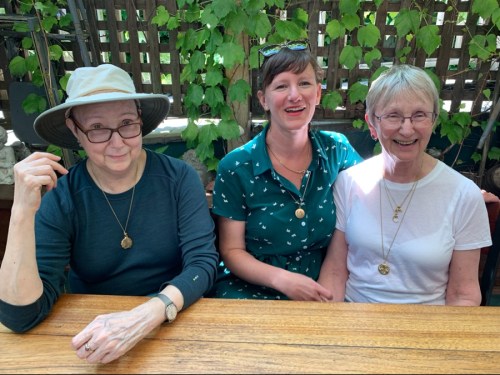
062219-Provincetown-ladies-modeling-lockets

In the picture above, my sister had already had a recurrence of glioblastoma. But, you know, while there’s life, there’s hope. We went on a junket to Provincetown.

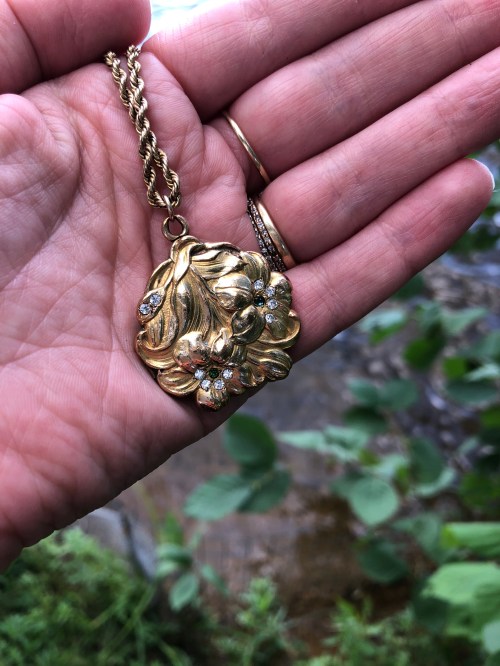
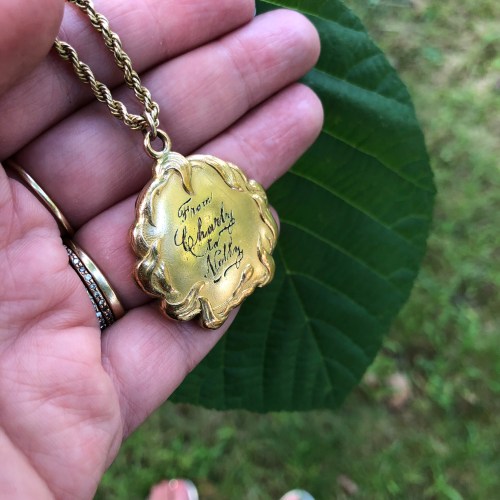
Not long before our trip, Suzanne, who pays regular visits to antique shows in Brimfield, Massachusetts, found the perfect locket for my sister. By some implausible alignment of the stars, it was inscribed on the back with both my sister’s name and her husband’s name. Suzanne does keep an eye open for particular designs for particular customers, but only magic could have turned up a locket with both those names.

Later, Suzanne found a similar design for me. It had my husband’s initials on the back.

Longtime readers know that this blog got its start when Suzanne said that she needed a blog for her jewelry business and that if I took it on, I could write about anything I liked. The offer of freedom was too good to refuse as my knowledge of jewelry, despite having a grandmother in the business, too, did not extend to a post a day. And I wanted to write a post a day.

Here’s a thing to know about Suzanne’s company, Luna & Stella. From its founding a decade ago, it’s been about relationships and the meaning that special pieces of jewelry can convey. At first, Suzanne’s emphasis was on her line of contemporary birthstone jewelry, which remains popular. But as she began to introduce antique lockets created with the craftsmanship of the famed Rhode Island jewelers of the 19th and early 20th centuries, she learned something interesting. Customers not only appreciated the beauty of their lockets but also felt a connection to the previous owners. Some people chose to keep the time-worn pictures inside instead of having Luna & Stella size and place images of their own family and friends.

Do check out Luna & Stella for a holiday gift of meaningful jewelry, here. You can use the discount code CarolineFriend at checkout. And Suzanne even has an installment plan now.

2019-locket-Suzanne-found-for-Nell

2019-words-on-locket-for-Nell

linnea-leidy

Photo: Zulekha Nathoo/CBC
Singer Linnea Leidy, 20, says she has relatives in Mexico and hopes the drop-in choir event on two sides of the border can “defuse some of the myths around these families who live around here.”

Sometimes our country feels noble for providing aid somewhere, and that’s OK. But how do we feel when other countries do the same for us — for example, when other countries stepped up because we failed to provide timely aid to Puerto Rico after Hurricane Maria? I think we need to be grateful and accept graciously, not get a chip on our shoulder. A similar dynamic can be seen in journalism. If we aren’t covering it, it’s great that another country does. Not sure if US journalists captured the following story, but I’m glad Canadians did.

Zulekha Nathoo reported at CBC about a Toronto choir that arranged a special friendship event at the US-Mexico border.

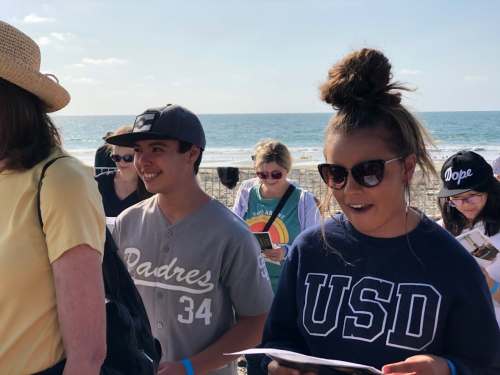
“The Toronto-based singing group Choir!Choir!Choir! staged a performance [in October] at the U.S.-Mexico border, saying the decision was based on a desire to foster community rather than on politics alone.

“With a barbed wire fence and border patrol dividing two groups of drop-in singers, one located on the beach at Border Field State Park in San Diego, Calif., and the other just metres away in the border town of Tijuana, Mexico, the popular choral group performed a rendition of ‘With A Little Help From My Friends’ by The Beatles. …

“About 300 people took part on the U.S. side and 500 across the divide in Tijuana.’We’re just trying to create a moment that can be shared and that will bring people hope,’ said Daveed Goldman, co-founder of Choir!Choir!Choir!. …

“Tens of thousands of migrants from across Central America are seeking asylum. … It has led to stiffer immigration policies, including forced family separation.

‘These people are no different than the rest of us,’ said Linnea Leidy, 20, who came to sing. She said she has family in Mexico. ‘[This event] can help defuse some of the myths around these families who live around here.’

“A short walk from the singers is the famous Friendship Park, a bi-national space at the border where residents from both sides can meet their loved ones through a guarded fence. The spaces in the fence barely allow a pinky finger to fit through. …

” ‘There are things that we can’t solve by singing, obviously,’ said Molly Clark, who works at ArtPower at University of California San Diego, which helped organize the event. ‘But I hope that in the end, we just feel more connected to one another.’

“Choir!Choir!Choir!, which invites audience members to join singalongs around the world in an effort to build a sense of community, was founded by Goldman and fellow Canadian artist Nobu Adilman in 2011. The pair teaches a song’s arrangements to participants before performing it live as a group. In addition to travelling across Canada, the duo has put on shows around the U.S. and in Europe. …

“Adilman, who was directing singers on the Tijuana side, couldn’t be seen through the fencing, but his voice could be heard on the San Diego side through loudspeakers set up near the stage.

” ‘We stand with you,’ Adilman told the Tijuana crowd. ‘We just want you to know: you have a lot of friends who you haven’t met yet.’ ”

Choir!Choir!Choir! does these events a lot and probably has the logistics and partnerships down to a science, but I’m still impressed with the organizational chops.

More at CBC, here.

Homeless Young People

tom-parsons-pVmjvK44Dao-unsplash

Photo: Tom Parsons on Unsplash
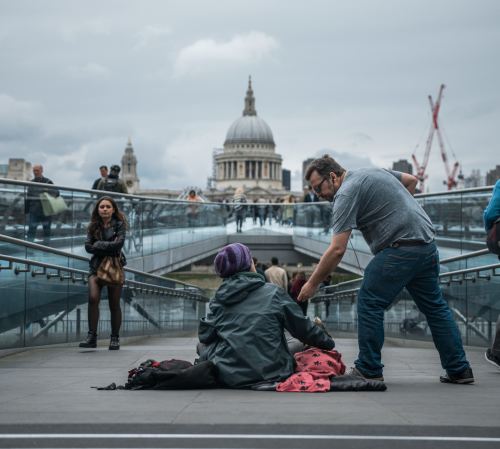
Concern for homeless youth continues to grow.

Since I read Sarah Smarsh’s memoir Homeland, I have had to recognize that my difficult childhood was not as difficult as many other people’s. And my difficulties were never exacerbated by the relentless poverty Smarsh’s farming family experienced despite always working hard.

Still, I identified with some aspects of her story, like the wish to run away. In the book, Smarsh would decide to live with a different relative from time to time, which seemed to help her get her head together for a while. I never ran away, but even as an adult, I used to fantasize about ways a child might do that successfully. I finally concluded it’s not possible, despite The Boxcar Children and their apparent self-sufficiency.

It may not be possible to do so successfully, but children and teens do run away. Tristan Hopper and Kaitlin J. Schwan write about youth homelessness in Canada at The Conversation and suggest some ways to help them.

“Despite decades of policy and programming, youth homelessness remains an urgent issue in many communities across Canada. [Twenty] per cent of people experiencing homelessness are youth. Particular groups — Indigenous youth, racialized youth and youth who identify as LGBTQ+ — are at increased risk of homelessness due to intersecting forms of structural and systemic inequity. …

“Given this, there has been an increased focus on homelessness prevention across Canada and globally. … Research shows that meaningful and accessible activities like sports and arts can have significant impacts on youth social connectedness, better developmental outcomes, improved mental health and recovery from trauma. …

“Youth homelessness is a complex social issue affecting people between the ages of 13-24 who are living independent of parents or caregivers and do not have the means to acquire safe and secure housing. …

“A key component of youth homelessness prevention is not only preventing youth from experiencing homelessness in the first place, but also preventing young people from re-entering life on the streets. …

“Social exclusion, loneliness and limited social networks are particularly common issues for those who have recently left homeless status. These experiences powerfully contribute to mental health decline, substance use, feelings of hopelessness and subsequent returns to homelessness.

“Young people exiting homelessness may be housed in locations that are isolated from services, community centres and childcare. This distance can create barriers to accessing meaningful activities and can present challenges to social and political inclusion.

“All young people deserve stable and safe housing, and also the opportunity to be engaged in meaningful activities, [which include] resources that encourage social inclusion … Social inclusion may also mitigate risks of eviction. For example, neighbourhood groups may help navigate conflicts with landlords. This inclusion may help in the development of a new identity as young people re-articulate their sense of selves in a new community.

“Some studies show that youth experiencing homelessness view artistic activity and sports engagement as absolutely critical to their wellbeing, recovery and exits from homelessness. … Recreational sport participation can have several physical, psychosocial, emotional and developmental benefits. … However, for sport programming for homeless youth to be purposeful, the social, political and cultural barriers to participation must be addressed, including time and place of programming, cost of access and cultural acceptance.

“Research has shown that for Indigenous youth, re-connection with cultural practices — including sports — can be a critical component in connectedness and meaning. … We need to [invest] in frontline prevention programming that includes sports and arts activities driven by the needs and interests of the young people they serve.”

More at The Conversation, here. (I believe social scientists like these are doing good work, but their writing is awfully dry. For more-engaging and specific writing on youth in trouble, try UTEC, here.)

2953

Photo: Achilleas Zavallis
Will these ancient, mudbrick, high-rise buildings survive the war in Yemen?

When I read fantasies to grandchildren, I explain that although passing through a wardrobe into another reality is not true, the feelings of the characters and the challenges they confront are. In fact, sometimes the issues of our world are made clearer through a fantasy lens.

Some fantasies I read just for my own pleasure. Having just finished Book Two of Philip Pullman’s The Book of Dust, I’m thinking about the way selfish monetary interests fuel the real world’s endless Middle East wars. In Pullman’s trilogy, a certain rose oil from the region of the old Silk Road has been found to have priceless properties, and behind-the-scenes power brokers are focused on trying to control it. Rose oil is a stand-in for whatever countries in the real world try to control, frequently another kind of oil.

One of the fiercest Middle East wars wars today is being fought in the small country of Yemen, and the report below is about amazing cultural sites we might not have heard about but for this disaster. I hope that spreading stories about the risks for civilians and cultural treasures will lead to more people demanding peace.

Bethan McKernan writes at the Guardian, “On the edge of the vast Empty Quarter desert that dominates the Arabian peninsula, white and brown towers rise together out of the valley floor like tall sandcastles. Once they welcomed weary caravans traversing the Silk Roads: now they stand as testimony to the ingenuity of a lost civilisation.

“This is the ancient walled city of Shibam, nicknamed the ‘Manhattan of the desert’ by the British explorer Freya Stark in the 1930s, in modern-day Yemen, a country also home to an untold number of other archeological treasures. The kingdom of Saba, ruled by the legendary Queen of Sheba, and many other dynasties of the ancient world rose and fell here, their fortunes linked to Yemen’s position at the crossroads of early frankincense and spice trades between Africa and Asia.

“Today, as a result of Yemen’s complex civil war – now in its fifth year – many of the country’s wonders have been damaged or are under threat. While the destruction pales in comparison to the human cost of the conflict, the country’s rich cultural heritage has also been ravaged. …

“Shibam, a 1,700-year-old settlement in the valley of Hadramawt, has largely escaped direct violence, but is still suffering from years of neglect, despite being a Unesco world heritage site.

“Named for King Shibam Bin Harith Ibn Saba, it is one of the oldest – and still one of the best – examples of vertical construction in the world. In the 16th century, Shibam’s inhabitants found they had run out of space to expand. To compensate, they began to build carefully on a rectangular street grid, and instead of spreading out, they built up …

“The city’s 3,000 residents still largely follow the traditional living pattern, with in some cases up to 40 family members in the same tower. Animals and tools are kept on the ground floor and food is stored on the second. Elderly people live on the third and the fourth is used for entertaining. Higher levels are occupied by more nimble families, with childless newlyweds on the roof. …

“Shibam is largely self-sustaining: its farmers and shopkeepers cater to the small population and many men are employed baking the straw and mud bricks used in construction. As in many Yemeni cities, goats and chickens roam the streets.

“ ‘Lots of young people have left,’ said Ali Abdullah, 28, who was looking after his family’s goats along with his 10-year-old brother, Majid.

‘Shibam is beautiful but there is no reliable money to make here unless they start preserving the buildings again.’ …

“Since Yemen’s Arab Spring revolt in 2011, funding to help preserve the city has dried up, as has the once steady flow of tourists, said Salim Rubiyah, the head of the local association responsible for looking after the public buildings inside Shibam’s walls. …

“Said Rubiyah, ‘I worry that this will be the last generation who are able to make a life here and appreciate the city’s beauty.’

“Elsewhere in Yemen, the story repeats itself. … In Sana’a, one of the oldest continuously inhabited cities in the world, ancient sites have been razed by Saudi-led coalition bombing [paid for, sadly, by the US]. … Despite Unesco having provided the coalition with a no-strike list of historical sites when the campaign began in 2015, sites such as the Castle of Taiz have been targeted, as well as the Dhamar Museum.

“ ‘We are nervous about the politicisation of heritage and the militarisation of archaeology during the conflict,’ said Sama’a al-Hamdani, director of the Yemen Cultural Institute for Heritage and the Arts. … ‘You can’t be the destroyer and the saviour at the same time.’ ”

More here.

Ancient Infographics

screen-shot-of-colony

Photo: Wolfenbüttel Digital Library of the Herzog August Bibliothek
A 6th century CE manuscript called the Codex Arcerianus shows how Roman land surveyors marked off, measured, and mapped property lines.

The website Hyperallergic always has interesting articles about art and art-related fields. This one, which reviews a book about how the ancients handled the graphical representation of information, shows that useful information was conveyed in art long before anyone thought of a term like infographics.

Sarah E. Bond has the report on classicist and historian Andrew M. Riggsby’s book.

“In Mosaics of Knowledge: Representing Information in the Roman World, Riggsby looks at the historical use of visual information technologies and the Roman use of what many today might term ‘infographics’ in the period from the founding of Rome in 753 BCE until 300 CE — just a few years before the ascent of the emperor Constantine and the empire-wide growth of Christianity. …

“Going beyond simple lists, Riggsby examines the rarified use of tables of contents, alphabetized lists, and indices. … Prior to the rise of the codex format, which we would later simply call a ‘book’, organizing was not done by pagination within scrolls, but rather by rows and chapters within a particular scroll. Riggsby reiterates the rarity of Roman tables of contents within literary works, but there was an abundance of indices.

“In public, Romans also encountered public inscriptions with lists of consuls and also calendars, called fasti. These calendars used abbreviations and color coding: marking each set of nine days under the month alphabetically, A through H, in order to signal the nine-day market cycle, highlighting special festival days, and often noting the civic or religious import of the day with the letters F, N, or C. These fasti are also a stark reminder that when there are no formal weekends (and there weren’t in antiquity)

one needed to travel to the forum and read the calendar to know about all the festival days off from work or state business. …

“Clocks were an important type of informational device that allowed Romans to measure time, but they can also double as art pieces and statements of wealth. While the technology governing timekeeping may have changed, for Romans in antiquity it was important to visually represent time — even if the length of Roman hours were not completely standardized, as ours are, and could vary by time of year. …

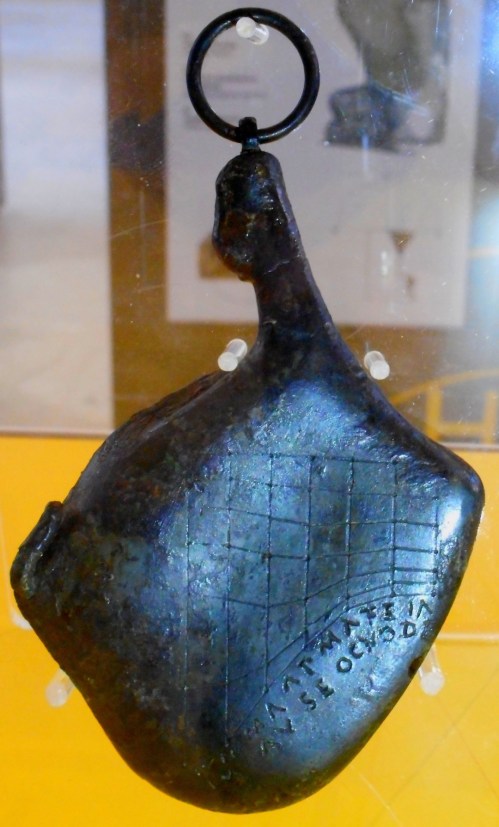
“There are even more numerous examples of portable models of sundials one could carry that could err widely based on the latitude, season, and time of day. But, just like the Rolex or Apple Watch of today, portable watches might have been seen as more of a fashion trend for the elite rather than a technology that was always accurate. Perhaps the most inventive portable sundial is one found at the Villa dei Papiri at Herculaneum, which is shaped like a ham. …

Mosaics of Knowledge underscores the fact that there were no modern data graphics such as the scatterplot, pie chart, bar graph, timeline, or musical staff notation in the Roman world. However, Romans did have occasion to use diagrams and maps, particularly when representing property lines as recorded by professional land surveyors.

“Romans did not make extensive use of textual illustrations in literary and historical works, but the handbooks for the Roman land surveyors collected and passed down through the Imperial Period were an exception to this rule. Additionally, the survival of building plans from antiquity gives yet another window into how Romans abstracted and then represented space for viewers.” More here.

No amount of fashion craving would induce me to carry around a heavy bronze ham to tell the time.

Photo: Carlo Raso via Flickr
A portable vertical sundial from Herculaneum, shaped like a ham, is exhibited in the Archaeological Museum of Naples.

a-portable-vertical-sundial-from-herculaneum-1080x1788-1

Extreme Christmas Cooking

picture2_sq-a1d7c85e7f7ab272b3c4ae2b72308ec950caad5f-s600-c85

Photo: Arty McGoo
These artistic Santas are an example of Arty McGoo’s cookie handiwork.

Before I share today’s story about Christmas cookies that are works of art, I want to tell you what Sandra does every Christmas for her extended Italian family in Connecticut. Sandra, you should know, is beloved of a large network of friends and family for her kindness, insight, moral support, good sense, and many other sterling attributes — not least of which is her cooking skill.

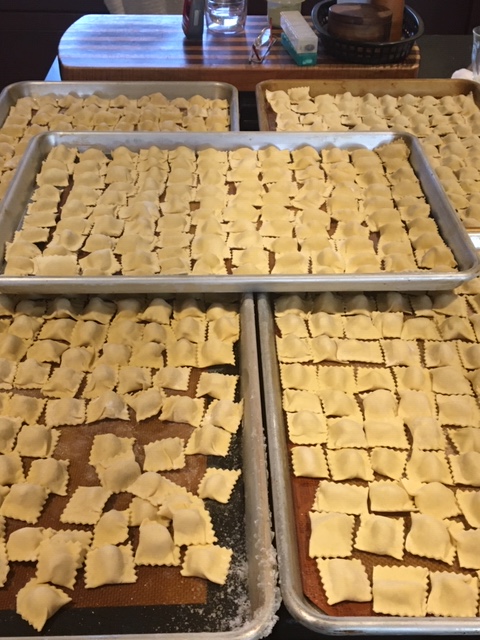
At Christmas, her family produces a prodigious feast, and her role is to make the cheese-filled anolini below, which she serves with chicken soup. She’s ahead of the game today having made and frozen roughly 1,100 of the small, ravioli-like dumplings.

Photo: Sandra M. Kelly
It’s traditional among Sandra’s Italian family members to serve anolini in chicken soup as one of the Christmas-dinner courses. She’s already made and frozen 1,100.

120619-Kelly-anolini-cheese-filled

Nina Keck reported a story about another edible art form at National Public Radio [NPR] last year.

“For many people the holidays wouldn’t be the holidays without baking and decorating cookies. But a growing number of creative bakers, known as ‘cookiers,’ are taking their art to a whole new level.

“Mary Thode of Chittenden, Vt., is one of them. This time of year, she bakes all sorts of cookies — some of the recipes were her mother’s, she says, which bring back nice memories.

” ‘But I do like a painted cookie,’ she says, nodding toward the nine coffee cups on her dining room table that are each filled with different colored frosting. … Thode makes cookies all year — baby-bottle shaped ones for shower gifts and pumpkins at Halloween. But during the holidays, she’ll bake about 700 cookies, half of which she’ll paint, often with many layers of different colored frosting. …

“Thode is among a growing number of people, who’ve changed bite-sized treats into an art form. Many, like Thode, are hobbyists, who give their cookies away as gifts. But it’s also big business. Some of the most elaborate designs by top artists sell for $150 per dozen, or even more. …

“Elizabeth Adams [is] known in the cookie world as Arty McGoo. McGoo has made a career out of cookies. The California resident has more than 80,000 followers on Facebook and now devotes most of her time to teaching others her craft. …

“The popularity of decorating cookies has been great for companies like CK Products, which manufactures and distributes things like edible glitter, sprinkles, meringue powder and piping gel. …

“Ann Clark Cookie Cutters, a family-owned business in Rutland, Vt., that began in 1989, has also ramped up production. CEO Ben Clark says 52 employees work two shifts and their assembly line churns out 22,000 cookie cutters a day. …

“Clark says llamas are big this year: ‘We immediately said “let’s do a llama.” And are our creative director said we’re going to do two; we’re going to do one that looks like a llama and we’re gonna have one that’s more of a cartoony llama. … Ten days later [both] those products were dominating Amazon as the llama cookie cutter.’ ”

More here. By the way, next year’s serious cookie convention, Cookie Con, will be held in Louisville. Get your tickets here.

The cookies my grandchildren made at the church’s craft workshop Saturday are works of art that have meaning for me. This one is by my youngest grandchild.

120719-V-MADE-COOKIES-AT-CHURCH