Feeds:
Posts
Comments

Greece Enigmatic Islet

Photo: Greek Culture Ministry via AP
A newly discovered stone staircase is seen in the lower terraces of Dhaskalio islet off Keros island in the Aegean Sea, Greece.

I’m a sucker for any story with revelations about Ancient Greece. But the first article I read on excavations on Keros island made wild claims about how they showed the origins of Greek culture and the reasons the ancients thought their gods lived on mountain tops. Worse, in illustrating the story, the newspaper chose a photo of a burial mask that has been around forever. I had a replica of that very mask as a kid, when there was speculation it was Agamemnon’s.

So I looked for a more more factual article.

The Athens-Macedonian News Agency reports at the National Herald, “An extensive and extremely interesting series of exhibitions has been organised on the Cyclades islands this year by the Cyclades Ephorate of Antiquities. …

“Among these are the exhibitions ‘From the world of Homer. Tinos and the Cyclades in the Mycenaean era’ that runs between July 13 and October 14, which is being held in cooperation with the Piraeus Group Cultural Foundation (PIOP) at the its Museum of Marble Craft in the village of Pyrgos, Tinos. A second exhibition [is] to be inaugurated on July 14 at Archaeological Collection of Koufonisia and will run until September 30, 2019.

“ ‘Both exhibitions are extremely important,’ said Dimitris Athanasoulis, Director of the Cyclades Ephorate of Antiquities, to the Athens-Macedonian News Agency (ANA). ‘On the occasion of the founding of the tomb of Agia Thekla in Tinos, we have a first exhibition for an unknown period of the Cyclades, the Mycenaean period, presenting great and unknown material.’ …

“Four-year excavations and research on the extraordinary architectural findings of Kavos on the island of Keros in the Cycladic Islands group confirmed the existence in Early Cycladic times of a complex, stratified and technically expert society.

“[The research programme under Cambridge University] has ‘revealed impressive architectural remains of a significant Early Cycladic settlement,’ the ministry said.
Under the project, excavations took place on the small islet of Daskalio, originally connected to the nearby site of Kavos on Keros through a narrow strip of land. … The remains of the culture at the time include ‘impressive staircases, drainage pipes and stone buildings that reveal an advanced urban architecture without precedence for the specific period. …

” ‘The complicated, interlinked and multi-level architecture shows the existence of a well-organised and well-built settlement on a steep promontory,’ it added. …

“According to co-excavator professor Colin Renfrew, Daskalio shows that the building techniques that were applied, the existence of huge entrance gates, stone ladders and the drainage pipes throughout the island show that there must have been a specialist architect and a central administration to carry out the building programme. He said the complexity of the construction is only comparable to Knossos on Crete for the same early period, he said. …

“Co-director of the site Michael Boyd added that a unique feature of the site includes the fact that metallurgy played a significant role throughout the life of the settlement. Its extent and scale proves a constant replenishing of raw materials from western Cyclades and Attica, and a social structure that trained and passed skills on to newer generations.”

More here.

sa27s_got_talent_logo_2016

Image: South Africa’s Got Talent
What are the chances for a taxi driver with a great voice to move from entertaining his passengers to the opera stage?

I wonder if someone with a tremendous talent who delights himself and a small circle of others with his singing necessarily wants an international audience. That is the question that came to my mind as I read about the fun that a taxi driver in South Africa is having as he sings for passengers.

Stephen Moss writes at the Guardian, “Are opera singers born or made? Are there wonderful natural operatic voices out there waiting to get a break on Britain’s Got Talent? Or maybe on South Africa’s Got Talent, because the reason to pose the question comes courtesy of an opera-loving South African Uber driver called Menzi Mngoma, whose impromptu performances in the front of his cab in Durban have caused a frisson of excitement among those who want to believe that great voices and instant opera stars are all around us.

“Mngoma is a self-taught tenor who likes to belt out arias for his passengers. One of his customers, Kim Davey, liked his singing so much that she posted a video on Facebook. That, in turn, attracted media attention and the 27-year-old Mngoma’s career was launched. He is said to be auditioning for Cape Town Opera. A stadium tour will no doubt follow.

“It generally pays to be suspicious of such stories. The media want to believe in fairytales because they make good copy. Being an opera singer is about more than giving a passable two-minute rendition of ‘La donna è mobile.’ It is singing and acting a role over three or more hours in an opera house twice a week; having the vocal technique to sustain a 20- or even 30-year career; performing a wide range of parts in up to five languages. It is bloody difficult.

“That said, Mngoma does have the spark of something. I played the clip to the Guardian’s opera critic Tim Ashley, and while Ashley said there was barely enough to make a judgment, he thought Mngoma ‘sang “La donna è mobile” perfectly decently and with no strain at the top [of the voice].’ Ashley says that being self-taught is ‘unusual but not completely unheard of.’ …

” ‘You have to be born with talent – that can’t be taught – but teaching will hone that talent,’ says Martha Hartman, the manager of the vocal studies department at the Guildhall School of Music and Drama. She says that singers do not have to start studying in their teens: the Guildhall has several students in their late 20s, including one who used to be a builder. But she emphasises that natural talent is not enough. …

“If Mngoma wants to be a professional opera singer, the hard work starts now. ‘If you find a singing teacher and if you hone your skills and if you have some classes in stagecraft and movement and drama and all these things that go into being a singer,’ says Hartman, ‘then you might have some roads open to you. But most opera houses and orchestras will demand knowledge of repertoire, and that’s a very big piece of the puzzle: knowing how to learn music and learn a role.’ ”

More at the Guardian, here.

song-celebration-sven-zacek-ii-1024x683

Photo: estonianworld.com
The Estonian Song Celebration every five years brings together a huge choir of up to 30,000 people for a weekend in July.

How do you get 30,000 people to sing together and hit the same note at the same time? It’s not easy. But if any group of people can do it, it’s the Estonians. They’ve had a lot of practice.

Writes Estonian World, “The Estonian Song Celebration is a unique event, which every five years brings together a huge choir of up to 30,000 people for a weekend in July. Approximately 100,000 spectators enjoy the concerts and sing along to the most popular songs.

“The first Song Celebration was initiated in 1869 by newspaper publisher Johann Voldemar Jannsen and celebrated freedom and the 50th anniversary of the end of Estonian serfdom at the hands of the Russian tsar in 1819. The first singing event was held in Tartu, with 878 male singers and brass musicians. All the songs were in Estonian and Estonians – mostly peasants and farmers at the time – discovered the value of their own language and cultural heritage through singing. …

“After the Second World War, during the Soviet occupation of Estonia, the song celebrations again helped keep the national identity alive. In the summer of 1988, several hundred thousand people gathered at the Tallinn Song Festival Grounds and sang for freedom for many days and nights. Dubbed ‘The Singing Revolution,’ it indirectly led to Estonia’s independence once again in 1991.

“The 27th Song Celebration [features] 1,020 choirs, which include over 35,000 singers. The youngest participant is Emma Kannik (5) from Musamari Koorikool (Tallinn) and the oldest is Aino (90) from the New York Estonian Choir.

“The smallest choir of 12 singers is Kauksi Primary School Choir and the largest is the European Estonian Choir, with 123 singers. The latter is not the only expat choir – 25 Estonian choirs from abroad and 17 foreign choirs are performing at the celebration.

“The emotional celebration kicked off with a traditional parade on 6 July, during which the performers walked along a five-kilometre route from the Tallinn city centre to the Song Festival Grounds, where 82,000 people later watched them perform old and new Estonian choral songs and other classical pieces. …

“Tickets sold out on Sunday as 95,000 people came to Tallinn’s Song Festival Grounds for the second day of the 150th anniversary of the Song Celebration, Minu Arm (My Love). … There were more singers, more choirs, more tickets sold, and there had been more dancers than ever before at dance festival earlier in the week. The festival organisers said there were 1,020 choirs, 35,000 singers, and 11,500 dancers. …

“[Song Celebration’s artistic director, Peeter Perens] noted his ideas for the song celebration had been built on the Finno-Ugric culture, which the Estonia language comes from, and the European culture which brought the singing festivals to Estonia more than 150 years ago. The programme was created three years ago and since then more than 300 rehearsals took place. …

“[Marju Lauristin, professor emeritus at the University of Tartu,] discussed her research that shows that 48% of the Estonian population has, at some time in their lives, taken part in the song celebration and is one of the remaining activities that is enjoyed by the whole of society.

“Discussing the history of the song celebration, she said, ‘Through 150 years these people have the same memories, coming together in winter, through snow, in times when there were no cars, no internet, walking 10-15 kilometres to school or place where they would gather and have a singing society, all over the country.’ …

“Lauristin added that the atmosphere of the song celebration had changed over the years from one of bitterness during the Soviet occupation, to one of joy today.

“[Composer Riho Esko Maimets said] that the experience of being at the celebration felt ‘very selfless, [like you are] existing as one little particle in a great mass of your nation.’  More here.

I’m impressed that so many people can sing together. I gave up on our town’s Christmas tree carol singing because the people on one side of the tree were always at a different place in the song than the people on the other side. And that leader was trying to keep together fewer than 100 people, not 30,000!

gv7u3lqeeqt8vvhtlhnv3k-650-80

Astronaut-honoring butter sculpture at the Ohio State Fair. Butter sculptures are traditional at many Midwest state fairs.

How I remember the kooky state-fair butter sculptures I saw when I lived in Minnesota! This year, to honor the 50th anniversary of the moon landing, there was a particularly unusual one at the Ohio state fair.

Elizabeth Howell wrote at Space.com in July, “The Ohio State Fair is buttering up its visitors with a sculpture series to celebrate the big moon-landing anniversary 50 years ago.

“The sculptures are of the Apollo 11 moon crew – Neil Armstrong, Buzz Aldrin and Michael Collins – as well as a separate buttery interpretation of Armstrong in his spacesuit by the lunar module, Eagle. There’s also a butter cow and calf standing beside the Apollo 11 patch. This took more than 2,200 pounds (1,000 kilograms) of butter to create. …

“Said Jenny Hubble, senior vice president of communications for the American Dairy Association Mideast, [the sculpture] pays special tribute to Armstrong, who is originally from Wapakoneta, Ohio. …

“In between gazing at the yellow sculptures of the crew, visitors will have a choice of many dairy foods, including ice cream, milkshakes, cheese sandwiches — and of course, milk.

“While the butter connection seems at first to be a stretch, Armstrong did buy a dairy farm in Ohio after leaving NASA in 1971, two years after his epic first steps on the moon, according to a 2012 article in the Independent.” More.

According to Wikipedia, “Butter sculptures often depict animals, people, buildings and other objects. They are best known as attractions at state fairs in the United States as lifesize cows and people. … Butter carving was an ancient craft in Tibet, Babylon, Roman Britain and elsewhere. The earliest documented butter sculptures date from Europe in 1536, where they were used on banquet tables. The earliest pieces in the modern sense as public art date from ca. 1870s America, created by Caroline Shawk Brooks, a farm woman from Helena, Arkansas. The heyday of butter sculpturing was about 1890-1930, but butter sculptures are still a popular attraction at agricultural fairs, banquet tables and as decorative butter patties.”

Butter Art: Caroline Shawk Brooks, 19th century Arkansas farm woman
“Dreaming Iolanthe” depicts Yolande, Duchess of Lorraine, the heroine of Henrik Hertz’s play
King René’s Daughter. Says Wikipedia, “It was this 1876 masterpiece that ignited popular interest in butter sculpting as a public art form. The bowl was kept cool with ice underneath it.”
800px-the_dreaming_iolanthe_from_henrik_hertz27s_play_king_renc3a927s_daughter_1876

unseen_coverart_final-720x908

Art: Thomas Rodgers
The cover art for Chad Allen’s audio comic,
Unseen, is the only visual feature. The comic was designed for the blind.

Hooray for people who recognize a need and do something about it. In this story, a man who is blind devised a way for other blind people to enjoy an art form usually closed to them.

Jessica Gelt writes at the Los Angeles Times, “Chad Allen was feeling helpless. Not because he happened to be blind. He had a healthy handle on that part of his life. It was the insanely dark news cycle that was dragging him down. The sense that the world was falling apart and he could do nothing about it.

“Mounting anxiety before the 2016 presidential election propelled him to do what he does best: tell stories. He created an audio comic book titled ‘Unseen,’ featuring a blind heroine, an assassin from Afghanistan named Afsana. It is believed to be one of the first audio comic books by a blind author, made for a blind audience.

“Working in a highly visual art form, Allen managed to create an auditory experience that closely mimics the sensation of reading a comic book. A whooshing sound occurs whenever a panel changes; the intentionally stilted delivery of lines, as well as narration that prompts mental images, conjure a feeling of being inside a high-stakes comic book world. Aside from a slick red-and-black graphic image of Afsana created for the cover, ‘Unseen’ has no visual art whatsoever. …

“ ‘Chad’s character is written for a blind audience, but all of us can identify with her because we can identify with the experience of being underestimated,’ says Melissa Alexander, the director of public programs at the Exploratorium [museum of science, art and human perception in San Francisco]. …

“The sense among marginalized groups — people of color, women, LGBTQ people and others — that they have been underestimated has made ‘Unseen’ a popular part of the exhibit. …

“Allen is thrilled to have his work included in ‘Self, Made’ because it validates one of his main objectives in writing ‘Unseen.’

‘You don’t see art with your eyes. You don’t see anything with your eyes. All your eyes do is filter light. You see with your brain, and that’s what I’m trying to teach to people more than anything,’ Allen says. …

“Afsana does not have superpowers like Marvel’s Daredevil. She has a skill. Her skill is to slip in and out of places without being seen. She is not seen because people with disabilities are often not seen. They can feel invisible to society at large, Allen says. …

“The catchphrase for the comic is, ‘Discounting her abilities is her enemies’ gravest mistake.’

“The first installment of Afsana’s journey, which is available for streaming at unseencomic.com, finds her at the American border with Mexico in a not-so-distant future, when a dictatorial president is rounding up immigrants and conducting scientific experiments on disabled people with some very spooky results. …

“Allen, 46, grew up loving comic books. … He was not born blind. He was diagnosed with retinitis pigmentosa, a genetic disorder that causes vision loss, at the age of 15, around the time his parents were divorcing. His world was thrown into turmoil in a way his fragile teen psyche had trouble processing. …

“Twenty years later, Allen is sitting at his dining room table in front of a small Braille keyboard attached to an iPhone that reads emails, books and writing back to him at breakneck speed. It is hard to imagine a time when he lacked confidence in the world. …

“Of all the questions lobbed his way, Allen says one of the most obvious and compelling is often asked by his son’s friends: How do you see in your head? His reply is beautiful in its simplicity.

“ ‘I say to them, “Do you go to bed at night? When you sleep do you dream? When you dream do you see places? Do you see people that you know? Do you see your family and friends?” ‘

“When they answer in the affirmative, he asks, ‘Are your eyes open?’

“They shake their heads.

“ ‘Well, that’s how I see you.’ ”

More here.

061420prairie

Photo: Melanie Stetson Freeman/Christian Science Monitor
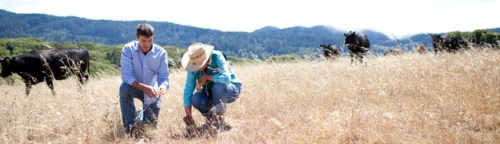
In Obert, Nebraska, agriculturists and environmentalists are joining forces to make a more sustainable future for all. In the background are croplands that have been converted from grasslands. In the foreground a rancher’s cow is enjoying inexpensive feed while grasslands get protected.

One reason I like the Christian Science Monitor, besides its great international coverage, is that it’s really good at finding win-win stories in which opposing sides of an issue find common ground.

Laurent Belsie reports, “Slowly, a prairie restoration movement is gaining momentum here in the Great Plains. After decades of plowing up native grasslands to plant crops, some ranchers are moving in the other direction. Helped by environmentalists in a sometimes uneasy alliance, they are restoring prairie pasture, which not only improves water retention and sequesters carbon in the soil, but can also improve their profits by creating better feed, allowing them to brand and sell their beef directly to consumers, or through ecotourism.

“ ‘I’m guardedly optimistic that we will see continued growth in that [revival] as the tourist business grows,’ says Rick Edwards, director of the Center for Great Plains Studies at the University of Nebraska. …

“This new breed of ranchers faces formidable odds. Conversion of the Plains ​– one of the world’s largest remaining grasslands ​– to cropland continues. As of 2017, nearly a third of the northern Great Plains, a swath of land running from central Nebraska to southern Saskatchewan and Alberta, had been converted. In that year alone, more than half a million acres were plowed under. The silver lining: The rate of conversion slowed considerably compared with 2016 in every state except here in South Dakota. It’s not clear why. Also there was a pickup in cropland that had gone back to grass, although it’s not certain that will be a permanent switch.

“Ranching to preserve the grasslands requires new modes of thinking.

“ ‘We’re getting to understand how important healthy grasslands are,’ says Leo Barthelmess, a rancher outside Malta, Montana, and president of the Ranchers Stewardship Alliance. For him, a high priority is making sure that his cattle do not overgraze an area, which means frequently moving the cows. When his father started ranching in the area in 1964, he moved cattle 10 times a year. Now, Mr. Barthelmes moves them 100 times a year, so ‘the grass has the opportunity to regrow.’

“The aha moment for Sarah Sortum, whose family diversified from strictly a ranching operation to an ecotourism business, came when she went searching for nesting areas of the greater prairie chicken on the family ranch. On the northern end, she heard their call and other birdsongs all over; on the southern end, ‘I didn’t hear anything,’ she recalls. ‘I didn’t hear chickens; I didn’t hear grouse; I didn’t hear all the other little birds I was supposed to be hearing.’ …

“An invasive red cedar, far more prevalent on the southern side of the ranch, was providing perches for birds that preyed on the ground-nesting prairie chicken and grouse. For years, getting rid of the trees had been a low priority for the family. Now that the birds were bringing tourists to the farm, removing the nonnative trees became a top priority.

“ ‘Before our tourism … we just managed for grass, because that’s how we make money’ ​– feeding grass to cattle, says Ms. Sortum. ‘Now … the biggest difference from just managing for grass is managing for that diversity, because we realize that everything has value now.’ …

“What changed [South Dakota rancher Jim] Faulstich was the farm crisis of the 1980s. ‘I was either done or I was going to change,’ he says. A typical cow-calf operator, he began looking into holistic management and realized the importance of preserving the health of the prairie. His son-in-law, with whom he ranches, is carrying on the tradition and has already converted some fields from cropland to prairie.

“It’s this kind of mental shift that has environmentalists excited.” Read more details here.

This is where my husband would launch into some version of the song “The Farmer and the Cowman Should Be Friends.” “The Cowman and the Environmentalist”? Hmm. Gotta fit the rhythm.

A Few More Summer Photos

082819-Susan-Klas-Wright-Spring-St-Gallery

Maybe I can hold on to the summertime feeling a bit longer with a few more photos. Not that I don’t love autumn, too, and the sense of getting my ducks in a row as I resume a normal routine, but …

Susan Klas Wright created this beautiful rendering of waves for the Spring Street Gallery’s most recent show. Elinor C. Thompson is the artist behind both lifelike and larger-than-life seashells. And I loved Robin Bell’s haunting double exposures of island scenes.

Next is a shot of New Shoreham’s Fresh Pond seen through the trees. That’s followed by another leafy vista, this one of an old, unused building labeled “Concord Water Works.”  In West Concord, there’s a pretty bridge arching Nashoba Brook behind the bakery where I bought an avocado toast Monday after walking a few miles on the Bruce Freeman Trail.

On my walk, I was startled to see a railroad light in the middle of woods. Was it public art? Something like Narnia’s lamp post?

I loved the profusion of Evening Primrose and the ubiquitous bumblebees, drunk with opportunity.

The final view represents my last Rhode Island sunset for the time being. It will have to hold me.

082819-Elinor-C-Thomson-Spring-St-Gallery

082819-Robin-Bell-Spring-St-Gallery

083019-Fresh-Pond-New-Shoreham

090119-old-water-works

090219-Nashoba-Brook-bridge

090219-trail-marker

090219-streetlight-in-woods

090219-evening-primroses

090219-busy-bee

082319-New-Shoreham-flaming-sunset


A Lunchbox Made of Bread

061820bunny_chow20indian

Photo: Ryan Lenora Brown/Christian Science Monitor
Ritesh Patel is the third generation of his family to run Patel’s Vegetarian Refreshment Room, one of the first establishments to sell the iconic food of Durban, South Africa — “bunny chow.”

Certain foods carry with them the unique history of a time and place. Such is the case with “bunny chow,” beloved in Durban, South Africa. No actual bunnies died for this vegetarian dish, the name of which is a linguistic misunderstanding. It all started with a lunchbox made of bread.

Ryan Lenora Brown writes at the Christian Science Monitor, “There are a few must-dos for any first-time visitor to Durban, a city of rolling hills in eastern South Africa. Among them: You must be sure to have a bunny.

“Wait, a what?

“Actually, bunny is short for bunny chow – but don’t be fooled. It’s not a rabbit, or a rabbit’s food. The Durban bunny chow is actually a hollowed-out loaf of bread filled with spicy curry, and it’s this city’s star culinary attraction.

” ‘A bunny chow is to Durban what a pizza is to New York,’ says Ritesh Patel, part of the third generation at Patel’s Vegetarian Refreshment Room, a takeout joint that is one of Durban’s earliest bunny chow peddlers. …

“There are many legends of the bunny chow’s illustrious beginnings, but they all share a few common features. For one thing, it’s undoubtedly the creation of Durban’s Indian community, most of which arrived here as 19th century indentured laborers, shipped in by the British to work the sugar-cane plantations and railroads.

“It also probably owes its name to the banias, the city’s early Indian shopkeepers. By the early 20th century, several were running lunch counters. And then one day, the legend goes, one of them had a novel idea: hollow out a loaf of bread and fill it with beans curry. Voilà: a kind of low-budget, edible lunch pail for workers at the nearby factories and shops. ..

“Some versions of the lore, however, offer a darker reason. In early 20th-century South Africa, people of different skin colors often couldn’t share the same shops, the same neighborhoods, and certainly not the same restaurants. Enter the bania chow, a takeout meal that black customers could eat on the road.

“Whatever its precise origins, bania chow morphed into bunny chow. Joints selling the curry bread bowls proliferated along the length of the Grey Street Casbah, a multiracial stretch of shops, mosques, and apartment blocks through the center of Durban’s downtown. …

“Like many pockets of multiculturalism in South Africa, the Grey Street Casbah was known for its music (jazz), its gangsters (feared), and its politics (anti-establishment). In the earliest years of Patel’s Vegetarian Refreshment Room, the restaurant shared a road with the offices of a fiery young Indian lawyer who’d gotten into politics after being kicked off the white section of a local train. His name? Mohandas Karamchand Gandhi. …

“Today, Grey Street is Dr. Yusuf Dadoo Street, renamed for an Indian titan of the anti-apartheid movement. Zulu gospel music jostles for space with calls to prayer from the gold-domed Juma Mosque down the road. Hawkers sell fat green avocados, roasted corn on the cob, and 25 kinds of knockoff brand name shoes, while prospective customers stream by chatting in Zulu, Shona, and Lingala.” Food can surmount cultural differences.

Read more about the history of this signature dish — and its future — at the Christian Science Monitor, here.

3500

Photo: Vincent Kessler/Reuters
Surplus bakery products account for nearly a third of the UK’s total retail food waste. Now Tesco is turning unsold bread into other products.

Remember this post on turning stale bread into beer? Stale bread is good for other products, too. Rebecca Smithers at the Guardian describes how the UK supermarket chain Tesco plans to make money while cutting waste.

“Britain’s largest supermarket chain is launching a drive to reduce food waste from bread by turning unsold baguettes and batons from its in-store bakeries into new products.

“Surplus bread is one of the biggest waste problems for food retailers, according to the government’s food waste adviser Wrap, particularly from freshly baked lines which have a short shelf life.

“Its most recent figures show surplus bakery products account for nearly a third (67,500 tonnes) of the UK’s total retail food waste a year. Bread is the second most wasted food in the home, with an estimated 1m loaves thrown away each day. It is also one of the most wasted items at every stage of the supply chain.

“Tesco said that, as well as being among the UK’s most popular breads, freshly baked baguettes and batons were among bread items left on its selves at the end of the day. The retailer said it had decided to use the unsold products to make a range of olive crostini and bread pudding which will be launched in 24 stores next week. It estimated the amount of unsold fresh bread could be cut by up to a half if the range was made available at all its outlets.

“Currently, Tesco’s surplus bread is reduced in price while still on sale, and some is sent to food distribution charities on the evening of its production. The remainder is then offered free in Tesco’s staff shop, after which it is sent for use in animal feed. …

“Said David Moon, the head of business collaboration at Wrap, ‘Using surpluses in store to make a delicious new product saves good food from spoiling and reduces the cost of waste to the business.’ ” Read more here.

If you would like to know more about the work of the sustainability consultant Wrap, check out the website. It says in part, “Our five year plan, ‘Resource Revolution, Creating the Future’ sets out how businesses, organisations and consumers can be part of a resource revolution that will re-invent, re-think and re-define how we use materials.

“It focuses on the three priority areas that will help best meet our goals – Food and Drink; Clothing and Textiles; and Electricals and Electronics, all of which are underpinned by resource management. …

“We work uniquely, and by design, in the space between governments, businesses, communities, thinkers and individuals – forging powerful partnerships and delivering ground-breaking initiatives to support more sustainable economies and society. We are world leaders in establishing the facts, getting the right people working together, then converting ideas into action and delivery on the ground. …

“Underpinning all our priority sectors is resource management, our focus on maximising the value of waste by increasing the quantity and quality of materials collected for re-use and recycling.”

062120whitefish20lake

Photo: Doug Struck
Access to streams in Whitefish, Montana, was threatened by development, so the town used the increasingly popular strategy of buying rights to the forest.

People can change their minds.

That’s what happened in Montana as property-rights advocates began to see that their water bills would be cheaper if they let government entities buy rights to forests on private lands.

Doug Struck writes at the Christian Science Monitor, “When the appetite for high-priced housing threatened the water source of [Whitefish, Montana], the residents raised taxes and spent money on forests. Three years later, when rising tourism upped the summer demand for water, more money was raised to buy more forests.

“The equation used by local and state officials, nonprofit groups, and private residents was straightforward: It’s cheaper and easier to have the forests cleanse the water than to throw chemicals and machinery at the task.

“ ‘Protecting forests of watersheds makes economic sense,’ says John Muhlfeld, the mayor of this town of 7,000 nestled in Montana’s Rocky Mountains. ‘And it’s a much different way of traditionally looking at a public water supply infrastructure.’ …

“As town planners look at the high cost of building water filtration plants and operating them year after year, the thought of letting the trees do it becomes a budgetary no-brainer.

“And the trees do it well. The natural filtering process that rain and snow undergo in seeping through forest canopies and forest beds, slowly toward streams and lakes, is so effective that five major cities in the United States – New York, Boston, Seattle, San Francisco, and Portland, Oregon – can pump unfiltered water from distant pristine watersheds to customer homes.

“New York is the poster-city example in this country. Twenty years ago, the city engaged in a wrenching political battle over whether to build a $6 billion water filtration plant that would cost $300 million per year to filter water for the city. Instead it gambled and spent $2 billion to protect the forested watershed in the Catskill Mountains, 125 miles away, the source of 90% of the city’s water. It was a bold and controversial decision – and it worked.

“ ‘Here we are, 20 years later they have been meeting the safe drinking water standards through tropical storms and superstorms,’ says Paul K. Barten, one of the junior architects of the original Catskills program who now chairs a current National Academy review of the system. …

‘People are not necessarily doing it because they love trees. … ‘They are doing it because it’s a lot less expensive.’ …

“The state and national park programs that began to emerge in the U.S. 150 years ago, and evolved at the prodding of such visionaries as John Muir, Frederick Olmsted, Gifford Pinchot, and Teddy Roosevelt, now preserve 13% of U.S. land, according to the World Bank. Another 56 million acres are held by various forms of private or public ‘trusts’ that allow some use but prohibit development, according to the Land Trust Alliance in Washington, D.C.

“In the case of Whitefish, that meant keeping land for logging. The Haskill Basin northeast of town was forestland owned for more than a century by the Stoltze lumber company. …

“Over the years, development pressures loomed larger as Whitefish blossomed into a high-end, expensive resort town sprouting multimillion-dollar second homes. … Stoltze ‘could have gotten an offer that they couldn’t refuse,’ says Kris Tempel, a biologist at the Montana Fish, Wildlife and Parks agency. …

“The Trust for Public Land … helped bring together $9 million from federal conservation funds. And Stoltze agreed to take a $4 million cut on the $21 million price of giving away development rights to its 3,000 acres in Haskill Basin. …

“That left a shortfall of $8 million. City residents had balked before about increasing the town’s ‘resort tax’ on restaurants, lodging, and retail. But in 2015, after a ‘Vote Yes for Water’ campaign by the mayor and others, residents gave an overwhelming 84% approval to a 1% tax increase. Late last year, the purchase of another 13,000-acre property helped protect a watershed for Whitefish Lake, a secondary source of water for the town.

” ‘The public support is a change in a place where encroachment on private land is viewed with suspicion, says [Montana Fish, Wildlife and Parks resource conservation manager Alan Wood]. ‘Twenty years ago there was a lot of opposition’ to these proposals.’

“But this deal ‘gave everyone what they wanted,’ says Mr. Wood. The town kept its access to clean and cheap water. Stoltze can keep harvesting timber on the land, employing an average of 110 workers.”

More at the Christian Science Monitor, here.

img_2122-edit-572ac53c931c7a2f01777cd9d56a9beb080e9036-s600-c85

Photo: Greg Allen/NPR
Francisco Valentin, a store owner in Mameyes, Puero Rico, helped parts of his town convert to solar energy after Hurricane Maria.

As Puerto Rico deals with another hurricane, Dorian, it’s worth remembering that even the extreme devastation of Hurricane Maria two years ago could not dampen the ability of a resourceful people to rebound.

In this story, we see how the months without electricity in 2017 led to innovations in renewable power.

Marisa Peñaloza and Greg Allen at National Public Radio’s All Things Considered report, “Mameyes is a small community of about 1,000 people high in Puerto Rico’s central mountains. But in its own way, it is one of the leaders of Puerto Rico’s energy future.

“Francisco Valentin grew up in Mameyes, where he runs a small store. Even before Maria he had big ambitions for his town. After Maria, he knew he wanted his community to run on solar power. And with the help of foundations, charities and the University of Puerto Rico — not the government — he has done that, converting the town’s school, health clinic and several other buildings.

“The move to solar was important, Valentine says, because after Maria it took months before power was restored to the area. This makes Mameyes self-sufficient and able to respond to residents’ needs in future disasters. …

“Across the island, individuals, communities and businesses are installing solar panels and battery systems. At the Community Foundation of Puerto Rico, Javier Rivera is working on solar systems with 50 mostly rural, underserved communities. His goal is to wire 250 communities for solar over the next few years.

“Rivera says that especially after the hurricane, people realized they couldn’t depend on Puerto Rico’s Electric Power Authority. … [PREPA] had severe problems long before Hurricane Maria. After decades of mismanagement, a several-billion-dollar debt drove the authority into bankruptcy. …

“PREPA officials say they are ready to make big changes. The authority has prepared a detailed plan to rebuild its power grid into a more resilient system. It includes hardening transmission towers and lines, burying some underground. It also envisions splitting the system into eight minigrids, each with its own power generation. That is intended to prevent another extended islandwide power failure.

“The first phase will cost $1.4 billion. … ‘This is a key part of what an energy sector should look like,’ [Fernando Padilla, one of PREPA’s top executives] says.

“Just a small portion of the utility’s energy currently comes from renewable energy sources. Some of that renewable energy will come from communities and business with solar panels. PREPA also envisions building large solar farms.

“And that’s in line with a new law in Puerto Rico that sets an ambitious timetable for the shift to renewables, including solar. It calls for the island to receive half of its power from renewable sources by 2035. …

” ‘There’s a gap there between what the government is saying it wants to do and what it’s actually presenting to the regulators,’ says Sergio Marxuach, with the Center for the New Economy, a research group in San Juan.

“While PREPA talks about building solar farms and other renewable sources eventually, in the short term it is investing heavily in natural gas. … Marxuach says PREPA is doing it backward and that the company should ‘do as much in renewables as you can right now. Have batteries for backup. And then have as a third line of defense, if you will, the new natural gas.’ …

“Others in Puerto Rico aren’t waiting. A new study estimates that over the next five years, businesses, individuals and communities in Puerto Rico will spend more than $400 million to convert to solar energy.” More here.


maxresdefault

You already know that certain gestures mean different things in different languages. It can get confusing. Now there’s a dictionary to help you out, François Caradec’s Dictionary of Gestures.

At the Times Literary Supplement, Thea Lenarduzzi writes, “Caradec’s Dictionary, newly translated into English by Chris Clarke, lists some 850 gestures that ‘successively address each part of the body, from top to bottom, from scalp to toe by way of the upper limbs’, and may be used as well as or instead of speech. They are numbered and ordered in a taxonomy running from 1.01 (‘to nod one’s head vertically up and down, back to front, one or several times: acquiescence’) to 37.12 (‘to kick an adversary in the rear end: aggression’), and accompanied by Philippe Cousin’s illustrations.  The majority of them are what the psychologist David McNeill has called ‘imagistic’, by which parts of the body are arranged to figure an imagined object or action. …

“Adam Kendon calls [this type of non-verbal expression] ‘visible action as utterance’ in his seminal Gesture (2004) – as a sub-category of body language more broadly, which comprises both conscious (that is, learnt) and unconscious (instinctive) movements.

“As social anthropologists have shown, though, the line between the two is sometimes fuzzy – learnt behaviour can become automatic, as a number of Caradec’s entries confirm. For example: grasping one’s throat when choking (which the American Red Cross lists as the universal gesture for choking); gritting one’s teeth (‘Vigor. Resistance.’); or yawning, hand in front of the mouth (‘bored’). We are in the realm of gesture when the movement is a deliberately crafted expression (note the Latin root, gerere, to bear or wear, which suggests that a gesture is ‘put on’, like a costume); otherwise, where the mind has wandered, body language may betray feelings you had not intended to make public. There can also be a question about sincerity. An action executed for show, in the knowledge that it will not translate to anything concrete – a politician, say, fraternizing with factory workers – is ‘merely a gesture’. …

“While certain aspects of body language may indeed overcome language barriers, the same cannot be said for many of the gestures Caradec catalogues. One culture’s gesture for something may resemble another culture’s gesture for something else: an Italian might bring her fingertips together and repeatedly move the wrist backwards and forwards to ask her interlocutor, informally, what, precisely, he thinks he is doing/saying/looking at. Do this in a busy bar in Leeds, though, and it is likely to communicate another matter entirely.” More here.

I’m thinking that fiction writers who use characters from different cultures would be wise to study this book to get the gestures right.


09landfill1-jumbo

Photo: Landfill Harmonic
Tania Vera Hertz showing off her recycled violin in a documentary about poor kids in Paraguay.

Today’s story is about people in Paraguay who built instruments out of recycled materials and taught the children of impoverished landfill scavengers to play. That is the nugget, and a lovely nugget it is. But as I learned at Wikipedia, fame brought conflict among the adults involved. You can read about both aspects of the story below and see what you think.

Ken Jaworowski writes at the New York Times about the documentary Landfill Harmonic, which “starts in Cateura, Paraguay, an impoverished town outside Asunción, the country’s capital. There, at an enormous landfill, thousands of slum-dwellers support their families by sifting through trash to find things to sell.

“Favio Chávez, an environmental engineer, came to the area to help with a recycling program. That failed, but he stayed to teach music to children. Instruments were so scarce that Mr. Chávez, with help from a resident, Nicolás Gómez, created them from materials found in the garbage heaps. Those include violins made with metal cans, a cello built from an oil container and a drumhead fashioned from discarded X-ray film.

“Mr. Chávez and his students formed the Recycled Orchestra of Cateura and gained fame once video of their playing these scrappy instruments went online. Soon, children who’d never left their town were traveling the world to perform.

“It’s an inspiring tale — if it were fiction you’d dismiss it as unbelievable — and Brad Allgood and Graham Townsley, the directors (Juliana Penaranda-Loftus is listed as co-director), capture some endearing moments. …

“The children of Landfill Harmonic are wonderful to watch. A section in which David Ellefson, bassist for the metal band Megadeth, comes to visit them is downright adorable. (The orchestra later performs with the group at a concert, and it’s excellent.) Here and elsewhere we see barriers disappear — those between genres, cultures and languages become meaningless. For everyone involved, there’s nothing but joyous music.” More at at the Times, here.

Wikipedia adds history and describes an ongoing controversy about who started what when.

“The orchestra originated in the ‘Sonidos de la Tierra (Sounds of the Earth) program (created and directed since 2002 by Luis Szarán) and Procicla a recycling project of the Alter Vida NGO. Szarán founded the Sonidos de Cateura (Sounds of Cateura) music school on July 7, 2006, and its first workshop, sponsored by the geAm NGO to build recycled instruments, was held on May 24, 2007, luthier Carlos Uliambre. …

“The music school began with the recyclers’ children after Szarán donated ten guitars bought with proceeds from a tribute he received at Salemma Mall. A group of children between 8 and 12 years old from the Sounds of Cateura school was presented at the regional seminary of Youth Orchestras of Sounds of the Earth in Acahay [in 2006]. …

“The first group of Sounds of the Earth musicians with recycled instruments made their debut at the former Sheldonian Theater in Oxford, England as part of the Skoll Foundation’s World Forum of Social Entrepreneurs on March 26, 2008. …

“In October 2011, Sounds of the Earth announced on its Facebook page that Orchestra of Recycled Instruments coordinator Favio Chávez had left the program. Chávez announced the formation of the Recycled, with Sounds of the Earth musicians from Carapeguá and Cateura playing recycled instruments, two months later.” Lawsuits were in their future.

Wikipedia may have more information than you want about the ins and outs, but if you are interested. click here.

5881
Photo: Sarah Johnson/
The Guardian 
A remote nurse oversees a virtual lunch for older people in Helsinki. “The client feels like they are a part of a bigger thing. It’s also guaranteed that they eat properly,” she says.

Because my sister’s brain cancer is so troubling and her needs for care are growing so fast, I have started to give more serious thought to my own future and the more-common problems of ageing. I may never bite the bullet about a retirement community, but I plan to look into what they offer just in case.

Meanwhile Finland, which seems to be on the cutting edge of everything from preschool to end-of-life care, has set an example of keeping people in their homes longer using technology, as costs for in-person services increase.

Sarah Johnson writes at the Guardian, “It’s 11.30 am on a midweek June morning in Helsinki, Finland. Duvi Leineberg, a remote care nurse, is doing the lunch rounds. But instead of jumping in a car and visiting each person one by one, she is sitting in an office looking at a large computer screen where she can see into seven people’s homes. Most are sitting at a table preparing to tuck into some food.

“This is a virtual lunch group, set up to make sure older people receiving home care services in the city eat regularly and at the right time. Leineberg runs the session. She starts by checking everyone has their food and that it is warmed up. Some have soup, others have pre-prepared meals that have been delivered by home care services. People also sip coffee.

“One screen shows an empty backdrop and she calls the home to check her client is all right. He walks past the screen but says he isn’t hungry and doesn’t want to eat right now. Leineberg then asks everyone if they have any plans for the afternoon. A few reply that they will go out for a walk.

“A former hospital nurse, Leineberg sees the value of such groups. ‘Firstly, the client feels like they are a part of a bigger thing. It’s also guaranteed that they eat properly. If I spot anything that seems out of the ordinary, I can call the home care nurses who will pay them a visit if necessary.’

“Her clients are also fans of the lunch group. Riitta Koskinen, 80, says through a translator: ‘I’m old and living alone and it’s nice to have the company. We eat at the same time – food tastes better when you’re with others – and I’ve really enjoyed it. It makes me eat and it’s good to see other people.’

“Finland has a rapidly ageing population and recruitment problems in health and care. By 2070, one in three Finns is expected to be over 65. At the same time there has been a huge decline in the birth rate and the number of Finns of working age is expected to fall by around 200,000 by 2050. As a result, the demand for and cost of care services are growing while tax revenues are decreasing. …

“The virtual lunch group is one aspect of Helsinki’s remote care – where clients have a tablet that links up with remote care nurses in a service centre. Remote care appointments are set up to check on clients throughout the day and to make sure they take the relevant medication. There are 800 home care clients, and nurses carry out 24,000 remote care visits a month. By the end of 2019, the service hopes to cater for 1,100 clients. …

Over the course of one shift, a remote care nurse can carry out over 50 visits – which works out almost 90% cheaper than if they had knocked on each of their client’s doors.

“Little wonder that the city’s service centre is hoping to start a remote dinner group soon as well as other sessions. They already take clients virtually to concerts and shows. Hanna Hämäläinen, who works as a planner at the service, remembers when she took 64 clients virtually to a carol concert. A screen was placed on the front row and the priest greeted them while they watched at home on their tablets. She remembers: ‘The funny thing is that even if some had memory problems, they knew all the lyrics. That is the power of music and made me see that if there’s a concert, we should be there.’ …

“Roope Leppänen, medical director of Espoo hospital, … maintains that remote care will never fully replace physical care but that, with advancing technology and future generations that are used to digital life, it will become more and more important. But he doesn’t expect it to totally replace physical care services. ‘People will need physical visits as well. It’s my belief that [remote care] can’t completely replace that, but tech will make [things] even easier in 10 years time.’

“Both the staff and patients I meet seem to like it. Tiina Kosonen, a remote care nurse, says she is able to build close relationships with her clients. ‘I like it and the patients get a lot from it. It’s really intensive this contact. We look into each other’s eyes and talk together face to face.’ ”

More at the Guardian, here.

26housetours-slide-4ytx-jumbo

Photo: Hunter McRae for the New York Times
The slave quarters at the Aiken-Rhett House in Charleston, S.C. House tours in the South have stopped glossing over slavery.

Having just finished reading the painful Pulitzer-Prize-winning book by Colson Whitehead, The Underground Railroad, I found this article about southern house tours encouraging. At least people have stopped glossing over slavery and pretending people “owned” by other people had jolly lives.

Tariro Mzezewa writes at the New York Times, “A few years ago, people touring the Owens-Thomas House and Slave Quarters in Savannah, Ga., would have heard a lot about George Owens, the lawyer, farmer and Congressional representative who lived in the massive neoclassical home in 1833. And about banker and slave trader Richard Richardson, for whom the house was built in 1816. They might have heard Emma Katin’s name, but not about how the enslaved black woman spent most of her nights sleeping on the wooden floors of the house, so that she could be available at all hours to the infants in the Owens family.

“They wouldn’t have heard about the 14 other enslaved people who lived there. And there’s a good chance that guests would not have heard about the 400 other slaves the Owenses had on their other nearby properties.

“ ‘Those pieces of the story would have been missing because she would have been treated as an accessory to the Owens’ lives,’ said Shannon Browning-Mullis, a curator of history and decorative arts for Telfair Museums, which owns the house and has been in charge of rethinking the way its history is told.

“In cities including Savannah and Charleston, S.C., where Confederate statues, elegant mansions and plantation weddings are common, tourism has often taken the form of nostalgia for the antebellum South, Southern charm and Southern hospitality. For years, tours of historic homes would focus on their architecture and fine furniture, but not on how the wealth so clearly displayed depended on enslaved labor.

“There is a growing consensus among the interpreters who guide people through historic properties that by excluding stories of the enslaved, institutions like historical societies, museums and tour companies have sent the message that power and wealth were not directly connected to slavery, and racism, and erased the stories of the black people who built these cities.

“Now that’s changing.

“ ‘When we come to see historic houses, often we are coming to see what it looked like to live in the past and a lot of us are sometimes just coming to see a pretty house,’ said Lacey Wilson, a historic interpreter for Telfair Museums, to a group of tourists on a recent tour. ‘What we’re looking at is the political power of the people who lived here. All the beautiful decorative objects throughout the house — the money coming for all these things came primarily from the enslaving of other human beings.’ …

“When Lauren Northup, director of museums for the Historic Charleston Foundation, leads a tour or when visitors listen to the self-guided audio tour of the house, they hear how the enslaved people in the house and the white family would have interacted in almost every room. The differences between the spaces where the white family lived and socialized compared to where the enslaved toiled are stark. Tourists also hear, again and again, about how every aspect of the house, which was built by a wealthy merchant, was designed to let the owners see and control the enslaved.

“Most guests at the Nathaniel Russel House remark on the beauty of the mansion and its décor, Ms. Northup said, adding that she reminds them that the house was built with the purpose of ‘keeping people in, keeping people from seeing each other, from socializing, from talking,’ she said. ‘It was a prison. That is what I’m trying to make people understand — you are in a beautiful prison.’

“Ms. Northup said that her organization has been actively working to change its storytelling since the mid-1990s. But in 2017, when she, with the help of art conservator Susan Buck, discovered that much of the original fabric of the slave quarters were intact, with artifacts, there was an urgency to study, preserve and open the space to the public.

“They were also galvanized by the 2015 killing of eight black parishioners and their pastor at Emanuel AME church, by Dylann Roof, a man who professed white supremacy. …

“After the Emanuel shooting, ‘things changed in Charleston,’ Ms. Northup said. ‘That was such a watershed time for Charleston because of Emanuel. The community fundamentally and irrevocably changed.’

“Increasingly, the people going on house tours are looking for more history and are trying to satisfy ‘a hunger’ for history and truth, Ms. Browning-Mullis in Savannah and Ms. Northup in Charleston said.”

More here.