Feeds:
Posts
Comments

794

Photo: Guenter Schneider/Kaoru Akagawa
An artist rediscovers kana script, used in medieval Japan by women for secret communications. “I felt as if I were reading a history of my DNA,” Kaoru Akagawa says.

In childhood, I loved the idea of secret languages, mainly for hiding thoughts from grownups, I believe. I never learned Pig Latin, but when I was about 10, my friends and I spoke almost nothing but Goose Latin, which involved throwing a lot of f’s into words.

In medieval Japan, women developed a secret script to hide their thoughts from other authority figures — men. Today the artist Kaoru Akagawa, among others, is giving the mostly forgotten kana calligraphy new life.

Elizabeth Dearnley writes at the Guardian, “Anyone who has ever fired off a text in haste will sympathise with the first point on 11th-century Japanese writer Sei Shōnagon’s list of ‘infuriating things’: ‘Thinking of one or two changes in the wording after you’ve sent off a reply to someone’s message.’

“This list, her messages, and her Pillow Book in which they’re recorded – a sparklingly acerbic, blog-style frolic through the lives of Heian-era aristocrats – were written using kana, a Japanese script mainly used by women for nearly a millennium to write literature, arrange secret assignations and express themselves freely within the confines of court life.

“Women in medieval Japan were discouraged from studying kanji – characters modelled on written Chinese which represent individual words – and began using kana, which transcribe words phonetically. A standardisation programme at the beginning of the 20th century saw 90% of the 550 characters used in kana die out. But these forgotten characters are now being kept alive by the artist and master of Japanese calligraphy Kaoru Akagawa, who became fascinated with them after deciphering letters from her grandmother.

“ ‘Reading my grandmother’s letters was always difficult for me as a teenage girl,’ recalls Akagawa. ‘Her handwriting looked like scribbling, and I used to ask her to write properly.’ But years later, during Akagawa’s calligraphy training, she had a revelation while taking a journey along Himekaido, a historic trading route favoured by women travellers. Reading documents written in kana housed in castles and temples, Akagawa says: ‘I felt as if I were reading a history of my DNA.’ Far from being scribbles, she realised, her grandmother had been writing to her using the same script.

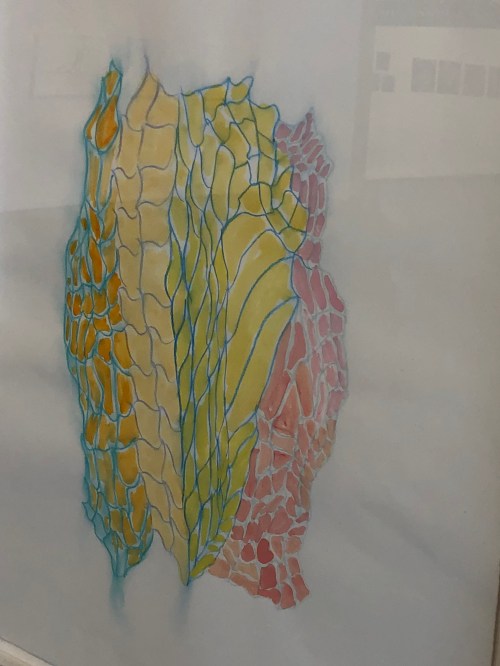
“Akagawa uses the forgotten kana in a style of calligraphy called kana shodo, and also fuses traditional calligraphy with new techniques in a style she’s named kana art, where thousands of minutely painted kana form larger images and paper sculptures

“ ‘When people talk about Japanese calligraphy, they normally mean kanji shodo,’ Akagawa explains, ‘a style imported from China, practiced by samurais and monks.’ Kana shodo uses a script which was known by the 10th century as onnade, or ‘woman hand’, she continues, which became ‘the backbone of a female-dominated literary culture’.

“Sei Shōnagon’s contemporary Murasaki Shikibu wrote her masterpiece The Tale of Genji – often called the world’s first novel – using kana, which were often associated with private and emotional life. Men who wanted to reply to love letters sent by noblewomen used kana themselves to reply. And the tradition lasted for hundreds of years; the 19th-century novelist Ichiyō Higuchi used kana script for her sympathetic portrait of the life of a geisha, Nigorie (Troubled Waters).

“Japan’s government standardised writing in 1900, establishing the system of kanji, hiragana and katakana characters used side-by-side in modern written Japanese. … By the second world war, knowledge of the older kana had almost vanished. One of the last generation to use the script in daily life was Akagawa’s grandmother, born in 1921: ‘When I told her I was learning kana shodo, she was very pleased.’ …

“Whether writing Japanese classics, love letters or embroidered messages, women have circumvented official communication channels in creative ways throughout history. As Akagawa remarks, such handwritten texts frequently feel very personal: ‘I’m always surprised how such a simple action as handwriting can affect audiences’ emotions so deeply.’ ”

More at the Guardian, here.

Theater in Your Car

orjalo_yee

Photo: The Toronto Star
A Canadian theater critic interviewed actors who give 10-minute dramatic performances in people’s cars.

More than five years ago, I wrote about actors creating theater in taxis in Iran and linked to a separate article on taxi performances in New York (check out the post). So that’s just to say there is no new thing under the sun.

Still, people think up creative ideas for their own reasons and don’t necessarily know about similar efforts anywhere else. In today’s example, providing entertainment in cars was devised as a way to bring theater to Toronto suburbs where there are large Asian populations that seldom brave the downtown scene.

Karen Fricker wrote at the Toronto Star about picking up a series of actors in her car who put on 10-minute plays for her as a demonstration.

“[I] picked up three actors who directed me around streets previously unknown to me in downtown Markham and its environs, and who each made me believe in ten short minutes that their situations were really happening.

“I did this as a test driver for fu-GEN Theatre Company’s wildly ambitious show Fearless, which involves micro-performances for individual spectators in their own cars, and a web app which lets the show work, as artistic director David Yee describes it, like ‘Uber in reverse.’

“Fu-GEN is a Toronto-based company dedicated to reflecting Asian-Canadian experiences. This show ‘began as outreach, as a way to engage with the large Asian Canadian community who live in Markham, Richmond Hill, North York, etc., who we know exist, but don’t make it downtown to see our work,’ says Yee. …

“The goal of the project is to give Markhamites something new and curated for them … “Fu-GEN commissioned [writers] to author short scripts that address the themes of fear and fearlessness, and at the same time found a developer, Shawn Li, ‘who works at Microsoft during the day, then builds us a weird little theatre-in-cars app in his off hours,’ says Yee.

“From my user perspective I found the show streamlined and easy to navigate. In order to participate, you need to have a car you are insured to operate. You book online, choosing between a series of timed slots, and are given a link to an online app you can use from a browser on your phone (you don’t have to download anything).

“When the app goes live, photos of the 20 performers appear on a live map along with the titles and authors of their shows and a one-sentence description of the content. Once you confirm your choice of performer, the app guides you to their location — and you know it’s them because they’re wearing a bright yellow backpack (and they know it’s you because you’ve uploaded a photo to your online profile). The performer disappears from the live map during the ride and reappears once you’ve dropped them off. You then start over by clicking on another performer photo. …

“Yee says that safety was one of the core tenets of the project. ‘Every aspect of this experience, from the ground up, has been built with both audience and performer safety in mind. … How eerie is it for a stranger to greet you by your name? It can be comforting or it can be unsettling; all that potential is alive in just having that information at hand. The writers had the choice to use that for whatever purpose is useful to them.’ ”

For me, this experience sounds like fun, but I am also not afraid to go downtown for a show. I really wonder if people who are afraid of something that simple and distancing would pick up a stranger for an in-your-face performance.Would you try it?

More here.

Be a Guest Art Critic

payment-720x478

Photo: Jay Simple
Artist Maia Chao pays a guest critic $75 in cash at the end of a 4-hour visit to the Rhode Island School of Design Museum.

The Rhode Island School of Design and its museum are justly famed for cutting-edge art and ideas. In this Hypoallergic story, Laura Raicovich speaks with Maia Chao and Josephine Devanbu, the founders of Look at Art. Get Paid., a program that pays people who wouldn’t otherwise visit art museums to visit one as guest critics. It premiered at RISD.

“Critique is a hallmark of the art field,” writes Raicovich, “yet the vast majority of cultural critics, curators, museum leadership, and museum visitors are affluent and white. What is critique without diversity? What possibilities and truths are we missing?

“I was fortunate to meet artists Maia Chao and Josephine Devanbu, who launched the pilot of an ingenious way to approach these questions called Look at Art. Get Paid. (LAAGP), in 2016 at the RISD [Rhode Island School of Design] Museum. The initiative is a socially engaged art project that pays people who wouldn’t otherwise visit art museums to visit one as guest critics of the art and the institution, flipping the script between the institution and its public, the educator and the educated, the paying and the paid. In the next year, they will embark on an expanded campaign to launch LAAGP simultaneously across a regional cohort of three to five art museums in the US. …

“Hyperallergic: What is the origin story of LAAGP?

“LAAGP: We started LAAGP when we were both students at the Rhode Island School of Design (RISD). We were grappling with the relevance of our chosen field to our wider communities. We believed in art making and cultural critique as vital sites of collective meaning-making and world-building, but felt frustrated by how access to the majority of resources and infrastructure to sustain ambitious projects was constrained to a (mostly white and affluent) initiated few. We asked each other, what would a critique environment look like if you didn’t need to be an insider to be in the room? We were curious to test out how we might use our institutional access and artistic license to move funds that would normally circulate within RISD out into the community. We launched our pilot in 2016 at the RISD Museum. …

“Paying people in cash to visit a museum names the elephant in the room: wealth, specifically the wealth accumulated by beneficiaries of the transatlantic slave trade, and the way this wealth continues to shape whose cultural production gets prioritized.

“As with any group of people, some enjoyed their experience and others didn’t. One critic took a picture of her favorite painting on her phone to get printed at Walgreens and hang it up in her living room. Others found the experience reaffirmed their assumptions that museums are boring.

“But beyond like and dislike of the experience, there was a general feeling amongst critics that the museum is ‘addressing a certain kind of person’ — namely white people and people with money. Throughout our conversations, the topic of belonging featured prominently, and one critic said, ‘maybe this place isn’t for me.’ Another critic articulated that they just didn’t feel like they had ‘bandwidth for another white space.’ When discussing what changes the critics would like to see, most agreed the museum would have to better represent POC [people of color] in their collection, improve language accessibility, advertise in their neighborhoods, and make the experience less intimidating.

“However, there were some critics who felt energized to help the museum. For instance, one critic, a sign-maker, said he’d love to help the museum improve their signage. Another critic — an organizer from Direct Action for Rights and Equality — suggested having cookouts at the museum. We’ve been working with these critics to commission local artists to engage these ideas. …

“Critic Samanda Martínez said, ‘Están cuidando más a las imágenes que a nosotros/They’re taking better care of the paintings than they are of us.’

“It’s one thing to know that a space isn’t welcoming to another person, but it’s another to hear directly from someone who has felt unwelcome. In general, our goal as artists is to make that experience legible and valid, in order to create more urgency and disrupt usual practices that need to change. ” More here.

Summer Scenes

080419-ice-cold-lemonade

The angle of light makes September seem close at hand, so it’s time to round up a few more photos from my Rhode Island summer before the hurricanes start.

As they do every year, both families of grandchildren took a turn at a lemonade stand to raise money either for a big item on a wish list — or a visit to the candy store.

Another every-year thing is the opening of my neighbor’s lotus flowers. No matter how many times I’ve seen it, it always feels like an unexpected miracle. I took the photo of a bud, and Sandra M. Kelly captured a full-blown lotus when I was in New York.

Sandra also took the photo of the jellies. She’s a famous jelly maker locally, making blackberry, beach plum, and strawberry-rhubarb jams and jellies, among others. But this was the first year we picked Queen Anne’s Lace so she could attempt the lemony jelly that Thelma, an island character, used to make out of the flowers. It had a lovely flavor.

On a couple of our early walks, I picked an array of wildflowers, carrying them home in my water bottle to make bouquets.

I also took shots of a lacy fire-escape shadow, a Monarch butterfly caterpillar, and a dew-bejeweled spiderweb.

I made a big mistake about the caterpillar, though, disrupting the course of nature by bringing it home on a milkweed stem thinking the kids would see it make its cocoon, emerge, and fly away safely. But the caterpillar absconded while I was out picking more milkweed.

I’m distressed about that because there is no milkweed growing on the property for the run-away to eat, and I’m worried it won’t ever turn into a butterfly. I will never do that again. If I see a cocoon, I might bring that home on a stem for the kids. At least a cocoon won’t abscond. But I’m more wary of disrupting nature now, especially as Monarchs are much less plentiful than they once were.

080419-lotus-opening

081419-SandraMKelly-open-lotus


080219-Queen-Anne's-Lace-jelly

080519-wildflower-bouquet

080419-iron-lace-fire-escape


082119-Monarch-caterpillar

081919-spider-web-jewels


3264

Photo: Smartshots International/Getty Images
A reader of the
Guardian wrote to the newspaper about this bicycle lane in Bucharest, Romania, where a huge tree blocks the entire path.

Do you need a laugh today? I did. Twitter provided it with a link to this June story in the Guardian about many horrendous (and a few great) bike lanes. The photos were provided by readers.

“Bike lanes blocked by bollards, potholes, contradictory signs and ‘the world’s shortest bike lane’: when we asked for examples of the best and worst cycle infrastructure in cities the submissions came in thick and fast.

“Readers around the world shared photos of bikes lanes that were impossibly narrow, that led nowhere or were blocked by parked cars, even police cars. On the upside there were also cycle networks and paths that were a joy for people on bikes. Here are some of the best (and worst).”

The Guardian shares a little background for each photo. For example, the text for the one below says, “Istvan sent in this photo taken in Queen Street, Edinburgh, and says: ‘Do I risk it? … Mmm, not today … Each traffic light on Queen Street has this very narrow bike lane to lead you to a bike zone in front of the traffic (usually used by cars, taxis and buses). There are many of these useless lanes everywhere in Edinburgh, and many many used for parking (when they don’t have a double yellow line above the bicycle sign).’ ”

Read all the funny commentary from Guardian readers and see their amazing photos here.

Photo: Istvan/Guardian Community
Istvan sent the
Guardian this photo of a dangerously skinny bike lane on Queen Street in Edinburgh, Scotland.

2682

shutterstock_1372207001

Photo: Shutterstock
The original clock at the Cathedrale Notre-Dame de Paris was destroyed by a conflagration in April.

What is lost can often be found — or a decent replica created. That is the message of a recent story about the clock destroyed by the fire at Notre-Dame Cathedral in Paris. After I read it, I felt curious about the clock expert who realized that a different church had an almost identical clock in storage. So I looked him up. Such discoveries are not ordinarily stumbled on by people with no expertise.

The Catholic News Agency, in an item widely shared last June, reported, “A clock nearly identical to the one destroyed in the fire at Cathedrale Notre-Dame de Paris has been found in storage. The duplicate was found at the Church of the Holy Trinity in Paris, in what is being called a ‘miraculous discovery.’ …

“The original clock was located near the cathedral spire, which collapsed during the April 15 fire. It was feared there would be no way to rebuild the clock, as there were no surviving drawings of its mechanism or any digital records of how the clock was made.

“The timepiece’s near-twin was found by clockmaker Jean-Baptiste Viot, during a storage inventory at Holy Trinity. Viot called the find ‘incredible.’ …

“The Church of the Holy Trinity’s original clock was replaced by an electronic model about 50 years ago. The old clock was then put in storage, and was discovered behind a wooden board amid statues and furniture in a small storage room.”

Said Olivier Chandez, who was responsible for maintaining the clock at Notre-Dame, ” ‘If we only had the photos, we would have had to extrapolate. … But with this model, we have all the dimensions.’

“While the clocks are very similar, Chandez said that there are enough differences to prevent restorers from simply inserting Holy Trinity’s clock into the refurbished Notre-Dame.”

Here is some of the information I found on the shard-eyed Jean-Baptiste Viot [J-B Viot].

Born in 1967, he “began his training in watch repair at the Public Watch Making School of Paris in September 1983. After graduating, he went to Switzerland to continue his studies at the Technical School of the Vallée de Joux. … The federal certificate he obtained in June 1988 enabled him to pursue his training with the International Museum of Watchmaking of Chaux de Fonds … resulting, after two further years of study, in a degree in watch restoration. …

“In June 1998, J-B VIOT was hired by Breguet 7 place Vendôme, giving him the chance to return to watch restoration in Paris. Indeed, working on original Breguet movements from the historical period 1775-1840 gave him the opportunity to study this great master from the past. …

“Following the purchase of the firm by the biggest Swiss watchmaking group (Groupe Swatch), J-B decided to devote himself entirely to the restoration of antique watches and clocks.” More here.

I like to imagine how Viot felt when he saw what Trinity had at a time that all Paris was mourning the cathedral.

1jeremydutcherheader

Photo: Matt Barnes
Jeremy Dutcher is a First Nations tenor and pianist who is getting a lot of attention in Canada and beyond.

Bit by bit we’re all learning more about the people around us, people who may have very different lives and who in the past we knew nothing about. Even those we thought we knew well sometimes have lives that are veiled to us, as I learned this summer when our niece sent me her story, a heartbreaking tale of a childhood that I had only perceived on the surface. You just can’t know what is going on behind someone’s eyes.

Among the kinds of people I am learning more about are indigenous people, both in the United States and elsewhere. This story is about a young tenor who belongs to a Canadian tribe.

Jeff Kaliss writes at San Francisco Classical Voice, “Interviews with Jeremy Dutcher figure among the new demands on a Canadian First Nations (indigenous) singer-pianist who’s risen rapidly to international attention. The 28-year-old Toronto resident needs now and then to take a break from the clamor, to return to something like the pastoral pace of his raising in the Maritime province of New Brunswick, as a member of the Wolastoqiyik [pronounced Wuh-last-o-key-yik] tribe.

“I first witnessed Dutcher a year ago, at the Festival International de Jazz de Montréal, performing on piano and singing in his tribe’s native Wolastoq language (the word denotes ‘the beautiful river’; renamed by the colonizers of New Brunswick as the St. John), in the basement of a church, a beautiful historical landmark. He hadn’t yet won Canada’s prestigious Polaris Prize, nor its Grammy-equivalent Juno Awards. Both of these wins would recognize his debut self-produced album, Wolastoqiyik Lintuwakonawa, translated as Songs of the People of the Beautiful River. …

“Dutcher incorporates in his live and recorded music an unusual and affecting act of legacy, playing transcribed wax recordings from 1911 by an early anthropologist of a tribal elder singing and speaking, and following the melodies with his own heldentenor voice and mellifluous keyboard compositions. The method and quality of his approach derive from his training, including classical voice with Marcia Swanston at Dalhousie University in Halifax, Nova Scotia.

“Two semesters before completing his music degree, Dutcher enrolled in a class in Social Anthropology, and decided to stick around Dalhousie for an additional year, completing a second major and an honors thesis on the subject of Traditional Music in a Contemporary Moment: Musical Pan-Indigeneity as Revitalization in the Wabanaki Region. The region is a confederacy of five indigenous nations including the Wolastoq and extending across the current provinces of New Brunswick, Nova Scotia, Prince Edward Island, and Quebec, and the state of Maine. The thesis title took the form of a mission statement for Dutcher, who was led to the wax recordings by a living tribal elder, sweat lodge keeper, and First Nations ambassador, Maggie Paul.

“ ‘I made my way to Ottawa [the site of the Canadian Museum of History] and went down into the basement archives there and threw on some headphones and started a journey,’ Dutcher recalled for an NPR presentation last year.

“ ‘To not just hear the songs, but also to hear the background noise and to hear them laughing and telling jokes — there was a sense of entering into that space through these voices. And that was something that changed my life.’

“The Dalhousie anthropology faculty have declared in writing their admiration for where their alumnus has taken his education and his life. … ‘Dutcher honors intergenerational connections, his voice singing on with the voices of his elders … It disrupts widespread expectations of indigenous music as a thing of the past, and shows instead how it lives in the present, fully capable of working and remixing in contemporary idioms. This has a decolonizing effect, in that it unsettles public conceptions that all too often primordialize and essentialize indigenous art forms.’ ”

I love the idea of a decolonizing effect. I never thought about that — about not only promoting healthier relations between indigenous people and others going forward but actually starting to undo harm that was done in the past. How great if we could apply that idea to all kinds of wrongs the world has seen!

More at San Francisco Classical Voice, here.

jayfai_wide-3a01246810c2d39a14544605a9be03051690aae9-s800-c85

Photo: Lillian Suwanrumpha/AFP/Getty Images
Chef Jay Fai in Thailand wears a wool cap and safety goggles to ward off the heat from the charcoal fires in the alley where she cooks all of her restaurant’s meals. She won a Michelin star for her high-quality food.

Quality can be found anywhere, as this National Public Radio (NPR) story about a chef in a Thailand alley shows.

Michael Sullivan writes, “Bangkok is legendary for its fun and its food. Especially its street food. And one vendor’s is so good, it has earned a Michelin star for the second year running.

“Raan Jay Fai is a small, seven-table joint in Old Bangkok that’d be easy to miss if it weren’t for the line. There’s always a line.

“You can try to make a reservation, but the place — named after its chef/owner, a local legend — is usually booked a month or two out. Signing up for the walk-in list is the best bet for many, especially tourists. But you need to get there early.

” ‘I got here at 7:30 [a.m.],’ says 24-year old Kashmira Velji, from Austin, Texas, who was determined to try Jay Fai after viewing the chef’s star turn on the recent Netflix special Street Food. Never mind that the restaurant doesn’t open for lunch until 2 p.m. …

” ‘I’ve never had anything like this before,’ Velji says between bites. … ‘Our first bites were very intense. We kind of just stayed silent and were in shock at how good it tastes.’

“Suparat Tretachayakorn — a doctor — isn’t shocked at all. He’s a regular. And the crab omelette is one of his go-to dishes. … He and his friends have also ordered Jay Fai’s famous tom yum soup, and half a dozen other dishes. Tom yum is a Thai staple — made with shrimp, lemongrass, galangal, kaffir lime leaves, chilies, garlic and mushrooms — and it’s found almost everywhere. But that doesn’t mean it’s always good.

” ‘Actually, I don’t normally order tom yum because I know that I’m going to be disappointed at most places,’ he says. …

“It’s another of her signature dishes. One that’s got the visitor from Austin, Velji, baffled. In a good way.

” ‘It tastes just like the soup, but it’s dry,’ she says. “It’s exactly the same flavors of the tom yum soup, but instead of slurping it, I’m chewing it and I’m still getting all those sour, spicy flavors’ …

“Part of the fun [is] watching the maestro at work. The 74-year-old Jay Fai cooks everything herself — over two blazing charcoal fires, in the alley next to the busy street. …

” ‘It’s faster to cook when using charcoal, to stir-fry vegetables,’ Jay Fai says. … Jay Fai is a perfectionist — so much so that she doesn’t let anyone else on her staff do the cooking. That’s another reason why it takes so long to get your food here — even with reservations.

” ‘They can’t do it. This is very hard to do,’ she says. ‘It’s not that I don’t want them to do it, I do. But even when they watch me, they can’t remember anything.’ …

“About that Michelin star: When she got the first phone call, she kind of blew them off. By accident.

” ‘I was confused,’ she says. ‘They said they wanted to invite me to an event, a gala dinner, and I said, “Oh, my, a gala dinner, no thank you. I don’t want to go. What would I wear?” ‘…

” ‘To be honest, it was the high point of my life. If I die now, if anything happens now, I’m OK with it. I’ll die peacefully.’ ”

More at NPR, here.

20esterly1-jumbo

Photo: David Jennings for the New York Times
David Esterly in 1989. His woodcarvings were in the tradition of a 17th-century English master.

How some artistic geniuses stumble onto their metier is a mystery. This wood carver didn’t even know how to carve wood when he was blown away by the beauty and intricacy of works by a 17th century master. He had to know more.

Katharine Q. Seelye writes at the New York Times, “David Esterly was in London in 1974, walking with his girlfriend to meet her parents for the first time, when she steered him into St. James’s Church, Piccadilly, to see the intricate woodcarvings by Grinling Gibbons, widely considered one of the greatest woodcarvers in history.

“Mr. Esterly, an American who had studied at Cambridge University in England and was trying to figure out what to do with his life, had never heard of Gibbons and knew nothing of woodcarving.

“But inside the church he was mesmerized by what he saw — a cascading cornucopia of delicate, lifelike blossoms, foliage and fruit above the altar, all sculpted in wood by Gibbons in the late 1600s.

” ‘I was seduced by the power of the carving and its capacity to convey the beauty of nature,’ Mr. Esterly told the New York Times in 1998. ‘It seemed to me beyond belief that a human hand had fashioned those seashell swags, drooping bellflower chains, birds with laurel twigs in their beaks and dense whorls of acanthus. My fate was sealed.’

“He decided to learn more about Gibbons, and to do so, he realized, required taking chisels into his own hands. He taught himself woodcarving, becoming so skillful that when some of Gibbons’s 300-year-old carvings were destroyed by fire, Mr. Esterly was summoned to recreate them. He became not only an expert on Gibbons, but also the maker of sought-after sculptures of his own. …

“Mr. Esterly’s life was shaped by his obsession with Gibbons, master carver to the crown, who was commissioned to work in Windsor Castle, Kensington Palace and St. Paul’s Cathedral, among other landmarks. …

“For Mr. Esterly, carving was as much an intellectual exercise as a physical one.

” ‘The wood is teaching you about itself, configuring your mind and muscles to the tasks required of them,’ he wrote in his book ‘The Lost Carving: A Journey to the Heart of Making’ (2012). ‘To carve is to be shaped by the wood even as you’re shaping it.’ …

“He worked slowly, creating only about 50 pieces in his lifetime. But as his literary agent, Robin Straus, said by email, he was ‘equally fluent with words and wood’; besides books, he wrote numerous articles and reviews about art and carving.

“The subjects of his carvings varied. One might be Gibbons-like but with a twist — a spray of delicate roses, but with insect holes in the leaves, or a broken stem; another might be a head covered in elaborately carved vegetation.

“In most cases Mr. Esterly carved to the specifications of a patron. For a buyer who revered Thomas Jefferson, he carved a necklace like one sent back by Lewis and Clark, whom Jefferson had sent to explore the Northwest Territory. In others he whimsically updated traditional themes by inserting, say, a carved iPhone or a set of car keys.

“After a fire in 1986 at Hampton Court, Henry VIII’s palace, Mr. Esterly spent a year creating a replica of a seven-foot-long Gibbons carving that had been destroyed.”

More of the story — and some terrific photos — here.

081519-purple-loosestrife-on-footbridge

All I do is shoot random things that catch my eye, but now when gathering them together, I note a bit of a theme. Ripening. It’s only mid-August, but when you see acorns and pine cones developing, you know autumn is coming.

The first photo is of a footbridge in Concord, where the invasive Purple Loosestrife is starting to take over the swampy area along the Mill Brook. Then there is the herb garden behind the Unitarian Universalist church and the sexton’s bonsai trees.

Those pictures are followed by a progression of grapes and by the pine cones and acorns. Next comes a landscaping business with an unusual name (for a landscape business), a midsummer sidewalk sale, and a local hero being used to promote an antiques shop.

I wonder if the landscaper chose the company name after hearing that potential clients were frustrated about other businesses not communicating. That can be an issue, and not just with landscapers. I appreciate that workers may get overwhelmed by demand in certain seasons, but customers do value having someone answer the phone or explain why it was impossible to come on the day originally scheduled.

Recently my husband saw a handyman’s truck with “We show up” in giant letters on the side. He told the handyman he liked the sign. “So do our clients,” the man responded.

071619-rue-and-other-herbs

071619-Doug-Baker-bonsai-deck

071519-grapes-ConcordMA

081519-grapes-in-Concord

081619-pinecones-ConcordMA

071519-acorns-in-July

081019-unusual-landscaping-name

081019-Sidewalk-Sale-ConcordMA

071619-Thoreau-as-sandwich-board

broken20treaty20quilt20performance

Photo: Portland (Maine) Museum of Art
The quilts of artist Gina Adams tell the tale of broken treaties.

Lately, I’ve been reading books that have given me a deeper, more disturbing understanding of American history. Of course I knew about slavery and broken Indian treaties and adventurism abroad, but I tended to slink away from knowing too many details. You can hide only so long. Two books I would recommend are the novel Underground Railroad and the history Ramp Hollow.

Artist Gina Adams found her metier in quilts about broken treaties. There are no shortage of those, she says. This article by Indian County Today recounts the evolution of her work “Broken Treaties Quilts.”

“Gina Adams’ journey to becoming a political artist began as she probed deeper into her Native roots. Trained as a painter and printmaker, Gina Adams made apolitical art for many years. …

“While studying the effects of post-Colonial trauma and assimilation at the University of Kansas, Adams identified feelings of remorse and grief in her own life, stemming from her Ojibwe-Lakota grandfather’s forced boarding at the Carlisle Indian Industrial School in Pennsylvania. Her art began to change.

“ ‘I realized how powerful it was to be able to speak about all of those feelings,’ said Adams, who lives in Longmont, Colorado. …

“ ‘Broken Treaties Quilts,’ involves sewing text from Indian treaties onto antique quilts. … Sewing the words of injustice, letter by letter, onto objects of comfort and beauty represents the turmoil that Indians have suffered. …

“Adams, 52, recently finished quilts about both the 1851 and 1868 Fort Laramie treaties, which she made in response to the Dakota Access Pipeline standoff at Standing Rock. She has made 18 quilts so far, and shown them from Maine to the Midwest. Wherever she shows her work, she makes a new quilt that’s relevant to the treaty history of that geographic area.

Her goal is to create a quilt for every U.S. state.

“There’s no shortage of broken treaties, she said, and all were populated with twisting, confusing language that purposefully misled people and subjected the treaties to misunderstanding and different interpretations.

“Adams has spent most of the past three years reading the treaties, word for word.

” ‘In cutting up these letters and reading and re-reading these treaties, you begin to realize how the language was meant to be confusing when they were written. They are still confusing today. They’re very duplicitous in their meaning,’ she said. ‘You can understand why the misunderstandings happened. …

“In Native cultures, the quilt transcends modern timekeeping. It’s been around forever, serving as a source of warmth and comfort, as well as a feeling of home and family. Quilting is also thoroughly American, she notes, and both the quilt and quilting bees symbolize community and the idea of working together. …

“Adams begins with antique quilts that she finds at flea markets and elsewhere. Many people also give them to her. She prefers quilts that are a century old or older, so they reflect the general vintage of the treaties she represents. …

“The process of making the quilts is time-consuming and labor intensive, and enjoyable, Adams said.

“ ‘It’s very contemplative. It’s very mindful,’ she said. ‘I so look forward to every single aspect of it, even when I am doing the detailed stitching on the quilt. It’s a really focused time. I am lost in my thoughts and just focusing on the work itself. I find it to be so rewarding.’

“Adams … descended from indigenous and colonial Americans. Her grandfather was Ojibwe and Lakota, and Adams has always identified with her Native roots. ‘I remember being 3 and 4 years old and going on hikes with my grandfather. He would talk to me and introduce me to plants and animals and things in nature in the Ojibwe language,’ she said. ‘He would tell me everything in Ojibwe and then translate it. It was a wonderful connecting point that stuck in my heart and soul and has been there my whole entire life.’

“Adams, who is not an enrolled tribal member, plans to take Ojibwe language classes this fall, to deepen her cultural immersion.”

Read about Adams’s quilting process here.

Hat tip: @WomensArt1 on twitter.


081119-early-shadows-on-ladder

Recently, I took a couple trips to New York to see my sister, who’s been having ups and downs with the brain cancer. We had decided to have a sibling gathering when the Midwest and West Coast brothers were in town with wives and several kids.

I’m not going to show you the group photo from our delicious Maialino lunch because my poor sister, despite feeling much better, is still horrifically bruised from tripping and getting a black eye. Falling is one of the biggest worries these days.

Instead I’ll share other pictures from my trips and explain any that need explaining.

In July, I took Amtrak from Kingston, Rhode Island, where there is a cute historic train station and, across the track, some interesting graffiti.

In New York, my camera was drawn to verbal images: Biblical messages chalked on the sidewalks, a port-a-potty pun for my collection, and outreach to immigrants (I saw the electronic kiosk message in Spanish and Chinese, too).

I also shot a giant balloon version of the city mascot (just kidding, it’s not the mascot) and one of the ubiquitous mini gardens planted around street trees. I especially admired the gardens that managed to do without the “curb your dog” signs because they completely spoil the charm. But how do people protect the plantings otherwise? I wondered. Do the doormen rush out and chase away dogs? Is there a spray deterrent that dogs hate? Some successful mini gardens used higher fences.

A large and glorious volunteer-maintained series of gardens in Riverside Park proclaimed a different kind of success with its clouds of delirious, happy butterflies, like the butterfly below. Red Admiral? Not sure.

Olmstead’s tinkling waterfalls in Central Park make me delirious.

072419-Kingston-RI-train-station

072419-graffiti-Kingston-RI

081319-NYC-sidewalk-wisdom

081319-23rd-Psalm-on-sidewalk

081219-potty-title

081119-ICE-not-Welcome

072419-NYC-protects-immigrants

081219-NYC-rat

072719-garden-without-ugly-dog-sign

081119-.delirious-butterflyJPG

idea_sized-cod-newsroom-38012019442_148f3964b4_oPhoto: CoD Newsroom/Flickr
Singers at the Illinois American Choral Directors Association conference. Research explores how people bond through singing together.

Sometimes when the grandkids were small and fighting, I would break out in a song they liked — “Mister Moon,” say, or “Baby Beluga” — and they would join in enthusiastically and forget to fight.

The bonding aspect of singing together is something that many other people have discovered on their own. Now researchers want to learn more.

Eiluned Pearce, a postdoc research associate in experimental psychology at the University of Oxford, writes at Aeon, “Singing is universal. It is found in all cultures and, despite protestations of tone deafness, the vast majority of people can sing. Singing also often occurs in collective contexts: think about sports stadiums, religious services and birthday celebrations. Given these two characteristics, my colleagues and I wondered whether singing is a behaviour that evolved to bond groups together.

“Being part of a group is essential to human survival. In our hunter-gatherer past, having supportive social relationships would have enabled people to get the resources they needed to defend them against outsiders, to benefit from collective childrearing, and to share and develop cultural knowledge about their environment and about useful technological inventions. We now also know that feeling sufficiently socially connected guards against physical and mental illness, and increases longevity. …

“Whereas monkeys and apes create social bonds through one-to-one grooming sessions, human groups are too large to be able to do that and still have enough time to eat and sleep. We needed a more efficient mechanism of creating social cohesion, a way to bond larger numbers of individuals together simultaneously.

“To find out whether singing might fill this role, we needed to find out if this activity was capable of making large groups of individuals feel closer to each other. To help us answer this question, we teamed up with Popchoir, a British organisation that runs local choirs across London and beyond. What is great about Popchoir is that these different local choirs of a few dozen members periodically come together to create a unified ‘Megachoir’ of several hundred members.

“Our research team went along to some rehearsals to collect data before and after they sang together, either in their local choir or in the amalgamated Megachoir. … On average, people showed a significantly bigger increase in how close they felt to the Megachoir over the course of singing with them, compared with when they were singing with their local choir. …

“So singing can create cohesion in large groups of several hundred individuals, supporting the idea that this behaviour might have evolved to create community cohesion in humans.

“What we still didn’t know, however, was whether singing itself is special, or whether any activity that provided opportunities for social engagement could have similar bonding effects. To tackle this issue, we collaborated with the Workers’ Educational Association (WEA), a national adult-education charity in the UK. We predicted that singing classes would become more closely bonded than other types of classes (either creative writing or crafts). We were wrong: at the end of the seven-month courses, all the classes were equally bonded.

“But as we looked more closely at the data, we saw something that surprised us. Singing seemed to bond the newly formed groups much more quickly than the comparison activities. It was the most effective. So singing is special: it has an ice-breaker effect.”

More at Aeon, here. Even when groups of singers are competing, the researchers found, bonding occurs among opposing groups.

pipl_nest_007

Photo: Wayne Hathaway
The endangered Piping Plover is a species that actually benefited from Hurricane Sandy in 2012 — at least on Fire Island.

It’s a ill wind that blows nobody good, as they say, and the ill wind of Hurricane Sandy seems to be a case in point. As devastating as it was along the East Coast, there are reasons why an endangered shore bird benefited on Fire Island, a place I spent many youthful summers. Annie Roth has the story at the New York Times.

“The wrath of Hurricane Sandy’s powerful winds and violent storm surge left considerable damage across New York and New Jersey in October 2012. But for one tiny bird, the cataclysmic storm has been a big help. …

“The piping plover is a small, migratory shorebird that nests along North America’s Great Lakes and Atlantic Coast. The species, which is listed as endangered in New York State and threatened federally, has been the focus of intensive conservation efforts for decades. But on one island that was heavily damaged by the big storm, the piping plover population has increased by 93 percent, [as Katie Walker, a graduate student in wildlife conservation at Virginia Tech] and colleagues reported in the journal Ecosphere. …

“Fire Island, a 32-mile-long barrier island off the southern coast of Long Island that is popular with vacationers, was hit particularly hard by Hurricane Sandy. The storm washed sand and seawater across the island, flooding homes, flattening dunes and breaching the island in three places.

“Sand deposited from Fire Island’s oceanside onto its bayside created a number of new sand flats. Some areas were also breached by seawater but most were filled by the Army Corps of Engineers shortly after the storm as part of the recovery effort. …

“Piping plovers like to nest on dry, flat sand close to the shoreline, where the insects and crustaceans they feed on are easily accessible. But over the past century, coastal development and recreational use of shorelines have vastly reduced the amount of waterfront property available. …

“For the past three years, the majority of new and returning plovers chose to nest in habitats generated by the storm. And now, for the first time in nearly a decade, Fire Island’s population of piping plovers is growing. …

“Barrier islands like Fire Island are known as early successional habitats, which means they require regular disturbance events to keep their ecosystems in check. Under normal circumstances, Fire Island would experience disturbance events on an annual basis. However, engineers have gone to great lengths to stabilize the island, and now only powerful storms like Sandy are able to have a significant impact on the island’s ecosystem.

“ ‘Barrier islands are very dynamic systems, they don’t stay the same from one year to the next. The species that inhabit them there are adapted to these changes, so if we try to keep these systems static, we are going to lose these species,’ said [Jonathan Cohen, assistant professor at SUNY College of Environmental Science and Forestry, who was not involved with the study].

“Last year, 486 pairs of piping plovers nested along the shores of New York and New Jersey, approximately 10 percent of which did so on Fire Island. If current trends continue, the two states may soon reach their recovery goal of 575 breeding pairs set out by the U.S. Fish and Wildlife Service.”

More at the New York Times, here.

a514c2fcd

Photo: Ville de Paris/Apur/Céline Orsingher
The trees in this rendering of Paris’s Opera Garnier would take the place of an existing bus-parking area. Big ideas are necessary if the city is to meet its ambitious greening goals, part of the international Paris Agreement to tackle global warming.

A January article by Feargus O’Sullivan at CityLab, showed artist renderings like the one above as part of a plan to bring more trees into Paris. The announcement came before Notre Dame burned, so I hope plans are still going forward. Here is the concept.

“Some of Paris’s most treasured landmarks are set to host the city’s new ‘urban forests,’ ” writes O’Sullivan.

“Thickets of trees will soon appear in what today are pockets of concrete next to landmark locations, including the Hôtel de Ville, Paris’s city hall; the Opera Garnier, Paris’s main opera house; the Gare de Lyon; and along the Seine quayside.

“The new plantings are part of a plan to create ‘islands of freshness’—green spaces that moderate the city’s heat island effect. It also falls into an overall drive to convert Paris’s surface ‘from mineral to vegetal,’ introducing soil into architectural set-piece locations that have been kept bare historically. As a result, the plan will not just increase greenery, but may also provoke some modest rethinking of the way Paris frames its architectural heritage. …

“[Such plans] are necessary if Paris is to meet its ambitious greening goals. By 2030, city hall wants to have 50 percent of the city covered by fully porous, planted areas, a category that can include anything from new parkland to green roofs. ..

“The city imagines turning the square in front of city hall into a pine grove, while future springtimes will see the opera house’s back elevation emerge from a sea of cherry blossom. The paved plaza at the side of the Gare de Lyon will become a woodland garden, while one of the two former car lanes running along the now pedestrianized Seine quays will be taken over by grass and shrubs.

“Such plans will require more than sticking saplings in the ground. Creating the new opera house cherry orchard will mean displacing a current parking lot used by tourist buses, a process that the city plans to repeat elsewhere. …

“Intriguingly, the urban forest plans are a slightly different take on the classic Parisian aesthetic. Sites like the areas around the opera and Hôtel de Ville don’t need beautifying — they are already grand, charismatic showcases for the elaborate, even fanciful historic buildings that they host.

“In the past, however, they have been left bare, or at most … fringed with small lines of trees that have been rigorously pruned and trained until they form a narrow, wall-like rampart. …

“Given how charming the designs appear, this seems unlikely to be controversial, but it does suggest a more rustic, quasi-natural approach to greenery than has previously been the rule in Paris.”

There is more information here. And maybe when blogger A Pierman Sister returns to Paris, we will get an eye-witness account of the city’s progress on its plans.