Feeds:
Posts
Comments

Photo: Dominique Soguel.
Rua, a Damascus university student, poses for a photo wrapped in the Syrian flag while celebrating the anniversary of the revolution that led to the toppling of Bashar al-Assad, in Damascus, Syria, March 15, 2025.

Although we can’t know where Syria is headed in the long run — or how many powerful countries will interfere with what everyday people want — I think we’re allowed a moment of hope at this this time. Certainly, that is what many astonished Syrians felt when the regime of the tyrant Bashar al-Assad was overthrown in a “sudden” uprising that was many years in the making.

Dominique Sequol of the Christian Science Monitor wrote an article in March about what Syrians were feeling. While it focuses on a new freedom to worship, worship is only one example of the change there.

“Alaa al-Saadi, like many Syrian men of his generation,” she says, “once fought to overthrow longtime dictator Bashar al-Assad. Now Mr. Saadi is savoring his first ‘free’ Ramadan in his hometown of Qaboun, a low-income neighborhood and former rebel stronghold on the outskirts of Damascus.

“At sunset, when Muslims rush home to break the fast with the iftar meal, the business owner stands on a street corner pouring out licorice juice from a giant metal pot. …

“Damascus is observing its first Ramadan since the fall of Mr. Assad, who cast himself as a protector of Syria’s many minorities while ruling them all with an iron fist. The Muslim holy month – one of heightened spirituality, and marked by the pursuit of good deeds to help those in need – is observed in Syria and across the Middle East.

“Mr. Saadi, who spent several years in Libya before returning to Syria in 2019, recalls hiding during previous Ramadans to avoid being conscripted into the Syrian army. Now, he is grateful to be in the position to help his community. …

“Families displaced by the conflict are trickling back to Qaboun, although much of it remains reduced to rubble after years of siege and bombardment.

“ ‘This Ramadan, our loved ones have returned,’ says Mr. Saadi, fielding greetings outside his car-painting workshop. ‘We are reunited. Friends, loved ones, and young men are all back. Things will gradually improve.’

“Indeed, Damascus seems to be inching toward greater functionality, with uniformed traffic police on the streets and a steadier electricity supply. The mood in the capital is one of cautious optimism under President Ahmed al-Sharaa, who broke ties with Al Qaeda and led the military effort that toppled Mr. Assad in December.  

“This has been a month of prayer but also mixed-gender celebrations that continue late into the night under the glitter of Ramadan light installations. Women in all kinds of Islamic dress – from the niqab to the veil – converged on central Ommayad Square for the March 15 marking of the anniversary of the 2011 Arab Spring-inspired revolution. So did women with no veil. …

“There has been no shortage of individual and collective volunteer efforts inspired by the month of fasting.

“In Douma, another war-ravaged suburb of Damascus, Osama Massaya leads the volunteer group Mulham. Boasting 40 participants, age 14 and up, it focuses on cleaning mosques and distributing meals to worshipers. Such ideas are not new – but the possibility of executing them this freely is.

“In 2024, Mr. Massaya, a history student at Damascus University, tried to obtain a license for a volunteer team to clean up mosques. The request never received the green light from the Ministry of the Endowment. ‘At the time, there was no interest in mosques,’ he explains.

“ ‘The mosques were very neglected,’ adds Mr. Massaya, whose team has helped to clean up a handful in Douma already. …

“The Mulham volunteers aim to distribute 4,000 meals throughout Ramadan. Such efforts are financed by individual donations made by local residents, including some who resettled in Europe and the Middle East during the war and remain abroad. Most donations – including a recent batch of 300 kilograms (660 pounds) of dates – are made anonymously. …

“The activities of mosques were closely monitored in the past. In 2011, they were a springboard for post-Friday prayer protests against the Syrian regime, and long were treated as potential hubs of dissent.

“Rua, a university student in Damascus who gave only one name and whose father died in the notorious Sadnaya prison, reports a similar newfound sense of freedom.

“ ‘It’s the difference between day and night,’ she says of this Ramadan, recalling past years when ‘people prayed quietly and left mosques quickly,’ to avoid regime informants.” More at the Monitor, here.

We don’t choose what country we are born into, and perhaps watching the news since 2011, many of us were glad we weren’t born in a country like Syria. But I think that to witness such a moment of hope after despair is something precious.

Photo: Suwa City.
Kiyoshi Miyasaka, a Shinto priest, leads parishioners from the Yatsurugi Shrine onto the frozen Lake Suwa in 2018, the last time the Miwatari, or Sacred Crossing, formed.

Climate change shows up in many ways around the world, especially where humans have kept records for centuries. One such place is in Japan.

Martin Fackler and Hisako Ueno report at the New York Times, “For at least six centuries, residents along a lake in the mountains of central Japan have marked the depth of winter by celebrating the return of a natural phenomenon once revered as the trail of a wandering god.

“It would only appear after days of frigid temperatures had frozen Lake Suwa into a sheet of solid white. First, people were awakened at night by a loud rumbling. Dawn broke to reveal its source: a long, narrow ridge of jagged ice that had mysteriously arisen across the lake’s surface, meandering like the spiked back of a twisting dragon.

“This was the Miwatari, meaning the sacred crossing, which local belief held was left by a passing god of Japan’s native Shinto belief. Its appearance evoked feelings of awe but also reassurance among the residents, who ventured onto the ice to perform a ceremony honoring what they saw as a visitation from the supernatural.

In the rare winters when the ice ridge did not appear, the god’s absence was viewed as a warning that the natural world was out of balance.

“So  important was the Miwatari that residents recorded whether it appeared, the condition of the lake and what historical events accompanied it. They have loyally written these descriptions every winter since 1443, creating a remarkable archive that attests to centuries of monotonously cold winters.

“But recently, the chronicles of Suwa have told a different, more alarming story. For the past seven winters, the Miwatari has failed to appear because the lake didn’t freeze. While there have been occasional years without ice, an absence of this length has happened only once before in the archive, and that was a half millennium ago.

“In fact, Lake Suwa has not fully frozen over — what locals call ‘an open sea’ — for 18 of the past 25 years. Kiyoshi Miyasaka, the chief priest of Yatsurugi Shrine, which for the past three and a half centuries has borne the duty of maintaining the records, says ice has failed to appear with regularity since the 1980s. He and other locals blame the disappearance of the ancient rhythms on global climate change.

“ ‘In old times, an open sea was regarded as a bad omen,’ said Mr. Miyasaka, 74, whose shrine’s traditional stone gate and tile-roofed wooden buildings stand about a mile from the lakeshore. ‘We hear about melting of ice caps and Himalayan glaciers, but our own lake is also trying to alert us.’ …

“Only parishioners in their 60s or older remember when the Miwatari was still big enough to make a sound that could wake them at night. The last time an ice ridge formed, in 2018, it was barely six inches tall.

“ ‘When I was child, the ice spikes rose higher than my height,’ said Isao Nakazawa, 81, a retired auto company worker. ‘We knew when it appeared because it made a sound like a taiko drum, “Gon-gon-gon!” ‘

“These days, the Miwatari has lost much of its religious significance. Residents in Suwa, a small, sleepy city wrapped along the lake’s edge, see it as a local rite of winter. …

” ‘Carrying on a tradition for 580 years binds our community together,’ said the mayor, Yukari Kaneko, 66. ‘I fear what’s happening now is a warning to rethink how we’re living.’

“Science has also robbed the ice ridges of their mystery by explaining how they arise. When Lake Suwa freezes, its surface hardens into a slab some two and a half miles across. On particularly cold nights, the ice contracts, opening cracks that fill with lake water, which also freezes. As temperatures rise again, the slab expands back into its original shape, pushing the newly formed ice upward into buckled ramparts. …

“While Mr. Miyasaka says he feels discouraged by the failure of the ice ridge to return, he intends to keep updating the archive.

“ ‘You cannot just quit something that has been around for more than 580 years,’ said Mr. Miyasaka, whose family has held the position of chief priest for five generations. ‘I will not be the one who ends it.’ ”

More at the Times, here.

Secret Book Club

Photo: Roman Pilipey/AFP/Getty Images.
The house of culture in the village of Posad-Pokrovske in southern Ukraine was badly damaged in attacks by Russian forces in 2022. 

There’s a secret teen book club in occupied Ukraine, where the “official” schools teach Russian propaganda. Confided one student, “They don’t teach us knowledge at school, but to hate other Ukrainians.” 

Peter Pomerantsev and Alina Dykhman report at the Guardian, “It must be one of the most dangerous book clubs in the world. Before they can feel safe enough to talk about poetry and prose, 17-year-old Mariika (not her real name) and her friends have to first ensure all the windows are shut and check there is no one lurking by the flat’s doors.

“Informants frequently report anyone studying Ukrainian in the occupied territories to the Russian secret police. Ukrainian textbooks have been deemed ‘extremist’ – possession can carry a sentence of five years. Parents who allow their children to follow the Ukrainian curriculum online can lose parental rights. Teens who speak Ukrainian at school have been known to be taken by thugs to the woods for questioning.’

“That is why the book club never meets with more than three people – any extra members would pose further risk of being discovered.

“Apart from the danger, there is another challenge: finding the books themselves. In the town where Mariika lives, the occupiers have removed and destroyed the Ukrainian books from several libraries – nearly 200,000 works of politics, history and literature lost in one town alone.

“So Mariika and her friends have to use online versions – careful to scrub their search history afterwards. The authorities like to seize phones and computers to check for ‘extremist’ content.

“Among the poems and plays Mariika’s book club likes to read are those of Lesya Ukrainka, the 19th-century Ukrainian feminist and advocate of the country’s independence under the Russian empire.

“In 1888 Ukrainka also formed a book club, in tsarist-era Kyiv, at a time when publishing, performing and teaching in Ukrainian was banned. Ukrainka’s works, in turn, explore the 17th-century struggle of Ukraine for independence from Moscow.

“In the dramatic poem ‘The Boyar Woman,’ the heroine chides a Ukrainian nobleman who has come under the cultural influence of Muscovy and praises a humiliating peace with the tsar that has ‘calmed’ Ukraine: ‘Is this peace,’ she asks, ‘or a ruin?’ …

“Over the centuries, Russia’s tactics have adapted. During the Russian empire, Ukraine was conquered, and its language and literature were suppressed. At other times, the Kremlin used mass starvation and the mass murder of intellectuals, as in the Holodomor, the Ukrainian famine of the 1930s, when about 4 million people were killed by Stalin’s policies.

“During the later years of the Soviet Union, the approach was subtler: some Ukrainian schools and a small amount of publishing were allowed but if you wanted to prosper, you had to speak Russian. Ukrainian poets and activists who asked for more national rights were sent to the last labour camps as late as the mid-1980s. …

“As it has done for centuries among its colonies, the Kremlin is changing the population on the ground by deporting local people and importing new ones with no connection to Ukraine. Since 2014, more than 50,000 Ukrainians have been forced to leave Crimea and about 700,000 Russian citizens brought in, many of them with military and security service backgrounds. …

“More than 19,000 children have been forcibly removed to Russia to indoctrinate them and break their connection to Ukraine. … There are the 1.5 million children who are still inside the occupied territories, but who are being forced to abandon their Ukrainian heritage, attend military youth groups and ultimately be conscripted into the Russian army. …

” ‘They don’t teach us knowledge at school,’ said Mariika, ‘but to hate other Ukrainians. They’ve taken down all Ukrainian symbols and have hung portraits of Putin everywhere. History is all about “great Russia” and how it’s always been under attack by others.’ …

“Part of what keeps Mariika’s book club going is the desire for people outside the occupied territories to realize that there are people fighting for their right to exist as Ukrainians. Not all the books the club has been reading are overtly political. Sometimes they enjoy reading books that are just about normal life of young women in Ukraine – about dating and shopping.

“These tales take on a greater meaning in the occupied territories – a way to stay in touch with everyday life in the rest of the country. Novels have always helped to make you feel part of the community, of a nation.

“But still there is no getting away from the all-too-relevant ideas of Ukrainka’s writing. One of her main themes was to meditate on the relationship between personal freedom – the freedom of the imagination and to define your life – and the political freedom of the nation. ‘Whoever liberates themselves, shall be free,’ she wrote.

“Mariika’s book club makes those words real every day.”

More at the Guardian, here.

Photo: Cincinnati & Hamilton County Public Library.
This copy of
Wild West was returned more than 35,000 days after its due date of Nov. 23, 1926.

Here’s a fun story for all of us who love libraries. Looking at you, Laurie.

Tana Weingartner writes, “Librarians at the Westwood and Price Hill branches of the Cincinnati & Hamilton County Public Library got quite a surprise late last year. A copy of Wild West, by Bertrand W. Sinclair, was returned after 98 years.

” ‘I’ve been here a while, and I’ve seen books come back that were due in the ’80s and the ’90s and even the ’70s, but this is the first time I’ve come across a book that was almost a century overdue,’ Christopher Smith, genealogy and research services reference librarian, tells WVXU.

“According to the date slip in the back of the book, it was checked out from the Price Hill branch sometime in 1926 and due back on Nov. 23, 1926. …

“The book was discovered by family members cleaning out the home of an elderly loved one who had died. It was found on a bookshelf with other books, though Smith says it’s unclear to whom the book belonged.

” ‘We assume it’s the person who checked it out, but we don’t know that,’ he says, noting the library does have some old records, but it would take a lot of digging to see if it still has lending records going back that far. …

“It was returned to the Westwood branch about five miles away — and more than 35,000 days late. The library no longer charges fines, but it if did, he calculates the fine would have been roughly $730. The average cost of a hardback novel in 1926, he points out, was $2.

” ‘The way I look at it is someone either loved this book — and I think they did — or they just forgot about it,’ says Smith. ‘I assume this person just loved the book and decided, “Nope, I’m going to keep that.” ‘

“After about two years, he notes, the library likely — though he can’t say for certain — sent someone out to look for the book. He says library policy at the time would have been to go after the borrower, so their borrowing privileges would also likely have been affected. …

“The book was clearly well cared for, despite its age. Smith reports it is in decent shape. The library did purchase another copy of the book two or three years after the original went missing, and it remains in circulation. …

” ‘Normally, for a book this old that’s fiction, we wouldn’t necessarily keep a second copy,’ he tells WVXU. ‘But in this case, I felt it deserved a place on the shelf, so I had it re-cataloged — because it had fallen out of our system decades and decades ago — and it’s back on the shelf and can be checked out.’

“A lot of times, library books head to a used book sale or the Friends of the Public Library after they reach their useful lifetime in circulation. Smith says it’s clear this wasn’t a case of someone picking the book up used.

” ‘[There] would have been a stamp that clearly said “discarded material,” and those are clearly visible,’ he notes. ‘But there is nothing in this book to indicate that it was not meant to come back, and there’s nothing in the book to indicate that the library got rid of it.’

“There is a stamp indicating the book was added to the library’s collection on May 14, 1926.

” ‘I just found it fascinating. The fact that it came back in decent shape, considering it’s an almost a 100-year-old book — that’s crazy,’ Smith says. ‘The fact that it made it back to us, and didn’t just make it into the garbage or recycling or getting ground up for paper pulp? It’s just amazing that a book like that made it back to us.’

“As the name suggests, Wild West is a Western-genre work of fiction. Smith notes it was very popular, and Westerns were a big deal at the time.

” ‘It was the books that would lead into the TV programs that were all the rage in the 1950s,’ he adds.

“Here’s the liner description from the library’s catalog: ‘Rustlers had long been stealing from Montana cattle outfits when Robin Tyler, rep for the Bar M during the Block S roundup, saw Mark Steele, the Block S ramrod, hazing cows into a hidden canyon, and learned that Steele was the secret owner of the T Bar S iron, whose cows showed a miraculous increase each year. Trying to catch Steele red-handed, Robin tipped his hand. And Steele, a gunman, trapped Robin, who had never owned a gun, in a line cabin and decided to kill him. Robin pulled through that ruckus and went on the dodge. But he came back-this time with a smoking Colt-to start a wholesale cleanup on the Montana rangeland!’ “

Did you ever keep a book you weren’t supposed to keep? As I child, I kept a story collection from my elementary school and used it for years to teach dolls in my little “school” on the third floor.

More at WVXU, here.

Photo: Alex Majoli/Magnum.
“Since at least the time of Greek philosophers, many writers have discovered a deep, intuitive connection between walking, thinking, and writing,” says Ferris Jabr at the New Yorker.

Charles Dickens kept few notes about where his plots were headed. From what I’ve read about him, he kept it all in his head, forming and saving his ideas on long walks wherever he was at the time.

In today’s article, we learn a bit about the science of that.

Ferris Jabr writes, “In Vogues 1969 Christmas issue, Vladimir Nabokov offered some advice for teaching James Joyce’s Ulysses: ‘Instead of perpetuating the pretentious nonsense of Homeric, chromatic, and visceral chapter headings, instructors should prepare maps of Dublin with Bloom’s and Stephen’s intertwining itineraries clearly traced.’ He drew a charming one himself. Several decades later, a Boston College English professor named Joseph Nugent and his colleagues put together an annotated Google map that shadows Stephen Dedalus and Leopold Bloom step by step. The Virginia Woolf Society of Great Britain, as well as students at the Georgia Institute of Technology, have similarly reconstructed the paths of the London amblers in Mrs. Dalloway.

“Such maps clarify how much these novels depend on a curious link between mind and feet. Joyce and Woolf were writers who transformed the quicksilver of consciousness into paper and ink. To accomplish this, they sent characters on walks about town. As Mrs. Dalloway walks, she does not merely perceive the city around her. Rather, she dips in and out of her past, remolding London into a highly textured mental landscape, ‘making it up, building it round one, tumbling it, creating it every moment afresh.’

“Since at least the time of peripatetic Greek philosophers, many other writers have discovered a deep, intuitive connection between walking, thinking, and writing. … ‘How vain it is to sit down to write when you have not stood up to live!’ Henry David Thoreau penned in his journal. ‘Methinks that the moment my legs begin to move, my thoughts begin to flow.’ Thomas DeQuincey has calculated that William Wordsworth — whose poetry is filled with tramps up mountains, through forests, and along public roads — walked as many as a hundred and eighty thousand miles in his lifetime, which comes to an average of six and a half miles a day starting from age five.

“What is it about walking, in particular, that makes it so amenable to thinking and writing? The answer begins with changes to our chemistry. When we go for a walk, the heart pumps faster, circulating more blood and oxygen not just to the muscles but to all the organs — including the brain. Many experiments have shown that after or during exercise, even very mild exertion, people perform better on tests of memory and attention. Walking on a regular basis also promotes new connections between brain cells, staves off the usual withering of brain tissue that comes with age, increases the volume of the hippocampus (a brain region crucial for memory), and elevates levels of molecules that both stimulate the growth of new neurons and transmit messages between them.

“The way we move our bodies further changes the nature of our thoughts, and vice versa. … When we stroll, the pace of our feet naturally vacillates with our moods and the cadence of our inner speech; at the same time, we can actively change the pace of our thoughts by deliberately walking more briskly or by slowing down.

Because we don’t have to devote much conscious effort to the act of walking, our attention is free to wander. …

“This is precisely the kind of mental state that studies have linked to innovative ideas and strokes of insight. Earlier this year, Marily Oppezzo and Daniel Schwartz of Stanford published what is likely the first set of studies that directly measure the way walking changes creativity in the moment. They got the idea for the studies while on a walk. …

“In a series of four experiments, Oppezzo and Schwartz asked a hundred and seventy-six college students to complete different tests of creative thinking while either sitting, walking on a treadmill, or sauntering through Stanford’s campus. In one test, for example, volunteers had to come up with atypical uses for everyday objects, such as a button or a tire. On average, the students thought of between four and six more novel uses for the objects while they were walking than when they were seated. …

“Where we walk matters as well. In a study led by Marc Berman of the University of South Carolina, students who ambled through an arboretum improved their performance on a memory test more than students who walked along city streets. A small but growing collection of studies suggests that spending time in green spaces — gardens, parks, forests — can rejuvenate the mental resources that man-made environments deplete. Psychologists have learned that attention is a limited resource that continually drains throughout the day. A crowded intersection — rife with pedestrians, cars, and billboards — bats our attention around. In contrast, walking past a pond in a park allows our mind to drift casually from one sensory experience to another, from wrinkling water to rustling reeds.”

More at the New Yorker, here.

Photo: Joanna Detz/ecoRI News.
Tess Feigenbaum and Brendan Baba in the hot-composting room at their Providence facility.

At my retirement community, there’s a handful of people who are serious about composting both garden waste and food waste. We have Black Earth bins available for anyone hardy enough to trek to the garden area.

Massachusetts, meanwhile, passed a law that the kitchens of institutions our size must also compost food waste. But no one seems to be enforcing it. Here, the powers that be say it’s too complicated and expensive to reconfigure kitchen processes. Maybe they’d have to knock down a wall to build out the space.

Still, the idea of composting is catching on slowly in New England generally, and more restaurants and institutions are finding it can save a lot in trash-pickup fees.

In a story supported by 11th Hour Racing (get it — we are at the 11th hour with climate), Frank Carini of ecoRI News writes about a particularly dedicated composting couple in Rhode Island.

“Their journey, so far, has been epic, from Pawtucket to Los Angeles and back to Rhode Island. They left for the City of Angels with an idea borrowed from ecoRI News and returned with a business model to help the Ocean State get out from under all its food waste.

“Tess Feigenbaum and Brendan Baba co-founded Epic Renewal soon after landing in Los Angeles in late August 2016. They left three years later, but not before keeping some 23,000 pounds (11.5 tons) of L.A. food scrap from being landfilled or incinerated.

“Their for-profit operation, now run out of a 3,000-square-foot space on Acorn Street [Providence], provides low-cost composting services for events, businesses, and homes. Epic Renewal also offers zero-waste consulting services, products such as vermicompost and red wiggler worms, and software that helps other composting businesses track the amount of organic matter they are keeping out of the waste stream.

“ ‘Our big focus area is zero-waste events,’ Feigenbaum said. ‘We do a little bit of commercial and residential, but we very intentionally lean out of residential because of the density there … we’re not interested in competing with all of our friends. The events are really our fun place. They also let us reach a ton of people who otherwise might not really care about it.’

“Feigenbaum and Baba are part of an unofficial composting collaborative that Michael Merner, founder of Earth Care Farm in Charlestown and godfather of Rhode Island composting, unknowingly started in the mid-1980s. For years, Earth Care Farm went at it alone.

“Now, four decades later, about a dozen composting operations, including Epic Renewal, are helping Earth Care Farm take a bite out of the amount of food scrap being unnecessarily wasted.

“ ‘We had three generations of Merners at the last compost fund bill hearing,’ Feigenbaum said. ‘It was awesome.’

“The bill (H5195) would create a compost fund that would award composting and waste-diversion grants to help reduce the amount of material being sent to the getting-crowded Central Landfill in Johnston. …

“Baba said, ‘We need every single solution at the table, but what we really firmly believe in is hyper local, many sites that are smaller, especially knowing we have the most expensive farmland in the country, and we want those to be farms. It’s pretty critical when we’re thinking about urban spaces and creating a resilient network that we create more sites, not just one or two big ones.’ …

“In November 2024, they experienced a life- and career-changing event: they moved their composting operation from a Central Falls basement — Feigenbaum called the space ‘depressing’ — to a roomy, industrial space in Providence’s Valley neighborhood. Epic Renewal was born in an extra bedroom in the couple’s Los Angeles apartment.

“Their newish Acorn Street workspace includes room to store the operation’s 300 or so containers of various sizes, hot-composting boxes made of wood, and parking for their biodiesel-powered truck, a van, and two trailers. …

“Baba, with help from LA Compost founder Michael Martinez, replicated something similar to ecoRI Earth. By the time the duo left Los Angeles, Epic Renewal had 200 residential and 16 commercial customers. …

“When the couple isn’t collecting food scrap and other organic material and making compost with it, Feigenbaum works part-time at the Social Enterprise Greenhouse in Davol Square and Baba works full-time as a financial technology consultant. He wrote the material-tracking software Epic Renewal is sharing with other composting business for free while he works on putting the final touches on the tech. …

“Epic Renewal diverts about three-quarters of a ton of organic matter monthly from the waste stream. Since 2022, the operation has diverted 35.6 tons. Feigenbaum and Baba work with offices, food service and retail businesses, gyms, cosmetic producers, weddings, marathons, and festivals to reduce their waste.

“All of Epic Renewal’s magic is done indoors, thanks to bokashi composting. This anaerobic process, using a culture of bacteria that thrive in an oxygen-free environment, doesn’t produce off-gassing and is ‘ideal for indoor composting.’

“Feigenbaum noted this method requires less space, offers more input options, and is better suited for an urban environment or anywhere with limited green space. There is no runoff. The little liquid that is produced is recycled back into the process, which avoids the need to add tap water. …

“ ‘The biggest thing is demystifying it for people,’ Feigenbaum said of getting folks to compost. ‘We just need to get people exposed to it.’ ”

This story is part of a series “Black Gold Rush: The Race to Reduce Food Waste and Save Soil.”

More at ecoRI News, here.

Photo: Melanie Stetson Freeman/CSM.
Abe Marciniec is the site manager of Vanguard Renewables, an organics recycling facility in Agawam, Massachusetts. It processes food waste from supermarkets, distribution centers, universities, and residential drop-offs, turning it to fuel.

Today’s story about Massachusetts being the only state to reduce food waste would seem to be a triumph, and in terms of intentions, it is. But I am ambivalent about the value of turning food waste into gas. Methane, after all, is one of the worst. See what you think.

Troy Aidan Sambajon reports at the Christian Science Monitor, “On a recent Thursday, Abe Marciniec unloads two dozen pallets of ice cream – enough to fill 31 refrigerators – into a machine that transforms it into fuel.

“Today’s flavor is room-temperature rocky road, but this facility handles all kinds of food waste from supermarkets, distribution centers, universities, and even residential drop-offs.

“ ‘We get everything you can find in Aisles 1 through 12,’ says Mr. Marciniec, site manager of the Agawam Organics Recycling Facility, owned and operated by Vanguard Renewables. Mr. Marciniec’s recycling facility is one of six in the commonwealth and only one of 25 nationwide.

“As the expired ice cream funnels into a turbo separator, Mr. Marciniec watches the machine strip food from its packaging. The organic waste is then trucked to a dairy farm, where it’s mixed with cow manure and processed into renewable natural gas.

“ ‘It’s really a great circle,’ says Mr. Marciniec. ‘Food starts at the farm, and our farms turn it back into energy. Farm to table, then back to farm.’ …

“Facilities like this one, which can process up to 250 tons of food waste daily, replace manual work typically done by hand or not done at all. That’s a crucial step in diverting waste away from landfills. Americans throw out about 40% of food annually – a waste of both money and natural resources. Reducing food waste can increase food security, promote resource and energy conservation, and address climate change.

“The Bay Sate has become a leader in reducing food waste. In fact, it’s the only state to significantly do so – to the tune of 13.2% – according to a 2024 study. Massachusetts was among the first five states to enact a food waste ban in 2014. (The others were California, Connecticut, Rhode Island, and Vermont.)

“ ‘The law has worked really well in Massachusetts,’ says Robert Sanders, an assistant professor of marketing and analytics at the University of California San Diego and co-author of the study. ‘That’s due to three things: affordability, simplicity, and enforcement.’

“[Food waste is] the largest category of waste – at 25% – sent to landfills in the United States. In 2019, 66 million tons of food waste came from retail, food service, and households. Around 60% of this waste was sent to landfills, according to the Environmental Protection Agency.

“Vanguard Renewables specializes in turning organic waste into renewable energy. The Massachusetts-based company partners with dairy farms to convert food scraps and manure into biogas through anaerobic digestion.

Microorganisms in cow manure digest organic matter, releasing biogas – a mix of methane and carbon dioxide. 

“The gas is captured in large steel vats on the farm and refined into renewable natural gas, which can be used to heat homes and power buildings. … Since 2014, Vanguard has processed more than 887,000 tons of food waste in New England, producing enough natural gas to heat 20,000 homes for a year. By 2028, the company plans to have more than 50 systems across the country.

“In western Massachusetts, Amherst College has become a model for limiting food waste at the source. Last year, it was recognized as the winner in the zero waste category in the Campus Race to Zero Waste Case Study Competition.

“ ‘The goal has been to push us aggressively to make sure everything is compostable,’ says Weston Dripps, director of sustainability. To achieve that, the school has phased out single-use plastics, to-go boxes, and even canned water, replacing them with refill stations and compostable materials.

“In 2023, Amherst College generated 238 tons of food waste – roughly 4 to 5 tons per week. But instead of ending up in landfills, Vanguard collected 100% of that waste and processed it at its Agawam facility.

“That total includes both pre-consumer waste – such as kitchen scraps from food prep – and postconsumer waste, like leftovers scraped off plates in the dining hall and campus cafés. ‘To really have a clean waste stream, we have to focus on the front end,’ says Mr. Dripps.

“Amherst’s approach goes beyond composting. Each month, the school donates 2,000 to 3,000 pounds of frozen surplus food to the the Food Bank of Western Massachusetts, ensuring edible food reaches those in need.

“Commercial businesses, too, are finding ways to cut down on waste. Maura Duggan, founder and CEO of Fancypants Baking Co., knows firsthand how much food can go to waste in the food industry. Her company produces hundreds of thousands of cookies each week.

“At its Walpole facility, Fancypants has large totes from Vanguard, which collect burnt cookies, food scraps, and anything that can’t be donated or sold. Last year alone, Fancypants diverted about 22 tons of waste. …

“Back in Agawam, Mr. Marciniec passes by 275-gallon totes full of leafy vegetables. Every day, he faces the reality that Americans waste 92 billion pounds of food a year – enough to make 145 million meals.

“ ‘It really makes you think about the things we take for granted,’ he reflects.

“ ‘Millions of people are starving everywhere, and the amount of food waste in this country is substantial,’ says Mr. Marciniec. ‘I’m sure we can do a better job.’ ”

Although I hate to quibble with this effort to at least do something, I know that enforcement has not reached my residential facility yet. Moreover, I’m pretty sure what we really need is not to have so much waste in the first place. What do you think? Is this a good first step?

Note Earle’s comment on my earlier post about this process, here.

More at the Monitor, here.

Photo: MWA Hart Nibbrig.
The makeover by Maarten van Kesteren Architects of  a 1960s Utrecht college at less than half the cost of a new building and a third the carbon footprint is a lesson in sustainability.

In today’s story, a design company worked with what was available to make an old building sustainable. Apparently there’s some controversy about the approach, refitting the old instead of building everything new. See what’s happening in the Netherlands.

Rowan Moore writes at the Guardian, ” ‘The greenest building,’ to quote a slogan now popular among architects, ‘is one that is already built.’ It sums up the belated realization that the carbon impact and energy consumption of demolition and new building can be more significant than those of heating, cooling and running a building when it’s in use. It’s still a principle that is only patchily put into practice, in the UK and elsewhere. But the Dutch not-for-profit organization Mevrouw Meijer (meaning Mrs Meijer), which works to give new life to old school buildings, is quietly showing how it can be done.

“Her organization’s approach, says its founder, Wilma Kempinga, makes environmental, financial and practical sense, but it’s also about the experiences and memories of childhood. ‘It’s very important that students experience beauty,’ she says. ‘This is a place you will remember for the rest of your life.’ For Kempinga, beauty is best achieved by making the most of existing buildings – even those thought unremarkable – and getting the best young architects to design the transformation.

“We’re sitting in Nimeto, a trade school in Utrecht where students aged 16 to 21 learn shop window dressing, theatre set design, painting and decoration, specialist restoration and other skills. It’s a decent work of 1960s Dutch welfare state modernism – one of thousands from the country’s postwar educational construction boom: well lit and well proportioned, built in white-painted brick, within whose plain walls are the sights, sounds and smells of young people making things. Some of them are painting at encrusted easels beneath north-facing skylights, or planing and cutting timber; others trying out their decorating techniques on a house-like structure built to offer them as many awkward junctions and other challenges as possible. The school is populated with trompe l’oeil fragments of architecture – parts of stage sets – and experimental displays of objects you might find in a shop window.

“Now it’s better than ever. Where once the school was divided into two main blocks, they are now linked by first floor bridge and gallery with a colonnade underneath. A central courtyard that was a car park is now a garden that marks the cycle of the school year with yellow-and-white flowers in September, and blue-and-white flowers in spring. Double-height spaces bring light into a large basement, which can now be used for learning rather just storage. They also break open a regimented former arrangement of internal corridors double-loaded with classrooms. You can now look up, down, sideways and across, as well as straight ahead.

“The canteen is in one of the two blocks, the library in another, meaning that the two facilities shared by all students are distributed across the school. Previously, says Nimeto’s principal, Henk Vermeulen, students working in one part would refer to those in another as being ‘on the other side,’ but now all parts of the building are equally theirs. …

“The new design, by Maarten van Kesteren, a young architect based in The Hague, is about opening up and connections and making a shared container for the multifarious creativity of the students. The ‘whole school has a feeling that you are part of a lively workshop,’ as Van Kesteren puts it. The detail is simple, with what Kempinga calls ‘very beautiful pure materials that are unusual in school buildings,’ such as an oak floor whose woody smell mixes with that of the workshops. The project is achieved by the minimum of means, the only new structure being the long gallery/bridge, and gains additional education space. … It is also less than half the cost of an equivalent new building, with 30% of the carbon footprint.

“Mevrouw Meijer’s role, here and elsewhere, is to make the case for renovating rather than replacing, generating the evidence that it will be cheap, practical and climate-friendly. They also help select the architect. … Young practices without previous school experience, such as Van Kesteren’s, are preferred. ‘We don’t want an old guy or an old girl,’ says Vermeulen, but someone who will bring fresh thinking. As his school is always making the case that its inexperienced students should be trusted with opportunities, he says, it should do the same when appointing architects. …

“The original Nimeto building is typical of many in the Netherlands, whose design is quietly humane without being spectacular or special enough for it to be designated as significant heritage. Yet, says Kempinga, they are part of the country’s shared memory. …

“Schools also tend to be located in the centre of the communities they serve, whereas new replacements are often more remote. Yet, as Vermeulen puts it, ‘our neighborhood should profit from a new school, and our students are supposed to be working for this society,’ so it’s better if they stay put. The external landscape at Nimeto has been designed so as to connect the school’s garden with its surroundings and form part of the ‘ecological structure,’ as Van Kesteren says, of Utrecht.

“Mevrouw Meijer now have a number of school projects under way and recently completed. … Mevrouw Meijer is named after a well-loved children’s book character who worries a lot about nothing until she adopts and raises a baby blackbird, which teaches her to concentrate on essentials. If this sounds whimsical, the organization’s projects seem to be based on impeccable logic and well-founded aspirations; the only mystery is why their ideas are not applied more widely. There’s a mistaken belief that the best way to be sustainable to is to build something with all the latest environmental materials and devices. …

“Kempinga says it’s a question of attitude. ‘A lot of people like new buildings,’ she says, ‘and don’t have the imagination to see what’s possible with old ones.’ “

More at the Guardian, here.

Plant-Based Music

Photo: Mark Vonesch / Modern Biology.
“Fungi whisperer” Tarun Nayar started experimenting with connecting a synthesizer to plants and fungi during the early days of the COVID-19 pandemic. 

Today we have another example of the creative work that got a lift during the pandemic. Not that we ever want a pandemic, but it doesn’t hurt to remember that good things can flourish in the shelter of nothing-much-going-on.

Radhika Iyengar writes at Atlas Obscura about some pandemic-era experiments. “On a pleasant December morning, Tarun Nayar was at a mangrove reserve in Mumbai, where he plugged his synthesizer into a thick leaf. The sound that emerged was hypnotic and otherworldly, blending a sense of the future with nostalgic echoes of 1980s synthwave. It felt like something right out of Stranger Things.

“Nayar is not your traditional musician—he’s a fungi whisperer. By connecting cables from his custom-built modular synthesizers to mushrooms, fruits, and leaves, he transforms their natural bioelectric signals into captivating sounds. …

“Over the last five years, Nayar has jammed with myriad types of fungi, including trumpet-shaped chanterelles and the glorious, red-roofed fly agaric mushrooms. He has also collaborated with a giant ficus tree, clumps of bamboo, sword ferns, a pineapple, and even the odd-looking citrus fruit called Buddha’s Hand. ‘It’s an intoxicating feeling to be able to make all these crazy sounds and program really interesting melodies, many of which will probably be impossible to play on a traditional instrument,’ he muses.

“Music has always been central to Nayar’s life. Born to a Punjabi father and a Canadian mother, he was immersed in Indian classical music from an early age, particularly through his training in tabla, a type of hand drum. But for the past four years, the former biologist, who is based in Montreal, has been experimenting with what one may describe as plant music.

“Nayar’s journey into this experimental soundscape began during the COVID-19 pandemic, when he was living on a tiny island north of Vancouver, surrounded by nature. That’s when he began ‘messing around’ with flora. He recalls plugging a software synthesizer into a salmonberry bush. ‘All of a sudden, the synthesizer started playing a piano patch,’ he says. ‘I could actually “listen” to the salmonberry bush.’ …

“In 2021, Nayar started posting videos of his ‘little experiments’ on the internet under the stage name Modern Biology. While initially his videos on TikTok received only three to four views, slowly they gained momentum and worldwide attention, leading to tens of thousands of people appreciating his work. ‘To be honest, I was quite surprised that people were interested in this relatively niche practice. It really gave me a feeling of community during the pandemic when my bubble was quite small,’ admits Nayar. Today, he has over 379,000 followers on Instagram alone.

“To be clear, fruits, fungi, and trees don’t make music. They don’t even produce sounds that lie within the audible range of human hearing. But as Nayar explains, ‘almost every behavior in plants and fungi is mediated by electrical impulses, just like in humans. Every thought, every movement, every little cellular division is associated with an electrical activity. These signals or processes are all reflected in the conductivity of the organism’s body. All I’m doing is tapping into these fluctuating electrical fields and translating the electrical signals into musical notes.’…

“His interest in sound synthesis began several years before the pandemic, sparking a deep fascination that eventually led him to build his own analog synthesizers at home. He pursued courses focused on DIY synthesizers made out of breadboards—versatile plastic boards with perforated holes, designed for assembling electronic circuits by plugging in jumper cables. …

“One of the first exercises in the online course involved the humble orange. ‘We had to use it in a circuit as a resistor,’ Nayar recalls. ‘Everything has electrical resistance, but some materials are so resistant that current can’t even pass through them. Fruits and vegetables, however, are effective conductors, allowing electrical current to flow through them.’

“When Nayar squeezed the orange, he realized that its conductivity changed, and the sound changed with it. ‘The pitch of the oscillator went up or down depending on whether you were squeezing it or not,’ he says, adding with a hint of amusement, you can actually play the synthesizer just by squeezing the orange!’

“From holding festivals in parks to conducting intimate gatherings at restaurants, Nayar has been gaining attention for his experimental music. His goal is to encourage people to reconnect with nature. ‘For the most part, as human beings we kind of forget that the world is alive,’ he says.”

Lots more at Atlas Obscura, here, where you can also listen to some musical results.

Mini Soap Operas

Photos: ReelShort.
From NPR: “Micro drama apps such as ReelShort, FlickReels and DramaBox offer short clips that add up to movie-length stories. They’re filmed vertically, so you can follow the twisty plotlines without turning your phone.”

Here’s a new type of video drama that could work for you when you’re strap-hanging in the subway for a couple stops. That is, if you like soap operas.

Kristian Monroe reports at National Public Radio (NPR), “They are called micro dramas — vertically filmed, under minute-long clips that together are often movie-length soap operas. But instead of waiting weeks to find out if Penny will wake up from her coma, or if Luke and Laura make it down the aisle, it takes just minutes for the plots of series like Fake Married to My Billionaire CEOReturn of the Abandoned Heiress and The Quarterback Next Door to unfold.

“The libraries of micro drama apps like ReelShort, FlickReels and DramaBox contain hundreds of series chopped up into 60-second-long parts, set to play one after the next, continuously. Perfect for the short attention spans of social media users.

“While the first few episodes are typically free to watch, once you want to see more, you’ll have to pay up — purchasing coins or passes from the apps to access additional content. That costs viewers $10 to $20 a week or up to $80 a month.

“Instead of investing in A-list stars or blockbuster franchises, the companies behind these apps bank on little-known actors, tight budgets and accelerated production timelines to churn out content drawing in millions of viewers and dollars.

“Micro dramas initially rose to prominence in China during the COVID pandemic, and by 2023, they grew to a $5 billion industry.

“They also faced increased scrutiny. Chinese media reports that between 2022 and 2023, government officials removed over 25,000 micro dramas for ‘violent, low-style or vulgar content’ in an effort to tighten controls over content published online. Simultaneously, micro drama apps in China experienced a stagnation in growth. …

“Government scrutiny and a crowded market pushed companies investing in micro dramas to expand abroad, where they hoped to duplicate their success in China with new audiences. …

“Women make up a majority of micro dramas’ fanbase. ReelShort’s parent company, Silicon Valley-based Crazy Maple Studio, said women comprise 70% of its 45 million monthly active users, half of whom are based in the U.S.

“This includes 26-year-old writer Britton Copeland, who, after repeatedly seeing TikTok ads for the ReelShort series True Heiress vs. Fake Queen Bee, purchased a pass to finish the 85-part series.

” ‘Despite the cheesy acting, the clip ended on a cliffhanger, and I desperately wanted to see what happened next,’ Copeland said. …

“She said the stories can suck you in. ‘It’s a lot easier to lose track of time when you can consume hundreds of videos in half an hour versus watching essentially a full film.’

“It’s a sentiment shared by actor Marc Herrmann, who’s starred in several micro dramas, including Billionaire CEO’s Secret Obsession and My Sugar-Coated Mafia Boss. He said the experience of watching a micro drama is different from sitting down to commit to watching a long film. …

“With micro dramas taking off in the U.S., the companies behind them are exploring new ways to expand their reach. A spokesperson for Crazy Maple Studio told NPR it’s begun reproducing some of ReelShort’s most popular English-language stories for other countries. The series are shot with different actors, and the scripts are adapted to represent different cultures.

“So far, it’s been a success. The Spanish version of ReelShort’s hit series The Double Life of My Billionaire Husband has gained nearly half the 450 million views of the original English version. The Spanish and Japanese versions of its newest story, Breaking the Ice, have racked up over 10 million views each.

“However, some, including [Caiwei Chen,  a tech reporter covering China for MIT Technology Review] wonder if micro dramas are just a trend. ‘I do worry about how soon people will get tired of it,’ she said. ‘It’s competing with TikTok … It’s competing with Instagram and a lot of other stuff.’

“And those other apps typically do not require users to spend cash or coins on passes to gain access to content.”

Would snippets of drama appeal too you? I think for me, the acting would have to be a lot better than “cheesy.” More at NPR, here.

Art:  C.E. Brock, 1895.
Mr. Darcy says Elizabeth is “not handsome enough to tempt him” to dance.

Jane Austen is in the news again thanks to a tv series about that devoted sister who burned all her letters after her death. I like thinking about how deeply Jane remains embedded in our culture, despite our losing out on the burned details.

Much continues to be discovered — or at least brought to our attention — about the world she knew. Today’s article is from the Conversation and describes the origins of the words that title her best-known novel, Pride and Prejudice.

Margie Burns, lecturer of English at the University of Maryland, writes, “Most readers hear ‘pride and prejudice’ and immediately think of Jane Austen’s most famous novel. … Few people, however, know the history of the phrase ‘pride and prejudice,’ which I explore in my new book, Jane Austen, Abolitionist: The Loaded History of the Phrase ‘Pride and Prejudice.’ …

“The phrase, which has religious origins, appeared in hundreds of works before Austen was born. From Britain it traveled to America, and from religious tomes it expanded to secular works. It even became a hallmark of abolitionist writing. …

“The phrase ‘pride and prejudice’ first appeared more than 400 years ago, in religious writings by English Protestants. … If ministers wanted to reproach their parishioners or their opponents, they attributed criticism of their sermons to ‘pride and prejudice’ – as coming from people too arrogant and narrow-minded to entertain their words in good faith.

“While the usage began in the Church of England, other denominations, even radical ones, soon adopted it. … One early takeaway is that, amid fervent religious conflicts, various denominations similarly used ‘pride and prejudice’ as a criticism. … At the same time, the phrase could be invoked to support religious toleration and in pleas for inclusiveness.

“ ‘When all Pride and Prejudice, all Interests and Designs, being submitted to the Honor of God, and the Discharge of our Duty,’ an anonymous clergyman wrote in 1734, ‘the Holy Scriptures shall again triumph over the vain Traditions of Men; and Religion no longer take its Denomination from little Sects and Factions.’ …

“One fan was American founding father Thomas Paine. In his 47-page pamphlet ‘Common Sense,’ Paine argued that kings could not be trusted to protect democracy: ‘laying aside all national pride and prejudice in favor of modes and forms, the plain truth is, that it is wholly owing to the constitution of the people, and not to the constitution of the government that the crown is not as repressive in England as in Turkey.’ …

“My annotated list in Jane Austen, Abolitionist includes more than a dozen female writers using the phrase between 1758 and 1812, the year Austen finished revising Pride and Prejudice. …

“As the critique embodied in the phrase progressed beyond religious and partisan conflict, it became increasingly used in the context of ethics and social reform. … The leaders of transnational antislavery organizations used it at their conventions and in the books and periodicals they published. In 1843, 30 years after the publication of Austen’s Pride and Prejudice, British Quaker Thomas Clarkson wrote to the General Antislavery Convention, which was meeting in London.

He exhorted the faithful to repudiate slavery ‘at once and forever’ if there were any among them ‘whose eyes may be so far blinded, or their consciences so far seared by interest or ignorance, pride or prejudice, as still to sanction or uphold this unjust and sinful system.’ …

“At the funeral for abolitionist John Brown, the minister prayed over his body, ‘Oh, God, cause the oppressed to go free; break any yoke, and prostrate the pride and prejudice that dare to lift themselves up.’

“Use of the phrase did not end with Emancipation or the end of the U.S. Civil War. In fact, it was one of Frederick Douglass’ favorite phrases. On Oct. 22, 1883, in his ‘Address at Lincoln Hall,’ Douglass excoriated the Supreme Court’s decision rendering the Civil Rights Act of 1875 unconstitutional.

“As was typical of Douglass, the speech ranged beyond racial inequities: ‘Color prejudice is not the only prejudice against which a Republic like ours should guard. The spirit of caste is malignant and dangerous everywhere. There is the prejudice of the rich against the poor, the pride and prejudice of the idle dandy against the hard-handed workingman.’ ”

More examples at the Conversation, here. No firewall.

Edgar Allan Poe

Photo: Steve Annear.
In October 2014, the Edgar Allan Poe Foundation of Boston officially unveiled the long-awaited statue of a literary phenomenon known for his dark personality and craft. Note the raven.

Why do generations of fiction readers love the creepy stories of Edgar Allan Poe? I for one, was so infatuated with “The Cask of Amontillado” as a teen that I wrote a theatrical adaptation and talked my high school into letting me cast a couple students to perform it for Halloween.

It was not a success. One of the actors couldn’t remember lines and spent most of the show hiding under a chair.

But we probably didn’t kill anyone’s love for Poe.

Recently at the Washington Post, Louis Bayard reviewed a new Richard Kopley biography of the horror-genre master. He compares the lack of control Poe seemed to have over his daily life with the utter mastery of the craft he essentially defined.

He writes in part, “A long and not always edifying tale of success and setback, temperance and bacchanals, playing out across the Atlantic seaboard and end-stopped by a death no less tragic for being in the cards. It’s exhausting stuff, and the only reason to strap ourselves in once more is the chance to see a genius being born.

“A good thing it happened, too, because if anybody desperately needed to be a genius, it was Poe. Born to indigent actors and orphaned at 2 years old, he was brought into the home of John Allan, a proud Richmond merchant. From the start, Poe’s foster father called the arrangement ‘an experiment,’ which meant that young Edgar was never formally adopted and lived in plain view of Allan’s disapproval. By the time Poe had withdrawn from the University of Virginia and been court-martialed out of West Point, the experiment was over.

“Lacking any other option, he embarked on the then-novel career path of becoming a working writer. …

“To the first editor who would listen to him, Poe declared: ‘I am young — not yet twenty — am a poet — if deep worship of all beauty can make me one — and wish to be so in the more common meaning of the word. I would give the world to embody one half the ideas afloat in my imagination.’ Journal by journal, he managed to carve out a fugitive living as poet, critic and short-story writer. Along the way, he found the family he’d been looking for: a doting aunt and a young cousin, Virginia, whom, according to then-common practice, Poe married when she was 13. The marriage wasn’t immediately consummated, but they remained deeply devoted to each other until her death at the age of 24.

“By then, Poe had become a real, if controversial, figure in the literary hierarchy with tales of grotesquerie like ‘The Fall of the House of Usher,’ ‘William Wilson’ and ‘The Masque of the Red Death.’

“ ‘Poe follows in nobody’s track,’ one admirer wrote. ‘His imagination seems to have a domain of its own to revel in.’ From that ferment, ‘The Raven’ emerged like a hit tune, immediately entering the zeitgeist. …

“Yet his fortunes never materially improved. In the words of one editor, he was ‘unstable as water,’ a gambler and serial debtor and inveterate drunk who fell off every wagon and was fired from every job and antagonized as many people as he befriended. In the wake of his wife’s death, he embarked on a chain of doomed platonic alliances and finished his days violently delirious in a Baltimore medical college. So few mourners showed up at his funeral that the minister dispensed with a eulogy. …

“By adhering [strictly] to chronology, Kopley opens the door to discontinuities, awkward transitions and numbing repetition.

“To his credit, though, he’s a good sight fonder of his exasperating subject than [previous biographer] Silverman was, and he does a fine job of recasting Poe’s alcoholism not as a moral problem but a medical one — ‘a terror equal to some of the terrors in his fiction.’

“Kopley also benefits from the privately held letters of Flora Lapham Mack, stepdaughter to Poe’s closest friend, who proffers such startling visions as Poe kicking up his heels in a Richmond parlor: ‘He would come with a sort of running leap in to the parlor & landing on the toes of his right foot twirl rapidly around for a moment & then he would dance most gracefully & rhythmetically an intricate a[nd] Spanish fandango.’

“Where Kopley really excels is in connecting the life back to the work. I always knew, for instance, that ‘The Cask of Amontillado’ was a revenge fantasy against one of Poe’s literary rivals, but it had never occurred to me that ‘The Tell-Tale Heart’ was a revenge fantasy against John Allan. Nor did I grasp how heavily Poe’s dead brother and mother figure in Poe’s lone novel, The Narrative of Arthur Gordon Pym (a superb book that remains shockingly underread). …

“There’s no disputing Kopley’s central argument: ‘As out of control as Poe’s life could sometimes be, his literary work was utterly in control.’

“That may explain why, despite all evidence to the contrary, I find Poe’s example not cautionary but inspirational. Through all his binges and bankruptcies, through every setback and depressive spell, he kept making art because he knew that’s where the best of him lay.”

More at the Post, here.

Photo: J. Przedwojewska-Szymańska / PASI.
The head of the male figurine is decorated with tattoos or scarification. Made between 410 and 380 B.C.

Here’s a story to tickle the frustrated archaeologist in you. I say “frustrated” because I’m not aware of any actual archaeologists who follow this blog, but many of us find the mysteries of of the field fascinating.

Sonja Anderson wrote recently at the Smithsonian about the excavation in El Salvador of “puppets that resemble modern toy dolls” with movable parts. They look like humans, but creepier.

“Researchers have discovered a trove of ancient clay puppets at an archaeological site in El Salvador, ” Anderson reports. “The five carved figurines are about 2,400 years old, and they may help shed new light on an ancient Mesoamerican society.

Jan Szymański and Gabriela Prejs, two archaeologists from the University of Warsaw, discovered the artifacts atop a ruined pyramid at the site of San Isidro. As they write in a new study published in the journal Antiquity, the items are known as Bolinas figurines: rare puppet-like artifacts that have been found in other ancient Central American sites, such as the early Maya site Tak’alik Ab’aj in Guatemala.

“All of the recently discovered Bolinas figurines have open mouths. The two smallest puppets measure around four inches and seven inches, while the other three stand at about a foot tall. These larger figurines have detachable heads and small holes in their necks and craniums. As the researchers write, this allows for ‘a string to be passed through the neck and tied on the top of the head.’ …

“Compared with neighboring countries, El Salvador’s pre-Columbian history is poorly understood, according to a statement from Antiquity. Excavations are challenging due to the country’s high population density, and volcanic eruptions over thousands of years have damaged and buried archaeological sites.

“ ‘Very little is known about the identities and ethnolinguistic affiliations of the creators of ancient settlements that predate the arrival of Europeans in the early 16th century,’ Szymański says in the statement. ‘This gets worse the further back in time we look.’

“The San Isidro site is a complex of mostly clay structures built by an unknown group, and it remains largely unexcavated. The researchers found the Bolinas figurines while digging at the top of the site’s largest pyramidal structure. Through carbon dating, they’ve concluded the five figurines were made between 410 and 380 B.C.E. [Before Current Era].

“ ‘This finding is only the second such a group found in situ, and the first to feature a male figure,’ Szymański says in the statement. The male puppet sports what appear to be facial tattoos, and the other four are female.

“The researchers think that these versatile Bolinas figurines could have been used during ‘rituals that would involve recreation of some actual events or mythical events,’ Szymański tells IFL Science’s Benjamin Taub.

“ ‘In Mesoamerican thought, still visible today, to recreate something was to actually create it,’ he adds. ‘So if a ruler decided to commission a sculpture of himself, he was effectively cloning himself, allowing himself to look over his people even when he was away.’ …

“Figurines like these have been found in Guatemala and elsewhere in El Salvador, and jade pendants unearthed nearby resemble similar artifacts discovered in present-day Nicaragua, Panama and Costa Rica, per the statement. As such, the ancient inhabitants of San Isidro may have been connected to distant peoples.

“ ‘This discovery contradicts the prevailing notion about El Salvador’s cultural backwardness or isolation in ancient times,’ Szymański adds. ‘It reveals the existence of vibrant and far-reaching communities capable of exchanging ideas with remarkably distant places.’ ”

Reading this story, I kept thinking about a clay figure from a completely different culture, the golem. Wikipedia says the golem “is an animated anthropomorphic being in Jewish folklore, which is created entirely from inanimate matter, usually clay or mud. … In modern popular culture, the word has become generalized, and any crude anthropomorphic creature devised by a sorcerer.”

There must be something in human nature that needs to invent these creatures.

More at the Smithsonian, here. No firewall.

Photo: via Freeport Traveler/YouTube.
Jesper Grønkjær, of Denmark, performs magic for children in North Korea.

What does it take to venture into enemy territory to entertain children? A Danish magician just does it.

Tod Perry writes at Upworthy, “North Korea is the most oppressive place in the world, and its people lack freedom of speech, press, or movement. The government, headed by Kim Jong Un, controls all aspects of its citizens’ lives, and those who stand up against the regime are punished harshly. It’s also hostile to people outside the country for fear that outside ideas could destabilize the regime.

“The country is so isolated from the rest of the world that it just recently opened its border to allow a small number of tourists to visit its Special Economic Zone for the first time since the COVID-19 pandemic. …

“Another of North Korea’s recent visitors was [Danish] magician and adventurer Jesper Grønkjær, who set out to see if he could manage to get a smile from its citizens. ‘I’ve spent my life proving one universal truth: a smile is the shortest distance between all people on Earth,’ Grønkjær said.

” ‘We know you can suppress people, but you can’t suppress a smile. I will investigate that, and where better to do it than in one of the strictest countries in the world?’ he opens his video on the Freeport Traveler YouTube page. When Grønkjær visited North Korea, he was accompanied by two guards wherever he went, and his passport was taken from him. At night, he was locked in his hotel like a jail cell. However, he still elicited huge grins from children and adults alike as he wowed them with magic tricks with animal balloons, a stuffed ferret, red foam balls, card tricks, and much of his joyful brand of Abracadabra.

“While visiting North Korea, Grønkjær watched the country’s ‘Day of the Sun Celebrations‘ at Kim Il-Sung Square in North Korea. Held each year on April 15th, the holiday celebrates the birthday of Kim Il-Sung, the country’s founder, and features dancing, military tests, parades, and concerts. For North Koreans, the holiday is akin to Christmas.

“Grønkjær’s trip to North Korea isn’t the only exotic and potentially dangerous place where he has performed magic. He has also performed for Indigenous people in Peru, the descendants of the Incas in the Andes mountains, and the Masai warriors in Tanzania. The magician of 20 years has also performed for orphanages in Uganda, the jungles of Irian Jaya, the ice caps of Greenland, and the Las Vegas strip.

“Grønkjær uses his adventurous expeditions as subject matter for his various lectures, print articles, and appearances on Danish television. When he’s back home, he performs more than 225 nights a year for family events, circuses, weddings, and corporate parties. …

“Grønkjær’s work shows that no matter where you live on the planet or what language you speak, we all share the same sense of wonder and humor. While nefarious forces in the world work to drive us apart, he proves it takes very little for all of us to realize our shared humanity.”

More at Upworthy, here. Listen to a radio interview at The World, here.
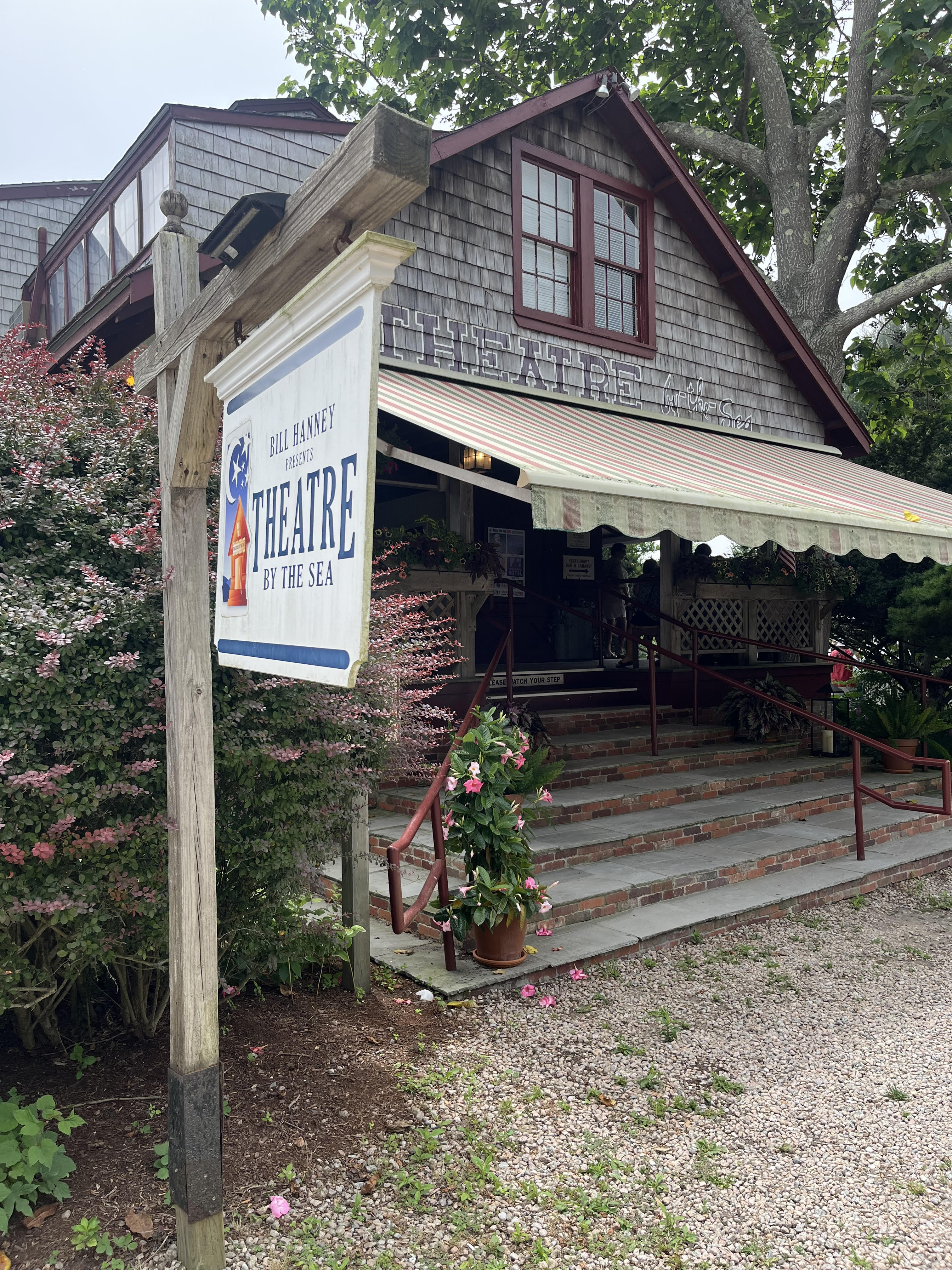
Photo: BBC.
During lockdown, set designer Stuart Marshall started making models of Belfast’s lost theatrical world. Above is his model of the Hippodrome.

No one wants to go back to the pandemic’s lockdown, but enough time has passed for people to feel a little nostalgia for the creative projects some folks undertook during that dark time. I remember a guy in Boston who encouraged artists to send him miniatures of their work, which he would then display on his popular website. Refresh your memory of that here.

Jake Wood at the BBC reported in March on an exhibit in Northern Ireland that had its beginnings when a set designer was stuck at home.

“Miniature models of Belfast’s lost theatres created by set designer Stuart Marshall are bringing the city’s vibrant theatre history back into the the limelight. They are part of an exhibition at Ulster University for the Children’s Festival.

“Mr Marshall told BBC News NI that … ‘Children appreciate the miniature dolls house type model making, adults appreciate the skill that goes into making them, and older people who may remember when some of these places still stood. …

” ‘I started working on a model of the Grand Opera House as part of the heritage exhibition and through doing that got interested in looking at all the other theatres that aren’t about anymore. …

” ‘The Hippodrome was the most complicated and detailed one I’ve made; it took me around six weeks to make.’

“He said he mostly works from old photographs, but it can be hard to get enough accurate detail because ‘with a black and white photograph that you can’t move around, it’s basically static.’

“When photographs of the old theatres are not available or poor quality, Mr Marshall refers to old newspaper articles which sometimes have written descriptions of what materials the theatre was built from and how it appeared.

“Opening in the early 1870s, the Alhambra was Belfast’s first music hall and was a ‘real spit on the floor type joint,’ according to Mr Marshall. ‘In the early days, the Alhambra was more of a variety house, and I’ve heard that it wasn’t the most enticing establishment, quite a rowdy place.’ …

“A typical bill from the early days of the Alhambra shows performances which ‘would nowadays be contentious’ included events such as a minstrel show and a Japanese troupe. …

“To adapt to the evolution of mass entertainment, the Alhambra converted to a full-time cinema house in 1936. Between the late 1800s and its closure in 1959, the Alhambra suffered four separate fires.

“The Theatre Royal was Belfast’s original high-end theatre, opening in the late 1700s with a capacity of just over 1,000. The building was demolished and rebuilt a number of times.

” ‘As these places go, they kept getting burnt down or demolished and rebuilt again – there’s always a renewal aspect to them.’

“The Theatre Royal was to be Belfast’s ‘higher class establishment,’ which in the end became ‘a mixed-use building of shops and place called the “boom boom room,” which was like a dance hall upstairs. …

” ‘Now, there’s a little Starbucks in the corner where the building stood,’ he added.

“Not to be mistaken for the pub and music hall on Botanic Avenue, the Empire Theatre was situated on Victoria Square and opened to the public in 1894. …

“While it did adapt to the growing popularity of cinema, the Empire ‘stayed true to theatre for all of its life,’ Mr Marshall said.

“The Hippodrome was ‘more fiddly.’ … There aren’t too many quality photographs of the Hippodrome, so he ‘had to use his judgment’ when designing the model in terms of color scheme and scale.

“Coming quite late, the ‘Hippodrome was was built in 1907 originally with a cinema in mind’ as to take full advantage of the advent of modern cinema and growing popularity of picture shows.

” ‘And then there was the Ritz,’ which opened in 1938. The Ritz was, according to Mr Marshall, ‘a giant cinema more or less, but it called itself the Ritz Theatre.’ However, it did produce shows as part of the night’s entertainment.

” ‘They would have a brass band, dancers or a ballet, and then a film at the end. It also did huge concerts, people like the Stones, The Beatles and Billy Connolly all performed at the Ritz during their time,’ he added. …

“The Ritz was damaged by bombs hidden in the seats and the theatre’s interior and roof was destroyed in 1977.” More at the BBC Northern Ireland, here.

Did you do a particularly creative project during lockdown? Of, course, many of us kept on blogging away, but we would have done that anyway.