Feeds:
Posts
Comments

Photo: NJ Advance Media
Rodin sculpture of Napoleon turns up in a New Jersey town hall. Drew University grad student Mallory Mortillaro did the legwork to authenticate it. She is pictured here with Rodin expert Jérôme Le Blay.

Sometimes lost treasures actually get found. In this story, a bust by famed sculptor Auguste Rodin turned up in a New Jersey town hall, thanks to a determined grad student.

Justin Zaremba wrote about the discovery at NJ Advance Media.

“The art world lost track of acclaimed sculptor Auguste Rodin’s bust of Napoleon in the 1930s, but it’s apparently been on display for the past 85 years in the most unlikely of places — the council chambers in Madison [New Jersey] Borough Hall. …

” ‘Napoléon Enveloppé Dans Son Rêve’ (‘Napoleon Wrapped in his Dream’) was ‘long rumored’ to be Rodin’s work but the borough and the Hartley Dodge Foundation, which owns the sculpture, didn’t know for certain until about two years ago … [when] Drew University graduate student Mallory Mortillaro was hired by the foundation to go through the various art pieces at the Hartley Dodge Memorial Building.

“The bust was able to hide for so long, he said, because it weighs 700 pounds and requires about five people to move it and its attached pedestal. Rodin’s signature had been hidden from view for decades because that side of the sculpture was pushed against the wall. …

“The building and the artworks inside it were deeded over to Madison by Ethel Geraldine Rockefeller Dodge in the 1930s as a memorial to her son, Marcellus Hartley Dodge Jr., who died in a car accident at the age of 22. The foundation’s sole focus is on preserving the art and architecture of the building. …

“Mortillaro began her detective work by researching every book on Rodin she could find, doing online searches, visiting the Rockefeller archives and contacting officials in the art world.

“Mortillaro, now a teacher at Lawton C. Johnson Middle School in Summit, pursued the case despite receiving the brush off from various art experts.

” ‘No one was being very receptive,’ she said.

Nevertheless, she persisted.

“Mortillaro got in touch with the world’s leading Rodin expert, Jérôme Le Blay, formerly of the Rodin Museum in Paris. …

“According to Mortillaro, when Le Blay walked into the council chambers he turned and said ‘Hello my friend, so is this where you have been hiding?’ …

“The bust had originally been conceived and begun in 1904 at the behest of New York collector John W. Simpson in 1904, but the commission wasn’t completed. Four years later, Thomas Fortune Ryan saw the unfinished piece in Rodin’s studio and acquired it. Rodin completed the piece in 1910. …

“[Hartley Dodge Foundation trustee Nicholas] Platt said the borough and the foundation kept the bust’s identity hidden until now because the insurance company wouldn’t insure the piece for its value and allow them to have the bust open to the public. That’s why for a limited time, it’ll be open to the public — though protected by security — before it leaves the Garden State.

“Platt estimated the piece was worth anywhere from ‘the mid-millions to the 10 million’ range depending on the market.”

The bust will go out on loan to the Philadelphia Museum of Art for a year.

More here.

A Seed Bank for Syria


Photo: Diego Ibarra Sanchez for The New York Times.
Ali Shehadeh, a plant conservationist from Syria who fled the war in his country, at work in Terbol, Lebanon.

The harm that wars do seems endless. Every aspect of life is affected. And yet, against all odds, good people rise up to save or try to reconstruct what might be lost. In this post, everyday heroes protect a seed bank from the war in Syria.

Somini Sengupta has the story at the New York Times. “Ali Shehadeh, a seed hunter, opened the folders with the greatest of care. Inside each was a carefully dried and pressed seed pod: a sweet clover from Egypt, a wild wheat found only in northern Syria, an ancient variety of bread wheat.

“He had thousands of these folders stacked neatly in a windowless office, a precious herbarium, containing seeds foraged from across the hot, arid and increasingly inhospitable region known as the Fertile Crescent, the birthplace of farming.

“Shehadeh is a plant conservationist from Syria. He hunts for the genes contained in the seeds we plant today and what he calls their ‘wild relatives’ from long ago. His goal is to safeguard those seeds that may be hardy enough to feed us in the future, when many more parts of the world could become as hot, arid and inhospitable as it is here.

“But searching for seeds that can endure the perils of a hotter planet has not been easy. It has thrown Shehadeh and his organization, the International Center for Agricultural Research in the Dry Areas, squarely at a messy intersection of food, weather, and war.

“The center, though it received no state funding, was once known as a darling of the Syrian government. Based in Aleppo, its research had helped to make Syria enviably self-sufficient in wheat production. …

“By 2014, the fighting drew closer to its headquarters in Aleppo and its sprawling field station in nearby Tal Hadya.

“Trucks were stolen. Generators vanished. Most of the fat-tailed Awassi sheep, bred to produce more milk and require less water, were stolen and killed for food. … And the center’s most vital project — a seed bank containing 155,000 varieties of the region’s main crops, a sort of agricultural archive of the Fertile Crescent — faced extinction.

“But researchers there had a backup copy. Beginning in 2008, long before the war, the center had begun to send seed samples — ‘accessions’ as they are called — to the Svalbard Global Seed Vault, the ‘doomsday vault,’ burrowed into the side of a mountain on a Norwegian island above the Arctic Circle. It was standard procedure, in case anything happened.

“War happened. In 2015, as Aleppo disintegrated, center scientists borrowed some of the seeds they had stored in Svalbard and began building anew. This time, they spread out, setting up one seed bank in Morocco and another just across Syria’s border with Lebanon in this vast valley of cypress and grapes known as the Bekaa. …

“Mr. Shehadeh … is obsessed with the wild relatives of the seeds that most farmers plant today. He eschews genetically modified seeds. He wants instead to tap the riches of those wild ancestors, which are often hardy and better adapted to harsh climates. ‘They’re the good stock,’ he said.

“He hunts for the genetic traits that he says will be most useful in the future: resistance to pests or blistering winds, or the ability to endure in intensely hot summers. He tries to select for those traits and breeds them into the next generation of seeds — in the very soil and air where they have always been grown.”

The experts believe that the seeds from plants that thrive in this arid part of the world will be needed for feeding the planet as it warms.

Read the whole article here.


Photo: anekoho/shutterstock
As art classes get cut back, Philadelphia foundations are stepping up to protect a vital part of education.

In this time of cutbacks in school arts programs, it is heartening to see some organizations stepping up to the plate. If the trend continues, we may all need to start volunteering in schools — just as scores of parishioners at my church did for an amazing arts and crafts day yesterday. The only problem is, Who has the time for sustained volunteering when government doesn’t do its part?

In Philadelphia, foundations are providing some respite, as Mike Scutari reports at Inside Philanthropy.

“In June of 2013, Philadelphia’s School Reform Commission approved massive cuts in funding in what critics referred to as ‘The Doomsday Budget.’ Cuts included mass faculty layoffs, reduction of materials and athletics programs, and the complete elimination of arts and music programs.

“Four years later, Peter Dobrin, the Philadelphia Inquirer‘s culture writer, surveyed the city’s music education landscape and convincingly argued that funders sufficiently rose to the challenge, pointing to city’s web of innovative music education programs, including:

  • Play On, Philly!, launched in 2013 with seed money from Carole Haas Gravagno and the Lenfest Foundation.
  • The Philadelphia Youth Orchestra’s Tune Up Philly, which receives support from Impact100, a women’s giving collective.
  • AristYear Philadelphia, which will pay 12 arts teaching fellows in area schools with a high percentage of children from low-income families. The Knight Foundation has supported both Artist Year Philadelphia and Play On, Philly!

“Knight is only one of many influential funders active in the city. William Penn Foundation has doubled down on arts education, allocating more than $12 million over the last 4 years …

“The Andrew W. Mellon Foundation, meanwhile, recently awarded more than $2.5 million to a new program called the Philadelphia Music Alliance for Youth.

“Other examples include the Neubauer Family Foundation, which, in tandem with other local organizations, is ‘working to figure out what arts education programs are here already to determine what’s needed’  …

“The city’s financial woes were so calamitous that, funders, most of whom already had extensive footprints in the city, had no choice but to respond en masse. …

“In many cases, we’re not talking about your standard music education programs.

“Play On, Philly!, for example, is billed as ‘music for social change.’ Its 2017 summer programming included anti-child obesity and ‘active play’ programming at neighborhood recreation centers. ,,,

“More than ever, funders tend to support arts experiences that are immersive, experiential, and drive positive social outcomes.

“Now, consider the supporting role of big data in framing the arts as a means for driving social change.

“Play On, Philly!’s pilot collected data to show that students in the program improve their self-perceptions, academic motivation and school attendance, all while learning to play and perform a musical instrument. …

“Funders, increasingly beholden to this ROI [return on investment] mindset, are more inclined to cut checks when backed by compelling data. …

“All involved parties agree that access and equality is the key. Funders, more than ever, intuitively rally around this idea. Breadth is important, as well — ‘the net must be cast wide to capture all the talent out there,’ said Dorbin. Music education shouldn’t be just for future Julliard students.”

More here.

Cousin on a Mission

My cousin Alex Frank is on a mission to reform the criminal justice system, starting with young men. She has worked in prisons on a variety of programs for some years now and is seeing measurable results.

A recent Boston Globe editorial expressed hope for the latest initiative. “Early next year, one of the most important criminal justice reform experiments in the country will spread to a stately brick jailhouse in Billerica.

“The Middlesex Jail and House of Correction will become one of the first in the nation to create a dedicated, service-rich cell block for young men.

“Inmates, ages 18 to 24, will gather in peace circles to talk through conflict. They’ll learn how to budget for rent and transportation. And they’ll get the chance to hold their children during visiting hours. ….

“The idea is that 19- and 24-year-olds are fundamentally different than 35- and 40-year-olds — less mature, yes, but also more malleable, and better positioned to change.

“It’s an idea borne out by decades of neuroscience research, which shows the brain is still developing into the mid-20s. And Middlesex Sheriff Peter Koutoujian, who is launching the unit, understands that research intuitively.

“He calls himself a ‘recovering young adult,’ who was adrift as a young man and didn’t get serious until his mid-20s. …

“Koutoujian says it only makes sense to keep impressionable young offenders away from the older inmates they mix with now. … Tailored services, he says, can make a real difference. A separate unit he established for military veterans is showing strong early results and garnering national attention.

“For this new project, Koutoujian is leaning heavily on the Vera Institute of Justice, a New York-based organization that helped create the nation’s first comprehensive unit for young adults at a tough prison in Cheshire, Conn., known as ‘The Rock.’

“The Cheshire unit hasn’t had a single fight between prisoners or attack on a guard since it launched early this year, and just a fraction of the disciplinary issues that normally arise among young adults in prison.

“Alex Frank, a senior program associate at Vera who has worked on both the Connecticut and Middlesex projects, says any serious effort to reduce mass incarceration in this country ‘requires a focus on young adults.’

“Eighteen-to-24-year-olds account for 10 percent of the American population but 21 percent of prison admissions, she notes. And their recidivism rates are much higher than for other age groups. Whatever we’re doing now is clearly failing. …

“The most expedient approach may be creating the sort of separate cell block Koutoujian is preparing to launch in Middlesex in February. …

“UTEC, an impressive, Lowell-based organization already working to rehabilitate some of the toughest young men in the region, will play a central role. Gregg Croteau, the executive director of the nonprofit, says his group will aim to smooth the transition to the outside — offering job training in jail, for instance, followed by work at a UTEC-run cafe after release. More.

See also this Lowell Sun article, which quotes Alex: “This project goes beyond simply improving living conditions for young people, and seeks to transform facility culture for everyone who lives and works in their facility … By providing meaningful opportunities for young adults to be successful and investing in their potential, supporting and reimagining the role of staff, Middlesex Jail & House of Correction is transforming the current correctional culture to promote equity, accountability, restoration, and healing.”

I think reader Asakiyume, who volunteers in a prison, knows exactly what Alex is saying about prison culture.

Photo: UTEC
Young people from the nonprofit UTEC in Lowell, Massachusetts, have been actively engaged in pushing for criminal justice reform. In February, they will start working with the Middlesex sheriff on a promising prison intervention.
organizing_banner2

Photo: Star Tribune
Police officers working to build a free-standing Little Free Library in Minneapolis as part of an initiative to encourage reading.

According to Libor Jany at the Star Tribune, some Minneapolis police officers are starting to engage with communities in a new way.

“In a partnership with Little Free Library, the department will turn a pair of its police cruisers into bookmobiles with the hope of teaching the importance of reading.

“Community policing officers will carry books while they are making their rounds on the city’s North and South sides. They’ll still respond to certain emergencies, but won’t be dispatched to calls for help, freeing them up to visit neighborhoods without libraries and give away books to anyone who wants them.

“The program is the first of its kind in the country, organizers say. …

“From a distance, the [Little Free Library] boxes could be mistaken for a birdhouse or an oversized mailbox. An unfinished dollhouse, even. But when they’re finished, officials say they’ll be stocked with dozens of all kinds books. People are encouraged to take a book or leave a book, without fear of overdue fines. …

“Police Chief Medaria Arradondo said in a statement that he was thrilled by the exercise in community building, ‘an incredible way to empower our youth and reach them in a positive way.’ …

“Little Free Library Executive Director Todd Bol started the book exchange in his hometown of Hudson, Wis., in 2009, building the first mini-library out of an old garage door in honor of his late mother. Today, there are more than 60,000 libraries in all 50 states and more than 80 countries around the world. In recent years, the little book boxes have sprung up in far-flung places like Australia and Qatar. …

“For now, available titles to be given away range from children’s books like ‘Camp Wildhog’ and ‘The Box Car Children: The Yellow House Mystery’ to more adult fare, including a well-thumbed unauthorized biography of Martha Stewart.” More.

Trust those Minnesotans to take a great concept a step farther!

A couple of my other posts on Little Free Libraries may be found here and here.

Photo: eGuide Travel
The highlands of Papua, New Guinea, are among the isolated places that linguists search for speakers of dying languages.

I’ve blogged before about linguists and others who are trying to preserve languages spoken by only a few people. The belief is that there is intrinsic value in such endangered languages and that they are key to understanding cultures. Recently I saw that one group is focusing on a particular manifestation of rare languages — their poems.

Fiona Macdonald writes at the BBC about the Endangered Poetry Project.

” ‘They fly to Port Moresby in Papua New Guinea and there they take a bus for three days and then they hike over a mountain and then they take a canoe and then they get to this little bay with 300 people,’ ” she reports, quoting Mandana Seyfeddinipur, head of the Endangered Languages Archive at London’s SOAS [School of Oriental and African Studies]. …

” They are ‘PhD students of 25 with a digital camera, a digital audio recorder and solar panels.’ …

“ ‘They live with the communities for months at a time, and develop social relationships, and talk to them and record them, and then they come back and they give me this SD card. … ‘The only record that we have of this language is in this tiny SD card.’ …

“The newly launched Endangered Poetry Project aims to tackle [language] loss at another level. ‘Languages are dying out at an astonishing rate: a language is being lost every two weeks,’ says the National Poetry Librarian Chris McCabe. ‘And each of those languages has a poetic tradition of some sort.’ …

“The project has issued a call-out to members of the public, asking for poems written in an endangered or vulnerable language. ‘In the first week, we’ve had over a dozen submissions in about 10 languages,’ says McCabe. ‘That includes poems in Breton, and poems in a dialect of Breton called Vannes. We’ve had a poem in Alsatian, and the Sardinian dialect Logudorese. We’re interested in these variations in language in different places as well, which can often be markedly different from the established language. …

” ‘You get a focus on place – in poems we’ve received from Sardinia, for example, there’s a focus on the mountain range there,’ says McCabe. ‘It shows you where people felt drawn to for inspiration in the landscape. Also, the style of a lot of Gaelic poems is very lyrical, and often uses repetition, a lot like a song. In that poetic tradition, you see how the division between poetry and music is quite slight – they often cross over between one and the other. The poetry tells us a lot about what kind of artistic experience people like, as well as what’s important in their geography.’ ”

Lots more here. Very interesting stuff.

Granny Pods

Photo: Amelia Templeton/Oregon Public Broadcasting
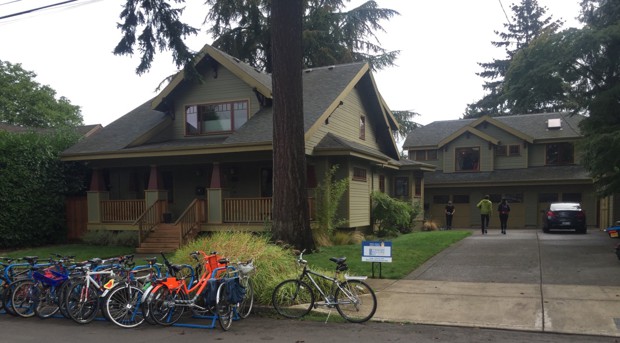
The Granny Pods of Portland, Oregon, aren’t just for grannies. This woman and her family live in one — technically an accessory dwelling unit (ADU) — in their landlord’s backyard. Last year, Portland issued building permits for roughly one ADU a day, easing a housing crunch.

When I was a child, I used to hear a lot about zoning from my politically oriented mother — large lots were good, allowing  residential uses in commercial or industrial areas was bad. Times change. Some industrial areas are clean; mixed-use development improves community vitality; higher density in cities is good for keeping rents affordable.

Amelia Templeton reports for National Public Radio about recent initiatives in Oregon.

Earlier this year, Michelle Labra got a notice that the rent on her family’s two-bedroom apartment was doubling, from around $620 a month to more than $1,300. She worried she was being priced out of Portland and would have to move to the suburbs.

“But Labra, her husband and their two children didn’t get pushed out of Cully, their North Portland neighborhood. They were able to stay by moving into a little house, 800 square feet, built in a neighbor’s backyard. It’s a type of housing city planners refer to as an accessory dwelling unit, or ADU, often called a granny flat or granny pod. …

“With a lot of cities looking for solutions to rising housing prices, the idea of making it easier for homeowners to add small second units in their backyards and garages is gaining traction. Portland has among the fastest rising rents in the country, and it has embraced the ADU as a low cost way to create more housing in desirable neighborhoods. …

“Talking about the sudden rent increase [at her old home] brings Labra to tears. She was close to the other families in the apartment complex, and so were her children …

“The [apartment complex] was on the main street in Cully, a neighborhood on the northern edge of Portland with mobile home parks, ranch houses and small apartments built in the 1960s and 1970s.

“It’s also, according 2010 census data, one of the most diverse neighborhoods in Oregon. Close to half of the people who live there are people of color.

“The residents of the Normandy started working with a community group called Living Cully and staged a protest against the rent increase. Hundreds of people marched in the streets back in February. …

“In an effort to arrest the gentrification of the neighborhood, Living Cully helped about half the families relocate to new homes in Cully. …

“Eli Spevak, a developer with the company Orange Splot, which builds smaller homes including ADUs … [says] Portland’s zoning code is contributing to its housing problems.

“On much of the city’s land, the code limits how many units you can build on a lot, so developers build the biggest house possible, to turn the most profit. There is an exception for ADUs as long as they meet certain criteria. …

” ‘The good thing about it from my perspective is they allow a neighborhood to have people with a wide range of incomes living with each other.’ ”

More here.


Photo: http://www.mlive.com/
Seitu Jones, a St Paul, Minnesota, artist who teaches urban food systems at the University of Minnesota is behind the community meal that won an art award.

Minnesota is home to many cutting-edge artistic endeavors, and the one described by Jim Harger at mlive.com is no exception. It’s neighborhood picnic as work of art.

“The ArtPrize Nine jurors — each of them experts in art — went for a neighborhood picnic in awarding the $200,000 juried grand prize for ArtPrize Nine.

” ‘Heartside Community Meal,’ an outdoor meal for 250 guests in Heartside Park on Sept. 23, was entered by Seitu Jones, a Saint Paul, Minnesota, artist who teaches urban food systems at the University of Minnesota.

” ‘This is a project that came out of love,’ said Jones after the award was announced on Friday, Oct. 6.

“The meal, served on a 300-foot-long table in Heartside Park, was aimed at engaging residents of the mixed-income neighborhood with each other over a table of locally produced foods. …

” ‘Seitu’s work speaks to some of the key issues in America now,’ [juror Gaetane] Verna said. ‘Access to food, access to community and people being able to create a space of conversation, exchange and synergy for everyone. He speaks to what is important in the context of the “now” in his practice, not just the ability to paint or draw.’

“Juror Scott Stulen, director and president of Philbrook Museum of Art in Tulsa, Oklahoma, nominated ‘Heartside Community Meal,’ saying he was struck by the event, where

‘people were sitting down and talking to people they would never talk to otherwise.’ …

“Inviting residents of condos and luxury apartments to dine with homeless residents who live beneath overpasses was a challenge for both groups, Jones said.

“Guests, both rich and poor, were moved by the experience, said Jones, who declared, ‘Of course this is art!’ when asked about the artistic nature of the big meal.”

More here.


Photo: Walter Siegmund
Storm Reyes, who grew up in an impoverished Native American community, says her life was transformed by a bookmobile. The first book she chose was about volcanoes because the previous night she’d heard a scary story about Mt. Rainier erupting.

Maria Popova has a wonderful blog that she often links to on twitter, which is where I picked up her heartwarming story about what access to books can mean in a poor child’s life.

From Brainpickings: “A beautiful testament to that emancipating, transformative power of public libraries comes from one such troubled little girl named Storm Reyes, who grew up in an impoverished Native American community, had her life profoundly changed, perhaps even saved, by a library bookmobile, and went on to become a librarian herself. She tells her story in this wonderful oral history animation by StoryCorps:

“The piece was adapted into an essay in Callings: The Purpose and Passion of Work

“Here is Reyes’s story, as it appears in the book:

Working and living in migrant farmworkers’ fields, the conditions were pretty terrible. My parents were alcoholics, and I was beaten and abused and neglected. I learned to fight with a knife long before I learned how to ride a bicycle.

When you are grinding day after day after day, there’s nothing to aspire to except filling your hungry belly. You may walk down the street and see a row of nice, clean houses, but you never, ever dream you can live in one. You don’t dream. You don’t hope.

When I was twelve, a bookmobile came to the fields. I thought it was the Baptists, because they used to come in a van and give us blankets and food. So I went over and peeked in, and it was filled with books. …

The night before, an elder had told us a story about the day that Mount Rainier blew up and the devastation from the volcano. So I told the bookmobile person that I was nervous about the mountain blowing up, and he said, ‘You know, the more you know about something, the less you will fear it.’

At Brainpickings, you can find out what happened next, here.

1011-ddp-turquoise-director-ledePhoto: Scott Peterson/Christian Science Monitor
Nathan Stroupe, Afghanistan country director for Turquoise Mountain, in the courtyard of one of the 112 buildings the British charity has restored so far to create an institute for Afghan artisans to revitalize their heritage.

Christian Science Monitor has great stories about people and organizations that make a difference. I loved this one on a UK nonprofit called Turquoise Mountain, which is reviving ancient crafts in Afghanistan and providing much-need work for craftsmen and -women. More than 500 artisans have graduated from Turquoise Mountain specializing in traditional crafts such as woodworking, jewelry-making and gem cutting, ceramics, and elaborate calligraphy.

Writes the Monitor, “What sounds like a lovely effort to revive traditional culture in a place where art had been almost stomped out by war is about more than making jewelry. As a former ambassador says: ‘It is about preserving the soul of the country.’

“When Turquoise Mountain took on the restoration of Murad Khani, one of Kabul’s poorest historical neighborhoods, its aim was to do more than clear away wartime debris. From the beginning, the British charity also sought to revive the disappearing arts of Afghan culture, among them jewelry-making, woodworking, and gem cutting.

“Rays of hope are rare in Afghanistan, but in the process of revitalizing Murad Khani, Turquoise Mountain has created a model now being applied in Myanmar (Burma) and Saudi Arabia, and soon in Jordan, with Syrian refugee artisans. A project that started by hiring 1,000 workers to remove deep layers of trash has so far renovated 112 buildings and created an art institute, primary school, and a clinic that sees 2,000 patients a month. The institute has produced 500 graduates, and their work has been exhibited at the Smithsonian. That helps change perceptions. …

“In her heart, Ramzia Sarwary-Khorami always wanted to make jewelry. But the path to success in Afghanistan is narrow, especially for a woman, no matter how intrepid or ambitious.

“Then on the radio a decade ago, she heard about a new urban reclamation project …

“Ms. Sarwary-Khorami signed up with Turquoise Mountain and learned soldering, sandpapering metals and stones, and the secrets of the six cultures of Afghan jewelry making.

“ ‘I found my dreams,’ says Sarwary-Khorami, who now works as a teacher and quality controller for the charity and sells her own creations through high-end jewelry designers in London – a pathway established by Turquoise Mountain for its graduate artisans.

“ ‘Every year we have more students, I tell them: “Come to Turquoise Mountain, we can support you,” ‘ she says.”

I will be talking to Suzanne about the jewelry. Maybe there would be a way for Luna & Stella to work with Turquoise Mountain. (And speaking of Luna & Stella, do check out the latest — antique lockets to complement the company’s contemporary birthstone jewelry. Think Christmas, Hanukah, weddings …)

More at the Christian Science Monitor, but it’s behind a firewall.


Photo: Andrew Nixon / Capital Public Radio
Tony Price, formerly homeless, grows tomatoes in his small patio garden and shares the produce with friends and neighbors. Now that he has permanent housing, he’s able to take better care of his health.

In the last decade, there’s been a lot written about how a small percentage of people use hospital emergency rooms on a regular basis and what could be done to stabilize them and save money. In today’s story, we find that providing housing for homeless patients can yield positive, long-term results.

From Pauline Bartolone and Kaiser Health News at Capital Public Radio: “Hospitals in Sacramento and around the country want to get [homeless patients] off the streets, to improve their health and minimize unnecessary visits to the ER. … That’s why many hospitals are stepping outside their role as medical providers to invest heavily in housing for homeless people.

“Dignity Health’s ‘Housing With Dignity’ initiative got Tony Price into an apartment, paid his rent for four months and set him up with a social worker who helped him become eligible for permanent housing. …

“A 2002 study showed that providing housing and supportive services, to more than 4,600 mentally ill homeless people in New York City dramatically reduced their presence in hospitals, shelters and correctional facilities. …

“Health insurers are starting to invest in housing, too. Dignity and other Sacramento hospitals have long funded ‘respite’ programs that shelter homeless people for a few weeks after their hospital stays, but the goal of ‘Housing With Dignity’ is to keep them from being homeless again. …

“Ashley Brand, Dignity’s director of community health and outreach, said the program is helping address the hospital chain’s longstanding challenge of ensuring that homeless patients get follow-up care after they’re discharged. …

“No matter how many times Tony Price visited Sacramento hospitals while he was living on the streets, he never got well. His diabetes was uncontrolled, he repeatedly lost the drugs he was taking for anxiety and depression and, he says, he regularly drank himself into ‘oblivion,’ sometimes consuming as much as half a gallon of vodka a day. …

“Price qualified for the services offered by ‘Housing with Dignity,’ which put him into a one-bedroom apartment in Sacramento’s sprawling North Highlands neighborhood in May 2015 and assigned him a social worker, Chris Grabe, who drove him to medical appointments. …

“He has been off the streets for nearly two and a half years, and he’s been to the hospital only once since January. … He now gardens, and he recently volunteered at a church and as a leader of an Alcoholics Anonymous group.”

At Capital Public Radio, here, you can read how Grabe stuck with Price through early relapses and what is needed to expand this effort to more people.

Hat tip: House of Hope CDC on twitter.

12/8/17 Update: Meanwhile in Boston, where one in four Boston Medical Center patients is homeless or in dangerous housing, BMC is partnering with local housing organizations and spending $6.5 million to help patients. This is the latest manifestation on BMC’s whole-patient approach to healing. Read about it here.


Photo: Ginny Fordham
Berklee professor Steve Wilkes gathers sound at the White Mountain National Forest in New Hampshire. A recent project also captures Cape Cod.

Berklee professor Steve Wilkes and his collaborator David Masher have created some amazing soundscapes that capture the music of the natural world. Their work is described at the Hear the Forest website:

“Hear The Forest is an effort to initiate the process of building an aural-map – essentially, an audio time capsule – of New Hampshire’s White Mountain National Forest.  Supported by the National Forest Service and the Arts Alliance of Northern New Hampshire, this work will be performed by Berklee College of Music Professor, Steve Wilkes, as part of the 2017 Artist-in-residence program. …

“In addition to his field ecology and sound recording work, Wilkes will offer several public programs, including workshops that will provide residents and visitors with information on contributing to the ongoing sound file collection on the White Mountain National Forest. …

“ ‘I hope to be able to express and communicate to others this profound sense of inspiration – and to help everyone slow down a bit, and really listen,’ ” Wilkes says. More here.

You might also like hear an interesting interview with Wilkes that was broadcast at WGBH. The station provides this intro: “Nature is rich with dynamic sounds, like the roaring of waterfalls or the sweetness of birdsong.

“Berklee professor Steve Wilkes … captured the still whispers of buzzing bugs, the martian-like atmosphere at the summit of Mount Washington and the laughter of children enjoying the park — all essential sounds to create a ‘digital aural map’ of the forest, which he calls Hear The Forest. Callie Crossley speaks with Wilkes about his project.” More here.

I like the idea of encouraging others to contribute their own nature recordings to the White Mountains project. It feels like something anyone could do if they just paid attention — and paying attention is the whole idea.

dsc4539

Photo: Jason Margolis
Signs & Shapes co-owner Scott Bowen with seamstress Tami Dahir. The Mom & Pop shop in Omaha, Nebraska, makes costumes and parade floats for customers around the world — and their only advertising is word of mouth.

Where do those gigantic Thanksgiving Day parade floats come from? Quite a few probably come from Omaha, Nebraska, according to Public Radio International program The World.

Jason Margolis reports, “Signs & Shapes’ space in Omaha is just about the coolest factory you’ve ever seen — a huge warehouse filled with dogs, ducks and astronaut costumes being stitched, then inflated and tested.

“ ‘The company was started in my dad’s basement, my folks’ basement, just about 30 years ago, and we started as distributors for inflatable signs,’ said Scott Bowen, the company’s co-owner.

“The company eventually expanded into props for plays, parade floats and inflatable costumes. Today, Signs & Shapes exports to 74 countries. …

“Lee Bowen, Scott’s father, who helps run international sales, explained how they find their foreign customers: ‘Word of mouth. … We don’t do any advertising.’

“Signs & Shapes relies on reputation and having a niche. If you want a high-end inflatable that won’t pop when your mascot is bouncing on its head in front of 20,000 people, call Omaha. …

“Scott Bowen has been at the export game for a while now and says the export process has become ‘quite easy’ for his company. Business is going well, but still, Signs & Shapes only has 25 employees. And Bowen said they’re limited in how much they can grow.

“ ‘We need seamstresses with a really high level of sewing intelligence that can look at a pattern of a couple of hundreds of pieces that’s never been made before, and put the whole thing together accurately,’ says Bowen. ‘But [they also must] have a business or commercial mentality in terms of speed.’ …

“While letting the product speak for itself has become the company’s best marketing strategy, they can’t take credit for some of the coolest stuff they make due to non-disclosure agreements. It can be a highly secretive industry.

“In a back room, airbrush artist Shane Perrin put the finishing touches on a mascot as Scott Bowen looked on.

“ ‘He’s had stuff on Broadway stages, the biggest amusement parks, huge international sporting events,’ said Bowen, who can’t name many of the actual places or events where Perrin’s work has been on display. …

“If you’re watching a Thanksgiving Day parade Thursday and see a float that you really, really like, chances are a group of folks in Nebraska may have had a hand putting that together. Or not.”

More at PRI, here.

112217-prepping-for-cranberry-sauce

112217-prepping-for-cranberry-sauce


For a few years now, I have sent readers to the “From Scratch Club” to get the best-ever cranberry sauce. Alas, the club seems to have dispersed and is no longer maintaining a website. Fortunately, I printed out the recipe and will share it here. Enjoy!

Maple, Citrus & Ginger Cranberry Preserves
Makes about two pints

12 ounces whole cranberries
3 clementines or 1 very large orange, peeled and cut in small chunks
½ lemon, juice and zest
½ tart apple, in small chunks
¾ cup maple syrup
½ teaspoon freshly grated ginger root
a pinch of sea salt
(optional: a crank of freshly ground pepper)

1. Bring cranberries & maple syrup to a low boil. Keep a close eye on the mixture so the syrup doesn’t burn. You want the fruit to break down, and you can use a potato masher after 5-8 minutes to speed things up.

2. Once you have a rolling boil, add apple chunks, lemon juice & zest and clementines. Stir. Apples need to get soft but not mushy.

3. Add sea salt & ginger. Cook a bit more and use the potato masher to make sure all berries have popped.

If you end up using this, do let me know.

A City’s Poetry Map

Photo: KUOW
Civic poet Claudia Castro Luna created Seattle’s Poetic Grid and, leading workshops in libraries, helped residents express how they feel about the places they know.

My friend Ronnie Hess, a Wisconsin poet, linked to this story on Facebook, adding, “An excellent story but one that reminds me of Madison’s Echolocations, an anthology edited by past poets laureate of Madison Sarah Busse and Wendy Vardaman.”

On PBS News Hour, Jeffrey Brown interviewed Claudia Castro Luna and others about Seattle’s Poetic Grid.

“Brown: The idea of the Poetic Grid is to capture a sense of place in a city going through rapid change, and to use the words of the people who live here. … Claudia Castro Luna dreamed up the online digital map in 2015, when she became Seattle’s first civic poet. …

“Luna: We all have stories to tell about the place we live in. And we all have memories attached to the place we live in. And so, [our workshop effort] was like opening up a faucet.

“And people have stories to tell. And that’s one of the marvelous things. At the end, I told them, you will write. You will see you will have a poem. And, indeed, they had one. …

“Brown: The poems for the grid span the city. Some are about home, memories of growing up in the affluent Blue Ridge neighborhood. Others are about homelessness, the cold concrete of a Seattle underpass.

“There are poems left in their native tongues, Spanish, Arabic. The writers run from well-established poets to first-timers. And they reflect the diversity of the changing city, where cranes dot the skyline.

“Luna: Some of the poems express very well what it feels like to not recognize the place you grew up in, because the buildings that you had so much attachment and were meaningful to you are no longer there …

“Koon Woon: I first moved in here when I couldn’t afford rent anywhere else in the city. And my uncle said well, there’s a room here for $60 a month. And I came here to look at it. And there’s this tiny little table. I said, I can put my typewriter on top of that. So, I took the room. …

“Brown: Koon Woon was born in China, but moved to Seattle in 1960. In the 1980s, he lived just a block from here, sometimes homeless, struggling with mental illness. His poem, ‘The High Walls I Cannot Scale,’ is now part of the grid. …

“For 17-year-old Lily Baumgart [Seattle Youth Poet Laureate], animals figured into her writing as well.

“Baumgart: The squirrels here are very aggressive. They expect to be fed by people. And so we’d write stories about why they’d come up to people, how humans’ interactions with animals change their behaviors. … Volunteer Park, they say there’s a giant squid in the reservoir, that if you could climb the fence, you could stick your hand into the bright water and feel his slimy body swimming by yours. When it rained we would hide in trees and feel their cold bark underneath our toes. We’d laugh so loud that the sky would be scared of us and our umbrella laughter. …

“Brown: Poetry brought something else to Claudia Castro Luna, a way to work through traumatic childhood memories of war in El Salvador that forced her family to leave their home when she was 14.

“Luna: It was a tremendous loss of place, of culture, of family, of language. [All] of my writing has to do with understanding that — what it meant to lose that place. And this is why I’m interested in other people’s lives and what they have to say about the place they occupy.”

More at PBS NewsHour, here. See the Poetic Grid here.