Feeds:
Posts
Comments

Mini Soap Operas

Photos: ReelShort.
From NPR: “Micro drama apps such as ReelShort, FlickReels and DramaBox offer short clips that add up to movie-length stories. They’re filmed vertically, so you can follow the twisty plotlines without turning your phone.”

Here’s a new type of video drama that could work for you when you’re strap-hanging in the subway for a couple stops. That is, if you like soap operas.

Kristian Monroe reports at National Public Radio (NPR), “They are called micro dramas — vertically filmed, under minute-long clips that together are often movie-length soap operas. But instead of waiting weeks to find out if Penny will wake up from her coma, or if Luke and Laura make it down the aisle, it takes just minutes for the plots of series like Fake Married to My Billionaire CEOReturn of the Abandoned Heiress and The Quarterback Next Door to unfold.

“The libraries of micro drama apps like ReelShort, FlickReels and DramaBox contain hundreds of series chopped up into 60-second-long parts, set to play one after the next, continuously. Perfect for the short attention spans of social media users.

“While the first few episodes are typically free to watch, once you want to see more, you’ll have to pay up — purchasing coins or passes from the apps to access additional content. That costs viewers $10 to $20 a week or up to $80 a month.

“Instead of investing in A-list stars or blockbuster franchises, the companies behind these apps bank on little-known actors, tight budgets and accelerated production timelines to churn out content drawing in millions of viewers and dollars.

“Micro dramas initially rose to prominence in China during the COVID pandemic, and by 2023, they grew to a $5 billion industry.

“They also faced increased scrutiny. Chinese media reports that between 2022 and 2023, government officials removed over 25,000 micro dramas for ‘violent, low-style or vulgar content’ in an effort to tighten controls over content published online. Simultaneously, micro drama apps in China experienced a stagnation in growth. …

“Government scrutiny and a crowded market pushed companies investing in micro dramas to expand abroad, where they hoped to duplicate their success in China with new audiences. …

“Women make up a majority of micro dramas’ fanbase. ReelShort’s parent company, Silicon Valley-based Crazy Maple Studio, said women comprise 70% of its 45 million monthly active users, half of whom are based in the U.S.

“This includes 26-year-old writer Britton Copeland, who, after repeatedly seeing TikTok ads for the ReelShort series True Heiress vs. Fake Queen Bee, purchased a pass to finish the 85-part series.

” ‘Despite the cheesy acting, the clip ended on a cliffhanger, and I desperately wanted to see what happened next,’ Copeland said. …

“She said the stories can suck you in. ‘It’s a lot easier to lose track of time when you can consume hundreds of videos in half an hour versus watching essentially a full film.’

“It’s a sentiment shared by actor Marc Herrmann, who’s starred in several micro dramas, including Billionaire CEO’s Secret Obsession and My Sugar-Coated Mafia Boss. He said the experience of watching a micro drama is different from sitting down to commit to watching a long film. …

“With micro dramas taking off in the U.S., the companies behind them are exploring new ways to expand their reach. A spokesperson for Crazy Maple Studio told NPR it’s begun reproducing some of ReelShort’s most popular English-language stories for other countries. The series are shot with different actors, and the scripts are adapted to represent different cultures.

“So far, it’s been a success. The Spanish version of ReelShort’s hit series The Double Life of My Billionaire Husband has gained nearly half the 450 million views of the original English version. The Spanish and Japanese versions of its newest story, Breaking the Ice, have racked up over 10 million views each.

“However, some, including [Caiwei Chen,  a tech reporter covering China for MIT Technology Review] wonder if micro dramas are just a trend. ‘I do worry about how soon people will get tired of it,’ she said. ‘It’s competing with TikTok … It’s competing with Instagram and a lot of other stuff.’

“And those other apps typically do not require users to spend cash or coins on passes to gain access to content.”

Would snippets of drama appeal too you? I think for me, the acting would have to be a lot better than “cheesy.” More at NPR, here.

Art:  C.E. Brock, 1895.
Mr. Darcy says Elizabeth is “not handsome enough to tempt him” to dance.

Jane Austen is in the news again thanks to a tv series about that devoted sister who burned all her letters after her death. I like thinking about how deeply Jane remains embedded in our culture, despite our losing out on the burned details.

Much continues to be discovered — or at least brought to our attention — about the world she knew. Today’s article is from the Conversation and describes the origins of the words that title her best-known novel, Pride and Prejudice.

Margie Burns, lecturer of English at the University of Maryland, writes, “Most readers hear ‘pride and prejudice’ and immediately think of Jane Austen’s most famous novel. … Few people, however, know the history of the phrase ‘pride and prejudice,’ which I explore in my new book, Jane Austen, Abolitionist: The Loaded History of the Phrase ‘Pride and Prejudice.’ …

“The phrase, which has religious origins, appeared in hundreds of works before Austen was born. From Britain it traveled to America, and from religious tomes it expanded to secular works. It even became a hallmark of abolitionist writing. …

“The phrase ‘pride and prejudice’ first appeared more than 400 years ago, in religious writings by English Protestants. … If ministers wanted to reproach their parishioners or their opponents, they attributed criticism of their sermons to ‘pride and prejudice’ – as coming from people too arrogant and narrow-minded to entertain their words in good faith.

“While the usage began in the Church of England, other denominations, even radical ones, soon adopted it. … One early takeaway is that, amid fervent religious conflicts, various denominations similarly used ‘pride and prejudice’ as a criticism. … At the same time, the phrase could be invoked to support religious toleration and in pleas for inclusiveness.

“ ‘When all Pride and Prejudice, all Interests and Designs, being submitted to the Honor of God, and the Discharge of our Duty,’ an anonymous clergyman wrote in 1734, ‘the Holy Scriptures shall again triumph over the vain Traditions of Men; and Religion no longer take its Denomination from little Sects and Factions.’ …

“One fan was American founding father Thomas Paine. In his 47-page pamphlet ‘Common Sense,’ Paine argued that kings could not be trusted to protect democracy: ‘laying aside all national pride and prejudice in favor of modes and forms, the plain truth is, that it is wholly owing to the constitution of the people, and not to the constitution of the government that the crown is not as repressive in England as in Turkey.’ …

“My annotated list in Jane Austen, Abolitionist includes more than a dozen female writers using the phrase between 1758 and 1812, the year Austen finished revising Pride and Prejudice. …

“As the critique embodied in the phrase progressed beyond religious and partisan conflict, it became increasingly used in the context of ethics and social reform. … The leaders of transnational antislavery organizations used it at their conventions and in the books and periodicals they published. In 1843, 30 years after the publication of Austen’s Pride and Prejudice, British Quaker Thomas Clarkson wrote to the General Antislavery Convention, which was meeting in London.

He exhorted the faithful to repudiate slavery ‘at once and forever’ if there were any among them ‘whose eyes may be so far blinded, or their consciences so far seared by interest or ignorance, pride or prejudice, as still to sanction or uphold this unjust and sinful system.’ …

“At the funeral for abolitionist John Brown, the minister prayed over his body, ‘Oh, God, cause the oppressed to go free; break any yoke, and prostrate the pride and prejudice that dare to lift themselves up.’

“Use of the phrase did not end with Emancipation or the end of the U.S. Civil War. In fact, it was one of Frederick Douglass’ favorite phrases. On Oct. 22, 1883, in his ‘Address at Lincoln Hall,’ Douglass excoriated the Supreme Court’s decision rendering the Civil Rights Act of 1875 unconstitutional.

“As was typical of Douglass, the speech ranged beyond racial inequities: ‘Color prejudice is not the only prejudice against which a Republic like ours should guard. The spirit of caste is malignant and dangerous everywhere. There is the prejudice of the rich against the poor, the pride and prejudice of the idle dandy against the hard-handed workingman.’ ”

More examples at the Conversation, here. No firewall.

Edgar Allan Poe

Photo: Steve Annear.
In October 2014, the Edgar Allan Poe Foundation of Boston officially unveiled the long-awaited statue of a literary phenomenon known for his dark personality and craft. Note the raven.

Why do generations of fiction readers love the creepy stories of Edgar Allan Poe? I for one, was so infatuated with “The Cask of Amontillado” as a teen that I wrote a theatrical adaptation and talked my high school into letting me cast a couple students to perform it for Halloween.

It was not a success. One of the actors couldn’t remember lines and spent most of the show hiding under a chair.

But we probably didn’t kill anyone’s love for Poe.

Recently at the Washington Post, Louis Bayard reviewed a new Richard Kopley biography of the horror-genre master. He compares the lack of control Poe seemed to have over his daily life with the utter mastery of the craft he essentially defined.

He writes in part, “A long and not always edifying tale of success and setback, temperance and bacchanals, playing out across the Atlantic seaboard and end-stopped by a death no less tragic for being in the cards. It’s exhausting stuff, and the only reason to strap ourselves in once more is the chance to see a genius being born.

“A good thing it happened, too, because if anybody desperately needed to be a genius, it was Poe. Born to indigent actors and orphaned at 2 years old, he was brought into the home of John Allan, a proud Richmond merchant. From the start, Poe’s foster father called the arrangement ‘an experiment,’ which meant that young Edgar was never formally adopted and lived in plain view of Allan’s disapproval. By the time Poe had withdrawn from the University of Virginia and been court-martialed out of West Point, the experiment was over.

“Lacking any other option, he embarked on the then-novel career path of becoming a working writer. …

“To the first editor who would listen to him, Poe declared: ‘I am young — not yet twenty — am a poet — if deep worship of all beauty can make me one — and wish to be so in the more common meaning of the word. I would give the world to embody one half the ideas afloat in my imagination.’ Journal by journal, he managed to carve out a fugitive living as poet, critic and short-story writer. Along the way, he found the family he’d been looking for: a doting aunt and a young cousin, Virginia, whom, according to then-common practice, Poe married when she was 13. The marriage wasn’t immediately consummated, but they remained deeply devoted to each other until her death at the age of 24.

“By then, Poe had become a real, if controversial, figure in the literary hierarchy with tales of grotesquerie like ‘The Fall of the House of Usher,’ ‘William Wilson’ and ‘The Masque of the Red Death.’

“ ‘Poe follows in nobody’s track,’ one admirer wrote. ‘His imagination seems to have a domain of its own to revel in.’ From that ferment, ‘The Raven’ emerged like a hit tune, immediately entering the zeitgeist. …

“Yet his fortunes never materially improved. In the words of one editor, he was ‘unstable as water,’ a gambler and serial debtor and inveterate drunk who fell off every wagon and was fired from every job and antagonized as many people as he befriended. In the wake of his wife’s death, he embarked on a chain of doomed platonic alliances and finished his days violently delirious in a Baltimore medical college. So few mourners showed up at his funeral that the minister dispensed with a eulogy. …

“By adhering [strictly] to chronology, Kopley opens the door to discontinuities, awkward transitions and numbing repetition.

“To his credit, though, he’s a good sight fonder of his exasperating subject than [previous biographer] Silverman was, and he does a fine job of recasting Poe’s alcoholism not as a moral problem but a medical one — ‘a terror equal to some of the terrors in his fiction.’

“Kopley also benefits from the privately held letters of Flora Lapham Mack, stepdaughter to Poe’s closest friend, who proffers such startling visions as Poe kicking up his heels in a Richmond parlor: ‘He would come with a sort of running leap in to the parlor & landing on the toes of his right foot twirl rapidly around for a moment & then he would dance most gracefully & rhythmetically an intricate a[nd] Spanish fandango.’

“Where Kopley really excels is in connecting the life back to the work. I always knew, for instance, that ‘The Cask of Amontillado’ was a revenge fantasy against one of Poe’s literary rivals, but it had never occurred to me that ‘The Tell-Tale Heart’ was a revenge fantasy against John Allan. Nor did I grasp how heavily Poe’s dead brother and mother figure in Poe’s lone novel, The Narrative of Arthur Gordon Pym (a superb book that remains shockingly underread). …

“There’s no disputing Kopley’s central argument: ‘As out of control as Poe’s life could sometimes be, his literary work was utterly in control.’

“That may explain why, despite all evidence to the contrary, I find Poe’s example not cautionary but inspirational. Through all his binges and bankruptcies, through every setback and depressive spell, he kept making art because he knew that’s where the best of him lay.”

More at the Post, here.

Photo: J. Przedwojewska-Szymańska / PASI.
The head of the male figurine is decorated with tattoos or scarification. Made between 410 and 380 B.C.

Here’s a story to tickle the frustrated archaeologist in you. I say “frustrated” because I’m not aware of any actual archaeologists who follow this blog, but many of us find the mysteries of of the field fascinating.

Sonja Anderson wrote recently at the Smithsonian about the excavation in El Salvador of “puppets that resemble modern toy dolls” with movable parts. They look like humans, but creepier.

“Researchers have discovered a trove of ancient clay puppets at an archaeological site in El Salvador, ” Anderson reports. “The five carved figurines are about 2,400 years old, and they may help shed new light on an ancient Mesoamerican society.

Jan Szymański and Gabriela Prejs, two archaeologists from the University of Warsaw, discovered the artifacts atop a ruined pyramid at the site of San Isidro. As they write in a new study published in the journal Antiquity, the items are known as Bolinas figurines: rare puppet-like artifacts that have been found in other ancient Central American sites, such as the early Maya site Tak’alik Ab’aj in Guatemala.

“All of the recently discovered Bolinas figurines have open mouths. The two smallest puppets measure around four inches and seven inches, while the other three stand at about a foot tall. These larger figurines have detachable heads and small holes in their necks and craniums. As the researchers write, this allows for ‘a string to be passed through the neck and tied on the top of the head.’ …

“Compared with neighboring countries, El Salvador’s pre-Columbian history is poorly understood, according to a statement from Antiquity. Excavations are challenging due to the country’s high population density, and volcanic eruptions over thousands of years have damaged and buried archaeological sites.

“ ‘Very little is known about the identities and ethnolinguistic affiliations of the creators of ancient settlements that predate the arrival of Europeans in the early 16th century,’ Szymański says in the statement. ‘This gets worse the further back in time we look.’

“The San Isidro site is a complex of mostly clay structures built by an unknown group, and it remains largely unexcavated. The researchers found the Bolinas figurines while digging at the top of the site’s largest pyramidal structure. Through carbon dating, they’ve concluded the five figurines were made between 410 and 380 B.C.E. [Before Current Era].

“ ‘This finding is only the second such a group found in situ, and the first to feature a male figure,’ Szymański says in the statement. The male puppet sports what appear to be facial tattoos, and the other four are female.

“The researchers think that these versatile Bolinas figurines could have been used during ‘rituals that would involve recreation of some actual events or mythical events,’ Szymański tells IFL Science’s Benjamin Taub.

“ ‘In Mesoamerican thought, still visible today, to recreate something was to actually create it,’ he adds. ‘So if a ruler decided to commission a sculpture of himself, he was effectively cloning himself, allowing himself to look over his people even when he was away.’ …

“Figurines like these have been found in Guatemala and elsewhere in El Salvador, and jade pendants unearthed nearby resemble similar artifacts discovered in present-day Nicaragua, Panama and Costa Rica, per the statement. As such, the ancient inhabitants of San Isidro may have been connected to distant peoples.

“ ‘This discovery contradicts the prevailing notion about El Salvador’s cultural backwardness or isolation in ancient times,’ Szymański adds. ‘It reveals the existence of vibrant and far-reaching communities capable of exchanging ideas with remarkably distant places.’ ”

Reading this story, I kept thinking about a clay figure from a completely different culture, the golem. Wikipedia says the golem “is an animated anthropomorphic being in Jewish folklore, which is created entirely from inanimate matter, usually clay or mud. … In modern popular culture, the word has become generalized, and any crude anthropomorphic creature devised by a sorcerer.”

There must be something in human nature that needs to invent these creatures.

More at the Smithsonian, here. No firewall.

Photo: via Freeport Traveler/YouTube.
Jesper Grønkjær, of Denmark, performs magic for children in North Korea.

What does it take to venture into enemy territory to entertain children? A Danish magician just does it.

Tod Perry writes at Upworthy, “North Korea is the most oppressive place in the world, and its people lack freedom of speech, press, or movement. The government, headed by Kim Jong Un, controls all aspects of its citizens’ lives, and those who stand up against the regime are punished harshly. It’s also hostile to people outside the country for fear that outside ideas could destabilize the regime.

“The country is so isolated from the rest of the world that it just recently opened its border to allow a small number of tourists to visit its Special Economic Zone for the first time since the COVID-19 pandemic. …

“Another of North Korea’s recent visitors was [Danish] magician and adventurer Jesper Grønkjær, who set out to see if he could manage to get a smile from its citizens. ‘I’ve spent my life proving one universal truth: a smile is the shortest distance between all people on Earth,’ Grønkjær said.

” ‘We know you can suppress people, but you can’t suppress a smile. I will investigate that, and where better to do it than in one of the strictest countries in the world?’ he opens his video on the Freeport Traveler YouTube page. When Grønkjær visited North Korea, he was accompanied by two guards wherever he went, and his passport was taken from him. At night, he was locked in his hotel like a jail cell. However, he still elicited huge grins from children and adults alike as he wowed them with magic tricks with animal balloons, a stuffed ferret, red foam balls, card tricks, and much of his joyful brand of Abracadabra.

“While visiting North Korea, Grønkjær watched the country’s ‘Day of the Sun Celebrations‘ at Kim Il-Sung Square in North Korea. Held each year on April 15th, the holiday celebrates the birthday of Kim Il-Sung, the country’s founder, and features dancing, military tests, parades, and concerts. For North Koreans, the holiday is akin to Christmas.

“Grønkjær’s trip to North Korea isn’t the only exotic and potentially dangerous place where he has performed magic. He has also performed for Indigenous people in Peru, the descendants of the Incas in the Andes mountains, and the Masai warriors in Tanzania. The magician of 20 years has also performed for orphanages in Uganda, the jungles of Irian Jaya, the ice caps of Greenland, and the Las Vegas strip.

“Grønkjær uses his adventurous expeditions as subject matter for his various lectures, print articles, and appearances on Danish television. When he’s back home, he performs more than 225 nights a year for family events, circuses, weddings, and corporate parties. …

“Grønkjær’s work shows that no matter where you live on the planet or what language you speak, we all share the same sense of wonder and humor. While nefarious forces in the world work to drive us apart, he proves it takes very little for all of us to realize our shared humanity.”

More at Upworthy, here. Listen to a radio interview at The World, here.

Photo: BBC.
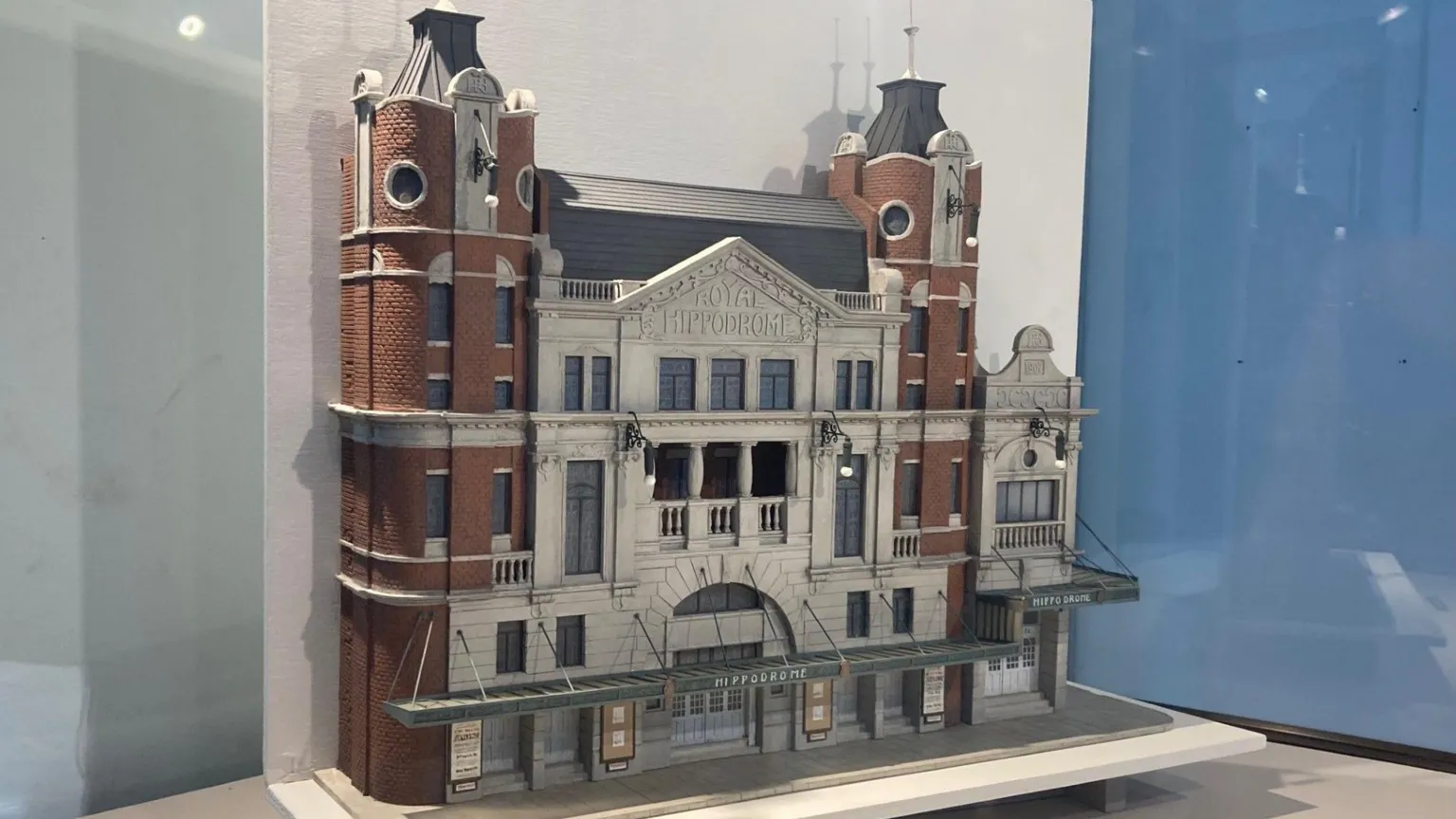
During lockdown, set designer Stuart Marshall started making models of Belfast’s lost theatrical world. Above is his model of the Hippodrome.

No one wants to go back to the pandemic’s lockdown, but enough time has passed for people to feel a little nostalgia for the creative projects some folks undertook during that dark time. I remember a guy in Boston who encouraged artists to send him miniatures of their work, which he would then display on his popular website. Refresh your memory of that here.

Jake Wood at the BBC reported in March on an exhibit in Northern Ireland that had its beginnings when a set designer was stuck at home.

“Miniature models of Belfast’s lost theatres created by set designer Stuart Marshall are bringing the city’s vibrant theatre history back into the the limelight. They are part of an exhibition at Ulster University for the Children’s Festival.

“Mr Marshall told BBC News NI that … ‘Children appreciate the miniature dolls house type model making, adults appreciate the skill that goes into making them, and older people who may remember when some of these places still stood. …

” ‘I started working on a model of the Grand Opera House as part of the heritage exhibition and through doing that got interested in looking at all the other theatres that aren’t about anymore. …

” ‘The Hippodrome was the most complicated and detailed one I’ve made; it took me around six weeks to make.’

“He said he mostly works from old photographs, but it can be hard to get enough accurate detail because ‘with a black and white photograph that you can’t move around, it’s basically static.’

“When photographs of the old theatres are not available or poor quality, Mr Marshall refers to old newspaper articles which sometimes have written descriptions of what materials the theatre was built from and how it appeared.

“Opening in the early 1870s, the Alhambra was Belfast’s first music hall and was a ‘real spit on the floor type joint,’ according to Mr Marshall. ‘In the early days, the Alhambra was more of a variety house, and I’ve heard that it wasn’t the most enticing establishment, quite a rowdy place.’ …

“A typical bill from the early days of the Alhambra shows performances which ‘would nowadays be contentious’ included events such as a minstrel show and a Japanese troupe. …

“To adapt to the evolution of mass entertainment, the Alhambra converted to a full-time cinema house in 1936. Between the late 1800s and its closure in 1959, the Alhambra suffered four separate fires.

“The Theatre Royal was Belfast’s original high-end theatre, opening in the late 1700s with a capacity of just over 1,000. The building was demolished and rebuilt a number of times.

” ‘As these places go, they kept getting burnt down or demolished and rebuilt again – there’s always a renewal aspect to them.’

“The Theatre Royal was to be Belfast’s ‘higher class establishment,’ which in the end became ‘a mixed-use building of shops and place called the “boom boom room,” which was like a dance hall upstairs. …

” ‘Now, there’s a little Starbucks in the corner where the building stood,’ he added.

“Not to be mistaken for the pub and music hall on Botanic Avenue, the Empire Theatre was situated on Victoria Square and opened to the public in 1894. …

“While it did adapt to the growing popularity of cinema, the Empire ‘stayed true to theatre for all of its life,’ Mr Marshall said.

“The Hippodrome was ‘more fiddly.’ … There aren’t too many quality photographs of the Hippodrome, so he ‘had to use his judgment’ when designing the model in terms of color scheme and scale.

“Coming quite late, the ‘Hippodrome was was built in 1907 originally with a cinema in mind’ as to take full advantage of the advent of modern cinema and growing popularity of picture shows.

” ‘And then there was the Ritz,’ which opened in 1938. The Ritz was, according to Mr Marshall, ‘a giant cinema more or less, but it called itself the Ritz Theatre.’ However, it did produce shows as part of the night’s entertainment.

” ‘They would have a brass band, dancers or a ballet, and then a film at the end. It also did huge concerts, people like the Stones, The Beatles and Billy Connolly all performed at the Ritz during their time,’ he added. …

“The Ritz was damaged by bombs hidden in the seats and the theatre’s interior and roof was destroyed in 1977.” More at the BBC Northern Ireland, here.

Did you do a particularly creative project during lockdown? Of, course, many of us kept on blogging away, but we would have done that anyway.

Photo: Gavin Doran.
“Song of the North” involves 483 puppets, 208 animated backgrounds, 16 masks and costumes and nine performers.

Here’s how an incredibly creative Iranian is showing the world something deeper than the stereotypes about his home country.

Jennifer Schuessler wrote about his puppet epic at the New York Times in March.

“On a recent afternoon on 42nd Street in Manhattan, a mythological bird was preparing to take flight. Backstage at the New Victory Theater, a black-clad puppeteer put on an elaborately stylized mask and stepped into a beam of light, throwing the shadow of fluttering hands onto a large scrim.

“Nearby, two other performers were gearing up to practice a sword fight. Then the music started, and a crew of nine began a full run-through of Song of the North, an elaborate shadow puppet staging of stories from the 10th-century Persian epic the Shahnameh.

“From the audience, the show unfolded like a seamless animation. But backstage, the next 80 minutes were half ballet, half mad scramble, as the performers grabbed hundreds of different puppets, props and masks stacked on tables and, with split-second timing, jumped in and out of the light beams streaming from two projectors.

“Leaning against a backstage wall was the show’s creator, Hamid Rahmanian. His role? ‘Stressing out,’ he said.

“Since premiering in 2022 in Paris, Song of the North (which is intended for audiences 8 and older) has received enthusiastic reviews and played to packed houses on three continents. Its arrival in the heart of Times Square [was] timed for Nowruz, the Persian new year celebration. It also coincides with the release of a new contemporary prose translation of the Shahnameh that Rahmanian produced in collaboration with the scholar Ahmad Sadri — the first complete English version by Iranians, Rahmanian said.

“The show is mind-dizzyingly complex, involving 483 puppets, 208 animated backgrounds, 16 character masks and costumes and nine performers who follow more than 2,300 separate cues.

“But the idea behind it, Rahmanian said, is simple: to bring the richness of Persian culture to young audiences and adults whose views of Iran may be dominated by negative stereotypes.

“ ‘Everything about Iran is seen through the lens of politics,’ he said. ‘Iranian culture is a symphony. But in the West, we only hear the drumbeat.’

“The Shahnameh, or Book of Kings, is said to be the longest poem ever written by a single author — twice as long as the Iliad and the Odyssey combined. It was composed by the Persian poet Abu al-Qasem Ferdowsi, who spent 33 years turning centuries of historical and mythological lore into more than 50,000 couplets.

“In Iran, where many people give their children names of characters (Rostom, Sohrab), it remains a cultural touchstone. But growing up in Tehran, Rahmanian, now 56, was resistant to his father’s admonitions to actually read it.

“He was more drawn to visual art, and by 19, he said, had founded his own graphic design business. In 1994, he moved to New York to study computer animation at the Pratt Institute. In 1996, he was hired by Disney, where he worked on projects like Tarzan … but he felt like he didn’t fit in, and left two years later. …

“In 2008, Hamid pivoted to what has become his life’s work: promoting the Shahnameh. … Rahmanian was inspired to create a theatrical piece after seeing a restored version of Lotte Reiniger’s 1926 silent film The Adventures of Prince Achmed, believed to be the oldest surviving full-length animated film. ‘I thought, “I want to do something like that!” ‘ he said. …

“Nazgol Ansarinia, a visual artist visiting from Tehran who was watching backstage, said she was amazed by both the intricacies of the performance and the immediacy of the storytelling.

“ ‘In Iran, everyone knows the stories and characters from the Shahnameh, but the text itself is not that accessible,’ she said. ‘Hamid has really made it accessible.’ ”

More at the Times, here. Beautiful photos and videos.

Photo: Barbara Alper/Getty Images.
Aqua aerobics is pitched at those who are ‘young at heart, recovering from pregnancy, or rehabilitating,’ writes Kate Leaver.

Since I moved to a retirement community with many excellent exercise instructors, I’ve been impressed to see how many seniors are really serious about staying in shape — even people close to 100. Today’s story is about a particular kind of class for older people, but not just older people. It comes from Sydney, Australia, via the Guardian.

Kate Leaver writes about her experience with a water aerobics class.

“At my first class, we sang Barbara ‘Happy Birthday.’ She was turning 80, doing fly-kicks underwater with the rest of us. …

“That’s the main demographic for aqua aerobics at the Manly’s Andrew Boy Charlton aquatic center in Sydney: women born in the era of Barbaras, Margarets and Gladyses, many of them wearing a full face of makeup and gold earrings. They keep their faces immaculate by extending their necks and keeping their heads above water (I’ve asked).

“Each week, 30 people turn up for 45 minutes of guided exercise, half-submerged in a heated, chlorinated lap pool. It’s popular: tickets go on sale three days in advance and it’s sold out within hours. …

“Aqua aerobics is pitched at those who are ‘young at heart, recovering from pregnancy, or rehabilitating.’ My mum and I are in that third category: rehab. She, from cancer; me, from long Covid (I contracted the virus at a Harry Styles concert in June 2022 and am yet to fully recover). Having spent a displeasing number of days/months/years lying down, we felt ready for some gentle exercise.

“It’s probably the most fun I’ve ever had in the pursuit of mild fitness. … The vibes are unmatched – it’s all ‘Very nice, Susan’ and ‘Lift those legs, Carol,’ never ‘No pain, no gain.’ One time, a young man with a six-pack walked the length of the pool in Speedos and I watched as a wave of giggles spread across the pool in his wake. …

“It’s a great workout, too, especially for anyone easing back into movement. The buoyancy of the water reduces strain on your joints and makes injuries less likely than routines on dry land. It’s adaptable in that you can glide your limbs for a mobility exercise or you can work up a sweat against the resistance of the water. I have to take it slow, but if you went hell for leather with some of these moves, you could really get your heart pumping.

“We do knee raises, lunges, kicks, punches and bicep curls. We jog back and forth in the water. We hold on to the edge of the pool and kick, kick, kick. We dance underwater to get our heart rates up and alternate between cardio and strengthening. Our leader is a loud, fit, flexible, brilliant middle-aged woman who has a special place in my heart because of the way she speaks to anyone who looks as though they might be struggling with her choreo. ‘You OK there, Maggie?’ she’ll say. ‘Don’t make me come in there and get you.’ She remembers people’s names, gently reminds the gossipers down the shallow end to concentrate, and winks at anyone who needs encouragement.

“She has a Britney microphone and a killer playlist of hits from the 70s and 80s. I don’t think I had truly lived until I’d done a kick-jump-kick sequence underwater while singing ‘There lived a certain man in Russia long ago / He was big and strong, in his eyes a flaming glow’ (Rasputin by Boney M, 1978).

“I will never again take a spin class run by a shouting bodybuilder or think of exercise as punishment. Not when this is an option. It’s a joy from start to finish, a truly adorable mother-daughter activity.” More at the Guardian, here.

I’m zeroing in on the soundtrack. In one of my classes we’ve had the same ’50s-’60s mix twice a week for 10 months. As much as I love music from those decades, would welcome a change to almost anything!

Photo: rkd/Mauritshuis.
Wilhelm Martin, the director of the Mauritshuis museum, quietly resisted by removing artworks from the museum during the Nazi occupation. And he hid people.

Today we go back to WW II to gather new information on the difficult choices that people had to make under Nazi occupation and how some Dutchmen practiced resistance while hiding in plain sight.

The Guardian‘s Senay Boztas reported the story from the Netherlands.

“The 13-year-old boy answered the doorbell,” she begins. “ ‘Tell your dad I’m here,’ said a man, who stored his bicycle and then disappeared upstairs.

“It was 1944, and right under the noses of Nazi command, people were hiding in the attic of The Hague’s Mauritshuis museum from forced labour conscription – Arbeitseinsatz – under which hundreds of thousands of men from the Nazi-occupied Netherlands were conscripted to work in Germany.

“The memories of 93-year-old Menno de Groot – a Dutch-Canadian who was that young boy – form an extraordinary part of a book and an exhibition of the secret history of the Dutch museum during the second world war.

“ ‘He must have gone all the way to the attic,’ De Groot tells his granddaughter Kella Flach in a video for the exhibition, referring to the man who he assumed had arrived to go into hiding. ‘I don’t know how many were up there. I have no idea how they lived up there, how they got there.’

“The chance find of a logbook by De Groot’s father, Mense de Groot, an administrator who from 1942 lived in the Mauritshuis museum with his wife and children, including Menno, inspired researchers to examine the museum’s history.

“ ‘People were hiding in November 1944 because of the Arbeitseinsatz, but hiding in the Mauritshuis was hiding in plain sight,’ Quentin Buvelot, a researcher and curator, said. ‘It was a house in the storm.’

“Art from the museum, including Johannes Vermeer’s Girl With a Pearl Earring, was first hidden in a bomb-proof bunker underneath the building and later stored in locations around the Netherlands. The German-born museum director Wilhelm Martin played a careful role, allowing the Nazis five propaganda exhibitions while also quietly resisting.

“A newly discovered note on Martin’s retirement in 1953 revealed he was involved in supporting people who had gone undercover on Assendelftstraat and in the museum. ‘Martin doesn’t say how many, but he says that on a daily basis, 36 loaves of bread were delivered. …

“Secret concerts were also held in the museum’s basement between 1942 and 1944, according to Frank van Vree, an author and researcher at the NIOD institute for War, Holocaust and Genocide Studies. ‘They were held to support musicians who were cornered by their resistance to German measures, especially compulsory membership of the Nazi Kultuurkamer,’ he said. …

“Mense de Groot, who was hired to work at the museum when the janitor retired, also worked for the resistance. ‘He usually got Trouw, an underground newspaper,’ Menno de Groot says in the exhibition. ‘And my dad, he copied them, made more copies. …

“Life under occupation was a series of difficult choices, according to Eelke Muller, a historian and NIOD specialist in looted art. ‘There was little knowledge [before this research] about how culture could be a political instrument for resistance from the Netherlands but also a strong ideological instrument for the occupier,’ she said. ‘Every museum, every civil servant in times of war was confronted with huge dilemmas: do you choose principled resistance, enthusiastically get behind Nazi ideas, or are you somewhere in the middle?’ More at the Guardian, here. No paywall.

Nina Siegal at the New York Times adds details about the famous Vermeer that Martin also hid.

“At first it went to a bomb shelter in the basement of a museum, then an art bunker built into the dunes on the North Sea in the Netherlands. Toward the end of the war it was hidden in a secured cave in Maastricht, a Dutch city near the Belgian border.

“Starting in 1939, as war in Europe spread and the Nazi invasion of the Netherlands loomed, leaders of the Mauritshuis, the jewel box museum in The Hague, took extraordinary steps to protect Johannes Vermeer’s ‘Girl With a Pearl Earring’ and other works central to its collection.

“Wilhelm Martin, the museum’s director at the time, removed it and other famous works … before the Germans arrived because he understood that they would be in peril, both from bombardments and from potential Nazi looting afterward.

“The survival of these works, through strategic planning, diplomatic appeasement and the German affinity with the conquered Dutch as ethnic brethren, is now the subject of an exhibit at the Mauritshuis. ‘Facing the Storm: A Museum in Wartime,’ which is on view until June 29, coincides with the 80th anniversary of the liberation of the Netherlands in 1945 and is based on extensive new research.”

I hope blogging chefs Michiel and Jeen in the Netherlands get to see this.

Photo: Biodiversity for a Livable Climate.
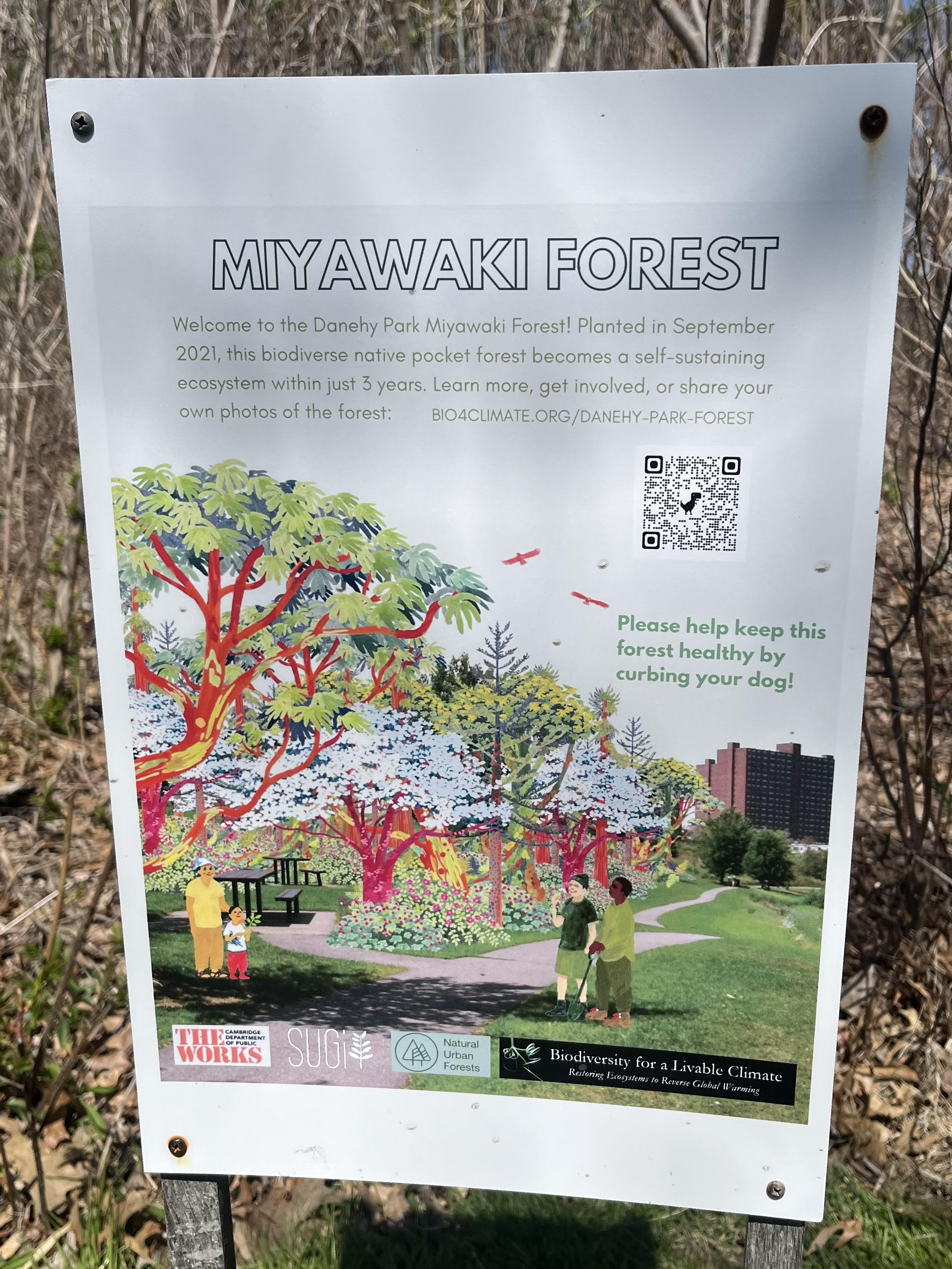
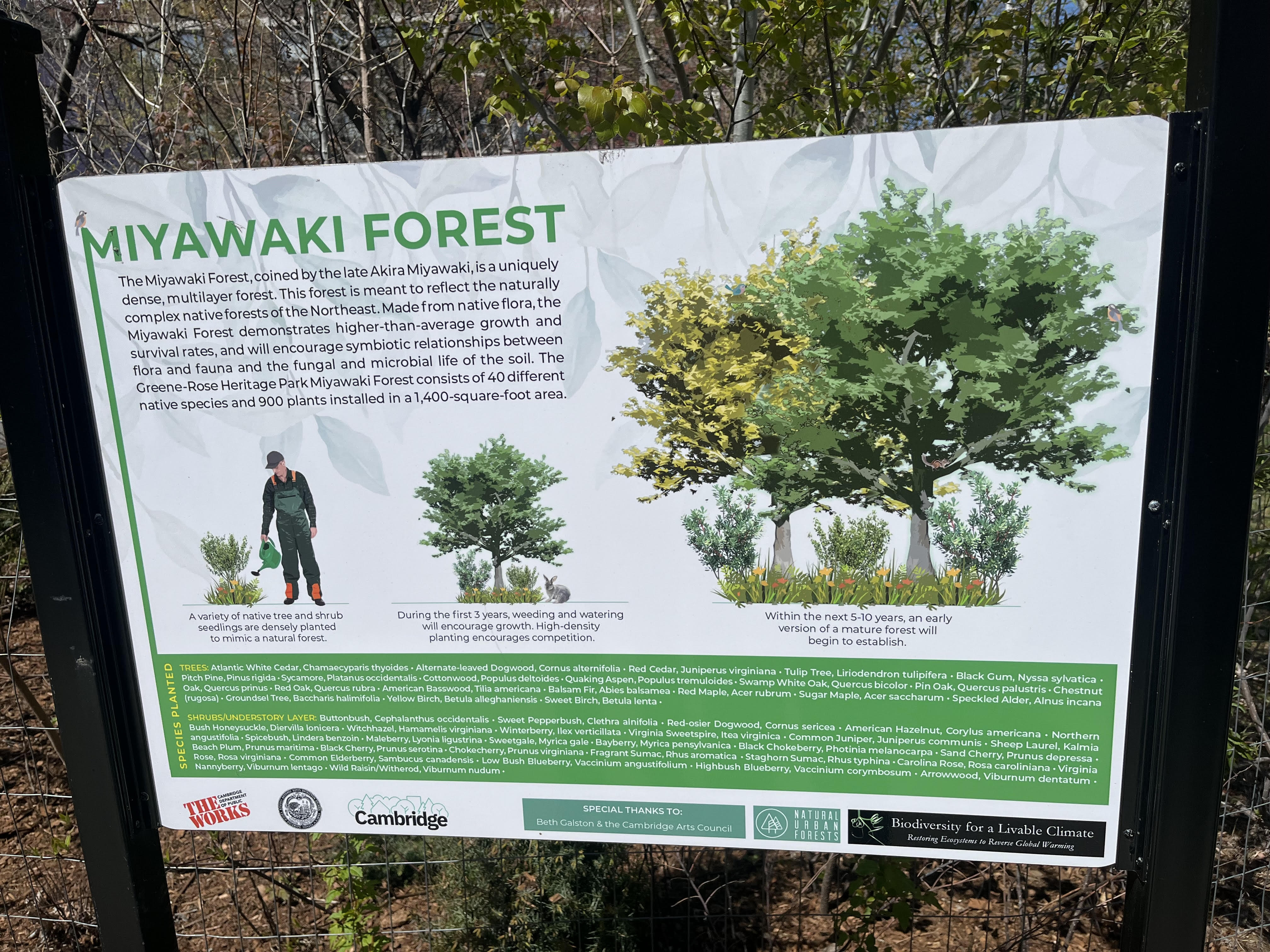
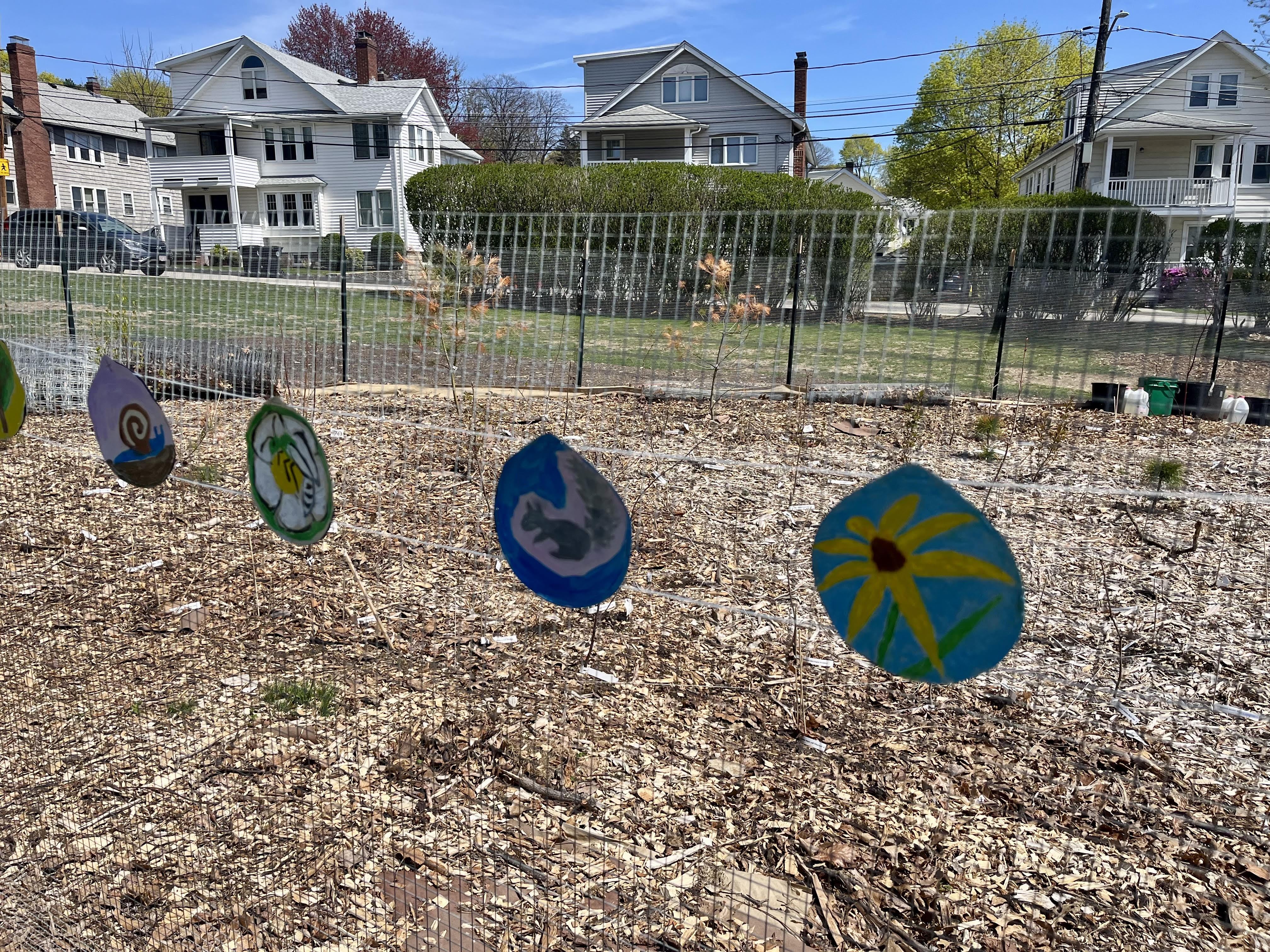
A Miyawaki forest at Danehy Park in North Cambridge, Massachusetts, planted on September 25, 2021 — with the help of enthusiastic volunteers. Other Miyawaki forests don’t look like much in April. But just watch!

Although I blogged about Miyawaki mini urban forests in 2023, here, and again after a tip from Hannah in Philadelphia, here, I had never seen one in person and didn’t really understand the concept. These are not forests you take a walk in. They are deliberately planted too densely for entering, which is why one elementary school asked for a crescent shape to let kids see the native plants that their teachers were talking about.

On a special day in April, my friend Jean Devine of Biodiversity Builders took two of us on a tour of three Miyawaki Forests and the site for one that she and students at her local high school are building.

Now I think I get it. In order to have a healthy climate, we need a healthy, biodiverse planet. And the effects of even very small sites can spread. Birds, small animals, pollinators, and other critters flourish in these biodiverse pockets.

Biodiversity for a Livable Climate: Restoring Ecosystems to Reverse Global Warming says, “The Miyawaki Forest is an ultra dense, biodiverse pocket forest that recreates the complexity of natural forests and the relationships and processes that help them grow strong and resilient. By giving home to a vast array of native species, they boost the biodiversity of the area and nurture pollinators, supporting and restoring ecosystems. They sequester carbon in the soil, reduce air pollution and soil contamination, improve water absorption to buffer against flooding and erosion, and cool the surrounding area to mitigate the urban heat island effect. They also create a living classroom for people and communities to learn about native ecology, engage in stewardship, and experience the interconnectedness of the natural world.”

GBH tv provides a forum on the concept, asking, “What can hold more than 500 species, sequester more than 500 lbs. CO2/year, be 10F cooler than its surroundings, soak up lots of rainwater, and be made by and for children in a space no bigger than a tennis court? A ‘mini-forest’ planted using the Miyawaki Method, of course!

“Biodiversity for a Livable Climate hosts Miyawaki-Method advocates Hannah Lewis (Bio4Climate Compendium editor) and Daan Bleichrodt (The Netherlands’ Tiny Forest initiative leader), as they talk about mini-/tiny-forests and their role in climate resilience, urban beautification, and connecting all of us to nature.” More here.

My photos are from mini forests Massachusetts, one in a large park in Cambridge, one in a Cambridge neighborhood’s pocket park, and one at an elementary school in Watertown. At the latter, the children sit on tree stumps for classes. Note the art they created for their forest, too. The forest doesn’t look like much in April, but just wait!

More at Biodiversity for a Livable Climate, here, and here.

April Photos

Photos: Suzanne and John’s Mom. (Erik took the photo of my grandson.)
Where I like to walk these days.

We had some gorgeous days in April, and May is shaping up nicely, too.

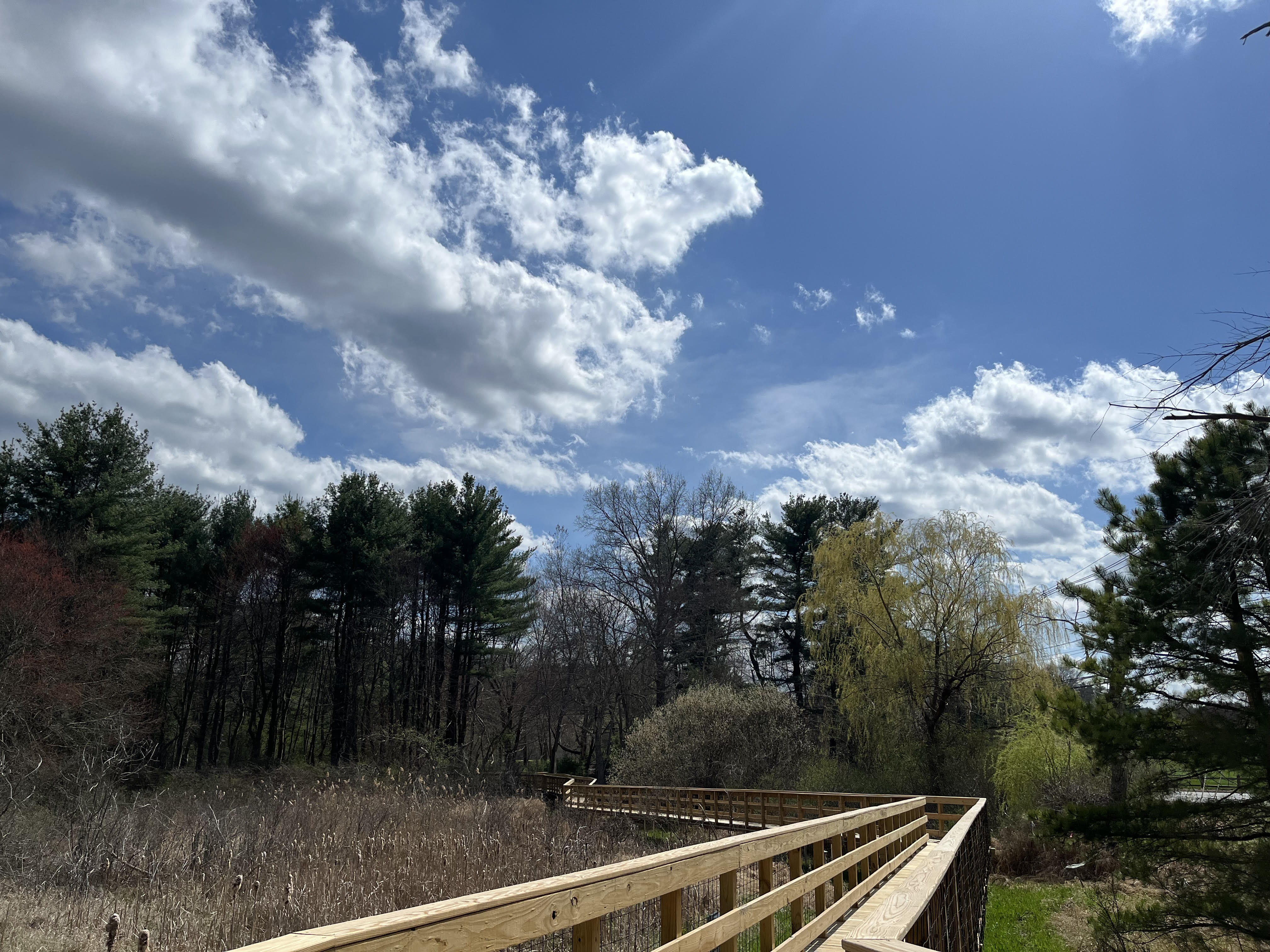
I start my latest photo round-up with the boardwalk my retirement community built according to stringent environmental regulations. I love the feeling of walking in the woods, and right now, wildflowers that were already there are coming up, while residents are planting others with the guidance of a woman specializing in the removal of invasive species.

The first photo below is a white trillium. Next in the leaf litter, you see a stand of May apples and a group of Spring beauty wildflowers. The apple tree has buds about to bloom.

Blogger Will McMillan bloomed at my retirement community the other day with one of his deep dives into the heroes of the American Songbook. This time it was Hoagy Carmichael. It’s amazing the forgotten songs Will digs up for his shows — while also presenting classics like “Skylark” and “Stardust.” There was a funny one about a jazz band in the afterlife, where all Carmichael’s departed friends were playing.

In one week, we went to see a grandson in the musical Matilda, which was polished and lots of fun, and the Spitfire Grille, which did not impress.

I also attended the Edvard Munch exhibit at the Harvard Museums, which I liked very much. It had paintings as well as a lot of prints in different stages of development to demonstrate Munch’s experiments with technique. The exhibit is there until the end of July, so try to catch it if you are ever near Cambridge, Massachusetts.

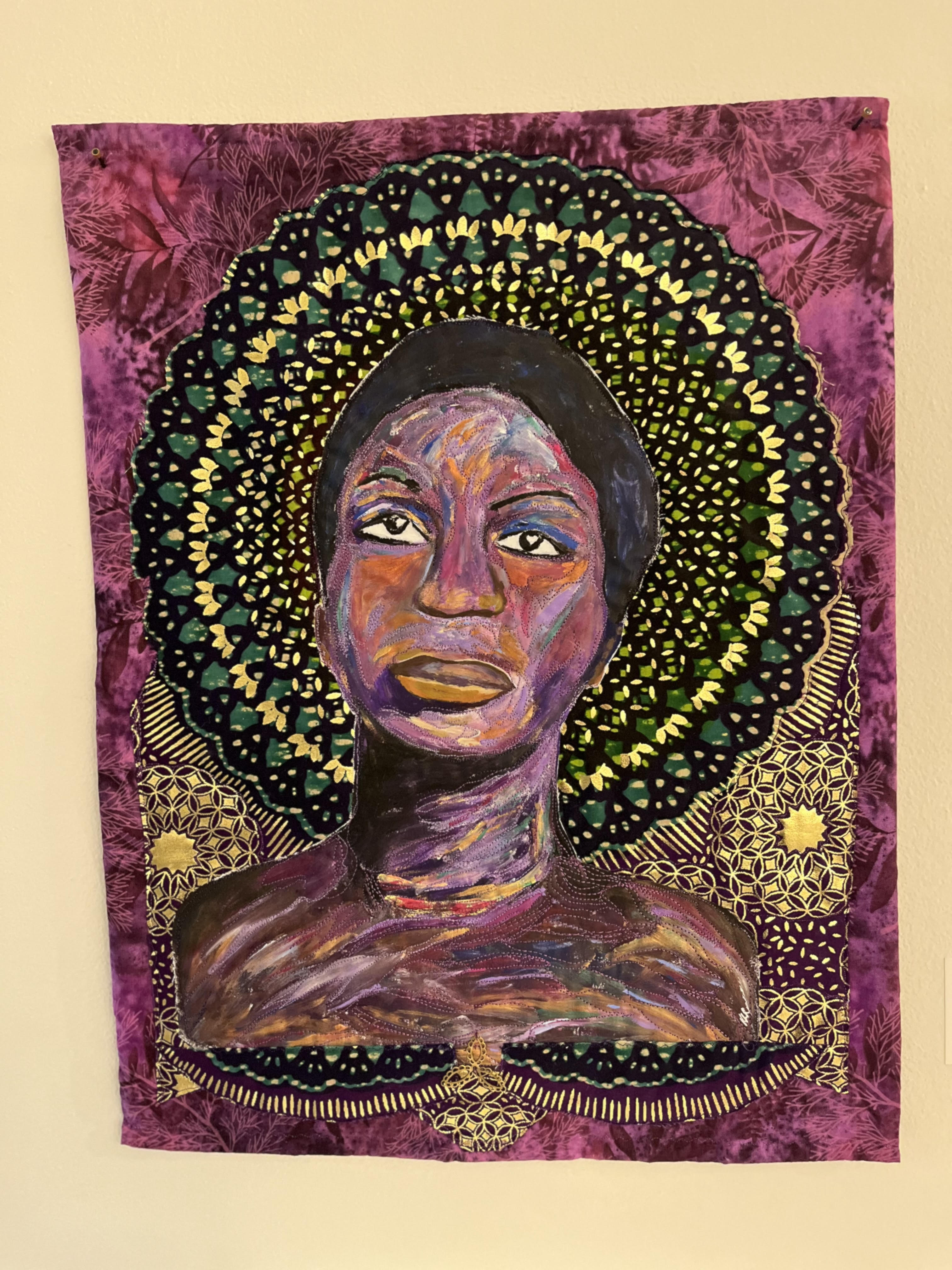
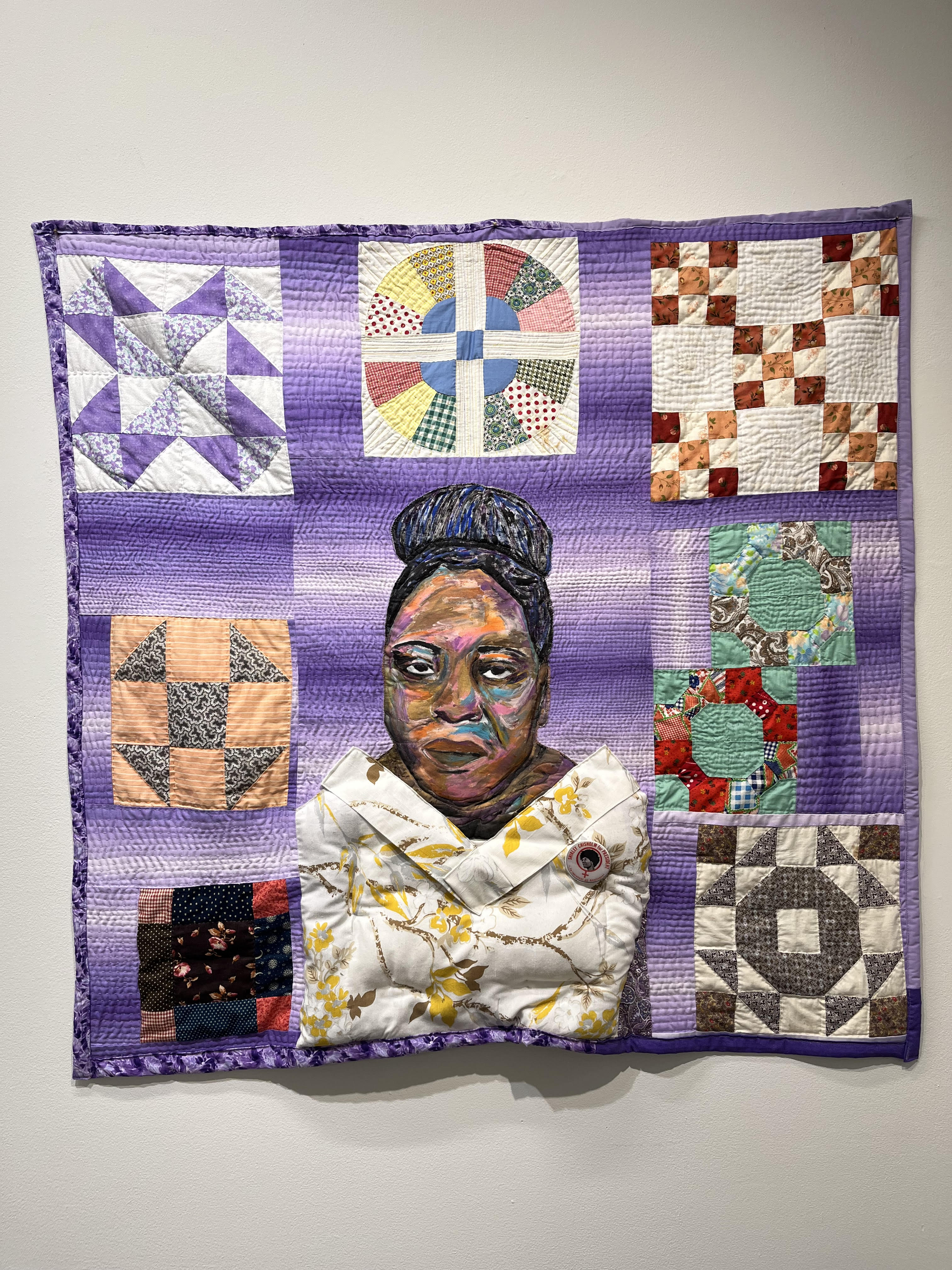
Meanwhile, at Umbrella Arts, there’s a textile show called “Weaving an Address.” The beautiful fiber art here is by Kimberly Love Radcliffe. The first one I photographed she calls “Have Faith in Art.” Then “Ms. Nina God Damn” references singer Nina Simone’s response to the murder of Black Sunday school girls in 1963. And the last Radcliffe I’m showing is a portrait of civil rights icon Fannie Lou Hamer. I just love these works.

Photo: Zoey Goto.
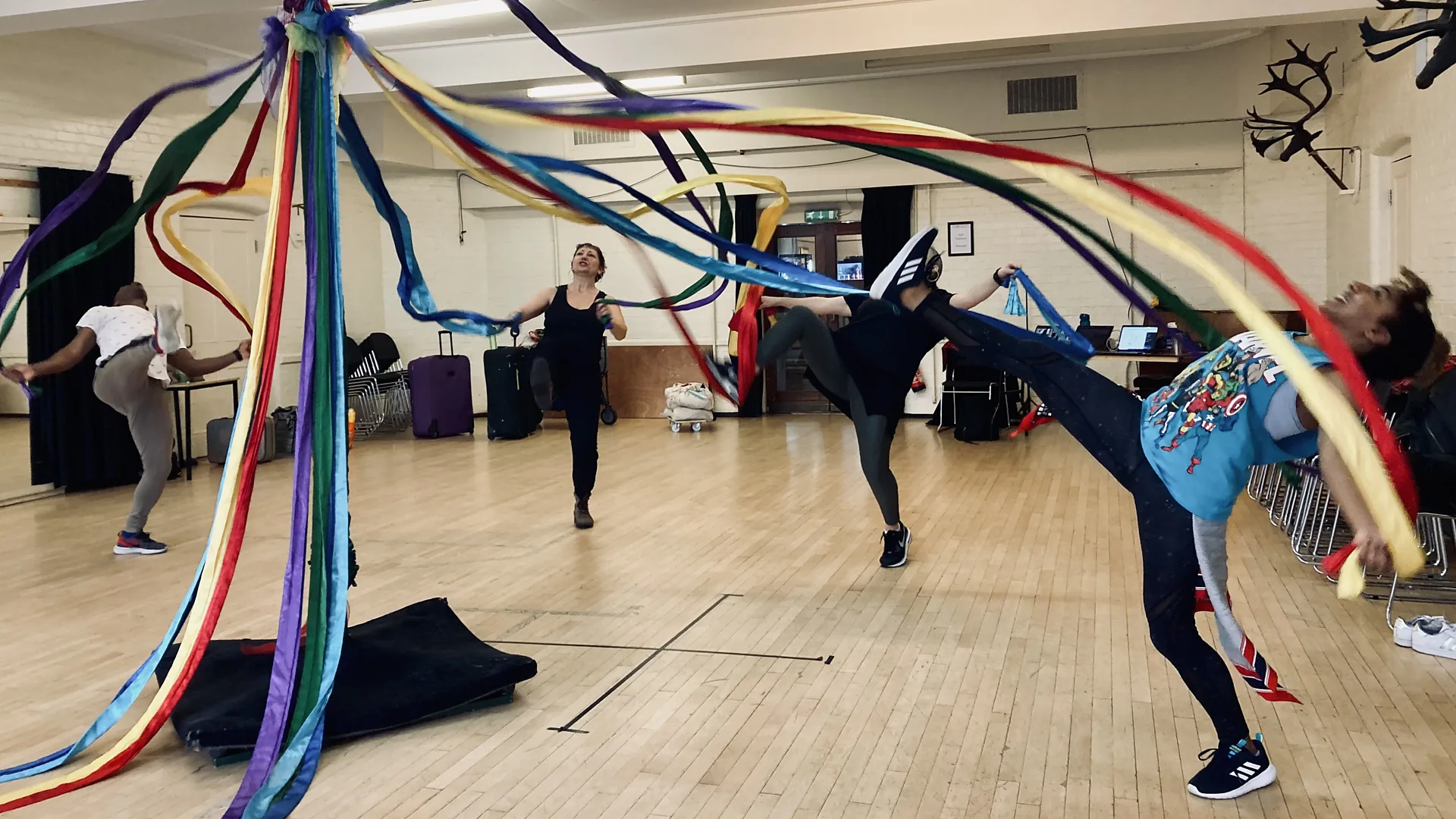
UK’s Folk Dance Remixed combines traditions like May Day music with contemporary street dance styles.

On May Day, I was telling Diana that I had just received a surprise May Basket from my college’s local club. I have left May baskets of my own off and on since childhood, loving people’s puzzlement. Now it was time for me to wonder who I should thank.

That reminded Diana that for years she went to New York City’s Riverside Park on numerous May firsts to see the Morris dancers perform.

Nowadays, May 1 is associated with the international labor movement, and that’s a fine thing, too. But I am usually conscious of a different, more ancient celebration underneath it all.

Today’s story is about reimagining traditions like the Morris dancing of May Day for a new age.

Zoey Goto wrote at the BBC, “Camden’s Cecil Sharp House has been questioning the very notion of what traditional British music means in the multicultural 21st Century.

” ‘Hip-hop is the folk dance of today,’ said Natasha Khamjani, breathing heavily. They’re both social dances created for crowd participation, both also existing on the fringes of the mainstream, she added. Khamjani was taking a quick break during a rehearsal of a high-energy performance blending Bollywood moves and English country dancing with the unmistakable bounce of hip-hop moves.

“In an unexpected twist, Khamjani and her troupe were also dancing under a rainbow of swirling maypole ribbons – a sight more commonly associated with English village fetes rather than a basement in inner-city London. …

“For Khamjani, artistic director of Folk Dance Remixed, a collective putting a global spin on old-time English dances, a natural synergy exists. These are the dances of the people, bubbling up from the streets, pubs, village greens, dance halls and international communities that birthed them, Khamjani explained. An easy fit between age-old English country dances and house music exists, she pointed out. ‘It sounds weird but the steps are basically the same,’ she laughed. …

“Remixing maypole dancing is just one of the myriad ways that English folk culture is currently having a reboot, thanks to a new wave of switched-on folkies diversifying the scene. At the heart of this progressive movement is the Cecil Sharp House, a music venue and folk arts centre that’s home to the English Folk Dance and Song Society (EFDSS) and where Folk Dance Remixed perform regularly.

“Named after Cecil Sharp, a folk music enthusiast who roamed the countryside of England and the US South collecting folk music and dances in the early 20th Century, this temple to vernacular culture threw open its Arts and Crafts-style doors in 1930. …

“Over the last few years, the EFDSS has ramped up its outreach efforts to engage new audiences, mixing diverse cultural traditions to create new interpretations of ‘Englishness.’ Projects have included teaming up with musician Kuljit Bhamra, pioneer of the British Bhangra sound, an upbeat musical style that mixes traditional Punjabi beats with Western pop, to uncover similarities between 18th-Century traditional Kentish jigs and Bhangra music. There have been sea shanty lessons with rap verses taught to schoolchildren; and feminist-themed pop-up events, including a recording of the podcast Thank Folk for Feminism at the house.

“Certain projects have undeniably chimed easier than others. Take for example Queer Folk’s Queer Ceilidh parties hosted at Cecil Sharp House, where evenings of LGBTQ ceilidh dancing and drag acts have proved a sell-out success. …

“Joining me in the main hall at the Cecil Sharp House beneath a whimsical mural of folkloric creatures and abstract dancing figures, Katy Spicer, the chief executive and artistic director at EFDSS, pointed out that it is, however, a work in progress making the English folk scene truly inclusive. ‘In terms of diversity, ethnicity has been the hardest challenge’ she said. …

” ‘There was perhaps a tunnel vision back then and histories not recorded, which no one questioned until recently. We’re working to set the record straight,’ Spicer said, as a group of teenagers, part of the National Youth Folk Ensemble, shuffled onstage to tune violins ready for the evening’s show. ‘Particularly when you have English in your title, you have to address what it means to be English and whose England is it?’ …

“Exploring some of these overlooked histories and racial crosscurrents is Cohen Braithwaite-Kilcoyne, a singer, musician and rising star of the folk scene, who in 2021 collaborated with the EFDSS on the Black Singers and Folk Ballads project. The work explored links between English folk and music-making among enslaved people in former British colonies in the US Southern states and the Caribbean.

” ‘I’d always been aware that there are songs and ballads that crop up across English folk music traditions and the music of Black America and the Caribbean, but perhaps hadn’t quite realised the extent of the shared repertoire,’ he told me. ‘These songs started life in Britain and migrated with the people to the Americas. It seemed that there was a certain amount of cultural exchange between the white colonizers and Black enslaved people,’ he said of his research, which unearthed examples of similar storytelling and melodies across the three traditions. ‘But the very nature of folk song means that as it’s passed along orally, you get an evolution.’

“Often still viewed as a relic from a dusty, bygone era, folk has also long struggled to attract a younger, hipper crowd. But things look set to change.”

More at the BBC, here. No firewall.

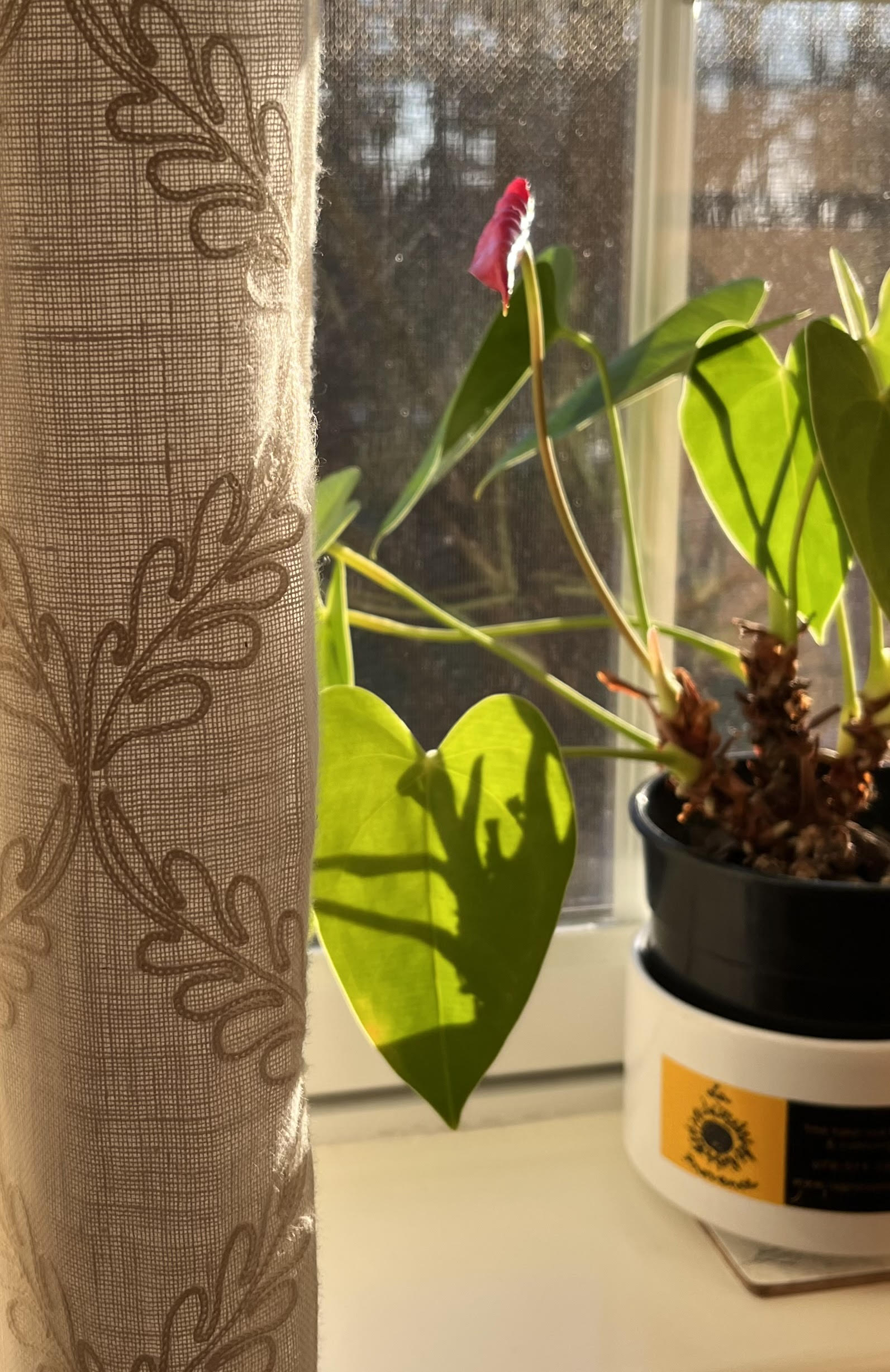
Photo: John and Suzanne’s Mom.

Do you talk to your houseplants? Do you sing to them?

Today’s story suggests that it’s no joke. Music can be the plant “food of love,” so play on.

Kate Morgan at the Washington Post reported the phenomenon.

“Zak Peters’s business began when he realized that the cannabis plants in his Massachusetts basement seemed to grow better when he played music for them. ‘I don’t know why, but they loved Radiohead so much,’ he says. …

“The flora seemed like an enthusiastic audience, so at the start of the pandemic, when most live music performances were canceled and venues closed, Peters started inviting local bands to play to the plants. …

“When Peters relocated to Austin in 2021, the idea grew. Bands and venues across the city have hired his company, Play to the Plants, to cover stages with houseplants of all shapes and sizes. It’s about more than just decoration, he says.

“ ‘People just love the idea of playing to the plants,’ Peters says. ‘It’s calming and it just makes the bands feel good.’ It also makes the plants feel good, at least in Peters’s estimation. ‘We’ve never had a plant die,’ he says. ‘If anything, they’ve had better growth.’

“Even if you’re not toting your plants along to concerts, there may be some benefit to exposing them to music. A number of streaming services now offer curated playlists and channels aimed at improving plant growth, and while scientists can’t say for sure whether it works, it probably can’t hurt.

“Plants do respond to sound. That much, at least, is settled science. Researchers have found that plants feel vibrations and react to them. When Heidi Appel, a chemical ecologist and professor of biology at the University of Houston, and her colleague, Rex Cocroft of the University of Missouri, replicated the sound of a caterpillar chewing, plants sensed those vibrations and increased their chemical defenses. They concluded it was proof that plants respond directly to noises.

“In fact, Appel says, plants (and all living things) are constantly surrounded by sound waves and vibrations. Whether we’re aware of it or not, she says, we all live in a vibroscape, an atmosphere of natural vibrations that humans may not even notice. ‘Plants are so responsive to everything in the environment,’ she says. ‘So what sounds are important to plants? Raindrops, probably. And pollinators, perhaps herbivores.’ …

“One study found that when beach evening-primrose flowers were exposed to the sound of a flying insect, they produced sweeter nectar almost immediately. …

“Research from the past few years suggests plants will lean toward sounds played at certain frequencies, and in a recent study, Japanese scientists exposed some arugula plants to Jimi Hendrix and others to Mozart. While the study didn’t look at which might be ‘better’ for the plants, it did find that the cellular structure of the plants was different depending on which music had been played to them. …

“Regardless of the science behind it, there’s plenty of music being made for plants. Several major streaming services have launched dedicated plant channels, and they all have different vibes, so choosing the right fit might depend a lot on your plants’ personalities. SiriusXM’s Music for Plants channel is heavy on the strings-driven instrumentals, for romantic plants that appreciate a sweeping fantasy film score or an Andrew Lloyd Webber musical. On Apple Music, artists including Hortus Botanist and Audioponics offer ambient synthesizer grooves for plants that just want to, like, chill, you know?

“And then there’s Spotify’s Hardcore Gardening.

“Last year, the streaming service partnered with Chris Beardshaw, a Britain-based horticulturalist and broadcaster who oversaw a study in which plants exposed to hardcore punk grew to be ‘much more robust’ compared to plants grown in silence or exposed to classical music. The plants that were ‘bombarded’ by hardcore, he says, ‘were the shortest but the stockiest and most resilient, with the least incidence of pests or disease.’

“In other words, if you want to grow the toughest plants in the mosh pit, toss on the playlist, which kicks off with Black Flag and keeps up the energy with songs from Bane, Have Heart and all the other loudest bands you can think of.”

More at the Washington Post via MSN, here. No paywall.

Photo: Lindsey McGinnis/The Christian Science Monitor.
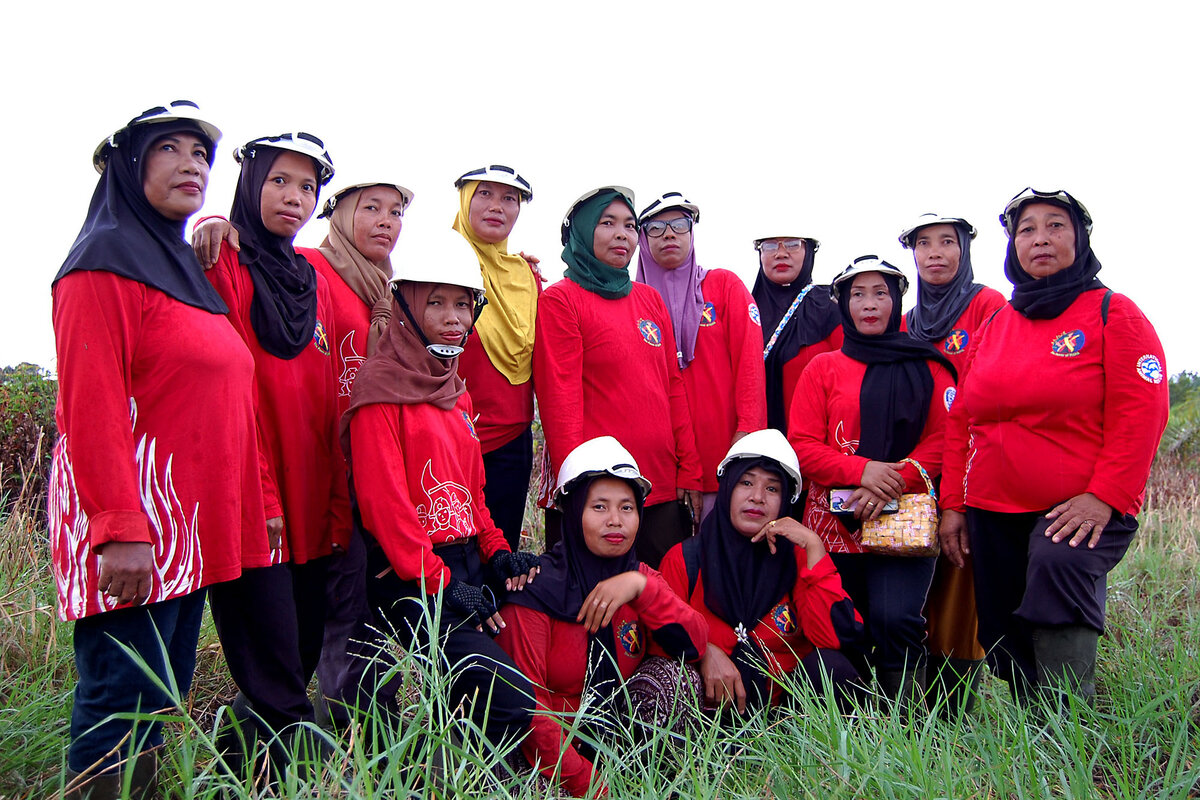
Power of Mama patrollers, who routinely put out palm oil fires in Indonesia.

In Indonesia, women have answered the call to do something about wildfires. Because in Indonesia, careless and illegal palm-oil logging routinely causes fires, endangering orangutans. And not just orangutans.

Lindsey McGinnis and Sara Miller Llana report the story at the Christian Science Monitor.

“The women adjust hard hats over hijabs and pull on knee-high boots. Then they set off into what was once a dense forest of rubber and bamboo trees but is now a patchwork of small-scale palm oil fields. Everyone knows who they are. Their scarlet, elbow-patched uniforms with flames snaking up the torso, and the image of a firefighter emblazoned on the chest, give it away.

“This is the Power of Mama.

“Across Kalimantan, the Indonesian part of the island of Borneo, lush rainforest hosting carbon-rich peatland and one of the country’s most significant populations of orangutans meets illegal logging and palm oil farms. That adds up to wildfires.

“So Power of Mama members have started patrolling for fire risks, urging farmers to follow the rules about slash-and-burn clearing, and challenging stereotypes about women’s roles in rural Indonesian life along the way.

“Female forest rangers in Indonesia are rare, says Eulis Utami, director of a nongovernmental organization called Hutan Itu Indonesia, or Indonesia is Forest, which aims to educate Indonesians about their tropical rainforest, the world’s third-largest. But when women are given training and information, she says, ‘They protect the forest with their whole hearts.’

“In untouched forests of West Kalimantan, orangutans build their nests high up in trees. Hornbills soar through the vines with deep swoops of their wings. The chirps of songbirds mingle with the ‘o-ho!’ calls of gibbons.

“But this habitat is shrinking. West Kalimantan has lost more than a third of its tree cover since 2000.

“Indonesia is the world’s largest producer of palm oil, and nearly all of it comes from either Sumatra or Kalimantan. The farms have wreaked havoc on peatlands, one of the world’s most important carbon sinks. When the bogs are cleared, the water table sinks and soil becomes highly flammable.

“A new consciousness about the risks of fire spread rapidly to this community in 2019, when agricultural burning amid drought conditions sparked fires that raged for months. Millions of acres of peatlands and rainforest burned. And it kept many of the mothers who would eventually form the Power of Mama up at night, worried about the effects of smoke and haze on their children’s health.

“The Power of Mama was launched in 2022 by Yayasan International Animal Rescue Indonesia (YIARI), whose long-term goal is to save the critically endangered orangutan. …

“YIARI intentionally made women part of the solution. Male farmers have been impervious to NGOs trying to convince them to protect the forests, but they listen to their wives, says Anna Desliani from YIARI. ‘Women have influence in their families,’ she says.

“One of the newest branches is in the community of Sungai Putri, which counts 2,000 residents. Farmers here have long tended rice paddies but many switched to more lucrative oil palm trees in 2017.

“ ‘It’s sad because … before it was real forest,’ says Misnati, a patroller who, like many Indonesians, has just one name. She says she misses the sounds of gibbons and the cooler air the forest brought. She also felt more protected from fire and floods when the forest served as a buffer zone.

“The Power of Mama doesn’t aim to stamp out cultivation – in fact, most of its members’ husbands toil in palm oil now. But they have been educated on the risks of clearing land by burning, of overcultivating, and of smoking in a highly flammable field. And that knowledge gives them an authority that many had never known. …

“When it comes to forests, the discussion is always ‘heavy,’ explains Ms. Utami. It’s about deforestation, wildfire, conflict. That’s why Indonesia is Forest, which introduces young town dwellers to the rainforest, focuses on positive narratives that make people want to protect Indonesian biodiversity.

“The Power of Mama is, in its own way, cultivating a similar enthusiasm.

“On this rainy day, the women aren’t on high alert. They walk the land and talk with farmers. Passing a patch of blackened vegetation, Misnati recalls her proudest moment: when she figured out how to connect a hose to a water pump and put out a fire here last year. …

“Before the Power of Mama, ‘I’d never venture this far into the land alone,’ she says. ‘I’ve gotten to know the landscape even though I’ve lived here my whole life.’ …

“ ‘We need to be a role model, to set an example,’ says another patroller, Lita, sporting an upcycled crossbody purse made of plastic detergent sachets she collected from her neighbors. Other women are wearing them, too. ‘If we don’t do this, who will?’ ”

More at the Monitor, here. Nice pictures. No paywall.

Photo: Nilo Merino Recalde.
A visual representation of an audio clip of five different great tit birds singing one song each.

There is so much for humans to learn about other species! The other day, a post on household pets reacting to the animated film Flow inspired Deb in Tennessee to conduct her own experiment with her dog. She learned that Buster, for one, was bored by Flow, failing to replicate the anecdotal evidence of curiosity described at the New York Times — a good example of why studies usually say, “More research is needed.”

Today we learn something new about birds, but maybe it’s only certain birds.

Victoria Craw writes at the Washington Post, “They sound beautiful, herald the start of spring, and even have the power to reduce stress and boost mental health.

“Now it turns out that some birdsongs also contain a hidden world of shared language, with varying local accents and dialects that change depending on the age of the bird and its peers — not unlike human songs.

“ ‘Just as human communities develop distinct dialects and musical traditions, some birds also have local song cultures that evolve over time,’ said Nilo Merino Recalde of the University of Oxford’s biology department, who led the new research published in the journal Current Biology. ‘Our study shows exactly how population dynamics — the comings and goings of individual birds — affect this cultural learning process.’ …

“The study is based on analysis of over 100,000 bird songs from at least 242 birds recorded in 2020, 2021 and 2022 in Wytham Woods in Britain’s Oxfordshire — a sprawling 1,000-acre wood where ecological and environmental research is carried out. For the last 77 years it has been the site of the Wytham Great Tit Study showing how two species of tit — the great tit and blue tit — have changed over time. …

“While some birds learn songs from their fathers and others learn continuously from neighbors, great tits are believed to do most of their learning in the first 10-11 months of life. …

“Merino Recalde said he was inspired by his love of birds and interest in social learning in animals, which creates an evolving shared culture reminiscent of the way humans learn languages and music. Theoretical work indicates that factors such as population turnover, immigration and age can affect the evolution of these cultural traits — so far, however, empirical evidence on the subject has been limited.

“His research team focused on the great tit, a small bird that lives just 1.9 years on average. The team recorded the ‘dawn chorus’ from March to May — coinciding with breeding season — using microphones placed near nesting boxes to gather more than 200,000 hours of the ‘simple yet highly diverse songs’ sung by males. Through a combination of physical capture, microchips and an artificial intelligence model, researchers were able to recognize the songs of individual birds and track how they changed over time, showing each bird had a repertoire ranging from one to more than 10 tunes.

“ ‘One of the main findings was that the distance that these birds travel while they are learning the songs, and also the ages of the other birds they interact with … affect how varied their songs become, collectively,’ Merino Recalde said. …

” ‘Homegrown’ songs in areas where birds stay close to their birthplace tend to stay unique, similar to the way in which isolated human communities can develop distinct local dialects over time, the team found.

“Age also had a significant impact, with birds of a similar age singing similar tunes, whereas mixed-age neighborhoods had ‘higher cultural diversity.’

This shows that the older birds can act as guardians of culture as they ‘continue to sing song types that are becoming less frequent in the population,’ researchers said.

“ ‘In this way, older birds can function as “cultural repositories” of older song types that younger birds may not know, just as grandparents might remember songs that today’s teenagers have never heard.’ …

“Merino Recalde said capturing how population changes are reflected in song could provide a future avenue for less invasive research, eliminating the need for capturing and tagging animals, for instance. …

“Professor Richard Gregory, the head of monitoring conservation science at Britain’s Royal Society for the Protection of Birds (RSPB), who was not involved with the study, praised the ‘herculean’ effort to analyze such a large data sample over a three-year period and said similar research could be used to highlight ‘critical tipping points’ for a population in future.

“While the great tit is not endangered, Gregory said the study could help inform plans to reintroduce or relocate certain animals, as such conservation efforts may be ‘doomed’ if they don’t take their cultural traits into account. ‘This study reminds us that the details of an animal’s life really matter.’

“Gregory, who is also an honorary professor of genetics, evolution and environment at University College London, said the study also showed that ‘methods of wildlife recording and song analysis are developing at break-neck speed,’ and AI is going to ‘revolutionize conservation science’ by allowing patterns in nature to be identified more readily.”

More at the Post, here. You can listen to an audio clip there.