Feeds:
Posts
Comments

Did you ever have a correspondence with an author or other celebrity? I know that as a child, author Francesca Forrest got to know the fantasy writer Lloyd Alexander and his family really well. And it all started with fan letters.

In today’s story from the Comics Journal, we learn about a family’s relationship with Edward Gorey.

Cynthis Rose wrties, “Edward Gorey’s friends apparently called him ‘Ted.’ But, in our family, he was always ‘Mr. Gorey.’ My father chanced on his works during a business trip, back when they were small, slight booklets that seemed handmade. With them came an entire world, curious and enticing, fashioned out of the finest and most meticulous pen strokes. It was focused on luckless protagonists with preposterous names, languorous figures who proved surprisingly gritty. Their startling encounters and unforeseen fates soon established a hold on my preteen mind.

“Looking back, this is not surprising. I was a kid who worked in theatre, spending half of every day in a theatre school. Since the age of eleven, I had been portraying other children onstage. This surrounded me with ideas of glamour that, if not quite real, were certainly persuasive. Filled as it was with fantasy, costume and wit, Mr. Gorey’s esoteric universe did not seem strange.

“All the more since my theatrical world was not the same one as the sunny productions of local schools. Instead of joining my classmates in Oklahoma!, I was emoting in Lady Audley’s Secret or The Diary of Anne Frank. I wasn’t reading A Wrinkle in Time and Judy Blume, but grappling with Ionesco, Chekhov and Oscar Wilde. 

“Mr. Gorey’s books made him seem a fellow traveler. I saw his kohl-eyed vamps as shady White Russians and his muscular villains as figures out of Bram Stoker. Even his trailing aspidistras felt familiar – just like the herringbone suits in his characters’ closets, they were the hallmarks of a period stage set. Maybe that’s why it seemed logical to write him, once my father looked him up in a Manhattan phone book. 

“Was I surprised when Mr. Gorey wrote me back? I don’t recollect, but most probably not. Ours was a family who liked filling envelopes. We all wrote postcards, birthday letters, condolence notes, thank-yous and regular, chatty epistles. Almost everyone I knew had a pen pal. Once, when my dad opened a box of chocolates and found one missing, he grabbed his Underwood and wrote the head of the candy company. His typed rebuke (why was the workforce kept so hungry they were forced to pilfer bonbons?) was rewarded by a new and bigger box of chocolates.  

“Mr. Gorey made himself a Proustian part of my postal history. He wrote on discreet, elegant, letter-size paper, almost always ivory or pale dove grey. The inks he favored were sepia and navy blue and the pen he used had a small, blunt nib. As everyone now knows, he also liked to decorate envelopes. However fanciful their design might be, those I received always included his famous black doll.

“What were his letters like? Like his stories and the little books he sent, they were florid and funny and full of deliberate effects. Mr. Gorey seemed to be insatiably curious, with catholic tastes that informed his literary style. He was a voracious reader and would cite both classic tomes and modern trash, differences in form or century notwithstanding. He once wrote that he had found ‘the definitive list of phobias.’ Another time, he sent me a recipe for grapefruit slices ‘bathed in’ Coca-Cola. 

But any letter from Mr. G was instructive, because he was never, ever lazy with language. Always reaching for the mot juste, he cherished terms like ‘habituated,’ ‘diverting’ and ‘gelatinous.’

“He made words perform and took the time to make every letter an event. His missives were as lively as those of Dickens and, like his little stories, owed much to Ronald Firbank

“Over time, we discussed a range of topics: the Moors murders, the benefits provided by a ha-ha, Gustave Doré’s views about the London slums, Lillian Gish in The Wind, Japanese ghost behavior in the Edo era, spirit photography, London’s cheap bookstores, Rudolf Nureyev’s feet, illicit dissections and why green wallpaper had killed Victorians. 

“My own life at this time had a Gorey-esque cast. At fifteen, for instance, my parents sent me off to London by myself. I had earned the money through my theatre school, which ‘loaned out’ their pupils to make commercials. I spent three happy weeks in an English hostel, quartered on the eighth floor of a nine-storey building. From here, I searched out genuine art by Aubrey Beardsley, talked my way into Scotland Yard’s ‘Black Museum‘ and explored a then-almost-derelict East End. I also managed to meet another pen pal – the retired costume historian James Laver. An ex-museum staffer and theatrical bon vivant, Mr. Laver was an expert on dandies and the Decadents. 

“When we met for tea in the Charing Cross Hotel, he invited me to dinner at his Greenwich home. This turned out to be a memorable evening, not least because of the Zulu dignitary who arrived with a leopard skin over his suit. To honour my interest in the Yellow Book era, dinner was also followed by a vintage absinthe. Served through the requisite slotted spoon and sugar cube, it was extraordinarily bitter – and extremely strong.

“Mr Gorey liked to hear about such episodes. I wrote him about the streetlamp that ran on sewer fumes, the private museum of Teddy bears and toy theatres – even the Lava soap (largely pumice) that produced my grandma’s youthful skin. I sent him the label of J. Collis Browne’s Mixture, a morphine-and-peppermint-oil cure still popular in London. I wrote him a great deal about cemeteries and tombs, from English boneyards to the graves of Clyde Barrow and Bonnie Parker. When it came to things that no-one else cared about, I could always depend on Mr. Gorey. I could tell him how Pearl Bixby Wait got the whole idea of Jell-O from Orator Francis Woodward. 

“To this day, many things Mr. Gorey told me – some true, many not – have remained stuck in my mind. (Notably, that someone called ‘Sebastian Chaveau’ invented the marshmallow.) I’ve never tried to verify one of these assertions and I’ve avoided reading about their author. But, from time to time, something makes me think of him. Like a phrase I read last month in Daniil Harms’ diary : ‘Poisoning children is cruel. But something has to be done about them!’ ” 

If you’re a Gorey fan, you’ll understand. More at the Comics Journal, here.
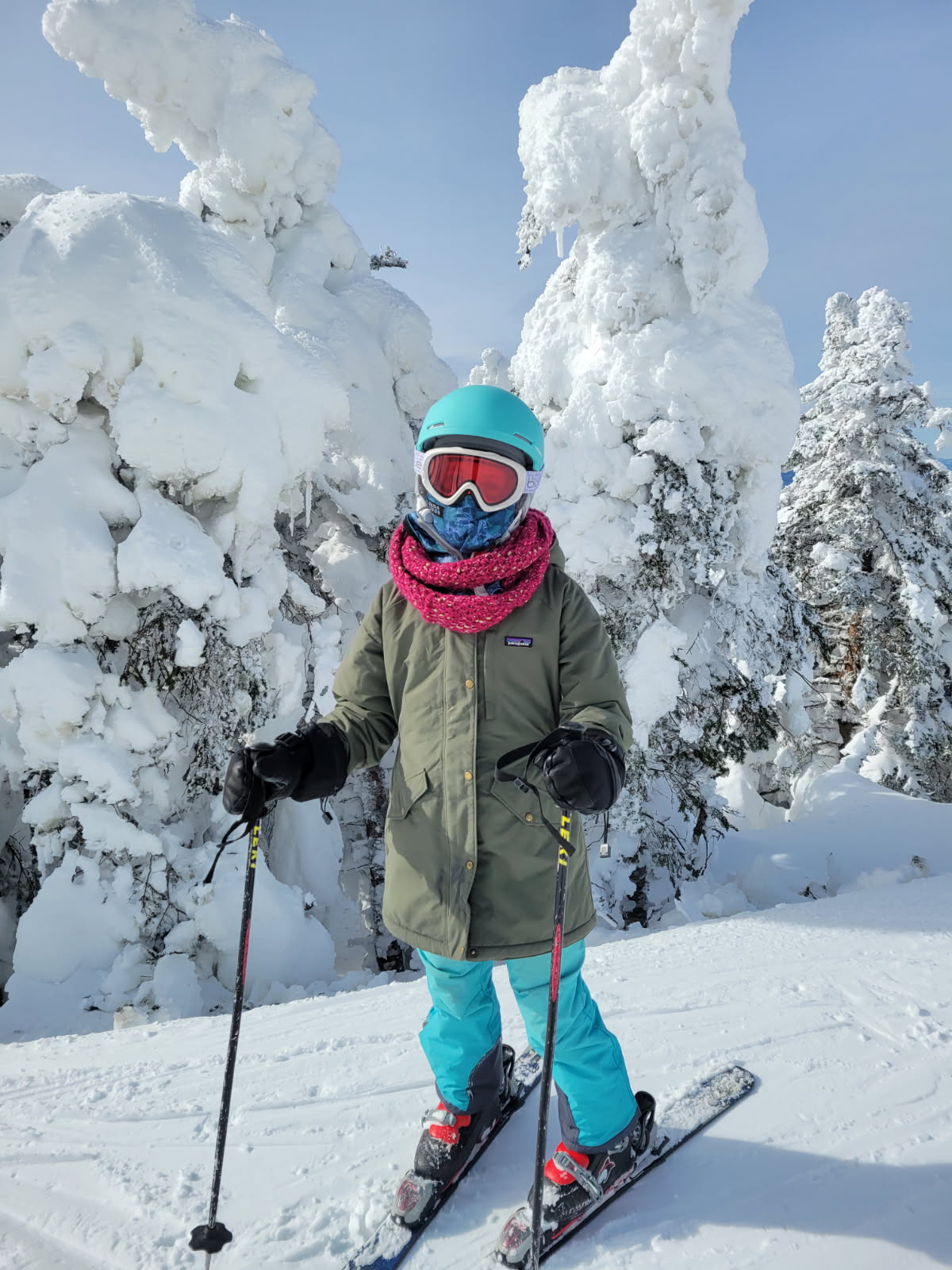
Photo: John.
Our older granddaughter skiing in Maine. I’m told it was cold.

Today’s photo roundup covers some winter and some spring. The weird thing is that just as we were beginning to enjoy spring in Massachusetts, we got a snowfall on April 12th, followed by a warm and sunny day today. That makes us wonder what April 19th will be like — a big deal here. It’s the 250th anniversary of what we think of as the beginning of the American Revolution, the confrontation at the North Bridge. (Amazing to think of how long democracy has lasted among erring mortals!)

Getting back to the photos, there was fresh snow on the boardwalk in February, making it eminently skiable. But after a few days of people walking there, it was all ice.

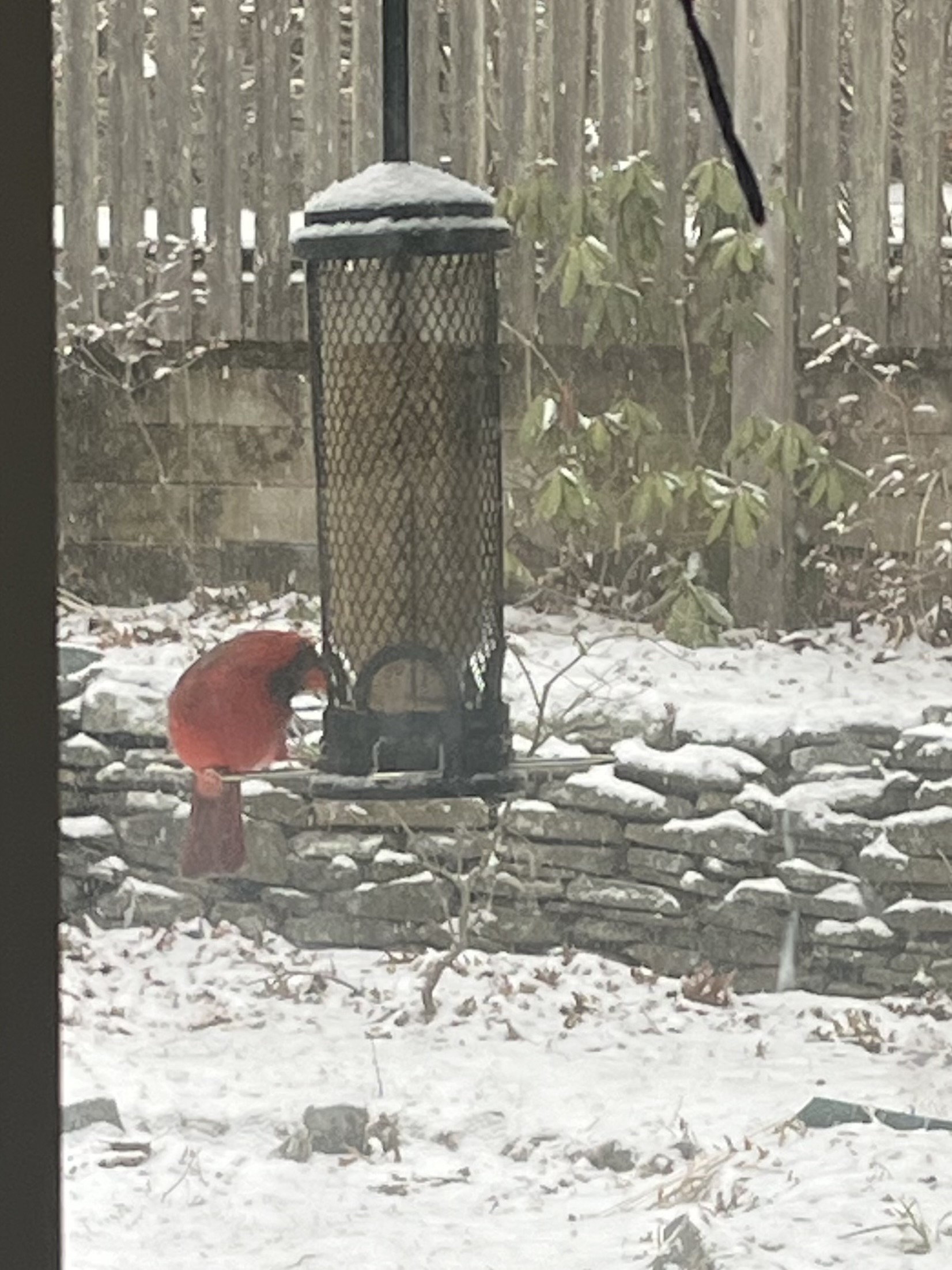
Next photo shows Erik’s Squirrel Buster birdfeeder with a visiting cardinal.

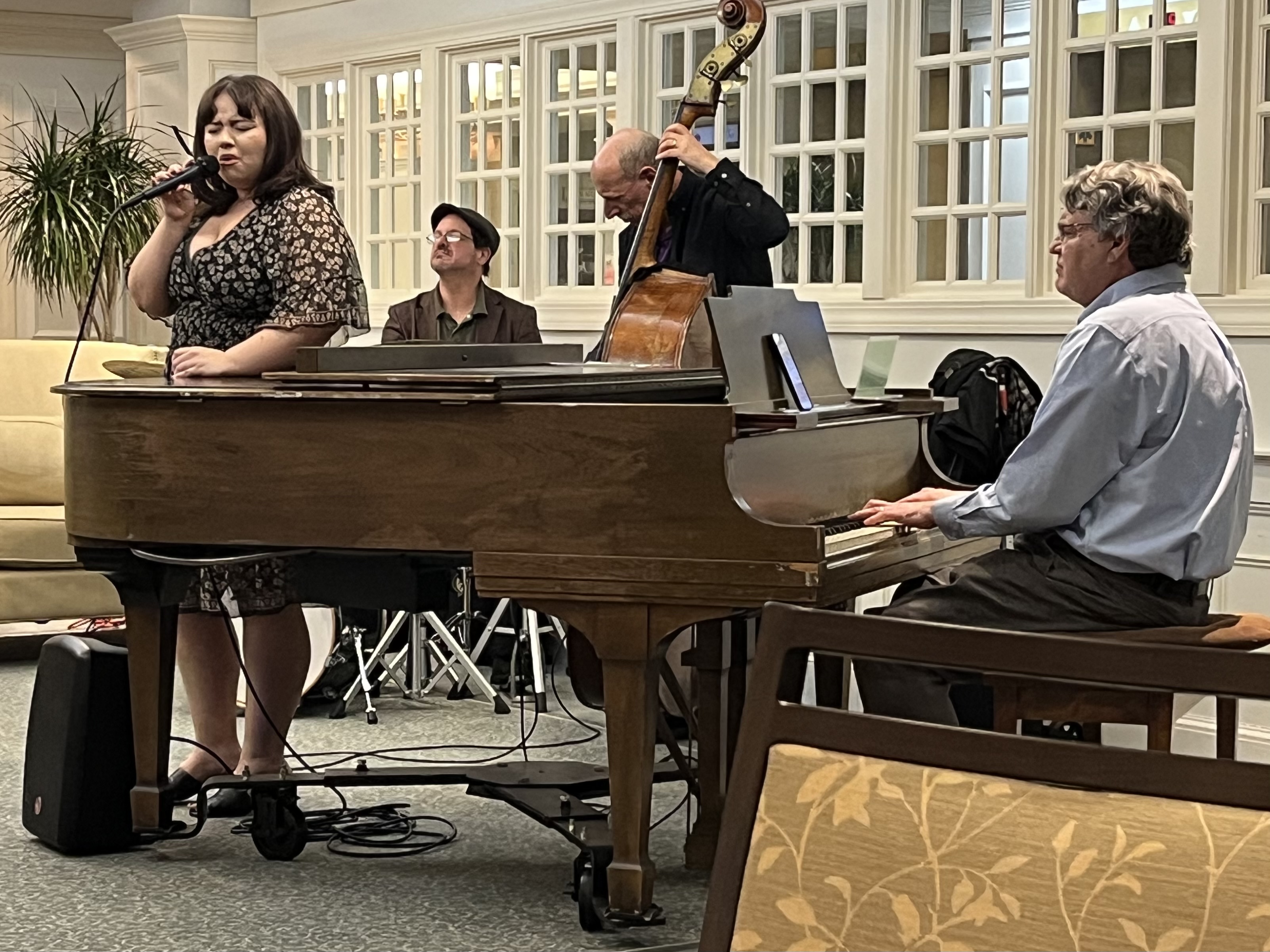
Keeping warm indoors at our retirement place, we enjoyed Joe Reid’s latest trio, with guest vocalist Mikayla Shirley from Berklee College of Music.

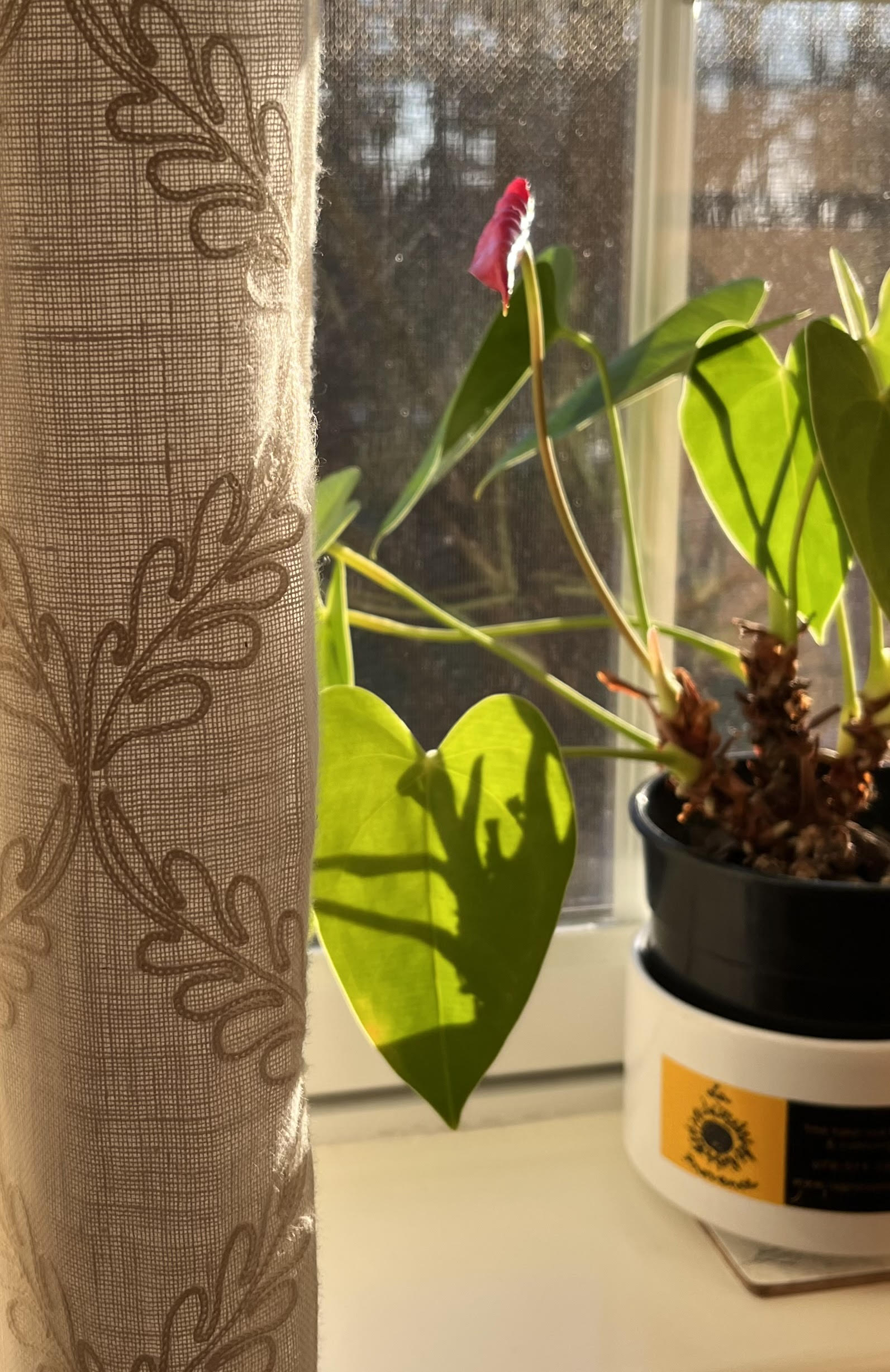
My anthurium in the sun is next.

The rest of the photos are from several local art displays.

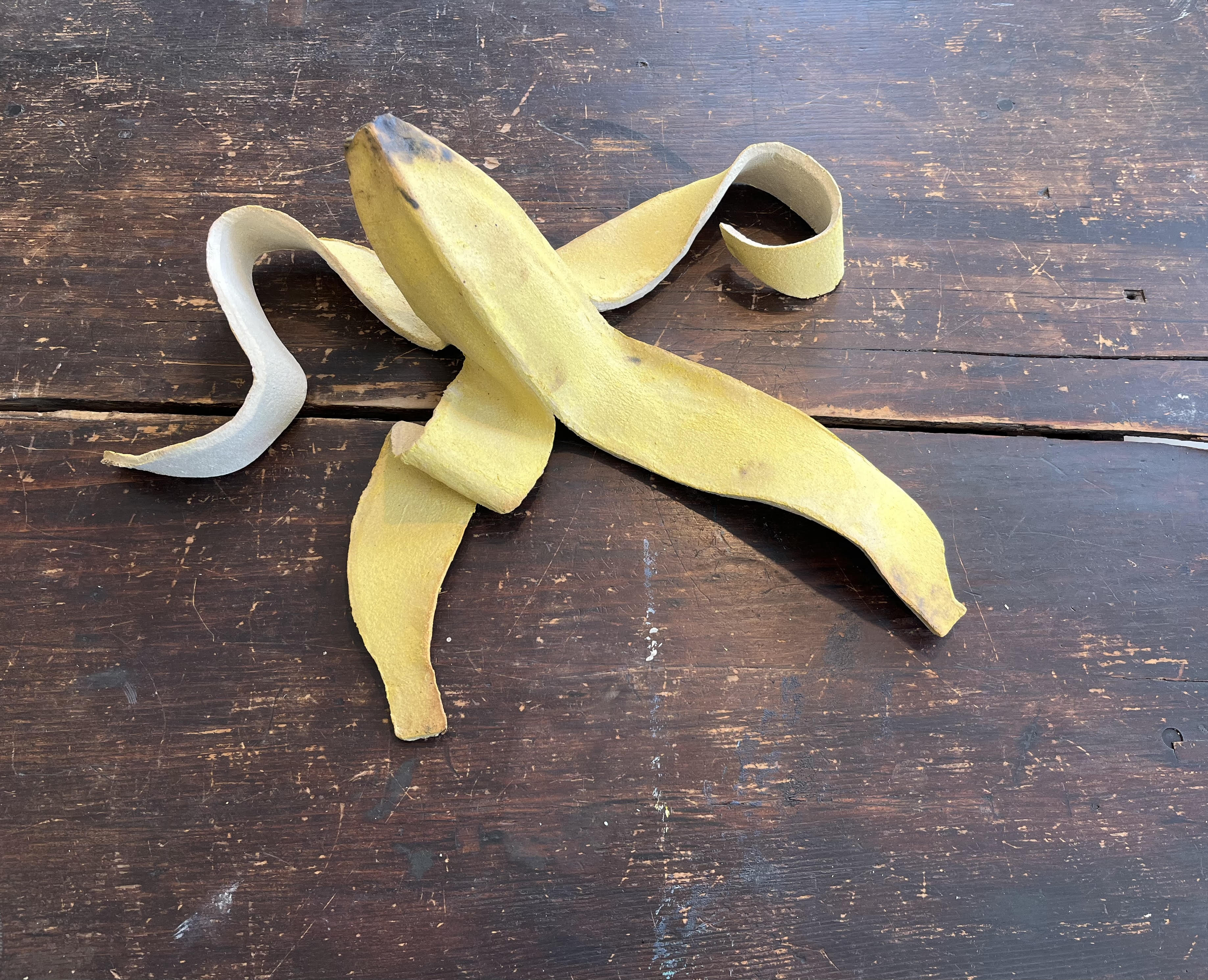
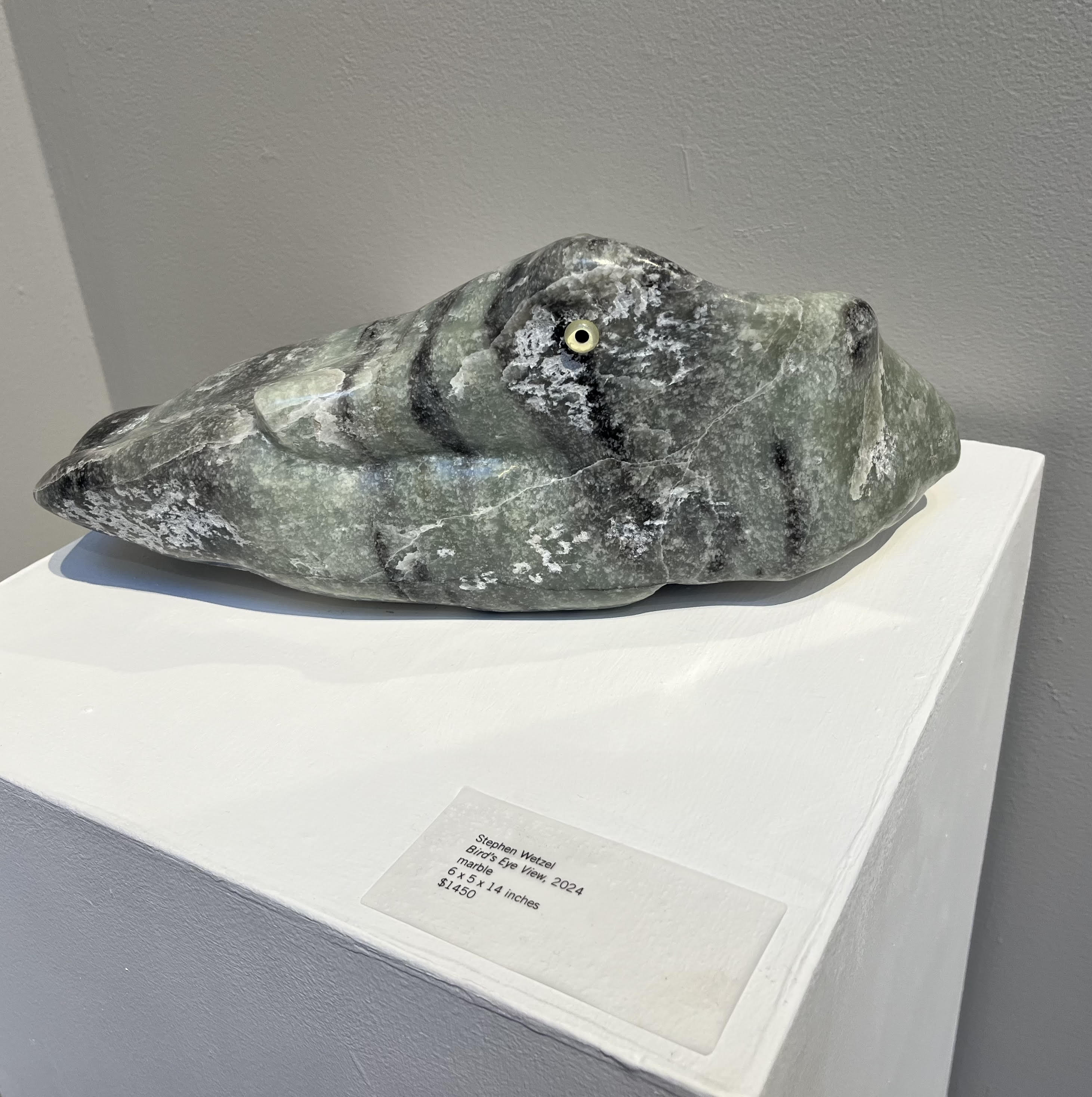
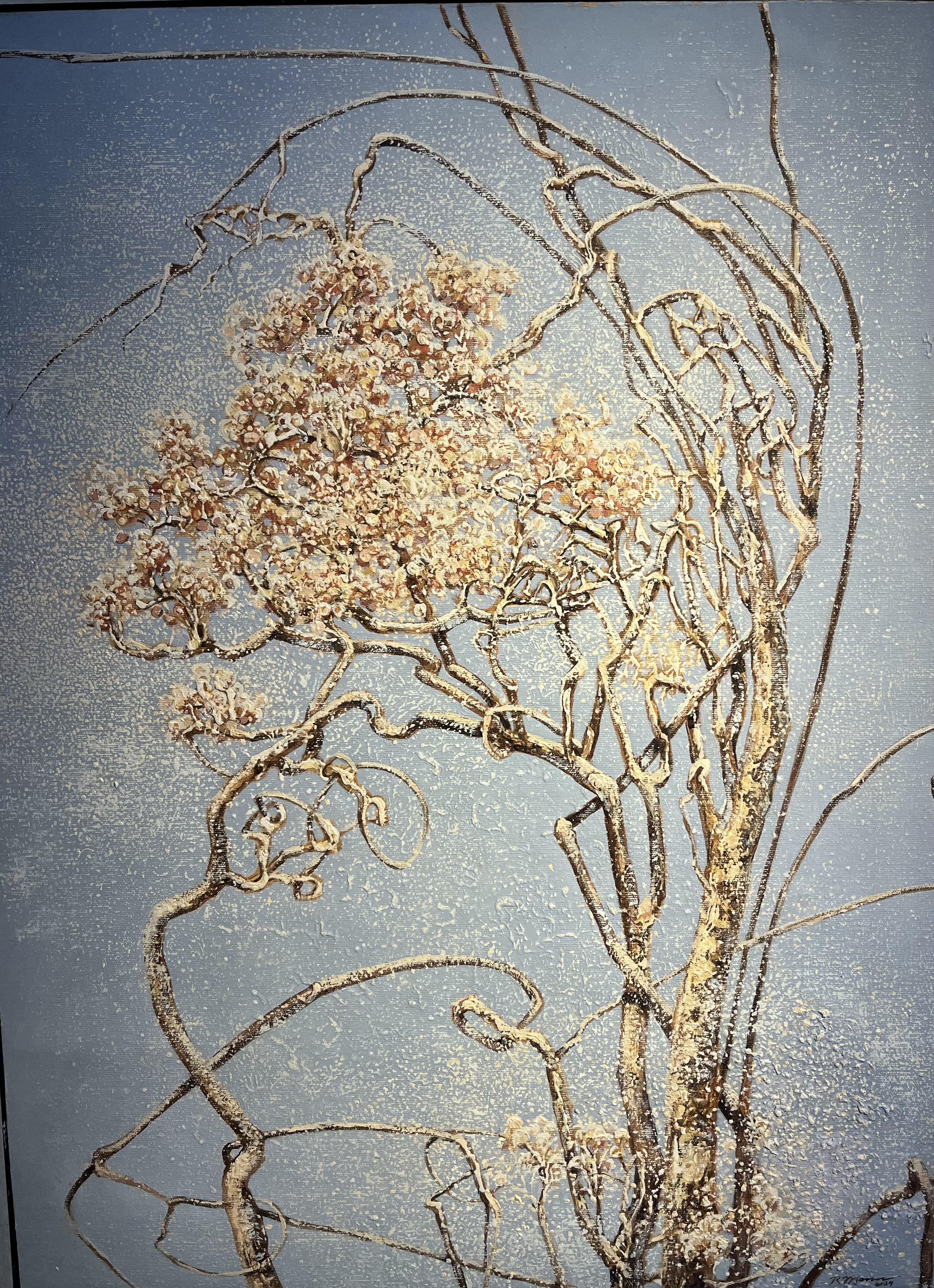
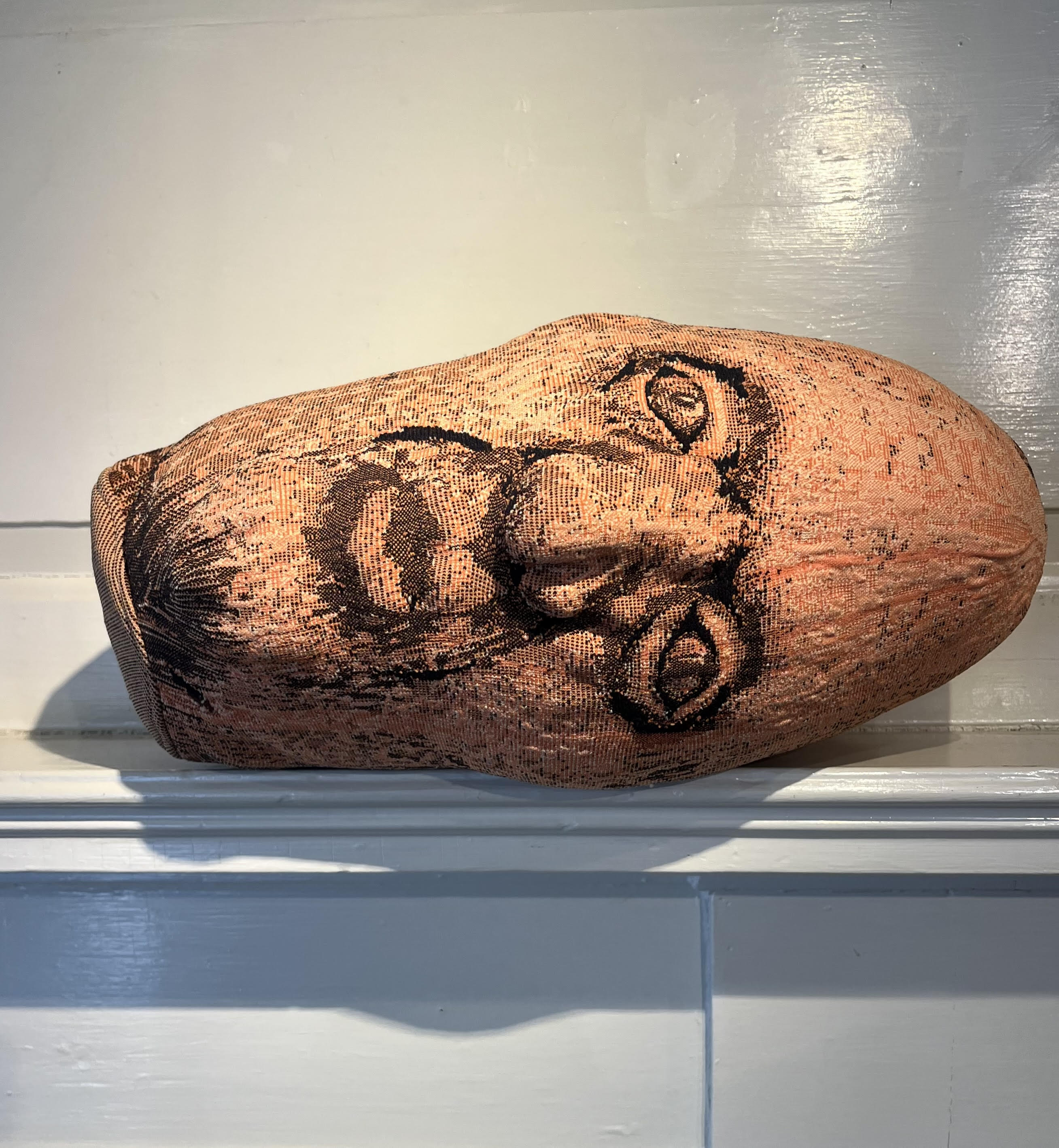
They include an outsize but otherwise lifelike banana peel by Mary Kenny, a marble bird by Stephen Wetzel, and “Pollen,” a piece of fabric art by Rebecca V. Mann expressing her preoccupation with the fragility of nature. These are followed by Felix Beaudry’s woven head. Resting.

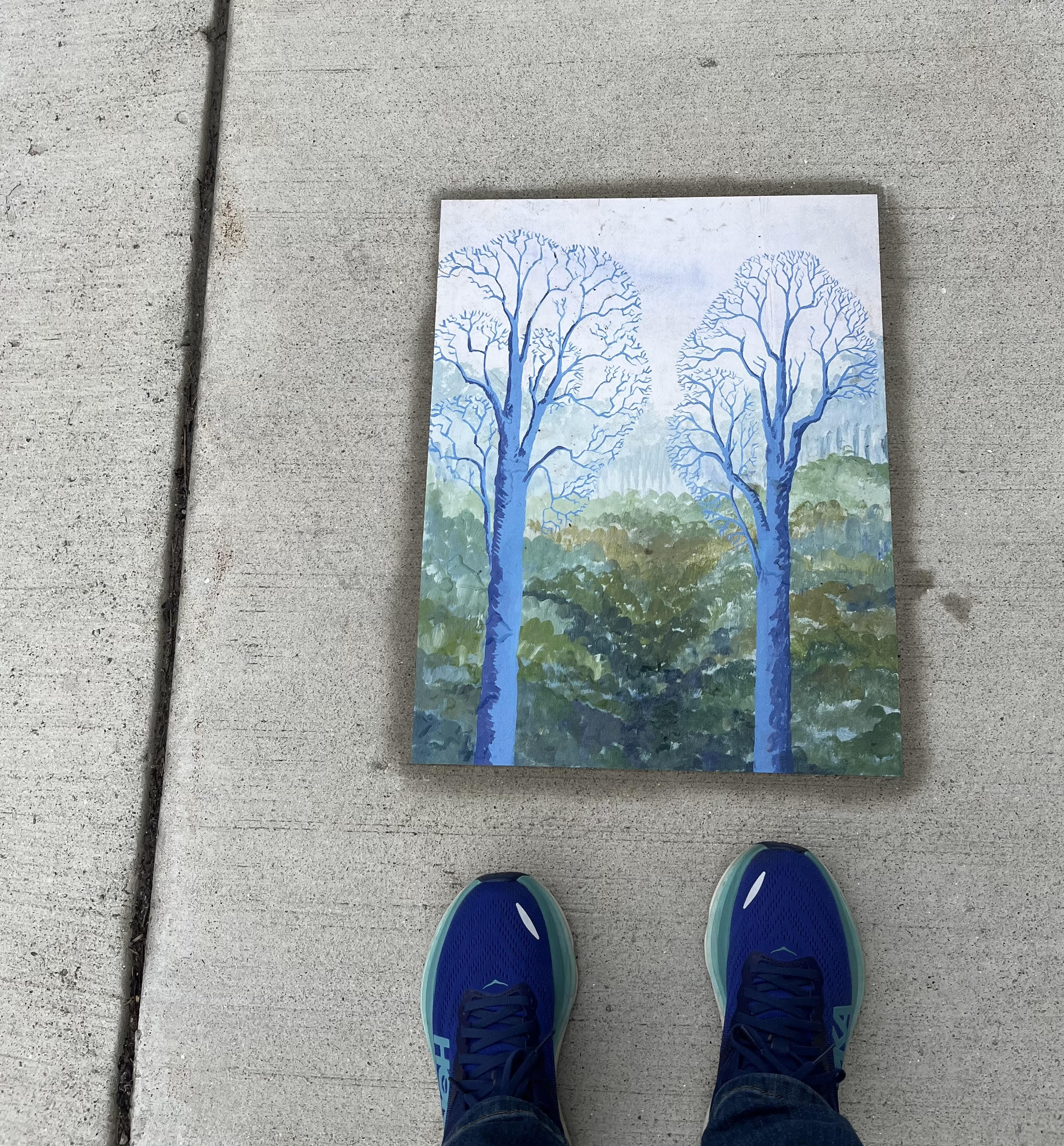
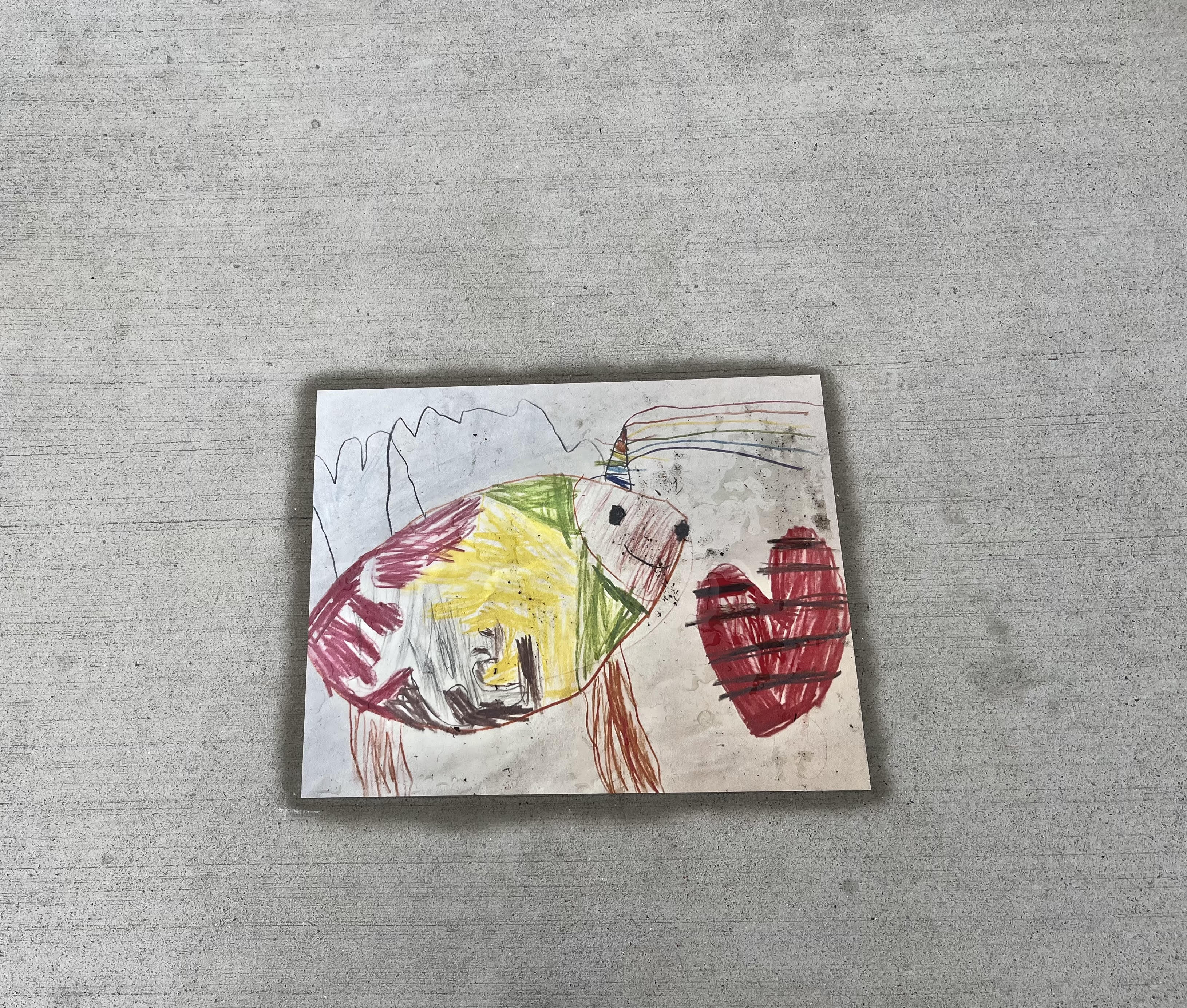
The last photos are part of an extensive sidewalk exhibit in which works by artists of all ages were somehow laminated and glued down so people could walk on them. You can see my shoes. The first, of trees, is by Jack Confrey, a young guy you’ll meet meet if you go to the website, here.

Then there’s a child’s art and a QR code for anyone interested.

Photo: Kalliopi Stara.
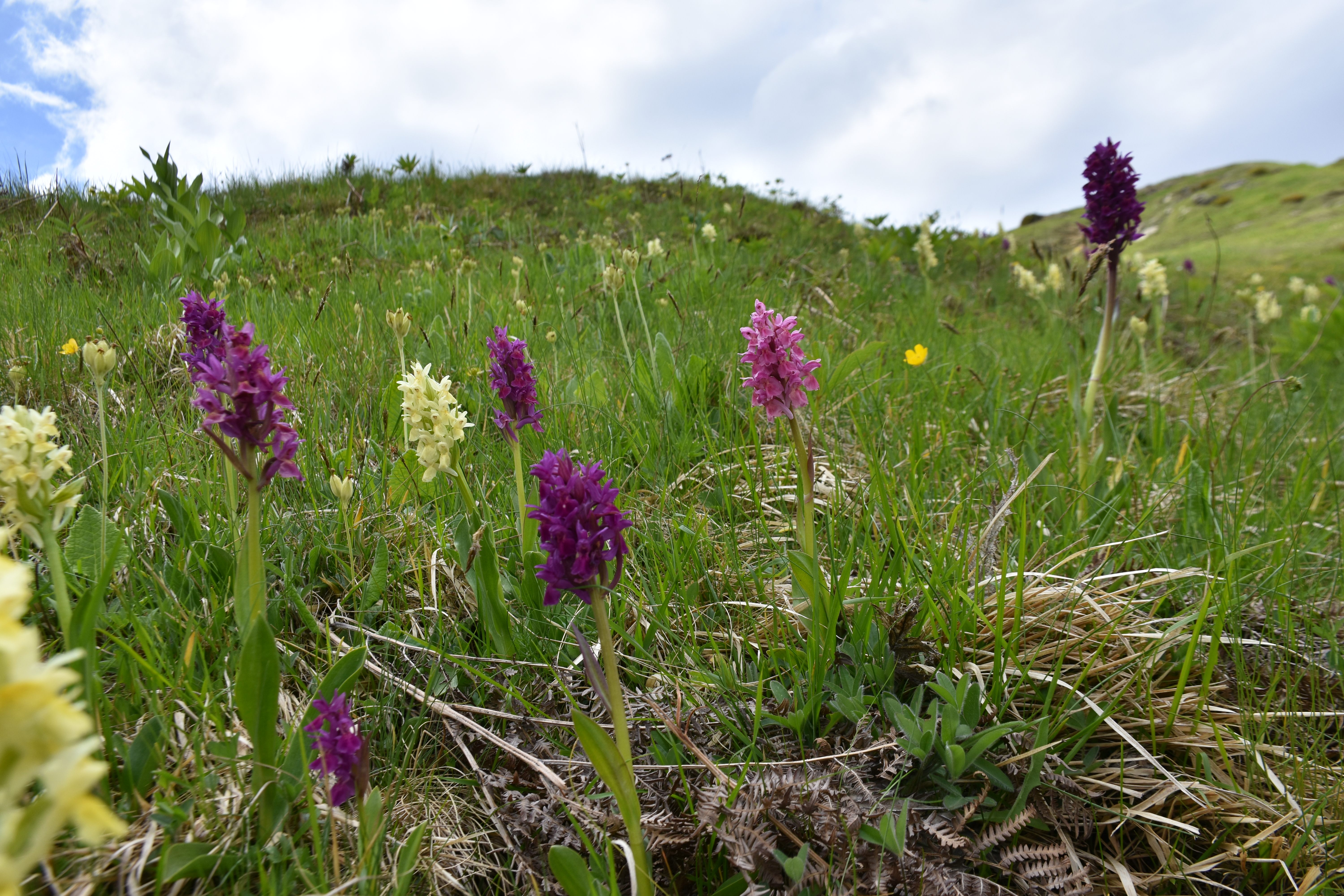
Powdered orchid bulbs are the main ingredient of the popular Middle Eastern drink called salep, or sahlep. But the orchids are endangered.

One of my sources for this blog is the international radio show called The World. It posts recordings of episodes and sometimes transcripts. I like to have a transcript, and if there isn’t one, I try to see if I can find the story elsewhere. Durrie Bouscaren at The World got me interested in today’s topic on some endangered orchids, and then I was able to find a 2023 Atlas Obscura piece to use as text.

Here is Vittoria Traverso writing about the Turkish beverage called salep at Atlas Obscura.

“For Kerem Özcan, a data scientist based in Amsterdam, winters in his home country of Turkey would not have been the same without salep, a hot drink made of crushed orchid roots, milk, and sugar. On ski trips to the mountains of Uludağ, ‘we’d always end the cold and tiring day with a salep,’ he says. Özcan, who left Turkey in 2013, is one of the many Turkish people living abroad who thirsts for salep. ‘I tried to quench it with eggnog a couple times, but it didn’t cut it for me,’ he says.

“Much like eggnog, salep is a staple winter drink, and it is enjoyed throughout Turkey, Greece, and parts of the Middle East. Part comfort food and part medicine, it is a popular folk remedy for everything from stomachache to impotence.

“In recent years, increased interest towards plant-based drinks and traditional foods has fueled a surge in demand for salep. But the craze is taking a toll on the drink’s key ingredient.

It can take as many as 13 orchid bulbs to make one cup.

“Currently, wild orchids are considered endangered in many parts of Greece and Turkey due to overharvesting, drought, and habitat degradation.

“It’s hard to say when and where salep originated but historical evidence suggests ancient Greeks and Romans consumed a similar beverage. Özge Samanci, head of the Gastronomy and Culinary Arts Department at Özyeğin University in Istanbul, explains that the Greek doctor Dioscorides described the medical properties of orchid roots in his first-century treatise De materia medica. Roman doctors also used bulbs to prepare a beverage called satyrion, a Latin word for orchid, as an aphrodisiac.

“During the Ottoman Empire, salep was a medicinal staple. ‘There is evidence that salep was consumed in palaces of the Ottoman Empire as early as the 15th century,’ Samanci explains. …

A journal entry by Jane Austen in 1826 describes the taste of salop as ‘nectar.’

“ ‘Tea is great, coffee greater; chocolate, properly made, is for epicures; but these are thin and characterless compared with the salop swallowed in 1826,’ Austen wrote.

“While salep is no longer a part of English daily life, it is still considered a winter must in Turkey. … Until recent times, salep was considered a special treat. ‘Drinking salep is usually a moment of luxury,’ Samenci says. ‘It’s not something you drink four times a day like coffee.’ …

“Interest in traditional and more wholesome foods is putting pressure on salep’s key ingredient. Orchid powder is made from the bulbs from the OrchisOphrys, and Dactylorhiza which include about 109 species of orchids mostly native to North Africa and Eurasia. In order to make salep powder, also known as ‘white gold’ for its market value, foragers dig orchid plants out of the soil with small shovels. Then, the round roots of each plant are harvested, cleaned, boiled, dried, and crushed into powder. This orchid powder can sell for up to 80 US dollars per pound.

“A few farms do cultivate orchids for salep, but it’s a difficult and expensive endeavor. The vast majority are still foraged in the wild. Most wild orchids used to make salep are listed as protected species under the Convention on International Trade in Endangered Species (CITES) which regulates the trade of endangered animals and plants. In theory, protected orchid plants should be traded across national borders only with documentation certifying that they have been harvested or cultivated sustainably. However, orchids are one of the most sought-after species on online platforms that sell illegally sourced wildlife. …

“Susanne Masters, an ethnobotanist at Naturalis Biodiversity Center in the Netherlands [advises] people to avoid consuming salep at all to avoid further endangering wild orchids. ‘To consume salep sustainably you would need to be growing your own, or personally know and trust a person who is a custodian of a landscape in which the orchids used for salep are growing.’ ”

The long, fascinating article is at Atlas Obscura, here.

Durrie Bouscaren first got me interested with her update at Public Radio International’s The World. You can listen to her story here. No paywall for either site.

Museum of Failure

Photo: Matt Stromberg/Hyperallergic.
Ford Edsel at the original Museum of Failure in 2018.

Years ago, my husband and I went to see a Harvard student performance of a rarely performed Cole Porter musical, Nymph Errant. The thing we remember most is that the director was outside handing out flyers disavowing his participation. Someone else had made decisions about the final production, and he wanted the audience to know he disagreed — violently!

I’m reminded of that incident by the current kerflufle over something called the Museum of Failure. The .com version, supposedly the original, is at war with a .net version and its recent exhibition.

Lily Janiak at the San Francisco Chroniclewrites, “Will the real Museum of Failure please stand up?

“Earlier this month, Time Out reported that a popup exhibition of some of history’s most spectacular bad ideas [would] tour next month, with a San Francisco stint at the space formerly occupied by Madame Tussauds in Fisherman’s Wharf.

“The website museumoffailure.net likewise teased the exhibition. But a different website called museumoffailure.com — which had the same logo and branding and much of the same content — made no mention of it.

“Turns out the discrepancy isn’t a marketing blunder. It’s an international copyright dispute.

“When the Chronicle contacted Samuel West, the proprietor of museumoffailure.com and the creator of the museum’s concept, he disavowed the San Francisco stop. 

“ ‘This is a surprise to me,’ he wrote via email. … He later claimed on a video call that it was ‘fraudulent.’

“David Perry, a spokesperson for SEE Global Entertainment Inc., which is producing the Fisherman’s Wharf event, rebutted West’s claims.

“ ‘SEE Global owns the international trademark for and all the assets in the Museum of Failure: period end stop,’ Perry wrote via email. ‘In years past, we have welcomed him to all iterations of the Museum of Failure as a valued cheerleader with all due credit given.’

“West, who’s based in Malaga, Spain, and has a Ph.D. in organizational psychology, studied play in the workplace, including how improv theater can improve a team’s creativity. He was interested in destigmatizing failure but thought, ‘It’s too interesting to be a TED Talk. I need a new form.’

“That new form, the Museum of Failure, premiered in 2017 in Sweden, where he was living at the time. A hit, it went on to tour to Taiwan, France, Canada and beyond. …

“For an item on the Fyre Festival, West made a replica of the real-life ‘Fyre Festival luxury lunch — a pathetic-looking cheese sandwich in a Styrofoam box — out of plastic. For a piece on Theranos, he made replicas of ‘little tiny vials’ of blood, putting them next to test tubes for scale. (The blood was ‘Halloween vampire blood,’ he said.)

“One of the museum’s fans was Martin Biallas, CEO of SEE Global Entertainment Inc., whose previous exhibition credits include the Disgusting Food Museum — which West also co-created. …

“In 2017, Biallas and West signed an agreement under California jurisdiction that granted SEE ‘exclusive license’ to the museum’s ‘assets, artifacts, memorabilia, content and exhibit and merchandising items and the descriptions thereof’ for a period of five years, with two options to renew. West could continue to stage his own popup exhibitions so long as they were either more than 200 miles or more than 12 months away from Biallas’. The agreement also ensured West would receive 20% of all gross revenues.

“But on Tuesday, Feb. 25 [this year], West told the Chronicle that not only has Biallas not renewed the license; Biallas hasn’t given him his 20%. …

“In 2023, West hired a lawyer to inform Biallas he was in breach of contract and demand payment. The letter goes on to note that Biallas successfully applied to the U.S. Patent and Trademark Office for the word mark ‘Museum of Failure.’ Perry supplied the Chronicle with proof of trademark ownership.

“ ‘At the time of the application, your client knew that it did not own the rights to Museum of Failure,’ the letter states. 

“Biallas’ lawyer responded by alleging that West knew about the trademark application. The letter also asserts that because West had been embroiled in a prior Museum of Failure ownership dispute, with Niklas and Jenny Madsen of Swedish design company Superlab, West might not have legal standing. …

“Biallas has also been involved in other legal disputes about exhibition copyright. He was a plaintiff in a lawsuit alleging that two of his former employees stole imagery from his ‘Michelangelo’s Sistine Chapel: The Exhibition’ and toured it in an exhibition called ‘Michelangelo: A Different View’ under the auspices of German company Exhibition 4 You. That lawsuit was settled in 2021. 

“In 2022, the Louvre sued Biallas’ SEE Global, alleging ‘misappropriation of the Louvre’s reputation and intellectual property through a venture called ‘ “Louvre Fantastique.” ‘ … That lawsuit was settled.

“Last year, SEE Global sued the patent attorney it had hired to secure Louvre permissions, alleging negligence. In a response and counterclaim, attorney David D’Zurilla and his firm Schwegman Lundberg & Woessner, P.A. wrote that they ‘were retained specifically to prosecute a trademark and they successfully obtained the trademark.’ That case will head to trial in July if a settlement isn’t reached.”

More at the San Francisco Chronicle via MSN, here. The art magazine Hyperallergic wrote a review of an exhibit by the .com version of the Museum of Failure, here. Sounds like there’s more than enough failure to go around.

Photo: Autodesk Instructables.
Building a ship in a bottle. “Hobbies are about doing things: planning, painting, building, contributing an article to your favorite magazine,” writes Alexander Poots at UnHerd.

Niche print magazines seem to survive even after everyone else has gone online. According to an article at UnHerd, that’s especially true of magazines about hobbies.

Alexander Poots writes, “Phil Parker is the editor of Garden Rail magazine. He’s a passionate man — especially on the subject of steam engines. ‘The steam engine is the nearest anybody has come to building a living thing,’ he says. … He talks about the joy of seeing them in action. The smells, the hiss and chuff, the weight of them on the line. It’s a joy that many people want to recreate at home. …

“Layouts in back gardens across Britain range from tiny loops of track to colossal, intricate landscapes. Parker knows a guy whose line crosses Lilliputian bridges and snakes through mountains 10 feet tall. Layouts are much more than models, he says. They really are railways, albeit on a smaller scale than usual. A keen sense of ownership is important: ‘these are their railway lines.’

“Ardent hobbyists are often viewed as eccentric. I think they might be the only normal people left. As a rule, they are active and engaged. They are more interested in making than consuming. They dream and they do. A passive appreciation for steam engines or military history or orchids isn’t enough. Hobbyists want to take part.

“ ‘I grew up fascinated by history, and wargaming helps you make that interest interactive,’ says Daniel Faulconbridge, editor of Wargames Illustrated. ‘It’s not good enough for me that I just read about the Battle of Hastings, I want to collect the figures that represent the troops that fought in the battle, and then paint them and play a game with them.’ …

“Magazines like Garden Rail and Wargames Illustrated are at the heart of the hobby world. The variety is extraordinary. Hornby MagazineAirfix Model WorldThe Orchid ReviewLute News. Monthly publications dedicated to remote control aircraft and koi keeping. Some hobbies have broader appeal than others — the UK has enough carp fishermen to support both Total Carp and CARPology. But even the more niche titles have a readership large enough to keep them viable in a brutal publishing environment. …

“The physical hobby magazine has in fact proved surprisingly durable. Both Faulconbridge and Parker acknowledge that their readers tend to be older, and prefer print media because it’s what they grew up with. There’s also a practical aspect: if you’re following a guide to painting a model Landsknecht, it’s easier to have a paper copy open on the table than faff about with a phone or tablet. …

“Again and again when talking to Parker and Faulconbridge, I am struck by the emphasis on the physical. Hobbies are about doing things: planning, painting, building, contributing an article to your favorite magazine. ‘You come into a hobby and you’re not being encouraged to binge-watch something on the tele — which is a very, very passive activity — you’re being encouraged to have a go at something,’ Parker observes. …

“Hanging out with like-minded people is the best way to have a go. Community is a word that comes up a lot in my chats with the editors. … Parker emphasizes that railway modeling exhibitions are as much social gatherings as they are celebrations of the hobby. As anyone who has worked an allotment knows, shared enthusiasms have a way of collapsing social barriers. Parker remembers one exhibition where he sat around a pub table with ‘a physics professor, a guy who ran his own bus company, a Liberal Democrat councillor, a theatre manager, a bishop and two lawyers. Our common interest was model railways. You find yourself meeting a really wide variety of people.’

“Still, it’s a mistake to think that these groups are purely focused on the hobby itself. Wargames and model railways are often the starting point for other things. Friendships are made, money is raised for charity, and support networks are formed. ‘Men are particularly bad at chatting,’ says Parker. ‘But they will chat about steam engines and they will chat about garden railways, and that chat can then move on to more valuable topics. We run the largest model railway forum in the world, and tucked away on it is a prostate cancer discussion group.’ …

“Hobby magazines survive because they are outgrowths of these communities. Most articles are written by hobbyists, in what Faulconbridge describes as ‘a fanzine approach.’ Neither the editors nor the contributors are in it for the money. They just love it. In a recent thread on X, Stone Age Herbalist observed that the continued success of the hobby magazine can be attributed to a particularly British — and more broadly Northern European — genius for voluntary association. Whether centered around giant vegetables or antique fountain pens, little communities bubble up everywhere. …

“A link between hobbies and productive industry can also be found in the world of railway modeling. Parker tells me that, ‘I’ve just reviewed a loco from a company based in Doncaster, Roundhouse Engineering. You’d be amazed, we do still build steam locomotives in this country! It’s a proper Rolls Royce engine model, beautifully constructed. They do pretty much everything in-house.’ This pride and attention to detail is at the root of what all hobbyists are up to. …

“Hobby magazines are heartening advertisements for that reward. Planning, making, getting things wrong, having a laugh about it.”

More at UnHerd, here.

Are bloggers hobbyists? We seem to check a lot of the boxes in the definition.

Photo: Magdalena Wosinska for the New York Times.
Ian White, an artist, against a burned house across from the park named for his celebrated father, the painter Charles White.

The outside world never knew much about the generations of Black artists enriching life in Altadena — not until after the town burned down.

As Sam Lubell wrote in February at the New York Times, “Before the Eaton fire raced across Altadena, destroying more than 9,000 of its buildings, many, even in nearby Los Angeles, barely knew of the place’s existence. This sleepy 42,000-person hamlet hugging the glowing foothills of the San Gabriel Mountains is not part of that city but an unincorporated community of Los Angeles County, and just far enough off the beaten track to blissfully avoid notice.

“Once typified by its bucolic quirkiness, tight-knit neighborhoods and generations-old churches and businesses, Altadena now consists of row after row of twisted, charred building remains, scorched car chassis, blinking or broken stoplights and the occasional khaki National Guard Humvee. The future, for now, is filled with toxic cleanup, insurance adjustments and conflicting visions for rebuilding.

“Yet the past has gained newfound prominence. With so much gone, Altadena’s histories are being unearthed, by residents, scholars and preservationists who say they may hold a key to making this a special place once again, and provide anchors for those weighing whether to stay.

“One of the most profound of Altadena’s legacies — its spectacular story of Black creative culture — had been buried not only under its seclusion, but also under layers of racial and institutional apathy, the loose accounting of informal memory, and the absence of formal plaques and other preservation markers. The fire has spurred calls for a more rigorous approach to remembrance.

“ ‘Sometimes it takes a tragedy for people to mark history,’ said Brandon Lamar, president of the N.A.A.C.P.’s Pasadena branch, whose own home was destroyed, as was his school, his grandparents’ home and their church. But that destruction, he noted, ‘does not mean that we can’t create public memories in spaces now, so that people can remember this information for generations to come.’

“Starting in the 1950s and ’60s, the west side of Altadena (and parts of neighboring northwest Pasadena not bulldozed for the 210 and 134 Freeways) drew middle-class Black families eager to buy homes.

“Many came because the redlining — discriminatory lending by banks — was less severe here, and some of the schools had been integrated comparatively early. The area became a magnet not just for Black teachers and social workers but also for Black artists from around the country, drawn to its affordability, inventive vibe, gorgeous mountain backdrop and general spirit of permissiveness.

“ ‘It had this energy of bohemian California,’ said Solomon Salim Moore, assistant curator of collections at the Benton Museum of Art at Pomona College. ‘You could have a little less scrutiny and a little more room to do your projects.’

“On Feb. 22, as part the Frieze Los Angeles art fair, a discussion called ‘Land Memories’ will feature artists’ recollections of this unique legacy. The talk will be co-hosted by the Black Trustee Alliance for Art Museums, which will also share oral histories recorded from Altadena artists and residents, and collect new histories.

“Moore, who is also an artist, grew up in Altadena and said that its nonconformist spirit has endured to the present, even as prices have climbed and the Black population has fallen, according to the U.C.L.A. Bunche Center for African American Studies, to about 18 percent from 43 percent in 1980. Artists here, he said, loved that they could set up informal studios or even family compounds, or that they could enjoy little freedoms like hosting parties without friends worrying about permit parking.

“Sometimes creative people need to step away because you need to get out of the light to see,” said Ian White, an artist, teacher and the son of Charles White, the renowned painter and printmaker whose haunting depictions of African Americans, their struggles and dignity, inspired generations of artists. He spent the last 20 years of his life in Altadena and is buried at the community’s Mountain View Cemetery. Ian lives in a house next to his father’s modest home (which he also owns) in the Meadows, a district along Altadena’s west edge that in the 1950s and ’60s became one of the first here to integrate. Virtually all of the Meadows survived the fire.

“Also living west of Lake Avenue (then the unofficial dividing line between white Altadena and Black Altadena) was John Outterbridge, the noted assemblage artist and longtime director of the Watts Towers Arts Center. His home on Fair Oaks Avenue was destroyed, along with much of his archive and family memorabilia, according to his daughter, Tami. The famed enamel artist Curtis Tann lived within walking distance, while the prolific sculptor Nathaniel Bustion, known as Sonny, lived near White in the Meadows. Betye Saar, 98, known for repurposing everyday objects into mystical collages, grew up in a home on northwest Pasadena’s Pepper Street, just blocks from Altadena’s west side.

Sidney Poitier, a good friend of White’s from New York, and the first Black actor to win an Academy Award, rented a home in west Altadena before moving to Beverly Hills.

“Ivan Dixon, the actor and trailblazing director, lived on Marengo Avenue, and the science fiction writer Octavia Butler on Morada Place.

“Later generations of Black artists continued to thrive here, including Mark Steven Greenfield, Yvonne Cole Meo, Senga Nengudi and Michael Chukes, and dozens of others holding down day jobs and creating whenever they could in this secret Eden.

“Charles White, already an established figure when he moved from New York in 1959 for health reasons — he had respiratory problems and was advised to live in a milder climate — would become the glue holding this arts community together. His home and studio, still standing, was a gathering place, with many artists competing for the honor of driving White to or from one place or another. (He didn’t drive.)

“Ian still refers to Dixon, Poitier and Charles’s good friend Harry Belafonte as his ‘fictive uncles.’ He recalled how his father set up the sculptor Richmond Barthé, a cornerstone of the Harlem Renaissance, with an apartment, and how his mother, a social worker named Frances Barrett, was his caregiver until the end.”

More at the Times, here.

 Illustration: Eleanor Shakespeare/Bridgeman Images/The Guardian.

Of course, it couldn’t happen here, right? As we children always said during the time of the Cold War when someone opposed us, “It’s a free country!” And if we had applied that to reading material, we would have known we could read whatever we wanted. No need to smuggle anything in.

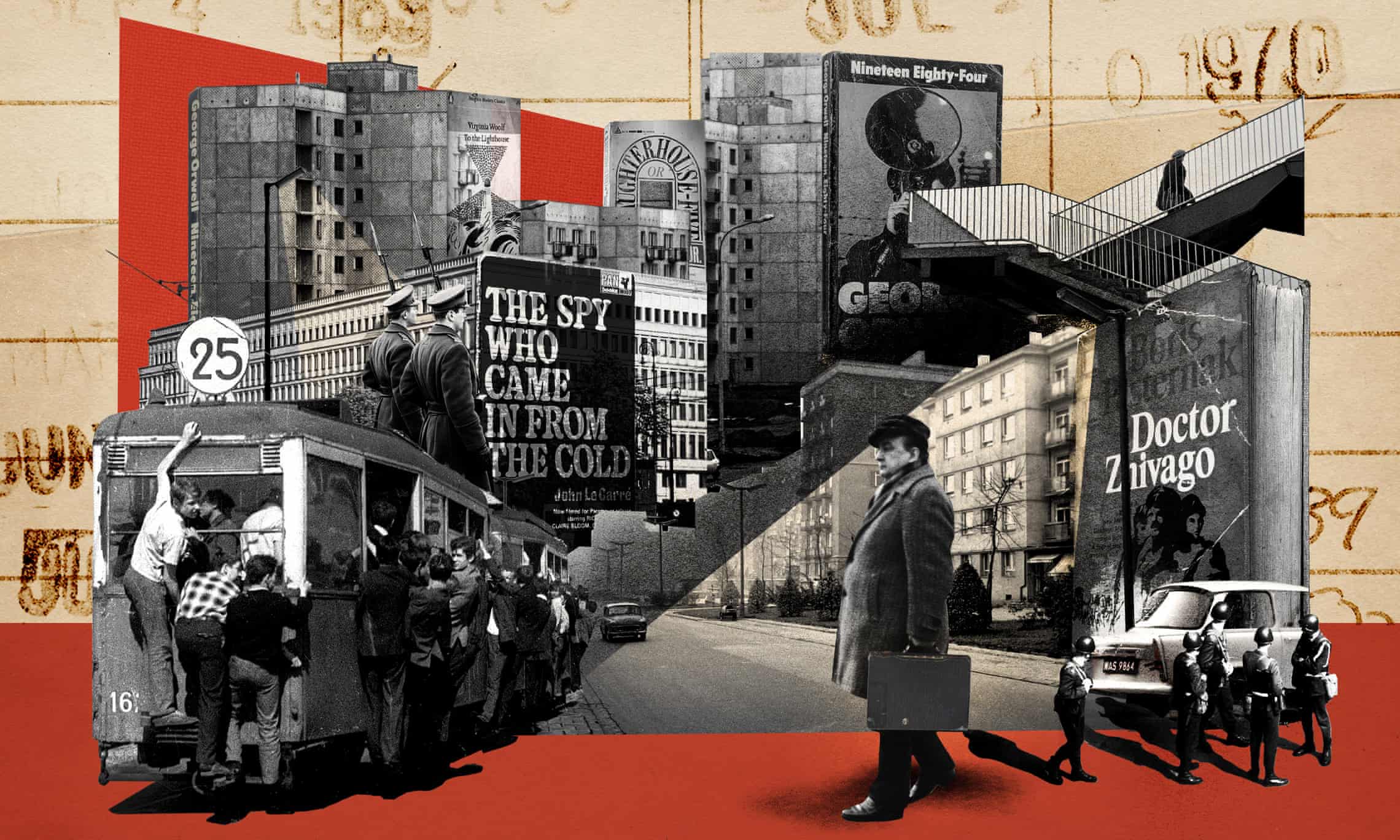
Well, what would that be like? In an edited extract from Charlie English’s book about Poland, The Best Kept Secret of the Cold War, the Guardian gives us an idea.

“The volume’s glossy dust jacket shows a 1970s computer room, where high priests of the information age, dressed in kipper ties and flares, tap instructions into the terminals of some ancient mainframe. The only words on the front read ‘Master Operating Station,’ ‘Subsidiary Operating Station’ and ‘Free Standing Display.’ Is any publication less appetizing than an out-of-date technical manual?

“Turn inside, however, and the book reveals a secret. It isn’t a computer manual at all, but a Polish language edition of Nineteen Eighty-Four, George Orwell’s famous anti-totalitarian novel, which was banned for decades by communist censors in the eastern bloc.

“This copy lives now in the library of Warsaw University, but for much of the cold war it belonged to the Polish writer and dissident Teresa Bogucka. It was Teresa’s father, the art critic Janusz Bogucki, who first brought it to Poland. In 1957, during a window of liberalization that opened after Stalin’s death, Janusz picked up the Orwell translation from a Polish bookshop in Paris, smuggled it back through the border and gave it to his daughter. Teresa was only 10 or 11 years old then, but she was a precocious reader, and recognized the ways in which communist Poland mirrored Orwell’s fictional dystopian state. …

“Years later, in 1976, when Bogucka joined the emerging Polish opposition movement, she decided to create a library of books that had bypassed the state censor, and donated her own small collection, including this Nineteen Eighty-Four. The SB security service, Poland’s KGB, kept continual watch on her, eavesdropping on her conversations, arresting her and searching her apartment, so she asked neighbors to store the forbidden books. Much of the time, though, they would be circulating among readers, since this would be a ‘Flying Library,’ which rarely touched the  ground.

“Bogucka’s system of covert lending ran through a network of coordinators, each of whom was responsible for their own tight group of readers. She sorted the books into categories – politics, economics, history, literature – and divided them into packages of 10, before allocating each coordinator a particular day to pick up their parcel, which they carried away in a rucksack. The coordinator would drop the books back the following month at a different address, before picking up a new set.

“The demand for Bogucka’s books was such that soon she needed more, and these could only come from the west. Activist friends passed word to London, where émigré publishers arranged shipments of 30 or 40 volumes at a time, smuggling them through the iron curtain aboard the sleeper trains that shuttled back and forth between Paris and Moscow, stopping in Poland along the way. By 1978, Teresa Bogucka’s Flying Library had a stock of 500 prohibited titles.

“How many people read her copy of Orwell’s book in those crucial cold war years? Hundreds, probably thousands. And this was just one of millions of titles that arrived illegally in Poland at that time. As well as via trains, books arrived by every possible conveyance: aboard yachts; in secret compartments built into vans and trucks; by balloon; in the post. Mini-editions were slipped into the sheet music of touring musicians, or packed into food tins or Tampax boxes. In one instance, a copy of Aleksandr Solzhenitsyn’s The Gulag Archipelago was carried on a flight to Warsaw hidden in a baby’s nappy.

“What some in the east suspected, but very few knew for sure, was that the uncensored literature flooding the country wasn’t reaching Poles by chance. It was sent as part of a decades-long US intelligence operation, known in Washington as the ‘CIA book program,’ designed, in the words of the program’s leader, George Minden, to assault the eastern bloc with an ‘offensive of free, honest thinking.’ Minden believed that ‘truth is contagious,’ and if they could only deliver it to the oppressed peoples of the Soviet zone, it was certain to have an effect.

“From today’s vantage point, when disinformation threatens western liberal democracy as never before, and censorship and book bans are once again turning schools and libraries into ideological battlegrounds, the CIA literary programs appear almost quaint.

Although they had political goals, they must rank among the most highbrow of psychological warfare operations.

“Along with copies of the Manchester Guardian Weekly and the New York Review of Books, the CIA sent works by blacklisted authors such as Boris Pasternak, Czesław Miłosz and Joseph Brodsky, anti-totalitarian writings by Hannah Arendt and Albert Camus, literary fiction from Philip Roth and Kurt Vonnegut, writing advice from Virginia Woolf, the plays of Václav Havel and Bertolt Brecht, and the spy thrillers of John le Carré.

“Later, as well as smuggling books, the CIA would fund and ship presses and printing equipment into Poland, so that the banned titles could be reproduced in huge quantities by underground printers in situ. Few individuals were more central to these latter operations than the dissident publisher Mirosław Chojecki, known to the CIA by the cryptonym QRGUIDE.

“On a Tuesday evening in March 1980, the police came to arrest Chojecki for the 43rd time.”

Exciting stuff! Read more at the Guardian, here. No firewall.

Photo: Museo Nacional del Prado, “El Greco. Santo Domingo el Antiguo.”
El Greco’s iconic altarpieces are reunited for the first time in nearly 200 years.

It’s impressive that museums not only preserve the wonders of the past but keep finding pieces of the past and reintroducing them. Consider how the Prado in Spain is currently uniting dispersed panels of El Greco’s first major commission.

Adam Schrader writes at Artnet that an exhibit at Spain’s Prado Museum “brings together the works the Greek painter Doménikos Theotokópoulos, better known as El Greco, completed for the Monastery of Santo Domingo el Antiguo in his first major commission.

“The exhibit reunites works that El Greco, a master of the Spanish Renaissance, made for the church, and marks the first time they have been brought together since their dispersion, thanks to to the loan of the main altarpiece, ‘The Assumption,’ by the Art Institute of Chicago which has owned it since 1906.

“In ‘The Assumption,’ the Virgin Mary ascends to heaven on a crescent moon over Jesus’s open tomb while aided by a group of angels. It has a companion, made for the attic of the altarpiece, titled ‘The Trinity,’ that visually connects above it. …

“In the main altarpiece, ‘The Assumption’ is flanked by four other canvases which depict John the Baptist and St. Bernard on the left side and John the Evangelist and St. Benedict on the right side, which were meant to act as intermediaries between the earthly realm and the divine. Those works are housed at the monastery and in private collections.

“Other works El Greco made for the altarpieces include a depiction of the ‘Adoration of the Shepherds,’ a scene from the nativity; the ‘Resurrection’; and ‘The Holy Face,’ an iconographic depiction of [a legend] in which a woman obtained the ‘true image’ of Jesus from a cloth he had wiped his face on. …

“For the works that are housed at the monastery, a team from the Prado Museum had to convince the nuns to let them borrow the paintings.

” ‘It was difficult,’ Leticia Ruiz, the head of the Prado’s Spanish Renaissance painting collection, told the newspaper. She added that the monastery also lives off of its visitors and from the sale of ‘delicious marzipans’ that they make. So, the museum agreed to restore one of its pieces by the painter Eugenio Cajés in exchange for the loan.

“Funnily, the Prado Museum’s exhibit comes several years after France’s Louvre Museum tried, and failed, to borrow three works by El Greco from them. …

“El Greco was first documented in Spain in June 1577 and quickly received the commission for the new monastery, which was designed and jointly paid for by a powerful dean of the cathedral named Diego de Castilla and a Portuguese woman named Doña María de Silva. According to the museum, the two benefactors were buried at the monastery. The Greek artist was appointed to make the altarpieces at the suggestion of Diego’s son Luis de Castilla, who had met him in Rome a few years earlier. He completed it in 1579.

“ ‘The result could not have been more dazzling. He revealed himself as a perfectly developed artist, with a creative maturity that linked him to some of the best painters of the Italian Renaissance,’ the Prado Museum said on its website.

“ ‘El Greco. Santo Domingo el Antiguo‘ is on view at Museo Nacional del Prado, Madrid, through June 15, 2025.”

Some of El Greco’s works look strikingly modern, and I’m always suprised that they were painted in the 16th century — and especially that patrons back then could appreciate them.

Here’s more from Wikipedia: “El Greco was born in the Kingdom of Candia (modern Crete), which was at that time part of the Republic of Venice, Italy, and the center of Post-Byzantine art. He trained and became a master within that tradition before traveling at age 26 to Venice, as other Greek artists had done. 

“In 1570, he moved to Rome, where he opened a workshop and executed a series of works. During his stay in Italy, El Greco enriched his style with elements of Mannerism and of the Venetian Renaissance taken from a number of great artists of the time, notably Tintoretto and Titian.

“In 1577, he moved to Toledo, Spain, where he lived and worked until his death. In Toledo, El Greco received several major commissions and produced his best-known paintings, such as View of Toledo and Opening of the Fifth Seal. El Greco’s dramatic and expressionistic style was met with puzzlement by his contemporaries but found appreciation by the 20th century.”

More at Artnet, here.

Photo: Jeremy Siegel/The World.
A Tokyo Metro train during rush hour.

Tokyo seems to have found better ways to get around than by car. Public transit can get crowded, of course — it would have to in a city of that size — but many thoughtful touches make it all run smoothly, with less stress for the traveler. And the travelers contribute with good transit behavior.

As Jeremy Siegel reports at Public Radio International’s The World, “At Tokyo’s Ebisu train station, the first thing passengers hear upon arrival is the theme music from the 1940s noir film, The Third Man

“Every train stop in the city has distinctive jingles, subtly and efficiently letting people know where they are and when to get off. 

“In Tokyo, every little way you can make things run more smoothly counts, according to Tomohiko Taniguchi, a former rail executive and adviser to former Prime Minister Shinzo Abe.

“It includes individual station songs; having train employees literally stuff passengers into train cars during rush hour; and enforcing a unique set of unspoken rules for how passengers should act.

“ ‘One of the first things you might have noticed is that people are dead silent in busy trains and crowded trains,’ he said. ‘It is to make [as little] annoyance as possible.’

“Despite a population of 37 million, there’s relatively little congestion and pollution here since the majority of its residents rely on public transit rather than cars. But while Tokyo’s mass transportation system may serve as a global success story, it may not be replicable, because its organic growth over the decades has fostered a unique culture of transit.

“Taniguchi said that he has been taking the train his whole life. After decades of observing Tokyo’s system, he said, he’s come to the conclusion that in many ways, life in this city revolves around trains. …

“The busiest train station of all, with 3.5 million people passing through every day, is Shinjuku station where Hari — who only provided her first name — met a friend on a recent Tuesday evening. Hari said that she [loves] Japanese transit. Despite the fact that she can drive, she hasn’t since moving to Tokyo.

“ ‘The train is just more convenient,’ she said. …

“Japan’s culture of transit can be traced back to the late 1800s, according to Fumihiro Araki, deputy director of The Railway Museum, which houses dozens of old trolleys, rail cars and bullet trains.

“ ‘When Japan moved from a shogun government [with leaders who were emperor-appointed] to a democratic government in the late 19th century, it was decided that railways were absolutely necessary,’ he said.

“The idea was to keep up with Western countries, many of which were growing — and railways played a big part. But after World War II, the US and European countries began throwing money at highways. Japan, which was rebuilding from the war’s destruction, doubled down on trains.

“The country made massive investments in transit, which coincided with a population boom in Tokyo that allowed the train system to grow organically alongside the city. Additionally, they felt it was easier to build railways because of the mountainous terrain, and because the country itself isn’t as spread out as, say, the US. …

“ ‘In other countries, a railway is just a railway. It’s just a place to ride on the train,’ said Shunzo Miyake, who heads up international affairs at the country’s largest railway company, JR East. 

“Miyake, who has visited 40 different countries, said that he believes that the difference has to do with how Tokyo rail operators compete for passengers. They even develop real estate around stations to turn them into economic hubs — places where people want to stay after they get off the train.

“In fact, busy stations like Shinjuku and Shibuya feel like city centers in and of themselves. People can spend an entire day finding hundreds of restaurants to dine at, places to shop at and bars to drink at, virtually without ever having to leave the station. …

“Miyake said that developing Tokyo’s system, and ingraining transit into the city’s culture, has taken time and money. But for companies like JR East — and the many residents who don’t have to contend with traffic — it’s paid off.”

More at The World, here. I highly recommend this show, which I listen to online at GBH.org. It offers voices from around the world that you rarely hear on US media — and often a more positive perspective.

Photo: Kaveh Kazemi/Getty Images.
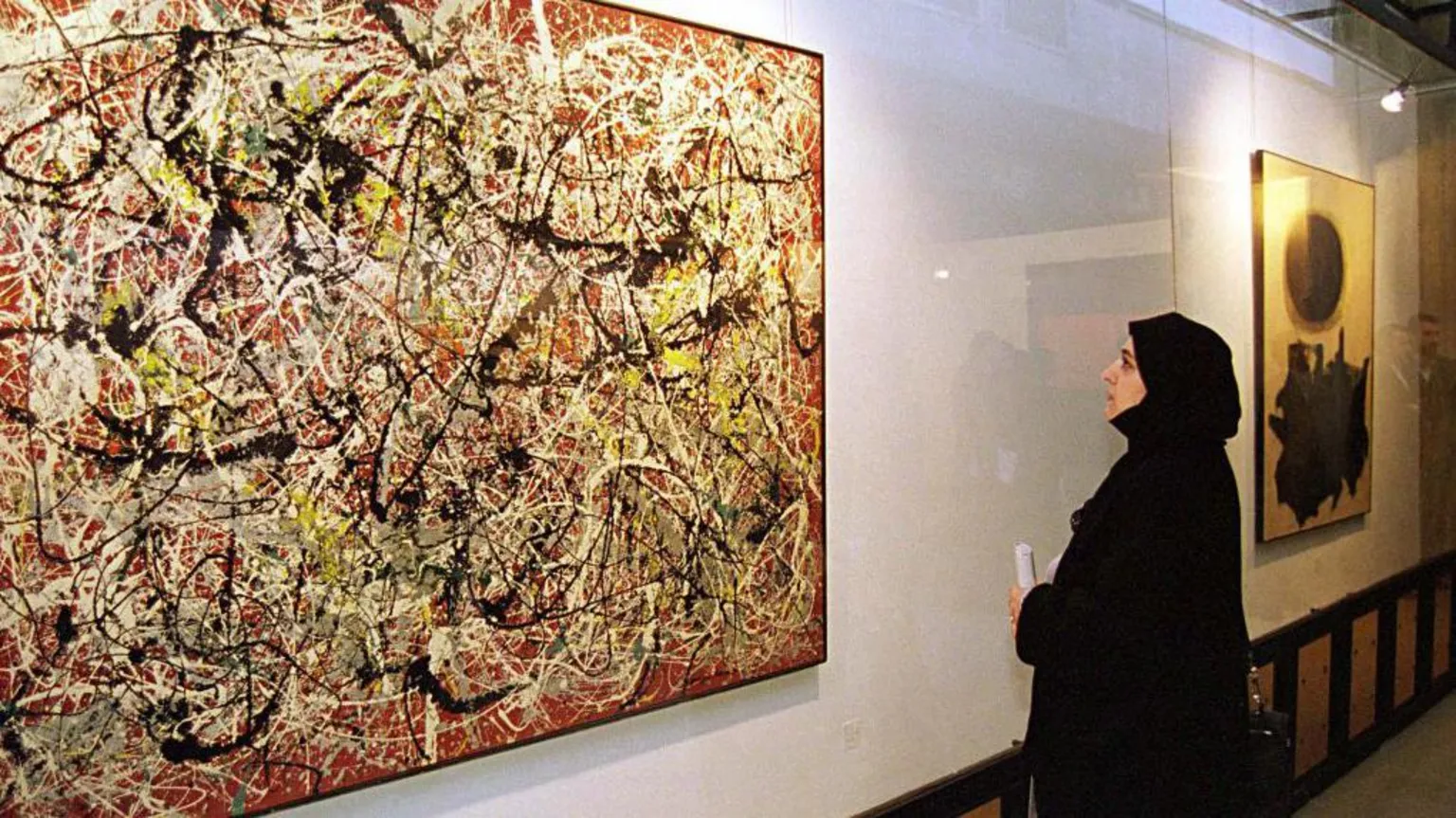
The family of Iran’s former shah collected modern art, including Jackson Pollock’s “Mural On Indian Red Ground.”

A recent BBC story about modern art in Iran (modern like Picasso, Jackson Pollock) took me by surprise. There is so much we don’t know about other countries — especially “enemy” countries.

The art described was collected by the Westernized, pre-Ayatollah Pahlavi family, but what’s interesting to me is the enthusiasm of contemporary Iranians — and the fact they’re allowed to see it.

Armen Nersessian writes, “It has been dubbed one of the world’s rarest treasure troves of art but few people outside its host country know about it. For decades, masterpieces by the likes of Pablo Picasso, Vincent Van Gogh, Andy Warhol and Jackson Pollock have been kept in the basement of a museum in Iran’s capital Tehran, shrouded in mystery. …

“Only a small portion of the work has been exhibited since the 1979 Iranian Revolution but in recent years, the Tehran Museum of Contemporary Art has been showcasing some of its most captivating pieces.

The Eye to Eye exhibition at the Tehran Museum of Contemporary Art, which opened in October 2024, was extended twice due to overwhelming public demand, running until January 2025.

“The display was widely regarded as one of the most significant exhibitions in the history of the museum, and it also became its most visited. …

“Among the artwork is Warhol’s portrait of Farah Pahlavi – Iran’s last queen – a rare piece blending his pop art flair with Iranian cultural history. Elsewhere, Francis Bacon’s work called ‘Two Figures Lying on a Bed with Attendants’ shows figures appearing to spy on two naked men lying on a bed.

“On the opposite wall in the basement of the museum, a portrait of Ayatollah Ruhollah Khomeini, the founder of the Islamic Republic of Iran, is on display in juxtaposition.

“The museum was built in 1977 under the patronage of Pahlavi, the exiled widow of the last Shah of Iran who was overthrown during the revolution. Pahlavi was a passionate art advocate and her cousin, architect Kamran Diba, designed the museum.

“It was established to introduce modern art to Iranians and to bridge Iran closer to the international art scene.

“The museum soon became home to a stunning array of works by luminaries including Picasso, Warhol and Salvador Dali, alongside pieces by leading Iranian modernists, and quickly established itself as a beacon of cultural exchange and artistic ambition.

“But then came the 1979 revolution. Iran became an Islamic republic as the monarchy was overthrown and clerics assumed political control under Ayatollah Khomeini. Many artworks were deemed inappropriate for public display because of nudity, religious sensitivities or political implications.

“Pierre-Auguste Renoir’s ‘Gabrielle with Open Blouse’ was deemed too scandalous. And Warhol’s portrait of the former queen of Iran was too political. In fact, Pahlavi’s portrait was vandalized and torn apart with a knife during the revolutionary turmoil.

“After the revolution, many of the artworks were locked away, collecting dust in a basement that became the stuff of art world legend. It was only in the late 1990s that the museum reclaimed its cultural significance during the reformist presidency of Mohammad Khatami. …

“Some pieces were loaned to major exhibitions in Europe and the United States, briefly reconnecting the collection with the global art world.

“Hamid Keshmirshekan, an art historian based in London, has studied the collection and calls it ‘one of the rarest treasure troves of modern art outside the West.’

“The collection includes Henry’s Moore’s ‘Reclining Figure’ series – an iconic piece by one of Britain’s most celebrated sculptors – and Jackson Pollock’s ‘Mural on Indian Red Ground.’ …

“Picasso’s ‘The Painter and His Model’ – his largest canvas from 1927 – also features, a strong example of his abstract works from the post-cubism period. And there is Van Gogh’s ‘At Eternity’s Gate’ – one of the very rare survivals of his first printmaking campaign during which he produced six lithographs in November 1882. …

“Challenges remain for the museum which operates under a tight budget. Shifting political priorities mean that it often functions more as a cultural hub than a traditional museum. Yet it continues to be a remarkable institution — an unlikely guardian of modern art masterpieces in the heart of Tehran.”

More at the BBC, here.

Photo: Katie Orlinsky.
“On Long Island [in New York state] a group of Shinnecock women are nursing a bay back to health and, in the process, reclaiming traditions,” writes the magazine Nature.

A couple nonprofits and a few indigenous women are putting into practice one of my favorite principles: “Two and two and 50 make a million.” They are saving their small piece of the ocean from pollution and helping to bring back a better world.

Claudia Geib writes at Nature, “Danielle Hopson Begun stands waist-deep in the waveless expanse of Long Island’s Shinnecock Bay. She reaches into the water and lifts out a heavy rope, which drips with the amber and butterscotch-colored fronds of a marine plant called sugar kelp. It’s early June, and over the past eight months this kelp, anchored here, has grown from millimeter-long seedlings into foot-long golden ribbons, absorbing nitrogen and carbon from the water in the process.

“Tended by Hopson Begun and four other women from the Shinnecock Indian Nation, these lines are part of the first Indigenous-owned kelp farm on the U.S. East Coast. The kelp is harvested each year and sold locally as a natural fertilizer. But for these women, who have formed a nonprofit organization called Shinnecock Kelp Farmers, it has become something more than a crop: It is one piece of a multifront effort to reassert ancestral ties to the lands and waters their community has stewarded for thousands of years.

“Today, though, Shinnecock Bay is drastically different from the waters their ancestors once harvested wild kelp from. It’s more polluted, and the waters have grown warmer and more acidic. And almost every year since starting the farm in 2020, Hopson Begun and her partners have found their lines coated in an alga that suffocates and kills baby kelp. It significantly reduced part of their harvests — until now.

“To combat the algae, the kelp farmers have turned to cutting-edge science and technological solutions — supported by a grant from The Nature Conservancy and industry expertise from aquaculture nonprofit GreenWave — to supplement their long connection to the bay.

“ ‘There is this traditional knowledge that we have — of how the seaweed grows in the bay, and how to nurture it and prepare it for the work that it has to do,’ says Tela Troge, one of the group’s founders. If the Shinnecock Kelp Farmers can successfully grow kelp in the bay — weaving this ancestral understanding with modern science — the plant stands to help restore an ancient link to a cultural practice, while perhaps helping stem the rising tide of pollution that has invaded these waters since the arrival of colonialism.

“Among the challenges of farming kelp is simply finding the time. The kelp farmers and their friends and families — mothers, lawyers, counselors, activists — live and work in the communities of the greater Long Island and New York City area. Today about half of the nearly 1,600 enrolled members of the Shinnecock Indian Nation live on a 900-acre property on the eastern edge of Shinnecock Bay — a property surrounded by wealthy Hamptons enclaves and just a barrier island away from the Atlantic Ocean.

“Life here has always been intertwined with water. For at least 10,000 years, the ‘People of the Stony Shore’ gathered fish, mussels, scallops and clams, and cultivated oyster gardens along a vast stretch of land and waters on and around what is now called Long Island. Skilled seafarers, they relied on the Shinnecock and Peconic Bays — both local inlets — as well as the open sea. They hunted whales and exchanged white and purple wampumpeag beads they carved from the shells of hard clams, or quahog. These beads, known as wampum, remain an important touchstone for the Shinnecock, who continue to carve them as jewelry and cultural symbols.

“When Europeans arrived in the Northeast in the 1600s, they brought diseases that decimated the Shinnecock and their neighbors, razed forests to sow farms and claimed burial grounds to build towns. Over time the Shinnecock Indian Nation lost access to most of their historic hunting and fishing grounds, retaining a territory of about 1,000 acres, including the 900-acre reservation. With the spread of new people, the waters the Shinnecock relied on changed, too.

“Shinnecock Bay, in particular, suffered. The bay spans 9,000 acres, separated from the Atlantic Ocean to the south by a narrow barrier island. Warm and shallow, with an average depth of only about 6 feet, the bay’s connection to the sea has shifted over the centuries as storms alternately carved and filled in cuts through the island. A powerful 1938 hurricane created Shinnecock Inlet, a permanent opening to the Atlantic. Yet, still largely landlocked, the bay’s waters concentrated high levels of nitrogen, which seeped through the ground from cesspools and septic systems as homes and towns sprung up along its shores.

“By the 1980s, annual nitrogen-fed algal blooms turned the water ‘brown like a cup of coffee,’ says Stony Brook University researcher Ellen Pikitch, one of the co-founders of the university’s Shinnecock Bay Restoration Program. These ‘brown tides’ clouded the water, blocking sunlight from reaching eelgrass, killing fish and destroying shellfish habitat. …

“By the mid-2000s the marine life that the Shinnecock people had once relied on was nearly gone. Oyster reefs vanished. Between the 1970s and 2011, the commercial fishery for quahogs, the clams used for Shinnecock wampum and food, collapsed by more than 99%.

“At the same time, members of the Shinnecock Indian Nation had been fighting to assert their ancestral land and water claims. In 2019, an ocean-farming nonprofit called GreenWave reached out to members of the Nation. Inspired by a PBS documentary about the Shinnecock people’s long battle against Southampton’s development, one of the group’s staffers wanted to know if members of the Nation would consider working with GreenWave on a kelp farm.

“The proposal captured the interest of the future Shinnecock Kelp Farmers for multiple reasons. They knew that, historically, the Shinnecock harvested seaweed for home insulation, food and medicine, and that kelp could absorb nitrogen and carbon into its tissues. When harvested and dried for garden fertilizer and used in place of traditional fertilizers, kelp offered a way to pull excess nutrients from the bay. …

“The Sisters of St. Joseph, a Catholic religious order, joined the collaboration by providing water access from their community center along Shinnecock Bay. In 2020, five Shinnecock women — Danielle Hopson Begun, Donna Collins-Smith, Rebecca Genia, Tela Troge and her mother, Darlene Troge — took up waders and began the work of nursing kelp to life.”

There’s a lot more at Nature, here. No paywall. Great photos.

Photo: Southside Community Land Trust.
Southside Community Land Trust high school interns making pizza. SCLT has numerous programs to ensure that locally grown produce gets to community members.  

Today’s story is about regular folks doing good things. It isn’t news. It’s common. As I scroll through all my feeds, I like to remind myself that it’s actually common.

Brooke Warner wrote at the Providence Eye about a neighborhood I know.

“The term ‘produce aggregation’ may not conjure up an image of healthy kids and families and farmers bringing good food to communities facing food insecurity. But Southside Community Land Trust’s Produce Aggregation Program is working to do just that. It’s a way to connect urban farmers to their neighbors with healthy food while at the same time connecting their small farms to new markets.

“It ‘gets fresh local food into the local community,’ said Amelia Lopez, food access associate at Southside Community Land Trust (SCLT), who works on the Produce Aggregation Program.

“Small-scale farmers typically face numerous challenges to access wholesale markets: they lack the capacity to grow large quantities; may not have access to processing facilities; and must manage the complexities of logistics and distribution required to fulfill wholesale orders.

“The Produce Aggregation Program addresses these challenges by acting as a wholesale buyer that combines the harvest of numerous urban farmers to distribute in larger quantities. The program has its own farm-to-market processing center to collect and process crops grown by the farmers and manages the logistics and distribution of the produce, making it possible for small farms to increase the scale of their businesses.

“Twenty-seven farmers regularly sell their produce through the program. Most of the farmers are refugees, immigrants, or part of other marginalized communities. More than half of the farmers who participate have plots at SCLT’s Urban Edge Farm or Good Earth Farm properties, where farmers are able to farm on larger plots of land.

“As their businesses expand and they run out of space, many farm on numerous plots in multiple community gardens and farms. Most of the farmers in the program also sell at farmers markets, but income from farmers markets can be unpredictable and unsteady, Lopez said. The aggregation program gives them another, more reliable, outlet to sell their produce. In addition, there are many years of experience among the farmers, and they are able to share this knowledge with the high school students who take part in the SCLT’s paid internship program. ..

“ ‘Sometimes there are moments when we have an abundance of some products and the program helps us to sell them,’ said Margarita Martinez, translating her husband’s comment from Spanish. Teo Martinez, a farmer from the Dominican Republic, and Margarita are commercial growers based at Urban Edge Farm. …

“Marcel De Los Santos, SCLT’s grants and communications manager, said, ‘The fight against food insecurity faces several significant obstacles that threaten its sustainability. Reducing crucial funding sources, such as the expiration of ARPA [American Rescue Plan Act] funds, has left many food assistance programs needing help to maintain their service levels. Land acquisition for food production and community gardens has become increasingly difficult as urban development drives up property costs and reduces available space.’

“Additionally, rising food and transportation costs and persistent supply chain disruptions strain food banks’ operational capacities. These challenges are compounded by the growing demand for food assistance services, climate change impacts on agricultural production, and the need for consistent volunteer engagement. …

“The [aggregation] program runs two distribution cycles each week during the growing season. SCLT orders different products in various quantities from different participating farmers and notifies them in advance of each cycle what they will be purchasing. Farmers deliver their produce to the food hub, where it is processed and packed into bags with other farmers’ produce. Each bag contains about $20 worth of fresh produce, sourced from different farmers, and is ready to be distributed … through numerous community partners that in turn give it out to their participants at no cost. Distribution partners include organizations such as health clinics, day care programs, and recreation centers. Health clinic partners … give out the produce through the VeggieRx program, where doctors give patients a ‘prescription’ of produce. …

“[As of this writing] the program us funded primarily by the USDA’s Local Food Purchase Assistance Cooperative Agreement program (LFPA), which began during the pandemic to expand access to local, healthy food and increase economic opportunities for underserved farmers. [The] program has a new home in the SCLT’s new Healthy Food Hub. …

“SCLT’s mission is to help local urban farmers by providing land access, agricultural resources, and agriculture and business training. The nonprofit supports the operation of 60 community gardens in Providence, Pawtucket, and Central Falls, including 20 land trust-owned properties.

“The Produce Aggregation Program is one of many that the SCLT runs or partners with to address food insecurity in the Providence area. Farmers markets, gardens, education programs, and internships are among further examples of the SCLT’s mission. All of these activities, like the Produce Aggregation Program, help increase access to fresh, healthy, and culturally relevant food for these urban communities and feed roughly 1,200 families annually.

“Although the growing season typically ends at Thanksgiving, the work of the SCLT continues year-round, along with its partner organizations and local businesses, farmers, volunteers, students, families, and the local community.”

Not being sure that USDA will still fund programs like those, I suspect this could be another worthy cause that will have to rely on private fund raising.

More from the Providence Eye via ecoRI News, here.

Photo:  Felix Uribe Jr/Guardian.
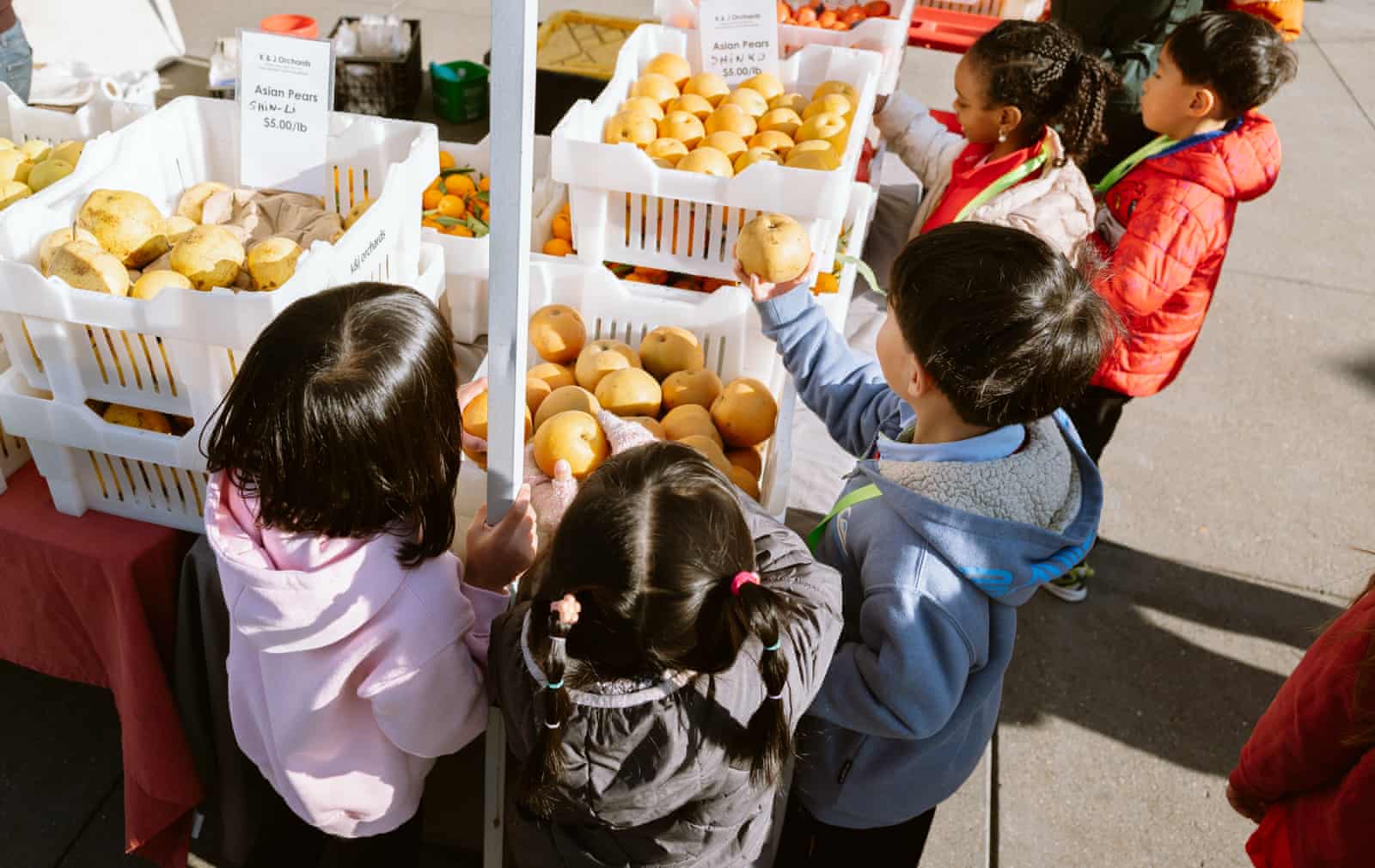
An organization called Foodwise Kids has brought more than 20,000 students to farmers’ markets to learn about the food system and taste new-to-them produce. Sometimes the teacher will challenge the students to join “the One-Bite Club.” 

When John came back from college the first time, one of the things he said, only half joking, was, “Why didn’t you tell me I liked mushrooms?”

He eats everything now, but as a kid, he had limited tastes, and I was no good at insisting he try something.

Today a special program for young children encourages tasting new things as part of a group.

Cecilia Nowell reports at the Guardian, “On a crisp winter morning in San Francisco, a team of six-year-olds declare that their favorite fruits and vegetables are peaches and broccoli – but then again, they have yet to venture out into the farmers’ market where produce they have never tried before awaits them. With handfuls of tokens, they will purchase persimmons, pomegranates, Asian pears, purple potatoes, kale and more from the farmers who grew them – then embark on a tasting journey, featuring new and familiar spices.

“The first-graders are visiting the Ferry Plaza Farmers Market – a Bay Area institution that draws more than 100 farmers to San Francisco’s waterfront three days a week – with 22 of their classmates from Lincoln elementary. That morning, the children had ridden the subway from their school in Oakland’s Chinatown into the city with parent chaperones and their teacher, Kathy Chen.

“Chen [knows] that at this age, her students are prone to becoming picky eaters – but what is cooked at home and what they try at school can change that. The hope is that after this field trip, when the cafeteria serves up an unfamiliar veggie or they’re offered a new fruit, the students might be a little more willing to take a bite.

“The trip is sponsored by Foodwise Kids, a nutrition and wellness program for elementary school students in the San Francisco Bay Area coordinated by the 30-year-old non-profit Foodwise. Since the program’s launch in 2012, it’s brought more than 20,000 local students out to the farmers’ market to learn about the food system. It’s focused primarily on schools with a high percentage of students of color or kids eligible for free or reduced-price school meals, and education director Tiffany Chung says the aim is to get ‘students excited about eating fruits and vegetables’ in the hopes that ‘they’ll incorporate them into their daily life and eventually lead to longer-term healthy eating options.’ …

“At folding tables, they introduce themselves to Foodwise’s staff and volunteers, and name their favorite fruits and vegetables. Chung jumps in for a moment to speak Mandarin with one student who doesn’t feel comfortable speaking English – she notes that many of the program’s volunteers are bilingual, usually in Spanish, to support the city’s diverse youth.

“While the majority of the classmates in her group prefer peaches, Temnit Desta says her favorite fruit is lemons. ‘She likes sour,’ her mom, Tehesh Hadush, explains. Although Temnit was born in California, her family is from Ethiopia and she has grown up eating lots of spicy foods. …

“Just a few years after the Loma Prieta earthquake devastated the highway running along San Francisco’s coast, community groups began discussing ways to connect downtown with the waterfront – and settled on a farmers’ market. Another aim was to educate urban dwellers about California’s farmland and sustainable agriculture while providing access to healthy, fresh produce. To this day, the market prioritizes urban families – not only by accepting Snap, previously known as food stamps, but by matching every dollar spent so families can double their Snap spending up to $15.

“After they’ve filled a basket with produce – so much that the six-year-olds are carrying the basket in teams of two – the small groups take off for a quick tour of the farmers market. When they return, Chung and other volunteers lead the groups in a game guessing which season different crops grow in. As they play, youth education manager Marcelo Clark starts chopping and roasting different trays of the produce – washing raspberries, flavoring cauliflower with jerk spice and roasting potatoes with cumin. He aims to use a mix of spices the children may have already tried at home – and others that might be new to them.

“ ‘A lot of our students are newer to America, and may not speak English,’ says Chung, but at the market ‘they’re able to see produce that is familiar to them. … They’re able to point out: “I know this. This is cilantro. I have this on tacos.” ‘ …

“When the food has been prepared, Clark carries trays of fruit and both raw and roasted veggies out to the class. The students dive into the purple potatoes, carrots, brussels sprouts, kale and cauliflower – but are more hesitant to try hummus and raw broccoli. Although her classmates and their parents exclaim at the fresh persimmon, Temnit is wary of the unfamiliar fruit.

“ ‘Today is all about trying new things and giving things a chance,’ Chung reminds the class, gently encouraging them to try just the smallest bite of everything.

“ ‘When students are unfamiliar with a fruit and vegetable, there is a lot of hesitation. We try to create this safe space where we’re telling them: “It’s OK if you don’t like it. The whole point is just to try it.” ‘ …

“By the end of the class, Temnit will be asking for more persimmon, and one of her classmates will be racing around trying to finish everyone’s leftover pomegranate seeds.”

More at the Guardian, here.

Photo: Agustín Marcarian/Reuters.
Capybaras eat the grass in the gated community of the Nordelta, north of Buenos Aires.

Can there be such a thing as too many capybaras? Five-year-old Suzanne visiting Disney World back in the day would have said no. Now she’s grown up with children of her own, but she was still pretty excited to see capybaras wandering around Columbia last week. (Columbia seems to be a new destination for school vacations. John’s family went last year and Suzanne’s this year.)

Meanwhile in Argentina, capybaras are considered too much of a good thing, especially in wealthy neighborhoods.

Harriet Barber reports for the Guardian, “A contraception debate is gripping one of Argentina’s most notable luxury neighborhoods – not for its wealthy residents, but for its original occupants, the capybaras.

“In recent years, the lovable rodents have been accused of overrunning the Nordelta, a meticulously landscaped and manicured suburb north of Buenos Aires.

“Now, in a bid to quell reproduction – some accounts suggest the number of capybaras has tripled to more than 1,000 in the past three years – the Buenos Aires government has approved wildlife population control plans, involving selective sterilization and contraceptives.

“Marcelo Cantón, a resident and spokesperson for the Nordelta Neighborhood Association, says that while capybaras themselves are not a problem, the ‘excessive growth’ of their populations is, adding that it is causing the creatures to ‘fight among themselves, fight with dogs in private gardens,’ leading to traffic accidents. …

According to El País, the new plans would see two doses of contraceptives injected into 250 of the rodents … which authorities hope will stem reproduction for up to a year.

“But not all neighbors are in agreement. The Nordelta sits within the Paraná Delta, an environmentally important wetland home to dense flora, an abundance of birds and dozens of species of mammals.

“Silvia Soto and a group of neighbors known as ‘Nordelta Capybaras – We Are Your Voice’ say the plans should be halted, dispute that there is an overpopulation problem and criticize property developers for ignoring proposals to create biological corridors and protected areas.

“ ‘For years, we have been asking for different, linked green areas that function as natural reserves connected by biological corridors, to protect the capybaras and preserve their survival and coexistence in their own natural space,’ Soto said. … Environmentalists are also now weighing in and calling on the government to protect the capybaras, which are the world’s largest rodent.”

More at the Guardian, here.

I don’t know what’s best for Buenos Aires, but I’ve often wondered if there weren’t some way to use contraception for the deer populations that have burgeoned in urban and suburban America, spreading tick diseases. What do you think?

Photo: Mason Kumet/The Hechinger Report.
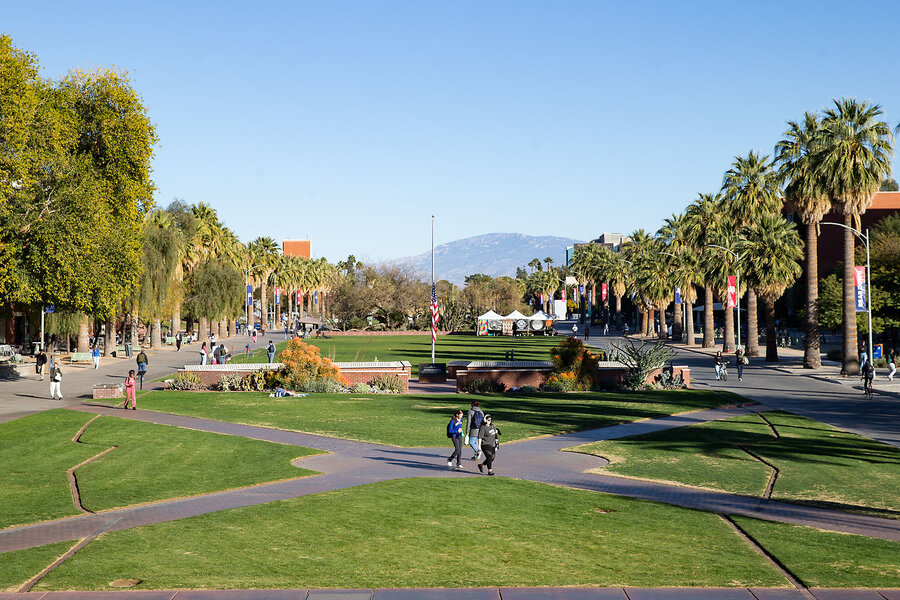
The University of Arizona campus in Tucson, where the number of undergrads majoring in the humanities has in creased by 76% since 2018, when a bachelor’s in humanities was introduced.

For years, the value of a postsecondary education has been measured by how much money someone can make after graduation, with the result that classes in the humanities were devalued.

Now there’s evidence that in addition to the intrinsic value of the humanities, they can make the difference between getting the job and not getting it.

Jon Marcus wrote at the Hechinger Report (a nonprofit news organization focused on inequality and innovation in education) about what’s going on, and the Christian Science Monitor reprinted the story.

“Olivia Howe was hesitant at first to add French to her major in finance at the University of Arizona. She was afraid it wouldn’t be very useful in the labor market.

“Then her language skills helped her land a job at the multinational technology company Siemens, which will be waiting for her when she graduates this spring.

“ ‘The reason I got the job is because of my French. I didn’t see it as a practical choice, but now I do,’ says Ms. Howe, who, to communicate with colleagues and clients, also plans to take up German. …

“The simple message that majoring in the humanities pays off is being pushed aggressively by this university and a handful of others. They hope to reverse decades of plummeting enrollment in subjects that teach skills employers say they need from graduates but aren’t getting.

“The number of undergraduates majoring in the humanities at the University of Arizona has increased 76% since 2018, when it introduced a bachelor’s degree in applied humanities that connects the humanities with programs in business, engineering, medicine, and other fields. It also hired a humanities recruitment director and marketing team and started training faculty members to enlist students in the major with the promise that an education in the humanities leads to jobs.

“That’s an uncharacteristic role for humanities professors, who have tended to resist suggestions that it’s their role to ready students for the workforce. But it has become an existential one.

“Between 2012 and 2022, the number of undergraduate degrees awarded in the humanities – English, history, languages, literature, philosophy, and related subjects – fell 24%, according to the American Academy of Arts and Sciences. It’s now below 200,000 for the first time in more than two decades.

“In response, universities and colleges nationwide have started eliminating humanities departments and laying off humanities faculty as policymakers, parents, and administrators put a premium on highly specialized subjects they believe lead more directly to jobs. …

“ ‘What we are up against is the constant negative storytelling about how the humanities are useless,’ says Alain-Philippe Durand, dean of the University of Arizona’s College of Humanities and a professor of French. …

“ ‘When you tell them we are teaching the life of the mind, they laugh at you,’ Dr. Durand says over lunch at the student center. ‘You have people saying, “Do we really need this?” ‘ he says. …

“Dr. Durand’s department went so far as to put that declaration on a billboard on Interstate 10 in Phoenix, conveniently near the campus of rival Arizona State University. ‘Humanities = Jobs,’ it said, with the college’s web address. Dr. Durand keeps a model of it on a shelf in his office.

“The skills he’s talking about include how to communicate effectively, think critically, work in teams, and be able to figure out a way to solve complex problems outside of a particular area of expertise. Employers say they want all of those, but aren’t getting them from graduates who major in narrower fields.

“Eight out of 10 executives and hiring managers say it’s very or somewhat important that students emerge from college with these kinds of skills, according to a survey by the American Association of Colleges and Universities. …

“What employers want ‘is people who can make sense of the human experience,’ says Rishi Jaitly, who has developed an executive education program at Virginia Polytechnic Institute that uses the humanities to help mid-career managers be better leaders.

“Along with Arizona, Virginia Tech is among a small group of universities taking steps to change the conversation about the humanities. A surprising number are technology-focused. These include the Georgia Institute of Technology, which has also started drawing a connection between the humanities and good jobs at high pay. That has helped boost undergraduate and graduate enrollment in Georgia Tech’s Ivan Allen College of Liberal Arts by 58% since 2019, to 1,884 students in 2023 – the most recent period for which the figure is available.

“Before then, ‘we were doing almost nothing to explain the value of the humanities,’ says Richard Utz, interim dean. That’s important at a technological institute, he says. …

“A medievalist, Dr. Utz uses the example of assigning his students 15th-century Robin Hood ballads. ‘They read something that is entirely alien to them, that is in late medieval English, so they’re completely out of their comfort zone,’ he says. Then they split into groups and consider the material from various perspectives. It makes them the kind of future workers ‘who are versatile enough to look at a situation from different points of view.’ …

“In the first two years of the humanities-focused executive education program at Virginia Tech, the participants have come from Amazon, Microsoft, Boeing, Zillow, and other companies. They study history, philosophy, religion, classics, literature, and the arts. They use these to consider questions about, and qualities of, leadership, and to see how what they learn can be applied to technology trends including data privacy and artificial intelligence. …

“Says Virginia Tech’s Mr. Jaitly, a former technology entrepreneur and founder of a venture capital firm whose own undergraduate degree was in history. ‘The superpowers of the future emanate from the humanities: introspection and imagination, storytelling and story-listening, critical thinking.’ …

“Some humanities faculty [bristle] at the idea that their work is relevant only when combined with more career-oriented disciplines, says Dr. Durand, at the University of Arizona. ‘But you have to be aligned with your students,’ he says. … ‘We can’t do things the way we always have.’ ”

More at the Hechinger Report via the Monitor, here. No firewall.