Here’s a lovely story by Bella English at the Boston Globe.
Like many other people who feel helpless after a tragedy, illustrators of children’s books wanted to do something useful last April 15 and were delighted to be asked to give their talents.
“After the Boston Marathon bombings,” writes English, “Joe and Susan McKendry of Brookline wanted to do something. …
“Joe, an artist who teaches at the Rhode Island School of Design, thought he could auction off a couple of paintings he did for his first book, ‘Beneath the Streets of Boston: Building America’s First Subway.’
“But then he realized he had something more valuable: connections to other artists. Why not make it a group project? We Art Boston was born, with dozens of artists contributing paintings or illustrations to the cause: the emergency and trauma fund at Boston Children’s Hospital.
“The fund helps children and families get the treatment they need ‘when faced with a tragedy,’ says Stacy Devine, an associate director with the Boston Children’s Hospital Trust. What began as a response to the Marathon bombings expanded to include all traumatic events. …
“The McKendrys also wanted to hold a community event for children to get more directly involved. On Oct. 20, We Art Boston is hosting a family day on the Rose Fitzgerald Kennedy Greenway, right across from the New England Aquarium.
“All of the donated artwork will be framed and on exhibit, and people can bid on them through volunteers who will place the bids online using iPads. Several of the illustrators will be there and will sign books or, for a donation to the cause, draw portraits of stuffed animals for children who bring their favorite one along.”
“Shepherds led a flock of 2,000 sheep through the streets of Spain’s capital and largest city on Sunday, in defense of ancient grazing, droving and migration rights that have been increasingly threatened by urban sprawl and modern agricultural practices.
“Those urban settings were once open fields and woodlands, crisscrossed by droving routes. Since at least the year 1273, the country’s shepherds have had the legal right to use about 78,000 miles of droving routes around the country to move livestock seasonally between summer pastures in the cool highlands and more protected lowland grazing areas in the winter.
“Every year, a handful of shepherds defend that right in Spain’s capital city.”
I guess it’s use it or lose it. Plus it’s good to make people think about where their food and wool come from, and whether things have changed for the better.
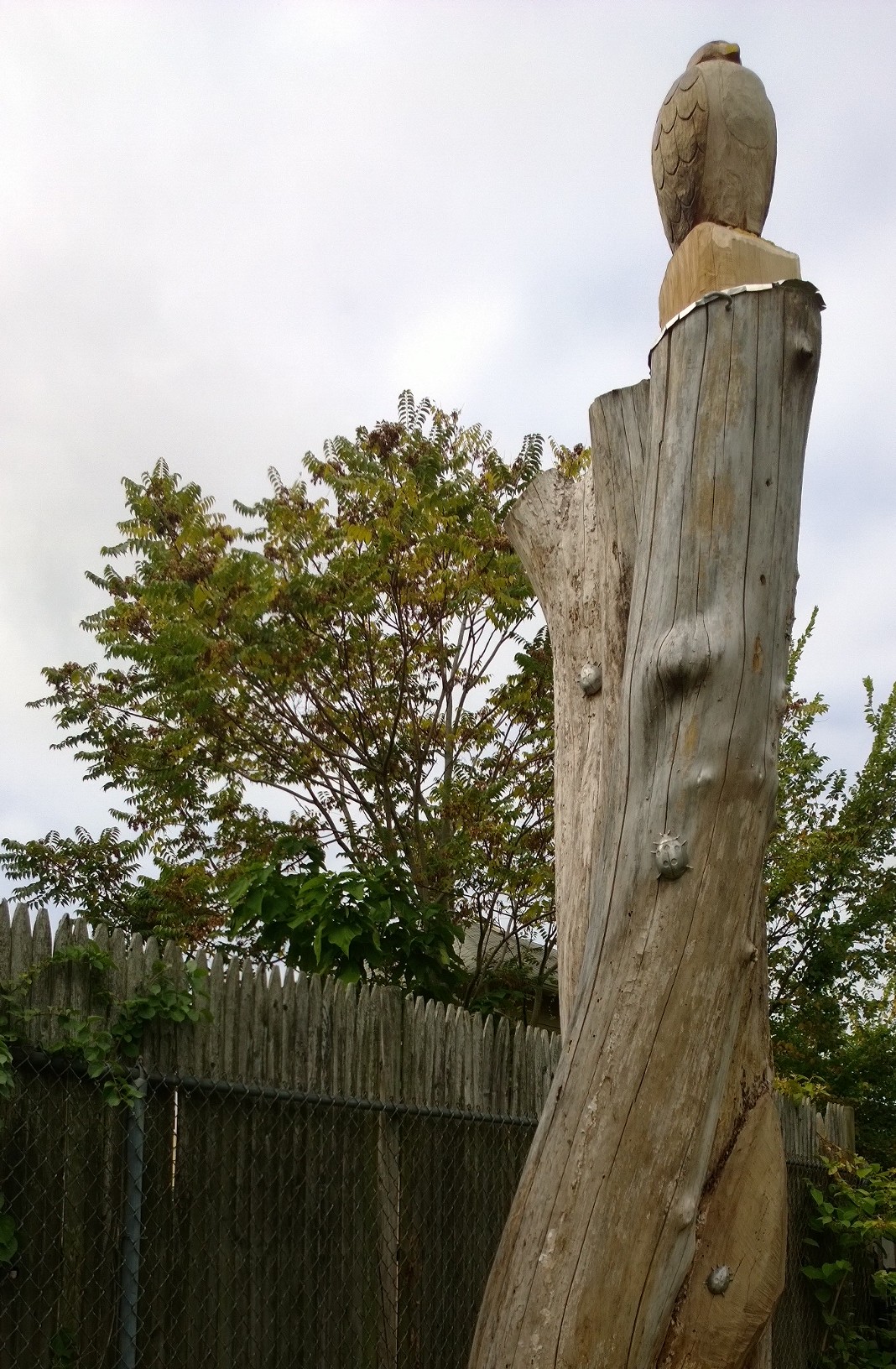
This was posted at an Arlington blog last May, but I just saw the sculpture it refers to.
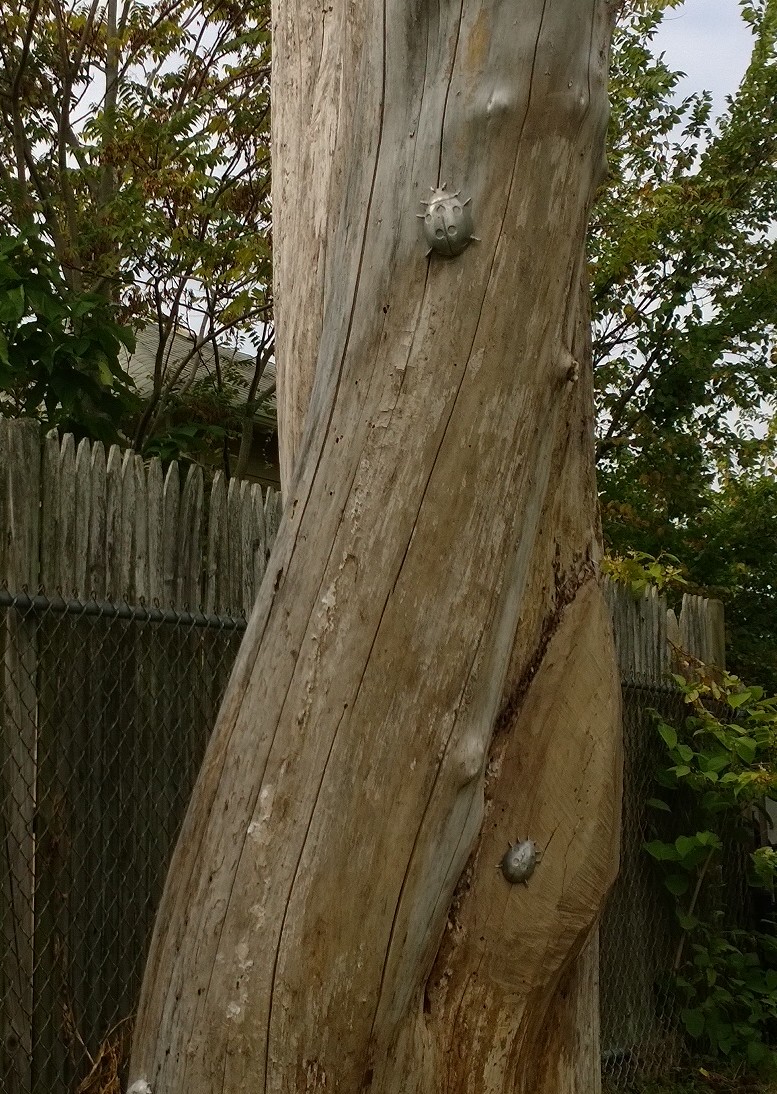
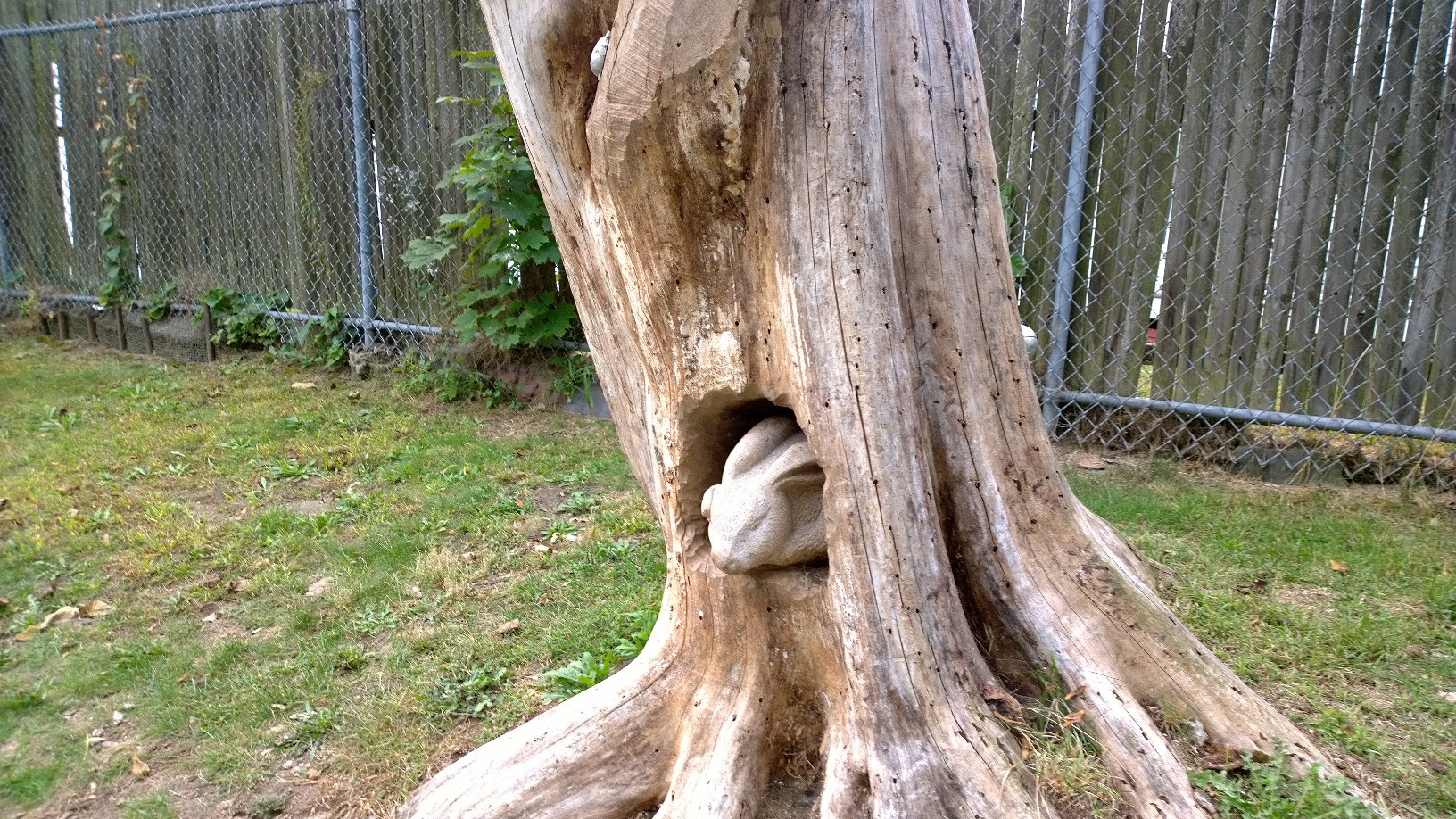
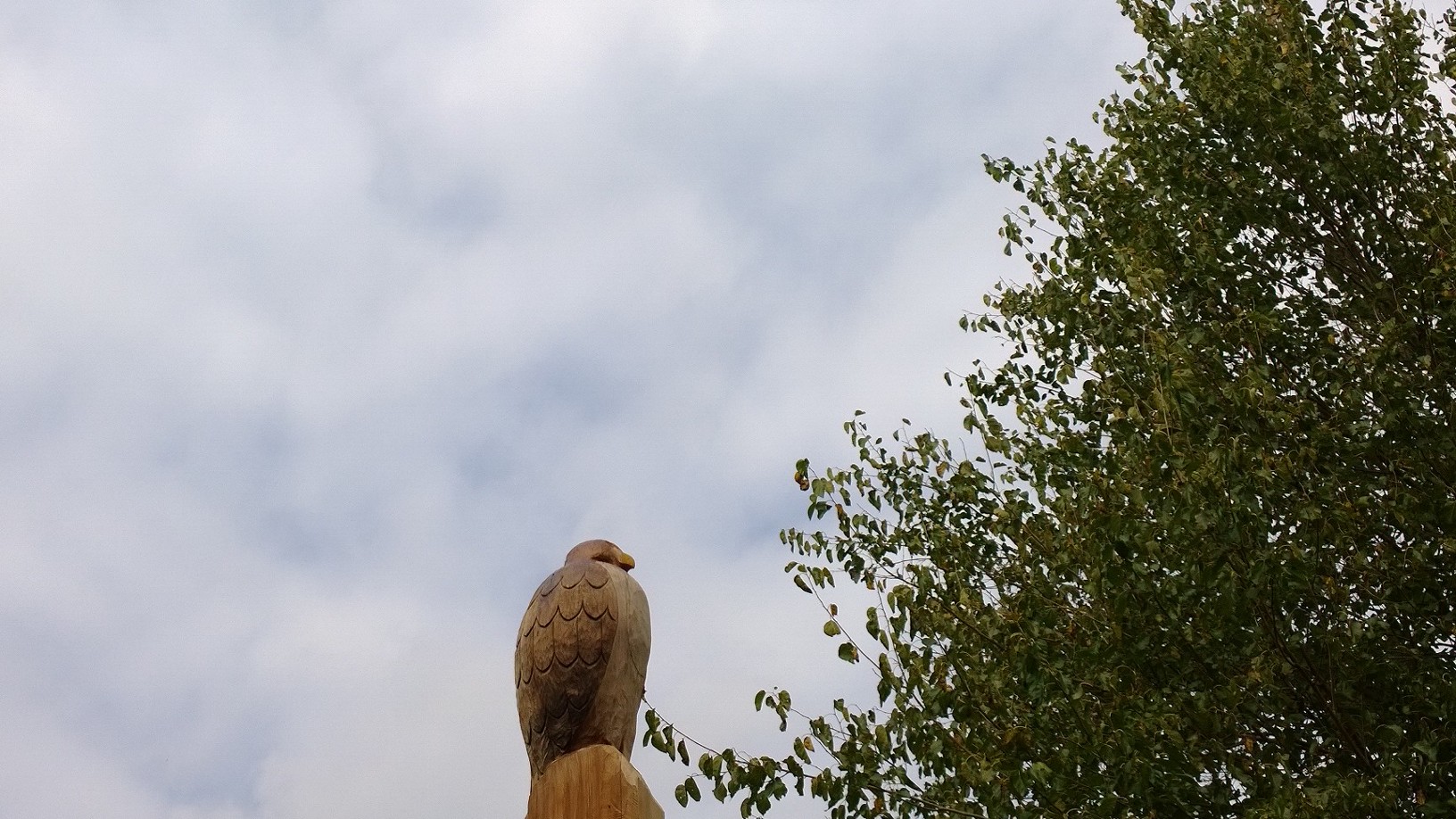
“You are invited to watch the ladybugs for the Waldo Park Tree Sculpture being made right before your eyes … Work by artists has already begun to transform a tall tree stump on the hill in Waldo Park … into multimedia sculpture that features local birds, animals and insects. The Friends of Waldo Park are holding two community participation days as this work is created. …
“Watch the metal-smiths at work as they cast aluminum ladybugs to be bolted onto the tree sculpture. Stop by for however long you’d like to see how metal-casting is done!” More.
Note the metal ladybugs crawling up the trunk, the bunnies peeking out from inside, and the hawk on top.
My husband and I are big fans of Broadway music and also of Boston area singer Will McMillan, who gave a free concert in the Brighton library today.
The show was centered around the composer Harold Arlen, beloved for songs such as “Somewhere Over the Rainbow,” “It’s Only a Paper Moon,” “Blues in the Night,” “Let’s Fall in Love,” and “That Old Black Magic.” Interspersed with his songs, Will gave a delightful rundown on Arlen’s life, work, and main collaborators (Ted Koehler, Johnny Mercer, and Yip Harburg).
For my money, no one puts over a song with the emotional truth of Will McMillan. He becomes the story. In fact, he almost skipped a beat on the little-known intro to “Rainbow,” when the words seemed to carry special meaning for him. And I really liked how he tied the words of “If I Only Had a Heart” to an important goal in his life: “to be a friend to the sparrows and the boy with the arrows.” Or, to see all sides.
Joe Reid, a fine jazz improviser, accompanied Will on the piano and got “Happiness Is a Thing Called Joe” in his honor.
Read more at Will’s blog, here, where you can listen to his MP3s, too. Catch him and frequent collaborator Bobbi Carrey at Scullers November 14.
Cabaret singer Will McMillan with a fan after his show in Brighton today.
Hidden Faces of Courage, a “theater piece with music” created by Mary Driscoll in collaboration with formerly incarcerated women, is coming soon. I will write more after I have seen the production in November, but I need to alert you that if you want tickets, you might want to get them now as the performance space is rather small. Go to Fort Point Theatre Channel, here.
I met Mary in the playwriting class that I blogged about a few times. I didn’t continue with theater after the class, but Mary kept working at this play. She has a deep commitment to helping women who have been in prison, having worked with them for years at her nonprofit, OWLL (On With Living and Learning Inc.).
Mary writes: “The voices of previously incarcerated women are notably absent in the artistic world—a world that can engage a broader community in reform and foster greater understanding between the individual and diverse audiences. Sometimes in unexpected ways.”
Read more about her show at Broadway World, Boston, here.
Hidden Faces of Courage is directed by Tasia A. Jones, with music by Allyssa Jones, and runs November 8-10, 15-17, at The Boiler Room, 50 Melcher Street, Fort Point, Boston.
This story was a reminder to me that every country has kind-hearted people. Too much of the news about Sudan focuses on its leader, his treatment of minorities, and his troubles with the international court. But this story is about Sudanese youth reviving a tradition of service.
Isma’il Kushkush reported the story for the NY Times.
“Their temporary headquarters are a beehive of young volunteers buzzing in and out of rooms, up and down stairs, carrying bags of donated food, medicine and large packets of plastic sheets. …
“They are the members of Nafeer, a volunteer, youth-led initiative that responded swiftly to the humanitarian crisis caused by heavy rains and flash floods that struck Sudan [in August]. …
“The area around Khartoum, the capital, suffered the hardest blow. …
“ ‘We saw that the heavy rains and floods were going to impact the lives of many, and we felt we had a social responsibility to help people,’ said Muhammad Hamd, 28, a Nafeer spokesman. ‘The idea came out of a discussion on Facebook among friends.’
“A ‘nafeer’ is a Sudanese social tradition that comes from an Arabic word meaning ‘a call to mobilize.’ The group’s formation was all the more important because the Sudanese government was slow to respond, some critics say.
“ ‘It was a weak response,’ said Khalid Eltigani, the executive editor of Ilaf, a weekly newspaper. ‘The Nafeer youth broke the silence on the flood situation.’ ” More here.
I love that the latest manifestation of this Sudanese tradition got organized on Facebook.
Photo: Reuters
Men built a barrier to protect houses from rising water in Khartoum, Sudan, the last week of August. More than 300,000 people were directly affected by the flooding.
Back in August, the Ideas section of the Sunday Globe had a short piece by Kevin Hartnett on a robot that creates art. Well, a robot that copies art. It’s a discomforting notion.
“When you watch an artist paint,” writes Hartnett, “individual brush strokes can seem random. It’s often not until close to the very end that the image the painter is after becomes clear. This is doubly true when you watch e-David, the robot painter, at work. e-David (the name stands for ‘Drawing Apparatus for Vivid Image Display’) was created by a team of engineers at the University of Konstanz in Germany. It’s a former welding robot that has been retrofitted to reproduce, brush stroke by brush stroke, existing works of art. The robotic arm has access to five different brushes and 25 colors of paint, and after each dab of paint, it takes a photograph of what it has painted so far. Computer software analyzes the photograph and tells e-David where to place the next brush stroke.
“The strangeness of the process is especially evident when e-David signs the art at the end, beginning by making the dot over the ‘i’ and then writing the rest of its name backwards.” More.
Having recently read an amusing novel about the Gardner heist, The Art Forger, I can’t help thinking that e-David could have quite a career — maybe not fooling any experts but at least making serviceable reproductions.
Photo: Oliver Deussen, University of Konstanz
Painting by e-David, a robot
According to Christopher Joyce at National Public Radio, young whooping cranes learn from older ones, and when older cranes are unavailable, they can learn from ultralights.
“Being a wildlife biologist in the 21st century increasingly means rescuing rare animals from extinction. Among the success stories is the whooping crane. Seventy years ago there were only about 16 birds left on the planet. Now there are about 600.
“But breeding more birds isn’t enough. Scientists want to restore the crane’s way of life, too. And a team of ecologists at the University of Maryland have discovered something that suggests they are succeeding: Captive-bred are picking up tips from older birds about how to skillfully navigate south for the winter.
“It’s a sign that those whooping cranes are passing knowledge from one generation to the next and, in a sense, rebuilding their culture.”
So how do whoopers raised in captivity learn to follow and where to go when there are no older birds around?
“Workers drive around the enclosures in an ultralight, one-person aircraft … that moves along the ground. It’s the first step in teaching these birds to identify an as a mature whooper. Then when the birds are yearlings and it’s migration time, they’re shipped up north, to Wisconsin.
” ‘The ultralight in Wisconsin not only circles on the ground and teaches them to follow,’ [Greg Smith of the U.S. Geological Survey] says, ‘but it also ultimately lifts up into the air’ and accompanies the whooping cranes on their great migration, which lasts between 50 and 100 days.”
Photo: Joe Duff/Operation Migration USA Inc.
This young whooping crane is on its first fall migration, guided by an Operation Migration ultralight aircraft. Each whooper in this population wears an identification band, and many carry tracking devices that record their movements in detail.
At Smithsonian magazine, Tom Downey explains why urban planners could learn a thing or two from a Hindu religious festival that occurs every 12 years.
“I arrived by taxi at the Kumbh [in India] at sunset, expecting throngs of cars, cows and human beings blocking all access points. Instead I glided comfortably into my camp, which sat on a hilltop. I looked out over the fleeting city before me: makeshift shelters constructed on the floodplain of a river that was sure to overflow again in a few months. …
“I’d come to witness the spectacle for myself, but also to meet a group of Harvard researchers from the university’s Graduate School of Design. Led by Rahul Mehrotra, an architect from Mumbai before he went stateside to teach, they would closely analyze this unparalleled feat of spontaneous urban organization.
“ ‘We call this a pop-up megacity,’ said Mehrotra, a bearded 54-year-old. ‘It’s a real city, but it’s built in just a few weeks to instantly accommodate tens of millions of residents and visitors. It’s fascinating in its own right, of course. But our main interest is in what can we learn from this city that we can then apply to designing and building all kinds of other pop-up megacities like it. Can what we see here teach us something that will help the next time the world has to build refugee camps or emergency settlements?’ …
“The Kumbh Mela works in a way that most other Indian cities do not in part because everyone is on their best behavior: Civil servants know that their careers will be defined by these few weeks in the national spotlight; members of the public arrive with a sense of purpose and community.” More here.
I think it goes to show that when large numbers of people are basically on the same page about the importance of something, miracles happen. Loaves and fishes get shared. People pick up their litter. Everyone feels they’ve been part of something big.
Photo: Alfred Yaghobzadeh
Cooks at the Hindu festival worked to feed millions.
Suzanne’s Mom apologizes for sending you ghost photographs with no text or context. I have never owned a smartphone before, and it may take me a couple more tries before I nail the WordPress app. I hope you don’t get fed up.
I have a natural history post today, courtesy of John and a site called Unbelievable-Facts.com.
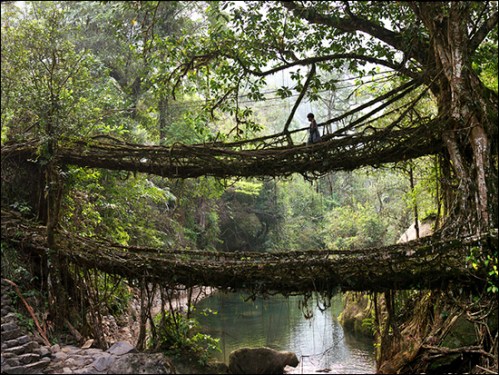
Apoorv Nagpal posts this: “Cherrapunji, a town in North-East India, which is known to be the second wettest place on earth, is also known for its living bridges. Here the bridges aren’t built but grown. The living bridges are made from the roots of Ficus elastica tree whose secondary roots grow above the ground surface.
“Long ago, War-Khasis, a tribe of Meghalaya, used this tree to cross rivers. Using the same technique, villagers of Cherrapunji grow their own bridges whenever required. The villagers have created a root-guiding system that forces the tender roots of the rubber tree to grow straight. Such roots make a strong, living bridge in about 10-15 years.
“Unlike the conventional man-made bridges which grow weak over time, these living bridges gain strength over time. Some of these bridges are more than five hundred (500) years old and can support 50 people at a time. A unique bridge called Umshiang Double-Decker Root Bridge is believed to be only one of its kinds in the whole world. It is actually a combination of two bridges, one stacked on top of the other.” More here.
I love that there are people with enough patience to wait 10-15 years for their bridge — and that they are rewarded with a bridge that grows stronger over time. Sounds like a fairy tale.
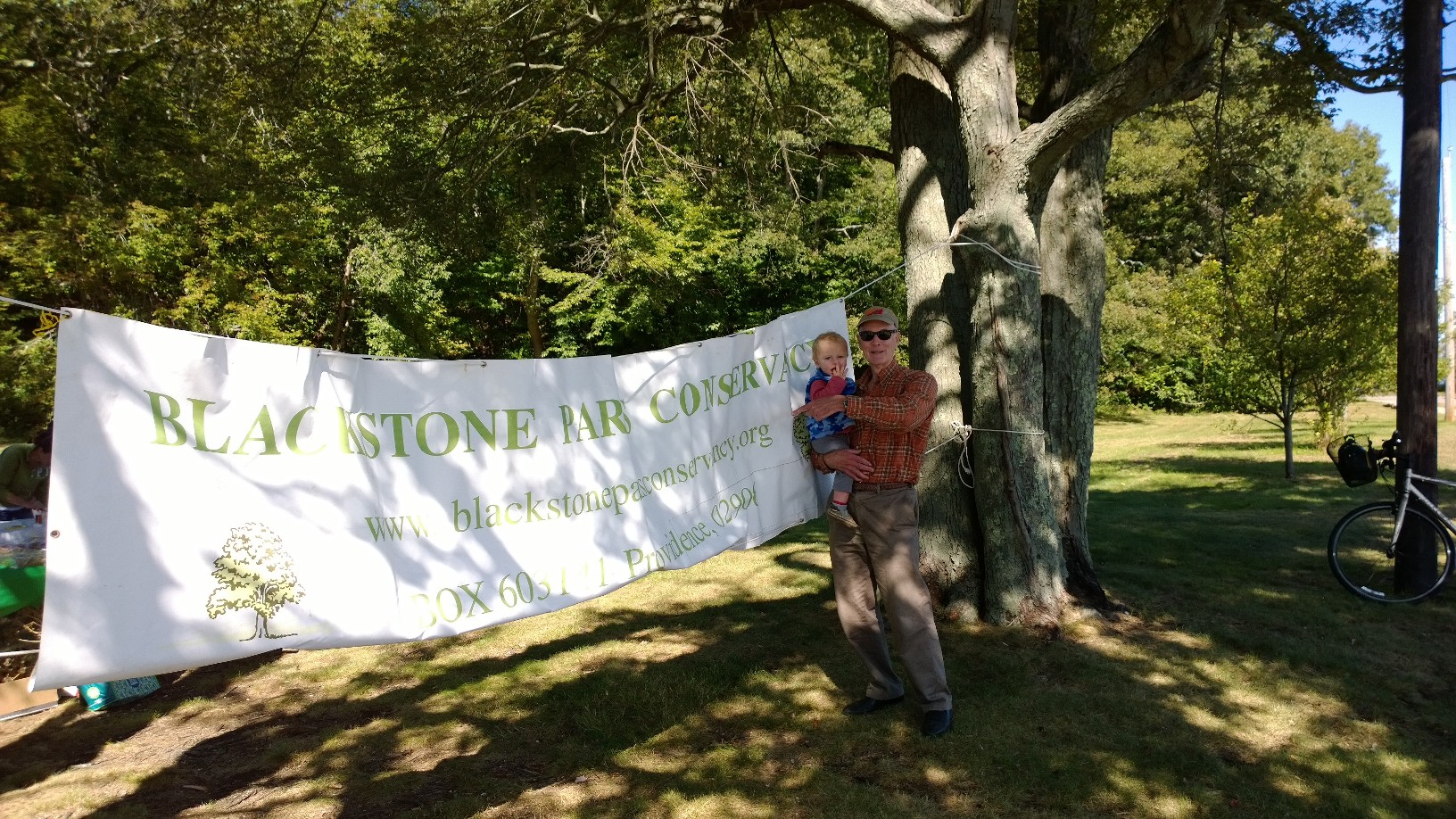
The Blackstone Parks Conservancy sent out this invitation, and we went.
“We invite you to attend the family event: Build your own Fairy House! This event was originally part of the summer series of family programs given by the Blackstone Parks Conservancy. Due to its rousing success, we are offering it again as part of Playful Providence, a citywide event organized by the Partnership for Providence Parks and the Providence Parks Department. Join us at the Field on River Road, across from the Narragansett Boat Club.”
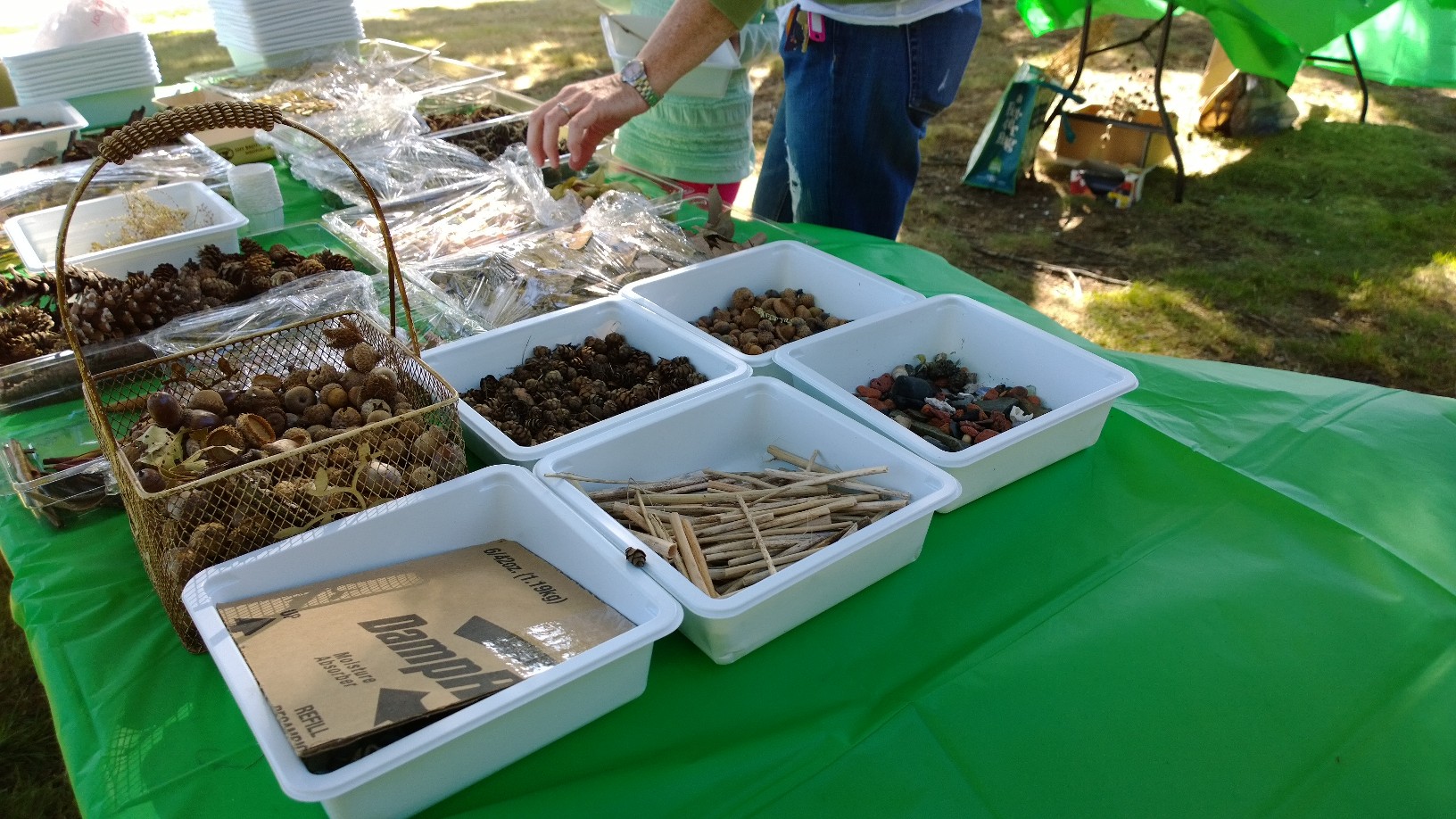
Cardboard forms that you could fold into houses were on hand. On top you could apply a layer of something like sand-colored Play-Doh, with actual sand in it. Next you could choose from a gorgeous array of seedpods, acorns, leaves, twigs, and other fruits of nature — and stick them into the “mortar” — the way a fairy would like them — before the clay dried.
Our middle grandchild was a little young for it, but he liked running around in the park and watching the rowing lessons on the Seekonk nearby.
I would like to try fairy houses again someday soon. Just collecting the pieces of nature to be used would be fun for a child.
Read about the conservancy and future events here.
The Street Pianos are in Boston and getting some enthusiastic use. Today was a lovely day to be outside, and I saw several people of varying skill levels playing the two pianos in Dewey Square.
Occupy Boston’s time in the square having failed to do anything to change the tragedy of homelessness, a loose-knit fraternity were hanging out, listening to the music or taking a turn. A group of us from work went over to hear an economist/musician play duets with strangers and then start taking requests.
Since the pianos are supposed to stay outdoors in Boston until October 14 — sunshine, rain, or snow — several colleagues were wondering about how the Celebrity Series folks, who are sponsoring them, intend to keep the pianos safe. We concluded that the huge pieces of plastic nearby were placed there in the faith that public-spirited passerby would do the right thing in case of a cloudburst.
It was a beautiful day for a work break singing Gospel, rock, “Climb Every Mountain, and “Old MacDonald Had a Farm” (for a toddler in a stroller whose mom stopped to watch).
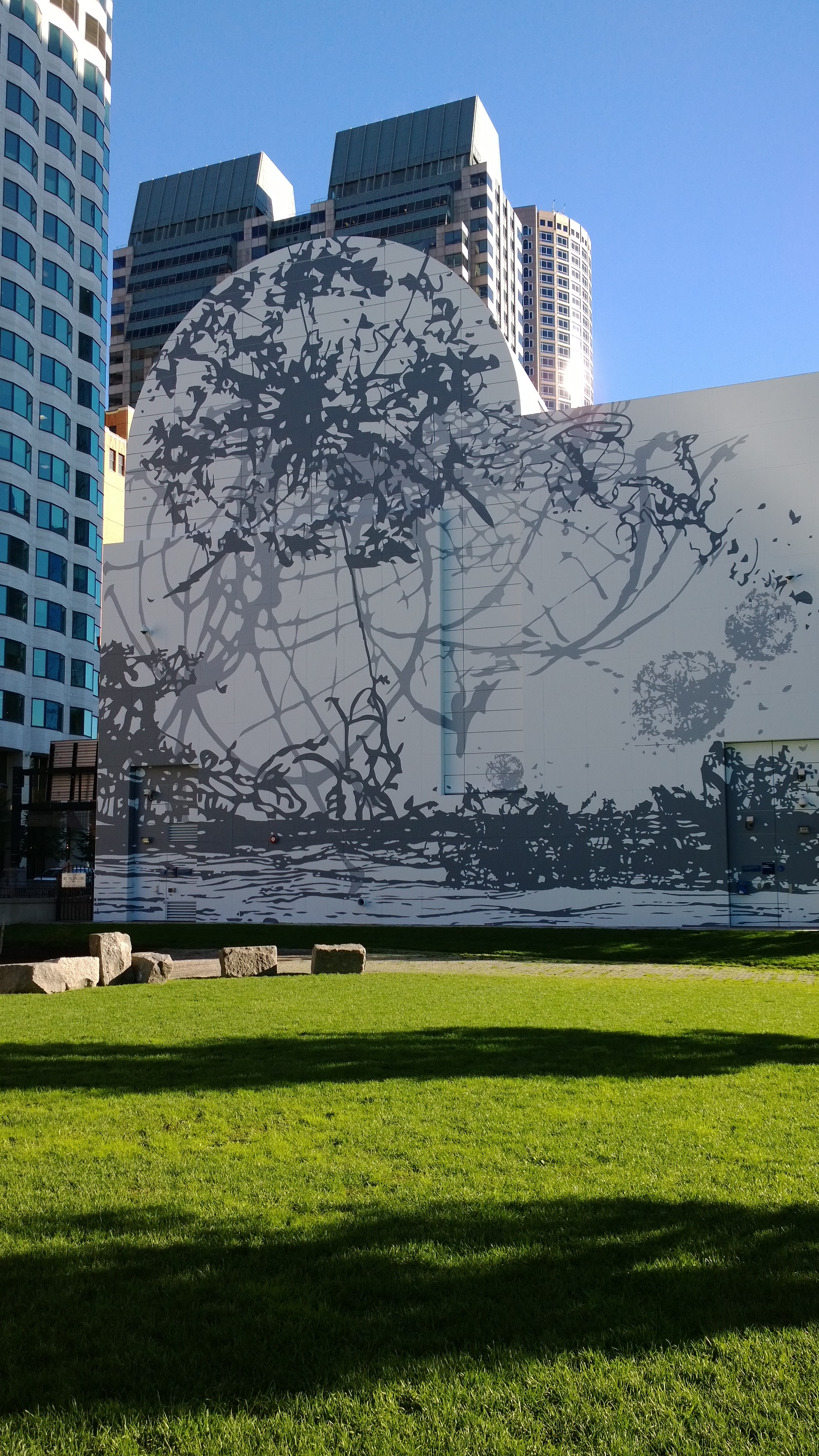
Remember the new Dewey Square mural I blogged about recently, here?
The Boston Globe has a brief update for you, but their picture is blocked by a cherry picker. As soon as the Greenway moved the heavy equipment, I shot my own picture.
Be watching for more on Dewey Square. I have blogged about the two months that Occupy Boston camped there. I have blogged about the Greenway’s teaching garden alongside the Big Dig exit and about the farmers market that sets up Tuesdays and Thursdays. Soon I will show pictures of the pianos that arrived today — with people playing them, I hope.
Matadero was an old abandoned slaughterhouse in Madrid. Lately it has been “evolving into a cultural laboratory, where a new arts financing strategy is being tested.” So says Doreen Carvajal in the NY Times.
“Companies and institutions are providing financial support to supplement dwindling government arts subsidies, but with a twist: they don’t just send checks, they move in.
“Within the walled 59,000-square-foot center, there are public theaters and exhibition spaces that last year drew more than 500,000 visitors for music and art events and avant-garde plays. But five new residents are private institutions, including a designers’ association, a publishing house’s foundation and offices of Red Bull, the Austrian energy drink maker.
“They are in the compound rent-free for now, but have invested millions in the remodeling of pavilions there, as well as in programming, from art exhibitions to music festivals.
“These new partnerships are forged, out of necessity, here in Spain, where government support for culture has plunged by almost 50 percent over the last four years, a result of a lingering economic crisis that hit late in 2008.”
Some observers worry about the downsides of corporations having a big influence on what art gets shown, but haven’t the arts always had to have some help from patrons or companies?
Probably it pays just to be wary, to recognize when there is undue influence, and to push back. Certainly smaller, more experimental projects are unlikely to find a home under a Red Bull banner.
Luke Jerram’s street-piano movement is coming to Boston. We blogged previously about the artist here (his solar chandelier installation) and here (the street piano concept).
The pianos will be scattered all around Boston, and everyone is encouraged to play. The Boston website says, “Touring internationally since 2008, Play Me, I’m Yours is an arts project by artist Luke Jerram. When the project goes live in Boston on September 27, over 1,000 street pianos will have been installed in 37 cities across the globe, bearing the simple invitation to Play Me, I’m Yours! The project has already reached more than four million people worldwide.
“As a thank you to millions of loyal patrons and to celebrate its 75th anniversary season, Celebrity Series of Boston is presenting Play Me, I’m Yours ‘the Street Pianos Boston Festival’ from September 27 – October 14, 2013.”
More here. The website also provides details of where all the pianos will be found starting Friday.
YouTube video: Dani Rosenoer of Three Days Grace punching on a street piano @ Cleveland.








 Suzanne's Mom's Blog