Feeds:
Posts
Comments

Photo: Girl Scout Troop 6000.
Girl Scouts of Greater New York’s Troop 6000 is a first-of-its-kind program designed to serve families living in temporary housing in the New York City shelter system.

Kindness and compassion are not dead. You just need to know where to find them.

Consider New York’s Girl Scout Troop 6000, which reaches out to migrant children.

Sara Herschander reports for the Chronicle of Philanthropy, “Once a week in a midtown Manhattan hotel, dozens of Girl Scouts gather in a spare room made homey by string lights and children’s drawings. They earn badges, go on field trips to the Statue of Liberty, and learn how to navigate the subway in a city most have just begun to call home.

“They are the newest members of New York City’s largest Girl Scout troop. And they live in an emergency shelter where 170,000 asylum seekers and migrants, including tens of thousands of children, have arrived from the southern border since the spring of 2022.

“As government officials debate how to handle the influx of new arrivals, the Girl Scouts — whose Troop 6000 has served kids who live in the shelter system since 2017 — are quietly welcoming hundreds of the city’s youngest new residents with the support of donations. Most of the girls have fled dire conditions in South and Central America and endured an arduous journey to the U.S.

“Not everybody is happy about the evolution of Troop 6000. With anti-immigrant rhetoric on the rise and a contentious election ahead, some donors see the Girl Scouts as wading too readily into politically controversial waters. That hasn’t fazed the group — or their small army of philanthropic supporters. Amid city budget cuts and a growing need for services, they are among dozens of charities that say their support for all New Yorkers, including newcomers, is more important than ever.

“ ‘If it has to do with young girls in New York City, then it’s not political,’ said Meridith Maskara, CEO of the Girl Scouts of Greater New York. ‘It’s our job.’ …

“Last year, Troop 6000 opened its newest branch at a hotel-turned-shelter in Midtown Manhattan, one of several city-funded relief centers for migrants. Though hundreds of families sleep at the shelter every night, the Girl Scouts is the only children’s program offered. …

“Last January, the group began recruiting at the shelter and rolled out a bilingual curriculum to help scouts learn more about New York City through its monuments, subway system, and political borders. …

“With few other after-school opportunities available, the girls are ‘so hungry for more’ ways to get involved, says Giselle Burgess, senior director of the Girl Scouts of New York’s Troop 6000.

“Seven years ago, Burgess, a single mother of six, built Troop 6000 from the ground up after losing her rental home to developers. While living in a hotel-turned-shelter, she got the idea of creating a troop for girls like her daughters. It was the height of ‘NIMBYism,’ she says, the not-in-my-backyard movement opposed to local homeless shelters.

“At the time, she asked: ‘Who’s gonna give us a chance?’

“As it turns out, ‘the donations started pouring in,’ she says. A New York Times profile lead to a groundswell of philanthropy. … So, when the mayor’s office floated the idea of starting a troop at the Midtown shelter, the Girl Scouts were ready. …

“Troop 6000 employs bilingual social workers and a transition specialist versed in supporting children who’ve experienced trauma. But otherwise, it operates much like any other Girl Scout troop. Most importantly, says Maskara, the troop offers a glimmer of consistency to children who often must pack up, move homes, and switch schools in the middle of the academic year. Scouts are encouraged to continue participating even when their families move. …

“ ‘Keeping the girls connected is what matters the most for us right now,’ says Burgess. ‘There’s a lot of emotion, frustration, and hurt.’ Around 50 scouts who have left the shelter participate in a virtual troop. ‘We want to be able to encourage the girls and let them know it’s not over,’ she says. ‘We’re still here.’ “

More here.
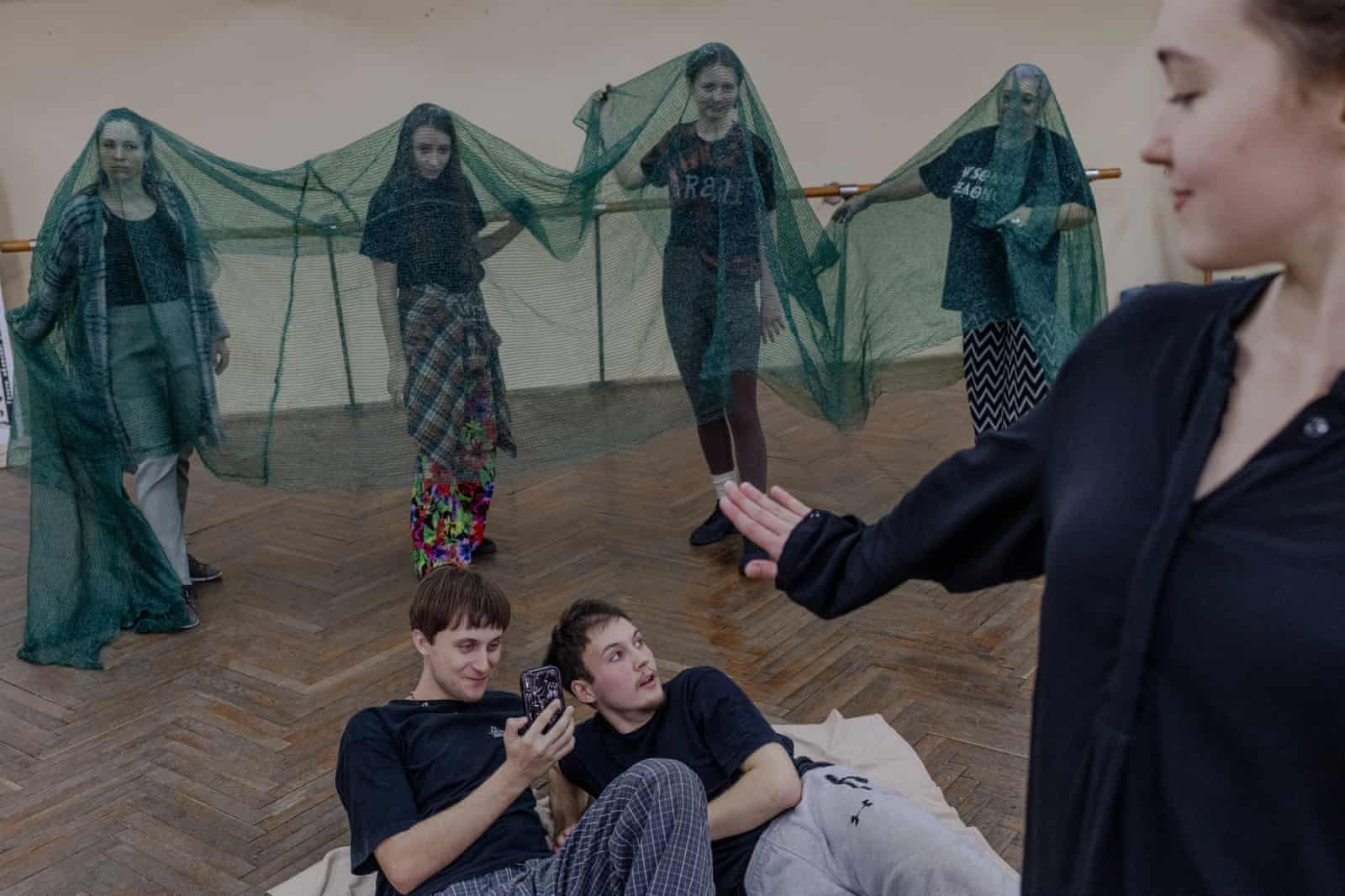
Photo: Kasia Stręk/The Guardian.
Actors from Mariupol theatre and new recruits of the renewed theater, now in Uzhorod, rehearse for a piece called Poets Lived Here, depicting how lives have been changed by the war.

As with all stories about war zones like Ukraine, one hopes that positive news published yesterday — or a few months ago — is still true today. Consider an article by the Guardian’s Shaun Walker written in March that was a testament to the resilient spirit of the Ukrainian people.

“When the bombs hit the Mariupol Drama theatre, Vira Lebedynska did not hear a boom or a blast. From the recording studio in the theatre’s basement, where she was sheltering along with a few other theatre employees, the sensation was more like a vacuum.

“ ‘There was a whoosh, and a feeling that the air was being sucked out of the room,’ she recalled. A few seconds earlier, her cat Gabriel had suddenly tensed, perhaps sensing the sound of a plane overhead. … The 65-year-old actor and vocal trainer was one of about 20 theatre employees among the more than 1,000 people sheltering in the theatre as the Russian army laid siege to Mariupol in March 2022.

“The strike, believed to have been carried out with two 500kg bombs dropped from a Russian aircraft, came despite widespread knowledge that it was the biggest civilian shelter in the city. …

“[Now] in Kyiv, Lebedynska will perform in Mariupol Drama, a play based on the memories of four actors who were sheltering inside the theatre, all of whom speak about their own experiences from the stage.

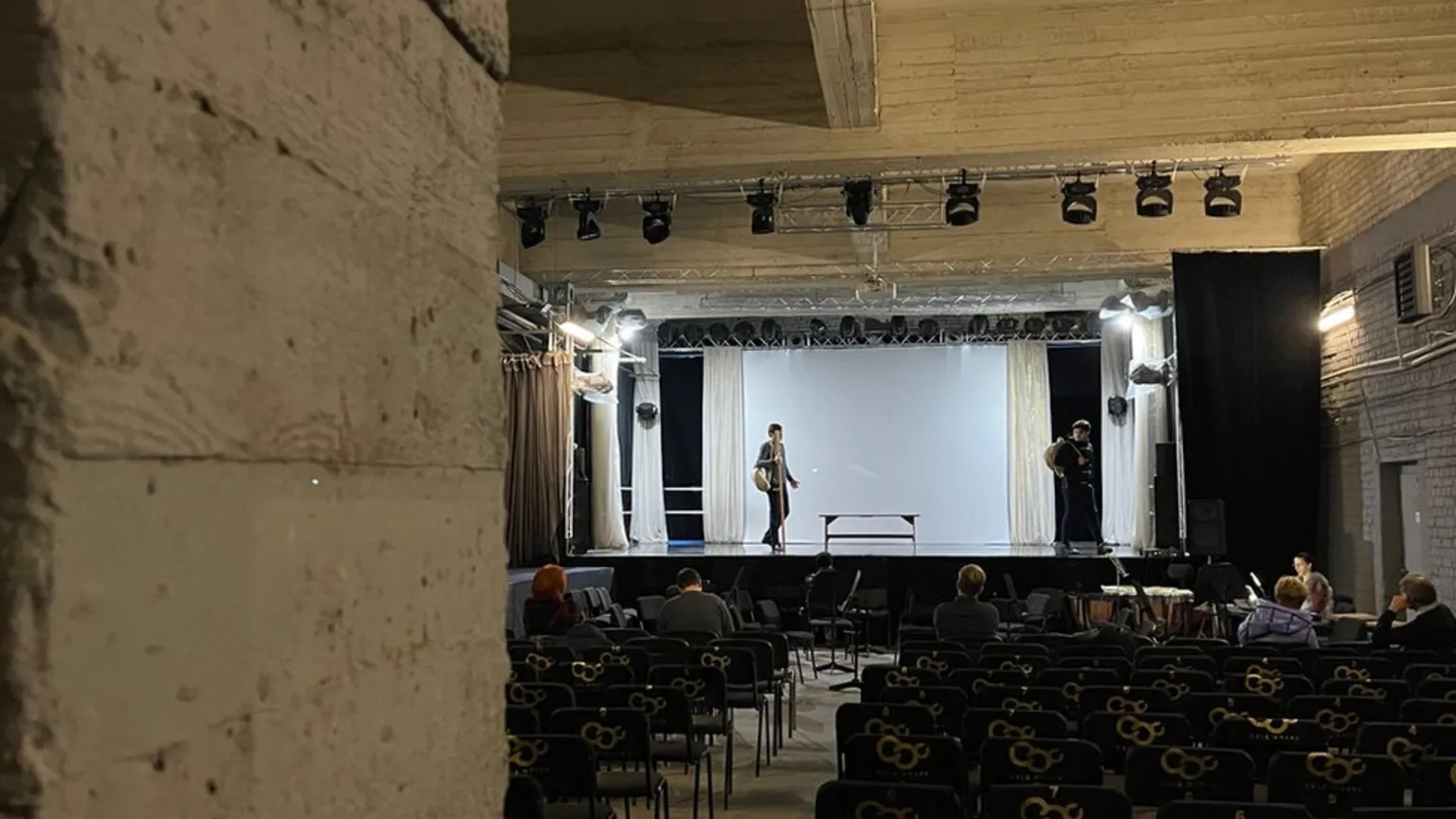
“The four are among a small group of actors and staff from the theatre who have resurrected the troupe in Uzhhorod, in the far west of Ukraine. Performances take place in the vast, boxy auditorium of the city’s main theatre, which has offered up its stage for the Mariupol troupe. There are also occasional tours; [The March 16] performance will be the Kyiv premiere of Mariupol Drama. Props are minimal while costumes have been sewn from scratch or bought in local secondhand shops, but the spirit and sense of duty is high.

‘The body of our theatre has been destroyed, but the heart still beats here in Uzhhorod,’ said Hennadiy Dybovskiy, the theatre’s recently appointed 63-year-old director, who is originally from Donetsk.

“In Mariupol Drama, each of the actors brings a real artifact on to the stage that reminds them of their time sheltering in the theatre. For Lebedynska, it is cloakroom tag number 392; staff of the theatre wore the tags around their necks to identify themselves to others who might need help finding their way around. For 24-year-old Dmytro Murantsev, it’s the one-piece Spider-Man pyjama suit that he wore throughout the siege, as it was his warmest item of clothing.

“Also on stage in the play are Ihor Kytrysh, 43, and his wife, Olena Bila, 42 who have both acted at the Mariupol theatre for more than two decades. They left the theatre the day before the explosion, risking a drive across the frontline to get out of the city.

“They feel grateful they made it out, with their son, but like most people from Mariupol, they feel a sharp sense of loss for everything they left behind. …

“Lebedynska said she ignored her son’s pleas to leave Mariupol in the buildup to the war because she did not think full-scale war was possible. When the hostilities started, she took a rucksack of important possessions and Gabriel the cat, and made her way to the theatre. She and a few other theatre colleagues set up camp in the recording studio in the basement. …

“ ‘There weren’t that many people at first, but then someone opened the theatre doors and people started streaming in. They had heard there would be an organized evacuation from the theatre, but there was no evacuation so in the end everyone stayed there,’ she recalled.

“People cooked food on open fires outside, and carried various sets and props from the storerooms to sleep on. On occasion, some people tried to leave and drive out of Mariupol, but they often came back some hours later, saying they had been shot at.

“Lebedynska does not remember the aftermath of the strike clearly. … She walked for two hours through the ruined city, in a dressing gown, before stopping to stay the night in an apartment on the edge of Mariupol with the windows blown out. …

“It can feel strange playing with a skeleton troupe to a mostly empty auditorium, in a theatre a thousand miles from Mariupol in the opposite corner of Ukraine. But Dybovskiy said it was an important act of defiance to keep going. ‘This is the only professional collective that is flying the flag of Donetsk region. We won’t let the Russian Orcs appropriate our Donetsk theatre traditions,’ he said. …

“[Meanwhile, a] newly Russianized troupe has already been on several tours to Russian regions, and Moscow has sent in actors and directors to work in occupied Ukrainian territory. The theatre frequently takes part in ‘patriotic’ concerts devoted to Russian national holidays and its orchestra is called on to play military marches. …

“Lebedynska said that in the months after she had fled to Ukraine-controlled territory, she still had some contact by telephone with fellow actors who had stayed. ‘I think a lot of them had simply been waiting for the “Russian world” to come.’ …

“Murantsev said he thought these views were more of a coping mechanism, for people who could not bear to leave their home town. ‘I don’t think there were many super pro-Russian people there, I think they just feel “outside politics” and want to stay quiet,’ he said.”

There will come a time after the war, a time of rebuilding. And it will have to start with healing these sorts of divisions. Meanwhile, a reduced but feisty Mariupol theater will grow in the west.

More at the Guardian, here. No firewall. Donations encouraged.

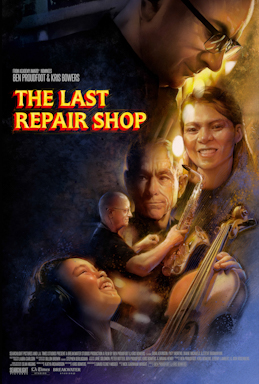
The Last Repair Shop, above, is a 2023 American short documentary film directed by Ben Proudfoot and Kris Bowers

I listen every day to WICN, a jazz station in Worcester, Massachusetts. Besides providing wonderful music, the station does good works that I appreciate. For example, they collect unused school instruments to donate to local public school students. Both Suzanne (oboe) and John (sax) let me take the instruments they hadn’t touched for years to WICN and donate them.

Other school districts also offer free instruments, but few have a reliable way to repair any that need work. Now, publicity for an Oscar-winning film about a repair initiative in one district is spreading inspiration.

Sheena Goodyear reports at CBC Radio, “Steve Bagmanyan is putting retirement on hold — and he couldn’t be more thrilled about it. Bagmanyan is the supervisor at a warehouse in Los Angeles, where a small, but mighty, team of music lovers repair musical instruments for thousands of public school students. 

“One of the last programs of its kind in the U.S., it has struggled to stay afloat over the years. But now, thanks to the Oscar-winning documentary short The Last Repair Shop, donations are pouring in. …

The Last Repair Shop tells the story of the L.A. Unified School District (LAUSD) Musical Instrument Repair Shop, where 11 technicians service about 6,000 instruments each year for more than 1,300 schools across the city.

“It spotlights the shop’s staff, including Bagmanyan, as well as the students who benefit from their work, showing how music has changed each of their lives in momentous ways. 

In an interview with As It Happens earlier this year, co-director Ben Proudfoot, a Halifax native, called the film ‘a vehicle to get people to stand up and cheer for music and arts education around the world.’

“Now, that’s exactly what people are doing. Proudfoot and co-director Kris Bowers have teamed up with the Los Angeles Unified School District to create ‘The Last Repair Shop Fund,’ hosted online by Paypal. …

” ‘Ben and I can’t think of a better impact for our film to make,’ Bowers said in a press release. … As the money comes in, Bagmanyan says he and the school district have big plans — new equipment, upgraded tools, more technicians and, if possible, an apprenticeship program.

” ‘Maybe some high school kids would be interested in learning the trade since there’s not many repair people left really,’ Bagmanyan said.

“Ever since The Last Repair Shop was nominated for best documentary short at the Academy Awards, Bagmanyan says life has been a whirlwind. After years of toiling in relative obscurity, he and his colleagues are now attending screenings, doing media interviews and going to red carpet events. 

At one of the first screenings, they met some of the students who rely on the public school instruments they repair — many of whom could never afford an instrument out of pocket.

” ‘It was very rewarding,’ Bagmanyan said. ‘I felt very proud. I always did, but when I met students and actually went to all the screenings, it’s a different way of feeling proud. It’s like you actually see who you’re doing it for.’

“One of those students, violinist Porché Brinker, was featured in the doc and shared the stage with Proudfoot and Bowers when they won the Oscar.  Bagmanyan and the other technicians were watching proudly from the balcony.

” ‘To see the way that everyday people have shown up to make sure that kids like Porché have a working violin in their hand is truly moving, and goes to show that good old fashioned generosity and goodness is still very much alive,’ Proudfoot told CBC in an emailed statement. …

“But the most amazing thing to come out of the film, Bagmanyan says, are the boxes of hand-written, thank you letters that keep arriving at the shop from L.A. public school teachers and students, he says. …

” ‘Every note is our Oscar. Every thank you email from a teacher, that’s our Oscar,’ he said. …

“Funding cuts and furloughs over the years meant that by the time he took over as supervisor in 2013, [the repair team was down to six from 30].

“With new funding and attention from the Oscars win, he’s aiming to ‘bring it — at least partially — back to its capacity.’ “

More at CBC, here.

The Car-Free City

Photo: Marek Lumi via Unsplash.
Barcelona, 2023.

How do you get people to change behavior? Even if they know something is good for the world and good for themselves (driving less, for instance), how do you get them to do it? Often people won’t change until they feel the reality of disaster.

But as Andrew Kersley reports at Wired magazine, “people hate the idea of car-free cities — until they live in one.” He notes that one of the best ways to get them started is “from the ground up.” Read on.

“London had a problem,” he begins. “In 2016, more than 2 million of the city’s residents—roughly a quarter of its population — lived in areas with illegal levels of air pollution; areas that also contained nearly 500 of the city’s schools. That same air pollution was prematurely killing as many as 36,000 people a year. Much of it was coming from transport: a quarter of the city’s carbon emissions were from moving people and goods, with three-quarters of that emitted by road traffic.

“But in the years since, carbon emissions have fallen. There’s also been a 94 percent reduction in the number of people living in areas with illegal levels of nitrogen dioxide, a pollutant that causes lung damage. The reason? London has spent years and millions of pounds reducing the number of motorists in the city.

“It’s far from alone. From Oslo to Hamburg and Ljubljana to Helsinki, cities across Europe have started working to reduce their road traffic in an effort to curb air pollution and climate change.

“But while it’s certainly having an impact (Ljubljana, one of the earliest places to transition away from cars, has seen sizable reductions in carbon emissions and air pollution), going car-free is a lot harder than it seems. Not only has it led to politicians and urban planners facing death threats and being doxxed, it has forced them to rethink the entire basis of city life.

“London’s car-reduction policies come in a variety of forms. There are charges for dirtier vehicles and for driving into the city center. Road layouts in residential areas have been redesigned, with one-way systems and bollards, barriers, and planters used to reduce through-traffic (creating what are known as ‘low-traffic neighborhoods’ — or LTNs). And schemes to get more people cycling and using public transport have been introduced. The city has avoided the kind of outright car bans seen elsewhere in Europe, such as in Copenhagen, but nevertheless things have changed.

“ ‘The level of traffic reduction is transformative, and it’s throughout the whole day,’ says Claire Holland, leader of the council in Lambeth, a borough in south London. Lambeth now sees 25,000 fewer daily car journeys than before its LTN scheme was put in place in 2020, even after adjusting for the impact of the pandemic. Meanwhile, there was a 40 percent increase in cycling and similar rises in walking and scooting over that same period.

“What seems to work best is a carrot-and-stick approach — creating positive reasons to take a bus or to cycle rather than just making driving harder. ‘In crowded urban areas, you can’t just make buses better if those buses are still always stuck in car traffic,’ says Rachel Aldred, professor of transport at the University of Westminster and director of its Active Travel Academy. ‘The academic evidence suggests that a mixture of positive and negative characteristics is more effective than either on their own.’ …

“Urban driving doesn’t make up the majority of a country’s car use, but the kind of short journeys taken when driving in the city are some of the most obviously wasteful, making cities an ideal place to start if you’re looking to get people out from behind the wheel. That, and the fact that many city residents are already car-less (just 40 percent of people in Lambeth own cars, for example) and that cities tend to have better public transport alternatives than elsewhere. …

“But as effective as policies to end or reduce urban car use have been, they’ve almost universally faced huge opposition. When Oslo proposed in 2017 that its city center should be car-free, the backlash saw the idea branded as a ‘Berlin Wall against motorists.’ The plan ended up being downgraded into a less ambitious scheme consisting of smaller changes, like removing car parking and building cycle lanes to try to lower the number of vehicles.

“In London, the introduction of LTNs has also led to a massive backlash. In the east London borough of Hackney, one councilor and his family were sent death threats due to their support for the programme. Bollards were regularly graffitied, while pro-LTN activists were accused of ‘social cleansing.’ It was suggested that low-traffic areas would drive up house prices and leave the only affordable accommodation on unprotected roads. ‘It became very intimidating,’ says Holland. ‘I had my address tweeted out twice, with sort of veiled threats from people who didn’t even live in the borough saying that we knew they knew where I lived.’ …

“Any attempts to reduce urban car use tend to do better when designed from the bottom up. Barcelona’s superblocks program, which takes sets of nine blocks within its grid system and limits cars to the roads around the outside of the set (as well as reducing speed limits and removing on-street parking) was shaped by having resident input on every stage of the process, from design to implementation. Early indicators suggest the policy has been wildly popular with residents, has seen nitrogen dioxide air pollution fall by 25 percent in some areas, and will prevent an estimated 667 premature deaths each year, saving an estimated 1.7 billion euros.” More at Wired, here.

What local policies for helping you use your car less would you welcome?

Nurse in Ukraine

Photo: Scott Peterson/Getty Images/The Christian Science Monitor.
Ukrainian senior nurse Oksana Sokhan waits to treat wounded soldiers near the southern war front in Zaporizhzhia district, Ukraine, in February.

You don’t need to save the whole world. Just do something where you are. That is a bit of wisdom I heard on the radio last week from a woman who had served as a judge in Massachusetts. In her youth, she had fought apartheid in her home country when the battle seemed hopeless. But as we know, many hands together made a difference in South Africa.

Scott Peterson writes at the Christian Science Monitor about a nurse in Ukraine who is also making a difference.

“From all her years of caring for wounded soldiers, the Ukrainian nurse recounts one transcendent moment of comfort she provided early in this war that she says she’ll never forget. …

“Not long after Russia’s February 2022 invasion of Ukraine, Oksana Sokhan found herself in an evacuation minibus, wedged between two stricken soldiers in the dark, as the vehicle tried to safely get away from the front line.

“The wounded men were agitated and anxious, disoriented and determined to get up and move. Ms. Sokhan had no sedatives – but she had within her the key to calming them. She began singing Ukrainian lullabies to the wounded fighters, and stroking them as a mother would. Their anxiety eased. If she stopped the soothing singing for a moment, she saw their anxiety surge again.

“ ‘I was surprised myself that it worked – surely it worked on a subconscious level for both of them. … I didn’t know what else to do; we didn’t have any medicine.’ …

“Ms. Sokhan may be just one senior nurse, but she is emblematic of the legions of Ukrainian military medics devoted to preserving the lives of the country’s outnumbered forces. …

“Ukraine’s liberation of Kherson in September 2022, for example, and the monthslong grinding fight for Bakhmut late last year pushed Ms. Sokhan and her colleagues to the limit. During both campaigns, the medical teams regularly saw 100 casualties come through their doors daily. …

“ ‘Everyone here, we all live for one day. If we survive today, it’s good,’ she says. ‘I’ve learned not to not build plans.’ …

“Ms. Sokhan never expected to be a front-line nurse in Russia’s war, either. … She was a decade ago at the opposite end of the country, in the far west, taking care of people at a sprawling resort.

“When Russian troops invaded Ukrainian Crimea in 2014, she recounts, her daughter and son-in-law, who were on the peninsula to ‘live close to the sea,’ called her in alarm. They told her the Russians had issued an ultimatum: Take Russian passports and denounce Ukraine, or leave. … They moved back to their hometown of Lysychansk, but within a month, Russian and pro-Russian proxies were there, too, seizing control. The family had to walk more than 4 miles, with a 4-year-old and all the belongings they could carry, before fleeing west.

“ ‘I got very angry,’ recalls Ms. Sokhan. ‘I quit that job and went to the military office to sign up for the army.’ …

“Ms. Sokhan focuses on doing what she can to contribute to the well-being of Ukraine’s wounded soldiers.

“ ‘We want to save everyone,’ she says. … ‘What’s uplifting and inspiring are our guys, people who come here wounded, who are cold and hungry and dirty,’ says Ms. Sokhan. ‘But all they say is, “Doc, quickly get me fixed up; I’ve got to get back to my guys.” ‘ “

More at the Monitor, here.

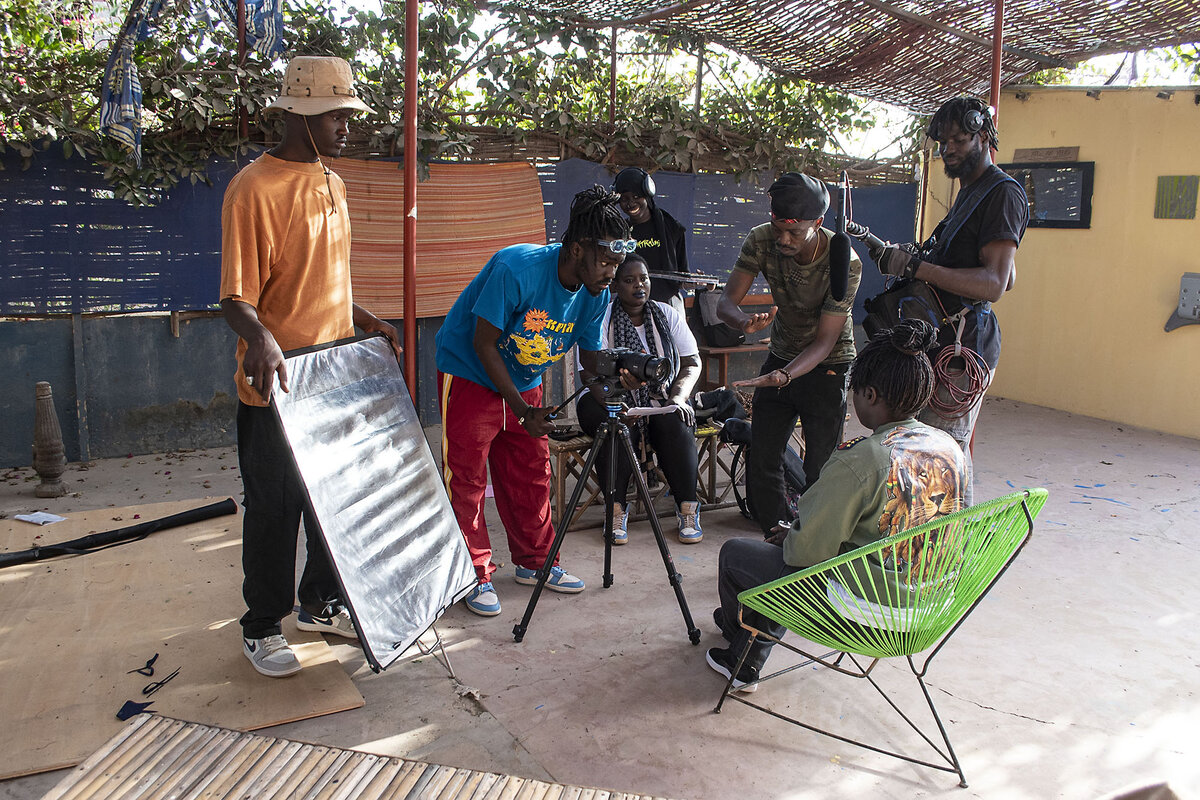
Photo: Ayen Deng Bior.
“Assistant director Pape Samba Tine (second from right) yells, ‘Action!’ on the set of a new Senegalese documentary about women’s lives,” the Christian Science Monitor reports.

For generations, films about Africa were written by non-Africans — in effect by the descendants of the colonizers. But over time, Africans have begun to tell their own stories in their own way.

Ayen Deng Bior, reporting from Senegal for the Christian Science Monitor, writes, “On a dusty Monday afternoon, the hallways of the Kourtrajmé film school buzz with nervous chatter and excitement. It is pitch day, and soon everyone files into a classroom to listen to the students present their screenplay ideas.

“The topics cover a wide sweep of Senegalese life, from the story of a 19th-century slave insurrection to a supernatural drama about a woman who can read people’s thoughts.

“When Leida Ndiaye’s turn comes, she is sweating. … But soon, she finds her rhythm, describing her idea for a rom-com about a woman in her early 30s who uses her job in human resources to ‘interview’ prospective dates to her birthday party. Ms. Ndiaye explains that she wants to provoke new conversations about dating and marriage.

“ ‘A lot of financially independent women are living the same situation here in Senegal,’ she says. ‘The tension between her professional life and her chaotic emotional life leads her to a deep introspection on her true desires and the nature of love.’

“Ms. Ndiaye and her classmates at Kourtrajmé are part of a new generation of Senegalese filmmakers who are setting out to tell their own stories on their own terms. With a film about Senegalese migrants, Io Capitano, up for best foreign film at the Oscars [2024], they know the world is eager to hear about their lives. 

“But Io Capitano’s success also highlights the challenges they face. The movie was made by Italian filmmakers, igniting conversation about what types of stories get told about Africa and by whom. 

“ ‘The Italian film is amazing, but it’s another story about migration,’ says Emma Sangaré, an American producer and screenwriter, and Kourtrajmé’s co-founder. For her students, she adds, there is so much more to say.

“Kourtrajmé’s popularity is a testament to hunger of young Africans to showcase a different kind of story. The school, which opened in 2022, gets hundreds of applications from all over the continent for about two dozen spots in its screenwriting and directing courses. Both six-month programs are fully funded.  

“The Dakar school is the third branch of Kourtrajmé, which French director Ladj Ly started in 2018 in a disadvantaged suburb of Paris in order to bring new and different voices into the film industry. Senegal’s Kourtrajmé was founded by Mr. Ly, Ms. Sangaré, and her husband, French Malian director Toumani Sangaré. …

“Last year, Banel & Adama, a magical realist romantic drama by French Senegalese director Ramata-Toulaye Sy, premiered to positive reviews at the Cannes film festival. But for many Senegalese filmmakers, a lack of resources and connections still makes the global film circuit hard to break into.

Io Capitano, for instance, had budget of more than $8 million. … But getting funding like that often means turning to American or European producers. In these situations, Ms. Sangaré says the power dynamic makes it hard for young Senegalese filmmakers to assert their authority about the kinds of stories they want to tell. …

“Mariama Niang is in director mode, supervising her team as it prepares to shoot an interview for her documentary, Elle, on a recent afternoon. …

“For Ms. Niang, an alumnus of Kourtrajmé who has wanted to be a filmmaker since she was a child, this moment has been a long time coming.

“ ‘Cinema is the world,’ she says. ‘In cinema, you can see everything. You can see one movie, and you see all your life in that movie.’

Elle, whose title means ‘she,’ follows five Senegalese women who have made names for themselves in their respective industries – from photography to financial consulting – while challenging the common narrative here that women are ‘just’ homemakers and childbearers. It’s a contentious topic that Ms. Niang has wanted to tackle for years, but she couldn’t figure out how to pay for it.

“Kourtrajmé changed that. The film school funded half the production, and Ms. Niang used the pitch skills she honed there to convince a private investor to pay for the rest.

“Back at Kourtrajmé, Ms. Ndiaye [says] ‘It’s better to tell our own story because if you don’t do it, people won’t know what exactly African people are living. … Westerners are doing it; they share their history; they share their culture. Why not us?’ ”

More at the Monitor, here. No paywall.

Ancient Bread

Photo: Serhat Cetinkaya/Anadolu/Getty Images.
A 8,600-year-old bread was found at the Neolithic archeological site at Cumra district in Konya, Turkey. 

You never know what you’ll find once you start digging. That’s true for many kinds of knowledge — and of course, for archeological sites. Consider this site in Turkey and the world’s oldest piece of bread.

Vishwam Sankaran has an interesting report at the Independent.

Archaeologists in Turkey have uncovered what could be the oldest known piece of fermented bread made by humans at a site dating back to around 6,600 BC.

“The piece of bread was discovered in Turkey’s central Anatolia in the ancient stone age site of Çatalhöyük – one of the largest and best-preserved remains of an early agrarian society around 8,600 years old. Researchers suspect the early human settlement in the Turkish province of Konya flourished between 6,700 to 6,500 BC. …

“Artifacts and structures uncovered at the site over the years suggest the residents of Çatalhöyük were pioneers of early farming, known to have cultivated wheat and barley as well as herding sheep and goats.

“The Unesco World Heritage site was one of the world’s first places of urbanization, accommodating over 8,000 people in its heyday between around 10,000 BC to 2,000 BC.”

For more details, listen to an audio at Public Radio International’s The World, here.

And at PNAS, here, you can read related research on the origins of bread. Amaia Arranz-Otaegui et al describe “the earliest empirical evidence for the preparation of bread-like products by Natufian hunter-gatherers, 4,000 years before the emergence of the Neolithic agricultural way of life. The discovery of charred food remains has allowed for the reconstruction of … the early production of bread-like products. [The] results suggest the use of the wild ancestors of domesticated cereals (e.g. wild einkorn) and club-rush tubers to produce flat bread-like products.”

Photo: Battery Dance.
Hussein Smko, a mostly self-taught Kurdish dancer/choreographer whose talent was spotted by Battery Dance over social media in 2014, inspring the company to give him training over Skype.

I love stories of surprising personal journeys, like the one today about a Kurdish boy whose admiration for a soldier’s hiphop move started him on a road to a dance career in the US.

Here’s Brian Schaefer at the New York Times . “When Hussein Smko was 9, the American military arrived in his hometown, Erbil, the capital of Iraq’s Kurdish region. It was 2003, and Smko, already a survivor of the Kurdish civil war, would chase the American Humvees with other kids. One day a soldier beckoned him over and demonstrated a simple, beguiling gesture: He held out a straight arm then made it ripple like water, a classic hip-hop move.

“ ‘I thought it was like a big sparkle,’ Smko, 30, said in an interview. ‘And I was like, How could you break your bones like that?’

“That brief encounter loomed large for Smko, starting him on an unlikely dance journey that eventually brought him to a small, sun-dappled theater in Tarrytown, N.Y., where he was rehearsing with the Swedish choreographer Pontus Lidberg last week: the dance they were preparing, ‘On the Nature of Rabbits. …

“Smko’s path to this moment has been twisting and at times precarious. After his encounter with that liquid-armed soldier, he immersed himself in hip-hop dance, learning Michael Jackson routines through pirated music videos. Finding outlets for dance was difficult. … He was teased and called gay. But he persevered, and at 13 he started the Street Wolves, a hip-hop troupe that helped spread the form in Kurdistan.

“His pursuit of dance brought him to workshops offered by American Voices, a cultural exchange program affiliated with the United States Department of State. That led to a two-month tour of several East Coast cities, including Niagara Falls, N.Y., where he met his future wife, a U.S. citizen. After the tour, he moved in with her, then brought her to Kurdistan in 2013. The next year, ISIS laid siege to the region.

“Smko’s wife returned to the U.S. to give birth to their daughter while he stayed and prepared to fight. But a relative dissuaded him, which sparked a realization.

“ ‘I decided then that I want to fight through art,’ he said. … He applied for a green card and moved to Niagara Falls in 2015. The next summer, he was contacted by Jonathan Hollander, the founder and director of Battery Dance, a New York company that had briefly trained Smko on Skype years earlier. …

“The company quickly absorbed him into its classes and rehearsals, and suddenly Smko was dancing with trained professionals. ‘Hussein came up to that level,’ Hollander said. ‘It was just a miracle.’

“[In] 2020, he found himself at a crossroads. He worked for the Muslim American Leadership Alliance, and at a hotel front desk. He and his wife separated. He went back to Erbil to see his family, his first visit in seven years.

“His prospects improved in 2022, when he was introduced to the dancer and filmmaker Sasha Korbut and cast in the short film Incomplete, alongside Lidberg. ‘Our energies were synced up,’ Lidberg said of working with Smko. ‘It was the most natural thing.’

“That chemistry inspired Lidberg to include Smko in the development of ‘Rabbits.’ … Smko’s contribution to the process proved invaluable. Lidberg, who is used to working with polished, formally trained dancers, appreciated Smko’s raw physicality and unaffected vitality. …

“In 2019, he founded a company, Project Tag, that has shown work at the Battery Dance Festival and other small performance platforms. It is ‘a goal for me to speak about my background and my history.’ “

More at the Times, here.

I liked how Battery Dance described its original connection with the dancer: “Hussein Smko was the Adel Euro Fellow from 2016-2020.  A self-trained Kurdish dancer/choreographer whose talent was spotted by Battery Dance over social media in the summer of 2014, he was subsequently trained via Skype from his home in Iraq connected with Battery Dance practitioners in their studios in New York City. He managed to get to the U.S. in early 2016 and was granted Permanent Resident Status.”

Photos: John and Suzanne’s Mom.
Delicious-smelling lilac.

Lots to notice in nature at this time of year. I do love spring.

On trails near where I live, there have been wonderful wildflowers lately. I’ve seen pink lady slippers, Canada mayflowers, starflowers, and a trillium.

I always love the redbud trees, like the one in the next photo. The color once made me think it was a plum tree, but my sister straightened me out. I see redbuds everywhere these days.

Next is a weathered old Japanese cherry with an inviting hole for some future inhabitant. The tulips in front of the carpet of azaleas also spoke to me.

A longtime birder found this perfect wood thrush, dead with no visible injuries. He said it was just lying on the ground under the birdbath. A mystery.

Finally, I thought I would show you another kind of Liège waffle at the Burgundian in Attleboro — a savory one with chicken. Our grandson devoured it in no time.

Photo: Siméon Duchoud/Kere Architecture.
Gando primary school in Burkina Faso, Diébédo Francis Kéré’s first construction project after finishing his studies in Germany.

In some cases, ingenuity will help people live with climate change. And the best ideas will come from those who have lived the life. Consider an architect who grew up in a very hot part of Africa.

Èlia Borràs  writes at the Guardian, “If architects are people who like to think their way around challenges, building schools in Burkina Faso must be the dream job. The challenges, after all, are legion: scorching temperatures in the high seasons, limited funds, materials, electricity and water, and clients who are vulnerable and young. How do you keep a building cool under a baking sun when there is no air conditioning?

Finding ingenious ways to use cheap materials to make sure that the schools and orphanages that they have built around Burkina Faso are cool, welcoming places.

“Architect Diébédo Francis Kéré grew up in the small village of Gando and knows the challenges well. He and other architects such as Albert Faus are finding ingenious ways to use cheap materials to make sure that the schools and orphanages that they have built around Burkina Faso are cool, welcoming places.

Kéré, who won the Pritzker prize in 2022, has spoken movingly about the support he was given as a child by the whole community, with everyone giving money towards his education as he left the village and eventually gained a scholarship and studied in Germany. ‘The reason I do what I do is my community,’ he said.

“Gando primary school, built in 2001, was Kéré’s first construction after completing his studies. ‘At first, my community didn’t understand why I wanted to build with clay when there were glass buildings in Germany, so I had to convince them to use the local materials,’ Kéré has said. Men and women came together to build the school, merging traditional techniques such as clay floors, beaten by hand until they were ‘smooth as a baby’s bottom’ with more modern technology to seek better comfort.

“The Noomdo orphanage was another of his projects. ‘The Kéré building provides us with good thermal comfort because when it’s hot, we’re cool, and when it’s cold, we’re warm inside,’ says Pierre Sanou, a social educator at the orphanage near the city of Koudougou in the Centre-Ouest (centre-west) region of Burkina Faso. ‘We don’t need air conditioning, which is an incredible energy saving,’ says Sanou. Temperatures in this region of the world remain at about 40C (104F) during the hottest season.

“ ‘Kéré builds with local materials from our territory like laterite stone and uses very little concrete,’ says Sanou. Kéré’s buildings in Burkina Faso are earthy. They start from the ground and take into account that concrete is a material that needs to be transported to the site, is much more expensive and generates waste. ‘They are permeable buildings that seek the movement of natural air and protection from the sun. For example, they are built with very strong walls and very light roofs so that the cool air that enters from below pushes the hot air out from above,’ says Eduardo González, a member of the Architecture School of Madrid.

“One particularly ingenious innovation is his use of the ancient idea of raised and extended metal roofs. The rooms of Noomdo are covered by a shallow barrel vault resting on a concrete beam but with openings. Above, a metal plate protects the roof from direct sunlight and rain. Additionally, it lets out the hot air. …

“Nearby, the Bangre Veenem school complex designed by Faus in the village of Youlou uses similarly ingenious ways to cool the building. Ousmane Soura works as an education adviser at the school. ‘Before building the school, [Faus] came to speak with the traditional authorities to obtain permission to build and to find out if there were sacred places that are sometimes not obvious or visible to people who don’t know them,’ says Soura.

“The school complex accommodates everything from nursery to high school, including a professional school. ‘The students don’t say: “It’s really hot” and want to go home because they’re comfortable and can concentrate with the class,’ adds Soura.

“It is built with bricks made from laterite stone native to the area. Laterite is shaped with a mould, dried in the sun, and becomes a brick of very intense red colour. ‘They are more resistant to bullets than concrete blocks, which have two holes in the centre,’ says Soura.

“Faus also managed to minimize material transportation and use the territory’s own materials. Even the quarry workers were from the area. ‘It’s a very beautiful material. When families see the buildings, they want their children to go to school,’ says Soura. There are even teenagers who meet inside the classrooms to talk after class or during vacation periods. The complex is an open space.”

More at the Guardian, here. No paywall. Donations encouraged.

About Waffles

Photos: Suzanne and John’s Mom.
Fancy Liège waffle at the Burgundian in Attleboro, Massachusetts, the center of an Oprah-related controversy.

Probably bloggers Cook and Drink, among other readers who cook, will be too polite to scoff at my culinary ignorance, but I have always conflated Dutch pancakes with Belgian waffles.

I love Dutch pancakes — their egginess, the way they swim in butter and puff up like popovers in the required hot, hot oven. My latest mistake arose when I started reading about the Waffle Wars in Massachusetts and the Liège waffle (named for a city in Belgium) at the center of the controversy.

On Mother’s Day, my husband and I went with Suzanne’s family to check out one party to the controversy, the Burgundian in Attleboro, and I for one was expecting to taste something with a popover texture. Turns out Liège waffles have a more doughy, almost chewy, texture and are much sweeter. The web says they are made with a brioche-type batter, using yeast! (I found a recipe online at Karen’s Kitchen, here.) In any case, they were a hit with my family, if not what I expected.

Now you want to hear about the Waffle Wars and what it has to do with Oprah. Let’s turn to the website JD Supra.

“A Massachusetts waffle manufacturer, The Burgundian, recently filed a lawsuit alleging that a potential co-venturer, Eastern Standard Provisions, submitted its Liege waffles for inclusion on Oprah Winfrey’s annual ‘Favorite Things’ list without giving credit to Burgundian. Then, after Burgundian refused to sell its secret waffle recipe, Eastern Standard employed a ‘bait and switch’ by selling Liege waffles from a different company while touting Oprah’s endorsement of the Liege waffles made by Burgundian and enjoying the spoils of landing a spot on the coveted list.

“Burgundian’s owner, Shane Matlock, lacked any formal baking training and therefore developed his secret Liege waffle recipe through years of trial and error. Sensing the limits of ‘self-teaching,’ Mr. Matlock arranged to train with a master Liege waffle maker in Belgium. Mr. Matlock alleges that he was approached by Eastern Standard in 2021 to explore expanding its existing pretzel line with Liege waffles, and the two companies began exploring co-branding opportunities.

“Burgundian shared its secret waffle recipe after Eastern Standard signed a nondisclosure agreement. Eastern Standard’s pretzels had previously been selected as one of Oprah’s ‘Favorite Things’ and the two companies decided to pitch the waffles for Oprah’s 2021 list. Mr. Matlock personally prepared the waffles using his confidential recipe, which were later delivered to Oprah by Eastern Standard.

“Sensing that the waffles would be selected by Oprah for her 2021 list, Eastern Standard allegedly set out in bad faith to secure the rights to Burgundian’s waffle recipe by presenting a term sheet which, rather than proposing a co-branding relationship, contemplated a ‘recipe buy’ whereby Burgundian would sell its recipe to Eastern Standard and receive a royalty for each waffle sold.

“After Oprah selected Burgundian’s waffles to be included in her 2021 list, Burgundian and Eastern Standard’s negotiations broke down. Burgundian alleges that Eastern Standard abruptly terminated the parties’ relationship and threatened litigation against Burgundian. Eastern Standard claimed that it had decided to move forward using a waffle recipe developed by its ‘co-packer,’ which was different than Burgundian’s recipe. Burgundian alleges that the Liege waffles Eastern Standard is currently selling are not the same waffles that Mr. Matlock made and submitted to Oprah, although Eastern Standard continues to advertise its selection on the ‘Favorite Things’ list.

“After Burgundian brought suit in Massachusetts state court, Eastern Standard hit back with counterclaims against Burgundian and Mr. Matlock, alleging that they breached the parties’ NDA by publicly disclosing confidential information in the complaint. Eastern Standard also told a very different story about the parties’ relationship: it alleged that Eastern Standard negotiated in good faith to pursue a co-branding deal with Burgundian, but when Burgundian could not secure the necessary capital to secure such a deal, Eastern Standard was forced to move forward with a different manufacturer, using a different waffle recipe.” Oy, oy, oy. Punished for not raising capital.

Read more at JD Supra, here. And let me hear about your own waffle experiences.

Dutch pancake in cast iron pan I wish I still had after my move.

Photo: BBC/Sarah Rainsford.
Culture has had to move underground in Kharkiv, to hide from Russian drone and missile strikes.

I want to tell you about a beautiful initiative to move culture underground in Kharkiv, Ukraine. But you know that in a county at war, plans are made with the knowledge that they may go off track at any time. What matters most about the story is the indomitable spirit of the Ukrainian people and how they always strive to get things back on track no matter what.

The BBC’s Eastern Europe correspondent Sarah Rainsford wrote about the initiative in March.

“If you want to go to a concert in Kharkiv these days, you have to know who to ask. In Ukraine’s second city, just 40 kilometres [~25 miles] from the Russian border, mass gatherings have been banned since the start of Russia’s full-scale invasion. Most cultural events that do take place are not advertised to make sure they do not get shelled.

“But after two years of near-silence, the Kharkiv National Opera and Ballet is about to burst back into sound — underground.

” ‘We want to bring life back to Kharkiv, including cultural life,’ the theatre’s general director, Ihor Touluzov, explains. ‘Demand for any kind of cultural event here is really high.’

“The bunker theatre is being prepared beneath the main auditorium, down several flights of stairs.

“It has no dress circle, chandeliers or champagne — and a lot of grey concrete. But follow the sound of music and it leads to a raised stage with spotlights and rows of seats. Most importantly, there’s a company of singers, dancers and musicians desperate to perform before a proper audience again.

” ‘We really miss our big hall, the feeling of being on a big stage with lots of people watching,’ violinist Natalia Babarok explains. …

“In the first weeks after the full-scale invasion, when Russian troops were closest and the shelling most intense, a missile landed near to the theatre. Chunks of stone were torn from the side of the building and windows blown out. The roof caught fire several times, but staff managed to extinguish the flames before they took hold. The risk to life remains. …

“When the main theatre closed in February 2022, Volodymyr Kozlov did not stop singing. Thousands of Kharkiv residents were living on the metro then, staying underground away from the explosions. So Volodymyr and a group of fellow artists would tour the stations, performing three concerts a day, a mixture of classical music and popular tunes.

“When he was not singing, Volodymyr was helping to evacuate residents from the areas under heaviest fire or delivering food and other supplies.

” ‘It was impossible to stop, because if you did then the thoughts [of danger] would enter your head, and you couldn’t let them,’ the baritone explains. …

“Volodymyr is performing alongside his wife, Yulia Forsyuk, a soprano soloist who plays the lead role in the Ukrainian opera, Natalka Poltavka. …

“Now the pair are rehearsing to perform for Kharkiv residents again, safely beneath the city streets. But it’s not just the surroundings and acoustics that are different. … One man was killed fighting on the frontline and several more have been mobilized; others are scattered as refugees.

“For those who have stayed in Kharkiv, everything is being adjusted to their reduced new reality.

” ‘Our director adapts the score to feel like everyone’s still there,’ Natalia Babarok describes the changes for the orchestra.

” ‘My husband plays the trombone, but he’s told to play the bassoon and the horn parts too. As a violinist, I might also play the part of the flute. You have to play for yourself, and for someone else.’ “

The long, beautiful article is at the BBC, here. No paywall.

Alas, last Friday: “KYIV, May 10 (Reuters) – Russian forces launched an armored ground attack on Friday near Ukraine’s second city of Kharkiv in the northeast of the country and made small inroads, opening a new front.”

Photo: Archaeological Park of Pompeii.
A well-preserved fresco depicting the myth of Phrixus and Helle was recently uncovered at Pompeii, a city buried in 79 CE.

Have you ever felt curious about a Greek myth? Once you start digging in, you find there’s always another story behind the story. Consider the Golden Fleece of Jason and the Argonauts‘ quest. That’s a tale stirred up anew by a discovery at Pompeii.

As Rhea Nayyar reports at Hyperallergic, “Archaeologists in Italy recently uncovered a 2,000-year-old fresco in remarkable condition on the walls of the House of Leda, a Pompeii mansion under excavation since 2018 that’s recognized for its exquisite art. Painted as if it were a framed artwork on a yellow wall, the fresco depicts the Greek mythological tale of Phrixus and Helle with vibrant pigments and crisp dimensions that have been preserved beneath volcanic ash since 79 CE, after the eruption of Mount Vesuvius.

“According to the tale, Phrixus and Helle were twin children born to the Boeotian king Athamas and a nymph named Nephele. Athamas remarried to a mortal woman named Ino who hated her step-children and devised a plan to have Phrixus sacrificed by the order of an oracle so she could secure her own son’s right to the throne. Phrixus [the boy] and Helle [the girl] escaped from Boeotia with the help of the Golden Ram that flew them across the sea, but Helle sadly fell off of its back mid-flight and drowned in the ocean. Phrixus found safety with King Aeëtes of Colchis, and later married his daughter Chalciope. The fresco depicts the frequently referenced scene of Helle drowning while reaching out for her brother’s hand as the Golden Ram prepares to soar away.

“Gabriel Zuchtriegel, the director of the Pompeii Archaeological Park [says] ‘history has repeated itself’ … Phrixus and Helle were ‘two refugees at sea.’ …

“The discovery came along during the conclusion of the Great Pompeii Project that was spearheaded by the Italian government in 2012 to further excavate, stabilize, and restore structures across the ancient city amidst research efforts, climate emergencies, and increased tourism. Earlier this month, Zuchtriegel shared in an official statement that the next phase for Pompeii was to develop it from an urban planning standpoint that engages surrounding towns and cities and promotes further educational opportunities for history and culture.”

More at Hyperallergic, here. No paywall. Subscriptions welcomed.

More on the Greek myth from Greek: “Helle, for unknown reasons, fell off the ram and drowned in the strait between Europe and Asia, which was named after her the Hellespont, meaning the sea of Helle (now Dardanelles). Phrixus survived all the way to Colchis, where King Aeëtes, the son of the sun god Helios, took him in and treated him kindly, giving Phrixus his daughter, Chalciope, in marriage. In gratitude, Phrixus sacrificed the ram to Poseidon and gave the king the Golden Fleece of the ram, which Aeëtes hung in a tree in the holy grove of Ares in his kingdom, guarded by a dragon that never slept. Phrixus and Chalciope had four sons, who later joined forces with the Argonauts.”

See what I mean about the way each myth makes you want to research another myth? I’m quite intrigued by a “dragon that never slept.” Even Smaug sleeps, for goodness’ sake!

Photo: John and Suzanne’s Mom.
Mother and baby sculpture at Mass General Hospital in Boston.

Sending love to all mothers today and to nonmothers who rise up in times of need to mother children. This year, I’m thinking particularly of those in the world’s trouble spots who do all they can to mother and protect frightened children. Wishing them strength and an end to the chaos around them.

Photo: Kat Baulu/Wikipedia.
Alanis Obomsawin in photo of the crew of Canadian film
Waseteg, 2010.

What caught my attention in one story about Alanis Obomsawin was that when an instagrammer I follow went to a dinner with the filmmaker, the 91-year-old prepared the food herself. That is, she’s still going strong.

CBC Radio interviewed Alanis Obomsawin not long ago in an episode produced by Nicola Luksic.

“At the age of 91, prolific Abenaki artist and filmmaker Alanis Obomsawin is not slowing down. For nearly 70 years, her storytelling and documentary work has served as a mirror for Canada, vividly capturing and reflecting Indigenous experiences, providing a space for all Canadians to witness perspectives that have otherwise been suppressed and ignored.

“Obomsawin talks about her life’s influences and the quiet power of listening in her 2023 Beatty Lecture at McGill University.

” ‘I continue making documentaries. In those days, everything was so full of pain and danger. It was hard for our people to imagine change,’ she told an audience at Pollack Hall on McGill’s downtown campus. ‘My dear brothers and sisters, we are all born with a gift. And to each one of you. Your life is sacred. You must change the perspective from limitations to all is possible. Slowly change came.’ …

“Making documentaries was a way to provide a space for Indigenous experiences that would otherwise go unseen and unheard, nurturing better Indigenous and settler relations. …

“After her Beatty Lecture, the legendary documentary filmmaker and artist spoke to IDEAS host Nahlah Ayed. …

Nahlah Ayed
“You said that you see this as a moment when all is possible. Can you speak a bit more about you know, you’ve seen a lot of change in the relationship between the Indigenous people of this country and the settlers on this land? 

Alanis Obomsawin
“I think that it didn’t happen overnight. It’s been very bad for many generations. And part of that is why I’m still here, because I really believe what is possible. But the extraordinary thing, like let’s say even 10 years ago, I could not have talked the way I do now.

“For instance, if you’re in conversation with anybody from anywhere, if you mentioned the word treaty, the reaction I know with me was all, ‘Oh, that doesn’t even exist anymore. No, there’s no treaty.’ And it really annoyed me. Something awful. But I made a film called Trick or Treaty. That tells you a lot. And since then, it is very much used at all levels. …

Ayed
“What’s changed? 

Obomsawin
“I think the educational system has changed. For many generations, the books that were used in places were called The History of Canada, written by the brothers of the Catholic Church, which was pretty ugly, full of lies and designed to create hate towards our people. I was getting beat up all the time as a child. When I figured it out, I thought if the children could hear a different story, they wouldn’t be like that. They’re not born racists. And that’s when I started singing and it took quite a while to get to that point. But telling stories to children. I’ve done hundreds of schools over the years, and I still do whenever I can. …

“I can say that now I can see Canada is at the front for a lot of things concerning education. So then this is a big change. And I don’t want anybody who is making the changes to get discouraged. I want to praise them because I see the difference. And I think I’m lucky to have lived this long to see the difference. …

Ayed
“What do you look forward to as evidence of a genuine attempt at truth and reconciliation in Canada?

Obomsawin
“Well, you’re not going to believe me, but it’s happening. I don’t know what exactly it will come to. And I never thought that, for instance, I could be part of a group with the government that we criticize and you know, they’re listening. We have some of our own people who are working there [in government]. There are the possibilities and the strength is there. I’m not saying it’s going to happen tomorrow, but we work on it.” More at CBC Radio, here.

This post about Obomsawin was inspired by Eve Respini (Curator_on_the_Run), who wrote at Instagram: “Honored to be invited to dinner at home with 91 year old legend, film-maker, singer and activist #alanisobomsawin. She cooked us (colleague @sirishr and I) a wonderful meal, serenaded us with songs and stories, and reminded us to cherish the sweet moments in life. Merci Alanis.”