Feeds:
Posts
Comments

Photo: San Francisco Silent film festival.
Clara Bow in newly rediscovered The Pill Pounder, a 14-minute film. 

We had one of the first televisions (1948? 1949?) because my father was writing a story for Fortune. It was a Dumont, a big wooden box with a tiny black and white screen. There wasn’t much content available at the time, so we watched lots of silent movies. I can’t remember if I ever saw any of starlet Clara Bow’s films, but I wouldn’t be surprised. I was too young to register names of actors.

Pamela Hutchinson writes at the Guardian, “A century after she first began to turn heads, Clara Bow is ‘It’ once more. The iconic flapper of the silent film era inspired Margot Robbie’s character Nellie in Damien Chazelle’s Hollywood epic Babylon, is name checked on Taylor Swift’s forthcoming album ‘The Tortured Poets Department,’ and yesterday at the San Francisco Silent Film Festival, one of her earliest films was shown for the first time since the days of bathtub gin.

“The story of the film’s discovery has already caused excitement online. Film-maker Gary Huggins inadvertently snapped up a slice of lost silent film history at an auction in a car park in Omaha, Nebraska, that was selling old stock from a distribution company called Modern Sound Pictures. Hoping to bid on a copy of the 1926 comedy Eve’s Leaves that he had spotted on top of a pile, Huggins was informed that he could only buy the whole pallet of movies, not individual cans. The upside? The lot was his for only $20.

“Huggins soon discovered that his new pile of reels included 1923’s The Pill Pounder, a silent comedy that had been thought to be lost for decades. It is a short, two-reel film, shot on Long Island, New York. … The film stars rubber-faced vaudeville veteran Charlie Murray, the so-called ‘Irish comedian’ who was actually from Laurel, Indiana. He plays a hapless pharmacist, the ‘pill pounder’ of the title, who is trying to host a clandestine poker game in the back room of his drugstore.

“What few realized until Huggins watched the film, was that it also features 17-year-old Bow in a supporting role. She plays the girlfriend of Murray’s son, played by James Turfler, who had already appeared with Bow in her second film Down to the Sea in Ships, directed by Elmer Clifton and screened in 1922. …

“In this, one of her earliest surviving performances on film, Bow looks even younger than her years. Although she lacks the sleek Hollywood glamour she later acquired, she has the charisma to turn a thankless bit-part into something of a scene-stealer. The critics took note: based on the evidence of this film, the Exhibitors’ Trade Review described her as ‘perhaps the most promising of the younger actresses.’ …

“The film, which has been restored by the festival’s organizers and was screened with accompanying music from composer Wayne Barker, now looks remarkably good for its age. The festival’s senior film restorer, Kathy Rose O’Regan, said it was in great shape when they received it. She added: ‘We imagined it was screened maybe a few times, but there’s hardly any damage.’ …

“It is still incomplete, being in what Stenn called a ‘beta version.’ That’s because the copy Huggins found was not from the 1920s, but a 35mm print from the 1950s or 1960s of an edit of the film that was destined to become part of a 16mm compilation of old silent films with a comic voiceover poking fun at its archaic aspects. The intertitles have been removed and there are a few scenes and shots missing, too. This process is deeply unflattering to old movies, but it has been responsible for preserving versions of silent films that would otherwise have been lost. …

“ ‘For me, it is a pretty perfect 14-minutes of fun,’ says O’Regan. ‘It would be nice to know what the titles were, but you can certainly get the gist without them.’

“Stenn called the tale of the film’s discovery ‘miraculous’ and … explained that there was reason to believe that some of the discarded material was among the other cans that were sold at the Omaha auction. The hunt is on to round out The Pill Pounder, and several people have joined in the search, combing through thousands of reels.”

More at the Guardian, here. No paywall.

Photo: Tony Jolliffe/ BBC.
Newly uncovered frescoes in Pompeii depict Paris (of Troy) and his surprisingly peaceful kidnapping of Helen (of Greece) — the act that triggered the Trojan War.

Art from the ancient world can make you think twice about what you know. When you picture the Greek myth in which Paris steals the most beautiful woman in the world from her husband Menelaus, do you ever imagine her going quietly? I don’t. But judging from newly uncovered frescoes, people in Pompeii did. It puts a whole different cast on the Trojan Wars.

Jonathan Amos, Rebecca Morelle, and Alison Francis report at the BBC, “Stunning artworks have been uncovered in a new excavation at Pompeii, the ancient Roman city buried in an eruption from Mount Vesuvius in AD79.

“Archaeologists say the frescos are among the finest to be found in the ruins of the ancient site. Mythical Greek figures such as Helen of Troy are depicted on the high black walls of a large banqueting hall. …

“A third of the lost city has still to be cleared of volcanic debris. The current dig, the biggest in a generation, is underlining Pompeii’s position as the world’s premier window on the people and culture of the Roman empire. …

“It was likely the walls’ stark color was chosen to hide the smoke deposits from lamps used during entertaining after sunset. ‘In the shimmering light, the paintings would have almost come to life,’ [Park director Dr Gabriel Zuchtriegel] said.

“Two set-piece frescos dominate. In one, the god Apollo is seen trying to seduce the priestess Cassandra. Her rejection of him, according to legend, resulted in her prophecies being ignored. The tragic consequence is told in the second painting, in which Prince Paris meets the beautiful Helen – a union Cassandra knows will doom them all in the resulting Trojan War.

“The black room is the latest treasure to emerge from the excavation, which started 12 months ago – an investigation [featured] in a documentary series from the BBC and Lion TV … in April. …

“Staff are having to move quickly to protect new finds, removing what they can to a storeroom. For the frescos that must stay in position, a plaster glue is injected to their rear to prevent them coming away from the walls. Masonry is being shored up with scaffolding and temporary roofing is going over the top. …

“Excavations in the late 19th Century uncovered a laundry in one corner. The latest work has now revealed a wholesale bakery next door, as well as the grand residence with its black room. The team is confident the three areas can be connected, physically via the plumbing and by particular passageways, but also in terms of their ownership. The identity of this individual is hinted at in numerous inscriptions with the initials ‘ARV.’ The letters appear on walls and even on the bakery’s millstones.

” ‘We know who ARV is: he’s Aulus Rustius Verus,’ explained park archaeologist Dr Sophie Hay. ‘We know him from other political propaganda in Pompeii. He’s a politician. He’s super-rich. We think he may be the one who owns the posh house behind the bakery and the laundry.’

“What’s clear, however, is that all the properties were undergoing renovation at the time of the eruption. Escaping workers left roof tiles neatly stacked; their pots of lime mortar are still filled, waiting to be used; their trowels and pickaxes remain, although the wooden handles have long since rotted away.

“Dr Lia Trapani catalogues everything from the dig. She reaches for one of the thousand or more boxes of artifacts in her storeroom and pulls out a squat, turquoise cone. ‘It’s the lead weight from a plumb line.’ Just like today’s builders, the Roman workers would have used it to align vertical surfaces.

“She holds the cone between her fingers: ‘If you look closely you can see a little piece of Roman string is still attached.’

“Dr Alessandro Russo has been the other co-lead archaeologist on the dig. He wants to show us a ceiling fresco recovered from one room. Smashed during the eruption, its recovered pieces have been laid out, jigsaw-style, on a large table.

“He’s sprayed the chunks of plaster with a mist of water, which makes the detail and vivid colours jump out. You can see landscapes with Egyptian characters; foods and flowers; and some imposing theatrical masks.

” ‘This is my favorite discovery in this excavation because it is complex and rare. It is high-quality for a high-status individual,’ he explained.”

At the BBC, here, read that there’s a dark side to what they’re finding. No paywall.

Photo: Dominique Soguel.
The
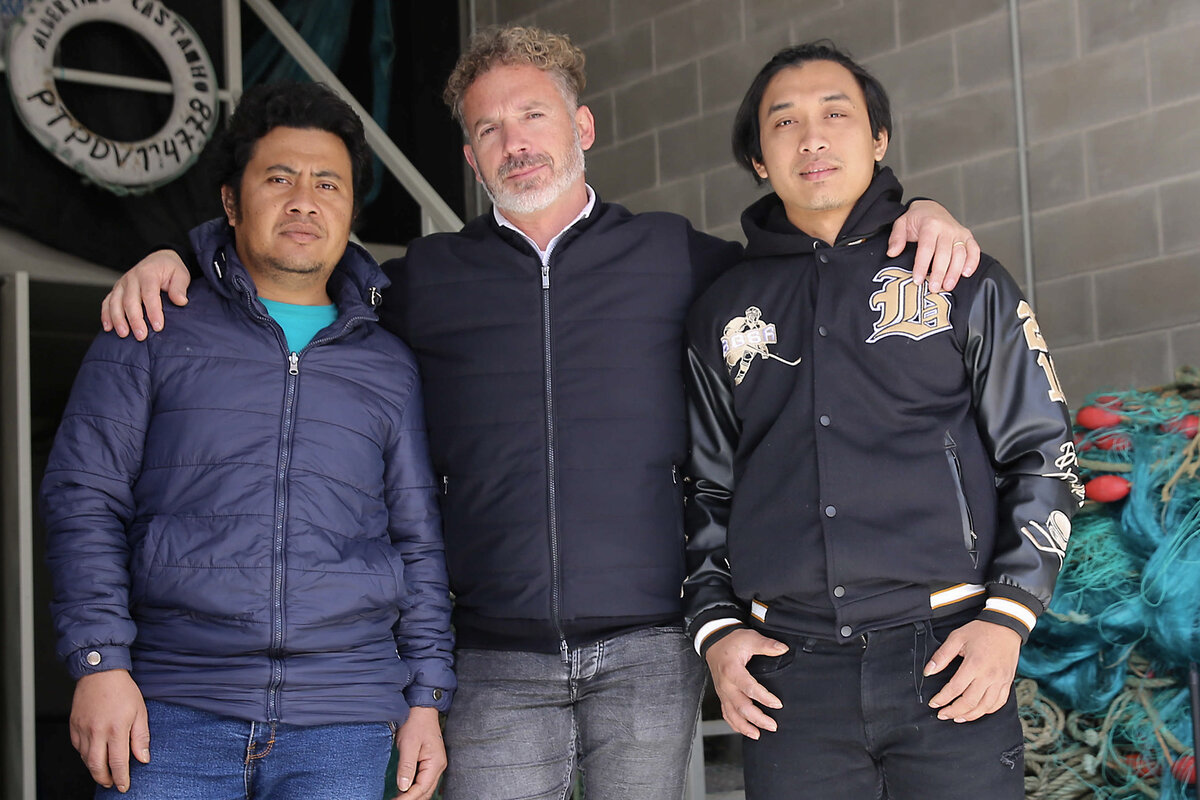
Christian Science Monitor shows a Portuguese fishing vessel captain with two of his Indonesian deckhands, March 8, 2024.

The Christian Science Monitor does a great job of finding stories about humans treating other humans with respect, even kindness. Such stories do exist. Why other media outlets don’t spend much time on them is anybody’s guess. They seem to think that anger is what people want, but why do they think that?

Dominique Soguel writes that many in Portugal are giving a welcome to migrants rejected elsewhere. They know it’s in their mutual interest. A far-right party is trying to change that, but so far harmony, says Soquel, is winning.

“Among the warehouses of one of Portugal’s oldest ports, conversations are flowing among the men sorting their fishing nets. But not without the help of Google Translate.

“The fishers at work include not just Portuguese people but also Indonesians. Thanks to a local ship captain who ventured east to solve labor shortages, Póvoa de Varzim sees a steady supply of deckhands from Indonesia, and now they account for half of all crew mates.

“And while an influx of Muslim migrants into a traditional vocation like fishing is the sort of event that would be potentially inflammatory elsewhere in Europe, in Portugal it seems to be working out without much fuss.

“ ‘The Indonesians are quite well integrated in the community,’ says another ship captain, Manuel Marques. ‘We were never against their culture. We did not ask them to change a single thing. We tried to make things as easy for them as if they were at home.

‘We do need them, and we know it. There is a mutual respect.’ …

“ ‘We also have a place to worship here, like a mosque,’ says Wahono Lucky, an Indonesian fisher. ‘I tell my boss that I don’t eat pork – I eat meat, chicken, rice, pasta, but no pork. Muslim, Christian, it’s never a problem here.’ …

“ ‘We are the only country in the European Union that allows people to come to Portugal without a job,’ notes journalist and professor Paulo Agostinho. ‘We are one of the biggest entry doors for Europe, and we are having problems with Brussels because of that. But Portugal does not have an immigration problem.’

“People from former colony Brazil make up about a third of the migrant population. Citizens of the Community of Portuguese Language Countries are also well represented, benefiting from facilitated residency procedures. In recent years, migration from India, Pakistan, Nepal, and Bangladesh has ticked up.

“Not all of Portugal’s South Asian arrivals are integrating smoothly. In the agricultural fields of Póvoa de Varzim, the sense of harmony that is palpable portside is elusive.

“Lazaro Morgado, a foreman overseeing a quartet of Indians planting seeds, clearly prefers working with a Brazilian, with whom he shares a native tongue. ‘It is complicated for the Portuguese to work with the migrants,’ says Mr. Morgado. ‘Sometimes they don’t know the procedure, and it is hard to explain. And sometimes they don’t obey the Portuguese worker even though at the end of the day, the Portuguese one is the one directly accountable to the boss.’

“Two Indian workers say they paid exorbitant sums – about €14,000 ($15,200) – to visa consultants to get here. ‘Not all Portuguese like migrants,’ notes Hardy Singh, one of the Indian workers, citing experiences of job and housing rejections on account of his ethnicity. ‘But our boss here is good.’

“Back at the port, Mr. Marques wants the Indonesian crews to stay. That’s why he – like other shipowners in the area – houses the workers in apartments scattered across the community and invites them for barbecues. The Indonesian fishers also get minimum-wage contracts and a paid-for trip home for vacation.

“ ‘Some Portuguese don’t make as much as them because they are on contract, while we only get paid if we go to sea,’ laments Tomas Postiga, an older fisher. But he grasps the importance of Indonesian workers to keep the traditional community afloat and prefers them to workers of other nationalities. Religious differences are not a problem. ‘Some are religious. Some are not. It changes nothing,’ stresses Mr. Postiga. …

“For Masrura Rashid, [Portugal’s Moorish quarter] is simply home. She arrived here six months ago, after studying engineering and wandering in the lush tea gardens of Sylhet, Bangladesh. Her father moved to Lisbon first, obtaining the right to family reunification. Now she works at her uncle’s travel agency.

“In a street rich in halal butchers and supermarkets, Ms. Rashid does not especially stand out. Donning traditional Muslim attire that fully covers her face, she is keen to learn Portuguese. ‘It’s easy here,’ she shares. ‘The weather, the environment, the people, it’s all good.’ “

More at the Monitor, here. No paywall. Subscriptions are not expensive.

 Photo: WikiPedant/ Wikimedia.
An example of “glacial rock flour” pours into Lake Louise, Alberta, Canada. 

Here’s a new-to-me theory: a discharge from our melting glaciers may be able to soak up some of the unwanted carbon in the atmosphere.

Dino Grandoni writes at the Washington Post, “Minik Rosing grew up around the fine mud flowing from Greenland’s glaciers. It wasn’t until much later, when his own daughter had grown up and was in her mid-20s, that he realized how special it is.

“During a family vacation in rural Greenland, where there was no electricity, she was fishing ice out of a milky-blue fjord for a gin and tonic when that mud gripped her feet so tightly that she had to abandon one of her boots.

“As temperatures rise, meltwater is flushing out millions of tons of this stuff: ultrafine powder ground down by the island’s melting glaciers. Geologists have a culinary-sounding name for the microscopic particles: ‘rock flour.’

“The loss of his daughter’s boot got Rosing thinking. Maybe those tiny grains of rock could be used to trap something much bigger: the carbon emissions that are altering the frozen landscape and way of life on the island.

“ ‘Greenland has been seen as the example and the horror story of climate change, and never been portrayed as a part of the solution,’ said Rosing, a geology professor at the University of Copenhagen in Denmark who was born in Greenland.

“As global emissions continue to rocket, he is part of a growing group of scientists looking for ways to suck carbon right out of the sky, an example of a sometime contentious suite of technologies called geoengineering. …

“Give it enough time and most of the carbon dioxide that humanity is pumping into the air will be taken back by the planet. CO2 dissolves in rainwater and reacts with rocks to form carbon-containing compounds that lock the gas out of the atmosphere. That naturally occurring process, called ‘chemical weathering,’ literally petrifies the air.

“The problem — at least for us humans — is that chemical weathering takes millennia to work its carbon-absorbing magic. Humanity doesn’t have that kind of time: The U.N. Intergovernmental Panel on Climate Change says society needs to drastically reduce CO2 emissions by the end of the decade. The situation has gotten so bad that the panel of scientists says we need to develop ways of pulling carbon from the air to avert catastrophe.

“So what if we could speed things up? What if, Minik Rosing and other scientists wonder, we exposed more carbon-absorbing rocks to the carbon-laden air? They call that technique ‘enhanced weathering.’

“Most enhanced-weathering proposals involve pulverizing tons of basalt or other rocks and spreading them across the land. But all that crushing would consume an enormous amount of energy that might result in more greenhouse-gas emissions. That’s where rock flour comes in.

“Glaciers flow over the bedrock like a slow-moving river. Over centuries, the tremendous weight of the ice grinds the rock underneath into a fine powder only a few ten-thousandths of a centimeter, or microns, in diameter — finer than most sand found on a beach. …

“The fineness of the grains is the flour’s advantage. It gives the substance an enormous surface area to expose to the air, making it an attractive candidate for enhanced weathering. …

“To test how well rock flour stashes carbon, Rosing and [Christiana Dietzen, a soil scientist working with Rosing] hauled about 200 tons of the stuff from Greenland for experiments.

“The material packed a one-two punch, according to a pair of papers the researchers published last year: Not only did it suck up carbon when spread over farm fields in southern Denmark, but it also enriched the soil with nutrients and increased the yield of corn and potatoes in the first year of application.

“The researchers estimate that, given enough time, spreading rock flour on all agricultural land in Denmark would suck up a quantity of carbon approximately equal to the annual emissions of that country (or of Hong Kong or Syria). Preliminary results show longer-lasting crop yields in nutrient-poor soil in Ghana.”

More at the Post, here.

Photo:Sasha Arutyunova/New York Times.
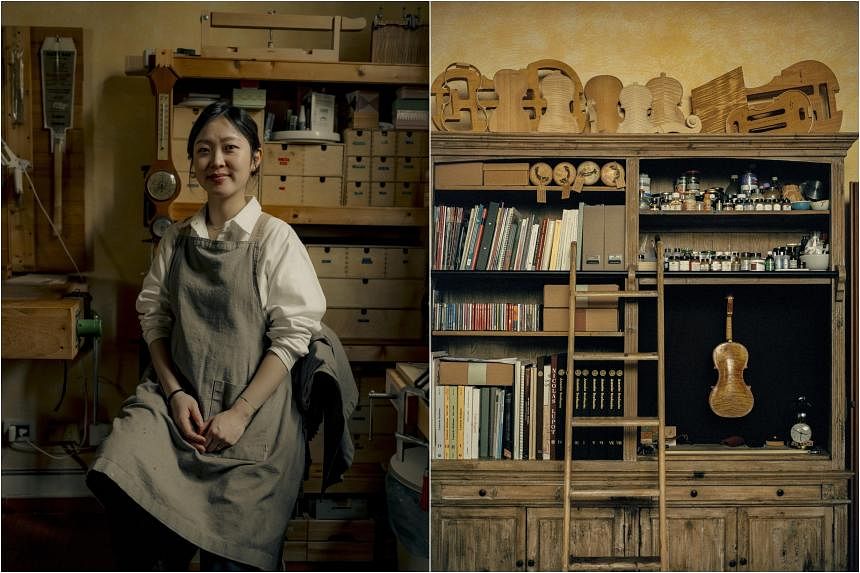
South Korean violin maker Ayoung An at her studio in Cremona, Italy. 

It’s a mystery how some children get a passion for an activity at a very young age and never let it go. You can probably think of someone you know who was like that.

At the New York Times, Valeriya Safronova writes about a little girl in Korea who slept with her violin and who later learned to make violins in the Italian tradition.

When Ayoung An was 8,” Safronova writes, “her parents bought her a violin. She slept with the instrument on the pillow next to her every night. Two years later, a shop selling musical instruments opened in Pyeongtaek, South Korea, her hometown, and An became a fixture there, pelting the owner with questions. ‘I think I bothered him a lot,’ An, now 32, said.

“As a teenager, she decided she would become a violin maker. Eventually, a journey with twists and turns took her to Cremona in northern Italy — a famed hub for violin makers, including masters like Antonio Stradivari, since the 16th century. There, An, a rising star in the violin-making world with international awards under her belt, runs her own workshop. …

“On a recent Monday, An was hunched over a thick 20-inch piece of wood held in place by two metal clamps. Pressing her body down for leverage, she scraped the wood with a gouge, removing layers, her hands steady and firm. She was forming a curving neck called a ‘scroll,’ one of the later steps of making a violin or cello. On this day, the violin maker was immersed on a commission for a cello, which shares a similar crafting process.

“Violins like An’s, made in the tradition of Stradivari and Giuseppe Guarneri, require about two months of work and sell for about 16,000 to 17,000 euros, or $17,500 to $18,500. …

“An was 17 when she hatched her plan to learn the craft: She would move in with an American family in a Chicago suburb so that she could attend a local high school, master English and eventually study at the Chicago School of Violin Making. There were no such schools in Korea at the time. Her parents, distraught about her moving so far away to pursue an uncertain career path, tried to stop her. …

“ ‘When I said goodbye to my parents at the airport, they were crying,’ she said. ‘I wasn’t. I was too excited.’

“Two years after moving to Illinois, she discovered that one of the best known schools for violin makers, the International School of Violin Making, was actually in Cremona. So in 2011, at age 20, she moved to a new country again.

“Cremona was home to some of history’s most famous luthiers, makers of stringed instruments: Stradivari; Andrea Amati, considered ‘the father of the violin’; and the Guarneri family. For the 160 to 200 violin makers in Cremona today, the sound quality of the masters remains the ultimate goal. …

“Around the studio, small pots of pigment, for varnishing, sat on shelves and tables alongside jars of powders — ground glass and minerals — for polishing. On a wall were dozens of knives, chisels and saws. Also present: dentist’s tools to scratch the instrument for a more antique look.

“An is the youngest member of a consortium in Cremona dedicated to upholding violin-making traditions. She is so immersed in the Cremonese method of violin making that, at the suggestion of a mentor, she created an artist’s name, Anna Arietti, to better fit in with Italian culture.

“An important moment is when luthiers place their label inside the instrument, called a ‘baptism.’ To make her label, An stamps her ink signature onto a small piece of paper — a browned page from a secondhand book, giving the impression of age. Then, using a traditional homemade mixture of melted bovine skin and rabbit skin as a long-lasting adhesive, she glues the label inside one half of the instrument. She also burns the signature of her Korean name into the instrument with a tiny heated brand.

“Afterward, the two halves are sealed together, completing the main body of the instrument. Her Italian artist’s name remains inside, intact as long as the violin is.”

More at the Times, here.

Photo: Kaamil Ahmed.
The Guardian writes: Asom Khan, who is deaf and mute, uses his own version of [signing] to communicate with friends and family in Bangladesh.” And he takes photos that speak, too. 

What a powerful need human have to communicate! Here’s a story of a boy with the deck stacked against him many times over who wanted badly to communicate and figured out his own way to do it.

Kaamil Ahmed  writes at the Guardian, “His own sign language of sweeping, dramatized gestures is rarely fully understood by those outside Asom Khan’s closest friends and family, but the 15-year-old is able to speak through his art and photography.

“From his shelter in the Rohingya refugee camps of south-east Bangladesh, Khan takes photos to share the stories of his community – of his elderly neighbors, disabled people, and of women at work and in times of crisis.

“It was a journey that started with a photograph of him in 2017 – tears running down his face as he hung on to the side of an aid truck – that won awards for a Canadian press photographer, Kevin Frayer, as 700,000 Rohingya fled to Bangladesh from massacres in what the UN described as ethnic cleansing by the Myanmar military.

“That photo has stuck with Khan, who is deaf and mute, and when he saw other Rohingya becoming photographers, using budget smartphones to document daily life, he fully understood the power of an image.

“ ‘I was inspired by other Rohingya photographers. When there were floods or fires or other issues, they would come and take pictures. I saw that there was some power in it,’ says Khan, whose friend interprets for him.

“Since arriving in Bangladesh, he has also been producing vivid paintings, sometimes of idyllic Myanmar villages scenes, others of those villages under attack and the chaos he witnessed.

“Raised by his aunt and uncle after his mother died in childbirth, Khan had no opportunity to learn formal sign language so he improvised, teaching his own version to those around him. But art and photography has given him a freedom to communicate without an interpreter. …

“The camps Khan arrived at six years ago quickly became the world’s largest, with almost 1 million Rohingya crammed into bamboo and plastic shelters. As conditions have worsened, with education, work and movement limited, international attention has died down, leaving the refugees to deal with their own problems. …

“ ‘I feel like when I show pictures of the Rohingya situation to the world, they understand a bit more what we face.’

“Frayer, the photographer now with Getty Images who took Khan’s photo in 2017, says … ‘I remember taking a few frames and then he disappeared into the crowd below. I remember feeling quite moved by how much courage this young boy showed,’ says Frayer.

“He found Khan again in 2018 and spent time with him, finally learning more of his story as they communicated through his sign language and his drawings.

“ ‘I was so moved and astounded to learn that he had taken an interest in photography. I saw in his artwork that he was incredibly talented at telling his story through his art, and that photography would indeed be a very strong tool for him,’ says Frayer.”

More at the Guardian, here. No firewall. Donations solicited.

Photo: Lisa Clarke.
Magnetic topper for Pair eyewear.

I was in elementary school when I got my first pair of glasses. At that time, people would say, “You look like Private Secretary,” a character in a television show of the same name. My wiseacre dad, however, couldn’t resist saying, “Men seldom make passes at girls who wear glasses.”

Nowadays, we know that glasses not only correct vision but make a fashion statement. And as Gabrielle Emanuel reports at National Public Radio (NPR), there’s even research about the connection between glasses and income.

She writes, “Jasmin Atker calls her reading glasses her best friend – and a companion she does not take for granted. But her spectacles do something most best friends don’t do: They help her make a lot more money.

“Atker, 42, is a grandmother who lives in Manikganj, Bangladesh, on a small family farm. It started as a cattle farm producing milk. After she got glasses through the nonprofit groups VisionSpring and BRAC in 2022, Atker says, her improved vision enabled her to set up a vegetable patch. She even learned how to grow mushrooms. She now sells mushrooms as well as pumpkins, watermelon and spinach at the market. Atker estimates that her monthly income has jumped from 9,000 to 10,000 Bangladeshi taka to closer to 15,000 to 17,000 taka – the equivalent of about $150.

” ‘Before, when I tried to cut vegetables and wanted to see if there were any insects or not, I couldn’t see properly,’ Atker says, speaking through an interpreter. ‘After [I got] the glasses, the average time that I take for each task has reduced significantly. And I can do more work … [and] I have this sense of independence.’

“There’s now data that suggests Atker’s story is common. For the first time, researchers have directly linked glasses and income. The study – published April 3 in PLOS ONE – found a dramatic increase in earnings with a very low-cost change: a new pair of reading glasses.

“The researchers went to 56 villages in Bangladesh and found more than 800 adults ages 35 to 65 who are farsighted – that is, they could not see well up close. Half were randomly selected to get glasses; the other half got glasses after eight months. In that time, the researchers found that income grew by 33% for those with glasses – from a median monthly income of $35 to $47 – and that people who were not in the workforce were able to start jobs after getting reading glasses. …

” ‘In a lot of low- and middle-income countries, glasses are still tightly regulated,’ says Dr. Nathan Congdon, a co-author of the study and chair of Global Eye Health at Queen’s University Belfast. People often have to get a prescription from a vision specialist before they can purchase glasses, even reading glasses. This proves to be a huge hurdle for those living in poverty and those in remote areas, he says.

“The study did more than quantify the income gains from glasses. The researchers also taught community health workers in just a few hours how to help people pick the right reading glasses. …

” ‘It’s a little bit like buying a pair of trousers where you’ve got small, medium, large, extra large – four or five, six different sizes,’ says Congdon. This makes reading glasses easier and cheaper to produce.

” ‘The glasses themselves cost maybe $3-4. And using village health workers, we can make the cost of delivery very inexpensive as well,’ said Congdon. ‘So the whole thing can really just be a handful of dollars to deliver something that’s potentially quite life changing.’

“This study’s findings fit with past studies that link glasses to productivity. For example, Congdon was involved in a study, in India, where tea pickers given glasses were more productive. Similarly, cataract surgery has been shown to increase economically valuable activities by 40% to 50%.

“The villagers in the study worked in a wide range of professions: shopkeepers, farmers, craftspeople and weavers, for example. Only about a third of them were literate. So the reading glasses weren’t for reading as much as for other daily tasks, like threading a needle, quickly figuring out change at a cash register or weeding and sorting grain on a family farm.

“What the participants had in common is they had presbyopia – as do over a billion people today. This condition happens naturally as people age. …

“Congdon would like to see regulations loosen to improve access to reading glasses. He says the regulations, the cost and a general lack of awareness have meant many people who need glasses go without. When searching for participants, his team met almost nobody in the Bangladeshi villages with glasses.

“Congdon, who is an ophthalmologist himself, largely blames his own profession. ‘Ophthalmologists and optometrists may be advising the government that they should tightly regulate access to these products [to] strengthen their professions. They may see themselves as gatekeepers of quality,’ he says. ‘I wouldn’t be recommending that we just hand out distance glasses, but I do think that for near [vision] glasses that’s a reasonable thing to do.’

“He says some for-profit companies and countries have successfully experimented with providing people with glasses. ‘Dozens of companies in coffee, tea, chocolate, textiles and other visually intensive sectors – they started to offer these programs, all across India and in many African countries,’ Congdon says.” More at NPR, here. No firewall.

I work with an ESL teacher who sees to it that students who need glasses take advantage of special programs. You have to jump through some hoops, but glasses make a huge difference in their lives.

Photo: OatShoes.
One of the companies vying to be first in sustainable footwear is Oat. Plant your shoes when done, the company says!

I try to follow sustainable practices, but shoes for an old person’s feet need to be pretty strong, which means that when they’re worn out, the pieces end up in a landfill. So now I’m wondering if the recent initiatives to improve the sustainability of shoes can work for me.

Here are some thoughts from the Washington Post.

Daliah Singer writes, “Thomas Bogle was logging dozens of miles on the spruce- and pine-lined backcountry trails that weaved around his home in Steamboat Springs, Colo., as he trained for an ultramarathon. His mind wasn’t focused on his target pace, though. Instead, he couldn’t stop thinking about the micro bits of plastic and rubber the soles of his shoes were shedding on the forest floor.

“With every step we take, our shoes leave behind an invisible trail of toxic contaminants that can potentially harm the soil, water and animal health.

“Nearly 24 billion pairs of shoes were produced in 2022. Each contains myriad plastics and synthetic, petroleum-based rubber. Of the 500,000 tons of microplastics that seep into the world’s oceans each year, up to 35 percent come from synthetic textiles, including footwear, according to one estimate, from the International Union for Conservation of Nature.

Footwear alone accounts for 1.4 percent of global greenhouse gas emissions, not that far below the airline industry, which is responsible for around 2 percent.

“Though shoe brands have taken strides toward sustainability, from offsetting carbon emissions to swapping out materials in the upper sections of shoes, they have largely overlooked soles. Now a slew of companies are starting to focus underfoot by developing new plant-based soles that won’t leave plastics behind when they degrade.

“Bogle, who spent eight years working in product development at a footwear company, is now working on an outsole from plant byproducts, while Keel Labs, a sustainable materials company started by two fashion design students, is making soles out of seaweed-based fiber. Native Shoes has a line of slip-ons made from an algae-based material, and Unless, a plant-based streetwear company in Portland, Ore., rolled out a shoe made entirely of biodegradable materials in conjunction with NFW.

“Shoes are designed ‘to last 1,000 years, and we use [them] for 100 days,’ said Yuly Fuentes-Medel, program director of climate and textiles at Massachusetts Institute of Technology. Americans alone toss out 300 million pairs of shoes every year. According to the Environmental Protection Agency, only about 13 percent of clothing and footwear is recycled in the United States.

“That’s partly because of the complexity of the shoemaking process. The average sneaker is composed of more than 130 individual pieces, according to Fuentes-Medel, who recently helped create the Footwear Manifesto, a report on how to make the industry more sustainable. Manufacturinga pairrequires at least 100 steps on average, including stitching and gluing, she said. That makes it nearly impossible to recycle them or take them apart to reuse their materials.

“The plastics in shoes also pose problems while consumers are wearing them. A 2022 study in the Journal of Hazardous Materials suggests abraded plastic from shoe soles reduces soil’s capacity to hold water and impedes photosynthesis. Another study, published in Science of the Total Environment, attributed mass coho salmon die-offs to 6PPD, a chemical added during tire manufacturing that is also found in footwear. …

“Bogle had an idea to create an entirely plastic-free shoe outsole — the component that was the first to wear out on his shoes during his long runs in the Colorado wilderness. He enlisted Gene Kelly, a professor of pedology (or soil science) at Colorado State University and a fellow runner, who helped develop a shoe sole made of beeswax, vegetable oils and plant byproducts such as leaves and husks from corn, hemp and other crops.

“Bogle’s company, Solum, partners with farmers and producers across the country to grow and harvest the materials, before converting them into bio-pellets and blending them with natural rubber to craft the sole.

“Instead of shedding toxic chemicals, Bogle explained, Solum’s soles deposit biologically derived nutrients back into the soil as they naturally wear down over time. A consumer survey by the company found that the average lifetime of a shoe outsole is around three years. Solum’s break down about 11 percent faster by design.”

Check out BlueView shoes and Ponto, too.

Photo: Mindaugas Kulbis/AP.
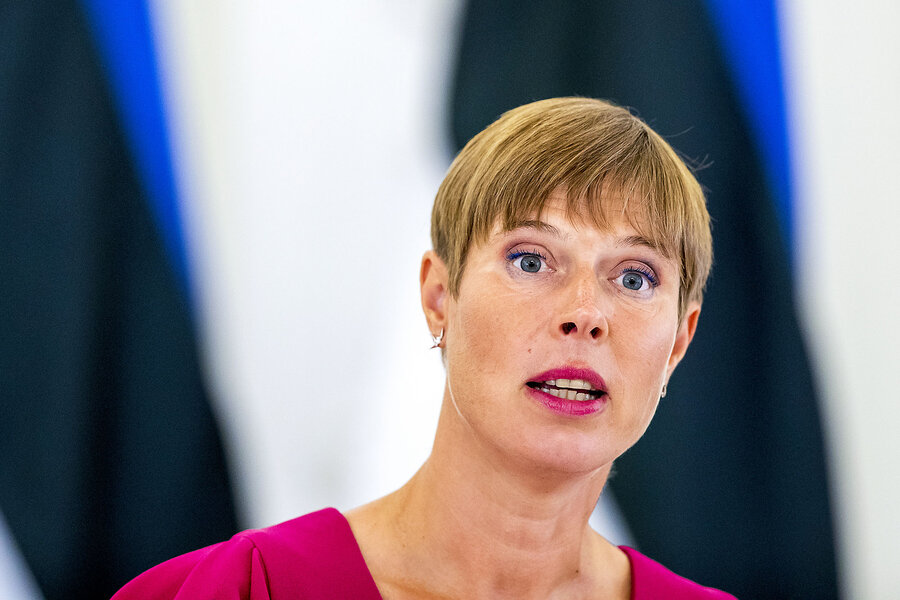
Estonian President Kersti Kaljulaid speaks during a news conference in Lithuania, Aug. 14, 2020.

Americans these days do not have much trust in government. It’s unfortunate because government does many good things. But a suspicious attitude has gained hold over the American mindset in the last few years. That’s why I look with envy at an Eastern European country that’s working really well because of a high level of trust — plus the efficient use of technology.

Lenora Chu explains at the Christian Science Monitor.

“Getting married is now one appointment easier in Estonia. The world’s most digitally integrated country launched the sacred union into the e-governance stratosphere last year – where it joined nearly every other government service you can imagine.

“Estonian citizens were already able to file taxes online, vote online, and access digital prescriptions. All of this digital activity hinges upon the Estonian smart identification system – which allows for state-recognized digital signatures – and a public trust in digital governance that’s been hard to replicate in other countries.

“ ‘I actually own my data – I can always track when someone looks at my data,’ says Kristiina Veerde-Toompalu. ‘I trust [my government].’ …

“Ms. Veerde-Toompalu got married in July, and applying online for the certificate saved her and her fiancé a special trip to her hometown’s city registrar. ‘We don’t have to go somewhere and announce our intention to get married,’ she says. …

“To deploy digital services successfully requires Estonians to trust the act of offering up to the cloud everything from birthdate and birthplace to tax information, salary, and medical diagnoses. That public trust took decades to cultivate, and ultimately relies on Estonia’s tight and transparent system of regulation.

“ ‘Paper files are not safer, because you cannot tell who looked at an analog file,’ says Kersti Kaljulaid, who served as president of Estonia from 2016 to 2021. ‘Estonian e-governance is a tightly regulated environment. … The data belongs to citizens, and you have control over who looks at your data, and you can ask them why they did. This is a luxury compared to an analog world, and I believe this is why we have this in-built trust.’

“It takes decades to build up the kind of comfort Estonia has with digitization, says Linnar Viik, a leading Estonian information technology scientist and government adviser since 1995.

‘Trust in digital channels didn’t happen overnight. It was kind of word of mouth and private and personal experience.’ …

“Trust also had to flow from leadership to the tech industry, and it did. ‘That is another layer of trust, whether you as a leader trust the experts on something you don’t understand. The politicians started to listen to the technology people and gave them space,’ says Mr. Viik.

“One such example: In 2000, Mr. Viik was allowed to convert Cabinet meetings from paper-based – at the time, they required knee-high stacks of printouts – to completely digital after one conversation with the prime minister.

“ ‘He asked, “Do we have any other examples around the world of paperless government?” ‘ recounts Mr. Viik. ‘I said, “No.” He said, “Cool, OK, do we have money for that?” ‘

“The Cabinet budget had $85,000 left for printing in that fiscal year, and Mr. Viik spent it on hardware, software, and training for Cabinet ministers and staff. What resulted was the paperless e-Cabinet: a fully wired room that drew global media attention. …

“Now Estonians not only vote and pay taxes online, but also buy property, register cars, sign job and rental contracts, and apply for unemployment benefits digitally. Nearly every service linked with a government office can be done digitally. And for many services,  citizens need not even apply, as certain entitlements are automated. That includes parental allowances and child support. Digitization also extends to health care, with every provider required to submit patient information to a centralized digital health authority. …

“ ‘The connotations [around trust] are different in different countries,’ says Mr. Viik. … ‘Other European Union governments – particularly Germany, which has a long history with government surveillance – want to mitigate all risk before digitizing. In Estonia, we would rather say, “Let’s start doing things,” and only then we can find out what are the problems we need to mitigate,’ he says.

“The paradox is that people already offer up enormous amounts of personal data to Google, Facebook, and other companies that are not only foreign but also governed independently, Mr. Viik says. ‘The institution you can control and govern is your own government – but you don’t trust? Why you don’t trust your government who is under your control?’ “

More at the Monitor, here. No firewall.

Photo: Claudia Wolff/Unsplash.
Do books use too much paper?

Those of us who still prefer a solid book to a pale, digital imitation may sometimes wonder whether we are encouraging the use of too much paper, especially since overstocks can end up in landfills.

Curiously, at least one publisher is thinking along the same lines.

Elizabeth Segran writes at Fast Company, “Over the past three years, HarperCollins’s designers have put their skills toward a new mission: saving paper. In an effort to reduce the carbon footprint of each book, they’re tweaking fonts, layout, and even the ink used. The goal is to pack more into each page, while ensuring that the pages are as readable as ever. And so far, these subtle, imperceptible tweaks have saved 245.6 million pages, equivalent to 5,618 trees.

“HarperCollins’s Christian publishing division, Zondervan Bibles, first came up with the idea of using design to save paper. Bibles have historically used upwards of 2,500 pages. In 2015, Zondervan’s designers determined that if they used different fonts and adjusted the page layout, they could reduce the number of sheets used. It would also cut HarperCollins’s printing costs. They developed a new compact typeface called the NIV Comfort Print. Ultimately, it saved more than 350 pages per bible, resulting in a total savings of 100 million pages in 2017. Stacked up, that would be the equivalent to four times the height of the Empire State Building.

“Tracey Menzies, the VP of creative operations and production at HarperCollins, wanted to see if the company could apply these learnings to other kinds of books. … The team got to work. They tested their theories with a large book in their catalog — more than 600 pages — by creating 50 versions of it using different fonts. HarperCollins uses a wide range of off-the-shelf fonts in its books, rather than custom ones. As the team ran the experiments, they observed that some fonts were more compact, resulting in fewer total pages, while remaining easy to read. So they curated a list of 15 fonts they determined are the most eco-friendly, which will be the preferred fonts from now on.

“In the end, the designers found that clever font selection, coupled with a thoughtful layout design that reduced white space, resulted in more words per page. For instance, in one example, the same text set to Garamond Pro resulted in many more words on the page compared to Bembo. Both fonts are fairly similar, with a classic serif look. And when you place them side by side, the differences are imperceptible. ‘The goal is to make these changes without the reader even seeing the difference,’ says Menzies.

“But there were also many complexities in the process. For instance, they had to consider the heaviness of the font. One font they used frequently is Bodoni, which was first created in 1798, and appears frequently in HarperCollins books. As a very heavy font, they realized they could fit more words on a page, while keeping it readable. But they also found that with very large letters, like subheadings, the ink would bleed through the paper, making it hard to read the words on the next page.

“ ‘The designer is always balancing out not just a single page, but also what’s on the page before and the page after,’ says [Leah Carlson-Stanisic, associate director of design at HarperCollins]. ‘Ultimately, this ended up with finding fonts that used less ink, in addition to less paper, which is also better for the planet.’

“Still, there is complex math involved with cutting pages from books. Printers produce very large sheets, which are then cut and folded into what ultimately becomes segments of 16 pages. When trying to cut pages from the book, designers need to be able to remove multiples of 16 pages. For the book So Fetch, for instance, using a more eco-friendly font saved nearly a million pages in total over the entirety of its print run. ‘We want to make sure our big titles, by prominent authors, are using these eco-fonts,’ says Carlson-Stanisic. ‘It adds up a little bit at a time, saving more and more trees.’ …

” ‘When we experimented with these fonts, we realized they weren’t a limitation at all,’ Menzies says. ‘It was simply a different approach that didn’t sacrifice aesthetics. Now, our designers are constantly questioning how we do things and thinking about ways to make things more sustainable.’

More at Fast Company, here.

Photo: FoxLocal via the New York Post.
The Atlanta Magnet Man has a system for saving bikers from flat tires.

Multitasking Americans like to do more than one thing while exercising. Some people listen to podcasts on their walk. Some turn the elliptical toward the TV. I try to do breathing and meditaion on the treadmill.

Now, here’s a guy who picks up bike-damaging metal while exercising. Cathy Free has the story at the Washington Post.

“Alex Benigno was sick of changing his flat tires. He was getting them all the time … on his bike tires when he biked after work. ‘I’m really good at getting flat tires, and I was tired of patching them all the time,’ he said.

“He looked into it and learned that metal road litter is a nationwide problem, often caused by nails or other sharp objects spilled from trucks, and sometimes even done deliberately. In the United States, a vehicle tire is punctured every seven seconds, causing 220 million flat tires a year, according to a report by Autoily.

“Benigno decided to do something about it. … About a year ago, he bought 10 strong magnets for $160 online, attached them to the underbelly of his bike trailer, then went for a ride through Atlanta late one afternoon to see how many nails, screws, bottle caps, flattened cans and pieces of metal wire he could attract. Benigno rides a stand-up bike because of his back surgery 12 years ago.

“During his first 10-mile trip with the magnets attached, the underside of the trailer picked up about six pounds of sharp metal bits.

“ ‘From there, I decided to keep going out after work every day, added more magnets and tried all kinds of configurations with them to get to where I was collecting even more,’ he said.

“He attached a broom to the trailer to help sweep more metal into the magnets, and he selected different areas of the city to ride through each time.

“By December, he said he was picking up about 50 pounds of debris every 10 days, scraping it off the bottom of the trailer each night and storing it in bins in his car and home or at the photo supply shop where he works.

“When he started an Instagram page in January to alert people to the problem of metal debris in the streets, Benigno called himself the ‘Atlanta Magnet Man.’ His videos and posts quickly built a following, and Georgia Public Broadcasting shared the story of his street cleanup efforts.

“People immediately began to post thank you messages, sharing their own stories of flat tires.

“ ‘Midtown is the worst,’ wrote one person. ‘I have had a couple of flat tires in recent years with all the construction.’ …

“Benigno posted one of his cycling videos on YouTube last month to give people a better idea of how much debris his magnets pick up.

“When Laura Lewis, an Atlanta scrap metal artist, found out what he was doing, she offered to take the mess he’d collected off his hands.

“ ‘I gave her the whole batch — 410 pounds worth,’ Benigno said. ‘I love that she can do something with it.’

“Lewis said she’d been looking for some smaller metal pieces to add more detail to her sculptures. …

” ‘They send out street sweepers to clean the streets, but they really can’t catch all the small bits,’ Benigno said. ‘Because some of these things are so little, they’re flipped around by the sweeper, and when someone runs over them, there goes another flat tire.’ “

I love that an artist can use Benigno’s trash. It’s amazing what certain people find a use for, but you’re lucky if you find them. We once replaced a copper roof, and a copper sculptor was thrilled to get free material for her work.

More at the Post, here.

Photo: Vivek Doshi/Unsplash.
A magpie. Magpies in Australia are part of the Artamidae family. 

Covid may have made us more nervous about the interaction between humans and wild animals, but who can resist all the adorable videos suggesting it can work? Here’s what happened when a magpie in Australia got a bit too much attention on social media.

Annabelle Timsit writes at the Washington Post, “Peggy and Molly are typical best friends. They hang out. Play. Sunbathe. But in one important way, they are an unusual pair: Peggy is a dog, and Molly is a magpie.

“A couple in Queensland, Australia, rescued Molly in 2020 after she fell from a nest. The magpie bonded with their Staffordshire terrier, Peggy, and became somewhat of a social media celebrity.

“Through their Instagram account @peggyandmolly, the couple, Juliette Wells and Reece Mortensen, chronicle the dog and magpie’s daily adventures for 813,000 followers. …

“But Peggy and Molly’s rising popularity also attracted the attention of wildlife authorities. The Department of Environment, Science and Innovation (DESI) successfully demanded that Molly be surrendered into its care after receiving complaints from members of the public, saying that Wells and Mortensen did not have the proper permits to look after a wild bird.

“Now, Peggy and Molly could soon be reunited — after fans called for Molly to be sent back, and Queensland Premier Steven Miles said Tuesday that Wells and Mortensen can ‘secure the appropriate license’ to care for the magpie. … The update from Miles, who is the head of government in the northeastern Australian state, comes after Wells and Mortensen mounted a public campaign to regain care of Molly. …

“After the public outcry, Miles had said that wildlife authorities stood ‘ready to train Molly’s parents to be wildlife caregivers, to get them the right certification, so Molly can be reunited with her family.’ …

“Peggy and Molly are the latest animals to get caught up in tensions between pet owners and wildlife authorities. Social media videos of animals exhibiting unusual or humanlike behavior are growing in popularity, but experts say many wild animals are not meant to live in domesticated settings, and they have warned about risks to the animals and their owners because of the spread of disease.

“Wells said she was walking outside in the fall of 2020 when she came across a baby magpie that had fallen from its nest. She rescued it from ‘certain death,’ she said, and brought the magpie home.

“ ‘Peggy needed something to nurture and Molly needed nurturing,’ says a website about their story, and the duo became ‘besties.’

“About a year later, Peggy had five puppies. Molly ‘became very close to all’ of them, and ‘now has an incredible bond’ with one of them, named Ruby, according to the website.

“In the past 3½ years, near-daily videos posted on the @peggyandmolly Instagram account have shown Molly, Peggy and Ruby sharing toys and napping next to each other in the sun — and suggest that the magpie even learned to imitate Peggy and Ruby’s bark. In another video, Molly puts a wing over its friend on a dog bed. …

“Australian authorities have warned the public that some magpies can be ‘aggressive towards people’ when defending their nests, particularly during what’s known as ‘magpie swooping season,’ typically between July and November. Videos of Australians being chased by magpies have gone viral, and the Queensland government has warned the public to ‘stay safe from swooping magpies.’ ”

Molly the Magpie returned home on April 15, according to @SevenJMiles on the bird site.

More at the Post, here.

PS. If you see two Blue-Throated Piping Guans on the loose (Monster and Chip), they escaped from Roger Williams Park Zoo in Providence during a recent storm. Read here.

Photo: Anna Mulrine Grobe/The Christian Science Monitor.
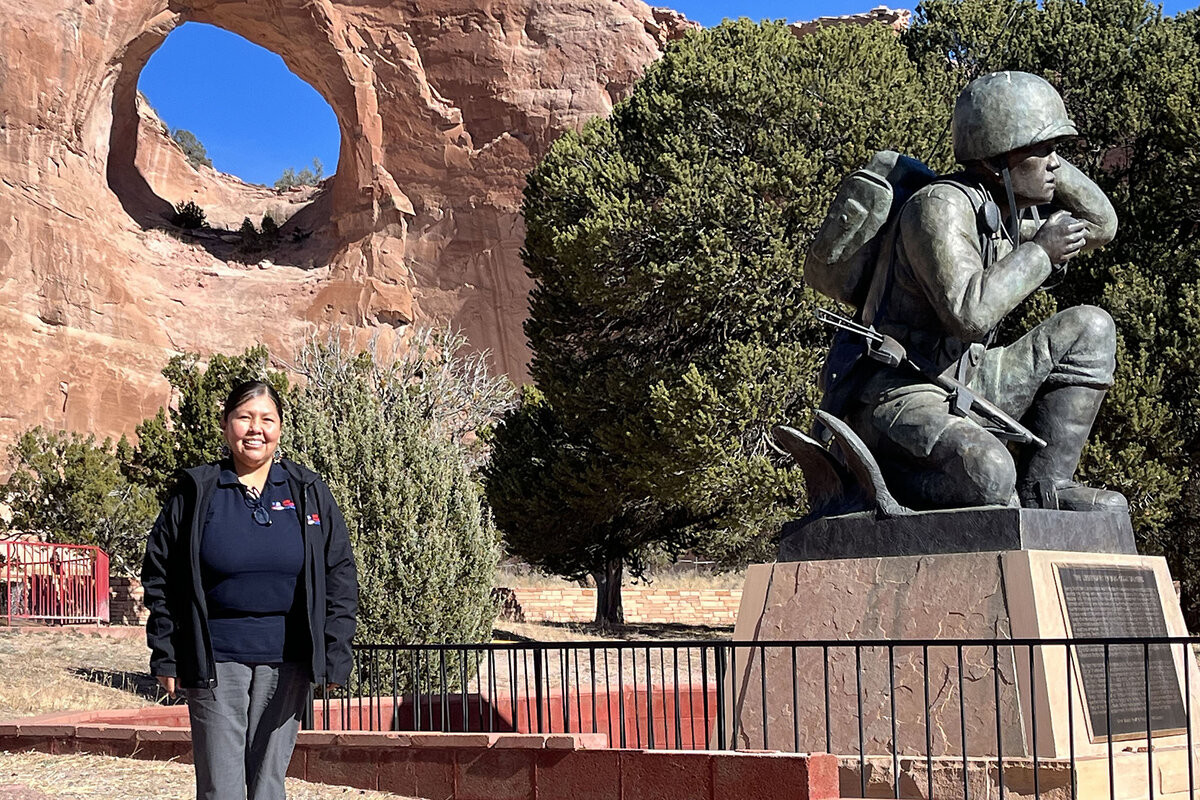
US veteran Bernadine Tyler stands at a memorial to Navajo code talkers on the Navajo Nation, in Window Rock, Arizona.

On this Memorial Day, let’s take a look at the indigenous people who have served in our military.

Anna Mulrine Grobe  writes at the Christian Science Monitor, “In her work with U.S. military veterans here on the Navajo Nation, Bernadine Tyler routinely logs 1,200 miles a month driving across an area the size of West Virginia, over high windswept plains dotted with rust-red mesas.

“Roughly one-third of homes here on America’s largest reservation don’t have electricity or running water, so Ms. Tyler, herself a member of the Navajo Nation and an Army veteran, brings services directly to her fellow vets, most of whom are over the age of 65. 

“She points out the occasional gas station and folks walking on the dusty shoulders of pot-holed roads. There’s a bus, ‘but it’s very unreliable and only runs one route,’ says Ms. Tyler, program lead for the Diné Naazbaa Partnership (DNP), which serves the Navajo Nation and receives funding from the U.S. Department of Veterans Affairs. …

“For vets without transport or refrigerators, she carries bags of ice to fill the convenience store coolers that many use to chill their food and medications. She enlists volunteers, including her sons, to help haul water and chop wood for warmth in the winter. 

“The particular challenges of accessing this care came to light during the COVID-19 pandemic, when Native American veterans living in small multigenerational homes without running water on closed tribal lands died at significantly higher rates than other former service members. The VA subsequently pledged to better serve America’s Native American community. 

“In 2020, the VA created the first advisory committee for Native American veterans. It held its first meeting in 2022 and began issuing its recommendations last year. Though they aren’t binding, the suggestions of some committees have an acceptance rate of 90%, according to the agency. …

“With this year’s 2024 defense spending bill, lawmakers also granted the Native American Indian Veterans a congressional charter, making it the first-ever group dedicated to the interests of Indigenous people in the U.S. to get the status. It is a development that took the NAIV nearly 20 years of lobbying to achieve. With the charter, NAIV can testify before Congress and, ideally, more easily help the VA process benefits claims. 

“The hope is that these developments will not only improve care, but also foment faith that, even after decades of neglect, change is possible – particularly among the 57% of Native American veterans who say their top reason for joining the military was a desire to serve their country. 

“Native American veterans are among America’s most patriotic, says Adam Pritchard, a researcher at Syracuse University’s Institute for Veterans and Military Families. ‘It’s a very important step in the right direction to acknowledge their history of the service and their ongoing needs.’ 

“ ‘Our history has much mistrust,’ Ms. Tyler says. Good-faith efforts to fix a long-broken system and build it up, she adds, can help heal old wounds, too. 

“In 1943, Thomas Begay joined the U.S. Marines. He was 16 or 17 years old – he’s not sure which. … He wanted to be an aerial gunner, Mr. Begay told the recruiter. [The recruiter sent him] to become a code talker. While he and his fellow troops practiced the top-secret tribal language with a twist, their basic training was more ad hoc than the Marine norm. 

“ ‘They got us a rubber boat, and they just dumped us way out in the ocean and said … “Learn how to get to shore,” ‘ he recalled in a 2013 discussion cataloged by the National Archives.

“Months later, after landing at Iwo Jima in February 1945, Mr. Begay and his fellow code talkers were hailed as instrumental in taking the island – and later with helping to win the war. Their code was never broken. …

“Today, Mr. Begay is living in a house where bad plumbing has damaged the floors and ceiling. ‘It’s not safe for him,’ says Karen Shirley, community coordinator for DNP, which is helping him apply for VA grants to fix up his home, or get Mr. Begay a new one. 

“ ‘How can we not support this great warrior who helped save this country, and just get him the housing he needs?’ Ms. Tyler says.”

More at the Monitor, here. No paywall. Subscriptions are reasonable.

Photo: Fareth Fuller, PA.
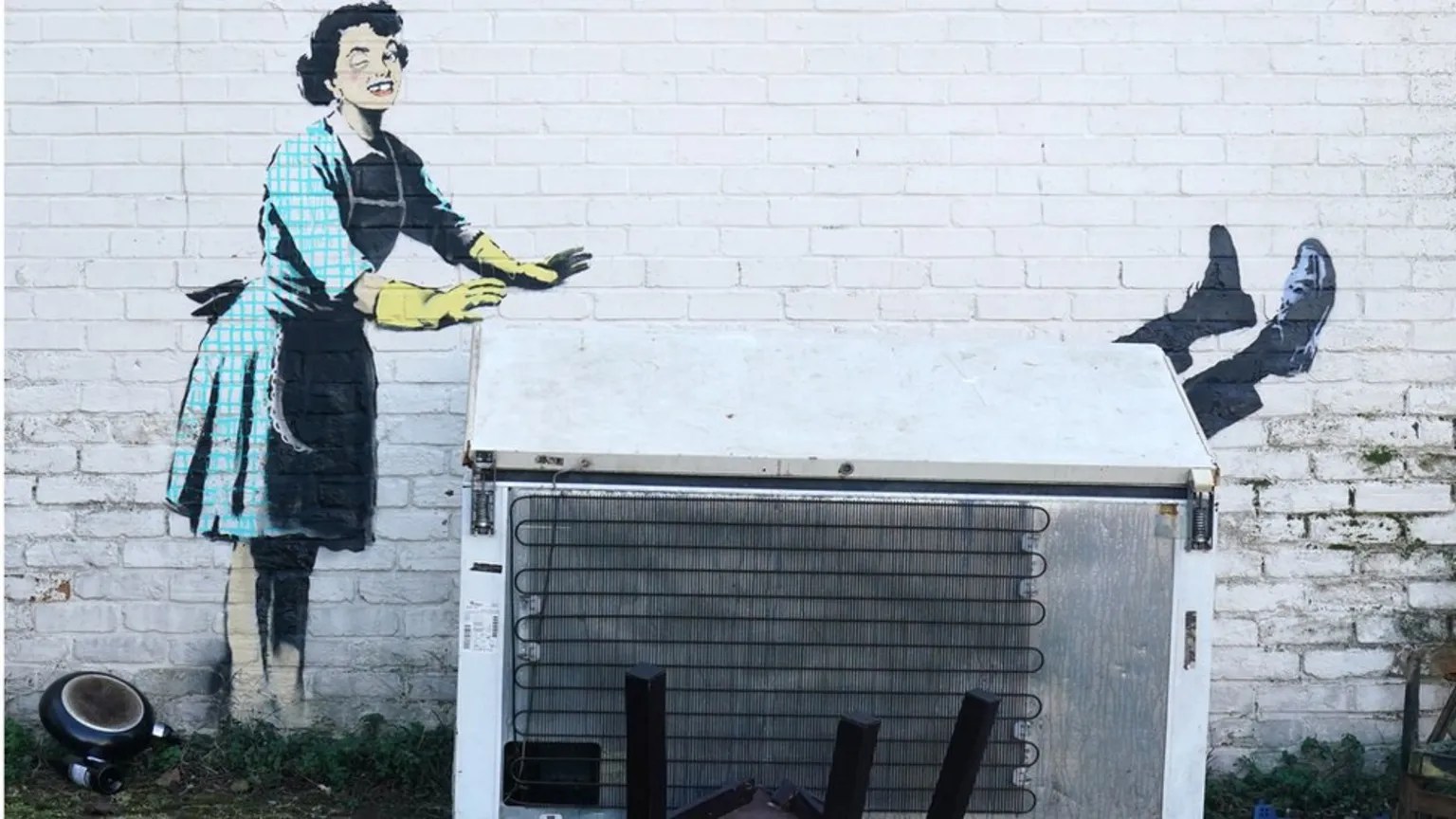
Valentine’s Day Mascara is one of Banksy’s murals in Margate, Kent.

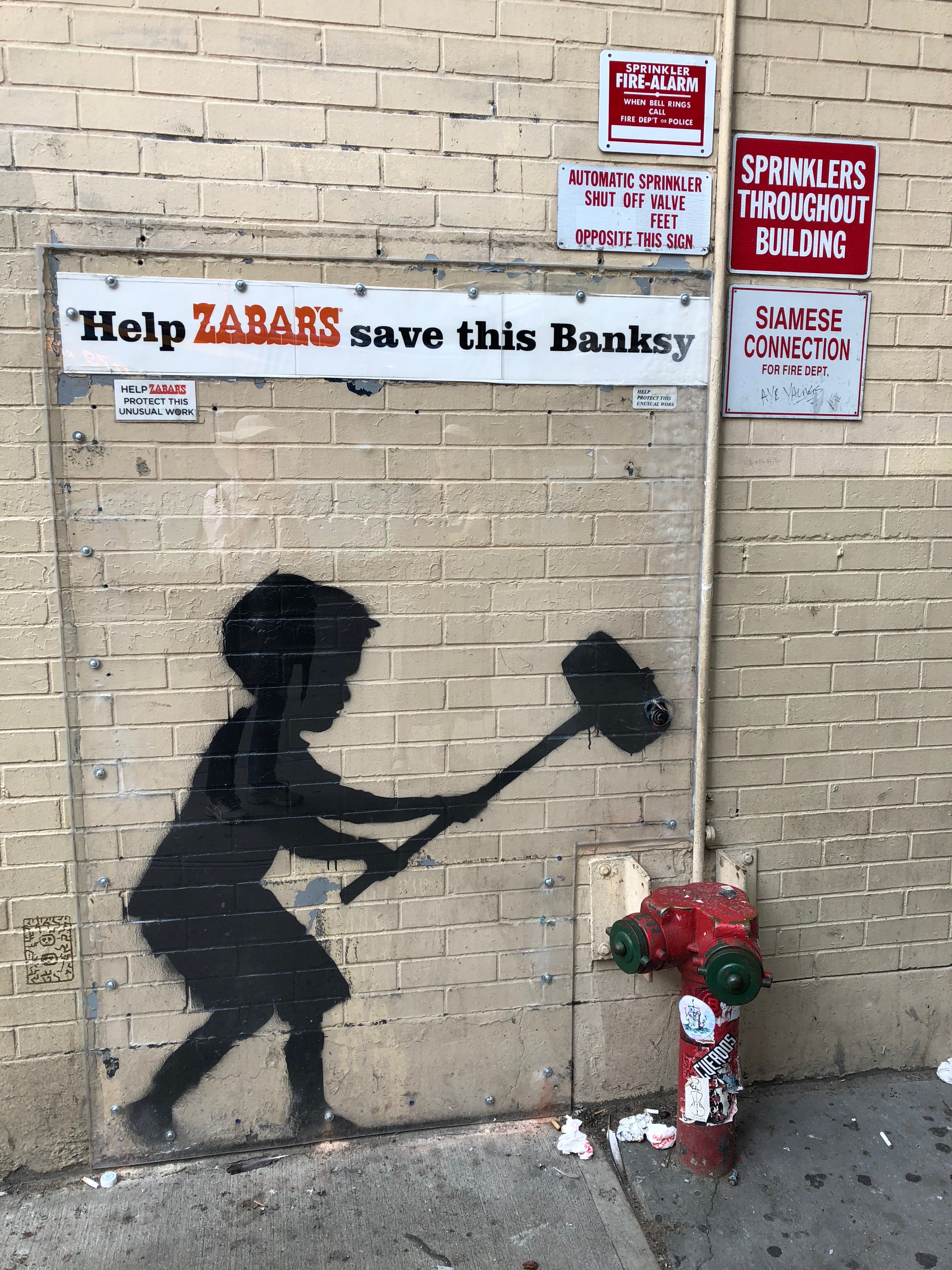
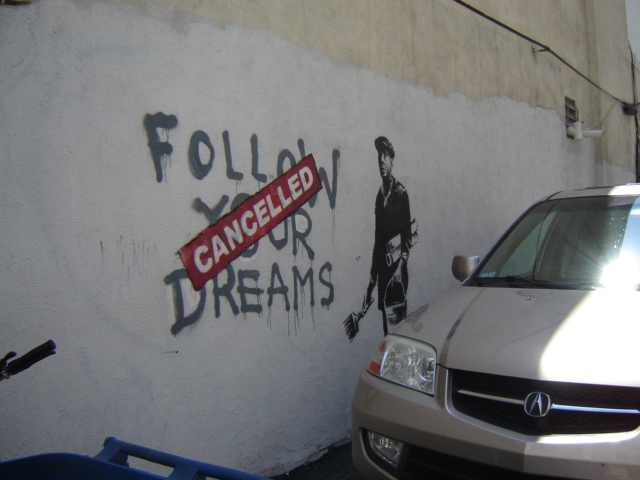
I like Banksy’s stealth art a lot and have seen works — or imagined I’ve seen works — in both Boston and New York. But Loraine Holmes is a super fan, and she really knows what’s what.

Hayley Coyle writes at BBC News, “Rumblings a few weeks ago about a new piece of work by world famous street artist Banksy appearing in London meant it was not long before social media was awash with rumors.

“About 200 miles away in Leeds, one of those caught up in the buzz was Loraine Holmes, a self-confessed Bansky super fan and co-founder of a Facebook group charting the elusive graffiti artist’s work.

“Within an hour of Banksy’s new tree-themed mural in Finsbury Park being ‘claimed,’ Mrs Holmes was already at the spot — one of the first in the world to view the fresh and, as she put it, ‘raw’ mural.

“After being tipped off the night before, Mrs Holmes, 61, had taken an early train from Leeds. …

” ‘I spent a total of about five hours there, just taking it all in and observing people,’ she added.

“Banksy’s latest offering, which he later confirmed on his Instagram account was one of his, was a green spray-painted wall depicting foliage, with a stencil of a person holding a sprayer standing next to it.

“Mrs Holmes was one of the lucky ones who got to see it before it was covered in plastic and surrounded by wooden boards after it was defaced with white paint.

“The self-confessed super fan is such a hardcore Banksy aficionado that she said she also once drove 14 hours from Leeds to Margate and back so she could spend just 10 minutes taking some photos of his mural in the Kent seaside town. …

“Mrs Holmes co-founded a Facebook super fan group called Banksy Locations in 2020 with fellow street art enthusiast Jay Tompkins. The group now has 20,000 members worldwide and covers ‘every single aspect of Banksy’ from the 1990s to today, Mrs Holmes said.

“The group also shares information on what condition Banksy’s works are in and where they can be found. In fact, Mrs Holmes said it was members of the Banksy Locations group who ‘unofficially confirmed’ the new London mural before the artist himself.

“Mrs Holmes, a senior business analyst, said she first discovered Banksy’s works in 2018 after seeing some of them online. Her admiration for the anonymous artist ‘spiraled’ and she said that now he would be her ‘Mastermind specialist subject.’

“She said: ‘It started out with me not knowing much about graffiti, but after I saw some pictures I liked on eBay, I started doing some research, read a few books and joined a few groups.’ …

“Mrs Holmes said other Banksy-related adventures included traveling to Paris while suffering with a broken ankle to see Man with Dog. She had undergone surgery a few weeks before to have screws put in her leg, but that did not put her off the journey.

” ‘I still managed to see six Banksy pieces that weekend,’ she recalled. … Mrs Holmes now has plans to visit San Francisco and Los Angeles in the near future to see more of the artist’s work.”

More at the BBC, here.

Photos below: John and Suzanne’s Mom.

Photo: Girl Scout Troop 6000.
Girl Scouts of Greater New York’s Troop 6000 is a first-of-its-kind program designed to serve families living in temporary housing in the New York City shelter system.

Kindness and compassion are not dead. You just need to know where to find them.

Consider New York’s Girl Scout Troop 6000, which reaches out to migrant children.

Sara Herschander reports for the Chronicle of Philanthropy, “Once a week in a midtown Manhattan hotel, dozens of Girl Scouts gather in a spare room made homey by string lights and children’s drawings. They earn badges, go on field trips to the Statue of Liberty, and learn how to navigate the subway in a city most have just begun to call home.

“They are the newest members of New York City’s largest Girl Scout troop. And they live in an emergency shelter where 170,000 asylum seekers and migrants, including tens of thousands of children, have arrived from the southern border since the spring of 2022.

“As government officials debate how to handle the influx of new arrivals, the Girl Scouts — whose Troop 6000 has served kids who live in the shelter system since 2017 — are quietly welcoming hundreds of the city’s youngest new residents with the support of donations. Most of the girls have fled dire conditions in South and Central America and endured an arduous journey to the U.S.

“Not everybody is happy about the evolution of Troop 6000. With anti-immigrant rhetoric on the rise and a contentious election ahead, some donors see the Girl Scouts as wading too readily into politically controversial waters. That hasn’t fazed the group — or their small army of philanthropic supporters. Amid city budget cuts and a growing need for services, they are among dozens of charities that say their support for all New Yorkers, including newcomers, is more important than ever.

“ ‘If it has to do with young girls in New York City, then it’s not political,’ said Meridith Maskara, CEO of the Girl Scouts of Greater New York. ‘It’s our job.’ …

“Last year, Troop 6000 opened its newest branch at a hotel-turned-shelter in Midtown Manhattan, one of several city-funded relief centers for migrants. Though hundreds of families sleep at the shelter every night, the Girl Scouts is the only children’s program offered. …

“Last January, the group began recruiting at the shelter and rolled out a bilingual curriculum to help scouts learn more about New York City through its monuments, subway system, and political borders. …

“With few other after-school opportunities available, the girls are ‘so hungry for more’ ways to get involved, says Giselle Burgess, senior director of the Girl Scouts of New York’s Troop 6000.

“Seven years ago, Burgess, a single mother of six, built Troop 6000 from the ground up after losing her rental home to developers. While living in a hotel-turned-shelter, she got the idea of creating a troop for girls like her daughters. It was the height of ‘NIMBYism,’ she says, the not-in-my-backyard movement opposed to local homeless shelters.

“At the time, she asked: ‘Who’s gonna give us a chance?’

“As it turns out, ‘the donations started pouring in,’ she says. A New York Times profile lead to a groundswell of philanthropy. … So, when the mayor’s office floated the idea of starting a troop at the Midtown shelter, the Girl Scouts were ready. …

“Troop 6000 employs bilingual social workers and a transition specialist versed in supporting children who’ve experienced trauma. But otherwise, it operates much like any other Girl Scout troop. Most importantly, says Maskara, the troop offers a glimmer of consistency to children who often must pack up, move homes, and switch schools in the middle of the academic year. Scouts are encouraged to continue participating even when their families move. …

“ ‘Keeping the girls connected is what matters the most for us right now,’ says Burgess. ‘There’s a lot of emotion, frustration, and hurt.’ Around 50 scouts who have left the shelter participate in a virtual troop. ‘We want to be able to encourage the girls and let them know it’s not over,’ she says. ‘We’re still here.’ “

More here.