Feeds:
Posts
Comments

Art: Asher Durand.
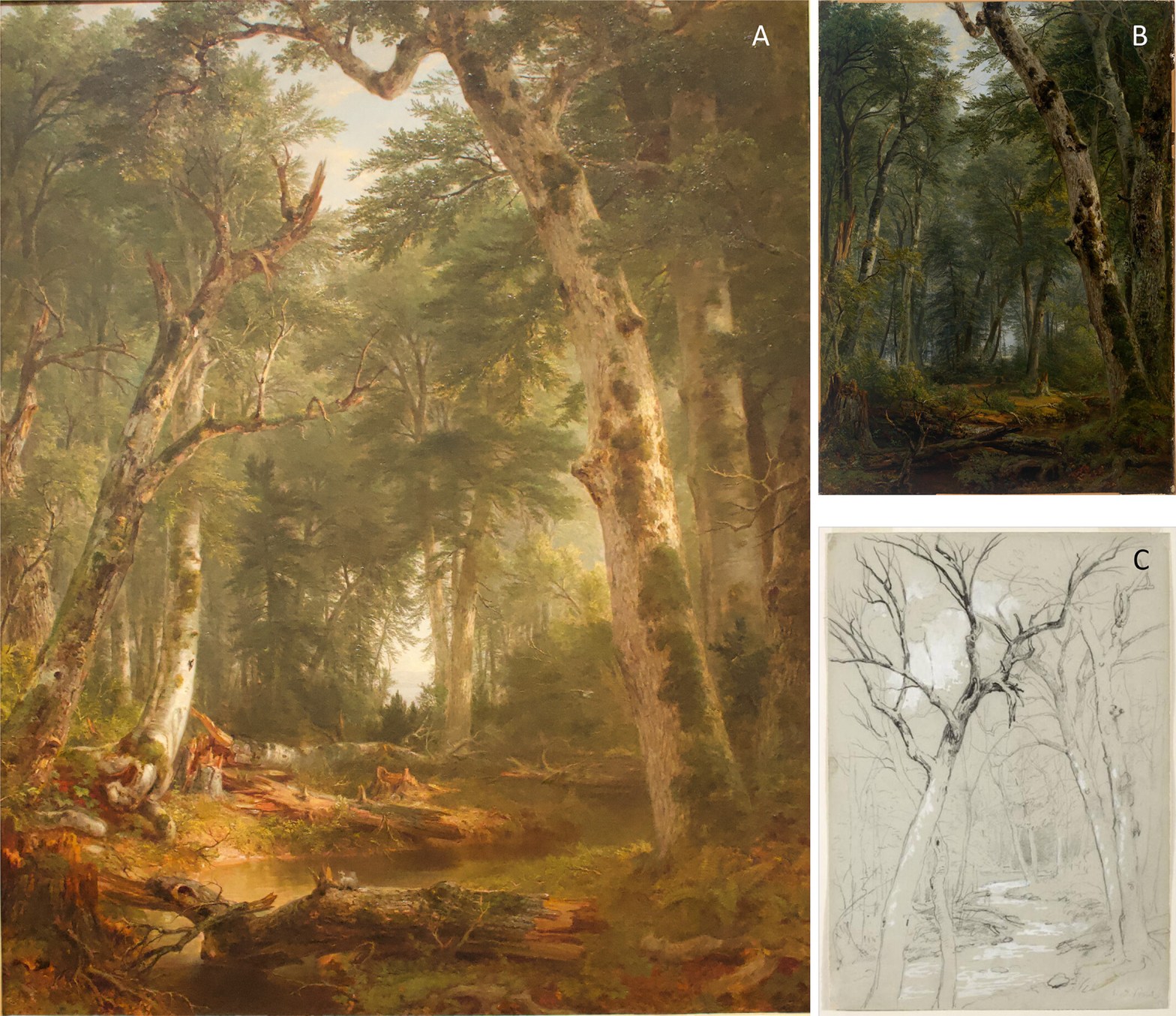
Nineteenth-century paintings of old growth forests are helping ecologists learn about what we have lost. Asher Durand, for example, understood the way that beech trees fit into their forest habitats. A) “In the Woods” (1855); B) “Woodland Interior” (c. 1854), oil on canvas; C) “A Brook in the Woods” (c. 1854), graphite, gouache, and white lead on paper.

Call me retro, but I’ll always love the Hudson River School paintings of a long-gone majestic American wilderness. So do ecologists, as it turns out.

Elaine Velie reports at Hyperallergic on a new study showing that the 19th-century paintings have a value beyond the aesthetic.

“The Hudson River School movement is an enduringly popular slice of 19th-century American art history,” Velie writes, “but as beloved as it is, its paintings of bucolic hills drenched in golden light are not particularly known for their adherence to reality. In a recently published study, a team of ecologists and art historians set out to determine just how true to life these works really were.

“Using onsite sketches and historical writings, the team determined that some of these paintings were true to life. … 

Some were so detailed that they could even help scientists today learn about the centuries-old forests that were destroyed before the advent of color photography.

“Dana Warren and Harper Loeb of Oregon State University published their findings last month in the academic journal Ecosphere along with scholars Peter Betjemann, Isabel Munck, William Keeton, David Shaw, and Eleanor Harvey.

“ ‘I have been interested in understanding older forests and old growth forest systems in the Northeast for a while,’ Warren told Hyperallergic. … ‘I was interested in these 19th-century paintings, but I had always thought that issues of artistic license removed the potential for any of these images to be used in a rigorous quantitative way.’ She paired up with art historians to investigate.

“The interdisciplinary team focused on Hudson River School paintings completed between 1830 and 1880, when Northeastern forests were being cleared for farms but more remote regions still remained untouched by European colonizers. Blights and invasive species had yet to arrive, and trees like the chestnut, ash, and elm still shaded the woodland floor. …

“In the early 1800s, American painters began working en plein air. Portable oil paints had come into fashion, and growing infrastructure made it easier to venture upstate. A fascination with ‘wilderness’ in literature and art emerged alongside the dark underpinnings of ‘manifest destiny‘ and colonial expansion. 

“As creators emphasized nature, they were acutely aware of the changing landscapes around them.

“ ‘The beauty of [untouched] landscapes is quickly passing away,’ Thomas Cole, the painter credited with founding the Hudson River School movement, wrote in 1836. ‘The ravages of the axe are daily increasing — the most noble scenes are made desolate.’

“While painters like Cole crafted dramatic allegorical renderings of the forests disappearing around them … other artists adhered to observational truth. 

“Warren and her team used the interior forest scenes of prominent Hudson River School painter Asher Durand (1796–1886) as a case study, examining his onsite sketches, writings, and oil paintings to establish the veracity of his finished works. …

“Durand explicitly stated his emphasis on depicting the natural world just as he saw it. Like other artists, Durand had been familiarized with the specimen-based botany that had been available in published form since the 1700s. 

“The scholars examined an 1855 Durand painting of the Catskills titled ‘In the Woods’ — a calm depiction of a shady stream lined with beech trees. Notably, an 1854 painting of the same scene excludes these plants, but an onsite sketch of a similar setting includes them, signifying that the artist added the trees into his final painting from a real sketch. …

“Warren said her recent study is a ‘proof of concept,’ and that she thinks the team’s exploration of Durand’s paintings can extend to the work of other artists. For now, Hudson River School depictions of microhabitats — groupings of flora like mushrooms on tree trunks and mats of moss on bark — can help ecologists learn about what old growth forests were really like. 

“With an interdisciplinary approach to ecology and art history, the scholars think paintings of the American West could help scientists learn about long-melted glaciers and plowed prairie biomes, and artworks showing the coast could help researchers study lost marsh habitats.”

Today we have lots of color photography, but if any of you artists out there want to help the scientists of the future, you know the way.

Check out the art at the Hyperallergic, here. No firewall, but subscriptions solicited.
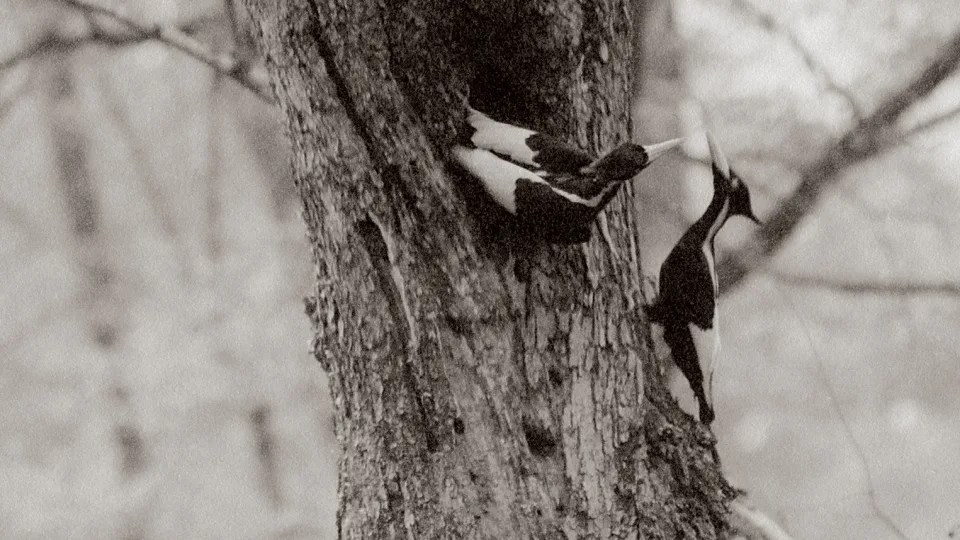
Ivory-Billed Woodpecker

Photo: Arthur Allen/Cornell Lab of Ornithology.
Ivory-billed woodpeckers in Louisiana in 1935.

When our younger granddaughter was in pre-school and learned about dinosaurs, she latched on to the word “extinct.” The idea of something being completely gone was powerful to her, and when she was angry at her brother she turned the word a verb: “I’m going to extinct you.”

Today I learned about the variety of reasons we keep some things off the extinct list even when they seem gone forever. As Rachel Ramirez reported at CNN, Federal wildlife officials “are delaying a long-awaited decision to declare the ivory-billed woodpecker extinct, months after grainy photos and videos emerged that purported to show the bird flying through a Louisiana forest.

“In 2021, the agency seemed ready to declare the so-called Lord God Bird extinct: The US Fish and Wildlife Service announced plans to remove 23 species, including the ivory-billed woodpecker, from the endangered species list due to extinction. Thorough scrutiny of ‘the best scientific and commercial data available’ had led to the conclusion the bird no longer exists, the agency told CNN.

“[But in October] Fish and Wildlife declared 21 of those species extinct — and the ivory-billed woodpecker is not among them. …

“The government’s last accepted sighting of the red-crowned bird species was in April 1944 by artist and birder Don Eckelberry.

“But expert biologists and birdwatchers have been adamant the nation’s largest woodpecker is still out there. Just after the feds announced the proposal to remove the bird, public comments poured in from ornithologists, amateur birders and even communities like the Cherokee Nation, whose leaders asserted the creature is a symbol whose ‘influence on our cultural activities remains to this day.’

“Amid the wave of testimony, the wildlife service invited more public comment and announced extensions to its decision that effectively postponed its ivory bill verdict into 2023. Now, that critical decision to delist the bird is once again delayed. …

“ ‘John Fitzpatrick, a renowned ornithologist and retired director emeritus of the Cornell Lab of Ornithology, told CNN, ‘Evidence of its persistence continues to emerge, albeit none of it 100% convincing to everyone.’

“Since the 1944 sighting, the only other ‘compelling evidence,’ according to the federal wildlife service, was 2005 research from Fitzpatrick and his associates that claimed ivory bill sightings in eastern Arkansas’ Cache River National Wildlife Refuge. …

“In 2022, CNN joined avid birdwatchers to search the Tensas River National Wildlife Refuge in Louisiana, where the ivory-billed woodpecker was last officially seen. Around the same time, a group known as Project Principalis — a nod to the ivory bill’s scientific name, Campephilus principalis — was gathering evidence observed over the prior decade by Steve Latta of the National Aviary and other colleagues.

“Using unmanned trail cameras and drones, they’d captured grainy pictures of what they claimed was the ivory bill.

“ ‘We have some of the best images, if not the best images, that have been produced in 80 years,’ Latta, who claimed he has seen the bird in 2019, told CNN at the time.

“This May, Project Principalis published peer-reviewed research that unveiled such recordings, which they submitted to the feds, including a drone video from October 2022 of two ivory bills quickly flying onto a tree branch.

“ ‘Our ultimate goal is the conservation of the species, its habitat, and the many other species relying on that habitat,’ Latta told CNN Monday. ‘Keeping the Ivory-billed Woodpecker on the Endangered Species list brings us one step closer to that goal.’ ”

More at CNN, here.

Photo: The Real West Virginia.
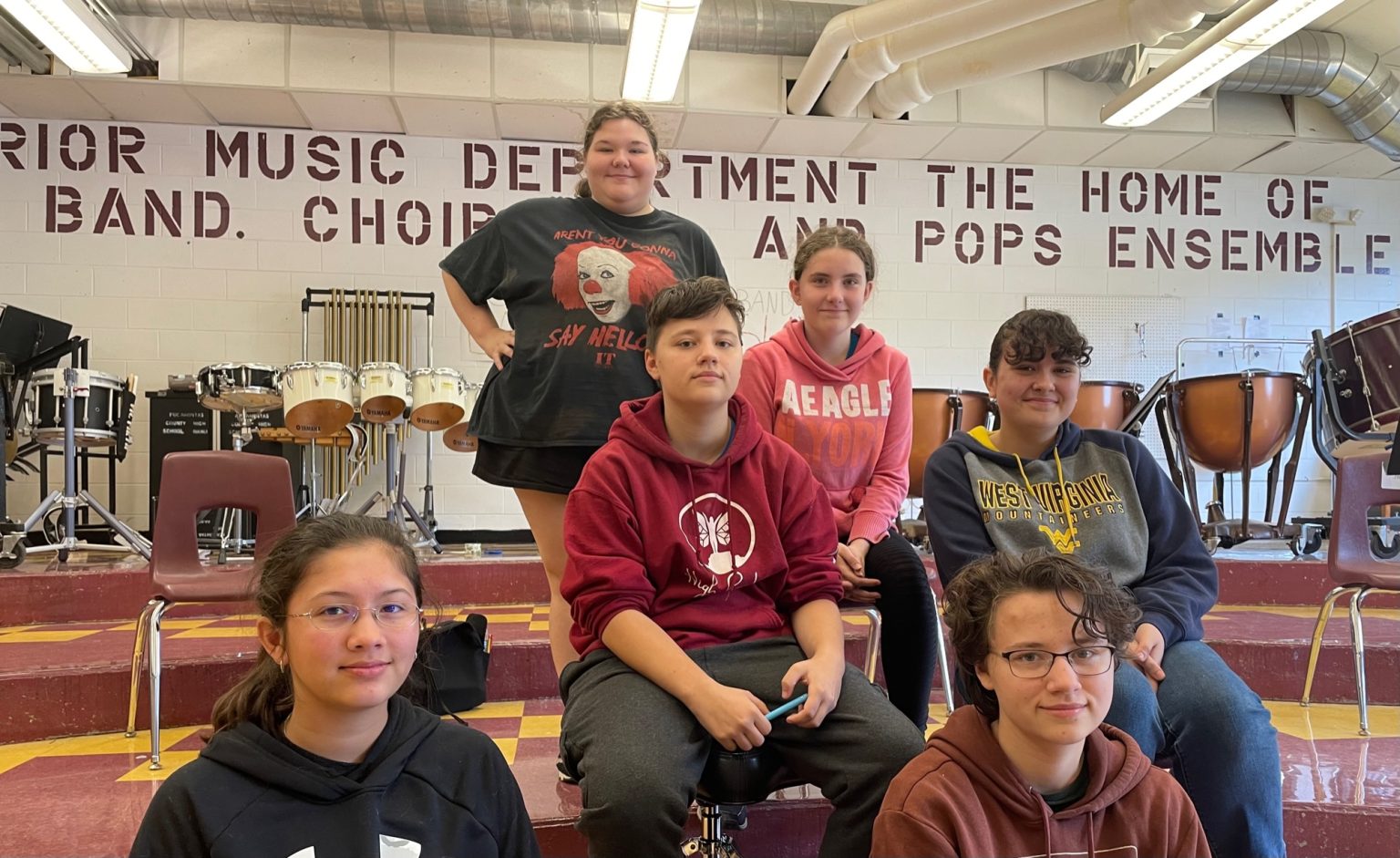
When the band teacher left, ten students decided to manage the band themselves.

This is the story of ten self-motivated students in West Virginia who didn’t want to give up band after the instructor left and no one else applied for the job.

Stephen Baldwin reports at the Real West Virginia, “Last year, the Pocahontas County High School Band had 38 student members and a full-time teacher. But over the summer, their director took another job and the school board had no applicants for the vacant position. 

“ ‘It was such a downer,’ remembers Jadyn Lane. ‘But we were given a choice.’ 

“Principal Joe Riley told them they could sign up for other electives, or find a way to make the band work.

“Most students signed up for other electives, but ten students decided to stay. … ‘It wasn’t an option to quit,’ says Hailey Fitzgerald. ‘I’ve been in the band for seven years. I love it! It’s too important for too many reasons.’ … 

“The students nominated Hailey as director, a position she accepted on the condition they would all work together and share responsibilities. They recruited Casey Griffith and Jennifer Nail-Cook to be their official faculty advisors. Casey does the paperwork, and Jennifer helps with the music. 

“ ‘They direct themselves,’ says Casey, who teaches math at Pocahontas County High School. ‘Have they told you about their rules?’ 

“Front and center on the band room whiteboard are a set of rules which they students created themselves. Rule 1–Be ready to play with your instrument within five minutes of arriving at class. Rule 2–Follow the director’s lead. (No complaining about which songs they’d play.) Rule 3–Keep the band room clean. (No sugary drinks which might hurt the instruments.) Rule 4–Take your instruments home on the weekend to practice. Rule 5–Only play your instrument. 

“In addition, they made a calendar of their upcoming gigs–football games, Homecoming, and Veterans Day. It included a daily countdown to each event so they’d be prepared. 

“Perhaps most importantly, they decided which instruments were necessary to make a band of this size work – clarinet, trumpet, alto, tenor, and drums. 

“But they still had one big problem. Most of them were drummers. And they weren’t a drumline. … How could they play those instruments with the people they had? 

“ ‘Several members switched instruments and some even learned brand new ones,’ Hailey says. ‘We aren’t even big enough to fill a closet, but we have instruments and uniforms and we are a band.’ 

“The time came last month for their first public performance. It was a home football game against Richwood. They had no idea what to expect. Would it work? Would the crowd cheer them on? Would they amp up the football team? …

“To their surprise, a group of students made posters for the band and hung them at the entrance to the football field. As they walked to the game, they saw the posters for the first time. 

“ ‘We thought some people didn’t even know we still had a band,’ says Jadyn. But their classmates had been paying attention and wanted to make their first game special. ‘This is the most support we’ve ever gotten.’ The Pocahontas County Warriors won the game. …

“Taking on the task of directing themselves has seen challenges and opportunities. 

“Kaidence says this version of the band is easier in some ways. ‘We can help each other directly with instrumentation.’ 

“ ‘It is hard to find music, though,’ Hailey adds. ‘The skill level isn’t the issue; it’s our size and instruments.’ …

“Hailey isn’t holding back as director. She set an aggressive schedule for the band. ‘We’ll do all home football games, a Veteran’s Day event, and ratings.’ 

“Ratings is an annual event which every band in the state is required to attend. They are graded on their performance. 

“ ‘If they didn’t do ratings this year, they’d be put on restrictions next year,’ adds Casey. ‘If you don’t do well at ratings, you get put on an improvement plan.’ …

“Hailey says the school board is still trying to find a band director. She appreciates that they’ve explored every option to find someone.  But even if they can’t, she’s not worried. ‘We’ll keep doing it,’ she says.

“ ‘Band is a weird family,’ her twin Miles chimes in, ‘but a family nonetheless.’ ” 

More at the Real West Virginia, here. I originally saw the story at the Post, here.

PS. If there is anything funky about the editing here, blame it on the fact that I just tested positive for Covid. Feeling icky.

Photo: Stefan Lefnaer via Wikimedia.
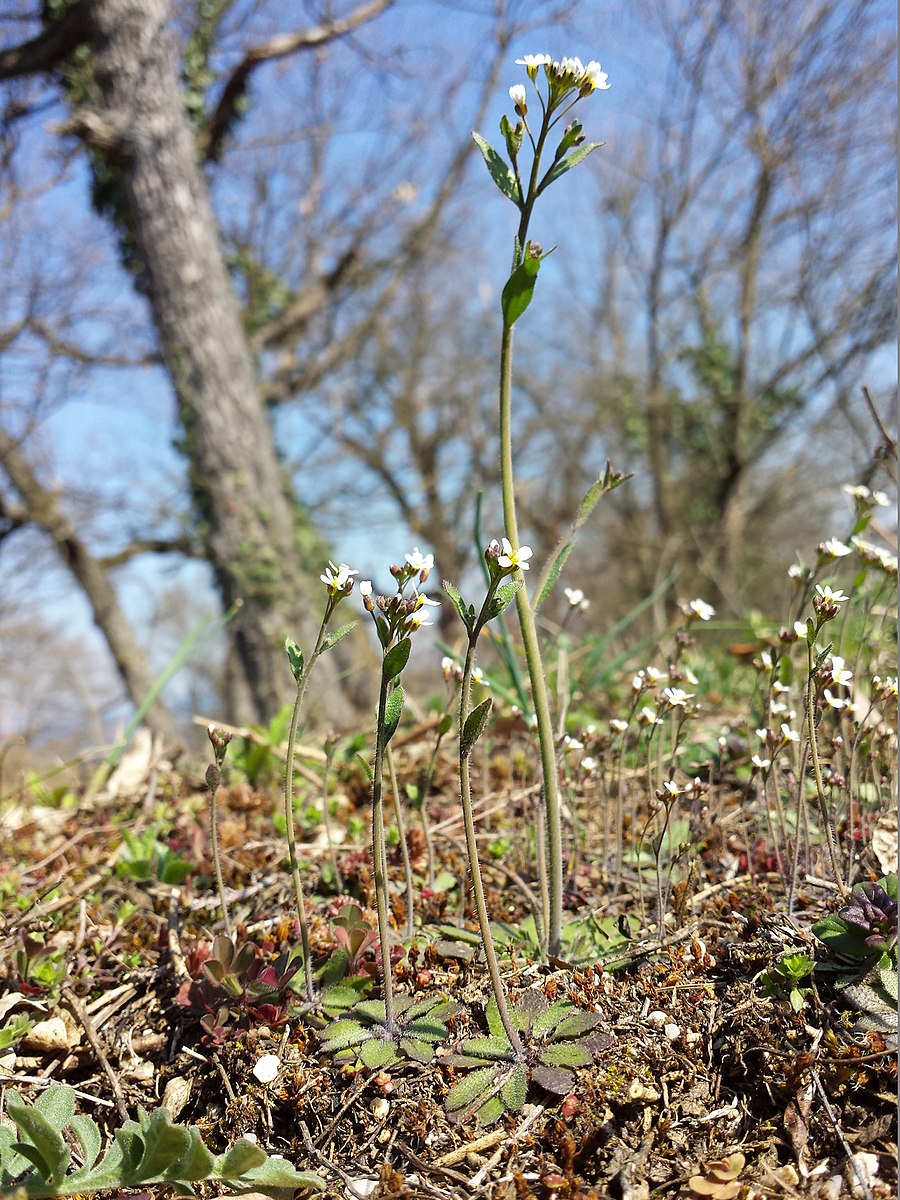
In the video below, an Arabidopsis plant warns of danger from a hungry caterpillar.

I think we are lucky to be learning so much about the natural world these days. I didn’t study much science in school, but who wouldn’t love scientific research that reveals such wonders as plants’ communications systems.

Kasha Patel at the Washington Post writes that some plants actually warn their brethren when it’s necessary to increase defenses.

“Trees on our Earth can communicate and warn each other of danger,” she says, “and a new study explains how.

“Injured plants emit certain chemical compounds, which can infiltrate a healthy plant’s inner tissues and activate defenses from within its cells, the new research found. …

“For the first time, researchers have been able to ‘visualize plant-to-plant communication,’ said Masatsugu Toyotasenior author of the study, which was [published] in Nature Communications. ‘We can probably hijack this system to inform the entire plant to activate different stress responses against a future threat or environmental threats, such as drought.’

“The idea of ‘talking’ trees started to take root in the 1980s. Two ecologists placed hundreds of caterpillars and webworms on the branches of willow and alder trees to observe how the trees would respond. They found the attacked trees began producing chemicals that made their leaves unappetizing and indigestible to deter insects. …

The scientists discovered healthy trees of the same species, located 30 or 40 meters away and with no root connections to the damaged trees, also put up the same chemical defenses to prepare against an insect invasion.

“Another pair of scientists around that time found similar results when studying damaged sugar maple and poplar trees. …The trees sent chemical signals to one another through the air, known today as plant eavesdropping. Over the past four decades, scientists have observed this cell-to-cell communication in more than 30 plant species, including lima bean, tobacco, tomato, sage brush and flowering plants in the mustard family.

“But no one knew which compounds were important and how they were being sensed — until now. …

“Plants obviously don’t have ears and eyes, but past research shows they communicate with their surroundings by emitting chemicals known as volatile organic compounds, which we can smell. … Plants can produce an array of these compounds for different purposes. Some are used to attract pollinators or as defense against predators.

“However, one class of these compounds are emitted when a plant is injured: green leafy volatiles. These are emitted by, as the name suggests, pretty much every green plant with leaves, and are produced when a plant experiences physical damage. An example of this compound is the smell released from fresh-cut grass.

“In the new study, Toyota and his colleagues manually crushed leaves and placed caterpillars on Arabidopsis mustard or tomato plants to trigger the emission of various green leafy volatiles. Then, they spread individual fumes to healthy plants to see if the plants would react.

“To track the healthy plants’ responses, the team genetically modified the plants so calcium ions would fluoresce when activated inside individual cells. Calcium signaling is important for cellular functions in most living organisms on Earth, including humans. … Depending on the plant, it can trigger messages to close its leaves or digest an insect.

“After testing many green leafy volatiles, the team found only two seemed to increase calcium ions inside cells. Additionally, they found calcium signaling first increased in guard cells forming the plant’s leaf pores, or stomata — an important finding, because it shows the compounds are absorbed into the plant’s inner tissues. …

“The calcium signaling, Toyota said, is like a switch to turn on the defense responses from the plant. … For example, Toyota said the plant may start producing certain proteins to inhibit insects from munching on them, giving the insects diarrhea. …

“With this new understanding, researchers say plants could be immunized against threats and stressors before they even happen — the equivalent of giving a plant a vaccine. For instance, exposing healthy plants to insect-ridden plants or the associated green leafy volatiles could boost their genetic defenses, so farmers use less pesticides, Kessler said. The revelation could also help make plants more resilient during a drought, signaling the plants to retain more water.”

More at the Post, here.

What Is a Pawpaw?

Photo: Plant Image Library, Flickr, CC BY-SA 2.0.
Pawpaw trees provide a rich tropical fruit, whose flavor has been compared to that of mangoes and bananas. Loved by Native Americans, pawpaws once fed people escaping slavery.

Recently the environmental radio show Living on Earth took a look at a fruit long beloved of indigenous people, the pawpaw, and asked whether it might be a good plant to introduce beyond its traditional range.

“STEVE CURWOOD: In many parts of North America, it’s well past harvest time, but not for the pawpaw. The pawpaw is a native fruit in the Eastern US that ripens in the late fall. Pawpaws were a delicious food source for Native Americans, as well for people escaping from slavery on the journey North to freedom. And there are still some pawpaw patches feeding folks today, though you can’t find them in grocery stores. Last spring When Living on Earth’s Bobby Bascomb spoke with Michael Weishan, former host of The Victory Garden on PBS, about gardening amid the coronavirus, Michael offered to dig up a few of his pawpaws for Bobby to try growing at home. …

“MICHAEL WEISHAN: Welcome to my pawpaw grove. So in front of us is the tree, It’s probably now about 30 feet tall and 15 feet wide. These are big, long lanceolate leaves [about] seven, eight inches long, three inches wide. And then as you go up, you see that they’re starting to change color. And that they’re a brilliant, brilliant yellow, which is one of the great fall features of this tree. …

“BOBBY BASCOMB: I’ve never seen one in the flesh, so to speak. [I] thought that they would be maybe bigger or greener or something.

“WEISHAN: It looks something like a green potato, wouldn’t you say?

“BASCOMB: Yeah, it’s a green potato. They’re sort of stuck together like a snow man or something. …

“WEISHAN: They’re not in commercial production because they’re very variable. So it would be very hard to ship them. They’re also, here you can feel one, they’re also quite soft.

“BASCOMB: Yeah, it’s like a ripe avocado. …

“WEISHAN: These trees are very unusual in that they form thickets … and they’re all tied via underground runners. And so when you try to go dig one up, you sever the runner. …

“BASCOMB: Now do they only reproduce by sending out runners? Or can you also take a seed and grow it and get a pawpaw? …

“WEISHAN: You can definitely plant the seeds. And presumably, that’s how this was grown. And that would actually be an easier way to propagate than these cuttings because then of course, it would form the roots within the pot. …

“The flowers are really interesting, too. They’re beautiful, long [inch] and a half flowers of a dark sort of vermilion purple color. And, interestingly, they have very little smell or a very unpleasant smell depending on your nose.

[They’re] propagated by flies, and not by bees. They bloom very early, before the bees are active. …

“BASCOMB: I was under under the impression that they grow really well in the south, like the Mid-Atlantic region and New England was sort of pushing the envelope for pawpaws. But yours looks pretty good here. …

“WEISHAN: We are at the northern edge of the range. So how much further north they will go? I don’t know. You’re right. They’re very well known down in the Mid-Atlantic and southeastern United States. However, with [climate change] things are moving north. …

“Plant it. If it dies, try the seeds. … I’m just gonna cut this open and then split it apart. [You] can see it’s like a banana. So at this point, I’m gonna give you a spoon. And these are the big black seeds. And you just take the seeds out, and then scoop it out like you would custard.

“BASCOMB: Hmm! It’s so good. Not what I expected. Everybody says banana and mango. And it’s got like, the texture of banana maybe, but …

“WEISHAN: It’s a delicious eating experience prized by the Native Americans. Of course, this was a principal food source all up and down the East Coast. A beautiful tree, great flower, great fruit … and great fall color. So if you can grow one of these in your yard, I highly recommend it.

“BASCOMB: [They] taste like a tropical fruit, almost, here in New England, which is so unusual. But … we’re into November and you’re just now harvesting these. That’s pretty unusual. [Even] apples are sort of on their way out at this point.”

More at Living on Earth, here. I’m thinking Deb will know something about pawpaws. Her blog has taught me a lot about life in the South.

Teaching Urban Farming

Photo: BBC News.
Rooted in Hull, a nonprofit that teaches people how to grow produce in urban areas, flourishes in the industrial heartland of Hull, UK.

Here’s a city in the UK that is essentially giving residents permission to save the planet in those small ways that can add up. It’s about growing healthful food where polluting industry once held sway.

Kevin Shoesmith writes at BBC News, “Hull looks set to become the first UK city to give people the ‘right to grow’ food on disused council land.

“Council bosses say the move would bring communities together, reduce antisocial behavior and make places look better, as well as put quality food on dinner plates. As campaigners call for the idea to be adopted nationally, BBC News visited one Hull-based community group that is ahead of the curve, growing healthy food in the shadows of factories. …

“In multiple raised beds on a graveled patch of land off St Peter’s Street, plants flourish, irrigated using a system which collects and stores rainwater from the roof of the Royal Mail’s sorting office next door.

“Stopping to inspect an apple tree as an HGV rattles by, Martin King, manager of Rooted in Hull, a not-for-profit community organization, said staff and volunteers have proven food can be grown almost anywhere.

” ‘You don’t need a lot at all,’ he says, grinning. ‘Joinery students at Hull College made the raised beds for us.’

“The organization acquired the land in 2015, with Mr King explaining it was once a basin used to hold ships delivering timber to a nearby dock. A stipulation of the lease, he told me, is that no foundations must be dug, hence the presence of containers, a compost toilet and even a reed bed that filters dirty dishwater. …

“[King is] supportive of Hull councillors who recently unanimously passed a ‘right to grow’ motion. If approved by the city council’s scrutiny committee, a map would eventually be produced showing suitable land it owns that could be used by those who want to grow their own fresh food.

“Hull would become the first city in the UK to give people a right to grow on unused council land. …

“Inside a grocery box before us is an abundance of autumnal vegetables destined for the dinner plates of volunteers. Glancing over the road towards the muddy banks of the River Hull, [King] says: ‘Let’s wash away the idea that Hull is some rundown backwater.’

“Incredible Edible, a network of more than 150 community growing groups, is pressing for more councils to do the same. The group insists unused land could ‘with a little TLC be turned into oases for food and wildlife.’ …

” ‘Land already earmarked for building in the future could be temporarily used to grow food,’ [Councillor Gill Kennett] says. ‘Years pass before the foundations are laid and fruit and vegetables could be grown over several seasons.’

“Councillor Mark Ieronimo, the council’s infrastructure portfolio holder, says the city is ‘blessed with green areas,’ adding there are also spaces that are no longer used, such as former car parks. … ‘This will bring people together and it’ll improve mental health and reduce food waste.’

“Back at Rooted in Hull, two volunteers beaver away, weeding and removing the remains of wilted, summer crops. Kale and butternut squash are in plentiful supply.

“Mr King agrees community gardening projects such as this one can help boost mental wellbeing. He says the group works with many vulnerable members of society, including Hull All Nations Alliance (HANA), which helps refugees.

” ‘We had a group of kids from HANA come down,’ he points out. ‘They made chips and pizzas using produce grown here. We help tackle social isolation.’

“At the back of the yard, there are three beehives. ‘A man serving a sentence at HMP Hull used his graphic skills to design labels for the honey,’ Mr King informs me.

“Mr King is content but conscious that more spaces, not just in Hull, could be used in a similar way for food production.”

More at BBC News, here.

The Land Has Spoken

Photo: Gabrielle Canon/The Guardian.
Lakeside Farms, near Oregon’s Upper Clamath Lake, now features a wetland drawing harmful pollutants out of the soil. It also serves as a sanctuary for birds.

This may sound strange, but one of the things I most want to be able to do as an old person is to relearn things. I have a lot of preconceptions and outdated information that I’ve relied on, and I don’t want my feet to stay stuck in mud.

In today’s story, an Oregon farmer shows he was capable of relearning.

Gabrielle Canon reports at the Guardian that he once allowed his land to leak “pollution into a nearby lake. Now, 70 acres are home to waterfowl, turtles and endangered fish.”

Canon continues, “Birdsong hums over the rumble of Karl Wenner’s truck as it bounces along the dusty trails that weave through his property. For almost 100 years, this farm in southern Oregon grew barley, but now, amid the sprawling fields, there lies a wetland teeming with life.

“Wenner installed the wetland on 70 of the farm’s 400 acres to help deal with phosphorus pollution that leaked into the adjacent Upper Klamath Lake after his land flooded each winter. With support from a team of scientists and advocates, the project has become a welcome sanctuary for migrating and native birds that are disappearing from the area.

“Today, this corner of Lakeside Farms looks far different from a typical American farm. Waterfowl nest among the vegetation, joining pond turtles and even endangered native fish near rows of sprouting barley.

“Looking out at the swaying cattails and wocus plants peeking through the water on an afternoon in June, Wenner beams:

‘This place wanted to be a wetland.’

“It’s a remarkable transformation and a promising example of a symbiotic solution to one of the world’s most pressing environmental problems.

“The stakes are high. Considered ‘among the most productive ecosystems in the world,’ wetlands are disappearing rapidly. Roughly 80% around the world have already vanished. In the expansive Klamath basin that straddles the California-Oregon border, once described as the ‘Everglades of the west,’ more than 95% of wetlands have been drained, diverted or dried.

“Wenner, a co-owner of the land, hopes the farm won’t be unique for long. With an unprecedented amount of federal funding available through the Biden administration’s Inflation Reduction Act and other government programs, Wenner and his partners are encouraging more farmers and ranchers to follow in their footsteps. …

“The Lakeside Farms wetland broke ground in 2021, flattening the barley fields and carving dikes and channels for water flows that would leave small artificial nesting islands. The water, produced from a natural spring on the property, quickly germinated seeds for marsh plants that had been dropped by birds and long left dormant.

“By the summer of 2022, the vegetation began to do its work, feeding fowl and cleaning the farm’s runoff, pumped within its banks rather than into the lake. … Wenner says his costs have largely been covered with government funds, and there’s a lot more to go around. …

“The benefits, Wenner says, have been almost immediate. Wetlands serve as a natural sponge, soaking up harmful minerals and pollution before they seep into the watershed. …

“ ‘You set the stage and Mother Nature takes over,’ Wenner said. ‘It’s just a magical thing to see.’

“Wenner is convinced the move has been a boon to business. The farm is no longer running afoul of regulations, while a plan to add a rotating wetland on other parts of its land will enable it to go organic, yielding ‘a much higher price for the crop.’ …

“The climate crisis is making the Klamath basin hotter and drier, creating stress for farmers and wildlife alike. Populations of migrating birds have plummeted, falling from roughly 5.8 million observed in 1958 to a peak of just 93,000 counted last year.

“Many are finding hope in plans to demolish four dams along the Klamath River – the largest dam removal project in US history – bringing the ecosystem one step closer to recovery. But more solutions will be needed. …

“The work is not without obstacles. ‘Our biggest challenge is where water is available to manage wetlands,’ said Ed Contreras, a coordinator of the Intermountain West Joint Venture, an organization dedicated to building public-private partnerships to support bird habitats. He added that the Lakeside Farms project was an important case study. …

“Thousands of miles away, Paul Botts is confronting the same challenges. As the executive director of the Wetlands Initiative, a non-profit conservation organization in Chicago, he is determined to expand the use of what he calls ‘smart wetlands’ across productive farm belts. …

“ ‘The ultimate goal here is that one day my children or grandchildren are driving around the midwest and every other farm field has one of these wetlands,’ he said. …

“These natural systems help blunt climate catastrophes, holding water for dry times and slowing the speed of floods. ‘We view smart wetlands as an excellent example of a big-picture climate adaptation solution,’ Botts added.”

More at the Guardian, here. No paywall but donations keep it free.

Photo: Nations Online.
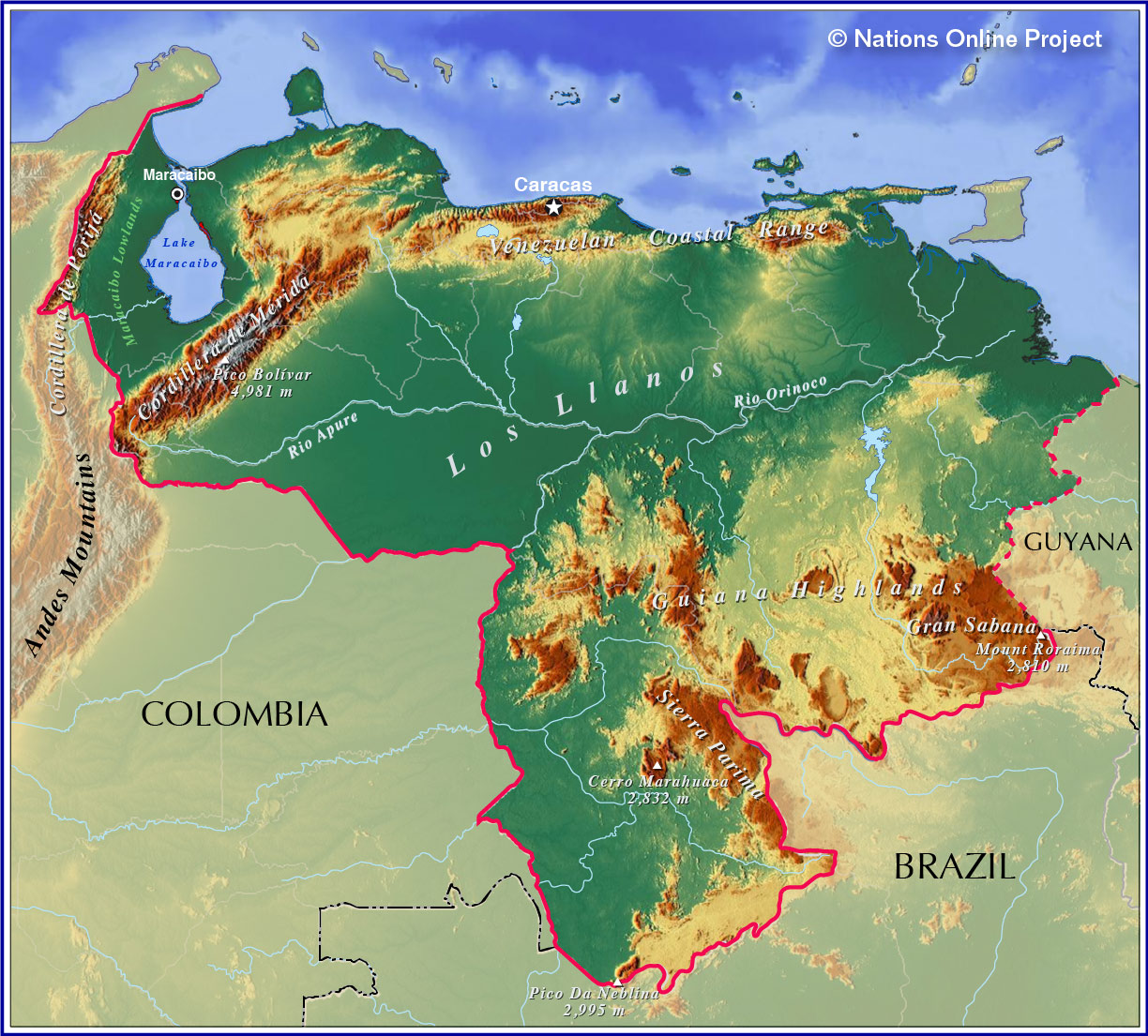
Lake Maracaibo in Venezuela (upper left) is subject to oil spills that thousands of volunteers have agreed to treat with their hair.

We all know that to solve big problems we need to get to root causes. But what to do in the meantime? A woman in Venezuela had an idea about a temporary fix for a lake’s constant oil leaks.

At the Washington Post, María Luisa Paúl writes, “For years, Selene Estrach has seen how Venezuela’s crumbling oil industry has taken a toll on Lake Maracaibo, one of the world’s largest and oldest lakes. Once a symbol of the country’s oil wealth, its waters are now coated with iridescent slicks and swirls of neon green algae blooms that can be seen from space.

“The pollution is the product of decaying machinery and ruptures in a network of nearly 16,000 miles of underwater pipelines. Though oil slicks are common in Lake Maracaibo, which contains one of one of the planet’s largest known oil and gas reserves, experts and environmental groups have warned that years of mismanagement and a crippled oil industry have left a constant stream of crude oil oozing into the water.

“Yet little has been done to clean up the lake, which is home to endangered species such as pink river dolphins and manatees. In recent years, officials have downplayed the pollution as ‘a visual matter‘ or ‘not a big deal.’

“That’s why Estrach, a 28-year-old environmental activist, was determined to find a way to help. She founded Proyecto Sirena, a national network of activists dedicated to saving the lake using an unorthodox, yet bountiful, material.

“Hair.

“She got the idea in July while scouring the internet for easy, cost-effective and sustainable solutions for the pollution marring Lake Maracaibo. She saw that Matter of Trust, a San Francisco-based nonprofit, had used human locks 22 years ago to help soak up a spill off the coast of the Galápagos Islands. …

“Estrach told the Washington Post. ‘I thought, “If they’re doing this in … other parts of the world, why can’t we do it in Venezuela?” It’s easy and cheap. Plus, all the hair that’s left over in the salons is going to waste. Why not put it to good use?’

“Since founding Proyecto Sirena — a play on the Spanish words for mermaid and emergency siren, Estrach said her car is constantly filled with bags of donated human and pet hair. Across Venezuela, more volunteers are holding haircut drives that have brought in thousands of people.

“In 1989, Philip McCrory, a hairstylist in Alabama, first designed a hair-filled net to be used after oil spills, which NASA later tested and found effective. Researchers from the University of Technology Sydney found in 2018 that hair is ‘significantly better at absorbing oil than other materials, including cellulose and cotton. …

“Hair was not only used in Ecuador in 2001, but to clean the 2007 Cosco Busan oil spill in California, the 2010 Gulf of Mexico oil spill and, most recently, in this year’s spill in the Philippines.

“Estrach has spent weeks huddled inside a lab at the University of Zulia, where she is a student, trying to replicate how the Matter of Trust nonprofit used hair after past oil spills. The results are promising, she said, with her tests indicating that about two pounds of hair can soak up between 11 and 17 pounds of oil. …

“Estrach’s team is also researching ways to safely discard the oil the devices soak up so they can be reused. ‘It will be our contribution to a growing field of research about this technique,’ she said.

“The first step, however, was getting the hair to make the items. Estrach turned to salons for help. … By October, 600 had signed up to help, which will allow her to collect about seven tons of hair every three months.

“Michele Giurdanella, 46, the CEO of Salvador Hairdressing … ended a 20-year hiatus of not cutting hair to personally help out during a donation drive. Next month, he and about 30 other stylists will give free cuts at Salvador Hairdressing’s headquarters. All the locks from the event will go toward the lake cleanup. …

“Giurdanella said, ‘[The drive] also helps out with our low-income community members who might otherwise not be able to afford getting a haircut. Everyone wins with this.’

“The effort has expanded well beyond Maracaibo. In Caracas, students from the Central University of Venezuela organized another haircut drive this month. They expected 200 people — nearly 1,500 showed up, said Rafael Chavero, a 26-year-old medical student and social activist.

“ ‘We had to promise some that we’d do another drive because we just didn’t have enough volunteer stylists to keep up with the demand,’ he said.

“That day, Chavero said people traveled up to an hour ‘to literally just give us a baggie of hair they collected.’ Others even brought their dogs for a shave and donated the fur.”

When in doubt about the state of humanity, remember that.

More at the Post, here. No firewall at Hindustan Times, here.

The Pampered Pet

Photo: Madeline Harper.
A faucet in a pet-food station designed by Daley Home makes it easy to add water to your pampered pet’s bowl.

Need an indoor shower designed for your dog? How about a built-in food and water station? Tim McKeough writes in the real estate section of the New York Times that for some wealthy pet owners, amenities know no bounds.

“When you’re designing or decorating a home, you have to consider the needs of the occupants — and that means not just people, but any resident animals,” McKeough writes.

“ ‘Our clients are very serious about their animals,’ said Jimmy Crisp, the principal of Crisp Architects, in Millbrook, N.Y. … Many of the homes he designs have built-in amenities for pets.

“Amy Storm, the principal of the interior design firm Amy Storm & Company, in Glen Ellyn, Ill., thinks along the same lines. … ‘It would actually be unusual that we wouldn’t be working on some sort of location for the pets to eat and bathe.’ …

“One of the most popular features is a dog shower. Usually placed in a mudroom or laundry room with direct outdoor access, it offers a convenient way to rinse muddy paws and fur.

Kate Marker, an interior designer in Barrington, Ill., added a shower for her two dogs to the lower-level mudroom of her own home. … There is no shower curtain or glass door to get in the way, which makes it easier to reach in and scrub the dog.

“For larger dogs, a shower with an opening at the floor makes the most sense, Ms. Storm said. But for smaller dogs, it’s often better to raise the shower, so that it resembles an oversized sink [and] you don’t have to hunch over. …

“Food and water bowls can look like an afterthought if separate dishes are simply placed on a waterproof mat. A better alternative is a built-in pet-food station.

“Shelby Van Daley, a founder of the interior design firm Daley Home, included an open cabinet with built-in dog bowls when she was designing a kitchenette for a family room in Austin, Texas. The pet dining space is lined in quartz countertop material and has cutouts to hold removable stainless-steel bowls. …

“ ‘A lot of our clients look for things they can add to their home to make it easier having pets,’ Ms. Van Daley said.

“If you don’t want to see bowls sitting out all day long, there’s another option: Install a low drawer in a bank of cabinetry, with cutouts for bowls, so you can slide it closed when it’s not in use. …

“Crate training your dog shouldn’t mean putting up with an ugly wire structure in the middle of your living space. Many designers are creating upscale custom crates that are built into homes.

“Ms. Van Daley designed a pair of crates with brass-mesh doors and enough space inside for dog beds as part of storage cabinets in the primary bedroom of one project. And Mr. Crisp designed a custom crate to fill the unused space under a staircase.

“If you don’t need a crate, but want a place to hold wet dogs in the mudroom, there are other options.

“For one client, Ms. Storm designed a mudroom with a half-height screened pocket door that pulls out of the wall like a baby gate. Compared to a solid door, ‘you still have good light and good air, and everyone can still see each other,’ she said, ‘even though the dogs are secured.’

“While dogs can usually get outside to play, indoor cats don’t have that opportunity. To compensate, some cat owners design their interiors to double as feline playgrounds.

“Alexandra Barker, the founder of the Brooklyn-based architecture firm BAAO, prioritized cat-friendly features while renovating a Brooklyn rowhouse for a couple of cat lovers. …

“The home’s defining feature is a built-in bookcase that runs along one wall of the living room. Some of the shelves project out into the room to serve as cat steps, and the top of the structure angles up and down to serve as a cat run. At one end, the run reaches a ceiling hatch that opens to the primary bedroom above; at the other, a hatch opens to an art studio.

“For another client in Brooklyn, Ms. Barker is designing a cat bathroom that conceals the litter box. ‘It’s a door into a closet with a portal in it,’ she said, so the cats can come and go as they please and no one has to look at the litter box. …

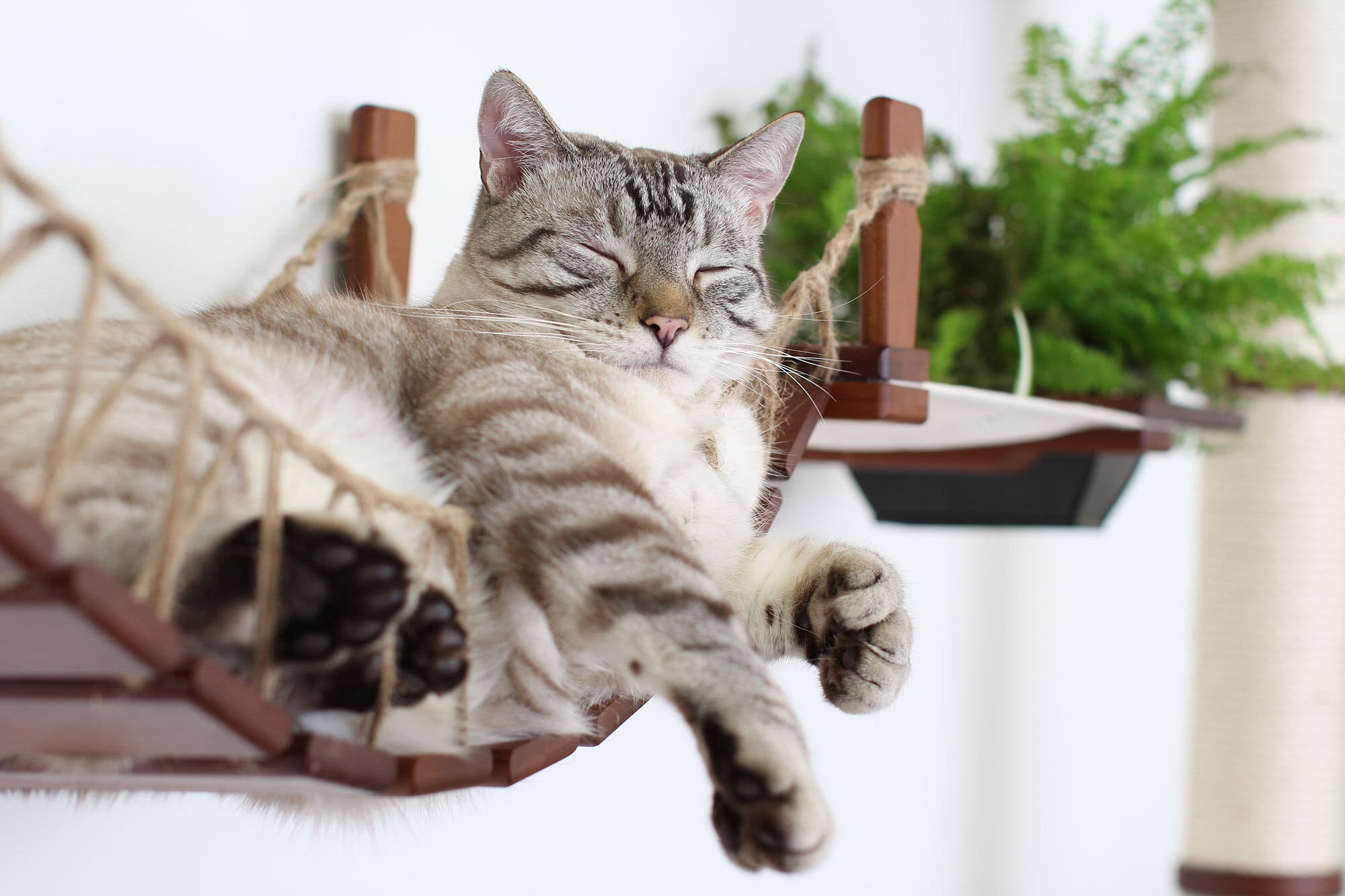
“If you want to create an indoor feline playground but aren’t ready to renovate, there are products that can be installed on an existing wall. Mike Wilson co-founded Catastrophic Creations, a manufacturer of cat-play equipment in Grand Rapids, Mich., after devising a wall-mounted rope bridge for his own cat. …

“On Etsy, the bridge was a hit, and the company soon developed a range of wall-mounted cat runways, steps, scratch posts and hammocks.

“Jackson Cunningham started Tuft & Paw in Vancouver, British Columbia, for similar reasons. ‘The idea came from our own experience of living in a smaller space in the city and caring about the stuff we put in that space,’ Mr. Cunningham said. …

“Tuft & Paw now makes cat hammocks, perches, beds and litter boxes that are as considered as any piece of designer furniture.”

More at the Times, here. OK, what do you think? You still have to walk the dog and empty the litter box. And do you think such things would improve the value of a home at resale — or would all those amenities have to be torn out?

Photo: Catastrophic Creations.

Photo: Luna & Stella.

This is your Small Business Saturday reminder that Suzanne’s jewelry company, which hosts this blog, has a 20%-off sale until late Sunday Eastern Standard Time.

Suzanne writes, “Our only sitewide sale of the year is now open to all! Save 20% on everything on the website with code SHOPSMALL23, including all our antique locketsvintage charmsvictorian chainsmodern necklacesbirthstone rings, and even our archive sale

“Thank you for shopping small, with us and in your communities.  It really makes a difference!”

Photo: Cristina Baussan for NPR.
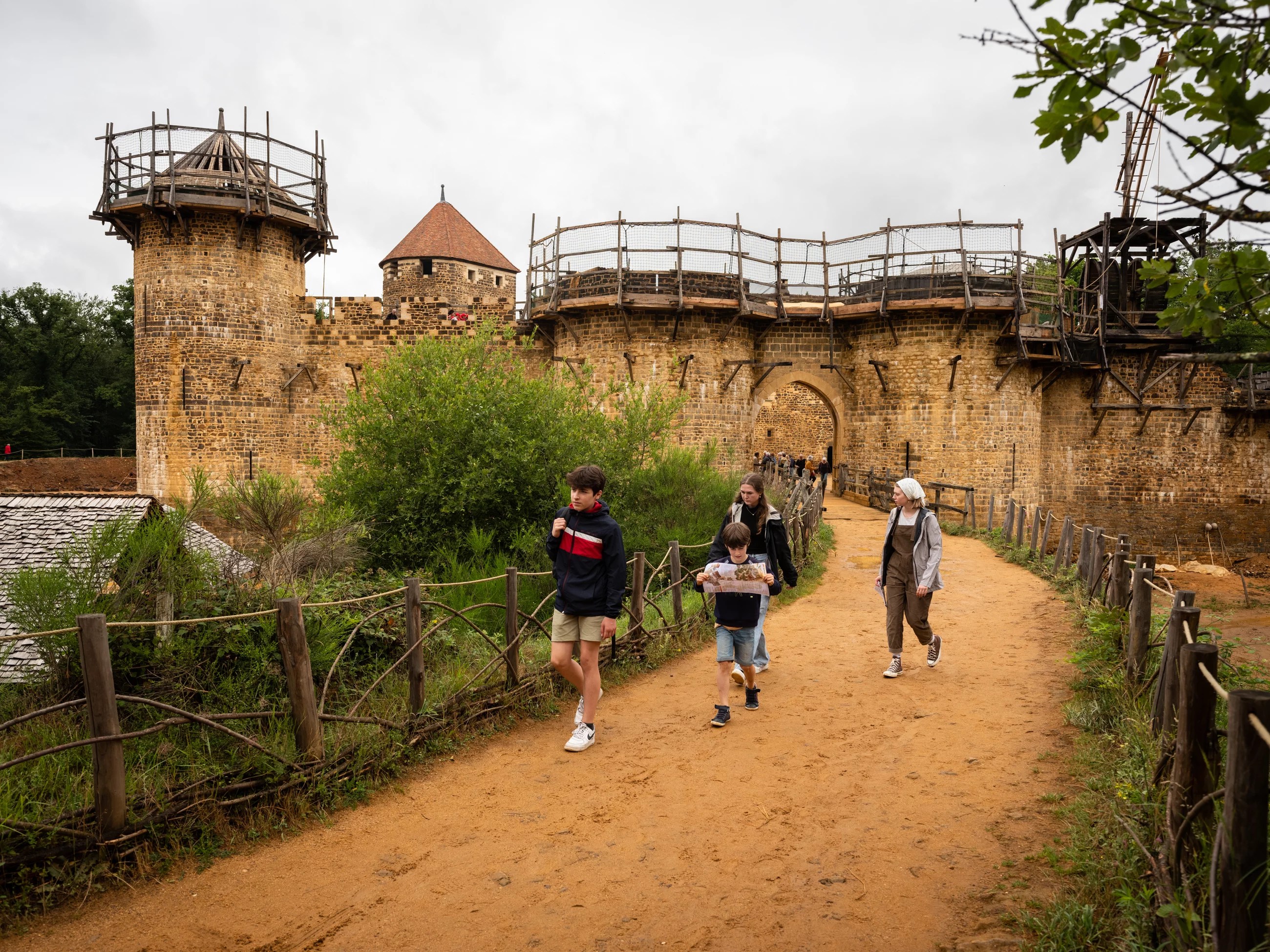
Visitors walk near the construction of Guédelon Castle, dreamed up as an exercise in “experimental archaeology” 25 years ago.

The Plimoth Patuxet Museums in Massachusetts used to be called Plimouth Plantation, and at Thanksgiving lucky visitors got to share in whatever version of the First Thanksgiving was in vogue at the time. Today the history involves the indigenous people in a much more balanced way. But a visit to the site is still a step into another century, a century without cellphones.

Not unlike a visit to a certain castle in France.

Eleanor Beardsley reports at National Public Radio, “Deep in a forest of France’s Burgundy region, a group of enthusiasts is building a medieval castle the old-fashioned way — that is, with tools and methods from the late 13th century.

“Some of those working here are heritage trade craftspeople, others are ardent history buffs, but all say they share a deep respect for nature and the planet, and a desire to return to simpler times.

” ‘This is a place you experience with all your senses,’ says Sarah Preston, communications director and guide of these grounds known as Guédelon Castle. ‘As soon as we walk onto the site you smell the woodsmoke. There’s something so evocative about these sights and sounds.’ …

“Once beyond the entrance barn doors, visitors plunge into a bygone age. There are no mechanical sounds, no motor engines — and cellphones must be turned off. The idea to build Guédelon was born in 1995 among three friends, residents of the area, who are also history buffs and nature lovers. One of the three owned a nearby 17th century château and was involved in work to restore different castles in the area.

” ‘But we thought, how amazing would it be to actually build a castle from scratch?’ Maryline Martin, CEO and a co-founder of Guédelon, told public radio station France Culture last year.

“After finding and purchasing the original 27 acres of land in a forest near a centuries-old abandoned quarry and water (necessary ingredients for any medieval construction site), the co-founders got a construction permit and, in 1997, laid the first stones. …

“Martin said Guédelon is an example of experimental archaeology — which is a way to research how people did things in the past by trying to imitate them. … The builders use the examples of other medieval castles in the area, as well as descriptions in old manuscripts and books.

“The workers are all dressed in medieval clothing, except for sturdy contemporary footwear and sometimes helmets mandated for a modern construction site. The smell of fire and a clanking sound are coming from a nearby blacksmith’s shop. That’s where 20-year-old Matisse Lacroix is forging the tools needed to build the castle. Sparks fly as he pulls a cord that operates a large bellows.

“Lacroix says the furnace temperature is around 2,000 degrees Fahrenheit, ‘so the iron is soft and malleable and I can make these nails.’ He bends and shapes pieces of iron into nails. …

“During NPR’s visit, a group of fourth-graders are at the site. They watch Lacroix pound the glowing red rods. The craftsmen stop their work to explain what they’re doing to visitors as well as train young craftsmen in heritage skills. …

“That learning aspect of Guédelon is one reason its construction is taking so long. The owners say the project is meant to discover and pass along skills and knowledge from a 13th century work site. Workers stop their tasks several times a day to answer questions from visitors — as part of the job. There are six turrets completed as well as a protective wall and inner living castle with a chapel. …

“Preston said they initially financed their work through donations and some European Union funding. Now the château is financed through more than 300,000 visitors a year (paying between 12 and 15 euros each). …

“There are all kinds of projects to recreate the kind of village that would have existed beside a castle like this 800 years ago. A garden grows plants indigenous to the area in the Middle Ages.

” ‘We grow only medieval plants,’ says Antoine Quellen, who works in the garden two days a week. ‘So that means we don’t have tomatoes, we don’t have potatoes, because those came from South America much later.’ He says people ate a lot of grains back then. The indigenous plants are hardier and help preserve the land and soil, as they have a kind of genetic memory of place in their germ cells, he says. …

“Half a dozen stone masons work near the quarry. Tendra Schrauwen, a 29-year-old from Belgium, says Guédelon is one of the few places in the world you can practice this craft using traditional methods and old tools.

” ‘Our job is to cut stones in perfect geometrical shapes,’ he says. ‘For window, doors, chimneys, staircases, stone by stone.’ He says it’s all about teamwork. ‘The stones are very heavy. It’s very dangerous, you can damage your body. So the most important thing is to work in a team.’ …

“To lift the tons of wood and stone needed to finish the castle’s outer walls, two men walk inside a contraption that looks much like a giant hamster wheel. It’s a kind of medieval crane with a central axle and ropes. Known as a treadmill crane, it can pivot and raise or lower materials, depending on which way the workers walk inside it. The only modern addition at Guédelon is a safety brake.”

More at NPR, here. No paywall. Great photos.

Happy Thanksgiving

Photo: Jorge Gardner via Unsplash.
Street art in Bogotá, Columbia.

We who have so much reason to be thankful at Thanksgiving can spare a thought today for those who have little — and are grateful for that little. An experiment in Bogotá is offering hope to some of the poorest women in Columbia.

In an opinion piece at the Washington Post, Bina Venkataraman writes, “One day in the distant future, caregiving could be as celebrated as carrying a football into an end zone. Rather than toil in the shadows, people who juggle children and aging parents might be applauded for their skills — or stopped on the street by admirers. Family caregivers could get paid for the hours they put in minding the young, the sick, the disabled and the old. Men would be as proud as women to care for their children. Governments would fund more services to relieve at-home caregiving, recognizing its physical and psychological toll. …

“For now, consider a small experiment hatched in Ciudad Bolívar, the second-poorest district of Colombia’s capital city, where settlements of makeshift houses sprawl up a steep mountainside, emblazoned with colorful street murals. This district has long been a hotbed of political resistance, home to diverse Indigenous peoples as well as Venezuelan refugees. …

“Since 2020, it has become the site of Bogotá’s first manzana delcuidado, or ‘care block,’ in a city where caregivers — mostly women, mostly poor — ordinarily labor in obscurity without compensation or formal recognition. More than 30 percent of Bogotá’s female population, some 1.2 million women, provide unpaid care full time, some for as much as 10 hours a day.

“Most lack formal education beyond some years of high school, and the city estimates that 1 of every 5 of these women has a diagnosed illness, ranging from arthritis from long hours spent hand-washing clothes to sexually transmitted diseases and untreated cancers. And many of them, says Nathalia Poveda, who manages the Manitas care block in Ciudad Bolívar, don’t recognize that when their husbands hit them, it is domestic abuse.

“A care block is a modest attempt to shift the way caregivers are viewed and supported, and the way they view themselves. It’s a community-scale solution — something that’s needed if poor women are to benefit from global progress in gender equality.

“In Ciudad Bolívar, women can drop off dirty clothes and bedding each week to a city-funded laundromat. Demand is so high in the district, and given only four washing machines and dryers, the women have to rotate out of using the program every three months.

“A community center offers free courses to help women earn high school diplomas and practice yoga while city employees mind the children, elderly or people with disabilities in their care. Caregivers and their spouses can learn to use a computer or cellphone and get STD testing, psychological counseling and legal aid — all under one roof. In the same building, a child can get a strep test and his mom can get a Pap smear, rather than having to shuffle to clinics around the city.

‘It gives me a breath, a break,’ said Lisbeth Diaz.

“This isn’t rocket science, but it is innovation. ‘We need to care for the people who care for us,’ says Diana Rodríguez Franco, Bogotá’s secretary for women’s affairs, who came up with the idea. The city now has 20 care blocks, as well as a program to send relief caregivers directly to people’s homes. The city funds the program with an annual budget of $800,000, and it has attracted grants from global organizations for pilot projects such as caregiving classes for men.

“I spoke with several women using services at various care blocks in the city. ‘It gives me a breath, a break,’ said Lisbeth Diaz, who was taking a class that would certify her skills as a caregiver at the Manitas care block in Ciudad Bolívar. The idea behind certification, said Poveda, is to help women recognize that the work they do in the home is valuable.

“ ‘You have to take care of yourself to take care of everyone else,’ said Sandra Quevedo, who was glad to learn yoga, lifting her chin and chest with pride as she spoke. At a care block within a high-altitude ecological park called Entrenubes, a group of middle-aged women in a program called Las Mujeres Que Reverdecen — ‘the women who regreen’ — giggled and flexed their muscles when I asked what it was like to get paid to learn to plant trees and care for city parks part time. …

“The manzanas are one of several initiatives that Bogotá’s first female and openly gay mayor, Claudia López, has launched to try to shift the balance of power between men and women. … The López government also brought in an all-electric fleet of city buses, called La Rolita, and has been hiring and training women to drive and maintain them.

“ ‘There’s been huge pushback,’ says Rodríguez Franco, noting that the city was sued in 2021 by a man who objected to the care blocks’ focus on women. (La Rolita also inspired a lawsuit.) But Rodríguez Franco is heartened to see some men now coming to the care blocks with their female partners to finish high school or to learn to use computers. …

“International development experts have long argued that, along with fostering social progress, educating girls and women and putting more income in their hands can break cycles of intergenerational poverty and moderate population growth. Helping caregivers finish school and find jobs has been an often overlooked but critical piece of this puzzle.

“In recent decades, Colombia has made strides toward recognizing the rights of women — especially caregivers. In 2010, it became the first country to require that women’s contributions to the care economy be documented. …

“Much change is needed to lift the burden on caregivers worldwide and to give women greater access to education and jobs. As political leaders in rich nations debate policies that can put more women into the halls of power, Bogotá’s efforts are a reminder that the world’s poorest caregivers also need innovative measures — if we are one day to inhabit a world in which the average woman’s economic and political power is equal to that of the average man.”

More at the Post, here.

Photo: Kris Craig/The Providence Journal.
Guerrilla Tango on the Van Leeston Pedestrian Bridge over the Providence River in Rhode Island.

Do you love reading about new ways people find to have fun? You don’t always need to spend money for entertainment. Check out what Kris Craig wrote at the Providence Journal.

“In the last rays of a beautiful Sunday in September, Susan Davis of Providence Tango finds an open spot and wheels a small black speaker to a corner railing around a lower deck of the Michael Van Leesten Memorial pedestrian bridge. She starts the music, and with it begins an evening of Guerrilla Tango.

“Everything around the bridge ebbs and flows, with people enjoying the mild late-day weather. And then, like a mist coming off the Providence River, the music rises, a beacon to a small, selective population, drawing tango true believers onto the planks and into the evening. 

“This is Milonga, a tango dance party, social dancing that is all about connection and community.

“Davis, who organizes these summer-long monthly events, will tell you this tango is about feeling quiet and sensitive to your partner of the moment and the others around you.

“As dancers accumulate on the decks to the side of the bridge, faces beam. There are a few newcomers and out-of-towners, but these people are not strangers.

All are part of the small New England tango community, moved by digital bulletin boards and word-of-mouth to the Guerrilla Tango.

“On the wooden planks of the bridge, street shoes are swapped for shiny black patent leathers for men and ankle-strapped high heels or stilletos for women. Hints of piano, violin and the accordion-like bandoneon coax the arrivals to finish changing quickly.

“The dancers pair off on the fly with provisional partners and ease into the tempo, and the scene transforms. The smiles of greeting fall away and the couples become one, as if the closeness of torsos and the placement of hands – one near the middle of the back or shoulder, the other gripped lightly with their partner’s – complete a circuit and light a fire in a world unto itself, shared two by two but really by all.

“The impromptu embrace and collective grace of this fluid assembly speak of romance uncoupled, large and free, less amorous than artful. The love is of music and motion. Of life itself. …

“I move from spot to spot, photographing the dancers, making my way around a crowd of spectators on the walkway, and I catch the awe in their appreciative murmurs. 

“A pair of teenage girls laugh their way down the terraces of the bridge, placing hands to bodies, mimicking the dancers, and they move into the mix. I too feel the pull to join the magic, but there are no invites for dilettantes. Knowledge of tango is the price of admission, and unaware guests become meteors wreaking havoc in this synchronized universe. Among the group, some dancers may learn from this evening, but it’s not a dance class. 

“A series of three mostly traditional tangos ends, and the music shifts to a 30-second Cortina, a completely different style. The dancers seem to awaken from a meditative trance. The short respite affords them a glimpse of the banal world surrounding their own before each seeks yet another partner for the next series. Another chance to get lost in the tango.

More at ProJo, here. Catch it next year, tango lovers!