Feeds:
Posts
Comments

Photo: Sophia Evans/The Observer.
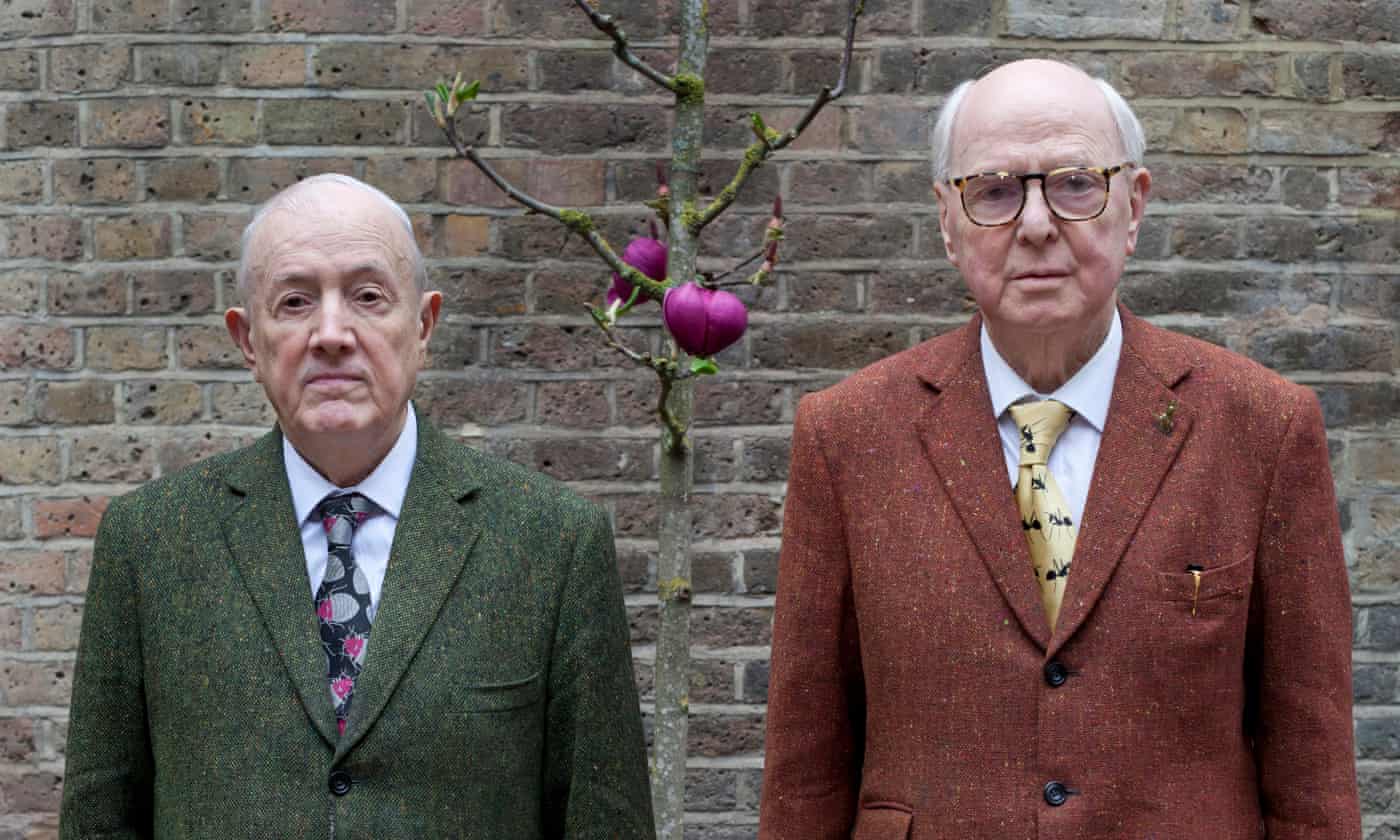
Gilbert, left, and George at their new gallery on April 1. When artists want control, they sometimes open their own museums.

I am always curious about innovations in the museum world. If you search this site on the word “museum,” you will find a wide range of posts, including one about a pandemic-era “mini museum for stir-crazy gerbils,” here, and a 2018 post on micro museums, here.

Vanessa Thorpe reported at the Guardian recently about two guys in London who decided to open a museum for their own work.

“Every creative person yearns for a room of their own,” wrote Thorpe. “But for the stars of Britain’s contemporary art world, it seems that now only a venue of their own will do. [In March] it was Tracey Emin in Margate; on [April 1] it was the turn of the veteran duo Gilbert and George.

“ ‘It is very exciting to see so many people,’ said George Passmore, 81, after the gates swung wide at 10 am to let in an orderly queue of first visitors. ‘Most amusing,’ added his lifelong collaborator – and, since 2008, civil partner – Gilbert Prousch, 79. …

“ ‘Do you know the gates [at this building] are painted in a shade called Invisible Green?’ asked Passmore. ‘It was invented for the great garden designer Humphry Repton when he noticed the grounds of the stately homes he created were being walked across by the public. He needed to put up barriers in a color that would not stand out. It is odd, because it is not invisible at all.’

“The pair’s decorative wrought-iron gates are also not intended to keep out the public. Far from it: the Gilbert and George Centre, which they have planned for years, is a built representation of their slogan ‘art is for all’ and designed as a gift to the community they have lived and worked alongside together for most of their working lives.

“Passmore, born in Devon, and Prousch, born in Italy, met in 1967 while studying sculpture at St Martin’s School of Art in London and developed a unique and entertaining style that places their own images in a variety of visual contexts and poses. ‘We are two people but one artist,’ they have been fond of explaining.

“This first show in the venue features vast photographic screens of leaves and organic products, including figs, roses, dates and leafy greens through which the artists peer or can be seen lolling on benches, either resting or in a swoon. …

“Mark Schofield, 50, a longtime fan, brought his parents, Jackie and Tony, down from Peterborough to see the show. A scientist who now lives in Boston, he was bowled over by the galleries.

“ ‘There’s this clear contrast that I love between the deadpan faces and the joy and mischief of the art. It is so English, somehow,’ he said.

“Rachel Scott, a painting conservator from Dalston, was also struck by the humor of the work. … For Bash Ali, 44, a charity worker and artist, the trip up from the south-east of the city had been well worth it. ‘It really works. It is such a great space.’

“The ‘naughty and a bit rude’ tone of much of Gilbert and George’s art was part of the appeal, said Paul Rudgley from Birmingham, who was visiting the centre with his artist friend Arran Patel from London. But in the end, as a collector of Pantone colors and a former paint industry executive, it was the bright and bold hues that won the day for him.

“The opening of the Gilbert and George Centre followed last weekend’s seaside event in Margate, Kent, when a new artists’ space run by Tracey Emin, a comparative newcomer on the subversive art scene, was unveiled. And over in south London, Damien Hirst’s Newport Street Gallery has also given space to displays of work from his own art and his wider collection since 2015. Admission to each of these three new private galleries is free, although Hirst’s is currently closed.

“Emin, 59, wore a full town crier’s outfit for the opening of her venue. Called the TKE Studios and T.E.A.R. (Tracey Emin Artist Residency), it has been constructed inside a former Edwardian bath-house after a [$1.3 million] investment. As the artist cut the ribbon, she promised: ‘We are going to make Margate an artistic mecca’ before she announced new plans to buy up a nearby derelict pavilion, for swimmers and surfers.

“Early to the trend for running his own artistic space, Turner prize finalist Yinka Shonibare offered more than just a gallery to visitors to his experimental space in east London. Called Guest Projects, and launched a decade ago, his project still offers residences for performers as well as visual artists and musicians.

“When it started, it provided food, too, in a special supper club called the Artists Dining Room where guest chefs create dinners inspired by the work of artists including Louise Bourgeois, David Lynch, Frida Kahlo and Jean-Michel Basquiat.

“ ‘Artists should have a space in which they can fail, and the art market doesn’t really allow room for failure – there’s too much at stake, Shonibare said at the time.”

More at the Guardian, here. You can enjoy all the pictures as there is no firewall.
Images: Brett Hawkes photos; Ally Rzesa illustration.

When do people get interested in researching family history? Some people never. Others — like my cousin who has made his genealogy hobby an obsession — very young. In today’s article, a 71-year-old from Massachusetts got the bug when he started going through the photos his grandfather took in France.

Travel writer Christopher Muther reports for the Boston Globe about Brett Hawkes and the stacks of old photos he used to re-create his grandfather’s journeys in WWI.

“For the better part of a century, the boxes and their mostly-forgotten contents collected dust while occupying real estate in attics throughout Massachusetts.

“But for Brett Hawkes … they inspired a once-in-a-lifetime journey that spanned 600 miles across the French countryside.

“Hawkes received the boxes of old photos and letters when his mother passed away in 2013. He said he glanced at them occasionally, but otherwise, they remained stored away, collecting another decade of dust. He came upon them again in the winter of 2022 while cleaning his office, but this time, the more he studied them, the more he was drawn to what he saw.

The pictures, taken in 1917 on the frontlines of the war in France, showed soldiers fighting in trenches, bombed buildings, and previously idyllic fields transformed into hastily-dug cemeteries.

“But his grandfather also took pictures of everyday life in the small towns where he was stationed. There are pictures of friends he made, soldiers playing football in a snowy field, and peaceful streets.

“ ‘I stared at these old photos and thought, “Oh my God, look at these churches bombed to the ground.” I started wondering what they look like now,’ Hawkes said. ‘I happened to find a photo he took of a famous chateau, and I Googled it and saw it was all renovated.’

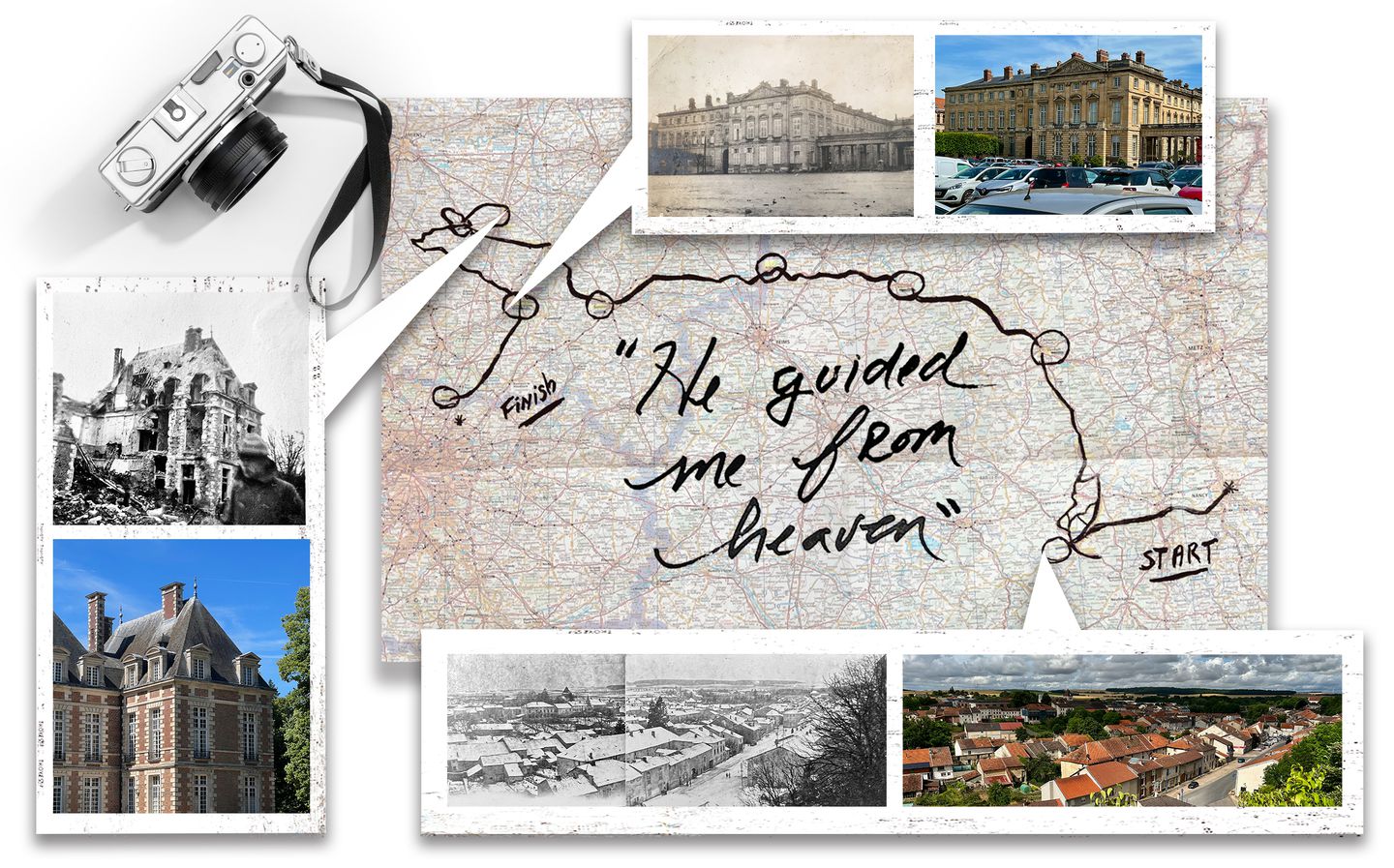
“That’s when the idea for his trip took root. He devised a plan to find the locations of as many of the photos as possible — thankfully, his grandfather had labeled the towns where pictures were taken — and re-create his grandfather’s 1917 route in France. …

“Alton Hawkes entered the war just months after America’s entry and was sent for further training in Abainville before being stationed in the villages of Warmaise, Chepoix, and Broyes, about 70 miles north of Paris.

“Brett said his grandfather, who studied engineering, was also an avid amateur photographer and collector, which made reconstructing the route easier. He also had letters that his grandfather had written home to his family, outlining some of his more benign activities.

“ ‘What boggled my mind was that he took these photographs of the destruction and fighting that would be classified today,’ he said. ‘The more I learned, the more I became emotionally involved. It’s part of the reason why Ancestry.com and 23andMe are so popular. People want to feel an emotional connection with the past.’

“Hawkes has two skills that made the trip possible. The first was years of cycling experience. When he was 16, his neck was broken in a severe car accident. As a result, the right side of his body was paralyzed. Over time he regained the use of his body, but the former athlete continued walking with a limp. While he could no longer run or play sports, he could cycle, which remains his passion.

“His other skill is the ability to speak French and a general love of French culture. He brushed up on his French before the trip, but he spoke no English for three weeks on the road.

“ ‘Being able to speak French helped form bonds and broke down barriers with the people I met,’ he said. …

“Those meetings with residents are what made his trip a success. He would roll into small farming towns and seek out cafes where he would strike up conversations with locals. If the town was too small for a cafe, he knocked on the doors of houses that his grandfather had photographed, or he would seek out the mayor of a town he was visiting for assistance in finding buildings or bridges.

“ ‘I’m an older guy. I wasn’t threatening. I couldn’t punch myself out of a paper bag,’ he said. ‘I think that helped a lot.’

“When word spread through these tiny towns of the American retracing his grandfather’s WWI route, strangers would show up at bed and breakfasts where Hawkes was staying with information about locations in the photographs and stories about the war that had been handed down. …

“ ‘I started to really go through a transition. It became more than a vacation, it became a passion. It was an incredible experience. It’s hard to explain, but that’s really what happened. I went through a transformation.’

“He found the field where the French government awarded his grandfather the Croix de Guerre for his bravery in battle. In one photo, his grandfather stood on a pile of rubble that had once been a church. Hawkes found the location with a new church in its place. It was the same with historic buildings that had been repaired or rebuilt. Just like his grandfather, the younger Hawkes was there to document it all.

“ ‘He guided me from heaven,’ Hawkes said.”

More at the Globe, here.

Twins Making Art

Photo: Luiz Bicalho.
The Sydnie and Haylie Jimenez creation “Memory Armor,” 2023. Stoneware, underglaze, glaze, oxide wash.

We have all read stories about the closeness of twins and the unusual effects that such closeness can lead to. I have blogged more than once about pairs of twins who become collaborative artists, for example, including the Brazilian brothers Os Gemeos (“the twins” in Portuguese), who created the first of the giant Dewey Square murals in Boston, part of my beat.

The acclaimed art critic Cate McQuaid wrote in April at the Boston Globe about identical twins whose work was being shown even closer to my home.

“There’s a rich figurative thread in the history of marginalized artists that declares, ‘this is who we are. See us,’ ” she writes. “When the 20th-century art world was besotted with modernist abstraction, sculptor Elizabeth Catlett, painter Aaron Douglas, and others stuck to figuration to tell Black stories. In the 1980s and 1990s, Nan Goldin and Catherine Opie used photography to showcase their queer communities.

“Identical twins Sydnie and Haylie Jimenez, mixed-race artists born in 1997, are the heirs of such artists. Their barbed show ‘Love You to Death’ is at Lucy Lacoste Gallery.

“Sydnie, a ceramicist, and Haylie, who paints and draws on paper and on clay tiles, make defiantly exuberant figurative works rejoicing in identity and relationship — their own, and those of their LGBTQ/BIPOC community. Some figures grin convivially, but many wear stern expressions, on the lookout for trouble.

“ ‘Memory Armor’ depicts a young woman with her hair atop her head in two buns. Sydnie crafted the figure and Haylie inscribed the tattoos. A chain inked at her hairline drops down, hinting at a third eye, a channel to wisdom and divinity. With a skull on her shoulder and Pegasus on her chest, a two-headed dragon and a butterfly on her back, she’s at once cautious and expressive.

“In collaborative pieces such as ‘I Love Country Boys’ and ‘Black Bikini,’ solid young women stand proud in their swimsuits, tattooed with flowers, nails, and the word ‘ROTTEN’ in ornate script. These figures, presented with the illustrative flare of cartoons, come across as people to be reckoned with. Many of Sydnie’s solo works have that thorny charm. A series of cherubs outfitted with black batwings includes ‘Blonde Haired Cherub,’ who looks ready to fight, and ‘Bucket Hat Cherub,’ wearing a beatific smile but a T-shirt emblazoned with ‘PROBLEM.’ …

“The Jimenez sisters say in their statement for ‘Love You to Death’ that their own relationship informs how they build community. These warm and prickly works invite viewers to hang with them, and savor their ferocity, loyalty, and joy.” More at the Globe, here.

You can read about artist twins Mohammed and Omar Kabbani from Lebanon and the Brazilian team Os Gemeos at this blog, here and here.

By the way, gallery owner Lucy Lacoste, who started out in ceramics herself, has a sharp eye for innovation in the field.

In the early 2000s, I brought her a booklet I picked up at a gallery in Minnesota where I was enraptured with the mysterious tea cups of Anne Kraus, coming back multiple times to admire the tiny paintings and read the inscriptions.

Lucy was grateful. She told me I’d made her day, and she set out at once to see if Kraus was already represented by a gallery. She was. Nevertheless, Lucy has been very successful hunting for similar kinds of quirky genius. What is interesting to me is that although the messages of the pieces are often dark, the artistic expression brings joy.

I guess that is how art tames and triumphs over what is painful.

Photo: Luna & Stella.
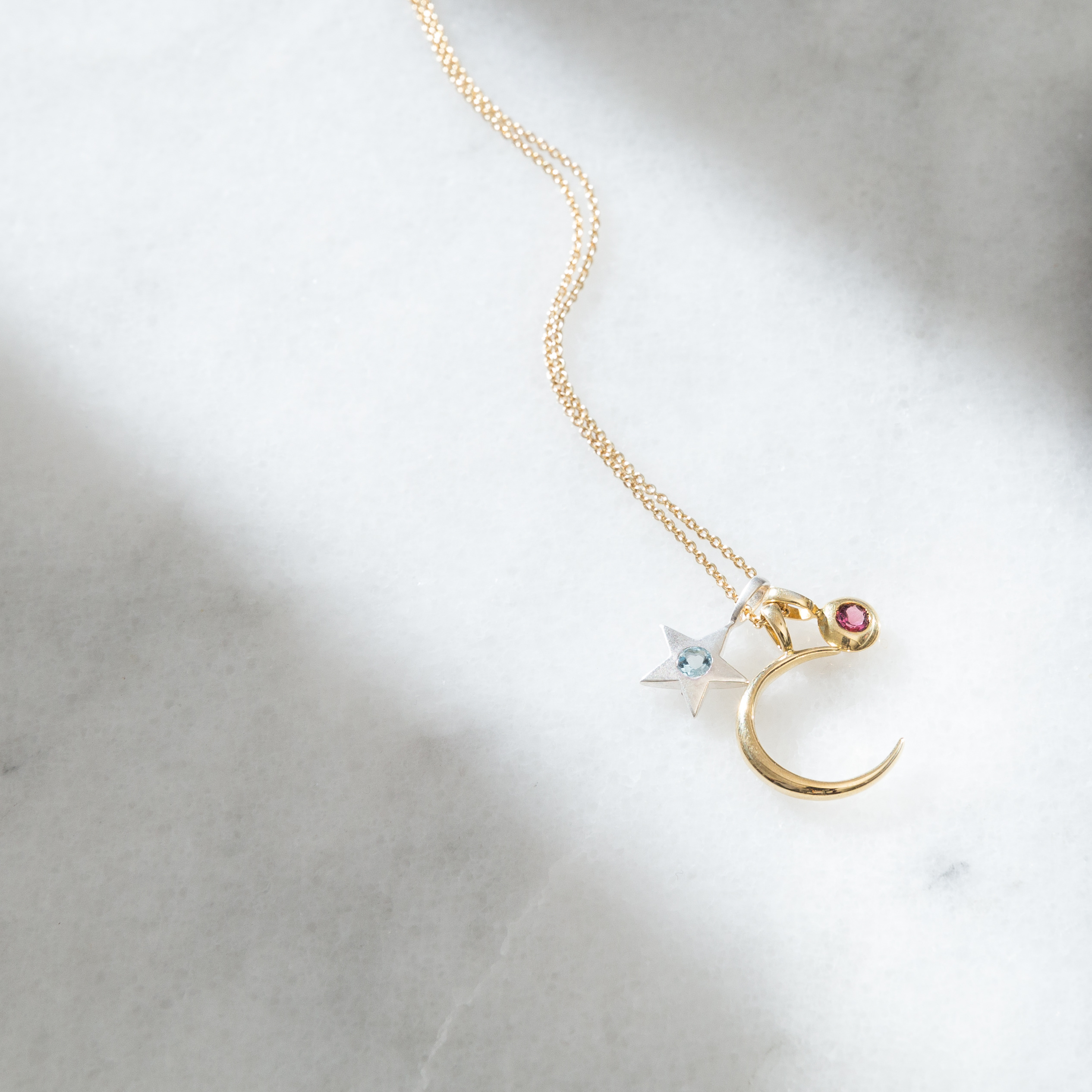
Birthstones of family members can be extra meaningful on Mother’s Day. For fun, read here about traditional associations with your own birthstone.

Newer visitors to this site don’t know that my eclectic blog is hosted by my daughter’s jewelry company, Luna & Stella. Suzanne gave me carte blanche to write about whatever was of interest to me, and I’ve been grateful for every day of the 12 years I’ve been writing here — through all the adjustments to aggravating WordPress “improvements.”

Although I tend to wander off in all directions, every once in a while, I get the urge to tell the world about Suzanne’s lovely products, especially at Mother’s Day, May 14th this year.

The necklace above is the kind you can customize with different charms using the birthstones of the mother’s family. I got one from Luna & Stella’s online shop years ago. It has birthstones for February, March, April, May, July, and December — my husband, my children, my grandchildren.

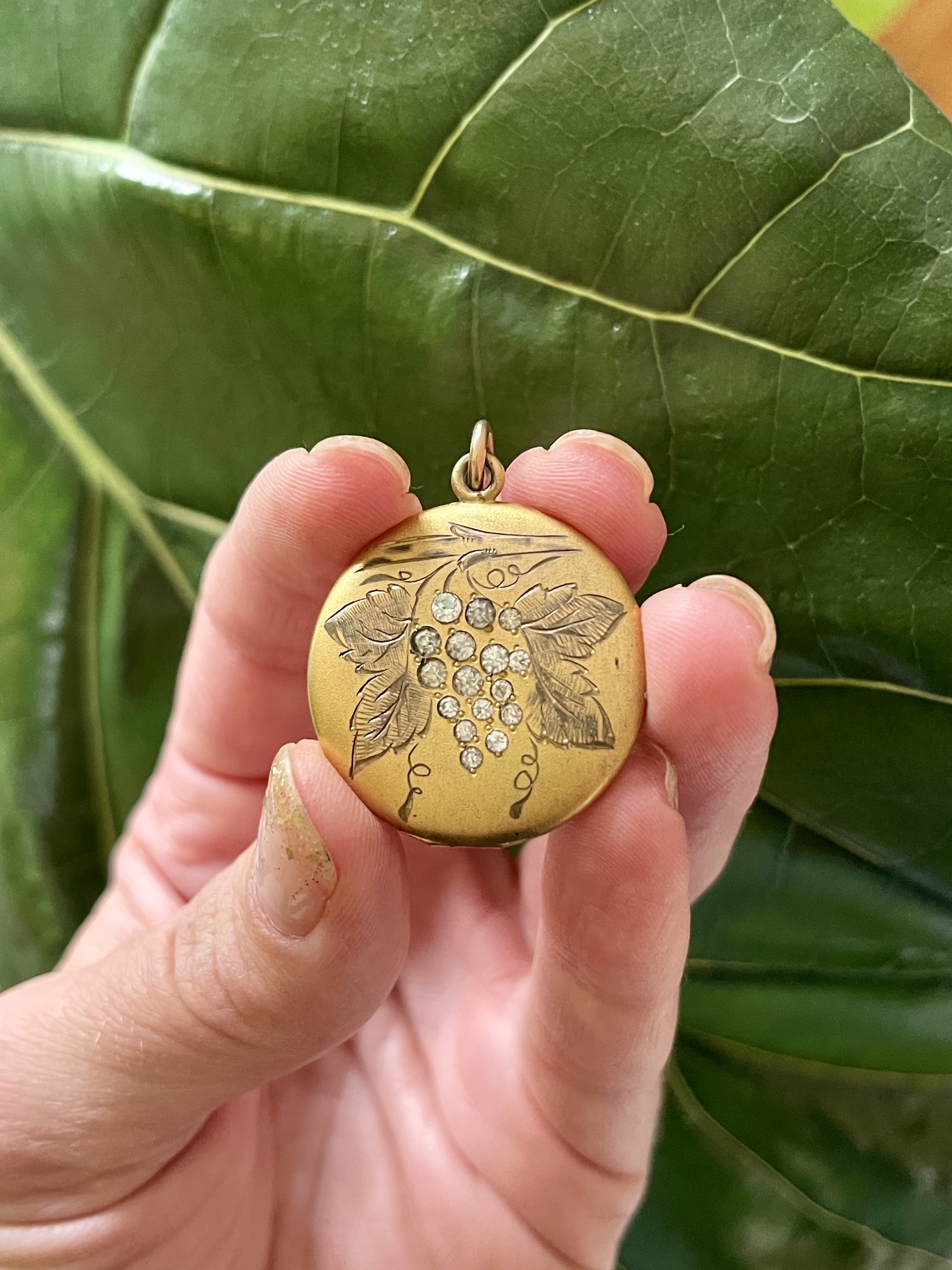
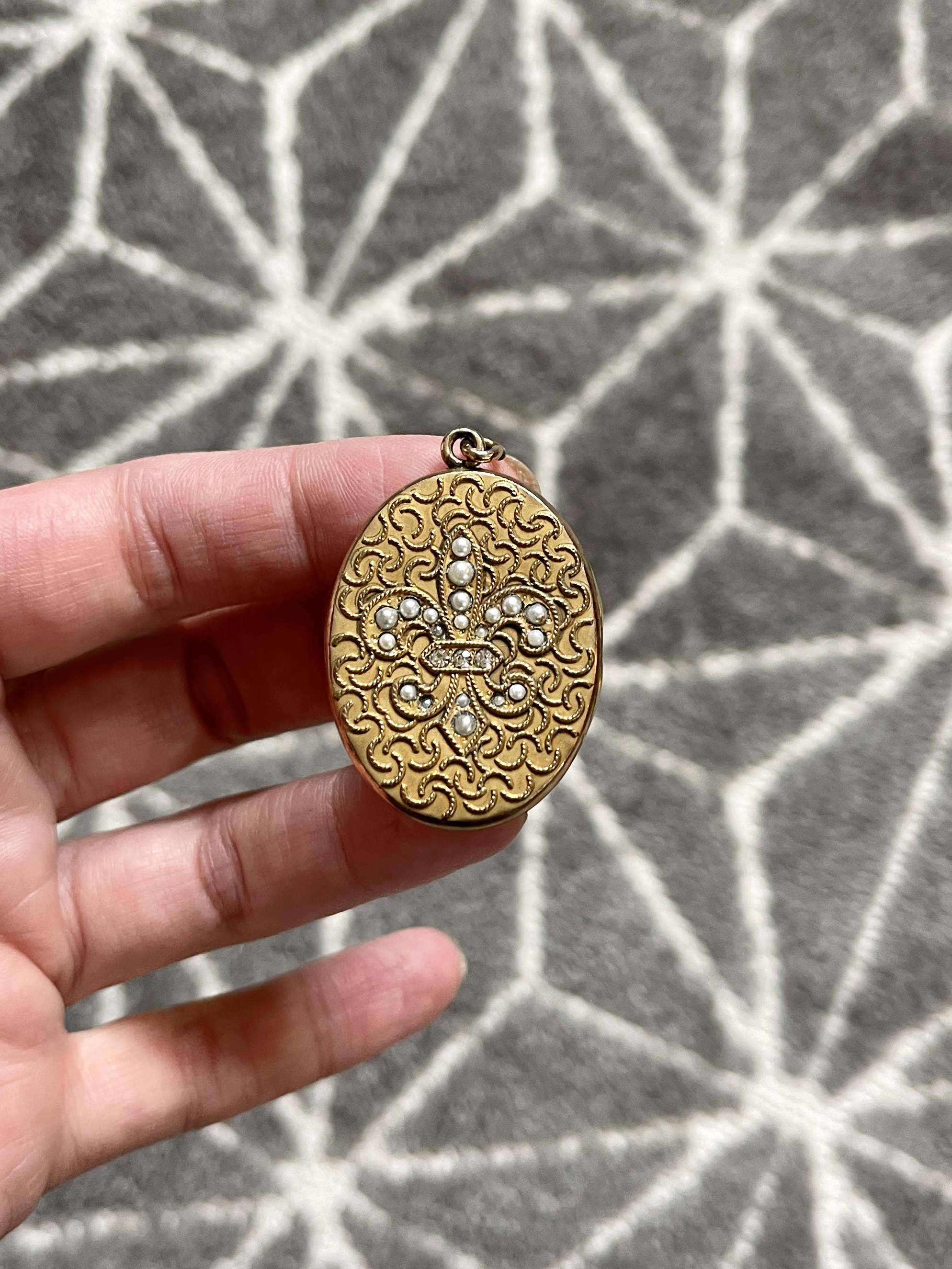
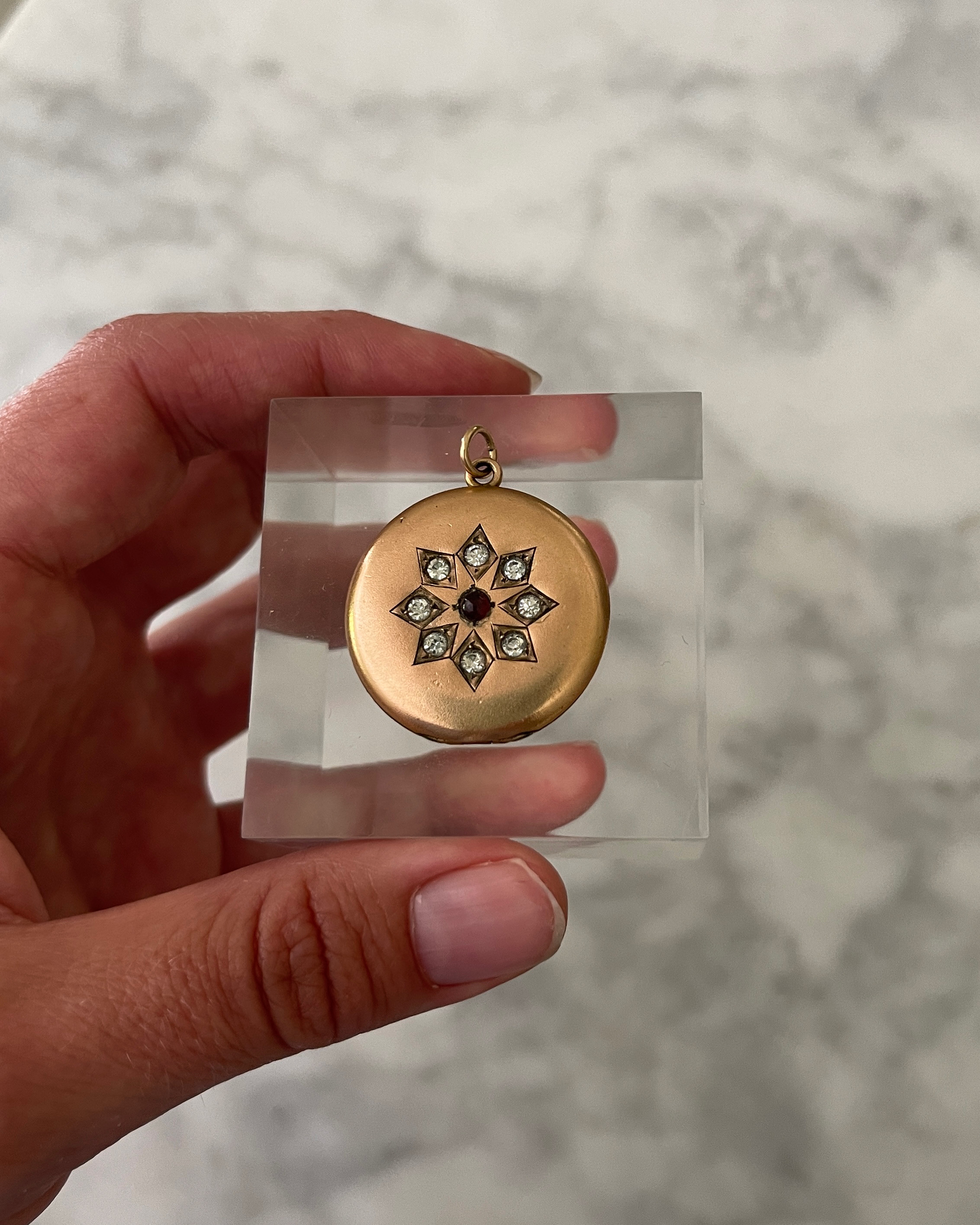
Today, Suzanne also offers an array of vintage lockets — all one of a kind. Look at three she just got in.

Luna & Stella will ship pretty much anywhere in the world.

PS. I need to show you a painting I saw recently. It reminds me of Suzanne at about six months old, reaching for the turntable on the days I tried bringing her along to my radio show. (Just a community station. Nothing big.)

Art: Karen Winslow, Self-Portrait with Daughter Annie, 1988. Working with a baby on a hip. Ah, yes indeed!

Photo: Guy Peterson/Special to the Christian Science Monitor.
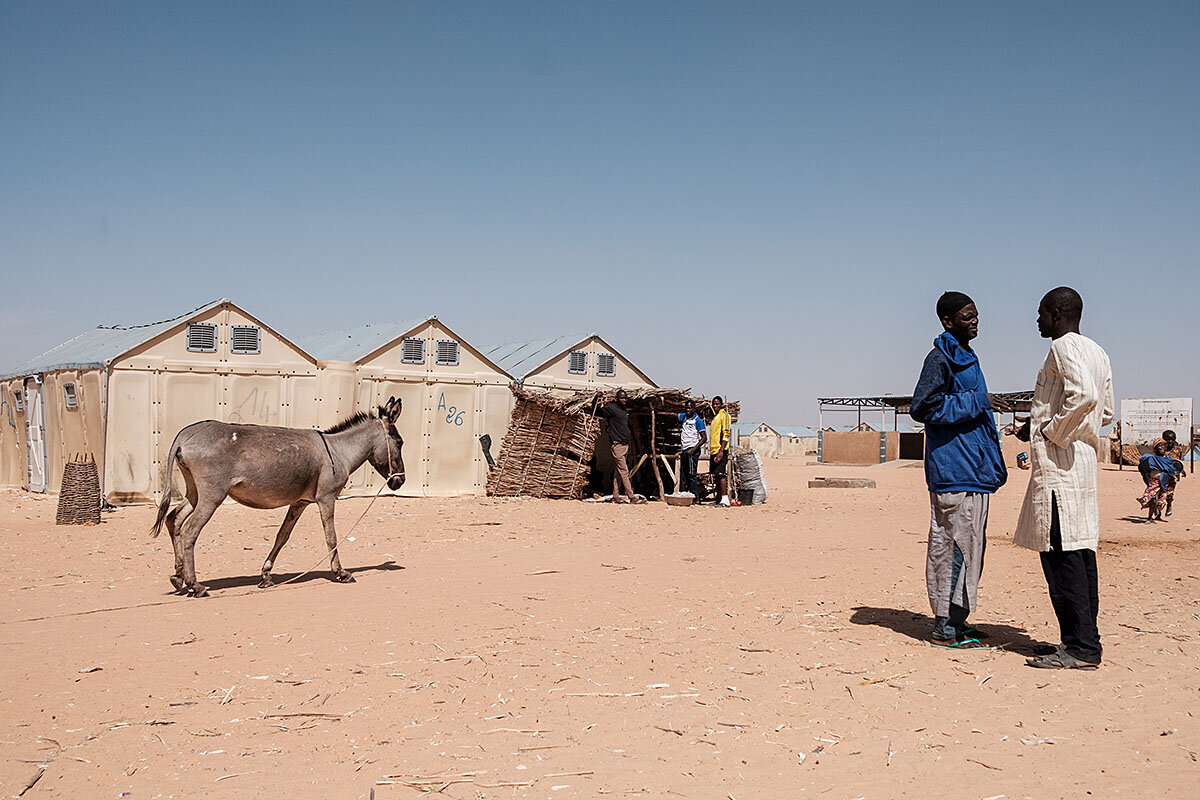
In Niger, the poorest of the poor are protecting refugees on the run.

When I was chatting with blogger Will McMillan after one of his recent concerts, he said he noticed that at my blog, I seemed to seek out stories to cheer people up. I said, “To cheer me up, too.”

A great source for such stories is the internationally focused Christian Science Monitor (CSM). The news site is not unrealistic about the world’s challenges, but it looks for the good people and positive developments it knows are out there.

Here’s a CSM story by Nick Roll set in an impoverished part of Africa.

“Yacouba Aboubacar has an unusual way to measure the welcome he received as a refugee in Niger. 

“His razor blade.

“It takes a certain amount of trust, after all, to let a stranger cut your hair – and a good deal more to allow him to circumcise your baby. But since Mr. Aboubacar fled here from neighboring Nigeria in December, he has found his services as a barber and circumciser constantly in demand.

“Some of that work comes from other refugees, with whom he lives in a sea of white tents huddled on the edge of this small village. But much of it comes from the locals who inhabit the mud-brick houses in town. …

“Mr. Aboubacar is one of some 200,000 Nigerians who have fled rising violence in recent years to seek refuge in neighboring Niger. Chadakori’s population has doubled to 16,000 since 2020 – a refugee intake on a scale almost unimaginable in the West. Yet the response from Chadakori and other villages like it has largely not been one of resentment or rejection. Instead, in one of the world’s poorest countries – beset by its own problems with violent extremism – locals have made visitors feel welcome, even when there is little to share. 

‘Your guest is your god,’ says Laouan Magagi, Niger’s minister of humanitarian action and catastrophe management, reciting a popular local proverb.

“Mr. Magagi, whose grandfather was an immigrant from Nigeria, responds with a firm ‘non‘ when asked if Niger would ever impose a cap on the number of refugees it receives. Despite conflicts in some areas of neighboring Nigeria and Mali stretching back more than a decade, ‘Niger is an open country,’ he says. ‘Niger stands for humanity.’

“Niger and Nigeria have long been deeply interlinked. They share a 1,000-mile border – much of it porous. Trade, languages, and culture straddle this colonial-era divide. Still, Niger is not an obvious place to host refugees, no matter how much they share in common with locals. 

“At $590, Niger’s GDP per capita ranks the 10th lowest in the world. On the United Nations Human Development Index, Niger has long jostled for last place, and now it sits only above Chad and South Sudan. Meanwhile, climate change has made farming in the semiarid country even more unpredictable, and some 3 million people are expected to face hunger in the next six months, according to the nonprofit Save the Children.

“But in welcoming refugees, Niger is not an outlier. About 86% of the world’s refugees live in low- and middle-income countries, and nearly 70% are in a country that neighbors the one they fled from.

“ ‘A lot of people disagreed’ at first, saying ‘we should not accept them,’ says Achirour Arzika, Chadakori’s traditional chief, recalling the day three years ago when a government delegation came to ask the residents if refugees could be resettled here. But he held firm, and others soon warmed to the idea. ‘It could happen to us also,’ he says. ‘So we agreed, and we gave a place where we could host them.’ 

“Besides, he adds matter-of-factly, ‘this is … international law,’ referencing Niger’s adherence to the 1951 United Nations Refugee Convention.

“Conflict between armed groups and the military have also displaced more than 350,000 Nigerians. … In northwest Nigeria, where Mr. Aboubacar is from, criminal groups stage regular armed robberies and kidnappings. It’s a campaign of terror born of poverty, joblessness, poor governance, and fights over the region’s dwindling land. 

“One evening last December, he was sitting outside with friends drinking tea in his village in Sokoto state, near Nigeria’s northern border. … After the attack, Mr. Aboubacar and the rest of his village fled north, over the border. He soon found himself in Chadakori, where ‘we were really received well,’ he says. 

“Integration isn’t always so smooth. Different official languages – French in Niger, English in Nigeria – are used in government as well as education. Refugee students must now make the switch to French, and government forms need translation.

“ ‘It’s a very welcoming country. … It’s just that the resources are very limited,’ says Ilaria Manunza, Niger country director for Save the Children, which runs child protection and other youth services in the country’s refugee camps. And the population of refugees, she notes, is constantly in flux. ‘They tend to go back when the situation is a little bit calmer, and they flee [again] when attacks increase.’ …

“Four years ago, Anas Habibou led a group of about 350 Nigerian refugees trekking through Niger, seeking somewhere to settle. Some villages offered help, but ‘many villages refused,’ says Mr. Habibou. Today, he is the traditional chief for 5,500 Nigerian refugees who have settled next to the town of Dan Daji Makaou, 22 miles away from Chadakori, where they outnumber the local population by a factor of four or five. ‘We are safe here,’ he says. ‘Even before NGOs brought anything, the head of the village and his people contributed personally.’

“Yacouba Saidou, a prominent Dan Dadji Makaou elder, says that other village leaders in the region warned him that trouble stalked refugees. They told him that the violence that caused Nigerians to flee could strike next on their doorstep. But his town’s experience, he says, has been the opposite. Refugees have been a boon to the local economy, working as farm laborers and brick makers, and spending their earnings in local markets. ‘It has turned into something beneficial to us,’ he says.”

More at the Monitor, here. No firewall.

The Little Sprouts Learning Center in Warren, Minn., is the town’s only day-care center. Residents recently voted to expand it — and fund it. 

The residents of a small town in northern Minnesota recently decided that “put your money where your mouth is” meant ponying up for a day-care center they couldn’t do without.

Cathy Free wrote at the Washington Post, “Lindsey Buegler learned that the only day-care center in her town of Warren, Minn., would be closing. She went to work that afternoon, upset and terrified. …

“She went to her boss, Phil Thompson, who owns the accounting and crop insurance firm where she worked, and told him: ‘We have no family here to help. If there is no child care, we’ll have to move.’

“Thompson said the moment hit hard as he realized Buegler and others were in a precarious situation. He decided to pitch in about $20,000 with a local banker to keep the Little Sprouts Learning Center open in the rural town, which has a population of about 1,600.

“That worked for a while, but Thompson said he knew it wouldn’t be enough to sustain the day-care center, which was operating as a nonprofit. …

“Thompson said he has written other large checks to help keep Little Sprouts running since that first crisis in 2015. He now employs about 30 people at his firm, and doesn’t mind when employees bring their children to work in a pinch when they need it.

‘I’ve seen firsthand how this affects people,’ said Thompson, who is also chairman of the Warren Economic Development Authority. ‘If people have to move away to work and raise their families, our town can’t grow.’

“In 2019, Thompson helped put together a committee that spent several years taking an in-depth look at Warren’s day-care dilemma. They explored several options to financially assist the day-care center, which was licensed for 47 infants and children and seven teachers. None of those options worked long-term.

“Last year, he and the committee proposed an idea: The city would ask residents to vote on a 20-year sales tax increase of half-a-cent to fund a $1.6 million low-interest loan for a new child care center, while keeping the old one open as it was being built. By doubling the number of teachers and increasing the availability of open slots, the day-care facility could survive.

“The plan was that Warren City would own the building and lease it to Little Sprouts, and the day-care center could continue to operate as a nonprofit. On Nov. 8, 2022, the measure narrowly passed. …

“ ‘We’re an agricultural community centered around corn, soybeans and sugar beets, and we have a lot of young people,’ [Thompson] said. ‘Now there’s an incentive to keep them here.’

“Nationwide, about 51 percent of the population live in child care ‘deserts‘ with no child care providers or not enough licensed child care slots, according to a 2018 study by the Center for American Progress. The pandemic made the situation more dire.

“Thompson and other residents of his farming community were determined to offer a day-care center option for working parents. ‘We became completely centered on solving this problem,’ said Mara Hanel, Warren’s mayor from 2018 to 2022. ‘At one time, we had a shortage of 180 child care slots in a 20-mile radius. We knew that we had to do something.’

“Shannon Mortenson, Warren’s city administrator, said the town decided that child care should become an essential service like water, electricity and sanitation.

“ ‘We knew that if we lost Little Sprouts, we would also lose revenue and some of our workforce,’ she said. ‘If parents had no options, they would move their families elsewhere.’

“The idea of moving to be near child care created stress in the community, said Adam Sparby, whose two daughters and son attend Little Sprouts. ‘Everyone was really worried — closing the day-care would mean a lot of us would have to move to another town and commute back and forth to work,’ said Sparby, who sells John Deere farm machinery in Warren.

“He said that his wife, Ashley, a pharmacist, would often volunteer at Little Sprouts on her lunch hour to help the teachers when the center was short on staff.

“ ‘Day-care is such a huge thing for families, so I’m really excited that the tax increase passed and we’ll soon have a new facility,’ Sparby said.

“Thompson said the sales tax increase will raise enough funds over 20 years for the town to pay off a $1.6 million loan for the new center but the community still needed to raise another $700,000 to $800,000 to offset price increases that occurred during the pandemic.

“ ‘We should meet our goal soon,’ he said, noting that businesses and residents have contributed about $600,000 to the effort. ‘Our community might be small, but people have been incredibly supportive and generous.’ ”

More at the Post, here.

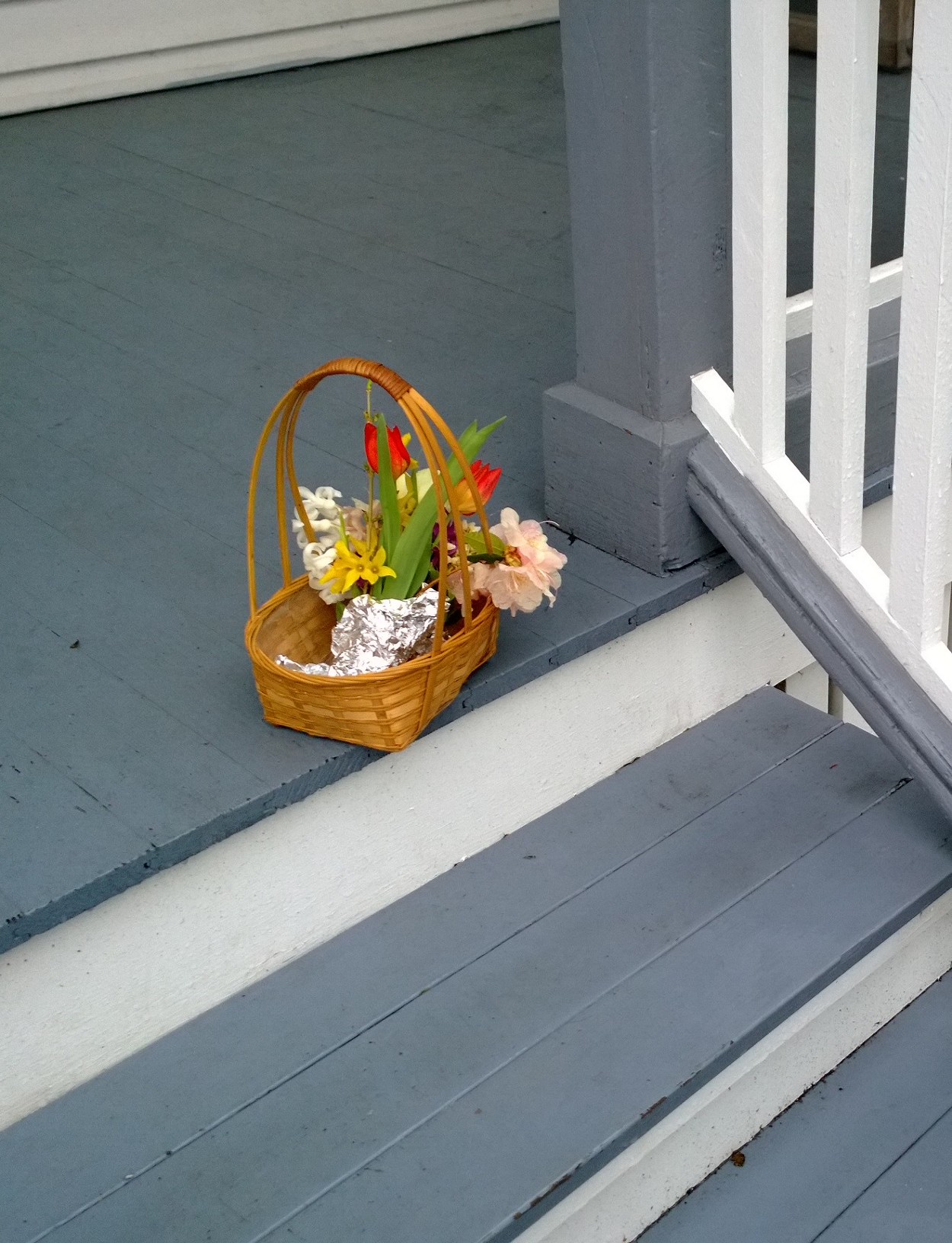
PS

Happy May Day!

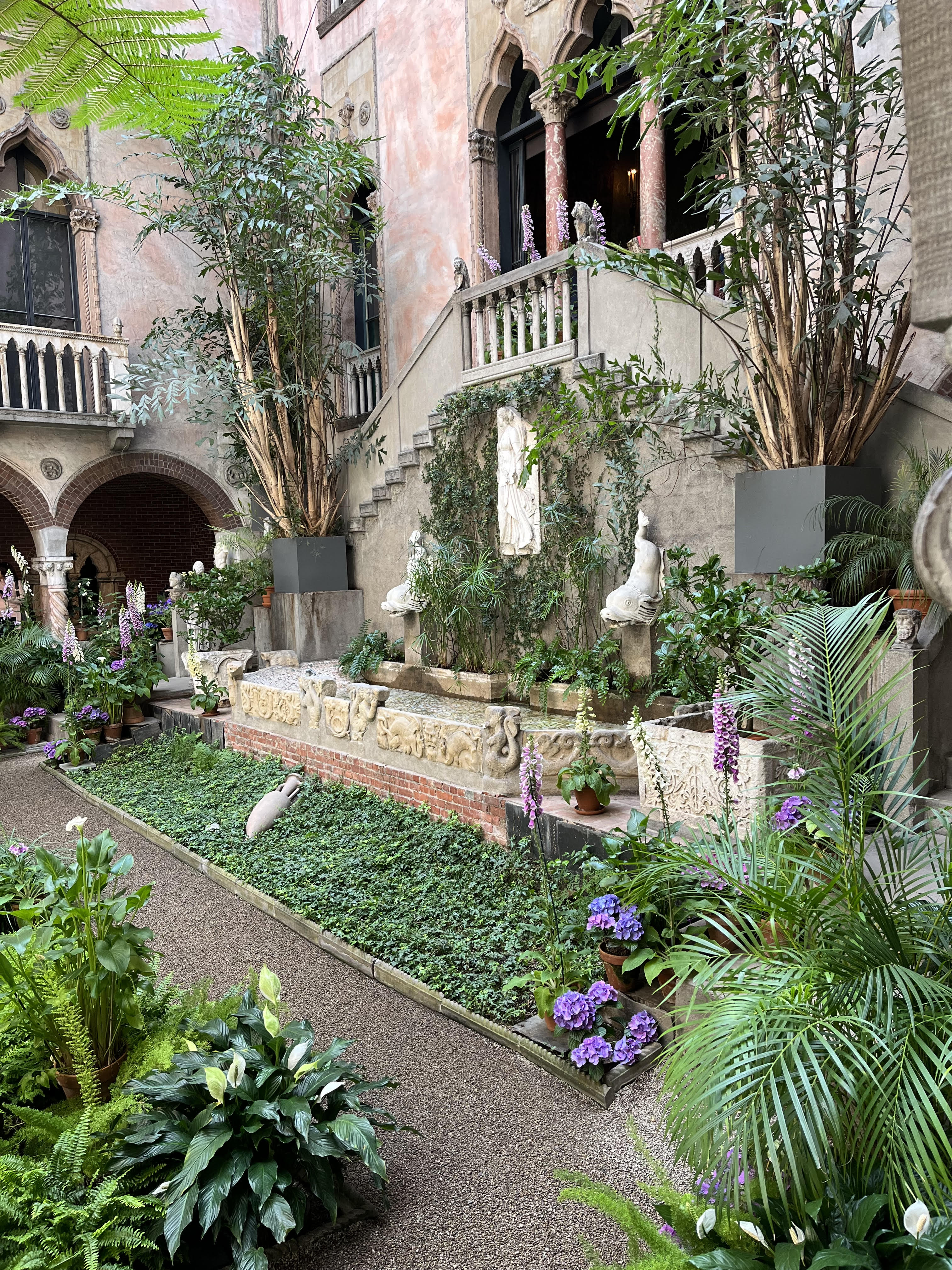
Photo: John and Suzanne’s Mom.
On April 28, the Isabella Stewart Gardner Museum’s courtyard was featuring cineraria and foxglove.

Last Friday, after a medical appointment, I thought I would treat myself to the Isabella Stewart Gardner again, a museum located in a wealthy woman’s former palace not far from the Museum of Fine Arts. The extraordinary collection has been mostly left the way Gardner displayed it, so there are no plaques. You need to rent the audio tour.

The Gardner may be best known outside New England for the brazen heist of valuable artworks in 1990. Empty places on the walls attest to the unresolved loss.

I usually love going there, but to my surprise, the magic really wasn’t happening for me Friday. That wasn’t just because I wanted to see the nasturtium display and they’d already changed it to foxglove and cineraria, or because the timed tickets had done nothing to control overcrowding, or because a guard told me I wasn’t allowed to carry my coat over my arm.

No, it was something along the lines of “what is one person doing with so much wealth?”

I have fallen into overthinking things: Was that piece of fruit picked for a living wage? Are the clothes I wear from factories with good ventilation and frequent bathroom breaks?

And if “philanthropists” give us access to their beautiful things after they die, wouldn’t they have been more truly philanthropic if they had spent some of that wealth trying to abolish poverty?

On Mastodon, I read about Paris Review contributor Katy Kelleher’s new book. Her publisher says she “explores our obsession with gorgeous things, unveiling the fraught histories of makeup, flowers, perfume, silk, and other beautiful objects. …

“Katy Kelleher,” Simon & Schuster continues, “has spent much of her life chasing beauty. As a child, she uprooted handfuls of purple, fragrant little flowers from the earth, plucked iridescent seashells from the beach, and dug for turquoise stones in her backyard. As a teenager she applied glittery shimmer to her eyelids after religiously dabbing on her signature scent of orange blossoms and jasmine.

“And as an adult, she coveted gleaming marble countertops and delicate porcelain to beautify her home. This obsession with beauty led her to become a home, garden, and design writer, where she studied how beautiful things are mined, grown, made, and enhanced. In researching these objects, Kelleher concluded that most of us are blind to the true cost of our desires. Because whenever you find something unbearably beautiful, look closer, and you’ll inevitably find a shadow of decay lurking underneath.

“In these dazzling and deeply researched essays, Katy Kelleher blends science, history, and memoir to uncover the dark underbellies of our favorite goods. She reveals the crushed beetle shells in our lipstick, the musk of rodents in our perfume, and the burnt cow bones baked into our dishware. She untangles the secret history of silk and muses on her problematic prom dress.

She tells the story of countless workers dying in their efforts to bring us shiny rocks from unsafe mines that shatter and wound the earth, all because a diamond company created a compelling ad.

“She examines the enduring appeal of the beautiful dead girl and the sad fate of the ugly mollusk. With prose as stunning as the objects she describes, Kelleher invites readers to examine their own relationships with the beautiful objects that adorn their body and grace their homes.

“[Kelleher] argues that while we have a moral imperative to understand our relationship to desire, we are not evil or weak for desiring beauty. The Ugly History of Beautiful Things opens our eyes to beauty that surrounds us, helps us understand how that beauty came to be, what price was paid and by whom, and how we can most ethically partake in the beauty of the world.”

I think I need to read the book and see if it will help me deal better with the rampant overconsumption and privilege I am finally noticing.

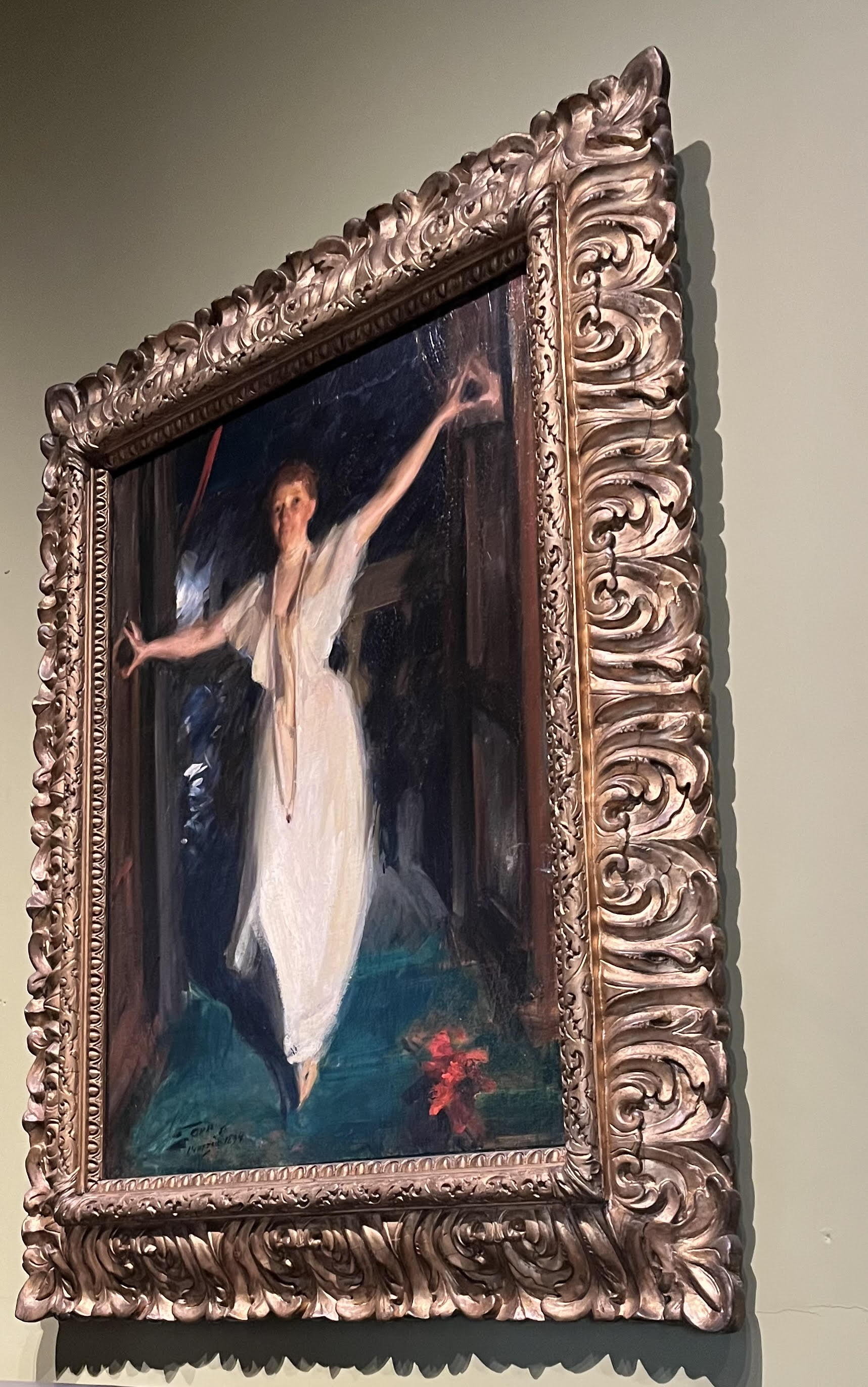
Art: Anders Zorn.
Gardner herself enjoying a high old time in Venice.

Photos: John and Suzanne’s Mom.

My paternal grandmother, as the wife of a once-renowned Alpine gardener in Syracuse, New York, cherished this quote from Dorothy Frances Gurney: “The kiss of the sun for pardon,/ The song of the birds for mirth,/ One is nearer God’s Heart in a garden/ Than anywhere else on earth.”

Lacking profound insight into that particular claim, I will just say that gardening is good for one’s observational skills and hence one’s mental health, as a recent Washington Post article suggests.

Catie Marron wrote, “I often keep a single flower in a small bottle on my desk, where I can enjoy it. I learn a lot from studying that flower’s cycle.

“It’s an idea I got from the philosopher and author Alain de Botton, who once remarked that we unfairly dismiss museum postcards of prominent paintings. ‘Our culture sees them as tiny, pale shadows of the far superior originals hanging on the walls a few metres away,’ he observed, ‘but the encounter we have with the postcard may be deeper, more perceptive and more valuable to us, because the card allows us to bring our own reactions to it.’

“[As] with the postcard, that single flower invites us to study every detail more deeply. Even over just a few days, the changes are breathtaking. I’ve witnessed the magic of a peony going from hot pink to pale coral, watched a tulip’s petals double in size and seen a rose clinging to the last glimmers of its fading bloom. …

“It was a new sensibility for me, one I didn’t have before I began gardening seriously and closely observing these single blooms on my desk. Once I started digging in the dirt, I noticed ecosystems I had taken for granted. I’d pause to study a surprising color combination on a single flower or a mix of plants. I’d catch myself mid-stride if I recognized a plant but it looked different from similar varieties I’d seen before. Soon, looking carefully at plant life became a habit.

“Much has been written and said about gardening’s practical health benefits, and those effects are real and important. But less is shared about the way that gardening can reshape what you notice, and how that can impact your days. Gardener’s eyes can lead you to gaze at the texture of turf, the imaginative plantings on a brownstone stoop, the splendor of a February cherry blossom. …

The best thing about gardener’s eyes is that you bring them with you everywhere — and everywhere there is something to see. …

“I’ve been awed by the great, formal gardens I’ve visited, but I’ve been just as absorbed by my own modest vegetable garden, where plant growth and renewal always offer something new to capture my attention.

“Well-developed gardener’s eyes can also make you aware of how little you know, a feeling shared by the renowned garden designer Beth Chatto, who experienced this during a visit to Benton End, the home and gardens of Sir Cedric Morris and Arthur Lett-Haines. Morris was an artist-gardener who crafted ‘a bewildering, mind-stretching, eye-widening canvas of color, textures and shapes, created primarily with bulbous and herbaceous plants,’ Chatto said in Hortus Revisited, edited by David Wheeler. …

” ‘That first afternoon, there were far too many unknown plants for me to see, let alone recognize,’ she wrote. ‘You may look, but you will not see, without knowledge to direct your mind.’ That’s how I felt in my first gardening forays: I was looking, but not seeing. After years of reading about plants and simply spending more time in gardens big and small, I was able to see more clearly.

“That vision didn’t only come by watching plant life. I also learned to watch gardeners themselves. That was based, in part, on the unexpected advice of Tom Coward, the head gardener of Gravetye Manor in Sussex, England. I once bumped into Coward while walking around Gravetye. At that time, I was a new gardener, and I asked if he had any tips for a fresh practitioner of the craft. His guidance: Find a knowledgeable gardener, and watch what they do. …

“If you are new to gardening and feel confused, visit more gardens, spend an afternoon at your local nursery and talk to the gardeners. Ask questions and listen to their stories. Gardeners tend to be unfailingly patient and generous, because they too had to learn the trade in the same slow and circuitous manner. They know the feeling of gardeners’ eyes moving from muddled to clear.”

More at the Post, here.

Photo: Nicole Tung for NPR.
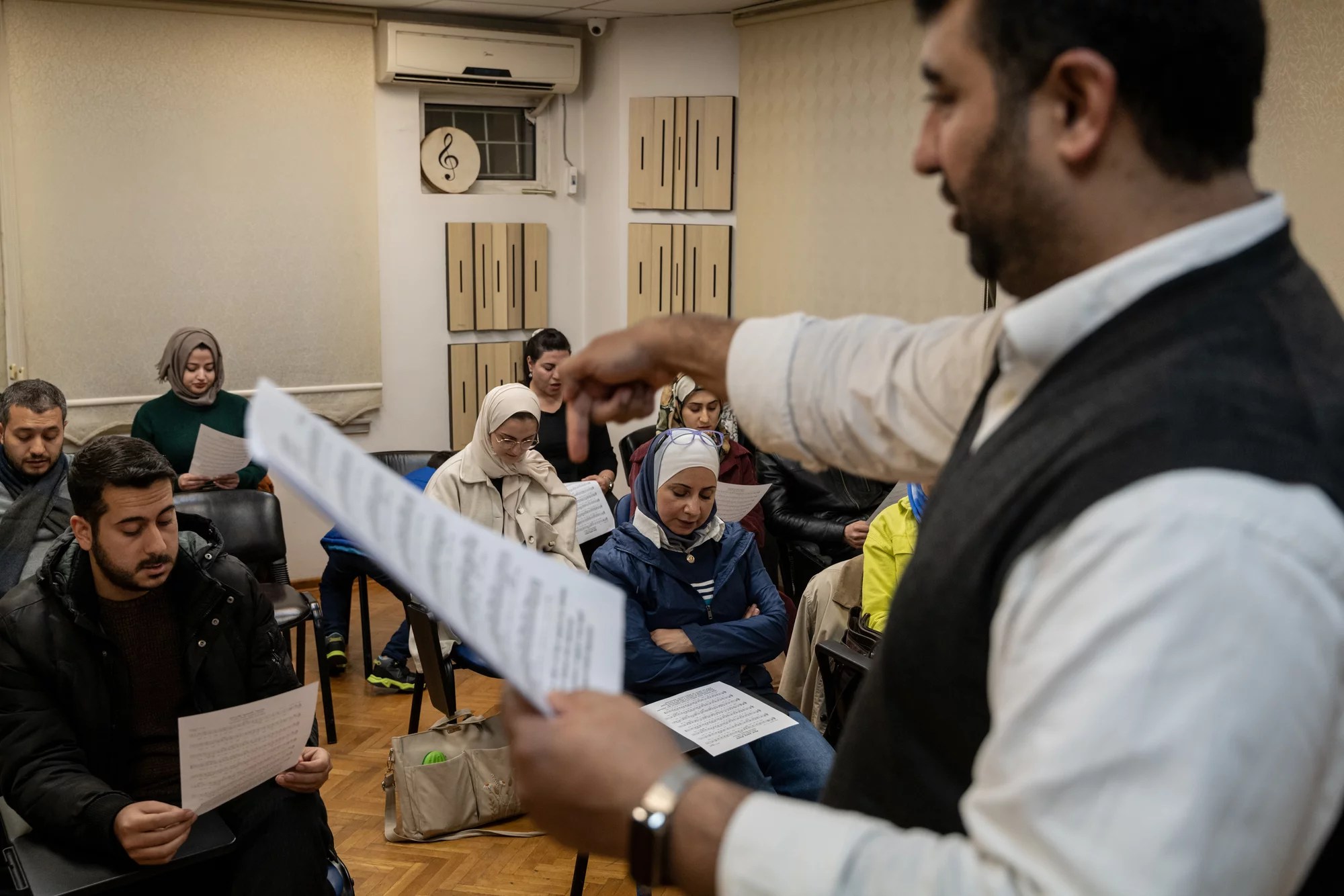
Ibrahim Muslimani, 30, speaks to a class about a piece of music blending different eras and languages at the Nefes Foundation for Arts and Culture, which he cofounded in 2016, in Gaziantep, Turkey.

Today’s story is about how the arts can help victims of disasters get their bearings again.

As Fatma Tanis reported recently at National Public Radio (NPR), “When the powerful earthquake rocked her home in early February, 18-year-old Sidra Mohammed Ali woke up and thought of one thing: her music school — was it OK?

“The next day, as survivors all over southern Turkey were taking stock of the destruction and checking on loved ones, Mohammed Ali rushed to the school, the Nefes Foundation for Arts and Culture, and took a deep breath of relief when she saw it was still standing, only having sustained some minor damage.

‘This school is my sanctuary from the stress of life as a Syrian refugee in Turkey,’ she said. ‘I couldn’t bear the thought of something happening to it.’

“The Nefes Foundation was created by Syrian and Turkish musicians in the city of Gaziantep in 2016. They have group classes where they try to revive forgotten Syrian classics and integrate Turkish and Syrian cultures with music that the two have shared for centuries.

“The school also offers private music lessons on the piano and Middle Eastern instruments like the oud (a pear-shaped string instrument), the kanun (a plucked zither) and the ney (an end-blown flute).

“But more than six weeks after the Feb. 6 disaster, life in the earthquake zone is far from back to normal. The magnitude 7.8 earthquake killed more than 55,000 people in Turkey and neighboring Syria. It damaged or destroyed hundreds of thousands of buildings and left 1.5 million people without a home in Turkey alone, according to the United Nations.

“The school had not been able to resume classes until [March 2023], when only three students, out of many dozens, showed up to sing and play.

“Before the earthquake, the school would be packed on weekday evenings, with students ranging from ages 6 to 50, mostly Syrian, but some Turks attended as well.

“The classes are bilingual — in Turkish and Arabic. And that was especially important, according to Ibrahim Muslimani, a Syrian classical musician from Aleppo, who is the brains behind the organization.

” ‘Because some of the young Syrian kids have spent most of their lives here in Turkey and are more fluent in Turkish,’ he told NPR in November 2022. ‘We’re trying to preserve our Syrian cultural identity but also getting to know the Turkish identity through art.’

“Turkey hosts 4 million refugees, the largest number of any country, according to the U.N. refugee agency. The vast majority are Syrians who fled the civil war.

“In the early years of the Syrian civil war, which started in 2011, Turkey had a generous open-door policy toward Syrian refugees. But without broad integration initiatives by the Turkish government, life for many of the refugees has been difficult.

“More recently, politicians in Turkey who oppose President Recep Tayyip Erdogan have scapegoated refugees for the country’s economic problems, leading to a rise in discrimination and hateful attacks. …

“Mohammed Ali, who studies medicine at university and the kanun at the music school, said last weekend the school has been a lifeline for her. She has a bleak outlook on her future, and doesn’t believe that the people in Turkey will ever accept her existence in the country.

” ‘But anytime I have an upsetting encounter, my Turkish teachers and friends here comfort me,’ she said. …

“Rafeef Saffaf Oflazoglu fled Aleppo in 2013 after a near-death encounter. She comes from a family that’s passionate about classical Arabic music. To be able to continue exploring her love of music in Gaziantep was priceless, she said.

“The school also introduced her to centuries-old Turkish songs from the Ottoman archives, and old tunes that traveled from Istanbul to Aleppo. Studying those shared melodies made her feel closer to the culture in her new home.

“Having to go without classes after the earthquake was harder than she expected. ‘After maybe 10 days, I just figured out, like the thing I miss most is art,’ she said, even though she was living in her car at the time. ‘People under trauma react in different ways. It’s not just about singing, you know? It’s spiritual.’

“For Muslimani, the earthquake was a triggering reminder of how he had lost everything a decade ago in Aleppo. … The civil war in Syria destroyed much of the country’s cultural output, along with the lives of millions of Syrians. Muslimani has a mission to keep Aleppo’s traditional form of music, al-Qudud al-Halabiya, alive from Gaziantep.

“He and other Syrian artists also record music at Nefes. ‘I promised my teacher that I would immortalize those precious pieces in the best form possible,’ he said. ‘With the proper orchestra and the glory that they deserve.’ …

“The Nefes Foundation, which survived on donations and fees for private lessons, is now at serious risk of closing down, said Muslimani. They don’t have the funds to pay for next month’s rent. …

” ‘The mere thought of losing this place… it’s unbearable.’ “

More at NPR, here.

Photo: Suzanne and John’s Mom.
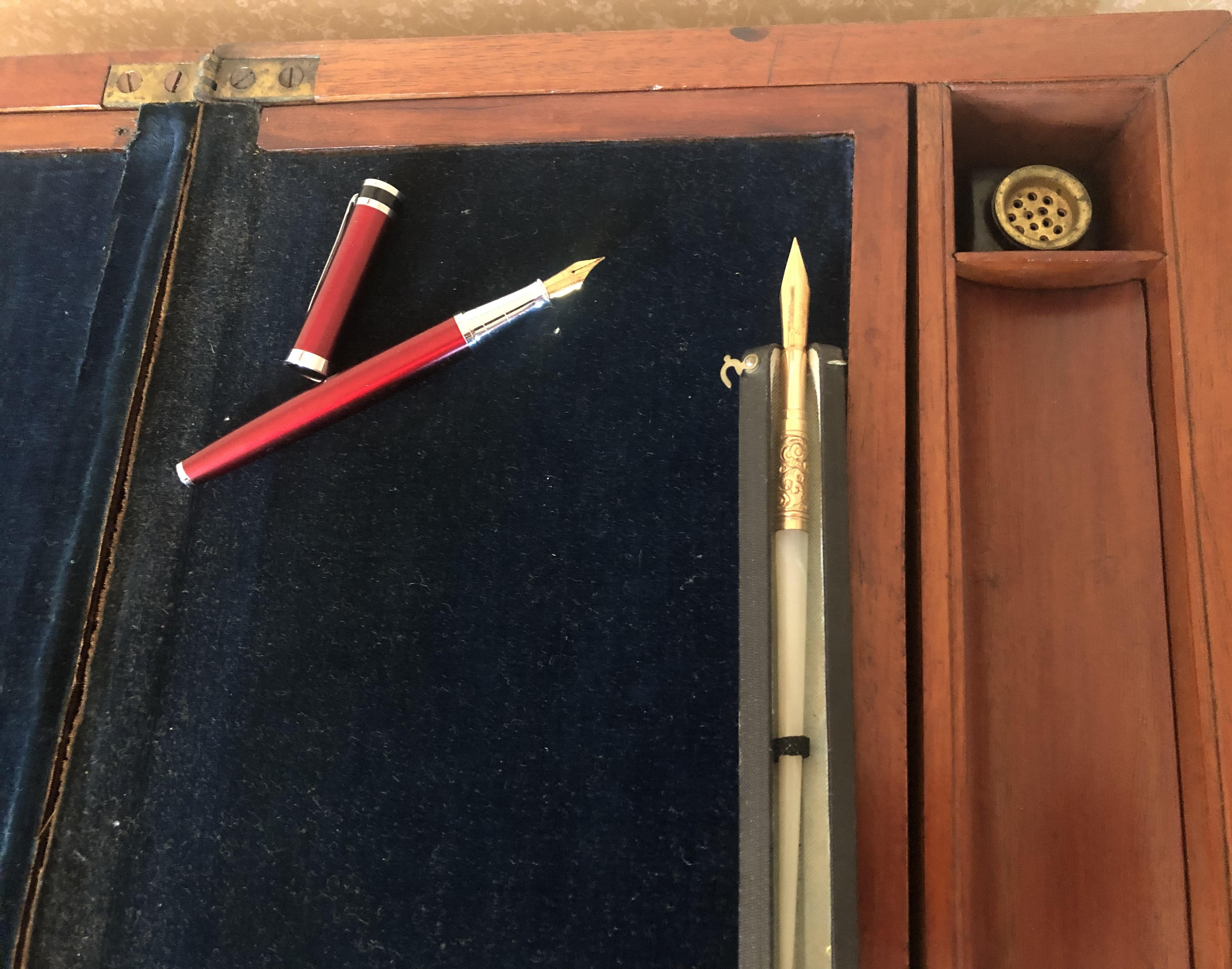
Writing desk and pen of Moses Webster, born 1781. The red pen is new, a Beiluner.

Today’s story shows that love for the old ways can rise up unexpectedly in young people, maybe even start a trend.

Tara Bahrampour writes at the Washington Post, “The enormous patina-green fountain pen juts over the sidewalk on F Street, two blocks from the White House, its gold nib pointing down at the front doors like a command.

“ ‘Fahrney’s Pens,’ the sign in calligraphy reads. Inside, the narrow space with 28-foot ceilings is a cathedral to its acolytes, its objects of worship gleaming under glass counters. Ball or fountain. Plastic or rose gold. Steel or acrylic resin, redwood or ebony, matte or shiny.

“ ‘Allow me to dip it,’ store manager Phuntsok Namgyal says softly. He bathes a nib in a bottle of blue-black ink and hands a fountain pen to a customer, who dashes off his signature. …

“In its 94 years, Fahrney’s has outlasted the advent of mass-produced ballpoints, the rise of email and text messages, and a pandemic that decimated newer downtown businesses all around it. Its staying power can be attributed to a base of loyal customers, along with a new generation raised on the digital but enchanted by the mechanical. …

“[Solomon Dennis, 79] leaning on a copper-colored walking stick, recalled the first pen he bought at Fahrney’s, in 1974: a Montblanc Diplomat. ‘It was a hundred and fifty dollars then; I think it’s a thousand and fifty now,’ he said. When he lost it, he cried for a week.

“Pens at Fahrney’s range from $20 to nearly $5,000 and from themes like Harry Potter to King Tut. Some have historical connections, like the Fisher Apollo, a ballpoint pen that traveled to the moon and contains gas that allows it to work underwater, upside down, in freezing temperatures and at zero gravity. A National Zoo pen features pandas.

“Once, Fahrney’s sold a $130,000 pen ‘completely covered in diamonds,’ store owner Chris Sullivan said. …

“Choosing a pen is personal. How do you tend to hold it? Is your lettering large and loopy? Do you close your L’s? Do you prefer the feel of a light pen or a heavy one? Flashy or subtle? Fine tip or broad? ‘It shows their individuality,’ Sullivan said.

“Sullivan’s parents bought the store in 1972 from founder Earl Fahrney. Sullivan, 62, worked in the shop growing up and now co-owns it with his sister; his 83-year-old mother is still working, too, in the warehouse in Upper Marlboro. (‘I can’t get her to stop,’ he said.) …

“The store still does repairs, though it is getting harder to find parts. It also sells stationery, journals, inks and calligraphy books, a small bulwark against the drift of a country that long ago dropped handwriting classes from school curriculums.

“And yet the generation that didn’t learn cursive has somehow fallen for fountain pens — and their interest is helping drive demand. The average age of customers at Fahrney’s is 60, but it is dropping, Sullivan said.

“ ‘There’s a lot of young buyers — “young” being people in their 30s — paying $1,200 for a pen,’ said [David Baker, executive director of the Writing Instrument Manufacturers Association.] ‘From what I hear, during covid, a lot of collectibles and fine items became significant as people had time to browse and look at these things.’

“Trends like urban sketching and journaling have helped spur interest in fountain pens in particular, said [Jonathan Weinberg, an artist and curator of the Maurice Sendak Foundation in Ridgefield, Conn.] who owns around 250 of them. ‘With a ballpoint pen, your hand tends to get a little cramped,’ he said. ‘Your hand kind of flies across the page with a fountain pen.’ …

“ ‘It’s like a candy store for me,’ [Connor Rosenberger, a 19-year-old music major] said, standing in the middle of Fahrney’s, as if unsure where to turn. ‘A very expensive candy store.’

“For his choir mates, too. Teddy McIntyre, a 21-year-old redhead with a denim jacket and a mustache, said he writes actual letters to relatives. … ‘It gives me an excuse to use my wax seal,’ he said. And Anna Kate Scott, 22, said she writes novels and short stories by pen ‘because I feel more like I’m in it, rather than separated from it by a screen.’ ”

About a year ago, my pal David gave me a fountain pen out of the blue. What a lovely surprise that was!

More at the Post, here.

Photo: Mark McGuinness.
Mark McGuinness, a photographer, said the income from Ireland’s government allowed him to devote two days a week to making work for exhibitions.

It’s hard to say which part of the story on Ireland’s experiment with guaranteed income for artists I love most, but “cross-party support” sure feels like heaven.

Alex Marshall reports at the New York Times, “Ian Fay had toiled for years to make it as a comic book artist and illustrator, and last fall, he was ready to call it a day.

“Fay, 32, who lives in Kilkenny in southern Ireland and specializes in drawing muscly superheroes, was only earning enough money to pay his bills, he recalled recently. He couldn’t afford vacations. He was considering boxing up his art supplies and getting a job in a grocery store.

“Then, in September, a lifeline appeared in his email inbox. A message from Ireland’s government said that Fay had been selected for a program guaranteeing 2,000 artists a basic income. For three years, participants — including musicians, novelists and circus performers — would be paid 16,900 euros a year, about $18,200, no strings attached.

“Fay stared at the email in disbelief. The payments — in weekly installments of €325 — would cover his rent, and lower his anxiety about making ends meet, he said. For the first time in years, he added, he would have ‘time to practice and develop my craft.’ …

“The Irish pilot project is the latest sign of growing international interest in universal basic income — when governments pay ‌their citizens, employed or not, a lump sum each month. Proponents of the idea, including antipoverty groups, left-wing politicians and libertarian organizations, say guaranteed income ensures a population’s sustenance and health better than other social welfare policies. Opponents say it’s simply giving the work-shy cash for nothing.

“In early experiments in Finland, California and Germany, people were paid regardless of their profession. But several pilots are now focused on cultural workers, who can spend months, or even years, on unpaid projects. Painters, dancers and musicians often rely on precarious, part-time jobs to fund their passions, and basic incomes are seen as a way to let them focus on artistic pursuits.

“Last year, in the United States, a privately funded initiative called Creatives Rebuild New York began giving 2,400 artists $1,000 a month. Similar programs are underway in San Francisco and Minnesota. But of these artist-focused efforts, Ireland’s stands out because it is government-run and involves rigorous analysis of the recipients’ finances, work patterns and well-being to gauge the handouts’ impact. The recipients’ livelihoods will be compared with those of 1,000 artists in a control group, who are not receiving any payments.

“Catherine Martin, Ireland’s culture minister — a trained singer and former street busker — said in a telephone interview that the idea for the policy emerged three years ago during the coronavirus pandemic. With Ireland’s music venues, theaters and museums shuttered, Martin commissioned a task force to explore how the government could help cultural workers survive. Its main recommendation was a basic income trial. …

The pilot, which has cross-party support, has a budget of €33.8 million a year — and that’s on top of the €130 million that Ireland spends on culture via the Arts Council, its main arts funding body.

“Applications opened last April for people working in the visual arts, theater, literature, music, dance, opera, movies, circuses and architecture. … The applicants had to submit two pieces of evidence to show they were genuine cultural workers, such as membership in a professional body, proof of income from art sales or newspaper reviews. Martin said the government didn’t consider the quality of the applicants’ work.

“More than 9,000 people applied, with 8,200 deemed eligible. From that pool, 2,000 were randomly selected to receive payments and 1,000 for the control group. …

“Lydia Mulvey, 47, a screenwriter, said that she quit her job in a telecommunications firm as soon as she heard she’d made it into the program. Now she spends her time writing pilot scripts for thrillers and sci-fi shows, rather than trying to squeeze that into evenings and weekends. ‘I knew it’d be transformative and give me my life back,’ Mulvey said, although she added that, if she didn’t already own her own home, she’d struggle to live on such a low income, especially in Ireland’s squeezed property market.

“Mark McGuinness, 31, a photographer, said that before receiving the basic income he had spent the whole week seeking commercial photography work to pay his rent and the cost of supplies, and had let his artistic practice slip away. Now, he’d ‘clawed back’ two days a week to make work for exhibitions, he said. …

“Ireland’s government is sending recipients questionnaires every six months that ask about the state of their finances, artistic career and health. … Last year, those taking part received a survey to collect baseline data. It asked if they could adequately heat their homes, replace worn furniture or ‘afford a meal with meat, chicken or fish every second day.’ …

“Aengus Ó Snodaigh, a spokesman on cultural issues for the opposition Sinn Fein party, which supports the program, said he wanted data long before the trial concluded so artists didn’t face a ‘cliff edge’ at the end. He added that he had many questions about the program, including whether payments benefited early-career artists more than established names, and whether the handouts were having unintended consequences, like causing tensions in rock bands if some members were selected, but others weren’t.

“ ‘Maybe the money would be better spent on hardship funds for artists who can prove they can’t afford the mortgage, or can’t rent a studio,’ Ó Snodaigh said.

“Few recipients are taking the windfall for granted. Mulvey, the screenwriter, said she’d recently met television companies about developing shows, and was often working long into the night. ‘I keep reminding myself that three years is a really short time, and we’ve already had six months,’ she said, adding that she wanted to make sure ‘I don’t have to go back to a day job when this stops.’ ”

More at the Times, here.

Photo: Francesca Magnani.
Film- and hat-maker Richard Faison on the G train in Brooklyn. A photographer’s chance encounter on the subway led to this story.

Do you notice how very creative people are good in almost any field calling for creativity? I have a friend like that who takes classes in many kinds of art and always does a nice job even if she is never going to make that particular skill her main thing.

Photographer Francesca Magnani wrote recently at the art newspaper Hyperallergic about a filmmaker who became a creative haberdasher.

“One December morning, among the sparse riders waiting for the G train in Brooklyn, New York, I saw a tall Black man with a colorful jacket and a cowboy hat. I took some photos as I introduced myself to Richard Faison. ‘I am also an artist and I actually made this hat,’ he told me. 

“A few weeks later, a friend who was visiting from Florence casually mentioned she wanted to buy a hat while here, and I arranged to see Faison in his lab, which turned out to also be his apartment. The one-bedroom apartment was filled with dozens of hats at various stages of existence and along with my friend Michèle’s green hat, two more were being ‘blocked’ and were drying by the window. On the wall was hanging a shtreimel, the first one that Faison made: these hats, traditionally worn by Orthodox Jewish men, were in fact his specialty.

“Sitting down with Faison on his sofa on that day, and once again more recently, I asked him some questions. Our conversations have been edited and condensed for clarity.

Francesca Magnani: You used to be a filmmaker. How did you become a milliner?

Richard Faison: I went to a small program at NY Film Academy for eight months. I started doing film by carrying around my mom’s video camera and shooting all my friends and my adventures, editing cool videos and creating a series that got pretty popular on Facebook. That led me to make music videos. I went to Toronto after meeting a few artists out there, and I became an editor and cinematographer for short films and documentaries.

“I started making hats legit by coincidence. I was friends with a Hasidic gentleman, Lov, and he came by my place for some drinks with friends. He said, ‘You always wear cool hats, you should work with a guy I sell fur to.’ That’s how I met my mentor and this entire adventure started.

FM: How do the two worlds, film and millinery, work in synergy?

RF: They are similar. You have to have an eye and a certain aesthetic that you want your pieces to have. The vision I see of a hat is like how I used to envision how I wanted certain shots to look like before going out to shoot, and just creating something with a story that people can either relate to or admire.

FM: You started your own business just a few months ago, last September. How did you build your own company, Oliver Lewis Hats?

RF: My mentor helped me: I worked for him in Williamsburg, Brooklyn, for about three years. The day I asked for a second raise, he took me on a long car ride and looked me directly in the eyes. He said, ‘You are a true artist with your hands, but I’ll never pay you what you deserve.’ Those words were the most beautiful and hurtful I’ve heard in one sentence. After that, he got me my first hat body and told me where to get more, and I took off running.

FM: Coming from a background in filmmaking, are there artists and directors you look to for inspiration?

RF: My number one influence would have to be Jimi Hendrix. His style, his grace, the chances he took, how groovy he was, everything! I used to watch his old concerts and get lost in his rhythm and clothing choices. The second is André 3000 of Outkast. I moved to Atlanta in 2003 for high school. I remember getting bullied for wearing tight jeans back then but then I would look at the shirts, pants, and hats André 3000 would wear, and it gave me the confidence to be myself no matter what others thought. …

RF: I reach my customers best through Instagram, where I can show my skills through video reels and also communicate directly with my audience. I have an even number of male and female clients — the age range is usually 30 to 40. …

FM: You said you devised your own gluing technique for shtreimels; you use as ornament some Swiss figurines usually found in ‘Swiss cowboy’ belts, and the name of your business comes from Oliver Lewis, the first Black jockey to win the Kentucky Derby. How do influences from different cultures inform your creations? 

RF: Influences are how I came to be. They’re the essence behind my entire being and work. Growing up in Brooklyn, I had so many cultures surrounding me that would impact me. My dad being from Trinidad and being a huge cowboy lover was one of the biggest for me. I watched Clint Eastwood movies with him and thought cowboys were the coolest people on earth. Then I found out that most cowboys were actually Mexican and Black and that piqued my interest. … I get a lot of inspiration from the Italians in NYC (such smooth style!), Jamaicans, and Hispanic communities. The melting pot in Flatbush helped me create my unique style.”

Need a hat? Or do you “already have all” your hats, as they used to say of the ladies in Boston? Check out Oliver Lewis Hats on Instagram.

More at Hyperallergic, here. No firewall. Lots of cool photos.

Photo: Alibaba.
You can take a jug to buy detergent in bulk at Debra’s and keep refilling the smaller bottle you keep by your sink.

For a few years now, I have been refilling the plastic bottle that my dishwashing liquid once came in. For a while I bought a concentrate online. Now I take a clean jug into Debra’s Next Door, pump the detergent into the jug, and refill my smaller container for months.

Today’s story is about big brands trying to get into the act.

Susan Shain reports at the New York Times, “Every week, Angela Espinoza Pierson looked at her recycling bin — filled with detergent jugs, shampoo bottles and clamshell containers that once held strawberries — with mixed feelings. Sure, it was a lot of plastic. But it was going to be recycled.

“Or so she thought. Then her husband sent her some articles revealing that less than 6 percent of the country’s plastic gets recycled, and that even recycled plastic can only be reused once or twice. Ms. Espinoza Pierson, who lives in Buda, Texas, was shocked. …

“Determined to cut back on her plastic consumption, Ms. Espinoza Pierson got a starter kit from a company selling refillable household cleaners. In it were tablets containing concentrated hand soap as well as multi-surface, glass and bathroom cleaners — and four empty containers. She filled each one with tap water, then dropped in a tablet and watched it dissolve. If she is happy with the cleaners, she will order more tablets but reuse the containers. No new plastic required.

“Given plastic’s detrimental effects on the environment, nearly three-quarters of Americans say they are trying to reduce their reliance on single-use plastic, according to Pew Research Center. Since plastic is everywhere and avoiding it altogether is extraordinarily difficult, some, like Ms. Espinoza Pierson, have revived a once-customary practice: refilling containers rather than disposing of them. If just 10 to 20 percent of plastic packaging were reused, a report from the World Economic Forum estimates, the amount of plastic waste entering the ocean could be cut in half. …

“Over the past few years, Windex, owned by SC Johnson, introduced concentrates that dissolve in water; Dove began selling a deodorant stick that slots into a reusable case; and The Body Shop added refill stations to half its American stores.

“These are tiny experiments in a country that generates nearly 500 pounds of plastic waste per person, per year. But Matt Prindiville, the chief executive of Upstream, a reuse advocacy organization and consultancy, says his organization has seen the number of reuse-refill start-ups grow from a dozen in 2019 to more than 150 today.

‘If you asked me about this three years ago, I wouldn’t have guessed at how quickly the interest in the sector has blown up,’ Mr. Prindiville said. ‘Not just from the do-gooders, but from the biggest brands in the world.’

“American beverage companies switched to single-use plastic containers during the 1970s, largely because it saved money, said Bart Elmore, an associate professor of environmental history at Ohio State University. No longer would companies have to collect or clean refillable bottles.

“Since throwing things away, rather than cleaning and reusing them, was convenient, too, it seemed like progress. … Manufacturers and consumers alike fell in love with the lightweight and unbreakable material. More than a third of all plastic ever produced has been used for packaging, most of it created and disposed of in the same year.

“Today, the pressure to reduce corporate carbon footprints is forcing a second look at all that plastic packaging. ‘Reuse, for some types of products and packaging,’ Mr. Prindiville said, ‘can put a huge dent in reducing those climate impacts.’

“Household cleaners seem particularly primed for a refill revolution. Whereas shampoo and conditioner* involve complicated chemical formulas, many cleaners can be easily concentrated and reconstituted with water. In fact, that’s what makes up the bulk of traditional cleaning products, leading Mr. Prindiville to describe the current system this way: ‘We’re just shipping around water. And that’s dumb.’

“In contrast, the concentrated surface cleaners sold by Grove Collaborative each contain 1 ounce of liquid, far less than a standard 16-ounce bottle of ready-to-use cleaner, and thus require less fuel to transport.

Grove’s spray bottles are meant to be reused, and its concentrates are packaged in glass or aluminum — materials that, unlike plastic, can be recycled over and over.

“Grove’s products are now on shelves in more than 5,000 stores, including Target, CVS and Walmart, and the company has seen its net revenue from refillables grow by more than 600 percent since 2018. But with $322 million in total revenue, it is a tiny player in the $30 billion home care market.

“The Clorox Company, on the other hand, has a huge reach. Last year, the $7.1 billion company, which sells products in 100 countries, stepped into the refillable market with cleaning spray concentrates that can be emptied into a reusable plastic spray bottle. (Packaging accounts for more than half of all trigger spray manufacturers’ greenhouse gas emissions, transportation for another third.) …

“Not everyone is as enthusiastic. Jan Dell, a chemical engineer and founder of the anti-plastic pollution organization The Last Beach Cleanup, noted that many cleaning products are housed in PET or HDPE, two types of plastic with relatively high recycling rates. So she is less concerned about them — and far more concerned about the packaging of other products.

“ ‘Where these companies should be focusing is on this vast portfolio of everything else that isn’t recyclable, that is single use and that often becomes plastic pollution,’ she said, pointing to SC Johnson’s Ziploc bags and Clorox’s Hidden Valley ranch dipping cups. ‘This is just a classic example of big corporations doing a stunt over here on something that’s not the main issue to distract from all the single-use plastic they’re pushing out.’

More at the Times, here, including the response from Clorox.

*Note that shampoo and conditioner in a soap-bar form work just fine.

Photo: Mary McCoy.
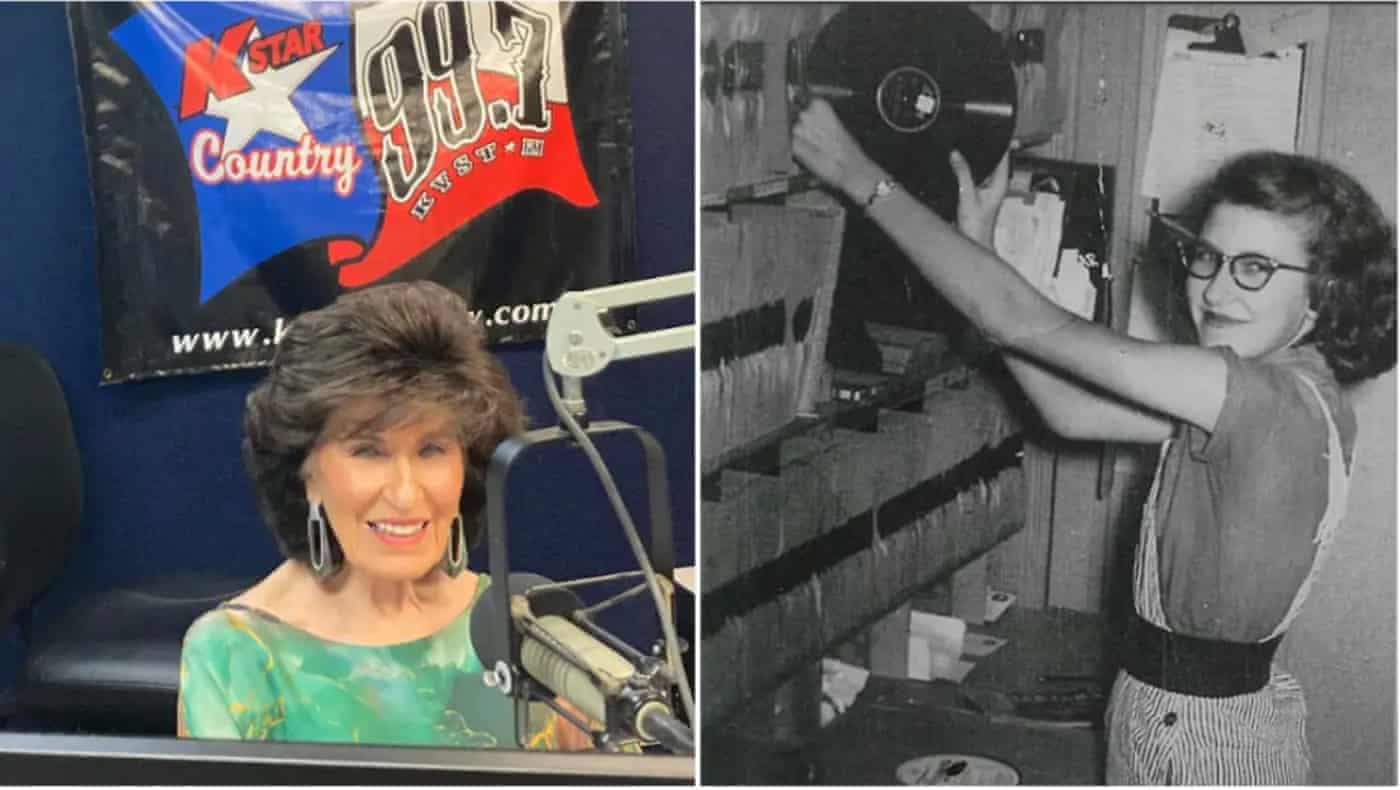
Mary McCoy, the longest-serving female radio DJ on the globe, according to Guinness World Records, has no interest in retirement. 

If you are lucky enough to have a job that lights up your life, why would you ever retire? That’s the thinking of the woman featured in today’s story.

Ramon Antonio Vargas reports at the Guardian, “Mary McCoy has broken her neck, had multiple bouts with Covid-19 and grieved the deaths of two husbands. But none of that could get the 85-year-old off the airwaves she has been on for more than 70 years. The transition from vinyl to purely digital control panels was no match either.

“ ‘I have seen it all,’ the radio presenter from Texas told the Guardian, weeks before the end of her 72nd year in her role. ‘And you know what? I don’t plan on stopping anytime soon.’

Guinness World Records has confirmed McCoy as the longest-serving female radio disc jockey. She passed Maruja Venegas Salinas of Peru, who died in 2015 during her 70th year as a host.

“Such recognition has given McCoy and her loved ones the occasion to reflect on a remarkable journey. It began with a childhood dream of breaking into the entertainment business – dreamed even as she and her family briefly lived in a tent without running water or electricity. …

“ ‘She’s been through adversity, she’s been through pain, and she keeps going,’ said her longtime co-host, Larry Galla. …

“McCoy was born on a farm in east Texas. Her family soon climbed into their Ford Model A and moved about 200 miles south-west to Conroe. There, about 40 miles north of Houston, life was lived without frills.

“McCoy took breaks from life in the tent by learning how to yodel. She joked that her father probably wanted to strangle her but she became quite skilled. When she was 11, she signed up for a talent show at a local theater. Performing the Patsy Montana yodeling classic ‘I Want to Be a Cowboy’s Sweetheart,’ she won.

“The manager of a new radio station, KMCO, learned of the performance and called her school, inviting her to a recorded audition. McCoy borrowed a guitar she said was ‘three times’ as big as her, took a bus ride and performed. The manager asked if she knew enough songs to play a 15-minute program.

“McCoy said she did, so they recorded a show. McCoy recalls crying when she heard herself on the air. She ‘thought it was the worst thing I’d ever heard – I thought I’d never go back and my career had ended.’ But the manager called back and said KMCO had picked up a sponsor for her program, which would go out on Saturdays.

“McCoy was delighted. Eventually, she convinced the manager to let her host a show. She simply played 78 rpm records by the country artists to whom she listened. That was where the McCoy everyone in her community now knows began to take shape.

“She had on fabled singer-songwriters including Jim Reeves, Hank Locklin and Sonny James. She toured, sang and played the guitar with artists like James and Slim Whitman. She landed a spot on the Louisiana Hayride tour, which came to Conroe in 1955.

On that stop, she performed alongside a rising musician named Elvis Presley.

“Other episodes in McCoy’s career could fill a book with ease. One of her favorites came in 1965, when she performed as a last-minute substitute at a prison rodeo. After she and Roy Acuff sang, organizers let loose some bulls. It was part of the show but it scared her. McCoy tried to climb out of the rodeo ring but couldn’t because the dress she performed in was too tight. She asked some clowns to help her up. She remembers them hugging and even trying to kiss her, smudging her with their face paint. …

“In 2013, she suffered a fall. Doctors diagnosed a fractured neck, performed an eight-hour surgery and sent her home to rest on a hospital-grade bed, wearing an elaborate head brace she said made her look ‘like Frankenstein.’

“By then, 78 rpm records had given way to 45rpms and in turn CDs, before everything ultimately went digital. McCoy said she had minimal understanding of the technology that now runs her industry, but knew she could co-host her show from home if she had to. So she did, with help from colleagues at the station now known as K-Star.

“A similar plan let her stay on the air each of three times she has caught Covid-19.

“ ‘That shows you how much I love this,’ McCoy said.

“She was inducted to the Texas country hall of fame in 2010. In Conroe in 2014, she was added to a wall of local legends. Images since added to the mural include Roy Harris, a boxer who challenged Floyd Patterson for the world heavyweight championship, and the Pulitzer-winning historian Annette Gordon-Reed.

“To see if McCoy had a shot at the Guinness World Records, K-Star enlisted the help of McCoy’s youngest of four daughters, Kim Colette Stout. Beginning last year, Stout gathered photographs, newspaper articles and social security payment records, all to establish that her mother’s career began way back when at KMCO, the station whose nickname, ‘Kim-Coe,’ inspired Stout’s first and middle names. …

“Stout submitted the materials to Guinness. It eventually sent an email back.

“It said: ‘Your mother is now the world record-holder.’

“Stout said she once tried to coax McCoy, her ‘momma,’ to retire. She’s now glad she didn’t succeed. … ‘She’d be lost if she came home and she wasn’t going to work every morning.’ ”

More at the Guardian, here.