Feeds:
Posts
Comments

Posts Tagged ‘1950s’

Photo: Lisa Guerriero.
A restored 1946 Wurlitzer jukebox model 1015, known as “the Bubbler” for the bubble tubes on its front.

In the 1950s, when the jukebox was at the height of its popularity, one of my brothers received for Christmas a magnificent toy version. I remember it lighting up in bright colors when you turned it on. It could not exchange records like tan authentic jukebox, but it was real enough to become the wonder of the neighborhood, at least for a while.

At the Smithsonian, Steven Melendez reminds us that the basic concept was launched long before the 1950s.

“In 1889, a San Francisco tavern called the Palais Royale debuted a hot new attraction: a modified Edison phonograph that, when a customer inserted a nickel, played music from a single wax cylinder. Electrical sound amplification was still years away, so customers had to insert stethoscope-like tubes into their ears to hear anything. …

“Despite this unwieldy setup, the machine reportedly brought in more than $1,000 (some $34,000 today) in less than six months, and coin-operated music machines soon proliferated in bars, at drugstores and even in new listening parlors across the country. Alas, poor sound quality meant selections couldn’t be soft or subtle, so popular offerings included such earsplitting numbers as John Philip Sousa marches and the novelty whistler John Yorke AtLee performing popular ditties of the day. By the early 1900s, the machines struggled to compete against player pianos and other automated instruments that could entertain whole venues with higher-quality audio. …

“Record players continued to improve in quality and volume, and pay-to-play phonographs made a huge comeback in the 1920s, paving the way for the jukebox era. In 1927, the Automatic
Musical Instrument Company unveiled the first amplified, multi-record coin phonograph.

“Jukeboxes — they took on this nickname in the 1930s in reference to African American ‘juke joints’ of the South — introduced the world to music on demand, for far less than buying a record (and on better equipment than people had at home). … Danceable big-band numbers and tunes like the ‘Beer Barrel Polka’ were early hits, and the irrepressible popularity of jukeboxes soon rocketed artists like swing impresario Glenn Miller to national fame, creating an audience for loud, catchy, rollicking tunes. …

“Jukebox operators came to account for a majority of record sales, as they frequently changed out selections to keep customers dropping nickels. Using meters within the machines, operators could track which tunes were most popular at which locations, and they programmed boxes accordingly, offering a mix of national hits and more regionally specific selections. The latter included many tunes by Black and working-class musicians, in folk genres such as country and blues that tended to get scant airplay on the radio of the day but soon found appreciative listeners on jukeboxes. 

“By the early 1940s, about 500,000 jukeboxes dotted the country, sometimes inspiring too much of a ruckus: Newspapers frequently reported on bar fights over music selections. …

“Jukeboxes had a chance to prove their patriotic bona fides during World War II, when they provided vital entertainment on military bases and at troops’ canteens, sometimes on machines donated by public-spirited American operators — not a single nickel required. …

“After the war, stylish and streamlined jukebox cabinets in diners let teenagers listen to rock ’n’ roll at volumes generally impossible (or at least inadvisable) to achieve at home. Jukeboxes became indelibly associated with 1950s youth culture. … The format of hit-after-hit music queues also helped inspire teen-friendly Top 40 radio, replacing older formats that defaulted to playing several songs in a row by a single artist.

“Over the next couple of decades, jukeboxes would see their numbers dwindle as fans turned to other sources of entertainment, including increasingly high-fidelity home stereos, television and the transistor radio.”

Teddy Brokaw continues the jukebox story at Smithsonian with a description of how mobsters saw easy money in the phenomenon.

“The jukebox,” Brokaw reports, “with its all-cash business model and fungible record-keeping, showed clear potential for tax evasion and money-​laundering operations and quickly caught the attention of organized crime.

“By the 1940s, Mafiosi, foremost among them Meyer Lansky, had pioneered the typical racket: Buy up all the jukeboxes in an area and lease them to businesses in exchange for 50 percent or more of the take. But the scheme’s true brilliance was its scope: The mob owned not only the jukeboxes, but also, often, the record companies supplying the discs and the contracts of the artists cutting the records. It was a masterpiece of vertical integration, and it worked gangbusters.

“By the mid-1950s, one enterprising gangster — Chicago Outfit member Jake ‘Greasy Thumb’ Guzik … controlled 100,000 of America’s half-million jukeboxes and was raking in several million dollars a year. 

“With made men at the helm, the jukebox industry relied on hits — of both kinds. Mobsters could make or break an artist’s career through their control over what made it into the machines and thus climbed the charts. And beatings, bombings and even murders were just ‘one of the liabilities of the business,’ as a Wurlitzer sales executive testified to a Senate investigative committee in 1959. Jukebox owners who didn’t play nice risked seeing their machines destroyed, while rival jukebox distributors who refused to cut the mob in on their operations were whacked on more than one occasion.

“The jukebox may be a relic of a bygone era, but the mob’s influence in jukeboxes remains. As recently as 2018, a reputed mobster was gunned down. … The victim’s funeral procession was led by a car carrying — what else? — a jukebox made of flowers.”

More at Smithsonian, here.
Read Full Post »

Bygone Jingles

Photo: CarGurus.
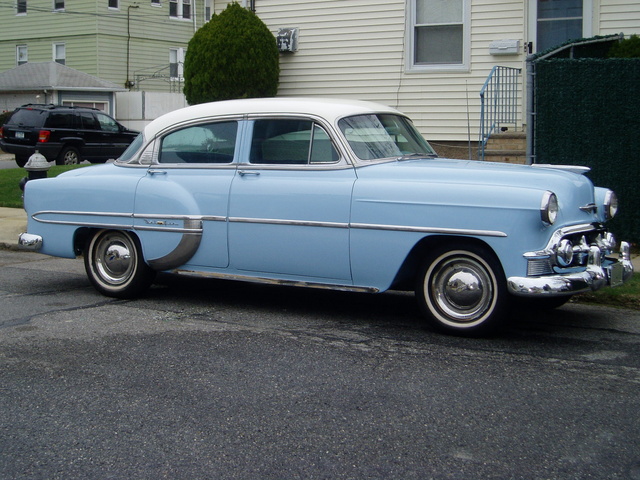
1953 Chevrolet. Back in the day, singer Dinah Shore was better known for singing the Chevrolet jingle than for her movies.

Given that you have to keep a distance from other people on your walk, it’s possible to sing quietly to yourself sometimes without feeling too ridiculous. The other day, for some reason, the old commercial for Rheingold Beer came into my head, and when I got home, my husband and I brainstormed about other well-remembered jingles.

Then I went on Youtube. I couldn’t find the commercial about the inkspot menace that will ruin “your rugs and furniture and clothes, and add a whole lot to your woes” (does anyone know it?), but I found several others.

What do you notice or think about when you play these ads? I notice there is no diversity among the characters. And I think how it’s a miracle anyone raised in this time became a feminist. All the messages for girls were about chasing some guy with nice hair. Check these out.

Rheingold Beer.

Chock Full o’ Nuts. The original jingle said, “Better coffee Rockefeller’s money can’t buy.” They had to change it.

Ipana Toothpaste.

Brylcreem.

Chevrolet.

Robert Hall.

Ajax.

Oscar Meyer Wiener.

Wildroot Cream Oil.

Send me your favorites?

Read Full Post »

Photo: Playhouse Records
Back in the day, Jim Copp (right) “made recordings [with Ed Brown] that offered children funny fables replete with sound effects, and were literate and charming enough for adults,” says the
New Yorker.

Years ago, the older of my two younger brothers received a record player that looked like a jukebox and flashed colored lights. It was the beginning of his long romance with records. Neighbor kids came over to see this wonder, and we listened not only to music on the records but also to stories. Call it an early podcast platform. David Owen has a bit of history at the New Yorker.

“When my wife was a kid, in the early nineteen-sixties, she and her siblings listened, over and over, to records by Jim Copp. … Copp made nine records between 1958 and 1971. They contain stories, poems, and songs that he wrote, performed, and recorded with the help of his friend Ed Brown. …

“Stories involve a family that takes a cross-country car trip with a cow; a duck that, with excruciating effort, manages to speak just enough English to warn his housemate, a carpenter, that their kitchen is on fire; a dog with the longest name in the world who goes to Yale; … a nearsighted heron; and a feeble-minded old man, Mr. Hippity, who thinks his chicken pull toy is sick. Copp may be the reason that my wife and her siblings and both our children have always had good vocabularies: destitute, vituperative, locality, inauspicious, gauche, megalomaniac, union suit. …

“Not long after my wife received [tapes] from her brother, she noticed a tiny advertisement in The New Yorker for rereleases of Copp’s records, on cassette. She called the telephone number in the ad, and eventually realized that the person taking her order was Copp himself. … In 1993, I [interviewed] Copp in his home. …

“In 1939, friends whom he was visiting in Chicago dared him to enter a talent contest at the old Edgewater Beach Hotel, whose ballroom was popular with movie stars and mobsters. He performed several humorous pieces that he’d written as a student — ‘Arabella and the Water Tank,’ ‘Peaches and Myrtle’ (about two showgirls, one of whom murders the other), ‘The Mystery of the Revolving Tree Trunk’ — and won. …

“Copp got hooked on performing. During the next three years, he appeared, as James Copp III and His Things, in some of Manhattan’s most famous night spots, among them the Blue Angel, Le Ruban Bleu, the Rainbow Room, and Café Society. … In 1941, Liberty released six of his night club pieces, on a set of three 78s.

“He was drafted a year later, and became the adjutant of an intelligence unit that took part in the Normandy invasion. … He returned to the United States in 1946, but decided that New York and its night clubs had changed in ways he didn’t like.

“Copp decided that his best chance of preserving his night-club material was to rework it, slightly, for children. He experimented with a wire recorder — a tape precursor, which recorded magnetically on steel wire. He sold one piece, ‘The Noisy Eater,’ to Capitol Records, which Jerry Lewis recorded, in 1952. … He decided that from then on he would make his own records. He … would record a single character or instrument or effect on one machine, then play that tape in the background as he recorded another on one of the others. For some pieces, he ‘ping-ponged’ as many as ninety layers. He sped up some voices and slowed down others, all without fancy equipment, and he added homemade sound effects.” For the long read, check out the New Yorker, here.

The story brought back memories, especially of my father’s wire recorder. He had a couple of his recordings made into actual records, and when I grew up, I found someone to turn a record featuring my squeaky voice (“The Birth of Willie”) into a cassette tape.

Read Full Post »

I just went back to bathe in the golden glow of blogger KerryCan’s early summer memories here. I’ve been planning to take her up on the idea of sharing a childhood summer photo and letting train of thought take over.

KerryCan says she and her cousins had “absolutely nothing to worry about except breaking a plastic flip flop or getting sticky drips of Popsicle running down an arm,” which doesn’t quite fit my childhood. But I was always looking forward and believing something nice was coming.

I began dreaming of Fire Island in January or so — creating a paper pocket on our front door with Ocean Beach postcards tucked in and badgering grown-ups with “When are we going?”

And goodness knows, I dearly loved the ocean, swimming every day in my early teens unless there was a red warning flag. On choppy mornings, I might be the only one out there in front of the lifeguards.

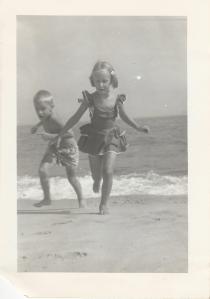
Here I am at about age 10 with the older of my two brothers, probably competing for who could run fastest.

I didn’t learn until I was practically a grandmother that some kinds of competition with him might be ill-advised — like the time I tried to bend back my thumb the way his joints allow him to and ended up with a trigger finger and a hand operation! Ha, ha. Laughing now.

On this Atlantic beach, we used to dig for the tiny armadillo-like mole crabs that we called “jumpies.” Where are they now?

Fire-Island-in-the-50s

Read Full Post »