
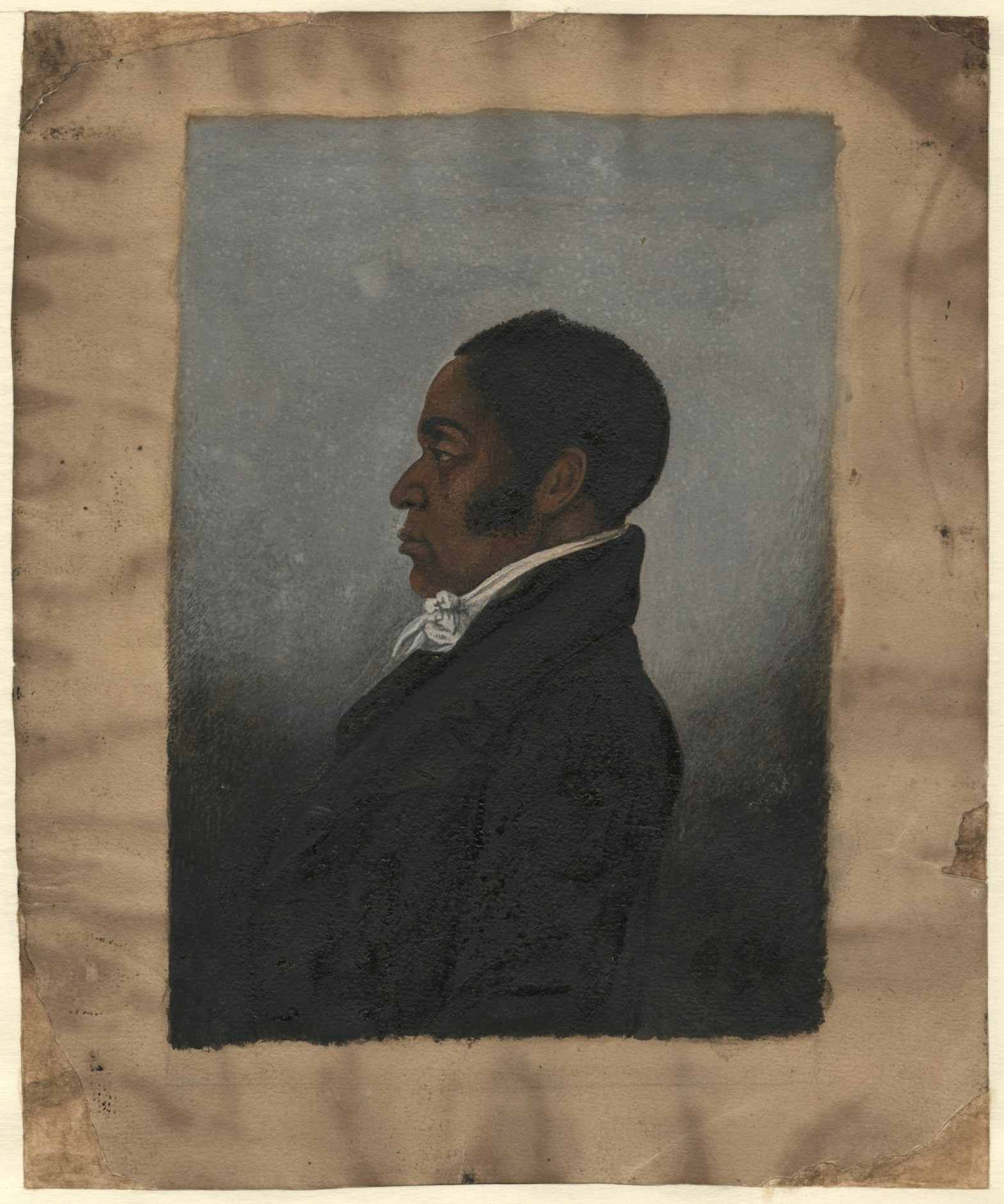
Photo: Westport Historical Society.
I think I can predict that in today’s climate, efforts to highlight the contributions of African Americans during Black History Month will be slighted in some areas. That is, unless folks who still value diversity, equality, and inclusion (DEI) stand up. A small but mighty newspaper in Providence, Rhode Island, is a case in point.
At the Providence Eye, Jane Lancaster recently highlighted a distinguished Black/Wampanoag Rhode Islander from the 19th century. Today his name, Paul Cuffe, uses the spelling “Cuffee.”
“According to the Paul Cuffee School website,” she says, “when their namesake returned to the U.S. in 1812 from voyages to Sierra Leone and then England, he found his ship had been ‘impounded by the U.S. Revenue Service in Newport. Within six days, at record-breaking speed, Cuffee was in Washington knocking at the door of President Madison, who immediately arranged for the ship to be returned. Cuffee is said to have been the first person of color to enter the White House through the front door.’
“[Cuffee] wrote in his journal on Saturday, May 2, 1812: ‘at 11 o’clock Waited on the President.’ He also met Secretary of State Albert Gallatin and discussed his desire to return to Sierra Leone, aiming to find alternatives to the slave trade. Gallatin told him that Madison’s government would ‘consisting with the Constitution’… be ready to help in any way they could. …
“So who was this influential pioneer and problem solver that Paul Cuffee School is named for? He was a businessman, whaler, ship’s captain, ship builder, philanthropist and abolitionist, and when he died in September 1817, he was believed to be the wealthiest man of African descent in America. … He saw education as a means of liberation; he was self-taught. In 1799, wanting his children to have schooling, and facing difficulties with the Westport [MA] authorities, he established a school open to all children regardless of race. It was possibly the first integrated school in America.
“He later told Delaware abolitionists of the difficulties he faced: ‘The collision of opinion respecting mode and place occasioned the meeting to separate without arriving at any conclusion.’ So he built the schoolhouse on his own land, hired a schoolmaster and opened the school to all, never demanding any rent, nor trying to dominate the school.
Paul Cuffee was born free as Paul Slocum on Cuttyhunk, a tiny island in Buzzards Bay, Massachusetts in 1759.
“His father was African-born and his mother was Wampanoag. Cuttyhunk was purchased in 1677 by the Slocum family, who were enslavers. … The complicated history of slavery in New England is borne out by the story of Paul Cuffee’s family. His father Cuffee Slocum, originally called Kofi, was brought from West Africa to New England as an enslaved child in the 1720s. …
“He was purchased by Peleg’s descendant Ebenezer Slocum and in the 1740s bought his freedom from Ebenezer’s nephew John Slocum. He soon after married Ruth Moses, a Wampanoag woman from Martha’s Vineyard and they began raising a family of 10 children on Cuttyhunk. In 1766, when his son Paul was seven, Cuffee purchased and moved to a 120-acre farm in Westport. …
“Paul Cuffee was taxed as a landowner, but as a Black and Wampanoag man, he had no vote. In 1780 he, his brother, and other Black and Native landowners petitioned the Bristol County authorities for the right to vote. No taxation without representation was in the air! Their petition was denied, but the case helped pave the way for the 1783 Massachusetts Constitution, which gave equal rights and privileges to all (male) citizens of the state.
“Cuffee first went to sea at sixteen, serving on a whaler and learning mathematics and navigation. The outbreak of the Revolutionary War meant, however, both opportunity and danger. In 1776 his ship was captured by the British and Cuffe was imprisoned for three months in New York. He returned to Massachusetts and in 1779 started running the British blockade taking trade goods to Nantucket and other Massachusetts ports. He built ten boats at his Westport shipyard, which grew increasingly large; among them, schooners, barks, the 109-ton brig Traveller, and finally, a 268-ton ship Alpha.
“Cuffee’s crew were all men of color, African or Native American (except, once, a Swedish youth). This became particularly dangerous after 1793, when Congress passed a Fugitive Slave Act that codified a provision in the Constitution giving enslavers the right to retrieve fugitives from slavery from another state. This put Cuffee and his crew in continual peril of being kidnapped and sold.
“Cuffee, who joined the Westport Monthly Meeting, was a Quaker for most of his life, though he was not a formal member until 1808. Non-white membership of the Society of Friends was unusual, though people of color attended services, often in a separate area. Cuffee, forced to sit in the gallery at a Quaker Meeting House in Philadelphia later that year, stood up and testified his intention of leading the struggle against slavery.”
More at the Eye, here. No firewall. Note the photo of the Paul Cuffee monument, erected by his great grandson in 1913 on the grounds of the Friends Meeting House in Westport, Massachusetts.





 Suzanne's Mom's Blog