Feeds:
Posts
Comments

Posts Tagged ‘activist’

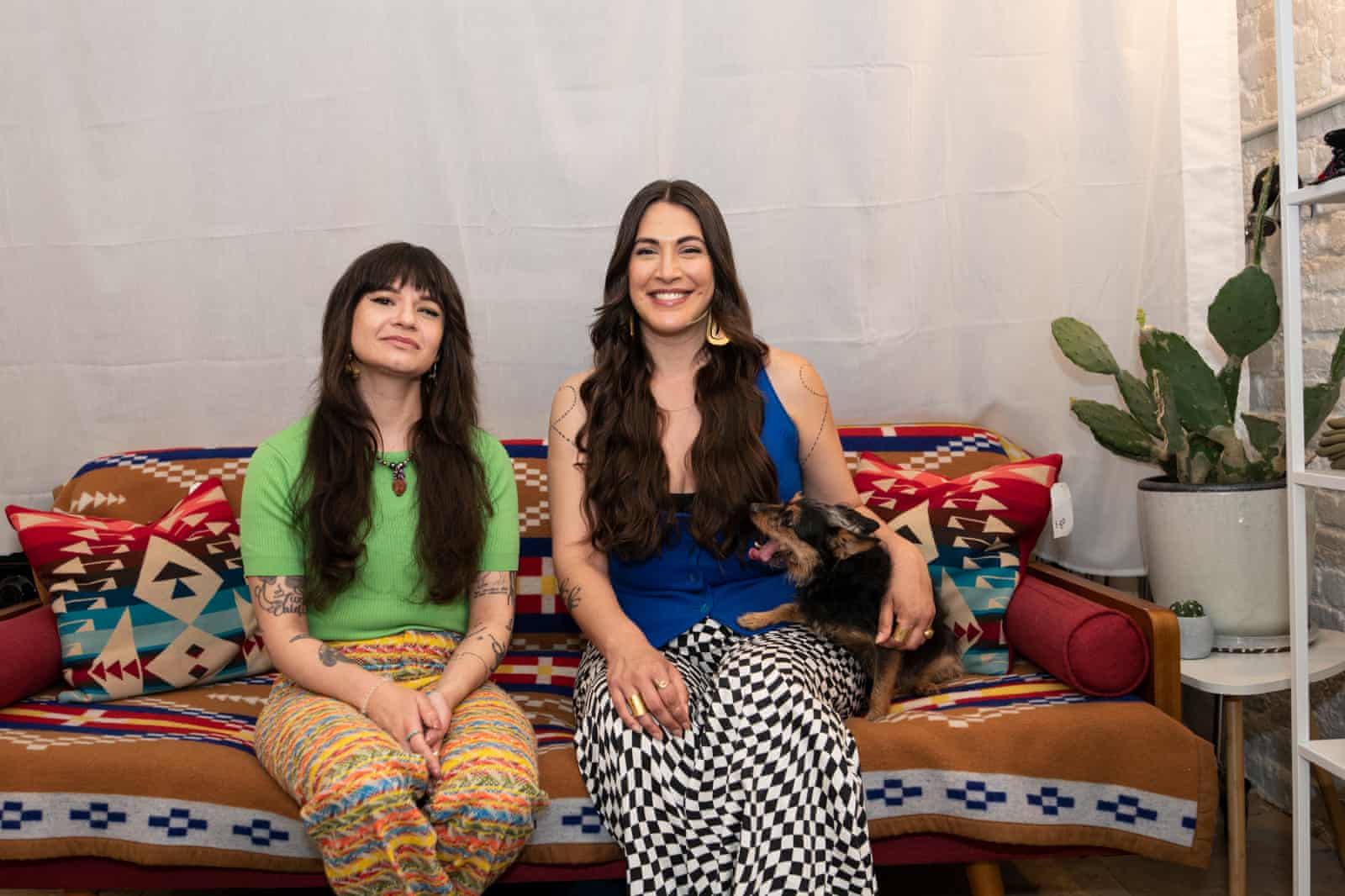
Photo: Maria Spann/The Guardian.
Liana Shewey and Korina Emmerich run a forward-thinking indigenous store in New York.

A friend who had just read Rinker Buck’s Life on the Mississippi was telling me recently how stunned she was to learn details of the Trail of Tears and related horrors visited on natives. Most of us know very little about that and have hardly been aware that indigenous people have been living among us all along.

At the very least, we are noticing them more now, learning more.

In today’s article, Sophia Herring of the Guardian interviews two very visible indigenous women with a new kind of shop in New York City.

“Location, location, location. It can make or break a business,” Herring says. “For Liana Shewey and Korina Emmerich, it was a call to action. When a mutual friend told the activists and creatives – Shewey is an educator and Emmerich is a fashion designer – about a newly vacant storefront on the ground floor of her mother’s Manhattan co-op building, the pair … visited the space. … ‘We jumped on it,’ said Shewey.

“The co-op board wasn’t willing to hand the keys over to just anyone. But their friend’s mother is Navajo, and also the board president. Within days the building had its newest tenant: Relative Arts NYC, a boutique that carries pieces by Indigenous designers and also hosts literary readings, album releases and art installations featuring work by Indigenous artists.

“ ‘It just felt so important for us to have a space, as grassroots organizers in the city,’ said Shewey, who was raised in Stillwater, Oklahoma, and is a member of the Mvskoke (Creek) Nation. Building a store that specializes in goods from Indigenous and many female-owned labels was a natural way to support their community. …

“The merchandise builds on their mission to shatter stereotypes. The entrepreneurs speak to ‘Indigenous futurism,’ an emerging art and design movement that leans away from cliches. …

“Emmerich, who grew up in Eugene, Oregon, and whose father is of Puyallup descent, focused on her own fashion label, EMME Studio, in her late 20s and early 30s. Her work has appeared on the cover of InStyle magazine and in the Lexicon of Fashion exhibition at the Metropolitan Museum of Art. She still makes pieces by special order, and the shop doubles as an atelier. When she spoke with the Guardian, she was rushing to complete a dress that she was making for a producer of Killers of the Flower Moon, the new Martin Scorsese film, to wear to the Cannes film festival. Shewey, whose day job is as an outreach educator at the New-York Historical Society, was speaking from her car, where she was taking a break from a marathon day of teaching four sixth-grade classes.

“The entrepreneurs, who can be found at their shop every weekend, relied on crowdfunding to convert the space into a store. An initial round of fundraising garnered $6,465, which covered shelving units and a sofa from Craigslist. They found a handful of industrial school chairs on the side of the road.

“The pair are breaking even, and still debating whether to form a nonprofit or operate as an LLC. ‘We want Relative Arts to be a greater incubation hub for people to be able to learn, create and work out of,’ said Shewey. …

Sophia Herring: Tell me about what led you both here.

Liana Shewey: I lived in Portland for about a decade and got really integrated into the local rock’n’roll scene. I bartended, worked at a local Starbucks, and then eventually started a music production company of my own with a few friends. In 2014, I moved to the Czech Republic and started organizing around the refugee crisis. I came back in 2016 when everything was happening with Standing Rock. It made me realize my struggle is here and I need to be with my community.

“Korina Emmerich: At 13, I made my first jingle dress regalia, and got very into sewing. I came to New York with two suitcases, a cat and $75. I worked in a boutique and I had my own line. I actually had a lot of success, thanks to a company called Brand Assembly that helps support smaller designers. But you slowly realize with everything in the fashion industry, if you want to do it ethically, you will be poor. I just dreamed that one day I would have a space to be able to share everybody’s work.

“Herring: How do you work as a team?

“Emmerich: We’ve been planning and organizing together for so long that we just naturally gravitate towards each other in our work style. Liana is analytical and does the logistical things as well as planning, and organizing when it comes to programming. I have this more creative, community outreach part of my work where building relationships is such an important aspect. …

“Herring: How do you choose what goes in the store?

“Emmerich: Our goal is to showcase contemporary Indigenous designers who are doing fun, subversive, wearable work, as opposed to the assumption of what Indigenous design has to look like. I want to talk about how Indigenous people exist here and now and we’re doing contemporary work here and now. There’s no rule that says we have to only exist in a historical context.

“Herring: What is it like operating an Indigenous business within a community that so rarely acknowledges it’s on Indigenous land to begin with?

“Emmerich: Even though Relative Arts may be the first of its kind, we are not the first ones to be doing this work. It was amazing to have the American Indian Community House come to open the space on our first day, to say a prayer and give us their blessing.

“Shewey: I’m thinking about how many people come off the streets and buy one of our pieces just because they like the garments themselves. Then they look at the basketball jersey and ask: what is the Salish Sea? [The Salish coast, along the north-western US and Canada, is home to Indigenous nations.] If they didn’t know, they walk out having learned about decolonization. …

“Herring: What is your long-term goal?

“Emmerich: We like to think of Relative Arts as a hub. The plans that we have are so much bigger than just a store. …

“Shewey: We’ve mused that we want it to kind of look like an Indigenous-futurist version of Andy Warhol’s Factory. It would be so wonderful to have thousands of feet, although I doubt Andy ever had to apply for funding.”

More at the Guardian, here. No firewall. Donations encouraged.
Read Full Post »

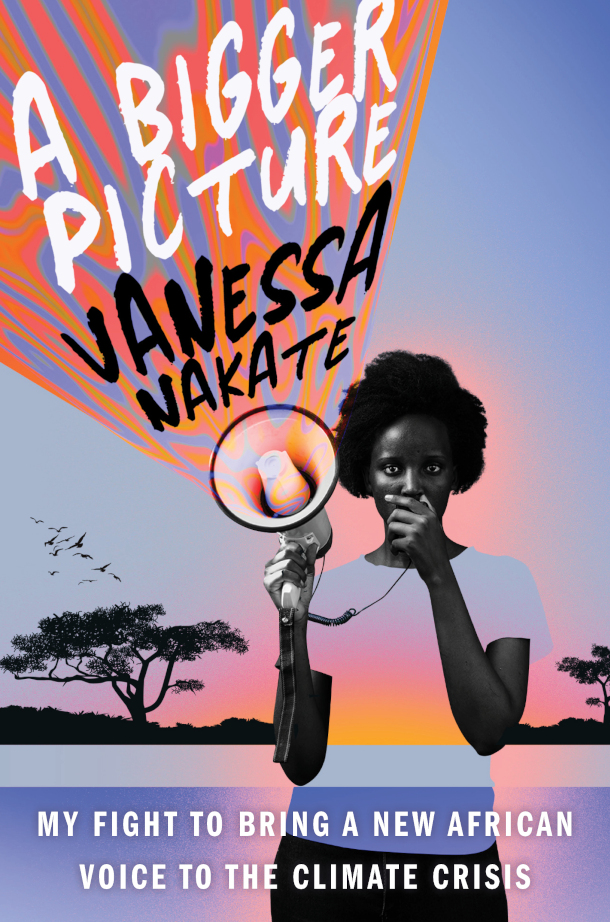
Photo: Vanessa Nakate.
Vanessa Nakate’s book A Bigger Picture: My Fight to Bring a New African Voice to the Climate Crisis recounts her journey as an environmental justice activist.

I continue to be impressed that people college age and younger are taking the lead on the critical issues of our time — gun control, climate change, inequality, everything. It is probably wrong to put pressure on them, but I do think they’re more likely to have answers — often because they don’t know what’s “impossible.” Older folks tend to believe things that have never been done are impossible. Young ones don’t.

At Living on Earth, Steve Curwood talks to a young Ugandan activist who has become a leader in fighting climate change.

“STEVE CURWOOD: Greta Thunberg started the Fridays For the Future climate strikes by sitting in front of the Swedish Parliament, and millions of people around the world ultimately joined her cause. One of them was Vanessa Nakate of Kampala, Uganda, who was just getting out of college at the time.

“Teenaged girls in Uganda don’t typically have the same social freedoms as many in the Global North have to be out on their own picketing and demonstrating. But at age 22 Vanessa Nakate could, as college age women have a lot more freedoms in her culture. And in the face of climate change, intensified floods and droughts that ravaged Uganda at the time, Vanessa was inspired by Greta to organize and start holding climate strike signs herself in front of the Ugandan Parliament.

“Greta Thunberg soon heard of Vanessa through social media and in January of 2020 Vanessa was invited to join Greta for a press conference at the World Economic Forum in Davos, Switzerland. But the Associated Press cropped Vanessa, the only black woman, out of a widely circulated photo that included Greta Thunberg and three other white European activists. Comments citing that editorial decision as racist soon went viral. And since that incident Vanessa has used her visibility to bring light to climate struggles in the Global South. In her book, A Bigger Picture: My Fight to Bring a New African Voice to the Climate Crisis, Vanessa points to how climate change is impacting Africa and the short shrift that she and other people and nations of color receive at the UN climate talks. … [Vanessa] what kind of climate change effects are going on in Uganda? …

“VANESSA NAKATE: Uganda as a country heavily depends on agriculture for survival for many communities, especially those in the rural areas. But with the rising global temperatures, many people are threatened with floods, droughts and landslides, causing massive destruction, massive loss of lives, loss of homes, farms and businesses. … In the western part of the country in areas of Kasese, because of the rising global temperatures, many people have been displaced and still are living in camps because of extreme flooding.

“CURWOOD: Please tell me a story of a particular recent climate related incident. …

“NAKATE: I can talk about one that happened last year. During the pandemic in 2020. The water levels of Lake Victoria rose as a result of extreme rainfall. And many people were displaced from their homes at a time when they had to stay at home to keep themselves safe. And with the rise in the water levels. Not only were farms destroyed, but even toilets were submerged, causing contamination of water sources and threatening the livelihoods of very many people.

“CURWOOD: Now, you join Friday’s for the Future in your 20s Vanessa. And that movement was made up of well, mostly teenagers and younger folks, why did you choose to join? …

“NAKATE: This is a challenge for some of my friends, because most of them were just finished in college and in their 20s. So, we all had this feeling that this movement was a movement for teenagers. But to me, that wasn’t the issue. … I just wanted to demand for climate justice and to talk about the challenges that the people in my country were facing because of the climate crisis.

“CURWOOD: Vanessa, tell me about some of the projects that you’re working on now.

“NAKATE: In 2019, I started school project Vash Green Schools Project. [It] involves the installation of solar panels and ecofriendly cookstoves in schools. I started this project to help drive a transition to renewable energy in schools in Uganda, and also for the clean cooking stoves to reduce the firewood that schools were using for preparation of foods. Almost all the schools in my country use firewood for food preparation. But with these ecofriendly stoves, the number that is used is greatly cut. … So far we’ve done installations in 13 schools.

“CURWOOD: You write in your book that when you came actually to the UN, a couple of [bad] things happened. …

“NAKATE: One of the people was a part of the Ugandan delegation [who] asked if I can meet him and talk about my activism. [I met] members of parliament, and I remember one of them actually recognizing me and saying that I’ve seen you on TV, you’re the girl who strikes every Friday. And at that moment, I’m like, wait, you’ve seen me. And you haven’t even said anything about the activism that I’m doing. …

“For the UN Youth Climate Summit … I was told that I would have a speaking role. I worked on my speech. And I was just really happy to talk about the experiences of the people in my country. [Then] I’m told that, well, you’re actually not going to speak but you will just be able to, you know, be like in discussions with other young activists. And at that point, it was really a disappointment before I left and I couldn’t tell my family or my friends because they were very excited.

“[And after the Davos incident] I felt like everything that I said at the press conference … didn’t matter, like it just went into the air and immediately disappeared, and no one was really paying attention. …

“It’s important for people to know that, historically, Africa is responsible for only 3% of global emissions. And yet Africans are already suffering some of the most brutal impacts of the climate crisis. It’s also important to know that while Africa, while the global south, is on the frontlines of the climate crisis, it is not on the front pages of the world’s newspapers. And it’s also important to know that there are a number of activists in the African continent in the global south who are speaking up, who are demanding for justice from leaders, from governments, from corporations. … We want climate action from the leaders and our voices will not be silenced.”

More at Living on Earth, here.

Read Full Post »

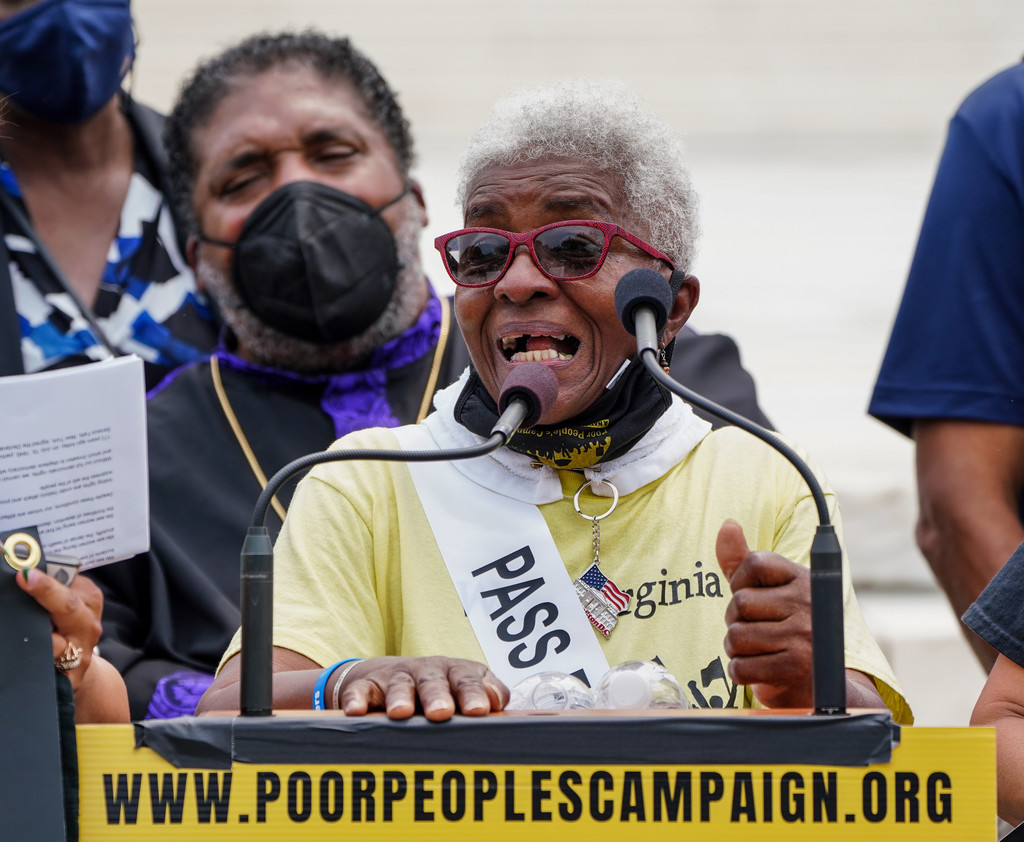
Photo: Jemal Countess/Getty Images for MoveOn.
Jean Evansmore of West Virginia, a leader of the Poor People’s Campaign, speaking at a rally on July 19, 2021
.

It’s not news that the attitudes of the people who raise you help to make you who you are. Activist Jean Evansmore, brought up by grandparents in West Virginia, never knew she was poor. What she knew was that her family worked hard and had dignity. Their self-esteem has carried her through life.

Courtland Milloy recently wrote about Evansmore at the Washington Post. “When Jean Evansmore was growing up in West Virginia coal country, her grandfather did two things that would have a profound effect on her life. He showed her how to plant a garden and, by his own example, let her see that just because you were poor didn’t mean you were lazy or stupid.

“Her grandfather, Webster Evans, earned between $2.50 and $5 a day in the 1920s if he could blast loose, load and haul at least five tons of coal from the mine where he worked. Today, low-wage workers make about $7.50 an hour.

“According to the Poor People’s Campaign, which focuses attention and resources on poverty, about 40 percent of West Virginia residents are poor or low-income. And as in much of the nation, the gap between rich and poor is widening. Since 1979, income for the top 1 percent in West Virginia grew by about 60 percent, while income for the bottom 99 percent fell by 0.4 percent, the group said. …

“Evansmore, 80, [is] one of the chairpersons for the West Virginia Poor People’s Campaign. That is a branch of a national faith-based activist civic organization founded by the Rev. William J. Barber II. In remaking the Poor People’s Campaign that was started by the Rev. Martin Luther King Jr. in 1968, Barber has cited poverty, racism and ecological destruction as culprits in the spiritual bankruptcy of the nation.

“The people of West Virginia know firsthand just how damaging poverty and not having a voice can be. One hundred years ago, in August 1921, thousands of coal miners gathered in Madison in preparation for a trek to Logan and Mingo counties. Several workers had been arrested for attempting to organize a union in both places.

“To reach their incarcerated co-workers, the miners had to cross Blair Mountain. … The miners lost what became known as the Battle of Blair Mountain. But years later during President Franklin D. Roosevelt’s New Deal, reforms were made that eventually would give miners safer working conditions along with better pay and health care.

” ‘What we should have learned from that history is organizing makes a difference,’ Evansmore said.

Just as the miners in the Battle of Blair Mountain were of different races and ethnic groups, Evansmore, who is Black, hopes the same diversity can be achieved in organizing the poor today.

“Her goal now is to teach more people about the fight for justice in the state. She encourages everyone to tune in to city and county council meetings. She writes letters to elected officials and newspaper editors, often expressing her dismay at how out of touch they are with the struggles of everyday residents.

“And she protests, carrying signs in opposition to proposed cuts to programs that help the poor — even if only a handful of people join in.

“ ‘Because people are told that poverty is caused by some character flaw, a lot of people won’t even admit they are poor,’ she said. … “Sometimes, she tells them about how little she knew about economics as a child.

‘I didn’t even know we were poor,’ said Evansmore. … ‘We were used to eating pinto beans six days a week and chicken on Sunday. The only time we knew something was wrong was when we had to eat beans on Sunday, too.’

“But after graduating from high school in 1958, she left the state to stay with relatives in New Jersey. It was a different world — one with well-insulated homes and indoor plumbing, not outhouses. She eventually enrolled at the University of Bridgeport in Connecticut. Then she got a job with Raytheon, first as a secretary and later working her way up to a buyer in the submarine signaling division. … In 2012, she returned home for good.

“ ‘I vowed that nothing would run me out of West Virginia,’ she said. ‘If I didn’t like something, I’d just stay and fight it.’ ”

More at the Post, here.

Read Full Post »

Photo: Carl Van Vechten
Portrait of composer Shirley Graham (1896-1977), later Shirley Graham Du Bois, taken July 18, 1946.

One of my favorite places to walk — because it’s lovely and because it’s easy to move away from maskless people — is the shady local cemetery. Naturally, I have read a lot of tombstone inscriptions on my walks, and one thing I’ve noticed is how often a woman’s marker says “his wife” or identifies the deceased as “wife of.” I have never seen a stone that describes a man as “husband of.” This hierarchy seems to apply to all races in our country.

So when I share today’s story about Black opera composer Shirley Graham, I’ll just say her husband was known as W.E.B. Du Bois and had a career in his own right.

David Patrick Stearns reported recently at WQXR radio that one Africana studies professor wants everyone to know Graham’s story.

“ ‘This is the time to unleash my voice again.’ Such is the message that Oberlin College’s Africana studies professor Caroline Jackson Smith is hearing, beyond the grave, from the late activist / composer / writer Shirley Graham Du Bois (1896–1977). … Smith moderated a panel following the Caramoor Festival’s recently streamed excerpts from Tom-Tom: An Epic of Music and the Negro, Du Bois’ 1932 opera that is said to be the first by an African American women composer. A full production is hoped for in 2021.

“From the outset, few listeners could’ve known what to expect, because — unfairly — Du Bois’ name has faded in history. … Born in Indianapolis, this daughter of a preacher lived all around the country during her childhood. As an adult, she was often on the move, most significantly with educational pursuits at the Sorbonne in Paris, where she studied composing and began writing Tom-Tom in 1926.

“The opera, however, predates most of what she was known for: Her joining the American Communist Party in the late 1940s, her 1951 marriage to the famous sociologist / activist W.E.B. Du Bois, their back-to-Africa immigration to Ghana in 1961, her later move to Cairo, and her many, many writings along the way.

“In fact, she seemed to write constantly, whether comedies and tragedies for the stage, biographies of fellow radical Paul Robeson (as well as Booker T. Washington and Gamal Abdul Nasser) as well as novels, almost right up to her death from breast cancer. Given her global existence, it’s fitting that she died in China but was a citizen of Tanzania.

In 1932, Tom-Tom was the kind of hit that composers dream about at its Cleveland Opera premiere. Reviews were excellent and two performances reportedly drew stadium-size audiences of 25,000.

“Descriptions suggest it was more than an opera — it was more like a pageant with dancers, singers, musicians, and even elephants. … Tom-Tom disappeared until a score was found among Du Bois’ papers in 2018 at Harvard by Lucy Caplan, then a Yale University doctoral candidate in American and African American studies. The six excerpts presented on the July 9 livestream from Caramoor revealed a convincing synthesis of spirituals and West African folk music applied to a Wagnerian template. …

“This is not a fragile but endearing ballad opera like Scott Joplin’s Treemonisha. … Tom-Tom is an opera with a mission: to connect the African American community with something beyond its history of American slavery. The only apt comparison that I can come up is Kurt Weill’s the Eternal Road, a 1937 pageant whose mission was to call attention to the plight of European Jews in Nazi Germany. …

“In writing Tom-Tom, Du Bois had plenty of education to draw on, and during her period in Paris at the Sorbonne, she discovered that the music that her missionary brother brought back from Liberia (as well as the spirituals she grew up with as the daughter of a minister) stuck in her head much more readily than the conventional chord progressions of western music, according to the 2000 biography by Gerald Horne, Race Woman: The Lives of Shirley Graham Du Bois. Later, she would translate those impulses directly into Tom-Tom, whose prelude was played by three timpani that were translated into what she considered an accurate rendering of African drumming. …

“Act I takes place in 1619 Africa, when a tribal human sacrifice is interrupted by the invasion of slave traders. Act II is set in mid-19th-century America, progressing on to then-contemporary 1930s Harlem in Act III. … How this epic-sized production was financed and mounted remains to be revealed.

“For all of the success of the opening (Horne quotes critic John Gruesser as describing the piece as having ‘the length, complexity and power to be called major’), the opera’s moment in the sun was brief.

“As Horne put it, ‘She quickly discovered that writing operas during the Great Depression was not the soundest method by which an African American woman could escape privation.’ Du Bois went on to the Federal Theater Project doing just about everything, including composing a number of works, including a musical. But after the early 1940s, she seems not to have pursued the kind of composing career that would prompt her — or those impressed with Tom-Tom — to return to the opera in later years.

“Being female and African American in a white, male-dominated world couldn’t have been encouraging. But looking at Du Bois’ biography in the long term, she was about spreading her message — whether as a civil rights activist, advocate of Socialism in various guises, and much else — in whatever form was most effective. Almost anything is more agile than the high-overhead medium of grand opera.” More at WQXR, here.

Photo: Lotte Jacobi, University of Massachusetts Amherst
Composer Shirley Graham Du Bois with her husband on his 87th birthday, 1955.

Read Full Post »

Photo: Tim Clyne
Genesis Blu calls herself a “raptivist” — a mix of rapper and activist. She also works as a psychotherapist.

I heard Genesis Blu interviewed on National Public Radio (NPR) one day when I was driving and thought you might be interested. She is a rapper, an activist, and a psycotherapist.

NPR’s Lulu Garcia-Navarro interviewed her at SugarHill Recording Studios, where Genesis Blu recorded the tracks for her EP, “Bluming Season.”

“Genesis Blu calls herself a ‘raptivist,’ mixing hip-hop with advocacy. She says she dedicates time to ‘facilitating change in her community.’ The dual passions for politics and music started at a young age.

” ‘I would be like 12 years old, going to a nightclub, where people are smoking and drinking. I was always a different type of kid, so my songs would be about the struggle, the political climate — even that young. And they would be like, “Where is this little girl coming from with this stuff?” ‘

“But when she got older, she put the music career on hold and focused on school — a lot of school. She got a bachelor’s, a master’s and started her doctorate. Until she had an epiphany one day — she wanted to be back in the community, writing music. She was in the middle of her dissertation.

” ‘I literally stopped that day, put down that pen and picked up another pen and a notepad and began to write music,’ she says. ‘And I’ve been doing that since.’

“Well, it’s not quite all of what she’s been doing since. She’s also a full-time psychotherapist. Blu works with children and families and teens ‘who are removed from their home due to abuse of some sort or due to their emotional disturbances,’ she says.

” ‘People ask me to choose [between music and therapy] and I cannot, I love them equally,’ she says. ‘Because you’re able to change lives both ways.’ ”

Here are some highlights of the interview.

” ‘I don’t want my people left behind. So, what’s happening [in Houston] right now is gentrification, in the worst way. They are pushing these people out. And there’s not many other options [of places] to go, because we don’t have a great public transportation system …

” ‘It’s upsetting a lot of us who have been in this community and are working in this community. And so even though I’m very happy about the diversity, what it also is doing is allowing people to come in with a bunch of money, throw money at some things, tear some things down, buy it out — and then leave the people who have been here stranded.’ …

” ‘My history is that my grandmother grew up in another neighborhood in Houston as well called Acres Homes. So living between Greenspoint and Acres Homes, which were rivals at the time when I was a kid by the way. So I would have to go to my grandmother’s house after school if my mother couldn’t be home from work.

” ‘And that was interesting because I was bullied — a lot. Because I’m too proper for the black kids and I’m not white enough for the white children, so I’m in a very awkward place. But still loving the culture of where I come from.

” ‘But my grandmother was also an activist. She was very influential in the war on drugs here in Houston. So … she would have me marching with her. So I get that from her.’ ”

More at NPR, here.

Read Full Post »