Feeds:
Posts
Comments

Posts Tagged ‘actor’

Photo: Everett Collection.
A de-aged version of actors Tom Hanks and Robin Wright, created by artificial intelligence for the 2024 film Here.

We are well into the age of AI, and I certainly hope that doesn’t mean we’re going to realize the dire warnings of one of its pioneers but just use it in relatively harmless ways.

Today’s story is about using AI to “de-age” actors in a movie covering 60 years.

Benj Edwards writes at Wired, “Here, a $50 million Robert Zemeckis–directed film [used] real-time generative AI face transformation techniques to portray actors Tom Hanks and Robin Wright across a 60-year span, marking one of Hollywood’s first full-length features built around AI-powered visual effects.

“The film adapts a 2014 graphic novel set primarily in a New Jersey living room across multiple time periods. Rather than cast different actors for various ages, the production used AI to modify Hanks’s and Wright’s appearances throughout.

“The de-aging technology comes from Metaphysic, a visual effects company that creates real time face swapping and aging effects. During filming, the crew watched two monitors simultaneously: one showing the actors’ actual appearances and another displaying them at whatever age the scene required.

“Metaphysic developed the facial modification system by training custom machine-learning models on frames of Hanks’ and Wright’s previous films. This included a large dataset of facial movements, skin textures, and appearances under varied lighting conditions and camera angles. …

“Unlike previous aging effects that relied on frame-by-frame manipulation, Metaphysic’s approach generates transformations instantly by analyzing facial landmarks and mapping them to trained age variations. … Traditional visual effects for this level of face modification would reportedly require hundreds of artists and a substantially larger budget closer to standard Marvel movie costs.

“This isn’t the first film that has used AI techniques to de-age actors. ILM’s approach to de-aging Harrison Ford in 2023’s Indiana Jones and the Dial of Destiny used a proprietary system called Flux with infrared cameras to capture facial data during filming, then old images of Ford to de-age him in postproduction. By contrast, Metaphysic’s AI models process transformations without additional hardware and show results during filming. …

“Meanwhile, as we saw with the SAG-AFTRA union strike [in 2023], Hollywood studios and unions continue to hotly debate AI’s role in filmmaking. While the Screen Actors Guild and Writers Guild secured some AI limitations in recent contracts, many industry veterans see the technology as inevitable. …

“Even so, the New York Times says that Metaphysic’s technology has already found use in two other 2024 releases. Furiosa: A Mad Max Saga employed it to re-create deceased actor Richard Carter’s character, while Alien: Romulus brought back Ian Holm’s android character from the 1979 original. Both implementations required estate approval under new California legislation governing AI recreations of performers, often called deepfakes. …

“Robert Downey Jr. recently said in an interview that he would instruct his estate to sue anyone attempting to digitally bring him back from the dead for another film appearance. But even with controversies, Hollywood still seems to find a way to make death-defying (and age-defying) visual feats take place onscreen — especially if there is enough money involved.”

What could go wrong?

The first thing I think of is fewer job opportunities for actors who play younger versions of stars. Still, I’d love to see an AI child version of the actress who plays Astrid in the French crime show of the same name, because I think it would look more natural than the mimicking girl they’ve got. (Awesome tv, by the way. Check it out on PBS Passport.)

More at Wired, here. This story originally appeared on Ars Technica.

Read Full Post »

Photo: Magnolia Pictures/AP.
Actor June Squibb with Richard Roundtree in the movie Thelma. 

I’ve been wanting to see this movie since I first read about it, but I have trouble accessing movies these days. Some get shown on the tv network in our retirement community, but we may not get this one for a while as it’s not available yet.

What’s cool about Thelma is that the lead actor is 94 and also that she has glowing reviews.

Fiona Sturges writes at the Guardian, “There’s a new action hero in town. In Josh Margolin’s wildly entertaining Thelma, an elderly widow is duped out of $10,000 by a scammer masquerading as her grandson. Realizing her error, she resolves to track him down, retrieve her cash and dispense some rough justice.

If summer blockbusters are about the action, then Thelma has it all: guns, explosions and mobility scooter-based stunts.

“When the 94-year-old actor June Squibb read the script, with its mischievous nods to Mission: Impossible, she knew she had to do it. She also knew she would do lots of the stunts herself. ‘I have more security in my physicality than a lot of people do, and I thought riding around on that scooter was going to be great fun,’ she beams. …

“She says she is in excellent health, even though, ‘I should be doing pilates more than I am, because I’ve had such a crazy schedule. I was doing it for one hour a week with a trainer, and it makes a huge difference. I’m in good shape.’

“Extraordinarily, Thelma is Squibb’s first ever starring role. Until now, she has been viewed as a character actor, someone you’re more likely to know by face (or by voice: she is Nostalgia in Inside Out 2) than by name. She has spent decades quietly propping up lead actors playing their wives, mothers and grandmothers in films such as Scent of a WomanAbout Schmidt and Palm Springs. 

“While Thelma is primarily a comedy, it is underpinned by a more serious theme: the way society treats its elderly. We see Thelma’s well-meaning family talking about her when she’s still in the room and pondering whether to move her into a home. … But she is happy to report that, in her 10th decade, she has had nothing but love and respect from her family and has retained her independence. She lives in an apartment complex in the San Fernando Valley. … ‘And I have a wonderful assistant without whom I couldn’t keep working,’ Squibb says. ‘I have two cats and I make sure that, first thing in the morning, they’re taken care of. And then I have most of the day to myself if I’m not filming. I have no trouble getting around, though I do get tired. Tiredness is real when you get to my age.’

“Yet Squibb has rarely been in such demand. She credits her increased workload to a ‘greater interest in the aging process. There’s more work for people my age than ever before. … When I was a young, good-looking actor in New York, I was constantly aware that people looked at me as an object.’ She and her contemporaries had their coping mechanisms, ‘but I got mad too. When #MeToo happened, all of us in our 80s were amazed. We were, like, “Oh my God, we’ve lived this our whole lives.” ‘ …

“Squibb learned her craft in the 1950s at the Cleveland Play House, where she met Jack Lee, who went on to become a leading musical director on Broadway. ‘He decided I had to sing. So, I began singing and I did all the comedienne roles in all the musicals. … My first 20 years in New York were all musicals.’ Then came a gear-change after she met her second husband, Charles Kataksakis, an acting coach. Kataksakis thought she had it in her to play more serious roles (he and Squibb were together for 40 years until his death in 1999). …

“Squibb was 61 when she made the move from stage to screen. … ‘I went to my agent and said, “I think I should be doing this too.” The next week I was auditioning for Woody Allen.’ That film was Alice, a romcom starring Mia Farrow in which Squibb played a maid. The casting director, Ellen Lewis, took an instant shine to Squibb and set her up for a meeting with Martin Brest, who cast her in his new Al Pacino vehicle, Scent of a Woman. …

“After that came roles in TV shows . … [Alexander] Payne brought her on board for 2013’s Nebraska, in which she played the abrasive and unfiltered Kate, wife of Bruce Dern’s delusional Woody. The role earned her an Oscar nomination for best supporting actress. …

“Squibb just wrapped another film, playing the lead in Eleanor the Great, about a 90-year-old who moves back to New York after decades in Florida. It is the directorial debut of Scarlett Johansson, who Squibb describes as ‘so bright, so smart.’ Being No 1 on the call sheet, she says, means ‘going into it with a feeling of responsibility that you don’t have with a supporting role. I always felt what I did was important. But as the lead you’re kind of responsible for the whole film.’ ”

More at the Guardian, here. Have you seen this movie yet? (Looking at Laurie, who seems to see everything.)

Read Full Post »

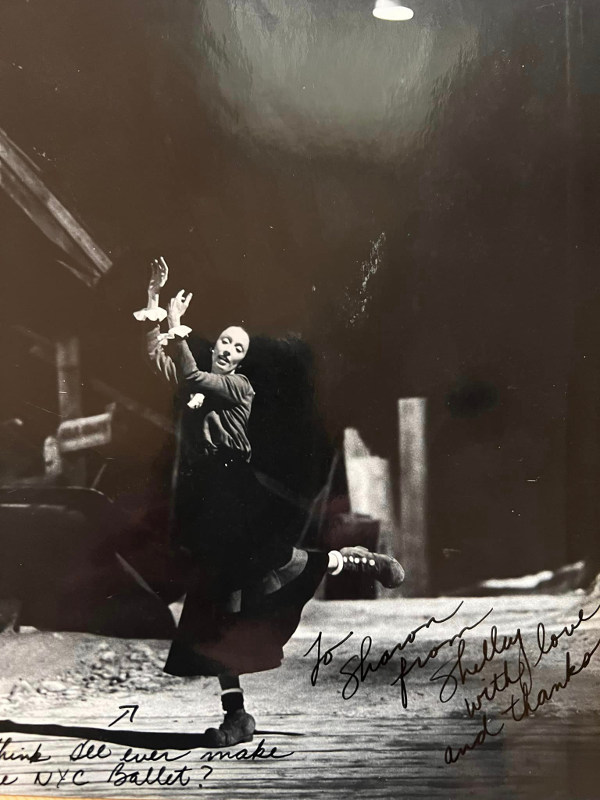
Photo: Sharon Kinney via ArtsMeme.
The recently deceased actress Shelley Duvall dancing as Olive Oyl in director Robert Altman’s Popeye (1980). 

One of the films that the late, versatile actor Shelley Duvall was best known for was her wistful interpretation of a cartoon character — Popeye’s girlfriend Olive Oyl.

Website ArtsMeme says, “Duvall (1949-2024), who recently passed away, led a long and memorable career primarily as a character actress, but in this case she played a full leading role countering Robin Williams as Popeye. …

Sharon Kinney … the creator/choreographer/coach of Shelley’s special dance, tells us that Duvall did her own singing in the number. She was not dubbed, which would be common in this circumstance.

“The dance world reveres Sharon for having been one of choreographer Paul Taylor‘s original dancers in his iconic dance company. But since retiring from performance, she has led a fruitful career as an instructor at Cal State Long Beach, as a filmmaker and indeed as a dance-film choreographer/coach living in Los Angeles. Sharon shared with Facebook friends her memories of working with the lanky Ms. Duvall in staging a solo song ‘He Needs Me,’ in the Altman film.

“Sharon reminisced, ‘She was so professional, so invested and really wanted to personify Olive Oyl and her love for Popeye! She did great things before with Altman and had just finished The Shining with Stanley Kubrick! She then went on to do some other great work with Faierie Tale theater!’

“Shelley Duvall’s inscription to Sharon Kinney on the glossy photo [above] is good natured. ‘Think I’ll ever make New York City Ballet?’ she mused. Dance ‘people’ will recognize the innate beauty of her pose that is rooted in the cartoon version of OO as gangly. Even in her clodhopper shoes, this Olive Oyl is luscious.” Check out YouTube videos of Duvall singing “He Needs Me” and “He’s Large,” in which she’s defending an early attachment to the character Bluto.

In a comprehensive reminiscence after her death, Owen Gleiberman at Variety notes, “In Robert Altman’s Popeye, an early visionary/cracked comic-book musical. With goldfish eyes, pursed lips, and a Victorian knot of hair set off by her dainty clenched-fist pose of adoration, Duvall gave a performance as Olive Oyl that was so perfect it was almost a joke.

“As an actor, Duvall could seem naturally stylized, which made Olive a role she was born to play. Yet within all that, she found a reservoir of heart. The highlight of Popeye might be Duvall’s performance of ‘He’s Large,’ in which Olive explains her devotion to the oversize Bluto with a girlish defiance that’s indelible.

“And indelible, make no mistake, was the word for Shelley Duvall. She imprinted her presence upon you; once you’d seen her, you couldn’t forget her. It was Altman who first had that reaction. In 1970, a few months after MASH came out and made Altman the hottest director in Hollywood (a status that wouldn’t last long — he was far too independent an artist), he was shooting his next feature in Houston, a fantasy comedy called Brewster McCloud, when he met Duvall at a party and, encouraged by a handful of crew members, decided to cast her in the movie.

“She’d had no experience as an actor. What they were all reacting to was what you can only call Duvall’s being — the eyes that were like something out of anime, her rabbity two front teeth, and a quality that could make you laugh or break your heart: the softness of her gaze, the tender passive radiance with which she looked out at the world.”

More at ArtsMeme, here, amd at Variety, here.

Read Full Post »

Photo: The Smart Local.
Members of the Gomi Hiroi Samurai, or the trash-collecting samurai, wear full-length samurai outfits and wield waste tongs that look like swords.

Proving that any kind of work can be turned into a game, Rebecca Rosman and Julia Kim report at Public Radio International’s the World, about some waste pickers in Japan.

“Passersby do a double take when they see Kaz Kobayashi and Ikki Goto. The two men glide through Tokyo’s bustling Ikebukuro district in full-length samurai outfits, while wielding objects that look like swords. They are members of the Gomi Hiroi Samurai or the trash-collecting samurai. …

“On closer inspection, their samurai swords — or katanas — are actually just very long tongs, used to pick up litter. Kobayashi said the tongs are important for novelty value.

“ ‘We’re doing this as entertainment … but it can be tiring sometimes. It’s tough, Man.’

“The Gomi Hiroi Samurai do this three times a week. There’s four of them, and they’re professional actors. In their spare time, they volunteer to keep the streets of Tokyo clean. Goto formed the group in 2009. Since then, they have become a viral sensation on TikTok, with over 700,000 followers and counting.

“Here in Ikebukuro, they target back alleys and parking lots, which are rife with litter. Kobayashi and Goto, working in sync, slice and spin their tongs through the air, meticulously seizing cigarette butts one by one before tossing them into the wastebaskets strapped to their backs. …

“An hour later, Kobayashi and Goto took their wastebaskets to a recycling base. There, they separated out every piece of rubbish they’ve collected. They said that they hope to recruit more Gomi Hiroi samurai  in Japan — and around the world — to spread their message: ‘We punish immoral hearts.’

“It means that trash in and of itself isn’t bad. Instead, it’s people and the actions that stem from their negative mindsets. And a growing sense of negativity is something that Kobayashi said worries him.

“ ‘This is a problem in Japan,’ he said. ‘People don’t go outside.’

“Last month, a government survey showed that 1.5 million people are living as social recluses in Japan. With loneliness and depression on the rise, Kobayashi said he hopes that their fun, zany take on something as mundane as trash-collecting helps people reengage with the outside world.

“ ‘Samurai is a warrior,’ he said. ‘Our philosophy is to help people.’

“For these eco-warriors, ‘clean space, clear mind’ is more than just a saying — it’s the way of the Gomi Hiroi samurai.”

More at the World, here. I was amazed that the “samurai” are doing this hard work as volunteers. PRI also has stories on trash pickers in countries like India, Ghana, and Colombia, where they earn a meager amount of pay and live very difficult lives.

I have to say, I think that public litter is best addressed by everybody pitching in. Clean communities are often the result of peer pressure against creating litter in the first place and individuals who are proud enough of their community to pick up litter where they see it.

PS. In case you don’t always read the Comments, do look at Hannah’s, which included a tip about Ya Fave Trashman. Like the trash samurai, he adds entertainment to an undervalued job. His online talks gained him fame during the pandemic, when trash was piling up in Philadelphia. Read about him here.

Read Full Post »

Photo: Dale Robinette/ Lionsgate Publicity.
Emma Stone and Ryan Gosling are not primarily dancers, but thanks to coaching, they did a good job dancing in the film La La Land.

Fred Astaire and Ginger Rogers were film stars who were best known for dancing. But what if your stars need to dance but know no more steps than the average partygoer? For stunts, you get stunt experts, but do you also get experienced dancers to stand in? Can’t imagine how that would work.

Haley Hilton has the answer at Dance Magazine, “From Patrick Swayze lifting Jennifer Grey above his head in Dirty Dancing, to John Travolta and Uma Thurman doing ‘The Twist’ in Pulp Fiction, to Emma Stone and Ryan Gosling tapping their way through ‘A Lovely Night’ in La La Land, dancing Hollywood A-listers have made simple steps iconic on the silver screen. Behind the movie magic and clever choreography is a hard-working choreographer, navigating the challenges unique to actors with varying levels of skills in dance. Leading industry choreographers Chloé Arnold, Marguerite Derricks and Mandy Moore [say] creating choreography for celebrities takes a different set of skills — and amount of time — than working with elite professional dancers.

“ ‘With dancers, you know they can do anything you come up with,’ says choreographer and tap dancer Chloé Arnold, who created the moves for Ryan Reynolds, Will Ferrell and Octavia Spencer for the 2022 holiday film Spirited. ‘Whereas with celebrities, you have to first build trust, then take the time to discover how their body naturally moves.’ Uncovering strengths is the first step: For example, certain actors­ might have an innate musicality. Once a choreographer is aware of that, they can highlight that strength while avoiding steps that magnify their weaknesses.

“Marguerite Derricks, who choreographed for the Amazon Prime series ‘The Marvelous Mrs. Maisel’ from 2016 to 2022, believes that adaptability is essential when choreographing for A-listers. ‘Once I have the script, I go into a studio with an assistant and put together movement ideas,’ she says. ‘Then I take those ideas to the actors, but I’m very ready to change up the moves. Right when I walk in, I tell them I have hundreds of ideas in my pocket, so if we try something that looks great and feels good we continue. If not, I will remove it and start playing with new ideas.’

“Derricks, whose movement has been featured in more than 50 films and 40 television shows, cultivates an open dialogue with performers and a low-stress environment in the studio. ‘It’s not about pushing a style or an idea on actors, but going in as their confidant and cheerleader, and making them feel comfortable,’ she says. ‘When they see my patience, they are more patient with themselves.’

“When La La Land choreographer Mandy Moore works with celebrities, she makes sure that she will have ample time to teach them to dance. ‘On set, things can change and shift, and if the actor understands the basics of movement and weight changes, as well as the choreography, they will be able to make changes without melting down.’ She, too, enters the rehearsal space with an open mind. ‘I am someone who preps everything to a T, knowing it could all change the first second I get into rehearsal,’ she says. …

“Having an A-lister on a project will bring attention to the work, but for these three choreographers, the benefits extend far beyond that. ‘What actors bring to the choreography is so rich — they totally embody the character,’ Derricks says. ‘I get so excited because I know that in some ways, they will take my movement deeper than even dancers can.’ That’s why Derricks encourages dancers to take acting classes. ‘You can kick and spin and pas de bourrée, but the magic is how you put it all together in a story. Acting brings greater depth to your dancing.’

“The Spirited celebrities shared their genuine enthusiasm for tap with their massive fan base—as well as their appreciation for the dancers on set. … ‘Everyone was so kind, and there were no big egos,’ [Arnold] says. ‘If one of the actors grasped something and the other didn’t, they would respond with comedy. If the steps didn’t work out and needed to be changed, they were trusting. They could have challenged me or pushed back, but there were no excuses.’ …

“ ‘So much of choreography is reading the room,’ Derricks says. ‘When working with actors for the first time, I want them to know that I am here for them. I’m not here to win an award. I will do whatever I can to help make them comfortable and confident for the scene.’

“Building that confidence is no easy task. Moore says she’s found many actors have been told they’re not good dancers, leading to insecurities. ‘It’s time-consuming, but you need to help them believe in themselves,’ she says. ‘It’s almost like therapy — you don’t want to feed into their complex. You want them to leave you loving dance.’ One of the ways Moore fosters confidence in the rehearsal studio is by not having mirrors on the walls. ‘I don’t want them to get critical of how they look,’ she says. She also holds off on filming portions of rehearsal until the dancers are ready.

“Navigating difficult personalities is another potential challenge. When casting dancers, choreographers can choose who to work with, but when they are part of a larger work with celebrities, they don’t have that luxury. Arnold does all she can to change the energy in the room. ‘If you are seeing negative things, introduce alternatives,’ she says. ‘Dress for the betterment of the space. Sometimes I will come in wearing a message T-shirt that says something uplifting. Be kind, lead by example and make sure the rest of the cast feel supported by you.’ ”

More at Dance, here. No firewall. Nice pictures from movies.

Read Full Post »

Photo: First Dibs.
Above, a restored 1938 Zenith radio. Stars such as James Dean, Jack Klugman, Martin Landau, Lee Marvin, Walter Matthau, Steve McQueen, Anthony Perkins, Jerry Stiller, Martin Balsam performed on the television version of The Big Story, a show that started on radio in 1947.

The other day, my husband heard a Richard Strauss tone poem that brought back a memory he had of a true-crime show he liked. The Big Story started on radio and later transferred to television, where it attracted an impressive array of guest stars.

I didn’t know The Big Story, but as I learned more, it got me thinking about what a great service radio was — and still is. (When Suzanne and John were little, I had a show of my own at WGMC, a community station in Greece, New York.)

I turned to Wikipedia.

The Big Story is an American radio and television crime drama which dramatized the true stories of real-life newspaper reporters. … Sponsored by Pall Mall cigarettes, the program began on NBC Radio on April 2, 1947. With Lucky Strike cigarettes sponsoring the last two seasons, it was broadcast until March 23, 1955. The radio series was top rated, rivaling Bing Crosby‘s Philco Radio Time.

“Produced by Barnard J. Prockter, the shows were scripted by Gail Ingram, Arnold Pearl and Max Ehrlich. Tom Vietor and Harry Ingram directed the series. … The theme was taken from Ein Heldenleben (‘A Hero’s Life’), a tone poem by Richard Strauss.

“Prockter was inspired to create the program after hearing about a man who was freed from a life sentence in jail by the work of two newspaper reporters in Chicago. Most of the stories in the show dealt with stories about closed cases. Ross Eaman, in his book, Historical Dictionary of Journalism, wrote that the program was ‘originally intended to honor reporters ignored by Pulitzer committees.’ Jim Cox also cited that plan in his book, Radio Crime Fighters: More Than 300 Programs from the Golden Age.

“Each week the program recognized the reporter who wrote the story on which that episode was based and the newspaper in which the story appeared. The reporter received $500, was interviewed on the air and was acknowledged in the introduction, as in this example:

” ‘Pall Mall, famous big cigarette, presents The Big Story, another in a thrilling series based on true experiences of newspaper reporters. Tonight, to Russ Wilson of the Des Moines Tribune goes the Pall Mall award for The Big Story. Now, the authentic and exciting story of “The Case of the Ambitious Hobo.” ‘

“The radio series was adapted for television where it debuted on NBC on September 16, 1949. The series continued to air on NBC until June 28, 1957, after which it appeared in syndication until 1958. The half-hour program was hosted by Robert Sloane, Norman RoseBen Grauer, and, finally, Burgess Meredith. …

“The theme music was two of the main themes from the tone poem ‘Ein Heldenleben’ (‘A Hero’s Life’) by the German composer Richard Strauss. The series was nominated for a Primetime Emmy Award in 1953.”

Now I’m thinking of some of my earliest memories of radio. I had a babysitter who love to listen to a morning show that opened with the song “Pack up your troubles in your old kit bag, and smile, smile, smile.” I know it’s a WW I song, but it was still in use when I was a kid.

I also remember that once when I was trying to fall asleep, I heard a radio drama someone had left playing and was too scared even to get up and turn it off!

What are your radio memories?

More at Wikipedia, here, and at Old Time Radio Downloads, here.

Read Full Post »

Photo: Folger Theatre.
Actor/director Holly Twyford got interested in a new kind of theater project during the pandemic.

How many of us began pandemic activities that we liked enough to keep? In my case, being obliged to do my volunteering via Zoom showed me there is often a greater feeling of individual connection when I can see English students’ faces up close on screen instead of in a large room. What new way of doing things did you decide to keep?

In one example, an actress was invited to teach elderly shut-ins during the down time and found she liked it. Peter Marks reported the story for the Washington Post.

“In the courtyard of an independent living residence in Rockville, Md., Holly Twyford brought her acting class to order. With the script of Spoon River Anthology in front of them, one of her students, 93-year-old Shelly Weisman, recited the words of Lucinda Matlock, a character who speaks of a marriage that lasted seven decades.

“ ‘I spun, I wove, I kept the house, I nursed the sick. I made the garden, and for holiday rambled over the fields where sang the larks,’ Weisman declaimed, as Twyford — long one of Washington’s premier actors — listened.

“ ‘I love that piece,’ Twyford said at last.

“ ‘I do, too,’ Weisman replied. ‘I love her.’

“And so it went for an hour with Twyford and several residents of Ring House, in the Charles E. Smith Life Communities, off Rockville Pike. Organized by Theater J, an arm of the Edlavitch D.C. Jewish Community Center, the class wasn’t just an exercise to nourish the artistic spirits of theater-loving seniors. It was an invigorating lifeline, too, for Twyford. Sidelined by the pandemic from pursuing her customary evenings-and-matinees vocation, the actress was hired by Theater J Artistic Director Adam Immerwahr to teach enrichment courses and earn some needed cash.

“ ‘The pandemic has been a nightmare for us who depend on large, live audiences,’ said Twyford, a ubiquitous presence on Washington stages, in everything from Shakespeare to Sondheim. When covid-19 collapsed the theater industry, Twyford lost two acting and two directing jobs.

‘I can only say Adam subsidized many out-of-work actors and directors by saying, “Hey, you should teach a class.” … That’s what he did for me.’ …

“Theater J, with only a handful of full-time staffers, took on a sizable mission, hiring dozens of theater folk to teach more than 50 classes, most of them virtual. …

“Angela Hughes, a die-hard theatergoer who lives in Northern Virginia, has enrolled in 16 of Theater J’s virtual classes. ‘It was a way to have theater in my life,’ she said in a phone interview. …

“The combination of pandemic isolation, audience fascination and artist deprivation created highly favorable circumstances for Theater J’s initiative: From July 1, 2020, to June 30, more than 700 people from 23 states and Israel, Canada and Australia took the company’s Zoom courses, according to Immerwahr. During that period, he has paid out more than $40,000 in fees to his improvised faculty.

“That might not boil down to a king’s ransom — national philanthropic organizations, such as the Actors Fund, have doled out millions. But every extra paycheck helps when one is scrambling.

“ ‘At times, it’s been serious,’ Immerwahr said of the need in the D.C.-area theater community. ‘We’ve had people who couldn’t qualify for unemployment, because they worked in seven different states.’

“Naomi Jacobson, another familiar talent to Washington theatergoers, has taught six courses for Theater J, including ‘Inside the Actor’s Process’ and ‘Inside the Rehearsal Room: “Collected Stories,” ‘the latter with actor Emily Whitworth and Immerwahr. ‘I had nine months of work lined up, and it all went away,’ she said, noting that she took her pension early to make sure she and her husband, actor John Lescault, could pay their mortgage.

“While Lescault carried on in the recording booth in their basement for his side business, narrating books for the Library of Congress, Jacobson built up a coaching practice for actors and public speakers in other professions. How she’ll balance the pedagogical pursuits with her acting life remains an open question: She is scheduled to return to the stage in September to portray Ruth Westheimer in Mark St. Germain’s one-person Becoming Dr. Ruth at Theater J. …

“It so happens that Twyford is directing Jacobson in the piece, a process they began before the shutdown. When that assignment abruptly ended, Twyford [says] ‘I did apply for a job at a hardware store, and I was turned down,’ she said. ‘I know tools and I build things, and it was really harsh to get that rejection.’

“But Immerwahr came calling, which was why on this warm August day, Twyford had driven to Rockville to teach the weekly sessions of her monologue-preparation class to students in their 80s and 90s, one at Ring House and another at its sister building, Revitz House. …

“The students had been asked to choose speeches from the script, a compendium of the more than century-old poems that make up Edgar Lee Masters’s cycle of ordinary townsfolk, narrating their personal tales from the afterlife.

“Weisman wasn’t sure at first about the material. ‘I said, “Why on earth did you pick this? It’s people speaking from the grave! We’re close to the grave!” ‘ The teacher thereby learned quickly that these pupils were not shy about speaking up. …

“Over several weeks of talking and rereading, though, she came to understand the value of immersing herself in the persona and hardships of her character. ‘As I was reading it over and over, it became much more real to me,’ Weisman said. ‘Every life has disappointment and tragedies. Lucinda didn’t dwell on it.’ …

“[Says Twyford] ‘Shelly asked me, “What have you learned about 90-year-olds?” I gotta say, talk about some role models! … These folks, they just haven’t stopped learning.’ “

More at the Post, here.

Read Full Post »

Photo: Clive Barda.
Opera singer John Tomlinson rehearses
King Lear. 

I remember once watching an Aida on television with staging that made my skin crawl. Here was Aida, here was her true love — both knowing they were dying — singing to each other from opposite sides of the cave, no touching. Really? You can’t always blame opera singers for bad acting when it’s the director’s staging that makes no sense.

Today I have a story for all the people who like to listen to opera but hate unnatural staging and acting. Turns out, there are singers who have longed for a chance to show what they can really do with drama.

Michael Billington writes at the Guardian, “I had coffee recently with King Lear and Goneril. To be more precise, with John Tomlinson and Susan Bullock, who play these roles in a brand new production of Shakespeare’s tragedy – one to be staged at the Grange festival in Hampshire [in July] with a cast exclusively drawn from the world of opera. …

“Its director, Keith Warner, says it started with him, Tomlinson and Kim Begley (ex-RSC before turning to opera) planning a two-person version called Lear’s Shadow. Word quickly spread and a reading of the whole play was mounted in Warner’s house. The result is a full-scale production with a dream cast. ….

“Talking to Tomlinson and Bullock, I am struck by their passion for theatre. At college, Bullock played Helena in A Midsummer Night’s Dream and became an ardent fan of Manchester’s Royal Exchange. ‘Seeing Uncle Vanya there with Albert Finney,’ she says, ‘made me think: “This is what I want to do.” When people ask me if I’ve ever acted before, I tell them I’ve been doing it all my life. You don’t get to play Brunnhilde or Electra without being able to act – and singing a Schubert song is a drama in itself.’

“Tomlinson, who made his stage debut at the age of six as a panto sultan, was equally turned on by Manchester theatre and recalls the excitement of going to drama, dance and improv classes when a student at the Royal Northern College of Music. Both are theatrical animals as well as singers – but is there a radical difference between working on an opera and a Shakespeare play?

“ ‘There are a lot of similarities,’ says Tomlinson. ‘You start with understanding the text, letting your imagination flow and working alone before joining the cast. The big difference is that in opera, we are used to emotions being sustained for a long time and underpinned by the music. In a Handel aria you might sing “I love you” for 10 minutes on end. In a play, particularly in Lear where the king is so mind-changing and capricious, you have to be more nimble and quick-thinking.’

“Bullock concurs, pointing out that in opera the drama inevitably starts in the orchestra pit.

‘What is so liberating about a play,’ [opera singer Bullock] says, ‘is that tempo and rhythm are in the hands of the actor, rather than the composer or conductor, and can vary hugely from one night to the next. I am loving the freedom and flexibility this gives me.’

“There is still a popular canard that opera singers are inferior actors: that, at best, they stand and deliver or deploy a limited number of traffic-cop gestures. It is a myth Tomlinson especially can’t wait to demolish. … ‘I’d say that in the UK from the 1960s to the late 1990s, singers were generally very good actors. But I admit that in the last couple of decades, operatic acting has often been stymied by hi-tech design and concept-driven direction that treats the singer as one item in a visual scheme.’ …

“What have Bullock and Tomlinson discovered in rehearsal? ‘That Goneril,’ says Bullock, ‘is not a figure of undiluted evil. She is a complex woman who has suffered from a dictatorial father, who knows that Cordelia is Daddy’s darling and who, quite reasonably, asks why he needs a train of 100 knights.’ …

“For Tomlinson, the whole play is a voyage of discovery. ‘Lear begins,’ he says, ‘as a brutally authoritarian figure but gradually becomes aware of poverty, homelessness, cruelty and injustice. The last is a subject he never stops talking about. … Lear, whose relationship with the Fool is a bit like that of Boris Godunov and the Simpleton in the Mussorgsky opera, also acquires a boundless curiosity. By the end he is not so much morally redeemed as spiritually enlightened.’ “

More at the Guardian, here.

Read Full Post »

cmyk-albina-ishmasova-as-lady-macbeth

Photo: Kyrgyz Academic State Theatre
Albina Ishmasova as Lady Macbeth. As part of a unique collaboration in Kyrgyzstan, director Sarah Berger created three versions of
Macbeth using the Kyrgyz language, which she doesn’t speak.

Theatrical directors are often up for a challenge, but this challenge takes the cake: directing actors who don’t speak your language in a production of Macbeth.

That is what Sarah Berger did in Kyrgyzstan. She writes about it at The Stage.

“I recently returned from six weeks in Kyrgyzstan directing the first ever Kyrgyz translation of Macbeth, made from Russian into Kyrgyz, at the Kyrgyz Academic State Theatre in Bishkek.

“I worked with 30 Kyrgyz actors who spoke no English. I don’t speak Russian or Kyrgyz.

“To add to the mix, I took two British actors with me, Claire Cartwright and Steve Hay, who performed in English with the rest of the cast speaking Kyrgyz. They played Lady Macbeth and Macbeth respectively. There was also a fully Kyrgyz performance that was filmed and screened on state TV.

“So I had to deliver three different versions of the production in just over three weeks, as we performed four premieres with the cast variations.

“The challenge of that aside, the Kyrgyz state theatre method of working is entirely different to what we’re used to in the UK: the company comprises people who have trained there and are attached to the theatre throughout their working life, which has its advantages and disadvantages.

“The advantages are that they practise their craft every day, and are used to working as a company. They are vocally highly trained and easily fill an 800-seat theatre. They are physically grounded and able to experiment with movement and voice. For example, the Witches and Hecate invented a unique style of delivery, incorporating song and dance.

“The disadvantages are that they are not hungry for work in the same way British actors are. There’s a competitive edge missing. …

“We discovered that the challenge of acting opposite someone speaking a different language was surmountable when the intentions of the scene or particular line were clear. In fact, the particular challenge for the actors wasn’t so much the language but the differing approach to rehearsals and the text. It quickly became apparent that we adhere far more strictly to the verse, and are led by it, whereas for Kyrgyz actors that is just one element of the performance. …

The production itself worked remarkably well given its disparate elements and the lack of rehearsal time. I would recommend the experience of working in such a different arena as it informs our practice.” More.

Read Full Post »

Photo: Village Voice
Grover Gardner is one of the country’s best-known voices on audiobooks.

Many of my friends are beginning to find that audiobooks work better for them than hard copy, probably because they can do something else at the same time as listening, like driving a car. One of my nephews, in fact, says audiobooks have changed his life because he just never took to reading much but he loves learning.

One of the country’s most intuitive vocal interpreters of an author’s works is Grover Gardner, profiled recently by Molly Fitzpatrick at the Village Voice.

“When Grover Gardner goes to work, there are certain things he can’t wear. No watches. No jewelry of any kind. No starched shirts. No starched anything. Nothing that could rustle, click, rattle, or otherwise make noise. …

“Among the more than 1,200 books Gardner has narrated are Ron Chernow’s Alexander Hamilton, Stephen King’s The Stand (all 48 hours), and all four volumes of Robert Caro’s The Years of Lyndon Johnson published to date. The resident of Medford, Oregon, was named 2005’s Audiobook Narrator of the Year by Publishers Weekly and has been heralded among AudioFile magazine’s ‘Best Voices of the Century.’ …

“Gardner’s favorite credits include Shelby Foote’s The Civil War, Paulette Jiles’s News of the World, John Irving’s The Cider House Rules, Saul Bellow’s The Adventures of Augie March …, David Rosenfelt’s Andy Carpenter mystery series, and the LBJ biographies. ‘Boy, I hope [Caro] finishes the fifth one before I get too old to read and my teeth fall out,’ Gardner says. ‘I wish he would write ten more, because I loved doing them so much.’

“For Gardner, every project begins, unsurprisingly, with reading the book in question, and with detailed visualization of the characters and events described therein. It works: His narration vividly conjures a sense of place, be it the streets of New York City via Joseph Mitchell’s Up in the Old Hotel, or the shores of the Mississippi via The Adventures of Huckleberry Finn. ‘If you act out the performance in your head, that’s what the listener is going to hear,’ Gardner explains. That acting extends to movement within the recording booth …, vital even though unseen by his audience — for instance, shifting from one side to another while embodying each of two characters in the midst of an animated conversation, or gesturing angrily to punctuate an argument. The trick is making sure you stay on mic. …

“Even seasoned voiceover artists will find that audiobooks are a ‘completely different’ discipline. ‘If you’re coming from a context where the point is to call attention to your voice, to grab the listeners’ ear — Tomorrow, big sale!  — that doesn’t work in audiobooks,’ Gardner explains. ‘If I’m listening to the sound of your voice, I’m missing the book. The word that we use a lot in the business is “transparency.” You want people to forget. You want to disappear into the book.’ ”

More at the Village Voice.

Read Full Post »

Here’s a great story from the Japan Times about a theater group for people over 60. Where do I sign up?

Nobuko Tanaka writes, “At the age of 91, Saitama resident Izumi Noguchi is speaking at his first press conference — at least as an actor anyway.

“ ‘When I saw an advert in April inviting anyone aged 60 or older to audition for a new project called 10,000 Gold Theater, I just felt like challenging myself to do something I’d never had a chance to try before,’ he says.

“Noguchi is the oldest person to join the 10,000 Gold Theater ensemble. …  ‘Gold Symphony, my dream, your dream’ [is] a staging on an unparalleled scale that features some 1,600 performers (not 10,000 as the name suggests) who are all volunteers and almost all amateurs …

“Arts promoter Taneo Kato came up with the idea [when] he was watching a performance of ‘Hamlet’ in which stage icon Yukio Ninagawa directed members of the Saitama Gold Theater and Saitama Next Theater — troupes made up of older and younger actors that he formed in 2006 and 2009, respectively, after becoming artistic director at Saitama Arts Theater in 2006.

“ ‘Out of the blue, midway through “Hamlet,” veteran enka singers the Komadori Sisters — who are actually twins — appeared and sang “I Want to be Happy One Day,” ’ Kato says, recalling how striking a moment it was to see the women, born in 1938, sing those words.” More here.

I wonder how big an issue memorization is for the performers. My friend Dorothy started a group of older amateur actors in Concord, but they do readings and don’t have to memorize. I have many memorized stories, Bible verses, and poems in my head and can trot them out at a moment’s notice. Not sure if I could acquire new ones to the same extent.

Photo: Maiko Miyagawa
Massive undertaking: Seiji Nozoe directs elderly actors during rehearsals for the play ‘Gold Symphony, my dream, your dream,’ performed in Chuo-ku, Saitama City, December 2016.

Read Full Post »

The world’s oldest working actor has died at age 101. And good for him to have worked at something he loved for so long!

Shaun Walker wrote recently at the Guardian, “Vladimir Zeldin, believed to have been the world’s oldest working actor, has died aged 101, after appearing for 71 years at the same Moscow theatre.

“The Russian actor appeared on stage as recently as [September], using a walking stick due to a broken hip, to appear in the play The Dance Teacher by the Spanish playwright Lope de Vega.

“He had appeared in the play more than 1,000 times, Tass reported. The theatre had planned for him to appear again next February, to mark his 102nd birthday. …

“Zeldin was born in 1915, when Tsar Nicholas II was on the Russian throne. He shot to fame when he appeared in the film They Met in Moscow, on which shooting began shortly before the Nazi invasion of the Soviet Union in 1941. …

“When the war finished, Zeldin joined Moscow’s Red Army Theatre, where he was part of the troupe from 1945 until his death. The theatre is now known as the Russian Army Theatre. Fellow actors at the theatre described him as full of energy until the very last.” More.

I think the actress who played 104-year-old Great-Great-Grandmaw in All the Way Home (the stage version of James Agee’s A Death in the Family) must have been nearly as old as Zeldin. I remember her voice came out as kind of a croak. But that may have been because she was acting.

Photo: Alexander Zemlianichenko Jr/AP  
Vladimir Zeldin on stage in Moscow.

Read Full Post »

Actor Finn Wittrock wrote recently at the New York Times about helping to start a mini Shakespeare company in the 1990s to entertain his parents and other theater professionals. He recalls with wonder his young self’s confidence of success.

“I was born in the Berkshires in Western Massachusetts. I lived there until I was 6, then moved to Evanston, Ill., and later to Los Angeles. But every summer for most of my youth, I would go back East with my brother, my mom and my dad, who most summers was acting or teaching for Shakespeare & Company. I would often be cast as a page or an altar boy in one of the professional productions.

“I went in lieu of a summer camp; I went to romp in the Berkshires, see old friends, get out of the city. But mostly I went for the Very Young Company.

“Starting at the age of 8 and until I was 16, my oldest friends and I would get together every summer: Rory, Reilly, Wolfe, and later my brother, Dylan, and Wolfe’s brother, Tiger (yes, their real names) would arrange five or six scenes from Shakespeare, rehearse them on our own time in the sun-drenched Berkshire afternoons and perform them for the adult company after one of their Mainstage shows. We began the company ourselves and it ended when we were no longer ‘very young.’

“For a kid, it was an epic undertaking; an outlet for pre- and post-adolescent energies. We were totally self-motivated; nobody told us to do it, which was in itself an incentive. We’d choose a scene based on our own criteria: Had the company done it before? Could we make fun of them for it? Could we put Reilly in a wig and have him play a girl? And, most important: Did it end in a sword fight? …

Sometimes I yearn to have the boldness of one who knows nothing, who jumps onstage for no other reason than because he is young and has a loud voice.”

Later in his essay, Wittrock recalls something the celebrated director Mike Nichols once said about his own early years: ” ‘Why was I so confident back then? I had no business being that confident.’ And yet he attributed most of his early success to that unreasonable confidence. …

“No one gave us permission to do the Very Young Company; no one ordered us to do it, and no one had to boost our confidence to do it. We just did it. We were just kids howling Shakespeare to the Berkshire trees, and our readiness was all.” More at the New York Times, here.

At one point in my  childhood, I, too, was confident. I thought, if my parents would only call the movie theater and set it up, four of us kids — the Gordons, one of my brothers, and I — would be a smashing success performing our version of “Snow White and Rose Red” before the feature. The grownups didn’t quite believe in it.

Some neighbors and I did perform an original play about a snowman for family members. One of the actors returned a copy of the pencil-scrawled script to me at my aunt’s funeral in 2002, decades later.

Photo: Lauren Lancaster for the NY Times
Finn Wittrock, right, and Rory Hammond, enacting the killing of Lady Macduff and her son in a mini-“Macbeth.” The young actors formed their own company more than 20 years ago to entertain their parents and other professionals at Shakespeare & Company in Lenox, Mass.

Read Full Post »

Maura Judkis of the Washington Post blogged recently about an actor who wants the opportunity to perform in your home and will throw in a surprising service.

Judkis writes, “Fringe Festival audiences have opened their homes to Brian Feldman. He has met their families and friends, admired their art, eaten their food, handled their precious china. …

“The premise for Feldman’s show, ‘Dishwasher,’ is this: He will come to a person’s house, wash all of the dirty dishes, perform a monologue of the audience’s choosing and then conclude with a single question: ‘Am I a better actor or dishwasher?’ The answer can depend on the monologue that he cold-reads — and on how crusty that casserole dish in the sink has become. The show — the first Fringe show to take place in private homes — has sold out its entire run. …

“His [work] follows in the tradition of great performance artists such as Tehching Hsieh and Marina Abramovic, but it’s more playful — and in his opinion, more theatrical.

“ ‘It’s hard to define — I’m straddling the middle, and I’m always pitching it as theater,’ he said. ‘I was always more interested in theater that had a concept that was hard to define, or things that didn’t have an ending, and didn’t necessarily have a beginning.’ …

“In the week of performing the show so far, he’s dealt with messes big and small. There was the Cleveland Park home with the too-small sink.

“ ‘It was hard to wash anything,’ he said. ‘They had a door that you could enclose yourself in the kitchen. I used it to comic effect, it was almost like “Noises Off.” ‘ …

“So far, five of his hosts have told him he’s better at acting, one has said he’s better at dishwashing, and two couldn’t decide.

“ ‘I’m trying to do as good a job dishwashing as I am acting,’ he said. ‘It’s subjective, just like art.’ ”

Read how Judkis and her friends got him to read “the character of Mrs. Pringle, who is fretting about a disappointing party, from the play ‘Fourteen’ by Alice Gerstenberg. ‘This is my last dinner party — my very last — a fiasco — an utter fiasco!’ ” here.

Photo: Maura Judkis/The Washington Post
Brian Feldman performs a monologue in the writer’s home.

Read Full Post »

John found a sweet little video clip of the 1955 Danny Kaye film The Court Jester featuring my favorite lullaby.

I often sing “I’ll Take You Dreaming” to my grandchildren, and I sang it to John when he was a baby and to Suzanne. (A pre-verbal Suzanne used to make a squeaking noise when I came to the word “dreaming,” and I finally figured out she thought the word was “screaming.”)

The YouTube video refused to embed, try as I might, and as I poked around the web for another video, I came on some information about Danny Kaye, who was hilarious in that movie. I never saw my mother laugh so hard. The lullaby was one of the few quiet places.

“Danny Kaye left school at the age of 13 to work in the so-called Borscht Belt of Jewish resorts in the Catskill Mountains. It was there he learned the basics of show biz. From there he went through a series of jobs in and out of the business. In 1939, he made his Broadway debut in Straw Hat Revue, but it was the stage production of the musical Lady in the Dark in 1940 that brought him acclaim and notice from agents.”

Oh, boy, I saw a production of Lady in the Dark in the 1980s at the Boston Conservatory. What a show!

“Samuel Goldwyn had been trying to sign Kaye to a movie contract for two years before he eventually agreed. Goldwyn put him in a series of Technicolor musicals, starting with Up in Arms (1944). His debut was successful, and he continued to make hit movies such as The Secret Life of Walter Mitty (1947) and The Inspector General (1949). In 1954, he appeared with Bing Crosby in White Christmas (1954), which was based on the Irving Berlin song of the same name. In 1955, he made what many consider his best comedy, The Court Jester (1955). …

“He also worked tirelessly for UNICEF.” More at IMDb.

You can find the lullaby scene on YouTube. I thought the sound quality was best here.

Studio publicity photo of actor and comedian Danny Kaye. 

Read Full Post »

Older Posts »