Feeds:
Posts
Comments

Posts Tagged ‘africa’

Doubtless you know about fairy circles, also called fairy rings. According to Wikipedia, they’re a “naturally occurring ring or arc of mushrooms. The rings may grow to over 10 metres (33 ft) in diameter, and they become stable over time as the fungus grows and seeks food underground.

“They are found mainly in forested areas, but also appear in grasslands or rangelands. Fairy rings are detectable by sporocarps in rings or arcs, as well as by a necrotic zone (dead grass), or a ring of dark green grass. If these manifestations are visible a fairy fungus mycelium is likely to be present in the ring or arc underneath.

“Fairy rings also occupy a prominent place in European folklore as the location of gateways into elfin kingdoms.”

But in Africa, there is a different kind of fairy circle that doesn’t seem to have anything to do with mushrooms.

Did you catch the article by Sindya Bhanoo in the NY Times?

“The grasslands of Namibia — and to a lesser extent its neighbors Angola and South Africa — are speckled with millions of mysterious bare spots called ‘fairy circles,’ their origins unknown.

“Now, a study based on several years of satellite images describes the circles’ life span as they appear, transform over decades, and then eventually disappear.

“Writing in the journal PLoS One, Walter R. Tschinkel, the study’s author and a biologist at Florida State University, reports that the circles can last 24 to 75 years.

“The circles, which range from about 6 to 30 feet in diameter, begin as bare spots on an otherwise continuous grass carpet; after a few years, taller grass starts to grow around the circle’s perimeter.”

The reader is left with the question, Are these circles gateways to elfin kingdoms? What kind of elves are in Namibia?

I don’t understand why scientists don’t investigate matters like that.

Update July 13, 2012: Asakiyume has been tracking down stories about African fairy circles. Read this.

Update March 30, 2013: NY Times has fingered a particular species of sand termites, Psammotermes alloceru. Read this.

Photograph: Walter R. Tschinkel

Read Full Post »

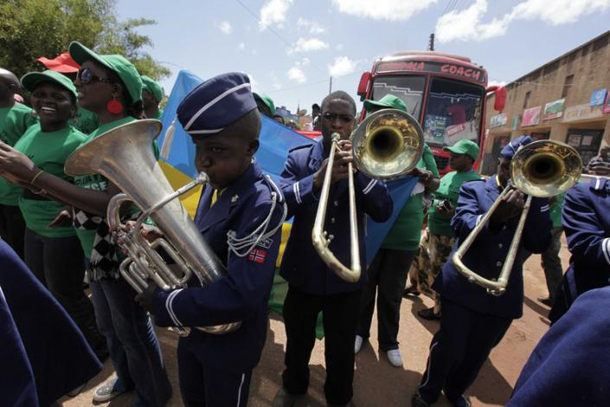
Living on Earth, a radio show based in Somerville, Massachusetts, and distributed by Public Radio International, recently did a story on East Africa and the worst drought in 60 years. Bobby Bascomb interviewed musicians who decided to do something about it, letting their voices be heard in the way they know best.

They call themselves the Caravan of Hope, says Bascomb. “More than 25 bands from 11 different African nations are traveling across the continent to raise awareness about climate change … as international climate talks begin in Durban, South Africa.”

Singer Angella Katatumba of Uganda explains, “We use our voices to get people fired up and educate people about climate change in Africa. Uganda usually has an amazing climate. It’s usually warm and just perfect. These days, when it’s hot it’s way too hot. When it’s cold it’s way too cold. When it’s wet, it’s storming. We’re seeing things like landslides, which we’ve never had before.” So she’s taking her concern on the road. Read more here.

Read Full Post »

Suzanne and Erik went to grad school with David O’Halloran, whose consulting company was recently cited in The Irish Times for its focus on sustainable business ventures in Africa.

“For Irish entrepreneur David O’Halloran, adhering to a sustainable business model that helps develop and protect local communities and their environment is the key to enjoying long-term success in Africa’s emerging markets. In late 2006, the Galway man, along with three former colleagues, rejuvenated a business development consultancy called BusinessMinds by turning it into an incubator company that develops, finances and operates sustainable commercial ventures in Africa.

“The idea behind the enterprise is to offer investors a socially responsible approach to doing business on the continent, while also making a profit. ‘Historically, many investors in Africa have used a more short-term, exploitative business model, one which has existed since the days of colonialism,’ O’Halloran says. ‘Unfortunately, for some investors this remains the modus operandi even today. As in, they take what resources they can and then get out without giving much back to the local economies.’

“However, O’Halloran says he believes people are starting to realise that such an approach is inherently unstable and increases risk.” His organization is called BusinessMinds, Africa.

Bill Corcoran wrote the Irish Times article. Read more here.

Read Full Post »

This YouTube video would have you believe that all you need in Minsk is love.

The video appears to be one of a couple Belarus entries into the “All You Need is Love” AIDS fund-raising effort that got Starbucks into Guinness World Records for the most nations in an online sing-along.

Personally, I think Starbucks would have done Minsk a bigger favor by setting up shop in town (with wi-fi and air conditioning).

That’s because, according to my son’s employees in that fair city, it is difficult to get office air conditioning. They did look into it as they were sweltering in the recent heat wave. But they soon discovered that another business in their building already had an air conditioner, and the local utility could not support more than one air conditioner at a time in that building.

So until the other business moves out, it would be nice if John’s employees could work in a cool web-connected Starbucks. But there is no Starbucks in Minsk.

Read Full Post »

« Newer Posts